
Recent Advances in Silk Fibroin Derived from Bombyx mori for Regenerative Medicine


Abstract
1. Introduction
2. Key Properties That Make Bombyx mori Silk Fibroin Promising for Regenerative Medicine
2.1. Mechanical Properties

| Materials | Young’s Modulus (GPa) | Tensile Strength (MPa) | Ref. |
|---|---|---|---|
| BMSF | 10–17 | 300–740 | [7] |
| Tasar silk fibroin | 3.7–4.1 | 360–400 | [18] |
| Muga silk fibroin | 4.2–4.8 | 470–510 | [18] |
| Eri silk fibroin | 6–6.6 | 540–580 | [18] |
| Collagen | 0.1–0.3 | 85 | [38,39] |
| Tropoelastin | 0.000003 | - | [40] |
| Spider silk (Néphila Clavipes) | 10.9 | 875 | [41,42] |
| Chitosan | 4.8 | 12–100 | [43,44] |
| Elastin | 0.00081 | - | [45] |
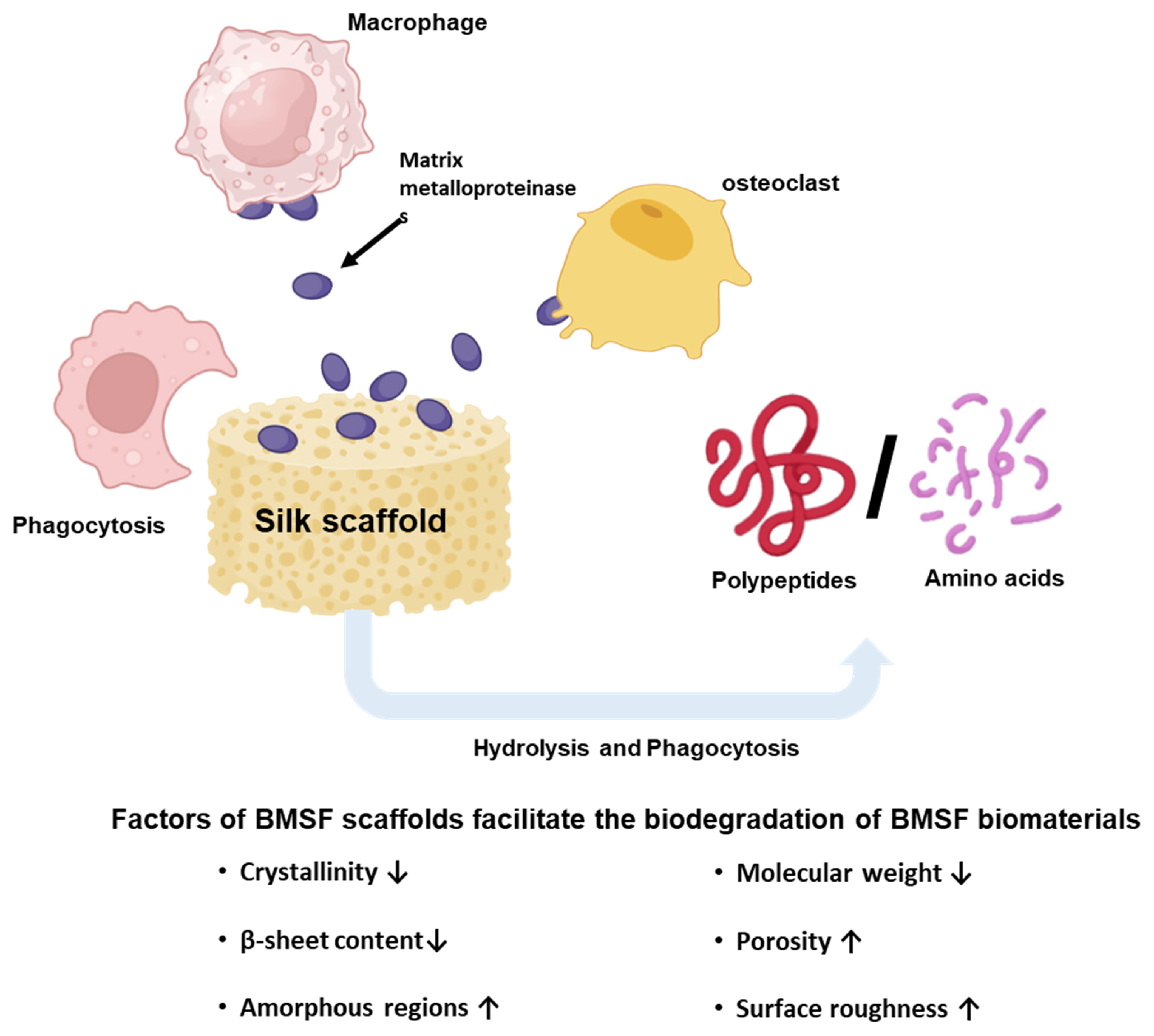
2.2. Biodegradation
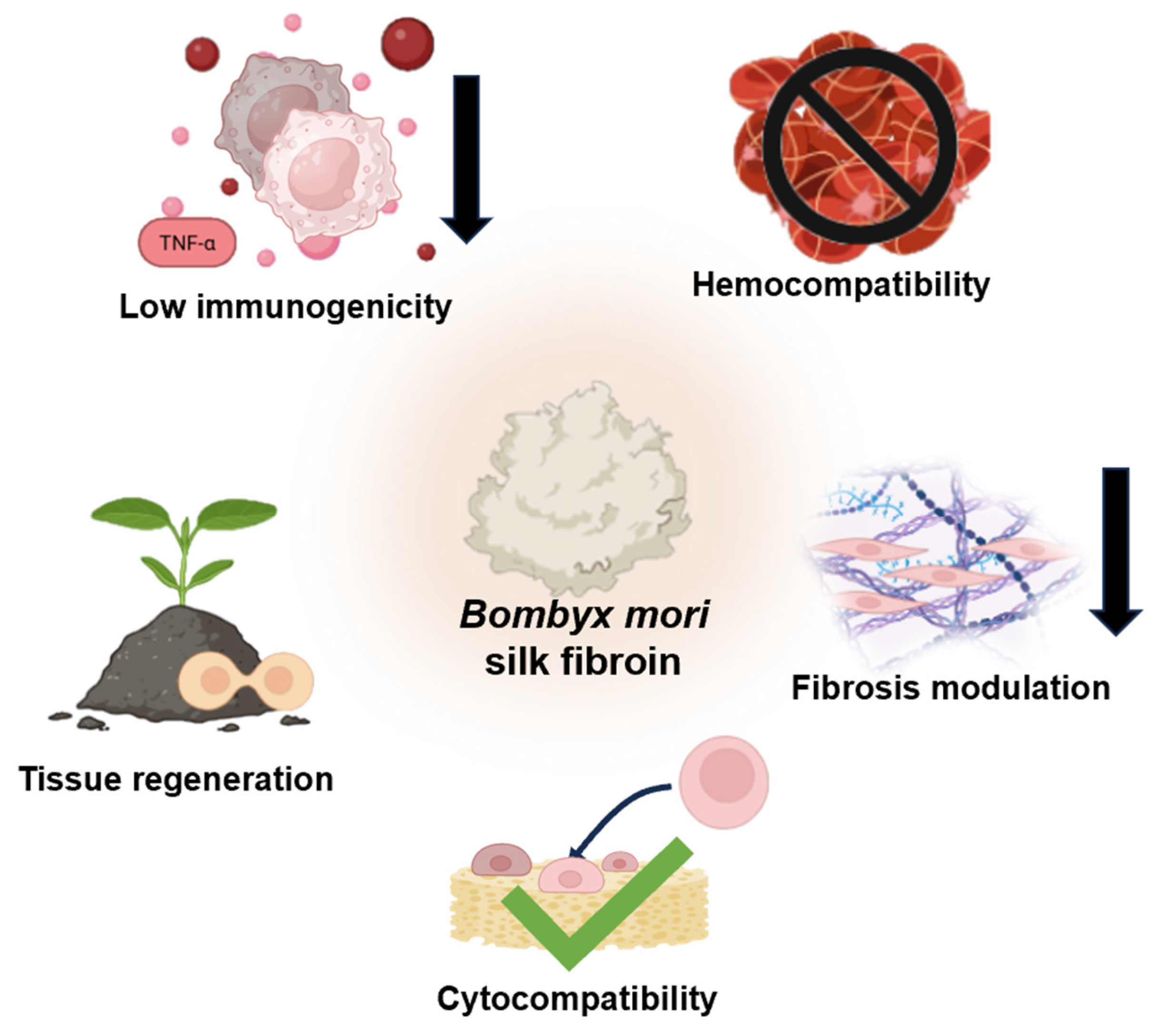
2.3. Biocompatibility
| Cell Types | Role in Biocompatibility | BMSF Biomaterial Parameter Affecting Response | Ref. |
|---|---|---|---|
| Endothelial cells | Angiogenesis, preventing thrombosis | Surface topography, stiffness, pore size | [88,89,90] |
| Fibroblasts | ECM deposition, capsule formation | Stiffness, fibre alignment | [91,92] |
| Macrophages (M1/M2) | Fibro capsule remodelling, immune response | Scaffold porosity, stiffness, surface topography | [83,84,93,94] |
| Mesenchymal stem cells (MSCs) | Differentiation, regeneration | Stiffness, surface topography | [95,96,97] |
| Neurons | Neurite outgrowth/extension | Fibre alignment, 3D geometry, softness, biomaterial conductivity | [98,99] |
| Corneal stromal cells | Epithelial cell layer organisation, transparency, and integration | Surface topography, fibre alignment | [100,101] |
| Epidermal cells | Wound healing, reepithelialisation | Surface topography, hydrophilicity | [92,102] |
| Osteoblasts/Chondrocytes | Hard/soft matrix formation and integration | Stiffness, pore size | [45,103] |
2.4. Optical Properties
3. Applications of Bombyx mori Silk Fibroin in Regenerative Medicine
3.1. Cartilage
3.1.1. Silk Fibroin-Based Composite Scaffolds
3.1.2. Surface Decoration with Bioactive Molecules
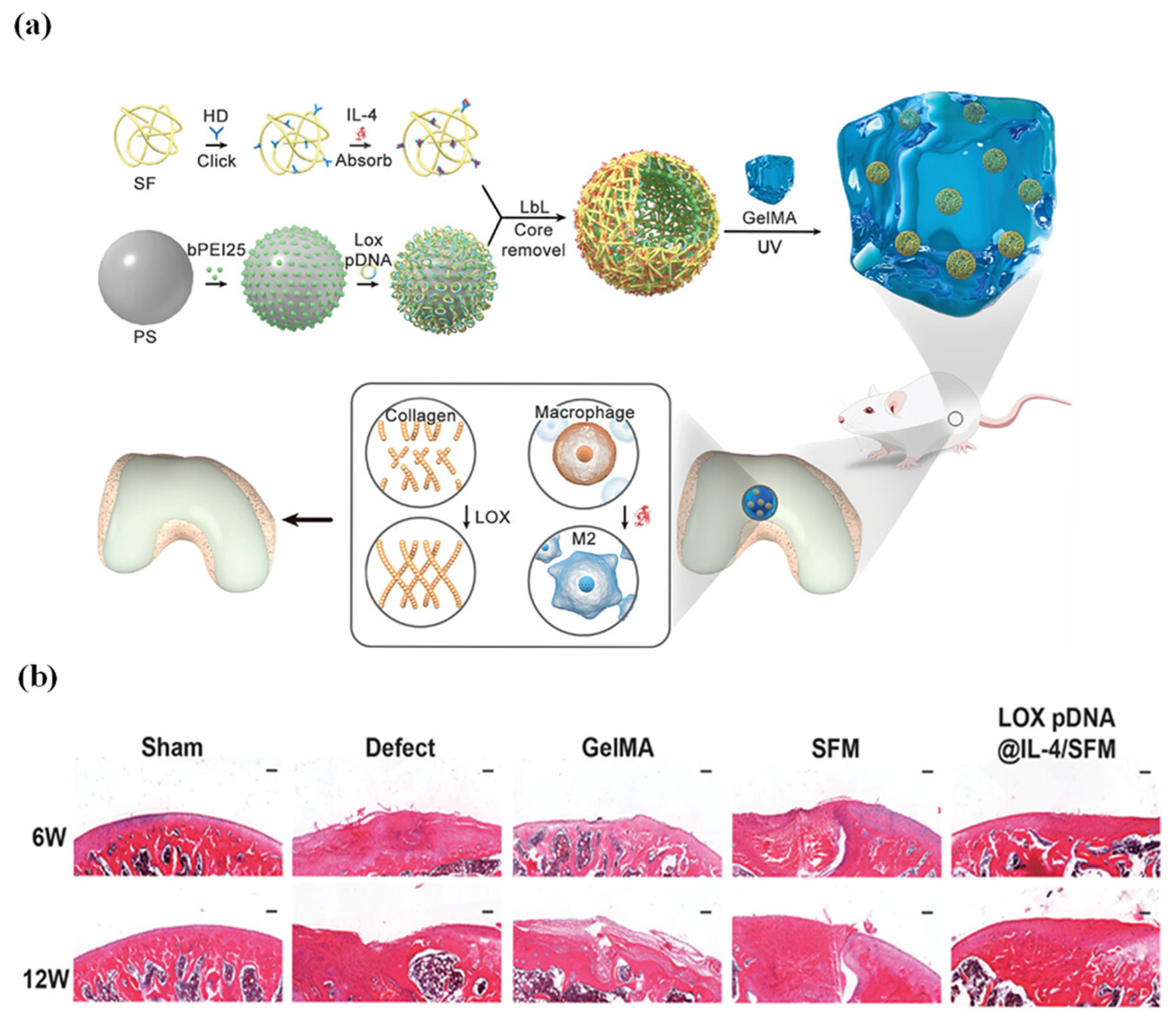
3.1.3. Immunomodulation Approaches
3.1.4. Clinical Translation Considerations and Future Directions
3.2. Bone
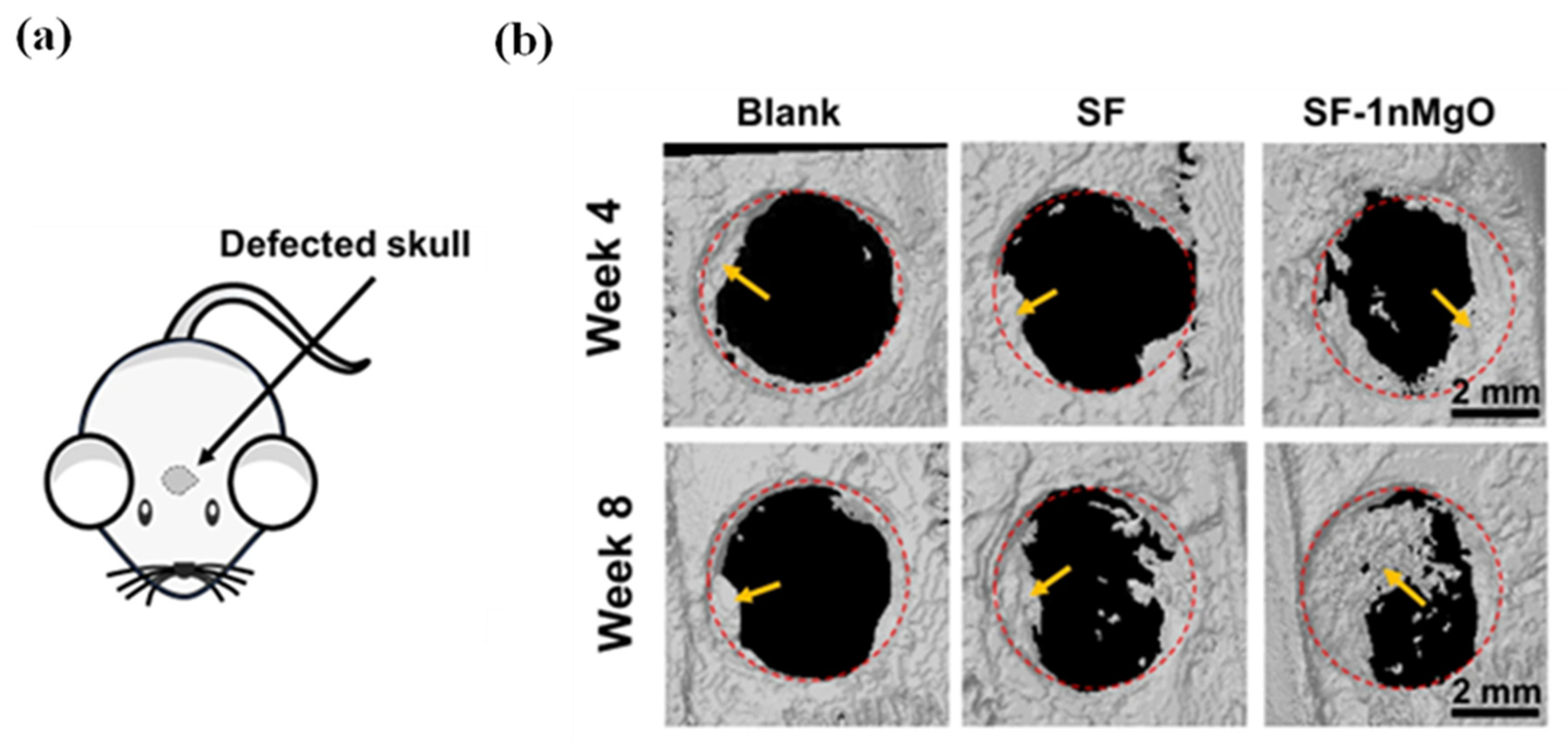
3.2.1. Surface Decoration with Bioactive Molecules
3.2.2. Impact of Bombyx mori Silk Fibroin Scaffold Architecture on Bone Regeneration
3.2.3. Vascularisation and Neurogenesis Are Essential for Bone Regeneration
3.2.4. Clinical Translation Considerations and Further Directions
3.3. Skin
3.3.1. Bombyx mori Silk Fibroin Is a Promising Biomaterial for Skin Healing
3.3.2. Functional Modification of BMSF Scaffolds with Bioactive Molecules
3.3.3. Immune Modulation and Macrophage Polarisation
3.3.4. Architectural Modulation of Immune Response
3.3.5. Clinical Translation Considerations and Further Directions
3.4. Nervous Tissue
3.4.1. Central Nervous System
3.4.2. Peripheral Nervous System
3.4.3. Clinical Translation Considerations and Further Directions
3.5. Vasculature
3.5.1. Surface Decoration with Bioactive Molecules
3.5.2. Impact of the Microarchitecture and Mechanical Properties of BMSF Vascular Grafts on Their Performance
3.5.3. Clinical Translation Considerations and Further Directions
3.6. Cornea
3.6.1. Biochemical Functionalisation
3.6.2. Topographical and Mechanical Cues in Corneal Regeneration
3.6.3. Clinical Translation Considerations and Future Directions
4. Current Clinical Research Challenges and Perspectives on Silk Fibroin
5. Conclusions
Author Contributions
Funding
Institutional Review Board Statement
Informed Consent Statement
Data Availability Statement
Conflicts of Interest
Abbreviations
| BMSF | Bombyx mori silk fibroin |
| RGD | Arg-Gly-Asp |
| FBR | Foreign body response |
| ePTFE | Expanded polytetrafluoroethylene |
| TGF-β | Transforming growth factor-β |
| IL-1β | Interleukine-1β |
| TNF-α | Tumour necrosis factor-α |
| NF-κB | Nuclear factor-κB |
| YAP | Yes-associated protein |
| PCL | Polycarpolactone |
| ICRS | Cartilage Repair Society scoring system |
| BMSC | Bone mesenchymal stem cells |
| DCM | Decellularised cartilage matrix |
| ROS | Reactive oxygen species |
| IL-4 | Interleukine-4 |
| CNS | Central nervous system |
| PNS | Peripheral nervous system |
| NSC | Neural stem cell |
| NIH | Neointimal hyperplasia |
| VSMC | Vascular smooth muscle cells |
| HFIP | Hexafluoroisopropanol |
| MSC | Mesenchymal stem cell |
| GDNF | Glial-cell-derived neurotrophic factor |
| MEW | Melt electrowriting |
| GelMA | Gelatine methacrylic |
| MPA | Methylprednisolone acetate |
| Bcl-2 | B-cell lymphoma-2 |
References
- Inoue, S.; Tanaka, K.; Arisaka, F.; Kimura, S.; Ohtomo, K.; Mizuno, S. Silk Fibroin of Bombyx mori Is Secreted, Assembling a High Molecular Mass Elementary Unit Consisting of H-chain, L-chain, and P25, with a 6:6:1 Molar Ratio. J. Biol. Chem. 2000, 275, 40517–40528. [Google Scholar] [CrossRef] [PubMed]
- Rajendra, P.K.M.; Nidamanuri, B.S.S.; Balan, A.P.; Venkatachalam, S.; Jawahar, N. A review on structure, preparation and applications of silk fibroin-based nano-drug delivery systems. J. Nanoparticle Res. 2022, 24, 141. [Google Scholar] [CrossRef]
- Sun, W.; Gregory, D.A.; Tomeh, M.A.; Zhao, X. Silk Fibroin as a Functional Biomaterial for Tissue Engineering. Int. J. Mol. Sci. 2021, 22, 1499. [Google Scholar] [CrossRef] [PubMed]
- Volkov, V.; Ferreira, A.V.; Cavaco-Paulo, A. On the Routines of Wild-Type Silk Fibroin Processing Toward Silk-Inspired Materials: A Review. Macromol. Mater. Eng. 2015, 300, 1199–1216. [Google Scholar] [CrossRef]
- Wongpinyochit, T.; Johnston, B.F.; Seib, F.P. Degradation Behavior of Silk Nanoparticles—Enzyme Responsiveness. ACS Biomater. Sci. Eng. 2018, 4, 942–951. [Google Scholar] [CrossRef]
- Reizabal, A.; Costa, C.M.; Pérez-Álvarez, L.; Vilas-Vilela, J.L.; Lanceros-Méndez, S. Silk Fibroin as Sustainable Advanced Material: Material Properties and Characteristics, Processing, and Applications. Adv. Funct. Mater. 2022, 33, 2210764. [Google Scholar] [CrossRef]
- Koh, L.-D.; Cheng, Y.; Teng, C.-P.; Khin, Y.-W.; Loh, X.-J.; Tee, S.-Y.; Low, M.; Ye, E.; Yu, H.-D.; Zhang, Y.-W.; et al. Structures, mechanical properties and applications of silk fibroin materials. Prog. Polym. Sci. 2015, 46, 86–110. [Google Scholar] [CrossRef]
- Johari, N.; Moroni, L.; Samadikuchaksaraei, A. Tuning the conformation and mechanical properties of silk fibroin hydrogels. Eur. Polym. J. 2020, 134, 109842. [Google Scholar] [CrossRef]
- Zhou, C.; Confalonieri, F.; Jacquet, M.; Perasso, R.; Li, Z.; Janin, J. Silk fibroin: Structural implications of a remarkable amino acid sequence. Proteins Struct. Funct. Bioinform. 2001, 44, 119–122. [Google Scholar] [CrossRef]
- Wang, H.-Y.; Zhang, Y.; Zhang, M.; Zhang, Y.-Q. Functional modification of silk fibroin from silkworms and its application to medical biomaterials: A review. Int. J. Biol. Macromol. 2024, 259, 129099. [Google Scholar] [CrossRef]
- Tanaka, K.; Inoue, S.; Mizuno, S. Hydrophobic interaction of P25, containing Asn-linked oligosaccharide chains, with the H-L complex of silk fibroin produced by Bombyx mori. Insect Biochem. Mol. Biol. 1999, 29, 269–276. [Google Scholar] [CrossRef] [PubMed]
- Ye, S.; Wei, F.; Li, H.; Tian, K.; Luo, Y. Structure and orientation of interfacial proteins determined by sum frequency generation vibrational spectroscopy: Method and application. Adv. Protein Chem. Struct. Biol. 2013, 93, 213–255. [Google Scholar] [CrossRef]
- Patel, M.; Dubey, D.K.; Singh, S.P. Phenomenological models of Bombyx mori silk fibroin and their mechanical behavior using molecular dynamics simulations. Mat. Sci. Eng. C-mater 2020, 108, 110414. [Google Scholar] [CrossRef] [PubMed]
- Li, N.; Lei, Y.; Song, Z.; Yin, L. Helix-specific properties and applications in synthetic polypeptides. Curr. Opin. Solid State Mater. Sci. 2023, 27, 101104. [Google Scholar] [CrossRef]
- Cheng, Y.; Koh, L.D.; Li, D.; Ji, B.; Han, M.Y.; Zhang, Y.W. On the strength of β-sheet crystallites of Bombyx mori silk fibroin. J. R. Soc. Interface 2014, 11, 20140305. [Google Scholar] [CrossRef]
- Inoue, S.; Tanaka, K.; Tanaka, H.; Ohtomo, K.; Kanda, T.; Imamura, M.; Quan, G.; Kojima, K.; Yamashita, T.; Nakajima, T.; et al. Assembly of the silk fibroin elementary unit in endoplasmic reticulum and a role of L-chain for protection of α1,2-mannose residues in N-linked oligosaccharide chains of fibrohexamerin/P25. Eur. J. Biochem. 2003, 271, 356–366. [Google Scholar] [CrossRef]
- Naskar, D.; Sapru, S.; Ghosh, A.K.; Reis, R.L.; Dey, T.; Kundu, S.C. Nonmulberry silk proteins: Multipurpose ingredient in bio-functional assembly. Biomed. Mater. 2021, 16, 062002. [Google Scholar] [CrossRef]
- Fang, G.; Sapru, S.; Behera, S.; Yao, J.; Shao, Z.; Kundu, S.C.; Chen, X. Exploration of the tight structural–mechanical relationship in mulberry and non-mulberry silkworm silks. J. Mater. Chem. B 2016, 4, 4337–4347. [Google Scholar] [CrossRef]
- Onder, O.C.; Batool, S.R.; Nazeer, M.A. Self-assembled silk fibroin hydrogels: From preparation to biomedical applications. Mater. Adv. 2022, 3, 6920–6949. [Google Scholar] [CrossRef]
- Huang, L.; Shi, J.; Zhou, W.; Zhang, Q. Advances in Preparation and Properties of Regenerated Silk Fibroin. Int. J. Mol. Sci. 2023, 24, 13153. [Google Scholar] [CrossRef]
- Mushtaq, A.; Do, K.L.; Wahab, A.; Yousaf, M.; Rahman, A.; Hussain, H.; Ali, M.; Du, P.; Su, M. Silk Fibroin-Derived Smart Living Hydrogels for Regenerative Medicine and Organoid Engineering: Bioactive, Adaptive, and Clinically Translatable Platforms. Gels 2025, 11, 908. [Google Scholar] [CrossRef] [PubMed]
- Parekh, N.; C.K., B.; Kane, K.; Panicker, A.; Nisal, A.; Wangikar, P.; Agawane, S. Superior processability of Antheraea mylitta silk with cryo-milling: Performance in bone tissue regeneration. Int. J. Biol. Macromol. 2022, 213, 155–165. [Google Scholar] [CrossRef] [PubMed]
- Patra, C.; Talukdar, S.; Novoyatleva, T.; Velagala, S.R.; Mühlfeld, C.; Kundu, B.; Kundu, S.C.; Engel, F.B. Silk protein fibroin from Antheraea mylitta for cardiac tissue engineering. Biomaterials 2012, 33, 2673–2680. [Google Scholar] [CrossRef] [PubMed]
- Zou, S.; Yao, X.; Shao, H.; Reis, R.L.; Kundu, S.C.; Zhang, Y. Nonmulberry silk fibroin-based biomaterials: Impact on cell behavior regulation and tissue regeneration. Acta Biomater. 2022, 153, 68–84. [Google Scholar] [CrossRef]
- Kalita, M.; Allardyce, B.J.; Sankaranarayanan, K.; Devi, D.; Rajkhowa, R. Sericin from mulberry and non-mulberry silk using chemical-free degumming. J. TEXT. I. 2022, 113, 2080–2089. [Google Scholar] [CrossRef]
- Chen, Y.; Chen, M.; Gao, Y.; Zhang, F.; Jin, M.; Lu, S.; Han, M. Biological Efficacy Comparison of Natural Tussah Silk and Mulberry Silk Nanofiber Membranes for Guided Bone Regeneration. ACS Omega 2022, 7, 19979–19987. [Google Scholar] [CrossRef]
- Kundu, B.; Kurland, N.E.; Yadavalli, V.K.; Kundu, S.C. Isolation and processing of silk proteins for biomedical applications. Int. J. Biol. Macromol. 2014, 70, 70–77. [Google Scholar] [CrossRef]
- Janani, G.; Zhang, L.; Badylak, S.F.; Mandal, B.B. Silk fibroin bioscaffold from Bombyx mori and Antheraea assamensis elicits a distinct host response and macrophage activation paradigm in vivo and in vitro. Mater. Sci. Eng. C 2022, 145, 213223. [Google Scholar] [CrossRef]
- Acharya, C.; Ghosh, S.K.; Kundu, S.C. Silk fibroin protein from mulberry and non-mulberry silkworms: Cytotoxicity, biocompatibility and kinetics of L929 murine fibroblast adhesion. J. Mater. Sci. Mater. Med. 2008, 19, 2827–2836. [Google Scholar] [CrossRef]
- Babu, K.M. Silk, 2nd ed.; Non-mulberry silks; Woodhead Publishing: Cambridge, UK, 2019; pp. 143–174. [Google Scholar]
- Drnovšek, N.; Kocen, R.; Gantar, A.; Drobnič-Košorok, M.; Leonardi, A.; Križaj, I.; Rečnika, A.; Novakae, S. Size of silk fibroin β-sheet domains affected by Ca2+. J. Mater. Chem. B 2016, 4, 6597–6608. [Google Scholar] [CrossRef]
- Le, T.C.; Zhang, Q.; Qu, Q.; Ding, W.; Lazarev, S.A.; Pan, S. A Review on Silk Fibroin as a Biomaterial in Tissue Engineering. J. Biosci. Med. 2024, 12, 275–290. [Google Scholar] [CrossRef]
- Lujerdean, C.; Baci, G.-M.; Cucu, A.-A.; Dezmirean, D.S. The Contribution of Silk Fibroin in Biomedical Engineering. Insects 2022, 13, 286. [Google Scholar] [CrossRef] [PubMed]
- Su, D.; Yao, M.; Liu, J.; Zhong, Y.; Chen, X.; Shao, Z. Enhancing Mechanical Properties of Silk Fibroin Hydrogel Through Restricting the Growth of β-Sheet Domains. ACS Appl. Mater. Interfaces 2017, 9, 17489–17498. [Google Scholar] [CrossRef] [PubMed]
- Gailer, C.; Feigel, M. Is the parallel or antiparallel β-sheet more stable? A semiempirical study. J. Comput. Mol. Des. 1997, 11, 273–277. [Google Scholar] [CrossRef] [PubMed]
- Xiao, S.; Stacklies, W.; Cetinkaya, M.; Markert, B.; Gräter, F. Mechanical Response of Silk Crystalline Units from Force-Distribution Analysis. Biophys. J. 2009, 96, 3997–4005. [Google Scholar] [CrossRef]
- Keten, S.; Xu, Z.; Ihle, B.; Buehler, M.J. Nanoconfinement controls stiffness, strength and mechanical toughness of β-sheet crystals in silk. Nat. Mater. 2010, 9, 359–367. [Google Scholar] [CrossRef]
- Dutov, P.; Antipova, O.; Varma, S.; O Orgel, J.P.R.; Schieber, J.D. Measurement of Elastic Modulus of Collagen Type I Single Fiber. PLoS ONE 2016, 11, e0145711. [Google Scholar] [CrossRef]
- Miyazaki, H.; Hayashi, K. Tensile Tests of Collagen Fibers Obtained from the Rabbit Patellar Tendon. Biomed. Microdevices 1999, 2, 151–157. [Google Scholar] [CrossRef]
- Mithieux, S.M.; Wise, S.G.; Weiss, A.S. Tropoelastin—A multifaceted naturally smart material. Adv. Drug Deliver. Rev. 2013, 65, 421–428. [Google Scholar] [CrossRef]
- Aparicio-Rojas, G.M.; Medina-Vargas, G.; Díaz-Puentes, E. Thermal, structural and mechanical characterization of Nephila clavipes spider silk in southwest Colombia. Heliyon 2020, 6, e05262. [Google Scholar] [CrossRef]
- Cunniff, P.M.; Fossey, S.A.; Auerbach, M.A.; Song, J.W.; Kaplan, D.L.; Adams, W.W.; Eby, R.K.; Mahoney, D.; Vezie, D.L. Mechanical and thermal properties of dragline silk from the spider Nephila clavipes. Polym. Adv. Technol. 1994, 5, 401–410. [Google Scholar] [CrossRef]
- Orkhis, S.; Essoussi, H.; Bougueraa, F.Z.; Ettaqi, S. Mechanical characterization of chitosan-based films using the bulge test. Int. J. Adv. Manuf. Technol. 2024, 135, 5267–5285. [Google Scholar] [CrossRef]
- Sun, S.; Zheng, J.; Liu, Z.; Huang, S.; Cheng, Q.; Fu, Y.; Cai, W.; Chen, D.; Wang, D.; Zhou, H.; et al. High-strength and recyclable pure chitosan films manufactured by an ionic liquid assisted roll-forming method. Chem. Eng. J. 2023, 463, 142368. [Google Scholar] [CrossRef]
- Coenen, A.M.; Bernaerts, K.V.; Harings, J.A.; Jockenhoevel, S.; Ghazanfari, S. Elastic materials for tissue engineering applications: Natural, synthetic, and hybrid polymers. Acta Biomater. 2018, 79, 60–82. [Google Scholar] [CrossRef]
- Shang, K.; Rnjak-Kovacina, J.; Lin, Y.; Hayden, R.S.; Tao, H.; Kaplan, D.L. Accelerated In Vitro Degradation of Optically Clear Lowβ-Sheet Silk Films by Enzyme-Mediated Pretreatment. Transl. Vis. Sci. Technol. 2013, 2, 2. [Google Scholar] [CrossRef]
- Horan, R.L.; Antle, K.; Collette, A.L.; Wang, Y.; Huang, J.; Moreau, J.E.; Volloch, V.; Kaplan, D.L.; Altman, G.H. In vitro degradation of silk fibroin. Biomaterials 2005, 26, 3385–3393. [Google Scholar] [CrossRef]
- Guo, C.; Li, C.; Kaplan, D.L. Enzymatic Degradation of Bombyx mori Silk Materials: A Review. Biomacromolecules 2020, 21, 1678–1686. [Google Scholar] [CrossRef]
- Arai, T.; Freddi, G.; Innocenti, R.; Tsukada, M. Biodegradation of Bombyx mori silk fibroin fibers and films. J. Appl. Polym. Sci. 2003, 91, 2383–2390. [Google Scholar] [CrossRef]
- Samal, S.K.; Dash, M.; Chiellini, F.; Kaplan, D.L.; Chiellini, E. Silk microgels formed by proteolytic enzyme activity. Acta Biomater. 2013, 9, 8192–8199. [Google Scholar] [CrossRef]
- Wang, Y.; Rudym, D.D.; Walsh, A.; Abrahamsen, L.; Kim, H.-J.; Kim, H.S.; Kirker-Head, C.; Kaplan, D.L. In vivo degradation of three-dimensional silk fibroin scaffolds. Biomaterials 2008, 29, 3415–3428. [Google Scholar] [CrossRef]
- Sengupta, S.; Park, S.-H.; Seok, G.E.; Patel, A.; Numata, K.; Lu, C.-L.; Kaplan, D.L. Quantifying Osteogenic Cell Degradation of Silk Biomaterials. Biomacromolecules 2010, 11, 3592–3599. [Google Scholar] [CrossRef] [PubMed]
- Jo, Y.-Y.; Kweon, H.; Kim, D.-W.; Kim, M.-K.; Kim, S.-G.; Kim, J.-Y.; Chae, W.-S.; Hong, S.-P.; Park, Y.-H.; Lee, S.Y.; et al. Accelerated biodegradation of silk sutures through matrix metalloproteinase activation by incorporating 4-hexylresorcinol. Sci. Rep. 2017, 7, srep42441. [Google Scholar] [CrossRef] [PubMed]
- Thurber, A.E.; Omenetto, F.G.; Kaplan, D.L. In vivo bioresponses to silk proteins. Biomaterials 2015, 71, 145–157. [Google Scholar] [CrossRef] [PubMed]
- Rockwood, D.N.; Preda, R.C.; Yücel, T.; Wang, X.; Lovett, M.L.; Kaplan, D.L. Materials fabrication from Bombyx mori silk fibroin. Nat. Protoc. 2011, 6, 1612–1631. [Google Scholar] [CrossRef]
- Vepari, C.; Kaplan, D.L. Silk as a biomaterial. Prog. PolyM. Sci. 2007, 32, 991–1007. [Google Scholar] [CrossRef]
- Wang, L.; Luo, Z.; Zhang, Q.; Guan, Y.; Cai, J.; You, R.; Li, X. Effect of Degumming Methods on the Degradation Behavior of Silk Fibroin Biomaterials. Fibers Polym. 2019, 20, 45–50. [Google Scholar] [CrossRef]
- Zhao, C.; Wu, X.; Zhang, Q.; Yan, S.; Li, M. Enzymatic degradation of Antheraea pernyi silk fibroin 3D scaffolds and fibers. Int. J. Biol. Macromol. 2011, 48, 249–255. [Google Scholar] [CrossRef]
- Hu, Y.; Zhang, Q.; You, R.; Wang, L.; Li, M. The Relationship Between Secondary Structure and Biodegradation Behavior of Silk Fibroin Scaffolds. Adv. Mater. Sci. Eng. 2012, 2012, 1–5. [Google Scholar] [CrossRef]
- Xu, X.; Ren, Z.; Zhang, M.; Ma, L. Enzymatic degradability and release properties of graphene oxide/silk fibroin nanocomposite films. J. Appl. Polym. Sci. 2021, 138, 51173. [Google Scholar] [CrossRef]
- Tajvar, S.; Hadjizadeh, A.; Samandari, S.S. Scaffold degradation in bone tissue engineering: An overview. Int. Biodeterior. Biodegrad. 2023, 180, 105599. [Google Scholar] [CrossRef]
- Bhattacharjee, P.; Kundu, B.; Naskar, D.; Kim, H.-W.; Maiti, T.K.; Bhattacharya, D.; Kundu, S.C. Silk scaffolds in bone tissue engineering: An overview. Acta Biomater. 2017, 63, 1–17. [Google Scholar] [CrossRef]
- Zhao, Y.-H.; Niu, C.-M.; Shi, J.-Q.; Wang, Y.-Y.; Yang, Y.-M.; Wang, H.-B. Novel conductive polypyrrole/silk fibroin scaffold for neural tissue repair. Neural Regen. Res. 2018, 13, 1455. [Google Scholar] [CrossRef]
- Ceccarini, M.R.; Cardinali, M.A.; Malaspina, R.; Libera, V.; Scattini, G.; Codini, M.; Chiesa, I.; De Maria, C.; Comez, L.; Paciaroni, A.; et al. Protective effects of silk fibroin against 6-OHDA in SH-SY5Y human neuroblastoma cells and comparative study with its release from gelatin films. Int. J. Biol. Macromol. 2025, 303, 140697. [Google Scholar] [CrossRef] [PubMed]
- Li, Y.; Liu, Y.; Guo, Q. Silk fibroin hydrogel scaffolds incorporated with chitosan nanoparticles repair articular cartilage defects by regulating TGF-β1 and BMP-2. Arthritis Res. Ther. 2021, 23, 50. [Google Scholar] [CrossRef] [PubMed]
- Fungmongkonsatean, T.; Jongjitwimol, J.; Paensuwan, P.; Nuamchit, T.; Siriwittayawan, D.; Kanokpanont, S.; Damrongsakkul, S.; Thitiwuthikiat, P. Hemocompatibility Evaluation of Thai Bombyx mori Silk Fibroin and Its Improvement with Low Molecular Weight Heparin Immobilization. Polymers 2022, 14, 2943. [Google Scholar] [CrossRef] [PubMed]
- Li, G.; Sun, S. Silk Fibroin-Based Biomaterials for Tissue Engineering Applications. Molecules 2022, 27, 2757. [Google Scholar] [CrossRef]
- Brink, T.T.; Damanik, F.; Rotmans, J.I.; Moroni, L. Unraveling and Harnessing the Immune Response at the Cell–Biomaterial Interface for Tissue Engineering Purposes. Adv. Healthc. Mater. 2024, 13, e2301939. [Google Scholar] [CrossRef]
- Franz, S.; Rammelt, S.; Scharnweber, D.; Simon, J.C. Immune responses to implants—A review of the implications for the design of immunomodulatory biomaterials. Biomaterials 2011, 32, 6692–6709. [Google Scholar] [CrossRef]
- Yu, T.; Tutwiler, V.J.; Spiller, K. Biomaterials in Regenerative Medicine and the Immune System; The Role of Macrophages in the Foreign Body Response to Implanted Biomaterials; Springer International Publishing: Cham, Switzerland, 2015; pp. 17–34. [Google Scholar]
- Hernandez, J.L.; Park, J.; Yao, S.; Blakney, A.K.; Nguyen, H.V.; Katz, B.H.; Jensen, J.T.; Woodrow, K.A. Effect of tissue microenvironment on fibrous capsule formation to biomaterial-coated implants. Biomaterials 2021, 273, 120806. [Google Scholar] [CrossRef]
- Wong, K.; Tan, X.H.; Li, J.; Hui, J.H.P.; Goh, J.C.H. An In Vitro Macrophage Response Study of Silk Fibroin and Silk Fibroin/Nano-Hydroxyapatite Scaffolds for Tissue Regeneration Application. ACS Biomater. Sci. Eng. 2024, 10, 7073–7085. [Google Scholar] [CrossRef]
- Santin, M.; Motta, A.; Freddi, G.; Cannas, M. In vitro evaluation of the inflammatory potential of the silk fibroin. J. Biomed. Mater. Res. 1999, 46, 382–389. [Google Scholar] [CrossRef]
- Ju, H.W.; Lee, O.J.; Lee, J.M.; Moon, B.M.; Park, H.J.; Park, Y.R.; Lee, M.C.; Kim, S.H.; Chao, J.R.; Ki, C.S.; et al. Wound healing effect of electrospun silk fibroin nanomatrix in burn-model. Int. J. Biol. Macromol. 2016, 85, 29–39. [Google Scholar] [CrossRef] [PubMed]
- Zhang, J.; Huang, H.; Ju, R.; Chen, K.; Li, S.; Wang, W.; Yan, Y. In vivo biocompatibility and hemocompatibility of a polytetrafluoroethylene small diameter vascular graft modified with sulfonated silk fibroin. Am. J. Surg. 2017, 213, 87–93. [Google Scholar] [CrossRef] [PubMed]
- Li, F.; Chen, J.L.; Zeng, X.L.; Bao, H.R.; Liu, X.J. Effects of TLR4-PI3K-Rac1 pathway on cytoskeleton rearrangement and phagocytosis of macrophage. Zhonghua Yi Xue Za Zhi 2018, 98, 2743–2748. [Google Scholar] [PubMed]
- Yan, S.; Li, Y.; Jiang, Y.-C.; Xu, Y.; Wang, D.; Zhang, X.; Li, Q.; Turng, L.-S. Expanded polytetrafluoroethylene/silk fibroin/salicin vascular graft fabrication for improved endothelialization and anticoagulation. Appl. Surf. Sci. 2021, 542, 148610. [Google Scholar] [CrossRef]
- Kämmerling, L.; Fisher, L.E.; Antmen, E.; Simsek, G.M.; Rostam, H.M.; Vrana, N.E.; Ghaemmaghami, A.M. Mitigating the foreign body response through ‘immune-instructive’ biomaterials. J. Immunol. Regen. Med. 2021, 12, 100040. [Google Scholar] [CrossRef]
- Tyan, Y.-C.; Yang, M.-H.; Chang, C.-C.; Chung, T.-W. Biocompatibility of Materials for Biomedical Engineering. Adv. Exp. Med. Biol. 2020, 1250, 125–140. [Google Scholar] [CrossRef]
- Vachiraroj, N.; Ratanavaraporn, J.; Damrongsakkul, S.; Pichyangkura, R.; Banaprasert, T.; Kanokpanont, S. A comparison of Thai silk fibroin-based and chitosan-based materials on in vitro biocompatibility for bone substitutes. Int. J. Biol. Macromol. 2009, 45, 470–477. [Google Scholar] [CrossRef]
- Filipe, E.C.; Santos, M.; Hung, J.; Lee, B.S.; Yang, N.; Chan, A.H.; Ng, M.K.; Rnjak-Kovacina, J.; Wise, S.G. Rapid Endothelialization of Off-the-Shelf Small Diameter Silk Vascular Grafts. JACC Basic Transl. Sci. 2018, 3, 38–53. [Google Scholar] [CrossRef]
- Yang, Y.; Ding, F.; Wu, J.; Hu, W.; Liu, W.; Liu, J.; Gu, X. Development and evaluation of silk fibroin-based nerve grafts used for peripheral nerve regeneration. Biomaterials 2007, 28, 5526–5535. [Google Scholar] [CrossRef]
- Yang, N.; Moore, M.J.; Michael, P.L.; Santos, M.; Lam, Y.T.; Bao, S.; Ng, M.K.C.; Rnjak-Kovacina, J.; Tan, R.P.; Wise, S.G. Silk Fibroin Scaffold Architecture Regulates Inflammatory Responses and Engraftment of Bone Marrow-Mononuclear Cells. Adv. Healthc. Mater. 2021, 10, 2100615. [Google Scholar] [CrossRef] [PubMed]
- Hu, D.; Li, T.; Bian, H.; Liu, H.; Wang, P.; Wang, Y.; Sun, J. Silk films with distinct surface topography modulate plasma membrane curvature to polarize macrophages. Mater. Today Bio 2024, 28, 101193. [Google Scholar] [CrossRef]
- Mei, F.; Guo, Y.; Wang, Y.; Zhou, Y.; Heng, B.C.; Xie, M.; Huang, X.; Zhang, S.; Ding, S.; Liu, F.; et al. Matrix stiffness regulates macrophage polarisation via the Piezo1-YAP signalling axis. Cell Prolif. 2024, 57, e13640. [Google Scholar] [CrossRef] [PubMed]
- Frisch, S.M.; Ruoslahti, E. Integrins and anoikis. Curr. Opin. Cell Biol. 1997, 9, 701–706. [Google Scholar] [CrossRef] [PubMed]
- Frazão, L.P.; Vieira de Castro, J.; Neves, N.M. In Vivo Evaluation of the Biocompatibility of Biomaterial Device. Adv. Exp. Med. Biol. 2020, 1250, 109–124. [Google Scholar] [CrossRef]
- Mitchell, T.C.; Feng, N.L.; Lam, Y.T.; Michael, P.L.; Santos, M.; Wise, S.G. Engineering Vascular Bioreactor Systems to Closely Mimic Physiological Forces In Vitro. Tissue Eng. Part B Rev. 2023, 29, 232–243. [Google Scholar] [CrossRef]
- Lancerotto, L.; Orgill, D.P. Mechanoregulation of Angiogenesis in Wound Healing. Adv. Wound Care 2014, 3, 626–634. [Google Scholar] [CrossRef]
- Bružauskaitė, I.; Bironaitė, D.; Bagdonas, E.; Bernotienė, E. Scaffolds and cells for tissue regeneration: Different scaffold pore sizes—Different cell effects. Cytotechnology 2016, 68, 355–369. [Google Scholar] [CrossRef]
- El-Mohri, H.; Wu, Y.; Mohanty, S.; Ghosh, G. Impact of matrix stiffness on fibroblast function. Mater. Sci. Eng. C 2017, 74, 146–151. [Google Scholar] [CrossRef]
- Zhu, J.; Wang, H.; Wu, C.; Zhang, K.; Ye, H. Tailoring silk fibroin fibrous architecture by a high-yield electrospinning method for fast wound healing possibilities. Biotechnol. Bioeng. 2024, 121, 3224–3238. [Google Scholar] [CrossRef]
- Camarero-Espinosa, S.; Carlos-Oliveira, M.; Liu, H.; Mano, J.F.; Bouvy, N.; Moroni, L. 3D Printed Dual-Porosity Scaffolds: The Combined Effect of Stiffness and Porosity in the Modulation of Macrophage Polarization. Adv. Healthc. Mater. 2021, 11, 2101415. [Google Scholar] [CrossRef]
- Tylek, T.; Blum, C.; Hrynevich, A.; Schlegelmilch, K.; Schilling, T.; Dalton, P.D.; Groll, J. Precisely defined fiber scaffolds with 40 μm porosity induce elongation driven M2-like polarization of human macrophages. Biofabrication 2020, 12, 025007. [Google Scholar] [CrossRef]
- Sun, C.; Jin, M.; Lian, Y.; Jiang, A.; Zhai, H. Substrate stiffness modulates osteogenic differentiation of BMMSCs via the hedgehog signaling pathway. Int. J. Biochem. Cell Biol. 2025, 187, 106840. [Google Scholar] [CrossRef]
- Wu, Y.; Yang, Z.; Law, J.B.K.; He, A.Y.; Abbas, A.A.; Denslin, V.; Kamarul, T.; Hui, J.H.; Lee, E.H. The Combined Effect of Substrate Stiffness and Surface Topography on Chondrogenic Differentiation of Mesenchymal Stem Cells. Tissue Eng. Part A 2017, 23, 43–54. [Google Scholar] [CrossRef] [PubMed]
- Cun, X.; Hosta-Rigau, L. Topography: A Biophysical Approach to Direct the Fate of Mesenchymal Stem Cells in Tissue Engineering Applications. Nanomaterials 2020, 10, 2070. [Google Scholar] [CrossRef]
- Jin, L.; Tai, Y.; Nam, J. Piezoelectric silk fibroin nanofibers: Structural optimization to enhance piezoelectricity and biostability for neural tissue engineering. Nano Energy 2024, 132, 110367. [Google Scholar] [CrossRef]
- You, R.; Zhang, Q.; Li, X.; Yan, S.; Luo, Z.; Qu, J.; Li, M. Multichannel Bioactive Silk Nanofiber Conduits Direct and Enhance Axonal Regeneration after Spinal Cord Injury. ACS Biomater. Sci. Eng. 2020, 6, 4677–4686. [Google Scholar] [CrossRef] [PubMed]
- Luo, Y.; Kang, K.B.; Sartaj, R.; Sun, M.G.; Zhou, Q.; Guaiquil, V.H.; Rosenblatt, M.I. Silk films with nanotopography and extracellular proteins enhance corneal epithelial wound healing. Sci. Rep. 2021, 11, 8168. [Google Scholar] [CrossRef]
- Mahmoudsalehi, A.O.; Soleimani, M.; Rios, K.S.C.; Ortega-Lara, W.; Mamidi, N. Advanced 3D scaffolds for corneal stroma regeneration: A preclinical progress. J. Mater. Chem. B 2025, 13, 5980–6020. [Google Scholar] [CrossRef]
- Yang, F.; Wang, Y.; Yang, D.; Zheng, X.; Xie, X.; Feng, K.; Cheng, G.; Hu, Q.; Chai, C.; Zhang, Q. Topography immune-responsive silk films for skin regeneration. Int. J. Biol. Macromol. 2024, 287, 138543. [Google Scholar] [CrossRef]
- Entezari, A.; Wu, Q.; Mirkhalaf, M.; Lu, Z.; Roohani, I.; Li, Q.; Dunstan, C.R.; Jiang, X.; Zreiqat, H. Unraveling the influence of channel size and shape in 3D printed ceramic scaffolds on osteogenesis. Acta Biomater. 2024, 180, 115–127. [Google Scholar] [CrossRef] [PubMed]
- Hu, F.; Lin, N.; Liu, X. Interplay Between Light and Functionalized Silk Fibroin and Applications. iScience 2020, 23, 101035. [Google Scholar] [CrossRef] [PubMed]
- Asha, S.; Sangappa, Y.; Ganesh, S. Tuning the Refractive Index and Optical Band Gap of Silk Fibroin Films by Electron Irradiation. Spectroscopy 2015, 2015, 1–7. [Google Scholar] [CrossRef]
- Kaewpirom, S.; Boonsang, S. Influence of alcohol treatments on properties of silk-fibroin-based films for highly optically transparent coating applications. RSC Adv. 2020, 10, 15913–15923. [Google Scholar] [CrossRef]
- Malinowski, C.; He, F.; Zhao, Y.; Chang, I.; Hatchett, D.W.; Zhai, S.; Zhao, H. Nanopatterned silk fibroin films with high transparency and high haze for optical applications. RSC Adv. 2019, 9, 40792–40799. [Google Scholar] [CrossRef]
- Guidetti, G.; Wang, Y.; Omenetto, F.G. Active optics with silk: Silk structural changes as enablers of active optical devices. Nanophotonics 2021, 10, 137–148. [Google Scholar] [CrossRef]
- Long, K.; Liu, Y.; Li, W.; Wang, L.; Liu, S.; Wang, Y.; Wang, Z.; Ren, L. Improving the mechanical properties of collagen-based membranes using silk fibroin for corneal tissue engineering. J. Biomed. Mater. Res. Part A 2014, 103, 1159–1168. [Google Scholar] [CrossRef]
- Applegate, M.B.; Partlow, B.P.; Coburn, J.; Marelli, B.; Pirie, C.; Pineda, R.; Kaplan, D.L.; Omenetto, F.G. Photocrosslinking of Silk Fibroin Using Riboflavin for Ocular Prostheses. Adv. Mater. 2016, 28, 2417–2420. [Google Scholar] [CrossRef]
- Xeroudaki, M.; Thangavelu, M.; Lennikov, A.; Ratnayake, A.; Bisevac, J.; Petrovski, G.; Fagerholm, P.; Rafat, M.; Lagali, N. A porous collagen-based hydrogel and implantation method for corneal stromal regeneration and sustained local drug delivery. Sci. Rep. 2020, 10, 16936. [Google Scholar] [CrossRef]
- Iacubitchii, M.; Bendelic, E.; Paduca, A.; Cociug, A.; Fernandez, M.J.G. In vivo Evaluation of PMMA Antiglaucoma Shunt’s Biocompatibility. Int. Conf. Nanotechnol. Biomed. Eng. 2023, 92, 431–442. [Google Scholar] [CrossRef]
- Kang, T.; Cho, Y.; Yuk, K.M.; Yu, C.Y.; Choi, S.H.; Byun, K.M. Fabrication and Characterization of Novel Silk Fiber-Optic SERS Sensor with Uniform Assembly of Gold Nanoparticles. Sensors 2022, 22, 9012. [Google Scholar] [CrossRef]
- Parker, S.T.; Domachuk, P.; Amsden, J.; Bressner, J.; Lewis, J.A.; Kaplan, D.L.; Omenetto, F.G. Biocompatible Silk Printed Optical Waveguides. Adv. Mater. 2009, 21, 2411–2415. [Google Scholar] [CrossRef]
- Chen, M.; Jiang, Z.; Zou, X.; You, X.; Cai, Z.; Huang, J. Advancements in tissue engineering for articular cartilage regeneration. Heliyon 2024, 10, e25400. [Google Scholar] [CrossRef] [PubMed]
- Liu, Y.; Shah, K.M.; Luo, J. Strategies for Articular Cartilage Repair and Regeneration. Front. Bioeng. Biotechnol. 2021, 9, 770655. [Google Scholar] [CrossRef] [PubMed]
- Jeyaraman, M.; Jeyaraman, N.; Ramasubramanian, S.; Nallakumarasamy, A. Biomaterials in Orthopaedics & Trauma; Advancements in Biomaterials for Cartilage Tissue Engineering: Challenges and Future Directions; Springer Nature: Berlin, Germany, 2025; pp. 147–168. [Google Scholar]
- Ribeiro, V.P.; Morais, A.d.S.; Maia, F.R.; Canadas, R.F.; Costa, J.B.; Oliveira, A.L.; Oliveira, J.M.; Reis, R.L. Combinatory approach for developing silk fibroin scaffolds for cartilage regeneration. Acta Biomater. 2018, 72, 167–181. [Google Scholar] [CrossRef] [PubMed]
- Sheng, R.; Chen, J.; Wang, H.; Luo, Y.; Liu, J.; Chen, Z.; Mo, Q.; Chi, J.; Ling, C.; Tan, X.; et al. Nanosilicate-Reinforced Silk Fibroin Hydrogel for Endogenous Regeneration of Both Cartilage and Subchondral Bone. Adv. Healthc. Mater. 2022, 11, e2200602. [Google Scholar] [CrossRef]
- Shi, W.; Zhang, J.; Gao, Z.; Hu, F.; Kong, S.; Hu, X.; Zhao, F.; Ao, Y.; Shao, Z. Three-Dimensional Printed Silk Fibroin/Hyaluronic Acid Scaffold with Functionalized Modification Results in Excellent Mechanical Strength and Efficient Endogenous Cell Recruitment for Articular Cartilage Regeneration. Int. J. Mol. Sci. 2024, 25, 10523. [Google Scholar] [CrossRef]
- Li, H.; Tong, Z.; Fang, Y.; Liu, F.; He, F.; Teng, C. Biomimetic Injectable Hydrogel Based on Methacrylate-Modified Silk Fibroin Embedded with Kartogenin for Superficial Cartilage Regeneration. ACS Biomater. Sci. Eng. 2023, 10, 507–514. [Google Scholar] [CrossRef]
- Chen, X.; Yang, M.; Zhou, Z.; Sun, J.; Meng, X.; Huang, Y.; Zhu, W.; Zhu, S.; He, N.; Zhu, X.; et al. An Anti-Oxidative Bioink for Cartilage Tissue Engineering Applications. J. Funct. Biomater. 2024, 15, 37. [Google Scholar] [CrossRef]
- Zhou, J.; Wu, N.; Zeng, J.; Liang, Z.; Qi, Z.; Jiang, H.; Chen, H.; Liu, X. Chondrogenic Differentiation of Adipose-Derived Stromal Cells Induced by Decellularized Cartilage Matrix/Silk Fibroin Secondary Crosslinking Hydrogel Scaffolds with a Three-Dimensional Microstructure. Polymers 2023, 15, 1868. [Google Scholar] [CrossRef]
- Zheng, D.; Chen, T.; Han, L.; Lv, S.; Yin, J.; Yang, K.; Wang, Y.; Xu, N. Synergetic integrations of bone marrow stem cells and transforming growth factor-β1 loaded chitosan nanoparticles blended silk fibroin injectable hydrogel to enhance repair and regeneration potential in articular cartilage tissue. Int. Wound J. 2022, 19, 1023–1038. [Google Scholar] [CrossRef] [PubMed]
- Zhang, Z.; Dong, Q.; Li, Z.; Cheng, G.; Li, Z. Bi-phasic integrated silk fibroin/polycaprolactone scaffolds for osteochondral regeneration inspired by the native joint tissue and interface. Mater. Today Bio 2025, 32, 101737. [Google Scholar] [CrossRef] [PubMed]
- Zhou, Z.; Song, P.; Wu, Y.; Wang, M.; Shen, C.; Ma, Z.; Ren, X.; Wang, X.; Chen, X.; Hu, Y.; et al. Dual-network DNA–silk fibroin hydrogels with controllable surface rigidity for regulating chondrogenic differentiation. Mater. Horizons 2024, 11, 1465–1483. [Google Scholar] [CrossRef] [PubMed]
- Hong, H.; Seo, Y.B.; Kim, D.Y.; Lee, J.S.; Lee, Y.J.; Lee, H.; Ajiteru, O.; Sultan, T.; Lee, O.J.; Kim, S.H.; et al. Digital light processing 3D printed silk fibroin hydrogel for cartilage tissue engineering. Biomaterials 2020, 232, 119679. [Google Scholar] [CrossRef]
- Yuan, T.; Li, Z.; Zhang, Y.; Shen, K.; Zhang, X.; Xie, R.; Liu, F.; Fan, W. Injectable Ultrasonication-Induced Silk Fibroin Hydrogel for Cartilage Repair and Regeneration. Tissue Eng. Part A 2021, 27, 1213–1224. [Google Scholar] [CrossRef]
- Yan, K.; Zhang, X.; Liu, Y.; Cheng, J.; Zhai, C.; Shen, K.; Liang, W.; Fan, W. 3D-bioprinted silk fibroin-hydroxypropyl cellulose methacrylate porous scaffold with optimized performance for repairing articular cartilage defects. Mater. Des. 2022, 225, 111531. [Google Scholar] [CrossRef]
- Wan, J.; Jiang, J.; Yu, X.; Zhou, J.; Wang, Y.; Fu, S.; Wang, J.; Liu, Y.; Dong, Y.; Midgley, A.C.; et al. Injectable biomimetic hydrogel based on modified chitosan and silk fibroin with decellularized cartilage extracellular matrix for cartilage repair and regeneration. Int. J. Biol. Macromol. 2025, 298, 140058. [Google Scholar] [CrossRef]
- Fu, X.; Yu, B.; Lu, L.; Han, Y.; Liu, Y.; Zhang, J.; Chen, T.; Yu, D. An injectable and photocurable methacrylate-silk fibroin/prussian blue nanozyme hydrogel with antioxidant and pyroptosis suppression properties for cartilage regeneration. Int. J. Biol. Macromol. 2025, 307, 142154. [Google Scholar] [CrossRef]
- Hou, M.; Zhang, Y.; Liu, Y.; Ge, X.; Hu, X.; Zhao, Z.; Tian, X.; Liu, T.; Yang, H.; Chen, X.; et al. Biomimetic melatonin-loaded silk fibroin/GelMA scaffold strengthens cartilage repair through retrieval of mitochondrial functions. J. Mater. Sci. Technol. 2022, 146, 102–112. [Google Scholar] [CrossRef]
- Zhang, W.; Zhang, Y.; Li, X.; Cao, Z.; Mo, Q.; Sheng, R.; Ling, C.; Chi, J.; Yao, Q.; Chen, J.; et al. Multifunctional polyphenol-based silk hydrogel alleviates oxidative stress and enhances endogenous regeneration of osteochondral defects. Mater. Today Bio 2022, 14, 100251. [Google Scholar] [CrossRef]
- Hu, Y.; Meng, L.; Li, W.; Zhou, Z.; Cui, S.; Wang, M.; Chen, Z.; Wu, Q. Construction of Cells-Membrane-Cells Living Complexes for Cartilage Repair by Enhancing the Structural Stability of Fibrous Membranes. Adv. Healthc. Mater. 2025, 14, e2403656. [Google Scholar] [CrossRef] [PubMed]
- Xiao, M.; Sun, L.; Wu, K.; Ding, Y.; Wang, P.; Mu, C.; Yao, J.; Shao, Z.; Zhao, B.; Chen, X. A sequential drug delivery system based on silk fibroin scaffold for effective cartilage repair. Bioact. Mater. 2025, 49, 255–270. [Google Scholar] [CrossRef] [PubMed]
- Wu, D.; Li, J.; Wang, C.; Su, Z.; Su, H.; Chen, Y.; Yu, B. Injectable silk fibroin peptide nanofiber hydrogel composite scaffolds for cartilage regeneration. Mater. Today Bio 2024, 25, 100962. [Google Scholar] [CrossRef]
- Chen, D.; Chang, P.; Ding, P.; Liu, S.; Rao, Q.; Okoro, O.V.; Wang, L.; Fan, L.; Shavandi, A.; Nie, L. MSCs-laden silk Fibroin/GelMA hydrogels with incorporation of platelet-rich plasma for chondrogenic construct. Heliyon 2023, 9, e14349. [Google Scholar] [CrossRef] [PubMed]
- Yamada, M.; Nakajima, A.; Sakurai, K.; Tamada, Y.; Nakagawa, K. Cell Proliferation, Chondrogenic Differentiation, and Cartilaginous Tissue Formation in Recombinant Silk Fibroin with Basic Fibroblast Growth Factor Binding Peptide. J. Funct. Biomater. 2024, 15, 230. [Google Scholar] [CrossRef]
- Hall, A.C. The Role of Chondrocyte Morphology and Volume in Controlling Phenotype—Implications for Osteoarthritis, Cartilage Repair, and Cartilage Engineering. Curr. Rheumatol. Rep. 2019, 21, 38. [Google Scholar] [CrossRef]
- Li, M.; Yin, H.; Yan, Z.; Li, H.; Wu, J.; Wang, Y.; Wei, F.; Tian, G.; Ning, C.; Li, H.; et al. The immune microenvironment in cartilage injury and repair. Acta Biomater. 2022, 140, 23–42. [Google Scholar] [CrossRef]
- Phan, V.G.; Murugesan, M.; Nguyen, P.T.; Luu, C.H.; Le, N.-H.H.; Nguyen, H.T.; Manivasagan, P.; Jang, E.-S.; Li, Y.; Thambi, T. Biomimetic injectable hydrogel based on silk fibroin/hyaluronic acid embedded with methylprednisolone for cartilage regeneration. Colloids Surfaces B Biointerfaces 2022, 219, 112859. [Google Scholar] [CrossRef]
- Shaygani, H.; Shamloo, A.; Akbarnataj, K.; Maleki, S. In vitro and in vivo investigation of chitosan/silk fibroin injectable interpenetrating network hydrogel with microspheres for cartilage regeneration. Int. J. Biol. Macromol. 2024, 270, 132126. [Google Scholar] [CrossRef]
- Song, X.; Wang, X.; Guo, L.; Li, T.; Huang, Y.; Yang, J.; Tang, Z.; Fu, Z.; Yang, L.; Chen, G.; et al. Etanercept embedded silk fibroin/pullulan hydrogel enhance cartilage repair in bone marrow stimulation. Front. Bioeng. Biotechnol. 2022, 10, 982894. [Google Scholar] [CrossRef]
- He, S.; Fu, X.; Wang, L.; Xue, Y.; Zhou, L.; Qiao, S.; An, J.; Xia, T. Self-Assemble Silk Fibroin Microcapsules for Cartilage Regeneration Through Gene Delivery and Immune Regulation. Small 2023, 19, e2302799. [Google Scholar] [CrossRef] [PubMed]
- Dupuy, S.; Salvador, J.; Morille, M.; Noël, D.; Belamie, E. Control and interplay of scaffold–biomolecule interactions applied to cartilage tissue engineering. Biomater. Sci. 2025, 13, 1871–1900. [Google Scholar] [CrossRef] [PubMed]
- Zhou, F.; Zhang, X.; Cai, D.; Li, J.; Mu, Q.; Zhang, W.; Zhu, S.; Jiang, Y.; Shen, W.; Zhang, S.; et al. Silk fibroin-chondroitin sulfate scaffold with immuno-inhibition property for articular cartilage repair. Acta Biomater. 2017, 63, 64–75. [Google Scholar] [CrossRef] [PubMed]
- Yu, S.; Shu, X.; Chen, L.; Wang, C.; Wang, X.; Jing, J.; Yan, G.; Zhang, Y.; Wu, C. Construction of ultrasonically treated collagen/silk fibroin composite scaffolds to induce cartilage regeneration. Sci. Rep. 2023, 13, 20168. [Google Scholar] [CrossRef]
- Mao, Z.; Bi, X.; Wu, C.; Zheng, Y.; Shu, X.; Wu, S.; Guan, J.; Ritchie, R.O. A Cell-Free Silk Fibroin Biomaterial Strategy Promotes In Situ Cartilage Regeneration via Programmed Releases of Bioactive Molecules. Adv. Healthc. Mater. 2023, 12, e2201588. [Google Scholar] [CrossRef]
- Schmidt, A.H. Autologous bone graft: Is it still the gold standard? Injury 2021, 52, S18–S22. [Google Scholar] [CrossRef]
- Farago, D.; Kozma, B.; Kiss, R.M. Different sterilization and disinfection methods used for human tendons—A systematic review using mechanical properties to evaluate tendon allografts. BMC Musculoskelet. Disord. 2021, 22, 404. [Google Scholar] [CrossRef]
- Hu, Z.-C.; Lu, J.-Q.; Zhang, T.-W.; Liang, H.-F.; Yuan, H.; Su, D.-H.; Ding, W.; Lian, R.-X.; Ge, Y.-X.; Liang, B.; et al. Piezoresistive MXene/Silk fibroin nanocomposite hydrogel for accelerating bone regeneration by Re-establishing electrical microenvironment. Bioact. Mater. 2022, 22, 1–17. [Google Scholar] [CrossRef]
- Liang, R.; Li, R.; Mo, W.; Zhang, X.; Ye, J.; Xie, C.; Li, W.; Peng, Z.; Gu, Y.; Huang, Y.; et al. Engineering biomimetic silk fibroin hydrogel scaffolds with “organic-inorganic assembly” strategy for rapid bone regeneration. Bioact. Mater. 2024, 40, 541–556. [Google Scholar] [CrossRef]
- Wu, T.; Liu, W.; Huang, S.; Chen, J.; He, F.; Wang, H.; Zheng, X.; Li, Z.; Zhang, H.; Zha, Z.; et al. Bioactive strontium ions/ginsenoside Rg1–incorporated biodegradable silk fibroin-gelatin scaffold promoted challenging osteoporotic bone regeneration. Mater. Today Bio 2021, 12, 100141. [Google Scholar] [CrossRef]
- Etemadi, N.; Mehdikhani, M.; Poorazizi, E.; Rafienia, M. Novel bilayer electrospun poly(caprolactone)/silk fibroin/strontium carbonate fibrous nanocomposite membrane for guided bone regeneration. J. Appl. Polym. Sci. 2020, 138, 50264. [Google Scholar] [CrossRef]
- Ding, X.; Huang, Y.; Li, X.; Liu, S.; Tian, F.; Niu, X.; Chu, Z.; Chen, D.; Liu, H.; Fan, Y. Three-dimensional silk fibroin scaffolds incorporated with graphene for bone regeneration. J. Biomed. Mater. Res. Part A 2020, 109, 515–523. [Google Scholar] [CrossRef] [PubMed]
- Qin, L.; Wu, L.; Fan, B.; Xu, B.; Zhou, M.; Wang, Q.; Wang, P. Enzymatic construction of silk fibroin-based scaffold using laccase-TEMPO for in-situ biomimetic mineralization. Colloids Surfaces A Physicochem. Eng. Asp. 2025, 726, 137931. [Google Scholar] [CrossRef]
- Gong, D.; Zhai, Q.; Wu, M.; Tao, X.; Wang, F. Promotion of rat femoral distal bone defect repair using alginate-silk fibroin composite hydrogel. Int. Immunopharmacol. 2025, 161, 114973. [Google Scholar] [CrossRef]
- Zhao, Z.-H.; Ma, X.-L.; Ma, J.-X.; Kang, J.-Y.; Zhang, Y.; Guo, Y. Sustained release of naringin from silk-fibroin-nanohydroxyapatite scaffold for the enhancement of bone regeneration. Mater. Today Bio 2022, 13, 100206. [Google Scholar] [CrossRef]
- Verbist, M.; Vandevelde, A.-L.; Geusens, J.; Sun, Y.; Shaheen, E.; Willaert, R. Reconstruction of Craniomaxillofacial Bone Defects with 3D-Printed Bioceramic Implants: Scoping Review and Clinical Case Series. J. Clin. Med. 2024, 13, 2805. [Google Scholar] [CrossRef]
- Mao, Z.; Bi, X.; Yu, C.; Chen, L.; Shen, J.; Huang, Y.; Wu, Z.; Qi, H.; Guan, J.; Shu, X.; et al. Mechanically robust and personalized silk fibroin-magnesium composite scaffolds with water-responsive shape-memory for irregular bone regeneration. Nat. Commun. 2024, 15, 4160. [Google Scholar] [CrossRef]
- Zhu, Y.; Gu, H.; Yang, J.; Li, A.; Hou, L.; Zhou, M.; Jiang, X. An Injectable silk-based hydrogel as a novel biomineralization seedbed for critical-sized bone defect regeneration. Bioact. Mater. 2024, 35, 274–290. [Google Scholar] [CrossRef]
- Chen, J.; Wang, Y.; Tang, T.; Li, B.; Kundu, B.; Kundu, S.C.; Reis, R.L.; Lin, X.; Li, H. Enhanced effects of slowly co-released TGF-β3 and BMP-2 from biomimetic calcium phosphate-coated silk fibroin scaffolds in the repair of osteochondral defects. J. Nanobiotechnol. 2024, 22, 453. [Google Scholar] [CrossRef]
- Lee, W.; Choi, J.H.; Lee, S.; Song, J.E.; Khang, G. Fabrication and Characterization of Silk Fibroin Microfiber-Incorporated Bone Marrow Stem Cell Spheroids to Promote Cell–Cell Interaction and Osteogenesis. ACS Omega 2020, 5, 18021–18027. [Google Scholar] [CrossRef]
- Ai, C.; Liu, L.; Goh, J.C.-H. Pore size modulates in vitro osteogenesis of bone marrow mesenchymal stem cells in fibronectin/gelatin coated silk fibroin scaffolds. Mater. Sci. Eng. C 2021, 124, 112088. [Google Scholar] [CrossRef]
- Deshpande, R.; Shukla, S.; Sayyad, R.; Salunke, S.; Nisal, A.; Venugopalan, P. Silk fibroin and ceramic scaffolds: Comparative in vitro studies for bone regeneration. Bioeng. Transl. Med. 2021, 6, e10221. [Google Scholar] [CrossRef] [PubMed]
- Liu, Q.; Chen, L.; Liu, H.; Wang, T.; Li, G.; Zheng, Z.; Wang, X.; Kaplan, D.L. Promotion of bone defect repairs using multiscale 3D printed silk porous hydrogel scaffolds. Acta Biomater. 2025, 198, 24–36. [Google Scholar] [CrossRef] [PubMed]
- Yao, Y.-T.; Yang, Y.; Ye, Q.; Cao, S.-S.; Zhang, X.-P.; Zhao, K.; Jian, Y. Effects of pore size and porosity on cytocompatibility and osteogenic differentiation of porous titanium. J. Mater. Sci. Mater. Med. 2021, 32, 72. [Google Scholar] [CrossRef] [PubMed]
- Yang, Y.; Feng, Y.; Qu, R.; Li, Q.; Rong, D.; Fan, T.; Yang, Y.; Sun, B.; Bi, Z.; Khan, A.U.; et al. Synthesis of aligned porous polyethylene glycol/silk fibroin/hydroxyapatite scaffolds for osteoinduction in bone tissue engineering. Stem Cell Res. Ther. 2020, 11, 522. [Google Scholar] [CrossRef]
- Hernandez, J.L.; Woodrow, K.A. Medical Applications of Porous Biomaterials: Features of Porosity and Tissue-Specific Implications for Biocompatibility. Adv. Healthc. Mater. 2022, 11, e2102087. [Google Scholar] [CrossRef]
- Bixel, M.G.; Sivaraj, K.K.; Timmen, M.; Mohanakrishnan, V.; Aravamudhan, A.; Adams, S.; Koh, B.-I.; Jeong, H.-W.; Kruse, K.; Stange, R.; et al. Angiogenesis is uncoupled from osteogenesis during calvarial bone regeneration. Nat. Commun. 2024, 15, 4575. [Google Scholar] [CrossRef]
- Kim, J.I.; Kieu, T.T.T.; Lee, J.-C. A Novel Strategy to Enhance the Bone Healing Efficacy of Composite Scaffolds via Induction of Cell Recruitment and Vascularization. Biomater. Res. 2025, 29, 0185. [Google Scholar] [CrossRef]
- Deng, L.; Hou, M.; Lv, N.; Zhou, Q.; Hua, X.; Hu, X.; Ge, X.; Zhu, X.; Xu, Y.; Yang, H.; et al. Melatonin-encapsuled silk fibroin electrospun nanofibers promote vascularized bone regeneration through regulation of osteogenesis-angiogenesis coupling. Mater. Today Bio 2024, 25, 100985. [Google Scholar] [CrossRef]
- Li, Y.; Liu, Z.; Tang, Y.; Fan, Q.; Feng, W.; Luo, C.; Dai, G.; Ge, Z.; Zhang, J.; Zou, G.; et al. Three-dimensional silk fibroin scaffolds enhance the bone formation and angiogenic differentiation of human amniotic mesenchymal stem cells: A biocompatibility analysis. Acta Biochim. Biophys. Sin. 2020, 52, 590–602. [Google Scholar] [CrossRef]
- Liu, Q.; Lei, L.; Yu, T.; Jiang, T.; Kang, Y. Effect of Brain-Derived Neurotrophic Factor on the Neurogenesis and Osteogenesis in Bone Engineering. Tissue Eng. Part A 2018, 24, 1283–1292. [Google Scholar] [CrossRef] [PubMed]
- Wang, X.; Zheng, W.; Bai, Z.; Huang, S.; Jiang, K.; Liu, H.; Liu, L. Mimicking bone matrix through coaxial electrospinning of core-shell nanofibrous scaffold for improving neurogenesis bone regeneration. Mater. Sci. Eng. C 2022, 145, 213246. [Google Scholar] [CrossRef] [PubMed]
- Jia, X.; Zhou, J.; Ning, J.; Li, M.; Yao, Y.; Wang, X.; Jian, Y.; Zhao, K. The polycaprolactone/silk fibroin/carbonate hydroxyapatite electrospun scaffold promotes bone reconstruction by regulating the polarization of macrophages. Regen. Biomater. 2022, 9, rbac035. [Google Scholar] [CrossRef] [PubMed]
- Wu, X.; Zhu, H.; Xu, Y.; Kong, B.; Tan, Q. Chronic wounds: Pathological characteristics and their stem cell-based therapies. Eng. Regen. 2023, 4, 81–94. [Google Scholar] [CrossRef]
- Tronci, G. 13–The application of collagen in advanced wound dressings. In Advanced Textiles for Wound Care, 2nd ed.; Rajendran, S., Ed.; Woodhead Publishing: Cambridge, UK, 2019; pp. 363–389. [Google Scholar] [CrossRef]
- Varshney, N.; Sahi, A.K.; Poddar, S.; Mahto, S.K. Soy protein isolate supplemented silk fibroin nanofibers for skin tissue regeneration: Fabrication and characterization. Int. J. Biol. Macromol. 2020, 160, 112–127. [Google Scholar] [CrossRef]
- Liang, R.; Shen, X.; Xie, C.; Gu, Y.; Li, J.; Wu, H.; Wen, Y.; Wu, B.; Zhao, K.; Wu, Y.; et al. Silk gel recruits specific cell populations for scarless skin regeneration. Appl. Mater. Today 2021, 23, 101004. [Google Scholar] [CrossRef]
- Hu, W.; Wang, Z.; Zha, Y.; Gu, X.; You, W.; Xiao, Y.; Wang, X.; Zhang, S.; Wang, J. High Flexible and Broad Antibacterial Nanodressing Induces Complete Skin Repair with Angiogenic and Follicle Regeneration. Adv. Healthc. Mater. 2020, 9, e2000035. [Google Scholar] [CrossRef]
- Fan, R.; Zhao, J.; Yi, L.; Yuan, J.; McCarthy, A.; Li, B.; Yang, G.; John, J.V.; Wan, W.; Zhang, Y.; et al. Anti-Inflammatory Peptide-Conjugated Silk Fibroin/Cryogel Hybrid Dual Fiber Scaffold with Hierarchical Structure Promotes Healing of Chronic Wounds. Adv. Mater. 2024, 36, e2307328. [Google Scholar] [CrossRef]
- Golipour, H.; Ezzatzadeh, E.; Sadeghianmaryan, A. Investigation of co-electrospun gelatin:TiO2/polycaprolactone:silk fibroin scaffolds for wound healing applications. J. Appl. Polym. Sci. 2022, 139, e52505. [Google Scholar] [CrossRef]
- Ramakrishnan, R.; Chouhan, D.; Sreelatha, H.V.; Arumugam, S.; Mandal, B.B.; Krishnan, L.K. Silk Fibroin-Based Bioengineered Scaffold for Enabling Hemostasis and Skin Regeneration of Critical-Size Full-Thickness Heat-Induced Burn Wounds. ACS Biomater. Sci. Eng. 2022, 8, 3856–3870. [Google Scholar] [CrossRef]
- Du, L.; Chen, Y.; Zhao, X.; Ren, X.; Wang, G.; Wu, P.; Zhang, Y. Noncovalently crosslinked silk fibroin based double network hydrogels with adhesive and self-healing property for wound repair. Colloids Surfaces B Biointerfaces 2025, 256, 114981. [Google Scholar] [CrossRef] [PubMed]
- Yan, Y.; Li, M.; Guo, L.; Zhang, W.; Wu, R.; Guan, T.; Ling, J.; Yang, Y.; Liu, M.; Gu, X.; et al. Silk fibroin hydrogel with recombinant silk fibroin/NT3 protein enhances wound healing by promoting type III collagen synthesis and hair follicle regeneration in skin injury. Mater. Today Bio 2025, 33, 101957. [Google Scholar] [CrossRef] [PubMed]
- Liu, J.; Yu, J.; Chen, H.; Zou, Y.; Wang, Y.; Zhou, C.; Tong, L.; Wang, P.; Liu, T.; Liang, J.; et al. Porous gradient hydrogel promotes skin regeneration by angiogenesis. J. Colloid Interface Sci. 2024, 671, 312–324. [Google Scholar] [CrossRef] [PubMed]
- Sun, F.; Xiao, D.; Su, H.; Chen, Z.; Wang, B.; Feng, X.; Mao, Z.; Sui, X. Highly stretchable porous regenerated silk fibroin film for enhanced wound healing. J. Mater. Chem. B 2023, 11, 1486–1494. [Google Scholar] [CrossRef]
- Hashimoto, T.; Kojima, K.; Tamada, Y. Gene expression advances skin reconstruction and wound repair better on silk fibroin-based materials than on collagen-based materials. Materialia 2020, 9, 100519. [Google Scholar] [CrossRef]
- Asakura, T.; Kitayama, K.; Naito, A. Development of wound dressing materials based on silk fibroin and transgenic silk fibroin with Arg-Gly-Asp motifs. J. Appl. Polym. Sci. 2024, 141, e55528. [Google Scholar] [CrossRef]
- Zhou, S.; Wang, Q.; Yang, W.; Wang, L.; Wang, J.; You, R.; Luo, Z.; Zhang, Q.; Yan, S. Development of a bioactive silk fibroin bilayer scaffold for wound healing and scar inhibition. Int. J. Biol. Macromol. 2023, 255, 128350. [Google Scholar] [CrossRef]
- Chen, Q.; Wu, K.; Yao, J.; Shao, Z.; Chen, X. Adhesive silk fibroin/magnesium composite films and their application for removable wound dressing. Biomater. Sci. 2024, 13, 287–298. [Google Scholar] [CrossRef]
- Khosrowpour, Z.; Bashiri, Z.; Jafari, D.; Alizadeh, S.; Keshtkaran, Z.; Rezaei, B.; Bargrizaneh, F.; Abdollahpour-Alitappeh, M.; Gholipourmalekabadi, M. Translation Prospects of a Novel ECM-Silk Fibroin/Alginate 3D-Printed Scaffold for Treatment of Full-Thickness Skin Wounds: An In Vitro and In Vivo Study. Polym. Adv. Technol. 2024, 35, e6637. [Google Scholar] [CrossRef]
- Louiselle, A.E.; Niemiec, S.M.; Zgheib, C.; Liechty, K.W. Macrophage polarization and diabetic wound healing. Transl. Res. 2021, 236, 109–116. [Google Scholar] [CrossRef]
- Gao, X.; Lu, C.; Miao, Y.; Ren, J.; Cai, X. Role of macrophage polarisation in skin wound healing. Int. Wound J. 2023, 20, 2551–2562. [Google Scholar] [CrossRef] [PubMed]
- Ding, Y.; Yang, P.; Li, S.; Zhang, H.; Ding, X.; Tan, Q. Resveratrol accelerates wound healing by inducing M2 macrophage polarisation in diabetic mice. Pharm. Biol. 2022, 60, 2328–2337. [Google Scholar] [CrossRef] [PubMed]
- Huang, B.; Xiao, F.; Chen, Z.; Hu, T.; Qiu, R.; Wang, W.; You, W.; Su, X.; Hu, W.; Wang, Z. Coaxial electrospun nanofiber accelerates infected wound healing via engineered probiotic biofilm. Int. J. Biol. Macromol. 2024, 279, 135100. [Google Scholar] [CrossRef] [PubMed]
- Yan, S.; Xu, S.; Wang, Y.; You, J.; Guo, C.; Wu, X. A Hydrogel Dressing Comprised of Silk Fibroin, Ag Nanoparticles, and Reduced Graphene Oxide for NIR Photothermal-Enhanced Antibacterial Efficiency and Skin Regeneration. Adv. Healthc. Mater. 2024, 13, e2400884. [Google Scholar] [CrossRef]
- Chen, Z.; Wang, L.; Guo, C.; Qiu, M.; Cheng, L.; Chen, K.; Qi, J.; Deng, L.; He, C.; Li, X.; et al. Vascularized polypeptide hydrogel modulates macrophage polarization for wound healing. Acta Biomater. 2022, 155, 218–234. [Google Scholar] [CrossRef]
- Liu, J.; Huang, R.; Li, G.; Kaplan, D.L.; Zheng, Z.; Wang, X. Generation of Nano-pores in Silk Fibroin Films Using Silk Nanoparticles for Full-Thickness Wound Healing. Biomacromolecules 2021, 22, 546–556. [Google Scholar] [CrossRef]
- Liu, J.; Xie, X.; Wang, T.; Chen, H.; Fu, Y.; Cheng, X.; Wu, J.; Li, G.; Liu, C.; Liimatainen, H.; et al. Promotion of Wound Healing Using Nanoporous Silk Fibroin Sponges. ACS Appl. Mater. Interfaces 2023, 15, 12696–12707. [Google Scholar] [CrossRef]
- Berry-Kilgour, C.; Cabral, J.; Wise, L. Advancements in the Delivery of Growth Factors and Cytokines for the Treatment of Cutaneous Wound Indications. Adv. Wound Care 2021, 10, 596–622. [Google Scholar] [CrossRef]
- Chouhan, D.; Chakraborty, B.; Nandi, S.K.; Mandal, B.B. Role of non-mulberry silk fibroin in deposition and regulation of extracellular matrix towards accelerated wound healing. Acta Biomater. 2017, 48, 157–174. [Google Scholar] [CrossRef]
- Greaves, N.S.; Ashcroft, K.J.; Baguneid, M.; Bayat, A. Current understanding of molecular and cellular mechanisms in fibroplasia and angiogenesis during acute wound healing. J. Dermatol. Sci. 2013, 72, 206–217. [Google Scholar] [CrossRef]
- Silver, J.; Miller, J.H. Regeneration beyond the glial scar. Nat. Rev. Neurosci. 2004, 5, 146–156. [Google Scholar] [CrossRef] [PubMed]
- Li, R.; Li, D.; Wu, C.; Ye, L.; Wu, Y.; Yuan, Y.; Yang, S.; Xie, L.; Mao, Y.; Jiang, T.; et al. Nerve growth factor activates autophagy in Schwann cells to enhance myelin debris clearance and to expedite nerve regeneration. Theranostics 2020, 10, 1649–1677. [Google Scholar] [CrossRef] [PubMed]
- Gao, Y.; Wang, Y.; Zhang, J.; Zhang, M.; Dai, C.; Zhang, Y.; Zhang, L.; Bian, L.; Yang, Y.; Zhang, K.; et al. Advancing neural regeneration via adaptable hydrogels: Enriched with Mg2+ and silk fibroin to facilitate endogenous cell infiltration and macrophage polarization. Bioact. Mater. 2024, 33, 100–113. [Google Scholar] [CrossRef] [PubMed]
- Yan, Y.; Zhang, W.; Wu, R.; Guan, T.; Li, Z.; Tu, Q.; Liu, Y.; Gu, X.; Liu, M. Promising application of a novel biomaterial, light chain of silk fibroin combined with NT3, in repairment of rat sciatic nerve defect injury. Int. J. Biol. Macromol. 2023, 240, 124447. [Google Scholar] [CrossRef]
- Zhang, J.; Xu, Y.; Zhang, Y.; Chen, L.; Sun, Y.; Liu, J.; Rao, Z. Facile construction of calcium titanate-loaded silk fibroin scaffolds hybrid frameworks for accelerating neuronal cell growth in peripheral nerve regeneration. Heliyon 2023, 9, e15074. [Google Scholar] [CrossRef]
- Zhang, B.; Wang, W.; Gao, P.; Li, X.; Chen, L.; Lin, Z.; Chen, H.; Liang, W.; Kong, Z.; Lin, D.; et al. Injectable, Electroconductive, Free Radical Scavenging Silk Fibroin/Black Phosphorus/Glycyrrhizic Acid Nanocomposite Hydrogel for Enhancing Spinal Cord Repair. Adv. Healthc. Mater. 2024, 13, e2304300. [Google Scholar] [CrossRef]
- Carvalho, C.R.; Chang, W.; Silva-Correia, J.; Reis, R.L.; Oliveira, J.M.; Kohn, J. Engineering Silk Fibroin-Based Nerve Conduit with Neurotrophic Factors for Proximal Protection after Peripheral Nerve Injury. Adv. Healthc. Mater. 2020, 10, e2000753. [Google Scholar] [CrossRef]
- Namini, M.S.; Ebrahimi-Barough, S.; Ai, J.; Jahromi, H.K.; Mikaeiliagah, E.; Azami, M.; Bahrami, N.; Lotfibakhshaiesh, N.; Saremi, J.; Shirian, S. Tissue-Engineered Core–Shell Silk-Fibroin/Poly-l-Lactic Acid Nerve Guidance Conduit Containing Encapsulated Exosomes of Human Endometrial Stem Cells Promotes Peripheral Nerve Regeneration. ACS Biomater. Sci. Eng. 2023, 9, 3496–3511. [Google Scholar] [CrossRef]
- Lan, D.; Wu, B.; Zhang, H.; Chen, X.; Li, Z.; Dai, F. Novel Bioinspired Nerve Scaffold with High Synchrony Between Biodegradation and Nerve Regeneration for Repair of Peripheral Nerve Injury. Biomacromolecules 2023, 24, 5451–5466. [Google Scholar] [CrossRef]
- Jiang, J.P.; Liu, X.Y.; Zhao, F.; Zhu, X.; Li, X.-Y.; Niu, X.G.; Yao, Z.T.; Dai, C.; Xu, H.-Y.; Ma, K.; et al. Three-dimensional bioprinting collagen/silk fibroin scaffold combined with neural stem cells promotes nerve regeneration after spinal cord injury. Neural Regen. Res. 2020, 15, 959. [Google Scholar] [CrossRef]
- Han, C.; Chen, S.; Shi, Z.; Guan, X.; Zou, W.; Liu, J. An innovative treatment for hypoxic-ischemic encephalopathy: Silk fibroin nanomaterials improve neural stem cell axon formation and facilitate cognitive improvement. Neural Regen. Res. 2025. [Google Scholar] [CrossRef] [PubMed]
- Chen, C.; Xu, H.-H.; Liu, X.-Y.; Zhang, Y.-S.; Zhong, L.; Wang, Y.-W.; Xu, L.; Wei, P.; Chen, Y.-X.; Liu, P.; et al. 3D printed collagen/silk fibroin scaffolds carrying the secretome of human umbilical mesenchymal stem cells ameliorated neurological dysfunction after spinal cord injury in rats. Regen. Biomater. 2022, 9, rbac014. [Google Scholar] [CrossRef] [PubMed]
- Chen, S.; Liu, S.; Zhang, L.; Han, Q.; Liu, H.; Shen, J.; Li, G.; Zhang, L.; Yang, Y. Construction of injectable silk fibroin/polydopamine hydrogel for treatment of spinal cord injury. Chem. Eng. J. 2020, 399, 125795. [Google Scholar] [CrossRef]
- Haki, M.; Shafaei, N.; Moeini, M. In Situ Gelling Silk Fibroin/ECM Hydrogel With Sustained Oxygen Release for Neural Tissue Engineering Applications. J. Biomed. Mater. Res. Part A 2024, 113, e37837. [Google Scholar] [CrossRef] [PubMed]
- Patil, V.; Bohara, R.; Kanala, V.K.; McMahon, S.; Pandit, A. Models and approaches to comprehend and address glial inflammation following spinal cord injury. Drug Discov. Today 2023, 28, 103722. [Google Scholar] [CrossRef]
- Dong, X.; Lu, Y.; Hu, Q.; Zeng, C.; Zheng, J.; Huang, J.; Dong, H.; Zou, P.; Wang, T.; Wu, Y.; et al. Engineered Exosome-Loaded Silk Fibroin Composite Hydrogels Promote Tissue Repair in Spinal Cord Injury Via Immune Checkpoint Blockade. Small 2025, 21, e2412170. [Google Scholar] [CrossRef]
- Feng, F.; Song, X.; Tan, Z.; Tu, Y.; Xiao, L.; Xie, P.; Ma, Y.; Sun, X.; Ma, J.; Rong, L.; et al. Cooperative assembly of a designer peptide and silk fibroin into hybrid nanofiber gels for neural regeneration after spinal cord injury. Sci. Adv. 2023, 9, eadg0234. [Google Scholar] [CrossRef]
- Sha, Q.; Wang, Y.; Zhu, Z.; Wang, H.; Qiu, H.; Niu, W.; Li, X.; Qian, J. A hyaluronic acid/silk fibroin/poly-dopamine-coated biomimetic hydrogel scaffold with incorporated neurotrophin-3 for spinal cord injury repair. Acta Biomater. 2023, 167, 219–233. [Google Scholar] [CrossRef]
- Zhou, L.; Wang, Z.; Chen, D.; Lin, J.; Li, W.; Guo, S.; Wu, R.; Zhao, X.; Lin, T.; Chen, G.; et al. An injectable and photocurable methacrylate-silk fibroin hydrogel loaded with bFGF for spinal cord regeneration. Mater. Des. 2022, 217, 110670. [Google Scholar] [CrossRef]
- Xu, Y.; Zhang, Z.; Chen, X.; Li, R.; Li, D.; Feng, S. A Silk Fibroin/Collagen Nerve Scaffold Seeded with a Co-Culture of Schwann Cells and Adipose-Derived Stem Cells for Sciatic Nerve Regeneration. PLoS ONE 2016, 11, e0147184. [Google Scholar] [CrossRef]
- Sarasati, A.; Rezkita, F.; Wibawa, K.; Winias, S.; Nugraha, A.; Ridwan, R.; Ramadhani, N. Gingival mesenchymal stem cells, concentrated growth factors and silk-fibroin scaffold to alleviate peripheral nerve regeneration: A review. Biochem. Cell. Arch. 2020, 20, 2921–2929. [Google Scholar]
- Guan, W.; Gao, H.; Sun, S.; Zheng, T.; Wu, L.; Wang, X.; Huang, R.; Li, G. Multi-scale, multi-level anisotropic silk fibroin/metformin scaffolds for repair of peripheral nerve injury. Int. J. Biol. Macromol. 2023, 246, 125518. [Google Scholar] [CrossRef]
- Badrak, M.R.; Senanayake, J.; Rain, A.Z.; Sundararaghavan, H.G. Silk fibroin-hyaluronic acid nanofibers for peripheral nerve regeneration. J. Biomater. Appl. 2025, 40, 307–323. [Google Scholar] [CrossRef] [PubMed]
- Gao, Y.; Dai, C.; Zhang, M.; Zhang, J.; Yin, L.; Li, W.; Zhang, K.; Yang, Y.; Zhao, Y. Biomimetic Silk Fibroin Hydrogel for Enhanced Peripheral Nerve Regeneration: Synergistic Effects of Graphene Oxide and Fibroblast Exosome. Adv. Funct. Mater. 2023, 34, 314610. [Google Scholar] [CrossRef]
- Xiang, R.; Chen, J.; Dang, J.; Zhu, H.; Ran, Z.; Dong, Y.; Wu, X.; Yang, Y.; Deng, H.; Xiong, C.; et al. Electrospun silk fibroin/polylactic acid conduit filled with proangiogenic carboxylated silk fibroin/chitosan hydrogel facilitates peripheral nerve regeneration. Int. J. Polym. Mater. Polym. Biomater. 2024, 74, 377–390. [Google Scholar] [CrossRef]
- Rios, R.; Jablonka-Shariff, A.; Broberg, C.; Snyder-Warwick, A.K. Macrophage roles in peripheral nervous system injury and pathology: Allies in neuromuscular junction recovery. Mol. Cell. Neurosci. 2021, 111, 103590. [Google Scholar] [CrossRef]
- Huang, T.-C.; Wu, H.-L.; Chen, S.-H.; Wang, Y.-T.; Wu, C.-C. Thrombomodulin facilitates peripheral nerve regeneration through regulating M1/M2 switching. J. Neuroinflamm. 2020, 17, 240. [Google Scholar] [CrossRef]
- Wang, H.; Wan, H.; Wang, Q.; Ma, Y.; Su, G.; Cao, X.; Gao, H. Engineered multifunctional silk fibroin/gelatin hydrogel conduit loaded with miR-29a@ZIF-8 nanoparticles for peripheral nerve regeneration. Smart Mater. Med. 2023, 4, 480–492. [Google Scholar] [CrossRef]
- Matsuo, T.; Kimura, H.; Nishijima, T.; Kiyota, Y.; Suzuki, T.; Nagoshi, N.; Shibata, S.; Shindo, T.; Moritoki, N.; Sasaki, M.; et al. Peripheral nerve regeneration using a bioresorbable silk fibroin-based artificial nerve conduit fabricated via a novel freeze–thaw process. Sci. Rep. 2025, 15, 3797. [Google Scholar] [CrossRef]
- Li, Y.M.; Ji, Y.; Meng, Y.X.; Kim, Y.J.; Lee, H.; Kurian, A.G.; Park, J.H.; Yoon, J.Y.; Knowles, J.C.; Choi, Y.; et al. Neural Tissue-Like, not Supraphysiological, Electrical Conductivity Stimulates Neuronal Lineage Specification Through Calcium Signaling and Epigenetic Modification. Adv. Sci. 2024, 11, 2400586. [Google Scholar] [CrossRef]
- Broda, C.R.; Lee, J.Y.; Sirivisoot, S.; Schmidt, C.E.; Harrison, B.S. A chemically polymerized electrically conducting composite of polypyrrole nanoparticles and polyurethane for tissue engineering. J. Biomed. Mater. Res. Part A 2011, 98A, 509–516. [Google Scholar] [CrossRef] [PubMed]
- Moore, M.J.; Tan, R.P.; Yang, N.; Rnjak-Kovacina, J.; Wise, S.G. Bioengineering artificial blood vessels from natural materials. Trends Biotechnol. 2022, 40, 693–707. [Google Scholar] [CrossRef] [PubMed]
- Weekes, A.; Bartnikowski, N.; Pinto, N.; Jenkins, J.; Meinert, C.; Klein, T.J. Biofabrication of small diameter tissue-engineered vascular grafts. Acta Biomater. 2022, 138, 92–111. [Google Scholar] [CrossRef] [PubMed]
- Tanaka, T.; Tanaka, R.; Ogawa, Y.; Takagi, Y.; Sata, M.; Asakura, T. Evaluation of small-diameter silk vascular grafts implanted in dogs. JTCVS Open 2021, 6, 148–156. [Google Scholar] [CrossRef]
- Tanaka, T.; Abe, Y.; Cheng, C.-J.; Tanaka, R.; Naito, A.; Asakura, T. Development of Small-Diameter Elastin-Silk Fibroin Vascular Grafts. Front. Bioeng. Biotechnol. 2021, 8, 622220. [Google Scholar] [CrossRef]
- Alkazemi, H.; Chai, J.; Allardyce, B.J.; Lokmic-Tomkins, Z.; O’COnnor, A.J.; Heath, D.E. Glycerol-plasticized silk fibroin vascular grafts mimic key mechanical properties of native blood vessels. J. Biomed. Mater. Res. Part A 2024, 113, e37802. [Google Scholar] [CrossRef]
- Isella, B.; Sallustio, F.; Acosta, S.; Andre, D.; Jockenhövel, S.; Fernández-Colino, A.; Rodriguez-Cabello, J.C.; Vaughan, T.J.; Kopp, A. A new approach for small-diameter vascular grafts using combined dip-coating of silk fibroin and elastin-like recombinamers. Mater. Sci. Eng. C 2025, 174, 214312. [Google Scholar] [CrossRef]
- Asakura, T.; Hayashi, T.; Tanaka, T.; Tatematsu, K.-I.; Sezutsu, H. Promotion of endothelialization of silk functionalized with IKVAV peptide and production of silk containing IKVAV-REDV sequence by transgenic silkworms. J. Biomater. Appl. 2025, 40, 402–418. [Google Scholar] [CrossRef]
- Krishnan, A.G.; Joseph, J.; Reshmi, C.R.; Nair, S.V.; Nair, M.; Menon, D. Silk-based bilayered small diameter woven vascular conduits for improved mechanical and cellular characteristics. Int. J. Polym. Mater. Polym. Biomater. 2021, 72, 194–203. [Google Scholar] [CrossRef]
- Asakura, T.; Shimokawatoko, H.; Nakazawa, Y. Characterization and promotion of endothelialization of Bombyx mori silk fibroin functionalized with REDV peptide. Int. J. Biol. Macromol. 2024, 261, 129746. [Google Scholar] [CrossRef]
- Tanaka, T.; Hara, S.; Hendawy, H.; El-Husseiny, H.M.; Tanaka, R.; Asakura, T. Development of Small-Diameter Artificial Vascular Grafts Using Transgenic Silk Fibroin. Prosthesis 2023, 5, 763–773. [Google Scholar] [CrossRef]
- Wu, Y.; Yazdani, S.K.; Bolander, J.E.M.; Wagner, W.D. Syndecan-4 and stromal cell-derived factor-1 alpha functionalized endovascular scaffold facilitates adhesion, spreading and differentiation of endothelial colony forming cells and functions under flow and shear stress conditions. J. Biomed. Mater. Res. Part B Appl. Biomater. 2022, 111, 538–550. [Google Scholar] [CrossRef] [PubMed]
- Liu, Z.; Rütten, S.; Buhl, E.M.; Zhang, M.; Liu, J.; Rojas-González, D.M.; Mela, P. Development of a Silk Fibroin-Small Intestinal Submucosa Small-Diameter Vascular Graft with Sequential VEGF and TGF-β1 Inhibitor Delivery for In Situ Tissue Engineering. Macromol. Biosci. 2023, 23, e2300184. [Google Scholar] [CrossRef] [PubMed]
- Choi, M.; Choi, W.; Hwang, P.T.; Oh, Y.; Jun, T.; Ryu, D.Y.; Kim, N.K.; Jang, E.H.; Shin, Y.R.; Youn, Y.-N.; et al. Engineered silk fibroin bio-hybrid artificial graft with releasing biological gas for enhanced circulatory stability and surgical performance. Int. J. Biol. Macromol. 2025, 309, 142760. [Google Scholar] [CrossRef]
- Gupta, P.; Chaudhuri, G.R.; Janani, G.; Agarwala, M.; Ghosh, D.; Nandi, S.K.; Mandal, B.B. Functionalized Silk Vascular Grafts with Decellularized Human Wharton’s Jelly Improves Remodeling via Immunomodulation in Rabbit Jugular Vein. Adv. Healthc. Mater. 2021, 10, 2100750. [Google Scholar] [CrossRef]
- Campinho, P.; Vilfan, A.; Vermot, J. Blood Flow Forces in Shaping the Vascular System: A Focus on Endothelial Cell Behavior. Front. Physiol. 2020, 11, 552. [Google Scholar] [CrossRef]
- Jiang, S.; Zhang, A.; Akhavan, B.; Whitelock, J.; Bilek, M.M.; Wise, S.G.; Lord, M.S.; Rnjak-Kovacina, J. Biofunctionalization of electrospun silk scaffolds with perlecan for vascular tissue engineering. Biomater. Sci. 2025, 13, 3598–3616. [Google Scholar] [CrossRef]
- Chan, A.H.P.; Filipe, E.C.; Tan, R.P.; Santos, M.; Yang, N.; Hung, J.; Feng, J.; Nazir, S.; Benn, A.J.; Ng, M.K.C.; et al. Altered processing enhances the efficacy of small-diameter silk fibroin vascular grafts. Sci. Rep. 2019, 9, 17461. [Google Scholar] [CrossRef]
- Ding, X.; Zhang, W.; Xu, P.; Feng, W.; Tang, X.; Yang, X.; Wang, L.; Li, L.; Huang, Y.; Ji, J.; et al. The Regulatory Effect of Braided Silk Fiber Skeletons with Differential Porosities on In Vivo Vascular Tissue Regeneration and Long-Term Patency. Research 2022, 2022, 9825237. [Google Scholar] [CrossRef]
- Meli, V.S.; Atcha, H.; Veerasubramanian, P.K.; Nagalla, R.R.; Luu, T.U.; Chen, E.Y.; Guerrero-Juarez, C.F.; Yamaga, K.; Pandori, W.; Hsieh, J.Y.; et al. YAP-mediated mechanotransduction tunes the macrophage inflammatory response. Sci. Adv. 2020, 6, eabb8471. [Google Scholar] [CrossRef]
- Meizlish, M.L.; Kimura, Y.; Pope, S.D.; Matta, R.; Kim, C.; Philip, N.H.; Meyaard, L.; Gonzalez, A.; Medzhitov, R. Mechanosensing regulates tissue repair program in macrophages. Sci. Adv. 2024, 10, eadk6906. [Google Scholar] [CrossRef] [PubMed]
- Liu, Y.; An, Y.; Li, G.; Wang, S. Regulatory mechanism of macrophage polarization based on Hippo pathway. Front. Immunol. 2023, 14, 1279591. [Google Scholar] [CrossRef] [PubMed]
- Mitchell, T.C. Advanced Mimicry of Physiological Blood Vessel Haemodynamics In Vitro. Ph.D. Thesis, The University of Sydney, Sydney, Australia, 2023. [Google Scholar]
- Steger, B.; Kaye, S.B.; Romano, V. Corneal transplantation: The fine line between donor shortage and tissue quality. BMJ Open Ophthalmol. 2022, 7, e001046. [Google Scholar] [CrossRef] [PubMed]
- Barroso, I.A.; Man, K.; Hall, T.J.; Robinson, T.E.; Louth, S.E.T.; Cox, S.C.; Ghag, A.K. Photocurable antimicrobial silk-based hydrogels for corneal repair. J. Biomed. Mater. Res. Part A 2022, 110, 1401–1415. [Google Scholar] [CrossRef]
- Beena, M.; Ameer, J.M.; Kasoju, N. Optically Clear Silk Fibroin Films with Tunable Properties for Potential Corneal Tissue Engineering Applications: A Process–Property–Function Relationship Study. ACS Omega 2022, 7, 29634–29646. [Google Scholar] [CrossRef]
- Kundu, B.; Rajkhowa, R.; Kundu, S.C.; Wang, X. Silk fibroin biomaterials for tissue regenerations. Adv. Drug Deliv. Rev. 2013, 65, 457–470. [Google Scholar] [CrossRef]
- Farasatkia, A.; Kharaziha, M.; Ashrafizadeh, F.; Salehi, S. Transparent silk/gelatin methacrylate (GelMA) fibrillar film for corneal regeneration. Mater. Sci. Eng. C 2021, 120, 111744. [Google Scholar] [CrossRef]
- Chang, J.; Wang, X.; Li, S.; Zheng, Z.; Li, G.; Wang, X.; Kaplan, D.L. Tailoring Silk Fibroin-Based Hydrogels for Enhanced Corneal Epithelial Repair. ACS Biomater. Sci. Eng. 2025, 11, 3682–3696. [Google Scholar] [CrossRef]
- Smita, S.S.; Pramanik, K. Fabrication and characterization of an electrospun silk fibroin/gelatin transparent graft material for corneal epithelial regeneration. Int. J. Polym. Mater. Polym. Biomater. 2024, 74, 1182–1198. [Google Scholar] [CrossRef]
- Kim, D.K.; Lee, S.; Choi, J.H.; Jung, B.S.; Kim, K.S.; Song, J.E.; Reis, R.L.; Khang, G. Enhanced Silk Fibroin-Based Film Scaffold Using Curcumin for Corneal Endothelial Cell Regeneration. Macromol. Res. 2021, 29, 713–719. [Google Scholar] [CrossRef]
- Torsahakul, C.; Israsena, N.; Khramchantuk, S.; Ratanavaraporn, J.; Dhitavat, S.; Rodprasert, W.; Nantavisai, S.; Sawangmake, C. Bio-fabrication of stem-cell-incorporated corneal epithelial and stromal equivalents from silk fibroin and gelatin-based biomaterial for canine corneal regeneration. PLoS ONE 2022, 17, e0263141. [Google Scholar] [CrossRef] [PubMed]
- Ghosh, A.; Bera, A.K.; Adhikari, J.; Ghosh, S.; Singh, V.; Basu, S.; Pati, F. Bioprinting of transparent and adhesive corneal patches: Integrating photo-crosslinkable dopamine-conjugated silk fibroin and decellularized cornea matrix for sutureless tissue integration and regeneration. Int. J. Biol. Macromol. 2025, 306, 141761. [Google Scholar] [CrossRef] [PubMed]
- Song, J.E.; Jeon, H.Y.; Choi, J.H.; Lee, D.H.; Khang, G. Characterization of Taurine/Silk Fibroin Blend Film for Application as a Carrier for Corneal Endothelial Cell Transplantation. Macromol. Res. 2022, 30, 254–260. [Google Scholar] [CrossRef]
- Bhattacharjee, P.; Ahearne, M. Silk fibroin based interpenetrating network hydrogel for corneal stromal regeneration. Int. J. Biol. Macromol. 2022, 223, 583–594. [Google Scholar] [CrossRef]
- Gavrilova, N.A.; Borzenok, S.A.; Revishchin, A.V.; Tishchenko, O.E.; Ostrovkiy, D.S.; Bobrova, M.M.; Safonova, L.A.; Efimov, A.E.; Agapova, O.I.; Agammedov, M.B.; et al. The effect of biodegradable silk fibroin-based scaffolds containing glial cell line-derived neurotrophic factor (GDNF) on the corneal regeneration process. Int. J. Biol. Macromol. 2021, 185, 264–276. [Google Scholar] [CrossRef]
- Forouzideh, N.; Nadri, S.; Fattahi, A.; Abdolahinia, E.D.; Habibizadeh, M.; Rostamizadeh, K.; Baradaran-Rafii, A.; Bakhshandeh, H. Epigallocatechin gallate loaded electrospun silk fibroin scaffold with anti-angiogenic properties for corneal tissue engineering. J. Drug Deliv. Sci. Technol. 2020, 56, 101498. [Google Scholar] [CrossRef]
- Polat, H.K.; Aytekin, E.; Karakuyu, N.F.; Çaylı, Y.A.; Çalamak, S.; Demirci, N.; Ünal, S.; Kurt, N.; Çırak, R.; Erkan, E.; et al. Harnessing silk fibroin microparticles for metformin delivery: A novel approach to treating corneal neovascularization. J. Drug Deliv. Sci. Technol. 2024, 96, 105625. [Google Scholar] [CrossRef]
- Zhang, W.; Chen, J.; Qu, M.; Backman, L.J.; Zhang, A.; Liu, H.; Zhang, X.; Zhou, Q.; Danielson, P. Sustained Release of TPCA-1 from Silk Fibroin Hydrogels Preserves Keratocyte Phenotype and Promotes Corneal Regeneration by Inhibiting Interleukin-1β Signaling. Adv. Healthc. Mater. 2020, 9, e2000591. [Google Scholar] [CrossRef]
- Orash Mahmoud Salehi, A.; Nourbakhsh, M.S.; Rafienia, M.; Baradaran-Rafii, A.; Heidari Keshel, S. Corneal stromal regeneration by hybrid oriented poly (ε-caprolactone)/lyophilized silk fibroin electrospun scaffold. Int. J. Biol. Macromol. 2020, 161, 377–388. [Google Scholar] [CrossRef]
- Sun, M.G.; Luo, Y.; Teng, T.; Guaiquil, V.; Zhou, Q.; McGinn, L.; Nazzal, O.; Walsh, M.; Lee, J.; Rosenblatt, M.I. Silk Film Stiffness Modulates Corneal Epithelial Cell Mechanosignaling. Macromol. Chem. Phys. 2021, 222, 2100013. [Google Scholar] [CrossRef]
- Jin, H.J.; Park, J.; Karageorgiou, V.; Kim, U.J.; Valluzzi, R.; Cebe, P.; Kaplan, D. L. Water-stable silk films with reduced β-sheet content. Adv. Funct. Mater. 2005, 15, 1241–1247. [Google Scholar] [CrossRef]
- Hassell, J.R.; Birk, D.E. The molecular basis of corneal transparency. Exp. Eye Res. 2010, 91, 326–335. [Google Scholar] [CrossRef] [PubMed]
- Altman, G.H.; Diaz, F.; Jakuba, C.; Calabro, T.; Horan, R.L.; Chen, J.; Lu, H.; Richmond, J.; Kaplan, D.L. Silk-based biomaterials. Biomaterials 2003, 24, 401–416. [Google Scholar] [CrossRef] [PubMed]
- Kumar, M.S.; Natta, S.; Shankar, G.; Reddy, S.H.K.; Visalakshi, D.; Seshiah, G.V. Comparison Between Silk Sutures and Cyanoacrylate Adhesive in Human Mucosa—A Clinical and Histological Study. J. Int. Oral Health 2013, 5, 95–100. [Google Scholar]
- Jewell, M.; Daunch, W.; Bengtson, B.; Mortarino, E. The development of SERI® Surgical Scaffold, an engineered biological scaffold. Ann. N. Y. Acad. Sci. 2015, 1358, 44–55. [Google Scholar] [CrossRef]
- Gulka, C.P.; Brown, J.E.; Giordano, J.E.M.; Hickey, J.E.; Montero, M.P.; Hoang, A.; Carroll, T.L. A novel silk-based vocal fold augmentation material: 6-month evaluation in a canine model. Laryngoscope 2019, 129, 1856–1862. [Google Scholar] [CrossRef]
- Nicodemo, D.; Oliveira, J.E.; Sedano, A.A.; Marconcini, J.M.; Tonoli, G.H.D. Impact of different silkworm dietary supplements on its silk performance. J. Mater. Sci. 2014, 49, 6302–6310. [Google Scholar] [CrossRef]
- Yao, X.; Zou, S.; Fan, S.; Niu, Q.; Zhang, Y. Bioinspired silk fibroin materials: From silk building blocks extraction and reconstruction to advanced biomedical applications. Mater. Today Bio 2022, 16, 100381. [Google Scholar] [CrossRef]
- Bora, S.; Narzary, P.R.; Ahmed, M.H.; Chetia, P.; Thengal, A.N. Integrating Multi-Omics, Bioinformatics and Genome Editing for Sustainable Sericulture. Arch. Curr. Res. Int. 2025, 25, 554–569. [Google Scholar] [CrossRef]
- Kaushik, A.; Narzary, P.R.; Ahmed, M.H.; Saikia, S.; Thengal, A.N. The Mulberry-Silkworm Nexus: Nutritional Ecology, Stress Responses, and Their Impact on Silk Production. Uttar Pradesh J. Zool. 2025, 46, 99–109. [Google Scholar] [CrossRef]
- Malashin, I.; Martysyuk, D.; Tynchenko, V.; Gantimurov, A.; Semikolenov, A.; Nelyub, V.; Borodulin, A. Machine Learning-Based Process Optimization in Biopolymer Manufacturing: A Review. Polymers 2024, 16, 3368. [Google Scholar] [CrossRef] [PubMed]
- Lin, D.; Li, M.; Wang, L.; Cheng, J.; Yang, Y.; Wang, H.; Ye, J.; Liu, Y. Multifunctional Hydrogel Based on Silk Fibroin Promotes Tissue Repair and Regeneration. Adv. Funct. Mater. 2024, 34, 2405255. [Google Scholar] [CrossRef]
- Hu, Y.; Liu, L.; Yu, J.; Wang, Z.; Fan, Y. Preparation of Natural Multicompatible Silk Nanofibers by Green Deep Eutectic Solvent Treatment. ACS Sustain. Chem. Eng. 2020, 8, 4499–4510. [Google Scholar] [CrossRef]
- Brooks, A.K.; Yadavalli, V.K. Enhancing the Versatility of Photocrosslinkable Silk Fibroin Using an Eco-Friendly Solvent. Adv. Eng. Mater. 2025, 27, 2402401. [Google Scholar] [CrossRef]
- Viola, M.; Ainsworth, M.J.; Mihajlovic, M.; Cedillo-Servin, G.; van Steenbergen, M.J.; van Rijen, M.; de Ruijter, M.; Castilho, M.; Malda, J.; Vermonden, T. Covalent Grafting of Functionalized MEW Fibers to Silk Fibroin Hydrogels to Obtain Reinforced Tissue Engineered Constructs. Biomacromolecules 2024, 25, 1563–1577. [Google Scholar] [CrossRef]
- Hai, A.M.; Yue, Z.; Beirne, S.; Wallace, G. Electrowriting of silk fibroin: Towards 3D fabrication for tissue engineering applications. J. Appl. Polym. Sci. 2022, 140, e53349. [Google Scholar] [CrossRef]
- Han, Y.; Lian, M.; Wu, Q.; Qiao, Z.; Sun, B.; Dai, K. Effect of Pore Size on Cell Behavior Using Melt Electrowritten Scaffolds. Front. Bioeng. Biotechnol. 2021, 9, 629270. [Google Scholar] [CrossRef]
- Yang, C.; Li, S.; Huang, X.; Chen, X.; Shan, H.; Chen, X.; Tao, L.; Zhang, M. Silk Fibroin Hydrogels Could Be Therapeutic Biomaterials for Neurological Diseases. Oxidative Med. Cell. Longev. 2022, 2022, 2076680. [Google Scholar] [CrossRef]
- Zhu, J.; Du, Y.; Backman, L.J.; Chen, J.; Ouyang, H.; Zhang, W. Cellular Interactions and Biological Effects of Silk Fibroin: Implications for Tissue Engineering and Regenerative Medicine. Small 2024, 21, e2409739. [Google Scholar] [CrossRef]
- Gil, E.S.; Park, S.; Hu, X.; Cebe, P.; Kaplan, D.L. Impact of Sterilization on the Enzymatic Degradation and Mechanical Properties of Silk Biomaterials. Macromol. Biosci. 2013, 14, 257–269. [Google Scholar] [CrossRef]
- Rnjak-Kovacina, J.; DesRochers, T.M.; Burke, K.A.; Kaplan, D.L. The Effect of Sterilization on Silk Fibroin Biomaterial Properties. Macromol. Biosci. 2015, 15, 861–874. [Google Scholar] [CrossRef]
- Yao, W.W.; Liu, Z.W.; Yi, H.G.; Wang, J.N. Structure and Mechanical Property of Silk Fiber under Gamma Radiation. Adv. Mater. Res. 2011, 175–176, 85–89. [Google Scholar] [CrossRef]
- Wang, J.-N.; Liu, Z.-W.; Yang, Y.-X.; Huang, H.-Y. Enzymatic degradation behavior of silk fibroin fiber treated by γ-ray irradiation. Text. Res. J. 2012, 82, 1799–1805. [Google Scholar] [CrossRef]
- Thongnuek, P.; Kanokpanont, S.; Uttayarat, P.; Damrongsakkul, S. Hydrogelation of Regenerated Silk Fibroin via Gamma Irradiation. Polymers 2023, 15, 3734. [Google Scholar] [CrossRef]
- George, K.A.; Shadforth, A.M.; Chirila, T.V.; Laurent, M.J.; Stephenson, S.-A.; Edwards, G.A.; Madden, P.W.; Hutmacher, D.W.; Harkin, D.G. Effect of the sterilization method on the properties of Bombyx mori silk fibroin films. Mater. Sci. Eng. C 2013, 33, 668–674. [Google Scholar] [CrossRef]
- Zhao, Y.; Yan, X.; Ding, F.; Yang, Y.; Gu, X. The effects of different sterilization methods on silk fibroin. J. Biomed. Sci. Eng. 2011, 4, 397–402. [Google Scholar] [CrossRef]


| Feature | Mulberry Silk Fibroin (BMSF) | Non-Mulberry Silk Fibroin |
|---|---|---|
| Natural cell adhesion motif (RGD) | Absent [26]. | Present. Enhancing integrin-mediated cell adhesion and proliferation [22,23,24]. |
| Processing reproducibility and standardisation | Established and mature preparation procedure. Reproducible batch to batch properties [27]. | Varies across species. Require species-specific optimisation [17,25,27]. |
| Mechanical properties and structural stability | Beta sheet content can be tuned to meet the mechanical needs of specific tissues. Higher stiffness [7,8]. | Some non-mulberry silk fibroin offers higher extensibility and lower stiffness [18]. |
| Immunogenicity | Low immunogenicity with mild inflammatory response and few foreign body cells [28,29]. | Low immunogenicity with mild inflammatory response [29]. |
| Availability and scalability | Mulberry silk is mass-produced with easy access [30]. | Less produced industrially, difficulty in minimising variation between batches and quality standardisation [30]. |
| BMSF-Based Biomaterial Form | Biomaterial Composition/Modification | Key Findings |
|---|---|---|
| Scaffold (Sponge) | Porous scaffold | The scaffold promoted adhesion, proliferation, and glycosaminoglycan deposition, with increased expression of chondrogenic differentiation markers in adipose stem cells (ASCs) in vitro and enhanced tissue ingrowth in a subcutaneous model by day 28 [118]. |
| Hydrogel | Montmorillonite | The hydrogel improved chondrogenic differentiation of BMSCs and promoted osteochondral regeneration in a rabbit femoral defect model at 12 weeks [119]. |
| Scaffold (3D printed) | Hyaluronic acid and BMSC affinity peptide | BMSC recruitment with BMSF scaffolds improved the outcome of cartilage healing in rabbit cartilage defects at 12 weeks, with high biocompatibility compared to scaffolds without BMSC affinity peptides [120]. |
| Hydrogel | BMSF was modified with methacrylate and then loaded with kartogenin | Modified BMSF scaffolds, both with and without kartogenin, increased ICRS scores compared to the negative control; the presence of kartogenin further enhanced chondrogenic differentiation without affecting cell viability [121]. |
| Scaffold (3D printed) | BMSF was modified with methacrylate and then loaded with an antioxidant (methacrylate-modified rutin) | The reduced oxidative stress was associated with the upregulation of collagen-related factors and downregulation of matrix degradation factors, resulting in the enhancement of cartilage tissue regeneration [122]. |
| Scaffold (Lyophilised) | Decellularised cartilage extracellular matrix | The addition of the decellularised cartilage matrix and the porous structure produced from lyophilisation synergistically promoted chondrogenic differentiation, as indicated by upregulated cartilage-related markers [123]. |
| Hydrogel | Chitosan, TGF-β1, BMSCs | The hydrogel sustainably released TGF-β1, which led to increased expression of chondrogenic markers of BMSCs and improved cartilage regeneration in a rat cartilage defect model [124]. |
| BMSF-Based Biomaterial Form | Biomaterial Composition/Modification | Key Findings |
|---|---|---|
| Hydrogel | Piezoresistive mxene | The hydrogel induced Ca2+/CALM signalling and M2 macrophage polarisation, resulting in significant bone regeneration at 12 weeks in rat cranial defects [151]. |
| Harversian canal mimicking hydrogel | Increased β-sheet crystallite and hydroxyapatite | The hydrogel increased mineralisation efficiency by 3.3 fold, enabling successful repair of load-bearing femoral condyle defects within 1 month in rabbits [152]. |
| Scaffold (sponge) | Strontium hydrogen phosphate, ginsenoside Rg1, gelatine | The scaffold promoted osteogenic differentiation of BMSCs, inhibited osteoclastogenesis, stimulated angiogenesis, and improved bone repair in critical sized cranial defects at 12 weeks through the TLR-4/P13K/Akt signalling pathway [153]. |
| Scaffold (electrospun) | Polycaprolactone-BMSF composite scaffold with strontium carbonate | The scaffold improved cell adhesion and increased ALP activity and mineralisation in vitro [154]. |
| Scaffold (sponge) | Graphene oxide | The scaffold enhanced osteogenic activity of BMSCs, showing higher ALP activity and osteogenic protein expression within 21 days [155]. |
| Scaffold (freeze-dried) | Enzyme crosslinked, then loaded with hydroxyapatite | The scaffold demonstrated increased mechanical strength and promoted osteoblastic differentiation and growth [156]. |
| Hydrogel | Graphene oxide and alginate | The hydrogel induced M2 macrophage polarisation via NF-κB and MAPK pathways, enhancing osteogenic and mineralisation in distal femoral defects in rats [157]. |
| Scaffold (sponge) | Hydroxyapatite, polylactic-co-glycolic acid microspheres loaded with naringin | The scaffold promoted osteogenic differentiation of BMSCs and enhanced bone regeneration in a rabbit femoral distal bone defect model at 6 weeks via the Notch signalling pathway [158]. |
| BMSF-Based Biomaterial Form | Biomaterial Composition/Modification | Key Findings |
|---|---|---|
| Scaffold (electropsun) | Soy protein isolate | Fibroblast proliferation (L929-RFP) was enhanced on scaffolds with higher soy protein isolate content. The scaffold achieved complete (≈100%) wound healing in a rat wound model within 14 days [179]. |
| Hydrogel | - | The BMSF-only hydrogel recruited a higher proportion of regenerative macrophages, which correlated with reduced scar length [180]. |
| Dressing (electrospun) | Quaternised chitin | The dressing promoted cell proliferation in vitro and accelerated wound healing, increasing number of hair follicles and blood vessels by day 15 [181]. |
| Scaffold (sponge) | Anti-inflammatory peptide-1, vertically aligned cryogel fibres | The scaffold reduced inflammation as indicated by increased CD-206 expression, enhanced angiogenesis, restored epithelial thickness, and promoted collagen. deposition at day 21 in diabetic rats [182] |
| Scaffold (electrospun) | Titanium dioxide, gelatine, polycaprolactone | High cell viability and antibacterial properties were observed; in vivo, the scaffold achieved nearly complete wound closure within 28 days [183]. |
| Scaffold (sponge) | Fibrinogen, hyaluronic acid | The scaffold enhanced epithelial regeneration, dermal remodelling, and angiogenesis, resulting in accelerated wound healing [184]. |
| Hydrogel | Polyvinylpyrrolidone, silicotungstic acid | The hydrogel exhibited strong adhesiveness, rapid self-healing, and antibacterial activity, leading to faster wound area reduction [185]. |
| Hydrogel | Neurotrophin-3 | The hydrogel accelerated wound healing by increasing collagen III deposition via the tropomyosin receptor kinase C downstream pathway [186]. |
| BMSF-Based Biomaterial Form | Biomaterial Composition/Modification | Key Findings |
|---|---|---|
| Hydrogel | Magnesium ions, bisphosphonate-modified alginate | The hydrogel regulated macrophage polarisation and promoted neurite growth and myelin sheath regeneration, resulting in functional motor recovery in rat sciatic defects at week 8 [207]. |
| Scaffold (electrospun) | Methanol treatment post-electrospinning | The scaffold facilitated neurite growth, increased sciatic functional index, cross-sectional area, and myelin thickness in rat sciatic nerve defects at week 12 [208]. |
| Scaffold (sponge) | Calcium titanate nanoparticles | Optimal calcium titanate concentration stimulated Schwann cell proliferation and attachment while preserving cell function in vitro [209]. |
| Hydrogel | Black phosphorus, glycyrrhizic acid | The hydrogel reduced oxidative damage, promoted M2 macrophage polarisation, induced neural stem cell differentiation, restored signal conduction at the spinal cord injury site, and improved motor function in mice with spinal cord hemisection at week 6 [210]. |
| Scaffold (lyophilised) | Nerve growth factor and glial-cell-line-derived neurotrophic factor | The scaffold promoted motor innervation and increased the number of myelinated neurons at the defect site, achieving recovery comparable to autologous grafts [211]. |
| Scaffold (electrospun) | Polylactic acid and exosomes derived from human endometrial stem cells | The scaffold enhanced axonal regeneration, neovascularisation, and functional recovery in rat sciatic nerve defects, with outcomes comparable to autografts at week 12 [212]. |
| Scaffold (electrospun) | Polylysine | Aligned scaffolds achieved complete biodegradation in 4 weeks and promoted sciatic nerve regeneration, showing functional and electrophysiological recovery comparable to autografts without scarring at week 12 [213]. |
| BMSF-Based Biomaterial Form | Biomaterial Composition/Modification | Key Findings |
|---|---|---|
| Vascular graft (knitted) | - | Five out of six silk vascular grafts maintained high patency with complete endothelial coverage at 3 months post implantation [238]. |
| Vascular graft (knitted) | Elastin | All vascular grafts remained patent at 2 weeks with endothelial cell coverage [239]. |
| Vascular graft (electrospun) | Glycerol | Grafts matched native vessel compliance and achieved full endothelial coverage after 5 days in vitro [240]. |
| Vascular graft (casting) | Elastin-like recombinamers | Achieved compliance matching native vessels with low thrombogenicity [241]. |
| Vascular graft (knitted) | IKVAV and REDV peptides via transgenic silkworms | The vascular graft enhanced endothelialisation and selective cell adhesion without increased platelet adhesion [242]. |
| Vascular graft (woven) | Inner electrospun polycaprolactone-collagen layer | Improved mechanical robustness in burst pressure, suture retention, and compliance with enhanced endothelial cell adhesion [243]. |
| BMSF-Based Biomaterial Form | Biomaterial Composition/Modification | Key Findings |
|---|---|---|
| Hydrogel (film) | Gelatine methacrylic | Supported the attachment, proliferation, and upregulated metabolism of stromal cells, achieving 97% coverage of stromal cell within 5 days [262]. |
| Hydrogel | Hyaluronic acid | Medium- and high-molecular-weight BMSF hydrogels upregulated key corneal repair genes in vitro and accelerated wound closure in mice [263]. |
| Scaffold (electrospun) | Gelatine | Epithelial regeneration was associated with the pore size of the scaffold [264]. |
| Scaffold (film) | Curcumin | Enhanced roughness, transparency, and hydrophilicity; increased corneal endothelial cell-specific mRNA at lower curcumin concentrations [265]. |
| Scaffold (film) | Gelatine | Supported cell adhesion, viability, proliferation, and differentiation; upregulated keratocyte markers and promoted collagen I deposition and ECM formation, mimicking native corneal structure [266]. |
Disclaimer/Publisher’s Note: The statements, opinions and data contained in all publications are solely those of the individual author(s) and contributor(s) and not of MDPI and/or the editor(s). MDPI and/or the editor(s) disclaim responsibility for any injury to people or property resulting from any ideas, methods, instructions or products referred to in the content. |
© 2025 by the authors. Licensee MDPI, Basel, Switzerland. This article is an open access article distributed under the terms and conditions of the Creative Commons Attribution (CC BY) license.
Share and Cite
Zhang, Y.; Roohani, I. Recent Advances in Silk Fibroin Derived from Bombyx mori for Regenerative Medicine. J. Funct. Biomater. 2026, 17, 12. https://doi.org/10.3390/jfb17010012
Zhang Y, Roohani I. Recent Advances in Silk Fibroin Derived from Bombyx mori for Regenerative Medicine. Journal of Functional Biomaterials. 2026; 17(1):12. https://doi.org/10.3390/jfb17010012
Chicago/Turabian StyleZhang, Yuhao, and Iman Roohani. 2026. "Recent Advances in Silk Fibroin Derived from Bombyx mori for Regenerative Medicine" Journal of Functional Biomaterials 17, no. 1: 12. https://doi.org/10.3390/jfb17010012
APA StyleZhang, Y., & Roohani, I. (2026). Recent Advances in Silk Fibroin Derived from Bombyx mori for Regenerative Medicine. Journal of Functional Biomaterials, 17(1), 12. https://doi.org/10.3390/jfb17010012