



You are currently viewing a new version of our website. To view the old version click .

Journal of Clinical Medicine

Journal of Clinical Medicine is an international, peer-reviewed, open access journal of clinical medicine, published semimonthly online by MDPI.
Indexed in PubMed | Quartile Ranking JCR - Q1 (Medicine, General and Internal)

All Articles (45,425)

Background: Pembrolizumab has reshaped the neoadjuvant treatment landscape for triple-negative breast cancer (TNBC). However, the influence of BRCA1/2 mutational status on the efficacy of chemo-immunotherapy remains unclear, particularly in real-world settings. Since BRCA-mutated tumors exhibit homologous recombination deficiency (HRD) and high genomic instability, they may be more immunogenic and responsive to immune checkpoint inhibitors. This multicenter study investigated the association between BRCA1/2 mutations and pathologic complete response (pCR) in TNBC patients treated with pembrolizumab-based neoadjuvant chemotherapy (NACT). Methods: We retrospectively analyzed 184 patients with stage II–III TNBC treated between 2021 and 2024 across eleven Italian oncology centers. All received pembrolizumab combined with platinum- and taxane-based NACT followed by anthracyclines, according to the KEYNOTE-522 regimen. Germline BRCA1/2 status was determined by next-generation sequencing. The primary endpoint was pCR, defined as ypT0/is ypN0. Fisher’s exact test and logistic regression models were used to assess associations between clinical–pathological variables and pCR. Results: Among 184 patients, 25 (13.6%) harbored BRCA1 mutations, 12 (6.5%) BRCA2 mutations, and 147 (79.9%) were wild-type. pCR was achieved in 80.0% of BRCA1-mutated, 75.0% of BRCA2-mutated, and 61.1% of wild-type tumors. When pooled, BRCA1/2-mutated cases showed a higher likelihood of achieving pCR (78.4% vs. 61.1%; odds ratio [OR] = 2.17; 95% CI 1.01–4.97; p = 0.056). High tumor-infiltrating lymphocytes (≥30%) were also associated with increased pCR rates. The frequency of BRCA mutations (20.1%) was consistent with that reported in major TNBC series. No comparative analysis of toxicity or survival outcomes was performed due to the retrospective design and limited follow-up. Conclusions: In this multicenter real-world cohort, TNBC patients carrying BRCA1/2 mutations exhibited a trend toward higher pCR rates with pembrolizumab-based NACT compared with wild-type tumors. These findings suggest enhanced chemosensitivity and immune responsiveness in BRCA-deficient disease, warranting further validation in larger prospective studies with survival endpoints.

14 December 2025
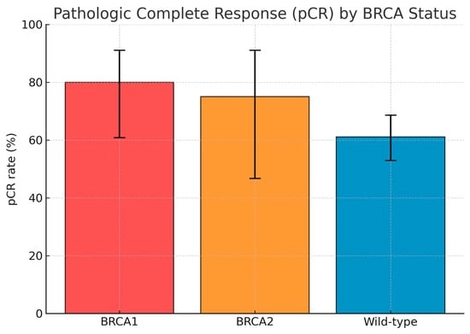
Pathologic complete response (pCR) by BRCA status. Bar chart illustrating the rate of pathologic complete response (pCR) according to BRCA mutational status in the study cohort (n = 184). pCR rates were higher in BRCA1- and BRCA2-mutated tumors (80.0% and 75.0%, respectively) compared with wild-type tumors (61.1%), with overlapping 95% confidence intervals (error bars). When pooled, BRCA1/2-mutated cases achieved a 78.4% pCR rate versus 61.1% in wild-type, showing a trend toward statistical significance (p = 0.056, Fisher’s exact test).

Background: The COVID-19 pandemic has imposed unprecedented stress on healthcare workers (HCWs), potentially affecting their job satisfaction and life satisfaction. This study aimed to examine the role of perceived stress, self-efficacy, and coping strategies as predictors and mediators of well-being among HCWs during the pandemic. Methods: A total of 326 HCWs participated in the study. Perceived stress was assessed using the Perceived Stress Scale (PSS-10), self-efficacy was assessed with the Generalized Self-Efficacy Scale (GSES), life satisfaction was assessed with the Satisfaction with Life Scale (SWLS), job satisfaction was assessed with the Brief Job Satisfaction Scale (BJSS), and coping strategies were assessed with the Mini-COPE. Correlation, regression, and mediation analyses were conducted. Results: HCWs reported elevated stress levels (M ≈ 24), higher than general population norms. Stress was negatively associated with life satisfaction and job satisfaction. Self-efficacy and adaptive coping strategies (acceptance, social support) were positively associated with life and job satisfaction and mediated the relationship between stress and life satisfaction. Helplessness mediated the effect of stress on life satisfaction but not job satisfaction. Conclusions: High self-efficacy and adaptive coping strategies serve as protective factors for HCWs’ well-being during the COVID-19 pandemic. Interventions enhancing self-efficacy and promoting acceptance and social support may mitigate stress and improve life and job satisfaction.

14 December 2025

  • Systematic Review
  • Open Access

Effectiveness of Pharmacological Treatments for Adult ADHD on Psychiatric Comorbidity: A Systematic Review

  • Beniamino Tripodi,
  • Manuel Glauco Carbone and
  • Irene Matarese
  • + 4 authors

Background: Attention-Deficit/Hyperactivity Disorder (ADHD) in adults is frequently accompanied by psychiatric comorbidities that worsen outcomes and complicate treatment. Pharmacological management is central in care, yet its impact on co-occurring disorders remains uncertain. This systematic review evaluated the effectiveness of commonly prescribed medications for adult ADHD (methylphenidate, atomoxetine, bupropion, and lisdexamfetamine) on comorbid mood, anxiety, personality, and substance use disorders. Tricyclic antidepressants were also included in the search strategy; however, no eligible adult studies assessing imipramine or desipramine in patients with ADHD and psychiatric comorbidity were identified. Methods: A systematic search of the literature was conducted to identify studies examining these medications in adults with ADHD and at least one psychiatric comorbidity. Eligible studies reported clinical outcomes for both ADHD symptoms and the co-occurring disorder. Data were extracted and narratively synthesized, with particular attention paid to treatment effects and sources of heterogeneity. Results: Across the included studies, pharmacological treatments consistently improved core ADHD symptomatology. Their effects on psychiatric comorbidity were more variable. Some evidence suggested beneficial outcomes for selected anxiety disorder subtypes and for features of Cluster B personality disorders, possibly related to reductions in emotional dysregulation and impulsivity. Findings regarding substance use disorders were mixed: several studies reported reduced craving or substance use, but long-term stabilization was inconsistent. Marked heterogeneity in study design, populations, and outcome measures limited comparability. Conclusions: Current pharmacological treatments for adult ADHD show reliable efficacy for core symptoms but inconsistent benefits across comorbid psychiatric conditions. While targeted improvements may occur in specific domains, the evidence base is insufficient to define optimal long-term strategies for adults with ADHD and complex comorbidity. Rigorous, longitudinal studies are needed to clarify medication effects on distinct comorbid profiles and to inform integrated treatment planning.

14 December 2025

Background/Objectives: Uremic middle molecules contribute to chronic inflammation and symptom burden in hemodialysis patients. The Theranova 500 medium-cutoff (MCO) dialyzer enhances clearance of larger uremic toxins and may offer clinical advantages. We hypothesized that Theranova 500 would improve dialysis adequacy (spKt/V), attenuate inflammation (CRP), and provide targeted improvement in symptom burden compared with the high-flux Revaclear 500. Methods: We conducted an open-label, prospective, quasi-randomized controlled trial including forty prevalent adult hemodialysis patients from two centers in Israel (Barzilai and Sheba Medical Centers). Patients were sequentially allocated 1:1 to Theranova 500 or Revaclear 500. Demographic, laboratory, and patient-reported outcomes (KDQOL-SF, Dialysis Symptom Index) were assessed at baseline and week 24. Within-group changes were analyzed using paired tests, and between-group differences using ANCOVA adjusted for baseline values. Safety monitoring included adverse events, dialyzer reactions, hospitalizations, and mortality. Results: Theranova 500 significantly increased mean spKt/V (1.24 ± 0.33 to 1.40 ± 0.36; p = 0.025), while Revaclear showed no significant change. CRP remained stable in the Theranova group but rose nearly threefold in the Revaclear group by week 24 (p < 0.001). Albumin, dry weight, anemia and mineral bone parameters remained stable in both groups. Total cholesterol increased modestly in the Theranova arm without nutritional compromise. Symptom-level analysis showed improvement in irritability, restless leg, dry skin, chest pain, and diarrhea with Theranova, whereas global KDQOL-SF domain scores improved similarly in both groups. No non-serious adverse events, hypersensitivity reactions, or dialyzer-related intolerance was observed. Hospitalizations (n = 8 per group) and mortality (two per group) were identical. Conclusions: Over 24 weeks, Theranova 500 MCO dialyzer improved dialysis adequacy and prevented the rise in inflammatory markers seen with Revaclear without compromising nutrition or safety. Targeted improvement in specific uremic symptoms suggests potential clinical benefit beyond small-molecule clearance. These findings support the safety and clinical utility of expanded hemodialysis and highlight the need for larger, fully randomized trials to validate these results.

14 December 2025

News & Conferences

Issues

Open for Submission

Editor's Choice

Reprints of Collections

New Advances in COVID-19 and Pregnancy
Reprint

New Advances in COVID-19 and Pregnancy

Editors: Gaspare Cucinella
Vitreoretinal Disease
Reprint

Vitreoretinal Disease

Clinical Insights and Treatment Strategies
Editors: Makoto Inoue

Get Alerted

Add your email address to receive forthcoming issues of this journal.

XFacebookLinkedIn
J. Clin. Med. - ISSN 2077-0383