
Skip to Content
  • 13 days
    Submission to First Decision
  • 4 days
    Acceptance to Publication

Industries

Industries is an international, peer-reviewed, open access journal published quarterly online by MDPI with a focus on interdisciplinary research bridging industrial engineering, digital technologies, and strategic management.
  • Open Access— free for readers, with article processing charges (APC) paid by authors or their institutions.
  • Rapid Publication: first decisions in 18 days; acceptance to publication in 7 days (median values for MDPI journals in the first half of 2026).
  • Recognition of Reviewers: Reviewers whose reports are timely and of high quality receive an APC discount voucher for a future publication in an MDPI journal. Become a reviewer.
  • Industries is a companion journal of Machines.

Get Alerted

Add your email address to receive forthcoming issues of this journal.

All Articles (13)

  • Article
  • Open Access

Vibration-based condition monitoring of beam-like metallic components requires vibration modes that are both sensitive to damage and consistent across different damage locations and severities. This study evaluates the damage sensitivity of the first eight bending-mode frequencies measured from 19 aluminum-alloy 6063 cantilever beams instrumented with magnetoelastic vibration sensors. The examined configurations comprised one undamaged reference beam and 18 damaged beams combining 6 six crack-like defect locations with three defect depths. Normalized absolute frequency shifts were used to determine the mean sensitivity of each mode, its response to increasing defect depth, and the consistency of this response across the examined locations. The combined modal response increased progressively with defect depth, although the magnitude of the change depended on the selected mode and defect location. Mode f7 exhibited the highest mean sensitivity (1.234%), comparable to f5 and f6, and a monotonic-consistency ratio of C7 = 1, indicating an increasing response with defect depth at all six locations. Modes f2 and f4 also demonstrated complete monotonic consistency but lower overall sensitivity, whereas f5 showed comparatively high sensitivity with greater dependence on defect location. Mode f8 presented the lowest sensitivity and consistency. The results show that high sensitivity does not guarantee consistent depth-dependent behavior (f5), so both criteria are needed to prioritize modes. Prioritizing modes that combine high sensitivity with consistent depth-dependent behavior may simplify the processing of modal information in laboratory studies of beam-like metallic components. Because the specimens were idealized beams with a single machined defect, validation on independent specimens, realistic damage, and operational and environmental conditions is required before diagnostic thresholds or practical monitoring applications can be considered.

Industries

6 November 2026
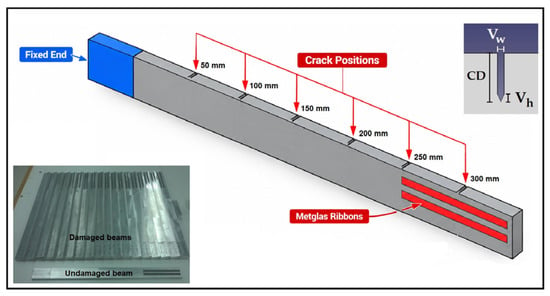
Schematic of the cantilever beam showing the fixed end, six defect positions, and Metglas ribbons. The inset illustrates the defect geometry ((Vw) = 1 mm, (Vh) = 0.5 mm, and CD = 1, 2, and 3 mm), while the bottom-left image shows the actual beam specimens (Adapted from [41]).
  • Article
  • Open Access

Project CIPACTLI (Compact Integrated Polymer Amphibian for Coastal and Littoral Investigation) evaluated whether rare-earth neodymium (N52) magnetic couplings provided an operational advantage over flexible magnetic tape in a rapid-deployment, cannon-launched amphibious robotic chassis intended for search-and-rescue (SAR) and environmental-monitoring use. Two prototype iterations were tested across a towed transit-rate proxy for movement performance, static structural loading, and ballistic-launch survivability. The first prototype was a tensegrity-inspired, segmented soft robot with inflatable buoyancy modules joined by magnetic couplings; a 23 factorial design varied core tendon material (nylon vs. steel), substrate (land vs. water), and magnet type (flexible tape vs. N52 neodymium). Tendon material was the dominant driver of transit rate (partial η2 = 0.637, p < 0.001); magnet type showed no significant main effect (p = 0.507). Because the per-cell sample size (n = 3) yielded low statistical power (~0.15), the null result was additionally evaluated with a two one-sided-tests equivalence procedure at a pre-specified margin of ±0.20 m/s (≈18% of the grand mean); the reconstructed 90% confidence interval for the magnet-type difference (−0.067 to +0.152 m/s) fell entirely inside this margin, supporting statistical equivalence at that margin, though a narrower margin could not be resolved with the present sample. Both magnet types achieved 3/3 survival under ballistic launch. The second prototype eliminated magnetic couplings and inflatable bladders in favor of a monolithic PLA body with integrated buoyancy; this design change (which altered four construction variables simultaneously and therefore cannot isolate any single feature’s contribution) was associated with a 6.96-fold increase in quasi-static compressive load capacity (p = 0.001), equivalent ballistic survivability, and a 24.9% reduction in towed aquatic transit rate. Tethered-deployment trials (n = 6 per condition) showed no observed tether-related failures. Within this bounded operational envelope—one magnet geometry and grade, one mounting scheme, one energy level, ambient chlorinated fresh water, and room temperature—rare-earth N52 magnets conferred no measurable transit rate or survivability advantage over flexible magnetic tape. Corrosion in saline water, thermal cycling, and long-duration exposure, which govern neodymium performance in actual maritime service, were not evaluated and are identified as priority future work before any broader material-substitution recommendation is warranted.

Industries

2 November 2026

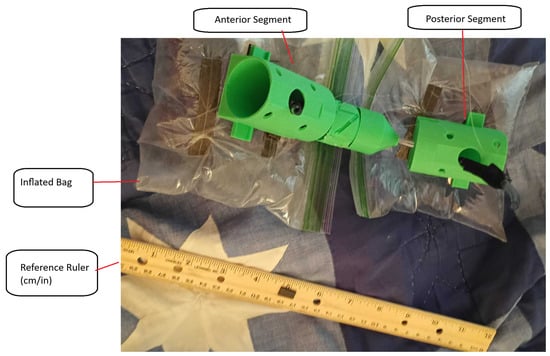
The first robot prototype (nylon tendon variant), showing the anterior sensor-bay segment and magnetic coupling, the central nylon tendon conduit, an inflatable buoyancy/actuator bag, and the posterior segment with its magnetic coupling face; a ruler is included for scale.
  • Article
  • Open Access

Medical ultrasound transducers require acoustic impedance matching layers to bridge the gap between piezoelectric ceramics (~30–38 MRayl) and biological tissue (~1.5–1.7 MRayl). Existing solutions—such as alumina–epoxy, anodic aluminum oxide–epoxy 1–3 composites, magnesium alloys, and gradient nanocomposites—rely on high-temperature curing, precision machining, or multi-step fabrication, which increase production costs and limit design flexibility. Viscoelastic suspensions offer a potential low-cost alternative, but prior to any clinical assessment, manufacturing protocols must be bounded at the exploratory stage. This study does not demonstrate impedance matching, quarter-wavelength performance, or immediate clinical relevance. This work defines a Stage 1 pre-pilot (Technology Readiness Level 2–3) exploratory study to bound manufacturing protocols, rank formulations, and identify candidate parameters for future Quality by Design implementation. Six formulations were tested in open-cell polyurethane foam matrix: thick cornstarch–water (50:50 wt%), thin cornstarch–water (66:33 wt%), polystyrene sulfonate (50:50 wt%), polyethylene glycol–fumed silica (40:60 wt%), boric acid–simethicone, and a boric acid–cornstarch hybrid. The 5 mm prototypes function as bulk composite samples rather than functional matching layers, and all testing was performed at audio frequencies (50 Hz–20 kHz) with uncalibrated consumer-grade instrumentation. At 50–1000 Hz, boric acid–simethicone exhibited the lowest attenuation (32 dB). At 10,000–20,000 Hz, polystyrene sulfonate and thin cornstarch showed the lowest attenuation (97 dB at 20 kHz). Attenuation increased with frequency; a dip between 100 and 1000 Hz was attributed to fixture interference. Two independent recordings were obtained per condition (n = 2). No inferential statistics, confidence intervals, or variance estimates were computed. The results establish a descriptive baseline but do not demonstrate impedance matching or immediate clinical relevance; the 5 mm prototypes function as bulk composite samples rather than quarter-wavelength matching layers. Should subsequent high-frequency validation prove promising, future work includes factorial or definitive screening designs, hydrophone calibration per international standards, Z = ρc measurements, substrate deconvolution, 0.5–1.0 mm layers for 650 kHz, phantom validation, and ISO 10993 biocompatibility screening.

Industries

8 October 2026

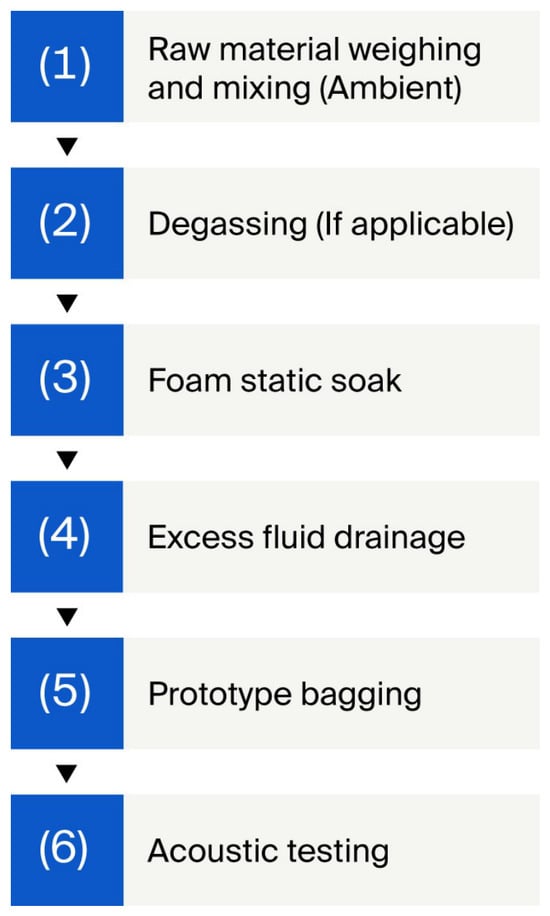
Simplified flow diagram for the six-step process: (1) raw-material weighing and mixing under ambient conditions; (2) degassing (if applicable); (3) foam scaffold impregnation via static soaking; (4) excess fluid drainage; (5) prototype bagging; and (6) acoustic testing.
  • Article
  • Open Access

Automated visual inspection has become a critical component of Industry 4.0 manufacturing systems, enabling improved product quality, reduced operational costs, and increased production efficiency. In the carpet manufacturing industry, quality inspection remains particularly challenging due to the high variability of textures, colors, patterns, and defect appearances, which often limits the effectiveness of conventional inspection systems. Furthermore, the scarcity of publicly available industrial carpet defect datasets limits the realistic assessment of automated inspection methods. Existing approaches are therefore frequently evaluated on benchmark datasets that do not fully capture the variability of real manufacturing environments or rely on computationally demanding end-to-end deep learning architectures, which may reduce their suitability for practical industrial deployment. To address these challenges, this paper introduces a new industrial carpet defect dataset acquired under controlled imaging conditions and containing defect-free samples together with four representative defect categories: Backing Seam, Bad Mend, Dirty Face, and End Out. In addition, we present an engineering study that systematically evaluates a practical two-stage inspection framework combining pretrained deep feature extraction, one-class anomaly detection, and supervised defect classification for industrial carpet quality control. A distinguishing aspect of this study is the systematic evaluation of the framework on both the public MVTec AD Carpet benchmark and the newly introduced industrial dataset, enabling its performance to be assessed under both benchmark and realistic industrial conditions. The first stage performs anomaly detection using one-class learning models trained exclusively on defect-free samples, while the second stage classifies detected defects into predefined categories. To investigate the impact of visual representations on inspection performance, multiple deep feature extraction backbones, including ConvNeXt, VGG-19, and Wide ResNet-50-2, are evaluated in combination with lightweight machine learning models. Experimental results demonstrate strong inspection performance, achieving an AUROC of 99.92% on the MVTec AD Carpet benchmark and 93.92% on the proposed industrial carpet dataset. The obtained results demonstrate that this integration of established techniques provides an effective and computationally lightweight solution for industrial deployment, while confirming the practical value of the proposed dataset as a realistic benchmark for future research.

Industries

7 October 2026

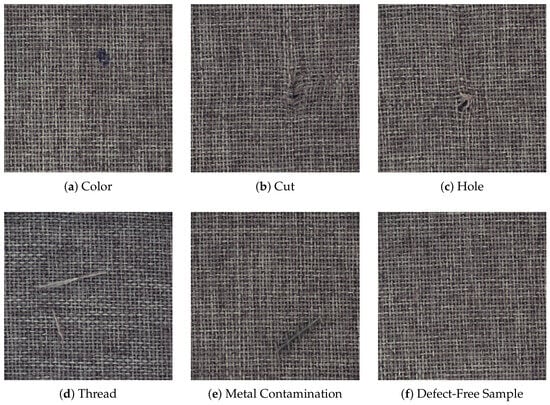
Representative examples of carpet surface conditions from the MVTec AD dataset, including defect categories and a defect-free sample.

Highly Accessed Articles

News & Conferences

Latest Issues

Open for Submission

Journal Sections

XFacebookLinkedIn
Industries - ISSN 3042-9021