Multidisciplinary Perspectives on Grape Wine: Genetics, Chemistry, and Sensory Properties

A special issue of Horticulturae (ISSN 2311-7524). This special issue belongs to the section "Viticulture".

Deadline for manuscript submissions: 30 December 2026 | Viewed by 2397

Special Issue Editors


E-Mail Website
Guest Editor
Laboratorio de Microbiología Enológica, Secretaría de Ciencia y Tecnología, Escuela Superior de Ciencias Exactas y Naturales, Universidad de Morón, Machado 914, Morón 1708, Buenos Aires, Argentina
Interests: lactic acid bacteria; malolactic fermentation; wine composition; sensory analysis of wine

E-Mail Website
Guest Editor
Laboratorio de Aromas y Sustancias Naturales, Estación Experimental Agropecuaria Mendoza, Instituto Nacional de Tecnología Agropecuaria (EEA Mendoza INTA), San Martín 3853, Mendoza 5507, Argentina
Interests: oenological technology; wine chemistry; sensory analysis

Special Issue Information

Dear Colleagues,

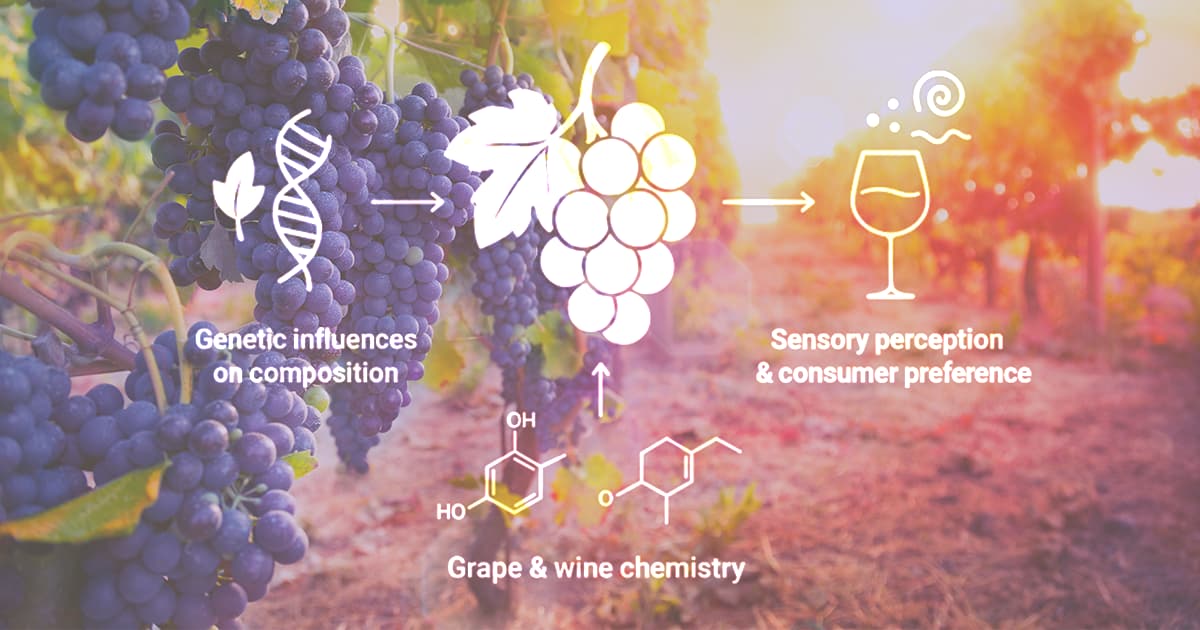
The study of grape and wine quality is deeply linked to the chemical composition of grapes and the sensory properties that define consumer preference. Phenolic compounds, aromatic molecules, and other metabolites are central to wine typicity and complexity, and their characterization is essential in advancing both viticultural and enological knowledge. At the same time, research in grapevine genetics is providing valuable insights into the regulation of metabolic pathways that shape grape and wine chemistry. The integration of biochemical analysis, genetic understanding, and sensory evaluation is therefore crucial to fully capture the factors influencing wine quality. We invite contributions on topics such as (1) the chemical profiling of grape and wine metabolites; (2) genetic influences on grape composition and wine traits; (3) relationships between chemical composition and sensory perception; and (4) sensory studies connecting biochemical markers with consumer response. We look forward to receiving contributions that explore the connection between chemistry, genetics, and sensory science in grape wine research.

Dr. Nair Olguín
Dr. Martín Fanzone
Guest Editors

Manuscript Submission Information

Manuscripts should be submitted online at www.mdpi.com by registering and logging in to this website. Once you are registered, click here to go to the submission form. Manuscripts can be submitted until the deadline. All submissions that pass pre-check are peer-reviewed. Accepted papers will be published continuously in the journal (as soon as accepted) and will be listed together on the special issue website. Research articles, review articles as well as short communications are invited. For planned papers, a title and short abstract (about 250 words) can be sent to the Editorial Office for assessment.

Submitted manuscripts should not have been published previously, nor be under consideration for publication elsewhere (except conference proceedings papers). All manuscripts are thoroughly refereed through a single-blind peer-review process. A guide for authors and other relevant information for submission of manuscripts is available on the Instructions for Authors page. Horticulturae is an international peer-reviewed open access monthly journal published by MDPI.

Please visit the Instructions for Authors page before submitting a manuscript. The Article Processing Charge (APC) for publication in this open access journal is 2200 CHF (Swiss Francs). Submitted papers should be well formatted and use good English. Authors may use MDPI's English editing service prior to publication or during author revisions.

Keywords

  • Vitis vinifera
  • grapevine genetics
  • grapevine chemical composition
  • grapevine sensory analysis

Benefits of Publishing in a Special Issue

  • Ease of navigation: Grouping papers by topic helps scholars navigate broad scope journals more efficiently.
  • Greater discoverability: Special Issues support the reach and impact of scientific research. Articles in Special Issues are more discoverable and cited more frequently.
  • Expansion of research network: Special Issues facilitate connections among authors, fostering scientific collaborations.
  • External promotion: Articles in Special Issues are often promoted through the journal's social media, increasing their visibility.
  • Reprint: MDPI Books provides the opportunity to republish successful Special Issues in book format, both online and in print.

Further information on MDPI's Special Issue policies can be found here.

Published Papers (2 papers)

Order results
Result details
Select all
Export citation of selected articles as:

Research

24 pages, 3720 KB  
Article
Pre-Apical Leaf Removal and Partial Must Substitution as Strategies to Reduce Ethanol in Tannat Red Wines
by Diego Piccardo, Yamila Celio-Ackermann, Guzmán Favre, Florencia Pereyra-Farina, Alejandro Cammarota, Gustavo González-Neves and Mercedes Fourment
Horticulturae 2026, 12(6), 674; https://doi.org/10.3390/horticulturae12060674 - 29 May 2026
Viewed by 372
Abstract
Climate change and evolving consumer preferences are increasing the demand for wines with lower alcohol content and improved compositional balance. This study evaluated the effects of pre-apical leaf removal (LR) and partial substitution of ripe grape must with must or wine from unripe [...] Read more.
Climate change and evolving consumer preferences are increasing the demand for wines with lower alcohol content and improved compositional balance. This study evaluated the effects of pre-apical leaf removal (LR) and partial substitution of ripe grape must with must or wine from unripe grapes (MS and WS) on ethanol content, acidity, phenolic composition, color, and sensory attributes of Tannat red wines under temperate-humid conditions. A complementary small-scale experiment assessed substitution levels (5–20%). All strategies reduced ethanol content, though with varying effects on wine composition. LR moderately decreased ethanol by limiting carbon assimilation but did not significantly affect acidity and reduced phenolic compounds, particularly anthocyanins. In contrast, MS and WS were more effective, reducing ethanol, lowering pH, and increasing titratable acidity. These treatments largely preserved phenolic composition and color, especially at moderate substitution levels, whereas post-fermentative blending showed a stronger dilution effect. Sensory differences were limited: LR wines showed lower color intensity, while MS and WS maintained visual attributes similar to the control. Results from the complementary exploratory assay suggested that substitution levels around 15% may provide a suitable balance between ethanol reduction, acidity, phenolic preservation, and sensory acceptability. These strategies offer practical tools to produce balanced, lower-alcohol Tannat wines. Full article
Show Figures

Graphical abstract

20 pages, 3216 KB  
Article
Combined Effects of Kaolin Particle Film and Training System on Sunburn Mitigation and Wine Aroma
by Fernando Sánchez-Suárez, Francisco Javier Mesas-Carrascosa and Rafael A. Peinado
Horticulturae 2026, 12(5), 554; https://doi.org/10.3390/horticulturae12050554 - 1 May 2026
Viewed by 1660
Abstract
Climate warming in Mediterranean vineyards accelerates grape ripening and increases the incidence of sunburn and berry shriveling, leading to imbalances in grape composition and wine quality. This study evaluated the combined effects of a non-positioned training system (asymmetric sprawl) and foliar application of [...] Read more.
Climate warming in Mediterranean vineyards accelerates grape ripening and increases the incidence of sunburn and berry shriveling, leading to imbalances in grape composition and wine quality. This study evaluated the combined effects of a non-positioned training system (asymmetric sprawl) and foliar application of kaolin particle film on vine microclimate, agronomic performance and wine aroma profile in a Syrah cv. vineyard under warm conditions. Vine canopy temperature was monitored by UAV thermography at veraison and harvest, while grape damage, yield components and vegetative balance were assessed at harvest. Wines obtained from each treatment were analysed for chemical composition, volatile compounds and sensory attributes. Kaolin application significantly reduced canopy temperature, particularly under water-limited conditions at veraison (up to 1.9 °C), and the combination with sprawl training decreased the proportion of sunburnt and shrivelled clusters. These microclimatic modifications were associated with higher ethanol content, improved colour intensity and increased total polyphenol index in wines. The combined strategy also enhanced the concentration of key aroma compounds, especially terpenes and fruity esters, resulting in higher values of citrus, floral and fruity aromatic series. Sensory evaluation confirmed a better overall appreciation of wines produced from vines managed with both practices. Overall, the integration of canopy architecture modification and reflective particle film represents an effective strategy to mitigate heat stress effects in warm viticultural regions, improving grape physiological performance and contributing to the preservation of wine aromatic quality under climate change scenarios. Full article
Show Figures

Figure 1

Back to TopTop