
You are currently on the new version of our website. Access the old version .

Agronomy

Agronomy is an international, peer-reviewed, open access journal on agronomy and agroecology published semimonthly online by MDPI. 
The Spanish Society of Plant Biology (SEBP) is affiliated with Agronomy and their members receive discounts on the article processing charges.
Quartile Ranking JCR - Q1 (Agronomy | Plant Sciences)

All Articles (18,633)

  • Systematic Review
  • Open Access

Alternative Tactics to Herbicides in Integrated Weed Management: A Europe-Centered Systematic Literature Review

  • Lorenzo Gagliardi,
  • Lorenzo Gabriele Tramacere and
  • Spyros Fountas
  • + 22 authors

Weeds pose a significant threat to crop yields, both in quantitative and qualitative terms. Modern agriculture relies heavily on herbicides; however, their excessive use can lead to negative environmental impacts. As a result, recent research has increasingly focused on Integrated Weed Management (IWM), which employs multiple complementary strategies to control weeds in a holistic manner. Nevertheless, large-scale adoption of this approach requires a solid understanding of the underlying tactics. This systematic review analyses recent studies (2013–2022) on herbicide alternatives for weed control across major cropping systems in the EU-27 and the UK, providing an overview of current knowledge, the extent to which IWM tactics have been investigated, and the main gaps that help define future research priorities. The review relied on the IWMPRAISE framework, which classifies weed control tactics into five pillars (direct control, field and soil management, cultivar choice and crop establishment, diverse cropping systems, and monitoring and evaluation) and used Scopus as a scientific database. The search yielded a total of 666 entries, and the most represented pillars were Direct Control (193), Diverse Cropping System (183), and Field and Soil Management (172). The type of crop most frequently studied was arable crops (450), and the macro-area where the studies were mostly conducted was Southern Europe (268). The tactics with the highest number of entries were Tillage Type and Cultivation Depth (110), Cover Crops (82), and Biological Control (72), while those with the lowest numbers were Seed Vigor (2) and Sowing Depth (2). Overall, this review identifies research gaps and sets priorities to boost IWM adoption, leading policy and funding to expand sustainable weed management across Europe.

16 January 2026
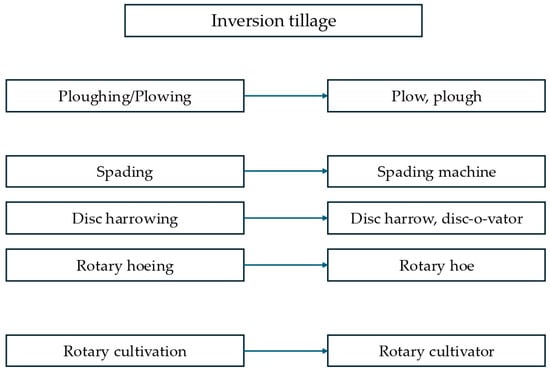
Identification of keywords for the inversion tillage subcategory.

Maize is one of the top three crops globally, ranking only behind rice and wheat, making it an important crop of interest. Aboveground biomass is a key indicator for assessing maize growth and its yield potential. This study developed an efficient and stable biomass prediction model to estimate the aboveground biomass (AGB) of spring maize (Zea mays L.) under subsurface drip irrigation in arid regions, based on UAV multispectral remote sensing and machine learning techniques. Focusing on typical subsurface drip-irrigated spring maize in arid Xinjiang, multispectral images and field-measured AGB data were collected from 96 sample points (selected via stratified random sampling across 24 plots) over four key phenological stages in 2024 and 2025. Sixteen vegetation indices were calculated and 40 texture features were extracted using the gray-level co-occurrence matrix method, while an integrated feature-selection strategy combining Elastic Net and Random Forest was employed to effectively screen key predictor variables. Based on the selected features, six machine learning models were constructed, including Elastic Net Regression (ENR), Gradient Boosting Decision Trees (GBDT), Gaussian Process Regression (GPR), Partial Least Squares Regression (PLSR), Random Forest (RF), and Extreme Gradient Boosting (XGB). Results showed that the fused feature set comprised four vegetation indices (GRDVI, RERVI, GRVI, NDVI) and five texture features (R_Corr, NIR_Mean, NIR_Vari, B_Mean, B_Corr), thereby retaining red-edge and visible-light texture information highly sensitive to AGB. The GPR model based on the fused features exhibited the best performance (test set R2 = 0.852, RMSE = 2890.74 kg ha−1, MAE = 1676.70 kg ha−1), demonstrating high fitting accuracy and stable predictive ability across both the training and test sets. Spatial inversions over the two growing seasons of 2024 and 2025, derived from the fused-feature GPR optimal model at four key phenological stages, revealed pronounced spatiotemporal heterogeneity and stage-dependent dynamics of spring maize AGB: the biomass accumulates rapidly from jointing to grain filling, slows thereafter, and peaks at maturity. At a constant planting density, AGB increased markedly with nitrogen inputs from N0 to N3 (420 kg N ha−1), with the high-nitrogen N3 treatment producing the greatest biomass; this successfully captured the regulatory effect of the nitrogen gradient on maize growth, provided reliable data for variable-rate fertilization, and is highly relevant for optimizing water–fertilizer coordination in subsurface drip irrigation systems. Future research may extend this integrated feature selection and modeling framework to monitor the growth and estimate the yield of other crops, such as rice and cotton, thereby validating its generalizability and robustness in diverse agricultural scenarios.

16 January 2026

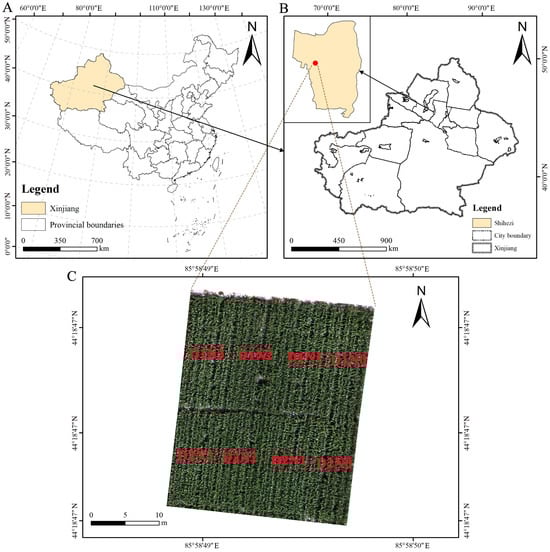
Overview of the study region (The map uses the WGS 1984 geographic coordinate system). (A) Location of the study area. (B) The experimental field is located at the Experimental Site of the Academy of Agricultural Reclamation Sciences in Shihezi City, Xinjiang Uygur Autonomous Region, China. (C) The distribution of the experimental field area.

Early recognition of crop diseases is essential for ensuring agricultural security and improving yield. However, traditional CNN-based methods often suffer from limited generalization when training data are scarce or when applied to transfer scenarios. To address these challenges, this study adopts the multimodal large model Qwen2.5-VL as the core and targets three major soybean leaf diseases along with healthy samples. We propose a parameter-efficient adaptation framework that integrates cross-architecture hyperparameter transfer and progressive fine-tuning. The framework utilizes a Vision Transformer (ViT) as an auxiliary model, where Bayesian optimization is applied to obtain optimal hyperparameters that are subsequently transferred to Qwen2.5-VL. Combined with existing low-rank adaptation (LoRA) and a multi-stage training strategy, the framework achieves efficient convergence and robust generalization with limited data. To systematically evaluate the model’s multi-scale visual adaptability, experiments were conducted using low-resolution, medium-resolution, and high-resolution inputs. The results demonstrate that Qwen2.5-VL achieves an average zero-shot accuracy of 71.72%. With the proposed cross-architecture hyperparameter transfer and parameter-efficient tuning strategy, accuracy improves to 88.72%, and further increases to 93.82% when progressive fine-tuning is applied. The model also maintains an accuracy of 91.0% under cross-resolution evaluation. Overall, the proposed method exhibits strong performance in recognition accuracy, feature discriminability, and multi-scale robustness, providing an effective reference for adapting multimodal large language models to plant disease identification tasks.

16 January 2026

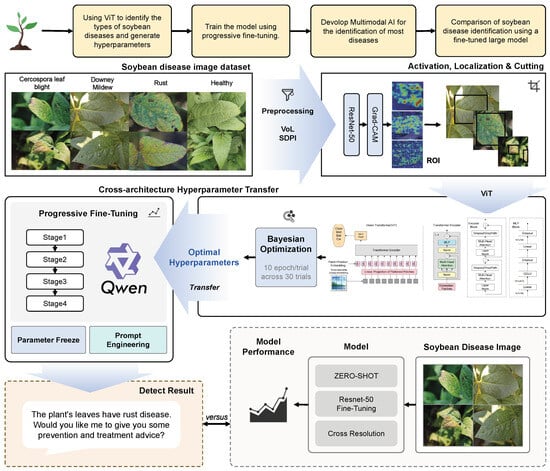
Workflow for soybean leaf disease recognition using Qwen2.5-VL.

Sorghum (Sorghum bicolor L. Moench) is a major cereal crop cultivated in semi-arid regions, but its yield is often constrained by soilborne fungal pathogens that affect plant growth and grain quality. This study explored how Trichoderma-based bioinoculants restructure the structure and functional composition of fungal communities in distinct sorghum compartments (soil, root, seed, and stem) using ITS amplicon sequencing. Two cultivars, Kalatur and Foehn, were evaluated under control and inoculated conditions. Alpha diversity indices revealed that inoculation reduced overall fungal richness and evenness, particularly in seed and stem tissues, while selectively enhancing beneficial taxa. Beta diversity analyses (PERMANOVA, p < 0.01) confirmed significant treatment-driven shifts in community composition. LEfSe analysis identified Trichoderma and Mortierella as biomarkers of inoculated samples, whereas Fusarium, Alternaria, and Penicillium predominated in controls. The enrichment of saprotrophic and symbiotrophic taxa in treated samples, coupled with the decline of pathogenic genera, indicates a transition toward functionally beneficial microbial assemblages. These results demonstrate that Trichoderma bioinoculants not only suppress fungal pathogens but also promote the establishment of beneficial ecological groups contributing to plant and soil health. The present work provides insight into the mechanisms through which microbial inoculants modulate host-associated fungal communities, supporting their use as sustainable tools for crop protection and microbiome management in sorghum-based agroecosystems.

16 January 2026

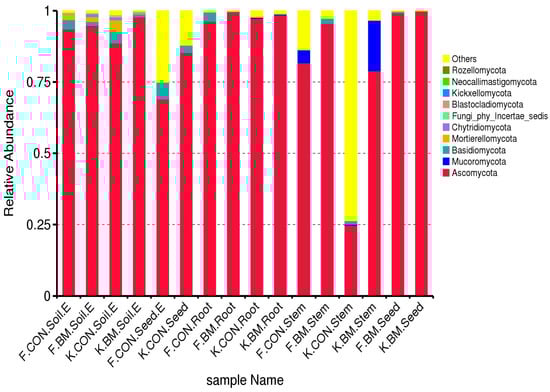
Relative abundance of fungal phyla across sorghum (Sorghum bicolor L. Moench) compartments under control and Trichoderma-based treatments. Samples were collected from four plant compartments: bulk soil, roots, seeds, and stems. The experiment included two S. bicolor cultivars—Kalatur (K) and Foehn (F)—representing a dual-purpose and a sweet sorghum type, respectively. Control plants (CON) received no microbial inoculant, whereas treatment plants (BM) were inoculated with a Trichoderma formulation at sowing. Colors represent dominant fungal phyla, with taxa representing &lt; 1% relative abundance across all samples grouped as “Others.” Relative abundances were calculated from ITS1/ITS2 amplicon sequence variants (ASVs) following quality filtering and chimera removal.

News & Conferences

Issues

Open for Submission

Editor's Choice

Reprints of Collections

Plant Invasion
Reprint

Plant Invasion

Editors: Bruce Osborne, Panayiotis G. Dimitrakopoulos
Climate Change Impacts and Adaptation
Reprint

Climate Change Impacts and Adaptation

Interdisciplinary Perspectives—Volume II
Editors: Cheng Li, Fei Zhang, Mou Leong Tan, Kwok Pan Chun

Get Alerted

Add your email address to receive forthcoming issues of this journal.

XFacebookLinkedIn
Agronomy - ISSN 2073-4395