You are currently viewing a new version of our website. To view the old version click .
Agronomy
  • Review
  • Open Access

3 December 2025

Soil Moisture Sensing Technologies: Principles, Applications, and Challenges in Agriculture

,
,
,
,
and
1
Department of Agriculture, Food, Natural Resources and Engineering (DAFNE), University of Foggia, Via Napoli 25, 71122 Foggia, Italy
2
Department of Soil, Plant and Food Sciences, University of Bari Aldo Moro, Via Amendola 165/A, 70126 Bari, Italy
*
Authors to whom correspondence should be addressed.
This article belongs to the Special Issue Advances in Soil and Water Sensor Technologies for Precision Agriculture and Environmental Monitoring

Abstract

Efficient soil moisture monitoring is fundamental to precision agriculture, enabling improved irrigation management, enhanced crop productivity, and sustainable water use. This review comprehensively evaluates soil moisture sensing technologies, classifying them into invasive and non-invasive approaches. The underlying operating principles, strengths, and limitations, as well as documented practical applications, are critically discussed for each technology. Invasive methods, including dielectric sensors, matric potential devices, heat-pulse sensors, and microstructured optical fibres, offer high-resolution data but require careful installation and calibration to account for environmental and soil-specific variables such as texture, salinity, and temperature. Non-invasive technologies—such as microwave remote sensing, electromagnetic induction, and ground-penetrating radar—enable large-scale monitoring without disturbing the soil profile; however, they face challenges in terms of resolution, cost, and data interpretation. Key performance factors across all sensor types include installation methodology, environmental sensitivity, spatial representativeness, and integration with decision-support systems. The review also addresses recent innovations such as biodegradable and Micro–Electro–Mechanical Systems sensors, the incorporation of Internet of Things platforms, and the application of artificial intelligence for enhanced data analytics and sensor calibration. While sensor deployment has demonstrated tangible benefits for irrigation efficiency and yield improvement, widespread adoption remains constrained by technical, economic, and infrastructural barriers, particularly for smallholder farmers. The analysis concludes by identifying research gaps and recommending strategies to facilitate the broader uptake of soil moisture sensors, with a focus on cost reduction, calibration standardisation, and integration into climate-resilient agricultural frameworks.

1. Introduction

Conventional farming methods often result in inefficient water usage, leading to unnecessary depletion of freshwater resources and environmental damage. Traditional irrigation scheduling is usually based on fixed, predetermined time intervals between watering rather than on real-time soil moisture data, causing either overwatering or underwatering [1,2]. Soil moisture sensors provide a solution by allowing precise, timely monitoring of soil water content, helping farmers optimise irrigation strategies based on actual field conditions and avoid overirrigation [3].
Precise knowledge of soil moisture dynamics is, indeed, also essential for enhancing agricultural yields, conserving water, and mitigating the impacts of climate change [2,4].
The main direct methods for measuring soil moisture include thermo-gravimetric analysis and the calcium carbide technique, which is widely regarded as the standard reference for determining soil moisture [5,6]. Although these methods are accurate, they are inherently destructive; they disturb the soil structure and prevent repeated or in situ measurements. As a result, they are unsuitable for applications that require non-destructive monitoring, such as precision irrigation or long-term hydrological research.
Over the past few decades, rapid advances in sensor technology have improved the measurement and monitoring of soil moisture, shifting from manual, labour-intensive methods to automated, real-time systems [7,8]. Soil moisture sensing technologies have been developed and refined, ranging from traditional tensiometers and dielectric sensors to advanced microwave and remote sensing techniques [8,9]. Choosing the most suitable sensor for a particular application requires careful consideration of various factors. Several comprehensive reviews (e.g., [5,10,11,12,13,14]) have updated the field’s research, while comparative studies have enhanced understanding of the performance and limitations of different soil moisture sensors. Recent research consistently indicates that soil moisture sensing faces numerous challenges, with sensor performance varying considerably depending on environmental and soil-related conditions. Qi et al. [15] assessed eight extensively used sensors under different soil salinity levels and discovered that high salinity can significantly diminish sensor accuracy, with some devices tending to overestimate moisture content. Similarly, Nandi and Shrestha [16] compared both low-cost and high-end sensors across a variety of soil textures and moisture levels, highlighting notable trade-offs between affordability and measurement accuracy. These studies underscore the importance of context-specific sensor evaluation, especially regarding soil texture and salinity. The incorporation of soil moisture sensors into automated irrigation systems has further spurred research into sensor reliability. Millan et al. [17] evaluated six commercial dielectric moisture sensors and three tensiometers, developing calibration equations for sandy soils and emphasising that sensor selection must consider soil-specific properties. In a comprehensive study, Nieberding et al. [18] performed laboratory and field experiments to examine the performance of soil moisture profile sensors, identifying key issues such as measurement accuracy, sensor-to-sensor variability, and temperature stability, which can affect data consistency. Moreover, while the adoption of low-cost, Internet of Things (IoT)-based soil moisture systems has opened new possibilities for real-time monitoring in precision agriculture, Agustirandi et al. [19] demonstrated through comparative calibration that both resistive and capacitive sensors, though economical, necessitate careful validation to ensure reliability. Collectively, these research efforts reveal that soil moisture sensing is inherently complex, and accurate measurements depend heavily on sensor type, calibration, environmental conditions, soil properties, and affordability for smallholder farmers.
The choice of soil moisture sensing technology depends on the specific application conditions (e.g., environmental monitoring or precision agriculture, use in field crops or containerised plants, soil/substrate type, soil and water salinity, power consumption, integration with IoT platforms, etc.). Furthermore, recent advancements in research have introduced innovative measurement techniques that address key limitations of conventional sensors, expanding the possibilities for more accurate and reliable soil moisture monitoring.
This review aims to expand on recent studies by providing a comprehensive analysis of advancements in soil moisture sensing technologies, their operating principles, comparative performance, emerging trends, and practical applications. These methods, listed in Figure 1, are generally classified into invasive techniques, which require inserting a probe into the soil matrix, and non-invasive techniques, which operate externally without disturbing the soil.
Figure 1. Classification of soil moisture sensors into invasive and non-invasive categories.

2. Methodology

The current study was carried out through a thorough narrative review, guided by a systematic literature selection protocol aimed at ensuring a rigorous and representative analysis. The methodological process included five distinct phases, as shown in the PRISMA flow diagram provided in Figure S1.
  • Identification: The Scopus database was used to analyse the evolution of research on soil moisture sensors, given its comprehensive and authoritative coverage across disciplines and regions. To minimise publication bias and capture relevant grey literature, targeted Google searches were conducted for technical reports, books, and other non-peer-reviewed sources. All identified records were screened and assessed using the same eligibility and quality criteria applied to peer-reviewed publications.
  • Screening: Before analysis, a rigorous data pre-processing procedure was implemented. A combination of keyword filtering and manual screening was used to remove irrelevant records. Relevance was determined by examining titles and abstracts, focusing on studies that address soil moisture sensing in an agricultural irrigation context. The search was restricted to articles and reviews published between 1980 and 2025. The following advanced query was applied: Topic Search = (“soil moisture sensor*” and pubyear > 1979 and pubyear < 2026 and (limit-to (subjarea, “agri”))). The database was queried on 4 June 2025.
  • Eligibility assessment: The full texts of the screened records were critically appraised. Studies provides substantive information regarding the operating principles of the technology, its comparative advantages and limitations, and its documented practical applications were included.
  • Inclusion and categorisation: Studies meeting the eligibility criteria were systematically classified according to two overarching categories forming the analytical framework of this review, complemented by a third category for general reference:
    a.
    Invasive methods (e.g., dielectric sensors, tensiometers);
    b.
    Non-invasive methods (e.g., ground-penetrating radar, microwave remote sensing, cosmic-ray and neutron sensing);
    c.
    Other general aspects, including references on soil moisture sensing that are not directly attributable to either invasive or non-invasive methodologies.
  • Exclusion criteria: Studies were excluded if they focused on primary research outside the agricultural field (e.g., geophysics, engineering, physics and astronomy, mathematics, or social sciences); due to duplication of technological coverage; or because they lacked sufficient technical detail to enable a meaningful critical evaluation.
Figures S2 and S3 illustrate the temporal and geographical distribution of the references included in this critical review.

3. Invasive Methods

Soil moisture is a vital state variable in agricultural systems and can be inferred using ground-based devices, proximal sensors, and remote sensing platforms, which enable observations across different spatial and temporal scales [20]. Automated in situ soil moisture monitoring networks include both invasive ground-based methods and non-invasive methods, such as proximal sensors and remote sensing platforms. The former involves point-scale sensors installed at various locations and soil depths, providing localised information on soil moisture dynamics within a field [20]. An overview of the principal technologies in this domain is presented in the following subsections.

3.1. Matric Potential Sensors

The technique evaluates soil water content based on the energy status of water. In this group, tensiometers are among the most established and widely used devices for measuring suction, or the force a plant must exert to extract water from the soil, i.e., soil water tension [21]. They consist of a porous cup and a vacuum gauge that measures the negative pressure (tension) in unsaturated soils [22]. When the soil is saturated, the vacuum gauge—typically a mechanical manometer—reads atmospheric pressure (displayed as zero). As the soil dries, water moves from the tensiometer into the soil through the porous cup, creating a vacuum until equilibrium is reached. The manometer then records the negative pressure, indicating the current soil water potential. Due to their affordability, ease of use, accuracy, and reduced sensitivity to soil temperature and salinity, tensiometers are widely employed for in situ soil moisture monitoring [23,24]. However, a major drawback is that water cavitation can occur within the tensiometer tube, causing inaccurate readings. To prevent this, regular monitoring and maintenance, such as refilling with deaerated water, are necessary following cavitation [25,26,27,28]. Additionally, tensiometers with small sensing areas require multiple units within a limited zone to effectively capture variability caused by soil heterogeneity [13]. Another practical constraint is the development of organic material on ceramic cups, necessitating ongoing maintenance, as discussed by Dukes et al. [29]. The tensiometer can be paired with a sensor that measures pressure changes. Abdelmoneim et al. [30] developed an IoT-based tensiometer system utilising the ESP 32 microcontroller (Espressif Systems, Shanghai, China) and BMP 180 barometric sensor (Bosch Sensortec, Reutlingen, Germany) to measure negative pressure within the tensiometer. This system demonstrated high accuracy, with a Root Mean Square Error (RMSE) ranging from 4.25 to 7.10 kPa, and an average R2 of 0.8, with RMSE in the same range when compared to traditional mechanical tensiometers.
The gypsum blocks (electrical resistance blocks) can be classified as matric potential sensors. They function by indirectly measuring soil water tension through variations in electrical resistance between two electrodes embedded in the soil. Unlike tensiometers, which depend on vacuum pressure, these sensors evaluate the resistance of a porous matrix that equilibrates with the soil’s moisture. The common design includes porous blocks (made of gypsum, fibreglass, ceramic, or nylon) embedded with electrodes connected by a cable. These blocks gradually reach moisture equilibrium with the soil, providing matric potential readings once balanced. Their main advantages are cost-effectiveness and durability, making them suitable for repeated, long-term measurements throughout a growing season. They perform especially well in fine-textured soils, although their reliability decreases in coarse-textured soils at tensions below 1 atm due to lower sensitivity. Advanced models, such as the Watermark soil moisture sensor (Irrometer Company, Inc., Riverside, CA, USA), feature a porous ceramic capsule filled with a granular matrix and integrated electrodes, allowing compatibility with IoT platforms for real-time monitoring.

3.2. Dielectric Sensors

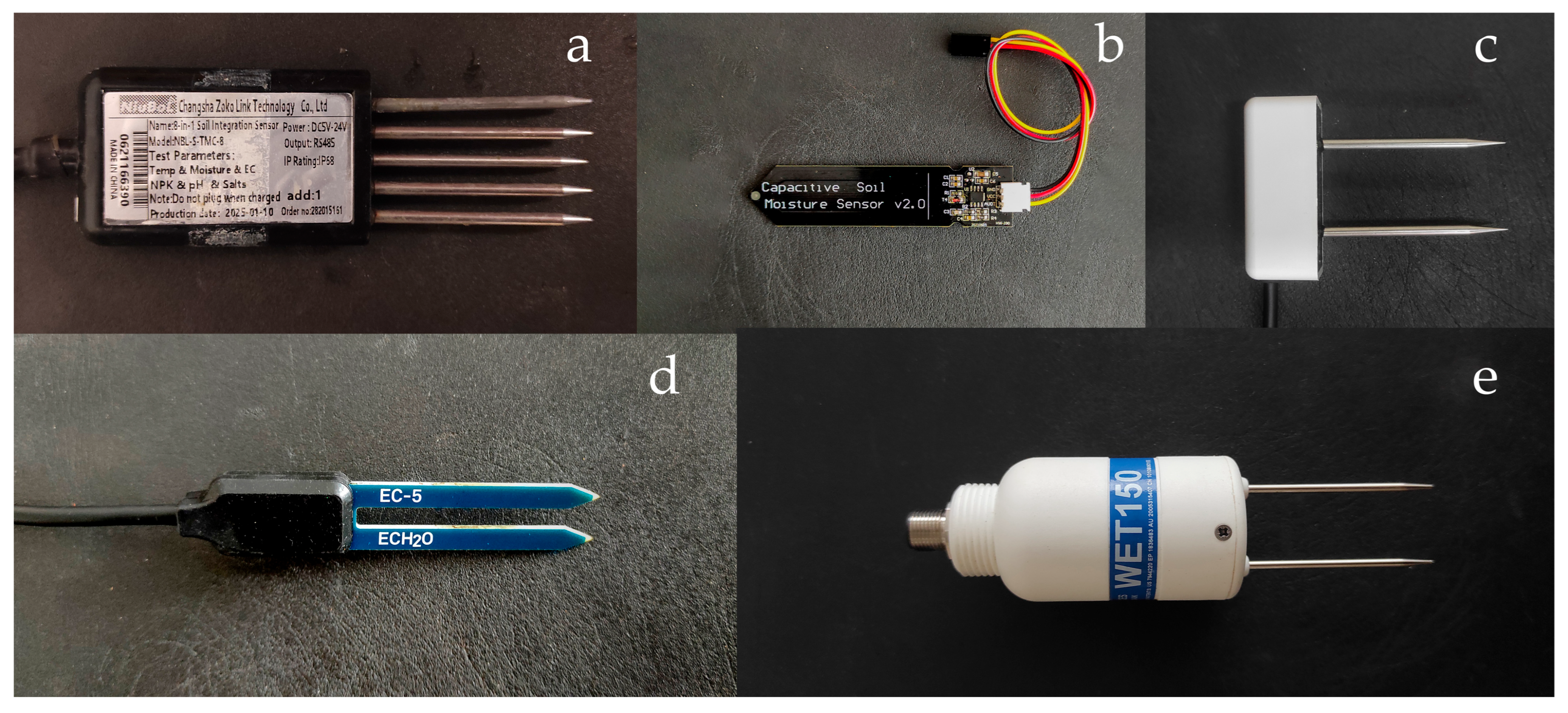
Most commercially available soil moisture sensors (some examples included in Figure 2), including multi-depth sensors, depend on measuring the electromagnetic relative permittivity of soil [5,11,31,32]. The dielectric constant (ε) is a complex phenomenon comprising real (ε′) and imaginary (ε″) components [32,33], expressed as ε = ε′ − i ε″, where the first component relates solely to pure water, while the second accounts for measurement errors in the dielectric constant associated with the soil, particularly the energy attenuation of electromagnetic waves as they pass through the soil [13].
Figure 2. Examples of some commercial dielectric soil moisture sensors. (a): NBL-S-TM resistive Soil Temperature and Moisture Sensor (NiuBol, Changsha City, China); (b): Capacitive soil moisture sensor v2.0; (c): TEROS-10 (Meter Group, Pullman, WA, USA) capacitive soil moisture sensor; (d): EC-5 (Meter Group, Pullman, WA, USA) capacitive soil moisture sensor; (e): WET 150 (Delta-T Devices, Cambirdge, UK) measures volumetric water content (VWC), electrical conductivity (EC), and temperature of soil.
Soil consists of solids, water, and air, with dielectric constants of about 4, 80, and 1, respectively. Since the dielectric constant of wet soil is mainly affected by its water content, it acts as an effective, quick, and dependable indicator for measuring soil moisture. However, different materials have varying dielectric constants. Both the imaginary and real parts of dielectric constants are affected by factors such as electromagnetic frequency, temperature, salinity, soil volumetric water content, the ratio of bound water to total soil water, soil density, soil particle shape, moisture content, clay composition, organic matter, and porosity [5,34,35,36]. Several dielectric-based measurement methods have been developed, including Time-Domain Reflectometry (TDR), Frequency-Domain Reflectometry (FDR), Standing-Wave Ratio (SWR), Amplitude-Domain Reflectometry (ADR), and Time-Domain Transmission (TDT), which operate on principles such as capacitance, resistance, reflection in time and frequency domains, and standing waves [37,38].

3.2.1. Time-Domain Reflectometry

The principle behind Time-Domain Reflectometry (TDR) sensors relies on the substantial contrast between the apparent dielectric constant of water and that of other soil components, including air and solid particles. This notable difference affects the travel time of an electromagnetic pulse, which in turn depends on the volumetric moisture content of the soil. Since water has a high dielectric constant, changes in soil moisture influence the signal’s travel time, enabling the sensor to measure moisture levels accurately.
The TDR soil moisture sensor is based on research conducted by Fellner-Feldegg [39], on the physical phenomenon of changes in propagation velocity with the dielectric constant of the medium, and Giese and Tiemann [40], who established a relationship between the TDR signal reflection coefficient and soil electrical conductivity. Further investigations by Topp et al. [33] explored the correlation between volumetric soil moisture content and the dielectric constant across frequencies ranging from 1 MHz to 1 GHz. These studies also examined how bulk density, temperature, and soluble moisture content influence this relationship. The researchers concluded that the real component of complex permittivity (K0) remains independent of frequency but exhibits high sensitivity to soil moisture levels. A subsequent study by Topp et al. [41] investigated TDR performance in a controlled laboratory environment using a one-metre column of silty loam soil. Their findings indicated that TDR is effective for monitoring soil moisture changes during processes such as infiltration, drainage, evaporation, and capillary rise. A comparison between volumetric soil moisture content measured by TDR and gravimetric methods revealed discrepancies of less than 3%.
A simplified model of the sensor involves a signal generator (placed above the soil) emitting a pulse signal and a transmission line of known length [42]. An impedance mismatch occurs when the signal is transmitted via the coaxial cable to the probe inserted into the soil. Impedance mismatch occurs repeatedly throughout the probe, and the time difference between the two reflected signals, representing the time for the signal to travel twice with the probe, is measured using a detection device [6,11]. The TDR probe typically consists of two stainless steel rods inserted into the soil from the surface to a depth of 0.3–0.6 m [11]. The instrument operates at frequencies of up to 1 GHz, allowing the sensor to remain minimally affected by variations in soil texture, temperature, or salinity. These features make it a suitable choice for long-term, in situ monitoring, and the system can be automated for continuous data collection [43]. One of the main advantages of TDR technology is its high precision in measuring soil moisture, high temporal resolution, rapid data acquisition, and repeatability.
Generating and analysing high-speed electromagnetic pulses to measure wave travel time, the TDR technology requires advanced circuitry, high-quality waveguides, and precise manufacturing tolerances to ensure accuracy. These requirements—including complex high-frequency electronics, precision components, and rigorous calibration—generally make TDR sensors more expensive than other dielectric soil moisture sensors.
While TDR sensors are generally considered less affected by salinity compared to other soil moisture sensing methods (e.g., capacitance sensors), they are not entirely immune to its effects. High-salinity and wet soils can cause signal attenuation [11], and in highly conductive environments (e.g., saline or clayey soils), elevated electrical conductivity may distort waveform propagation, leading to errors in travel time determination and moisture estimation [44,45,46]. Thus, while TDR technology offers relative robustness against salinity, its accuracy can still be compromised under extreme conditions, necessitating careful calibration or alternative approaches in such scenarios. However, in most typical soil conditions, various studies have demonstrated the high performance of TDR sensors. Mittelbach et al. [47] conducted a two-year study comparing three low-cost soil moisture sensors with a high-accuracy, high-cost TDR sensor in a clay loam site. The study evaluated daily volumetric soil moisture data and their sensitivity to temperature fluctuations. Their findings indicated that TDR sensors exhibited higher sensitivity in specific soil moisture conditions or did not display erratic temperature dependencies. The researchers concluded that site-specific calibration is not essential when using a TDR sensor to enhance measurement accuracy. Miralles-Crespo and van Iersel [48] reported that, when properly calibrated, TDR sensors can be effectively used to maintain optimal moisture levels in container-grown plants, such as begonias. TDR-based systems have been proposed for open field conditions to provide continuous, automated soil moisture monitoring. One such system, described by De Benedetto et al. [49], used elongated sensing probes along crop rows to track moisture variations, aiding farmers in making data- driven irrigation decisions. In tomato cultivation, a comparison between TDR and wireless FDR sensors (see Section 3.2.2). Ref. [50] found both to be effective. TDR sensors have also been used to estimate soil evaporation rates, particularly in injection-irrigated fields, to fine-tune irrigation [51].
One of the most recent advancements in TDR technology is the work by Comegna et al. [52], who developed a low-cost, compact TDR device called PoKetTDR (PKTDR) for accurately measuring soil water content across different soil textures. The PKTDR system was calibrated and validated through laboratory experiments involving four soil types: sandy loam, silty loam, loam, and sand. The results showed a strong correlation between PKTDR readings and standard measurement methods, with a coefficient of determination (R2) of 0.95. These findings confirm the reliability of PKTDR for monitoring soil moisture. Compared with commercial TDR devices, the PKTDR demonstrated comparable performance, highlighting its potential as a more affordable alternative.

3.2.2. Frequency Domain Reflectometry

Frequency Domain Reflectometry (FDR) sensors operate on the principle of frequency domain decomposition. The sensor probe functions as a capacitor, and when inserted into the soil, the surrounding medium acts as a dielectric. This configuration is part of a tuning circuit with an external oscillator. As soil moisture increases, the dielectric constant rises, which in turn increases the sensor’s capacitance. This change directly influences the resonant frequency of the sensor, measured using a high-frequency detection circuit. Therefore, variations in operating frequency enable the inference of soil moisture content [6,42,53,54].
The development of FDR technology started as a more affordable alternative to the more costly and complex TDR sensors. In particular, those operating at lower frequencies (10–150 MHz) can significantly cut costs while maintaining adequate accuracy [13]. Emerging from early research by Hilhorst and colleagues in the 1990s, FDR sensors have since advanced, providing greater flexibility in probe design and frequency settings. However, compared to TDR sensors, they are more susceptible to measurement errors influenced by soil type, electrical conductivity, and temperature [5]. Despite this, their simplicity—avoiding the need for waveform analysis—makes them appealing for many practical applications, especially when budget constraints are present [37].
In terms of construction and use, FDR sensors generally include a capacitive probe connected to an oscillator circuit. They are intended for on-site installation, either directly in the soil or within an access tube. Proper installation is vital to ensure accuracy, since air gaps between the soil and the sensor can significantly affect readings. These sensors are most effective in non-saline soils (with conductivity below 1 dS m−1) and in soils that do not contain high levels of clay or shrink-swell properties [55,56].
Field experiences with FDR sensors reveal both strengths and limitations. Shakya et al. [57] observed that the sensors are sensitive to installation errors—particularly, gaps between the soil and probe can lead to inaccurate readings. Temperature has also been recognised as a critical factor. Studies by Seyfried et al. [58] demonstrated that the imaginary part of the dielectric constant is especially sensitive to temperature, impacting moisture readings. They further highlighted the mismatch between manufacturer calibration curves and those derived from site-specific experiments, indicating that FDR sensors need calibration tailored to the specific soil type for optimal accuracy.
Another challenge is the effect of external electromagnetic interference, particularly for wireless FDR sensors. To address these issues, electromagnetic shielding can be applied to the sensor and its cables. Recent advancements, such as the development of adaptive shielding materials [59] and improved signal processing algorithms, aim to minimise interference and improve data reliability.
From a methodological standpoint, Lin [60] argued that frequency domain techniques offer distinct advantages over time-domain methods by enabling broader bandwidths and enhanced measurement accuracy. In practical applications, FDR sensors have proven especially valuable for real-time irrigation management [27].

3.2.3. Time-Domain Transmittometry

The fundamental principle of the Time-Domain Transmittometry (TDT) technology relies on transmitting electromagnetic pulses through a transmission line embedded in the soil. As the pulse travels along the line, its speed is affected by the dielectric properties of the surrounding medium, mainly soil water content [61]. By measuring the time it takes for the signal to pass from one end of the sensor to the other, TDT devices can accurately determine moisture levels. Over time, TDT has gained growing interest in environmental monitoring and precision agriculture. Its development has resulted in various sensor designs with enhanced accuracy, sensitivity, and integration with digital technologies. Researchers have tested different configurations to adapt TDT to different soil types and field conditions, while also aiming to lower costs and power consumption. Kojima et al. [62] created a TDT-based sensor capable of measuring soil water content (θ), electrical conductivity (σb), temperature, and matric potential simultaneously. It demonstrated high accuracy and stability in both laboratory and field tests, with root-mean-square errors (RMSE) of 1.7 for θ, 62 mS m−1 for σb, and 0.05–0.88 for log ψ. The sensor was minimally affected by temperature, except at extreme suctions (ψ < −100 kPa), making it particularly useful for smart farming.
Keshavarz and Shariati [63] introduced a compact, high-sensitivity TDT sensor that measures complex permittivity using a dispersive phase shifter (DPS) excited by a 114 MHz sine wave. Unlike traditional pulse-based sensors, the sine wave approach reduces distortion in dispersive soils, enhancing accuracy. The sensor captures both the real and imaginary components of permittivity by measuring phase and amplitude differences between the reference and DPS output signals. Experimental results in sandy soil show that the sensor achieves a volumetric water content estimation error within ±1.2% at 30% moisture, with average errors of 3.5% for the real and 11% for the imaginary permittivity components. It operated without external instruments and was optimised for low-power, IoT-based deployments.
Pérez et al. [64] reported the development of a compact, low-cost TDT sensor system designed for on-site measurement of dielectric permittivity in soils. The system is built around a microstrip transmission line and employs a time-delay technique to indirectly determine soil dielectric properties, which is particularly useful for estimating moisture content. Its architecture includes a pulse generator, delay logic, a microcontroller, a WiFi-enabled communication unit, and the microstrip head sensor, all integrated into a single PCB. Experimental validation was carried out using a commercial substrate with varying moisture levels, and measurements from the TDT sensor were compared to those from a high-precision dielectric assessment kit and the Topp empirical formula. The results demonstrated that the system achieves a mean absolute error below 1.2 for soils with moisture content below 20%, confirming its effectiveness for relatively dry soils. However, performance decreases at higher moisture levels due to oscillator frequency limitations.

3.2.4. Spatial Frequency-Domain Transmittometry

Spatial Frequency-Domain Transmittometry (SFDT) is a developing technique for measuring soil moisture content, aimed at overcoming the limitations of conventional methods like TDR and FDR. Its core operating principle involves transmitting ultrawideband electromagnetic waves, usually in the 1–6 GHz range, between two antennas embedded in the soil. These waves experience a propagation delay affected by the dielectric constant of the surrounding medium, which correlates closely with soil water content. Since the dielectric constant increases substantially with higher volumetric water content, the measured delay provides a reliable estimate of moisture. Unlike TDR or FDR, SFDT is much less affected by soil electrical conductivity (EC), texture differences, or air gaps—factors that often impair the performance of traditional sensors [5,58,65].
The historical background of SFDT originates from an increasing need for more precise and reliable soil moisture sensors that can operate in saline or heterogeneous field conditions. Although capacitive and time/frequency domain methods have been widely employed for many years, they encounter difficulties in extreme soil environments, such as highly saline soils or dry conditions, where issues like contact resistance and sensor-soil coupling distort readings [33,66]. SFDT was introduced by Saito et al. [65] as a response to these challenges, integrating advances in ultrawideband communication and microwave sensing that enable more detailed and interference-resistant measurements.
In terms of sensor design, SFDT systems typically feature a pair of antennas integrated into a compact probe, connected to electronic circuits capable of generating and capturing ultrawideband signals. The system measures the propagation delay between the transmitting and receiving antennas, which reflects the average dielectric constant along the signal path. The calibration process is simplified due to the sensor’s linear response to volumetric water content, removing the need for soil-type-specific empirical equations usually required for capacitive or resistive sensors [67]. Furthermore, the high frequency of operation means the system is less affected by soil EC, which influences low-frequency methods more strongly [68].
Experimental validation carried out by Saito et al. [65] involved testing sandy soil samples at ten different moisture levels, with results compared to the widely used TEROS12 capacitance sensor (Meter Group, Pullman, WA, USA) (see Section 3.2.8). The SFDT sensor showed strong linearity (R2 > 0.99) throughout the entire range, including at high EC levels up to 9.2 dS·m−1—conditions where most TDR and FDR sensors tend to become unreliable [65]. Additionally, the sensor displayed minimal sensitivity to artificial air gaps created using polyethylene films, further confirming its robustness in realistic soil installation scenarios. These features are essential for agricultural applications in arid, saline, or structurally complex soils.
Despite its promise, SFDT has limitations. Practical issues such as the probe’s size and the difficulty of inserting it into hard or rocky soils may impede large-scale use. Additionally, its current prototypes are not yet commercially available, and further development is needed to optimise power use, wireless data transfer, and long-term stability in the field [59].

3.2.5. Transmission Line Oscillator

The Transmission Line Oscillator (TLO) technique for soil moisture sensing works by transmitting an electromagnetic wave (175 kHz) through the soil and analysing its reflection, which depends on the dielectric permittivity of the medium [69]. The TLO system includes a transmission line, a probe that extends into the soil, and a measurement unit. An oscillator circuit is connected to the rods and responds to signal reflections by changing its oscillation state. The system measures soil moisture either by the two-way travel time or the period of the reflected wave (oscillation frequency), which is inversely related to the dielectric permittivity [69].
Caldwell et al. [69] presented a comprehensive assessment of the CS655 sensor (Campbell Scientific Inc., N. Logan, UT, USA) performance in measuring volumetric water content in soils under both laboratory and field conditions. In the laboratory, the authors tested the CS655 in multiple soils with contrasting textures to develop soil-specific calibration curves. The results showed that soil moisture measurement accuracy was ±0.025 m3 m−3 using calibration provided by the factory, while developing a specific calibration, the accuracy ranged between ±0.016 m3 m−3 and ±0.129 m3 m−3.
However, its accuracy can be influenced by external factors, especially temperature, which affects the dielectric response of the soil matrix [69]. Both TLO and FDR techniques deliver frequency responses that indicate different moisture levels, and they are superior to time-domain reflectometry (TDR) and capacitance sensors regarding depth range and precision, especially in clay and organic soils [70].
Experimental studies have demonstrated that TLO-based probes, such as the Hydra Probe (Stevens Water, Portland, OR, USA), provide higher accuracy in clay-rich and organic soils compared to alternative technologies [71,72,73]. However, measurement reliability can still be influenced by soil salinity and clay content [73,74]. To address these limitations, site-specific calibration is strongly recommended, as it significantly improves accuracy across diverse soil conditions.
Studies assessing sensor performance, like those by Caldwell et al. [69] and Mane et al. [70], have reported accuracy ranges of ±0.0177–0.0623 m3 m−3 for the Hydra Probe and ±0.018–0.055 m3 m−3 for Theta Probes (Delta-T Devices Ltd., Cambridge, UK). Although TLO sensors are generally more expensive than capacitance-based systems, they remain more cost-effective than TDR systems [70].

3.2.6. Amplitude Domain Reflectometry

In Amplitude Domain Reflectometry (ADR), an electromagnetic signal is transmitted along a probe inserted into the soil. As the signal travels through the soil, part of it is reflected depending on the dielectric constant of the surrounding material, which varies with moisture content. The amplitude of the reflected signal decreases with increasing soil moisture due to the higher dielectric constant of water compared to dry soil. By analysing this signal attenuation, ADR sensors can estimate the volumetric water content of the soil. Unlike TDR, which focuses on the travel time of the signal, ADR emphasises changes in amplitude, making it generally simpler and more cost-effective. Its relatively straightforward design allows for more compact and durable sensors, suitable for field applications. However, the accuracy of ADR can be influenced by soil texture, temperature, and salinity, which may require calibration for specific soil types. ADR has gained attention for its potential in precision agriculture, environmental monitoring, and irrigation management due to its low power requirements and real-time sensing capability [75,76].

3.2.7. Standing-Wave Ratio

The Standing-Wave Ratio (SWR) soil moisture sensor operates on the principle that changes in the dielectric constant of a three-state mixture can cause a significant change in the standing-wave ratio of the transmission line. In 1996, Gaskin and Miller [77] introduced a soil moisture measurement method based on the SWR principle within microwave theory. The system consists of a signal source generating a 100 MHz signal, which travels along the coaxial cable to the probe, causing an impedance mismatch. When part of the signal reflects along the original path, the incident and reflected signals combine to form a standing wave.
The change in the probe impedance, affected by the soil’s dielectric constant, causes a variation in the voltage difference. The measurement principle closely resembles that of TDR, with the difference that, instead of measuring the time difference (ΔT) between two reflections of the signal, the ratio of the standing wave is measured [75]. This sensor, due to its technological simplicity, costs less than TDR and FDR. However, there are minor delays in measurement accuracy and sensor interchangeability.
Manatrinon et al. [78] demonstrated that SWR-based sensors employing 3- and 4-electrode probes achieved moisture measurement accuracy with average deviations of ±3.2% and ±3.8%, respectively, in moderate saline loam soil. Compared to TDR sensors, SWR sensors show a high measurement precision, particularly in sandy soil [79]. A comparative study of SWR, TDR, and FDR sensors in sandy loam, loess, peaty sand, and leady loam types revealed that SWR sensors performed similarly to TDR and FDR sensors [80]. Ochsner et al. [12] further report that SWR sensors outperform FDR sensors under high-salinity conditions. Tian et al. [81] developed a novel portable soil water sensor based on the SWR method with integrated temperature compensation, which enhances measurement accuracy. Key features of the system include a sensing probe, a temperature sensor, and a microcontroller unit that processes data and compensates for temperature-induced errors in real-time. The compact and lightweight design improves portability, enabling on-site and real-time monitoring. Experimental results demonstrated that the sensor achieved high accuracy and stability across a wide range of temperatures, and the inclusion of temperature compensation significantly reduced measurement deviations, with a correlation coefficient of 0.998 between the sensor’s output and actual soil moisture content, making it effective in delivering precise and consistent soil moisture readings.
Overall, SWR sensors provide significant advantages due to their low power consumption, making them highly compatible with IoT-based monitoring networks, as well as their lower sensitivity to temperature and salinity variations compared to FDR sensors. However, they require soil-specific calibration in heterogeneous soils, which may limit their accuracy in diverse field conditions [82]. Despite this challenge, their combination of energy efficiency, durability, and scalability makes SWR sensors especially suitable for large-scale agricultural deployments and continuous real-time soil monitoring.

3.2.8. Capacitance-Based

The dielectric constant of a medium, such as soil, and the capacitance principle serve as a reliable indicator of water content variations, a concept first explored by Smith-Rose [83] and later expanded upon by Thomas [84]. When a capacitive soil moisture sensor is embedded in the soil, it operates by applying a square-wave excitation signal to a first-order resistor-capacitor circuit. It consists of a resistor and an equivalent capacitance formed by the probe and the surrounding medium. As the equivalent capacitance undergoes cyclic charging and discharging, the voltage at the probe exhibits a periodic pattern waveform, converted into an equivalent Direct Current (DC) voltage by a true Root Mean Square (RMS) detector. Changes in soil moisture levels alter the dielectric constant, modifying the equivalent capacitance and, consequently, the charge and discharge characteristics of the circuit [85]. These shifts ultimately affect both the periodic waveform at the probe and the DC voltage output of the sensor [86,87].
When compared to other soil moisture sensing technologies, capacitance sensors offer distinct advantages and limitations. A field study comparing two capacitance-based ECH2O probes and EC-5 sensors (both from Meter Group, Pullman, WA, USA) with CS616 TDR sensors (Campbell Scientific Inc., N. Logan, UT, USA) has found that after field calibration, all sensors provided acceptable results. Capacitive sensors demonstrated root mean square errors (RMSE) ranging between 2.5 and 3.6%, while TDR probes showed a lower RMSE of 1.6%, indicating higher precision [88].
Another study assessed four commercially available capacitive soil moisture sensors—TEROS 10 (Meter Group, Pullman, WA, USA), SMT50 (Truebner GmbH, Neustadt an der Weinstraße, Germany), Scanntronik (Scanntronik Mugrauer GmbH, Zorneding, Germany), and SKU:SEN0308 (DFRobot, Shanghai, China)—across three different substrates under controlled laboratory conditions. The results showed that while all sensors covered the moisture ranges vital for plant health, their accuracy varied considerably, emphasising the need for substrate-specific calibration. Among them, the TEROS 10 demonstrated the lowest relative deviation and highest measurement consistency, making it the most dependable for smart irrigation applications [89].
The interest in the sensor SKU:SEN0193 (DFRobot, Shanghai, China) is increasing in the market for low-cost capacitive soil moisture sensors. Research conducted by Schwamback et al. [90] specifically examined the balance between sensor cost and measurement accuracy, aiming to determine whether low-cost alternatives can effectively monitor soil moisture levels. The sensors showed consistent readings in laboratory settings, indicating reliable performance under controlled conditions. However, field tests revealed considerable variability in sensor outputs, attributed to environmental factors such as temperature fluctuations, soil composition, and moisture gradients. Despite these challenges, the study concludes that, with proper calibration and an understanding of their limitations, large-scale soil moisture monitoring is feasible with these sensors. Their affordability allows for widespread deployment, providing extensive spatial coverage that is often unattainable with more expensive commercial sensors. Kushwaha et al. [91] investigate the performance of low-cost capacitive soil moisture and temperature sensors under field conditions. Utilising a PCB-based interdigital fringe field design, these sensors operate with a 3.3 VDC supply and integrate with ESP32 microcontrollers for data acquisition, transmitting readings wirelessly via Zigbee to a Raspberry Pi (Raspberry Pi-Trading-Ltd., Cambridge, UK) server. Calibration was performed using a linear regression between analogue sensor outputs and gravimetric soil moisture values. Installed at depths of 15, 30, and 45 cm, the sensors demonstrated good accuracy, with R2 values up to 0.83 for wheat and 0.82 for sugarcane crops, and relative errors of 5.87 and 5.22%, respectively. The system also included a temperature sensor. The entire wireless sensor network system (comprising one sensor node, three moisture sensors, and one temperature sensor) costs approximately £ 150, offering an affordable alternative to commercial devices. Results demonstrated the sensors’ reliability across soil depths and environmental conditions, supporting their potential for efficient, real-time irrigation management. The research highlights the feasibility of adopting this technology in smart agriculture, especially for resource-limited farmers.
Various experiences with agricultural use of capacitance sensors have proven to be highly effective in managing irrigation. For example, Muñoz-Carpena et al. [92] achieved significant water savings without compromising crop yield in drip-irrigated tomato fields by using a low-cost capacitance sensor (ECHc2O probe, Decagon Devices—now Meter Group, Pullman, WA, USA) installed at a depth of 20 cm and controlled by a custom-built microcontroller. This method outperformed traditional fixed irrigation schedules commonly used by commercial tomato growers. Similarly, Ferrarezi et al. [93] demonstrated the potential of an open-source microcontroller platform connected to a capacitance sensor in container-based experiments under different irrigation thresholds.
Abdelmoneim et al. [94] examined the performance and calibration of a very low-cost capacitive soil moisture sensor (SKU:SEN0193) for use in precision irrigation systems. Researchers tested 12 sensors in loamy silt soils across five controlled moisture levels (5% to 40%) to assess accuracy and variability. Results showed a strong correlation between sensor readings and actual volumetric water content, with R2 values between 0.85 and 0.87 and RMSE of 4.9%. However, variability increased at higher moisture levels, with a coefficient of variation up to 16%. The findings indicate that although low-cost sensors show unit-to-unit differences, proper calibration greatly improves their reliability. This makes them a promising solution for affordable, scalable soil monitoring in irrigation management.
Capacitive soil moisture sensors show potential not only for monitoring water content but also for evaluating the nutritional status of the substrate. Stroobosscher et al. [95] investigated the ability of capacitance-based soil moisture sensors to detect key macronutrients—nitrogen, phosphorus, and potassium—by measuring volumetric ion content. Their results indicate that such sensors could perform a dual function, potentially allowing simultaneous monitoring of soil moisture and nutrient levels.

3.2.9. Resistance-Based

Resistance-based (RB) moisture sensors measure soil moisture by detecting the resistance between electrodes inserted into the soil [14]. The measurement principle assumes that as soil moisture content increases, its resistivity decreases, causing variations in the current flowing between the sensor’s electrodes. Sreedeep et al. [96] designed an electrical resistivity box and used a resistivity probe to estimate soil resistivity. They developed a calibration chart and measured the electrical resistivity of both locally sourced silty soil and commercially available white clay. The device amplifies, transforms, and outputs these resistivity fluctuations as a DC voltage. A pre-calibrated voltage-moisture curve then interprets this voltage to estimate soil moisture content. Typically, developing a calibration curve for the relationship between electrical resistivity and soil moisture for a specific soil type takes about 2–3 h [42]. Soil resistivity can be measured by either the resistance between electrodes placed in the soil or the resistivity of a material that has reached equilibrium with the surrounding soil [5,97]. Historically, soil resistivity measurements relied on a single soil sensor. However, technological advancements have led to matrix sensors, which offer improved measurement capabilities [98,99].
Several authors have conducted interesting comparative studies between RB sensors and capacitive sensors. A study by Cappelli et al. [100] explored the impedance spectra of low-cost RB and capacitive soil moisture sensors across various soil types, including clay, loam, and fertilised clay, with moisture levels ranging from 0% to 30%. The RB sensors demonstrated satisfactory sensitivity over a broader frequency range compared to their capacitive counterparts. However, measurements were significantly affected by soil conductivity, requiring soil-specific calibration for accurate readings. The findings suggest that RB sensors, when properly calibrated, can be effectively integrated into low-power microcontroller systems for cost-effective soil moisture monitoring in agricultural settings. Adla et al. [101] carried out a laboratory evaluation of two very low-cost RB soil moisture sensors, YL100 and YL69 (both low-cost, mass-produced, and open-design modules), alongside capacitive sensors. The study involved calibrating these sensors in four different soil types using piecewise linear equations. Results indicated that although the RB sensors exhibited limited accuracy, with the YL69 performing slightly better than the YL100, they still responded adequately to variations in soil moisture. The study concluded that, despite their limitations, these low-cost RB sensors could be used alongside more accurate sensors to monitor spatial and temporal variations in soil moisture, especially in resource-constrained agricultural environments. Chowdhury et al. [102] compared low-cost RB and capacitive soil moisture sensors through calibration in gravimetric and volumetric water content measurements. The study assessed sensor responses to varying water quantities added to consistent soil samples. Findings highlighted that RB sensors, though cost-effective, exhibited variability in readings, emphasising the need for careful calibration and consideration of soil-specific factors. The research underscores the importance of selecting suitable sensors based on specific agricultural requirements and environmental conditions.
In practical agricultural applications, these sensors have proven to be cost-effective for small-scale and resource-limited farming operations. Their low price makes them accessible to farmers in developing regions where precision irrigation can significantly enhance water efficiency [103]. Commercial nurseries and greenhouse growers often use them to monitor substrate moisture in container-grown plants, helping maintain ideal growing conditions while preventing water waste. Urban landscaping projects, such as golf courses and park irrigation systems, frequently incorporate these sensors because of their affordability at scale. The advantages of resistance-based sensors become clear when considering the broader technological landscape. Their low power consumption makes them suitable for remote or solar-powered setups where conserving energy is essential. Unlike more advanced technologies, they are simple to install and operate, reducing the skill level needed for users. The small size of many resistance sensors allows for placement in confined spaces where larger systems might be impractical. However, these benefits are accompanied by notable limitations that users must consider. Over time, the sensors’ performance declines as the porous matrix absorbs salts from the soil solution, gradually distorting measurements. In saline or heavily fertilised soils, this effect can make the sensors unreliable within a single growing season. Applying a constant DC voltage across the electrodes causes electrolytic corrosion; one electrode acts as the anode, attracting and reacting with oxygen ions, and thus corrodes continuously. To minimise electrode degradation, particularly oxidation and electrolysis effects, methods include: (i) creating a power cycle that activates the sensor only during readings, (ii) alternating the polarity of the electrodes every few milliseconds, (iii) utilising an AC excitation circuit, and (iv) employing stainless steel or gold-plated sensors [5,66].

3.3. Microstructured Optical Fibre

A notable development in Microstructured Optical Fibre (MOF)-based soil moisture sensing involves the use of a Fabry–Pérot (FP) interferometer configuration, where a microstructured optical fibre is coated with a thin layer of tin dioxide (SnO2).
The study by Lopez Aldaba et al. [104] employs a MOF—specifically a four-bridge silica MOF connected to a single-mode fibre—to create a miniature Fabry–Pérot (FP) interferometric cavity approximately 700 µm long. A thin SnO2 layer is sputtered onto the MOF’s internal structure, functioning as the humidity-sensitive material. The process known as physisorption underpins the adsorption and desorption of water molecules on SnO2. The sensor is enclosed in a perforated PVC tube for protection, and in field tests, it is buried 10 cm deep alongside a fibre Bragg grating (FBG) for temperature compensation, ensuring precise soil moisture measurement [103].
This setup has been tested in real soil conditions and compared with commercial capacitive sensors. MOF sensors offer high sensitivity and are suitable for point measurements. A comparative study between capacitive and MOF-based sensors revealed that while both sensor types agreed in high soil humidity scenarios, MOF sensors were less effective in conditions with very low humidity (below 15%). Additionally, MOF sensors, due to their reduced dimensions, are highly sensitive to local humidity changes, whereas capacitive sensors provide volumetric measurements, making them more suitable for field applications [104].
MOF-based soil moisture sensors are a promising advancement in soil monitoring technology, offering high sensitivity and excellent multiplexing capabilities. However, due to the delicate structure of MOF materials, these sensors require protective housing to prevent damage during installation and operation [103]. Furthermore, their performance can be affected by temperature fluctuations, and their accuracy tends to decline in extremely dry conditions [104].

3.4. Neutron Probe

Neutron probes are highly versatile tools for measuring volumetric soil moisture content in field conditions, operating on the principle of neutron scattering [105]. In the neutron probe method, a neutron source (typically Americium-241/Beryllium) is placed beneath the soil to be tested, emitting continuous neutrons that interact with various atomic ions in the soil medium [14]. Fast neutrons lose energy and slow down atoms upon collision with hydrogen. The neutron meter determines soil moisture content by establishing the relationship between the density of the slow neutron cloud and water molecules. As soil moisture content increases, the hydrogen content and density of slow neutron clouds also rise. The neutron probe allows for non-destructive measurement of soil moisture without disturbing soil structure and enables continuous monitoring at several fixed points, yielding fast and accurate results with no hysteresis. The neutron probe technique is widely regarded as the most precise method for determining soil moisture, offering a non-destructive approach capable of measuring moisture in any phase. With a response time of just 1 to 2 min, it provides an extremely rapid measurement method. One of its key strengths is its ability to assess moisture across a large soil volume and at multiple depths, enabling the creation of detailed moisture distribution profiles. These devices come in two main configurations: surface metres and profile metres. The surface metre is placed directly on the soil surface, while the profile metre features a cylindrical probe inserted into the soil and connected via a cable to an external unit. This external unit contains the power supply, microprocessor, keypad, and display system [105]. Fityus et al. [106] conducted a study comparing the capacitance technique with neutron probes to evaluate soil moisture content in expansive soils. Results showed that capacitance probes were ineffective in expansive soils due to soil cracking. In contrast, neutron probes delivered more reliable results for total moisture content across the surrounding soil volume, regardless of soil cracking.
Research has identified several limitations inherent to neutron probe technology that restrict its practical use. These include the instrument’s poor vertical resolution and difficulties in precisely measuring moisture content in surface soil layers (0–15 cm). Additionally, the sensor’s large measurement volume—typically covering a sphere of about 30 cm radius-is a significant drawback, as it naturally averages out important localised moisture variations that could be critical for precision irrigation management [6].
Operational characteristics also restrict its practicality for modern irrigation management. The need for manual depth-specific measurements results in a lengthy data collection process that prevents real-time monitoring capabilities. This fundamental limitation makes neutron probes incompatible with contemporary automated irrigation systems that depend on continuous, instant soil moisture data for decision-making.
Additionally, it requires a significant initial investment, has limited spatial resolution, and poses potential health risks due to radiation exposure [107]. The high capital cost, combined with concerns about radiation safety, has greatly restricted its widespread use in agricultural settings [14,108,109]. Regulatory requirements further limit its application, as most jurisdictions mandate special licences for radioactive materials and require certified training for proper handling and transportation protocols. As a result of these factors, neutron probe applications have largely remained confined to specialised contexts where their high measurement accuracy (±1–2% volumetric water content) justifies the operational challenges (e.g., research environments).

3.5. Radio Frequency Identification

Radio Frequency Identification (RFID) systems, especially those operating in the Ultra-High-Frequency (UHF RFID) range, span a broad spectrum from 120 kHz to 10 GHz. These systems are designed to automatically identify and measure tagged items, known as RFID tags (sensors). These sensors utilise passive (battery-free) or semi-passive RFID tags combined with innovative nanomaterials and MEMS technologies (see Section 3.10) for improved sensitivity and low-cost deployment. Costs range from under USD 1 to USD 50, providing a cost-effective solution for soil moisture monitoring. These tags can be passive, requiring no power source, and can communicate over several metres [110]. Passive RFID tags operate by harnessing energy from the reader to generate a unique identification and an analogue voltage output. This output can power external electronics, such as low-power microcontrollers or sensors [111]. Several recent studies have examined various applications of RFID tags: for instance, Pichorim et al. [110] introduced an RFID system comprising two tags placed at different depths (adhesive labels, FT-G1210 at 100 and 12 mm above the soil surface), measuring moisture by the difference in power needed to activate each tag. Another approach studied by Pichorim et al. [110] involved a passive UHF chip with a real-time clock and an internal temperature sensor, showing a 0.99 correlation with soil moisture. Boada et al. [111] also developed a passive RFID multi-parameter sensor capable of measuring moisture, temperature, and relative humidity. This system utilised a near-field communication (NFC) chip and an NFC-enabled smartphone to read the data collected. Currently, RFID-based system applications in agriculture are limited by the reader’s distance requirement (within <2 m of the RFID tag) and the shallow measurement depth associated with RFID methods. Potential uses for RFID soil moisture sensors include plant nurseries or early stages of leafy green vegetable production [13]. Wang et al. [112] developed a cost-effective RFID-based soil moisture sensing system, known as GreenTag, designed for monitoring substrate moisture in potted plants and greenhouse environments. The system employs a dual-tag configuration, with two RFID tags attached to each plant container, determining soil moisture by analysing the Differential Minimum Response Threshold (DMRT) between the paired tags. This method enables highly accurate measurements, with an error margin within 5%. Notably, the GreenTag system delivers performance comparable to that of high-end commercial sensors whilst maintaining robust resistance to variations in RF interference and pot positioning.

3.6. Heat-Pulse Sensors

As defined by Robinson et al. [5] and Muñnoz-Carpena [113], Heat Pulse Soil Moisture Sensors (HPSMS) are systems capable of non-destructively measuring soil thermal properties and water content in response to applied heat. In recent years, significant advances have been made in both the theoretical understanding and practical design of these sensors. These systems depend on the influence of soil moisture on heat dissipation; as water content in soil increases, the rate of heat dissipation decreases [5,113]. The main benefits include high accuracy and minimal impact from salinity and soil temperature [114]. Recently, advances in electronics have enabled the development of low-cost, low-power prototypes. A notable breakthrough was introduced by Lu et al. [115], who developed a heat-pulse method that can simultaneously determine soil bulk density and volumetric water content. This approach enhances soil assessment efficiency by reducing the need for separate measurements. Alongside this, Tanna et al. [116] developed a system to overcome limitations of conventional heat-pulse probes, which often ignore probe physics and soil mineral composition, reducing accuracy in moisture estimation. The authors introduce an enhanced sensing framework that incorporates probe design parameters, a revised heat-strength model, and a mineral-dependent formulation of soil heat capacity. This integrated approach enables a more realistic representation of heat transfer in diverse soils. Experimental evaluation shows strong agreement between predicted and measured heat strength and moisture values, with high coefficients of determination and low errors, demonstrating substantially improved precision across a wide range of soil types and moisture conditions. On the technological side, Yao et al. [117] integrated Distributed Temperature Sensing (DTS) into the dual-probe heat pulse (DPHP) method. Their enhancements allow for more precise and scalable soil moisture monitoring, especially in large-field applications. Further innovations by Heitman et al. [118] examined subsurface soil evaporation measurements using a sensible heat balance approach based on heat-pulse sensor data—broadening the applications of these sensors beyond mere moisture estimation.
Emerging sensor designs also incorporate cutting-edge technologies. A 2024 study integrated Fiber Bragg Grating (FBG) into the DPHP method, achieving calibration-free measurement of soil thermal properties, thus simplifying deployment in various field conditions. Meanwhile, the semi-automated fabrication of DPHP sensors by Bosco and Ananthasuresh [119] marked a step forward in scalable sensor production, improving consistency and reducing manual intervention.
Other notable contributions include the development of temperature-stable heat-pulse driver circuits [120] and low-cost DPHP-based matric potential sensors [121], both aimed at improving sensor stability and affordability. Kamai et al. [122] also redesigned the heat-pulse probe itself, introducing a “button” configuration that enhanced sensitivity and reduced measurement errors.
Although heat-pulse sensors provide robust and detailed soil moisture measurements, they encounter several practical challenges. Installation remains technically demanding, requiring precise placement and firm soil contact to prevent measurement errors—especially in loose or disturbed soils. Additionally, calibration is often soil-specific, adding complexity in heterogeneous field conditions. Other limitations include their relatively high cost and fragility, particularly for advanced models that incorporate fibre optics or distributed temperature sensing (DTS), which are both expensive and susceptible to damage. Power consumption is another concern, as generating heat pulses demands significant energy, limiting use in remote or battery-powered systems. These sensors also respond more slowly to rapid moisture changes compared to other electronic alternatives and require sophisticated controllers to accurately measure heat fluxes. Moreover, their accuracy diminishes in fine-textured or saturated soils, where thermal properties are less responsive to moisture variations [11,123].
Despite these challenges, the field of heat-pulse soil moisture sensing continues to advance rapidly, driven by progress in electronics, materials science, and soil physics. Ongoing research aims to enhance sensor durability, scalability, and adaptability, paving the way for more reliable and accessible tools for environmental monitoring [114].

3.7. Fibre Optic Sensors

Fibre optic soil moisture sensors operate by detecting deformations in the fibre. This deformation can be achieved in two ways: (i) the Actively Heated Fibre Bragg Grating (AH-FBG), which involves the hydration of a hydrophilic coating (Polyimide) applied to the external surface of the fibre [124,125]; (ii) the second method relies on temperature changes in the soil surrounding the cable, which is actively heated by passing an electrical current through the outer metal sheath of an optic fibre (Actively Heated Distributed Temperature Sensing (AH-DTS) [126,127,128,129]. These systems have gained notable attention due to their ability to deliver high-resolution, distributed measurements crucial for use in agriculture, hydrology, and environmental monitoring. Recent developments focus on improving the accuracy, sensitivity, and practical deployment of these sensors. They provide distributed measurement capabilities, durability, and long-range monitoring. Practical applications have proven their effectiveness in capturing soil moisture dynamics [130].

3.8. Hydrogel-Based Sensors

Hydrogel sensors consist of a chemically inert hydrogel polymer, a semi-porous membrane/filter/porous plate that prevents hydrogel migration into the soil, and a method (mechanical, optical, capacitance) of measuring gel expansion. The fundamental principle of this sensor is the ability of these polymers to absorb 10–1000 times their original weight or volume in water over a short period [131]. Hydrogel sensors function similarly to tensiometers, with soil moisture causing the hydrogel to expand and contract in balance with the soil matric potential. Sun et al. [132] provided a comprehensive review of hydrogel-based sensor networks, discussing their compositions, properties, and applications, emphasising the potential of hydrogels in developing flexible and biocompatible sensors for various uses, including environmental monitoring. Zhan et al. [133] designed a passive, self-regulating irrigation sensor based on hydrogel technology. The hydrogel expands or contracts in response to soil moisture, mechanically triggering an on–off valve to control water flow. The system operates without external power sources, relying solely on the hydrogel’s physical response to soil moisture levels.
However, despite their innovative potential, hydrogel sensors face several significant limitations. Their readings are highly affected by environmental factors such as temperature and soil salinity [131,134], and they are susceptible to degradation or mechanical failure caused by repeated swelling and deswelling cycles or physical stress [13,131,135]. Additionally, hydrogel sensors have delayed response times, taking 30 to 60 min to respond to changes in soil moisture, which restricts their usefulness for real-time irrigation management [13].

3.9. Thermal Dissipation Blocks

Thermal dissipation blocks (TDBs) are sensors made of porous ceramic or metal materials with an embedded heater. They are installed in the soil and connected via cable to a surface temperature sensor. They work by measuring the heat dissipation rate, which is the speed at which heat is conducted away from the heater, directly relating to soil moisture content [42]. When voltage is applied, the internal heater produces heat, and the thermal response is used to estimate water content. While TDBs offer reliable moisture measurements, they require soil-specific calibration and are generally more costly than resistance-based sensors [136]. Their advantages include robustness in harsh conditions (e.g., salinity, temperature fluctuations) and long-term stability with minimal drift [137,138]. However, they need time to reach thermal equilibrium, which limits their use for tracking rapid moisture changes [139]. Additionally, their accuracy drops in dry soils due to decreased thermal conductivity differences, requiring calibration for different soil types such as clay versus sand [140,141]. Another limitation is their small volume measurement (a few centimeters around the sensor), which might not reflect field-scale variability [142]. Lastly, repeated heating cycles are reported to change soil properties near the sensor over time [143].

3.10. Micro Electro-Mechanical System

Nanotechnology-based Micro Electro-Mechanical Systems (MEMS) for soil moisture measurement utilise microsensors, nanosensors, and actuators controlled by microcircuitry. These systems typically incorporate a micro-cantilever beam coated with a moisture-responsive polymer film and a microsensor chip, which integrates a nano-polymer sensing element and a Wheatstone bridge piezoresistor circuit [42]. When exposed to soil moisture, the film expands, causing the cantilever to bend downward until the mechanical stress in the beam balances the moisture-induced strain [42]. This deflection alters the electrical resistance, which is measured to determine moisture content. Jackson et al. [144] conducted theoretical and experimental studies to assess the feasibility of low-cost, nanotechnology-based MEMS for field applications. Their findings indicated that the sensor’s resistance change depends primarily on the cantilever beam thickness, elastic modulus, and moisture concentration.
Nanotechnology-enhanced MEMS offer considerable benefits, including miniaturisation, high sensitivity, and low power use. The integration of nanomaterials such as carbon nanotubes, graphene, and metal oxide nanoparticles further boosts sensitivity, enabling precise, real-time soil moisture monitoring [145]. Additionally, MEMS technology supports the development of compact, energy-efficient sensors, making them suitable for large-scale agricultural deployment. Wireless connectivity allows for remote data collection and ongoing field monitoring [145].
Nanotechnology-based sensors offer improved accuracy and reliability compared to traditional soil moisture measurement methods, but despite their potential, the practical implementation of MEMS-based soil moisture sensors requires further investigation, particularly regarding long-term stability, soil-specific calibration, and scalability [146].

3.11. Biodegradable Sensors

Despite biodegradable sensors have long been studied and used in other disciplines such as medicine, i.e., [147] and engineering [148], few efforts have been made to develop sensors that are suitable for agricultural use, for example, for detecting nitrate [149] or moisture [150].
Kasuga et al. [151] proposed a biodegradable, wireless-powered soil moisture sensor built from eco-friendly materials such as nanopaper for the substrate, tin for conductive lines, and a natural wax coating to prevent moisture ingress. These materials guarantee that the sensor can decompose harmlessly in the soil after use. A key feature of the system is its wireless power transmission capability. When power is supplied via magnetic resonance coupling, the sensor’s internal heating element activates. The amount of heating is inversely proportional to the soil’s moisture level, as wetter soil absorbs more transmitted energy, reducing the heating effect. Moisture levels are measured using thermal imaging. As the sensors emit heat, an infrared camera captures thermal data to estimate how much the sensor warmed up, directly reflecting the surrounding soil moisture. This method enables real-time detection of both the moisture content and the spatial distribution of sensors without physical retrieval. After completing their function, the sensors can be left in the ground where they naturally degrade. In some versions, they are infused with fertiliser, allowing them to contribute nutrients to the soil during decomposition. Experimental results confirmed the system’s effectiveness. In field tests, twelve sensors were deployed within a compact 0.4 × 0.6-metre area. They successfully identified regions with varying moisture levels, demonstrating their ability to operate in high-density arrangements necessary for precise agricultural monitoring. Additionally, the system proved environmentally friendly, with the sensors fully degrading and even promoting plant growth when fertiliser components were included.
In a study of Dahal et al. [150] conducted in 2020, a greenhouse experiment was conducted to evaluate candidate biodegradable component materials for a soil-moisture sensor, and to assess whether their degradation influences crop growth. The system under investigation comprised three functional parts: (i) a structural substrate (balsa wood), (ii) a printable substrate (poly(3-hydroxybutyrate-co-3-hydroxyvalerate), PHBV), and (iii) encapsulant layers (three blends of beeswax and soy wax: 1:1, 1:3 and 3:1 beeswax–soy wax). These materials were embedded in three growing media (field soil, silica sand, and a commercial potting mix) and retrieved at four maize-growth stages (30, 60, 90, and 120 days after planting) to measure changes in mass and dimensions, while concurrently monitoring maize (Zea mays L.) height, green biomass and dry biomass. Results showed that PHBV degraded completely within 30 days in soil and potting media, and within 60 days in sand. In contrast, balsa wood and the wax-blend encapsulants (especially the 3:1 beeswax–soy wax blend) showed minimal changes in weight, length, width or thickness across the harvest times and media. Importantly, none of the tested materials significantly affected maize growth—neither plant height nor biomass (green or dry) differed from controls across media and time. The authors conclude that the selected materials exhibit desirable degradability profiles and appear agronomically safe, supporting their suitability for future biodegradable soil-moisture sensor development.

4. Non-Invasive Soil Moisture Sensors

Unlike the former methods, non-invasive techniques do not involve inserting any probes into the soil, allowing soil moisture to be measured without disturbing the soil system or the root apparatus. They can include proximal sensors such as cosmic-ray neutron probes, which monitor soil moisture over a footprint of hundreds of meters in diameter and a soil depth of several decimeters [12,152,153], or remote-sensing platforms, with a spatial resolution ranging from approximately 101 m (e.g., Sentinel-1) to 103 m (e.g., SMAP, SMOS). These systems allow estimation of near-surface soil moisture when vegetation cover does not cause significant interference, but they are unable to provide information about the entire soil rooting zone [154]. The subsequent discussion reviews prominent technological advances and their applicability in agriculture for non-invasive soil moisture sensing.

4.1. Gamma-Ray Sensors

The gamma-ray attenuation method is a radioactive technique used to measure soil moisture content, providing high resolution up to 2 m depth. It is a non-destructive in situ measurement method with a rapid response time of less than one minute, making it highly effective for capturing volumetric moisture content [42].
It is based on the principle that gamma-ray scattering and absorption are affected by the density of the material they pass through. Since the specific weight of soil remains relatively constant, changes in saturated density caused by variations in moisture content can be monitored through gamma transmission [42]. By detecting these density changes, the corresponding moisture content can be determined. The gamma-ray method uses a radioactive source (typically from Cesium-137 or Americium-241) to emit γ-rays. The energy of the transmitted γ-rays through the soil, received by the probe, is converted into soil moisture content. These instruments have several advantages, including speed and accuracy in measuring soil moisture, protection of soil structure during measurements, the ability for continuous fixed-point monitoring, and more vertical resolution compared to neutron instruments. On the other hand, this technique could be affected by changes in soil bulk density. The gamma-ray method shares most of the advantages and limitations of neutron probe technology, particularly regarding radiation safety concerns that make its application problematic in many operational settings [155]. Like neutron probes, gamma-ray sensors pose significant hazards due to ionising radiation exposure, requiring strict safety protocols that complicate field deployment. Furthermore, the high costs associated with radiation shielding, specialised personnel training, and regulatory compliance [6] often outweigh the benefits for routine agricultural use, relegating this technology primarily to research environments.

4.2. Microwave-Based Sensors

Microwave-based soil moisture sensors have been widely studied and utilised across various fields, especially in agriculture and environmental monitoring. These sensors provide non-invasive, quick, and precise measurements of soil moisture content. Tested for both remote and proximal sensing, these systems rely on microwaves’ ability to induce rotation in dipole molecules like water, leading to measurable changes in electromagnetic waves [156]. Microwave-based soil sensors offer advantages over commercial technologies like TDR and FDR. They enable larger analysis areas and are highly versatile, suitable for both proximal and remote sensing. Additionally, microwaves are unaffected by errors caused by small air gaps between the soil and the sensor [157]. However, as an emerging technology, information on sensor performance, measurement volume, calibration, and the influence of soil properties on error and calibration is still under investigation. Okamura [158] reviewed applications of microwave technology in soil moisture measurement over recent decades, including measurement methods and emerging research trends, with examples of practical use. Examples include a system developed by Oliveira et al. [159], which comprises a compact, low-cost, and easily manufacturable narrowband open-ended antenna microwave sensor for soil moisture measurement. Franceschelli et al. [160] described the development of a portable, non-invasive system that uses an open rectangular waveguide operating between 1.5–2.7 GHz. This system demonstrated accurate and rapid moisture assessment without invasive electrodes, achieving an R2 value of 0.892 and a root mean square error (RMSE) of 1.0% in silty clay loam soils.

4.3. Radio, Acoustic, and Seismic Wave-Based Approaches

Studies involving these three types of waves have shown that it is possible to determine soil moisture content by measuring the wave speed and signal attenuation between two paired transceivers [161,162,163,164,165,166]. The radio wave approach relies on wireless underground sensor networks (WUSN), where these paired transceivers exchange signals. Soil moisture content measurement depends on wave speed, Time-of-Flight (ToF), or signal attenuation. Acoustic and seismic waves operate similarly to radio wave-based WUSN systems, as pressure waves’ propagation through soil is affected by soil properties, including moisture content. Acoustic waves are longitudinal (P waves), whereas seismic waves generate four different types during seismic events, offering more precise measurements. In both seismic and acoustic wave methods, soil moisture is estimated from the propagation velocity of P waves using the Brutsaert model. Since properties like density, texture, void ratio, porosity, cementation, and electrical conductivity significantly influence radio wave characteristics, the primary challenge for researchers is developing suitable paired transceivers. Recently, new designs have been created. Josephson et al. [167] introduced a radar backscatter system that utilises ultra-wideband (UWB) radio frequency (RF) transceivers combined with low-cost, passive tags to assess soil moisture levels. By analysing the radar backscatter response, their approach offers a practical and energy-efficient solution with accuracy comparable to commercial sensors.
Building on the idea that RF signal attenuation relates to soil moisture, Kiv et al. [168] developed the “Smol” system, which estimates water content by analysing the Received Signal Strength Indicator (RSSI) and transmission power of Long Range (LoRa) signals. This approach shows how low-power wide-area network (LPWAN) technologies can be adapted for environmental sensing in distributed agricultural systems.
Salman et al. [169] further investigated the use of Wi-Fi signals for measuring soil moisture. The core idea is that the dielectric properties of soil, mainly affected by its water content, influence the movement of RF waves. By observing variations in signal behaviour, this method provides a low-cost, infrastructure-free way to detect moisture.
In the acoustic domain, Woo et al. [170] proposed a contactless ultrasonic sensing technique that employs leaky Rayleigh waves to detect variations in soil moisture. This non-invasive method allows for accurate measurements without physically disturbing the soil and is effective across different soil types and conditions.
Seismic wave-based techniques have also demonstrated notable potential. Shen et al. [171] employed Distributed Acoustic Sensing (DAS) technology, which repurposes existing fibre-optic infrastructure to detect seismic waves generated by ambient sources such as traffic. As these waves travel through soil, their velocity is affected by moisture content. By examining the resulting travel-time variations, DAS allows for continuous, high-resolution monitoring of moisture in the vadose zone, with significant implications for hydrological modelling and water resource management [172].

4.4. Seismoelectric Sensors

Seismoelectric soil moisture sensors (SSMS) represent an emerging and innovative method for measuring soil water content by harnessing the coupling between seismic and electromagnetic (EM) waves within the soil. When seismic waves travel through a porous medium, they generate electrical signals resulting from the relative motion between the pore fluid and the solid matrix—a phenomenon known as the seismoelectric effect. This effect is highly responsive to changes in soil moisture, as the presence and distribution of water significantly affect the soil’s electrokinetic properties [13]. Although the seismoelectric method has traditionally been investigated in geophysical studies, its potential for soil moisture sensing is gaining increasing interest. Recent research has concentrated on quantifying the seismoelectric transfer function and examining its dependence on parameters such as soil electrical conductivity and degree of saturation. For example, Holzhauer et al. [173] conducted experiments in loose sand to measure the seismoelectric transfer function, demonstrating a clear dependence on both soil conductivity and saturation level.
Additionally, numerical investigations have been conducted to understand how soil texture affects seismoelectric responses. Zyserman et al. [174] studied shear wave–induced seismoelectric signals across different soil textures in the vadose zone, providing valuable insights into the potential for soil characterisation based on seismoelectric measurements. Despite notable progress, the practical use of seismoelectric sensors for routine soil moisture monitoring in agriculture is still in its early stages. Key challenges such as sensor sensitivity, signal interpretation, and the influence of soil heterogeneity must be systematically addressed to enhance the reliability and applicability of this approach.

4.5. Cosmic Ray-Based Sensors

Cosmic ray sensors (CRS) measure naturally produced neutrons generated by cosmic rays passing through the Earth’s atmosphere [175]. These neutrons continuously collide with hydrogen atoms in the soil. These collisions cause the release of fast neutrons from the ground into the air (evaporation). A passive neutron detector placed a few metres above the ground detects and measures this neutron flow [176]. The main benefit of this system is its wide range of applications and large detection area: it is suitable for stony and vertic soils where installing typical soil moisture sensors is not always feasible; cosmic ray sensors have a large measurement footprint of around 260–600 metres in radius [175]. However, they face certain limitations such as high cost, imprecise measured soil volume, lengthy measurement durations exceeding 4 h, variable measurement depths (around 15 cm in wet soils to approximately 70 cm in dry soils), and difficulties in deriving precise calibrations [176,177,178,179].
CRNS has been proposed to optimise irrigation scheduling and enhance field-scale water-use efficiency [180,181,182]. Programmatic reports from the FAO/IAEA indicate savings of up to ~100 mm per season per hectare with maintained or improved yields [183].

4.6. Electromagnetic Induction

Electromagnetic induction (EMI) surveys provide quick, non-invasive assessments with high spatial resolution and require less specialised skill to process and interpret data [184,185,186,187,188]. Unlike dielectric or microwave-based methods, EMI sensors are not directly sensitive to water content or hydrogen ion levels; instead, measurements rely on the ion concentration (salt content) in the soil solution. The system depends on the correlation between soil moisture and ion abundance: as soil moisture increases, ion abundance and mobility also tend to rise, resulting in higher apparent electrical conductivity (ECa) [188,189].

4.7. Near-Infrared Optical Approach

Near-infrared (NIR) spectroscopy is a commonly employed method for soil moisture monitoring, utilising strong water absorption bands at 1450, 1940, and 2950 nm. Research [190,191,192] shows that NIR spectral variations are linked to vegetation water content, stress detection, and canopy moisture levels. However, accuracy is affected by soil surface properties [193,194,195], and dense vegetation can diminish soil-reflected signals, leading to a loss of precision [42].
Visible-to-NIR (vis-NIR, 400–1000 nm) techniques are particularly popular because of their portability, low cost, and minimal sample preparation requirements [196]. These methods depend on detecting spectral shifts caused by water film thickness changes on soil particles, although measurements remain sensitive to surface roughness, texture, pH, and clay content [197]. Despite their proven effectiveness, these instruments face several operational and technical limitations. A main constraint is their reliance on mobile connectivity for spectral data interpretation, which can be problematic in areas with poor network coverage. This issue is worsened by the need to access extensive spectral libraries and locally calibrated datasets, often requiring cloud-based platforms. Additionally, the systems have inherent measurement limitations due to their shallow detection depth, usually limited to the top 0–5 cm of soil, preventing assessment of moisture in deeper layers [198]. Their penetration capability is also restricted, as high-frequency optical signals struggle to pass through dense clay soils or waterlogged conditions, greatly reducing measurement accuracy in these scenarios [199,200]. These limitations highlight the need to combine complementary techniques for a more complete soil moisture assessment.

4.8. Ground-Penetrating Radar

Ground-Penetrating Radar (GPR) is a non-invasive geophysical technique that utilises high-frequency electromagnetic waves (typically 1 MHz to 1 GHz) to image and analyse subsurface structures. GPR provides critical information about the permittivity of subsurface materials by measuring the travel time of the direct ground wave, which propagates from the source to the receiver antenna through the topmost soil layer. This travel time is directly correlated with the dielectric constant, enabling accurate soil moisture measurement [11]. GPR is useful in two different ways: on the soil surface for traditional GPR surveys or as microwave or radar surveys from off-ground or airborne platforms [201]. One of GPR’s key strengths is its ability to estimate variations in dielectric properties across large surface and subsurface areas, making GPR particularly valuable for large-scale soil moisture assessments [202].
One of the main limitations of GPR is its inability to produce reliable results in saline soils and certain clay soils. This is due to signal attenuation caused by an increase in bulk electrical conductivity exceeding 1 dS m−1 [5]. Additionally, GPR requires a high level of end-user expertise to ensure the collection of good-quality data and valid interpretations [11,203]. Moreover, it faces limitations regarding signal depth applications and is more affected by vegetation and surface roughness [204,205,206].
Modern inversion algorithms like the Grey Wolf Optimiser have improved the accuracy of soil moisture retrieval from GPR data. These methods interpret signal reflections more accurately, enhancing the robustness of soil moisture estimation across different soil textures and they were successfully integrated into an autonomous system for site-specific irrigation. The EU MIRAGE project introduced a robot named Oscar, equipped with a GPR operating in the 130–190 MHz range. It performs real-time mapping of soil, enabling soil moisture profiling up to 40 cm depth and supporting variable-rate irrigation.
GPR sensor data have also been successfully combined with Sentinel-1 SAR satellite imagery to improve soil moisture estimation over larger areas. This hybrid approach enhances spatial resolution and depth sensitivity compared to either method alone, especially in agricultural or semi-arid environments [207].

4.9. Geographical Positioning System Interferometric Reflectometry

Geographical positioning system interferometric reflectometry (GPS-IR or GNSS-IR) receivers utilise the difference between incoming and reflected L-band microwaves (1–2 GHz, 15–30 cm wavelength) to estimate the dielectric constant and, consequently, soil moisture [208]. These sensors analyse the interference pattern between the direct satellite signal and the one reflected off the ground. The reflected signal’s strength and phase are influenced by the dielectric properties of the soil, which vary with moisture content. Therefore, changes in the reflected signal are used to infer changes in soil moisture near the ground surface [209]. These systems operate on the principle that increased soil moisture results in decreased frequency and increased noise and phase of the reflected signal [210]. Since GPS signals can be received almost everywhere, these techniques can be used advantageously. Moreover, measurements can be obtained with commercially available handheld receivers equipped with modified antennas, over moderate to large distances (tens to hundreds of metres).
However, GPS-IR technology for soil moisture measurement is limited to shallow soil depths (~5 cm), requiring complementary data for deeper profiles, and there is also a need for consistent calibration and validation protocols across different geographical settings [201]. It is heavily affected by signal attenuation caused by canopy cover, which can decrease measurement accuracy [211].

5. Critical Discussion

Table 1 provides a comparative overview of the reviewed soil-invasive moisture sensing technologies, emphasising their practical use in field conditions. Each sensor or method has been assessed across twelve key attributes, including technical sensitivities (e.g., to salinity, temperature, soil type), operational factors (e.g., power demand, calibration needs), and user-focused criteria (e.g., ease of use, required expertise, cost, and accuracy). Generally, for dielectric sensors, accuracy is greatly affected by installation methods. Iwata et al. [212] evaluated three sensor installation techniques and found that the method significantly influences the sensor’s output. Zhou et al. [213] examined how installation depth impacts sensor stability, using a flat, thin millimeter-sized soil moisture sensor made from a golden compact disc and covered with a layer of carbon ink. This resistive sensor was placed at shallow, middle, and deep positions within hollow plastic rods. Their results indicated that sensors in shallow soil were unstable due to long-term soil settlement, while those in deep soil showed high stability. Installation in stony or compacted soils can impair sensor-soil contact, causing inaccurate readings. Proper installation practices, including using slurry or backfill materials, are vital to minimise air gaps and ensure measurement accuracy. Compacting soil during installation increases sensor output, emphasising the importance of correct calibration and following manufacturer guidelines for reliable soil moisture monitoring. Additionally, the interaction between plant root systems and irrigation infrastructure significantly influences the performance of invasive sensors. The depth and spread of roots determine where soil moisture measurements are most relevant, as sensors need to be positioned within the primary root zone to accurately indicate water availability for crops. Studies on containerised plants show how root density and species-specific traits impact sensor requirements, highlighting the need for customised deployment [214,215]. Similarly, the design of the irrigation system—whether drip, sprinkler, or subsurface—affects soil wetting patterns, which further impacts optimal sensor placement. For example, in drip-irrigated crops, sensors should be installed within the wetting bulb to monitor localised moisture dynamics [216]. A key limitation of invasive sensors is their relatively small measurement volume, which may not always reflect larger soil moisture conditions. Cylindrical capacitance sensors, for example, typically sample a radial area of about 10 cm, while fork-shaped probes measure approximately 1.4 times the distance between their prongs. This limitation underscores the importance of strategic sensor placement and, in some cases, deploying multiple probes to account for spatial variability. Using multiple sensors can improve data quality, but this approach must balance cost against the added value of extra information. The optimal number of sensors depends on factors such as sensor accuracy, environmental variability, installation costs, and the marginal benefit of increased data resolution [217]. A practical approach involves initially deploying a high density of sensors to identify key variability patterns, then optimising sensor numbers and placement based on observed trends [218].
Table 1. Key management aspects of sensors that require insertion into the soil (soil invasive). The table summarises the general characteristics of each method/approach. Within each group, a specific sensor model may exhibit variations in these characteristics.
Temperature fluctuations also significantly influence dielectric sensor performance, requiring specific correction equations for substantial temperature changes [14,216]. Capacitance sensors, including FDR probes, are especially sensitive to temperature and perform poorly in certain soils [65,219,220]. Resistive sensors are also vulnerable to temperature-induced errors, necessitating temperature compensation during field measurements [41,221]. TDR sensors display smaller temperature errors, making them more dependable under varying conditions [41,222].
Soil salinity is another crucial factor influencing sensor performance: the effect of salinity on dielectric soil moisture sensors—particularly capacitance-based types—is connected to the dielectric loss of the imaginary part of the complex dielectric constant, which is positively related to soil ionic conductivity [223]. However, the influence of salinity on dielectric measurements is often concealed at low temperatures [224]. High-frequency sensors tend to reduce the effect of soil conductivity, thereby enhancing accuracy in saline environments; consequently, in such conditions, common in arid or irrigated agricultural regions, TDR sensors are a more reliable option [208].
Soil characteristics—such as texture, bulk density, and heterogeneity—can significantly influence sensor accuracy. For example, clay and sandy soils differ in water retention properties, necessitating soil-specific calibration for many sensor types. However, among invasive sensors, Microstructured Optical Fibre, Fibre Optic, and Neutron Probe sensors are the least affected by variations in soil type.
Advanced dielectric sensors (such as TDR, FDR, TDT, FDT, ADR, and SWR) and fibre optic sensors vary from high to good accuracy with real-time data capabilities, making them suitable for precision agriculture, although they are costly and technically demanding. Conversely, tensiometers and resistive sensors are more user-friendly and affordable but provide lower precision and need frequent maintenance. Notably, MEMS and RFID-based sensors are emerging as promising options for IoT integration, offering a good compromise between technological sophistication and moderate operational costs. Alternatively, neutron probes, while highly accurate, are less practical for widespread field use due to their expense, complexity, and regulatory restrictions.
The design and technical specifications of the sensors themselves also require careful evaluation. Fixed, portable, and profile probes each provide distinct advantages depending on the application, while measurement capabilities, such as simultaneous monitoring of moisture, temperature, and salinity, can improve data granularity. Power efficiency and communication protocols (e.g., SDI-12) are equally essential, especially for wireless sensor networks where long-term energy autonomy and seamless data transmission are crucial for operational success [216].
Non-invasive soil moisture sensors, summarised in Table 2, provide the distinct advantage of measuring soil moisture without disturbing the soil profile. This is especially valuable in large-scale agricultural fields where invasive methods can be labour-intensive and impractical. Non-invasive sensors can cover larger areas more quickly, which benefits crops like vegetables that are sensitive to moisture changes and often grown in fields requiring high-frequency monitoring [225].
Table 2. Key management aspects of non-invasive soil moisture sensors. The table summarises the general characteristics of each method/approach. Within each group, a specific sensor model may exhibit variations in these characteristics.
Remote sensing allows integration of soil moisture data with climate and crop models for irrigation decisions [210]. While satellite data (e.g., SMAP, Sentinel-2) provide low-cost, large-scale monitoring [226], non-invasive tools such as GPR, remain expensive for smallholders due to costs, processing, and expertise requirements [227]. Their lower resolution also restricts plot-level accuracy [228].
Among the methods, gamma-ray and cosmic ray-based sensors stand out for their high accuracy and broad area coverage [229], although their cost, power demand, and expertise requirements are substantial, potentially limiting adoption to research or large-scale farming operations [230,231].
Microwave-based and Electromagnetic Induction (EMI) sensors offer a well-balanced profile, with high suitability for real-time data collection, IoT integration, and moderate calibration requirements, making them appealing for precision agriculture applications [232]. However, their performance may be affected by soil heterogeneity and vegetation cover, requiring site-specific adjustments [153,233].
Seismoelectric and acoustic/seismic wave-based methods provide non-destructive monitoring potential, but they face challenges with installation complexity, cost, and the need for expertise, which currently restricts their scalability outside specialised applications [234].
Near-infrared optical and Ground Penetrating Radar (GPR) systems also score highly for accuracy and automation, but they require advanced interpretation and consume a lot of power, which indicates a trade-off between performance and accessibility [13,235].
GPS-based approaches, although very low-cost and easy to use, are not meant for direct moisture measurement. Instead, they are usually part of larger geospatial monitoring systems and therefore have lower accuracy and sensor-specific calibration relevance [13].
Table 3 provides an overview of the technical maturity of a wide range of soil and sensing technologies. Most conventional and well-established approaches—such as matric potential sensors, TDR and FDR techniques, capacitance- and resistance-based sensors, neutron probes, microwave-based sensors, cosmic-ray neutron sensing, and electromagnetic induction—are classified as widely used. This reflects their proven reliability, commercial availability, and extensive validation across diverse environmental and agronomic contexts. Conversely, several sensing approaches fall into the experimental category. These include techniques based on spatial frequency domain transmittometry, various radio-frequency or oscillator-based methods, fibre-optic and heat-pulse sensors, and hydrogel-based technologies. Their classification indicates that, while promising, these methods are still undergoing refinement and have not yet achieved broad adoption or standardisation. A smaller group of technologies, such as biodegradable sensors and GNSS-R approaches, are considered under development. These emerging methods are typically at an early research stage, with ongoing efforts focused on improving measurement principles, enhancing robustness, or expanding potential applications. Taken together, the table highlights both the technological consolidation within the field and the active innovation aimed at expanding the capabilities of soil and environmental sensing.
Table 3. Technical maturity of the listed sensors. The table summarises the technical maturity based on characteristics and the level of use of each method/approach. For each sensor/method, letters a, b and c indicates “widely used”, “experimental”, and “being developed”, respectively.
Similar sensors comparison was made by Kukal et al. [236] in Table 4 where summarises a comprehensive evaluation of nine commercial soil moisture sensors based on both performance accuracy and operational feasibility. The sensors were tested in two contrasting soils, silt loam and loamy sand, with installations in horizontal and vertical orientations, and measurements were compared against a neutron probe used as the reference method. Accuracy was quantified through RMSE values calculated under factory and site-specific calibration; these values were normalised to a 0–100 scale to generate the Performance Accuracy scores. Operational feasibility was assessed independently of soil and calibration and included telemetry availability, sensor cost, total system cost with and without telemetry, and ease of operation, all converted into normalised scores. The results reveal substantial variability across sensors. Most supported telemetry, except the TDR-315L, and sensor and system costs ranged widely, influencing their operational ranking. Ease of operation was generally high, although some models required programming or data conversion. Accuracy depended strongly on soil type, installation orientation, and calibration procedure. No sensor consistently outperformed others across all conditions; for instance, the 5TE showed robust accuracy in silt loam, while the highest-scoring sensors in loamy sand varied with calibration and orientation.
Table 4. Summary of the scores assigned to the operational feasibility (O.F.) criteria and performance accuracy (P.A.) for each sensor investigated. While the O.F. scores are constant across conditions, the P.A. scores depend on soil characteristics, sensor installation orientation, and calibration approach. This table was developed by adapting data presented in Kukal et al. [236].
Overall, non-invasive soil moisture sensors, although technologically advanced, often involve greater operational complexity and costs. Therefore, their practical use should be assessed based on specific field size, budget limitations, technical expertise, and the necessary spatial resolution of moisture data.
Together, these factors emphasise the need for a personalised strategy in selecting and implementing sensors, ensuring that the chosen technology aligns with the specific agronomic, environmental, and economic conditions of the irrigation system.

6. Conclusions

Efficient soil moisture management is essential for sustainable agriculture, as it helps optimise water use, enhance crop productivity, and minimise environmental impact. The widespread adoption of soil moisture sensors can revolutionise irrigation practices, enabling farmers to shift from traditional, experience-based or schedule-based methods to data-driven precision irrigation. Technologies such as tensiometers, dielectric sensors, neutron probes, and microwave-based sensors each have distinct advantages and disadvantages. Choosing the most appropriate sensor depends on specific agricultural conditions, economic considerations, and technological availability. Automated irrigation systems that utilise real-time data have been shown to save water, improve energy efficiency, and increase yields, while also providing economic benefits like cost reductions and higher returns on investment.
Despite these advancements, challenges persist. The high cost of sensors, calibration complexities, data integration issues, and limited accessibility—especially for smallholder farmers in developing regions—continue to obstruct widespread adoption. Moreover, environmental factors such as soil heterogeneity, salinity, and extreme weather events can impair sensor performance and reliability. Tackling these challenges will need ongoing technological innovation and supportive policies focused on creating affordable, user-friendly solutions suited to diverse agricultural landscapes.
Looking ahead, the future of soil moisture sensing in agriculture will be shaped by technological advancements, especially in sensor development, artificial intelligence, and data analytics. Creating more affordable and accurate sensors will be crucial for widespread use, as the current high costs often limit access. Artificial intelligence and machine learning can improve irrigation management through predictive analytics and decision-support systems that analyse both real-time and historical soil moisture data. These technologies can also enhance sensor calibration, making them more adaptable to different soil types and environmental conditions. Additionally, the growth of Internet of Things (IoT) technologies and smart farming solutions can connect soil moisture sensors with other systems, such as weather stations, remote sensing tools, and drones. This integrated approach will offer deeper insights into water and crop management. As climate change worsens, there will be a greater need for drought-resistant irrigation strategies and sensors powered by renewable energy sources like solar power, ensuring the long-term sustainability of sensor networks. It is essential to create soil moisture sensors that are more cost-effective and long-lasting, enhancing their accuracy and dependability through advanced materials and technologies. This will ensure they function efficiently in demanding agricultural conditions and remain affordable for small-scale farmers and developing nations.
Finally, market incentives, training programmes, and farmer-friendly digital platforms can play an essential role in supporting the adoption of these technologies, especially among smallholder farmers. By embracing soil moisture sensing technologies alongside IoT and AI, the agricultural sector can move towards more resource-efficient, climate-resilient farming practices. This can increase productivity, help conserve valuable water resources, and contribute to global food security in the face of a rapidly changing climate.

Supplementary Materials

The following supporting information can be downloaded at: https://www.mdpi.com/article/10.3390/agronomy15122788/s1. Figure S1. PRISMA flow diagram used for the systematic review. Figure S2. Temporal distribution of the references included in this critical review. Figure S3. Geographical distribution of the references included in this critical review.

Author Contributions

Conceptualization, D.L. and A.E.; Literature search, D.L., M.E. and G.C. (Giuseppe Cristiano); Writing—Original Draft, D.L.; Writing—Review and Editing, B.D.L., G.C. (Giulia Conversa) and A.E. All authors have read and agreed to the published version of the manuscript.

Funding

This work was supported by the European Union under the Italian National Recovery and Resilience Plan (NRRP) of Next-GenerationEU, partnership on the Agritech National Research Center (NRRP—Mission 4 Component 2, Investment 1.4—D.D. 1032 17 June 2022, CN00000022).

Data Availability Statement

No new data were created in this study. Data sharing is not applicable to this article.

Acknowledgments

The authors acknowledge the use of ChatGPT (GPT-5.1., OpenAI, 2025) for assistance in improving the English language and readability of the manuscript. The authors take full responsibility for the content and conclusions presented in this work. All authors have read and agreed to the published version of the manuscript.

Conflicts of Interest

The authors declare no conflicts of interest.

References

  1. Vories, E.; O’Shaughnessy, S.; Sudduth, K.; Evett, S.; Andrade, M.; Drummond, S. Comparison of precision and conventional irrigation management of cotton and impact of soil texture. Precis. Agric. 2021, 22, 414–431. [Google Scholar] [CrossRef]
  2. Bwambale, E.; Abagale, F.K.; Anornu, G.K. Smart irrigation monitoring and control strategies for improving water use efficiency in precision agriculture: A review. Agric. Water Manag. 2022, 260, 107324. [Google Scholar] [CrossRef]
  3. Dong, Y.; Werling, B.; Cao, Z.; Li, G. Implementation of an in-field IoT system for precision irrigation management. Front. Water 2024, 6, 1353597. [Google Scholar] [CrossRef]
  4. Kushwaha, Y.K.; Joshi, A.; Panigrahi, R.K.; Pandey, A. Development of a smart irrigation monitoring system employing the wireless sensor network for agricultural water management. J. Hydroinform. 2024, 26, 3224–3243. [Google Scholar] [CrossRef]
  5. Robinson, D.A.; Campbell, C.S.; Hopmans, J.W.; Hornbuckle, B.K.; Jones, S.B.; Knight, R.; Ogden, F.; Selker, J.; Wendroth, O. Soil moisture measurement for ecological and hydrological watershed-scale observatories: A review. Vadose Zone J. 2008, 7, 358–389. [Google Scholar] [CrossRef]
  6. Zazueta, F.S.; Xin, J.N. Soil moisture sensors. In Florida Cooperative Extension Service. Bulletin; Florida Cooperative Extension Service, Institute of Food and Agricultural Sciences, University of Florida: Gainesville, FL, USA, 1994; Volume 292, pp. 1–11. [Google Scholar]
  7. Singh, G.; Panda, R.K.; Bisht, D.S. Improved generalized calibration of an impedance probe for soil moisture measurement at regional scale using bayesian neural network and soil physical properties. J. Hydrol. Eng. 2021, 26, 04020068. [Google Scholar] [CrossRef]
  8. Mane, S.; Singh, G.; Das, N.N.; Kanungo, A.; Nagpal, N.; Cosh, M.; Dong, Y. Development of low-cost handheld soil moisture sensor for farmers and citizen scientists. Front. Environ. Sci. 2025, 13, 1590662. [Google Scholar] [CrossRef]
  9. Nagahage, E.A.A.D.; Nagahage, I.S.P.; Fujino, T. Calibration and validation of a low-cost capacitive moisture sensor to integrate the automated soil moisture monitoring system. Agriculture 2019, 9, 141. [Google Scholar] [CrossRef]
  10. Vereecken, H.; Huisman, J.A.; Bogena, H.; Vanderborght, J.; Vrugt, J.A.; Hopmans, J.W. On the value of soil moisture measurements in vadose zone hydrology: A review. Water Resour. Res. 2008, 44, W00D06. [Google Scholar] [CrossRef]
  11. Su, S.L.; Singh, D.N.; Baghini, M.S. A critical review of soil moisture measurement. Measurement 2014, 54, 92–105. [Google Scholar] [CrossRef]
  12. Ochsner, T.E.; Cosh, M.H.; Cuenca, R.H.; Dorigo, W.A.; Draper, C.S.; Hagimoto, Y.; Kerr, Y.H.; Larson, K.M.; Njoku, E.G.; Small, E.E.; et al. State of the art in large-scale soil moisture monitoring. Soil Sci. Soc. Am. J. 2013, 77, 1888–1919. [Google Scholar] [CrossRef]
  13. Hardie, M. Review of novel and emerging proximal soil moisture sensors for use in agriculture. Sensors 2020, 20, 6934. [Google Scholar] [CrossRef] [PubMed]
  14. Yu, L.; Gao, W.; Shamshiri, R.R.; Tao, S.; Ren, Y.; Zhang, Y.; Su, G. Review of research progress on soil moisture sensor technology. Int. J. Agric. Biol. Eng. 2021, 14, 32–42. [Google Scholar] [CrossRef]
  15. Qi, Q.; Yang, H.; Zhou, Q.; Han, X.; Jia, Z.; Jiang, Y.; Chen, Z.; Hou, L.; Mei, S. Performance of soil moisture sensors at different salinity levels: Comparative analysis and calibration. Sensors 2024, 24, 6323. [Google Scholar] [CrossRef] [PubMed]
  16. Nandi, R.; Shrestha, D. Assessment of low-cost and higher-end soil moisture sensors across various moisture ranges and soil textures. Sensors 2024, 24, 5886. [Google Scholar] [CrossRef]
  17. Millan, S.; Montesinos, C.; Campillo, C. Evaluation of different commercial sensors for the development of their automatic irrigation system. Sensors 2024, 24, 7468. [Google Scholar] [CrossRef]
  18. Nieberding, F.; Huisman, J.A.; Huebner, C.; Schilling, B.; Weuthen, A.; Bogena, H.R. Evaluation of three soil moisture profile sensors using laboratory and field experiments. Sensors 2023, 23, 6581. [Google Scholar] [CrossRef]
  19. Agustirandi, B.; Inayah, I.; Aminah, N.S.; Budiman, M. Analysis comparison, calibration, and application of low-cost soil moisture in smart agriculture based on internet of things. Telkomnika 2024, 22, 1221–1230. [Google Scholar] [CrossRef]
  20. Nasta, P.; Bogena, H.R.; Sica, B.; Weuthen, A.; Vereecken, H.; Romano, N. Integrating Invasive and Non-invasive Monitoring Sensors to Detect Field-Scale Soil Hydrological Behavior. Front. Water 2020, 2, 26. [Google Scholar] [CrossRef]
  21. Campbell, G.S. Soil water potential measurement: An overview. Irrig. Sci. 1988, 9, 265–273. [Google Scholar] [CrossRef]
  22. Richards, L. Soil moisture tensiometer materials and construction. Soil Sci. 1942, 53, 241–248. [Google Scholar] [CrossRef]
  23. Hodnett, M.; Bell, J.; Koon, P.A.; Soopramanien, G.; Batchelor, C. The control of drip irrigation of sugarcane using “index” tensiometers: Some comparisons with control by the water budget method. Agric. Water Manag. 1990, 17, 189–207. [Google Scholar] [CrossRef]
  24. Marthaler, H.; Vogelsanger, W.; Richard, F.; Wierenga, P. A pressure transducer for field tensiometers. Soil Sci. Soc. Am. J. 1983, 47, 624–627. [Google Scholar] [CrossRef]
  25. Thalheimer, M. Tensiometer modification for diminishing errors due to the fluctuating inner water column. Soil Sci. Soc. Am. J. 2003, 67, 737–739. [Google Scholar] [CrossRef]
  26. Mendes, J.; Buzzi, O. New insight into cavitation mechanisms in high-capacity tensiometers based on high-speed photography. Can. Geotech. J. 2013, 50, 550–556. [Google Scholar] [CrossRef]
  27. Smith, J.B.; Kean, J.W. Long-Term Soil-Water Tension Measurements in Semiarid Environments: A Method for Automated Tensiometer Refilling. Vadose Zone J. 2018, 17, 1–5. [Google Scholar] [CrossRef]
  28. Take, W.A.; Bolton, M.D. Tensiometer saturation and the reliable measurement of soil suction. Géotechnique 2003, 53, 159–172. [Google Scholar] [CrossRef]
  29. Dukes, M.D.; Simonne, E.H.; Davis, W.E.; Studstill, D.W.; Hochmuth, R. Effect of sensor-based high frequency irrigation on bell pepper yield and water use. In Proceedings of the 2nd International Conference on Irrigation and Drainage, Phoenix, AZ, USA, 12–15 May 2003; pp. 665–674. [Google Scholar]
  30. Abdelmoneim, A.A.; Khadra, R.; Derardja, B.; Dragonetti, G. Internet of Things (IoT) for soil moisture tensiometer automation. Micromachines 2024, 14, 263. [Google Scholar] [CrossRef]
  31. Valente, A.; Silva, S.; Duarte, D.; Pinto, F.C.; Soares, S. Low-Cost LoRaWAN Node for agrointelligence IoT. Electronics 2020, 9, 987. [Google Scholar] [CrossRef]
  32. Bobrov, P.P.; Belyaeva, T.A.; Kroshka, E.S.; Rodionova, O.V. Soil moisture measurement by the dielectric method. Eurasian Soil Sci. 2019, 52, 822–833. [Google Scholar] [CrossRef]
  33. Topp, G.C.; Davis, J.L.; Annan, A.P. Electromagnetic determination of soil water content: Measurements in coaxial transmission lines. Water Resour. Res. 1980, 16, 574–582. [Google Scholar] [CrossRef]
  34. Kelleners, T.J.; Robinson, D.A.; Shouse, P.J.; Ayars, J.E.; Skaggs, T.H. Frequency dependence of the complex permittivity and its impact on dielectric sensor calibration in soils. Soil Sci. Soc. Am. J. 2005, 69, 67–76. [Google Scholar] [CrossRef]
  35. Grisso, R.; Alley, M.; Holshouser, D.; Thomason, W. Precision Farming Tools: Soil Electrical Conductivity; Virginia Polytechnic Institute and State University: Blacksburg, VA, USA, 2009. [Google Scholar]
  36. Walthert, L.; Schleppi, P. Equations to compensate for the temperature effect on readings from dielectric Decagon MPS-2 and MPS-6 water potential sensors in soils. J. Plant Nutr. Soil Sci. 2018, 181, 749–759. [Google Scholar] [CrossRef]
  37. Kargas, G.; Soulis, K.X. Performance evaluation of a recently developed soil water content, dielectric permittivity, and bulk electrical conductivity electromagnetic sensor. Agric. Water Manag. 2019, 213, 568–579. [Google Scholar] [CrossRef]
  38. Saeed, I.A.; Wang, M.; Ren, Y.; Shi, Q.; Malik, M.H.; Tao, S.; Cai, Q.; Gao, W. Performance analysis of dielectric soil moisture sensor. Soil Water Res. 2019, 14, 195–199. [Google Scholar] [CrossRef]
  39. Fellner-Feldegg, H. Measurement of dielectrics in the time domain. J. Phys. Chem. 1969, 73, 616–623. [Google Scholar] [CrossRef]
  40. Giese, K.; Tiemann, R. Determination of the complex permittivity from thin-sample time domain reflectometry: Improved analysis of the step response waveform. Adv. Mol. Relax. Interact. Process. 1975, 7, 45–59. [Google Scholar] [CrossRef]
  41. Topp, G.C.; Davis, J.L. Measurement of soil water content using time-domain reflectrometry (TDR): A field evaluation. Soil Sci. Soc. Am. J. 1985, 49, 19–24. [Google Scholar] [CrossRef]
  42. Schlaeger, S. A fast TDR-inversion technique for the reconstruction of spatial soil moisture content. Hydrol. Earth Syst. Sci. 2005, 9, 481–492. [Google Scholar] [CrossRef]
  43. Noborio, K. Measurement of soil moisture content and electrical conductivity by time domain reflectometry: A review. Comput. Electron. Agric. 2001, 31, 213–237. [Google Scholar] [CrossRef]
  44. Pepin, S.; Livingston, N.J.; Hook, W.R. Temperature-dependent measurement errors in time domain reflectometry determinations of soil moisture. Soil Sci. Soc. Am. J. 1995, 59, 38–43. [Google Scholar] [CrossRef]
  45. Hook, W.R.; Livingston, N.J. Errors in converting time domain reflectometry measurements of propagation velocity to estimates of soil moisture content. Soil Sci. Soc. Am. J. 1996, 60, 35–41. [Google Scholar] [CrossRef]
  46. Sun, Z.J.; Young, G.D.; McFarlane, R.A.; Chambers, B.M. The effect of soil electrical conductivity on moisture determination using time-domain reflectometry in sandy soil. Can. J. Soil Sci. 2000, 80, 13–22. [Google Scholar] [CrossRef]
  47. Mittelbach, H.; Lehner, I.; Seneviratne, S.I. Comparison of four soil moisture sensor types under field conditions in Switzerland. J. Hydrol. 2012, 430–431, 39–49. [Google Scholar] [CrossRef]
  48. Miralles-Crespo, J.; van Iersel, M.W. A calibrated time domain transmissometry soil moisture sensor can be used for precise automated irrigation of container-grown plants. HortScience 2011, 46, 889–894. [Google Scholar] [CrossRef]
  49. De Benedetto, E.; Cannazza, G.; Masciullo, A.; Demitri, C.; Cataldo, A. Reflectometric system for continuous and automated monitoring of irrigation in agriculture. Adv. Agric. 2018, 2018, 2849250. [Google Scholar] [CrossRef]
  50. Souza, C.F.; Conchesqui, M.E.S.; da Silva, M.B. Semiautomatic irrigation management in tomato. Eng. Agríc. 2019, 39, 118–125. [Google Scholar] [CrossRef]
  51. Walczak, A.; Lipiński, M.; Janik, G. Application of the TDR sensor and the parameters of injection irrigation for the estimation of soil evaporation intensity. Sensors 2021, 21, 2309. [Google Scholar] [CrossRef]
  52. Comegna, A.; Di Prima, S.; Hassan, S.B.M.; Coppola, A. A novel time domain reflectometry (TDR) system for water content estimation in soils: Development and application. Sensors 2025, 25, 1099. [Google Scholar] [CrossRef]
  53. Hilhorst, M.A.; Breugel, K.V.A.N.; Plumgraaff, D.J.M.H.; Kroese, W.S. Dielectric sensors used in environmental and construction engineering. MRS Proc. 1995, 411, 401–406. [Google Scholar] [CrossRef]
  54. Stacheder, M.; Koeniger, F.; Schuhmann, R. New dielectric sensors and sensing techniques for soil and snow moisture measurements. Sensors 2009, 9, 2951–2967. [Google Scholar] [CrossRef]
  55. Thompson, R.B.; Gallardo, M.; Fernández, M.D.; Valdez, L.C.; Martínez-Gaitán, C. Salinity effects on soil moisture measurement made with a capacitance sensor. Soil Sci. Soc. Am. J. 2007, 71, 1647–1657. [Google Scholar] [CrossRef]
  56. Woszczyk, A.; Szerement, J.; Lewandowski, A.; Kafarski, M.; Szypłowska, A.; Wilczek, A.; Skierucha, W. An open-ended probe with an antenna for the measurement of the water content in the soil. Comput. Electron. Agric. 2019, 167, 105050. [Google Scholar] [CrossRef]
  57. Shakya, M.; Hess, A.; Wadzuk, B.M.; Traver, R.G. Quantifying the Impact of Soil Moisture Sensor Measurements in Determining Green Stormwater Infrastructure Performance. Sensors 2025, 25, 27. [Google Scholar] [CrossRef] [PubMed]
  58. Seyfried, M.S.; Grant, L.E.; Du, E.; Humes, K. Dielectric loss and calibration of the hydra probe soil water sensor. Vadose Zone J. 2005, 4, 1070–1079. [Google Scholar] [CrossRef]
  59. Houa, X.; Fenga, X.-R.; Jianga, K.; Zhenga, Y.-C.; Liua, J.-T.; Wanga, M. Recent progress in smart electromagnetic interference shielding materials. J. Mater. Sci. Technol. 2024, 186, 256–271. [Google Scholar] [CrossRef]
  60. Lin, C.P. Frequency domain versus travel time analyses of TDR waveforms for soil moisture measurement. Soil Sci. Soc. Am. J. 2003, 67, 720–729. [Google Scholar] [CrossRef]
  61. Diekmann, A. Soil moisture sensing in saltwater: A review. Environ. Earth Sci. 2023, 82, 478. [Google Scholar] [CrossRef]
  62. Kojima, Y.; Matsuoka, M.; Ariki, T.; Yoshioka, T. Time domain transmission sensor for simultaneously measuring soil water content, electrical conductivity, temperature, and matric potential. Sensors 2023, 23, 2340. [Google Scholar] [CrossRef]
  63. Keshavarz, R.; Shariati, N. High-sensitivity and compact time domain soil moisture sensor using dispersive phase shifter for complex permittivity measurement. IEEE Trans. Instrum. Meas. 2021, 71, 8001010. [Google Scholar] [CrossRef]
  64. Pérez, M.; Mendez, D.; Avellaneda, D.; Fajardo, A.; Páez-Rueda, C.I. Time-domain transmission sensor system for on-site dielectric permittivity measurements in soil: A compact, low-cost and stand-alone solution. HardwareX 2023, 13, e00398. [Google Scholar] [CrossRef] [PubMed]
  65. Saito, T.; Oishi, T.; Inoue, M.; Iida, S.; Mihota, N.; Yamada, A.; Shimizu, K.; Inumochi, S.; Inosako, K. Low-Error Soil Moisture Sensor Employing Spatial Frequency Domain Transmissometry. Sensors 2022, 22, 8658. [Google Scholar] [CrossRef] [PubMed]
  66. Kizito, F.; Campbell, C.S.; Campbell, G.S.; Cobos, D.R.; Teare, B.L.; Carter, B.; Hopmans, J.W. Frequency, electrical conductivity and temperature analysis of a low-cost capacitance soil moisture sensor. J. Hydrol. 2008, 352, 367–378. [Google Scholar] [CrossRef]
  67. Kelleners, T.J.; Soppe, R.W.O.; Robinson, D.A.; Schaap, M.G.; Ayars, J.E.; Skaggs, T.H. Calibration of capacitance probe sensors using electric circuit theory. Soil Sci. Soc. Am. J. 2004, 68, 430–439. [Google Scholar] [CrossRef]
  68. Robinson, D.A.; Jones, S.B.; Wraith, J.M.; Or, D.; Friedman, S.P. A review of advances in dielectric and electrical conductivity measurement in soils using time domain reflectometry. Vadose Zone J. 2003, 2, 444–475. [Google Scholar] [CrossRef]
  69. Caldwell, T.G.; Bongiovanni, T.; Cosh, M.H.; Halley, C.; Young, M.H. Field and laboratory evaluation of the CS655 soil water content sensor. Vadose Zone J. 2018, 17, 1–16. [Google Scholar] [CrossRef]
  70. Mane, S.; Das, N.; Singh, G.; Cosh, M.; Dong, Y. Advancements in dielectric soil moisture sensor Calibration: A comprehensive review of methods and techniques. Comput. Electron. Agric. 2024, 218, 108686. [Google Scholar] [CrossRef]
  71. Bosch, D.D.; Lakshmi, V.; Jackson, T.J.; Choi, M.; Jacobs, J.M. Large scale measurements of soil moisture for validation of remotely sensed data: Georgia soil moisture experiment of 2003. J. Hydrol. 2006, 323, 120–137. [Google Scholar] [CrossRef]
  72. Kelleners, T.J.; Verma, A.K. Measured and modeled dielectric properties of soils at 50 megahertz. Soil Sci. Soc. Am. J. 2010, 74, 744–752. [Google Scholar] [CrossRef]
  73. Zawilski, B.M.; Granouillac, F.; Claverie, N.; Lemaire, B.; Brut, A.; Tallec, T. Calculation of soil water content using dielectric-permittivity-based sensors—Benefits of soil-specific calibration. Geosci. Instrum. Methods Data Syst. 2023, 12, 45–56. [Google Scholar] [CrossRef]
  74. Bittelli, M. Measuring soil water content: A review. HortTechnology 2011, 21, 293–300. [Google Scholar] [CrossRef]
  75. Wijaya, K.; Nishimura, T.; Kato, M.; Nakagawa, M. Field estimation of soil dry bulk density using amplitude domain reflectometry data. J. Jpn. Soc. Soil Phys. 2004, 97, 3–12. [Google Scholar] [CrossRef]
  76. Moroizumi, T.; Sasaki, Y. Estimating the nonaqueous-phase liquid content in saturated sandy soil using amplitude domain reflectometry. Soil Sci. Soc. Am. J. 2008, 72, 1520–1526. [Google Scholar]
  77. Gaskin, G.J.; Miller, J.D. Measurement of soil water content using a simplified impedance measuring technique. J. Agric. Eng. Res. 1996, 63, 153–159. [Google Scholar] [CrossRef]
  78. Manatrinon, S.; Chantaweesomboon, W.; Chinrungrueng, J.; Kaemarungsi, K. Moisture sensor based on standing wave ratio for agriculture industry. In Proceedings of the 13th International Conference on Electrical Engineering/Electronics, Computer, Telecommunications and Information Technology (ECTI-CON), Bangkok, Thailand, 20–22 March 2016; pp. 1–6. [Google Scholar]
  79. Feng, L.; Wang, Y.; Yang, W.; Shi, Q. Comparison of standing wave ratio, time domain reflectometry and gravimetric method for soil moisture measurements. Sensor Lett. 2011, 9, 1140–1143. [Google Scholar] [CrossRef]
  80. Zhao, Y.; Bai, C.; Kuang, Q.; Zhang, J.; Wolfgang, P. Performance of three types of soil moisture sensors: SWR, TDR and FD. J. Beijing For. Univ. 2006, 28, 158–160. [Google Scholar]
  81. Tian, H.; Yu, C.; Xie, T.; Zheng, T.; Sun, M. A Novel Portable Soil Water Sensor Based on Temperature Compensation. J. Sens. 2022, 2022, 1061569. [Google Scholar] [CrossRef]
  82. Yan, X.; Zhao, Y.; Cheng, Q.; Zheng, X.; Zhao, Y. Determining Forest Duff Water Content Using a Low-Cost Standing Wave Ratio Sensor. Sensors 2018, 18, 647. [Google Scholar] [CrossRef] [PubMed]
  83. Smith-Rose, R.L. The electrical properties of soils for alternating currents at radio frequencies. Proc. R. Soc. A. 1933, 140, 359–377. [Google Scholar]
  84. Thomas, A.M. In situ measurement of moisture in soil and similar substances by ‘fringe’ capacitance. J. Sci. Instrum. 1966, 43, 21–27. [Google Scholar]
  85. Abdulraheem, M.I.; Chen, H.; Li, L.; Moshood, A.Y.; Zhang, W.; Xiong, Y.; Zhang, Y.; Taiwo, L.B.; Farooque, A.A.; Hu, J. Recent Advances in Dielectric Properties-Based Soil Water Content Measurements. Remote Sens. 2024, 16, 1328. [Google Scholar] [CrossRef]
  86. Dean, T.J.; Bell, J.P.; Baty, A.J.B. Soil moisture measurement by an improved capacitance technique, Part I. Sensor design and performance. J. Hydrol. 1987, 93, 67–78. [Google Scholar] [CrossRef]
  87. Fares, A.; Polyakov, V. Advances in crop water management using capacitive water sensors. Adv. Agron. 2006, 90, 43–77. [Google Scholar]
  88. Ventura, F.; Facini, O.; Piana, S.; Rossi Pisa, P. Soil moisture measurements: A comparison of instrumentations performances. J. Irrig. Drain. Eng. 2010, 136, 81–89. [Google Scholar]
  89. Gümüser, M.A.; Pichlhöfer, A.; Korjenic, A. A comparison of capacitive soil moisture sensors in different substrates for use in irrigation systems. Sensors 2025, 25, 1461. [Google Scholar] [CrossRef] [PubMed]
  90. Schwamback, D.; Persson, M.; Berndtsson, R.; Bertotto, L.E.; Kobayashi, A.N.A.; Wendland, E.C. Automated Low-Cost Soil Moisture Sensors: Trade-Off between Cost and Accuracy. Sensors 2023, 23, 2451. [Google Scholar] [CrossRef]
  91. Kushwaha, Y.K.; Panigrahi, R.K.; Pandey, A. Performance analysis of capacitive soil moisture, temperature sensors and their applications at farmer’s field. Environ. Monit. Assess. 2024, 196, 793. [Google Scholar] [CrossRef]
  92. Muñoz-Carpena, R.; Dukes, M.D.; Li, Y.; Klassen, W. Design and field evaluation of a new controller for soil-water based irrigation. Appl. Eng. Agric. 2008, 24, 183–191. [Google Scholar] [CrossRef]
  93. Ferrarezi, R.S.; Dove, S.K.; van Iersel, M.W. An automated system for monitoring soil moisture and controlling irrigation using low-cost open-source microcontrollers. HortTechnology 2015, 25, 110–118. [Google Scholar] [CrossRef]
  94. Abdelmoneim, A.A.; Al Kalaany, C.M.; Khadra, R.; Derardja, B.; Dragonetti, G. Calibration of low-cost capacitive soil moisture sensors for irrigation management applications. Sensors 2025, 25, 343. [Google Scholar] [CrossRef]
  95. Stroobosscher, Z.J.; Athelly, A.; Guzmán, S.M. Assessing capacitance soil moisture sensor probes’ ability to sense nitrogen, phosphorus, and potassium using volumetric ion content. Front. Agron. 2024, 6, 1346946. [Google Scholar] [CrossRef]
  96. Sreedeep, S.; Reshma, A.C.; Singh, D.N. Measuring Soil Electrical Resistivity Using a Resistivity Box and a Resistivity Probe. Geotech. Test. J. 2004, 27, 411–415. [Google Scholar] [CrossRef]
  97. Vasantrao, B.M.; Bhaskarrao, P.J.; Mukund, B.A.; Baburao, G.R.; Narayan, P.S. Comparative study of Wenner and Schlumberger electrical resistivity method for groundwater investigation: A case study from Dhule district (M.S.), India. Appl. Water. Sci. 2017, 7, 4321–4340. [Google Scholar] [CrossRef]
  98. McCann, I.R.; Kincaid, D.C.; Wang, D. Operational characteristics of the watermark model 200 soil water potential sensor for irrigation management. Appl. Eng. Agric. 1992, 8, 603–609. [Google Scholar] [CrossRef]
  99. Gawande, N.A.; Reinhart, D.R.; Thomas, P.A.; McCreanor, P.T.; Townsend, T.G. Municipal solid waste in situ moisture content measurement using an electrical resistance sensor. Waste Manag. 2003, 23, 667–674. [Google Scholar] [CrossRef] [PubMed]
  100. Cappelli, I.; Parri, L.; Bichi, B.; Mugnaini, M.; Vignoli, V.; Fort, A. Low-cost sensors for soil moisture measurement: Modeling and characterization. In Proceedings of the 2023 IEEE International Workshop on Metrology for Agriculture and Forestry (MetroAgriFor), Pisa, Italy, 6–8 November 2023; pp. 237–242. [Google Scholar]
  101. Adla, S.; Rai, N.K.; Karumanchi, S.H.; Tripathi, S.; Disse, M.; Pande, S. Laboratory calibration and performance evaluation of low-cost capacitive and very low-cost resistive soil moisture sensors. Sensors 2020, 20, 363. [Google Scholar] [CrossRef]
  102. Chowdhury, S.; Sen, S.; Janardhanan, S. Comparative analysis and calibration of low cost resistive and capacitive soil moisture sensor. arXiv 2022, arXiv:2210.03019. [Google Scholar] [CrossRef]
  103. Saleh, M.; Elhajj, I.H.; Asmar, D.; Bashour, I.; Kidess, S. Experimental evaluation of low-cost resistive soil moisture sensors. In Proceedings of the 2016 IEEE International Multidisciplinary Conference on Engineering Technology (IMCET), Beirut, Lebanon, 2–4 November 2016; pp. 179–184. [Google Scholar]
  104. Lopez Aldaba, A.; Lopez-Torres, D.; Campo-Bescós, M.A.; López, J.J.; Yerro, D.; Elosua, C.; Arregui, F.J.; Jean-Louis, A.; Jamier, R.; Roy, P.; et al. Comparative study of capacitive and microstructured optical fiber sensors for soil moisture measurement. Appl. Sci. 2018, 8, 1499. [Google Scholar] [CrossRef]
  105. Jayawardane, N.S.; Meyer, W.S.; Barrs, H.D. Moisture measurement in a swelling clay soil using neutron moisture meters. Aust. J. Soil Res. 1984, 22, 109–117. [Google Scholar] [CrossRef]
  106. Fityus, S.; Wells, T.; Huang, W. Water content measurement in expansive soils using the neutron probe. Geotech. Test. J. 2011, 34, 255–264. [Google Scholar] [CrossRef]
  107. Jarvis, N.J.; Leeds-Harrison, P.B. Some problems associated with the use of the neutron probe in swelling/shrinking clay soils. J. Soil Sci. 1987, 38, 149–156. [Google Scholar] [CrossRef]
  108. Gardner, W.; Kirkham, D. Determination of soil moisture by neutron scattering. Soil Sci. 1952, 73, 391–402. [Google Scholar] [CrossRef]
  109. Van Bavel, C.H.M.; Underwood, N.; Swanson, R.W. Soil moisture measurement by neutron moderation. Soil Sci. 1956, 82, 29–42. [Google Scholar] [CrossRef]
  110. Pichorim, S.F.; Gomes, N.J.; Batchelor, J.C. Two solutions of soil moisture sensing with RFID for landslide monitoring. Sensors 2018, 18, 452. [Google Scholar] [CrossRef]
  111. Boada, M.; Lazaro, A.; Villarino, R.; Girbau, D. Battery-less soil moisture measurement system based on a NFC device with energy harvesting. Sensors 2018, 18, 1838. [Google Scholar] [CrossRef]
  112. Wang, J.; Chang, L.; Aggarwal, S.; Abari, O.; Keshav, S. Soil moisture sensing with commodity RFID systems. In Proceedings of the 18th International Conference on Mobile Systems, Applications, and Service (MobiSys ′20), Toronto, ON, Canada, 15–19 June 2020; pp. 273–285. [Google Scholar]
  113. Muñoz-Carpena, R. Field devices for monitoring soil water content: BUL343/AE266, 7/2004. EDIS 2004. [Google Scholar] [CrossRef]
  114. He, H.; Dyck, M.; Lv, J. The Heat Pulse Method for Soil Physical Measurements: A Bibliometric Analysis. Appl. Sci. 2020, 10, 6171. [Google Scholar] [CrossRef]
  115. Lu, Y.; Horton, R.; Ren, T. Simultaneous determination of soil bulk density and water content: A heat pulse-based method. Eur. J. Soil Sci. 2018, 69, 947–952. [Google Scholar] [CrossRef]
  116. Tanna, J.; Jha, S.; Muruganant, M.; Singh, A.K.; Vyas, A.K.; Kumar, S. Heat pulse probe-based smart soil moisture detection system. IEEE Sens. J. 2023, 23, 11428–11436. [Google Scholar] [CrossRef]
  117. Yao, J.C.; Shi, B.; Liu, J.; Sun, M.Y.; Fang, K.; Yao, J.; Gu, K.; Zhang, W.; Zhang, J.W. Improvement and performance evaluation of a dual-probe heat pulse distributed temperature sensing method used for soil moisture estimation. Sensors 2022, 22, 7592. [Google Scholar] [CrossRef]
  118. Heitman, J.L.; Sauer, T.J.; Horton, R.; Xiao, X. Measuring in situ soil water evaporation with a sensible heat balance approach. Soil Sci. Soc. Am. J. 2020, 84, 710–726. [Google Scholar] [CrossRef]
  119. Bosco, M.J.; Ananthasuresh, G.K. Semi-Automated Setup for the Manufacture of Dual-Probe Heat Pulse (DPHP) Soil-Moisture Sensor. In Recent Advances in Industrial Machines and Mechanisms; Springer: Singapore, 2024; pp. 161–170. [Google Scholar]
  120. Dias, R.S.; Morais, F.O.; França, M.B. Temperature-stable heat pulse driver circuit for low-voltage single supply soil moisture sensors based on junction transistors. Electron. Lett. 2016, 52, 208–210. [Google Scholar] [CrossRef]
  121. Kojima, Y.; Noborio, K.; Mizoguchi, M.; Kawahara, Y. Matric potential sensor using dual probe heat pulse technique. Agric. Inf. Res. 2017, 26, 77–85. [Google Scholar] [CrossRef]
  122. Kamai, T.; Kluitenberg, G.J.; Hopmans, J.W. Design and Numerical Analysis of a Button Heat Pulse Probe for Soil Water Content Measurement. Vadose Zone J. 2009, 8, 167–173. [Google Scholar] [CrossRef]
  123. Jorapur, N.; Palaparthy, V.S.; Sarik, S.; John, J.; Baghini, M.S.; Ananthasuresh, G.K. A low-power, low-cost soil-moisture sensor using dual-probe heat-pulse technique. Sens. Actuators A Phys. 2015, 233, 108–117. [Google Scholar] [CrossRef]
  124. Yeo, T.L.; Sun, T.; Grattan, K.T.V. Fibre-optic sensor technologies for humidity and moisture measurement. Sens. Actuators A Phys. 2008, 144, 280–295. [Google Scholar] [CrossRef]
  125. Leone, M.; Principe, S.; Consales, M.; Parente, R.; Laudati, A.; Caliro, S.; Cutolo, A.; Cusano, A. Fiber optic thermo-hygrometers for soil moisture monitoring. Sensors 2017, 17, 1451. [Google Scholar] [CrossRef] [PubMed]
  126. Benítez-Buelga, J.; Sayde, C.; Rodríguez-Sinobas, L.; Selker, J.S. Heated fiber optic distributed temperature sensing: A dual-probe heat-pulse approach. Vadose Zone J. 2014, 13, 1–10. [Google Scholar] [CrossRef]
  127. Vidana Gamage, D.N.; Biswas, A.; Strachan, I.B.; Adamchuk, V.I. Soil water measurement using actively heated fiber optics at field scale. Sensors 2018, 18, 1116. [Google Scholar] [CrossRef]
  128. Cao, D.F.; Shi, B.; Wei, G.Q.; Chen, S.E.; Zhu, H.H. An improved distributed sensing method for monitoring soil moisture profile using heated carbon fibers. Measurement 2018, 123, 175–184. [Google Scholar] [CrossRef]
  129. Cao, D.F.; Shi, B.; Zhu, H.H.; Tang, C.S.; Song, Z.P.; Wei, G.Q.; Garg, A. Characterization of soil moisture distribution and movement under the influence of watering-dewatering using AHFO and BOTDA technologies. Environ. Eng. Geosci. 2019, 25, 189–202. [Google Scholar] [CrossRef]
  130. Sun, M.-Y.; Shi, B.; Guo, J.-Y.; Zhu, H.-H.; Jiang, H.-T.; Liu, J.; Wei, G.-Q.; Zheng, X. Development and Application of Fiber-Optic Sensing Technology for Monitoring Soil Moisture Field. Front. Sens. 2022, 2, 796789. [Google Scholar] [CrossRef]
  131. Ahmed, E.M. Hydrogel: Preparation, characterization, and applications: A review. J. Adv. Res. 2015, 6, 105–121. [Google Scholar] [CrossRef] [PubMed]
  132. Sun, X.; Agate, S.; Salem, K.S.; Lucia, L.; Pal, L. Hydrogel-based sensor networks: Compositions, properties, and applications—A review. ACS Appl. Bio Mater. 2021, 4, 140–162. [Google Scholar] [CrossRef]
  133. Zhan, X.Q.; Ran, Z.Q.; Bao, H.Y.; Ye, Q.; Chen, H.; Fu, Q.; Ni, W.; Xu, J.M.; Ma, N.; Tsai, F.C. Intelligent hydrogel on–off controller sensor for irrigation. Adv. Compos. Hybrid Mater. 2024, 7, 6. [Google Scholar] [CrossRef]
  134. Jiang, H.; Zhang, G.; Li, F.; Zhang, Y.; Zeng, Y.; Chen, T.; Wang, G. A self-healing hydrogel electrolyte for flexible solid-state supercapacitors. Chem. Eng. J. 2020, 389, 124441. [Google Scholar]
  135. Zhang, Y.; Tan, Y.; Lao, J.; Gao, H.; Yu, J. Hydrogels for flexible electronics: Materials, structures, and applications. ACS Nano 2023, 17, 9681–9693. [Google Scholar] [CrossRef]
  136. Noborio, K.; McInnes, K.J.; Heilman, J.L. Measurements of soil moisture content, heat capacity and thermal conductivity with a single TDR probe. Soil Sci. 1996, 161, 22–28. [Google Scholar] [CrossRef]
  137. Flint, A.L.; Campbell, G.S.; Ellett, K.M.; Calissendorff, C. Calibration and temperature correction of heat dissipation matric potential sensors. Soil Sci. Soc. Am. J. 2002, 66, 1439–1445. [Google Scholar] [CrossRef]
  138. Ren, T.; Ochsner, T.E.; Horton, R.; Ju, Z. Heat-pulse method for soil water content measurement: Influence of the specific heat of the soil solids. Soil Sci. Soc. Am. J. 2003, 67, 1631–1634. [Google Scholar] [CrossRef]
  139. Campbell, G.S.; Calissendorff, C.; Williams, J.H. Probe for measuring soil specific heat using a heat-pulse method. Soil Sci. Soc. Am. J. 1991, 55, 291–293. [Google Scholar] [CrossRef]
  140. Tarara, J.M.; Ham, J.M. Measuring soil water content in the laboratory and field with dual-probe heat-capacity sensors. Agron. J. 1997, 89, 535–542. [Google Scholar] [CrossRef]
  141. Ochsner, T.E.; Horton, R.; Ren, T. A new perspective on soil thermal properties. Soil Sci. Soc. Am. J. 2001, 65, 1641–1647. [Google Scholar] [CrossRef]
  142. Bristow, K.L.; Kluitenberg, G.J.; Horton, R. Measurement of soil thermal properties with a dual-probe heat-pulse technique. Soil Sci. Soc. Am. J. 1994, 58, 1288–1294. [Google Scholar] [CrossRef]
  143. Heitman, J.L.; Xiao, X.; Horton, R.; Sauer, T.J. Sensible heat measurements indicating depth and magnitude of subsurface soil water evaporation. Water Resour. Res. 2008, 44, W00D05. [Google Scholar] [CrossRef]
  144. Jackson, T.; Mansfield, K.; Saafi, M.; Colman, M.; Romine, P. Measuring soil temperature and moisture using wireless MEMS sensors. Measurement 2008, 41, 381–390. [Google Scholar] [CrossRef]
  145. Michie, C.; Andonovic, I.; Tachtatzis, C.; Davison, C.; Konka, J. Wireless MEMS sensors for precision farming. In Wireless MEMS Networks and Applications; Woodhead Publishing: Cambridge, UK, 2017; pp. 215–238. [Google Scholar]
  146. Parameswari, P.; Belagalla, N.; Singh, B.V.; Abhishek, G.; Rajesh, G.; Katiyar, D.; Hazarika, B.; Paul, S. Nanotechnology-Based Sensors for Real-Time Monitoring and Assessment of Soil Health and Quality: A Review. Asian J. Soil Sci. Plant Nutr. 2024, 10, 157–173. [Google Scholar] [CrossRef]
  147. Schusser, S.; Poghossian, A.; Bäcker, M.; Leinhos, M.; Wagner, P.; Schöning, M.J. Characterization of biodegradable polymers with capacitive field-effect sensors. Sens. Actuators B Chem. 2013, 187, 2–7. [Google Scholar] [CrossRef]
  148. Salvatore, G.A.; Sülzle, J.; Dalla Valle, F.; Cantarella, G.; Robotti, F.; Jokic, P.; Knobelspies, S.; Daus, A.; Büthe, L.; Petti, L.; et al. Biodegradable and highly deformable temperature sensors for the internet of things. Adv. Funct. Mater. 2017, 27, 1702390. [Google Scholar] [CrossRef]
  149. Jiang, H.; Yu, W.; Rahimi, R.; Ziaie, B. A Biodegradable Sensor Housed in 3D Printed Porous Tube for in-Situ Soil Nitrate Detection. In Proceedings of the Hilton Head Workshop 2018: A Solid-State Sensors, Actuators and Microsystems Workshop, Hilton Head Island, SC, USA, 3–7 June 2018; pp. 148–151. [Google Scholar]
  150. Dahal, S.; Yilma, W.; Sui, Y.; Atreya, M.; Bryan, S.; Davis, V.; Whiting, G.L.; Khosla, R. Degradability of Biodegradable Soil Moisture Sensor Components and Their Effect on Maize (Zea mays L.) Growth. Sensors 2020, 20, 6154. [Google Scholar] [CrossRef]
  151. Kasuga, T.; Mizui, A.; Koga, H.; Nogi, M. Wirelessly powered sensing fertilizer for precision and sustainable agriculture. Adv. Sustain. Syst. 2024, 8, 2300314. [Google Scholar] [CrossRef]
  152. Vereecken, H.; Huisman, J.A.; Hendricks Franssen, H.J.; Brüggemann, N.; Bogena, H.R.; Kollet, S.; Javaux, M.; van der Kruk, J.; Vanderborght, J. Soil hydrology: Recent methodological advances, challenges, and perspectives. Water Resour. Res. 2015, 51, 2616–2633. [Google Scholar] [CrossRef]
  153. Babaeian, E.; Sadeghi, M.; Jones, S.B.; Montzka, C.; Vereecken, H.; Tuller, M. Ground, proximal, and satellite remote sensing of soil moisture. Rev. Geophys. 2019, 57, 530–616. [Google Scholar] [CrossRef]
  154. Brocca, L.; Ciabatta, L.; Massari, C.; Camici, S.; Tarpanelli, A. Soil moisture for hydrological applications: Open questions and new opportunities. Water 2017, 9, 140. [Google Scholar] [CrossRef]
  155. Dhingra, N. Gamma-ray spectrometry for the measurement of mass attenuation coefficient and bulk density of soil: A review. Commun. Soil Sci. Plant Anal. 2023, 54, 2329–2335. [Google Scholar] [CrossRef]
  156. Kabir, H.; Khan, M.J.; Brodie, G.; Gupta, D.; Pang, A.; Jacob, M.V.; Antunes, E. Measurement and modelling of soil dielectric properties as a function of soil class and moisture content. J. Microw. Power Electromagn. Energy 2020, 54, 3–18. [Google Scholar] [CrossRef]
  157. Berardinelli, A.; Luciani, G.; Crescentini, M.; Romani, A.; Tartagni, M.; Ragni, L. Application of non-linear statistical tools to a novel microwave dipole antenna moisture soil sensor. Sens. Actuators A Phys. 2018, 282, 1–8. [Google Scholar] [CrossRef]
  158. Okamura, S. Microwave technology for moisture measurement. Subsurf. Sens. Technol. Appl. 2000, 1, 205–227. [Google Scholar] [CrossRef]
  159. Oliveira, J.G.D.; Pinto, E.N.M.G.; Neto, V.P.S.; D’assunção, A.G. CSRR-based microwave sensor for dielectric materials characterization applied to soil water content determination. Sensors 2020, 20, 255. [Google Scholar] [CrossRef]
  160. Franceschelli, L.; Berardinelli, A.; Crescentini, M.; Iaccheri, E.; Ragni, L. A non-invasive soil moisture sensing system electronic architecture: A real environment assessment. Sensors 2020, 20, 6147. [Google Scholar] [CrossRef]
  161. Adamo, F.; Andria, G.; Attivissimo, F.; Giaquinto, N. Soil moisture measurement with acoustic methods. In Proceedings of the 12th IMEKO TC4 International Symposium on Electrical Measurements and Instrumentation, Zagreb, Croatia, 25–27 September 2002; pp. 239–244. [Google Scholar]
  162. Adamo, F.; Andria, G.; Attivissimo, F.; Giaquinto, N. An acoustic method for soil moisture measurement. IEEE Trans. Instrum. Meas. 2004, 53, 891–898. [Google Scholar] [CrossRef]
  163. Adamo, F.; Attivissimo, F.; Fabbiano, L.; Saving, M. Improvements of seismic sensor design for soil moisture measurement. In Proceedings of the 18th IMEKO World Congress, Rio de Janeiro, Brazil, 17–22 September 2006; pp. 1740–1745. [Google Scholar]
  164. Attivissimo, F.; Cannazza, G.; Cataldo, A.; De Benedetto, E.; Fabbiano, L. Enhancement and metrological characterization of an accurate and low-cost method based on seismic wave propagation for soil moisture evaluation. IEEE Trans. Instrum. Meas. 2010, 59, 1216–1223. [Google Scholar] [CrossRef]
  165. Dong, X.; Vuran, M.C. Impacts of soil moisture on cognitive radio underground networks. In Proceedings of the 1st International Black Sea Conference on Communications and Networking, Batumi, Georgia, 3–5 July 2013; pp. 222–227. [Google Scholar]
  166. Salam, A. An underground radio wave propagation prediction model for digital agriculture. Information 2019, 10, 147. [Google Scholar] [CrossRef]
  167. Josephson, C.; Barnhart, B.; Katti, S.; Winstein, K.; Chandra, R. RF soil moisture sensing via radar backscatter tags. arXiv 2019, arXiv:1912.12382. [Google Scholar] [CrossRef]
  168. Kiv, D.; Allabadi, G.; Kaplan, B.; Kravets, R. smol: Sensing Soil Moisture using LoRa. arXiv 2022, arXiv:2110.01501. [Google Scholar]
  169. Salman, A.K.; Al-Jumaili, M.; Sut-Lohmann, M.; Durner, W. Wi-Fi signal for soil moisture sensing. Environ. Monit. Assess. 2025, 197, 109. [Google Scholar] [CrossRef]
  170. Woo, D.K.; Do, W.; Hong, J.; Choi, H. A novel and non-invasive approach to evaluating soil moisture without soil disturbances: Contactless ultrasonic system. Sensors 2022, 22, 7450. [Google Scholar] [CrossRef]
  171. Shen, Z.; Yang, Y.; Fu, X.; Adams, K.H.; Biondi, E.; Zhan, Z. Fiber-optic seismic sensing of vadose zone soil moisture dynamics. Nat. Commun. 2024, 15, 6432. [Google Scholar] [CrossRef]
  172. Atun, R.; Gürsoy, Ö.; Koşaroğlu, S. Field scale soil moisture estimation with ground penetrating radar and Sentinel 1 data. Sustainability 2024, 16, 10995. [Google Scholar] [CrossRef]
  173. Holzhauer, J.; Brito, D.; Bordes, C.; Brun, Y.; Guatarbes, B. Experimental quantification of the seismoelectric transfer function and its dependence on conductivity and saturation in loose sand. Geophys. Prospect. 2017, 65, 1097–1120. [Google Scholar] [CrossRef]
  174. Zyserman, F.I.; Monachesi, L.B.; Jouniaux, L. Dependence of shear wave seismoelectrics on soil textures: A numerical study in the vadose zone. Geophys. J. Int. 2017, 208, 918–935. [Google Scholar] [CrossRef]
  175. McJannet, D.; Hawdon, A.; Baker, B.; Renzullo, L.; Searle, R. Multiscale soil moisture estimates using static and roving cosmic-ray soil moisture sensors. Hydrol. Earth Syst. Sci. 2017, 21, 6049–6067. [Google Scholar] [CrossRef]
  176. Zreda, M.; Desilets, D.; Ferré, T.P.A.; Scott, R.L. Measuring soil moisture content non-invasively at intermediate spatial scale using cosmic-ray neutrons. Geophys. Res. Lett. 2008, 35, L21402. [Google Scholar] [CrossRef]
  177. Pathak, H.S.; Brown, P.; Best, T. A systematic literature review of the factors affecting the precision agriculture adoption process. Precis. Agric. 2019, 20, 1292–1316. [Google Scholar] [CrossRef]
  178. Bhakta, I.; Phadikar, S.; Majumder, K. State-of-the-art technologies in precision agriculture: A systematic review. J. Sci. Food Agric. 2019, 99, 4878–4888. [Google Scholar] [CrossRef] [PubMed]
  179. Dimitrova-Petrova, K.; Geris, J.; Wilkinson, M.E.; Rosolem, R.; Verrot, L.; Lilly, A.; Soulsby, C. Opportunities and challenges in using catchment-scale storage estimates from cosmic ray neutron sensors for rainfall-runoff modelling. J. Hydrol. 2020, 586, 124878. [Google Scholar] [CrossRef]
  180. Ragab, R.; Evans, J.G.; Battilani, A.; Solimando, D. The Cosmic-ray Soil Moisture Observation System (Cosmos) for estimating the crop water requirement: New approach. Irrig. Drain. 2017, 66, 456–468. [Google Scholar] [CrossRef]
  181. Chen, X.; Song, W.; Shi, Y.; Liu, W.; Lu, Y.; Pang, Z.; Chen, X. Application of cosmic-ray neutron sensor method to calculate field water use efficiency. Water 2022, 14, 1518. [Google Scholar] [CrossRef]
  182. Brogi, C.; Pisinaras, V.; Köhli, M.; Dombrowski, O.; Hendricks Franssen, H.-J.; Babakos, K.; Anna Chatzi, A.; Panagopoulos, A.; Bogena, H.R. Monitoring irrigation in small orchards with cosmic-ray neutron sensors. Sensors 2023, 23, 2378. [Google Scholar] [CrossRef]
  183. International Atomic Energy Agency. Using Cosmic Rays to Measure Moisture Levels in Soil; IAEA: Vienna, Austria, 2018. [Google Scholar]
  184. Doolittle, J.A.; Sudduth, K.A.; Kitchen, N.R.; Indorante, S.J. Estimating depths to claypans using electromagnetic induction methods. J. Soil Water Conserv. 1994, 49, 572–575. [Google Scholar] [CrossRef]
  185. Inman, D.J.; Freeland, R.S.; Ammons, J.T.; Yoder, R.E. Soil investigations using electromagnetic induction and ground-penetrating radar in southwest Tennessee. Soil Sci. Soc. Am. J. 2002, 66, 206–211. [Google Scholar] [CrossRef]
  186. Rodrigues, F.A.; Bramley, R.G.V.; Gobbett, D.L. Proximal soil sensing for Precision Agriculture: Simultaneous use of electromagnetic induction and gamma radiometrics in contrasting soils. Geoderma 2015, 243–244, 183–195. [Google Scholar] [CrossRef]
  187. Martini, E.; Werban, U.; Zacharias, S.; Pohle, M.; Dietrich, P.; Wollschläger, U. Repeated electromagnetic induction measurements for mapping soil moisture at the field scale: Validation with data from a wireless soil moisture monitoring network. Hydrol. Earth Syst. Sci. 2017, 21, 495–513. [Google Scholar] [CrossRef]
  188. Altdorff, D.; Galagedara, L.; Nadeem, M.; Cheema, M.; Unc, A. Effect of agronomic treatments on the accuracy of soil moisture mapping by electromagnetic induction. Catena 2018, 164, 96–106. [Google Scholar] [CrossRef]
  189. Stanley, J.N.; Lamb, D.W.; Falzon, G.; Schneider, D.A. Apparent electrical conductivity (ECa) as a surrogate for neutron probe counts to measure soil moisture content in heavy clay soils (Vertosols). Soil Res. 2014, 52, 373–378. [Google Scholar] [CrossRef]
  190. Sims, D.A.; Gamon, J.A. Estimation of vegetation water content and photosynthetic tissue area from spectral reflectance: A comparison of indices based on liquid water and chlorophyll absorption features. Remote Sens. Environ. 2003, 84, 526–537. [Google Scholar] [CrossRef]
  191. Eitel, J.U.H.; Gessler, P.E.; Smith, A.M.S.; Robberecht, R. Suitability of existing and novel spectral indices to remotely detect water stress in Populus spp. For. Ecol. Manag. 2006, 229, 170–182. [Google Scholar] [CrossRef]
  192. Clevers, J.G.P.W.; Kooistra, L.; Schaepman, M.E. Using spectral information from the NIR water absorption features for the retrieval of canopy water content. Int. J. Appl. Earth Obs. Geoinf. 2008, 10, 388–397. [Google Scholar] [CrossRef]
  193. Alessi, R.S.; Prunty, L. Soil water determination using fiber optics. Soil Sci. Soc. Am. J. 1986, 50, 860–863. [Google Scholar] [CrossRef]
  194. Kaleita, A.L.; Tian, L.F.; Hirschi, M.C. Relationship between soil moisture content and soil surface reflectance. Trans. ASAE 2005, 48, 1979–1986. [Google Scholar] [CrossRef]
  195. Piccini, C.; Metzger, K.; Debaene, G.; Stenberg, B.; Götzinger, S.; Borůvka, L.; Sandén, T.; Bragazza, L.; Liebisch, F. In-field soil spectroscopy in Vis–NIR range for fast and reliable soil analysis: A review. Eur. J. Soil Sci. 2024, 75, e13481. [Google Scholar] [CrossRef]
  196. Marakkala Manage, L.P.; Humlekrog Greve, M.; Knadel, M.; Moldrup, P.; De Jonge, L.W.; Katuwal, S. Visible-near-infrared spectroscopy prediction of soil characteristics as affected by soil-water content. Soil Sci. Soc. Am. J. 2018, 82, 1333–1346. [Google Scholar] [CrossRef]
  197. Yin, Z.; Lei, T.; Yan, Q.; Chen, Z.; Dong, Y. A near-infrared reflectance sensor for soil surface moisture measurement. Comput. Electron. Agric. 2013, 99, 101–107. [Google Scholar] [CrossRef]
  198. Mouazen, A.M.; Maleki, M.R.; Cockx, L.; Van Meirvenne, M.; Van Holm, L.H.J.; Merckx, R.; De Baerdemaeker, J.; Ramon, H. Optimum three-point linkage set up for improving the quality of soil spectra and the accuracy of soil phosphorus measured using an on-line visible and near infrared sensor. Soil Tillage Res. 2009, 103, 144–152. [Google Scholar] [CrossRef]
  199. Tekin, Y.; Kuang, B.; Mouazen, A.M. Potential of on-line visible and near infrared spectroscopy for measurement of pH for deriving variable rate lime recommendations. Sensors 2013, 13, 10177–10190. [Google Scholar] [CrossRef]
  200. Rodionov, A.; Welp, G.; Damerow, L.; Berg, T.; Amelung, W.; Pätzold, S. Towards on-the-go field assessment of soil organic carbon using Vis-NIR diffuse reflectance spectroscopy: Developing and testing a novel tractor-driven measuring chamber. Soil Tillage Res. 2015, 145, 93–102. [Google Scholar] [CrossRef]
  201. Zajícová, K.; Chuman, T. Application of ground penetrating radar methods in soil studies: A review. Geoderma 2019, 343, 116–129. [Google Scholar] [CrossRef]
  202. Pathirana, S.; Lambot, S.; Krishnapillai, M.; Cheema, M.; Smeaton, C.; Galagedara, L. Ground-penetrating radar and electromagnetic induction: Challenges and opportunities in agriculture. Remote Sensing 2023, 15, 2932. [Google Scholar] [CrossRef]
  203. Klotzsche, A.; Jonard, F.; Looms, M.C.; van der Kruk, J.; Huisman, J.A. Measuring soil water content with ground penetrating radar: A decade of progress. Vadose Zone J. 2018, 17, 1–9. [Google Scholar] [CrossRef]
  204. Lambot, S.; Slob, E.; Minet, J.; Jadoon, K.Z.; Vanclooster, M.; Vereecken, H. Full-waveform modelling and inversion of ground-penetrating radar data for non-invasive characterisation of soil hydrogeophysical properties. In Proximal Soil Sensing; Springer: Dordrecht, The Netherlands, 2010; pp. 299–311. [Google Scholar]
  205. Vereecken, H.; Huisman, J.A.; Pachepsky, Y.; Montzka, C.; van der Kruk, J.; Bogena, H.; Weihermüller, L.; Herbst, M.; Martinez, G.; Vanderborght, J. On the spatio-temporal dynamics of soil moisture at the field scale. J. Hydrol. 2014, 516, 76–96. [Google Scholar] [CrossRef]
  206. Zhang, L.; Lu, T.; Yu, P.; Zhang, C. Parameter measurement of soil moisture based on GNSS-R signals. In Proceedings of the 2019 IEEE International Conference on Artificial Intelligence and Computer Applications (ICAICA), Dalian, China, 29–31 March 2019; pp. 161–166. [Google Scholar]
  207. Wu, K.; Desesquelles, H.; Cockenpot, R.; Guyard, L.; Cuisiniez, V.; Lambot, S. Ground-penetrating radar full-wave inversion for soil moisture mapping in trench-hill potato fields for precise irrigation. Remote Sens. 2022, 14, 6046. [Google Scholar] [CrossRef]
  208. Edokossi, K.; Calabia, A.; Jin, S.; Molina, I. GNSS-Reflectometry and Remote Sensing of Soil Moisture: A Review of Measurement Techniques, Methods, and Applications. Remote Sens. 2020, 12, 614. [Google Scholar] [CrossRef]
  209. Larson, K.M.; Small, E.E.; Gutmann, E.; Bilich, A.; Braun, J.; Zavorotny, V. Use of GPS receivers as a soil moisture network for water cycle studies. Geophys. Res. Lett. 2008, 35, L24405. [Google Scholar] [CrossRef]
  210. Zhang, S.; Calvet, J.C.; Darrozes, J.; Roussel, N.; Frappart, F.; Bouhours, G. Deriving surface soil moisture from reflected GNSS signal observations from a grassland site in southwestern France. Hydrol. Earth Syst. Sci. 2018, 22, 1931–1946. [Google Scholar] [CrossRef]
  211. Chew, C.C.; Small, E.E.; Larson, K.M.; Zavorotny, V.U. Vegetation sensing using GPS-interferometric reflectometry: Theoretical effects of canopy parameters on signal-to-noise ratio data. IEEE Trans. Geosci. Remote Sens. 2016, 53, 2755–2764. [Google Scholar] [CrossRef]
  212. Iwata, Y.; Miyamoto, T.; Kameyama, K.; Nishiya, M. Effect of sensor installation on the accurate measurement of soil water content. Eur. J. Soil Sci. 2017, 68, 817–828. [Google Scholar] [CrossRef]
  213. Zhou, W.C.; Xu, Z.H.; Ross, D.; Dignan, J.; Fan, Y.Z.; Huang, Y.K.; Wang, G.; Bagtzoglou, A.C.; Lei, Y.; Li, B. Towards water-saving irrigation methodology: Field test of soil moisture profiling using flat thin mm-sized soil moisture sensors (MSMSs). Sens. Actuators B Chem. 2019, 298, 126857. [Google Scholar] [CrossRef]
  214. Daniels, A.B.; Barnard, D.M.; Chapman, P.L.; Bauerle, W.L. Optimizing substrate moisture measurements in containerized nurseries. HortScience 2012, 47, 98–104. [Google Scholar] [CrossRef]
  215. Bauerle, T.L.; Bauerle, W.L.; Goebel, M.; Barnard, D.M. Root system distribution influences substrate moisture measurements in containerized ornamental tree species. HortTechnology 2013, 23, 754–759. [Google Scholar] [CrossRef]
  216. Vera, J.; Conejero, W.; Mira-García, A.B.; Conesa, M.R.; Ruiz-Sánchez, M.C. Towards irrigation automation based on dielectric soil sensors. J. Hortic. Sci. Biotechnol. 2021, 96, 696–707. [Google Scholar] [CrossRef]
  217. van Iersel, M.W.; Chappell, M.; Lea-Cox, J.D. Sensors for Improved Efficiency of Irrigation in Greenhouse and Nursery Production. HortTechnology 2013, 23, 735–746. [Google Scholar] [CrossRef]
  218. Starry, O. The Comparative Effects of Three SEDUM Species on Green Roof Stormwater Retention. Ph.D. Thesis, University of Maryland, College Park, MD, USA, 2013. [Google Scholar]
  219. Seyfried, M.S.; Grant, L.E. Temperature effects on soil dielectric properties measured at 50 MHz. Vadose Zone J. 2007, 6, 759–765. [Google Scholar] [CrossRef]
  220. Evett, S.R.; Tolk, J.A.; Howell, T.A. Soil profile water content determination: Sensor accuracy, axial response, calibration, temperature dependence, and precision. Vadose Zone J. 2006, 5, 894–907. [Google Scholar] [CrossRef]
  221. Palaparthy, V.S.; Baghini, M.S.; Singh, D.N. Compensation of temperature effects for in-situ soil moisture measurement by DPHP sensors. Comput. Electron. Agric. 2017, 141, 73–80. [Google Scholar] [CrossRef]
  222. Palaparthy, V.S.; Baghini, M.S.; Singh, D.N. Review of polymer-based sensors for agriculture-related applications. Emerg. Mater. Res. 2013, 2, 166–180. [Google Scholar] [CrossRef]
  223. Saito, T.; Fujimaki, H.; Inoue, M. Calibration and simultaneous monitoring of soil water content and salinity with capacitance and four-electrode probes. Am. J. Environ. Sci. 2008, 4, 683–692. [Google Scholar] [CrossRef]
  224. Bogena, H.R.; Huisman, J.A.; Oberdörster, C.; Vereecken, H. Evaluation of a low-cost soil water content sensor for wireless network applications. J. Hydrol. 2007, 344, 32–42. [Google Scholar] [CrossRef]
  225. Orangi, A.; Narsilio, G.A.; Ryu, D. A laboratory study on non-invasive soil water content estimation using capacitive based sensors. Sensors 2019, 19, 651. [Google Scholar] [CrossRef]
  226. Drusch, M.; Del Bello, U.; Carlier, S.; Colin, O.; Fernandez, V.; Gascon, F.; Hoersch, B.; Isola, C.; Laberinti, P.; Martinort, P.; et al. Sentinel-2: ESA’s Optical High-Resolution Mission for GMES Operational Services. Remote Sens. Environ. 2012, 120, 25–36. [Google Scholar] [CrossRef]
  227. Allred, B.; Eash, N.; Freeland, R.; Martinez, L.; Wishart, D. Effective and efficient agricultural drainage pipe mapping with UAS thermal infrared imagery: A case study. Agric. Water Manag. 2020, 229, 105930. [Google Scholar] [CrossRef]
  228. Jonard, F.; Weihermüller, L.; Schwank, M.; Jadoon, K.Z.; Vereecken, H.; Lambot, S. Estimation of hydraulic properties of a sandy soil using ground-based active and passive microwave remote sensing. IEEE Trans. Geosci. Remote Sens. 2020, 53, 3095–3109. [Google Scholar] [CrossRef]
  229. Evans, J.G.; Ward, H.C.; Blake, J.R.; Hewitt, E.J.; Morrison, R.; Fry, M.; Ball, L.A.; Doughty, L.C.; Libre, J.W.; Hitt, O.E.; et al. Soil water content in southern England derived from a cosmic-ray soil moisture observing system—COSMOS-UK. Hydrol. Earth Syst. Sci. 2016, 20, 1269–1284. [Google Scholar] [CrossRef]
  230. Schrön, M.; Köhli, M.; Scheiffele, L.; Iwema, J.; Bogena, H.R.; Lv, L.; Martini, E.; Baroni, G.; Rosolem, R.; Weimar, J.; et al. Improving calibration and validation of cosmic-ray neutron sensors in the light of spatial sensitivity. Hydrol. Earth Syst. Sci. 2017, 21, 5009–5030. [Google Scholar] [CrossRef]
  231. Vereecken, H.; Schnepf, A.; Hopmans, J.; Javaux, M.; Or, D.; Roose, T.; Vanderborght, J.; Young, M.; Amelung, W.; Aitkenhead, M.; et al. Modeling soil processes: Review, key challenges, and new perspectives. Vadose Zone J. 2016, 15, 1–57. [Google Scholar] [CrossRef]
  232. De Benedetto, D.; Montemurro, F.; Diacono, M. Mapping an agricultural field experiment by electromagnetic induction and ground penetrating radar to improve soil water content estimation. Agronomy 2019, 9, 638. [Google Scholar] [CrossRef]
  233. Doolittle, J.A.; Brevik, E.C. The use of electromagnetic induction techniques in soils studies. Geoderma 2014, 223–225, 33–45. [Google Scholar] [CrossRef]
  234. Jouniaux, L.; Zyserman, F. A review on electrokinetically induced seismo-electrics, electro-seismics, and seismo-magnetics for Earth sciences. Solid Earth 2016, 7, 249–284. [Google Scholar] [CrossRef]
  235. Gibertoni, G.; Lenzini, N.; Ferrari, L.; Rovati, L. Design and performance of a near-infrared spectroscopy measurement system for in-field alfalfa moisture measurement. Photonics 2022, 9, 178. [Google Scholar] [CrossRef]
  236. Kukal, M.S.; Irmak, S.; Sharma, K. Development and Application of a Performance and Operational Feasibility Guide to Facilitate Adoption of Soil Moisture Sensors. Sustainability 2020, 12, 321. [Google Scholar] [CrossRef]
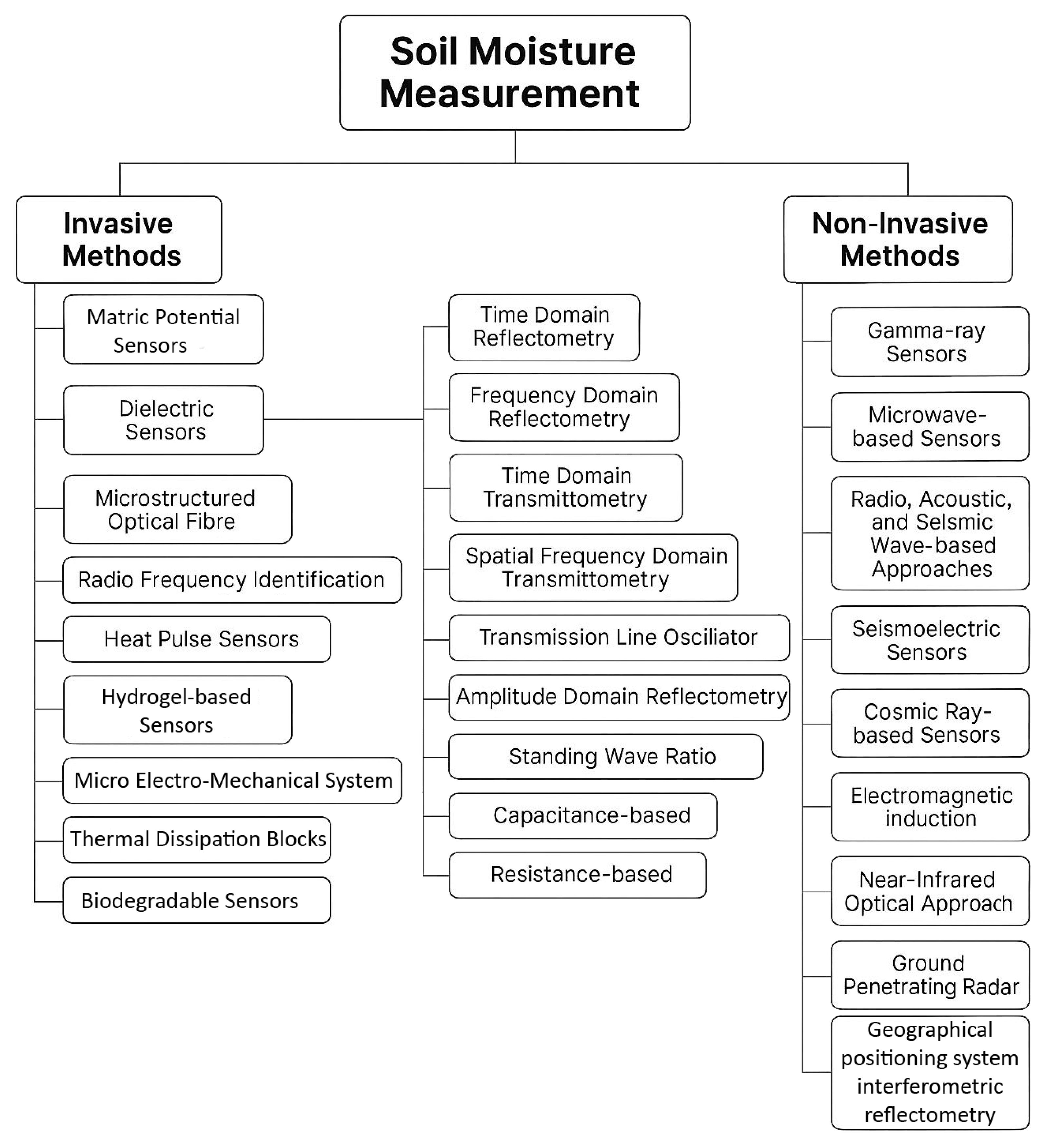
Disclaimer/Publisher’s Note: The statements, opinions and data contained in all publications are solely those of the individual author(s) and contributor(s) and not of MDPI and/or the editor(s). MDPI and/or the editor(s) disclaim responsibility for any injury to people or property resulting from any ideas, methods, instructions or products referred to in the content.

Article Metrics

Citations

Article Access Statistics

Article metric data becomes available approximately 24 hours after publication online.