

- 3.6Impact Factor
- 6.3CiteScore
- 19 daysTime to First Decision
Effects of Wastewater and Pesticides on Soil Fertility and Microbiological Activity
This special issue belongs to the section “Agricultural Soils“.
Special Issue Information
Dear Colleagues,
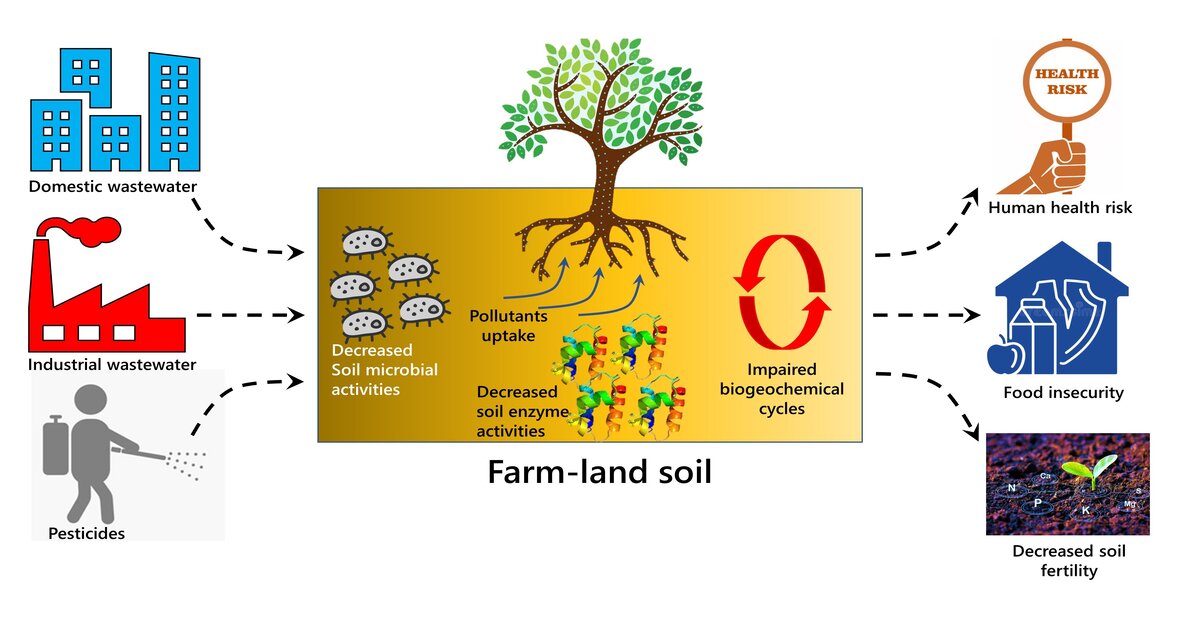
Unsustainable agricultural practices have a huge impact on soil pollution for diverse reasons; among these, the application of wastewater (untreated/treated) for irrigation and the use of excessive pesticides are key causes of soil pollution in agriculture. The consequence of agricultural soil pollution is the loss of soil fertility. It is not surprising that 20 million hectares are estimated to be irrigated with wastewater. Wastewater comprise a cocktail of pollutants that are both naturally occurring or man-made and can include chemical contaminants (e.g., nitrogen, bleach, salts, pesticides, metals, toxins produced by bacteria, and human or animal drugs) and biological contaminants. Wastewater can alter organic matter, soil pH, Ex-Ca capacity in top layers, and build up heavy metals in topsoils. On the other hand, soil microbial activities are inextricably linked with nutrient recycling and the decomposition of dead organic matter, which are the pillars of soil fertility. These contaminants have various adverse effects on the development, morphology, and metabolism of soil microorganisms by causing functional disturbances, protein denaturation, the destruction of cell membrane integrity, etc. In particular, soil microbial enzymes are efficient in revealing ecosystem perturbations, and they are very sensitive to agricultural management practices; thus, soil enzymes are good indicators of biogeochemical cycles, organic matter degradation, and soil remediation processes. Keeping this in view, the latest insights related to the influential effects of wastewater and pesticides on soil fertility and microbiological activities will not only protect soil fertility but also avoid problems of food insecurity and human health risks.
Therefore, this Special Issue calls for articles related to the theme of “wastewaters and pesticides versus soil fertility and microbial activities”. All types of articles, such as original research, opinions, and reviews, are welcome.
Prof. Dr. Naga Raju Maddela
Dr. Binbin Sheng
Guest Editors
Manuscript Submission Information
Manuscripts should be submitted online at www.mdpi.com by registering and logging in to this website. Once you are registered, click here to go to the submission form. Manuscripts can be submitted until the deadline. All submissions that pass pre-check are peer-reviewed. Accepted papers will be published continuously in the journal (as soon as accepted) and will be listed together on the special issue website. Research articles, review articles as well as short communications are invited. For planned papers, a title and short abstract (about 250 words) can be sent to the Editorial Office for assessment.
Submitted manuscripts should not have been published previously, nor be under consideration for publication elsewhere (except conference proceedings papers). All manuscripts are thoroughly refereed through a single-blind peer-review process. A guide for authors and other relevant information for submission of manuscripts is available on the Instructions for Authors page. Agriculture is an international peer-reviewed open access semimonthly journal published by MDPI.
Please visit the Instructions for Authors page before submitting a manuscript. The Article Processing Charge (APC) for publication in this open access journal is 2600 CHF (Swiss Francs). Submitted papers should be well formatted and use good English. Authors may use MDPI's English editing service prior to publication or during author revisions.
Keywords
- wastewater
- pesticides
- soil fertility
- microbial activities
- soil enzymes
- antropogenic agents
- soil pollution
- food insecurity
- human health risk
Benefits of Publishing in a Special Issue
- Ease of navigation: Grouping papers by topic helps scholars navigate broad scope journals more efficiently.
- Greater discoverability: Special Issues support the reach and impact of scientific research. Articles in Special Issues are more discoverable and cited more frequently.
- Expansion of research network: Special Issues facilitate connections among authors, fostering scientific collaborations.
- External promotion: Articles in Special Issues are often promoted through the journal's social media, increasing their visibility.
- e-Book format: Special Issues with more than 10 articles can be published as dedicated e-books, ensuring wide and rapid dissemination.
Published Papers
Get Alerted
Add your email address to receive forthcoming issues of this journal.


