Skip to Content

Agriculture

Agriculture is an international, peer-reviewed, open access journal published semimonthly online. 

Quartile Ranking JCR - Q1 (Agronomy)

All Articles (12,714)

Cotton is one of the most significant economic crops cultivated worldwide. Cottonseed is a strategic reservoir of high-quality plant protein and an underexploited resource for the food and feed industries. To quantify nutritional diversity and identify superior germplasm, we evaluated 312 upland cotton (Gossypium hirsutum L.) accessions over two consecutive growing seasons and characterized 30 agronomic and nutritional traits. Protein content varied widely (29.6–48.8%), with a coefficient of variation of 7.5–11.7% and a two-year mean of 37.0%. Glutamic acid (Glu; 154.0 mg/g) and aspartic acid (Asp; 90.7 mg/g) were the most abundant amino acids, and lysine and arginine were relatively high among essential amino acids. Correlation analysis based on genotype best linear unbiased estimates (BLUEs) showed that most nutritional traits were positively or neutrally associated with key yield-related traits, particularly lint percentage (LP) (e.g., protein vs. LP: r = 0.18, p < 0.01), indicating the feasibility of simultaneous improvement in seed nutritional quality and lint yield potential. Using 29 core traits with complete two-year data, we developed an integrated evaluation framework combining principal component analysis (PCA), grey relational analysis (GRA), TOPSIS, and the analytic hierarchy process (AHP) to rank accessions comprehensively. This framework identified 10 elite germplasm lines with high protein content and favorable yield potential, exemplified by “Xinluzhong 34” (Rank 1; phenotypic comprehensive value, Pi = 0.733). These results provide a quantitative foundation for value-added cottonseed utilization and support breeding strategies aimed at developing cultivars with both high yield and enhanced nutritional quality.

26 February 2026
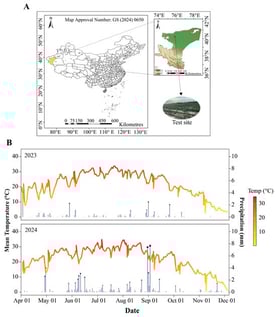
Overview of the experimental site in Yuepuhu County and related experimental data. (A) Geographical location of the experimental sites. (B) Temporal variations in air temperature and precipitation during the 2023–2024 study period (meteorological data, April–December). The size of the blue dots is positively correlated with the amount of precipitation (larger dots indicate higher precipitation).

Iron ore tailings have been shown to promote the formation of soil aggregate cementing agents through weathering, thereby influencing soil aggregate formation in reclaimed land. However, their mechanism of action under different reclamation methods remains unclear. This study established a field station in the semi-arid region of Northern China to investigate three typical iron ore tailing reclamation methods, including topsoil blending type (DT), sublayer moisture conservation type (JT), and thick-layer tailings type (FT), with adjacent farmland as the control (CK). The analysis of soil organic carbon (SOC) components, soil inorganic carbon (SIC), iron/aluminum oxides, and aggregate composition and stability in the reclaimed soils revealed the evolution patterns of cementing materials and the potential mechanisms driving aggregate formation. The results indicate that the reclamation process promotes the weathering of tailings, with a significant increase in free iron oxide (Fed) content ranging from 19.09% to 41.93%. Iron oxides released from iron ore tailings influenced the reclaimed topsoil through plant litter return processes, resulting in a significantly higher amorphous iron oxide (Feo) content compared to CK. Additionally, the content of crystalline aluminum oxide (Alc) in the DT topsoil showed a significant increase, reaching 2.82 g/kg. The variation in organic and inorganic cementing agents significantly influences aggregate composition and stability, with soil particulate organic carbon (POC), crystalline iron oxide (Fec), Alc, and amorphous aluminum oxide (Alo) identified as the primary agents affecting aggregate formation (p < 0.05). After five years of reclamation, the proportion of DT macroaggregates (>0.25 mm) increased to 42.10%, and both the mean weight diameter (MWD) and the geometric mean diameter (GMD) increased significantly to 2.21 mm and 0.43 mm, respectively. In contrast, JT macroaggregates and microaggregates (0.053–0.25 mm) decreased to 26.88% and 29.01%, respectively, and aggregate stability significantly declined. FT macroaggregates and their stability showed no significant difference compared to CK. The study shows that after years of reclamation, both DT and FT reclamation methods have reached normal farmland levels in terms of aggregate formation and stability, making them practical and valuable reclamation solutions.

26 February 2026

Rapid and uniform seedling establishment is critical for the productivity of direct-seeded rice, particularly in late-season cropping systems where sowing frequently coincides with high-temperature stress. Current seed quality assessment relies predominantly on the Standard Germination Test (SGT); however, this method, conducted under optimal conditions, often fails to predict field performance in thermally stressful environments. To resolve this discrepancy, this study established a High-Temperature Germination (HTG) protocol optimized specifically for late-season rice. Twenty-three diverse rice genotypes—comprising conventional japonica, indica-japonica hybrids, and indica hybrids—were evaluated using SGT and HTG assays at 35 °C, 38 °C, and 41 °C, incorporating a pre-treatment with trichloroisocyanuric acid (TCCA) to standardize initial seed conditions. Validation was conducted through field trials at two distinct locations in Zhejiang, China. The results demonstrated that while SGT indicated high viability (>85%) for most varieties, it exhibited a poor correlation with field emergence (r < 0.31). In contrast, HTG tests conducted at 38 °C and 41 °C showed reliable predictive validity, yielding highly significant correlations with field establishment (r > 0.70, p < 0.001). Significant genotypic variation was observed: hybrid varieties displayed superior thermotolerance and stable germination even at 41 °C, whereas conventional japonica varieties exhibited marked sensitivity to temperatures exceeding 35 °C. These findings highlight the potential of the HTG assay (specifically at 38 °C or 41 °C) as an effective, cost-efficient, and rapid screening tool. By accurately simulating the acute thermal stress of the sowing-to-emergence window, this method facilitates the identification of climate-resilient germplasm and supports reliable stand establishment in direct-seeded rice production.

26 February 2026

Downy mildew (Plasmopara viticola) poses a major and recurring threat to Greek viticulture, yet existing point-based forecasting models require in-vineyard stations, limiting scalability in fragmented landscapes. This study introduces a spatially explicit model (MeteoGrape) using one fully equipped reference meteorological station plus eight distributed sensors across an 85 km2 area in Kavala, Greece. The model is structured in three phases. In Phase A, a single reference station was paired with eight low-cost distributed sensors to reconstruct hourly temperature and relative humidity data through regression correction and radial basis function interpolation, generating a 342-cell grid at 0.005° resolution. During Phases B and C, deterministic epidemiological rules were applied to simulate oospore development, with accumulated degree-hours and humidity exposure converted into spatial risk classifications. Cross-validation (leave-one-sensor-out) confirms meteorological reliability. The model captured an elevated risk period beginning on 16 May, preceding the regional advisory bulletin (23 May), and mapped the spatial distribution of accumulated risk through late May. Validation supports temporal consistency at the regional scale, while fine-scale spatial accuracy is identified as a subject for future field-based evaluation. The framework demonstrates the feasibility of extending established point-based disease models into spatially explicit risk maps under limited meteorological infrastructure.

26 February 2026

News & Conferences

Issues

Open for Submission

Editor's Choice

Reprints of Collections

Beneficial Microbes for Sustainable Crop Production
Reprint

Beneficial Microbes for Sustainable Crop Production

Editors: Vlad Stoian, Roxana Vidican
Innovative Solutions for Sustainable Agriculture
Reprint

Innovative Solutions for Sustainable Agriculture

From Waste to Biostimulants, Biofertilisers and Bioenergy
Editors: Daniele Del Buono, Giovanni Gigliotti, Alberto Maria Gambelli

Get Alerted

Add your email address to receive forthcoming issues of this journal.

XFacebookLinkedIn
Agriculture - ISSN 2077-0472