Article

Effects of Different Reclamation Methods on Soil Aggregate Cementing Agents and Potential Aggregate Formation Mechanisms

1
College of Land and Environment, Shenyang Agricultural University, Shenyang 110866, China
2
Key Laboratory of Cultivated Land System Protection, Department of Natural Resources of Liaoning Province, Shenyang 110866, China
3
College Resources & Environment, Shanxi Agricultural University, Taiyuan 030031, China
4
Natural Resources Affairs Service Center of Liaoning Province, Shenyang 110032, China
*
Author to whom correspondence should be addressed.
Agriculture 2026, 16(5), 513; https://doi.org/10.3390/agriculture16050513
Submission received: 24 January 2026 / Revised: 20 February 2026 / Accepted: 24 February 2026 / Published: 26 February 2026
(This article belongs to the Section Agricultural Soils)

Abstract

Iron ore tailings have been shown to promote the formation of soil aggregate cementing agents through weathering, thereby influencing soil aggregate formation in reclaimed land. However, their mechanism of action under different reclamation methods remains unclear. This study established a field station in the semi-arid region of Northern China to investigate three typical iron ore tailing reclamation methods, including topsoil blending type (DT), sublayer moisture conservation type (JT), and thick-layer tailings type (FT), with adjacent farmland as the control (CK). The analysis of soil organic carbon (SOC) components, soil inorganic carbon (SIC), iron/aluminum oxides, and aggregate composition and stability in the reclaimed soils revealed the evolution patterns of cementing materials and the potential mechanisms driving aggregate formation. The results indicate that the reclamation process promotes the weathering of tailings, with a significant increase in free iron oxide (Fed) content ranging from 19.09% to 41.93%. Iron oxides released from iron ore tailings influenced the reclaimed topsoil through plant litter return processes, resulting in a significantly higher amorphous iron oxide (Feo) content compared to CK. Additionally, the content of crystalline aluminum oxide (Alc) in the DT topsoil showed a significant increase, reaching 2.82 g/kg. The variation in organic and inorganic cementing agents significantly influences aggregate composition and stability, with soil particulate organic carbon (POC), crystalline iron oxide (Fec), Alc, and amorphous aluminum oxide (Alo) identified as the primary agents affecting aggregate formation (p < 0.05). After five years of reclamation, the proportion of DT macroaggregates (>0.25 mm) increased to 42.10%, and both the mean weight diameter (MWD) and the geometric mean diameter (GMD) increased significantly to 2.21 mm and 0.43 mm, respectively. In contrast, JT macroaggregates and microaggregates (0.053–0.25 mm) decreased to 26.88% and 29.01%, respectively, and aggregate stability significantly declined. FT macroaggregates and their stability showed no significant difference compared to CK. The study shows that after years of reclamation, both DT and FT reclamation methods have reached normal farmland levels in terms of aggregate formation and stability, making them practical and valuable reclamation solutions.

1. Introduction

The accumulation of large volumes of iron ore tailings (IT) from mining operations poses significant challenges, including land occupation and ecological risks [1]. Ecological engineering offers a promising solution by converting these tailings into soil-like substrates for vegetation restoration [2]. Expanding on this approach, using modified tailings as a primary material for soil reclamation in mine areas represents a viable strategy for large-scale tailings utilization [3]. The weathering of iron ore tailings is a fundamental process that enables the development of soil-like physicochemical properties [4]. During weathering, iron/aluminum oxides are generated and act as soil aggregate cementing agents that promote soil aggregation [5]. As the basic structural units of soil, aggregates are crucial for water retention, nutrient cycling, and microbial activity [6]. Therefore, understanding the formation and transformation of aggregates following tailings reclamation is essential for improving soil quality and achieving sustainable ecological restoration.
The primary agents that cement and stabilize aggregates include organic matter, microorganisms, iron/aluminum oxides, and clay particles [7]. The method used for reclaiming iron ore tailings is a major factor influencing these cementing agents. Studies have shown that blending tailings with topsoil at a low ratio (<30%) promotes plant growth. The geochemical activity of rhizosphere microorganisms then drives the weathering of iron-bearing minerals, leading to the formation of amorphous iron oxides (Feo) [8,9]. In these blended substrates, the rhizosphere effect and leaching promote the dissolution of alkaline minerals, while calcium ions released from soil inorganic carbon (SIC) play a crucial role in stabilizing organic matter [10,11]. Furthermore, placing a layer of tailings beneath the topsoil can regulate water and gas exchange, which over time significantly increases the soil organic carbon (SOC) content in the overlying reclaimed layer [3]. However, different tailings reclamation methods significantly affect soil water retention and root development [8], potentially leading to divergent pathways in the formation of soil aggregate cementing agents. Understanding the evolution of reclaimed soils requires a systems perspective to comprehensively analyze the interactions among soil properties [12]. Therefore, investigating how soil organic and inorganic cementing agents change under different iron ore tailings reclamation methods is essential.
Organic and inorganic cementing agents interact in complex ways to jointly influence aggregate formation. As the primary organic cementing agent, SOC promotes aggregation by forming complex polymers that adsorb onto mineral surfaces or by binding directly to minerals via covalent bonds [13]. Among inorganic agents, SIC and iron/aluminum oxides are also crucial. SIC can act as a calcium bridge between mineral particles, becoming enriched in newly formed aggregates and enhancing their stability in remediated soils [14]. Iron/aluminum oxides, in contrast, function through distinct mechanisms, which primarily involve directly bridging clay particles and electrostatic adsorption to negatively charged clays and organic matter [15]. Furthermore, they interact with organic matter to form metal–organic complexes, which significantly enhance aggregate stability [16]. However, the dominant cementing agents and the fundamental processes driving aggregate evolution are likely to differ across reclamation methods, and these mechanisms require further investigation.
The study was conducted in an iron ore mining reclamation area within the semi-arid region of northern China, where zonal cinnamon soil is the predominant soil type [17]. The soils in this region typically contain a certain amount of primary or secondary carbonates (SIC), and their role in aggregate formation has been a topic of interest [18]. However, compared to carbonates, the content of iron/aluminum oxides and organic matter in the local cinnamon soils is generally low. The use of iron ore tailings, which are rich in iron/aluminum oxides, for reclamation in this region is expected to significantly alter the soil cementing substance content through exogenous input and weathering processes, thereby affecting aggregate development. Currently, the changes in cementing substances and the evolution of aggregates under different reclamation methods remain to be clarified. Based on this, we propose the hypothesis that different reclamation methods influence the input and morphological transformation of iron ore tailings weathering products into the topsoil, and that these interact with organic cementing materials, leading to variations in aggregate composition and stability. To test this hypothesis, our study investigated the changes in soil carbon, iron, and aluminum components, as well as aggregate composition and stability, under three typical iron ore tailings reclamation methods. The study aims (1) to clarify the variation patterns of organic and inorganic cementing agents within aggregates under different reclamation methods, and (2) to reveal the potential evolutionary pathways of aggregates driven by these agents.

2. Materials and Methods

2.1. Experimental Site

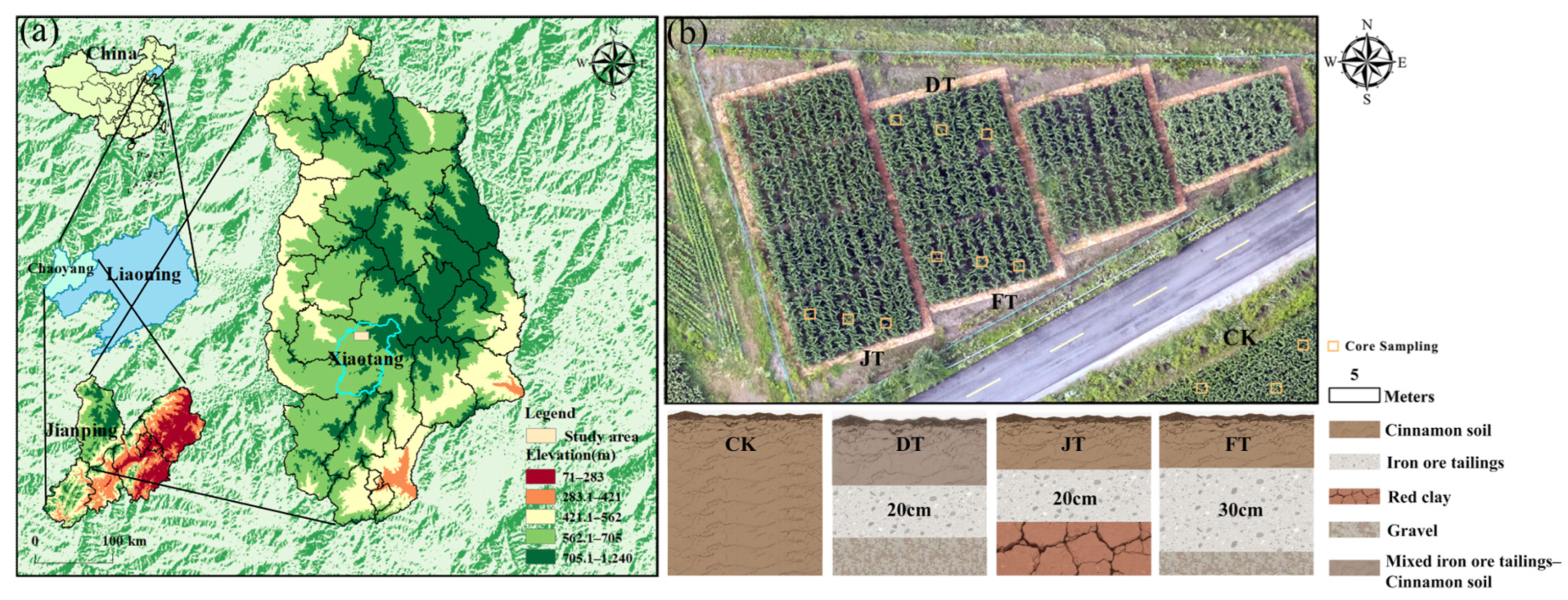
The study site was established in May 2020 in Jianping County, Chaoyang City, Liaoning Province, China (119°29′–119°41′ E, 41°35′–41°45′ N) (Figure 1a). This region has a northern temperate continental monsoon climate, with a mean annual temperature of 7.6 °C and annual precipitation of 614.7 mm. The experimental materials comprised cinnamon soil (according to the Chinese Soil Taxonomy; equivalent to Cambisols in the World Reference Base (WRB) system) [19], iron ore tailings, and red clay, all sourced from the iron ore mining area. Their fundamental physicochemical properties are provided in Table 1. The cinnamon soil and red clay were collected from the topsoil and deep soil layers, respectively, which were exposed during mining operations. The iron ore tailings are sandy particles generated from the dry stacking process of iron ore beneficiation. Chemically, they are composed primarily of SiO2 (67.83%), Al2O3 (10.56%), Fe2O3 (8.91%), and CaO (4.38%). The heavy metal content in the tailings is below the limits stipulated by China’s “Risk Control Standards for Soil Pollution in Agricultural Land” (GB 15618-2018) [8].

2.2. Experimental Design

This study was conducted at an abandoned river channel in the mining area of Jianping County, where crushed stone from mining stripping was used as the base layer for agricultural construction, and the experimental materials were placed above it. The reclamation was carried out using an in situ leveling method. Due to the region’s soil being relatively poor, it is suitable for testing different reclamation methods. A total of 10 reclamation methods were set up for the experimental plots. Each experimental plot had an area of 12 × 6 m, with 3 replicate subplots of 4 × 6 m each. The entire experimental design followed an annual maize (Zea mays L.) planting system, using the same planting and management practices as the local conventional farming methods. After 5 years of reclamation, three reclamation structures with good maize growth and maize yields reaching normal farmland levels (9.02 t/ha) were selected as the experimental objects, with surrounding farmland selected as the control. The three treatments and their control group configurations are shown in Figure 1b: (1) Adjacent farmland CK: No tailings involved in reclamation, using conventional farmland cinnamon soil as the control; (2) Topsoil blending type DT: 20 cm of iron ore tailings laid over gravel, with 20 cm of cinnamon soil and 5 cm of iron ore tailings laid on top, mixed during tilling; (3) Sublayer moisture conservation type JT: 20 cm of red clay used as a water retention layer to replace gravel, with 20 cm of iron ore tailings and 20 cm of cinnamon soil laid above it; (4) Thick-layer tailings type FT: 30 cm of iron ore tailings laid over gravel, with 20 cm of cinnamon soil placed on top. The basic physicochemical properties of the topsoil and plant root characteristics for each treatment are shown in Table 2.

2.3. Soil Sampling and Analyses

Soil samples were collected in October 2024, prior to maize harvest in the fifth year of reclamation. To ensure sample representativeness, we performed stratified sampling from three replicate subplots of different treatments based on the layers of reclamation materials (topsoil and tailings layers). Additionally, three sampling points (0–20 cm) were selected from the control farmland to serve as background controls. All sampling points were mixed using the five-point sampling method. The collected topsoil and tailings samples were used to measure the contents of various cementing substances. These consisted of organic agents, including soil organic carbon (SOC), particulate organic carbon (POC), and mineral-associated organic carbon (MAOC), along with inorganic agents, such as soil inorganic carbon (SIC), free iron/aluminum oxides (Fed, Ald), amorphous iron/aluminum oxides (Feo, Alo), crystalline iron/aluminum oxides (Fec, Alc), and complex iron/aluminum oxides (Fep, Alp). From the soil samples collected at each site (0–20 cm), some undisturbed soil samples were sealed in plastic boxes for subsequent aggregate fractionation analysis to assess the impact of different reclamation methods on soil aggregate stability. In addition, initial iron ore tailings samples (IT) were collected from the stockpile of unreclaimed tailings as a control.
Soil aggregate size distribution and stability were analyzed using the wet-sieving method [7]. First, the collected soil samples were passed through a 10 mm sieve. Then, 50 g of the soil sample was placed on a nested sieve with mesh sizes of 0.25 mm and 0.053 mm, and soaked in deionized water for 5 min. The sieve was then mechanically oscillated 50 times at a 3 cm amplitude for 2 min. Macroaggregates (>0.25 mm), microaggregates (0.053–0.25 mm), and silt and clay fractions (<0.053 mm) were collected from the corresponding sieves and the water column. All fractions were oven-dried at 60 °C and weighed. Their mass was expressed as a percentage of the total sample weight. The mean weight diameter (MWD) and geometric mean diameter (GMD), which characterize aggregate stability, were calculated based on the mean diameter ( x ¯ i ) and mass percentage ( w i ) of aggregates in each size fraction, using the following formulas:
MWD = i = 1 n w i x ¯ i
GMD = exp ( i = 1 n w i ln x ¯ i )
The morphology of soil aggregates was observed after classification by dry sieving. Following natural air-drying, the collected soil samples were first passed through a 10 mm sieve. Subsequently, a 100 g subsample was sieved using a Retsch AS 200 automatic sieve shaker (Retsch GmbH, Haan, Germany). The sieving parameters were set to an amplitude of 2.5 mm, a vibration frequency of 50 Hz, and a duration of 2 min [20]. Aggregates from each size fraction were then examined with a GeminiSEM 300 scanning electron microscope (ZEISS, Oberkochen, Germany) at an accelerating voltage of 3.00 kV. The sample stage was scanned in an “S” pattern during imaging. Morphological features were observed, and elemental composition was analyzed using an attached energy dispersive spectroscopy (EDS) spectrometer (Oxford Instruments plc, High Wycombe, UK). Observations were conducted at magnifications of 50×, 200×, 1000×, 2000×, and 5000×.
The contents of organic and inorganic cementing agents in the soil samples were determined using established laboratory procedures. SOC was quantified by the high-temperature external heating potassium dichromate oxidation method [21]. POC and MAOC were separated and determined using a combination of wet sieving, particle size fractionation, and the potassium dichromate oxidation method [22]. For inorganic agents, SIC was measured by the manometric method [23]. Various forms of iron and aluminum oxides were sequentially extracted and their concentrations determined by inductively coupled plasma optical emission spectrometry (ICP-OES 5800, Agilent Technologies, Santa Clara, CA, USA). Specifically, Fed and Ald were extracted by the dithionite-citrate-bicarbonate (DCB) method [24]. Feo and Alo were extracted using acid ammonium oxalate [25]. Fep and Alp were extracted with sodium pyrophosphate solution [26]. Finally, the content of Fec and Alc was calculated as the difference between the free and amorphous forms [27].

2.4. Data Analysis

This study used Origin 2024 to generate graphs, and statistical analyses were performed using SPSS 26.0 and R 4.5.1. To ensure the validity of hypothesis testing, outlier detection was conducted first, followed by assessments of data normality and homogeneity of variance using the Shapiro–Wilk test and Levene’s test, respectively. Differences between reclamation treatments were compared using one-way analysis of variance (ANOVA), with Tukey’s HSD post hoc test applied for mean separation. The significance level was set at p < 0.05; values of p < 0.01 and p < 0.001 were considered as representing higher levels of significance. To identify key cementing substances influencing the formation of different aggregate size fractions, a random forest model was constructed in R using the “randomForest” package (v. 4.7-1.2), and variable importance was evaluated using the %IncMSE index. For variables with significant correlations, univariate linear regression was further used to describe the direction and strength of the relationship, reporting the R2 and p-values of the regression.

3. Results

3.1. Distribution of Cementing Agents in Iron Ore Tailings

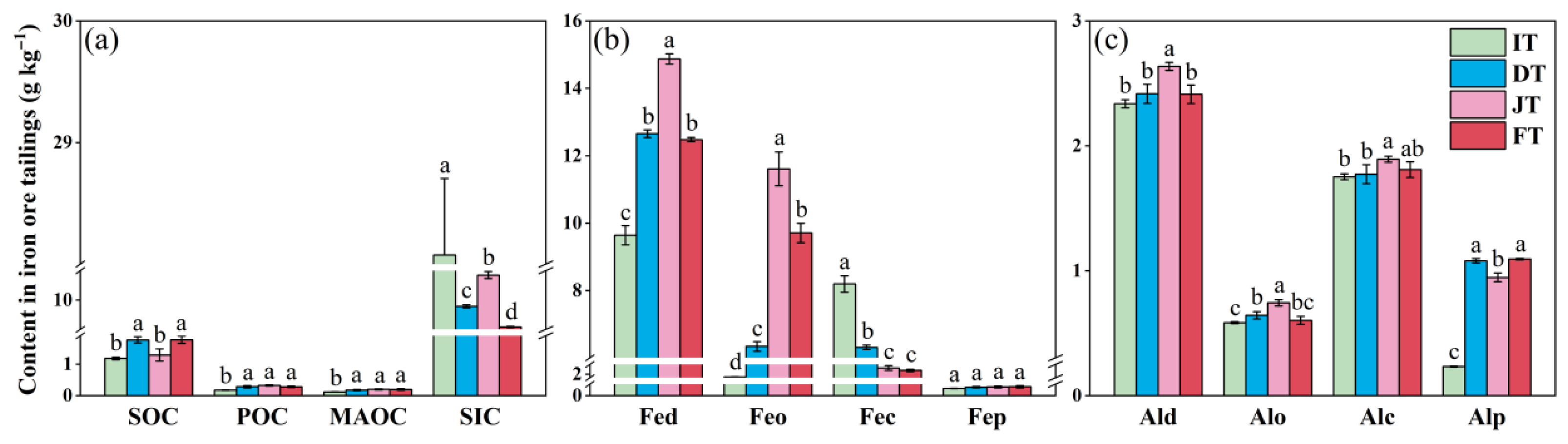
The distribution of carbon fractions revealed that the iron ore tailings (ITs) were characterized by high SIC (28.08 g/kg) and low SOC (1.18 g/kg) contents. When used in reclamation, the SIC content decreased significantly across all treatments, declining to 15.93, 8.48, and 3.54 g/kg under JT, DT, and FT, respectively. Conversely, SOC content increased markedly, reaching 1.77, 1.77, and 1.29 g/kg in DT, FT, and JT, with DT and FT showing significantly higher values than IT. Both POC and MAOC components of SOC also increased substantially in the reclaimed tailings (Figure 2a).
Analysis of iron fractions indicated that the Fed content in the IT was 9.64 g/kg. After reclamation, Fed content increased significantly to 14.87, 12.65, and 12.48 g/kg under JT, DT, and FT, respectively, with JT being significantly higher than DT and FT. The Feo component increased markedly, following the order JT (11.61 g/kg) > FT (9.71 g/kg) > DT (6.34 g/kg) > IT (1.45 g/kg). In contrast, the Fec component decreased significantly, in the order IT (8.19 g/kg) > DT (6.31 g/kg) > JT (3.26 g/kg) > FT (2.77 g/kg). Among these, JT and FT were significantly lower than DT. The Fep fraction remained largely unchanged (Figure 2b).
Regarding aluminum fractions, the Ald content in the IT was low (2.34 g/kg). Reclamation significantly increased Ald content to 2.63, 2.41, and 2.41 g/kg under JT, DT, and FT, respectively, with JT being significantly higher than the other two treatments. Both Alo and Alc showed a synchronous increasing trend. In contrast, the Alp fraction increased significantly across all treatments, with JT (0.95 g/kg) being significantly lower than both DT (1.08 g/kg) and FT (1.09 g/kg). All reclaimed treatments had higher Alp than IT (0.23 g/kg) (Figure 2c).

3.2. Distribution of Cementing Agents in Topsoil

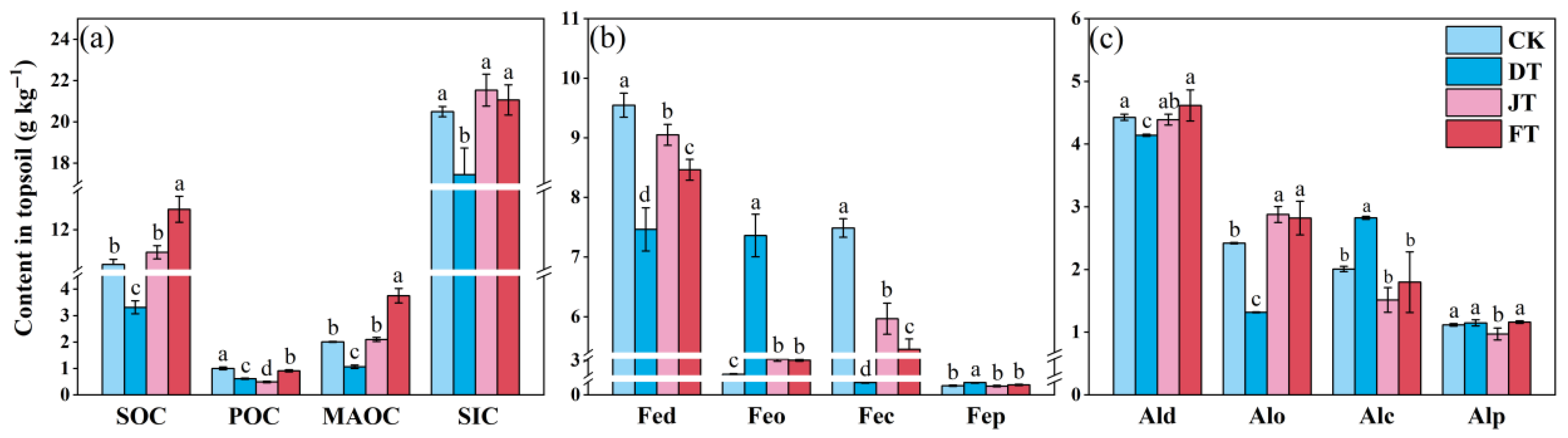
In terms of carbon forms, farmland topsoil (CK) exhibited high SIC (20.50 g/kg) and relatively low SOC (10.25 g/kg). When iron ore tailings were applied as a 20 cm layer (JT) or a 30 cm layer (FT) above the topsoil, SOC content increased significantly, following the order FT (13.03 g/kg) > JT (10.86 g/kg) > CK (10.25 g/kg). Both reclamation methods also led to a significant rise in the MAOC fraction of SOC, whereas the POC fraction decreased markedly. FT consistently showed significantly higher values than JT. In contrast, SIC content in the reclaimed topsoil did not exhibit a consistent trend. When iron ore tailings were applied as a 20 cm layer beneath the blended soil (DT), both SOC and SIC contents decreased significantly, to 3.33 g/kg and 17.44 g/kg, respectively. Correspondingly, both POC and MAOC components of SOC also declined significantly, to 0.61 g/kg and 1.06 g/kg (Figure 3a).
For iron forms, the Fed content in farmland topsoil was 9.55 g/kg. After iron ore tailings were applied beneath the topsoil, Fed content decreased significantly to 9.05, 8.46, and 7.46 g/kg under JT, FT, and DT treatments, respectively. The Feo fraction, however, increased significantly in the reclaimed topsoil, in the order DT (7.36 g/kg) > JT (3.08 g/kg) > FT (3.01 g/kg) > CK (2.06 g/kg). In contrast, the Fec fraction decreased significantly, following the sequence CK (7.49 g/kg) > JT (5.60 g/kg) > FT (5.45 g/kg) > DT (0.10 g/kg). The Fep fraction only increased significantly under the DT treatment, reaching 0.10 g/kg, while no clear trend was observed under other treatments (Figure 3b).
Regarding aluminum forms, the Ald content in the topsoil was 4.43 g/kg. When iron ore tailings were applied beneath the topsoil under the JT and FT treatments, the Ald content in the topsoil showed no significant change. However, the Alo fraction increased markedly, with the sequence being JT (2.87 g/kg) > FT (2.82 g/kg) > CK (2.42 g/kg). In contrast, under the DT treatment, Ald content in the topsoil decreased significantly to 4.14 g/kg, accompanied by a notable decrease in the Alo fraction to 1.32 g/kg, while the Alp fraction remained largely unchanged (Figure 3c).

3.3. Aggregate Composition and Stability in Topsoil

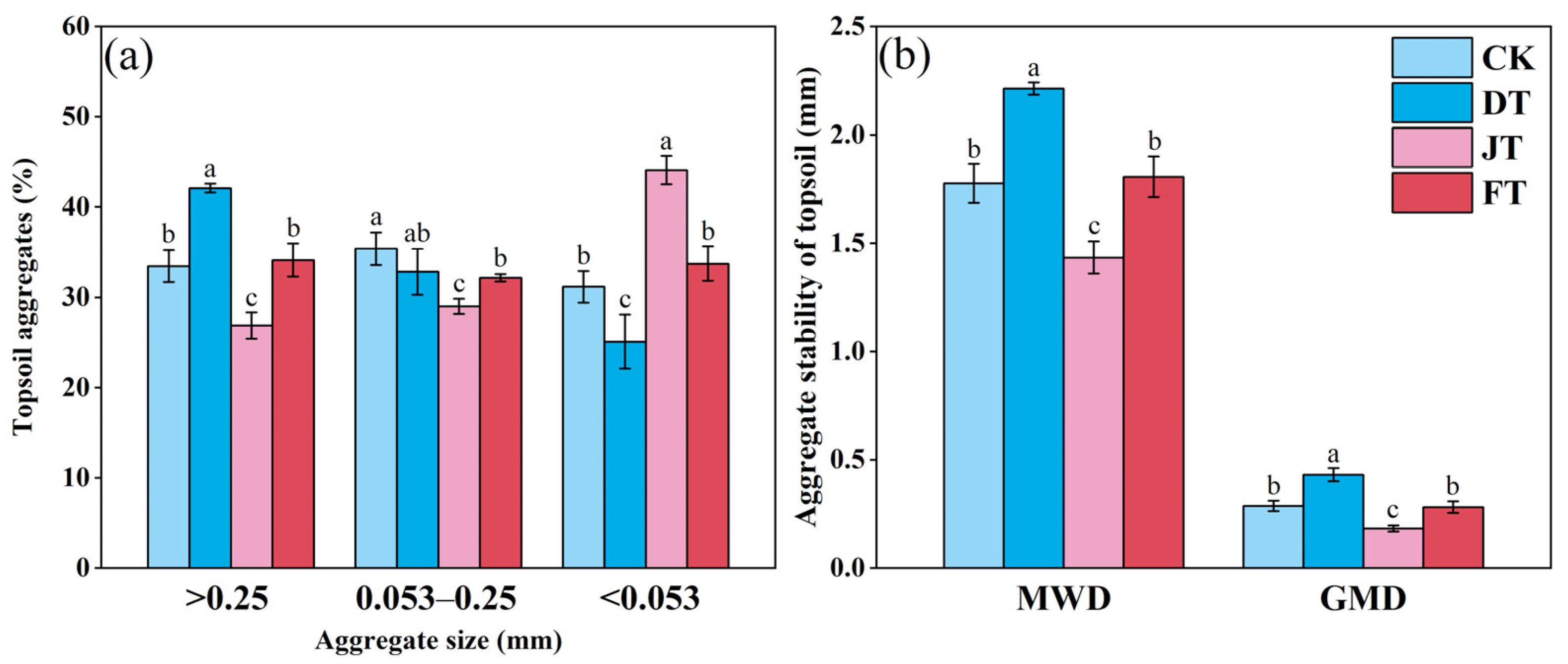
The aggregate composition of farmland topsoil (CK) was dominated by microaggregates, which accounted for 35.38%. After the application of iron ore tailings under the JT and FT treatments, the microaggregate content in the topsoil decreased significantly to 32.15% and 29.01%, respectively. In contrast, both reclamation methods led to a significant increase in the silt and clay fraction, which rose to 44.10% under JT and 33.73% under FT, with JT showing a significantly greater increase than FT. When iron ore tailings were applied under the DT treatment, the content of macroaggregates in the topsoil increased significantly to 42.10%, while the silt and clay fraction decreased significantly to 25.08%. The microaggregate content, however, remained largely unchanged (Figure 4a).
The MWD of the CK was 1.78 mm. After the application of iron ore tailings under the DT and FT treatments, the MWD of the topsoil increased to 2.21 mm and 1.81 mm, respectively, with DT being significantly higher than FT. In contrast, under the JT treatment, the MWD decreased significantly to 1.43 mm. A similar trend was observed for the GMD. Specifically, the DT treatment significantly improved topsoil aggregate stability, whereas the JT treatment markedly reduced it. The FT treatment showed no significant difference in aggregate stability compared to CK (Figure 4b).

3.4. Aggregate Morphological Characteristics and Elemental Composition in Topsoil

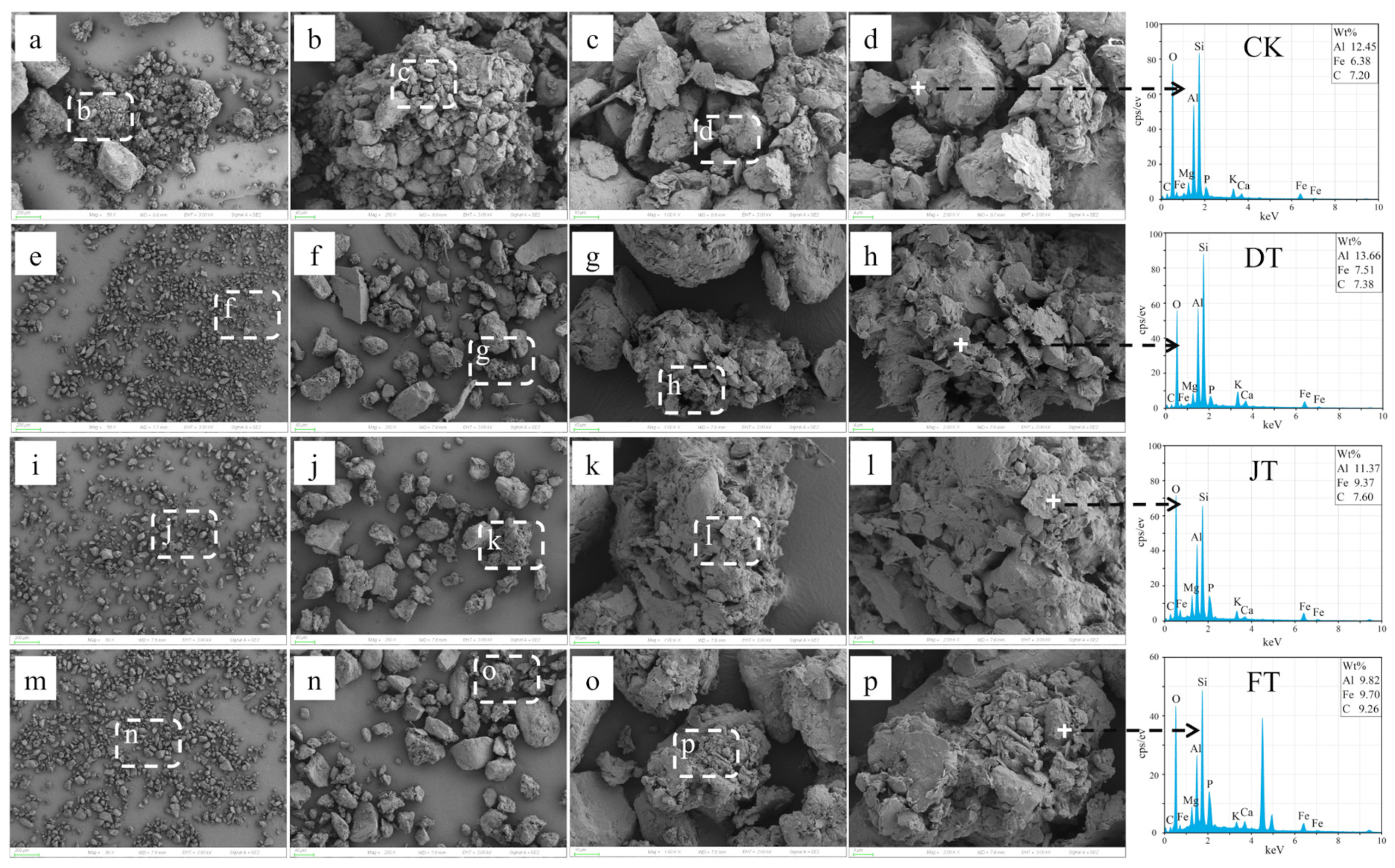
The SEM results indicate significant differences in the surface morphology and pore structure of macroaggregates in the topsoil under different treatments (Figure 5). The aggregates in the farmland topsoil (CK) exhibit a well-preserved shape, with a continuous fine-grained matrix covering the particles, arranged tightly, and primarily microporous pores. In the DT treatment, although relatively stable aggregates formed, the internal particle arrangement is uneven, with relatively open inter-particle pores, showing typical characteristics of the structural reconstruction stage. The aggregates in the JT treatment were loose, with enhanced fissure connectivity, weaker cementing material continuity, and loosely connected particles. In contrast, the FT treatment aggregates have the most continuous fine-grain coating, tighter particle connections, significantly reduced fissures, and the overall structure is the most compact.
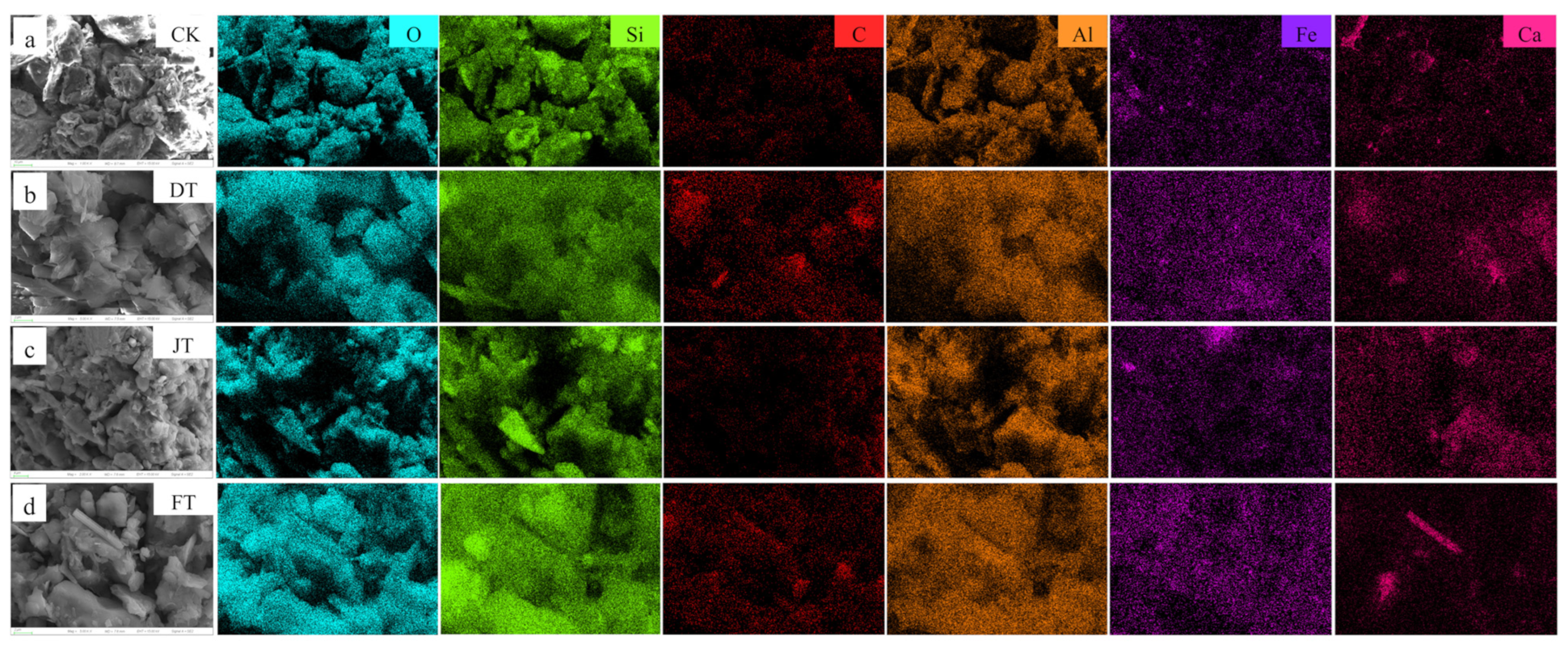
The EDS results show that the dominant elemental composition in all treatments is O-Si-Al (Figure 6). The differences between treatments are mainly reflected in the enrichment intensity of Fe and C and their spatial configuration. In the farmland topsoil (CK), Fe and C signals are generally weak and diffusely distributed. In the DT treatment, the Al-related matrix is more continuous, Fe signals are enhanced compared to CK, but the spatial co-location of C and Fe remains not prominent. In contrast, the FT and JT treatments show distinct differentiation in the surface distribution characteristics of C and Fe. In the FT treatment, the spatial co-location of C and Fe is stronger, with a higher overlap of high value areas, while in the JT treatment, the overlap of high value areas of C and Fe decreases, and their spatial distribution tends to separate.

3.5. Main Cementing Substances of Soil Aggregates

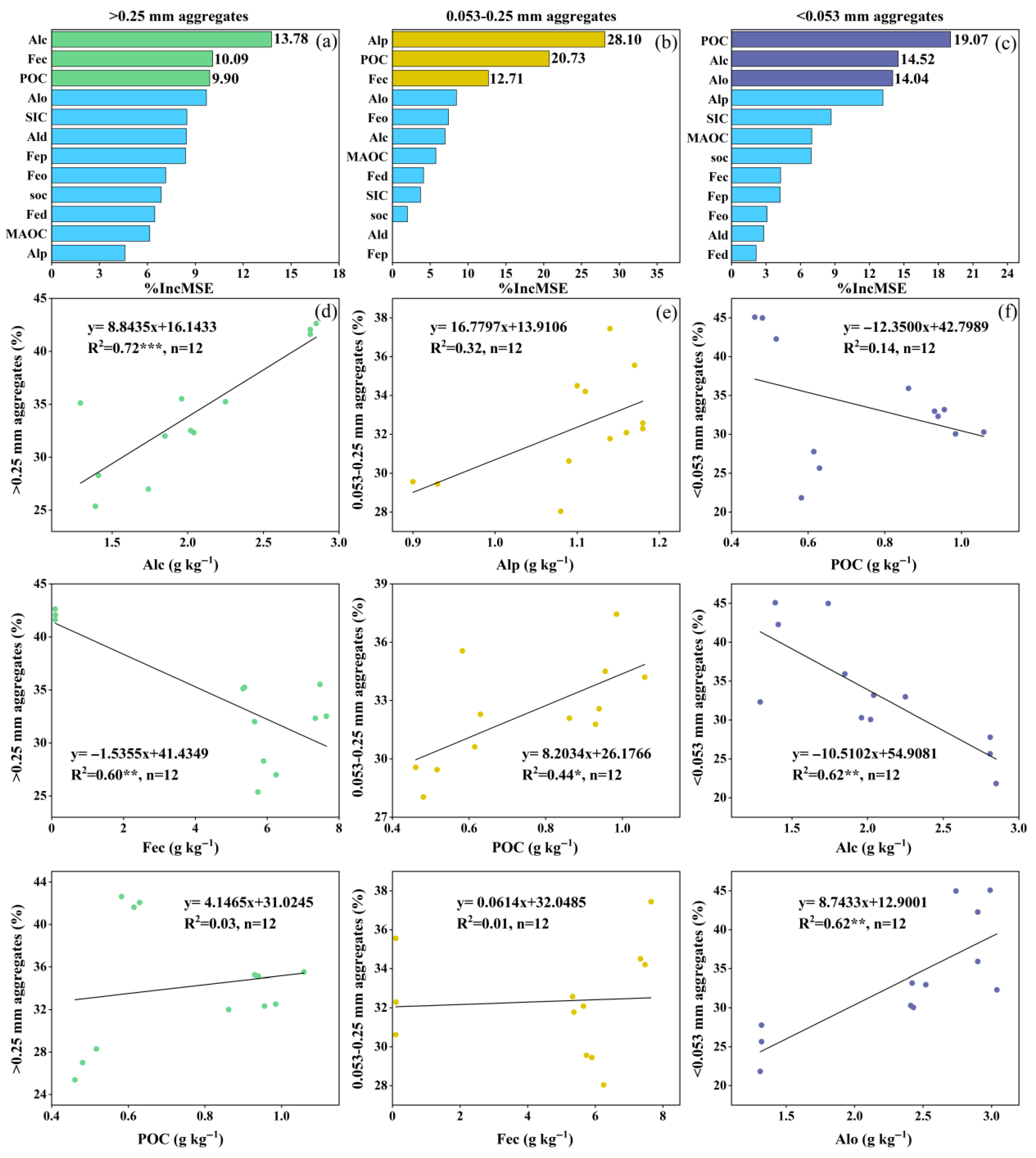
Combined with random forest and regression analysis, it is evident that there are significant differences in the dominant cementing substances and their effect directions corresponding to different aggregate size fractions (Figure 7). The main cementing substances influencing the formation of macroaggregates are Alc, Fec, and POC, with relative contributions of 13.78%, 10.09%, and 9.90%, respectively. Macroaggregates show a significant positive correlation with Alc (R2 = 0.72, p < 0.001), a significant negative correlation with Fec (R2 = 0.60, p < 0.01), and no significant correlation with POC. The main cementing substances influencing the formation of microaggregates are Alp, POC, and Fec, with only a significant positive correlation between microaggregates and POC (R2 = 0.44, p < 0.05), and a relative contribution of 20.73%. In the silt and clay fractions, POC, Alc, and Alo were identified as the main cementing substances, with relative contributions of 19.07%, 14.52%, and 14.04%, respectively. The silt and clay fractions show a significant negative correlation with Alc (R2 = 0.62, p < 0.01), a significant positive correlation with Alo (R2 = 0.62, p < 0.01), and no significant correlation with POC.

4. Discussion

4.1. Variation in Soil Aggregate Cementing Agents Under Different Reclamation Methods

Iron ore tailings, which are a valuable reclamation material, are rich in metal oxides such as Fe2O3 and Al2O3 [8]. When iron ore tailings were applied beneath the topsoil as 20 cm (JT) or 30 cm (FT) layers, these tailings weather through microbial activity (e.g., sulfur-oxidizing bacterium), releasing iron and aluminum ions [28]. However, the alkaline environment of the tailings (pH = 8.67, Table 1) inhibits the mobilization of aluminum oxides [29], resulting in iron oxides being the dominant released metallic elements. Consequently, the Fed content increased to 14.87 g/kg under JT and 12.48 g/kg under FT (Figure 2b,c). The JT treatment led to significantly higher Fed content than FT, which can be attributed to the underlying red clay layer that retarded water infiltration, while frequent redox fluctuations further enhanced iron oxide transformation [30].
These released iron ions are taken up by maize roots and subsequently returned to the topsoil via plant litter [31,32]. A portion of the newly formed iron oxides coprecipitates with SOC to form stable iron (Fe)-organic carbon (OC) complexes (Fe-OC) [33], which physically protect SOC from microbial decomposition [34,35,36]. This mechanism is reflected in the elevated SOC content in the topsoil under JT and FT treatments, reaching 10.87 g/kg and 13.03 g/kg, respectively (Figure 3a). Stimulated by the priming effect of SOC, microorganisms continuously decomposed POC into MAOC, whereby a consistent pattern was observed under both reclamation methods, with a significant overall decrease in POC content and a significant increase in MAOC content. This finding aligns with Yu et al. (2025) [37], who reported that exogenous organic matter inputs enhance microbial-driven POC decomposition. Another portion of the newly formed iron oxides adsorbs onto SOC surfaces via ligand exchange or cationic bridging [38], with their crystallization process being suppressed [15,34]. This explains the observed decrease in Fec content and the concurrent increase in Feo.
Notably, under the DT treatment, where a 20 cm tailings layer was placed beneath the blended topsoil, the iron ore tailings weathered within the topsoil, releasing not only iron but also aluminum ions [28]. As in the JT and FT treatments, some iron oxides formed Fe-OC, while others were stabilized in amorphous forms due to SOC adsorption. However, the incorporation of tailings increased the non-capillary porosity (NCP = 0.83%, Table 2) of the topsoil, enhancing leaching [39]. This promoted the downward migration of most cementing agents, leading to significant decreases in SOC, Fed, and SIC contents.

4.2. Effects of Different Reclamation Methods on Aggregate Formation

Driven by the dynamic changes in cementing agents from iron ore tailings, aggregates in the reclaimed topsoil undergo continuous cycling between agglomeration and disintegration. Under the JT and FT treatments, iron oxides released from the tailings are returned to the topsoil via maize root litter [28,31,32]. A portion of the newly introduced iron oxides enhances SOC stability and increases SOC content through coprecipitation with organic matter (Figure 3a). This process facilitates the binding of silt and clay fractions and microaggregates, promoting their aggregation into macroaggregates [40,41,42]. However, the priming effect induced by new SOC inputs enhanced the microbial decomposition of existing SOC [37], thereby causing the disintegration of macroaggregates into silt and clay fractions along with microaggregates [43]. Simultaneously, another portion of the newly introduced iron oxides is adsorbed onto SOC surfaces, inhibiting their crystallization [15,34]. This promotes the conversion of Fec to Feo (Figure 3b), further accelerating the breakdown of macroaggregates [44]. In the JT treatment, frequent redox cycles enhance microbial decomposition and the transformation of cementing agents. As a result, aggregate disintegration in the JT topsoil significantly exceeded aggregation, leading to a reduction in macroaggregate content to 26.89% and an increase in the silt and clay fraction to 44.10% (Figure 4a). In contrast, no significant differences were observed between the FT treatment and the farmland control (CK).
Scanning electron microscopy (SEM) and micro-area elemental analysis provided supporting evidence for these morphological changes (Figure 5 and Figure 6). Macroaggregates under the FT treatment exhibited a compact structure with well-cemented particles, and the spatial distributions of C and Fe elements were highly consistent, with overlapping peak positions. This provides direct microscopic evidence that Fe-OC synergistic cementation promotes aggregate formation. In contrast, JT-treated macroaggregates showed loose structures with visible cracks and distinct spatial segregation of C and Fe elements. Furthermore, the microaggregate content decreased to 29.01% and 32.15% under JT and FT, respectively, indicating that this fraction was primarily involved in the aggregation process. It is noteworthy that the fragmentation of macroaggregates under the JT treatment was accompanied by a significant decrease in aggregate stability. In contrast, the FT treatment, which showed no significant change in macroaggregate content, maintained stable aggregates (Figure 4b).
In the DT treatment, macroaggregate fragmentation into silt and clay fractions and microaggregates also occurred, driven by the SOC priming effect and iron oxide activation. However, the degree of fragmentation was less severe, as primary cementing agents, including SOC, SIC, and Fed, were largely leached downward. At the same time, aluminum oxides, whose crystallization is less affected by organic matter, continuously generated Alc, which further promoted the aggregation of macroaggregates [45] (Figure 5e–h). Ultimately, under the DT reclamation method, the aggregation of soil aggregates in the topsoil significantly exceeded their fragmentation. This was reflected in an increase in macroaggregate content to 42.10% and a decrease in the silt and clay fraction to 25.08%. Along with the continuous formation of macroaggregates, aggregate stability also increased significantly under the DT treatment.

4.3. Conceptual Models of Soil Aggregate Formation Under Different Reclamation Methods

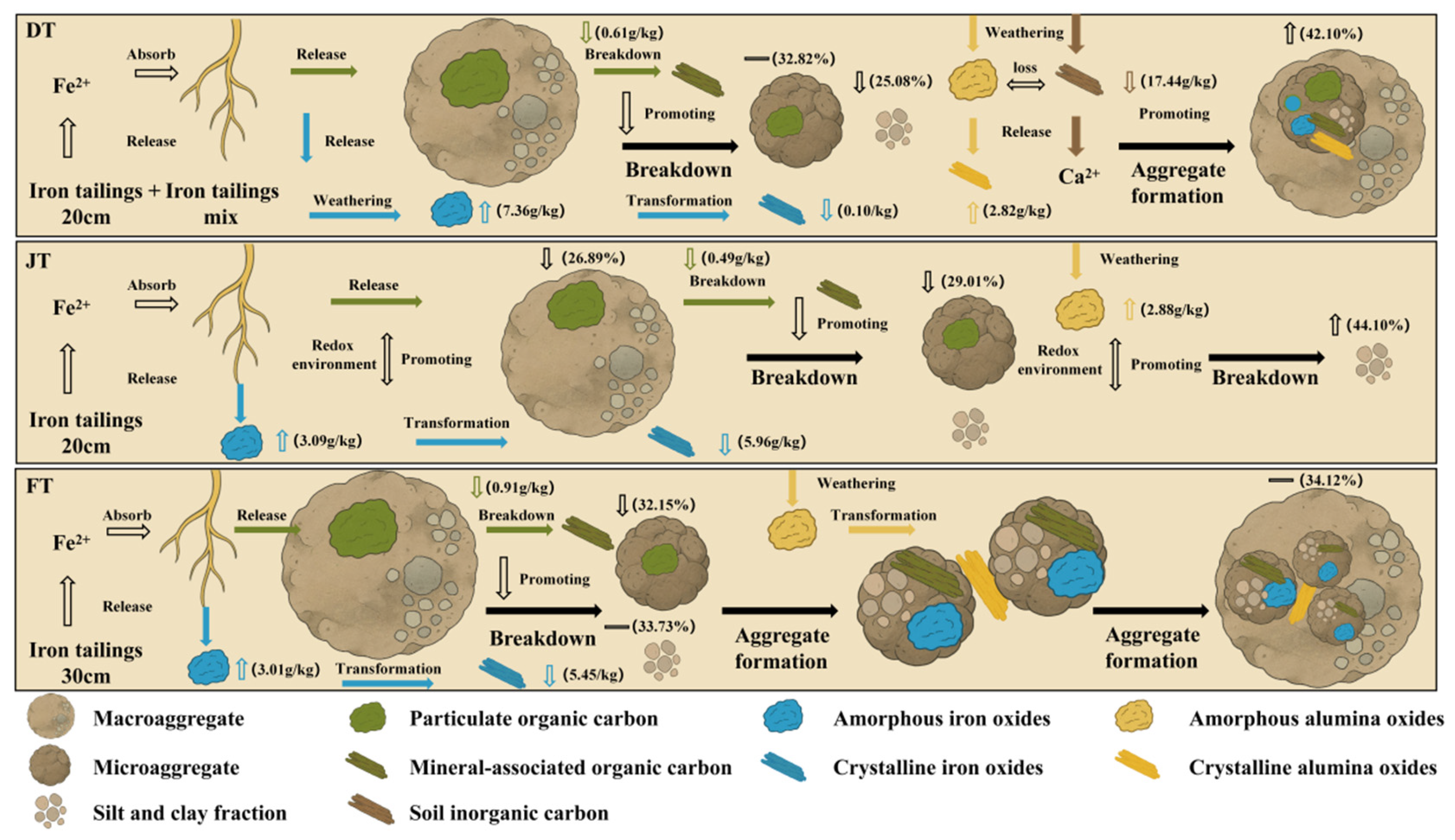
Based on the above analysis, a conceptual model was developed to illustrate the potential evolutionary pathways of topsoil aggregates during tailings reclamation (Figure 8), which can be summarized as follows:
(1) In farmland topsoil (CK), microaggregates constituted the dominant fraction, accounting for 35.38%. Multiple types of cementing agents were present, though their concentrations were relatively low, including SOC at 10.25 g/kg, SIC at 20.50 g/kg, Fed at 9.55 g/kg, and Ald at 4.43 g/kg.
(2) When iron ore tailings were applied as a 20 cm layer beneath the blended soil (DT), the crystallization of aluminum oxides increased Alc content in the topsoil to 2.82 g/kg (relative contribution, 13.78%), promoting the continuous aggregation of silt and clay fractions into macroaggregates (p < 0.001). Concurrently, the activation of iron oxides (relative contribution, 10.09%) reduced the Fec content to 0.10 g/kg, enhancing the aggregation of microaggregates into macroaggregates (p < 0.01). In contrast, the priming effect of SOC (relative contribution, 20.73%) drove a decrease in POC to 0.61 g/kg, resulting in the fragmentation of macroaggregates into microaggregates and silt and clay fractions (p < 0.05). Overall, aggregation processes strongly outweighed fragmentation, resulting in an increase in macroaggregate content to 42.10% and a decrease in the silt and clay fraction to 25.08%.
(3) When iron ore tailings were applied as 20 cm (JT) or 30 cm (FT) layers beneath the topsoil, iron oxide activation also occurred in the reclaimed topsoil. The Fec content decreased to 5.96 g/kg under JT and 5.45 g/kg under FT, promoting the aggregation of microaggregates into macroaggregates. Meanwhile, driven by the SOC priming effect, POC content decreased to 0.49 and 0.91 g/kg, respectively, resulting in the continuous fragmentation of macroaggregates into microaggregates and silt and clay fractions. Both treatments exhibited a cyclic process of microaggregate coalescence and macroaggregate fragmentation, leading to a decrease in microaggregate content to 29.01% for JT and 32.15% for FT. However, in the JT treatment, fragmentation strongly exceeded aggregation, reducing macroaggregate content to 26.89% and increasing the silt and clay fraction to 44.10%. In the FT treatment, fragmentation and aggregation remained in relative balance.
Figure 8. Conceptual models of soil aggregate formation under different reclamation methods. Black, green, brown, blue, and yellow arrows represent changes in aggregates, soil organic carbon, soil inorganic carbon, iron oxides, and aluminum oxides, respectively.
Agriculture 16 00513 g008
This study, based on a five-year field experiment on iron ore tailings reclamation in a semi-arid region, revealed the differential responses of aggregate composition, stability, and cementing substances under different reclamation methods. However, several limitations that need to be addressed in future research remain. First, the study focused on sampling from a single time point, which did not capture the dynamic changes in aggregate structure and cementing substances across seasonal and interannual succession. Second, microbial communities and root inputs, among other process variables, were not simultaneously monitored. Environmental variables such as pH and pore characteristics were only used to support the explanation of cementing substance differences, rather than being included as explanatory factors in the models. Additionally, the iron/aluminum oxides lack mineralogical and molecular-scale evidence. Future studies should implement continuous multi-period monitoring, integrate microbial and root process indicators, and include key environmental variables for a comprehensive analysis. Furthermore, X-ray diffraction (XRD) and other mineralogical analyses should be introduced to validate the sources, transformation, and migration processes of cementing substances and their mechanistic responses in aggregate development.
Based on the current results and engineering feasibility, it is recommended to prioritize the use of topsoil blending type (DT) and thick-layer tailings type (FT) reclamation methods in similar semi-arid mining areas to promote aggregate structural recovery and enhance stability. For the sublayer moisture conservation type (JT), the design should be optimized, for example, by increasing the thickness of the tailings layer or reducing the thickness of the red clay layer, to mitigate prolonged waterlogging and pronounced wet-dry fluctuations. Meanwhile, practices such as straw return should be implemented to enhance organic inputs to the topsoil, thereby accelerating structural reconstruction and reducing the risk of aggregate fragmentation.

5. Conclusions

This study shows that the reclamation process accelerates the weathering of iron ore tailings beneath the topsoil, significantly increasing iron oxide content within the tailings layer. These iron oxides are subsequently incorporated into the surface soil via litter return, where they interact with SOC, thereby promoting the decomposition of POC and the activation of iron oxides. In contrast, aluminum ions introduced into the topsoil via tailings blending experience weaker inhibition of crystallization, leading to a significant increase in Alc content. However, alterations in soil texture and enhanced leaching under this configuration result in substantial losses of SOC, SIC, Fed, and Ald. Random forest modeling combined with regression analysis identified POC, Fec, Alc, and Alo as the primary cementing agents governing aggregate formation in reclaimed topsoil. Building on these findings, we propose a conceptual model describing the potential evolutionary pathways of topsoil aggregates under tailings reclamation. In DT, the concurrent increase in Alc and decrease in Fec jointly enhance macroaggregate assembly, such that aggregation exceeds fragmentation, thereby increasing macroaggregate content and stability. In JT and FT, Fec and POC jointly contribute to aggregate turnover; however, in JT, alternating wet-dry conditions intensify fragmentation relative to aggregation, resulting in declines in macroaggregates and aggregate stability. By contrast, FT exhibits a more balanced interplay between fragmentation and aggregation, maintaining macroaggregate content and aggregate stability at levels comparable to the farmland control (CK). Overall, after several years of reclamation, the topsoil blending type (DT) and the thick-layer tailings type (FT) configurations can achieve aggregate formation and stability comparable to those of normal farmland, and thus should be prioritized in iron ore tailings reclamation practices.

Author Contributions

Conceptualization, Z.B. and Z.D.; methodology, Z.S.; software, W.J.; validation, C.W. and D.G.; formal analysis, Z.D.; investigation, Z.D.; resources, Z.D.; data curation, Y.Q.; writing—original draft preparation, Z.D.; writing—review and editing, Y.Z.; visualization, Z.D.; supervision, Z.B. and Z.S.; project administration, M.H. All authors have read and agreed to the published version of the manuscript.

Funding

This research received no external funding.

Data Availability Statement

The original contributions presented in this study are included in the article. Further inquiries can be directed to the corresponding author.

Acknowledgments

This study acknowledges the assistance provided by Shengde Rixin Mining Co., Ltd. in providing the experimental site and sample collection. We also express our gratitude to Siyi Duan and Yalong Liu for their support in the preparation of this paper.

Conflicts of Interest

The authors declare no conflicts of interest. The funders had no role in the design of the study; in the collection, analyses, or interpretation of data; in the writing of the manuscript; or in the decision to publish the results.

References

  1. Macklin, M.G.; Thomas, C.J.; Mudbhatkal, A.; Brewer, P.A.; Hudson-Edwards, K.A.; Lewin, J.; Scussolini, P.; Eilander, D.; Lechner, A.; Owen, J.; et al. Impacts of Metal Mining on River Systems: A Global Assessment. Science 2023, 381, 1345–1350. [Google Scholar] [CrossRef] [PubMed]
  2. Li, X.; Huang, L. Toward a New Paradigm for Tailings Phytostabilization—Nature of the Substrates, Amendment Options, and Anthropogenic Pedogenesis. Crit. Rev. Environ. Sci. Technol. 2015, 45, 813–839. [Google Scholar] [CrossRef]
  3. Jin, W.; Wu, H.; Wei, Z.; Han, C.; Bian, Z.; Zhang, X. Are Iron Tailings Suitable for Constructing the Soil Profile Configuration of Reclaimed Farmland? A Soil Quality Evaluation Based on Chronosequences. Int. J. Environ. Res. Public Health 2022, 19, 8235. [Google Scholar] [CrossRef] [PubMed]
  4. Yi, Q.; Wu, S.; Liu, Y.; Chan, T.-S.; Lu, Y.-R.; Saha, N.; Southam, G.; Huang, L. Mineral Weathering of Iron Ore Tailings Primed by Acidithiobacillus Ferrooxidans and Elemental Sulfur under Contrasting pH Conditions. Sci. Total Environ. 2023, 856, 159078. [Google Scholar] [CrossRef]
  5. Zhao, J.; Chen, S.; Hu, R.; Li, Y. Aggregate Stability and Size Distribution of Red Soils under Different Land Uses Integrally Regulated by Soil Organic Matter, and Iron and Aluminum Oxides. Soil Tillage Res. 2017, 167, 73–79. [Google Scholar] [CrossRef]
  6. Rabot, E.; Wiesmeier, M.; Schlüter, S.; Vogel, H.-J. Soil Structure as an Indicator of Soil Functions: A Review. Geoderma 2018, 314, 122–137. [Google Scholar] [CrossRef]
  7. Liu, Z.; Li, J.; Gao, L.; Li, X.; Song, W.; Li, L.; Zang, Y.; Zhang, G. Behavior of Soil Aggregates in Reclaimed Farmland with Different Restoration Durations: Mediating Factors and Mechanisms. Geoderma 2025, 453, 117140. [Google Scholar] [CrossRef]
  8. Jin, W.; Wei, Z.; Liu, X.; Li, Q.; Han, C.; Bian, Z.; Zhang, X.; Qian, F.; Liu, Y. Effects of Constructing Farmland with Large Amounts of Iron Tailings as Soil Reconstruction Materials on Soil Properties and Crop Growth. Sci. Rep. 2022, 12, 20205. [Google Scholar] [CrossRef]
  9. Wu, S.; Liu, Y.; Southam, G.; Nguyen, T.A.; Konhauser, K.O.; You, F.; Bougoure, J.J.; Paterson, D.; Chan, T.-S.; Lu, Y.-R.; et al. Ecological Engineering of Iron Ore Tailings into Useable Soils for Sustainable Rehabilitation. iScience 2023, 26, 107102. [Google Scholar] [CrossRef]
  10. Li, J.; Yuan, X.; Ge, L.; Li, Q.; Li, Z.; Wang, L.; Liu, Y. Rhizosphere Effects Promote Soil Aggregate Stability and Associated Organic Carbon Sequestration in Rocky Areas of Desertification. Agric. Ecosyst. Environ. 2020, 304, 107126. [Google Scholar] [CrossRef]
  11. Dou, X.; Zhang, J.; Zhang, C.; Ma, D.; Chen, L.; Zhou, G.; Li, J.; Duan, Y. Calcium Carbonate Regulates Soil Organic Carbon Accumulation by Mediating Microbial Communities in Northern China. CATENA 2023, 231, 107327. [Google Scholar] [CrossRef]
  12. Lal, R. Restoring Soil Quality to Mitigate Soil Degradation. Sustainability 2015, 7, 5875–5895. [Google Scholar] [CrossRef]
  13. Bronick, C.J.; Lal, R. Soil Structure and Management: A Review. Geoderma 2005, 124, 3–22. [Google Scholar] [CrossRef]
  14. Pihlap, E.; Steffens, M.; Kögel-Knabner, I. Initial Soil Aggregate Formation and Stabilisation in Soils Developed from Calcareous Loess. Geoderma 2021, 385, 114854. [Google Scholar] [CrossRef]
  15. Sun, Z.; Duan, S.; Jiang, Y.; Wang, Q.; Zhang, G. Dominant Aggregate Binding Agent Dynamics of Quaternary Ancient Red Soils under Different Land Use Patterns. Agronomy 2023, 13, 1572. [Google Scholar] [CrossRef]
  16. Xue, B.; Huang, L.; Huang, Y.; Yin, Z.; Li, X.; Lu, J. Effects of Organic Carbon and Iron Oxides on Soil Aggregate Stability under Different Tillage Systems in a Rice–Rape Cropping System. CATENA 2019, 177, 1–12. [Google Scholar] [CrossRef]
  17. Zhang, W.L.; Xu, A.G.; Zhang, R.L.; Ji, H.J.; Wu, S.X. Review of Soil Classification and Revision of China Soil Classification System. Sci. Agric. Sin. 2014, 47, 3214–3230. [Google Scholar]
  18. Xie, J.; Gao, J.; Cao, H.; Li, J.; Wang, X.; Zhang, J.; Meng, H.; Hong, J.; Li, T.; Xu, M. Calcium Carbonate Promotes the Formation and Stability of Soil Macroaggregates in Mining Areas of China. J. Integr. Agric. 2024, 23, 1034–1047. [Google Scholar] [CrossRef]
  19. The Food and Agriculture Organization of United Nation. World Reference Base for Soil Resources 2014: International Soil Classification System for Naming Soils and Creating Legends for Soil Maps. World Soil Resour. Rep. 2014, 106, 12–21. [Google Scholar]
  20. Fomin, D.S.; Valdes-Korovkin, I.A.; Holub, A.P.; Yudina, A.V. Dry Sieving Analysis of Soil by Vibratory Sieve Shaker: Modification and Optimization. Dokuchaev Soil Bull. 2019, 96, 149–177. [Google Scholar] [CrossRef]
  21. Lu, R.K. Soil Agrochemical Analysis Methods; China Agricultural Science and Technology Press: Beijing, China, 1999. [Google Scholar]
  22. Bradford, M.A.; Fierer, N.; Reynolds, J.F. Soil Carbon Stocks in Experimental Mesocosms Are Dependent on the Rate of Labile Carbon, Nitrogen and Phosphorus Inputs to Soils. Funct. Ecol. 2008, 22, 964–974. [Google Scholar] [CrossRef]
  23. Zhang, G.L.; Gong, Z.T. Soil Survey Laboratory Methods; Science Press: Beijing, China, 2012. [Google Scholar]
  24. Mehra, O.P.; Jackson, M.L. Iron Oxide Removal from Soils and Clays by a Dithionite–Citrate System Buffered with Sodium Bicarbonate. In Clays and Clay Minerals; Elsevier: Amsterdam, The Netherlands, 2013; pp. 317–327. [Google Scholar]
  25. McKeague, J.A.; Day, J.H. Dithionite- and oxalate-extractable Fe and Al as aids in differentiating various classes of soils. Can. J. Soil. Sci. 1966, 46, 13–22. [Google Scholar] [CrossRef]
  26. Bascomb, C.L. Distribution of Pyrophosphate-Extractable Iron and Organic Carbon in Soils of Various Groups. J. Soil Sci. 1968, 19, 251–268. [Google Scholar] [CrossRef]
  27. Sun, Z.; Wang, S.; Jiang, Y.; Wang, Q.; Zhang, G. Iron Pools of the Typical Loess–Palaeosol Sequence and Their Environmental Significance in Northeastern China. Earth Surf. Process. Landf. 2024, 49, 511–524. [Google Scholar] [CrossRef]
  28. Yi, Q.; Wu, S.; Southam, G.; Robertson, L.; You, F.; Liu, Y.; Wang, S.; Saha, N.; Webb, R.; Wykes, J.; et al. Acidophilic Iron- and Sulfur-Oxidizing Bacteria, Acidithiobacillus ferrooxidans, Drives Alkaline pH Neutralization and Mineral Weathering in Fe Ore Tailings. Environ. Sci. Technol. 2021, 55, 8020–8034. [Google Scholar] [CrossRef]
  29. Shetty, R.; Vidya, C.S.-N.; Prakash, N.B.; Lux, A.; Vaculík, M. Aluminum Toxicity in Plants and Its Possible Mitigation in Acid Soils by Biochar: A Review. Sci. Total Environ. 2021, 765, 142744. [Google Scholar] [CrossRef]
  30. Chen, C.; Thompson, A. The Influence of Native Soil Organic Matter and Minerals on Ferrous Iron Oxidation. Geochim. Cosmochim. Acta 2021, 292, 254–270. [Google Scholar]
  31. Bani, A.; Pioli, S.; Ventura, M.; Panzacchi, P.; Borruso, L.; Tognetti, R.; Tonon, G.; Brusetti, L. The Role of Microbial Community in the Decomposition of Leaf Litter and Deadwood. Appl. Soil Ecol. 2018, 126, 75–84. [Google Scholar] [CrossRef]
  32. Singh, R.; Sawatzky, S.; Thomas, M.; Akin, S.; Raun, W.R.; Zhang, H.; Arnall, D.B. Micronutrients Concentration and Content in Corn as Affected by Nitrogen, Phosphorus, and Potassium Fertilization. Agrosystems Geosci. Environ. 2024, 7, e20568. [Google Scholar] [CrossRef]
  33. Six, J.; Bossuyt, H.; Degryze, S.; Denef, K. A History of Research on the Link between (Micro) Aggregates, Soil Biota, and Soil Organic Matter Dynamics. Soil Tillage Res. 2004, 79, 7–31. [Google Scholar] [CrossRef]
  34. Jia, N.; Li, L.; Guo, H.; Xie, M. Important Role of Fe Oxides in Global Soil Carbon Stabilization and Stocks. Nat. Commun. 2024, 15, 10318. [Google Scholar] [CrossRef] [PubMed]
  35. Li, Y.; Wang, C.; Zou, C.; Zhao, Y.; Wei, P.; Liu, Y.; Zhao, X.; Lin, D.; He, X.; Huang, J.; et al. Effects of Iron/Aluminum Mineral Phases on Soil Organic Carbon Storage in Different Clay Soils of Subtropical Acidic Forests. CATENA 2025, 252, 108853. [Google Scholar] [CrossRef]
  36. Duan, S.-Y.; Sun, Z.-X.; Liu, H.-B.; Qian, F.-K.; Wang, Q.-B.; Jiang, Y.-Y.; Song, X.-D. Human Activities Drive Accelerated Soil Aggregation in Quaternary Red Soil. CATENA 2025, 258, 109232. [Google Scholar] [CrossRef]
  37. Yu, X.; Wang, L.; Wang, Q.; Zhou, G.; Sun, H.; Guggenberger, G.; Li, Y.; Yakov, K.; Luo, Y.; Fu, Y. Faster Soil Organic Carbon Turnover in MAOM versus POM: Straw Input Causes Larger Microbial Driven Soil Organic Carbon Decomposition but Higher Straw Accumulation in MAOM. Soil Tillage Res. 2025, 251, 106549. [Google Scholar] [CrossRef]
  38. Kaiser, K.; Guggenberger, G. The Role of DOM Sorption to Mineral Surfaces in the Preservation of Organic Matter in Soils. Org. Geochem. 2000, 31, 711–725. [Google Scholar] [CrossRef]
  39. Egli, M.; Fitze, P. Quantitative Aspects of Carbonate Leaching of Soils with Differing Ages and Climates. CATENA 2001, 46, 35–62. [Google Scholar] [CrossRef]
  40. Totsche, K.U.; Amelung, W.; Gerzabek, M.H.; Guggenberger, G.; Klumpp, E.; Knief, C.; Lehndorff, E.; Mikutta, R.; Peth, S.; Prechtel, A.; et al. Microaggregates in Soils. J. Plant Nutr. Soil Sci. 2018, 181, 104–136. [Google Scholar] [CrossRef]
  41. Six, J.; Paustian, K.; Elliott, E.T.; Combrink, C. Soil Structure and Organic Matter I. Distribution of Aggregate-Size Classes and Aggregate-Associated Carbon. Soil Sci. Soc. Am. J. 2000, 64, 681–689. [Google Scholar] [CrossRef]
  42. Even, R.J.; Cotrufo, M.F. The Ability of Soils to Aggregate, more than the State of Aggregation, promotes Protected Soil Organic Matter Formation. Geoderma 2024, 442, 116760. [Google Scholar] [CrossRef]
  43. Wang, F.; Huang, J.; Yang, Y.; Tang, Q.; Wei, H.; Yang, G.; Duan, X.; Deng, Y. Soil Aggregate Stability in Karst Peak-Cluster Depressions: How Do Organic–Inorganic Cements Work Together? CATENA 2025, 258, 109230. [Google Scholar] [CrossRef]
  44. Tian, Y.; Lu, S. Amorphous Iron Oxides Protect Aggregate-Associated Organic Carbon from Microbial Utilization and Decomposition Evidenced from the Natural Abundance of 13C. Soil Tillage Res. 2023, 227, 105623. [Google Scholar] [CrossRef]
  45. Takahashi, T.; Dahlgren, R.A. Nature, Properties and Function of Aluminum–Humus Complexes in Volcanic Soils. Geoderma 2016, 263, 110–121. [Google Scholar] [CrossRef]
Figure 1. Location map of the study area (a) and schematic diagram of the reclamation configuration in the study area (b).
Agriculture 16 00513 g001
Figure 2. Variation characteristics of carbon, iron, and aluminum components in iron ore tailings under different reclamation methods. (a) carbon fractions; (b) iron fractions; (c) aluminum fractions. Lowercase letters indicate significant differences (p < 0.05).
Agriculture 16 00513 g002
Figure 3. Variation characteristics of carbon, iron, and aluminum components in topsoil under different reclamation methods. (a) carbon fractions; (b) iron fractions; (c) aluminum fractions. Lowercase letters indicate significant differences (p < 0.05).
Agriculture 16 00513 g003
Figure 4. Variation characteristics of aggregate composition and stability in topsoil under different reclamation methods. (a) aggregate composition; (b) aggregate stability. Lowercase letters indicate significant differences (p < 0.05).
Agriculture 16 00513 g004
Figure 5. Morphology and elemental composition of topsoil macroaggregates under different reclamation treatments. Panels (ad), (eh), (il), and (mp) show macroaggregates from the CK, DT, JT, and FT treatments, respectively, at magnifications of 50×, 200×, 1000×, and 2000×. The right-hand images are higher-magnification views of the areas outlined by white dashed boxes in the adjacent images. The rightmost column displays the elemental composition at selected cohesive points within the macroaggregates.
Agriculture 16 00513 g005
Figure 6. Spatial distribution of elements in topsoil macroaggregates. Panels (ad) show the EDS elemental maps for O, Si, C, Al, Fe, and Ca in macroaggregates from the CK, DT, JT, and FT topsoils, respectively.
Agriculture 16 00513 g006
Figure 7. Key cementing agents governing the distribution of different soil aggregate size classes as identified by random forest (ac) and regression analysis (df). Panels (df) show significant positive or negative correlations for macroaggregates, microaggregates, and silt and clay fractions, respectively. Significance levels are denoted as * p < 0.05, ** p < 0.01, and *** p < 0.001.
Agriculture 16 00513 g007
Table 1. Basic physicochemical properties of the test materials.
MaterialpHSand (%)Silt (%)Clay (%)
Cinnamon soil8.00 ± 0.0329.45 ± 1.8060.58 ± 0.529.97 ± 1.42
Iron ore tailings8.67 ± 0.0881.04 ± 0.5718.82 ± 0.470.26 ± 0.04
Red clay7.84 ± 0.0311.79 ± 1.1360.91 ± 1.0527.30 ± 1.78
Note: The original samples for the test materials were all collected prior to reclamation.
Table 2. Basic physicochemical properties of the topsoil and root system characteristics under different reclamation methods.
TreatmentpHSand (%)Silt (%)Clay (%)BD (g/cm3)TP (%)NCP (%)CP (%)RB (g)
CK7.83 ± 0.06 ab33.62 ± 2.99 b57.64 ± 2.56 b8.74 ± 0.61 b1.21 ± 0.03 a42.16 ± 0.97 c0.78 ± 0.07 ab41.38 ± 1.03 c44.29 ± 3.67 b
DT7.93 ± 0.06 a52.88 ± 3.58 a41.71 ± 2.91 c5.42 ± 0.68 c1.22 ± 0.06 a45.36 ± 0.71 b0.83 ± 0.11 a44.53 ± 0.66 b44.77 ± 5.22 b
JT7.82 ± 0.08 ab28.42 ± 0.56 c60.99 ± 0.80 b10.59 ± 0.28 a1.02 ± 0.03 b55.29 ± 0.31 a0.72 ± 0.06 ab54.57 ± 0.30 a45.86 ± 3.92 b
FT7.78 ± 0.08 b24.54 ± 2.05 c65.25 ± 1.91 a10.21 ± 0.32 a1.01 ± 0.06 b55.54 ± 1.72 a0.63 ± 0.07 b54.91 ± 1.66 a64.45 ± 2.44 a
Note: BD, bulk density; TP, total porosity; NCP, non-capillary porosity; CP, capillary porosity; RB, root biomass. The root collection area was 30 cm × 30 cm × 20 cm. Lowercase letters denote significant differences among treatments (p < 0.05).
Disclaimer/Publisher’s Note: The statements, opinions and data contained in all publications are solely those of the individual author(s) and contributor(s) and not of MDPI and/or the editor(s). MDPI and/or the editor(s) disclaim responsibility for any injury to people or property resulting from any ideas, methods, instructions or products referred to in the content.