


Abstract
Lean Construction and digital tools such as Building Information Modeling (BIM), common data environments (CDEs), and mobile applications are widely adopted in construction projects but are often implemented through parallel and disconnected workflows. Consequently, Lean production control continues to rely heavily on manual observations, meetings, and spreadsheets, while increasing volumes of digital project data remain underutilized for operational decision-making. This disconnect limits project teams’ ability to detect waste early, stabilize production flow, and learn systematically from recurring issues. This study develops a conceptual Digital Lean Construction (DLC) framework using a design-oriented methodology comprising three stages: synthesis of gaps in existing BIM–Lean integration research, examination of previously validated digital workflows for BIM Quality Control (QC), Quantity Takeoff (QTO), and digital twin monitoring, and integration of these components into a unified closed-loop architecture. The resulting framework organizes project information through four conceptual layers and six implementation components that connect BIM/Industry Foundation Classes (IFC4 × 3) models, schedules, issue and quality records, quantity data, field inputs, sensor information, and GIS-based spatial context. The framework assumes IFC4 × 3 because it provides enhanced support for infrastructure assets and linear referencing required for transportation and civil infrastructure projects. Rule-based analytical logic is formalized for seven Lean key performance indicators (KPIs): Percent Plan Complete (PPC), takt deviations, constraint age, rework cycles, waste event counts, QC status, and delay risk. The framework demonstrates how validated and location-aware project information can be transformed into actionable Lean performance intelligence and incorporated into weekly planning, daily huddles, problem-solving, and standardization routines. Several underlying data-generation components have been validated in previous studies; however, the integrated DLC framework itself remains conceptual and requires project-level empirical evaluation. As a conceptual framework grounded in prior literature and previously validated digital workflows, this study does not include empirical field validation. Instead, it proposes an operational architecture intended to guide future implementation and evaluation in real construction projects. The study contributes an implementable architectural foundation for moving from fragmented, retrospective reporting toward proactive, data-supported, and continuously improving production control.
1. Introduction
Despite continuous improvement efforts, construction projects continue to experience persistent productivity losses, unstable short-term planning, and significant operational waste. Lean Construction has been widely adopted to address these challenges by emphasizing flow reliability, waste reduction, collaborative planning, and continuous learning. Practices such as collaborative production planning, constraint management, and feedback-driven improvement have demonstrated positive effects on planning reliability, productivity, and waste reduction [1,2,3]. Building Information Modeling (BIM) is a collaborative methodology for creating, managing, and exchanging structured digital information throughout the lifecycle of built assets, enabling improved coordination, information consistency, and decision support among project stakeholders. Lean Construction is a production management philosophy that seeks to maximize customer value while minimizing waste through reliable planning, workflow optimization, and continuous improvement. Together, these complementary approaches provide the foundation for more integrated and data-driven production control strategies, motivating the development of the conceptual Digital Lean Construction (DLC) framework proposed in this study. However, in practice, Lean implementation continues to rely heavily on manual data collection, subjective progress reporting, and delayed feedback, limiting its ability to proactively stabilize production flows and prevent waste.
In parallel, digital delivery practices have matured significantly through BIM, common data environments (CDEs), and automated workflows. BIM enables enhanced visualization, coordination, and information consistency and data-supported communication among project stakeholders [2,4]. Nevertheless, multiple studies have shown that BIM adoption alone does not automatically lead to improved production control or Lean outcomes. Instead, BIM and Lean are often implemented in parallel, without an integrated operational mechanism that continuously connects digital project data with Lean decision-making processes at scale [4]. Consequently, a persistent data-to-action gap remains, as construction projects generate increasing volumes of digital data, whereas Lean production control continues to depend largely on manual interpretation, fragmented tools, and retrospective analysis rather than real-time, data-supported decision-making.
Extensive research has identified strong conceptual complementarity between BIM and Lean Construction [1,2,4]. Lean focuses on stabilizing production flow and eliminating non-value-adding activities, while BIM improves transparency, coordination, and information reliability across project stages. Nevertheless, systematic reviews and synthesis studies emphasize that BIM–Lean integration remains uneven, fragmented, and often project-specific instead of becoming institutionalized [1,2,5]. Recent evidence further highlights persistent challenges related to data interoperability, fragmented lifecycle management, and the absence of unified implementation frameworks capable of translating BIM-enabled information into standardized Lean production workflows [2]. These studies consistently highlight that the challenge is not purely technical but also depends heavily on process maturity, organizational capability, and the standardization of how project data are created and used.
Building on this perspective, several studies emphasize that successful BIM–Lean integration depends not only on technology adoption but equally on organizational readiness, standardized workflows, and aligned production processes. Comparative research shows that integration challenges are primarily rooted in fragmented processes, inconsistent information structures, and limited alignment between planning, modeling, and field execution [6]. These findings reinforce the view that people, processes, and technology must evolve together, instead of treating BIM as a standalone digital tool.
Recent guideline-based research has proposed structured approaches for BIM–Lean integration, offering practical recommendations for improving collaboration, productivity, and waste reduction. However, these guidelines largely remain descriptive and conceptual, focusing on organizational adoption and best practices rather than operationalizing real-time production control workflows supported by validated digital data [7]. Similarly, empirical studies examining BIM–Lean integration from a project-delivery perspective have demonstrated measurable benefits such as cost reduction, schedule improvement, and waste minimization, while also identifying persistent barriers related to fragmented information flows, insufficient interoperability, and limited real-time coordination mechanisms [3,8]. For example, Hei et al. [3] reported improvements in labor productivity, construction duration, cost efficiency, and waste reduction through the combined implementation of BIM and Lean methods in a real construction project, demonstrating the practical value of BIM–Lean integration while emphasizing the continued need for structured implementation approaches.
Several studies have further examined BIM–Lean integration maturity and implementation stages. For example, maturity modeling research highlights that organizations require progressive transitions across people and culture, process standardization, waste minimization, and continuous improvement to achieve stable BIM–Lean capability [9]. While such models help explain why integration remains difficult in practice, they do not provide a detailed operational data pipeline that links day-to-day project information to Lean metrics and learning processes.
More recent studies have proposed conceptual frameworks that integrate Lean construction, BIM, and emerging technologies such as artificial intelligence (AI), Internet of Things (IoT), digital twins, and automation. These frameworks reinforce the potential of digital technologies to enhance Lean optimization. However, most emphasize what should be integrated rather than how to establish reliable workflows based on validated data, spatial logic, and closed-loop feedback mechanisms [5,10]. Furthermore, many studies demonstrate the potential of BIM–Lean decision-support systems in specific application domains, such as sustainability-related decision-making, but they remain limited to isolated use cases rather than supporting continuous production control throughout the project lifecycle [11].
A critical challenge repeatedly observed in practice is that Lean metrics are only as reliable as the underlying data. Construction projects commonly face:
- Model reliability issues, including incomplete parameters, inconsistent naming conventions, and geometric inconsistencies, which reduce confidence in automated reporting;
- Fragmented data sources, including BIM/IFC models, issue logs, schedules, Quantity Takeoff (QTO) outputs, field reports, photos, and sensor data, that are distributed across multiple systems and updated at different frequencies;
- Missing location logic, particularly in civil and infrastructure contexts, where production control must be location-based (zones, chainage, workfaces) and where BIM alone may not capture the geospatial and linear referencing context required for flow measurement.
Therefore, the most practical gap is not the absence of Lean theory or BIM capability. The persistent gap lies in the absence of a lightweight, implementable, end-to-end workflow that:
- Validates and standardizes digital project data;
- Aligns data spatially (including GIS context where required);
- Structures information into actionable work packages and workfaces;
- Produces Lean KPIs and waste signals that directly support meetings, learning, and continuous improvement.
Studies examining BIM–Lean integration across design and construction phases further demonstrate that the absence of structured, location-aware data pipelines restricts the ability to monitor flow and detect waste in real time, thereby reinforcing reactive rather than proactive Lean management [12].
Recent automation research has demonstrated strong progress in generating structured and reliable project data. Automated BIM Quality Checking (QC) demonstrates how model compliance and parameter completeness can be validated with reduced manual effort, improving confidence in downstream uses [13]. Automated and high-accuracy BIM-based QTO workflows further highlight how data extraction can be systematized when models are validated and rules are explicit [14]. Cloud-based architectures additionally enable centralized storage, traceability, collaboration, and repeatable validation metrics for QTO and QC workflows [15]. In parallel, digital twin and closed-loop production-control studies illustrate how BIM, GIS, and IoT data can be integrated to monitor project execution and strengthen operational feedback cycles [16]. While these contributions provide essential enabling components, such as QC, automated extraction, cloud storage, and closed-loop monitoring, they do not yet formalize a Lean-focused operating workflow that directly converts digital inputs into Lean KPIs, waste detection logic, and a continuous improvement loop embedded within planning routines.
To address this gap, this paper proposes a Digital Lean Construction (DLC) framework that connects heterogeneous project data sources to Lean production control through a structured, closed-loop workflow. The framework is designed to be implementable using common project systems and lightweight automation while supporting Lean concepts such as flow measurement, workface definition, waste identification, and continuous improvement.
The objectives of this study are:
- To develop a conceptual DLC framework that integrates heterogeneous project data into Lean production control.
- To establish a structured workflow for data validation, spatial alignment, KPI computation, and closed-loop learning.
- To demonstrate how validated BIM, GIS, QC, QTO, scheduling, and field information can be systematically organized to support Lean decision-making.
This paper contributes to the following:
- An end-to-end DLC architecture that links BIM/IFC models, issue and QC logs, schedules and lookahead plans, QTO outputs, field data, and GIS context into a unified Lean workflow.
- A practical data processing and validation logic emphasizing model and parameter checks, automated QTO and data extraction, and centralized data hub organization, building on recent automation and cloud-based BIM QC/QTO research.
- A location-based integration layer that supports workface definition and flow measurement, incorporating GIS alignment when required, particularly relevant for civil and infrastructure projects where chainage and zones drive production control.
- A Lean analytics and learning loop that connects KPI computation and waste detection to Lean routines, including dashboards, weekly planning, daily huddles, problem-solving, and standardization, enabling a closed-loop improvement cycle consistent with Lean objectives.
2. Research Methodology
This research adopts a conceptual and design-oriented methodology to develop a practical framework for integrating Lean Construction principles with digital construction data and automation. Rather than validating a specific technology through experimentation, the study aims to develop and formalize a coherent, end-to-end workflow that transforms existing digital project data into actionable Lean decision support and continuous improvement processes.
The framework-development methodology comprised six sequential steps.
Step 1—Problem and gap identification: Previous BIM–Lean integration studies, maturity models, implementation guidelines, and digital-construction research were synthesized to identify recurring limitations related to fragmented data, manual reporting, model reliability, interoperability, missing spatial logic, and weak connections between analytical outputs and Lean routines.
Step 2—Functional-requirement definition: The identified limitations were translated into functional requirements for the DLC architecture. These requirements included multi-source data integration, BIM and GIS alignment, model and parameter validation, automated quantity extraction, location-based workface assignment, traceable KPI computation, dashboard visualization, and closed-loop feedback.
Step 3—Selection of enabling components: Previously developed workflows for automated BIM QC, high-accuracy QTO, cloud-based data management, and digital twin monitoring were examined to identify reusable data-generation and validation services. The inputs, outputs, dependencies, and limitations of each component were mapped to the functional requirements.
Step 4—Architecture synthesis: The selected capabilities were organized into four conceptual layers: Project Data Sources, Data Processing and Validation, Lean Analytics and Waste Detection, and Lean Decisions and Learning. Their implementation was further decomposed into six operational components: project data acquisition; Extract, Transform, and Load (ETL), processing, and spatial alignment; the DLC Data Hub; Lean analytics and waste detection; Lean KPI visualization; and Lean meetings and actions.
Step 5—Analytical formalization: The project information required for each Lean indicator was defined, and transparent computation logic was established for PPC, takt deviation, constraint age, rework cycles, waste event counts, QC status, and delay risk. The Lean performance indicators adopted in this study, including PPC, takt deviation, constraint age, and related production-control metrics, are grounded in established Lean Construction principles and the Last Planner System literature [17,18,19,20]. Within the proposed framework, these indicators are computed automatically from validated digital project data while preserving their original Lean definitions. Data-quality gates were incorporated to prevent invalid records from entering affected KPI calculations.
Step 6—Consistency and applicability assessment: The resulting architecture was examined through representative building and civil–infrastructure use scenarios. This assessment verified the logical consistency of data flows, the traceability of outputs to source information, the compatibility of the framework with commonly used digital tools, and the connection between analytical outputs and established Lean planning routines. This step represents conceptual verification rather than empirical project validation.
In addition, the proposed DLC workflow is designed to be complementary to established Digital Twin Construction (DTC) workflow models, particularly the digital twin information system framework presented by Sacks et al. [21]. While the DTC workflow formalizes the closed-loop interaction between the physical construction system and its digital representation through monitoring, interpretation, and feedback, the proposed DLC framework builds on this foundation by extending the downstream use of validated digital twin outputs into Lean production control, performance measurement, and continuous improvement.
Additionally, the proposed DLC framework does not replace or replicate the DTC workflow. Instead, it operationalizes DTC-generated information within Lean planning, production control, and continuous learning processes, systematically transforming digital twin data into actionable Lean KPIs and decision-support information.
The proposed architecture is technology-flexible. However, one implementable configuration is presented based on commonly used construction and open-source data tools. FME 2026.1, Dynamo 4.1, and Python 3.14.7 support data extraction, transformation, validation, and spatial preparation. Dynamo can be used to extract BIM element identifiers, categories, geometry references, required parameters, and quantity attributes from authoring environments and to map these records to schedules or work packages. Python scripts can perform schema validation, naming checks, duplicate detection, issue classification, data normalization, and KPI computation. FME supports coordinate-system transformation, geometry filtering, BIM-GIS conversion, spatial overlay, and the assignment of zones, chainage, or workfaces.
The centralized data environment is implemented conceptually using PostgreSQL 18.6 together with its PostGIS 3.6.2 spatial extension. PostgreSQL was selected because it provides a robust open-source relational database platform for managing heterogeneous project information, while PostGIS enables efficient storage, indexing, and querying of geospatial data required for BIM-GIS integration, spatial analysis, and chainage-based infrastructure workflows. PostgreSQL stores normalized records for elements, activities, work packages, quantities, issues, progress, and sensor events, while PostGIS stores project geometry and supports spatial queries. Curated and materialized database views provide validated datasets to Power BI for dashboard visualization. Although PostgreSQL/PostGIS is used as the reference implementation in this conceptual architecture, equivalent ETL, database, scripting, and business intelligence technologies could be adopted, provided that data traceability, validation, spatial consistency, and closed-loop feedback requirements are preserved.
This clarifies that the paper uses PostgreSQL/PostGIS, not MySQL. Your current manuscript already identifies PostgreSQL and PostGIS as the Data Hub technologies. Table 1 presents the reference technical configuration used to illustrate the implementation of the proposed DLC framework.
Table 1.
Reference technical configuration for implementation of the DLC framework.
The proposed architecture is designed around widely adopted open standards for digital construction interoperability. Building information exchange is based on IFC, while geospatial information is integrated using GIS-compatible spatial data structures. The framework also supports rule-based information validation through Information Delivery Specification (IDS) and issue management using the BIM Collaboration Format (BCF), enabling interoperability across heterogeneous digital construction platforms.
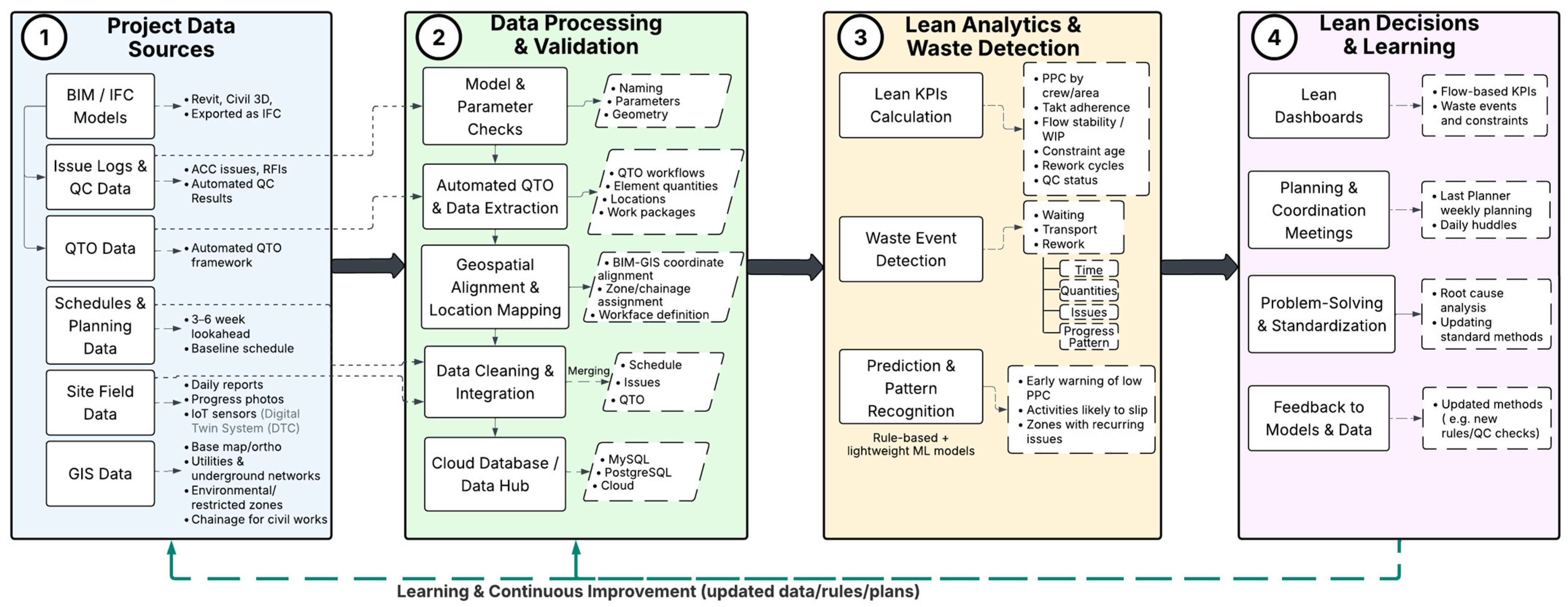
The outcome of this methodology is the proposed DLC framework, illustrated in Figure 1, which presents the overall system architecture. The framework is lightweight, scalable, and compatible with common construction practices while supporting Lean concepts such as flow measurement, workface management, waste identification, and continuous improvement. Figure 1 illustrates how heterogeneous project data are transformed into actionable Lean insights through a structured, closed-loop workflow. The framework is organized into four primary layers:
Figure 1.
Overall architecture of the proposed DLC framework.
- Project Data Sources;
- Data Processing and Validation;
- Lean Analytics and Waste Detection;
- Lean Decisions and Learning.
The first layer, Project Data Sources, represents the information typically available throughout construction projects. These data sources include BIM/IFC models exported from authoring tools, issue logs and QC records from CDEs, automated QTO outputs, planning and scheduling information (including baseline schedules and look-ahead plans), site field data (e.g., daily reports and progress photos), and sensor readings where available. Within this context, site field data encompass both manually reported information and digitally captured execution signals generated by sensors and IoT-based monitoring systems [16]. In addition, GIS data provide spatial context that is often missing from BIM models, such as terrain, access routes, underground utilities, environmental or restricted zones, and linear referencing information for civil infrastructure projects. Table 2 summarizes the main project data sources integrated into the proposed DLC framework and their respective Lean purposes.
Table 2.
Main project data sources integrated into the proposed DLC framework.
The second layer, Data Processing and Validation, ensures that incoming data are reliable, consistent, and suitable for Lean analysis. This layer begins with model geometry and parameter validation to verify naming conventions, parameter completeness, and geometric validity. Automated QTO and data extraction processes are then performed to generate element-level quantities, locations, and preliminary work packages. A key component of this layer is geospatial alignment and location mapping, where BIM and GIS data are aligned, and project zones, chainage, or other spatial areas are assigned to define workfaces. This step enables location-based analysis and supports Lean flow measurement. The processed data are subsequently cleaned and integrated by merging schedule information, issue logs, quantities, and field data into a unified data structure. Finally, all validated and integrated data are stored in a cloud-based database, or centralized data hub, which serves as a single source of truth for downstream analytics. Table 3 outlines the principal data processing and validation activities and the output generated at each stage.
Table 3.
Data processing and validation activities within the proposed DLC framework.
The third layer, Lean Analytics and Waste Detection, transforms validated and integrated project data into Lean-relevant performance information. Core Lean key performance indicators (KPIs), including Percent Plan Complete (PPC), takt performance deviations, flow stability indicators, constraint age, rework cycles, and waste event counts, are computed using transparent, rule-based logic aligned with established Lean production control practices. QC status indicators are also derived to ensure that production and quantity-based metrics are generated exclusively from validated data. Based on these indicators, waste events associated with waiting, transport, rework, and other non-value-adding activities are identified through the analysis of time, quantity, issue, and progress patterns. Furthermore, lightweight prediction and pattern-recognition models provide early warnings of declining planning reliability, identify activities with elevated delay risk, and highlight locations with recurring quality or coordination issues. The specific definitions and mathematical formulations of these indicators are detailed in the expanded framework architecture presented in Figure 2.
The final layer, Lean Decisions and Learning, incorporates analytical outputs into daily Lean management routines. Results are visualized through Lean dashboards and discussed during planning and coordination meetings, including weekly Last Planner sessions and daily huddles. Identified problems trigger structured problem-solving and standardization activities, including root cause analysis and updates to standard work. Subsequently, the outcomes of these decisions are fed back into models, project data, and validation rules, establishing a closed-loop learning mechanism that supports continuous improvement. Figure 1 illustrates how the proposed methodology transitions Lean Construction from a predominantly manual and reactive practice to a data-supported, location-based, and learning-oriented production system while preserving the transparency and human-centered nature of Lean principles.
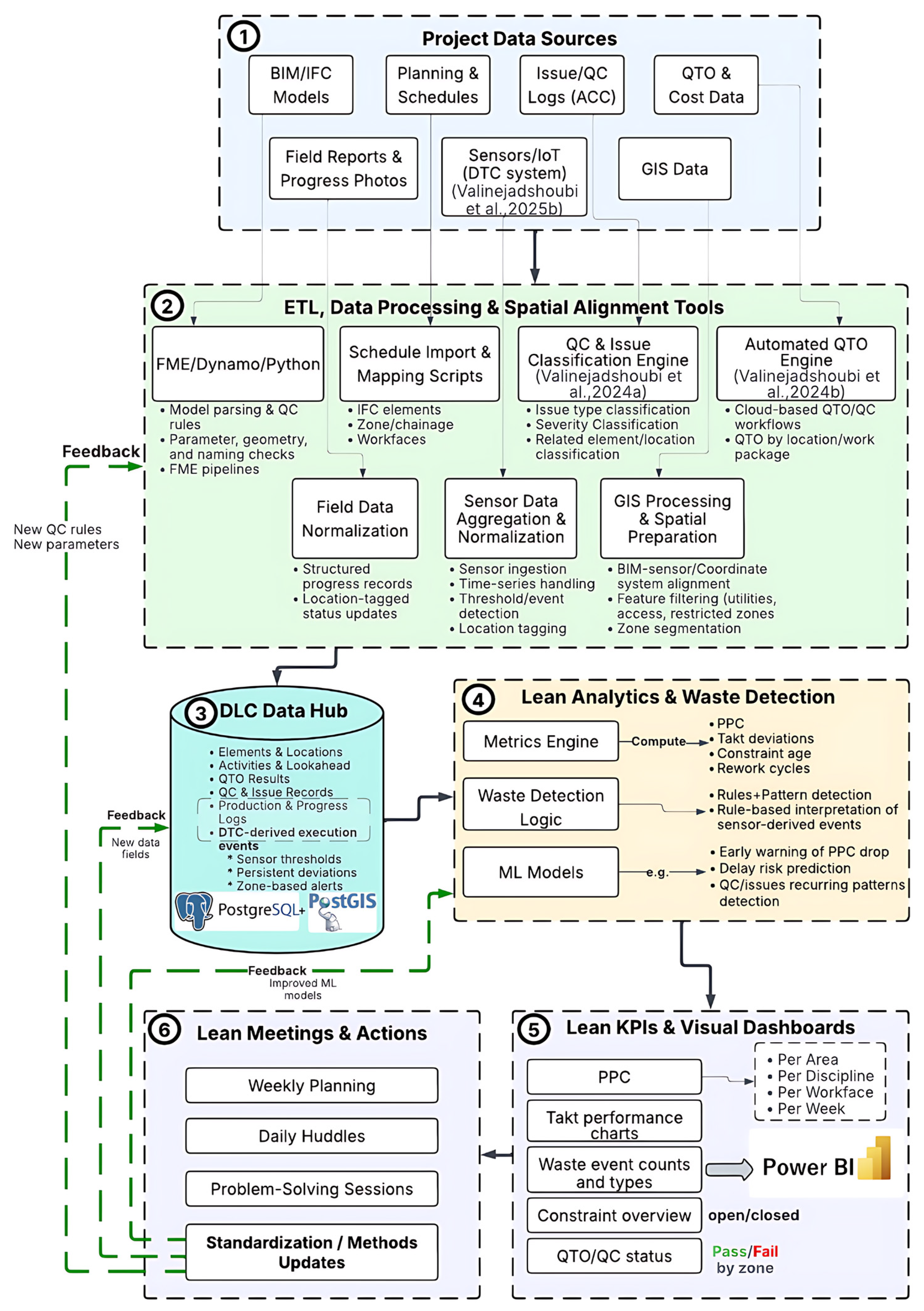
Figure 2 illustrates the expanded and implementation-oriented architecture of the proposed DLC framework, showing how the conceptual layers introduced in Figure 1 are operationalized through specific data processing steps, system components, and analytical mechanisms. While Figure 1 presents a high-level conceptual overview, Figure 2 focuses on execution logic, tool integration, and KPI computation pathways. Several components of the detailed architecture are derived from previously validated workflows for DTC [16], automated QTO [14], and automated BIM QC [13], which are embedded as modular data-generation and validation services within the proposed DLC framework.
At the data acquisition level, the framework integrates BIM/IFC models, planning and scheduling data, issue and QC logs, QTO and cost data, field reports and progress photos, sensor and IoT streams, and GIS data. Each source contributes a distinct perspective to production performance. BIM models provide element-level geometry and parameters; schedules define planned production sequences and takt structures; issue logs capture constraints and quality deviations; QTO data quantify production output; field and sensor data reflect actual execution conditions; and GIS data enable spatial alignment through zones, chainage, and workfaces. Sensor and IoT data are ingested through a DTC system, which enables near-real-time monitoring of execution events, progress states, and environmental conditions while linking them to BIM and GIS contexts. Although these datasets are commonly available for projects, their fragmentation across systems limits their usefulness for Lean decision-making, particularly when production control requires location-based analysis rather than document-based reporting.
To operationalize these inputs, all incoming data are processed through an ETL, processing, and alignment layer implemented using FME, Dynamo, and Python-based automation. This layer performs executable tasks, including model parsing, parameter completeness checks, geometry and naming validation, schedule-to-model mapping, issue classification, automated QTO, and the normalization of field and sensor data into structured, time-stamped records. The automated QTO workflows implemented in this layer reuse and extend a previously validated high-accuracy BIM-based QTO system, which includes quantity precision checks and location-aware quantity aggregation to ensure reliable production and cost-related metrics. GIS data are processed to ensure coordinate system alignment, feature filtering, and zone segmentation, thereby enabling location-based production analysis. These steps are critical because Lean metrics are only meaningful when underlying data are reliable, standardized, and spatially consistent. The framework also supports feedback loops that allow new QC rules, parameters, and data fields to be introduced as learning occurs, thereby continuously improving data quality and analytical relevance across planning cycles.
Model reliability is treated as a prerequisite for downstream Lean analytics rather than as a separate model-management activity. Before BIM-derived information enters the DLC Data Hub, the proposed workflow uses a sequence of rule-based quality gates. First, model geometry and required parameters are checked for completeness, valid object classification, naming consistency, duplicate identifiers, and discipline-specific requirements. Second, extracted quantities and locations are checked against predefined extraction rules and spatial boundaries. Third, detected nonconformities are classified according to issue type, severity, affected element, and project location. Each element, zone, or workface is then assigned a QC status indicating whether the relevant validation requirements have been satisfied.
Only records that meet the required validation criteria are released for quantity aggregation, KPI computation, and dashboard reporting. Failed records remain traceable in the issue-management workflow and are excluded from affected production indicators until they are corrected. This quality-gating mechanism prevents incomplete or inconsistent model information from directly influencing PPC, takt, quantity, rework, or delay-risk calculations. The validation logic builds on previously developed automated BIM QC and QTO systems, while the integrated application of these controls within the DLC architecture remains subject to future project-level evaluation. Table 4 summarizes the model-reliability controls applied within the DLC framework and their effects on downstream Lean analytics.
Table 4.
Model-reliability controls and analytical consequences in the DLC framework.
QC and issue management are operationalized through a dedicated QC and Issue Classification Engine, which builds upon an automated BIM quality evaluation system. This engine performs rule-based checks on BIM parameters, geometry, naming conventions, and discipline-specific requirements and classifies detected issues by type, severity, and spatial location. QC results are directly linked to elements, zones, and workfaces, ensuring that downstream Lean analytics are computed exclusively from validated and trustworthy data.
All processed information is stored in a centralized DLC Data Hub, which serves as a single source of truth for Lean analytics. In the proposed implementation, the DLC Data Hub is implemented using PostgreSQL coupled with PostGIS, providing a unified relational and spatial database environment capable of storing both structured production datasets and geospatially referenced project information. PostgreSQL supports normalized project entities including elements, activities, work packages, issue records, and progress logs, while PostGIS enables location intelligence through spatial data types and spatial queries (e.g., intersecting element footprints with zones, assigning workfaces based on proximity or chainage, and aggregating performance metrics by spatial boundaries). The data hub consolidates outputs from multiple processed data streams, including the DTC system, automated QTO engine, automated QC workflows, scheduling and planning data, field progress records, and GIS-derived spatial information, enabling traceable, time-aware, and location-aware production records. This architecture supports consistent KPI computation, maintains traceability across planning cycles, and facilitates historical analysis of production behavior.
To support decision-making and visualization, curated database views and materialized views are published from the DLC Data Hub and connected directly to business intelligence platforms such as Power BI, enabling efficient, scalable visualization of Lean KPIs without duplicating or transforming source data outside the central system.
Lean performance measurement is carried out within the Lean analytics and machine learning layer, which includes a KPI computation engine, rule-based waste detection logic, and optional predictive models. The primary objective of this layer is to make Lean performance visible, measurable, and actionable. One of the core indicators is Percent Plan Complete (PPC), which measures planning reliability and is computed as follows:
PPC is calculated at multiple levels of aggregation, including areas, discipline, workface, and time periods. This multi-level computation prevents local instability from being masked by averaged values and enables teams to identify where planning commitments are systematically not being met. Declining PPC trends serve as early indicators of constraint accumulation, planning inaccuracies, or execution disruptions.
To evaluate flow stability, takt performance deviations are computed by comparing actual production cycle times with planned takt times:
Takt Deviation = Tactual − Tplanned
Positive deviations indicate delays and flow interruptions, whereas negative deviations may indicate uneven workload distribution or overproduction. Monitoring takt deviations supports corrective adjustments in crew allocation, sequencing, and spatial work distribution, thereby restoring production flow.
Constraint management is supported through the measurement of constraint age, defined as the elapsed time between constraint identification and resolution:
Constraint Age = tcurrent − tcosntraint identified
Constraint age is a critical Lean indicator because unresolved constraints directly reduce planning reliability and increase the likelihood of rework and delay.
Rework is measured through rework cycle counts, which quantify the number of times an activity or work package must be repeated because of quality defects, coordination failures, or design changes:
Rework Cycles = Nactivity re-openings
Waste is further quantified through waste event counts detected using rule-based logic and pattern recognition, including rules that interpret sensor-derived events, recurring QC failures, and repeated issue patterns across zones and workfaces:
Data reliability is safeguarded through QC status indicators at the zone or workface level, which directly represent the outputs of the automated QC and issue classification engine:
QC Statusz = Pass, if all QC rules satisfied in zone z
Fail, → otherwise
Fail, → otherwise
Finally, predictive indicators estimate delay risk using historical and current production data, leveraging combined signals from PPC trends, constraint age, takt deviations, rework cycles, sensor-derived execution patterns, and recurring QC issues:
P(Delay) = f (PPC, Constraint Age, Takt Deviation, Rework Cycles, Sensor Events, QC Issues)
Here, Sensor Events represent aggregated indicators derived from sensor-based execution patterns, while QC Issues capture recurring quality deviations identified through the automated QC and issue classification engine. Table 5 presents the Lean performance indicators implemented in the proposed DLC framework and the decisions they support.
Table 5.
Lean performance indicators implemented in the proposed DLC framework.
All KPIs are visualized through Lean dashboards and reviewed during weekly planning sessions, daily huddles, and structured problem-solving meetings. Insights generated during these routines feed back into standardization efforts, refined QC rules, and improved predictive models, thereby closing the learning loop. Overall, the proposed DLC framework transforms digital project data from passive repositories into an active Lean operating system. By integrating previously validated DTC system monitoring, automated BIM-based QTO, and automated BIM QC workflows into a unified, location-aware architecture, the framework illustrates how research-proven digital systems can be operationalized to support Lean production control at scale. By connecting validated, location-aware data stored in a PostgreSQL/PostGIS-based DLC Data Hub with formalized Lean KPIs and closed-loop feedback mechanisms, the framework enables reliable production control, early detection of waste and risk, and sustained continuous improvement across the project lifecycle.
3. Framework Application and Use Scenarios
The proposed DLC framework is intended to support operational decision-making throughout the construction lifecycle by embedding digital data into routine Lean management practices. Rather than introducing new planning concepts, the framework strengthens existing Lean workflows by delivering consistent, location-aware, and validated performance information when decisions are made. This section illustrates how the framework can be implemented in practice and how it supports Lean production control under different project conditions.
In a typical building project, the DLC framework is integrated into established planning and control cycles, particularly weekly planning sessions and daily coordination meetings. Project teams continue to define commitments, identify constraints, and review progress using familiar Lean practices. The difference lies in how information is prepared and presented. Instead of relying on manually compiled reports or subjective progress updates, planners and field teams access performance indicators that are automatically generated from integrated project data. These indicators provide a shared, objective view of planning reliability, flow stability, and emerging risks, enabling discussions to focus on problem-solving rather than data reconciliation. During weekly planning meetings, the framework supports commitment management by highlighting areas or workfaces where planned tasks are consistently left incomplete. Teams can immediately identify whether failures are isolated or systemic and whether they are associated with specific trades, locations, or recurring constraints. This enables more realistic commitment setting, improved lookahead planning, and better prioritization of constraint removal activities. Importantly, the framework does not prescribe planning decisions; instead, it provides timely evidence to support collaborative decision-making. At the daily control level, the framework supports short-cycle feedback through concise, location-based performance views. Supervisors and crews can assess whether production is maintaining its intended rhythm and whether deviations are emerging that require corrective action. When deviations are detected, teams can trace them back to unresolved constraints, quality issues, or coordination mismatches rather than treating them as isolated execution problems. This supports proactive intervention before minor disruptions develop into major delays.
In civil and infrastructure projects, the framework is applied with a stronger emphasis on spatial production logic. Rather than managing work solely by activity lists or schedules, production control is structured around zones, chainage segments, or workfaces defined along the project alignment. This enables Lean principles, such as flow continuity and workface stability, to be applied in environments where linear progression and access constraints dominate production activities. In these scenarios, the framework supports decision-making related to zone handovers, crew movement, and sequencing adjustments based on actual performance trends rather than predefined assumptions.
Figure 2.
Detailed data and workflow architecture of the proposed DLC framework [13,14,16].
The framework is also applicable across different organizational maturity levels. For projects with limited digital automation, it can initially serve as a structured reporting and visualization layer that consolidates existing data sources into a coherent performance view. As organizations build confidence, additional capabilities, such as automated QC, advanced waste detection rules, and predictive indicators, can be progressively introduced. This incremental adoption approach allows teams to realize value immediately without requiring major changes to contractual arrangements or organizational structures.
A key application strength of the proposed DLC framework lies in its support for continuous improvement. Insights generated during planning and coordination meetings are not treated as isolated observations; instead, they are systematically fed back into project practices. Adjustments to planning assumptions, standard work methods, QC rules, and data structures are captured and reused, reducing the likelihood that the same issues will recur in subsequent cycles. Over time, this continuous feedback process reinforces learning at both the project and organizational levels. Throughout its application, the framework remains aligned with the human-centered nature of Lean Construction. Automated analytics and dashboards are designed to support transparency and learning while complementing, not replacing, professional judgment or collaborative decision-making. The role of the framework is to reduce uncertainty, improve information reliability, and shorten feedback loops, allowing teams to focus on value-adding coordination and improvement efforts.
Overall, the application scenarios demonstrate that the proposed DLC framework functions as an operational enabler rather than a standalone digital system. By embedding validated digital information into routine Lean practices, the framework supports more reliable production control, earlier identification of emerging problems, and sustained improvement across different project types and organizational contexts. Table 6 illustrates how the proposed DLC framework supports key project-management and Lean production-control activities.
Table 6.
Practical application of the proposed DLC framework across project management activities.
4. Discussion
This study proposes a DLC framework that advances BIM–Lean integration from conceptual alignment to an operational, data-driven production control system. Unlike many existing approaches that discuss Lean and digital technologies in parallel, the proposed framework focuses on how heterogeneous project data are transformed into reliable, location-aware Lean performance information and integrated into daily planning, control, and learning routines. The primary strength of the DLC framework lies in its ability to bridge the persistent gap between digital data availability and practical Lean decision-making. An important aspect of the proposed framework is that it does not rely on hypothetical or untested digital components. Instead, several core data-generation and validation capabilities, including digital twin-based site monitoring, automated BIM-based QTO, and automated BIM QC, are grounded in previously developed and validated systems by the authors. These systems are incorporated as modular services within the broader DLC framework, ensuring that key inputs such as execution events, quantities, and quality states are generated through proven workflows instead of assumed abstractions.
Existing BIM–Lean studies can generally be grouped into four categories: conceptual integration frameworks, implementation guidelines and maturity models, domain-specific applications, and technology-centered decision-support systems. Conceptual frameworks clarify the potential relationships among Lean, BIM, and emerging technologies but often stop short of defining executable data flows. Guidelines and maturity models address organizational readiness and adoption but provide limited detail regarding data validation, KPI computation, and feedback mechanisms. Domain-specific applications demonstrate measurable benefits but typically focus on isolated lifecycle stages or individual performance objectives. Technology-centered systems improve visualization, automation, or monitoring but do not necessarily embed their outputs within routine Lean production-control processes.
The novelty of the proposed DLC framework lies in combining these previously separate contributions within a single operational architecture. First, it adopts a Lean-first design in which production-control requirements and Lean KPIs determine the digital data and processing logic required by the system. Second, it incorporates model-reliability gates before analytical outputs are generated. Third, it introduces location-aware BIM-GIS integration to support workface- and chainage-based production control. Fourth, it formalizes transparent data-to-KPI relationships rather than relying solely on opaque analytical outputs. Finally, it connects dashboards and performance signals to planning meetings, problem-solving, standardization, and updates to models and validation rules, thereby establishing a closed-loop learning mechanism. Table 7 provides a critical comparison between existing BIM–Lean approaches and the proposed DLC framework.
Table 7.
Critical comparison of existing BIM–Lean approaches and the proposed DLC framework.
Although the proposed framework is conceptually grounded in established Lean principles and previously validated digital workflows, its operational performance has not yet been evaluated through live project deployment. Consequently, the discussion focuses on the framework’s conceptual contributions and implementation potential rather than claiming operational benefits.
One of the key advantages of the proposed framework is its strong grounding in Lean production logic rather than technology-driven optimization. While numerous BIM-based systems emphasize visualization, clash detection, or document coordination, they often fail to translate digital outputs into Lean-relevant signals such as planning reliability, flow stability, constraint effectiveness, and waste patterns. The DLC framework addresses this limitation by defining Lean KPIs as the primary output of the system and treating digital technologies as enablers rather than objectives. This ensures that automation supports, rather than replacing, human-centered Lean practices, such as commitment management, collaborative planning, and continuous improvement.
The framework’s use of multiple data types, including BIM/IFC models, schedules, issue and QC logs, QTO results, field reports, sensor data, and GIS information, captures the multidimensional nature of production performance. Lean performance cannot be reliably inferred from a single data source. For example, schedule adherence alone does not capture quality-related rework, spatial congestion, or unresolved constraints, while model-based quantities without field validation may misrepresent actual production status. By combining design intent, planned production, actual execution, quality outcomes, and spatial context, the DLC framework provides a more comprehensive and objective representation of production reality. This integration reinforces Lean’s emphasis on understanding the entire production system rather than optimizing isolated activities.
A particularly important contribution of the framework is its location-based data alignment, achieved through the integration of GIS concepts with BIM data. Many existing BIM–Lean implementations remain activity-centric and struggle to support flow-based production control, particularly in civil and infrastructure projects where linear progression, access constraints, and spatial sequencing dominate. By incorporating zones, chainage, and workfaces as first-class analytical entities, the DLC framework enables Lean principles, such as flow continuity, takt adherence, and workface stability, to be applied consistently across both building and infrastructure contexts. This spatial grounding differentiates the framework from document-centric or schedule-only systems and addresses a well-documented limitation in current Lean digitalization efforts.
The selection of PostgreSQL coupled with PostGIS as the DLC Data Hub further improves the framework’s practical applicability. Rather than relying on proprietary data silos or tool-specific databases, the framework adopts an open, relational, and spatially enabled database architecture that facilitates interoperability, traceability, and scalability. PostgreSQL provides a robust environment for managing structured production data, such as activities, quantities, constraints, and progress records, while PostGIS enables spatial reasoning essential for location-based Lean analytics. This combination allows performance indicators to be computed consistently across time, discipline, and space while supporting advanced queries, such as aggregating PPC by workface, linking issues to spatial zones, and tracking rework patterns along linear alignments. Furthermore, this database architecture enables seamless integration with business intelligence platforms, such as Power BI, allowing Lean dashboards to be generated directly from validated source data without manual data manipulation or duplication.
Another strength of the proposed framework is its transparent, rule-based KPI computation, complemented by lightweight predictive models. Many emerging digital construction platforms apply advanced analytics or AI without clearly articulating how their outputs relate to Lean principles or why the results can be trusted by practitioners. In contrast, the DLC framework prioritizes explainable indicators, such as PPC, takt deviation, constraint age, rework cycles, and waste event counts, whose meanings are well established within Lean practice. Predictive models are deliberately positioned as supportive tools that enhance early warning and pattern recognition instead of functioning as black-box decision-makers. This design choice preserves trust, interpretability, and alignment with Lean’s emphasis on learning and problem-solving.
The framework’s closed-loop feedback mechanism represents another significant advancement over static reporting systems. Analytical outputs are not treated as end products but as inputs to Lean routines, including weekly planning, daily huddles, problem-solving sessions, and standardization efforts. Decisions and learning outcomes feed back into data validation rules, model parameters, and analytical logic, allowing the system to evolve alongside organizational maturity. This institutionalization of learning directly supports Lean’s continuous improvement philosophy and helps prevent the common failure mode in which digital dashboards are reviewed but do not lead to sustained behavioral or process change.
Compared with existing BIM–Lean integration approaches, the DLC framework is implemented as a lightweight and practical solution using tools and data already available on most projects. It does not require real-time IoT infrastructure, proprietary platforms, or extensive process reengineering to deliver value. Instead, it supports incremental adoption, allowing organizations to begin with structured reporting and progressively advance toward predictive and optimization-oriented capabilities as data quality and process maturity improve. This flexibility increases the likelihood of real-world adoption and long-term sustainability.
Overall, the proposed DLC framework advances the state of BIM–Lean integration by transforming digital project data into a Lean operating system rather than a passive information repository. By aligning validated, location-aware data with Lean KPIs and embedding analytical outputs into closed-loop decision-making routines, the framework is designed to support more reliable production control, early detection of waste and risk, and sustained continuous improvement across the project lifecycle. This positions the DLC framework as a pragmatic and theoretically grounded contribution to both Lean Construction research and digital construction practice.
5. Practical Implications
The proposed DLC framework has several practical implications for construction organizations seeking to improve production control, planning reliability, and continuous improvement using existing digital assets. Rather than introducing a new management philosophy or replacing established Lean practices, the framework strengthens current routines by delivering timely, objective, and location-aware performance evidence that supports better decision-making across multiple organizational levels.
At the project level, the framework helps teams transition from reactive, report-driven control to proactive, data-supported production management. By automatically generating Lean performance indicators from integrated project data, planners and field teams gain a shared and consistent view of planning reliability, flow stability, and emerging risks. This reduces the time spent reconciling conflicting reports and allows coordination meetings to focus on problem-solving and corrective actions rather than data interpretation. Moreover, the framework supports commitment management without dictating decisions, thereby preserving the collaborative and human-centered nature of Lean planning.
For field supervisors and crews, the framework improves situational awareness through concise, location-based performance views. Rather than relying on aggregated project-wide metrics, teams can assess performance at the workface or zone level, making deviations visible where they occur. This supports timely interventions, such as reallocating crews, adjusting sequences, or addressing unresolved constraints before disruptions escalate into major delays. The emphasis on spatial production logic is particularly valuable in infrastructure and linear projects, where traditional activity-based reporting often fails to reflect actual execution conditions.
At the management and organizational level, the framework supports consistency and scalability in Lean implementation. Because performance indicators are derived from standardized data structures and transparent rules, organizations can compare production behavior across projects, identify recurring systemic issues, and benchmark improvement over time. This facilitates more informed strategic decisions related to process standardization, training needs, and digital investment priorities. In addition, the use of an open, database-centric architecture minimizes dependence on project-specific tools and fosters long-term organizational learning beyond individual projects.
The framework also has important implications for digital transformation strategies. Many organizations struggle to translate investments in BIM, CDEs, and data platforms into measurable operational benefits. The DLC framework establishes a clear pathway for converting existing digital data into Lean-relevant insights, demonstrating tangible value without requiring full real-time automation or advanced AI maturity. This approach makes the framework suitable for gradual adoption, allowing organizations to start with descriptive analytics and incrementally incorporate predictive capabilities as data quality and maturity improve.
From a quality and risk management perspective, the integration of QC status indicators and constraint-related metrics supports earlier detection of production risks and quality deviations. By linking quality outcomes directly to planning reliability and flow performance, the framework promotes a more integrated approach to quality management instead of treating QC as a separate compliance activity. This alignment helps prevent rework, reduces uncertainty in progress reporting, and increases confidence in automated quantity- and cost-based assessments.
Finally, the framework has implications for Lean culture and continuous improvement. By institutionalizing feedback loops between data, decisions, and standardization efforts, the DLC framework reinforces learning-oriented behavior across planning cycles. Lessons learned from recurring issues, constraint patterns, or flow disruptions are captured within updated rules, data structures, and planning assumptions, reducing reliance on tacit knowledge and individual experience alone. Over time, this contributes to the development of more resilient production systems capable of adapting to project complexity and uncertainty. Table 8 lists representative technologies that can support the practical implementation of the proposed DLC framework.
Table 8.
Practical implementation technologies supporting the proposed DLC framework.
6. Limitations and Future Research
While the proposed DLC framework offers a coherent and implementable approach to integrating digital construction data with Lean production control, several limitations must be acknowledged. These limitations do not diminish the value of the framework; instead, they define its current scope and identify opportunities for further investigation and refinement.
First, this study adopts a conceptual and design-oriented approach and does not include empirical validation through live project deployment. Although the framework is grounded in established Lean principles and informed by recent research on BIM automation, QC, and digital twins, its performance has not yet been quantitatively evaluated across real projects. Future research should focus on implementing and evaluating the framework in live construction environments to assess its impact on planning reliability, flow stability, waste reduction, and decision-making efficiency. Comparative case studies across multiple project types would provide valuable evidence of its practical effectiveness.
Second, the framework assumes a baseline level of data availability and digital maturity. While the architecture is designed to be lightweight and adaptable, its effectiveness largely depends on the quality and consistency of input data, particularly BIM models, schedules, and field reporting. Although key inputs generated by the previously validated DTC, automated QTO, and BIM QC systems provide structured, reliable, and location-aware data streams, the overall framework still relies on complementary data sources whose quality may vary across projects. In organizations where data governance practices are weak or digital workflows are highly fragmented, additional effort may be required to achieve reliable results. Future studies could explore maturity assessment methods and incremental adoption strategies that support gradual implementation in low-maturity contexts.
Third, the current framework does not directly address real-time production control. Although the architecture supports the integration of sensor and IoT data, it does not require continuous real-time streams to function effectively. As such, the framework is best suited to near-real-time or periodic planning cycles rather than high-frequency operational control. Future research could further extend the framework to incorporate real-time data ingestion and streaming analytics, particularly for safety-critical or highly repetitive construction operations.
Fourth, the predictive analytical components of the framework are intentionally lightweight and supportive, emphasizing transparency and interpretability over advanced machine learning complexity. While this design choice aligns with Lean principles and supports trust in analytical outputs, it may reduce predictive accuracy in highly complex or uncertain environments. Future work could investigate hybrid analytical approaches that combine explainable machine learning techniques with Lean-compatible decision support, as well as systematic evaluation of model performance and robustness.
Finally, the framework has been designed to be methodologically neutral with respect to contract type and organizational structure. However, implementation challenges and potential benefits may vary across delivery models such as Design–Bid–Build, Design–Build, and Integrated Project Delivery. Further research should examine how contractual arrangements, incentives, and governance structures influence the adoption and effectiveness of digital Lean production control systems.
In summary, future research should prioritize empirical validation, explore real-time and advanced analytics extensions, investigate organizational adoption pathways, and assess the framework’s adaptability across diverse project and contractual contexts. These efforts would further strengthen the contribution of the DLC framework and support its evolution from a conceptual operating model to a validated, industry-wide production control approach.
7. Conclusions
This paper presents a DLC framework that systematically connects digital construction data with Lean production control through a structured, closed-loop workflow. The framework addresses the persistent gap observed in both research and practice: while construction projects increasingly generate rich digital data through BIM, CDEs, and automation, Lean decision-making continues to rely largely on manual interpretation, fragmented information, and delayed feedback.
By adopting a Lean-first perspective, the proposed framework positions production control needs and Lean performance indicators as primary drivers of system design. Digital tools, data sources, and automation components are systematically aligned to support these objectives rather than functioning as independent or technology-driven solutions. This approach preserves the human-centered nature of Lean Construction while enhancing transparency, reliability, and timeliness of production information.
The framework integrates diverse project data sources, including BIM/IFC models, schedules, quality and issue logs, QTO outputs, field data, and GIS context, within a centralized and unified data environment. Through automated validation, spatial alignment, and standardized and validated data structures, the framework is designed to provide a structured approach for consistent computation of Lean KPIs related to planning reliability, flow stability, constraint management, quality performance, and waste detection. The framework is designed to embed these indicators within Lean routines, supporting collaborative decision-making, structured problem-solving, and continuous learning.
One of the principal contributions of the DLC framework lies in its practical applicability and adaptability. It does not require real-time sensing infrastructure, proprietary platforms, or advanced AI maturity to deliver value. Instead, it leverages commonly available project data and lightweight automation technologies, allowing organizations to adopt the framework incrementally while aligning it with existing Lean practices. The use of an open, spatially enabled data hub further enhances scalability, interoperability, and long-term organizational learning.
Overall, this research provides a conceptual foundation for a coherent and implementable operating model that advances BIM–Lean integration beyond visualization and reporting toward reliable, data-driven, location-aware production control. By formalizing the link between validated digital data, Lean analytics, and closed-loop decision-making, the proposed DLC framework establishes a foundation for future empirical studies and provides a practical pathway for improving production stability and continuous improvement in construction projects.
Funding
This research received no external funding.
Data Availability Statement
The data presented in this study are available on request from the corresponding author.
Conflicts of Interest
Mojtaba Valinejadshoubi is employed by the company Pomerleau Inc. The author declares no other competing financial, professional, or personal interests that could have appeared to influence the work reported in this paper.
References
- Tezel, A.; Taggart, M.; Koskela, L.; Tzortzopoulos, P.; Hanahoe, J.; Kelly, M. Lean construction and BIM in small and medium-sized enterprises (SMEs) in construction: A systematic literature review. Can. J. Civ. Eng. 2020, 47, 186–201. [Google Scholar] [CrossRef] [Scilit]
- Yang, Y.; Chen, C.; Liu, X.; Zhang, Z. Integration of Lean Construction and BIM in Sustainable Built Environment: A Review and Future Research Directions. J. Build. 2025, 15, 2411. [Google Scholar] [CrossRef] [Scilit]
- Hei, S.; Zhang, H.; Luo, S.; Zhang, R.; Zhou, C.; Cong, M.; Ye, H. Implementing BIM and Lean Construction Methods for the Improved Performance of a Construction Project at the Disassembly and Reuse Stage: A Case Study in Dezhou, China. J. Sustain. 2024, 16, 656. [Google Scholar] [CrossRef] [Scilit]
- Andújar-Montoya, M.D.; Galiano-Garrigós, A.; Rizo-Maestre, C.; Echarri-Iribarren, V. BIM and lean construction interactions: State-of-the-art review. In Building Information Modelling (BIM) in Design, Construction and Operations III (WIT Transactions on The Built Environment; WIT Press: Southampton, UK, 2019; Volume 192. [Google Scholar] [CrossRef] [Scilit]
- Alnajjar, O.; Atencio, E.; Turmo, J. Framework for Optimizing the Construction Process: The Integration of Lean Construction, Building Information Modeling (BIM), and Emerging Technologies. Appl. Sci. 2025, 15, 7253. [Google Scholar] [CrossRef] [Scilit]
- Moradi, S.; Sormunen, P. Integrating lean construction with BIM and sustainability: A comparative study of challenges, enablers, techniques, and benefits. Constr. Innov. Inf. Process Manag. 2024, 24, 188–203. [Google Scholar] [CrossRef] [Scilit]
- Likita, A.J.; Jelodar, M.B.; Vishnupriya, V.; Rotimi, J.O.B. A Guideline for BIM and lean integrated construction practice. Smart Sustain. Built Environ. 2025, 14, 1264–1291. [Google Scholar] [CrossRef] [Scilit]
- Al-Zubaidi, E.D.A.; AlZaidi, Z.A.K. Integration of Building Information Modeling (BIM) and Lean Construction Methods: A Pathway to Improved Project Delivery. J. Eur. Systèmes Autom. 2025, 58, 551–562. [Google Scholar]
- Rashidian, S.; Drogemuller, R.; Omrani, S. An integrated Building Information Modelling, Integrated Project Delivery and Lean Construction Maturity Model. Archit. Eng. Des. Manag. 2024, 20, 454–1470. [Google Scholar] [CrossRef] [Scilit]
- Alnajjar, O.; Atencio, E.; Turmo, J. A systematic review of lean construction, BIM and emerging technologies integration: Identifying key tools. Buildings 2025, 15, 2884. [Google Scholar] [CrossRef] [Scilit]
- Mounla, K.E.; Beladjine, D.; Beddiar, K. Integrating BIM with lean principles for enhanced decision-making: Optimizing insulation Material Selection in Sustainable Construction Project. Energy Inform. 2025, 8, 61. [Google Scholar] [CrossRef] [Scilit]
- Mounla, K.E.; Beladjine, D.; Beddiar, K. Lean-BIM Synergy in the Construction Design Phase: Auto-Generation and Evaluation of Thermal Alternatives. In Proceedings of the 32nd Annual Conference of the International Group for Lean Construction (IGLC 32); Costa, D.B., Drevland, F., Florez-Perez, L., Eds.; International Group for Lean Construction: Auckland, New Zealand, 2024; pp. 622–631. [Google Scholar] [CrossRef] [Scilit]
- Valinejadshoubi, M.; Moselhi, O.; Iordanova, I.; Valdivieso, F.; Shakibabarough, A.; Bagchi, A. The development of an automated system for a quality evaluation of engineering BIM models: A case study. Appl. Sci. 2024, 14, 3244. [Google Scholar] [CrossRef] [Scilit]
- Valinejadshoubi, M.; Moselhi, O.; Iordanova, I.; Valdivieso, F.; Bagchi, A. Automated system for high-accuracy quantity takeoff using BIM. Autom. Constr. 2024, 157, 105155. [Google Scholar] [CrossRef] [Scilit]
- Valinejadshoubi, M.; Moselhi, O.; Iordanova, I.; Valdivieso, F.; Bagchi, A.; Corneau-Gauvin, C.; Kaptué, A. A Cloud-Driven Framework for Automated BIM Quantity Takeoff and Quality Control: Case Study Insights. Buildings 2025, 15, 3942. [Google Scholar] [CrossRef] [Scilit]
- Valinejadshoubi, M.; Sacks, R.; Valdivieso, F.; Corneau-Gauvin, C.; Kaptué, A. Digital twin construction in practice: A case study of closed-loop production control integrating BIM, GIS, and IoT sensors. J. Constr. Eng. Manag. 2025, 151, 05025014. [Google Scholar] [CrossRef] [Scilit]
- Ballard, G.; Howell, G. Shielding Production: An Essential Step in Production Control. ASCE J. Constr. Eng. Manag. 1998, 124, 18–24. [Google Scholar] [CrossRef] [Scilit]
- Ballard, G. The Last Planner System of Production Control. Ph.D. Dissertation, Civil Engineering, University of Birmingham, Birmingham, UK, 2000. [Google Scholar]
- Koskela, L. An Exploration Towards a Production Theory and Its Application to Construction; Espoo, VTT Building Technology; VTT Publications: Espoo, Finland, 2000; Volume 408, 296p, Available online: https://aaltodoc.aalto.fi/server/api/core/bitstreams/c3ebc768-7321-42b1-9ec7-d2f4d68bc4d3/content (accessed on 19 May 2000).
- Kenley, R.; Seppänen, O. Location-Based Management for Construction: Planning, Scheduling and Control; Spon Press: London, UK; New York, NY, USA, 2010. [Google Scholar]
- Sacks, R.; Brilakis, I.; Pikas, E.; Xie, H.S.; Girolami, M. Construction with digital twin information systems. Data-Centric Eng. 2020, 1, e14. [Google Scholar] [CrossRef] [Scilit]

Disclaimer/Publisher’s Note: The statements, opinions and data contained in all publications are solely those of the individual author(s) and contributor(s) and not of MDPI and/or the editor(s). MDPI and/or the editor(s) disclaim responsibility for any injury to people or property resulting from any ideas, methods, instructions or products referred to in the content. |
© 2026 by the author. Licensee MDPI, Basel, Switzerland. This article is an open access article distributed under the terms and conditions of the Creative Commons Attribution (CC BY) license.