


Abstract
Non-Revenue Water (NRW) from leakage represents a major global economic and environmental challenge for urban utilities. While Deep Learning (DL) offers transformative potential for leak detection in Water Distribution Systems (WDSs) and existing reviews provide critical assessments, a consolidated, quantitative evaluation of real-world applicability and performance consistency that is actionable for engineering practice remains absent. This systematic review critically evaluates DL applications for WDS leak detection and localisation, with a focused analysis of model accuracy in relation to data types, methodological rigour, and the validation gap between controlled experiments and operational deployment. Following the Preferred Reporting Items for Systematic reviews and Meta-Analyses (PRISMA) framework, a systematic literature search was performed using Scopus, Web of Science, Google Scholar, ScienceDirect, Taylor & Francis, and MDPI databases for publications spanning the period from 2015 to 2025. From an initial 5265 records, 72 studies met the inclusion criteria for qualitative synthesis. Analysis revealed a specialisation of DL architectures by data modality: Convolutional Neural Networks (CNNs) applied to acoustic or vibration data yield the highest reported accuracy for direct leak identification; Long Short-Term Memory (LSTM) and Transformer models are predominant for temporal hydraulic data (pressure and flow); and Graph Neural Networks (GNNs) excel with topological data for state estimation. While reported accuracy is often high, performance is highly contingent on data quality and pre-processing. A significant disparity exists between results on synthetic versus real-world validation datasets, ranging from a decline of approximately 3 to 30 percentage points, with reported real-world accuracy spanning 70 to 79.7 percent. Moreover, DL demonstrates a paradigm shift in technical capability for leak management. However, transitioning to reliable field applications requires overcoming key challenges: standardising benchmarks and performance reporting, improving model generalisability and explainability, and fostering integration within practical Digital Twin (DT) frameworks to enable proactive infrastructure management.
1. Introduction
Urban water utilities worldwide face the critical challenge of NRW, with physical losses from leakage representing the most significant component. The economic implications are substantial, with global annual losses estimated at USD 39 billion [1]. Beyond financial impacts, water leakage represents significant environmental costs through wasted energy for water treatment and distribution. Water scarcity poses an urgent global challenge, compounded by significant physical losses in urban WDSs. A major contributing factor is the occurrence of leaks, which account for approximately 30% of total water consumption in many municipal systems, leading to substantial resource wastage and operational inefficiencies [2].
Conventional techniques for leak detection, such as acoustic listening devices, correlation analysis, and ground-penetrating radar have demonstrated utility in both controlled and field scenarios. However, they are often constrained by high labour intensity, limited spatial coverage, diminishing effectiveness in noisy urban environments, and an inability to provide real-time, scalable monitoring [3,4]. The advent of pervasive monitoring systems, including Supervisory Control and Data Acquisition (SCADA) and Advanced Metering Infrastructure (AMI), has enabled a shift toward data-driven methodologies.
Prior to the widespread adoption of DL, leak detection research progressed through four methodological paradigms, each with fundamental limitations. Transient-based methods exploit pressure wave propagation but require expensive high-frequency sensors (>100 Hz) and are vulnerable to background noise [3,5]. Negative pressure wave methods focus on burst-induced pressure drops yet consistently fail for small or incipient leaks [6].
Model-based approaches (Kalman/particle filtering, model invalidation) achieve robust detection under ideal conditions, but they depend on exquisitely calibrated hydraulic models, a condition rarely satisfied in aging infrastructure with unknown parameters [7,8,9,10,11]. Statistical process control methods treat leaks as anomalies but assume stationary, Gaussian data routinely violated by real WDN time series [10,12].
Initial approaches employed statistical models and conventional Machine Learning (ML), yet these often struggled with complex, non-linear system dynamics and required extensive manual feature engineering [5]. Artificial Intelligence (AI) and ML integration has enabled promising avenues for addressing these limitations [13]. Within this domain, as a subset of ML that utilises hierarchical neural networks, DL represents a paradigm shift. Additionally, DL models excel at autonomously learning hierarchical representations from high-dimensional temporal and spatial data, offering superior capabilities in modelling complex patterns and automating feature extraction compared to traditional methods [14,15].
The collective limitations of prior paradigms sensor costs, failure on incipient leaks, model dependency, and invalid statistical assumptions create a compelling rationale for DL, which offers automatic feature extraction, captures nonlinear temporal–spatial dependencies, and eliminates explicit physical model requirements [16]. Consequently, DL holds significant potential for dynamic, intelligent leak detection and localisation under the uncertainties inherent to real-world WDSs [17].
A critical gap exists in the systematic evaluation of DL for leak detection, particularly regarding the rigour of its accuracy claims, methodologies, and real-world validation. Literature reveals substantial variance in reported performance metrics, with insufficient attention to reproducibility, benchmarking, and the factors driving performance discrepancies. To address this gap, unlike previous reviews that have noted the importance of architecture data matching [17,18,19], this paper provides the first systematic, quantified analysis of DL-based leak detection. We reveal interconnected crises in validation strategy, reproducibility, architecture data matching, and failure of pre-processing to fix validations bias, insights no previous review has quantified.
Consequently, this study undertook a systematic literature review to critically evaluate the application of DL for leak detection and localisation in WDS. It aimed to synthesise evidence, assess the validity of accuracy claims, and identify key determinants of model performance. The systematic review was guided by the following research questions:
- RQ1: Which DL architectures are predominantly deployed for WDS leakage detection input data types?
- RQ2: How do DL architectures’ reported accuracy metrics compare across different experimental conditions?
- RQ3: What data pre-processing techniques yield optimal model performance, and how does data quality influence accuracy claims?
- RQ4: What are the primary methodological challenges and limitations, and what future research directions would advance the field toward practical implementation?
Synthesising findings to address these research questions and outlining future directions, this review provides a critical reference for academics, practitioners, and governing bodies in WDS leakage detection.
2. Materials and Methods
This study employed a Systematic Literature Review (SLR) to ensure methodological rigour and comprehensive insights into the application of DL in WDS. The review followed the PRISMA framework [20] to explore relevant scholarly articles from multiple databases. These findings serve to expand the body of knowledge and offer a comprehensive synthesis of current research. To achieve this, the review was conducted in three sequential phases. First, relevant databases were selected and search keywords were defined. Second, the search was executed, and the resulting articles were screened for eligibility through an abstract and full-text review. Third, eligible studies were critically evaluated and the results were synthesised. Each phase is discussed in detail in the following subsections.
2.1. Search Strategies
To identify relevant literature, searches were systematically performed using the following five databases: Web of Science, Scopus, ScienceDirect, Google Scholar, Taylor & Francis, and MDPI. The search strategy incorporated keywords related to DL, water leakage, and distribution systems. This was achieved through the use of the following Boolean search string: (“Water Leakage detection” OR “Water Pipe Leakage” OR “Water Pipeline Leakage” OR “Water Leakage prevention”) AND (“Deep Learning”) AND (“Water Distribution System” OR “Water Distribution Networks” OR “Water Distribution Pipeline”).
2.2. Conducting the Search for Inclusion and Exclusion Criteria
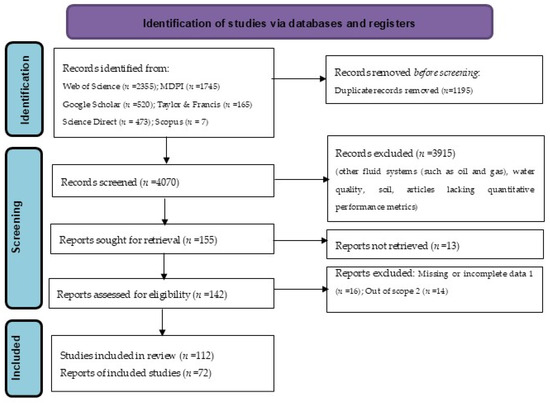
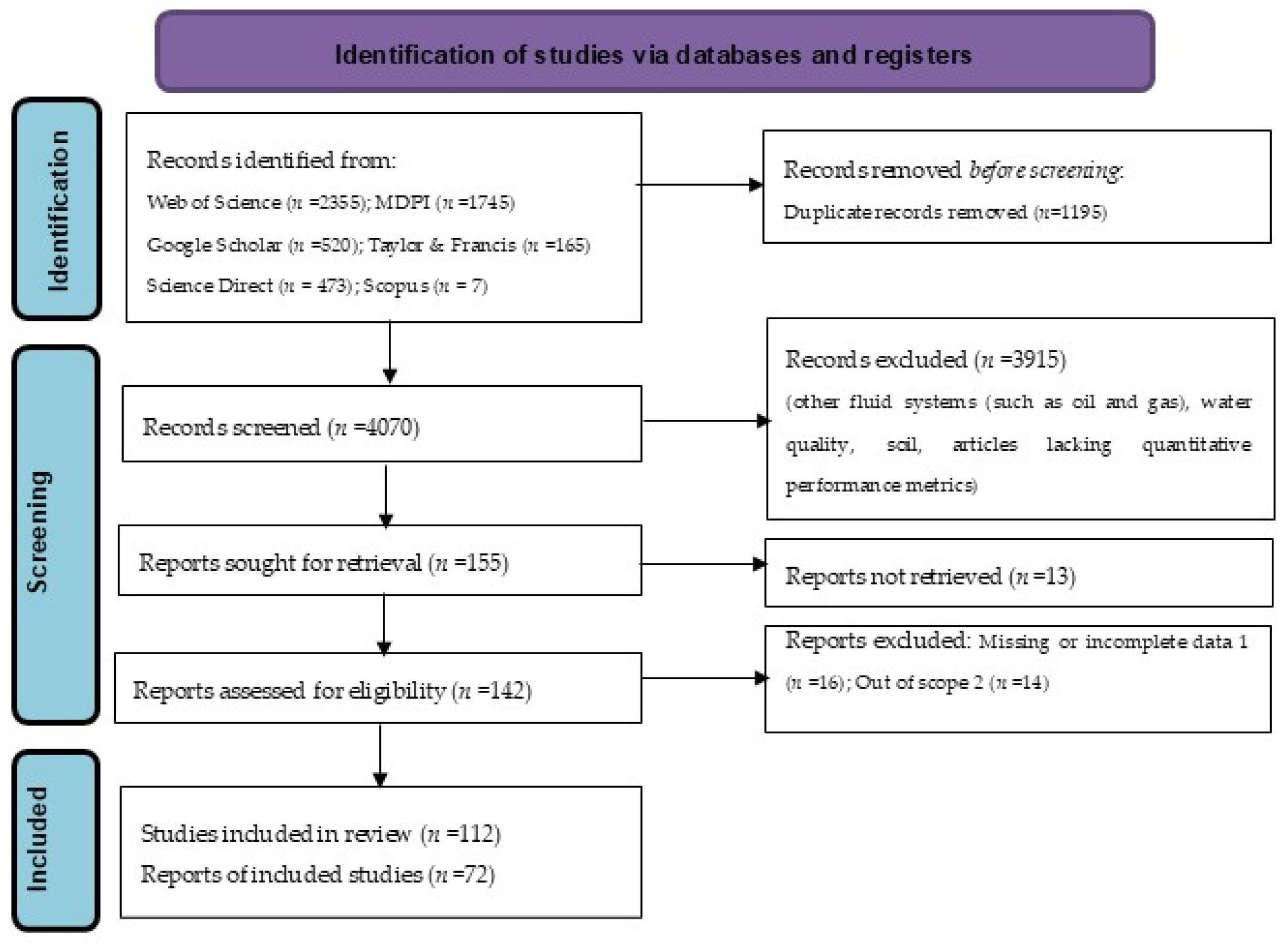
The literature search spanned publications from January 2015 to December 2025, a period aligned with the emergence of modern DL applications in WDS. An initial search was conducted in September 2025 across six electronic databases, yielding a total of 5265 records: Web of Science (n = 2355), MDPI (n = 1745), Google Scholar (n = 520), ScienceDirect (n = 473), Taylor & Francis (n = 165), and Scopus (n = 7). The scope of the review was limited to studies focusing on leakage detection and localisation within WDS in environmental and industrial contexts. The study selection process followed the PRISMA guidelines [20], as illustrated in Figure 1. Prior to screening, 1195 duplicate records were removed, leaving 4070 unique studies for title and abstract screening. These 4070 records were assessed against predefined inclusion criteria to ensure relevance. Studies were excluded if the research object was not a WDS, if the focus was not on leakage detection or monitoring, if DL methods were not applied, or if the publication was a review article without original data. Additional exclusion criteria included studies on other fluid systems (e.g., oil and gas), articles lacking quantitative performance metrics, and publications for which the full text could not be accessed.
Figure 1.
PRISMA flow diagram of the article screening process.
After this initial screening, 155 reports were sought for retrieval. Of these, 13 reports could not be retrieved and were, therefore, excluded. The remaining 142 full-text reports were assessed for eligibility. During this eligibility assessment, reports were excluded for two primary reasons: 16 reports due to missing or incomplete data, and 14 reports because they fell out of scope (i.e., they employed conventional leak detection techniques such as acoustic listening devices, correlation analysis, or ground-penetrating radar, rather than advanced, data-driven methods based on DL). A total of 112 studies met all inclusion criteria and were included in the final review. From these, 72 reports contained sufficient quantitative data on leakage detection, monitoring, or localisation to be eligible for full data extraction, categorisation, and qualitative synthesis.
Subsequently, the full texts of the remaining 72 articles were reviewed in detail, assessing introductions, methods, results, and discussions to select the most relevant studies. Articles that did not directly address the DL application for leakage detection and localisation were excluded. The information extracted included the specific DL architecture and its implementation details, the types and sources of data used, the applied pre-processing techniques, including performance metrics such as precision, F1-score, accuracy, recall, and the Area Under the Receiver Operating Characteristic Curve (AUC-ROC), as well as the context of documented real-world applications or case studies.
3. Results
This systematic review analysed 72 studies to map the current state of DL applications in WDS management. This comprehensive overview details crucial elements, including the data type, DL category, pre-processing techniques, real-world application, performance metrics, and efficiency. The following subsections present a detailed analysis of the findings from the reviewed literature.
3.1. Publication Trends, DL Architectures, Data Characteristics, and Performance
3.1.1. Temporal and Geographical Distribution
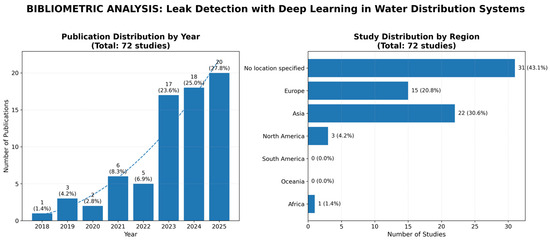
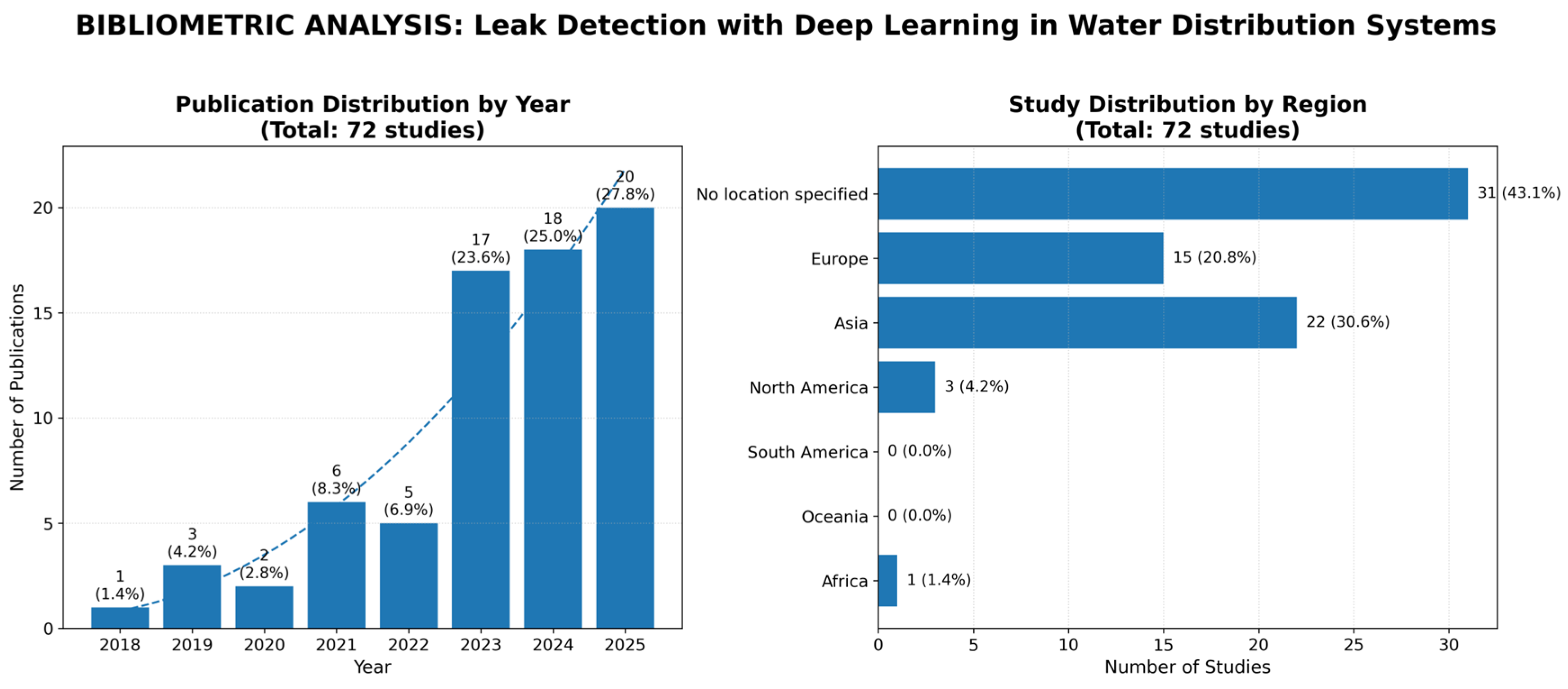
An analysis of the 72 primary references in Figure 2 shows a significant and recent concentration of research interest in this domain. Approximately 76.4% of the surveyed literature was published between 2023 and 2025 [21,22,23,24,25,26]. This surge coincides with parallel advancements in IoT sensor technology and increased accessibility to DL frameworks. Geographically, contributions from Asia dominate the scholarly output, constituting 30.6% of the corpus e.g., [26,27,28,29,30]. In addition, significant research originates from European nations (20.8%) e.g., [21,31,32,33,34,35], with a further 4.2% from North America e.g., [36]. Furthermore, a substantial proportion of the literature demonstrates direct application to real-world urban networks. These include case studies in Hong Kong [37,38], mainland China [27,39], Barcelona [40], Seoul [41], and Oosterbeek, Netherlands [21].
Figure 2.
Bibliometric analysis, Leak Detection with Deep Learning in Water Distribution Systems.
3.1.2. Architecture Distribution and Evolution
The methodological landscape is characterised by a predominance of specialised DL architectures, each tailored to specific data characteristics. Convolutional Neural Networks (CNNs) represent the most prevalent architecture, primarily employed to process spatial or image-based data representations. Their applications include analysing spectrograms derived from acoustic signals [22,35,42,43], interpreting interpolated pressure maps [44,45], and extracting spatial features within graph-based network models [27]. For modelling temporal dynamics, LSTM networks are extensively utilised to capture sequential patterns in time series data, such as pressure, flow, and demand [46,47,48,49,50]. Consequently, they have become a fundamental component of modern forecasting frameworks. A rapidly advancing category is that of GNNs, including variants like Graph Attention Networks (GATs) and Graph Convolutional Networks (GCNs) [21,30,34,51,52]. These architectures are explicitly designed to operate on the topological structure of WDS, demonstrating high proficiency in tasks such as hydraulic state estimation [53] and leak localisation [27]. A significant trend is the creation of hybrid models by merging complementary architectures to capture both spatial and temporal dependencies simultaneously. Prominent examples include CNN-LSTM [28,54] and GCN-LSTM [53] frameworks. Other hybrid approaches leverage autoencoders in conjunction with CNNs or LSTMs for enhanced feature extraction and anomaly detection [46,55,56,57].
3.1.3. Data Characteristics and Sources
Analysis of the literature reveals distinct types in data modality usage as evidenced in Table 1. Acoustic and vibration data, typically captured by accelerometers or hydrophones, predominates as the primary input data and serves as a critical modality for the direct localisation of leaks [22,37,38,56,58,59,60]. Complementing this, pressure data serves as input for core tasks such as leak detection and hydraulic state estimation [31,33,51,61,62,63,64]. Flow rate data is extensively leveraged for network-scale analysis, including demand forecasting and bulk leak detection within District Metered Areas (DMAs) [24,47,54,65]. To enhance model robustness and accuracy, several studies adopt hybrid methodologies that integrate multiple data streams. Prominent combinations include fusing pressure with acoustic data [66] or coupling flow with pressure measurements [36,46]. The data sources for these models are diverse, ranging from synthetic datasets generated by high-fidelity hydraulic simulators such as EPANET [27,55,67,68] to real-world operational data from SCADA systems, purpose-built IoT sensor networks, and physical experimental testbeds [42,66,69].
3.1.4. Comparative Performance Analysis
The reported model performance in Table 1 is inherently contingent on the specific task, data quality, and experimental conditions. For the task of binary leak detection, studies utilising acoustic data with CNN architectures or pressure data with LSTM models frequently report high classification accuracy, often exceeding 90% and reaching up to 99.7% in optimal cases [22,26,58,70,71]. Performance in leak localisation is typically quantified using specialised metrics such as the Average Topological Distance (ATD) or accuracy within a specified radius [15,72]. Advanced models, such as CNN, LSTM, and CGNN, have demonstrated a strong capacity to constrain the search area, with numerous studies achieving successful localisation within a range of 1 to 5 pipe segments or within a spatial radius of 50 to 100 m [15,27,73,74]. In the domain of demand forecasting, models based on LSTM or hybrid CNN-LSTM architecture have achieved notable precision, yielding low error rates for short-term predictions. Reported performance commonly falls within a Mean Absolute Percentage Error (MAPE) range of approximately 1.65% to 12.26% [28,47,54]. For hydraulic state estimation, GNN-based approaches have shown superior capability in reconstructing network-wide pressure and flow states from sparse sensor data. These models consistently achieve a significant reduction in estimation error compared to traditional physical simulations and other DL benchmarks [21,23,51].
Table 1.
Summary of DL techniques, pre-processing techniques, performance metrics/efficiency, and verifications strategies.
3.2. Data Pre-Processing and Feature Engineering
3.2.1. Data Pre-Processing Techniques
The critical importance of data pre-processing is a near universal consensus across the reviewed literature. A foundational step involves noise filtering and denoising of raw signals, particularly for acoustic data, and common techniques for this purpose include Gaussian and band-pass filters, as well as wavelet denoising [22]. Following this, normalisation or standardisation, typically using min–max scaling or Z-score transformation, is a standard practice to ensure stable model training [46,47,80]. A pivotal strategy for leveraging powerful convolutional architectures is the transformation of one-dimensional time-series data into two-dimensional representations. This is primarily achieved through time-frequency analysis, such as applying the Short-Time Fourier Transform (STFT) or Continuous Wavelet Transform (CWT) to generate spectrograms and scalograms [22,23,70]. Alternatively, spatial interpolation techniques like Kriging are employed to convert sparse pressure sensor readings into comprehensive 2D pressure maps for spatial feature learning [44,45]. Finally, robust handling of data imperfections is essential. Missing values are addressed using methods ranging from simple linear interpolation and moving averages [52,53] to sophisticated tensor completion algorithms [29]. Outlier detection similarly relies on both statistical approaches, such as the Interquartile Range (IQR) method, and domain-specific heuristic rules [29,47].
3.2.2. Input Feature Engineering
Beyond the application of raw sensor data, the engineering of domain-specific features is a critical contributor to model performance. For acoustic data analysis, this involves extracting discriminative characteristics such as Mel-Frequency Cepstral Coefficients (MFCCs), temporal signal energy, and autocorrelation coefficients [66,81]. In the context of hydraulic data, engineered features are designed to amplify the physical signatures of anomalies. Prominent examples include pressure differentials, head loss ratios [62,82], and composite indicators such as the “centre of gravity” of pressure residuals, which aid in spatial localisation [83].
3.3. Evaluation Methodologies and Real-World Applicability
3.3.1. Evaluation Methodologies and Metric Reporting
The methodological rigour of the reviewed studies is further defined by their validation strategies and evaluation frameworks. To ensure realistic performance estimates and avoid temporal data leakage, the most robust studies employ time-series-aware validation, rigorously training on past data and testing on future sequences [84]. A clear trend is the adoption of nuanced performance metrics tailored to specific tasks, moving beyond aggregate accuracy. For leak detection, metrics such as Precision, Recall, F1-Score, and the AUC-ROC are commonly reported to provide a comprehensive view of model capability [38,76,85]. Given the operational implications, the False Alarm Rate (FAR) is also treated as a critical performance indicator [24,62,63]. Leak localisation was evaluated using specialised metrics, including the ATD and accuracy within a defined search radius or a top-N candidate list [15,72]. Regression metrics including MAPE, the coefficient of determination (R2), Mean Absolute Error (MAE) and Root Mean Square Error (RMSE) are commonly adopted for forecasting and state estimation task [47,53,86]. Novel models are now routinely compared against established DL baselines as well as traditional ML models, providing a clearer assessment of relative advancement [28,84,85,87].
As shown in Table 1, the choice of validation strategy critically influences reported performance. Zero studies employed fully chronological validation. Only one study used partial chronological hold-out (60). Six studies used random splitting [33,34,35,43,78,87], with accuracies ranging from 91% to 98%.
Representative examples of studies that respected temporal causality include [28,40,46,49,74,75,76,77]. As demonstrated by(84), random splitting can inflate accuracy by up to four times. Studies using random splits report inflated upper bounds, while chronological validation provides trustworthy estimates for real-world deployment. Several studies did not report their validation strategy [23,64,88]. Future research must adopt chronological validation protocols (walk-forward, expanding window, or first-N-days training) and explicitly report split strategies. Without this, reported accuracies cannot be reliably compared or generalised to field deployment.
3.3.2. Real-World Application and Gaps
A prominent and encouraging trend is the growing emphasis on practical validation. A significant portion of studies demonstrated their models on real-world data from operational WDSs [21,27,37,40,77] or through controlled physical testbeds [66,69], signalling a strong push toward operational applicability. However, the scarcity of labelled leak events in field data necessitates the widespread use of hydraulic simulators such as EPANET to generate comprehensive synthetic datasets for training [55,67,68]. To bridge this simulation to reality gap, the most effective methodologies frequently adopt a hybrid paradigm: models are initially trained on simulated data and subsequently fine-tuned or validated using limited real-world observations [27,82]. Furthermore, leading research has begun to directly address critical practical deployment challenges. These include robustness to sensor noise and data loss, accommodation of demand uncertainty, constraints imposed by limited sensor placement [23,51,72], and the development of low-computational-cost models amenable to edge deployment, for instance, using TinyML frameworks [42,58,89].
4. Discussion
This systematic review analysed the state of the art in DL applications for WDS management. While the field demonstrates remarkable technical progress, critical gaps remain between reported performance and real-world readiness.
4.1. Dominant Architecture, Optimal Data Types, and Comparative Performance
The DL architectures have evolved from generic models to highly specialised frameworks tailored to the unique data characteristics of WDSs. In addition, CNNs dominate tasks involving spatial or image-like data, such as acoustic spectrograms and interpolated pressure maps, consistently achieving classification accuracies exceeding 95–99% [22,58,71]. Moreover, LSTM networks and their variants have become the established standard for modelling temporal sequences in pressure, flow, and demand data, with reported accuracy typically ranging from 85% to 97% for detection and forecasting tasks [28,46,49]. The GNNs, including GCN and GraphSAGE, represent a paradigm shift by explicitly encoding network topology, excelling in state estimation and failure prediction with metrics such as AUC up to 0.821 and R2 up to 0.911 [30,51]. The optimal data modality is inherently task dependent. Acoustic/vibration signals, when processed into time-frequency representations, yield the highest discrimination for leak detection, especially when paired with CNN-based architectures. Pressure and flow time-series remain the backbone for network-scale anomaly detection and hydraulic state estimation, with their sequential nature well suited to RNNs and Transformers. Graph structured data, derived from GIS and network topology, is indispensable for GNNs performing failure prediction and pressure estimation.
However, direct performance comparisons are confounded by heterogeneous experimental conditions. Hybrid models (e.g., CNN-LSTM, GCN-LSTM) frequently report superior metrics (e.g., >99% accuracy, 96% detection rate) by capturing both spatial and temporal dependencies [55,70]. Yet, these gains are often observed under idealised conditions using synthetic or well-curated data. Crucially, studies employing rigorous time-series-aware validation training on past data and testing on future sequences report more conservative and operationally realistic performance, highlighting how common practices such as random data splitting can inflate accuracy by up to fourfold [84]. Therefore, while architectural advances are clear, reported accuracy is highly sensitive to evaluation methodology, and claims of near-perfect performance must be contextualised within the data’s realism and the validation protocol’s rigour.
4.2. Data Pre-Processing, and the Data Quality Imperative
Pre-processing is not merely a preliminary step but a critical determinant of model success. The consensus pipeline involves: (1) noise reduction using Gaussian/wavelet filters or VMD, especially for acoustic data; (2) normalisation/standardisation (min-max or Z-score); (3) transformation to 2D representations (spectrograms, scalograms, or kriged pressure maps) to leveraging CNNs; and (4) robust handling of missing data and outliers using interpolation, tensor completion, or IQR methods [22,47,90]. Advanced feature engineering, such as computing pressure differentials, head loss ratios, or the “centre of gravity” of pressure residuals, further amplifies physical leak signatures, enhancing model sensitivity and localisation accuracy [62,83]. However, data quality fundamentally dictates the ceiling of achievable accuracy.
A pervasive challenge is the simulation-to-reality gap. Models achieving >99% accuracy on pristine synthetic data from tools like EPANET often experience significant degradation when exposed to real-world noise, sensor drift, and demand uncertainty [37,68]. For instance, a conditional convolutional generative adversarial network (CDCGAN) achieved only 70% accuracy for real-time leak detection in a real network [44]. Localisation accuracy also suffers, with one study correctly identifying only 13 of 16 real leaks (81%) within a 300m radius [75]. However, performance varies considerably; other work reports 99.7% real-world accuracy under controlled conditions [70]. Key influencing factors include sensor noise, demand uncertainty, and sensor density. Reducing sensors from 21 to 8 decreased detection accuracy from 99.6% to 96.4% (68). Critically, localisation accuracy deteriorates sharply when leaks occur beyond 15 m from a sensor [29].
Consequently, the most robust performance claims originate from studies that employ hybrid data strategies: training on augmented synthetic data and fine-tuning or validating on (often limited) real-world operational datasets [27,82]. This underscores that optimal performance is less about a single pre-processing technique and more about a holistic data strategy that acknowledges and mitigates the imperfections of field data.
4.3. Methodological Challenges and Future Research Directions
Despite the promising results, the field faces significant methodological hurdles that must be overcome to transition from research prototypes to practical tools. The foremost challenge is the reproducibility and benchmarking crisis. A systematic quantification of open-source practices across 72 reviewed studies revealed that only 13% (9 studies) made their code openly available [33,46,51,66,69,79,82,86,91], while 72% provided no code availability statement whatsoever. The lack of standardised datasets and evaluation protocols stifles cumulative progress.
Future work must prioritise public code and data sharing and rally around common benchmarks to enable meaningful benchmarking and accelerate innovation. Equally critical is the robustness generalisation trade-off. Models are frequently developed and validated on single networks, leading to poor generalisation across diverse WDSs with varying topologies and operational conditions [72]. Transfer learning, domain adaptation, and meta learning are essential frontiers for creating adaptable models that maintain performance when deployed in new, unseen systems [23,82]. Furthermore, the deployability gap presents a major barrier. State-of-the-art hybrid and deep models often have computational footprints that are challenging to accommodate on the resource-constrained edge devices prevalent in large-scale IoT deployments. This is amplified in WDSs, where processing hundreds of sensors exceeds individual compact model capabilities.
Research must shift towards efficient model design exploring lightweight architectures, pruning, quantisation, and TinyML frameworks to enable real-time, on-device inference without prohibitive cost or energy consumption [42,58].
Compounding these technical challenges is the black-box problem and operator trust. The limited explainability of DL models is a major barrier to adoption by utilities. Integrating Explainable AI techniques, such as Grad-CAM for highlighting decisive signal features or Shapley values for identifying critical sensors, is vital to build interpretable systems that engineers can trust and act upon [26,91].
Ultimately, the trajectory points beyond isolated detection models. The most impactful future research should embed DL components within integrated DT frameworks [21]. In this paradigm, models provide real-time state estimation and anomaly detection, feeding a dynamic digital replica that enables predictive maintenance, scenario simulation, and adaptive control, transitioning the field from reactive leak repair to proactive, resilient network management.
4.4. Implications for Leak Management Systems
This SLR establishes that DL enables a fundamental shift in how leaks are detected and monitored within WDSs, moving from reactive response to proactive management. This transition relies on aligning specialised architectures with distinct data sources and operational objectives. The evidence points to a cohesive design framework. Moreover, CNNs are suited to processing acoustic and vibration data from modern sensors, while LSTM networks analyse temporal patterns within existing pressure and flow data. The GNNs introduce a topological understanding of the network, which is best leveraged when integrated with a DT for system wide insight and prediction.
Achieving reliable performance in practice depends on addressing several interconnected factors. Models trained in simulated environments must be adapted to real-world conditions through continuous learning. Practical deployment often requires architectures that are compatible with a range of edge computing constraints. Furthermore, the operational value of these systems hinges on providing interpretable outputs that integrate seamlessly with human expertise and established workflows.
Finally, advancing leak management involves a holistic approach that focuses on integration. This means connecting data streams with adaptive models, situating detection capabilities within a living digital model of the infrastructure, and fostering collaboration across engineering and data science disciplines. The outcome points toward resilient networks where leaks are not only found but anticipated, fundamentally changing the paradigm of WDS management.
5. Conclusions
This systematic literature review synthesises the current state of DL applications for leak detection and localisation in WDSs, addressing a critical challenge in urban water management. In response to RQ1, the review identifies a clear evolution from generic models to specialised frameworks, with CNNs excelling on acoustic data, LSTM and Transformer models on hydraulic time-series, and GNNs on topological data. Hybrid architectures capturing spatiotemporal dependencies report superior metrics, yet direct comparison is confounded by heterogeneous experimental conditions, as random splitting can inflate accuracy up to fourfold. Addressing RQ2, the analysis confirms that model efficacy is governed by a synergistic pre-processing pipeline involving noise filtering, normalisation, and transformation of one-dimensional data into two-dimensional representations, such as spectrograms, with engineered features such as pressure differentials further enhancing sensitivity. Crucially, data quality imposes the ultimate limit on accuracy claims, revealing a persistent simulation-to-reality gap between controlled synthetic studies and real-world deployment under noise and demand uncertainty. Concerning RQ3, key limitations include a reproducibility crisis whereby only 13 percent of studies provide open code, poor model generalisation across diverse networks, and computational demands incompatible with edge deployment.
To advance the field toward practical implementation, three actionable guidelines are distilled for water utilities and standardisation bodies. Architecture must align with data: CNNs with spectrograms for acoustic data, LSTM or Transformers for hydraulic time-series, and GNNs for explicit topology. A verification protocol requiring chronological validation, false alarm rate and topological distance reporting, and open code is mandatory. Field calibration must include noise characterisation, hybrid synthetic–real training, and sensor density reporting. Without these, the simulation-to-reality gap persists. Integrating these components into DT frameworks will transition leak management from reactive repair to proactive resilience.
Author Contributions
C.R.C.C.: writing—review and editing, writing—original draft preparation, methodology, investigation, formal analysis, data curation, conceptualisation. M.C.: writing—review and editing, visualisation, supervision, project administration, methodology, investigation, conceptualisation. M.F.: writing—review and editing, visualisation, supervision, methodology, investigation, conceptualisation. M.E.O.: writing—review and editing, visualisation, supervision, methodology, investigation, conceptualisation. All authors have read and agreed to the published version of the manuscript.
Funding
This research was funded by the Southern African Science Service Centre for Climate Change and Adaptive Land Management (SASSCAL), Namibia, sponsored by the German Government through the Federal Ministry of Research, Technology and Space (BMFTR), Germany, grant number 01LG2091A.
Data Availability Statement
No new data were generated for this review article.
Acknowledgments
During the preparation of this manuscript, the authors cautiously used OpenAI 4.0 for the purpose of enhancing language and readability. The authors have reviewed and edited the output and take full responsibility for the content of this publication.
Conflicts of Interest
The authors declare no conflicts of interest.
References
- Liemberger, R.; Wyatt, A. Quantifying the Global Non-Revenue Water Problem. Water Supply 2019, 19, 831–837. [Google Scholar] [CrossRef] [Scilit]
- Guo, G.; Yu, X.; Liu, S.; Xu, X.; Ma, Z.; Wang, X.; Huang, Y.; Smith, K. Novel Leakage Detection and Localization Method Based on Line Spectrum Pair and Cubic Interpolation Search. Water Resour. Manag. 2020, 34, 3895–3911. [Google Scholar] [CrossRef] [Scilit]
- Puust, R.; Kapelan, Z.; Savic, D.A.; Koppel, T. A Review of Methods for Leakage Management in Pipe Networks. Urban Water J. 2010, 7, 25–45. [Google Scholar] [CrossRef] [Scilit]
- Negm, A.; Ma, X.; Aggidis, G. Review of leakage detection in water distribution networks. In IOP Conference Series: Earth and Environmental Science; Institute of Physics: London, UK, 2023. [Google Scholar] [CrossRef] [Scilit]
- Colombo, A.F.; Lee, P.; Karney, B.W. A selective literature review of transient-based leak detection methods. J. Hydro-Environ. Res. 2009, 2, 212–227. [Google Scholar] [CrossRef] [Scilit]
- Li, J.; Zheng, Q.; Qian, Z.; Yang, X. A novel location algorithm for pipeline leakage based on the attenuation of negative pressure wave. Process. Saf. Environ. Prot. 2019, 123, 309–316. [Google Scholar] [CrossRef] [Scilit]
- Wang, X.; Ghidaoui, M.S.; Lin, J. Identification of multiple leaks in pipeline III: Experimental results. Mech. Syst. Signal Process. 2019, 130, 395–408. [Google Scholar] [CrossRef] [Scilit]
- Ye, G.; Fenner, R.A. Kalman Filtering of Hydraulic Measurements for Burst Detection in Water Distribution Systems. J. Pipeline Syst. Eng. Pract. 2011, 2, 14–22. [Google Scholar] [CrossRef] [Scilit]
- Vrachimis, S.G.; Timotheou, S.; Eliades, D.G.; Polycarpou, M.M. Leakage Detection and Localization in Water Distribution Systems: A Model Invalidation Approach. Control Eng. Pract. 2021, 110, 104755. [Google Scholar] [CrossRef] [Scilit]
- Jung, D.; Lansey, K. Water Distribution System Burst Detection Using a Nonlinear Kalman Filter. J. Water Resour. Plan. Manag. 2015, 141, 04014070. [Google Scholar] [CrossRef] [Scilit]
- Hutton, C.J.; Kapelan, Z.; Vamvakeridou-Lyroudia, L.; Savić, D.A. Dealing with Uncertainty in Water Distribution System Models: A Framework for Real-Time Modeling and Data Assimilation. J. Water Resour. Plan. Manag. 2014, 140, 169–183. [Google Scholar] [CrossRef] [Scilit]
- Mounce, S.R.; Mounce, R.B.; Boxall, J.B. Identifying Sampling Interval for Event Detection in Water Distribution Networks. J. Water Resour. Plan. Manag. 2011, 138, 187–191. [Google Scholar]
- Michael, G.; Shahra, E.Q.; Basurra, S.; Wu, W.; Jabbar, W.A. Real-Time Pipeline Fault Detection in Water Distribution Networks Using You Only Look Once v8. Sensors 2024, 24, 6982. [Google Scholar] [CrossRef] [Scilit] [PubMed]
- LeCun, Y.; Bengio, Y.; Hinton, G. Deep learning. Nature 2015, 521, 436–444. [Google Scholar] [CrossRef] [Scilit] [PubMed]
- Zhou, X.; Tang, Z.; Xu, W.; Meng, F.; Chu, X.; Xin, K.; Fu, G. Deep learning identifies accurate burst locations in water distribution networks. Water Res. 2019, 166, 115058. [Google Scholar] [CrossRef] [Scilit] [PubMed]
- Fu, G.; Jin, Y.; Sun, S.; Yuan, Z.; Butler, D. The role of deep learning in urban water management: A critical review. Water Res. 2022, 223, 118973. [Google Scholar] [CrossRef] [Scilit] [PubMed]
- Javed, A.; Wu, W.; Sun, Q.; Dai, Z. Leak Management in Water Distribution Networks Through Deep Reinforcement Learning: A Review. Water 2025, 17, 1928. [Google Scholar] [CrossRef] [Scilit]
- Krishnan, S.R.; Nallakaruppan, M.K.; Chengoden, R.; Koppu, S.; Iyapparaja, M.; Sadhasivam, J.; Sethuraman, S. Smart Water Resource Management Using Artificial Intelligence—A Review. Sustainability 2022, 14, 13384. [Google Scholar] [CrossRef] [Scilit]
- Rojek, I.; Studzinski, J. Detection and localization of water leaks in water nets supported by an ict system with artificial intelligence methods as a way forward for smart cities. Sustainability 2019, 11, 518. [Google Scholar] [CrossRef] [Scilit]
- Page, M.J.; McKenzie, J.E.; Bossuyt, P.M.; Boutron, I.; Hoffmann, T.C.; Mulrow, C.D.; Shamseer, L.; Tetzlaff, J.M.; Akl, E.A.; Brennan, S.E.; et al. The PRISMA 2020 statement: An updated guideline for reporting systematic reviews. BMJ 2021, 372, n71. [Google Scholar] [CrossRef] [Scilit] [PubMed]
- Degeler, V.; Hadadian, M.; Karabulut, E.; Lazovik, A.; Loo, H.v.H.; Tello, A.; Truong, H. DiTEC: Digital Twin for Evolutionary Changes in Water Distribution Networks. In Leveraging Applications of Formal Methods, Verification and Validation. Application Areas; Lecture Notes in Computer Science; Springer Science and Business Media Deutschland GmbH: Cham, Switzerland, 2025; pp. 62–82. [Google Scholar] [CrossRef] [Scilit]
- Siddique, M.F.; Ahmad, Z.; Ullah, N.; Kim, J. A Hybrid Deep Learning Approach: Integrating Short-Time Fourier Transform and Continuous Wavelet Transform for Improved Pipeline Leak Detection. Sensors 2023, 23, 8079. [Google Scholar] [CrossRef] [Scilit] [PubMed]
- Wang, J.; Sun, A.; Wang, C.; Zhang, X.; Huang, J. Improved deep learning-based detection of drainage pipeline defects using an enhanced YOLOv8 framework. J. Water Process. Eng. 2025, 78, 108605. [Google Scholar] [CrossRef] [Scilit]
- Qiao, J.; Xiao, C.; Fu, A. An Edge Cloud Collaborative Leakage Detection Approach for Urban Water Distribution Systems. IEEE Trans. Instrum. Meas. 2025, 74, 1–15. [Google Scholar] [CrossRef] [Scilit]
- Chen, J.; Wu, X.; Jiang, Z.; Li, Q.; Zhang, L.; Chu, J.; Song, Y.; Yang, L. A novel parameter-optimised LSTM model fused by convolutional block attention module for water pipeline leakage detection. Nondestruct. Test. Eval. 2025, 41, 3300–3332. [Google Scholar] [CrossRef] [Scilit]
- Liu, R.; Zayed, T.; Xiao, R. Investigating the Performance of Kolmogorov–Arnold Network on Acoustic Leak Detection in Water Distribution Networks. IEEE Trans. Instrum. Meas. 2025, 74, 1–8. [Google Scholar] [CrossRef] [Scilit]
- Li, X.; Wu, Y. A Convolutional Graph Neural Network Model for Water Distribution Network Leakage Detection Based on Segment Feature Fusion Strategy. Water 2024, 16, 3555. [Google Scholar] [CrossRef] [Scilit]
- Namdari, H.; Ashrafi, S.M.; Haghighi, A. Deep learning–based short-term water demand forecasting in urban areas: A hybrid multichannel model. Aqua Water Infrastruct. Ecosyst. Soc. 2024, 73, 380–395. [Google Scholar] [CrossRef] [Scilit]
- Liu, R.; Tariq, S.; Tijani, I.A.; Fares, A.; Bakhtawar, B.; Fan, H.; Zhang, R.; Zayed, T. Data-Driven Approaches for Vibroacoustic Localization of Leaks in Water Distribution Networks. Environ. Process. 2024, 11, 14. [Google Scholar] [CrossRef] [Scilit]
- Hu, Q.; Zhang, Y.; Liu, W.; Song, Z.; Ji, H.; Wang, F. Predicting Water Pipe Failures with Graph Neural Networks: Integrating Coupled Road and Pipeline Features. Water 2025, 17, 1307. [Google Scholar] [CrossRef] [Scilit]
- Magini, R.; Moretti, M.; Boniforti, M.A.; Guercio, R. A Machine-Learning Approach for Monitoring Water Distribution Networks (WDNs). Sustainability 2023, 15, 2981. [Google Scholar] [CrossRef] [Scilit]
- Meirelles, G.; Manzi, D.; Brentan, B.; Goulart, T.; Luvizotto, E. Calibration Model for Water Distribution Network Using Pressures Estimated by Artificial Neural Networks. Water Resour. Manag. 2017, 31, 4339–4351. [Google Scholar] [CrossRef] [Scilit]
- Sourabh, N.; Timbadiya, P.; Patel, P.L. Leak detection in water distribution network using machine learning techniques. ISH J. Hydraul. Eng. 2023, 29, 177–195. [Google Scholar] [CrossRef] [Scilit]
- Şahin, E.; Yüce, H. Prediction of Water Leakage in Pipeline Networks Using Graph Convolutional Network Method. Appl. Sci. 2023, 13, 7427. [Google Scholar] [CrossRef] [Scilit]
- Ma, X.; Wu, Y.; Guo, G.; Liu, S.; Xu, Y.; Fan, J.; Wang, H.; Xu, L. Leak detection in water supply networks using two-stage temporal segmentation and incremental learning for non-stationary acoustic signals. Water Res. X 2025, 29, 100333. [Google Scholar] [CrossRef] [Scilit]
- Momeni, A.; Piratla, K.R.; Madathil, K.C. Application of Neural Network–Based Modeling for Leak Localization in Water Mains. J. Pipeline Syst. Eng. Pract. 2022, 13, 04022032. [Google Scholar] [CrossRef] [Scilit]
- Fares, A.; Tijani, I.A.; Rui, Z.; Zayed, T. Leak detection in real water distribution networks based on acoustic emission and machine learning. Environ. Technol. 2023, 44, 3850–3866. [Google Scholar] [CrossRef] [Scilit] [PubMed]
- El-Zahab, S.; Abdelkader, E.M.; Fares, A.; Zayed, T. Comparative Analysis of Machine Learning Techniques in Enhancing Acoustic Noise Loggers’ Leak Detection. Water 2025, 17, 2427. [Google Scholar] [CrossRef] [Scilit]
- Hu, S.; Gao, J.; Zhong, D.; Deng, L.; Ou, C.; Xin, P. An innovative hourly water demand forecasting preprocessing framework with local outlier correction and adaptive decomposition techniques. Water 2021, 13, 582. [Google Scholar] [CrossRef] [Scilit]
- Escriba, G.; Pérez, D.; Vila, N.; Marín, D.; Oliver, M. Unsupervised Anomaly Detection in Urban Water Networks U sing a Hierarchical Deep Learning Model. In Proceedings—2024 International Conference on Machine Learning and Applications, ICMLA 2024; Institute of Electrical and Electronics Engineers Inc.: New York, NY, USA, 2024; pp. 182–189. [Google Scholar] [CrossRef] [Scilit]
- Kang, J.; Park, Y.-J.; Lee, J.; Wang, S.-H.; Eom, D.-S. Novel leakage detection by ensemble CNN-SVM and graph-based localization in water distribution systems. IEEE Trans. Ind. Electron. 2018, 65, 4279–4289. [Google Scholar] [CrossRef] [Scilit]
- Atanane, O.; Mourhir, A.; Benamar, N.; Zennaro, M. Smart Buildings: Water Leakage Detection Using TinyML. Sensors 2023, 23, 9210. [Google Scholar] [CrossRef] [Scilit] [PubMed]
- Choi, J.; Im, S. Application of CNN Models to Detect and Classify Leakages in Water Pipelines Using Magnitude Spectra of Vibration Sound. Appl. Sci. 2023, 13, 2845. [Google Scholar] [CrossRef] [Scilit]
- Rajabi, M.M.; Komeilian, P.; Wan, X.; Farmani, R. Leak detection and localization in water distribution networks using conditional deep convolutional generative adversarial networks. Water Res. 2023, 238, 120012. [Google Scholar] [CrossRef] [Scilit] [PubMed]
- Yu, H.; Lin, S.; Zhou, H.; Weng, X.; Chu, S.; Yu, T. Leak detection in water distribution networks based on deep learning and kriging interpolation method. Aqua Water Infrastruct. Ecosyst. Soc. 2024, 73, 1741–1753. [Google Scholar] [CrossRef] [Scilit]
- Kammoun, M.; Kammoun, A.; Abid, M. LSTM-AE-WLDL: Unsupervised LSTM Auto-Encoders for Leak Detection and Location in Water Distribution Networks. Water Resour. Manag. 2023, 37, 731–746. [Google Scholar] [CrossRef] [Scilit]
- Coy, Y.; González, L.; Basto, L.; Rodríguez, V.; Gómez, S.; Perafán, J.; Cardona, S.; Tabares, A.; Saldarriaga, J. A Methodology for Forecasting Demands in a Water Distribution Network Based on the Classical and Neural Networks Approach. Eng. Proc. 2024, 69, 29. [Google Scholar] [CrossRef] [Scilit]
- Kühnert, C.; Gonuguntla, N.M.; Krieg, H.; Nowak, D.; Thomas, J.A. Application of LSTM networks for water demand prediction in optimal pump control. Water 2021, 13, 644. [Google Scholar] [CrossRef] [Scilit]
- Lee, C.-W.; Yoo, D.-G. Development of leakage detection model and its application for water distribution networks using RNN-LSTM. Sustainability 2021, 13, 9262. [Google Scholar] [CrossRef] [Scilit]
- Gómez-Coronel, L.; Santos-Ruiz, I.; Blesa, J.; Puig, V.; López-Estrada, F. Leak localization in an urban water distribution network using a LSTM deep neural network. IFAC-PapersOnLine 2024, 58, 79–84. [Google Scholar] [CrossRef] [Scilit]
- Truong, H.; Tello, A.; Lazovik, A.; Degeler, V. Graph Neural Networks for Pressure Estimation in Water Distribution Systems. Water Resour. Res. 2024, 60, e2023WR036741. [Google Scholar] [CrossRef] [Scilit]
- Wang, N.; Du, W.; Liu, H.; Zhang, K.; Li, Y.; He, Y.; Han, Z. Fine-Grained Leakage Detection for Water Supply Pipelines Based on CNN and Selective State-Space Models. Water 2025, 17, 1115. [Google Scholar] [CrossRef] [Scilit]
- Bonilla, C.A.; Brentan, B.; Montalvo, I.; Ayala-Cabrera, D.; Izquierdo, J. Assessing the Impacts of Failures on Monitoring Systems in Real-Time Data-Driven State Estimation Models Using GCN-LSTM for Water Distribution Networks. Water 2025, 17, 46. [Google Scholar] [CrossRef] [Scilit]
- Salem, A.K.; Abokifa, A.A. A Multivariate LSTM Model for Short-Term Water Demand Forecasting. Eng. Proc. 2024, 69, 167. [Google Scholar] [CrossRef] [Scilit]
- Karimanzira, D. Simultaneous Pipe Leak Detection and Localization Using Attention-Based Deep Learning Autoencoder. Electronics 2023, 12, 4665. [Google Scholar] [CrossRef] [Scilit]
- Cody, R.A.; Tolson, B.A.; Orchard, J. Detecting Leaks in Water Distribution Pipes Using a Deep Autoencoder and Hydroacoustic Spectrograms. J. Comput. Civ. Eng. 2020, 34, 04020001. [Google Scholar] [CrossRef] [Scilit]
- Fan, X.; Zhang, X.; Yu, X. Machine learning model and strategy for fast and accurate detection of leaks in water supply network. J. Infrastruct. Preserv. Resil. 2021, 2, 10. [Google Scholar] [CrossRef] [Scilit]
- Boujelben, M.; Benmessaoud, Z.; Abid, M.; Elleuchi, M. An efficient system for water leak detection and localization based on IoT and lightweight deep learning. Internet Things 2023, 24, 100995. [Google Scholar] [CrossRef] [Scilit]
- Bykerk, L.; Miro, J.V. Vibro-Acoustic Distributed Sensing for Large-Scale Data-Driven Leak Detection on Urban Distribution Mains. Sensors 2022, 22, 6897. [Google Scholar] [CrossRef] [Scilit] [PubMed]
- Nam, Y.W.; Arai, Y.; Kunizane, T.; Koizumi, A. Water leak detection based on convolutional neural network using actual leak sounds and the hold-out method. Water Supply 2021, 21, 3477–3485. [Google Scholar] [CrossRef] [Scilit]
- Luo, J.; Wang, C.; Yang, J.; Zhong, X. A Transformer-Based Approach to Leakage Detection in Water Distribution Networks. Sensors 2024, 24, 6294. [Google Scholar] [CrossRef] [Scilit] [PubMed]
- Peng, S.; Wang, Y.; Fang, X.; Wu, Q. Burst Diagnosis Multi-Stage Model for Water Distribution Networks Based on Deep Learning Algorithms. Water 2024, 16, 1258. [Google Scholar] [CrossRef] [Scilit]
- Jun, S.; Jung, D.; Lansey, K. Three-dimensional convolutional neural network for leak detection and localization in smart water distribution systems. Water Res. X 2024, 25, 100264. [Google Scholar] [CrossRef] [Scilit] [PubMed]
- Komba, G.; Mathonsi, T.; Owolawi, P. A Novel Leak Detection Algorithm Based on SVM-CNN-GT for Water Distribution. Indones. J. Comput. Sci. 2025, 14, 2589–2609. [Google Scholar] [CrossRef] [Scilit]
- Lee, S.S.; Lee, H.-H.; Lee, Y.-J. Prediction of Minimum Night Flow for Enhancing Leakage Detection Capabilities in Water Distribution Networks. Appl. Sci. 2022, 12, 6467. [Google Scholar] [CrossRef] [Scilit]
- Mahdi, N.M.; Jassim, A.H.; Abulqasim, S.A.; Basem, A.; Ogaili, A.A.F.; Al-Haddad, L.A. Leak detection and localization in water distribution systems using advanced feature analysis and an Artificial Neural Network. Desalin. Water Treat. 2024, 320, 100685. [Google Scholar] [CrossRef] [Scilit]
- Quiñones-Grueiro, M.; Lázaro, J.M.B.-D.; Verde, C.; Prieto-Moreno, A.; Llanes-Santiago, O. Comparison of Classifiers for Leak Location in Water Distribution Networks. IFAC-PapersOnLine 2018, 51, 407–413. [Google Scholar] [CrossRef] [Scilit]
- Fang, Q.; Zhang, J.; Xie, C.; Yang, Y. Detection of multiple leakage points in water distribution networks based on convolutional neural networks. Water Supply 2019, 19, 2231–2239. [Google Scholar] [CrossRef] [Scilit]
- Wang, Z.; Lu, D.; Wang, H.; Liu, T.; Li, P. Evolutionary convolutional neural network optimization with cross-tasks transfer strategy. Electronics 2021, 10, 1857. [Google Scholar] [CrossRef] [Scilit]
- Saleem, F.; Ahmad, Z.; Kim, J.-M. Real-Time Pipeline Leak Detection: A Hybrid Deep Learning Approach Using Acoustic Emission Signals. Appl. Sci. 2025, 15, 185. [Google Scholar] [CrossRef] [Scilit]
- Zhang, S.; Xiong, Z.; Ji, B.; Li, N.; Yu, Z.; Wu, S.; He, S. Water Pipeline Leakage Detection Based on Coherent φ-OTDR and Deep Learning Technology. Appl. Sci. 2024, 14, 3814. [Google Scholar] [CrossRef] [Scilit]
- Mücke, N.T.; Pandey, P.; Jain, S.; Bohté, S.M.; Oosterlee, C.W. A Probabilistic Digital Twin for Leak Localization in Water Distribution Networks Using Generative Deep Learning. Sensors 2023, 23, 6179. [Google Scholar] [CrossRef] [Scilit] [PubMed]
- Capelo, M.; Brentan, B.; Monteiro, L.; Covas, D. Near–real time burst location and sizing in water distribution systems using artificial neural networks. Water 2021, 13, 1841. [Google Scholar] [CrossRef] [Scilit]
- Barros, D.; Zanfei, A.; Menapace, A.; Meirelles, G.; Herrera, M.; Brentan, B. Leak detection and localization in water distribution systems via multilayer networks. Water Res. X 2025, 26, 100280. [Google Scholar] [CrossRef] [Scilit] [PubMed]
- Tornyeviadzi, H.M.; Seidu, R. Leakage detection in water distribution networks via 1D CNN deep autoencoder for multivariate SCADA data. Eng. Appl. Artif. Intell. 2023, 122, 106062. [Google Scholar] [CrossRef] [Scilit]
- Shin, Y.; Na, K.Y.; Kim, S.E.; Kyung, E.J.; Choi, H.G.; Jeong, J. LSTM-Autoencoder Based Detection of Time-Series Noise Signals for Water Supply and Sewer Pipe Leakages. Water 2024, 16, 2631. [Google Scholar] [CrossRef] [Scilit]
- Sousa, J.; Martinho, N.; Muranho, J.; Marques, A.S. Leakage Calibration in Water Distribution Networks with Pressure-Driven Analysis: A Real Case Study. Environ. Sci. Proc. 2020, 2, 59. [Google Scholar] [CrossRef] [Scilit]
- Punukollu, H.; Vasan, A.; Raju, K.S. Leak detection in water distribution networks using deep learning. ISH J. Hydraul. Eng. 2023, 29, 674–682. [Google Scholar] [CrossRef] [Scilit]
- Pandian, C.; Alphonse, P.J.A. Long short-term memory and Kalman filter with attention mechanism as approach for covariance shift problem in water leakage. Eur. Phys. J. Spec. Top. 2025, 234, 4365–4379. [Google Scholar] [CrossRef] [Scilit]
- Antunes, A.; Ferreira, B.; Marques, N.; Carriço, N. Hyperparameter Optimization of a Convolutional Neural Network Model for Pipe Burst Location in Water Distribution Networks. J. Imaging 2023, 9, 68. [Google Scholar] [CrossRef] [Scilit] [PubMed]
- Chandanwala, A.A.; Bhowmik, S.; Chaudhury, P.; Rajasekaran, U.; Nesam, J.J.J.; Kothandaraman, M. Water Pipeline Leakage Recognition and Localization Using Machine Learning and Deep Learning Techniques. J. Pipeline Syst. Eng. Pract. 2025, 16, 04025035. [Google Scholar] [CrossRef] [Scilit]
- Shi, G.; Wang, X.; Zhang, J.; Gao, X. High Precision Detection Pipe Bursts Based on Small Sample Diagnostic Method. Sensors 2025, 25, 3431. [Google Scholar] [CrossRef] [Scilit] [PubMed]
- Gómez-Coronel, L.; Blesa, J.; Santos-Ruiz, I.; López-Estrada, F.-R.; Puig, V. Neural network-based leak localization in water distribution networks using the gravity center of pressure measurements. J. Water Process. Eng. 2025, 77, 108348. [Google Scholar] [CrossRef] [Scilit]
- Ajoodani, A.; Nazif, S.; Ramazi, P. Towards a Realistic Data-Driven Leak Localization in Water Distribution Networks. Water 2025, 17, 1988. [Google Scholar] [CrossRef] [Scilit]
- Liu, R.; Zayed, T.; Xiao, R. Acoustic leak localization for water distribution network through time-delay-based deep learning approach. Water Res. 2025, 268, 122600. [Google Scholar] [CrossRef] [Scilit] [PubMed]
- Rashid, A.; Kumari, S. Performance evaluation of ANN and ANFIS models for estimating velocity and pressure in water distribution networks. Water Supply 2023, 23, 3925–3949. [Google Scholar] [CrossRef] [Scilit]
- Pandian, C.; Alphonse, P.J.A. Evaluating water pipe leak detection and localization with various machine learning and deep learning models. Int. J. Syst. Assur. Eng. Manag. 2025, 1–13. [Google Scholar] [CrossRef] [Scilit]
- Wu, X.; Zhang, C. Leakage Location Method of Water Supply Pipe Network Based on Integrated Neural Network. In 2022 IEEE Asia-Pacific Conference on Image Processing, Electronics and Computers, IPEC 2022; Institute of Electrical and Electronics Engineers Inc.: New York, NY, USA, 2022; pp. 670–675. [Google Scholar] [CrossRef] [Scilit]
- Lee, S.; Chae, J.; Moon, S.; Lee, S.-C.; Park, K.-J. False Alarm Prevention Through Domain Knowledge-Driven Machine Learning: Leakage Detection in Water Distribution Networks. IEEE Sens. J. 2024, 24, 31538–31550. [Google Scholar] [CrossRef] [Scilit]
- Xi, F.; Liu, L.; Shan, L.; Liu, B.; Qi, Y. Pipeline Leak Identification and Prediction of Urban Water Supply Network System with Deep Learning Artificial Neural Network. Water 2024, 16, 2903. [Google Scholar] [CrossRef] [Scilit]
- Doss, P.M.; Rokstad, M.M.; Tscheikner-Gratl, F. Leak Localization Using Autoencoders and Shapley Values. Eng. Proc. 2024, 69, 92. [Google Scholar] [CrossRef] [Scilit]
Disclaimer/Publisher’s Note: The statements, opinions and data contained in all publications are solely those of the individual author(s) and contributor(s) and not of MDPI and/or the editor(s). MDPI and/or the editor(s) disclaim responsibility for any injury to people or property resulting from any ideas, methods, instructions or products referred to in the content. |
© 2026 by the authors. Licensee MDPI, Basel, Switzerland. This article is an open access article distributed under the terms and conditions of the Creative Commons Attribution (CC BY) license.