


Abstract
The search for effective hydrogen storage materials has stimulated extensive research into compounds with high storage capacity and stability. In this study, we explored lithium-based hydride perovskites, , as potential candidates for solid-state hydrogen storage applications. Our results reveal that both compounds possess remarkable structural stability, which is confirmed by phonon dispersion analysis, negative formation energies, elementary molecular dynamics simulations (AIMD), and elastic static evaluations. The calculated optoelectronic properties indicate the metallic character of both perovskites. Moreover, the thermodynamic behavior was examined under various temperature and pressure conditions. Importantly, the predicted hydrogen storage characteristics—including gravimetric and volumetric capacities as well as hydrogen desorption temperatures—meet the U.S. Department of Energy (DOE) targets. These findings suggest that perovskites are promising materials for sustainable solid-state hydrogen storage, contributing to the advancement of clean and efficient energy technologies.
1. Introduction
The necessity of energy in contemporary societies is increasing daily due to the rise in living standards and the increase in population. Unfortunately, this over-reliance on fossil fuels has led to increased carbon dioxide emissions and the exacerbation of severe meteorological conditions, such as floods, droughts, and deforestation. Even though they are a damaging energy source, fossil fuels are the main source of energy in the modern world. However, it is now obvious that these non-renewable resources have their limits and will not be enough to supply our future energy demands. This has made it necessary to search for new sources of energy that are clean and environmentally friendly. In this context, green hydrogen is considered one of the most important sources of environmentally safe energy, as its combustion results in the formation of water molecules, and these sources require materials with a high capacity to store hydrogen. Chemisorption and physisorption are two potential methods for studying the solid-state storage of hydrogen. Physisorption storage is the process by which hydrogen molecules are adsorbed onto a material’s surface. Hydrogen molecules are chemically bound to the surface of the material during chemisorption. High-pressure gaseous hydrogen, cryogenically compressed hydrogen, or liquid hydrogen stored in specially made physical containers is generally referred to as physical storage. Storage of hydrogen materials, including adsorbents, metal hydrides, and chemicals, is known as material-based storage. Material-based storage involves storing hydrogen materials such as adsorbents, metal hydrides, and chemicals [1,2,3,4,5,6,7].
In recent years, perovskite hydrides have attracted attention for hydrogen storage applications, with the general formula , where A and B represent cations and X denotes an anion. These materials are adaptable. The anion X can be exchanged with oxygen, nitrogen and halogens, and we can also exchange it with hydrogen, making hydride perovskites a versatile solution for hydrogen storage applications [8,9,10,11,12,13]. The introduction of hydrogen into gives a perovskite hydride, called . However, the challenge of using hydrogen as a fuel is related to its complex storage requirements. Significantly, the prospects of perovskite hydrides, designated by the chemical configuration , as a solution for hydrogen storage, are very promising. Furthermore, the low molecular weight, high hydrogen storage gravity densities, and low temperature of perovskite hydrides are very promising for hydrogen storage [14,15,16,17,18]. The experimental and theoretical studies on the use of perovskite hydrides have proven them to be advanced materials for hydrogen storage. In addition, due to their high hydrogen capacity and reversible storage capabilities at the desired temperature and pressure, perovskite metal hydrides have demonstrated tremendous potential as solid-state materials for hydrogen storage applications. Future research can be guided and informed by the computation of physical properties, which makes it easier to characterize promising novel hydride materials [19,20]. Several researchers are currently conducting extensive research on lithium ()-based hydrides, which have shown strong potential for hydrogen storage, such as Li-based hydride perovskites [21], [22], [23], [10], [15], [24], [25], and , . According to these materials, the hydrogen storage capacity increased from to an astounding [1]. Moreover, the current DFT results show also a high potential for storage of the hydrides 1, as their hydrogen storage capacities improved from to with volumetric hydrogen storage equal to 26.93–86.59 g.H2/L, respectively [25]. In addition to lithium-based hydride perovskites , Ru-based perovskite hydrides , where and [26]; and , where and [27]; and Ge-based hydride perovskites [28] and (, [29] have been investi gated and have shown a high potential as hydrogen storage materials, as their gravimetric and volumetric storage capacities meet the U.S. Department of Energy (DOE) target set for 2025, making them strong contenders for hydrogen storage applications [30].
In this study, we examine the physical properties of perovskite-type hydrides, promis- ing materials for solid-state hydrogen storage. Typically described by the general formula , this class of materials is known for its high gravimetric hydrogen storage capacities [31]. Lithium-based hydride perovskites ) have attracted significant attention due to their excellent potential for hydrogen storage applications, as discussed previously. Building on these earlier studies, we use ab initio calculations within the framework of density functional theory (DFT) to examine the structural, elastic, electronic, thermodynamic, and hydrogen storage properties of germanium- and ruthenium-based perovskite hydrides, specifically and . Our research contributes to the theoretical design of advanced energy storage materials and provides valuable insights to support the development of efficient, environmentally friendly, and sustainable solid-state hydrogen storage technologies.
2. Computational Details
In this study, we used the Cambridge Serial Total Energy Package (CASTEP) algorithm, a well-known tool for electronic structure computations, to perform simulations based on DFT [32,33]. Electronic interactions were accurately modeled using the Perdew–Burke–Ernzerhof (PBE) exchange-correlation functional in conjunction with the Generalized Gradient Approximation (GGA) [34,35]. A plane-wave basis set was used to represent the electronic wave functions, and the ultrasoft Vanderbilt pseudopotential was used to manage the interactions between the frozen core and valence electrons [36]. This approach precisely captures the behavior of valence electrons while accounting for core electron impacts. The electronic structures of the elements used in our calculations were as follows: ( ), ( ), ( ), and H, ensuring a consistent modeling approach for the and perovskites. A cutoff energy of 600 eV was used to guarantee accurate results because it is high enough to capture the important interactions in the system. A k-point grid was used to sample the Brillouin zone using the Monkhorst–Pack technique, enabling accurate calculations of electronic and structural properties. Strict convergence criteria were used to optimize the geometry. Atomic displacements were limited to less than eV/atom, the highest force given to an atom was less than eV/Å, the maximum stress was not greater than GPa, and the total energy variation between iterations was kept below Å. The lattice parameters and atomic coordinates were adjusted until the force convergence for each atom reached eV/Å. To evaluate the thermal stability of , the ab initio molecular dynamics (AIMD) simulation is calculated in the canonical ensemble (NVT) with a time step of 2 fs [37]. In addition, the dynamic properties of are determined using the Phonopy (v.2.21.0) software package [38].
3. Results and Discussion
3.1. Structural Stability Analysis
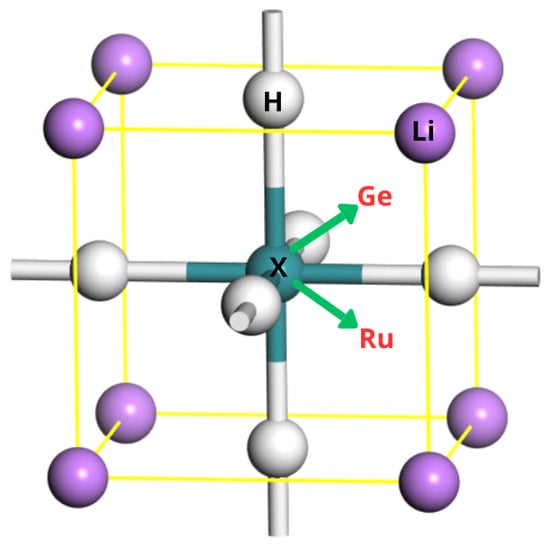
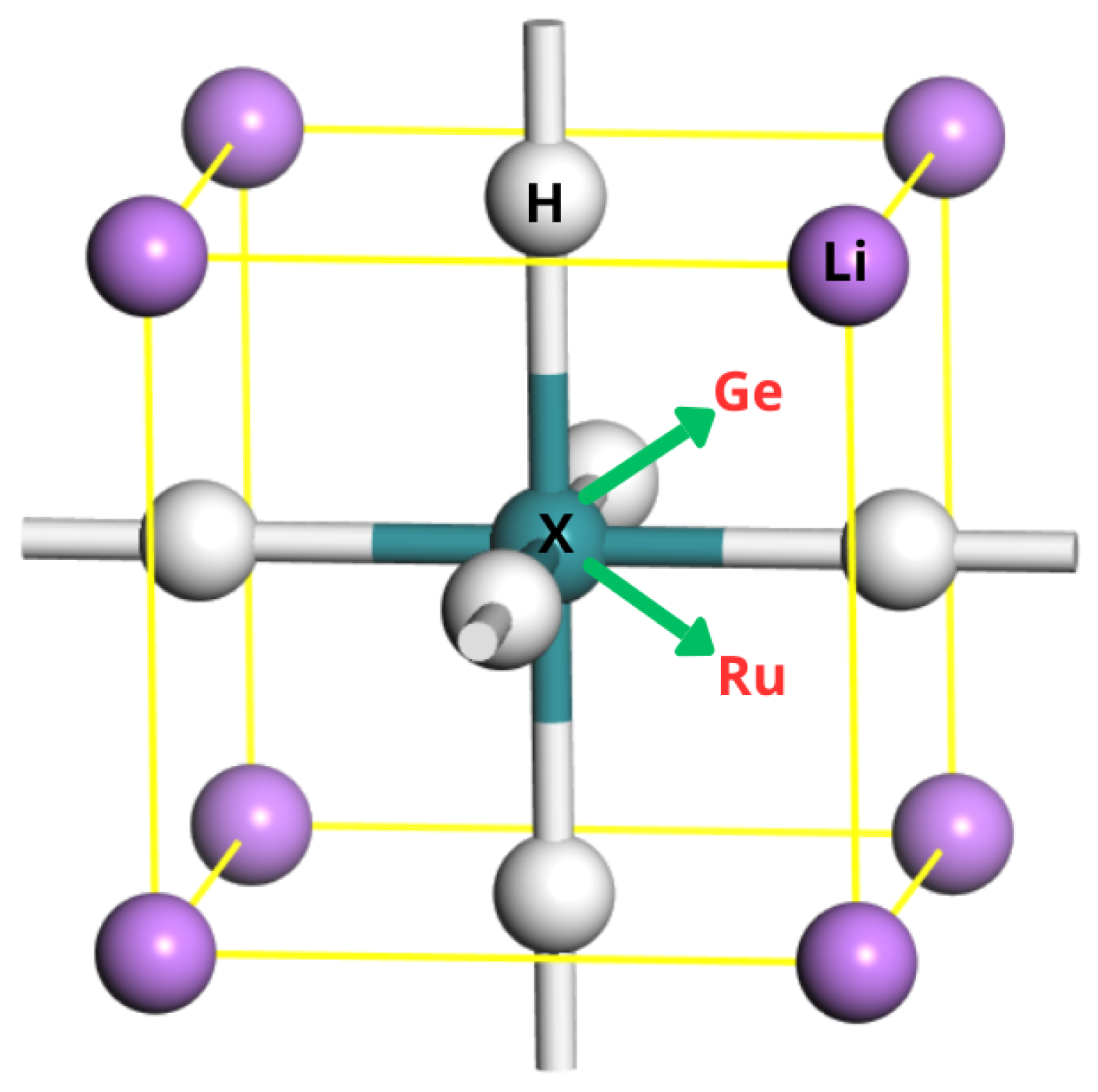
The structural stability of and was initially analysed using density functional theory (DFT), as assessing their stability is a crucial prerequisite for further exploration. To achieve this, it is essential to determine their structural properties. Both and are predicted to crystallize in a cubic structure with a space group. The unit cell configuration was established based on fractional coordinates: atom occupies the corners of the unit cell at , atoms are positioned at the center , and hydrogen atoms reside at the face-centered octahedral sites , , and , as illustrated in Figure 1. Moreover, the optimized lattice parameters for are Å, while for , they are Å, with angles . These conditions ensured a robust and reliable geometry optimization, guaranteeing both the stability and accuracy of the final results, as summarized in Table 1 [27,28].
Figure 1.
Crystal structures of the cubic for and hydrides.
Table 1.
Lattice parameter and formation energy for and hydrides.
The hydrogen evolution process of and can be described by the following chemical reaction [28,39,40]:
These two equations illustrate the decomposition of and perovskites, leading to the release of hydrogen gas. To assess the thermodynamic stability of and compounds, their formation energies were calculated using the formulas, and the factor of 5 appearing in these equations corresponds to the total number of atoms in the primitive unit cells of our materials:
where and represent the total energy of the and materials, and , , and correspond to the total energy of , and , respectively, while is the total energy of the molecule.
The calculated formation energies are eV for and eV for , as summarized in Table 1. The negative formation energies indicate that the formation of both hydrides from their constituent elements is energetically favorable, confirming their intrinsic thermodynamic stability. Moreover, the moderate magnitude of these values suggests that the compounds are stable against spontaneous decomposition while still allowing reversible hydrogen release, which is a desirable characteristic for hydrogen storage applications.
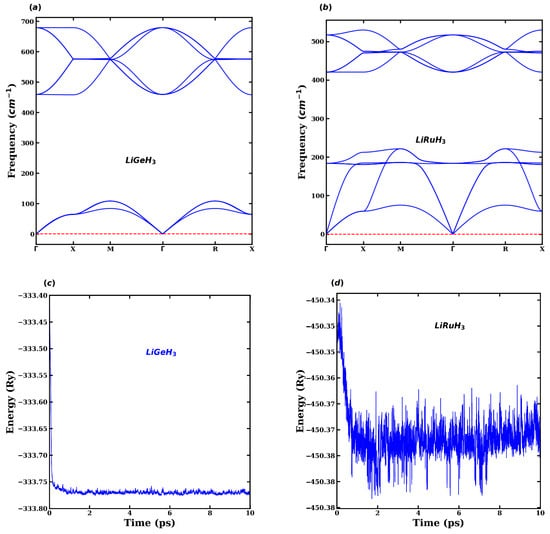
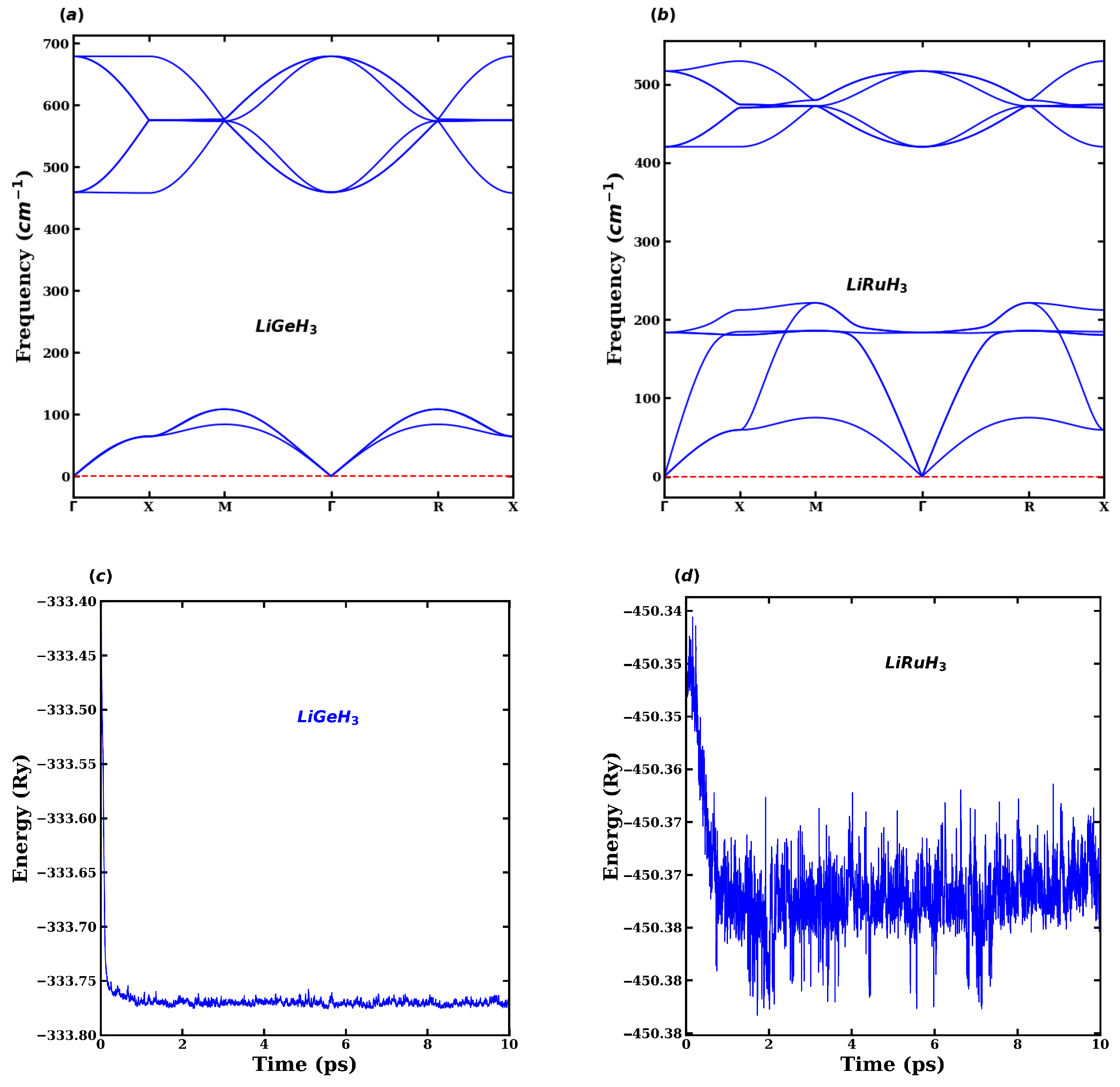
Figure 2a,b illustrates the phonon dispersion curves for and , calculated using the Phonopy package to evaluate their lattice dynamical stability, providing crucial insights into their dynamical stability. The full phonon dispersion relations were computed along the high-symmetry paths of the Brillouin zone (). The absence of imaginary frequencies throughout the Brillouin zone clearly confirms that both materials are dynamically stable. The phonon modes of extend up to approximately 700 cm−1, indicating a relatively strong bonding environment. However, exhibits lower phonon frequencies, reaching up to 500 cm−1, suggesting softer bonds and the influence of heavier atomic masses on vibrational properties. Importantly, the complete lack of negative phonon modes demonstrates that both compounds can exist as stable crystal structures without undergoing any lattice instabilities or structural distortions.
Figure 2.
(a,b) Phonon dispersion curves along high-symmetry paths in the first Brillouin zone, showing no imaginary frequencies and confirming dynamical stability; (c,d) energy fluctuations during ab initio molecular dynamics simulations at 300 K over 10 ps, with insets showing the preserved structures after simulation, demonstrating excellent thermal stability at room temperature for and hydrides.
Furthermore, ab initio molecular dynamics (AIMD) simulations were performed within the NVT ensemble to gain insights into the thermal stability of the proposed materials. The simulations were carried out for 10 ps at a temperature of 300 K, as shown in Figure 2c,d. Throughout the simulation, maintains an almost constant total energy, indicating good thermal equilibration and strong stability under ambient conditions. Similarly, exhibits only minor energy fluctuations after an initial equilibration stage, which is typical of thermally stable systems at finite temperature. Importantly, no structural collapse, bond breaking, or significant atomic rearrangement is observed during the AIMD trajectories for either material, and the crystal frameworks remain intact with only small thermal vibrations of atoms. The absence of abrupt energy changes or irreversible distortions confirms that both materials preserve their structural integrity under thermal fluctuations. These results demonstrate that and are thermally stable at room temperature, supporting their feasibility for experimental synthesis and their potential application in hydrogen storage systems.
3.2. Mechanical Properties
Mechanical properties describe the response of a material to external loads, stresses and pressures, which undergoes deformation and recovery to its original shape [41,42]. These properties illuminate the material’s elastic stiffness, bonding character, anisotropy, and structural and mechanical stability. To study the stability and nature of forces acting in the cubic phase of our and materials, the elastic constants , , and were successfully calculated by PBE-GGA approximation, as shown in Table 2.
Table 2.
Elastic constants and derived mechanical parameters of , hydrides calculated in this work, with comparison to literature data.
These constants meet the Born stability criteria [43], which confirms that our materials are mechanically stable.
Furthermore, other mechanical properties such as the bulk modulus , Voigt–Reuss shear modulus , Young’s modulus , Poisson’s ratios , Pugh’s ratio , and anisotropy factor of the materials are all calculated using the following equations [44,45,46,47]:
The hardness of the material can be defined from the bulk modulus . , have a high bulk modulus, which indicates a great ability to resist stress-induced deformation; the material is harder than the material , with values of GPa and GPa, respectively. From Table 2, our perovskite hydride materials have a relatively high Young’s modulus, which means great rigidity and resistance to stress. In addition, the brittleness, ductility and binding nature of hydride perovskites can be explored by mechanical parameter values. Firstly, if the Poisson’s ratio is less than , then the material is brittle, and if it is greater than , then the material is ductile [48,49,50]. In our case, has a value of and has a value of . This indicates the ductile nature of the compound and the brittle nature of the compound. Secondly, if the Pugh ratio is greater than , then it predicts ductile materials, and if its value is less than , the material is brittle [51]. The compound has a value of , indicating its ductile nature, while the compound has a value of —less than —indicating its brittle nature. These values confirm the previous results. Moreover, to calculate the isotropic and anisotropic nature of the materials, we calculate the anisotropic factor A; a material is isotropic if and anisotropic if [52]. Thus, our materials present anisotropic values equal to and for and , respectively.
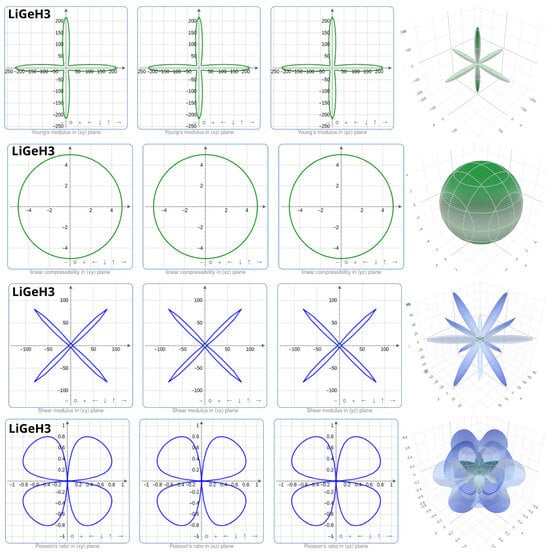
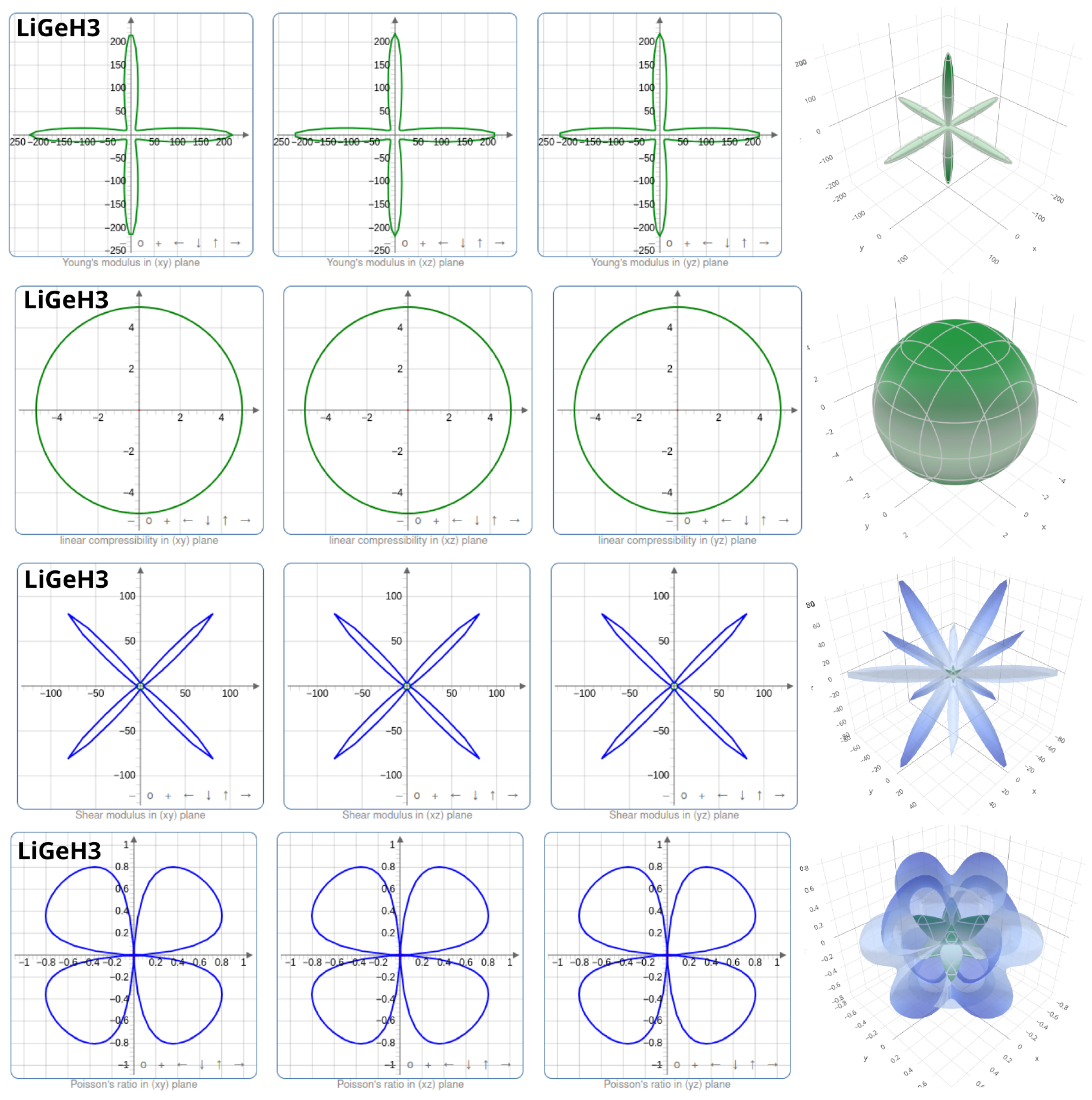
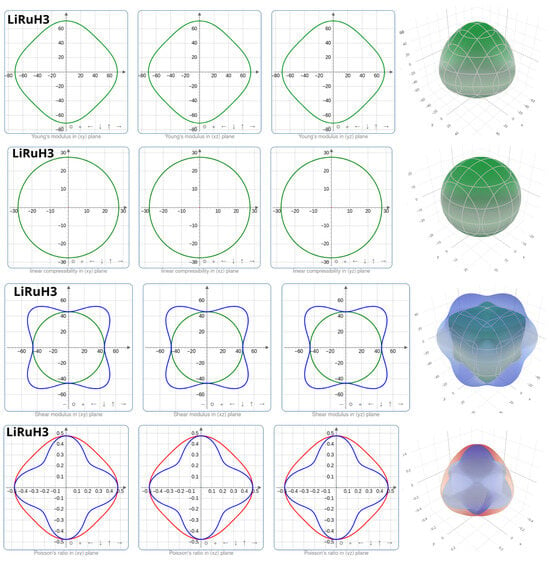
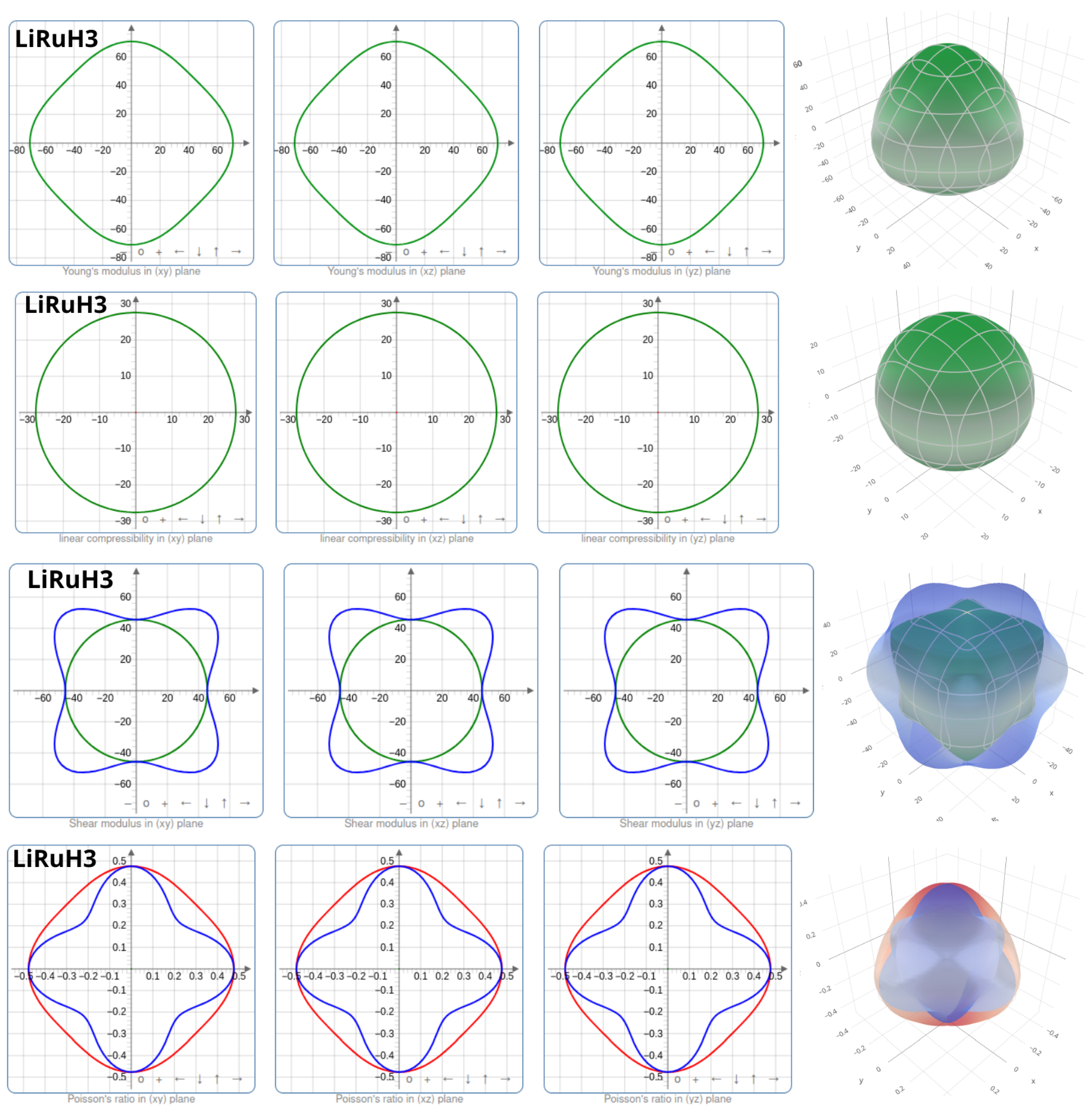
Figure 3 and Figure 4 display 2D and 3D configurations of the Young’s modulus, linear compressibility, shear modulus, and Poisson’s ratios for the perovskite hydride materials using ELATE software(GNU General Public Licence ) [53,54]. This figures illustrate the spherical forms, and the geometric shapes ensuring anisotropy of our materials. Therefore, the mechanical characteristics of our compounds suggest a high level of durable resilience in several applications, implying that and compounds have promising mechanical properties that make them suitable for many technological applications.
Figure 3.
2D and 3D configurations of Young’s modulus, linear compressibility, shear module and Poisson’s ratio for hydride.
Figure 4.
2D and 3D configurations of Young’s modulus, linear compressibility, shear module and Poisson’s ratio for hydride.
4. Thermodynamic Properties
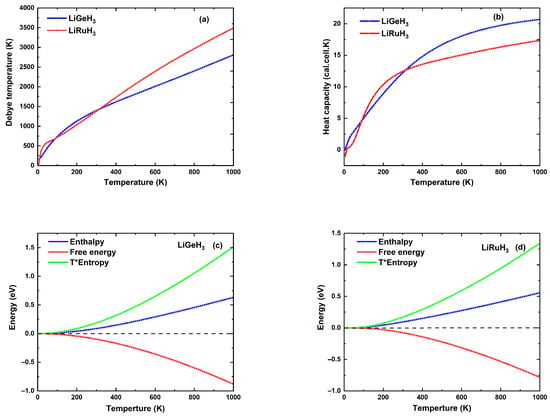
In this section, we calculated the thermodynamic parameters such as Debye temperature, specific calorific capacity, enthalpy, Gibbs free energy, and temperature times entropy for our hydride perovskite materials , using the quasi-harmonic approximation [55]. These plots indicate the enthalpy with a blue curve, the free energy with a red curve, and the temperature times the entropy of the studied material with a green curve, over a wide temperature range from 0 K to 1000 K.
The Debye temperature of a material is an essential parameter that can solve the thermodynamic and mechanical problems of materials, including their melting point and modulus of elasticity [56]. Figure 5a clearly shows that the Debye temperature increases with increasing temperature for both hydride materials , , reaching its maximum at 1000 K. In the room temperature, the Debye temperature is equal to 1500 K for both materials, which improves higher melting point temperatures, and also means greater atomic bonding forces. Next, in Figure 5b, we illustrate the specific calorific capacity, which is defined as the heat absorbed or released by a mass unit when its temperature increases by 1 K. From this figure, the calorific capacity of , increases with increasing temperature and reaches a limit, which refers to the Dulong–Petit limit at high temperature [57].
Figure 5.
(a) Debye temperature for and ; (b) specific heat capacity for and ; and (c,d) enthalpy, Gibbs free energy, and temperature × entropy for and .
As shown in Figure 5c,d, the enthalpy, free energy, and entropy of both hydride perovskite materials are nearly equal to zero when the temperature is below 100 K. Then, with increasing temperature, only enthalpy and entropy increase while free energy decreases. The maximum value of enthalpy is eV at 1000 K for and equal to eV at 1000 K for ; in addition, the negative values of free energy confirm the thermodynamic stability of our materials [58]. Moreover, the temperature multiplied by entropy increases more with increasing temperature than the free energy and enthalpy, which enhances the fact that entropy increases with increasing temperature because the thermal vibrations of atoms increase with increasing temperature. The maximum value of entropy is obtained at an energy of eV for and eV for against 1000 K.
5. Optoelectronic Properties
5.1. Electronic Propreties
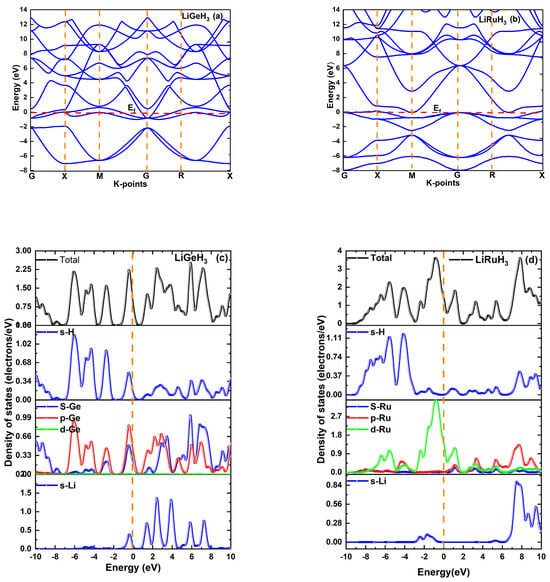
In this section, we study the electronic properties of and perovskites based on the electronic band structure, as well as the total and partial density of states. These properties have been analyzed to better understand the electronic behavior of these perovskites and their conductivity. These materials contain hydrogen atoms, which are very important for hydrogen storage. Figure 6a,b illustrates the electronic band structure of , , along the high-symmetry directions in the first Brillouin zone. The analysis of these structures shows that, for both materials, the valence band maximum (VBM) and the conduction band minimum (CBM) cross directly at the Fermi level. This property is a key indicator of the metallic nature of these perovskites, as it implies the absence of an energy gap between the valence and conduction bands [59,60,61]. These perovskites, owing to their intrinsic metallic nature, exhibit excellent electrical conductivity, which can facilitate efficient hydrogen adsorption and desorption processes. In hydride perovskites, hydrogen is an integral constituent of the crystal lattice rather than an interstitially incorporated species, and its presence does not necessarily induce a metal–insulator transition. The preserved metallic character mainly originates from the hybridization between hydrogen states and the B-site, maintaining finite electronic density at the Fermi level even in the fully hydrogenated structure. While such metallicity may imply moderate hydrogen binding strength compared to classical ionic hydrides, it can be beneficial for fast hydrogen exchange kinetics and good reversibility. Similar behavior has been reported in other metallic hydride systems, including hydride perovskites and metal–hydrogen alloys, highlighting the suitability of these materials for hydrogen storage and related electrochemical applications [62,63,64,65].
Figure 6.
(a,b) Electronic band structures and (c,d) partial/total density of states for both and hydrides.
Figure 6c,d shows the total density of state (TDOS) and the partial density of state (PDOS) of the two perovskites and in an energy range from eV to 10 eV, using the GGA-PBE functional. Understanding the electronic behavior of these two perovskites is further made possible by the total density of states, which shows the distribution and location of various energy levels inside a material’s band structure. Furthermore, the s orbital of hydrogen and the p orbital of the atom mainly contributes in the energy range of to 0 eV for the material , while the s orbital of hydrogen and the d orbital of the atom mainly contributes in the energy range of to 0 eV for the material in the valence band. However, the main contributions of the s orbitals for and the s orbitals of H and atoms, and the p orbital of for , were shown in the conduction band. Moreover, the TDOS of both materials cross the Fermi level, proving the metallic character of both materials, which is in line with our energy band analysis’s findings.
5.2. Electronic Charge Density
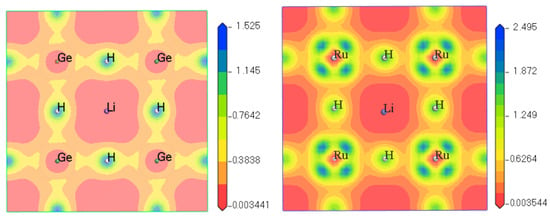
For a better understanding of the chemical bond between hydride perovskite atoms, the electron charge density distribution in metal hydride perovskites was studied and is presented in Figure 7. The orange color represents the electron accumulation and the blue color represents the electron depletion with respect to the free states of atoms. The H atoms get electrons and the metal element entirely loses electrons, which results in electron transfer during bonding. The electronegativity of , and H is , and . A large difference in electronegativity confirms the presence of an ionic bond and a small difference in electronegativity confirms the presence of a covalent bond. Thus, the difference in Li-H atoms shows an ionic bond, while Ge-H and Ru-H show the characteristics of a covalent bond. This double behavior highlights the different complex electronic interactions within these compounds, showing the characteristics of their electronic structure [66].
Figure 7.
Electronic charge density for , hydrides.
Table 3 lists the properties of the Mulliken atomic population of our hybrid perovskite materials , which give a thorough understanding of the chemical bonding formation between atoms. In addition, they explain how the overlap of the electron clouds of the two bound atoms are quantified, thus indicating characteristic ionicity and covalence in the chemical bonds. Low values of these parameters refer to ideal ion bonds, that is, the population of ion bonds, while high values indicate an increase in covalence level [67,68,69].
Table 3.
Mulliken atomic population parameters of , hydrides.
5.3. Optical Properties
The dielectric function of a material represents its complex behavior in response to electromagnetic radiation. This dielectric function is given by the relation [70]:
where represents the dispersion or scattering of light, while the imaginary part of the dielectric function describes the material’s ability to absorb electromagnetic radiation.
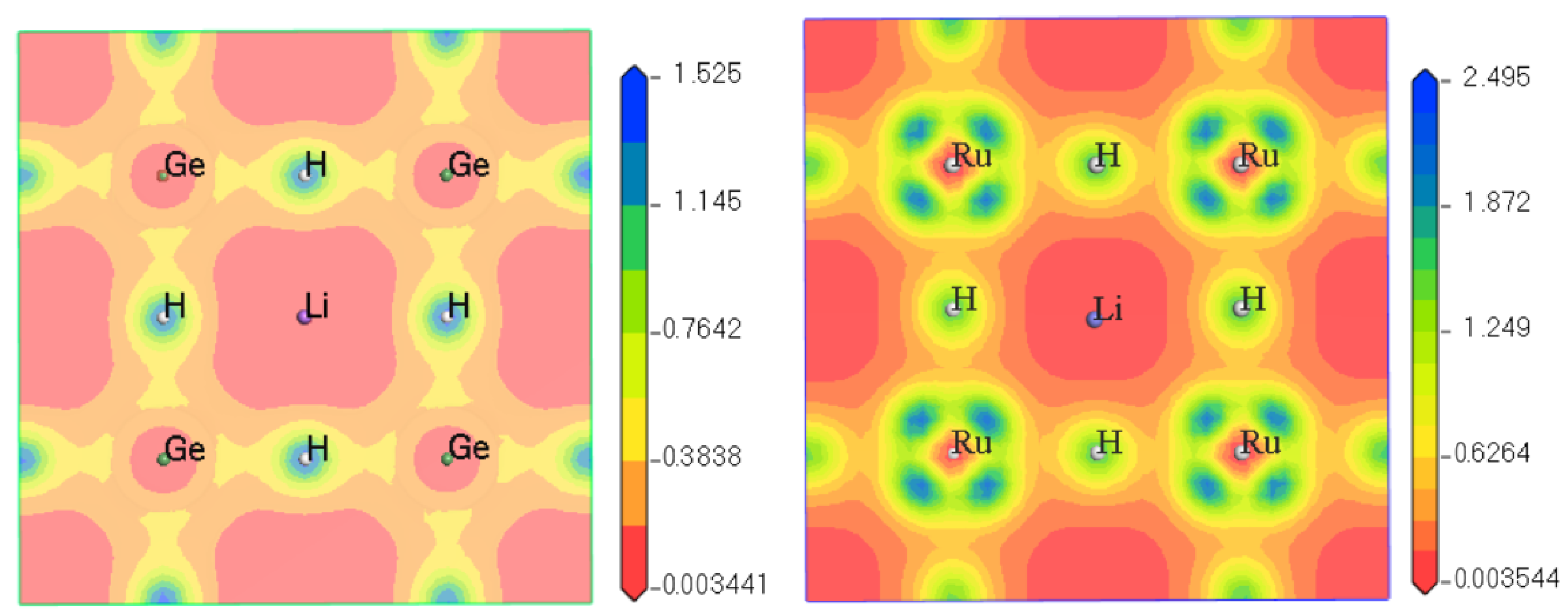
Figure 8a shows the real part of the dielectric function as a function of energy in the range [0, 30 eV]. It is clear that the real parts of both perovskites, and , follow a similar trend as the energy increases. When the energy is zero, the static values of for and are and respectively. It is evident that the real part reaches its maximum values near eV for and 0 eV for , but as the energy increases, this part of the dielectric function decreases and tends towards zero for energies above 20 eV. Additionally, of shows negative values in the energy range from to eV, while also exhibits negative values in the range from to eV; these negative values induce optical losses and reduce transmission. The maximum values of are found near zero in the infrared range, which shows that these materials have a high potential for hydrogen energy storage [71,72].
Figure 8.
(a) Real and (b) imaginary parts of the dielectric function, (c) absorption coefficient, (d) reflectivity, (e) refraction index, and (f) extinction coefficient for , hydrides.
The imaginary component of the dielectric function is represented by Figure 8b. Its statistically significant values are 0 and 2, respectively, for and , while its maximum values are to eV for and to eV for . Beyond 15 eV, the 2 decreases and tends to zero. A material’s capacity to absorb and trap light energy or any other kind of electromagnetic radiation as it travels through is measured by its absorption coefficient . Figure 8c illustrates the absorption coefficient of our perovskite materials as a function of energy in the range [0, −30 eV]. When no photons are present on the surface of these two perovskites ( eV), these materials exhibit no absorption. However, when the energy increases, an increase in these coefficients is observed. Moreover, the maximum absorption coefficient values for and are cm−1 at eV and cm−1 at eV, respectively. Therefore, these two materials exhibit extremely low absorption coefficients, close to zero, when exposed to high frequencies [73].
The reflectivity of a material’s surface represents the ability of the surface to reflect incident light. It helps to understand the optical properties of materials as well as the influence of photons on the material’s electronic structure, and its formula is given by the following relation [67]:
where n is the refractive index and is the extinction coefficient. Figure 8d illustrates the reflectivity of the materials , as a function of energy in the range of 0 to 30 eV. The maximum reflectivities of and are at eV and at eV, respectively. It is observed that at high frequencies, the reflectivity of these two materials decreases and tends towards zero for energies greater than 30 eV.
The complicated index of refraction describes how light travels through different materials [42]. This index is expressed in a complex way to account for the dissipative properties of the materials as follows:
Figure 8e represents the real part of the refractive index; as observed, the static values for and are and , respectively. Therefore, the static value of is higher than that of , indicating a greater polarization in compared to . The real part exhibits two identical maximum values at different energies: and eV, while for , it has a maximum value of at eV. These two perovskites have potential in the field of hydrogen storage, as they possess static refractive indices exceeding the value of 2 [74]. Moreover, Figure 8f represents the extinction coefficient of the two materials as a function of energy in the range of 0–30 eV. This coefficient is useful for determining the absorption capacity of the incident radiation by the materials. It is related to the imaginary part of the dielectric function. The static values of the extinction coefficient for and are 0 and , respectively. The maximum value of k for is at eV, while the maximum value of k for is at eV. The maximum value of is significantly higher than that of , highlighting that the interactions between and the incident radiation are stronger [75].
6. Hydrogen Storage Properties and Desorption Temperature
Hydrogen storage with an appropriate gravimetric capacity remains a major challenge for industrial energy storage applications. Various storage methods exist, including gas, liquid, and solid-state storage. Identifying materials with optimal properties for sustainable and efficient hydrogen storage is crucial [76]. A key metric used to evaluate hydrogen storage materials is the material-level gravimetric capacity, which expresses the hydrogen content relative to the mass of the active material. The U.S. Department of Energy (DOE) has defined system-level targets for onboard hydrogen storage in light-duty vehicles, corresponding to approximately kWh/kg (≃6.5 ), where the target refers to the entire storage system, including the tank, thermal management, balance-of-plant components, and auxiliary hardware [77,78]. It should be noted that these targets refer to complete storage systems, including the storage vessel, balance-of-plant components, insulation, and all auxiliary hardware, rather than the intrinsic properties of the active material. Accordingly, the comparison presented here is intended as a qualitative benchmark, highlighting the intrinsic hydrogen storage potential of the studied materials, rather than claiming direct compliance with DOE system-level targets. To meet this objective, a wide range of materials, including metal hydrides and perovskites, have been explored as promising candidates for hydrogen storage. Lightweight perovskite materials, in particular, have demonstrated superior hydrogen storage efficiency compared to other compounds, mainly due to their high gravimetric and volumetric storage capacities. Recently, new hydride perovskites with enhanced hydrogen gravimetric density have gained significant attention, complementing the well-studied metal hydrides [31,79].
The gravimetric capacity of the studied perovskite hydrides was quantitatively calculated using DFT calculations based on the following equation [79]:
where n represents the number of hydrogen atoms in the material, is the molar mass of the hydrogen, and is the molar mass of the studied hydride. This formulation provides a reliable measure of the hydrogen storage potential of these elements for energy applications. Our computational results indicate significant gravimetric capacities of approximately and for and , respectively. Additionally, the substitution of the B-site atom ( and impacts the gravimetric hydrogen storage capacity. The increasing atomic mass leads to a decreasing trend in the storage capacity. As a result, exhibits a higher gravimetric capacity (3.66 wt%) than , making it more favorable at the material level for theoretical comparison.
Another crucial parameter in hydrogen storage is the volumetric storage capacity, which strongly correlates with the primitive cell volume of a compound. A lower volume implies a higher storage density. The calculated volumetric storage capacities for the studied hydrides are approximately g.H2/L for and g.H2/L for . While these values exceed the material-level benchmark of 50 g.H2/L often cited in the literature, it is important to reiterate that they reflect material-level capacities, not full system-level performance [77,80]. Beyond storage capacity, the desorption temperature is a key factor that determines the feasibility of hydrogen release. The desorption temperature (TD) was estimated using a van’t Hoff-type relation based on the DFT-calculated formation enthalpy () and the entropy change () associated with hydrogen release [81]:
This temperature corresponds to the energy required to release the stored hydrogen from the metal hydrides. The DOE recommended that, the ideal amount of hydrogen is released within the temperature range of 233–358 K [77,82,83]. For our DFT calculations, the desorption temperature is obtained by dividing the computed formation energy values by the entropy change of hydrogen (approximately KJ/mol, and 298 K) [84]. The obtained desorption temperature values are K for and K for . Therefore, and require moderately elevated temperatures for hydrogen release. These results indicate that B-site chemistry plays an important role in tuning hydrogen release behavior at the material level, providing useful insight into the intrinsic hydrogen storage potential and a basis for future material and system-level optimization studies [30].
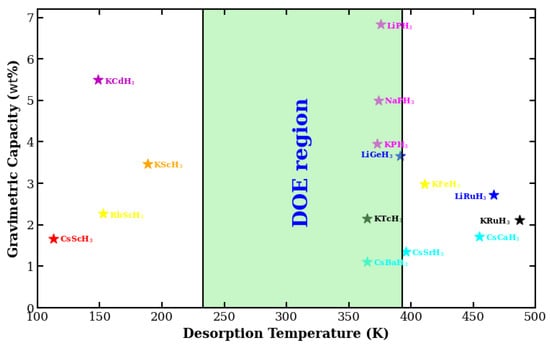
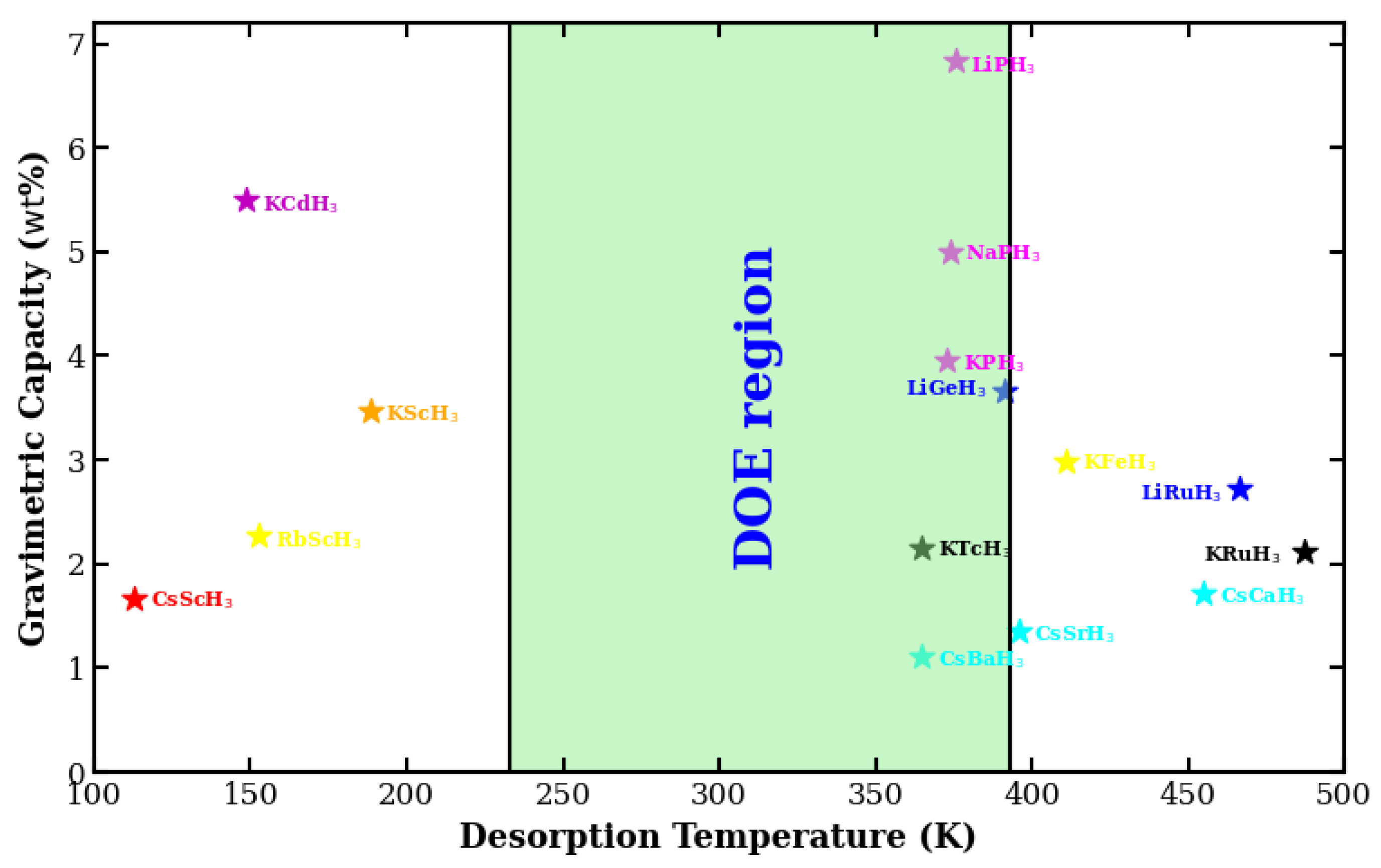
Figure 9 presents a comparative, material-level analysis of gravimetric capacity and desorption temperature for the studied compounds relative to previously reported hydride perovskites. The calculated gravimetric capacities exceed those reported for several systems, including , , , and [27,85,86,87], while remaining lower than those of lighter hydride perovskites such as and [30,88]. These trends highlight the strong influence of A- and B-site atomic masses on hydrogen storage capacity within the perovskite hydride family. Overall, this study provides a material-level comparison of and within the broader hydride perovskite landscape, rather than proposing them as standalone solutions to current DOE system-level hydrogen storage targets. In particular, emerges as a promising reference system for theoretical screening, offering balanced gravimetric capacity and favorable desorption temperature, while serves as a comparative case illustrating the impact of heavier B-site elements. These findings can inform future efforts aimed at material optimization, compositional tuning, and system-level integration.
Figure 9.
Comparative analysis of gravimetric capacity and desorption temperature for hydrogen storage in hydride perovskites.
Finally, Table 4 presents a systematic, material-level comparison of the hydrogen storage properties of and , with some representative hydrogen storage materials, LiXH3 hydrides, reported from the literature. This comparison includes gravimetric capacity, volumetric capacity (where available), and hydrogen desorption temperature, allowing the present results to be directly cross-referenced with earlier theoretical studies on hydride perovskites and conventional hydrides. By situating the studied compounds within this broader context, the table clearly illustrates where LiGeH3 and LiRuH3 stand relative to existing materials, highlighting both their competitive aspects and their intrinsic limitations.
Table 4.
Comparison of material-level hydrogen storage properties of and with representative hydrogen storage materials reported in the literature.
Overall, the comparative analysis presented in Figure 9 and Table 4 place and within the broader landscape of -type hydride perovskites, rather than among state-of-the-art hydrogen storage materials that satisfy current system-level requirements. While their gravimetric capacities remain moderate compared to lighter hydrides, in particular exhibits a balanced combination of hydrogen capacity and desorption temperature, comparable to several reported compounds. In contrast, heavier B-site substitutions such as lead to increased volumetric density but higher hydrogen release temperatures, illustrating the inherent trade-offs within this material class. These results confirm that hydrides should be viewed as model systems for understanding structure–property relationships, providing guidance for future compositional tuning and materials design. Within the hydrogen economy landscape, such insights are valuable for advancing theoretical screening and informing experimental efforts toward optimized, lightweight hydride systems, rather than offering immediate practical storage solutions.
7. Conclusions
In this work, first-principles DFT calculations combined with short-time AIMD simulations were employed to investigate the structural, electronic, mechanical, and thermodynamic properties of lithium-based hydride perovskites , . The results demonstrate that both compounds satisfy theoretical criteria for structural stability, including dynamical, elastic, and thermal stability within the limits of the applied computational framework. Electronic structure analysis reveals metallic behavior, while optical calculations provide complementary insight into their electronic response.
From a hydrogen storage perspective, the calculated theoretical gravimetric capacities are approximately and , with corresponding volumetric capacities of g.H2/L and g.H2/L for and respectively. The predicted desorption temperatures (391 K for and 467 K for ) fall within a moderate operational range when compared to other hydride perovskites. These values represent upper-bound theoretical estimates and do not account for kinetic limitations or reversibility.
It is emphasized that this study is purely theoretical and intended as a screening-level investigation rather than a demonstration of practical hydrogen storage performance. Experimental realization may face significant challenges, including synthesis control, phase stability, and cycling behavior. Consequently, the present results are best viewed as providing physical insight and comparative trends that may help guide future experimental and computational studies on Li-based hydride perovskites.
Author Contributions
Conceptualization, K.R.; methodology, A.W. and L.M.; software, A.W. and H.O.; validation, A.A., S.T., B.M. and M.E.I.; formal analysis, O.B.; investigation, M.A.; resources, S.T.; writing—original draft, A.W., M.A. and H.O.; supervision, A.A. and B.M.; and project administration, B.M. All authors have read and agreed to the published version of the manuscript.
Funding
This research received no external funding.
Data Availability Statement
The raw data supporting the conclusions of this article will be made available by the authors on request.
Conflicts of Interest
The authors declare no conflicts of interest.
References
- Vincent, B.; Raquel, E.G.; Liana, M.M.; Dmitrii, P.; Piyanut, P.; Giorgia, Z. Research Frontiers in Energy-Related Materials and Applications for 2020–2030. Adv. Sustainable Syst. 2020, 4, 1900145. [Google Scholar]
- IEA. World Energy Outlook 2018, IEA. Available online: https://www.iea.org/reports/world-energy-outlook-2018 (accessed on 12 November 2018).
- Yang, W.S.; Park, B.W.; Jung, E.H.; Jeon, N.J.; Kim, Y.C.; Lee, D.U.; Shin, S.S.; Seo, J.; Kim, E.K.; Noh, J.H.; et al. Odide management in formamidinium-lead-halide-based perovskite layers for efficient solar cells. Science 2017, 356, 1376–1379. [Google Scholar] [CrossRef] [Scilit]
- Tsai, H.; Asadpour, R.; Blancon, J.C.; Stoumpos, C.C.; Durand, O.; Strzalka, J.W.; Chen, B.; Verduzco, R.; Ajayan, P.M.; Tretiak, S.; et al. Light-induced lattice expansion leads to high-efficiency perovskite solar cells. Science 2018, 360, 67–70. [Google Scholar] [CrossRef] [Scilit] [PubMed]
- Zhang, L.; Chen, Z. Polyoxometalates: Tailoring metal oxides in molecular dimension toward energy applications. Int. J. Energy Res. 2020, 44, 3316. [Google Scholar] [CrossRef] [Scilit]
- Keiji, A.; Masaya, T.; Yoji, S. Photo-electrochemical characteristics of a cobalt–air cell using an anode active material–semiconductor (Co–GaP) hybrid electrode. J. Power Sources 2021, 103, 72–79. [Google Scholar]
- Shah, M.A.H.; Hossain, A. Insights of pressure-mediated optoelectronic, vibrational and thermodynamic properties of APdH3 (A = Ca, Sr, Ba) perovskite hydrides from ab initio calculations. Phys. B Condens. Matter. 2024, 695, 416595. [Google Scholar] [CrossRef] [Scilit]
- Raza, H.H.; Murtaza, G.; Umm-e-Hani; Muhammad, N.; Ramay, S.M. First-principle investigation of XSrH3 (X = K and Rb) perovskite-type hydrides for hydrogen storage. Int. J. Quantum Chem. 2020, 120, e26419. [Google Scholar] [CrossRef] [Scilit]
- Surucu, G.; Gencer, A.; Candan, A.; Gullu, H.H.; Isik, M. CaXH3 (X = Mn, Fe, Co) perovskite-type hydrides for hydrogen storage applications. Int. J. Energy Res. 2020, 44, 2345–2354. [Google Scholar] [CrossRef] [Scilit]
- Shah, M.A.H.; Hossain, A.; Alam, M.A.; Pervez, M.S.; Nuruzzaman, M.; Zilani, M.A.K. Exploring pressure induced thermoelectric properties of LiAeH3 (Ae = Ca, Sr, Ba) perovskite hydrides along with optoelectronic features. Mater. Sci. Semicond. Process. 2022, 137, 106238. [Google Scholar] [CrossRef] [Scilit]
- Kabli, M.R.; Rehman, J.U.; Tahir, M.B.; Usman, M.; Ali, A.M.; Shahzad, K. Structural, electronics and optical properties of sodium based fluoroperovskites NaXF3 (X = Ca, Mg, Sr and Zn): First principles calculations. Phys. Lett. A 2021, 412, 127574. [Google Scholar] [CrossRef] [Scilit]
- Waqdim, A.; Agouri, M.; Abbassi, A.; Elhadadi, B.; Zidane, Z.; Taj, S.; Manaut, B.; Driouich, M.; El Idrissi, M. Theoretical investigation of the physical properties of cubic perovskite oxides SrXO3 (X = Sc, Ge, Si). Mater. Sci. Semicond. Process. 2023, 158, 107340. [Google Scholar] [CrossRef] [Scilit]
- Waqdim, A.; Agouri, M.; Ouali, M.; Abbassi, A.; Taj, S.; Manaut, B.; El Idrissi, M. Ab initio insight into the physical properties of new ferroelectric perovskite oxide materials XGeO3 (X = Sr, Ca). Rev. Mex. De Fis. 2024, 70, 051603. [Google Scholar] [CrossRef] [Scilit]
- Li, Y.; Chung, J.S.; Kang, S.G. First-principles computational screening of perovskite hydrides for hydrogen release. ACS Comb. Sci. 2019, 21, 736–742. [Google Scholar] [CrossRef] [Scilit] [PubMed]
- Shah, M.A.H.; Alam, M.A.; Hossain, A.; Hossain, M.F.; Nuruzzaman, M.; Parvin, F.; Zilani, M.A.K. Hydrostatic pressure on XLiH3 (X = Ba, Sr, Ca) perovskite hydrides: An insight into structural, thermo-elastic and ultrasonic properties through first-principles investigation. Solid State Commun. 2021, 328, 114222. [Google Scholar] [CrossRef] [Scilit]
- Sharma, S.; Ghoshal, S.K. Hydrogen the future transportation fuel: From production to applications. Renew. Sustain. Energy Rev. 2015, 43, 1151–1158. [Google Scholar] [CrossRef] [Scilit]
- Dutta, S. A review on production, storage of hydrogen and its utilization as an energy resource. J. Ind. Eng. Chem. 2014, 20, 1148–1156. [Google Scholar] [CrossRef] [Scilit]
- Salvi, B.L.; Subramanian, K. Sustainable development of road transportation sector using hydrogen energy system. Renew. Sustain. Energy Rev. 2015, 51, 1132–1155. [Google Scholar] [CrossRef] [Scilit]
- Schuth, F.; Bogdanovic, B.; Felderhoff, M. Light Metal Hydrides and Complex Hydrides for Hydrogen Storage. Chem. Commun. 2004, 20, 2249–2258. [Google Scholar] [CrossRef] [Scilit]
- Orimo, S.; Nakamori, Y.; Eliseo, J.R.; Züttel, A.; Jensen, C.M. Complex hydrides for hydrogen storage. Chem Rev. 2007, 107, 4111–4132. [Google Scholar] [CrossRef] [Scilit]
- Pan, Y. Exploring the structural, physical properties and hydrogen storage properties of LiBHx (x = 1 and 4) lithium borohydrides. Ceram Int. 2024, 50, 3837–3842. [Google Scholar] [CrossRef] [Scilit]
- Shah, S.F.A.; Murtaza, G.; Ismail, K.; Raza, H.H.; Khan, I.J. First principles investigation of transition metal hydrides LiXH3 (X = Ti, Mn, and Cu) for hydrogen storage. J. Comput. Electron. 2023, 22, 921–929. [Google Scholar] [CrossRef] [Scilit]
- Siddique, A.; Khalil, A.; Almutairi, B.S.; Tahir, M.B.; Ahsan, T.; Hannan, A.; Alzaid, M. Structural, electronic, mechanical and dynamical stability properties of LiAH3 (A = Sc, Ti and V) perovskite-type hydrides: A first principle study. Chem. Phys. 2023, 568, 111851. [Google Scholar] [CrossRef] [Scilit]
- San, X.J.; He, Z.; Ma, Y.M.; Cui, T.; Liu, B.B.; Zou, G.T. Electronic structure and optical properties of LiXH3 and XLiH3 (X = Be, B or C). Chin. Phys. B 2008, 17, 2222. [Google Scholar]
- Mubashir, M.; Mubashar, A.; Bibi, Z.; Younis, M.W.; Muzamil, M. Efficient hydrogen storage in LiMgF3: A first principle study. Int. J. Hydrogen Energy 2024, 50, 774–786. [Google Scholar] [CrossRef] [Scilit]
- Parvaiz, M.M.; Khalil, A.; Tahir, M.B.; Ayub, S.; Alic, T.E.; Masood, H.T. A DFT investigation on structural, electronic, magnetic, optical, elastic and hydrogen storage properties of Ru-based hydride-perovskites XRuH3 (X = Cr, V, Ni). RSC Adv. 2024, 14, 8385–8396. [Google Scholar] [CrossRef] [Scilit]
- Al-Zoubi, N.; Almahmoud, A.; Almahmoud, A.; Obeidat, A. Theoretical assessment of a novel NaXH3 and KXH3 (X = Tc, Ru and Rh) perovskite hydrides for hydrogen storage. Int. J. Hydrogen Energy 2024, 93, 822–831. [Google Scholar] [CrossRef] [Scilit]
- Masood, M.; Murtaza, G.; Ahmad, N.; Touqir, M.; Hafiz, I.; Usman, A.; Ayyaz, A.; Nazir, A. An ab-initio study of the physical properties of Ge-based perovskites (XGeH3: X = Mg, Ca, and Sr) for potential hydrogen storage application. Int. J. Hydrogen Energy 2025, 97, 981–993. [Google Scholar] [CrossRef] [Scilit]
- Kiani, M.S.; Bakar, A.; Rehman, E. First-principles study on structural, elasto-mechanical, electronic, thermodynamic and hydrogen storage properties of XGeH3 (X = K, Rb) hydrides. Results Phys. 2025, 68, 108078. [Google Scholar] [CrossRef] [Scilit]
- Murtaza, H.; Ain, Q.; Issa, S.A.M.; Zakaly, H.M.H.; Munir, J. A precise prediction for the hydrogen storage ability of perovskite XPH3 (X = Li, Na, K) hydrides: First-principles study. Int. J. Hydrogen Energy 2024, 94, 1084–1093. [Google Scholar] [CrossRef] [Scilit]
- Ikeda, K.; Sato, T.; Orimo, S. Perovskite-type hydrides synthesis, structures and properties. Int. J. Mater. Res. 2008, 99, 471e9. [Google Scholar] [CrossRef] [Scilit]
- Kresse, G.; Furthmüller, J. Efficient iterative schemes for ab initio total-energy calculations using a plane-wave basis set. Phys. Rev. B 1996, 54, 11169–11186. [Google Scholar] [CrossRef] [Scilit]
- Moulaoui, L.; Najim, A.; Archi, M.; Al-Hattab, M.; Bajjou, O.; Bakour, A.; Lachtioui, Y.; Rahmani, K.; Manaut, B. Theoretical study of the Sb-substitution effect on the optoelectronic properties of Cs2AgBiBr6 double perovskite. Results Chem. 2025, 13, 102025. [Google Scholar] [CrossRef] [Scilit]
- Perdew, J.P.; Burke, K.; Ernzerhof, M. Generalized Gradient Approximation Made Simple. Phys. Rev. Lett. 1996, 77, 3865. [Google Scholar] [CrossRef] [Scilit]
- Perdew, J.P.; Zunger, A. Self-interaction correction to density-functional approximations for many-electron systems. Phys. Rev. B 1981, 23, 5048–5079. [Google Scholar] [CrossRef] [Scilit]
- Monkhorst, H.J.; Pack, J.D. Special points for Brillouin-zone integrations. Phys. Rev. B 1976, 13, 5188–5192. [Google Scholar] [CrossRef] [Scilit]
- Karasiev, V.V.; Sjostrom, T.; Trickey, S.B. Finite-temperature orbital-free DFT molecular dynamics: Coupling Profess and Quantum Espresso. Comput. Phys. Commun. 2014, 185, 3240–3249. [Google Scholar] [CrossRef] [Scilit]
- Togo, A.; Tanaka, I. First principles phonon calculations in materials science. Scr. Mater. 2015, 108, 1–5. [Google Scholar] [CrossRef] [Scilit]
- Bloch, J.; Moshe, H.M. Kinetics and mechanisms of metal hydrides formation—A review. J. Alloys Compd. 1997, 253–254, 529–541. [Google Scholar] [CrossRef] [Scilit]
- Smithson, H.; Marianetti, C.A.; Morgan, D.; Van der Ven, A.; Predith, A.; Ceder, G. First-principles study of the stability and electronic structure of metal hydrides. Phys. Rev. B 2002, 66, 144107. [Google Scholar] [CrossRef] [Scilit]
- Ayyaz, A.; Alkhaldi, H.D.; Saidi, S.; Albalawi, H.; Zayed, O.; Al-Daraghmeh, T.M.; Mahmood, Q.; Alqorashi, A.K. DFT investigation of thermodynamic, electronic, optical, and mechanical properties of XLiH3 (X = Mg, Ca, Sr, and Ba) hydrides for hydrogen storage and energy harvesting Authors. Mater. Sci. Semicond. Process. 2025, 186, 109020. [Google Scholar] [CrossRef] [Scilit]
- Rehmat, B.; Rafiq, M.A.; Javed, Y.; Irshad, Z.; Ahmed, N.; Mirza, S.M. Elastic properties of perovskite-type hydrides LiBeH3 and NaBeH3 for hydrogen storage. Int. J. Hydrogen Energy 2017, 42, 10038–10046. [Google Scholar] [CrossRef] [Scilit]
- Born, M. On the stability of crystal lattice. I. In Mathematical Proceedings of the Cambridge Philosophical Society; Cambridge University Press: Cambridge, UK, 1940; Volume 36, pp. 160–172. [Google Scholar] [CrossRef] [Scilit]
- Voigt, W. bub-upload, Crystallography. In Lehrbuch der Kristallphysik: (Mit Ausschluss Derkristalloptik); Leipzig, B.G., Ed.; Teubner: Berlin, Germany, 1910. [Google Scholar]
- Reuss, A. Calculation of the Flow Limits of Mixed Crystals on the Basis of the Plasticity of Monocrystals. ZAMM-J. Appl. Math. Mech. 1929, 9, 49–58. [Google Scholar] [CrossRef] [Scilit]
- Birnbaum, H.K. Mechanical properties of metal hydrides. J. Less Common Met. 1984, 104, 31–41. [Google Scholar] [CrossRef] [Scilit]
- Tahir, M.; Usman, M.; Rehman, J.U.; Tahir, M.B. A first-principles study to investigate the physical properties of Sn-based hydride perovskites XSnH3 (X = K, Li) for hydrogen storage application. Int. J. Hydrogen Energy 2024, 50, 845–853. [Google Scholar] [CrossRef] [Scilit]
- Greaves, G.N.; Greer, A.L.; Lakes, R.S.; Rouxel, T. Poisson’s ratio and modern materials. Nat. Mater. 2011, 10, 823–837. [Google Scholar] [CrossRef] [Scilit]
- Frantsevich, I.N.; Voronov, F.F.; Bakuta, S.A. Handbook on Elastic Constants and Moduli of Elasticity for Metals and Nonmetals; Naukova Dumka: Kiev, Ukraine, 1982. [Google Scholar]
- Afaq, A.; Bakar, A.; Anwar, S.; Anwar, W.; Fazal-e-Aleem. DFT study of SmXO3 (X = Al and Co) for elastic, mechanical and optical properties. Int. J. Mod. Phys. B 2018, 32, 1850362. [Google Scholar] [CrossRef] [Scilit]
- Rkhis, M.; Laasri, S.; Touhtouh, S.; Belhora, F.; Hlil, E.K.; Zaidat, K.; Obbade, S.; Hajjaji, A. Recent advances in magnesium hydride for solid-state hydrogen storage by mechanical treatment: A DFT study. Int. J. Hydrogen Energy 2023, 48, 35650–35660. [Google Scholar] [CrossRef] [Scilit]
- Pugh, S. XCII. Relations between the Elastic Moduli and the Plastic Properties of Polycrystalline Pure Metals. London Edinburgh Dublin Philos. Mag. J. Sci. 1954, 45, 823–843. [Google Scholar] [CrossRef] [Scilit]
- Yalameha, S.; Nourbakhsh, Z.; Vashaee, D. ElATools: A tool for analyzing anisotropic elastic properties of the 2D and 3D materials. Comput Phys. Commun. 2022, 271, 108195. [Google Scholar] [CrossRef] [Scilit]
- Ekuma, C.E.; Liu, Z.-L. ElasTool v3.0: Efficient computational and visualization toolkit for elastic and mechanical properties of materials. Comput. Phys. Commun. 2024, 300, 109161. [Google Scholar] [CrossRef] [Scilit]
- Inaba, H.; Yamamoto, T. Debye Temperature of Materials. Netsu Sokutei. 1983, 10, 132–145. [Google Scholar]
- Andritsos, E.I.; Zarkadoula, E.; Phillips, A.E.; Dove, M.T.; Walker, C.J.; Brazhkin, V.V.; Trachenko, K. The heat capacity of matter beyond the Dulong–Petit value. J. Phys. Condens. Matter. 2013, 25, 235401. [Google Scholar] [CrossRef] [Scilit] [PubMed]
- Červinka, C.; Fulem, M.; Stoffel, R.P.; Dronskowski, R. Thermodynamic Properties of Molecular Crystals Calculated within the Quasi-Harmonic Approximation. J. Phys. Chem. A 2016, 120, 2022–2034. [Google Scholar] [CrossRef] [Scilit]
- Colmenero, F.; Fernández, A.M.; Cobos, J.; Timón, V. Temperature-Dependent Gibbs Free Energies of Reaction of Uranyl-Containing Materials Based on Density Functional Theory. J. Phys. Chem. C 2018, 122, 5268–5279. [Google Scholar] [CrossRef] [Scilit]
- Ghaffar, N.; Usman, M.; Rehman, J.U.; Hussain, A.; Ali, S.M.; Ali, M. A DFT study to investigate physical properties and hydrogen storage capability of Mn-based hydride perovskites XMnH3 (X = Ba, Ca) for hydrogen storage application. Inorg. Chem. Commun. 2024, 161, 112167. [Google Scholar] [CrossRef] [Scilit]
- Raza, H.H.; Murtaza, G.; Shafiq, M. Structural, phonon, thermodynamic, and electronic properties of MgFeH3 at different pressures: DFT study. Comput. Theor. Chem. 2023, 1221, 114030. [Google Scholar] [CrossRef] [Scilit]
- Rehman, Z.u.; Rehman, M.A.; Rehman, B.; Amjad, M.; Awais, M.; Iqbal, I.; Rafique, A. A DFT study of structural, electronic, mechanical, phonon, thermodynamic, and H2 storage properties of lead-free perovskite hydride MgXH3 (X = Cr, Fe, Mn). J. Phys. Chem. Solids 2024, 186, 111801. [Google Scholar] [CrossRef] [Scilit]
- Sato, T.; Noréus, D.; Takeshita, H.; Häussermann, U. Hydrides with the perovskite structure: General bonding and stability considerations and the new representative CaNiH3. J. Solid State Chem. 2005, 178, 3381–3388. [Google Scholar] [CrossRef] [Scilit]
- Wang, Z.; Li, J.; Tao, S.; Deng, J.; Zhou, H.; Yao, Q. Structure, thermal analysis and dehydriding kinetic properties of Na1−xLixMgH3 hydrides. J. Alloy. Compd. 2016, 660, 402–406. [Google Scholar] [CrossRef] [Scilit]
- Tarasov, B.P.; Fursikov, P.V.; Volodin, A.A.; Bocharnikov, M.S.; Shimkus, Y.Y.; Kashin, A.M.; Yartys, V.A.; Chidziva, S.; Pasupathi, S.; Lototskyy, M.V. Metal hydride hydrogen storage and compression systems for energy storage technologies. Int. J. Hydrogen Energy 2021, 46, 13647–13657. [Google Scholar] [CrossRef] [Scilit]
- Zohra, F.T.; Webb, C.W.; Lamb, K.E.; Gray, E.M. Degradation of metal hydrides in hydrogen-based thermodynamic machines: A review. Int. J. Hydrogen Energy 2024, 64, 417–438. [Google Scholar] [CrossRef] [Scilit]
- Al-Anazy, M.m.; Mustafa, G.M.; Zayed, O.; Younas, B.; Al-Daraghmeh, T.M.; Alkhaldi, N.D.; Alofi, A.S.; Alqorashi, A.K.; Mahmood, Q. Study of alkaline metals hydrides RbXH3 (X = Mg/Ca/Sr/Ba) for green energy and hydrogen storage applications. Int. J. Hydrogen Energy 2024, 78, 927–937. [Google Scholar] [CrossRef] [Scilit]
- Usman, M.; Pan, D.; Masood, M.K.; Zhang, C. Mn-based hydride perovskites XMnH3 (X = K, Li): A DFT study for physical properties, and hydrogen storage capability. Solid State Commun. 2024, 390, 115600. [Google Scholar] [CrossRef] [Scilit]
- Sorker, S.; Islam, R.; Chakraborty, A.; Sarker, A.R. First-principles and experimental study to investigate structural, elastic, electronic, thermal, and optical properties of KCdCl3 metal halide perovskite crystals Open Access. AIP Adv. 2024, 14, 045038. [Google Scholar] [CrossRef] [Scilit]
- Peng, C.; Zhong, Y.; Wang, G.; Min, F.; Qin, L. Atomic-level insights into the adsorption of rare earth (n = 1–3) ions on kaolinite surface. Appl. Surf. Sci. 2019, 469, 357–367. [Google Scholar] [CrossRef] [Scilit]
- Pottmaier, D.; Pinatel, E.R.; Vitillo, J.G.; Garroni, S.; Orlova, M.; Baró, M.D.; Vaughan, G.B.M.; Fichtner, M.; Lohstroh, W.; Baricco, M. Structure and Thermodynamic Properties of the NaMgH3 Perovskite: A Comprehensive Study. Chem. Mater. 2011, 23, 2317–2326. [Google Scholar] [CrossRef] [Scilit]
- Xiong, K.; Robertson, J.; Clark, S.J. Defect states in the high-dielectric-constant gate oxide LaAlO3. Appl. Phys. Lett. 2006, 89, 022907. [Google Scholar] [CrossRef] [Scilit]
- Hayat, S.; Khalil, R.M.A.; Hussain, M.I.; Rana, A.M.; Hussain, F. First-principles investigations of the structural, optoelectronic, magnetic and thermodynamic properties of hydride perovskites XCuH3 (X = Co, Ni, Zn) for hydrogen storage applications. Optik 2021, 228, 166187. [Google Scholar] [CrossRef] [Scilit]
- Hussain, M.I.; Arif Khalil, R.M.; Hssain, F.; Imran, M.; Rana, A.M.; Sungjun, K. Investigations of structural, electronic and optical properties of TM-GaO3 (TM = Sc, Ti, Ag) perovskite oxides for optoelectronic applications: A first principles study. Mater. Res. Express 2020, 7, 015906. [Google Scholar] [CrossRef] [Scilit]
- Vajeeston, P.; Ravindran, P.; Kjekshus, A.; Fjellvåg, H. First-principles investigations of the MMgH3 (M = Li, Na, K, Rb, Cs) series. J. Alloys Compd. 2008, 450, 327–337. [Google Scholar] [CrossRef] [Scilit]
- Song, R.; Chen, Y.; Chen, S.; Xu, N.; Zhang, W. First-principles to explore the hydrogen storage properties of XPtH3 (X = Li, Na, K, Rb) perovskite type hydrides. Int. J. Hydrogen Energy 2024, 57, 949–957. [Google Scholar] [CrossRef] [Scilit]
- Mulky, L.; Srivastava, S.; Lakshmi, T.; Sandadi, E.R.; Gour, S.; Thomas, N.A.; Priya, S.S.; Sudhakar, K. An overview of hydrogen storage technologies-Key challenges and opportunities. Mater. Chem. Phys. 2024, 325, 129710. [Google Scholar] [CrossRef] [Scilit]
- DOE Technical Targets for Onboard Hydrogen Storage for Light-Duty Vehicles. Available online: https://www.energy.gov/eere/fuelcells/doe-technical-targets-onboard-hydrogen-storage-light-duty-vehicles (accessed on 1 January 2026).
- Kudiiarov, V.; Lyu, J.; Semyonov, O.; Lider, A.; Chaemchuen, S.; Verpoort, F. Prospects of hybrid materials composed of MOFs and hydride-forming metal nanoparticles for light-duty vehicle hydrogen storage. Appl. Mater. Today 2021, 25, 101208. [Google Scholar] [CrossRef] [Scilit]
- Masood, M.K.; Chaoui, K.; Khan, W.; Bahajjaj, A.A.A.; Bibi, S.; Kanwal, A.; Rania, C.; Bilal, Y.; Rehman, J. Unveiling the potential platinum-based hydrides for solid-state hydrogen storage application: A DFT study. Mater. Sci. Semicond. Process 2025, 188, 109214. [Google Scholar] [CrossRef] [Scilit]
- Lyu, J.; Elman, R.; Svyatkin, L.; Kudiiarov, V. Theoretical and experimental research of hydrogen storage properties of Mg and Mg-Al hydrides. J. Alloys Compd. 2023, 938, 168618. [Google Scholar] [CrossRef] [Scilit]
- Li, Q.; Lu, Y.; Luo, Q.; Yang, X.; Yang, Y.; Tan, J.; Dong, Z.; Dang, J.; Li, J.; Chen, Y.; et al. Thermodynamics and kinetics of hydriding and dehydriding reactions in Mg-based hydrogen storage materials. J. Magnes. Alloy 2021, 9, 1922–1941. [Google Scholar] [CrossRef] [Scilit]
- Satyapal, S.; Petrovic, J.; Read, C.; Thomas, G.; Ordaz, G. The U.S. Department of Energy’s National Hydrogen Storage Project: Progress towards meeting hydrogen-powered vehicle requirements. Catal. Today 2007, 120, 246–256. [Google Scholar] [CrossRef] [Scilit]
- Klebanoff, L.E.; Keller, J.O. 5 Years of hydrogen storage research in the U.S. DOE Metal Hydride Center of Excellence (MHCoE). Int. J. Hydrogen Energy 2013, 38, 4533–4576. [Google Scholar] [CrossRef] [Scilit]
- Haynes, W.M. CRC Handbook of Chemistry and Physics; CRC Press: London, UK, 2014. [Google Scholar]
- Xu, N.; Song, R.; Chen, S.; Chen, Y.; Li, S.; Jiang, Z.; Zhang, W. First-principles study on the structure, mechanical, electrical, optical, kinetic, thermodynamic and hydrogen storage properties of the hydride perovskites XScH3 (X = K, Rb, Cs) for hydrogen storage applications. J. Energy Storage 2025, 107, 114945. [Google Scholar] [CrossRef] [Scilit]
- Selmani, Y.; Labrim, H.; Jabar, A.; Bahmad, L. Computational study of the mechanical stability, hydrogen storage and optoelectronic properties of new perovskite hydrides CsXH3 (X = Ca, Sr and Ba). Inorg. Chem. Commun. 2024, 170, 113335. [Google Scholar] [CrossRef] [Scilit]
- Benaali, H.; Bahhar, S.; Tahiri, A.; Didi, Y.; Fatihi, H.; Abbassi, A.; Manaut, B.; Naji, M. Investigation of KMnH3 and KFeH3 perovskite hydrides via ab-initio for hydrogen storage. Inorg. Chem. Commun. 2024, 169, 113033. [Google Scholar] [CrossRef] [Scilit]
- Ain, Q.; Naeem, H.T.; Ali, M.; Munir, J.; Bibi, Z.; Ghaithan, H.M.; Ahmed, A.A.A.; Qaid, S.M.H. A precise prediction of structure stability and hydrogen storage capability of KCdH3 perovskite hydride using density functional theory calculations. J. Energy Storage 2024, 100, 113734. [Google Scholar] [CrossRef] [Scilit]
- Anupam; Gupta, S.L.; Kumar, S.; Thakur, S.S.; Kumar, A.; Panwar, S.; Diwaker. Effects of metals LiXH3 (X = Pd, Ag, Cd) on structural, electronic, mechanical, thermoelectric and hydrogen storage properties of LiXH3 perovskites. Comput. Theor. Chem. 2024, 1241, 114927. [Google Scholar] [CrossRef] [Scilit]
- Waqdim, A.; Agouri, M.; Ouhenou, H.; Fatihi, H.; Abbassi, A.; Taj, S.; Manaut, B.; El Idrissi, M. Lithium-based hydride perovskites LiXH3 (X = Mo, Tc, Rh) for hydrogen storage applications: A DFT study. Int. J. Hydrogen Energy 2025, 153, 150065. [Google Scholar] [CrossRef] [Scilit]
- Qadoos, A.; Rashid, M.; Gassoumi, A.; Naeem, M.N.; Asghar, S.; Fatima, N.; Moin, M.; Jahangir, M.; Bakar, A. Hydrogen Storage, Optoelectronic, and Thermoelectric characteristics of Lithium-Based Perovskite Hydrides LiXH3 (X = Be − Ba): First-Principles Insights for Sustainable Energy Technologies. J. Energy Storage 2025, 137, 118656. [Google Scholar] [CrossRef] [Scilit]
- Parvaiz, M.M.; Khalil, A.; Hannan, A.; Tahir, M.B.; Assiri, M.A.; Rafique, M. Comprehensive DFT analysis of Cr-based XCrH3 (X = Li, K, Cs) metal hydride perovskites: Unveiling multifaceted properties and hydrogen storage potential. Next Mater. 2025, 8, 100559. [Google Scholar] [CrossRef] [Scilit]
- Song, Y.; Shahzad, M.K.; Hussain, S.; Farrukh, A.; Riaz, M.; Sattar, H.; Khan, G.; Ghulam Abbas Ashraf, G.A.; Ali, S.M.; Alam, M. Theoretical prediction of perovskite ARH3 (A = K, Li, Rb; R = Ca, Sr) hydride materials for hydrogen storage applications: A DFT investigation. Int. J. Hydrogen Energy 2024, 79, 1472–1482. [Google Scholar] [CrossRef] [Scilit]

Disclaimer/Publisher’s Note: The statements, opinions and data contained in all publications are solely those of the individual author(s) and contributor(s) and not of MDPI and/or the editor(s). MDPI and/or the editor(s) disclaim responsibility for any injury to people or property resulting from any ideas, methods, instructions or products referred to in the content. |
© 2026 by the authors. Licensee MDPI, Basel, Switzerland. This article is an open access article distributed under the terms and conditions of the Creative Commons Attribution (CC BY) license.