


Abstract
Carrier-phase precise point positioning (PPP) entered Bureau International des Poids et Mesures (BIPM) time computations around 2009 and now yields sub-nanosecond time differences with – frequency stability over multi-day arcs, while International GNSS Service (IGS) real-time streams, Galileo High Accuracy Service (HAS), and BeiDou PPP-B2b push toward similar performance at second-level latency. We survey peer-reviewed PPP time-transfer work from 2007 through June 2026 along the product chain from IGS final solutions to state-space-representation (SSR) and broadcast corrections, grouping studies by processing latency, float versus integer ambiguity handling, constellation mix, and receiver-clock models. Post-processed campaigns typically report 0.2–0.4 ns scatter; real-time trials that match the filter clock model to the local atomic reference approach 0.2–0.3 ns root-mean-square error. Open issues include multi-provider datum alignment, outage resilience, real-time integer ambiguity resolution, and kinematic or low-Earth-orbit platforms. The review targets timing laboratories, UTC(k) operators, and GNSS analysts who share the orbit and clock products used in time-scale generation and frequency dissemination.
1. Introduction
1.1. Time Transfer in UTC and Metrology
Global navigation, telecommunications, finance, and electric power grids all depend on Coordinated Universal Time (UTC), which in turn rests on picosecond-level comparisons among roughly 80 national laboratories. Each laboratory maintains a local realization UTC(k); link quality determines how well the Bureau International des Poids et Mesures (BIPM) can steer International Atomic Time (TAI) and publish UTC. For decades, laboratories have relied on GPS common-view (CV), all-in-view (AV), and two-way satellite time and frequency transfer (TWSTFT). CV remains inexpensive and central to BIPM routine comparisons, but GPS L3 updates arrive only every 16 min and the STD of the resulting time links is often 3–5 ns [1]. TWSTFT reaches sub-nanosecond performance yet requires dedicated stations and high-bandwidth links, with substantial capital and maintenance costs [2].
Early geodetic work showed that GPS carrier phase could support time transfer at sub-microsecond levels when products and calibrations were controlled [3,4,5,6,7]. Lee and Shim [8,9] quantified GPS PPP time-transfer performance against TWSTFT and all-in-view links; Ray et al. [10] documented how International GNSS Service (IGS) clock products matured into metrology-grade infrastructure. Weinbach and Schön [11] and Lejba et al. [12] framed how GNSS time transfer complements TWSTFT in national-laboratory networks—the context within which PPP later entered BIPM Circular T [2,13].
From the mid-2000s onward, GPS carrier-phase precise point positioning (PPP) offered timing laboratories an all-in-view alternative. Each site estimates its receiver clock against precise products, and differencing two solutions yields a clock comparison without a dedicated baseline network [14,15]. Ray and Senior [16] codified geodetic processing of code and phase for time and frequency transfer. BIPM adopted GPS PPP links around 2009 [17]; Petit and Luzum [13] described the technique’s role in TAI computation. Integer PPP (IPPP) later extended frequency comparison toward 10−16 [18,19]. The same orbit and clock products therefore serve both geodetic positioning and time metrology—a connection that matters for readers who estimate satellite clocks or validate IGS products in precise orbit determination workflows.
1.2. Motivation for Real-Time PPP Time Transfer
Post-processed PPP and IPPP depend on IGS final or rapid products delivered hours to days after observation. That delay increasingly conflicts with operational reality. National laboratories need continuous UTC(k) monitoring; telecommunications, power grids, and finance require low-latency GNSS time; moving platforms need clock synchronization on the fly; and multi-constellation operations demand high-rate tracking of inter-system offsets such as the Galileo–BeiDou time offset (GBTO) [1,20].
Since 2013 the IGS Real-Time Service (RTS) has disseminated state-space representation (SSR) orbit and clock corrections via NTRIP [21]. Galileo High Accuracy Service (HAS) and BeiDou PPP-B2b add satellite-broadcast SSR, reducing reliance on terrestrial internet at remote sites. Early laboratory demonstrations have grown into multi-station trials that report sub-nanosecond statistics when the filter and oscillator match the SSR stream [1,20,22]. The open question is less whether real-time PPP time transfer works in principle than which product tier and clock model support traceable operation.
1.3. Relation to Prior Work and Contributions of This Review
Surveys of PPP-RTK and multi-GNSS positioning already exist [23]. Time-transfer results, by contrast, are scattered across metrology journals, IGS workshop reports, and geodesy papers and seldom follow one continuous product chain from IGS final solutions through RTS to broadcast SSR. Here, the literature is arranged by processing mode against product tier so that float PPP, IPPP, and multi-GNSS links can be compared with shared metrics—STD/RMS of well-defined solution differences, MDEV/TDEV versus averaging time τ, and convergence time—rather than by publication year alone. Section 3 collects representative campaigns in a literature synthesis matrix; Section 5 and Section 6 then track 2020–2025 real-time gains only where authors publish quantitative metrics. Section 8 returns to the open tensions—datum alignment, convergence, real-time IPPP, and platform extension—with a consolidated evidence map.
1.4. Relevance to Time and Frequency Metrology
PPP time transfer sits at the intersection of time-scale generation, frequency dissemination, and GNSS satellite technology. Laboratories form UTC(k) links from the same IGS orbit/clock and SSR streams that support geodetic networks, while MDEV/TDEV metrics connect filter design to oscillator physics [18,24,25]. Orbit and clock errors project straight into receiver-clock estimates and therefore into inter-station links. Timing-grade receivers at UTC(k) sites often reveal product signatures—sampling gaps, day-boundary steps, inter-system datum offsets—that positioning-only tests overlook [25,26]. An AC clock day-boundary or stream switch that inflates link STD at a timing receiver will also perturb co-located undifferenced residuals used in LEO POD quality control [25,26,27]. Multi-GNSS post-processed links [17,28] and PPP-B2b/HAS trials [29,30,31] are therefore read here together with BIPM-oriented metrology sources.
Adding GLONASS, Galileo, and BeiDou enlarges the observation set for clock estimation, but it also brings inter-system biases, constellation-specific clock datums, and attitude-model coupling. Onboard GNSS for precise orbit determination meets the same obstacles when frequencies and constellations are mixed. Product-chain choice (final versus RTS versus broadcast SSR) and receiver-clock stochastic modeling therefore matter for laboratory time transfer, frequency comparison, and satellite PNT alike.
2. Scope, Sources, and Organization
This article is a narrative review of carrier-phase PPP time and frequency transfer written for timing laboratories, UTC(k) operators, and GNSS analysts concerned with time-scale links and frequency dissemination. A PRISMA-style systematic protocol was not followed; evidence was synthesized thematically along the product chain from post-processed IGS solutions through real-time SSR to broadcast corrections.
2.1. Literature Identification and Selection
To make the narrative synthesis reproducible at the level expected for a review, we summarize how sources were identified, screened, and organized. Searches were run in Web of Science, Scopus, and publisher platforms (including MDPI and IEEE Xplore) for combinations of the keywords PPP/IPPP, time transfer, frequency transfer, UTC(k), IGS RTS, SSR, Galileo HAS, and PPP-B2b, covering roughly 2007 through June 2026. Landmark and operational sources were also traced from IGS and BIPM report series and by backward/forward citation chasing from core metrology and real-time timing papers [1,3,8,10,17,18,20,32]. Titles and abstracts were screened for timing relevance; full texts were retained when they reported PPP or IPPP clock-difference or frequency-comparison results, clock-product evaluation tied to timing links, or operational UTC(k)/BIPM campaigns. Positioning-only PPP without receiver-clock analysis, code-only common-view work without carrier phase, and non-peer-reviewed grey literature were excluded. Duplicate records and purely positioning SSR papers were removed. Surviving papers were then mapped onto the processing-mode × product-tier taxonomy in Section 3 so that float PPP, IPPP, multi-GNSS links, and receiver-clock models could be compared with shared yardsticks (STD/RMS, MDEV/TDEV, convergence, and, where reported, outage or validation metadata) rather than by publication year alone. The final cited corpus comprises 128 DOI-indexed papers that illustrate each node of the product chain developed in Section 3; the search was not intended as an exhaustive census of every PPP timing paper.
Coverage spans peer-reviewed English literature with an emphasis on IPPP metrology, multi-GNSS timing, IGS RTS, and Galileo HAS/BeiDou PPP-B2b developments. Section 3 organizes evidence by processing mode against product tier, not by year. Product latency and clock parameterization confound a purely chronological reading. Numerical values are quoted as published and interpreted only together with the experimental conditions stated by the original authors (product tier, ambiguity mode, oscillator class, baseline/campaign setting, and calibration state); studies are not ranked against one another when those conditions differ materially.
Topics noted but not reviewed in depth include network RTK time transfer, optical/fiber links at short baselines, and PPP-RTK positioning surveys [23]. PPP-RTK and PPP time transfer intersect when SSR includes atmospheric corrections enabling fast convergence, but PPP-RTK reviews focus on centimeter positioning rather than picosecond-level clock comparison and are not duplicated here.
Figure 1 maps the review scope onto the section structure (a conceptual organization diagram, not a PRISMA screening flow).
Figure 1.
Review scope and section organization (conceptual map). Evidence is arranged along the product chain from post-processed IGS solutions through real-time SSR to broadcast corrections, then assessed against metrological benchmarks and open operational challenges.
2.2. Organization of the Review
Section 3, Section 4, Section 5, Section 6, Section 7, Section 8 and Section 9 follow the framework in Figure 1. Section 3 defines the processing-mode and product-tier taxonomy and places representative campaigns on a common method–product grid. Section 4 covers post-processed PPP/IPPP, calibration, and ambiguity resolution, but it is still the accuracy reference for BIPM links. Section 5 treats real-time PPP, IGS RTS, and receiver-clock stochastic modeling, where filter choices often matter as much as the SSR stream. Section 6 addresses multi-GNSS integration and broadcast SSR (HAS, PPP-B2b, MADOCA), including GBTO and product-chain selection. Section 7 states the metrics used for comparison and validation (stability via MDEV/TDEV at stated τ; accuracy and bias against external references; STD/RMS only for differences of the same quantity), together with CV/TWSTFT benchmarks and operational acceptance testing. Section 8 and Section 9 summarize open challenges and deployment guidance.
Readers looking for a single number that ranks all PPP timing methods will not find one. Latency, calibration state, and product datum differ across campaigns. The sections instead keep those dimensions visible so that a laboratory can map its own requirement—Circular T reporting, real-time alarms, or broadcast-only resilience—onto an appropriate product chain [1,17,32].
2.3. Thematic Synthesis
Section 4, Section 5, Section 6, Section 7 and Section 8 return repeatedly to four practical strands. Metrology foundations and BIPM traceability still govern post-processed practice [2,13,16,33]. Post-processed IPPP at 10−16 sits alongside multi-GNSS float campaigns that emphasize availability and ISB control [17,18,19,28,34]. Real-time PPP performance now hinges as much on stochastic clock modeling and predicted-clock constraints as on the SSR stream itself [1,20,22,35]. Broadcast SSR from HAS and PPP-B2b is usable for timing only when GBTO and inter-system biases are estimated explicitly [29,30,31,32,36,37]. Across these strands, MDEV and TDEV remain the shared yardsticks for otherwise incompatible experiments [24,25].
3. Taxonomy and Organizing Framework
Before reviewing individual campaigns, this section fixes the axes used throughout the paper—how late a product arrives, whether ambiguities are float or integer, which constellations enter the filter, and how the receiver clock is parameterized. Table 1, Table 2 and Table 3 and Figure 2 and Figure 3 make those axes concrete; later sections reuse the same language when comparing RTS, HAS, and final-product links.
3.1. Four-Dimensional Classification
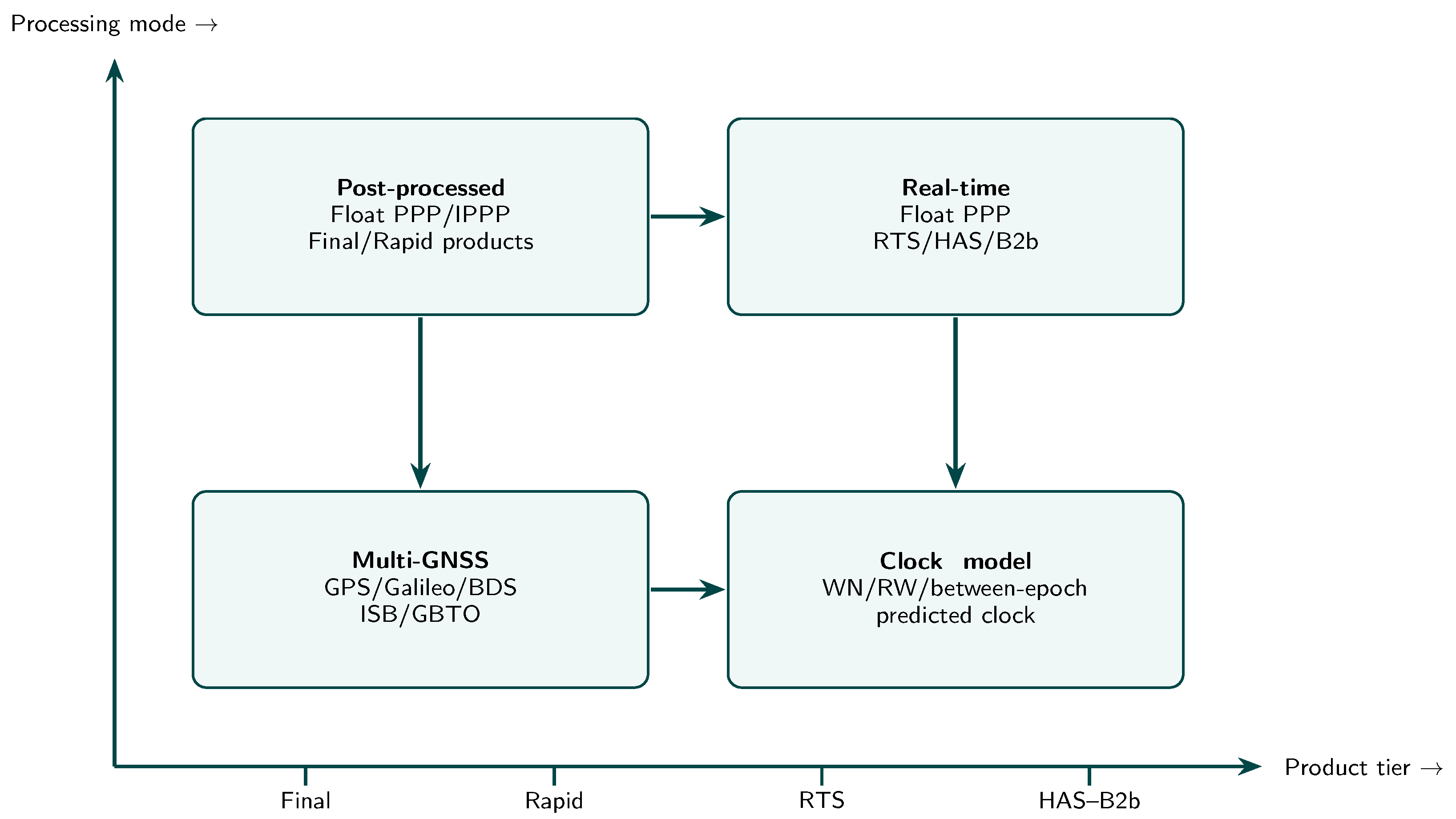
Four largely orthogonal dimensions organize the literature (Figure 2). Processing latency separates post-processed links that feed BIPM Circular T from near-real-time Ultra-Rapid products with predicted-clock root-mean-square error near 3 ns [38] and from real-time RTS or broadcast SSR with second-level latency. Ambiguity handling distinguishes float PPP, where real-valued ambiguities degrade long-term frequency stability, from IPPP with integer-fixed ambiguities preferred for BIPM frequency links [18]. Constellation integration spans mature GPS through Galileo, BeiDou (BDS), GLONASS, and multi-GNSS combinations that improve geometry and availability [17,28]. Receiver-clock parameterization ranges from white noise and random walk to between-epoch constraints and predicted receiver clocks [17,22,35].
Figure 2.
Four-dimensional taxonomy for organizing PPP time-transfer literature: processing latency, ambiguity handling (float versus IPPP), constellation integration, and receiver-clock parameterization intersect with the product chain (final → RTS → broadcast SSR).
3.2. Precise Product Chain and Latency
Product latency is the first decision a timing laboratory makes, because of the trade-off between clock accuracy and operational usefulness along the IGS and broadcast chain. Final and rapid products support BIPM-grade and near-real-time monitoring once calibrated receivers are in place; Ultra-Rapid predicted clocks remain near 3 ns RMS and are a poor real-time substitute; RTS and satellite-broadcast SSR bring second-level latency into the sub-nanosecond regime when the filter and oscillator match the stream [1,20,38]. Table 1 summarizes typical product tiers from a time-transfer perspective.
Table 1.
IGS and broadcast SSR product tiers: latency, clock accuracy, and time-transfer suitability.
Figure 3.
Conceptual trade-off between product latency and satellite-clock correction accuracy for PPP time transfer (not to scale). Sub-nanosecond real-time transfer became feasible with IGS RTS and broadcast SSR; post-processed final products remain the BIPM reference [1,20,36,38].
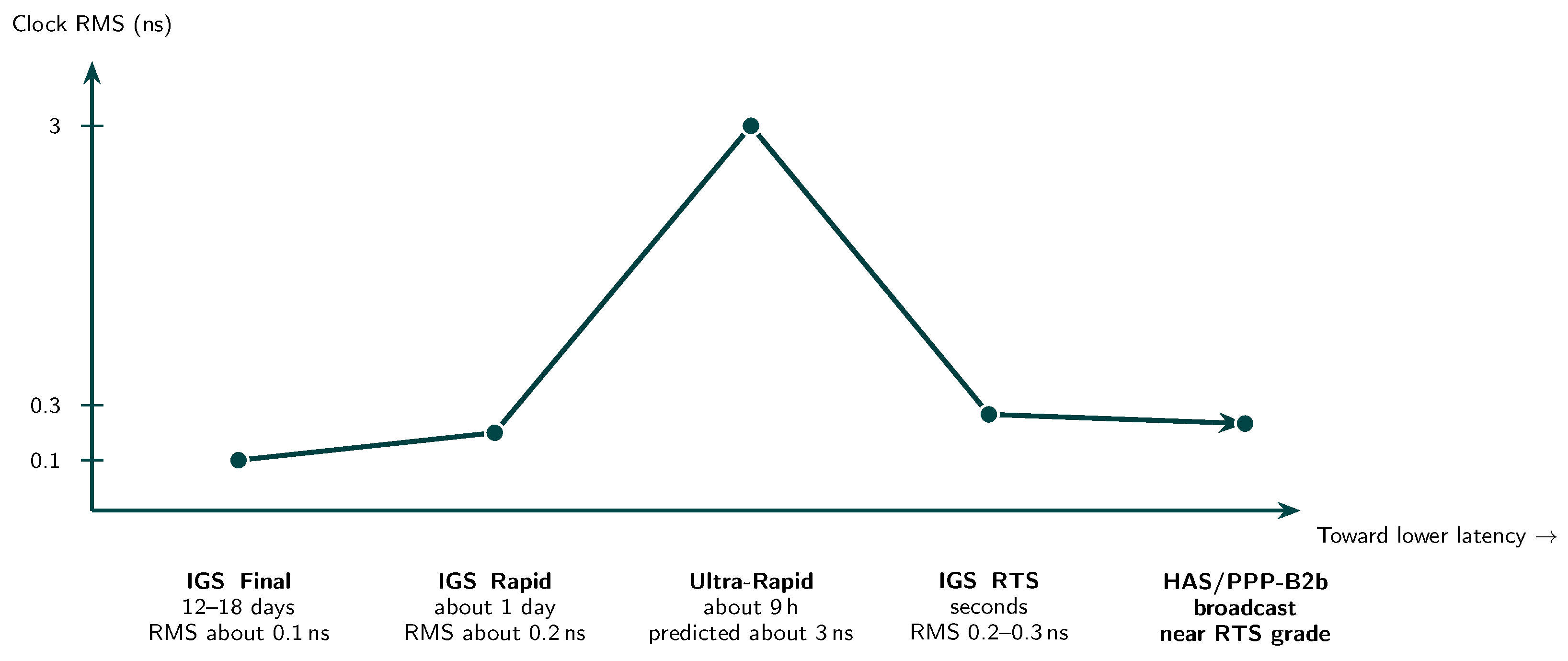
The operational trend is Final → Rapid → RTS/broadcast SSR, moving time transfer from high-precision but delayed solutions toward sub-ns accuracy with second-level latency [20,38]. Figure 3 sketches that trade-off qualitatively. The Ultra-Rapid peak is a reminder that shorter latency alone does not guarantee timing-grade clocks. Laboratories that need both low latency and Circular T traceability therefore keep a hybrid chain—final or IPPP for official reporting, RTS or HAS for alarms—rather than replacing one tier with another [2,32,39].
3.3. Historical Milestones
Table 2 lists selected milestones that shaped PPP time transfer from an experimental geodetic technique to an operational UTC link and real-time monitoring capability. The sequence is not merely chronological. Early GPS PPP demonstrations established that carrier-phase clocks could compete with TWSTFT at the nanosecond level once products and delays were controlled [3,8,14]. BIPM adoption around 2009 moved PPP from campaign demos into the UTC computation chain [2,17]. Integer PPP then set the frequency-comparison benchmark near 10−16 [18], while IGS RTS and later HAS/PPP-B2b shifted the latency frontier without yet matching IPPP as a Circular T substitute [1,36,38]. Recent undifferenced multi-GNSS and LEO-aided trials extend the same product-chain logic to denser geometry rather than inventing a separate timing paradigm [40,41].
Table 2.
Historical milestones in PPP time transfer from experimental geodetic links to operational UTC monitoring (2005–2025).
When read against Table 1, the milestones also explain why laboratories still maintain parallel workflows. Each leap that cut latency (RTS, HAS, B2b) left a residual absolute-bias or metadata problem that Circular T practice had already solved for final products [33,49].
3.4. SSR Product Content Relevant to Timing
Real-time PPP time transfer depends on SSR streams that typically include (1) orbit corrections to broadcast ephemerides; (2) satellite clock corrections referenced to a product-specific time scale; (3) code/phase bias corrections (DCB/OSB or phase-bias streams) required for multi-frequency ambiguity handling [23,50]. For timing, satellite clock corrections are primary; however, unmodeled orbit errors project onto receiver-clock estimates, and inconsistent bias conventions across ACs can destabilize multi-GNSS clock integration [26,36].
Message content alone does not define timing quality. Update interval, outage duration, and whether OSB/phase biases accompany the clock message decide whether a filter can stay in float PPP or attempt integer fixing [40,50]. Broadcast HAS and PPP-B2b carry analogous orbit/clock/bias fields but under constellation-specific datums; mixing them with IGS RTS without an explicit GBTO or ISB state recreates the multi-AC inconsistency already seen in post-processed product switches [32,36,51]. Timing users should therefore log SSR message type and provider ID with every clock-difference series they archive for acceptance testing.
3.5. Cross-Literature Synthesis: Method × Product × Performance
Table 3 consolidates representative PPP time-transfer results along the taxonomy axes in Figure 2. Each row is tied to a specific product tier, ambiguity mode, and campaign setting reported in the source paper; values are quoted as published and are not intended for direct numerical ranking across rows when calibration, baseline length, oscillator type, or AC streams differ.
Table 3.
Literature synthesis matrix: processing workflow × product tier × reported performance (campaign-specific; not cross-ranked).
Reading Table 3 across rows yields a distinction used throughout this review. Sub-nanosecond relative scatter is now common in both post-processed and real-time modes, whereas 10−15–10−16 frequency stability and absolute UTC(k) traceability still concentrate in post-processed IPPP with final products and registered calibrations [18,32,49]. Predicted clocks, random-walk (RW) modeling, and HAS+B2b fusion mainly reduce the STD of differenced real-time links and shorten convergence; they do not replace Circular T mapping. Multi-GNSS raises availability and can stabilize kinematic links only when inter-system bias and GBTO states are estimated jointly with receiver clocks [17,54,55].
Positioning benchmarks (centimeter root-mean-square error) should not be read as timing benchmarks (sub-nanosecond STD of clock-difference or link-difference series). Error budgets and product choices differ even when the same SSR stream is used.
4. Post-Processed PPP and IPPP for Time and Frequency Transfer
Post-processed PPP and IPPP remain the accuracy reference against which real-time and broadcast methods are judged. This section recalls the observation model, contrasts float and integer solutions, and collects the calibration and Circular T practices that turn a relative clock difference into a UTC(k) link [17,18,33].
4.1. Observation Model and Inter-Station Differencing
At a single frequency, PPP uses both pseudorange and carrier-phase observations. With geometric range , receiver and satellite clock offsets and , slant ionospheric delay I, tropospheric delay T, code and phase biases and , carrier wavelength , and ambiguity N, the undifferenced observation equations are Equations (1) and (2):
Dual-frequency ionosphere-free (IF) combinations (Equations (3) and (4)) are commonly used in timing laboratories.
and absorb frequency-dependent code/phase biases (DCB/OSB) after IF combination. PPP jointly estimates (and often troposphere and ambiguities) from both P and ; for sub-nanosecond time transfer, the carrier phase provides the dominant clock information after convergence, whereas code observations mainly aid initialization, cycle-slip detection, and ambiguity fixing [15,16,17]. Inter-station differencing forms the observable time link (Equation (5)). With station clocks and estimated in a common product frame,
aggregates receiver/antenna delay calibrations registered in Circular T metadata [15,16,33]. Equivalently, yields the clock-difference time series used for time transfer [15,16]. Frequency transfer is assessed by differentiating or by modified Allan deviation (MDEV; Equation (6)). For averaging time τ and phase data sampled at interval ,
is the clock-difference series at epoch i and M is the number of samples in the window [17,18]. Each MDEV value characterizes frequency stability of the link difference only at the stated averaging time τ [18,24].
Unlike network RTK, PPP requires no regional reference network, making it attractive for global UTC(k) comparisons. The trade-off is dependence on precise products (orbits, clocks, observable-specific biases OSB/differential code biases DCB, phase center offsets/variations PCO/PCV) and troposphere modeling—the same product dependencies that govern precise orbit determination and troposphere/ionosphere estimation from GNSS ground networks.
4.2. Float PPP Versus IPPP
Float PPP and IPPP share the same code and carrier observation models above, but differ in how ambiguities enter the estimator and in the clock/bias products used [18,19,50]. In float PPP the ionosphere-free ambiguity is treated as a real-valued parameter (Equation (7)),
is the ionosphere-free wavelength. Estimation errors and unmodeled effects on can accumulate over long arcs and appear as random-walk phase noise in frequency-transfer metrics, limiting MDEV at averaging times beyond a few hours even when daily STD remains sub-nanosecond [17,18].
IPPP for time and frequency transfer preserves the integer nature of carrier-phase ambiguities using dual-frequency data and integer-capable satellite products (wide-lane/satellite bias and phase-clock streams from analysis centers such as GRG/CNES) [18,19]. Processing is typically organized in two steps.
Step 1 (wide-lane fixing). The Melbourne–Wübbena combination identifies the integer wide-lane ambiguity (Equation (8)):
denotes satellite wide-lane biases from integer PPP products and absorbs the receiver wide-lane bias. Fixing removes the long-wavelength ambiguity component from the ionosphere-free phase combination.
Step 2 (narrow-lane/ionosphere-free integer fixing). After wide-lane correction, the ionosphere-free phase observation is modeled with an integer narrow-lane ambiguity and phase-compatible satellite clocks (Equation (9)):
are satellite phase clock (or phase-bias-corrected clock) products consistent with integer fixing—distinct from the mixed clock/bias states in standard float-PPP orbit/clock streams [18,50]. Bootstrapping or partial-ambiguity-resolution searches then fix epoch-wise or arc-wise; once fixed, the ambiguity no longer drifts as a real-valued state and the dominant long-term phase noise of float PPP is suppressed [18,19,56].
For frequency comparison at 10−15–10−16, IPPP therefore relies on (i) continuous phase tracking across batch boundaries, (ii) consistent phase-bias/integer-clock products, and (iii) stable fixing of and . Time comparison at shorter scales can still use float PPP when products are high quality, but IPPP becomes necessary when MDEV must remain flat at over multi-day arcs [17,18,19].
Petit et al. [18] demonstrated GPS IPPP frequency comparison at 10−16 over multi-day arcs; Petit [19] extended the approach to multi-GNSS with sub-10−16 potential. Ge et al. [17] reported float-PPP STD of about 0.3 ns for BIPM GPS links—useful for time comparison, but not equivalent to the frequency stability achieved once ambiguities are fixed.
Mi et al. [40] developed undifferenced and uncombined (UDUC) time and frequency transfer with integer ambiguity resolution across GPS, BDS, and Galileo. Keeping the individual frequencies—rather than forming ionosphere-free combinations—preserves multi-frequency redundancy and improves mixed-constellation behavior under current multi-GNSS product conventions.
4.3. Multi-GNSS Post-Processed PPP Time Transfer
Ge et al. [17] compared GPS, GLONASS, Galileo, and BDS single-system and combined PPP time and frequency transfer with system-specific clocks and inter-system biases (ISBs). Quad-frequency BDS-3/Galileo combinations extend the same framework [57]. GLONASS requires careful handling of inter-frequency code biases (IFCBs); Galileo benefits strongly from a priori constraints. Pei et al. [28] assessed integrated GNSS/RNSS PPP time transfer under nearly fully deployed constellations with a priori ISB constraints, confirming the contribution of BDS-3 and Galileo to global links.
Complementary post-processed multi-GNSS work clarifies when extra constellations help timing rather than merely adding observations. Three transferable lessons recur: (i) analysis-center product choice and day-boundary consistency can shift interpreted link STD by tenths of a nanosecond [51,58]; (ii) ionospheric strategy (IF versus GIM/RIM) changes both STD and convergence [59]; (iii) ISB/datum alignment—not constellation count alone—governs whether BDS-3/Galileo additions stabilize global links [17,28,60]. Yaw-attitude/clock coupling and regional integer-PPP services further show that multi-GNSS gains must be verified per product chain [61,62,63,64]. Parallel Asia–Pacific BDS/GPS timing campaigns [65,66,67,68] reinforce the same product-consistency theme alongside European IPPP practice.
4.4. Linkage to BIPM Circular T
BIPM Circular T uses GPS PPP as a key link type. Laboratories must employ calibrated receivers and map GNSS system time to UTC(k) [49]. The PPP with broadcast clock and ephemeris corrections (PPP-BCE) chain offers analogous UTC access in real-time scenarios, but broadcast correction errors yield a UTC offset RMS of about 1.8–2.5 ns for GPS and Galileo [49].
Circular T submission therefore binds three layers that real-time monitoring often treats separately—hardware delays registered in the BIPM database, the product tier (usually final or rapid) used to form the link, and the UTC–UTC(GNSS) offset published for each constellation time scale [2,33]. A real-time RTS or HAS link that looks sub-nanosecond in relative STD can still sit several nanoseconds away from Circular T until those layers are reconciled [49,51]. For that reason, operational UTC(k) monitoring and official BIPM reporting remain complementary rather than interchangeable uses of PPP.
4.5. Receiver Calibration and Delay Standards
Sub-nanosecond PPP time transfer requires absolute calibration of the signal path from the satellite to the local UTC(k) realization—antenna cable, filters, distribution amplifiers, and receiver internal delays. BIPM and regional metrology institutes maintain calibration campaigns; uncalibrated equipment can introduce biases of several nanoseconds that dominate link uncertainty. Antenna phase center calibrations (igs14/igs20) affect phase observations and therefore clock estimates at the millimeter-to-subcentimeter level—equivalent to picoseconds for timing, but systematic PCO/PCV mismatches across sites can bias inter-laboratory comparisons.
Timing receivers often use hydrogen masers or commercial GNSS timing receivers with 1 PPS outputs tied to UTC(k). The 1 PPS cable delay must be measured and registered in Circular T metadata. For geodetic networks co-located with timing equipment, consistent antenna models and monument stability are shared prerequisites for both coordinate and time accuracy.
Petit [33] summarized calibration practices for GNSS stations contributing to UTC, emphasizing that sub-ns PPP links require traceable delay measurements registered in Circular T metadata alongside antenna and receiver models.
Cross-analysis-center comparisons remain essential because timing links inherit each AC’s clock datum and bias conventions. Ouyang et al. [51] demonstrated that product choice alone can change interpreted link stability by tenths of a nanosecond when comparing analysis-center streams. Song et al. [58] and Ban et al. [69] document day-boundary effects and experimental timing receivers that timing laboratories must audit before interpreting MDEV on multi-day arcs.
4.6. Post-Processing Workflow Summary
A typical post-processed PPP time-transfer workflow comprises (1) download RINEX from timing receivers; (2) retrieve IGS final/rapid or AC-specific products; (3) estimate float PPP or IPPP with appropriate clock model (often RW for H-maser-class clocks); (4) form inter-station differences; (5) apply UTC(k) and calibration offsets; (6) compute STD/MDEV and submit to BIPM or internal monitoring. Frequency transfer adds long arc lengths (days) and ambiguity-fixing stability checks. This workflow remains the accuracy reference against which real-time methods are validated [17,18]. Figure 4 summarizes the processing chain.
Figure 4.
Post-processed PPP/IPPP time-transfer workflow used in timing laboratories. Carrier-phase solutions are formed against precise orbit/clock products, differenced between sites, aligned to UTC(k) with registered calibrations, and assessed with STD/MDEV before Circular T submission [17,18,33].
Two practical notes follow from Figure 4. First, product download and OSB/DCB consistency belong in the same QA checklist as the filter itself. Switching AC streams mid-arc without re-estimating biases can mimic a clock step [51,58]. Second, Circular T reporting is not a cosmetic last step; the calibration offsets applied after formation are what turn a relative PPP link into a UTC(k)-traceable comparison [33,49]. Real-time pipelines in Section 5 reuse the same logical chain, replacing final products with SSR ingest and relaxing the reporting delay.
4.7. GLONASS and Constellation-Specific Considerations
GLONASS FDMA signaling introduces inter-frequency code and phase biases (IFCBs) that complicate multi-GNSS PPP time transfer [17,42,70]. Single-system GLONASS PPP links show larger STD relative to GPS unless IFCBs are modeled with constellation-specific products. Galileo and BDS modernized signals use CDMA like GPS, simplifying multi-GNSS integration. Pei et al. [28] emphasized satellite clock datum differences. AC clock solutions may refer to different hybrid clock definitions; ignoring datums when mixing products can create apparent inter-station drifts at the sub-ns level. POD groups encounter the same datum issues when mixing AC products for multi-GNSS orbit solutions.
For timing laboratories that still ingest GLONASS, the conservative practice is either a GPS/Galileo/BDS core with GLONASS as a soft constraint, or an explicit IFCB state with constellation-specific products—not a blind four-system float solution [17,42]. Asia–Pacific multi-GNSS campaigns that include BDS-3 reinforce the complementary lesson. Adding a constellation helps only when ISB and clock datums are estimated jointly with the receiver clock [28,60,66].
5. Real-Time PPP Time Transfer
Section 4 established the post-processed accuracy floor. This section asks what fraction of that performance survives when orbit/clock corrections arrive with second-level latency. The answer depends less on a single STD number than on three coupled choices—which SSR stream is used, how the receiver clock is modeled, and how the filter recovers after outages [1,22,35].
5.1. From Ultra-Rapid Products to IGS RTS
Ultra-Rapid predicted satellite-clock corrections exhibit an RMS of about 3 ns, which is inadequate for sub-nanosecond real-time transfer [38]. IGS RTS disseminates SSR orbit and clock corrections through multiple analysis-center (AC) streams and combination streams (e.g., IGC01) [21]. Users typically connect via NTRIP clients, apply SSR corrections to broadcast ephemerides in a PPP filter, and estimate receiver position, zenith troposphere delay, and receiver clock at each epoch. Figure 5 summarizes the real-time processing chain.
Figure 5.
Real-time PPP timing architecture. Terrestrial IGS RTS and broadcast SSR (HAS, PPP-B2b) corrections merge at the ingest stage, pass through a streaming PPP filter with stochastic receiver-clock modeling, and support UTC(k) monitoring with operational alarms. Absolute traceability still requires periodic reconciliation to post-processed final solutions [1,20,32,39].
For timing laboratories, the receiver clock is often the parameter of primary interest, and coordinates may be tightly constrained to known monument values. Fixed coordinates remove one source of correlation between height/troposphere and clock, improving clock stability statistics—an approach widely used in timing-grade processing and reflected in Galileo/GPS timing studies with a priori constraints [17,71]. Product latency and continuity similarly constrain filter-based real-time clock estimation in low-Earth-orbit POD workflows, where orbit solutions inherit the same SSR clock errors that timing links expose [72].
Li et al. [1] ran real-time PPP time transfer among four Western European timing laboratories and obtained RMS 0.30 ns, STD 0.25 ns, and 1-day averaged frequency stability of —evidence that RTS can support sub-nanosecond links under laboratory conditions.
Parallel BDS/GPS real-time timing campaigns [29,73,74,75,76] confirm that sub-ns links are reproducible when oscillator type and SSR stream are documented.
5.2. Real-Time Timing and UTC(k) Monitoring
Ge et al. [20] proposed a real-time PPP timing framework based on IGS RTS. The steps are (1) align RTS product time tags to UTC(k) via PPP; (2) redistribute aligned products via NTRIP; (3) allow users to estimate local time relative to UTC(k) with a single receiver. Compared with IGS final clocks, STD was about 0.2 ns; between-epoch constraints further reduced STD by 2.76–25.66% [47].
Defraigne et al. [39] early demonstrated UTC(k) monitoring with PPP and IGS real-time products. Qin et al. [77] introduced a clock model for real-time PPP time and frequency transfer during data discontinuities. Laboratory campaigns at EFTF/IFCS confirm sub-ns RTS links against final products [78,79,80], and service-oriented prototypes now disseminate aligned SSR or system time [81,82,83]. The field has moved from one-off experiments toward monitoring services, yet absolute UTC(k) mapping still needs calibration and Circular T offsets [49].
5.3. Stochastic Receiver-Clock Modeling
In real-time filtering the receiver clock is commonly modeled as a stochastic process in the state vector. A white-noise (WN) clock treats each epoch independently; a random-walk (RW) model integrates process noise as in Equation (10):
q is the clock Allan variance slope. Between-epoch constraints penalize when oscillator physics expect smooth evolution [17,47]. Figure 6 and Table 4 contrast the main clock-state parameterizations used in real-time timing filters.
Figure 6.
Receiver-clock stochastic models used in real-time PPP timing filters. Model choice should match the local oscillator noise type: white noise for fast re-convergence, random walk for maser-class references, between-epoch penalties for smooth evolution, and predicted-clock constraints for short arcs under SSR latency [20,35,47,84].
Table 4.
Stochastic receiver-clock models for real-time PPP timing: constraint form, setting, and reported benefit.
Ge et al. [17] showed RW modeling improves MDEV in post-processing; Mikoś et al. [35] extended RW constraints to HAS, IGS, CNES, and CODE RTS streams with up to 59% reduction in the vertical (Up) component IQR during the first 3 h. For PPP-B2b timing specifically, Ge et al. [37] introduced BDS-3-oriented receiver-clock models. Table 4 lists the constraint form and quantitative gains behind those choices.
Forecast-clock models for PPP transfer [87] complement the stochastic approaches above by supplying short-horizon clock predictions that reduce filter transients after gaps.
5.4. Predicted Receiver-Clock Constraints
Convergence remains a major limitation of real-time time transfer [22]. On European laboratory links with multi-AC RTS, Xie et al. [22] constrained the filter with predicted receiver clocks accurate to better than 0.1 ns over 1–2 h, shortening convergence from 7.06 min to essentially instantaneous and reducing link STD from 0.336 ns to 0.021–0.025 ns (>92% improvement), with MDEV gains of 13–89%. Those figures are campaign-specific and should not be read as a universal real-time floor. Table 5 collects representative real-time statistics under their reported conditions. The reported STD/RMS values in Table 5 quantify differences between solutions of the same quantity under each study’s stated conditions; rows should not be ranked across studies when experimental conditions differ.
Table 5.
Representative real-time PPP time-transfer results (as reported). STD/RMS refer to differences between solutions of the same quantity and are not cross-ranked across differing experimental conditions.
Beyond predicted receiver clocks [22,88], convergence acceleration has been pursued through rapid undifferenced clock estimation [89], long-baseline PPP constraints [90], TDCP-assisted updates [91], LEO clock modeling [92,93,94], and multi-GNSS clock steering [95]. These methods address different failure modes—geometry weakness, filter re-initialization, and inter-system bias drift.
5.5. Sensitivity to Satellite Clock and Orbit Errors
Real-time time transfer is more sensitive to SSR imperfections than post-processed solutions because filtering cannot benefit from backward smoothing. Zheng et al. [26] quantified impacts of satellite clock errors on GPS/BDS/Galileo real-time PPP time transfer, showing that clock noise and datum inconsistencies propagate directly into receiver-clock estimates and inter-station links. Orbit errors couple with geometry to produce time-correlated clock drifts; multi-GNSS redundancy mitigates but does not eliminate this effect. Independent evaluations of real-time BDS satellite clocks likewise show that product noise floors set a practical limit on link STD before the receiver filter is tuned [96].
Mikoś et al. [25] analyzed IGS receiver clock performance from multi-GNSS PPP solutions across global stations, showing constellation-dependent clock behavior and sensitivity to product conventions. Timing-grade assessment should report link STD against final products together with product noise floors and discontinuity statistics.
5.6. Adaptive and Discontinuity-Resilient Clock Models
Beyond fixed RW models, recent work explores adaptive constraints that adjust receiver-clock process noise based on observed stability. Han et al. [84] proposed an adaptive clock constraint model for PPP time transfer, improving link stability relative to static white-noise or RW assumptions when receiver oscillators exhibit mixed noise types.
Qin et al. [77] addressed data discontinuities—common in operational networks due to receiver resets, tracking losses, or product outages—by modeling clock offsets across gaps to preserve time-transfer continuity. Together with predicted-clock constraints [22], these methods form a toolkit for maintaining sub-ns links under realistic operational conditions rather than ideal continuous tracking.
In acceptance tests, adaptive and discontinuity-aware models should be evaluated on the same arcs used for RW baselines, with explicit logging of gap duration and post-gap time-to-threshold [35,39]. A model that reduces quiet-period STD but prolongs recovery after an SSR outage is not an operational gain for UTC(k) monitoring.
5.7. Real-Time Undifferenced Multi-GNSS and Multi-Frequency Timing
Xu et al. [48] reported real-time undifferenced precision time transfer with multi-GNSS and multi-frequency observations, targeting timing-laboratory use cases where preserving individual frequencies aids ambiguity resolution and fault detection. Undifferenced timing avoids forming inter-station single differences at the observation level while still enabling clock comparison through post-estimation differencing or common-view-like aggregation, depending on implementation. Such approaches bridge PPP time transfer and emerging real-time IPPP research directions.
Undifferenced multi-frequency filters also expose product problems earlier. A frequency-specific bias jump or OSB inconsistency appears in residuals before it is absorbed into a single ionosphere-free clock state [40,50]. That diagnostic value matters for laboratories that co-locate timing receivers with geodetic monuments and need to separate receiver faults from AC product changes [25,26].
5.8. Convergence Dynamics and Operational Metrics
Real-time PPP time transfer exhibits three operational phases—initial convergence, steady-state tracking, and recovery after outage. During convergence, float ambiguities and troposphere states correlate with receiver clock estimates, inflating STD until geometry and filtering duration separate parameters adequately. Predicted-clock and between-epoch constraints primarily shorten the first phase [22,47]; RW modeling improves steady-state and recovery phases [35,77].
Timing laboratories should report time-to-threshold (e.g., minutes until link STD < 0.5 ns) alongside asymptotic STD, because operational monitoring cares about both transient and steady behavior. Availability metrics—fraction of epochs with valid SSR, rate of cycle slips, average gap duration—should accompany difference-based STD/RMS and MDEV/TDEV statistics when comparing AC streams or broadcast SSR [26,36]. IGS ground networks that also produce atmospheric products can adopt the same metrics when validating real-time clock streams used for low-latency POD [25,27].
Recent work refines short-arc MDEV under broadcast SSR [31,97,98,99] and documents BDS-3 service prototypes [100,101].
5.9. IGS Analysis Center Streams and Combination Products
IGS RTS aggregates contributions from multiple analysis centers (e.g., CODE, GFZ, WHU, CNES-related streams, combined IGC products). Each stream reflects the AC’s orbit/clock estimation strategy, satellite metadata, and bias conventions [21,25]. Timing users have observed stream-dependent clock noise floors and occasional day-boundary steps when AC processing changes.
Combination products average or select corrections across ACs to reduce single-stream outliers; timing laboratories that compare UTC(k) links should still record which stream was used and treat stream switches as part of the uncertainty budget. Zheng et al. [26] showed that satellite clock error characteristics differ among GPS, BDS, and Galileo in real-time transfer, implying that multi-GNSS benefits depend on each constellation’s SSR quality within a given stream. When an AC publishes both final and RTS products, comparing them at timing-grade receivers provides a direct real-time versus final validation metric useful for operational acceptance testing [38,39].
6. Multi-GNSS Integration and Broadcast SSR Services
IGS RTS assumes a terrestrial NTRIP path. Broadcast SSR and multi-GNSS bias handling remove that assumption—or at least provide a failover—while introducing constellation-specific datums that timing filters must estimate explicitly. This section collects HAS, PPP-B2b, kinematic/LEO extensions, and the product-chain checklist laboratories use when choosing among them.
6.1. Galileo HAS and BeiDou PPP-B2b
HAS and PPP-B2b broadcast SSR corrections via satellite signals, enabling precision PPP without internet access [23]. HAS provides orbit/clock/bias corrections for Galileo and GPS via E6-B; PPP-B2b provides BDS-3 SSR via the B2b signal. Differences between the Galileo Terrestrial Reference Frame (GTRF) and the BeiDou Coordinate System (BDCS) require explicit handling of GBTO [32]. Sub-nanosecond UTC dissemination trials with PPP-B2b further show that broadcast SSR can support timing links when absolute offsets are calibrated against a terrestrial reference [102]. Lyu et al. [103] complement those service-level studies with the design and laboratory performance evaluation of a dedicated sub-nanosecond timing receiver that disciplines its local clock (1 PPS) via the PPP-B2b service.
From an operational resilience viewpoint, broadcast SSR decouples precision timing from terrestrial connectivity—useful at remote UTC(k) or monitoring sites where NTRIP is unreliable. However, broadcast corrections may use different update rates and datum definitions than IGS RTS streams; timing users must validate offsets against post-processed final solutions before trusting absolute UTC(k) mappings [36,49]. Figure 7 maps the main correction sources feeding a multi-GNSS timing receiver.
Figure 7.
SSR product ecosystem for multi-GNSS PPP time transfer. Terrestrial IGS RTS streams and broadcast services (HAS, PPP-B2b, regional MADOCA-PPP) supply orbit/clock/bias corrections to the same receiver-clock estimator; multi-constellation timing requires explicit ISB and GBTO states [21,32,36,37,104].
Multi-GNSS broadcast SSR requires explicit estimation of inter-system time offsets. For Galileo–BeiDou timing, GBTO can be included as a weakly stochastic state in the filter (Equation (11)) [32]:
process noise reflects how rapidly system-time offsets drift relative to UTC-steered clocks. Hu et al. [32] showed that tightly coupled HAS + B2b filtering with GBTO states reduces rolling STD to 0.1–0.2 ns versus PPP-BCE, although absolute offsets against BIPM remain at the few-ns level without post-fit datum alignment. Table 6 compares the main broadcast SSR services used for timing.
Table 6.
Comparison of broadcast SSR services for PPP time transfer.
Hu et al. [32] compared PPP-BCE, post-fit differenced PPP, and a tightly coupled HAS + B2b extended Kalman filter (EKF) with GBTO as a weakly stochastic state. Over 14 days, the fused solution achieved a rolling STD of 0.1–0.2 ns, and an MDEV at 960 s improved by fivefold relative to PPP-BCE, reaching the 10−14 level. Against BIPM references, all real-time solutions showed 2–4 ns bias; the fused method had the smallest day-to-day residual IQR (1.1 ns).
Service-level BDS-3 evaluations complement these fusion experiments: Tang et al. [29] and Zhang et al. [30,108] analyzed PPP-B2b operational performance; Ma et al. [109] quantified real-time clock-offset biases; and advanced orbit/clock demonstrations [110,111] show how broadcast SSR quality propagates into timing-grade STD when biases are modeled explicitly. Follow-on work quantifies constellation-specific biases [54,55], LEO-assisted transfer [31,112], and CSAC disciplining [113]. Absolute UTC(k) traceability still stalls on cross-provider datum harmonization.
6.2. Kinematic and Maritime PPP Time Transfer
Static PPP time transfer is well established; kinematic links remain limited by re-convergence after geometry changes. Xu et al. [71] investigated GPS/Galileo kinematic PPP time transfer with HAS—sub-ns under static conditions; single-system kinematic solutions often exceed 1 ns, whereas GPS + Galileo kept all links within 0.48 ns with short-term MDEV of . Related Galileo single-frequency timing trials show the same geometry dependence when dual-frequency redundancy is removed [114]. Han et al. [115] reported preliminary ocean multi-GNSS kinematic PPP time transfer using Doppler observations and alternative clock parameterizations.
Regional augmentation studies extend the kinematic evidence base—NavIC timing [116], QZSS-augmented transfer [117], undifferenced inter-station real-time links [73], and combined HAS+B2b processing [31,32] show that geometry and regional SSR availability often dominate algorithm choice on moving platforms. LEO clock-impact analyses [118] and maritime clock parameterizations [87,115] reinforce the same lesson: multi-GNSS redundancy is currently the most reliable mitigation when single-system kinematic STD exceeds 1 ns.
6.3. LEO Augmentation
LEO-enhanced multi-GNSS real-time PPP trials report faster convergence and improved short-arc stability under simulated or campaign geometries [41,118,119,120]. What has been demonstrated is mainly filter-level benefit when dense LEO signals are available; what remains open is multi-month, timing-laboratory validation of commercial LEO-PNT as a metrological time-transfer reference. Until those campaigns exist, LEO should be treated as a convergence aid rather than a substitute for IGS final or calibrated RTS/IPPP links.
The coupling also runs the other way. LEO POD and onboard clock characterization inherit the same SSR datum and OSB problems that ground timing links already expose [27,118]. Co-located UTC(k) receivers that publish MDEV/TDEV against several AC streams therefore serve spaceborne GNSS QA as well as metrology—an incentive for IGS stations to keep timing-grade logging even when their primary product is geodesy [25,121].
6.4. Phase-Bias Streams and Real-Time Ambiguity Support
Real-time IPPP and multi-frequency PPP time transfer need phase-bias or OSB products in addition to orbit/clock SSR. Guo et al. [50] reported a GPS/Galileo/BDS phase-bias stream from the Wuhan IGS analysis center for real-time PPP ambiguity resolution; such AC-specific bias feeds are prerequisites for fixing strategies that timing laboratories now test for near-real-time frequency monitoring.
Without aligned phase biases, float PPP remains the conservative default for real-time timing. With them, real-time IPPP is technically reachable, though fixing reliability under SSR latency and outages still lacks multi-year operational evidence. Campaigns that claim near-10−16 real-time frequency transfer should therefore publish fixing rates, hold periods, and the exact bias product identifier alongside MDEV—the same metadata BIPM practice already expects for post-processed IPPP [18,19,34].
6.5. BDS-3 Real-Time PPP Time Transfer: SSR Versus PPP-B2b
Chen et al. [36] compared BDS-3 real-time PPP time-transfer performance using internet-delivered SSR versus satellite-broadcast PPP-B2b corrections. Product source and correction latency affect link STD and stability differently by baseline and tracking environment—a factor when laboratories choose between terrestrial NTRIP and broadcast-only workflows. Earlier BDS-3 real-time PPP analyses already separated time-transfer, positioning, and troposphere products under the same SSR chain [122]; read with Ge et al. [37] on BDS-3 clock modeling and Lyu et al. [103] on PPP-B2b timing-receiver hardware, these results justify treating BDS-3 as a primary timing constellation in real-time PPP once biases and clock datums are modeled explicitly.
Dual-path operation is already practical in Asia–Pacific networks, where laboratories use NTRIP SSR for primary monitoring and PPP-B2b as a resilience path when terrestrial links fail, keeping GBTO or ISB states continuous across the switch [31,32,37]. Acceptance tests should inject synthetic NTRIP outages and verify that the broadcast path recovers without a hidden UTC(k) jump.
6.6. Choosing a Product Chain: Decision Factors
Table 7 summarizes practical selection criteria for timing laboratories and network operators deploying PPP time transfer, including common failure modes that acceptance tests should exercise.
Table 7.
Product-chain selection criteria and typical failure modes for timing laboratories and network operators.
Many laboratories already run hybrid chains—post-processed final solutions for official reporting, RTS or HAS for operational alarms, and TWSTFT or CV for an independent cross-check [2,32]. Networks with co-located IGS stations can fold timing-quality clock logging into routine processing, which helps both metrology validation and POD quality control [25].
Table 7 is meant to be read left-to-right as a decision tree, not as a ranking. A laboratory that needs Circular T compliance starts in the first row and only borrows RTS/HAS rows for alarms; a remote site with unreliable NTRIP starts in the broadcast row and borrows final PPP for periodic bias calibration [36,49]. The failure-mode column should feed the acceptance tests in Section 7 rather than remain a paper checklist.
7. Performance Assessment and Operational Context
Section 3, Section 4, Section 5 and Section 6 collect methods and products; this section states how those results should be judged for comparison and validation. A single numerical label is not enough: the same published STD of 0.3 ns may describe a well-calibrated link difference against a reference solution, or only the scatter of a differenced series after mean removal, and it says nothing about MDEV/TDEV at long averaging times or about absolute UTC(k) mapping [18,24,39].
7.1. Metrics for Comparison and Validation
We distinguish three questions that PPP timing papers often conflate under the vague label of precision.
Stability characterizes how a clock-difference (or frequency-difference) series evolves with averaging time τ. It is quantified by modified Allan deviation (MDEV) and time deviation (TDEV), and related Allan-family statistics. MDEV and TDEV carry equivalent stability information, expressed respectively in the frequency domain and in the time domain; they are not alternative better/worse scores, and each reported value is meaningful only at the stated τ [18,24]. A campaign that quotes MDEV without τ, or that treats one MDEV/TDEV number as a global ranking metric, is incomplete for validation.
Accuracy is closeness to an external metrological reference after calibration—typically a registered UTC(k) realization, Circular T, TWSTFT, or an independent CV link. Accuracy therefore requires hardware-delay calibration and UTC–UTC(GNSS) mapping; it cannot be inferred from short-arc scatter alone [2,33,49].
Bias is a systematic offset (for example, a few-nanosecond HAS/B2b offset relative to BIPM) that may be nearly constant over a campaign yet still preclude absolute UTC(k) monitoring if left uncalibrated. Traceability is the documented chain from the PPP estimate through registered delays and product datums to a recognized time scale.
STD and RMS in this review are used only as authors publish them, and they are interpreted strictly as measures of the difference between two series that represent the same quantity—most often an inter-station PPP clock difference, or a PPP link minus a reference link (final products, TWSTFT, CV, or UTC(k) 1 PPS). STD/RMS should not be read as an intrinsic property of a single PPP solution in isolation, unless that series is already defined as a difference with respect to an accepted reference (a calibrated reference solution, or a difference relative to a known perfect reference) [1,20,39]. When primary papers loosely call such scatter precision, we retain their numbers but map them onto the difference-based STD/RMS usage above rather than treating precision as a third independent metrological category alongside stability and accuracy.
For operational validation we therefore recommend reporting, where available: (i) MDEV and/or TDEV versus τ on the clock-difference series; (ii) STD/RMS of well-defined solution differences (PPP versus PPP, or PPP versus an independent technique); (iii) cold-start and post-outage time-to-threshold; (iv) SSR interruption, cycle-slip, and holdover statistics; (v) independent checks against UTC(k), CV, or TWSTFT whenever co-located references exist [1,24,39,77]. BIPM link assessment additionally considers day-boundary discontinuities and leap seconds [2].
7.2. Stability Metrics: MDEV and TDEV
Frequency-domain stability of the clock-difference series is assessed by modified Allan deviation (MDEV; Equation (6) in Section 4). Time deviation (TDEV; Equation (12)) is the corresponding time-domain stability measure for averaging time with sample interval :
M is the number of epochs in the analysis window [17,18]. MDEV and TDEV provide equivalent stability information (frequency stability versus time stability). Laboratories commonly plot both against τ because the shape of the curve, not a single ordinate, reveals whether white phase noise, flicker, random walk, or product-induced steps dominate [24,25,26]. BIPM IPPP frequency-comparison campaigns conventionally emphasize MDEV at long τ; TDEV is equally legitimate when the scientific question is posed in the time domain. In either case, a quoted MDEV/TDEV value is valid only for the averaging time at which it was computed.
Receiver oscillators and filtered clock estimates are often described by the Allan variance of fractional frequency (Equation (13)):
, , and are noise coefficients for white phase modulation (WPM), flicker phase modulation (FPM), and white frequency modulation (WFM), respectively [17,18]. Matching the PPP filter clock model (WN, RW, between-epoch, adaptive) to the dominant term of the local oscillator explains much of the spread in reported real-time improvements (Table 4) [35,84].
The synthesis matrix in Section 3.5 (Table 3) should be read together with MDEV/TDEV-versus-τ curves from the source papers. A link with a small STD of a differenced series at short lag can still fail frequency-comparison requirements if MDEV/TDEV rises at because ambiguities remain float or SSR products introduce day-boundary steps [58,77].
7.3. Comparison with CV and TWSTFT
Figure 8 contrasts the four main GNSS link families reviewed here; Table 8 lists representative performance and infrastructure requirements.
Figure 8.
Complementary GNSS time-transfer techniques compared by precision, infrastructure, and latency. Numerical entries are order-of-magnitude figures under typical published conditions and are not directly interchangeable across techniques or campaigns. PPP provides global all-in-view links that complement CV routine comparisons and TWSTFT sub-nanosecond benchmarks; post-processed IPPP remains the frequency-comparison reference, while real-time PPP supports operational UTC(k) monitoring [1,2,18,24].
Table 8.
Comparison of major time-transfer techniques (typical published orders of magnitude; conditions differ by campaign).
PPP provides independent, all-in-view comparisons at global scale and is used together with TWSTFT and CV for mutual validation [2]. Table 9 groups hybrid CV/PPP studies that increasingly serve as independent checks rather than replacements for PPP links [123,124,125,126,127,128]; Krawinkel and Bauch [24] provide frequency-transfer limits against which PPP MDEV claims should be interpreted.
Table 9.
CV and hybrid CV/PPP studies in the PPP era.
In operational networks the three techniques usually keep distinct roles. CV remains the low-cost scheduled comparison for many national links; TWSTFT anchors sub-nanosecond baselines where stations exist; PPP fills the all-in-view gap and now also the real-time monitoring gap when SSR is available [1,2]. Hybrid CV/PPP analyses in Table 9 are valuable precisely because disagreements often reveal product or calibration issues that a single technique would absorb into its clock estimate [123,125].
7.4. Major Error Sources
The principal error sources are precise-product imperfections (orbit/clock errors, sampling interval, outages), hardware calibration (cable delays, receiver internal delays, antenna PCO/PCV), ambiguities and biases (float-PPP stability; inconsistent OSB/DCB across providers), troposphere and multipath (more critical in real-time filtering), and inter-system offsets including GBTO, GLONASS inter-frequency code biases, and UTC–UTC(GNSS) mapping [32,49]. For co-located geodetic networks, product-induced clock steps propagate into both timing links and POD solutions unless the same bias and datum conventions are applied [25,26].
These sources do not contribute equally at every averaging time. At short τ, multipath, measurement noise, and high-rate SSR clock noise dominate STD; at , day-boundary steps, float-ambiguity drift, and UTC–UTC(GNSS) mapping errors dominate MDEV/TDEV and are what BIPM-grade frequency comparison must control [18,24,58]. Real-time campaigns should therefore state which error class their claimed improvement addresses, rather than reporting a single STD for the entire arc.
7.5. Operational Acceptance Testing and Long-Term Monitoring
Before adopting real-time PPP operationally, laboratories typically run a staged acceptance sequence—post-processed IPPP baseline against Circular T, cross-checks across product tiers, parallel real-time runs with aligned SSR time tags, failover tests under product loss, and defined alarms on link-difference STD and on MDEV/TDEV at selected τ [1,20,25,32,39].
That sequence should treat continuity and independent validation as mandatory controls. Useful checks include (i) cold-start and post-outage convergence time to a stated STD threshold on a well-defined difference series; (ii) SSR interruption drills that record gap duration, reconvergence, and any hidden UTC(k) jump after NTRIP or broadcast failover; (iii) cycle-slip and ambiguity-reset rates under the intended tracking environment; and (iv) parallel comparison against an independent technique—calibrated UTC(k) 1 PPS, CV, or TWSTFT—so that a small STD of a PPP–PPP difference is not mistaken for absolute accuracy [2,22,39,77]. Where a laboratory cannot maintain TWSTFT, even a short co-located CV or zero-baseline check still constrains bias and day-boundary artifacts that STD alone hides.
Long-term monitoring should archive clock-difference series together with product metadata such as AC stream ID, SSR message types, HAS/B2b signal status, ambiguity-fixing rates, and estimated ISB/GBTO states. Without that metadata, a link that degrades after a product update is hard to diagnose—a frequent situation as multi-GNSS SSR services change quickly [26,36,50]. The same logging habit lets co-located geodetic networks correlate clock-product anomalies with POD quality loss.
8. Open Challenges and Future Directions
PPP time transfer now spans a mature post-processed IPPP baseline, multiple real-time SSR product tiers, and emerging platform extensions. The remaining challenges concern operational traceability, continuity, and standardized evaluation under heterogeneous multi-GNSS products (Figure 9), not further sub-nanosecond demonstrations under ideal static conditions.
Figure 9.
Interconnected open challenges in PPP time transfer (Section 8). Datum harmonization affects all product tiers; convergence methods interact with real-time IPPP feasibility; platform extensions require the same evaluation standards as static timing-laboratory links.
Table 10 maps those tensions to evidence and feasible directions. Sub-nanosecond relative scatter is already common with HAS/B2b/RTS [1,32,36], while few-nanosecond BIPM offsets persist until Circular T mapping and OSB metadata are aligned [49,51]. Receiver-clock models—predicted clocks, RW constraints, adaptive process noise—now decide whether a sub-ns demonstration survives gaps and stream switches [22,35,77,84]. Multi-GNSS helps kinematic, maritime, and LEO-augmented links only when re-convergence is designed in [41,71,115]. Over the next 3–5 years, comparable MDEV/TDEV curves, SSR metadata, and failover tests under a shared acceptance framework will matter more than incremental STD gains in quiet static trials [24,78,79].
Table 10.
Open challenges, unresolved tensions, and feasible directions.
8.1. Outlook for Timing Networks and Spaceborne GNSS
National timing networks increasingly co-locate UTC(k) receivers with geodetic monuments that also feed IGS products. Unified clock-product processing benefits both communities. Timing links validate AC clock quality, while improved clocks support PPP/POD for low-Earth missions that carry GNSS receivers [25,27]. Future LEO constellations transmitting GNSS-like signals may augment geometry for ground timing [41] while themselves requiring precise onboard clock characterization—a feedback loop between laboratory time transfer and spaceborne PNT.
Standardization of SSR metadata (datum, OSB type, update interval, outage logging) would accelerate cross-community adoption. The IGS SSR working group and RTCM SSR messages provide partial standards, but timing-laboratory-specific validation procedures remain institution-specific [21,50]. Embedding timing QA (MDEV/TDEV of receiver clocks) into routine IGS station processing would close this gap with minimal new infrastructure.
8.2. Research Priority Summary
Table 10 suggests where effort is most likely to pay off over the next 3–5 years—multi-SSR datum harmonization and metadata standards; failover drills and acceptance tests for national timing services; multi-month real-time IPPP campaigns that log phase-bias products; kinematic and maritime multi-GNSS trials that report MDEV; and co-located timing–POD checks at global geodetic sites. Each item ties established post-processed metrology practice to the real-time, multi-GNSS, broadcast-SSR setting that laboratories are already adopting.
Priority ordering is institution-dependent. National UTC laboratories should put Circular T reconciliation and failover drills first; networks that already publish RTS streams gain more from shared OSB/metadata conventions and co-located timing–POD QA; research groups chasing real-time IPPP should treat phase-bias logging and long-campaign fixing rates as first-class deliverables, not footnotes to STD tables [18,39,50]. Across all three settings, comparable MDEV/TDEV reporting remains the cheapest way to keep otherwise incompatible experiments comparable [24,25].
9. Conclusions
PPP time transfer now supports both BIPM-grade post-processed frequency comparison and near-real-time UTC(k) monitoring. The reviewed evidence covers post-processed IPPP [34,56], RTS and broadcast-SSR chains [53,81,82], multi-GNSS datum handling [54,60], and hybrid common-view checks [124,125]. IPPP remains the 10−16 frequency-comparison reference; IGS RTS, HAS, and PPP-B2b cut latency to seconds when the filter and oscillator match the stream. Sub-nanosecond STD of a differenced PPP link remains distinct from UTC(k)/BIPM accuracy and traceability unless calibration, product datum, and independent checks are in place. Stability claims require MDEV/TDEV to be reported at stated averaging times τ.
Choosing the product chain is as consequential as tuning the filter. Ultra-Rapid, RTS, final, and broadcast SSR occupy different regions of the latency–accuracy plane (Table 1); selection criteria and failure modes are summarized in Table 7. Random-walk, between-epoch, adaptive, and predicted clock constraints (Table 4) let real-time filters exploit laboratory-grade oscillators; without that match, SSR quality alone seldom delivers sub-nanosecond MDEV. Extra constellations help only when inter-system bias, GBTO, and clock datums are estimated jointly—the same discipline required in multi-GNSS POD.
Outstanding tasks are multi-SSR interoperability, long-campaign real-time IPPP, laboratory evaluation protocols for SSR streams, and failover designs for national timing services. Tighter coupling between clock-product validation and geodetic analysis would serve UTC generation, frequency dissemination, and GNSS/LEO PNT platforms alike. The taxonomy and product-chain framing used here are meant to keep latency, traceability, and infrastructure cost visible when a laboratory or mission team picks a processing path.
Author Contributions
Conceptualization, Y.G.; methodology, C.J., S.Y. and Y.G.; investigation, C.J., S.Y., X.F. and Y.G.; writing—original draft preparation, C.J. and S.Y.; writing—review and editing, C.J., S.Y., X.F. and Y.G.; supervision, Y.G.; funding acquisition, Y.G., C.J. and S.Y. contributed equally to this work. All authors have read and agreed to the published version of the manuscript.
Funding
This work was supported by the Jiangsu Provincial Water Conservancy Science and Technology Project (2025056); the Open Fund of the Key Laboratory of BeiDou Navigation and Positioning, Department of Natural Resources of Jiangsu Province (KLBDS-G202505); the Jiangsu Province Natural Resources Science and Technology Project (JSZRKJ202404); the National Natural Science Foundation of China (42104014 and 42674014); the Jiangsu Province Market Supervision Administration Science and Technology Plan Project (KJ2026025); and the Hunan Engineering Research Center of BeiDou High-Precision Satellite Navigation and Location-Based Service (KFKT2025-N003).
Institutional Review Board Statement
Not applicable.
Informed Consent Statement
Not applicable.
Data Availability Statement
No new data were created or analyzed in this study. Data sharing is not applicable to this article.
Acknowledgments
The authors acknowledge the International GNSS Service (IGS) and Bureau International des Poids et Mesures (BIPM) for open geodetic and time-transfer products that underpin this review.
Conflicts of Interest
The authors declare no conflicts of interest.
Abbreviations
The following abbreviations are used in this manuscript:
| PPP | Precise point positioning |
| IPPP | Integer-ambiguity precise point positioning |
| UTC | Coordinated Universal Time |
| TAI | International Atomic Time |
| BIPM | Bureau International des Poids et Mesures |
| IGS | International GNSS Service |
| RTS | Real-Time Service |
| SSR | State-space representation |
| NTRIP | Networked Transport of RTCM via Internet Protocol |
| HAS | Galileo High Accuracy Service |
| GBTO | Galileo–BeiDou time offset |
| ISB | Inter-system bias |
| DCB | Differential code bias |
| AC | Analysis center |
| CV | Common view |
| TWSTFT | Two-way satellite time and frequency transfer |
| STD | Standard deviation |
| RMS | Root-mean-square error |
| MDEV | Modified Allan deviation |
| TDEV | Time deviation |
| POD | Precise orbit determination |
| OSB | Observable-specific bias |
| LEO | Low Earth orbit |
References
- Li, G.; Lin, Y.; Shi, F.; Liu, J.; Yang, Y. Using IGS RTS Products for Real-Time Subnanosecond Level Time Transfer. In Proceedings of the 9th China Satellite Navigation Conference (CSNC 2018); Lecture Notes in Electrical Engineering; Springer: Berlin, Germany, 2018; Volume 514, pp. 427–437. [Google Scholar] [CrossRef] [Scilit]
- Jiang, Z.; Petit, G. Combination of TWSTFT and GNSS for accurate UTC time transfer. Metrologia 2009, 46, 305–314. [Google Scholar] [CrossRef] [Scilit]
- Defraigne, P.; Bruyninx, C.; Guyennon, N. PPP and Phase-only GPS Time and Frequency transfer. In Proceedings of the 2007 IEEE International Frequency Control Symposium Joint with the 21st European Frequency and Time Forum, Geneva, Switzerland, 29 May–1 June 2007; IEEE: New York, NY, USA, 2007; pp. 904–908. [Google Scholar] [CrossRef] [Scilit]
- Guyennon, N.; Cerretto, G.; Tavella, P.; Lahaye, F. Further Characterization of the Time Transfer Capabilities of Precise Point Positioning (PPP). In Proceedings of the 2007 IEEE International Frequency Control Symposium Joint with the 21st European Frequency and Time Forum; IEEE: New York, NY, USA, 2007; pp. 399–404. [Google Scholar] [CrossRef] [Scilit]
- Baire, Q.; Defraigne, P.; Pottiaux, E. Influence of troposphere in PPP time transfer. In Proceedings of the 2009 IEEE International Frequency Control Symposium Joint with the 22nd European Frequency and Time forum, Besançon, France, 20–24 April 2009; IEEE: New York, NY, USA, 2009; pp. 1065–1068. [Google Scholar] [CrossRef] [Scilit]
- Guyennon, N.; Cerretto, G.; Tavella, P.; Lahaye, F. Further Characterization of the Time Transfer Capabilities of Precise Point Positioning (PPP): The Sliding Batch Procedure. IEEE Trans. Ultrason. Ferroelectr. Freq. Control 2009, 56, 1634–1641. [Google Scholar] [CrossRef] [Scilit] [PubMed]
- Xuhai, Y.; Zhigang, L.; Aihui, H. Analysis of Two-Way Satellite Time and Frequency Transfer with C-Band. In Proceedings of the IEEE International Frequency Control Symposium, Geneva, Switzerland, 29 May–1 June 2007; IEEE: New York, NY, USA, 2007; Volume 21, p. 901. [Google Scholar] [CrossRef] [Scilit]
- Lee, S.W.; Schutz, B.E.; Lee, C.B.; Yang, S.H. A study on the Common-View and All-in-View GPS time transfer using carrier-phase measurements. Metrologia 2008, 45, 156–167. [Google Scholar] [CrossRef] [Scilit]
- Lee, S.W.; Lee, D.K.; Lee, Y.J. Real-time linked common-view time transfer for monitoring GNSS system time differences. Metrologia 2012, 49, 685–695. [Google Scholar] [CrossRef] [Scilit]
- Ray, J.; Senior, K. IGS/BIPM pilot project: GPS carrier phase for time/frequency transfer and timescale formation. Metrologia 2003, 40, S270–S288. [Google Scholar] [CrossRef] [Scilit]
- Weinbach, U.; Schön, S. GNSS receiver clock modeling when using high-precision oscillators and its impact on PPP. Adv. Space Res. 2011, 47, 229–238. [Google Scholar] [CrossRef] [Scilit]
- Lejba, P.; Nawrocki, J.; Schillak, S.; Lemański, D.; Lehmann, M.; Nogaś, P. Time Transfer Realized by PPP Technique for Trimble Netrs and TTS-4 Receivers. Artif. Satell. 2011, 46, 151–163. [Google Scholar] [CrossRef] [Scilit]
- Petit, G.; Luzum, B. Precise Point Positioning for TAI computation. Int. J. Navig. Obs. 2008, 2008, 562878. [Google Scholar] [CrossRef] [Scilit]
- Orgiazzi, D.; Tavella, P.; Lahaye, F. Experimental assessment of the time transfer capability of precise point positioning (PPP). In Proceedings of the 2005 IEEE International Frequency Control Symposium and Exposition, Vancouver, BC, Canada, 29–31 August 2005; IEEE: New York, NY, USA, 2005; pp. 337–345. [Google Scholar] [CrossRef] [Scilit]
- Feldmann, T.; Bauch, A.; Piester, D.; Esteban, H.; Palacio, J.; Galindo, F.J.; Gotoh, T.; Maeno, H.; Weinbach, U.; Schon, S. GPS Carrier Phase and Precise Point Positioning Time Scale Comparisons Using Different Software Packages. In Proceedings of the 2009 IEEE International Frequency Control Symposium Joint with the 22nd European Frequency and Time Forum, Besançon, France, 20–24 April 2009; IEEE: New York, NY, USA, 2009. [Google Scholar] [CrossRef] [Scilit]
- Ray, J.; Senior, K. Geodetic techniques for time and frequency comparisons using GPS phase and code measurements. Metrologia 2005, 42, S215–S224. [Google Scholar] [CrossRef] [Scilit]
- Ge, Y.; Dai, P.; Qin, W.; Yang, X.; Zhou, F.; Wang, S.; Zhao, X. Performance of Multi-GNSS precise point positioning time and frequency transfer with clock modeling. Remote Sens. 2019, 11, 347. [Google Scholar] [CrossRef] [Scilit]
- Petit, G.; Kanj, A.; Loyer, S.; Delporte, J.; Mercier, F.; Perosanz, F. 1 × 10⁻¹⁶ frequency transfer by GPS PPP with integer ambiguity resolution. Metrologia 2015, 52, 301–309. [Google Scholar] [CrossRef] [Scilit]
- Petit, G. Sub-10-16 accuracy GNSS frequency transfer with IPPP. GPS Solut. 2021, 25, 22. [Google Scholar] [CrossRef] [Scilit]
- Ge, Y.; Qin, W.; Su, K.; Yang, X.; Ouyang, M.; Zhou, F.; Zhao, X. A new approach to real-time precise point-positioning timing with International GNSS Service real-time service products. Meas. Sci. Technol. 2019, 30, 125104. [Google Scholar] [CrossRef] [Scilit]
- Rovira-Garcia, A.; Juan, J.M.; Sanz, J.; Hernández-Pajares, M. Fast Precise Point Positioning Performance Based on International GNSS Real-Time Service Data. In Proceedings of the 2012 6th ESA Workshop on Satellite Navigation Technologies (NAVITEC 2012) & European Workshop on GNSS Signals and Signal Processing, Noordwijk, The Netherlands, 5–7 December 2012; IEEE: New York, NY, USA, 2012. [Google Scholar] [CrossRef] [Scilit]
- Xie, W.; Wang, K.; Wu, M.; Li, M.; Yang, X. On the multi-GNSS real-time PPP time transfer assisted by predicted receiver clocks. Meas. Sci. Technol. 2025, 36, 116304. [Google Scholar] [CrossRef] [Scilit]
- Hou, P.; Zha, J.; Liu, T.; Zhang, B. Recent advances and perspectives in GNSS PPP-RTK. Meas. Sci. Technol. 2023, 34, 051002. [Google Scholar] [CrossRef] [Scilit]
- Krawinkel, T.; Elmaghraby, A.; Schön, S. Exploring the Technical Limits of GNSS-based Frequency Transfer. In Proceedings of the Precise Time and Time Interval Systems and Applications Meeting, Long Beach, CA, USA, 25–27 January 2022; Institute of Navigation: Manassas, VA, USA, 2022; pp. 188–198. [Google Scholar] [CrossRef] [Scilit]
- Mikoś, M.; Kazmierski, K.; Sośnica, K. Characteristics of the IGS receiver clock performance from multi-GNSS PPP solutions. GPS Solut. 2023, 27, 55. [Google Scholar] [CrossRef] [Scilit]
- Zheng, F.; Wang, M.; Zhang, D.; Lin, Y.; Deng, L.; Shi, C. Impacts of satellite clock errors on GPS/BDS/Galileo real-time PPP time transfer. Meas. Sci. Technol. 2024, 35, 056304. [Google Scholar] [CrossRef] [Scilit]
- Brack, A.; He, S.; Wickert, J. Multi-GNSS Real-Time Precise Clock Estimation at GFZ: Introduction and Evaluation of New Data Product. In International Association of Geodesy Symposia; Springer: Berlin/Heidelberg, Germany, 2026. [Google Scholar] [CrossRef] [Scilit]
- Pei, G.; Pan, L.; Zhang, Z.; Yu, W. GNSS/RNSS integrated PPP time transfer: Performance with almost fully deployed multiple constellations and a priori ISB constraints considering satellite clock datums. Remote Sens. 2023, 15, 2613. [Google Scholar] [CrossRef] [Scilit]
- Tang, J.; Lyu, D.; Zeng, F.; Ge, Y.; Zhang, R. Comprehensive Analysis of PPP-B2b Service and Its Impact on BDS-3/GPS Real-Time PPP Time Transfer. Remote Sens. 2022, 14, 5366. [Google Scholar] [CrossRef] [Scilit]
- Zhang, R.; He, Z.; Ma, L.; Xiao, G.; Guang, W.; Ge, Y.; Zhang, X.; Zhang, J.; Tang, J.; Li, X. Analysis of BDS-3 PPP-B2b Positioning and Time Transfer Service. Remote Sens. 2022, 14, 2769. [Google Scholar] [CrossRef] [Scilit]
- Yi, R.; Zhu, X.; Ouyang, M.; Cao, L.; Wu, J.; Fan, G. Consistent Fusion of MADOCA-PPP and PPP-B2b SSR Corrections for Robust Real-Time PPP. Remote Sens. 2026, 18, 1973. [Google Scholar] [CrossRef] [Scilit]
- Hu, Y.; Lyu, D.; Zhou, P.; Ge, Y.; Wang, Z.; Shi, J.; Qin, W.; Bai, S.; Zhu, R. Real-time PPP-based monitoring of Galileo–BDS time offset using PPP-B2b and HAS. Meas. Sci. Technol. 2026, 37, 086303. [Google Scholar] [CrossRef] [Scilit]
- Petit, G.; Defraigne, P. Calibration of GNSS stations for UTC. Metrologia 2023, 60, 025009. [Google Scholar] [CrossRef] [Scilit]
- Geng, J.; Wen, Q.; Chen, G.; Dumitraschkewitz, P.; Zhang, Q. All-frequency IGS phase clock/bias product combination to improve PPP ambiguity resolution. J. Geod. 2024, 98, 48. [Google Scholar] [CrossRef] [Scilit]
- Mikoś, M.; Kazmierski, K.; Schön, S.; Sośnica, K. Improving the stability of real-time PPP solutions by receiver clock modeling. GPS Solut. 2026, 30, 82. [Google Scholar] [CrossRef] [Scilit]
- Chen, S.; Liu, Y.; Li, X.; Zhang, H.; Qin, W.; Fan, D.; Zhao, Z. Comparative analysis of real-time PPP time transfer performance of BDS-3 based on SSR/PPP-B2b corrections. Meas. Sci. Technol. 2025, 36, 025017. [Google Scholar] [CrossRef] [Scilit]
- Ge, Y.; Wang, Q.; Wang, Y.; Lyu, D.; Cao, X.; Shen, F.; Meng, X. A new receiver clock model to enhance BDS-3 real-time PPP time transfer with the PPP-B2b service. Satell. Navig. 2023, 4, 8. [Google Scholar] [CrossRef] [Scilit]
- Elsobeiey, M.; Al-Harbi, S. Performance of real-time precise point positioning using IGS real-time service. GPS Solut. 2015, 20, 565–571. [Google Scholar] [CrossRef] [Scilit]
- Defraigne, P.; Aerts, W.; Pottiaux, E. Monitoring of UTC(k)’s using PPP and IGS real-time products. GPS Solut. 2014, 19, 165–172. [Google Scholar] [CrossRef] [Scilit]
- Mi, X.; Zhang, B.; El-Mowafy, A.; Wang, K.; Yuan, Y. Undifferenced and uncombined GNSS time and frequency transfer with integer ambiguity resolution. J. Geod. 2023, 97, 13. [Google Scholar] [CrossRef] [Scilit]
- Xie, W.; Wang, K.; Lai, W.; Wu, M.; Li, M.; Yang, X. LEO-enhanced multi-GNSS real-time PPP time transfer. Remote Sens. 2025, 17, 3549. [Google Scholar] [CrossRef] [Scilit]
- Defraigne, P.; Baire, Q.; Guyennon, N. GLONASS and GPS PPP for Time and Frequency Transfer. In Proceedings of the 2007 IEEE International Frequency Control Symposium Joint with the 21st European Frequency and Time Forum, Geneva, Switzerland, 29 May–1 June 2007; IEEE: New York, NY, USA, 2007; pp. 909–913. [Google Scholar] [CrossRef] [Scilit]
- Defraigne, P.; Guyennon, N.; Bruyninx, C. GPS Time and Frequency Transfer: PPP and Phase-Only Analysis. Int. J. Navig. Obs. 2008, 2008, 175468. [Google Scholar] [CrossRef] [Scilit]
- Wang, F.; Chen, X.; Guo, F. GPS/GLONASS Combined Precise Point Positioning with Receiver Clock Modeling. Sensors 2015, 15, 15478–15493. [Google Scholar] [CrossRef] [Scilit] [PubMed]
- Petit, G.; Kanj, A.; Harmegnies, A.; Loyer, S.; Delporte, J.; Mercier, F.; Perosanz, F. GPS frequency transfer with IPPP. In Proceedings of the 2014 European Frequency and Time Forum (EFTF), Neuchâtel, Switzerland, 23–26 June 2014; IEEE: New York, NY, USA, 2014; pp. 451–454. [Google Scholar] [CrossRef] [Scilit]
- Jihai, Z.; Wei, G.; Wenjun, W.; Shanhe, W.; Jingya, C.; Haibo, Y.; Shaowu, D. BDS PPP Time Transfer at NTSC. In Proceedings of the 2018 IEEE International Frequency Control Symposium (IFCS), Olympic Valley, CA, USA, 21–24 May 2018; IEEE: New York, NY, USA, 2018; pp. 1–6. [Google Scholar] [CrossRef] [Scilit]
- Ge, Y.; Qin, W.; Yang, X.; Ouyang, M.; Zhou, F.; Zhao, X. Enhancing real-time precise point positioning time and frequency transfer with between-epoch clock model. GPS Solut. 2018, 22, 114. [Google Scholar] [CrossRef] [Scilit]
- Xu, W.; Yan, C.; Zhang, P.; Chen, J.; Qiu, D.; Liang, L.; Song, J.; Zhao, L.; Tao, J. Real-time undifferenced precision time transfer of multi-GNSS and multi-frequency. Meas. Sci. Technol. 2025, 36, 025005. [Google Scholar] [CrossRef] [Scilit]
- Carlin, L.; Montenbruck, O.; Furthner, J.; Hauschild, A. UTC and GNSS System Time Access Using PPP with Broadcast Ephemerides. GPS Solut. 2022, 26, 142. [Google Scholar] [CrossRef] [Scilit]
- Guo, J.; Geng, J.; Zeng, J.; Song, X.; Defraigne, P. GPS/Galileo/BDS phase bias stream from Wuhan IGS analysis center for real-time PPP ambiguity resolution. GPS Solut. 2024, 28, 67. [Google Scholar] [CrossRef] [Scilit]
- Ouyang, M.; Zhu, X.; Yi, R.; Lyu, D. Using Various Analysis Center Products to Assess the Time-Frequency Transfer Performance of GPS/Galileo/BDS PPPAR Methods. Remote Sens. 2022, 15, 92. [Google Scholar] [CrossRef] [Scilit]
- Mikoś, M.; Kazmierski, K.; Hadas, T.; Sośnica, K. Stochastic modeling of the receiver clock parameter in Galileo-only and multi-GNSS PPP solutions. GPS Solut. 2024, 28, 14. [Google Scholar] [CrossRef] [Scilit]
- Chen, G.; Zhang, Q.; Shen, T.; Hu, Z.; Zhao, Q. Orbit and clock combination of PPP-B2b, HAS and MADOCA-PPP at the user end: With emphasis on the improvement of global real-time precise point positioning. Measurement 2026, 279, 121739. [Google Scholar] [CrossRef] [Scilit]
- Liu, J.; Tang, C.; Zhou, S.; Hu, X.; Yang, Y.; Yang, J.; Liu, Y. The Bias in PPP-B2b Real-Time Clock Offset and the Strategy to Reduce It. Remote Sens. 2022, 14, 4569. [Google Scholar] [CrossRef] [Scilit]
- Zhao, Q.; Pan, S.; Gao, W.; Tao, X.; Huang, H.; Zhang, Z. The Clock Constant Bias in BeiDou PPP-B2b signals: Estimation and impact analysis on precise positioning and time transfer. Meas. Sci. Technol. 2026, 37, 056306. [Google Scholar] [CrossRef] [Scilit]
- Ren, Z.; Lyu, D.; Gong, H.; Peng, J.; Huang, X.; Sun, G. Continuous time and frequency transfer using robust GPS PPP integer ambiguity resolution method. GPS Solut. 2023, 27, 82. [Google Scholar] [CrossRef] [Scilit]
- Ge, Y.; Cao, X.; Shen, F.; Yang, X.; Wang, S. BDS-3/Galileo Time and Frequency Transfer with Quad-Frequency Precise Point Positioning. Remote Sens. 2021, 13, 2704. [Google Scholar] [CrossRef] [Scilit]
- Song, W.; Zheng, F.; Tian, Y.; Zhang, D.; Shi, C. Inconsistent pseudorange biases in time links and their effect on BDS and GPS PPP frequency transfer. Measurement 2023, 221, 113514. [Google Scholar] [CrossRef] [Scilit]
- Zhao, Q.; Guo, J.; Zuo, H.; Gong, X.; Guo, W.; Gu, S. Comparison of time transfer of IF-PPP, GIM-PPP, and RIM-PPP. GPS Solut. 2023, 27, 99. [Google Scholar] [CrossRef] [Scilit]
- Zhang, D.; Zheng, F.; Wang, M.; Lin, Y.; Deng, L.; Wang, Z.; Shi, C. On theoretical and practical analyses of BDS-3/Galileo/GPS all-in-view and PPP time transfer with the consideration of satellite clock biases. J. Geod. 2024, 98, 1–16. [Google Scholar] [CrossRef] [Scilit]
- Cheng, L.; Geng, T.; Liu, J.; Xie, X.; Zhao, P.; Liu, W. GNSS satellite yaw attitude laws and impact on satellite clock, phase OSB and PPP-AR. Adv. Space Res. 2025, 75, 2535–2549. [Google Scholar] [CrossRef] [Scilit]
- Zhang, R.; Tu, R.; Ge, Y.; Wang, S.; Lu, X. Regional augmented integer PPP for ambiguity-resolved time and frequency transfer. Meas. Sci. Technol. 2025, 36, 085004. [Google Scholar] [CrossRef] [Scilit]
- Zhang, R.; Tu, R.; Ge, Y.; Wang, S.; Lu, X. An investigation into multi-frequency ambiguity resolution for real-time PPP time and frequency transfer. Meas. Sci. Technol. 2025, 36, 045003. [Google Scholar] [CrossRef] [Scilit]
- Guo, J.; Defraigne, P.; Pinat, E. Continuous time and frequency transfer achieved by multi-day GPS/Galileo/BDS integer precise point positioning. GPS Solut. 2025, 29, 95. [Google Scholar] [CrossRef] [Scilit]
- Ge, Y.; Qin, W.; Cao, X.; Zhou, F.; Wang, S.; Yang, X. Consideration of GLONASS Inter-Frequency Code Biases in Precise Point Positioning (PPP) International Time Transfer. Appl. Sci. 2018, 8, 1254. [Google Scholar] [CrossRef] [Scilit]
- Ge, Y.; Ding, S.; Qin, W.; Zhou, F.; Yang, X.; Wang, S. Performance of ionospheric-free PPP time transfer models with BDS-3 quad-frequency observations. Measurement 2020, 160, 107836. [Google Scholar] [CrossRef] [Scilit]
- Zhang, Z.; Pan, L. Galileo Time Transfer with Five-Frequency Uncombined PPP: A Posteriori Weighting, Inter-Frequency Bias, Precise Products and Multi-Frequency Contribution. Remote Sens. 2022, 14, 2538. [Google Scholar] [CrossRef] [Scilit]
- Ouyang, M.; Li, J.; Li, W.; Ge, Y.; Zhu, X.; Chen, Z.; Dai, Z. Research on time and frequency transfer during PPP convergence with parameters correlation comparison. Measurement 2021, 173, 108597. [Google Scholar] [CrossRef] [Scilit]
- Ban, Y.; Yu, L.; Liu, H.; Luo, H.; Xu, X. Experimental research on PPP time transfer based on BDS. IET Conf. Proc. 2022, 2022, 369–372. [Google Scholar] [CrossRef] [Scilit]
- Mitrikas, V.V.; Pecheritsa, D.S.; Skakun, I.O.; Fedotov, V.N. Time Transfer using the PPP Method Based on Measurements of GLONASS User Navigation Equipment. Her. Bauman Mosc. State Tech. Univ. Ser. Instrum. Eng. 2018, 121, 32–44. [Google Scholar] [CrossRef] [Scilit][Green Version]
- Xu, L.; Chen, S.; An, Y.; Shen, P.; Xiao, X.; Chen, Q.; Wei, J.; Chen, Y.; Yu, Y. An investigation of real-time Galileo/GPS integrated precise kinematic time transfer based on Galileo HAS service. Sensors 2025, 25, 3243. [Google Scholar] [CrossRef] [Scilit] [PubMed]
- Wu, M.; Wang, K.; Wang, J.; Xie, W.; Liu, J.; Chen, B.; Ge, Y.; El-Mowafy, A.; Yang, X. Impact of Latency and Continuity of GNSS Products on Filter-Based Real-Time LEO Satellite Clock Determination. Remote Sens. 2024, 16, 4315. [Google Scholar] [CrossRef] [Scilit]
- Lyu, D.; Liu, G.; Zhao, W.; Liao, W.; Zhang, B.; Lyu, M. An Interstation Undifferenced Real-Time Time Transfer Method with Refined Modeling of Receiver Clock. Remote Sens. 2023, 16, 168. [Google Scholar] [CrossRef] [Scilit]
- Xiao, X.; Shen, F.; Lu, X.; Shen, P.; Ge, Y. Performance of BDS-2/3, GPS, and Galileo Time Transfer with Real-Time Single-Frequency Precise Point Positioning. Remote Sens. 2021, 13, 4192. [Google Scholar] [CrossRef] [Scilit]
- Matsushita, S.; Sasaki, T.; Yamada, H.; Yoshida, K.; Nagano, T.; Kogure, S. First In-Orbit Demonstration of Real-Time Precise Orbit Determination for LEO Satellite Using QZSS MADOCA-PPP. In Proceedings of the ION Pacific PNT; Institute of Navigation: Manassas, VA, USA, 2026; pp. 166–176. [Google Scholar] [CrossRef] [Scilit]
- Wang, S.; Ge, Y.; Meng, X.; Shen, P.; Wang, K.; Ke, F. Modelling and Assessment of Single-Frequency PPP Time Transfer with BDS-3 B1I and B1C Observations. Remote Sens. 2022, 14, 1146. [Google Scholar] [CrossRef] [Scilit]
- Qin, W.; Ge, Y.; Wei, P.; Yang, X. An approach to a clock offsets model for real-time PPP time and frequency transfer during data discontinuity. Appl. Sci. 2019, 9, 1405. [Google Scholar] [CrossRef] [Scilit]
- Hauglin, H.; Rønningen, O.P.; Melgård, T. Performance of Real-Time PPP for UTC(k) Time Transfer. In Proceedings of the 2023 Joint Conference of the European Frequency and Time Forum and IEEE International Frequency Control Symposium (EFTF/IFCS), Toyama, Japan, 15–19 May 2023; IEEE: New York, NY, USA, 2023; pp. 1–3. [Google Scholar] [CrossRef] [Scilit]
- Collini, F.; Tagliaferro, G. Use of VMF-Based Tropospheric Model for Pseudorange-Based Time Transfer in UTC. In Proceedings of the 2025 Joint Conference of the European Frequency and Time Forum and IEEE International Frequency Control Symposium (EFTF/IFCS), Querétaro, Mexico, 12–16 May 2025; IEEE: New York, NY, USA, 2025; pp. 1–4. [Google Scholar] [CrossRef] [Scilit]
- Ruksana, R.; Bharath, V. UTC(NPLI) Time Traceability System with Near Real Time Monitoring Using NavIC as Common Clock. In Proceedings of the 6th URSI Regional Conference on Radio Science—RCRS 2024; URSI–International Union of Radio Science: Ghent, Belgium, 2024. [Google Scholar] [CrossRef] [Scilit]
- Li, H.; Luojie, D.; Ding, H. Real-time service performances of BDS-3 and Galileo constellations with a linear satellite clock correction models. Satell. Navig. 2023, 4, 23. [Google Scholar] [CrossRef] [Scilit]
- Ge, Y.; Cao, X.; Lyu, D.; He, Z.; Ye, F.; Xiao, G.; Shen, F. An investigation of PPP time transfer via BDS-3 PPP-B2b service. GPS Solut. 2023, 27, 61. [Google Scholar] [CrossRef] [Scilit]
- Shupen, K.; Braginets, V.; Meshcheryakov, V. Transmission of UTC time and GNSS system time when implementing absolute high-precision positioning using PPP technology and real-time ephemeris and time information. Radioengineering 2025, 89, 25–35. [Google Scholar] [CrossRef] [Scilit]
- Han, J.; Zhang, J.; Zhong, S.; Lu, R.; Peng, B. PPP time transfer using an adaptive clock constraint model. Geo-Spat. Inf. Sci. 2024, 28, 1914–1926. [Google Scholar] [CrossRef] [Scilit]
- Mikoś, M.; Kazmierski, K.; Sośnica, K. Multi-GNSS time transfer with different modeling of station coordinates and troposphere delays. GPS Solut. 2025, 29, 192. [Google Scholar] [CrossRef] [Scilit]
- Mikoś, M.; Kazmierski, K.; Hadas, T.; Sośnica, K. Multi-GNSS PPP solutions with different handling of system-specific receiver clock parameters and inter-system biases. GPS Solut. 2023, 27, 137. [Google Scholar] [CrossRef] [Scilit]
- Han, J.; Zhang, J.; Zhong, S.; Lu, R.; Peng, B. An Improved Method for PPP Time Transfer with Forecast Clock Model and Performance Evaluation. In China Satellite Navigation Conference (CSNC 2024); Proceedings Lecture Notes in Electrical Engineering; Springer: Singapore, 2024; pp. 355–365. [Google Scholar] [CrossRef] [Scilit]
- Yang, H.; Gao, Y. An Investigation of GPS Satellite Clock Offsets Prediction with Different Update Intervals and Application to Real-Time PPP. In Proceedings of the ION GNSS+, The International Technical Meeting of the Satellite Division of the Institute of Navigation; Institute of Navigation: Manassas, VA, USA, 2016; pp. 822–832. [Google Scholar] [CrossRef] [Scilit]
- Xie, W.; Huang, G.; Fu, W.; Du, S.; Cui, B.; Li, M.; Tan, Y. Rapid Estimation of Undifferenced Multi-GNSS Real-Time Satellite Clock Offset Using Partial Observations. Remote Sens. 2023, 15, 1776. [Google Scholar] [CrossRef] [Scilit]
- Wang, K.; Sun, B.; Qin, W.; Mi, X.; El-Mowafy, A.; Yang, X. A method of real-time long-baseline time transfer based on the PPP-RTK. Adv. Space Res. 2023, 71, 1363–1376. [Google Scholar] [CrossRef] [Scilit]
- Xie, W.; Wang, K.; Fu, W.; Li, M.; Du, S.; Yang, X. TDCP-assisted undifferenced multi-GNSS real-time satellite clock estimation. GPS Solut. 2026, 30, 122. [Google Scholar] [CrossRef] [Scilit]
- Ge, Y.; Liu, Y.; Lyu, D.; Wu, M.; Wang, Y.; Cao, X.; Shen, F. LEO satellite clock modeling and its benefits for real-time LEO PPP timing. Measurement 2025, 242, 116035. [Google Scholar] [CrossRef] [Scilit]
- Zhang, J.; Han, J.; Lu, R.; Hu, Z.; Zhong, S. Real-time PPP timing and long-baseline time transfer via independent time-frequency steering. Phys. Scr. 2026, 101, 065003. [Google Scholar] [CrossRef] [Scilit]
- Wang, C.; Pan, L. Real-time estimation of inter-system bias with BDS-3 PPP-B2b by repairing the frequent jumps of satellite clock datum. Adv. Space Res. 2026, 77, 3086–3100. [Google Scholar] [CrossRef] [Scilit]
- Xie, W.; Wang, K.; Fu, W.; Li, M.; El-Mowafy, A.; Yang, X. Accelerating convergence of real-time multi-GNSS satellite clock estimation with ultra-rapid predicted GNSS satellite clocks constrained. Meas. Sci. Technol. 2026, 37, 026302. [Google Scholar] [CrossRef] [Scilit]
- Yuan, Z.; Cai, C.; Pan, L.; Kuang, C. An Improved Multi-Satellite Method for Evaluating Real-Time BDS Satellite Clock Offset Products. Remote Sens. 2020, 12, 3638. [Google Scholar] [CrossRef] [Scilit]
- Lu, R.; Zhang, J.; Zhong, S.; Han, J.; Liang, Z.; Cui, Q.; Hu, Z.; Peng, B. Carrier phase common-view time transfer based on PPP with broadcast ephemeris. Measurement 2026, 257, 118597. [Google Scholar] [CrossRef] [Scilit]
- Chen, X.; Yang, X.; Zhang, R.; Ge, Y.; Lei, H.; Jia, H.; Liu, G. Refined real-time PPP-based timing via data fusion of meteorological models and Galileo HAS. Meas. Sci. Technol. 2025, 36, 106307. [Google Scholar] [CrossRef] [Scilit]
- Liu, P.; Ling, K.V.; Qin, H.; Jiang, M.; Lu, J.; Guan, Y.L.; Yuen, C. Obstructed GNSS Positioning Assisted by Opportunistic LEO Doppler Leveraging Real-Time PPP With State-Space Representation. IEEE Sens. J. 2025, 25, 24770–24783. [Google Scholar] [CrossRef] [Scilit]
- Pan, L.; Yang, C. BDS-3 PPP-B2b and Galileo HAS tightly integrated real-time PPP. GPS Solut. 2025, 29, 162. [Google Scholar] [CrossRef] [Scilit]
- Zhao, L. Python toolbox for BDS PPP-B2b and Galileo HAS decoding and its products performance validation. GPS Solut. 2025, 29, 83. [Google Scholar] [CrossRef] [Scilit]
- Zhang, Z.; Sun, B.; Wang, K.; Han, X.; Yang, H.; Wang, G.; Wu, M.; Wang, Y.; Geng, C.; Yang, X. Sub-Nanosecond UTC Dissemination Based on BDS-3 PPP-B2b Service. Remote Sens. 2023, 16, 43. [Google Scholar] [CrossRef] [Scilit]
- Lyu, D.; Ge, Y.; Zhou, P.; Zhang, J.; Jia, Z.; Wang, W.; Yang, X. Design and Performance Evaluation of a Sub-Nanosecond Timing Receiver via PPP-B2b Service. IEEE Trans. Instrum. Meas. 2026, 75, 5502114. [Google Scholar] [CrossRef] [Scilit]
- Kawate, K.; Igarashi, Y.; Yamada, H.; Akiyama, K.; Okeya, M.; Takiguchi, H.; Murata, M.; Sasaki, T.; Matsushita, S.; Miyoshi, S.; et al. MADOCA: Japanese precise orbit and clock determination tool for GNSS. Adv. Space Res. 2023, 71, 3927–3950. [Google Scholar] [CrossRef] [Scilit]
- Hu, Y.; Lyu, D.; Zhou, P.; Ge, Y.; Zhang, J.; Bai, S.; Shen, F.; Cao, X. Enhancing real-time kinematic time transfer with PPP using Galileo HAS service leveraging an advanced clock model. Meas. Sci. Technol. 2025, 36, 095015. [Google Scholar] [CrossRef] [Scilit]
- He, Z.; Li, L.; Zhang, R.; Hou, J.; Xiao, G.; Guang, W.; Zhang, J.; He, X. Research on Single-Frequency PPP-B2b Time Transfer. IEEE Instrum. Meas. Mag. 2023, 26, 42–47. [Google Scholar] [CrossRef] [Scilit]
- Qin, W.; Zhang, Z.; Wei, P.; Su, H.; Yang, X. Analysis of the performance of the PPP-B2b satellite clock and its effects on time transfer. Phys. Scr. 2024, 99, 125026. [Google Scholar] [CrossRef] [Scilit]
- Zhang, R.; Tu, R.; Zhang, J.; Lu, X. A Comparative Investigation of Broadcast Frameworks, Service Availability, and Time Transfer Performance in PPP-B2b, HAS, and MADOCA-PPP. IEEE Instrum. Meas. Mag. 2025, 28, 61–69. [Google Scholar] [CrossRef] [Scilit]
- Ma, H.; Yang, J.; Guan, X.; Wu, J.; Wu, H. Differences in Time Comparison and Positioning of BDS-3 PPP-B2b Signal Broadcast Through GEO. Remote Sens. 2025, 17, 2351. [Google Scholar] [CrossRef] [Scilit]
- Pırtı, A. Evaluation of the performance of multi-gnss advanced orbit and clock augmentation—Precise point positioning (MADOCA-PPP) in Japan region. Geod. Cartogr. 2024, 50, 1–7. [Google Scholar] [CrossRef] [Scilit]
- Reyes, R.; Manandhar, D.; Alfante, R.M.; Fredeluces, E.; Bahia, R. Evaluation of low-cost GNSS receiver and Multi-GNSS Advanced Demonstration Tool for Orbit and Clock Analysis (MADOCA) Precise Point Positioning (PPP) for water level monitoring. In Proceedings of the XXXVth URSI General Assembly and Scientific Symposium—GASS 2023; URSI–International Union of Radio Science: Ghent, Belgium, 2023. [Google Scholar] [CrossRef] [Scilit]
- Liu, M.; Tu, R.; Chen, Q.; Li, Q.; Chen, J.; Zhang, P.; Lu, X. Study of Fast and Reliable Time Transfer Methods Using Low Earth Orbit Enhancement. Remote Sens. 2024, 16, 2044. [Google Scholar] [CrossRef] [Scilit]
- Kunzi, F.; Montenbruck, O. Precise disciplining of a chip-scale atomic clock using PPP with broadcast ephemerides. GPS Solut. 2023, 27, 165. [Google Scholar] [CrossRef] [Scilit]
- Xu, W.; Yan, C.; Chen, J. Investigation of Precise Single-Frequency Time and Frequency Transfer with Galileo E1/E5a/E5b/E5/E6 Observations. Remote Sens. 2022, 14, 5371. [Google Scholar] [CrossRef] [Scilit]
- Han, J.; Zhang, J.; Zhong, S.; Peng, B.; Lu, R.; Liang, Z.; Hu, Z.; Gao, F.; Huang, W. Ocean multi-GNSS kinematic PPP time transfer with Doppler observations and different system clock parameter solution strategies. GPS Solut. 2025, 29, 114. [Google Scholar] [CrossRef] [Scilit]
- Santra, A.; Dan, S.; Banerjee, P.; Kundu, S.; Bose, A. On Timing Performance of NavIC Receiver Through PPP Time Transfer Technique. MAPAN 2022, 37, 207–214. [Google Scholar] [CrossRef] [Scilit]
- Ouyang, M.; Zhu, X.; Yi, R.; Shen, D.; Xie, T.; Li, J. GNSS PPP with added QZSS: Positioning and time-frequency transfer. Adv. Space Res. 2023, 71, 4485–4497. [Google Scholar] [CrossRef] [Scilit]
- El-Mowafy, A.; Wang, K.; Li, Y.; Allahvirdi-Zadeh, A. The impact of orbital and clock errors on positioning from Leo constellations and proposed orbital solutions. Int. Arch. Photogramm. Remote Sens. Spat. Inf. Sci. 2023, XLVIII-1/W2-2023, 1111–1117. [Google Scholar] [CrossRef] [Scilit]
- Liu, M.; Tu, R.; Chen, Q.; Li, Q.; Chen, J.; Zhang, P.; Lu, X. Study of high-precision time transfer method enhanced by PPP-AR/PPP-RTK. Meas. Sci. Technol. 2024, 35, 096310. [Google Scholar] [CrossRef] [Scilit]
- Xu, W.; Zhang, P.; Wang, L.; Yan, C.; Chen, J. Performance Assessment of Undifferenced GPS/Galileo Precise Time Transfer with a Refined Clock Model. Remote Sens. 2025, 17, 1910. [Google Scholar] [CrossRef] [Scilit]
- Liang, K.; Wei, B.; Li, Y.; Yang, Z.; He, Z.; Wang, J.; Zhao, J. Monitoring in real time—BDS system time and its broadcast UTC. GPS Solut. 2026, 30, 81. [Google Scholar] [CrossRef] [Scilit]
- Ge, Y.; Chen, S.; Wu, T.; Fan, C.; Qin, W.; Zhou, F.; Yang, X. An analysis of BDS-3 real-time PPP: Time transfer, positioning, and tropospheric delay retrieval. Measurement 2021, 172, 108871. [Google Scholar] [CrossRef] [Scilit]
- Lu, R.; Zhang, J.; Zhong, S.; Han, J.; Wang, J.; Liang, Z.; Peng, B. A common-view carrier phase frequency transfer based on PPP-derived parameters. GPS Solut. 2024, 28, 58. [Google Scholar] [CrossRef] [Scilit]
- Wei, P.; Wang, H.; Ding, S.; Yang, X.; Sun, B.; Qin, W. Method of precise common-view time and frequency transfer based on BDS GEO satellites. Measurement 2026, 283, 122095. [Google Scholar] [CrossRef] [Scilit]
- Wang, M.; Pang, C.; Guo, D.; Wang, S.; Zhang, Y.; Gao, J.; Zhao, X. Analysis on GNSS Common View and Precise Point Positioning Time Transfer: BDS-3/Galileo/GPS. Remote Sens. 2025, 17, 1725. [Google Scholar] [CrossRef] [Scilit]
- Montare, A.A.; Novick, A.N.; Sherman, J.A. Evaluating Common-View Time Transfer Using a Low-Cost Dual-Frequency GNSS Receiver. In Proceedings of the The Precise Time and Time Interval Systems and Applications Meeting; Institute of Navigation: Manassas, VA, USA, 2024; pp. 127–135. [Google Scholar] [CrossRef] [Scilit]
- Zhou, H.; Sun, B.; Sun, L.; Zhao, L.; Zhang, Z.; Wang, G.; Wang, K.; Yang, X. Accuracy Analysis of BeiDou-3/GPS Real-Time Precise Common View Time Transfer Based on Carrier-Phase. In China Satellite Navigation Conference (CSNC 2024) Proceedings; Lecture Notes in Electrical Engineering; Springer: Singapore, 2024; pp. 432–444. [Google Scholar] [CrossRef] [Scilit]
- Xu, W.; Shen, W.; Liang, L.; Yan, C.; Zhang, P.; Wang, L.; Song, J. Carrier Phase Common-View Single-Differenced Time Transfer via BDS Penta-Frequency Signals. Remote Sens. 2024, 16, 3955. [Google Scholar] [CrossRef] [Scilit]
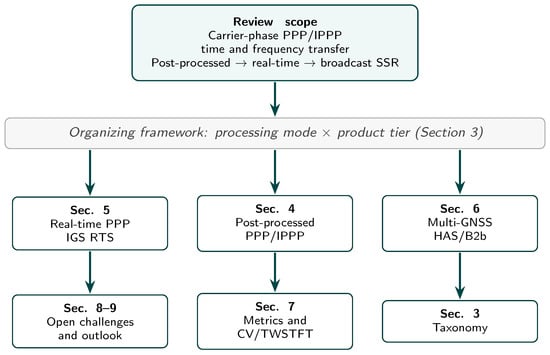
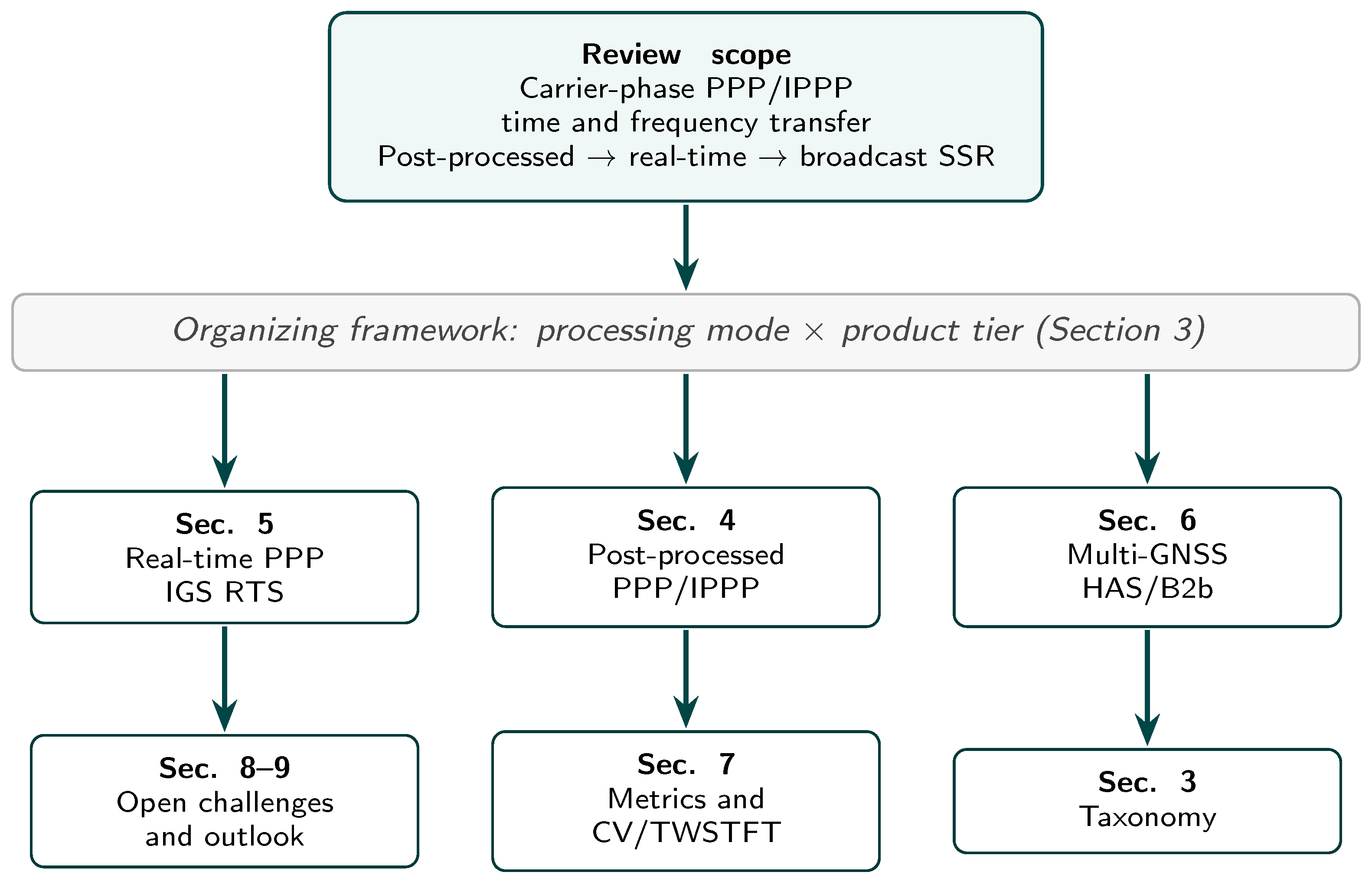


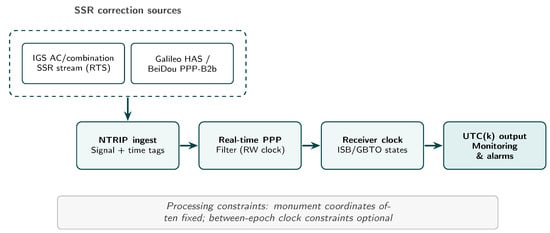
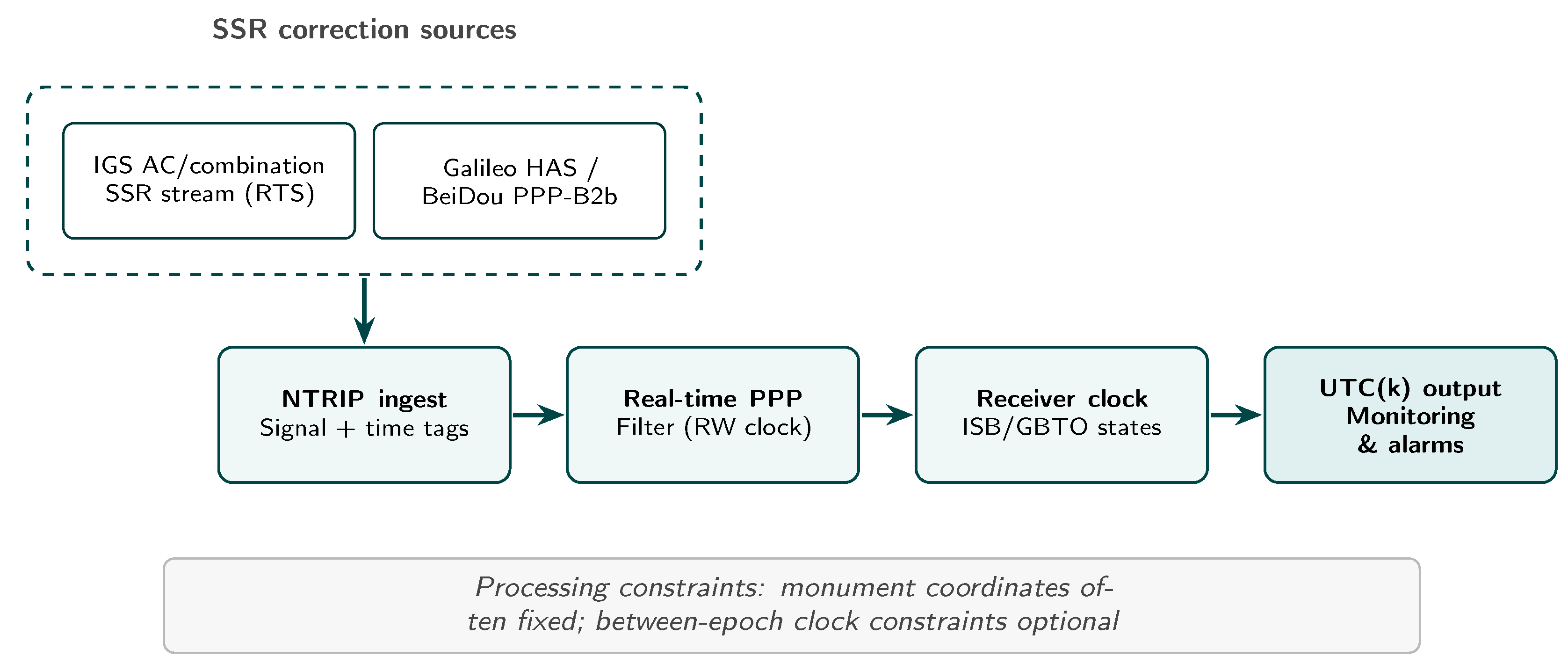
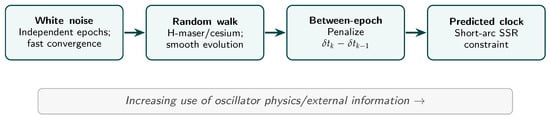
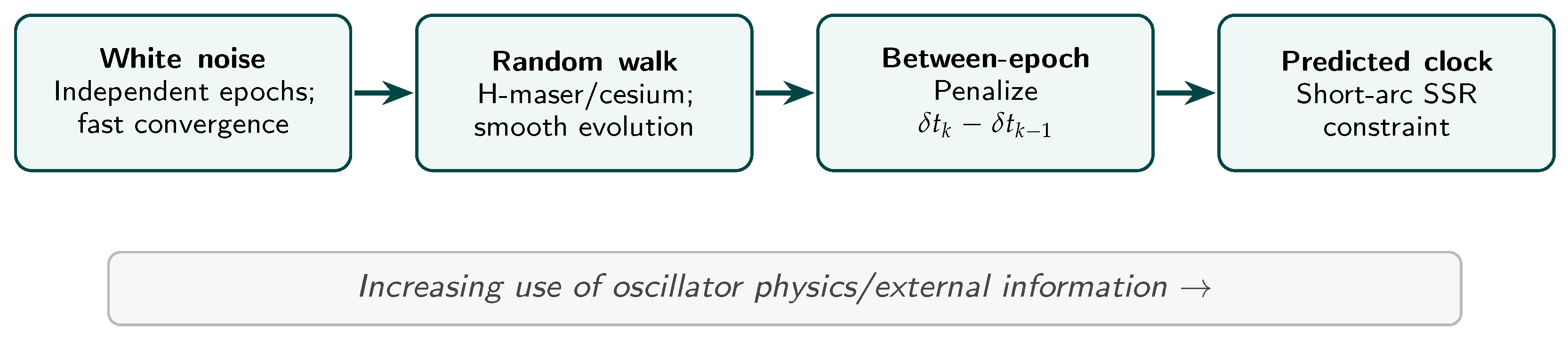
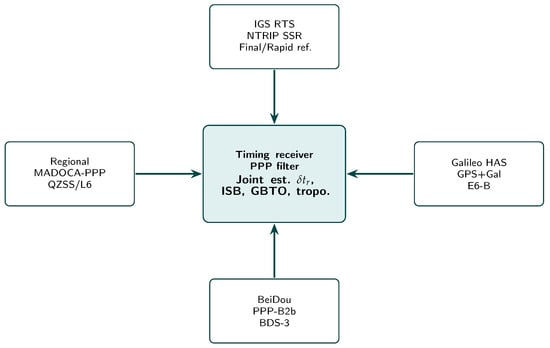
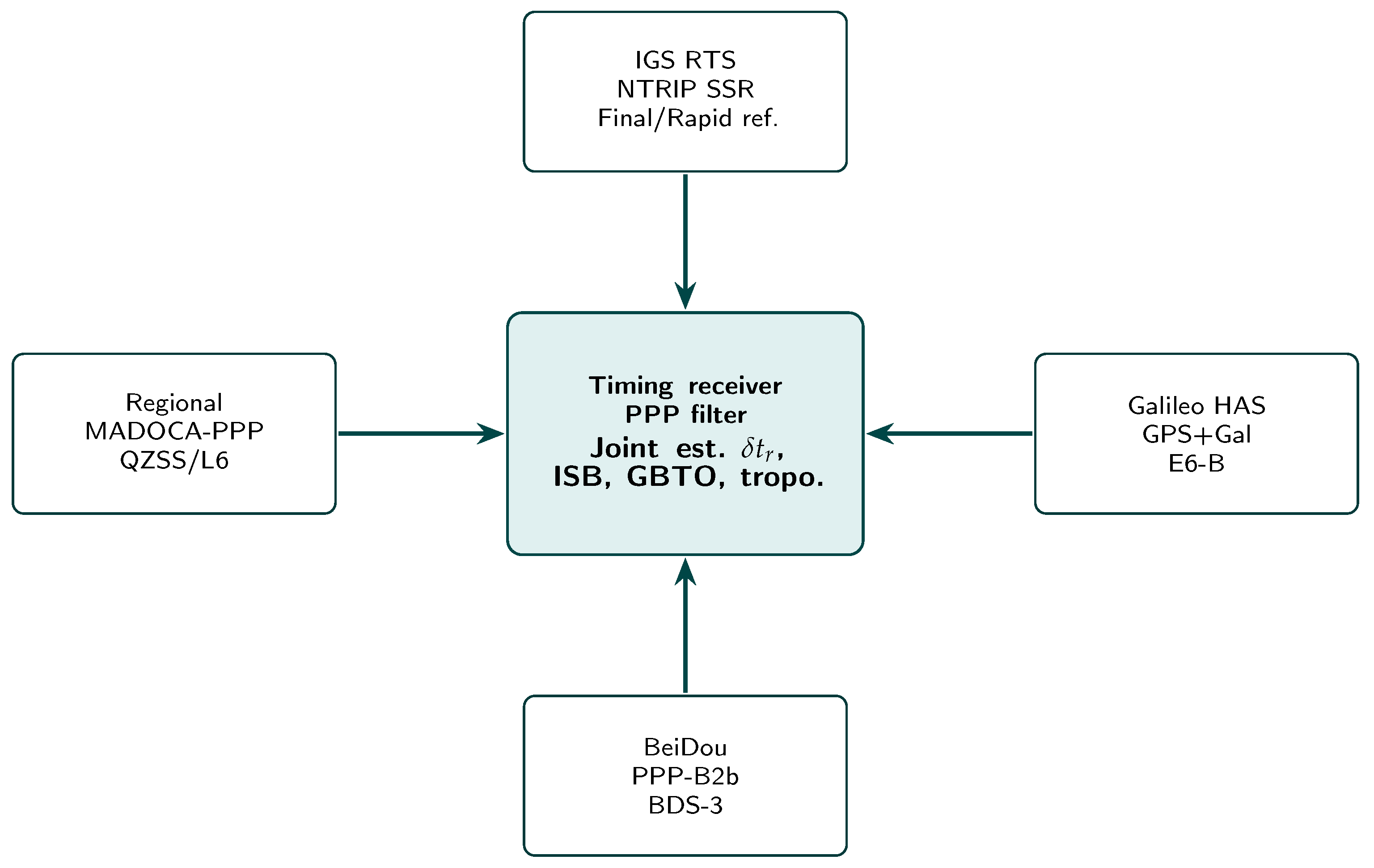
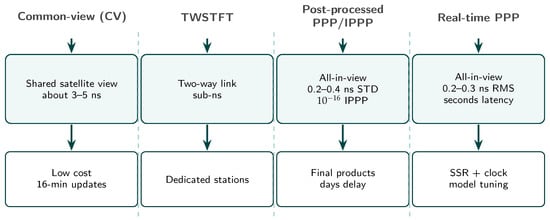
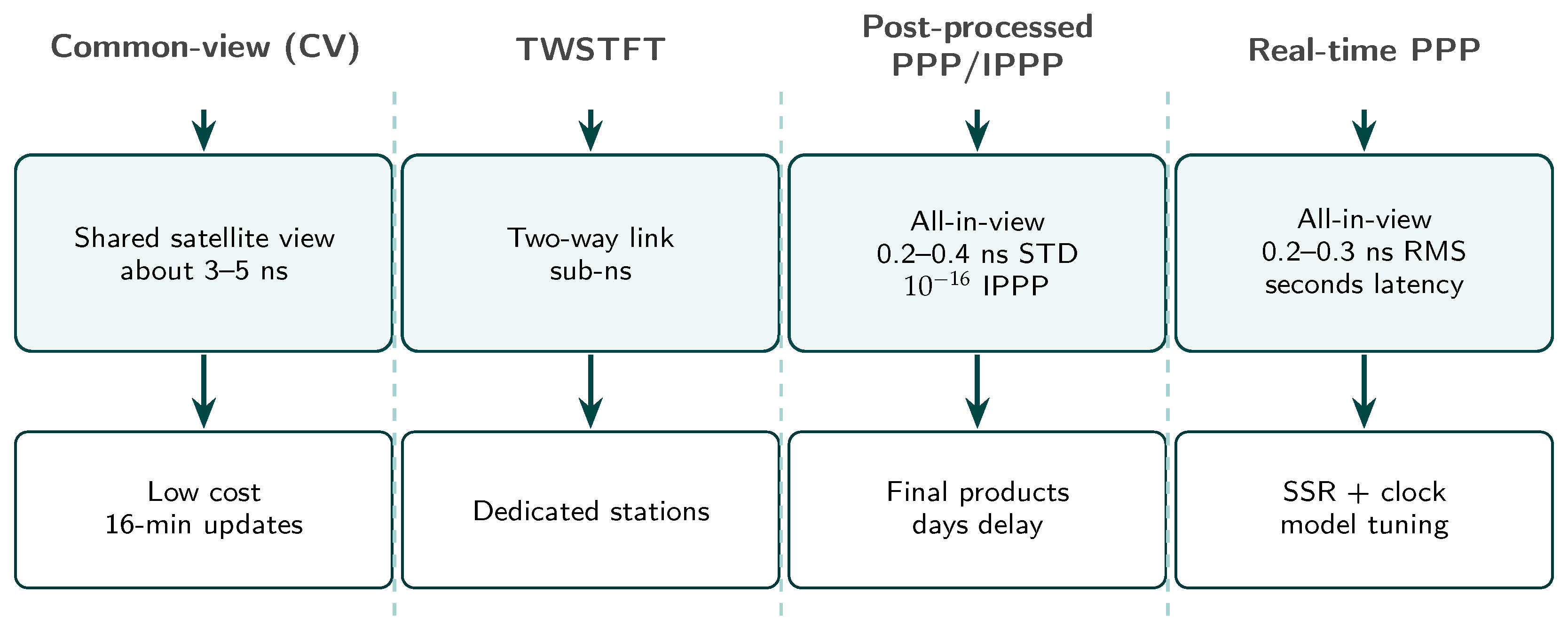
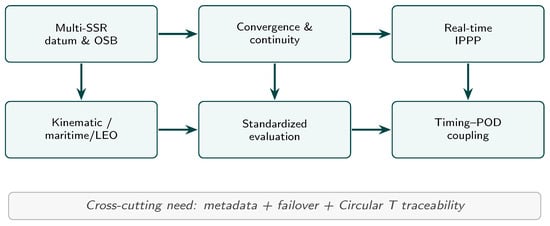
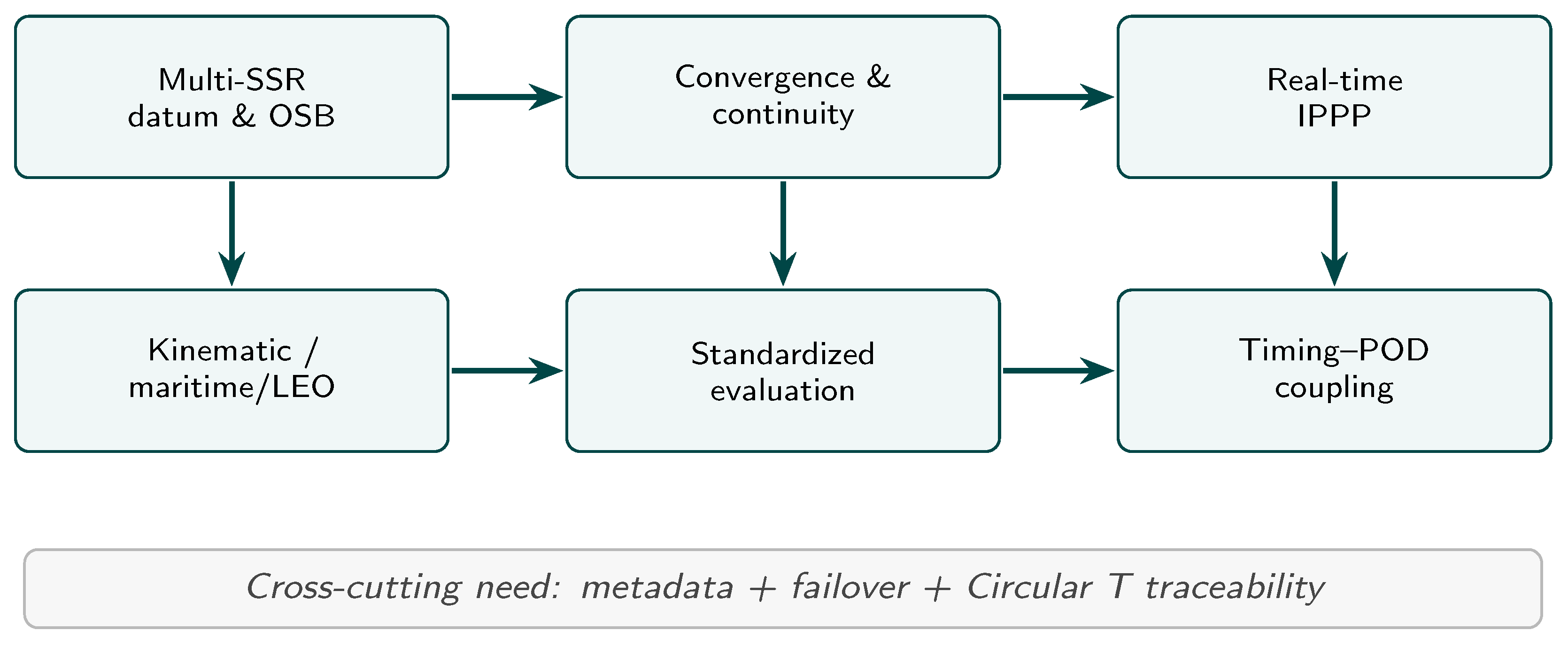

Disclaimer/Publisher’s Note: The statements, opinions and data contained in all publications are solely those of the individual author(s) and contributor(s) and not of MDPI and/or the editor(s). MDPI and/or the editor(s) disclaim responsibility for any injury to people or property resulting from any ideas, methods, instructions or products referred to in the content. |
© 2026 by the authors. Licensee MDPI, Basel, Switzerland. This article is an open access article distributed under the terms and conditions of the Creative Commons Attribution (CC BY) license.