Time Space 2026, 2(3), 6; https://doi.org/10.3390/timespace2030006 - 14 Jul 2026
Abstract
►
Show Figures
The aim of this paper is to introduce the basic theoretical (both conceptual and technical) tenets of Mallios’s Abstract Differential Geometry (ADG), as well as to present and to summarise the main results from its applications in the last quarter of a century
[...] Read more.
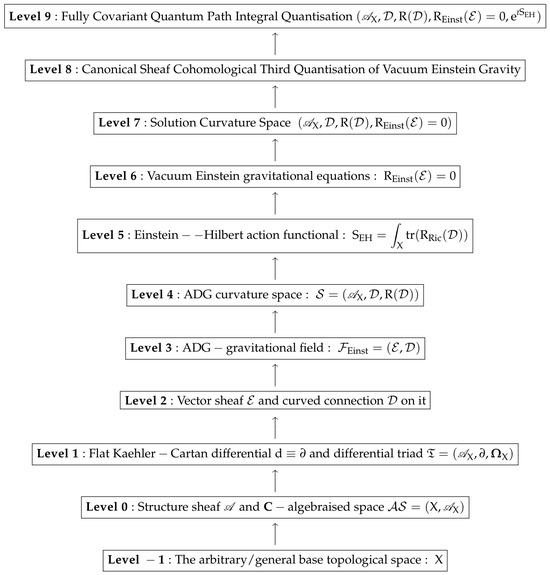
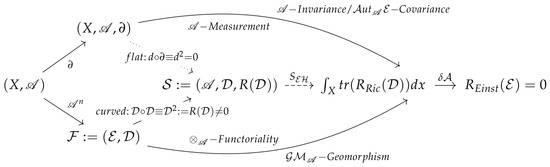
The aim of this paper is to introduce the basic theoretical (both conceptual and technical) tenets of Mallios’s Abstract Differential Geometry (ADG), as well as to present and to summarise the main results from its applications in the last quarter of a century towards formulating an entirely homological-algebraic, purely gauge-theoretic, finitistic, quantal and manifestly background geometrical smooth spacetime-manifold-independent vacuum Einstein gravity to a wider readership of mathematicians, mathematical physicists, and philosophers of mathematics and physics alike. This is an abstract and generalised version of the usual pseudo-Riemannian spacetime manifold-based vacuum Einstein gravity of General Relativity (GR), here called ADG-gravity. ADG-gravity, like the mathematical theory of ADG on which it is based, is shown here to rely crucially on and to derive from a sheaf
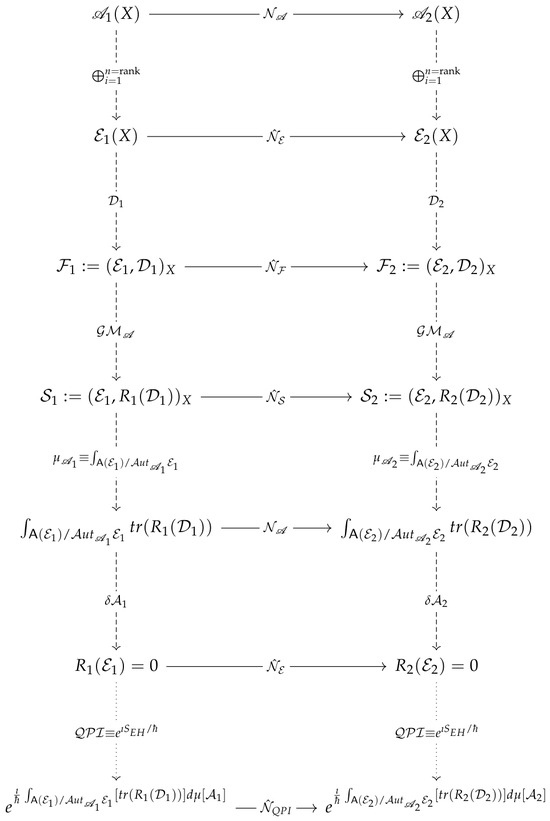
Figure 1