


Abstract
We present a pre-geometric gauge theory in which spacetime geometry and gravity emerge from spontaneous symmetry breaking and a concurrent topological phase transition. The theory is formulated on a four-dimensional manifold without presupposed metric structure, with general covariance maintained. Based on the de Sitter or anti-de Sitter gauge groups, a Higgs-like vector field triggers symmetry breaking to the Lorentz group, dynamically generating the spacetime metric and spin connection. We identify the complete set of irreducible pre-geometric operators, which reduce upon symmetry breaking to the most general 4D topological extension of Einstein gravity, encompassing the Einstein–Hilbert action, the cosmological constant, and the Gauss–Bonnet, Pontryagin, Holst and Nieh–Yan invariants. The emergent couplings reveal a see-saw mechanism between the Planck mass and and link the Barbero–Immirzi parameter to the ratio of topological couplings. The emergence of spacetime is a topological phase transition, with the Higgs field interpolating between a pure BF topological phase () with exact non-perturbative quantizability, an out-of-equilibrium regime and a geometric phase (, where v is the vacuum expectation value, or vev, parameter) where gravity emerges. This transition provides a new pathway toward the resolution of the Big Bang and Black Hole singularities, replacing them with phase boundaries where geometry dissolves into a pre-geometric description. Our framework offers a deep conceptual revisitation of the notions of space and time, establishing spacetime as an emergent phenomenon rather than a fundamental entity, and provides a novel foundation for a ultraviolet (UV) completion of Einstein gravity grounded in the topological structure of the pre-geometric phase.
1. Introduction
The nature of spacetime and the origin of gravitational interactions remain among the most profound open questions in fundamental physics. General relativity, despite its remarkable empirical success, presents spacetime as a smooth, continuous and fundamentally classical entity. This conception, however, is widely believed to be an effective, low-energy approximation to a deeper, more fundamental description. The search for a consistent theory of quantum gravity is, in large part, the search for the microscopic structure underlying the spacetime continuum and for the mechanisms through which geometry and gravity emerge from a more fundamental base.
The meta-geometric or pre-geometric approach offers a distinct and conceptually attractive paradigm. The central idea is that the metric structure of spacetime is not presupposed but is itself generated dynamically from a more fundamental, non-metric field theory [1,2,3,4,5,6] (The foundational works on gauge-theoretic approaches to gravity include the MacDowell–Mansouri construction [7], the Wilczek formulation [8], early developments in supersymmetric gauge formulations by Chamseddine, West, Stelle [9,10]. See also Refs. [11,12,13,14,15,16,17,18,19,20,21,22,23,24,25,26,27,28,29,30,31,32,33,34] for other works from different prospectives on these subjects). In this framework, we start from a gauge theory defined on a bare differentiable manifold without any prior metric structure. The gauge group is chosen to be, for instance, the de Sitter group or the anti-de Sitter group , both of which contain the Lorentz group as a subgroup. The de Sitter gauge group choice appears more naturally compatible with realistic cosmology; nevertheless, we have also included the anti-de Sitter case, as it is of interest from a purely theoretical perspective.. A gravitational Higgs field, transforming in the fundamental representation of the gauge group, is introduced to catalyze the symmetry breaking. Through a spontaneous symmetry breaking mechanism, the gauge symmetry is reduced to the Lorentz subgroup, and the Goldstone bosons associated with the broken generators are identified with the emergent tetrad fields. In this way, the spacetime metric is dynamically generated from the vacuum expectation value of the Higgs field and the components of the gauge connection, rather than being presupposed from the outset. Moreover, the gravitational Newton constant and the cosmological constant, initially absent from the fundamental action, emerge as specific recombinations of the gauge and Higgs parameters of the theory. This naturally addresses several deep conceptual issues: it provides a dynamical mechanism for the generation of the metric, grounds the notion of spacetime in a more fundamental theory and offers a potential explanation for the observed hierarchy between the Planck scale and the cosmological constant through a see-saw mechanism.
In this work, we present a comprehensive formulation of meta-geometric gravity as a constrained BF theory on a four-dimensional differentiable and orientable manifold without any presupposed metric structure (BF theory is so named because it involves the coupling of an antisymmetric B-field to the gauge field strength . The theory can be consistently formulated in arbitrary spacetime dimensions and for any choice of gauge group G). We identify the complete set of irreducible pre-geometric operators that constitute the most general generally covariant action constructed from the gauge connection and a Higgs-like field. We demonstrate that, upon spontaneous symmetry breaking, this theory reduces to the most general 4D topological extension of Einstein gravity, encompassing the Einstein–Hilbert action, the cosmological constant, and the complete set of topological invariants: Gauss–Bonnet, Pontryagin, Holst, and Nieh–Yan.
A central insight of our work is that the emergence of spacetime is not merely a spontaneous symmetry breaking but also a topological phase transition. The Higgs field interpolates between three distinct phases: a pure BF topological phase with no propagating degrees of freedom and exact non-perturbative quantizability, an out-of-equilibrium runaway regime, and a geometric phase where gravity, spacetime, topological terms, and all gravitational constants emerge. This dual nature of the phase transition offers a new perspective on the resolution of gravitational singularities, suggesting that the Big Bang and Black Hole singularities may be replaced by phase boundaries where the notion of spacetime geometry dissolves into a pre-geometric description. This radically challenges the conventional view of space and time at the Planck scale: spacetime is not a fundamental entity that breaks down, but an emergent phenomenon that transitions into a topological phase where geometry simply ceases to exist.
2. Emergent Gravity in the Spontaneously Broken Phase
We shall now examine a gauge theory formulated on a pre-geometric four-dimensional differentiable manifold, invariant under either the de Sitter group or the anti-de Sitter group (For a metric-free formulation based on the metalinear group , see Ch. 13 of [35] and [36]). The fundamental dynamical variables are the components of the gauge potential and the associated field strength , both antisymmetric in their internal (Latin) and spacetime (Greek) indices. The central objective is to dynamically generate a (pseudo-)Riemannian metric and the Einstein–Hilbert action without presupposing the existence of any spacetime metric or tetrads, while strictly adhering to the principle of general covariance. The only fixed structure is an internal-space metric with signature (depending on the gauge group), which generalizes the Minkowski metric to five dimensions. This emergence is achieved via the Higgs mechanism, employing a spacetime scalar field that transforms as a vector in the internal space. The spontaneous symmetry breaking of its ground state can reduce the original gauge symmetry to that of the Lorentz group , thereby recovering the Einstein Equivalence Principle in the spontaneously broken phase. In this geometric phase, the curvature of spacetime and its dynamics effectively emerge from the interactions of the pre-geometric fields and below a specific energy scale.
Crucially, the group is an internal gauge group on a four-dimensional manifold, not a spacetime symmetry. Thus, our symmetry breaking is fundamentally distinct from Kaluza–Klein compactification, as it generates geometry itself from a purely four-dimensional setting, rather than deriving it from a higher-dimensional spacetime.
The construction of generally covariant Lagrangian densities in the pre-geometric phase requires forming scalar densities of weight (since the action must be coordinate-invariant). The fundamental fields and are covariant tensors; contracting their indices requires a contravariant object. In the absence of an inverse metric, the only intrinsically defined four-dimensional contravariant object on the manifold is the constant Levi-Civita symbol , which is a tensor density of weight . The term ’intrinsically’ signifies that no structure other than the differential structure of the manifold is necessary—in particular, a metric structure is not required. The density character of the integration measure is defined solely through the Jacobian determinant of coordinate transformations, with no reference to a spacetime metric. Consequently, the Levi-Civita symbol is the fundamental object for constructing generally covariant Lagrangian densities, as it contracts exactly four covariant indices and possesses the correct weight to yield an action that is invariant under general coordinate transformations.
Let us now introduce the pre-geometric theory from a BF perspective [37,38,39,40,41,42]. On a topological manifold without a metric, the most natural gauge-invariant action is of the BF type, where the field strength is paired with a field :
Such a topological theory contains no propagating degrees of freedom. To generate propagating modes and ultimately gravity, one must impose constraints on the B-field that break the full topological invariance. In our framework, these constraints are implemented dynamically by expressing B in terms of the Higgs-like field and its covariant derivatives, while the integration over the manifold is performed using the volume form . This procedure yields two distinct and irreducible constrained BF theories, ultimately generating the Einstein–Hilbert action, corresponding to the MacDowell–Mansouri and Wilczek constructions respectively.
2.1. The MacDowell–Mansouri Constraint
The first constrained BF theory corresponds to the MacDowell–Mansouri construction [7]. In this case, the Lagrange multiplier B is constrained to take the form
Inserting this constraint into the BF action yields the MacDowell–Mansouri Lagrangian density:
This construction naturally yields the Einstein–Hilbert action plus the Gauss–Bonnet term upon symmetry breaking. The constraint (1) effectively imposes that the B-field is proportional to the field strength contracted with the Higgs field, projecting the topological BF theory to a propagating theory of gravity.
2.2. The Wilczek Constraint
The second constrained BF theory corresponds to the Wilczek construction [8]. Here, the Lagrange multiplier is constrained to be
leading to the Wilczek Lagrangian density:
This constraint implements a different algebraic structure for the B-field, involving the covariant derivatives of the Higgs field rather than the field strength itself. Both theories share the same underlying BF structure but differ in how the constraint is implemented through the scalar field , leading to different phenomenological consequences after symmetry breaking.
In both cases, the covariant derivative acts on internal-space vectors as
where . The mass dimensions of the coupling constants are and , with the dimensions of the field initially left unspecified. Before analyzing the SSB mechanism itself, we will examine the effective theory emerging after the symmetry reduction from or to . This allows for a clear understanding of the classical physics implications of these theories, before venturing into the pre-geometric regime.
2.3. The MacDowell–Mansouri Sector
The spontaneous symmetry breaking (SSB) mechanism selects a preferential direction in the internal space, characterized by a fixed vacuum expectation value (VEV) , where v is a nonzero constant. Such a choice is not the unique possible one but it is assumed for simplicity. This breaking allows for a classification of the components of the gauge potential: for each spacetime index , four potentials are of the type (where the index 4 is fixed) and the remaining six are (with ), where are the gauge indices of the Lorentz gauge subgroup . Let us first compute the form of after the SSB. Upon making the identifications
where and are the tetrads and the spin connections respectively, and a mass parameter m is introduced for dimensional consistency, the Lagrangian density decomposes into three distinct contributions:
where is equivalent to the Ricci scalar in Einstein–Cartan formalism with Lorentz gauge indices and space-time ones and is the Gauss–Bonnet density. These correspond respectively to the Einstein–Hilbert action, the cosmological constant term, and the Gauss–Bonnet term. For consistency with established physics, the reduced Planck mass must then be identified as
This reveals the emergent nature of the Planck scale, as it arises from a specific combination of the fundamental parameters , v, and m. Consequently, the cosmological constant is also emergent, given by
This expression for reveals a natural see-saw suppression mechanism. Assuming the experimentally measured value GeV2 and a coupling constant of order unity () (The renormalization-scale dependence of the coupling constants is discussed in [43]), the observed small value GeV2 can be generated from a large vacuum expectation value . Within this framework, the cosmological constant is therefore set by the mass scale m of the SSB (These large VEVs represent an open hierarchy problem. A possible resolution involves multiple vacua , from a periodic potential, with tunneling driving the system toward larger VEVs. The small cosmological constant would then arise from such relaxation dynamics, spontaneously occurring as de Sitter entropy increases).
2.4. The Wilczek Sector
The analysis of the SSB for follows a parallel path to that for . One additional element is required: the action of the covariant derivative on the internal-space vector after its VEV becomes fixed. From Equation (5), we find
Utilizing the identifications (6) and following a computation analogous to the previous case, we arrive at the result:
This theory yields precisely the Einstein–Hilbert Lagrangian density plus the cosmological constant term, with no Gauss–Bonnet contribution. The reduced Planck mass and cosmological constant are identified as
Again, assuming a coupling of order unity (), the observed value GeV2 emerges from a large VEV .
2.5. Geometric and Pre-Geometric Variables
To demonstrate that a metric theory of gravity can emerge, completely and consistently, from a non-metric field theory, it is essential to derive within the same formalism not only an effective metric , but also its inverse and the tetrad determinant . The inverse metric is indispensable for constructing kinetic and interaction terms in the Lagrangians of General Relativity and the Standard Model, while the metric determinant is required for a generally covariant volume element in the action principle. The metric can be constructed from quadratic combinations of tetrads. Similarly, the inverse metric arises from quadratic combinations of inverse tetrads.
The definition of an emergent tetrad was provided in the identifications (6), and subsequently allows for the construction of an effective metric:
In light of expression (10), an effective metric can also be formulated as
where the auxiliary field is defined as
To obtain a suitable expression for an inverse tetrad, we first define the auxiliary field
After the SSB, this field becomes
which is effectively proportional to the inverse tetrad multiplied by the tetrad determinant. This can be verified by considering the identity :
This result might suggest that the inverse tetrad and the tetrad determinant are not independent. However, an effective tetrad determinant can be constructed independently via another auxiliary field:
which can be interpreted as an effective Jacobian determinant. After the SSB, one finds
Finally, an effective inverse metric can be constructed as follows:
In summary, in this subsection, we have established a comprehensive dictionary to translate the pre-geometric fields and into the effective geometric fields and after the SSB. For conciseness, we reiterate the full dictionary here:
with the auxiliary fields , , and J defined in Equations (15), (16) and (19) respectively. It is straightforward to verify that all emergent geometric quantities transform as tensors and that the effective metric and its inverse are symmetric.
2.6. The Constrained B-Field After Symmetry Breaking
Having established the dictionary between pre-geometric and geometric variables, we now examine the fate of the Lagrange multiplier field after the SSB. Recall that the pre-geometric theory is formulated as a constrained BF theory, where the B-field is expressed in terms of the Higgs field and its derivatives. Upon symmetry breaking, these constraints reduce to the well-known simplicity constraints of Palatini gravity, thereby reconstructing the Einstein–Hilbert action and, in the MacDowell–Mansouri case, the Gauss–Bonnet term.
Let us first consider the MacDowell–Mansouri constraint. From Equation (1), we have . After the SSB, this becomes
This expression encapsulates the simplicity constraint of the MacDowell–Mansouri formulation: the B-field is forced to be proportional to the Hodge dual of the curvature two-form, with an additional term proportional to the wedge product of tetrads. When contracted with the field strength F in the BF action, this yields precisely the Einstein–Hilbert term, the cosmological constant term, and the Gauss–Bonnet term. The presence of the Gauss–Bonnet contribution is a distinctive feature of the MM constraint, arising from the term proportional to .
For the Wilczek constraint, from Equation (3), we have . After the SSB, making use of Equation (10), this becomes
In this case, the B-field is constrained to be proportional to the wedge product of tetrads alone, with no direct curvature term. When contracted with in the BF action, this yields the Einstein–Hilbert term plus the cosmological constant term, but no Gauss–Bonnet contribution. This is precisely the simplicity constraint of the Wilczek formulation: the B-field imposes that the curvature two-form is projected onto the tetrad sector, effectively enforcing the compatibility between the connection and the tetrads.
In both cases, the constrained B-field after SSB implements the simplicity constraints that are characteristic of Palatini formulations of gravity. However, the two constraints differ in their algebraic structure: the MM constraint involves the curvature itself, while the W constraint involves only the tetrads. This difference accounts for the distinct phenomenological consequences of the two theories, most notably the presence of the Gauss–Bonnet term exclusively in the MM case.
The emergence of these simplicity constraints from the pre-geometric BF theory is a key result of our framework. It demonstrates that the Palatini formulation of gravity, in which the connection and the tetrads are treated as independent variables subject to the constraint that the connection is torsion-free, can be derived from a more fundamental pre-geometric theory. Moreover, the specific form of the constraint—whether it involves the curvature (MM) or only the tetrads (W)—determines the topological content of the emergent gravitational theory.
2.7. The Symmetry-Breaking Potential
The process of SSB, which reduces the gauge symmetry from or to via the field , is responsible for the dynamical emergence of a classical spacetime metric in theories of pre-geometric gravity. This mechanism can be implemented by introducing a simple symmetry-breaking potential term into the Lagrangian density:
where is a positive constant with dimension . The potential is minimized, and the above term is stationarized, for field configurations satisfying . A specific solution, such as , can be chosen; then, any other VEV related to this one by a gauge transformation is physically equivalent. The factor of ensures that transforms as a scalar density, thus preserving general covariance. It is noteworthy that if one imposes a unimodular condition, as done by Wilczek [8], the factor can be omitted. In that case, the coupling constant assumes a fixed mass dimension of , independently of the chosen dimensions for the field . The field is quantized by expanding it around its VEV as , which defines the unitary gauge. In this gauge, the four would-be Goldstone bosons associated with the broken generators can be absorbed via the Higgs mechanism, leaving a single scalar degree of freedom .
For the MacDowell–Mansouri sector, however, the standard quartic potential must be replaced by a periodic potential of the form
where , p is a positive semi-integer, and c is a numerical constant. This periodic structure is required by the topological nature of the Gauss–Bonnet term, which acts as a gravitational -angle and forces the VEV to be quantized into discrete topological sectors [44]. The potential (4) possesses an infinite tower of degenerate minima labeled by an integer k, with , each corresponding to a distinct value of the cosmological constant. The observed vacuum sector corresponds to , as required by the holographic entropy of the de Sitter universe. Transitions between different topological sectors are strongly suppressed by an exponentially large potential barrier, ensuring the stability of the selected vacuum state [44], saturating Holographic Bounds on Cosmological Constant Naturalness [45,46,47].
3. General 4D Topological Extension of Einstein Gravity
In this section, our objective is to generalize the pre-geometric action by incorporating all possible minimal gauge-invariant operators constructed from the connection and the Higgs field. We will demonstrate that, following SSB, the resulting low-energy theory encompasses not only the standard Einstein–Hilbert and cosmological constant terms, but also the complete set of four-dimensional topological invariants. This establishes the pre-geometric framework as a unified origin for both the dynamical and topological sectors of gravity.
3.1. Decomposition After Spontaneous Symmetry Breaking
Once the Higgs-like scalar acquires a non-vanishing vacuum expectation value, , the gauge connection undergoes a natural decomposition into its irreducible gravitational components. Specifically, the Lorentz-indexed part becomes the spin connection, while the remaining components yield the tetrad field: , with the parameter m ensuring dimensional consistency for the tetrad. Consequently, the field strength splits into
where and denote the Riemann curvature and torsion, respectively.
Throughout this work, we employ the standard Hodge dual operation on curved spacetimes. For an arbitrary two-form , its dual is defined as
with
For convenience in the subsequent analysis, we introduce a set of curvature and torsion scalars that will appear naturally in the broken phase:
These quantities correspond respectively to the Gauss–Bonnet invariant, the Pontryagin density, the Holst term, the torsion contribution, and the Nieh–Yan combination. We neglect fluctuations of the Higgs field around its VEV—represented by the radial mode —since they are expected to be extremely massive and therefore decouple from the infrared dynamics.
3.2. The Complete Set of Pre-Geometric Operators
Assuming that general covariance remains a symmetry of the unbroken phase, the most general pre-geometric action constructed from A, , and their first derivatives (with polynomial dependence) contains exactly five independent terms:
The coupling constants carry mass dimensions , , , , and . In the absence of a background spacetime metric, all index contractions are performed using the purely combinatorial Levi-Civita symbols.
3.3. BF Reformulation of the Pre-Geometric Operators
It is instructive to reinterpret the four operators , , , and from a BF perspective. On a topological manifold without a metric, the most natural gauge-invariant action is of the BF type, where the field strength is paired with a Lagrange multiplier field :
However, such a topological theory contains no propagating degrees of freedom. To generate propagating modes and ultimately gravity, one must impose constraints on the B-field that break the full gauge symmetry. In our framework, these constraints are implemented dynamically by expressing B in terms of the Higgs-like field and its covariant derivatives, while the integration over the manifold is performed using the volume form .
Remarkably, all non-trivial pre-geometric operators (with the exception of , which contains no field strength and contributes only to the cosmological constant) can be understood as constrained BF theories. Specifically, the complete B-field is given by the sum of four distinct contributions, each corresponding to one of the operators:
where the individual constraints are defined as follows.
The MacDowell–Mansouri contribution is given by
which, when inserted into the BF action, yields
The Wilczek contribution corresponds to
producing
The -type contribution, which involves contractions with the Minkowski metric, is
leading to
Finally, the -type contribution corresponds to
which yields
With these definitions, the total BF action with the complete constrained B-field becomes
which reproduces precisely the sum of the four pre-geometric actions with corresponding to the general integral constraint on the B-form implemented through Lagrange multipliers.
In all four cases, the B-field constraint effectively reduces the topological BF theory to a propagating theory of gravity. The different algebraic structures of the constraints—involving the field strength, covariant derivatives of the Higgs field, or combinations thereof—lead to distinct phenomenological consequences after symmetry breaking, as we shall see in the following subsections. The operator , which does not contain the field strength F, cannot be expressed as a BF term; it contributes exclusively to the Higgs potential as previously discussed.
3.4. Spontaneous Symmetry Breaking of the Pre-Geometric Operators
Inserting the symmetry-broken expressions for the fields, the operators reduce to the following gravitational Lagrangians:
Summing these contributions yields the complete pre-geometric Lagrangian:
After SSB, this becomes the effective gravitational Lagrangian
where the six emergent parameters are expressed in terms of the pre-geometric ones as follows:
Here, denotes the reduced Planck mass, and the Newton constant is given by .
Several salient features of this mapping deserve emphasis:
- (i)
- The Planck mass originates solely from the operators and ; consequently, at least one of these must be present for the theory to reproduce a finite Newtonian coupling.
- (ii)
- The cosmological constant draws contributions from , , and , with the last of these affecting only .
- (iii)
- Neither nor participates in generating or .
- (iv)
- The Gauss–Bonnet coefficient is determined exclusively by .
- (v)
- The Pontryagin coefficient receives its sole contribution from .
- (vi)
- The Barbero–Immirzi parameter depends on the interplay between and through the combination , while also being connected to via the Planck mass definition.
- (vii)
- The torsion coupling is controlled exclusively by and dictates the strength of the sole term in the emergent theory that explicitly involves torsion.
- (viii)
The final observation suggests a convenient reparametrization. By absorbing the torsion-dependent piece of the Holst term into a redefined Nieh–Yan coupling (On the anomaly in connection with the Holst and NY terms, see [48]), the gravitational Lagrangian can be rewritten in the alternative form
with the new set of constants
Comparing Equations (37a)–(37f) with Equations (39a)–(39f) reveals that this redefinition successfully decouples the roles of and : the former now influences only and , whereas the latter contributes solely to .
The expression (38) encapsulates the central claim of this work: the gravitational theory emerging from the pre-geometric action constitutes the most general 4D topological extension of Einstein gravity. Its first two components reproduce the Einstein–Cartan theory (Einstein–Hilbert plus cosmological constant), while the remaining four terms coincide with all known topological invariants in four dimensions—namely, the Gauss–Bonnet, Pontryagin, Holst, and Nieh–Yan terms. (We do not consider boundary terms such as the Gibbons–Hawking–York term.) Schematically,
where the pre-geometric actions are
and the emergent gravitational actions are
where, here, indices, for example in tetrads, are omitted as the usual form-wedge formalism conventions.
A subtle but important clarification concerns the topological nature of the Holst term. The Gauss–Bonnet, Pontryagin, and Nieh–Yan terms are manifestly topological, as each can be written as an exact differential:
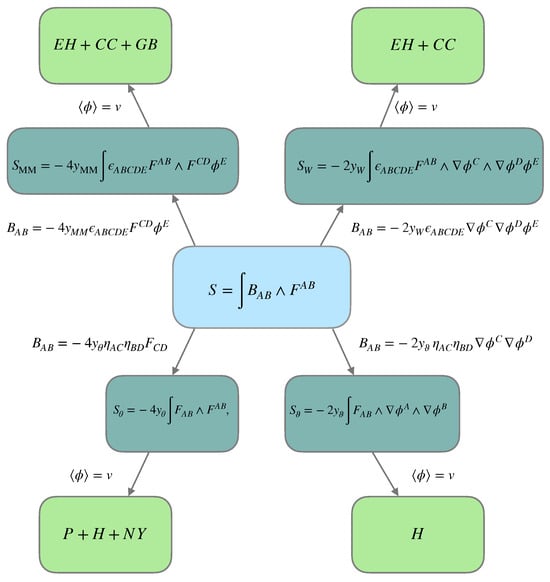
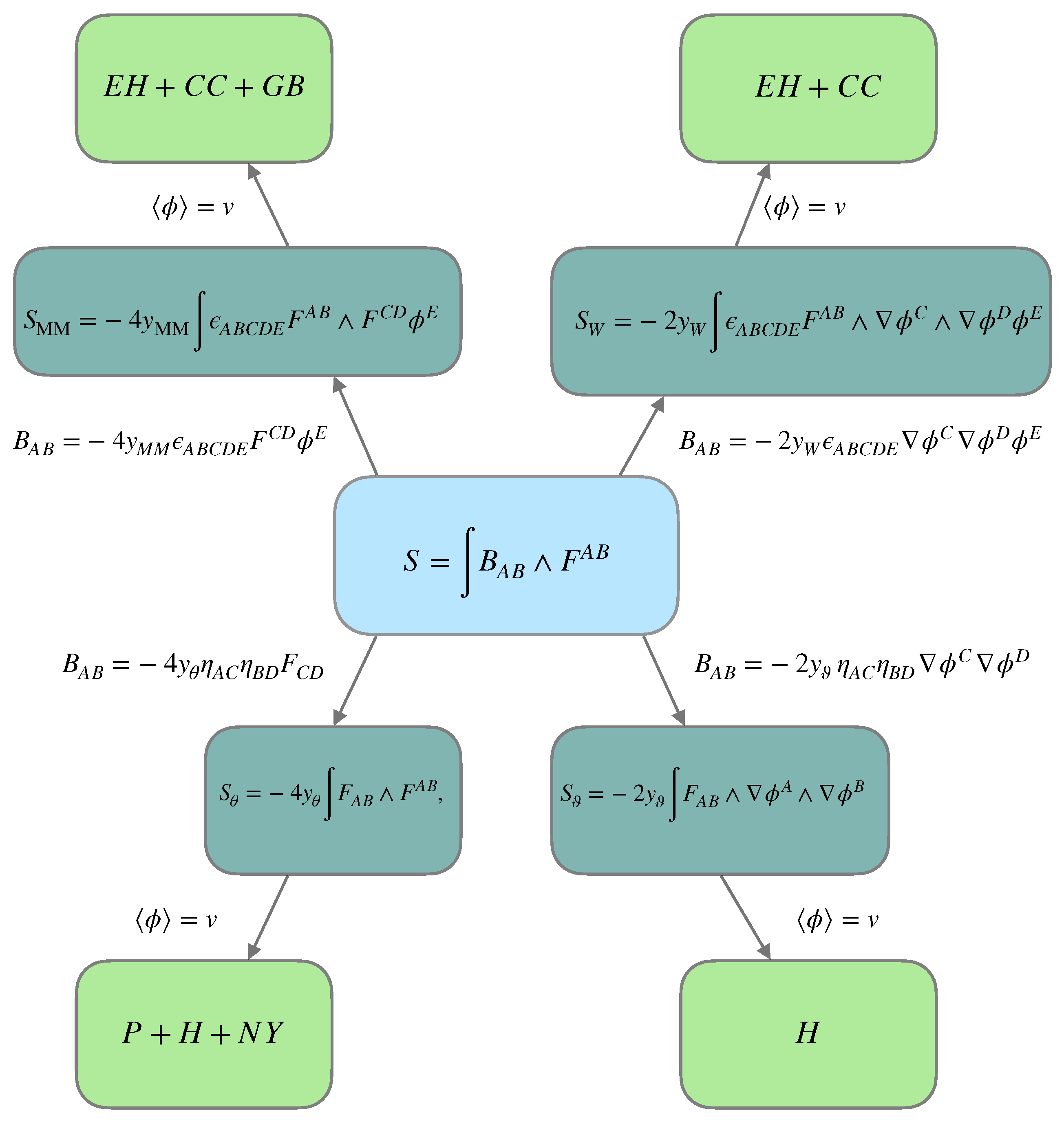
The Holst term, however, is topological only in the special case where torsion vanishes—since then by Equation (28e). In a generic pre-geometric setting, there is no reason to assume a priori that torsion is absent. Therefore, the emergent theory qualifies as a genuine topological extension of the Einstein–Cartan theory only when , i.e., when is omitted from the pre-geometric action. In Figure 1, the diagrammatic representation of the constrained BF formulation of meta-geometric gravity is displayed.
Figure 1.
Summary of the BF reformulation of pre-geometric gravity and its spontaneous symmetry breaking. The central part (blue) represents the unconstrained BF action; the first layers (dark green) around it are the four meta-geometric action terms obtained by BF from constraints. The second layers (light green) represent the terms generated after spontaneous symmetry breaking , with EH, CC, GB, H, P, NY representing Einstein–Hilbert, Cosmological Constant, Gauss–Bonnet, Holst, Pontryagin, Nieh–Yan respectively.
4. A Special Case: The Link Between Dynamical and Topological Sectors of Gravity
Additional physical insight emerges from examining a particular limit of the parameter space, defined by
This choice is instructive because it enables a clean separation of the pre-geometric terms according to the type of internal index contraction—those using the Levi-Civita symbol versus those using the Minkowski metric:
Under this restriction, the emergent couplings take the remarkably simple form
This simplified scenario exhibits several noteworthy characteristics:
- (i)
- A physically admissible (positive) Planck mass demands .
- (ii)
- The cosmological constant becomes completely independent of the pre-geometric couplings; its sign is dictated solely by the gauge group—positive for , negative for . Furthermore, a see-saw relation naturally arises:
- (iii)
- The Gauss–Bonnet coefficient is fixed by the ratio of the Planck mass to the cosmological constant:
- (iv)
- The Pontryagin and Nieh–Yan couplings become proportional, with the proportionality constant given by the cosmological constant:
- (v)
- The Barbero–Immirzi parameter depends exclusively on and can be written asConsequently, , , and share the same reality properties—they are either all real or all complex depending on the imaginary component of , while , , and remain real. Notably, the explicit dependence on the VEV scale v cancels out when expressed in terms of observable quantities. This also yields the inverse relation
- (vi)
- Finally, the Nieh–Yan coupling scales linearly with the cosmological constant:
The Relation (44) is particularly remarkable. It indicates that in this special case, the Gauss–Bonnet term is not an independent coupling but is instead tied to the Planck scale and the cosmological constant. As discussed in Ref. [44], this has far-reaching consequences for the vacuum structure: the Gauss–Bonnet coupling behaves as a gravitational -angle, and the resulting potential for the Higgs-like field develops a discrete set of degenerate vacua. Each vacuum sector is labeled by an integer k and corresponds to a distinct pair . This naturally implements a see-saw mechanism: a large Gauss–Bonnet coupling (large k) implies a hierarchically small cosmological constant. Moreover, the model predicts a quantized cosmological constant and a discretized de Sitter entropy proportional to the large-k VEV of , in full agreement with Holographic expectations [45,46,47].
It is also worth noting that the subcase within Equation (42) corresponds precisely to setting and redefining the remaining two couplings and . Thus, the most general 4D topological extension of the Einstein–Cartan theory—even in the presence of torsion—can already be generated from the minimal pre-geometric action .
5. The Conception of Spacetime in Meta-Geometric Gravity
The pre-geometric framework presented above embodies a radical shift in the conception of spacetime. Rather than treating the spacetime continuum and its metric structure as fundamental, meta-geometric gravity posits that geometry is an emergent, low-energy phenomenon arising from a more primitive, ametric sublayer. We now elaborate on the conceptual pillars underlying this paradigm, drawing connections to broader discussions on the emergence of spacetime in quantum gravity.
5.1. From Pre-Geometric Substrate to Emergent Geometry
As remarked in previous sections, in the unbroken phase, the theory is formulated on a four-dimensional differentiable manifold that is initially devoid of any metric structure. The only fixed tensorial structure is an internal metric with signature , which generalizes the Minkowski metric to five dimensions. Crucially, no spacetime metric, tetrads, or notion of distance exist at the fundamental level. The manifold is endowed only with its differential structure and the Levi-Civita symbol , which serves as the sole object for constructing generally covariant Lagrangian densities in the absence of an inverse metric. Geometry emerges dynamically through the spontaneous symmetry breaking of the gauge group or down to the Lorentz group , triggered by the condensation of the Higgs-like field . Below the symmetry-breaking scale, the gauge connection decomposes into tetrads and spin connections, and an effective metric is constructed from the emergent tetrads. This phase transition from a pre-geometric to a metric world is realized at a critical energy near the Planck scale. The process is conceptually akin to a condensation or geometrogenesis, where the collective behavior of pre-geometric degrees of freedom gives rise to the smooth continuum of classical spacetime.
5.2. General Covariance Without a Metric
A distinctive feature of meta-geometric gravity is the implementation of general covariance in the absence of a background metric. In standard GR, general covariance is implemented using the metric determinant in the volume element. In the pre-geometric phase, however, the volume form is provided by the Levi-Civita symbol , which is a tensor density of weight intrinsically defined by the manifold’s differential structure. This allows for the construction of scalar densities by contracting exactly four covariant indices, ensuring invariance under coordinate transformations without reference to a metric.
The density character of the action is defined solely through the Jacobian determinant of coordinate transformations, with no metric required. The term ‘intrinsically’ implies that no structure beyond the differential properties of the manifold is necessary. This is a crucial departure from conventional field theories, which presuppose a background metric for defining kinetic terms and volume elements.
5.3. Topological Phase Transition and the Three Gravitational Phases
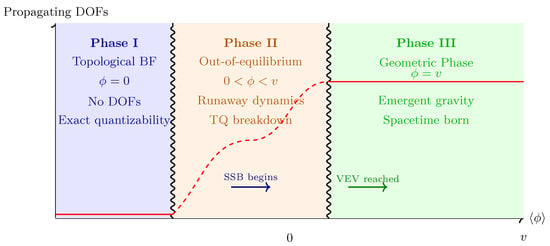
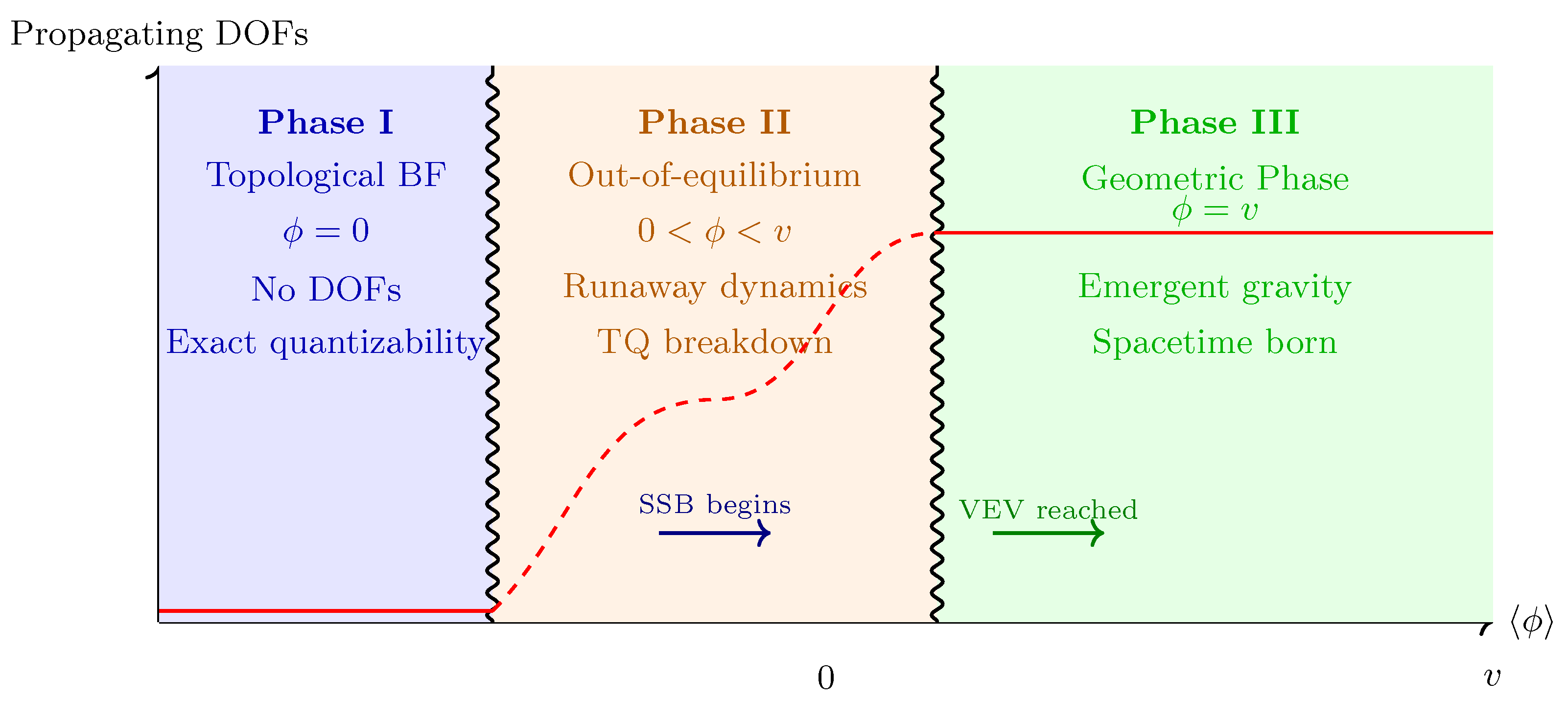
A crucial feature of the pre-geometric framework is that the emergence of spacetime is not merely a spontaneous symmetry breaking but also a topological phase transition. This dual nature of the phase transition is inspired by analogous phenomena in condensed matter physics, where topological phase transitions are characterized by changes in the topological invariants of the ground state [49,50,51,52,53,54,55,56,57]. In parallel with these condensed matter systems, the topological phase transition in our pre-geometric framework is accompanied by a change in the topological content of the theory, signaling the emergence of topological order. In our framework, the Higgs-like field acts as an order parameter that interpolates between three distinct phases, each characterized by different topological and dynamical properties. The field thus controls the magnitude of the constraints on the B-field and, consequently, the topological and dynamical content of the theory. In Figure 2, a schematic representation of the three phases of meta-geometric gravity is displayed.
Figure 2.
Schematic representation of the three phases of pre-geometric gravity as a function of the Higgs field vacuum expectation value . Phase I () corresponds to the pure BF topological phase with no propagating degrees of freedom and exact non-perturbative quantizability. Phase II () is an out-of-equilibrium runaway regime where standard vacuum quantization breaks down. Phase III () is the geometric phase where gravity, spacetime, and all gravitational constants emerge. The red curve schematically indicates the number of propagating degrees of freedom.
- Phase I: The topological BF phase ().
In the limit where the Higgs field vanishes, , all constraints on the B-field vanish identically. The complete B-field (Equation (30)) reduces to zero, and the theory becomes a pure BF topological field theory [37,38,39,40,41,42]:
This phase is characterized by several remarkable properties:
- (i)
- Absence of propagating degrees of freedom. The BF theory is a topological field theory with no local propagating modes. All degrees of freedom are topological and can be eliminated by gauge fixing.
- (ii)
- Exact non-perturbative quantizability. The BF action is quadratic in the fields, and the path integral can be computed exactly by integrating out the B field. This procedure imposes the flatness constraint via a delta function, so that the partition function localizes on the moduli space of flat connections . This allows for a complete, non-perturbative quantization of the theory [58]. For a closed manifold, the partition function can be expressed as a sum over topological sectors, yielding the symplectic volume of the moduli space of flat connections [58].
- (iii)
- Topological invariance. The action is independent of any metric structure and depends only on the topology of the underlying manifold. Correlation functions are topological invariants.
- (iv)
- Spacetime dissolves. In this phase, there is no notion of spacetime geometry, distances, or causality. The manifold retains only its differential and topological structure.
This phase corresponds to the pre-geometric regime at energies far above the symmetry-breaking scale, where the gauge symmetry is fully unbroken. The notion of spacetime as a continuum with a metric dissolves entirely.
- Phase II: The runaway out-of-equilibrium regime ().
As the Higgs field evolves from zero toward its VEV, the theory enters an intermediate regime where . This phase is characterized by the following:
- (i)
- Activation of meta-geometric constraints. The B-field constraints are operational, the theory has propagating meta-geometric degrees of freedom corresponding to the gauge and Higgs bosons.
- (ii)
- Out-of-equilibrium dynamics. The system is in a runaway regime, driven by the kinetic terms encoded in the pre-geometric effective Jacobian J (Equation (19)) and the potential . The field is dynamically evolving toward its VEV.
- (iii)
- Breakdown of vacuum quantization. In this out-of-equilibrium regime, the standard quantization methods based on a vacuum state do not apply. The system is not stationary, and the usual notions of particles and vacuum fluctuations break down.
- (iv)
- No well-defined spacetime. The metric has not yet emerged, and the manifold remains non-metric. However, the Higgs-dependent constraints are dynamically active, de-freezing the meta-geometric degrees of freedom.
This intermediate phase is conceptually the most challenging and represents the true non-equilibrium regime of the pre-geometric theory. Understanding its dynamics requires methods beyond conventional quantum field theory, such as those developed in the context of quantum cosmology or stochastic quantization [5]. The early Universe may have passed through this phase during the pre-geometric era and the signatures of this out-of-equilibrium dynamics could be encoded in the primordial fluctuations and cosmological acceleration.
- Phase III: The geometric phase ().
When the Higgs field settles into its VEV, , the full set of constraints is activated, and the theory undergoes a spontaneous symmetry breaking accompanied by a topological phase transition. This phase is characterized by the following:
- (i)
- Emergence of gravitational degrees of freedom. The gravitational degrees of freedom become dynamical, corresponding to the two transverse-traceless polarizations of the graviton. The theory acquires local propagating modes.
- (ii)
- Emergence of the metric and geometry. The tetrads and spin connections emerge from the gauge connection, and an effective metric is constructed. General relativity is recovered as the low-energy effective theory.
- (iii)
- Emergence of gravitational constants. The Planck mass , the cosmological constant , and all topological couplings (, , , ) are generated dynamically from the pre-geometric parameters (see Equations (37a)–(37f) and (39a)–(39f) (The topological angles , , , and the Immirzi parameter do not enter the classical equations of motion. Consequently, they are not directly constrained by cosmological observations, and all standard ΛCDM predictions are recovered regardless of their values. Their precise determination would require either quantum-level effects or non-minimal extensions of the gravitational theory).
- (iv)
- Topological invariants become θ-angles. The Gauss–Bonnet, Pontryagin, Holst, and Nieh–Yan terms emerge as topological invariants, with their couplings acting as gravitational -angles.
- (v)
- Spacetime is born. The classical notion of spacetime as a continuum with distances, causal structure and Lorentz invariance emerges from the pre-geometric base.
In this phase, although general covariance is realized as a fundamental symmetry in the unbroken phase through the Levi-Civita symbol, the Einstein Equivalence Principle itself is an emergent property of the broken phase, not a fundamental axiom. The theory possesses an internal gauge symmetry, such as or , but this is an internal symmetry, not a spacetime Lorentz symmetry. Before symmetry breaking, there are no tetrads to map internal indices to spacetime indices, no metric to define local Lorentz frames and no notion of local inertial frames in spacetime. While one can formally define geodesic frames using only an affine connection, the full equivalence principle requires more: local Lorentz invariance, the existence of local Minkowski frames and the universal coupling of all matter fields to the same geometric structure. These require a metric (or tetrads), which only appear after symmetry breaking, when the tetrads emerge from the gauge connection components , identifying the internal Lorentz subgroup with the spacetime Lorentz group. The connection alone provides a notion of geodesic motion, but not the local Lorentz structure that underpins the physical indistinguishability between gravitational and inertial effects. The phase transition from the topological to the geometric phase can thus be seen as a “geometrogenesis,” where spatial distances and temporal intervals are dynamically generated rather than presupposed.
5.4. Summary: Spacetime as a Topological Phase Transition
In summary, the conception of spacetime in meta-geometric theories is one of radical emergence. Spacetime geometry, the metric, and even the principles of general relativity arise from a more fundamental, non-metric gauge theory through a dual phase transition that is both a spontaneous symmetry breaking and a topological phase transition. The theory interpolates between three distinct phases:
- (i)
- A pure BF topological phase with no propagating degrees of freedom and exact non-perturbative quantizability ().
- (ii)
- An out-of-equilibrium runaway regime where standard vacuum quantization breaks down ().
- (iii)
- A geometric phase where gravity, spacetime, and all gravitational constants emerge ().
This dual nature of the phase transition—combining symmetry breaking with topological change—is reminiscent of phenomena in topological condensed matter systems [49,50,51,52,53,54,55,56,57] and provides a concrete realization of the idea that the continuum spacetime of classical physics is a low-energy emergent phenomenon arising from quantum non-metric degrees of freedom. The presence of topological invariants as gravitational -angles and their quantization are interpreted as signatures of the underlying topological order, revealing a deep connection between gravity, topology and quantum information.
5.5. Emergent Cosmology and Hypothetical Non-Singular Black Holes
The pre-geometric framework presented above has profound implications for two of the most perplexing phenomena in gravitational physics: the Big Bang singularity and Black Hole singularities. In both cases, classical general relativity predicts the breakdown of the spacetime continuum and the divergence of curvature invariants, signaling the limits of the classical description. Within the meta-geometric paradigm, these singularities are not merely smoothed out by quantum corrections; rather, they are replaced by a phase transition to the pre-geometric topological phase, where the very notion of spacetime geometry ceases to exist. This perspective offers a unified resolution of gravitational singularities and provides a new conceptual framework for understanding the early Universe and the interiors of Black Holes.
The resolution of the Big Bang singularity within meta-geometric gravity represents one of the most compelling consequences of the framework. In standard cosmology, the initial singularity represents a moment when the scale factor vanishes and curvature invariants diverge, indicating geodesic incompleteness and the breakdown of general relativity at the Planck scale. In the pre-geometric picture, however, the history of the Universe traced backward in time does not end at a singular point but rather approaches a critical scale where the Higgs-like field transitions toward its symmetric phase . At this critical scale, the constraints on the B-field gradually vanish, and the theory undergoes a transition from the geometric phase (Phase III) to the topological BF phase (Phase I). In this pre-geometric phase, the manifold retains only its topological and differential structure, and the very notion of a scale factor loses its meaning. The Big Bang is thus not a singularity but a phase boundary between a non-metric, topologically ordered phase and the geometric phase that describes our expanding Universe.
This resolution is particularly compelling because the topological BF phase is exactly quantizable, as discussed in the previous subsection. The path integral of the BF theory can be computed non-perturbatively, localizing on flat connections and yielding a complete, unitary description of the pre-geometric era without the divergences that plague the quantization of general relativity.
The Black Hole interior presents a second arena where the meta-geometric framework offers a radical resolution. At the center of a Black Hole, curvature invariants diverge and the classical description breaks down. In pre-geometric gravity, the Black Hole interior is described as a region where the spacetime geometry undergoes a phase transition to the pre-geometric topological phase as one approaches the would-be singularity. When the energy density reaches the critical scale at which the Higgs field approaches , the constraints on the B-field vanish and the metric description dissolves, replaced by the topological BF phase. The singularity is thus replaced by a phase transition to a non-geometric phase. However, The Black Hole case warrants particular care, as below the critical topological phase transition scale, the Hamiltonian constraint is identically satisfied by the flat gauge connection, rendering the usual notion of energy scale ambiguous in the topological limit while usually well fixed in standard Black Holes. Work on explicit analytical solutions for such configurations is in progress and will be presented in a companion paper in preparation.
In summary, the meta-geometric theory provides a possible unified conceptual resolution of both Big Bang and Black Hole singularities. In both cases, the classical singularity is replaced by a phase transition from the geometric phase to the pre-geometric topological BF phase. The three phases of the theory correspond to a coherent narrative: the pre-Big Bang or Black Hole interior corresponds to the topological BF phase where geometry dissolves and the theory is exactly quantizable; the transitional regime corresponds to the out-of-equilibrium Phase II where geometry is emerging but standard quantization methods on a static vacuum state break down; the observable Universe or Black Hole exterior corresponds to the geometric phase where Einstein gravity and the Standard Model operate. This unified picture suggests that what we perceive as singularities are in fact boundaries between different phases of the pre-geometric theory, where the notion of spacetime geometry itself is replaced by a more fundamental ametric description. However, while this resolution appears compelling for the Big Bang singularity and in the context of emergence cosmology, the case of Black Holes requires further technical investigation before a definitive solution can be established.
6. Conclusions
In this work, we have presented a comprehensive formulation of pre-geometric gravity as a constrained BF theory on a four-dimensional differentiable and orientable manifold without presupposed metric structure. Our framework is based on the de Sitter or anti-de Sitter gauge groups and features a Higgs-like field whose spontaneous symmetry breaking dynamically generates the spacetime metric and spin connection.
We have identified the complete set of five irreducible pre-geometric operators that constitute the basis to construct the most general generally covariant action from the gauge connection , the Higgs field , and their first derivatives. With the exception of the operator , which contributes exclusively to the cosmological constant, all operators admit a unified BF reformulation in terms of a constrained B-field whose algebraic structure determines the topological and dynamical content of the emergent theory. This BF reformulation establishes a direct connection between pre-geometric gravity and topological field theory, providing a clear foundation for the emergence of propagating degrees of freedom from a topologically ordered phase.
Our main result is that, upon spontaneous symmetry breaking, the pre-geometric action reduces to the most general 4D topological extension of Einstein gravity, encompassing the Einstein–Hilbert action, the cosmological constant and the complete set of topological invariants: the Gauss–Bonnet, Pontryagin, Holst, and Nieh–Yan terms. This unification of the dynamical and topological sectors of gravity demonstrates that what are traditionally considered independent sectors of gravitational theory may have a common pre-geometric origin. The emergent couplings—, , , , , —are all expressed in terms of the pre-geometric parameters, revealing a rich network of relations. In a special case, these relations exhibit a see-saw mechanism between and , a direct proportionality between the Gauss–Bonnet coupling and the de Sitter entropy and a link between the Barbero–Immirzi parameter and the ratio of topological couplings.
A central conceptual insight of our work is that the emergence of spacetime is not merely a spontaneous symmetry breaking but also a topological phase transition. The Higgs field interpolates between three distinct phases: a pure BF topological phase () with no propagating degrees of freedom and exact non-perturbative quantizability; an out-of-equilibrium runaway regime () where standard vacuum quantization breaks down; and a geometric phase () where gravity, spacetime, and all gravitational constants emerge. This dual nature of the phase transition provides a new framework for understanding the resolution of gravitational singularities. Both the Big Bang and Black Hole singularities are replaced by phase boundaries where the notion of spacetime geometry dissolves into a pre-geometric description, offering a novel pathway toward a UV completion of Einstein gravity grounded in the topological structure of the pre-geometric phase.
Several avenues for future research emerge from our analysis. The complete dynamics of the out-of-equilibrium Phase II remain to be understood, requiring methods beyond conventional quantum field theory. The role of the superheavy Higgs excitation and its coupling to matter fields deserves further investigation, as the presence of matter may modify the critical scale at which the phase transition occurs. The quantum dynamics of the full pre-geometric theory, including the topological terms and the Barbero–Immirzi parameter, requires a systematic investigation. Finally, the pre-geometric framework suggests a radical rethinking of space and time, presenting spacetime as a collective phenomenon rather than fundamental, with deep implications for quantum gravity and cosmology.
Funding
My work is supported by Program for Innovative Research Team in Anqing Normal University and the National Science Foundation of China (NSFC) through the grant No. 12350410358.
Data Availability Statement
No new data were created or analyzed in this study. Theoretical developments and all supporting arguments are fully contained within the manuscript.
Acknowledgments
I gratefully acknowledge Giuseppe Meluccio for numerous discussions and for his insightful remarks on the subjects covered in this paper.
Conflicts of Interest
The author declares no conflicts of interest.
References
- Addazi, A.; Capozziello, S.; Marciano, A.; Meluccio, G. Gravity from pre-geometry. Class. Quantum Gravity 2025, 42, 045012. [Google Scholar] [CrossRef] [Scilit]
- Addazi, A.; Capozziello, S.; Marcianò, A.; Meluccio, G. Hamiltonian analysis of pregeometric gravity. Phys. Rev. D 2025, 112, 064058. [Google Scholar] [CrossRef] [Scilit]
- Addazi, A. Emergent Gravity from a Spontaneously Broken Gauge Symmetry: A Pre-geometric Prospective. arXiv 2025, arXiv:2512.20681. [Google Scholar]
- Addazi, A.; Capozziello, S.; Meluccio, G. olographic aturalness and Pre-Geometric Gravity. arXiv 2026, arXiv:2604.26032. [Google Scholar]
- Addazi, A.; Capozziello, S.; Liu, J.; Marciano, A.; Meluccio, G.; Su, X.L. Emergent gravity from topological quantum field theory: Stochastic gradient flow perspective away from the quantum gravity problem. Phys. Lett. B 2026, 879, 140576. [Google Scholar] [CrossRef] [Scilit]
- Meluccio, G. Pregeometric Einstein-Cartan field equations and emergent cosmology. Phys. Rev. D 2025, 112, 064057. [Google Scholar] [CrossRef] [Scilit]
- MacDowell, S.W.; Mansouri, F. Unified geometric theory of gravity and supergravity. Phys. Rev. Lett. 1977, 38, 739. [Google Scholar] [CrossRef] [Scilit]
- Wilczek, F. Riemann-Einstein structure from volume and gauge symmetry. Phys. Rev. Lett. 1998, 80, 4851. [Google Scholar] [CrossRef] [Scilit]
- Chamseddine, A.H.; West, P.C. Supergravity as a gauge theory of supersymmetry. Nucl. Phys. B 1977, 129, 39–44. [Google Scholar] [CrossRef] [Scilit]
- Stelle, K.S.; West, P.C. de Sitter gauge invariance and the geometry of the Einstein-Cartan theory. J. Phys. A Math. Gen. 1979, 12, L205. [Google Scholar] [CrossRef] [Scilit]
- Hehl, F.W.; McCrea, J.D.; Mielke, E.W.; Ne’eman, Y. Metric affine gauge theory of gravity: Field equations, Noether identities, world spinors, and breaking of dilation invariance. Phys. Rept. 1995, 258, 1–171. [Google Scholar] [CrossRef] [Scilit]
- Adler, S.L. Einstein Gravity as a Symmetry-Breaking Effect in Quantum Field Theory. Rev. Mod. Phys. 1982, 54, 729. [Google Scholar] [CrossRef] [Scilit]
- Bekenstein, J.D. Gravitation and Spontaneous Symmetry Breaking. Found. Phys. 1986, 16, 409–422. [Google Scholar] [CrossRef] [Scilit]
- Krasnov, K. Spontaneous Symmetry Breaking and Gravity. Phys. Rev. D 2012, 85, 125023. [Google Scholar] [CrossRef] [Scilit]
- Chamseddine, A.H.; Mukhanov, V. On Unification of Gravity and Gauge Interactions. J. High Energy Phys. 2016, 03, 020. [Google Scholar] [CrossRef] [Scilit]
- Westman, H.F.; Zlosnik, T.G. Cartan gravity, matter fields, and the gauge principle. Ann. Phys. 2013, 334, 157–197. [Google Scholar] [CrossRef] [Scilit]
- Westman, H.F.; Zlosnik, T.G. Exploring Cartan gravity with dynamical symmetry breaking. Class. Quant. Grav. 2014, 31, 095004. [Google Scholar] [CrossRef] [Scilit][Green Version]
- Westman, H.F.; Zlosnik, T.G. An introduction to the physics of Cartan gravity. Ann. Phys. 2015, 361, 330–376. [Google Scholar] [CrossRef] [Scilit][Green Version]
- Złośnik, T.; Urban, F.; Marzola, L.; Koivisto, T. Spacetime and dark matter from spontaneous breaking of Lorentz symmetry. Class. Quant. Gravity 2018, 35, 235003. [Google Scholar] [CrossRef] [Scilit]
- Koivisto, T.; Hohmann, M.; Złośnik, T. The General Linear Cartan Khronon. Universe 2019, 5, 168. [Google Scholar] [CrossRef] [Scilit]
- Koivisto, T. Cosmology in the Lorentz gauge theory. Int. J. Geom. Meth. Mod. Phys. 2023, 20, 2450040. [Google Scholar] [CrossRef] [Scilit]
- Koivisto, T.S.; Zlosnik, T. Paths to gravitation via the gauging of parametrized field theories. Phys. Rev. D 2023, 107, 124013. [Google Scholar] [CrossRef] [Scilit]
- Koivisto, T.S.; Zheng, L. Black holes in Lorentz gauge theory. arXiv 2024, arXiv:2408.10100. [Google Scholar]
- Verlinde, E. On the origin of gravity and the laws of Newton. J. High Energy Phys. 2011, 2011, 29. [Google Scholar] [CrossRef] [Scilit]
- Maitiniyazi, Y.; Matsuzaki, S.; Oda, K.Y.; Yamada, M. Irreversible vierbein postulate: Emergence of spacetime from quantum phase transition. Phys. Rev. D 2024, 109, 106018. [Google Scholar] [CrossRef] [Scilit]
- Maitiniyazi, Y.; Matsuzaki, S.; Oda, K.Y.; Yamada, M. Spacetime and Planck mass generation from scale-invariant degenerate gravity. arXiv 2024, arXiv:2411.17238. [Google Scholar]
- Akama, K. An Attempt at Pregeometry: —Gravity with Composite Metric—. Prog. Theor. Phys. 1978, 60, 1900–1909. [Google Scholar] [CrossRef] [Scilit]
- Wetterich, C. Gravity from spinors. Phys. Rev. D 2004, 70, 105004. [Google Scholar] [CrossRef] [Scilit]
- Wetterich, C. Pregeometry and spontaneous time-space asymmetry. J. High Energy Phys. 2022, 2022, 069. [Google Scholar] [CrossRef] [Scilit]
- Diakonov, D. Towards lattice-regularized quantum gravity. arXiv 2011, arXiv:1109.0091. [Google Scholar]
- Obukhov, Y.N.; Hehl, F.W. Extended Einstein–Cartan theory a la Diakonov: The field equations. Phys. Lett. B 2012, 713, 321–325. [Google Scholar] [CrossRef] [Scilit]
- Obukhov, Y.N.; Volovik, G.E. Spacetime geometry from Dirac spinor theory. Phys. Rev. D 2024, 109, 064076. [Google Scholar] [CrossRef] [Scilit]
- Melichev, O.; Percacci, R. On the renormalization of Poincaré gauge theories. J. High Energy Phys. 2024, 2024, 133. [Google Scholar] [CrossRef] [Scilit]
- Chkareuli, J.L. On gravity unification in SL(2N,C) gauge theories. Eur. Phys. J. C 2024, 84, 1212. [Google Scholar] [CrossRef] [Scilit]
- GMD of Gauge Fields; Springer: Berlin/Heidelberg, Germany, 2017; Chapter 13.
- Wise, D.K. MacDowell-Mansouri gravity and Cartan geometry. Class. Quantum Gravity 2010, 27, 155010. [Google Scholar] [CrossRef] [Scilit]
- Schwarz, A.S. The partition function of degenerate quadratic functionals and Ray-Singer invariants. Lett. Math. Phys. 1978, 2, 247–252. [Google Scholar] [CrossRef] [Scilit]
- Horowitz, G. Exactly soluble diffeomorphism-invariant theories. Comm. Math. Phys. 1989, 125, 417–437. [Google Scholar] [CrossRef] [Scilit]
- Birmingham, D.; Blau, M.; Rakowski, M.; Thompson, G. Topological field theories. Phys. Rep. 1991, 209, 129–340. [Google Scholar] [CrossRef] [Scilit]
- Blau, M.; Thompson, G. Topological gauge theories of antisymmetric tensor fields. Ann. Phys. 1991, 205, 130–172. [Google Scholar] [CrossRef] [Scilit]
- Husain, V.; Major, S. Gravity and BF theory defined in bounded regions. Nucl. Phys. B 1997, 500, 381–401. [Google Scholar] [CrossRef] [Scilit][Green Version]
- Momen, A. Edge dynamics for BF theories and gravity. Phys. Lett. B 1997, 394, 269–274. [Google Scholar] [CrossRef] [Scilit]
- Kreimer, D. A remark on quantum gravity. Ann. Phys. 2008, 323, 49–60. [Google Scholar] [CrossRef] [Scilit][Green Version]
- Addazi, A.; Meluccio, G. Solution to the Cosmological Constant Problem from Pre-geometric Gravity. arXiv 2026, arXiv:2602.16840. [Google Scholar]
- Addazi, A. Holographic Naturalness. Int. J. Mod. Phys. D 2020, 29, 2050084. [Google Scholar] [CrossRef] [Scilit]
- Addazi, A. Holographic Naturalness and Cosmological Relaxation. Eur. Phys. J. Plus 2020, 135, 940. [Google Scholar] [CrossRef] [Scilit]
- Addazi, A. Holographic Naturalness and Topological Phase Transitions. Int. J. Geom. Meth. Mod. Phys. 2021, 18, 2150030. [Google Scholar] [CrossRef] [Scilit]
- Kreimer, D.; Mielke, E.W. Comment on ‘Topological invariants, instantons, and the chiral anomaly on spaces with torsion’. Phys. Rev. D 2001, 63, 048501. [Google Scholar] [CrossRef] [Scilit]
- Nobel Prize in Physics 2016. Available online: https://www.nobelprize.org/prizes/physics/2016/summary/ (accessed on 16 July 2026).
- Kosterlitz, J.M.; Thouless, D.J. Ordering, metastability and phase transitions in two-dimensional systems. J. Phys. C 1973, 6, 1181. [Google Scholar] [CrossRef] [Scilit]
- Berezinskii, V.L. Destruction of long-range order in one-dimensional and two-dimensional systems having a continuous symmetry group I. Classical systems. Sov. Phys. JETP 1971, 32, 493. [Google Scholar]
- Haldane, F.D.M. Nonlinear field theory of large-spin Heisenberg antiferromagnets: Semiclassically quantized solitons of the one-dimensional easy-axis Néel state. Phys. Rev. Lett. 1983, 50, 1153. [Google Scholar] [CrossRef] [Scilit]
- Haldane, F.D.M. Continuum dynamics of the 1-D Heisenberg antiferromagnet: Identification with the O(3) nonlinear sigma model. Phys. Lett. A 1983, 93, 464. [Google Scholar] [CrossRef] [Scilit]
- Leinaas, J.M.; Myrheim, J. On the theory of identical particles. Nuovo Cim. B 1977, 37, 1. [Google Scholar] [CrossRef] [Scilit]
- Wilczek, F. Quantum mechanics of fractional-spin particles. Phys. Rev. Lett. 1982, 49, 957. [Google Scholar] [CrossRef] [Scilit]
- Haldane, F.D.M. Fractional statistics in arbitrary dimensions: A generalization of the Pauli principle. Phys. Rev. Lett. 1991, 67, 937. [Google Scholar] [CrossRef] [Scilit] [PubMed]
- Wu, Y.S. Statistical distribution for generalized ideal gas of fractional-statistics particles. Phys. Rev. Lett. 1994, 73, 922. [Google Scholar] [CrossRef] [Scilit] [PubMed]
- Baez, J.C. An Introduction to Spin Foam Models of BF Theory and Quantum Gravity. Lect. Notes Phys. 2000, 543, 25–93. [Google Scholar] [CrossRef] [Scilit] [PubMed]
Disclaimer/Publisher’s Note: The statements, opinions and data contained in all publications are solely those of the individual author(s) and contributor(s) and not of MDPI and/or the editor(s). MDPI and/or the editor(s) disclaim responsibility for any injury to people or property resulting from any ideas, methods, instructions or products referred to in the content. |
© 2026 by the author. Licensee MDPI, Basel, Switzerland. This article is an open access article distributed under the terms and conditions of the Creative Commons Attribution (CC BY) license.