


Abstract
Accurate time dissemination is essential for telecommunications, scientific instrumentation, industrial control, and distributed computer systems, motivating the development of cost-effective timing solutions. This work presents the design, implementation, and evaluation of low-cost Network Time Protocol (NTP) Stratum-1 servers based on Raspberry Pi platforms disciplined by a pulse-per-second (PPS) signal derived from a UTC(k) reference. The proposed systems were configured and optimized to provide traceable time synchronization services and were assessed through long-term comparisons against institutional Stratum-1 reference servers. Time offset and network delay were continuously monitored over extended observation periods, while synchronization stability was characterized using Time Deviation (TDEV) analysis. The findings indicate that Raspberry Pi-based NTP servers provide a practical and economical platform for the performance monitoring of industrial NTP servers, supporting the long-term evaluation of time dissemination services.
1. Introduction
Accurate time synchronization is a fundamental requirement in a wide range of scientific, industrial, and telecommunication applications, as well as in distributed technologies such as cryptocurrency networks and blockchain infrastructures [1,2,3].
The Network Time Protocol (NTP), developed in the 1980s and 1990s, provides a mechanism for synchronizing system clocks to Coordinated Universal Time (UTC) across a network. It employs a hierarchical architecture where clients synchronize via two-way point-to-point time transfer from time source servers [4].
This paper describes the assembly of two low-cost servers and evaluates their performance against reference servers operated by national institutions.
Although Raspberry Pi–based NTP Stratum-1 servers synchronized to GNSS receivers have been extensively reported in the literature, their use as UTC(k)-referenced timing nodes within a national time dissemination infrastructure has received little attention. In contrast to GNSS-disciplined implementations, the servers presented here are directly referenced to UTC(INTI) through a cesium-clock-derived PPS signal distributed within a controlled laboratory environment. This configuration allows the Raspberry Pi platform to operate as a traceable timing instrument and enables its use for continuous monitoring and characterization of institutional NTP services. This work therefore focuses not only on the implementation of a low-cost Stratum-1 server, but also on its performance as a metrological tool for long-term assessment of time dissemination systems.
The main contributions of this work are:
- (1)
- The implementation of low-cost Raspberry Pi Stratum-1 NTP servers directly disciplined by UTC(INTI) through a cesium-clock-derived PPS reference;
- (2)
- The demonstration that such servers can operate as monitoring nodes within a national timing infrastructure;
- (3)
- The long-term characterization of their synchronization performance through offset, delay, and TDEV analyses;
- (4)
- The evaluation of their suitability for monitoring institutional NTP services under real operational conditions.
2. Materials and Methods
2.1. Clock Synchronization Algorithm
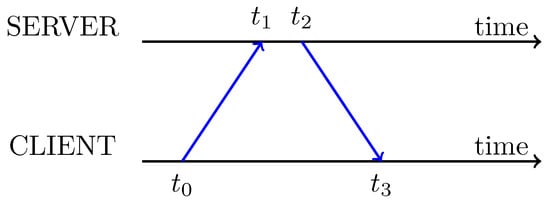
A typical NTP client periodically polls one or more time servers to synchronize its local clock. For each exchange, the client must estimate the time offset and the round-trip delay . Four timestamps are computed in the process (see Figure 1).
Figure 1.
Timing diagram for a NTP exchange initiated by a client’s NTP computer at time and answered by a servers’s NTP. See text for explanation of timestamps.
The offset represents the signed difference in absolute time between the server and the client clocks [5].
Assuming symmetry of the delays, the offset is computed as:
and the round-trip delay is given by
where is the client’s timestamp at the moment of request transmission, is the server’s timestamp upon request reception, is the server’s timestamp at response transmission, and is the client’s timestamp upon response reception.
2.2. Stability Analysis
The characterization of time and frequency stability is a central aspect of time metrology, particularly in applications involving the comparison and calibration of clocks and time transfer equipment. While frequency-domain estimators such as the Allan deviation (ADEV) are widely used to quantify fractional frequency stability, time-domain metrics are often more appropriate when the primary observable is a time or phase difference [6,7]. In this context, the Time Deviation (TDEV) has become a standard estimator for assessing time stability over a wide range of averaging intervals [8].
Let denote the time (or phase) deviation of a clock or timing signal with respect to a reference. For sampled data with sampling interval , the sequence represents the measured time offsets. The Allan variance is defined as:
where denotes the expectation operator.
The modified Allan variance (MVAR) is a variable bandwidth modified variant of Allan variance, a measurement of frequency stability in clocks, oscillators and amplifiers. Its main advantage relative to Allan variance is its ability to separate white phase noise from flicker phase noise. It is defined as:
The Time Deviation (TDEV) for an averaging time is defined as:
Because TDEV is expressed in units of time, it is particularly well-suited for the evaluation of timing systems, travelling receivers, and calibration links, where sub-nanosecond stability is of primary interest. For this reason, TDEV is widely adopted by timing laboratories and is recommended in international guidelines for the analysis of time transfer measurements. Additionally, the the root-mean-square of Time Interval Error (TIErms) statistic is used. It is a first-difference statistic on time and provides a direct statistical measure of time dispersion, which is important in quantifying precision and accuracy in time links and is commonly used in the telecommunications industry. The definition is presented in Equation (6).
where is the time difference at point i [9,10].
2.3. Software and Hardware Configuration
Two Stratum-1 NTP servers were implemented using two Raspberry Pi 3 single-board computers, Broadcom Inc., Palo Alto, CA, USA. A pulse-per-second (PPS) signal generated by a pulse distribution amplifier provides the timing reference for each server. As the general-purpose input/output (GPIO) input of the Raspberry Pi is limited to , a resistive voltage divider was used to reduce the 5 TTL pulse amplitude accordingly.
Each server operates on a Linux-based system configured for high-precision time synchronization. The PPS signal is interfaced through the Linux PPS subsystem using pps-tools, and the NTP daemon is configured to discipline the system clock using kernel-level PPS support.
The Linux PPS subsystem was enabled via the pps-gpio kernel module, which connects the GPIO-triggered PPS signal to the NTP daemon.
Table 1 summarizes the main software configuration parameters employed in the implementation.
Table 1.
Software configuration of the Raspberry Pi Stratum-1 NTP servers.
2.4. System Architecture
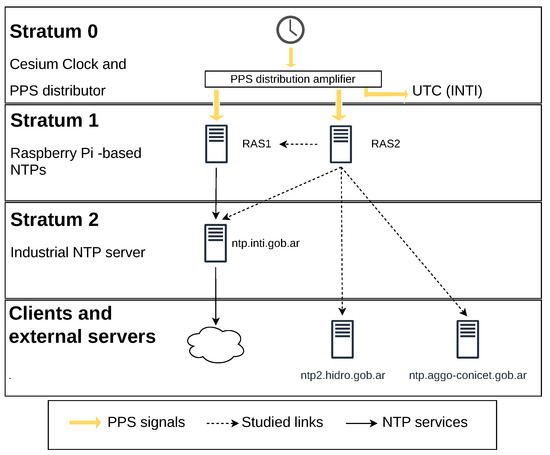
The time distribution infrastructure used in this study is depicted in Figure 2. The architecture follows a hierarchical NTP model and has been designed to enable an evaluation of the performance of Raspberry Pi–based Stratum-1 NTP servers under realistic operational conditions. The output of the PPS distribution amplifier constitutes the physical realization of the national time scale UTC(INTI), which is maintained and disseminated by INTI.
Figure 2.
Structure of the NTP synchronization network under study.
At the top of the hierarchy (Stratum-0), a cesium atomic clock provides the primary time reference. A one-pulse-per-second (PPS) signal derived from the clock is distributed through a dedicated PPS distribution amplifier. The yellow arrows in Figure 2 represent these PPS synchronization signals, which are delivered directly to the Stratum-1 servers.
The Stratum-1 layer consists of two independent NTP servers implemented on Raspberry Pi platforms (RAS1 and RAS2). Each server is directly synchronized to the Stratum-0 reference via the PPS signal and operates as a primary time server. These Raspberry Pi–based Stratum-1 servers are the main subject of the performance analysis presented in this work. RAS1 and RAS2 were initially set on time to an external timestamp source, because the 1 pps signal does not designate the time of day.
For this initial time-of-day setting, an NTP server maintained at the Physikalisch-Technische Bundesanstalt was used as the external timestamp source. Once the UTC timestamp was acquired, each Raspberry Pi’s internal timebase was aligned to the rising edge of the incoming 1 PPS signal. The systems were then left to stabilize for several days prior to data collection, allowing the internal oscillators to discipline themselves to the PPS reference.
For this study, time differences and time delays between server RAS2 and the rest of the studied NTPs have been logged on an hourly basis [11].
The objective of this study was to characterize the long-term behavior of the evaluated NTP servers and synchronization links over periods in the order of several days. For this reason, the measurement strategy was based on a single NTP query executed every hour, from which one time offset and one round-trip delay estimate were recorded.
It is important to note that server RAS1 is dedicated exclusively to serve as the time reference for ntp.inti.gob.ar. Also, RAS2 is configured to respond to NTP timing packet requests only from RAS1, and to periodically probe other servers; this probing was implemented via a scheduled crontab script executed at fixed intervals to query selected NTP servers.
An industrial-grade NTP server synchronized to the Raspberry Pi Stratum-1 servers forms the Stratum–2 layer. Solid arrows in Figure 2 denote NTP-based time synchronization services between servers and clients. ntp.inti.gob.ar is the service offered by INTI to external clients for synchronization.
The lowest layer comprises client systems and external NTP servers. Local and institutional clients synchronize to the Stratum-2 server, while additional external servers are included for reference and comparison.
Dashed arrows indicate the specific network links analyzed in this study. These links correspond to NTP synchronization paths between the Raspberry Pi Stratum-1 servers and selected downstream or external servers, including national and international references. By focusing on these links, the impact of network conditions and server implementation on time accuracy and stability can be systematically assessed.
3. Results and Analysis
3.1. Internal Measurements
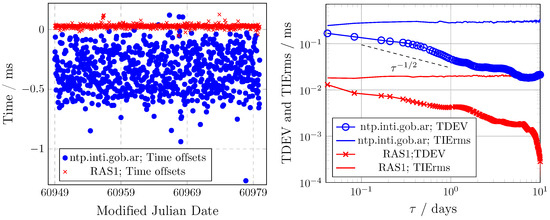
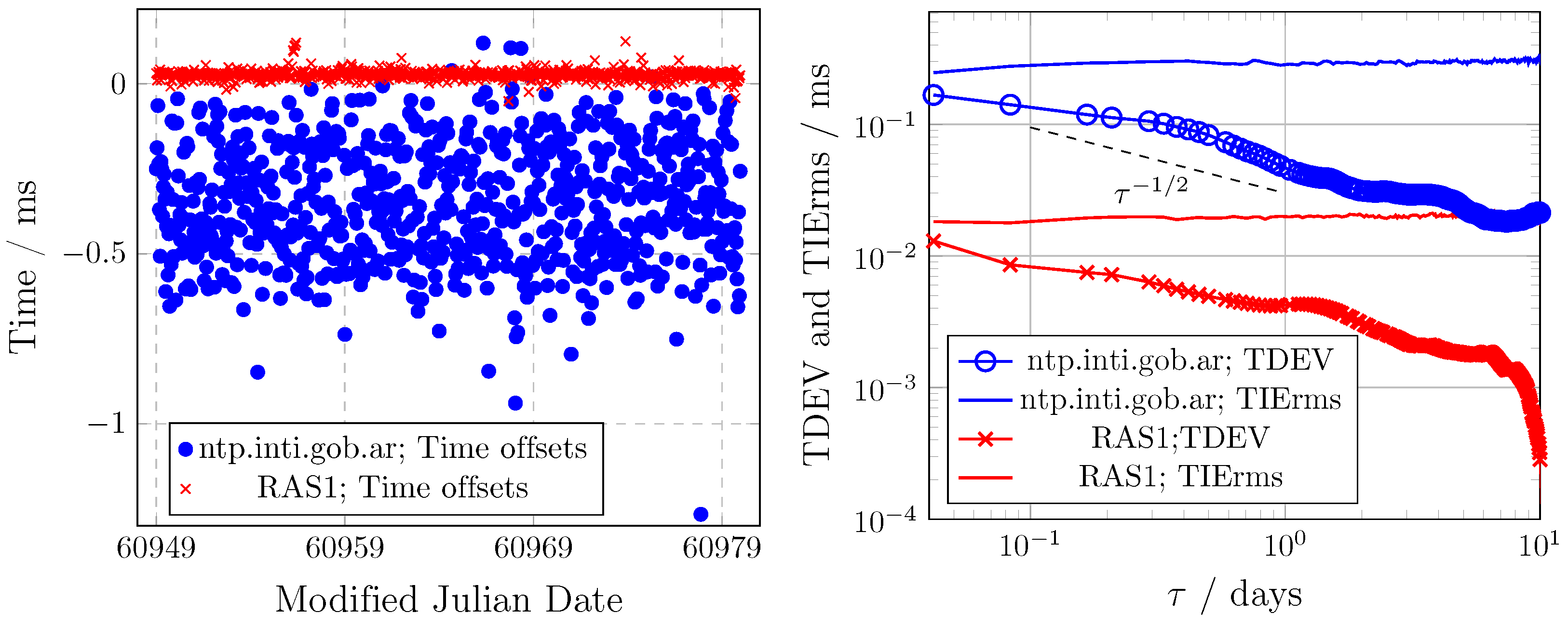
Figure 3 shows the time offset and corresponding TDEV and TIErms between the pivot NTP Stratum 1 server (RAS2) and two local NTP servers during October 2025: ntp.inti.gob.ar, operating as a Stratum 2 server, and RAS1, operating as a Stratum 1 server [12].
Figure 3.
Time offset, Time Deviation and Time Interval Error between the pivot NTP Stratum 1 server (RAS2) and two other NTP servers in LAN network during October 2025. ntp.inti.gob.ar is implemented on a Stratum 2 industrial-grade NTP server, while RAS1 is maintained in an Raspberry Pi computer. See architecture in Figure 2.
The left panel presents the time offsets as a function of the Modified Julian Date (MJD). The offsets of ntp.inti.gob.ar (Stratum 2) are centered around approximately ms with a comparatively large dispersion, reflecting the additional synchronization layer and the influence of network delay within the local infrastructure. In contrast, RAS1 (Stratum 1) exhibits offsets tightly clustered around ms, with significantly reduced scatter, indicating closer agreement with the pivot server and improved short-term stability.
The right panel displays TDEV as a function of the averaging time . RAS1 (Stratum 1) consistently achieves lower TDEV values across the full range of , reaching the low ms level at longer averaging times. Conversely, ntp.inti.gob.ar (Stratum 2) shows higher TDEV values and a -like behavior over part of the averaging range, consistent with white phase noise dominance.
At short integration times ( = 1 h), TDEV is on the order of ms for ntp.inti.gob.ar (Stratum 2), whereas it reaches the ms level for RAS1 (Stratum 1).
The stability performance difference between the two servers is consistent with their respective NTP strata and underlying hardware implementations.
Overall, the results confirm that the Stratum 1 RAS1 server provides superior time stability relative to the Stratum 2 ntp.inti.gob.ar server.
Figure 3 also presents the TIErms as a function of the averaging time . Unlike TDEV, which characterizes the stochastic stability of the synchronization process after suppressing deterministic trends, TIErms quantifies the precision and accuracy in time links.
Additionally, a least-squares fit was also performed on each time offset series to quantify any overall frequency offset. A quantitative summary of the main statistical indicators for the time offsets is provided in Table 2.
Table 2.
Statistical summary of time offsets relative to the pivot server RAS2 during October 2025.
3.2. Remote NTP Servers
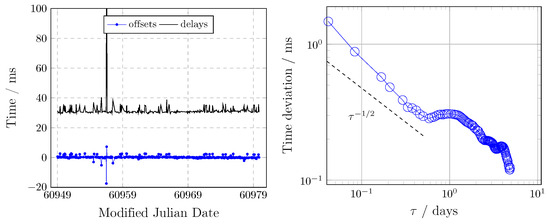
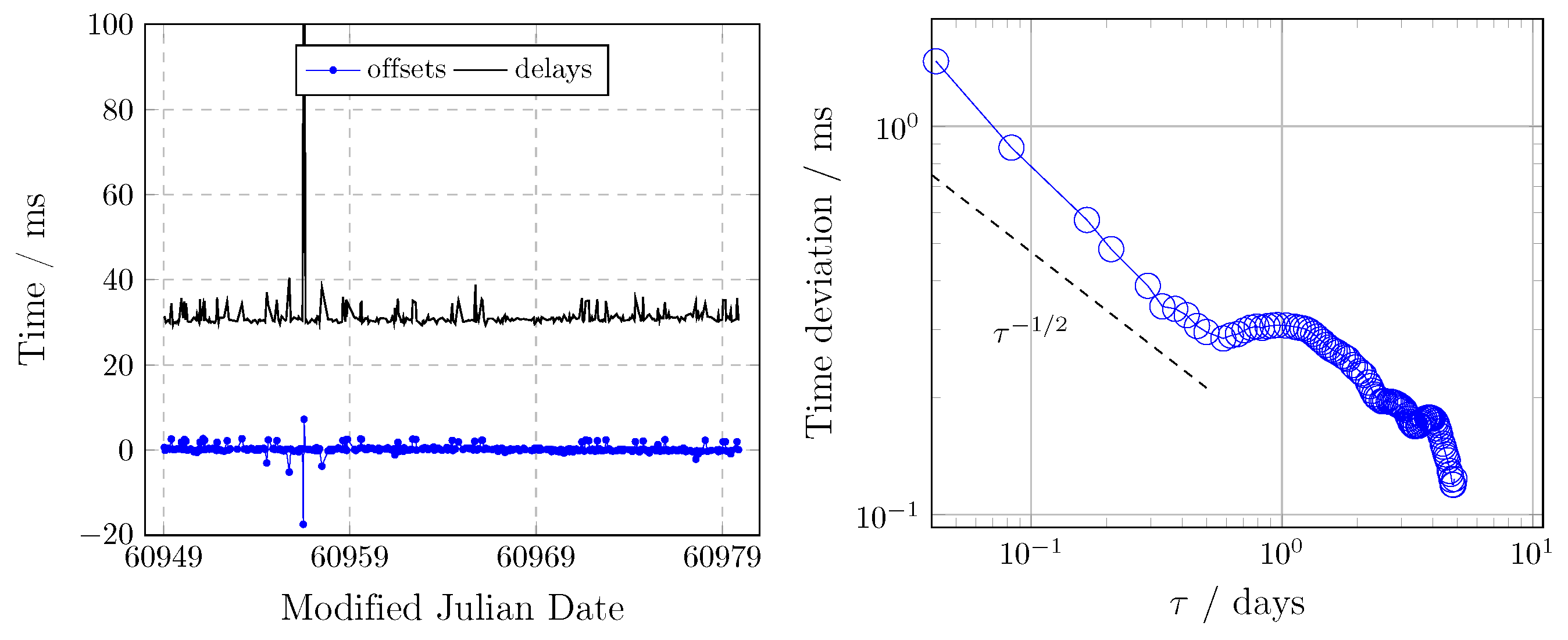
Figure 4 shows the time transfer performance between RAS2 and the remote server ntp2.hidro.gob.ar. The period analyzed is the same as in Section 3.1, October 2025. The offsets remain close to zero with fluctuations at the millisecond level, while the round-trip delay is typically around 30–35 ms with occasional excursions.
Figure 4.
Time offsets and network delays measured between the local server RAS2 and the remote server ntp2.hidro.gob.ar. (Left) time series of the NTP offset (blue markers) and round–trip delay (black markers) as a function of MJD. (Right) Time Deviation (TDEV) of the offsets as a function of the averaging time . The TDEV exhibits an approximately dependence at short averaging times. At longer averaging times, the TDEV departs from this behavior, indicating the presence of additional noise contributions that become relevant as the averaging time increases.
The corresponding Time Deviation (right panel) follows approximately a dependence for short averaging times. Nonetheless, this dependence cannot be attributed to a specific noise type, as the measurements in the left panel exhibit discontinuities of variable duration that do not follow a stochastic process. For averaging times larger than 0.5 days, the TDEV departs from the previous behavior and exhibits a plateau around . This behavior suggests the presence of correlated components that are not efficiently averaged by longer integration times.
3.3. Impact of Network Delay on Time Offset
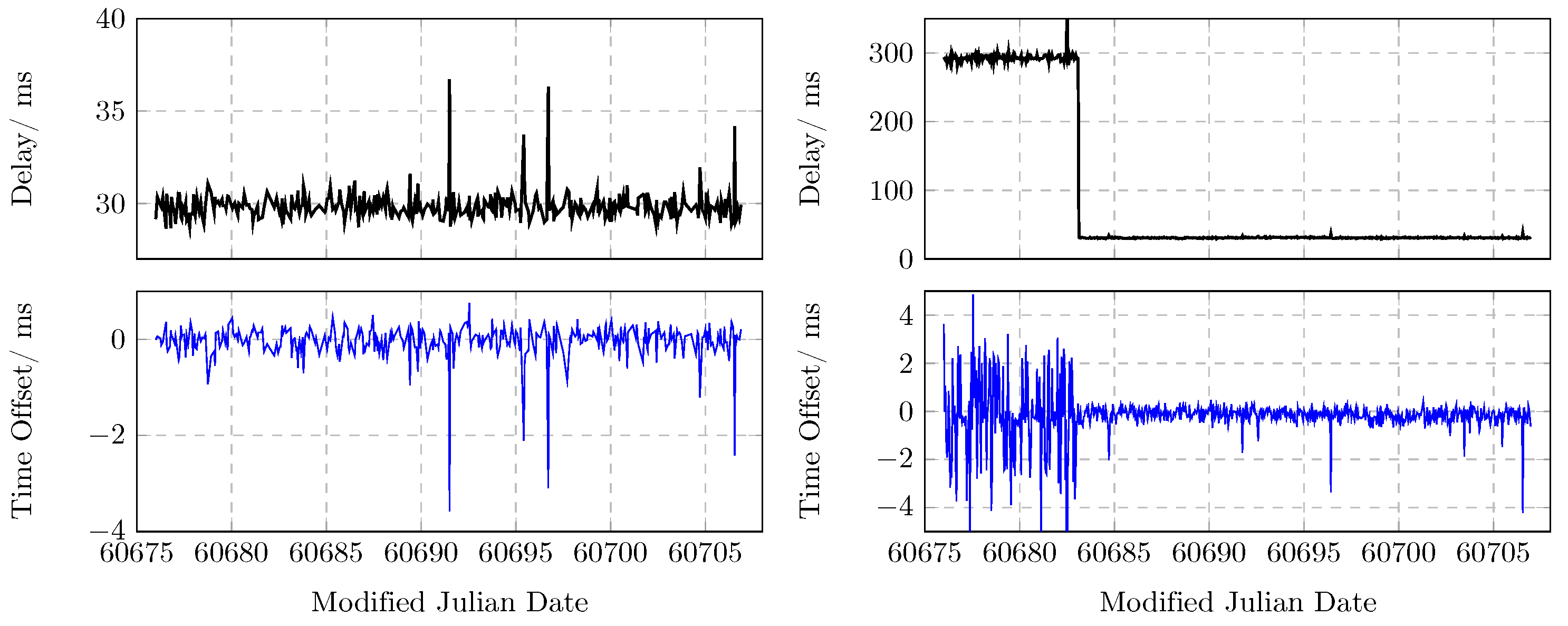
Figure 5 shows the relationship between the measured network delay and the corresponding time offset for the evaluated NTP servers during January 2025. In the left panel, the delay remains approximately constant around 30 ms with moderate fluctuations, and the time offset exhibits a relatively stable behavior around zero with occasional outliers of about 3 ms. In contrast, the right panel shows a clear step-like reduction in the measured delay, from approximately 300 ms to about 30 ms. After this transition, the time offset becomes significantly less noisy.
Figure 5.
Time offset and network delay between the evaluated external NTP servers. (Left) Time offsets and delays between RAS2 and ntp2.hidro.gob.ar. (Right) Time offsets and delays between RAS2 and ntp.aggo-conicet.gob.ar.
The origin of the abrupt reduction in the round-trip delay could not be determined from the available measurements, as no routing or network diagnostic information was recorded during the observation period.
This reduction in the time offset noise may be associated with the change observed in the network delay. In particular, it could result from a reduction in the stochastic fluctuations of the delay, from the decrease in its mean value, or from a combination of both effects.
As shown by Levine [[13], Equation (7)], and Smuszkiewicz [14], the uncertainty of the estimated clock offset contains a term directly associated with the asymmetry in the time delay. Therefore, reducing the network delay—and consequently the uncertainty associated with its estimation—reduces the delay-induced component of the offset error, leading to a more stable synchronization.
3.4. Temperature Dependence
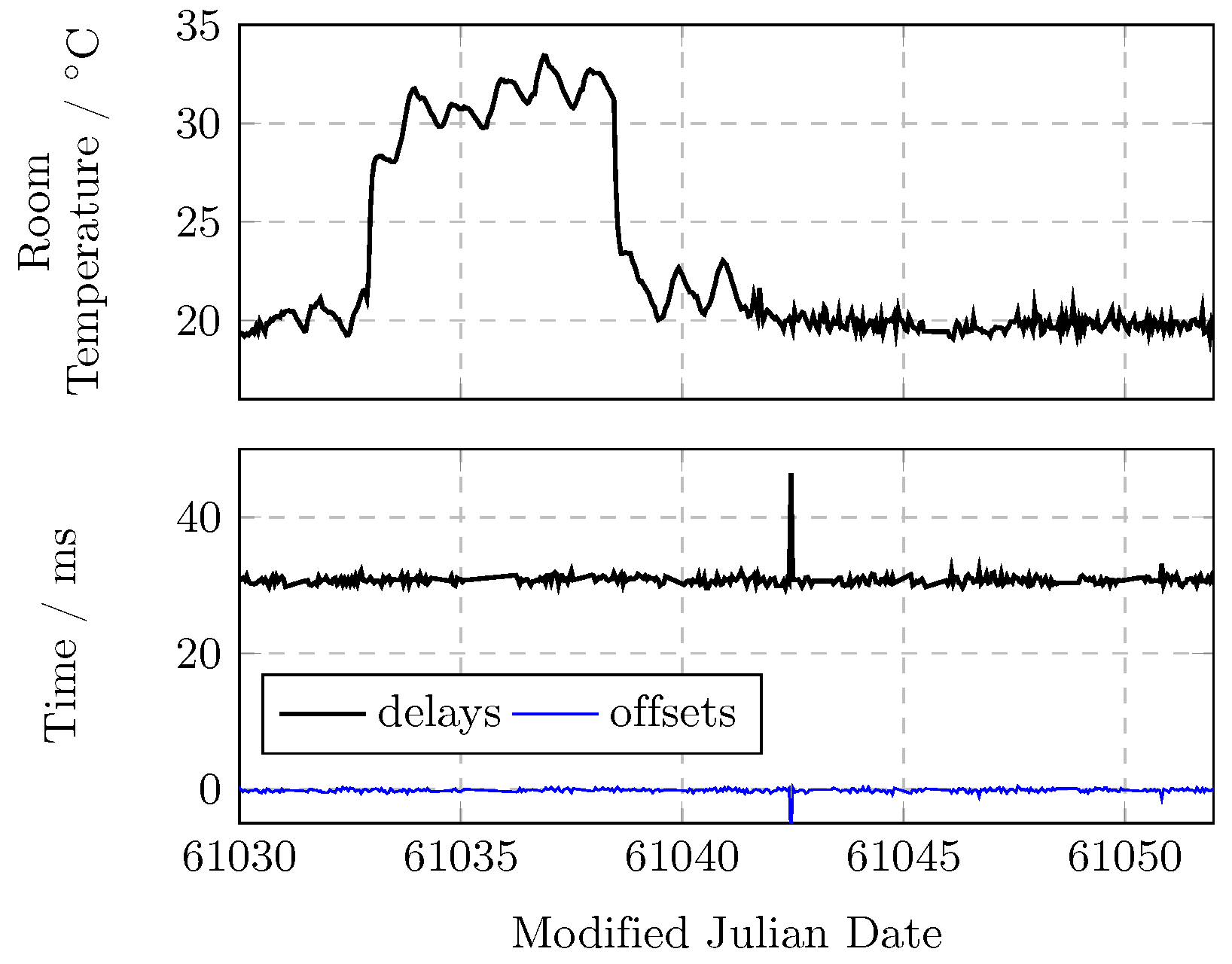
At the end of December 2025, the air conditioning system of the clock room experienced a malfunction, leading to a significant increase in the ambient temperature inside the laboratory. As a result, room temperature rose from nominal values around 20 °C to peaks exceeding 31 °C.
Figure 6 shows the recorded ambient temperature in the clock room (top panel) together with the corresponding time delays and time offsets between the server RAS2 and ntp.aggo-conicet.gob.ar (bottom panel), both plotted as a function of MJD.
Figure 6.
Ambient temperature in the clock room (top panel), and corresponding time delays and time offsets between server RAS2 and ntp.aggo-conicet.gob.ar (bottom panel) as a function of MJD.
Despite the pronounced temperature variations, no significant correlation can be observed between ambient temperature and either the measured time delays or time offsets. This result indicates that the time transfer performance of the evaluated NTP link remained stable within the observed temperature range, and that the thermal conditions in the clock room did not introduce measurable degradation in the synchronization performance during the analyzed period.
4. Conclusions
The observed performance demonstrates that low-cost NTP Stratum 1 servers can achieve time synchronization quality comparable to established institutional servers under typical network conditions. Limitations related to network asymmetry and environmental effects were discussed in Section 3.3. The sensitivity of the low-cost servers to extreme loading should be addressed in the future. However, this kind of servers have shown to be useful as a source of dedicated time references or to monitoring tools.
A low-cost approach to implementing a NTP Stratum 1 servers has been presented and experimentally validated. The proposed solution provides a viable alternative for expanding national time dissemination infrastructure with reduced hardware costs.
Future versions of the monitoring platform could be complemented with network diagnostics to correlate abrupt delay changes with modifications in the underlying network path.
Author Contributions
Conceptualization, D.L.; methodology, D.L.; software, D.L. and F.B.; validation, F.B.; formal analysis, D.L. and F.B.; investigation, D.L.; resources, D.L. and F.B.; data curation, D.L. and F.B.; writing—original draft preparation, D.L.; writing—review and editing, D.L. and F.B.; visualization, D.L. All authors have read and agreed to the published version of the manuscript.
Funding
This research received no external funding.
Data Availability Statement
The original contributions presented in this study are included in the article. Further inquiries can be directed to the corresponding author.
Acknowledgments
The authors thank the reviewers for their helpful insights and discussions.
Conflicts of Interest
The authors declare no conflicts of interest.
References
- Levine, J. Improvements to the NIST network time protocol servers. Metrologia 2008, 45, S12–S22. [Google Scholar] [CrossRef] [Scilit][Green Version]
- Lombardi, M.A.; Novick, A.N.; Neville-Neil, G.; Cooke, B. Accurate, traceable, and verifiable time synchronization for world financial markets. J. Res. Natl. Inst. Stand. Technol. 2016, 121, 436. [Google Scholar] [CrossRef] [Scilit] [PubMed]
- Lombardi, M.A.; Levine, J.; Lopez, J.M.; Jimenez, F.; Bernard, J.; Gertsvolf, M.; Sanchez, H.; Fallas, O.G.; Forero, L.C.H.; de Carvalho, R.J.; et al. International comparisons of network time protocol servers. In Proceedings of the 46th Annual Precise Time and Time Interval Systems and Applications Meeting, Boston, MA, USA, 1–4 December 2014; pp. 57–66. [Google Scholar]
- Mills, D.L. Internet time synchronization: The network time protocol. IEEE Trans. Commun. 2002, 39, 1482–1493. [Google Scholar]
- Douglas, R.; Charbonneau, A.; Gertsvolf, M. Remote calibration of time from NTP servers. Metrologia 2018, 55, 855. [Google Scholar] [CrossRef] [Scilit]
- Allan, D.W. Statistics of Atomic Frequency Standards; National Bureau of Standards Technical Note 394; National Bureau of Standards, 1966. Available online: https://tf.nist.gov/general/pdf/2757.pdf (accessed on 23 June 2026).
- Allan, D.W.; Levine, J. A historical perspective on the development of the Allan variances and their strengths and weaknesses. IEEE Trans. Ultrason. Ferroelectr. Freq. 2016, 63, 513–519. [Google Scholar] [CrossRef] [Scilit] [PubMed]
- Riley, W.J. NIST Special Publication 1065: Handbook of Frequency Stability Analysis; U.S. Government Printing Office: Washington, DC, USA, 2008. [Google Scholar]
- Parker, T. Time Domain Statistics for Evaluating Residual Noise, Including Instabilities in Time/Frequency Transfer Systems. Time Space 2025, 1, 3. [Google Scholar] [CrossRef] [Scilit]
- Parker, T.E.; Brown, R.C.; Sherman, J.A. Statistics for Quantifying Aging in Time Transfer System Delays. Metrologia 2023, 60, 065011. [Google Scholar] [CrossRef] [Scilit] [PubMed]
- Novick, A.N.; Lombardi, M.A. A comparison of NTP servers connected to the same reference clock and the same network. In Proceedings of the 48th Annual Precise Time and Time Interval Systems and Applications Meeting, Monterey, CA, USA, 30 January–2 February 2017; pp. 264–270. [Google Scholar]
- AllanTools Developers. AllanTools: Python Library for Frequency Stability Analysis. Available online: https://allantools.readthedocs.io/ (accessed on 7 August 2026).
- Levine, J. An Algorithm for Synchronizing a Clock When the Data Are Received over a Network with an Unstable Delay. IEEE Trans. Ultrason. Ferroelectr. Freq. Control 2016, 63, 561–570. [Google Scholar] [CrossRef] [Scilit] [PubMed]
- Smuszkiewicz, J.; Jones, T.; Novick, A.; Matsakis, D. Lucky packets and Network Time Protocol (NTP). In Proceedings of the 57th Annual Precise Time and Time Interval Systems and Applications Meeting, Anaheim, CA, USA, 26–29 January 2026; pp. 38–59. [Google Scholar]

Disclaimer/Publisher’s Note: The statements, opinions and data contained in all publications are solely those of the individual author(s) and contributor(s) and not of MDPI and/or the editor(s). MDPI and/or the editor(s) disclaim responsibility for any injury to people or property resulting from any ideas, methods, instructions or products referred to in the content. |
© 2026 by the authors. Licensee MDPI, Basel, Switzerland. This article is an open access article distributed under the terms and conditions of the Creative Commons Attribution (CC BY) license.