

Abstract
1. Opening Quote
(Q1): “…Circa 1990, Anastasios Mallios used sheaf-theoretic methods to extend the mechanism of the classical differential geometry (CDG) of smooth manifolds to spaces, which do not admit the usual smooth structure (smooth atlas). In this new setting of abstract differential geometry (ADG) a large number of notions and results of CDG have already been extended, becoming at the same time applicable to spaces with singularities and to quantum physics.
In ADG, the ordinary structure sheaf of smooth functions [on a smooth manifold] is replaced by a sheaf of abstract algebras , admitting a differential ∂ (in the algebraic sense), which takes values in an -module Ω. A triplet like that is called a differential triad. Suitably defined morphisms organize the differential triads into a category denoted by . Every smooth manifold defines a differential triad and every smooth map between manifolds defines a morphism of the respective differential triads, so that the category of smooth manifolds is embedded in (ibid.)…” [1].
- Author’s Note 2: In the paper below, among various numbered Quotes and Important Notes, the reader will also encounter numerically ordered Aphorisms and Apophthegms. Aphorisms, first encountered in our recent paper [2], are theoretical axioms that are, in a sense, basic, conceptually irreducible and fundamental statements from an ADG-theoretic perspective. (In our latest mathematical endeavours and philosophical musings on applications of ADG to QG [2,3], in continuation and extension of the didactics (lessons learned) in [4,5], we distilled certain aphorisms which encapsulate certain key ADG-theoretic concepts and results from applying ADG to QG research). Apophthegms, (An apophthegm, apophthegma, or even apothegm (plural in Greek, apophthegmata, apophthegms or even apothegms; words which we will use interchangeably in the sequel)) on the other hand, are reduced down, concise and often terse statements, encapsulating in a nutshell a saying or proverb of wisdom, or even a pithy maxim, which aims to distill in a short space a lot of meaning or significance.
2. A Brief Introduction to Abstract Differential Geometry
- The vacuum Einstein ADG-gravitational equations mentioned above, unlike those of the usual CDG-Riemannian geometry-based GR, are formulated purely gauge-theoretically—i.e., solely in terms of the -connection field .
- The vacuum Einstein ADG-gravitational equations are formulated purely homological-algebraically (categorically) as equations between sheaf morphisms such as the connection and its curvature , which are functorial, natural transformation type of morphisms between the relevant sheaf categories involved.
- The vacuum Einstein ADG-gravitational equations, unlike those of the usual CDG-Riemannian geometry-based GR, are formulated in the manifest absence of a base differential (-smooth) manifold, which is a fixed, locally Euclidean background geometrical point set, traditionally representing the curved spacetime continuum in GR.
At the basis of it all lies the structure sheaf , which is the cornerstone structure on which the whole ADG is founded as a theory of differential geometry proper and, as a consequence, from which ADG-gravity derives as a physical application of the underlying mathematical theory; hence the title of this paper.
- However, before we delve head-on into the paper, and for the reader’s convenience, we give a three-paragraph, concise, yet detailed, summary-cum-account of the route of argument that we follow in this paper, together with a few key references in the published literature to back its claims.
- A Detailed Summary of the Route of the Argument Taken to Support the Title of the Paper
- We will structurally and mathematically show and present arguments starting from the very foundations of ADG that are rooted in .
- We will further provide depictions categorically and diagrammatically in various different but equivalent ways.
- We will physically interpret the relevant mathematical structures involved, so as to justify the very title of this paper.
- We explain the sense in which -Relativity—the natural transformation theory of supporting the PARD and the Principles of and of the ADG-gravitational vacuum Einstein dynamics—is a generalised, purely (homological) algebraic, genuinely background geometrical spacetime point-set manifold-independent, local relativistic gauge field theory of gravity (ADG-gravity) that has its roots in and fundamentally derives, like the mathematical theory of ADG on which it is based, from a structure sheaf of commutative algebras of generalised arithmetics/coefficients/coordinates, together with some inherently built-in quantum traits, that can potentially address, tackle, resolve, or ultimately evade, several important issues/problems in current and future classical and quantum gravity research.
2.1. Kinematical Structures I: A Synopsis of the Structural Aufbau of ADG and ADG-Gravity Starting from
2.2. 4+1 Fundamental Structural Pillars in the Progressive Bottom-Up Aufbau of ADG
- Fundamental Structure 1. At the very basis of ADG, we have the notion of a -algebraised space , which consists of the following pair:
- Important Note 0: In physical applications of ADG to gravity and gauge theories [6,7,8,16,17,18], is physically interpreted as the sheaf of abelian algebras of generalised local coordinate measurements or determinations of the ADG-gravitational field. In other words, and as we will see in more detail in the sequel, physically represents the sheaf of gauge localisations of the ADG-gravitational field relative to a system of local open gauges covering X. (See below for more technical details). This is much in the same way that in the -smooth spacetime manifold M-based GR, the abelian algebra of smooth functions on M, which is the smooth manifold’s natural structure sheaf , physically represents the smooth coordinates of M’s spacetime point events (relative to a given atlas of smooth local coordinate charts or patches covering M) and, in extenso, the ten smooth components of the locally Lorentzian spacetime metric (which physically represent the smooth gravitational potentials in GR) relative to a given locally Euclidean-Lorentzian coordinate frame prescribed on M.
- Fundamental Structure 2. Once we have defined as above, the second fundamental ADG-theoretic structure is that of a differential triad :
- Fundamental Structure 3. The third fundamental notion in the sequential aufbau (German for building up or progressive construction from the ground up). of ADG, one that derives naturally once one has defined a differential triad as in (2) above, is that of an -connection (viz. the generalised or ‘curved’ version of the ‘flat’ differential operator ∂ above). (The epithets ‘flat’ and ‘curved’ for ∂ and , respectively, will become transparent shortly).
- Note: Parenthetically here, the reader should note the general formal definition of a vector sheaf in ADG: a vector sheaf is a locally free -module of finite rank . That is, for every , , with standing for the n-fold Whitney sum of n copies of : . Thus, is a locally free (differential) -module of finite rank (or dimension) n, an appellation synonymous to vector sheaf in ADG [6,7,8,9,16,17,18]. (From the definition of a vector sheaf above, it follows that every continuous local section s of () can be expressed or decomposed as a linear combination with coefficients in relative to the local open gauge in X. In turn, the n-tuple () represents a local coordinate frame of the vector sheaf relative to the local open gauge U in a system of local open gauges covering X, as defined above).

- Fundamental Structure 4. Having defined a vector sheaf and a connection on it, we arrive at the last fundamental ADG-theoretic notion, that of an ADG-field—alias, an ADG -connection field. This is defined to be a pair:
- Important Note 1: The reader should note that in the ADG-theoretic -connection field structure in (13) above, may be regarded as the associated vector sheaf (or representation sheaf) of the principal group sheaf of its own local -automorphisms [7,8,18,42,43,44,45]. Since, as we saw earlier, , the principal group sheaf is locally isomorphic to the group sheaf of invertible -matrices with local entries in , the space of local sections of relative to the local open gauge [6,7,8,16,17,18]. (The bullet •-superscript notation in means invertible, while indicates the -set of -endomorphisms of . Clearly, ; hence, , as noted above). We will return to this important salient point when we discuss the purely gauge-theoretic character of vacuum Einstein ADG-gravity below.
- ‘Bonus’ Auxiliary Structure 5. As the title of this paragraph entails, there is a secondary, ‘bonus’ auxiliary fifth structure in the progressive aufbau of ADG, which augments and completes the tetrad of fundamental structures outlined above.
- (i) -bilinear between the -modules involved.
- (ii) Symmetric (i.e., ) and of indefinite signature.
- (iii) Strongly non-degenerate.
- Riemannian symmetry: ; for and the usual Lie bracket (product).
- Ricci identity: ; for , as usual.
- Important Note 2: The reader should note that we called the fifth fundamental structure above—i.e., the -metric ()—auxiliary, secondary, or ‘bonus’, because, as we will see in the sequel, the sole dynamical variable in ADG-gravity is the Einstein -connection field unlike in the standard background geometric Riemannian spacetime manifold-based GR in which the smooth spacetime metric is the only dynamical variable (second-order formalism), with the ten independent components of the symmetric tensor physically representing the gravitational potentials. We will return to this subtle point shortly, when we discuss the ADG-gravitational vacuum Einstein equations and the fundamental character of vacuum Einstein ADG-gravity as being purely gauge and its symmetries purely internal to the ADG-gravitational field itself, without any external (background) geometrical spacetime manifold dependence or commitment.
- Important Note 3: With the four fundamental ADG-theoretic notions above, as well as with the optional fifth one corresponding to the -metric and its compatibility with the -connection , one is able to reproduce all the basic concepts, structures, calculations and results thereof of the usual CDG—the standard Newtonian Differential Calculus (or Analysis) on Smooth (pseudo-)Riemannian Manifolds; albeit, entirely relationally (homological-algebraically) and, more importantly vis-à-vis ADG’s applications to QG that we will discuss in the sequel, one is able to formulate ADG-gravity in the manifest absence of a smooth background geometrical spacetime manifold [2,3,5,6,7,8,9,16,17,18,19,20,21].
Structural Interregnum I: Derivative Derives from Algebra
- Key Observation: In ADG, ‘differentiation’ and ‘differentiability’—i.e., the usual (flat) differential operator ∂ in (3) and its generalisation to the general (curved) connection in (5)—derive from and have as their source or domain of definition the structure algebra sheaf of generalised arithmetics, coefficients and theoretical local coordinate measurements; hence, its ADG-theoretic denomination as an -connection. In short and as shown below, and as the title of this subsection maintains:
The derivative (connection) derives from algebra (pun intended); hence, it is an -derivative or -derived connection. (A structure that in the pure mathematics research literature on further developing ADG has been coined Mallios’s algebraic -connection [42,43,44,45]. Thus, we could equivalently coin it here Mallios’s -derived connection).
Aphorism 1: One cannot do Differential Geometry without a differential operator like the flat ∂ in (3) or its curved generalisation, the algebraic -connection in (5). No derivative operator, no differentiation, no differential equations, no differential calculus or differential geometry. What qualifies ADG as a theory of DifferentialGeometry proper is the -connection , which is the fundamental concept and structural pillar in the aufbau of the mathematical theory of ADG [2,6,7,8,9].
Apophthegm 1: ADG’s central concept and structural backbone—the connection (or its flat counterpart ∂)—has its source and domain of definition in, thus it derives from, the structure algebra sheaf , as (5) for , or (3) for ∂ show its ADG-theoretic denomination as an algebraic -connection (cf. quote (Q1) opening this paper). Hence, in effect, at the very basis and heart of ADG as a mathematical theory of Differential Geometry, as well as its application in formulating the law of vacuum Einstein ADG-gravity as a differential equation proper, lies the structure sheaf of generalised arithmetics, coefficients and theoretical local coordinate-measurements. Everything in ADG (and in ADG-gravity) originates and follows from, and in one way or another revolves about, the structure sheaf ; hence the title of the present paper.
2.3. Philosophical Interregnum II: The Essentially Algebraico-Topological Character of the Notion of Connection
- Algebraic Character-Structure: As in (22) above involves the algebraic (structure) operations of subtraction (the inverse of addition) and division (the inverse of multiplication) afforded by the number field .
- Topological Character-Structure: As the notion of limit in (22) above presumes (or requires) the presence of an underlying topology (topological structure) being defined (or assumed) on the (base) Euclidean domain space () of f.
which leads us to the following Apophthegm, our second one:Aphorism 2: The usual notion of derivative or (flat) differential operator , or its generalisation to a (curved) connection operator , is essentially of an algebraico-topological (or equivalently, of a topologico-algebraic) character.
Apophthegm 2: In ADG, Mallios’s algebraic -connections derive from the structure sheaf of (abelian) algebras over an underlying (in principle arbitrary) topological space, as the structure of such a sheaf of algebras over an arbitrary base topological space X possesses all the essential algebraico-topological structure that is necessary to define an abstract and generalised differential (derivative) operator such as in the first place, as in the defining expression (5) earlier. As such, ADG is a purely relational (algebraic) way of doing differential geometry that does not involve the mediation of a background locally Euclidean space (a point-set manifold M that locally looks like ) for defining and setting up differential geometric structures and doing differential geometric calculations (Calculus—e.g., setting up and solving differential equations) based on them.
- Important Note 7: By contrast to Apophthegm 2 above, it must be emphasised here that in the usual Newtonian Differential Calculus and Riemannian Differential Geometry (CDG), the source or origin of the standard differential operator —the (flat) derivative ∂ in (3) and/or the operator in (22)—is the base locally Euclidean differential point-set manifold M; or equivalently, the structure sheaf of smooth coordinate functions of its points. Such a smooth background geometrical manifold M, however, is manifestly absent from ADG. To emphasise it once again, ADG is a genuinely background geometrical manifold-independent way of doing differential geometry [2,3,5,6,7,8,9,16,17,18].
- Addendum to Important Note 7: In addition to the Important Note above, it must be highlighted, as a key historical type of remark on the development of ADG, that Mallios’s original (Circa 1990, as (Q1) in the beginning of the paper recounts.) intuition and inception of an algebraic -connection as the key structure for developing ADG was made in the context of topological algebra theory—i.e., when the original structure sheaves were assumed to be sheaves of general (possibly non-normed) topological algebras [46,47,48,49,50,51,52]. As such, they were the archetypal structure sheaves , ones that combine both the essential topological and algebraic characters/structures noted in Aphorism 2 and Apophthegm 2 above. As noted above, those topologico-algebraic characters are necessary for defining and deriving the -connections ∂ and as in (3) and (5), respectively. A fortiori, shortly after the publication of the first 2-volume monograph on ADG [6], Mallios continued to apply ADG to mathematical-physics topics, from GR [24,25,27] to QFT [22,23], by using (possibly non-functional or even generalised functional) topological algebra structure sheaves that carry the requisite ADG-theoretic -connections in the manifest absence of a background geometrical smooth spacetime manifold [53].
2.4. Kinematical Structures II: Three Important ADG-Theoretic Functor (Sheaf) Categories (, , )
- The Category of Differential Triads: This category has for objects differential triads , like those defined by Equation (2) earlier, and differential triad morphisms as arrows between them [1,54,55,57,58,59]. Since the elements of differential triads are functorial objects (sheaves) as explained above, is essentially a functor category, thus the differential triad morphisms are morphisms of functors, alias natural transformation type of maps [10].
- The Category of ADG-Fields: Likewise for the category of the dynamical ADG-fields , like the ones defined by Equation (13) earlier. (Originally in [7,8], and subsequently in [3,5], the ADG-theoretic (abelian gauge) Maxwell fields, (non-abelian gauge) Yang–Mills fields and (non-abelian gravitational gauge) Einstein fields, are all seen to be organised into respective categories called Maxwell (abelian gauge fields), Yang–Mills (non-abelian gauge fields) and Einstein category, respectively.) Like above, too has vacuum Einstein ADG-gravitational fields as objects and natural transformation type of arrows between them as ADG-field morphisms. (Plainly, the natural transformation type of map preserves the connection sheaf morphisms of the respective ADG-gravitational fields as the latter are defined by (5) above. We are going to witness such natural transformation type of maps in the sequel, when we discuss the Principle of Algebraic Relativity of Differentiability (PARD), which is the ADG-theoretic generalisation of the Principle of General Covariance (PGC) of GR).
- The Category of Curvature Spaces: Mutatis mutandis for the category of curvature spaces: its objects are curvature spaces like the ones defined in (14) earlier, while its arrows are functorial, natural transformation type of maps between them. (As was posited in our last footnote, the natural transformation type of map preserves the curvature -morphisms R of the corresponding ADG-curvature spaces as defined by Equation (14) earlier. As it was mentioned in the previous footnote, we are going to meet such functorial, natural transformation type of maps when we discuss the PARD below).
- Important Note 8: At this point it must be emphasised that, since we have already seen how the structure sheaf of abelian algebras of generalised arithmetics, coefficients or theoretical generalised local coordinate determinations (measurements), by constituting what we earlier defined in (1) as a -algebraised space , fundamentally underlies both the notion of differential triad and the notion of an ADG-field and its associated curvature space , we deduce the following apophthegm, our third one:
Apophthegm 3: A possible structure sheaf morphism —as it were, a natural transformation type of map between sheaves of algebras of generalised arithmetics, coefficients, or theoretical local coordinate measurements—induces or lifts to natural transformation type of maps (morphisms) between the corresponding three important functor (sheaf) categories , and above.
- We coin the functorial transformation mappings (changes) like in Apophthegm 3 above fundamental structure sheaf morphisms or fundamental changes of generalised arithmetics, coefficients or theoretical local coordinate measurements. Alternatively, but equivalently, we may view them as fundamental natural transformation type of morphisms between -algebraised spaces, themselves natural transformation type of functors in the category of -algebraised spaces (By definition, the category has the -algebraised spaces defined by Equation (1) as objects, and -structure preserving sheaf morphisms between them as arrows.) underlying the three kinematical-structural categories , and above:
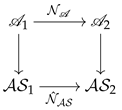
- Important Note 9: Categorically speaking, the natural transformations (morphisms) above are members (categorical arrows) in the class of (abelian algebra) structure sheaf morphisms. As we will see and posit below, they constitute the fundamental -Relativity structure underlying our abstract and generalised theory of ADG-gravity, which -Relativity (), in turn, and in a dynamical context, supports and has as a functorial consequence both the aforementioned PARD and Mallios’s Principle of -Invariance ().
- Fundamental Question (FQ): How can we understand and physically interpret in the context of ADG-gravity changes in structure sheaves of generalised arithmetics, coefficients or theoretical generalised local coordinate determinations like the morphisms depicted in (23) above?
3. Dynamical Functoriality: The Principles of -Relativity () and Algebraic Relativity of Differentiability (PARD) of the Vacuum Einstein ADG-Gravitational Field Dynamics
3.1. ADG-Theoretic Vacuum Einstein Equations, Functorial -Invariance and -Covariance: The Forebearers of the -Relativity and the PARD Principles
Nine Key Facts About the Vacuum Einstein ADG-Gravitational Field Dynamics
- Fact 1: In ADG, the dynamical laws of vacuum Einstein gravity and free Yang–Mills theory derive from a variational extremum principle applied to an action functional—the vacuum Einstein–Hilbert and free Yang–Mills Lagrangian action functionals, respectively [2,3,4,5,6,7,8,16,17,18,19,20,21,38], as depicted below:with being the ADG-theoretic version of the Ricci curvature scalar (this is the usual trace of the Ricci curvature tensor of the connection on ) of the Einstein curvature -tensor of the -connection field on the vector sheaf .A propos, the reader should notice that both scalar action functionals in (24) are -valued, so this is another instance of our general motto in this paper that the whole of ADG and ADG-gravity involves, and revolves about, the structure sheaf in one way or another.
- Fact 2: The physical laws—i.e., the dynamical equations of vacuum Einstein gravity and free Yang–Mills theory in (24) above—are differential equations proper that are homological-algebraically (categorically) expressed ADG-theoretically as equations between the relevant -connection sheaf morphisms and their curvatures , which, as we saw earlier, are natural transformation type of maps between the relevant sheaf categories involved—the category of differential triads, the category of ADG-fields and its associated category of curvature spaces [2,3,4,5,6,7,8,16,17,18,19,20,21,36,38];
- Fact 3: As we see in (24) above, the dynamical laws are actually expressed via the curvatures of the corresponding -connection fields (gravitational and Yang–Mills), which are -tensors. (Whereby, is the homological tensor product functor with respect to the generalised arithmetics or coefficients in [2,3,6,7,8,18].) Thus, the curvatures involved in the integrands of the two Lagrangian action functionals in (24) are -invariant, hence also the laws that they define (or obey) as differential equations proper, are -covariant (By covariant laws, we mean form invariant laws under self- or auto-symmetry transformations of the corresponding ADG-fields (vacuum Einstein gravitational and free Yang–Mills fields).) [2,3,4,5,6,7,8,16,17,18,19,20,21,36,38];
- Fact 4: From the two facts above it transpires that the internal local gauge symmetry group sheaf in ADG-gravity is the principal sheaf of local automorphisms of the associated (representation) vector sheaf [2,3,5,7,8,18,42,43,44,45]. (See Important Note 1 earlier). Notice that , as a group sheaf of local automorphisms of , acts internally—i.e., within the vacuum Einstein ADG-gravitational field . It is the group sheaf of local dynamical self-symmetries of the vacuum Einstein ADG-gravitational field and of the dynamical equations that it defines via its -invariant curvature form (-tensor) in (24).
- Fact 5: Due to the manifest absence of an external (to the gravitational and Yang–Mills ADG-theoretic -connection fields) background geometrical spacetime manifold, the said dynamics is purely gauge. That is to say, as noted in Fact 4 above, the ADG-gravitational field’s symmetries are purely internal—i.e., intrinsic to the ADG-gravitational field itself. Equivalently stated, in ADG-gravity, there is no external (or background) to the ADG-gravitational field itself geometrical spacetime manifold with its own, also external to the gravitational field itself, spacetime symmetries. It follows that there is no external geometrical spacetime interpretation of the theory either, thus from an ADG-theoretic viewpoint, gravity is a pure gauge theory in which the sole dynamical variable is the ADG-gravitational -connection Einstein field , with its structure group sheaf of self-symmetries of the vacuum Einstein ADG-gravitational field law (24) that it defines via its curvature [2,3,5,7,8,16,17,18,21];
- Fact 6: The background spacetime manifoldless gauge field theory that ADG-gravity is has been coined gauge theory of the third kind, because it is still a local (sheaf-theoretic) gauge field theory of gravity based solely on the gravitational -connection field variable , but without any background spacetime manifold geometry to support either its mathematical representation by differential geometric (CDG) means, or its physical interpretation in terms of spacetime concepts, constructions and associated ‘geometrical pictures’. This variant of gauge theory should be distinguished from the usual external (background) smooth spacetime manifold-based gauge theories of matter of the first (global) and second (base geometrical spacetime manifold localised) kind [2,3,5,16,17,18,21];
- Fact 7: In addition to the six facts above, the ADG-theoretic local gauge connection field theory used to formulate ADG-gravity has been coined half-order formalism, to distinguish it from the usual CDG and external differential spacetime manifold-based gravitational theories of Einstein (second order formalism) and the smooth vierbein-cum-connection-based Palatini–Ashtekar scheme (first order formalism). In the ADG-theoretic half-order formalism for ADG-gravity, the sole dynamical variable is the gravitational -connection field ; hence, the kinematical space of the theory is the moduli space —the orbifold of the affine space of -connections quotiented by the local gauge group , which is physically interpreted as the space of gauge equivalent -connections [2,3,5,16,17,18,21];
- Fact 8: From the seven facts above, it follows that the principal (gauge group) sheaf of local dynamical gauge (internal) self-symmetries of ADG-gravity comes to replace the (external) spacetime diffeomorphism group , which is the dynamical symmetry group of the spacetime manifold M-based GR, implementing the Principle of General Covariance (PGC) in the classical, CDG-based field theory of gravity (GR). In turn, as noted in Fact 4 above, can be thought of as the principal, internal to the ADG-gravitational vacuum Einstein field itself, gauge group sheaf of auto-symmetries of the ADG-gravitational field auto-dynamics in (24). Moreover, as explained earlier in Important Note 1, since the vector sheaf is, by definition, locally isomorphic to (), , with the local group of invertible endomorphisms of , which is in turn locally isomorphic to the linear group of invertible -matrices with entries in —the local sections of the structure sheaf [2,3,5,16,17,18,21]; (The reader should also note that if the rank n of is equal to 4, —the local linear gauge group sheaf of invertible -matrices with entries in , which is the (sheaf-theoretic) ADG-gravitational analogue of the general linear group of the usual 4-dimensional smooth spacetime manifold-based GR, implementing the PGC as the group of general coordinate transformations).
- Fact 9: From Fact 8 above, we note that, in ADG-gravity, the PGC of GR is expressed by the following three different, but mutually equivalent [2,3,18], smooth background geometrical spacetime manifoldless ways:
- This follows from what Mallios coined -invariance () or -functoriality: this means that the ADG-gravitational field dynamics in (24) is expressed via the curvature of the -connection , which is an -tensor—i.e., it is a quantity that transforms -tensorially under the homological tensor product functor . This corresponds to the fact that is an -morphism which transforms homogeneously under the, intrinsic to the vacuum Einstein ADG-gravitational field , principal gauge group sheaf , unlike the connection from which it derives, which is not an -morphism hence it transforms inhomogeneously (affinely) under local gauge transformations in [2,3,5,33,34,35,36,38,39,60,61];
- By what we originally coined -invariance of the Einstein–Hilbert Lagrangian action functional and -covariance of the vacuum Einstein dynamical equations of motion, which result from extremising the corresponding action functionals with respect to the -connection field as depicted in (24) earlier [2,3,5,16,17,18]. These are the internal, purely gauge -effectuated self-symmetries (auto-invariances) of the vacuum Einstein ADG-gravitational field and of the dynamical equations that it defines in (24) above [2,3,5,18]; and,
- By the natural transformation type of functorial equivalence between the category of vacuum Einstein ADG-fields and the category of their corresponding curvature spaces [2,3,33,34,35,36,38,39,61]. Recently, in [3], it was shown that the said natural functorial equivalence is represented by the following pair of adjoint functors:which is commonly known in category theory as a geometric morphism [10], between the sheaf categories of fields and curvature spaces that we saw earlier. That is to say, since the vacuum Einstein ADG-gravitational dynamics in (24) is expressed via the curvature of the -connection variable , which is an -tensor, the dynamics is -invariant. (Notice, as indicated by their subscripts, that the two adjoint functors involved in the geometric morphism above are functors relative to : that is to say, they are -respecting or -preserving functors. Hence, the dynamics is -functorial or -invariant, as maintained in point (i) above). The geometric morphism in (25) above is what Mallios refers to in [2,3,33,34,35,60,61] as the fundamental -adjunction representing the -functoriality and the -invariance () of the mathematical ADG-theoretic constructions and, as a result, of the physical vacuum Einstein ADG-gravitational field dynamics in (24), which is fundamentally based on those mathematical structures.
3.2. A Functorial Diagrammatic Representation of the ADG-Gravitational Field Theoretic Principle of Algebraic Relativity of Differentiability (PARD)
- Fundamental Ur-Principle of -Relativity (): The ADG-gravitational field law of vacuum Einstein gravity, which is differential geometrically represented by homological-algebraic means (i.e., sheaf and category-theoretically) by differential equations involving the relevant -connection sheaf morphism and its corresponding -functorial curvature form in (24), is independent of any choice of, hence of any potential (functorial) changes in, structure sheaf of generalised arithmetics, coefficients or theoretical local coordinate measurements that we choose in the first place in order to coordinatise and measure (locally gauge) the ADG-gravitational field (relative to a chosen system of local open gauges covering X). That is to say, the vacuum Einstein ADG-gravitational field law in (24) is -transformations’ form-invariant, which in turn, as explained earlier, for a particular choice of structure sheaf , is equivalent to it being -gauge covariant. Then, as noted above, the corresponding -valued Lagrangian Einstein–Hilbert action functional, from which the vacuum Einstein differential equations derive variationally by extremising it with respect to variations of the -connection field as depicted in (24) earlier, should be -gauge invariant [2,3,5,16,17,18]. As also noted earlier, this is effectively the content and physical meaning of Mallios’s Principle of -Invariance () [2,3,5,33,34,35,36,38,39,60,61] as well as of the -functoriality of vacuum Einstein ADG-gravity and free Yang–Mills theories recently observed in [2,3] principally in connection with the geometric morphism depicted in (25) earlier.
- The vacuum Einstein gravitational field law in (24) is not only invariant with respect to, or independent of, arbitrary changes within a particularly chosen structure algebra sheaf of generalised coordinate measurements of the ADG-gravitational field . (This is the ADG-theoretic notion of -invariance and -covariance that generalise the PGC of GR mentioned earlier).
- However, it is also differential form invariant under arbitrary changes in structure sheaves like those depicted in (23): one may use different, or whatever may be suitable to a particular problem or situation in hand, structure sheaves to describe, measure or locally coordinatise the vacuum Einstein ADG-gravitational field and the dynamical law (24) that it defines, and the latter’s form of expression, as a differential equation proper, remains form-invariant (alias, covariant) under such changes.
- Important Note 6: In the tower of ADG-theoretic structures below and their functorial interdependences, the reader should note that the structure sheaf is involved in one way or another, explicitly or implicitly, at every level. This is another instance ‘justifying’ the title of this paper that ADG, and in extenso ADG-gravity, comes or originates from the structure sheaf .
3.2.1. Diagram I: The ADG-Theoretic Architectonic Tower from Top to Bottom

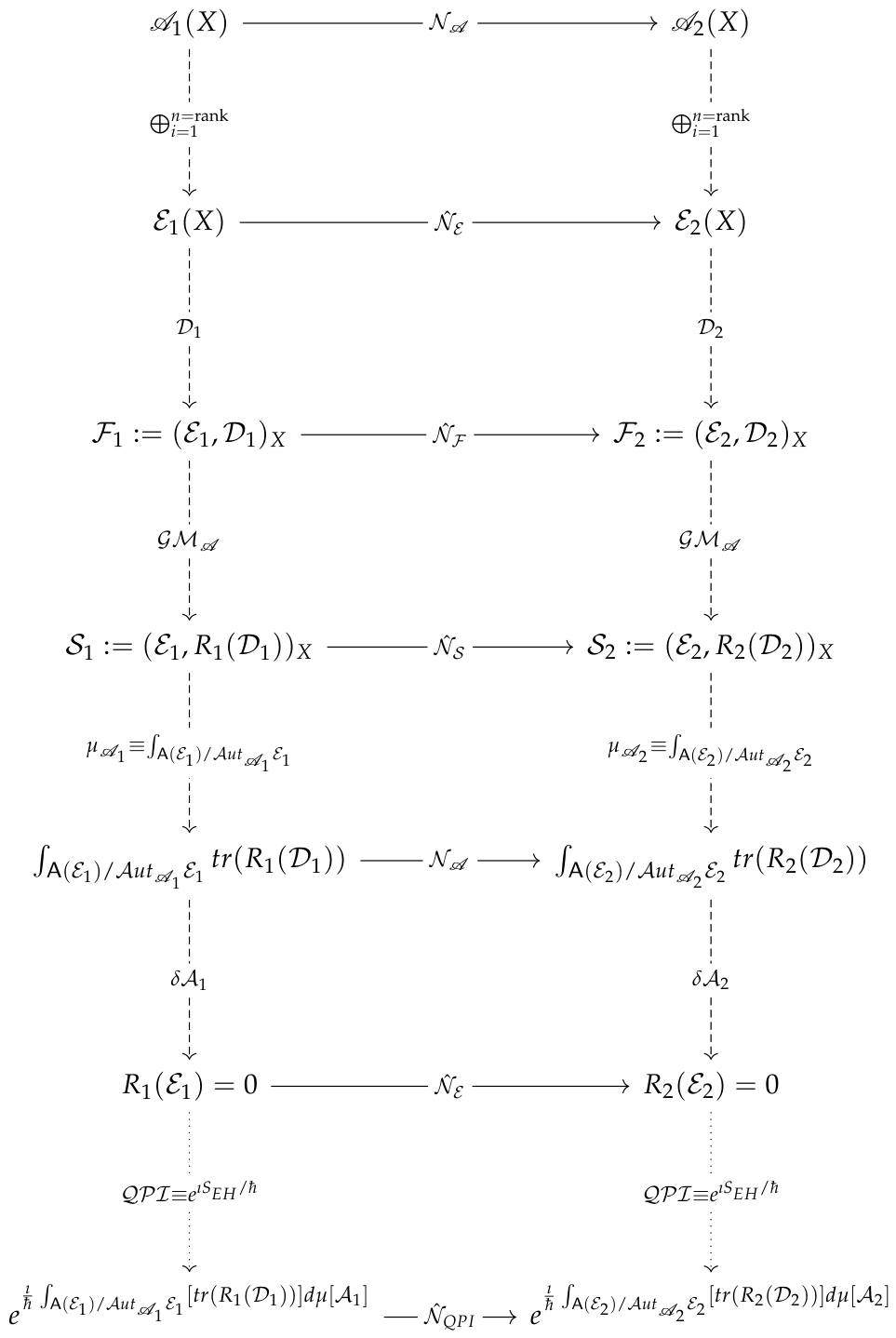
- Horizontal Level 1: In the top storey, the horizontal map:may be thought of as a functorial, natural transformation type of morphism (between the corresponding sheaf categories of -algebraised spaces to which the structure sheaves belong) corresponding to changes of structure sheaves of generalised arithmetics and coefficients in ADG, regarded as a mathematical theory, and to changes of theoretical generalised local coordinate measurements in ADG-gravity, regarded as a physical theory.Since, as we have seen earlier, the entire differential geometric mechanism of ADG derives from the structure sheaf of generalised arithmetics employed, these are structure sheaf changes that effect ‘functorial changes of differentiability’—i.e., changes of the entire ‘differential structure’ or ‘differential mechanism’ of ADG that leave the ensuing structures (differential triads, fields, curvature spaces, -metrics, etc.), that issue from and trickle all the way down the tower, ‘differential form invariant’.
- The Physical Significance of the Structure Sheaf Morphisms : The theoretical physics import and physical significance of such ‘functorial changes of differential structure or differentiability’ effectuated by as depicted in (27) can be appreciated in the light of two quite successful applications of ADG to quantum spacetime structure, quantum GR and QG:
- Finitary and Quantal ADG-Gravity: If we change the structure sheaf of generalised coordinates from the usual sheaf of smooth coordinates on a differential spacetime manifold M, on which one can write the usual vacuum Einstein equations by CDG means, to finitary spacetime sheaves of discrete differential incidence algebras associated with Sorkin’s finitary poset substitutes of continuous manifolds [12,13,14,15], we are able to formulate a locally finite, causal and quantal version of vacuum Einstein–Lorentzian gravity [16,17,18]. Moreover, we are able to ‘resolve’ (better, evade altogether) both the exterior, but more importantly, the interior Schwarzschild singularities of GR [19] without any ‘breakdown’ of the physical law of gravity (which is represented by a differential equation proper) in their vicinity, unlike what the usual CDG (the standard Newtonian Differential Calculus) and background geometrical -smooth manifold-based Analysis of those spacetime singularities purports to show [62,63].
- Spacetime Foam Dense Singularities: The second successful application of ADG involves again switching from the usual structure sheaf of a differential spacetime manifold M to the so-called Rosinger algebra sheaf of spacetime foam dense singularities [28,29,30,60]. This is a flabby structure sheaf of differential algebras of generalised functions (The epithet ‘differential’ to the noun ‘algebras’ here pertaining to the fact that these algebras provide us with the essential differential mechanism of ADG—Mallios’s -connections ∂ and [28,29,30].) (non-linear distributions) that are teeming with singularities of the most unmanageable kind when viewed from the usual perspective of the featureless smooth manifold-based CDG, (The subscript ‘nd’ to Rosinger’s algebra sheaf above means ‘nowhere dense’, while from [28,29,30,60] we read that Rosinger’s non-linear generalised functions not only include as a subset, but they also include the Dirac -functions and the usual Schwartz linear distributions as a proper subsheaf on X.) yet the whole differential mechanism and the technical-cum-conceptual panoply of ADG applies to them in full force, (for instance, Poincaré’s Lemma and a full-fledged de Rham Cohomology are seen to hold intact on the very pathological and problematic, when viewed from the perspective of a -smooth manifold M, structure sheaf ) one can do to the extent that the vacuum Einstein equations are seen to hold intact, and in no differential geometric sense are seen to break down, at their presence [28,29,30,60].
- In addition to the two applications above, we are able to regard and cast ADG-gravity (and ADG-Yang–Mills theory) as an inherently third-gauged (background geometrical spacetime manifoldless and purely gauge) and third-quantised (canonically sheaf cohomologically quantised) field theory [2,3,5,21]. (See remarks on sheaf cohomology and third quantisation in the second half of the paper below).
Apophthegm 4: Whenever we encounter a conceptual issue or technical problem associated with, say, a particular choice of structure sheaf of generalised arithmetics (e.g., the associated with a smooth base spacetime manifold M, with all its pestilential ‘geometrical pathologies’ in the form of singularities and associated unphysical field infinities either at the classical or at the quantum level of description of the theory), we can switch to a more useful or appropriate structure sheaf for the physical situation/model or problem at issue, with respect to which the physical field laws—which are still modelled after differential equations involving -invariant connection and curvature sheaf morphisms with respect to the new structure sheaf —still hold intact. That is, the laws of vacuum Einstein gravity and free Yang–Mills theory will still be -invariant and -covariant in the form of (24). Moreover, the -functoriality of all the main ADG-theoretic concepts, constructions and associated structures (e.g., -algebraised spaces, differential triads , differential -modules/vector sheaves and -connections on them, etc.) secures and guarantees that the latter will still be in force in the new ‘differential geometric setting’ that is based on, and derives from, the new structure algebra sheaf employed.
- In this light, we quote a short passage from [60] (Quote (4.18) in [60].) that, on the one hand, totally corroborates our Apophthegm 4 above, and on the other, it captures perfectly our interpretation of the Top-Down Tower of ADG-Theoretic Natural Equivalences representing categorically what Mallios coined -invariance of the entire ADG-theoretic differential geometric mechanism [2,3,5,33,34,35,36,38,39,60,61]: (The morphisms presented below are called ‘Natural’, because of an essential characteristic of theirs. Technically speaking, they are mappings between sheaf functors (sheaf categories); hence they are Natural Transformation type of maps [10]).
(Q2): “…Starting from any basic “differential triad”, in the sense of ADG (even a classical one, as, e.g., a “locally Euclidean one, this is the case, herewith, we can then perform any (functorial) operation, provided within the category of differential triads, to get thus at a new one [occasionally, more useful/flexible than the initially given one!]…”
- Thus, in what follows, we will witness the import and usefulness of this ‘functorial conservation of differential geometric structure and mechanism’ effect, which follows from the -functoriality observed in the aufbau of the entire ADG-theoretic edifice, storey-by-storey, in the Top-Down Tower of ADG-Theoretic Natural Transformations and Categorical Equivalences above.
- Horizontal Level 2: The second storey (level) in the top-down tower involves seeing the original fundamental structure sheaf change lift to (or induce) the following morphism between the respective vector sheaves (differential -modules of finite rank):which is a natural transformation type of functorial correspondence within the category of differential triads [54,55,57] as Mallios points out in (Q2) above, or within its associated category of vector sheaves .On the other hand, the syncopated vertical arrow from Level 1 to Level 2:simply represents the local assembly of a vector sheaf as the n-th Whitney sum of n-copies of its corresponding underlying structure sheaf , as it was defined in the first section of the paper.
- Horizontal Level 3: The third storey (level) in the top-down tower involves the vector sheaf change in the previous level lifting to (or inducing) the following ADG-field morphism:which is again a natural transformation type () of functorial correspondence within the category of vacuum Einstein gravitational ADG-fields —a natural ADG-field transformation (functorial morphism) [3,6,7,8].On the other hand, the syncopated vertical arrow from Level 2 to Level 3:simply denotes the endowment of a vector sheaf with an -connection to form the vacuum Einstein ADG-gravitational field pair on X (relative to a chosen local coordinatising structure sheaf ), as defined earlier in (5).
- Horizontal Level 4: The fourth storey (level) in the top-down tower involves the vector sheaf change of Level 2 lift to the following morphism:which is yet again a natural transformation type () of correspondence within the category of vacuum Einstein gravitational ADG-curvature spaces —a functorial morphism type of change between ADG-curvature spaces [3,6,7,8].On the other hand, the syncopated vertical map from Level 3 to Level 4:corresponds to the aforementioned fundamental geometric morphism (pair of adjoint functors) that we saw earlier in (25), which maps the Einstein ADG-gravitational field pair to its corresponding curvature space on X in their respective categories and [2,3].
- Horizontal Level 5: The fifth storey (level) in our top-down tower involves the morphism in the previous horizontal level inducing the following morphism:which represents an -functorial natural transformation type of map between the ADG-gravitational Einstein–Hilbert action functional on the moduli space of -gauge equivalent -connection fields, to its corresponding counterpart dynamical action functional on the space of gauge equivalent connections. (The reader should recall that, as it was noted earlier and originally emphasised in [2,3,5,18,21], the relevant ‘kinematical configuration space’ in ADG-gravity, regarded as a third-gauged and third-quantised pure gauge field theory, is the affine moduli space of -equivalent -connection vacuum Einstein fields in the relevant Einstein category ).On the other hand, the syncopated vertical map from Level 4 to Level 5 in our top-down tower diagram above:corresponds to a Radon-type of measure map on the affine moduli space of -gauge equivalent dynamical -connection fields implementing the Einstein–Hilbert dynamical action functional on the said moduli space of ADG-gravitational -connection fields [6,7,8,18].
- Horizontal Level 6: The sixth storey (level) in our top-down tower involves the natural transformation type of morphism between the dynamical action functionals relative to two different structure sheaves at the previous level lifting to the following morphism:which represents a natural transformation-type of functor linking the Einstein–Hilbert action functional holding on vector sheaf relative to (or derived from) , to the Einstein–Hilbert action functional holding on relative to (or derived from) .On the other hand, the syncopated vertical map from Level 5 to Level 6 in our top-down tower diagram above:represents the variation of the Lagrangian Einstein–Hilbert action functional with respect to the local ADG-gravitational -connection field variable that yields as an extremum expression the vacuum Einstein equations holding on the vector sheaf .
- Horizontal Level 7: The penultimate seventh storey (level) in our top-down tower involves the natural transformation type of morphism:which, in turn, represents an -functorial map between the vacuum Einstein equations holding on the vector sheaves (relative to ) and (relative to ) in their respective vacuum Einstein curvature spaces and .On the other hand, the faintly syncopated last vertical map from Level 6 to Level 7 in our top-down tower diagram above:represents the application of a ‘fiducial’ (still not explicitly constructed) Quantum Path Integral () involving a quantal Radon-type measure on the affine moduli space of -gauge equivalent ADG-gravitational connection fields that is expected to ultimately yield a fully -invariant (-functorial, -covariant and -invariant) quantum gravitational ADG-theoretic vacuum Einstein dynamical equations.
- Horizontal Level 8: Finally, the last storey (level) in our top-down tower involves the natural transformation type of morphism (The subscript ‘em QPI’ standing for ‘Quantum Path Integral’.) between envisaged quantum dynamical path integral action functionals over the corresponding moduli spaces of gauge-equivalent -connections relative to different structure sheaves ( and , respectively), as follows:
3.2.2. The Principle of Algebraic Relativity of Differentiability Distilled
Fundamental Apophthegm (5): The Principle of Algebraic Relativity of Differentiability (PARD) maintains that one can naturally transform (change or switch) from one structure sheaf (or -algebraised space or even differential triad in their respective categories and ) on a fixed and in principle arbitrary base topological space X, to another one (or -algebraised space , or even differential triad ) on the same base space X, and the entire inherently algebraic (i.e., -based and derived) ADG-theoretic differential geometric technical machinery and structural mechanism remains intact (invariant). This PARD is secured and guaranteed to hold due to the aforementioned Mallios’ -functoriality and -invariace () of the said differential geometric mechanism of ADG, which is in turn manifested by the -functorial natural transformation type of morphisms at each horizontal level of the Top-Down Tower of the architectonic skeletal backbone of ADG-categorical structures supporting the aufbau of the entire ADG-theoretic edifice, as it was ostensibly depicted and explained above.
Corollary Apophthegm (6): The Physical Utility of PARD One can naturally transform (change or switch functorially) from a given structure sheaf of generalised arithmetics or coordinates in which the vacuum Einstein ADG-gravitational field law, which is expressed as a differential equation proper via the curvature -morphism as in (24), may appear to be ‘singular’, ‘problematic’, or ‘difficult’ to handle (e.g., by the manifold-based and CDG-dependent means, when and the base space X is a differential manifold M), to another one , which is better suited to the problem or issue in hand, while the entire ADG-theoretic mechanism—as well as the physical connection field law that it supports—remains intact and still in force, without ‘suffering’ any loss, let alone breakdown, of differential geometric structure whatsoever. That is, we are still able to do Differential Geometry in the very presence of singularities, infinities and other differential geometric anomalies and pathologies, which only appeared to be insuperable analytic obstacles and irretrievable breakdown effects of the physical field law of gravity [62,63], when the latter is formulated by the smooth geometrical spacetime manifold-based means of CDG () [2,3,5,18,19,20,21]. Equivalently stated, all the apparent differential geometric anomalies and pathologies inherent in can be ‘naturally transformed away’—i.e., directly evaded simply by naturally transforming the whole inherently algebraic ADG-theoretic differential geometric mechanism to a different, more ‘suitable’ (less pathological and better suited to a physical situation in hand) structure sheaf of generalised coordinates .
- Important Note 10: In connection with the natural transformation type of ‘change of structure sheaf’ morphism above, we note that the category-theoretic epithet natural in front of transformation, apart from its usual mathematical (category-theoretic) meaning as ‘a functor preserving functors’ [10], in ADG-gravity it has the additional physical meaning and significance of preserving the differential geometric form of the vacuum Einstein -connection field equations that mathematically represent the Natural law of gravity, (More commonly referred to as the Physical law of gravity. Physis means Nature in both Ancient and Modern Greek.) regardless of what structure sheaf of generalised arithmetics, coefficients or theoretical generalised local coordinate measurements one employs in order to localise (locally ‘measure’ or ‘gauge’) and thus ‘coordinatise’ the ADG-theoretic vacuum Einstein -connection field . (Always relative to a chosen system of open local gauges covering X.) Thus, we arrive at our seventh apophthegm:
Apophthegm 7: The naturality of reflects its physicality: on the one hand, as a categorical, natural transformation type of morphism, it preserves the homological-algebraic (sheaf and category-theoretic) differential geometric structure and mechanism of ADG (in the respective categories), and on the other, it preserves the ‘differential geometric form’ of the ADG-vacuum Einstein field equations that represent the physical vacuum Einstein gravitational field law. In line with the -functoriality and Mallios’s principle of -invariance () that we saw earlier, the form of the physical law remains invariant no matter what structure sheaf one chooses to employ in order to theoretically locally coordinatise and measure (i.e., locally gauge) the vacuum Einstein ADG-gravitational -connection field . Natural transformations (in a categorical sense) are physical changes, in the physical sense that they preserve the form of the dynamical physical laws as the aforementioned Fundamental Ur-Principle of -Relativity () requires.
- A Weak Analogy from GR about Preferred Coordinate Frames. A loose analogy with the local Principle of Relativity in GR [31,32,64] is that there one can switch (transform) to a particular coordinate system—a so-called ‘locally inertial’ (or free-falling) frame—in which the gravitational field is ‘gauged’ or ‘transformed away’ (thus manifesting the local Principle of Equivalence). (This corresponds to the fact that locally, the curved spacetime of GR can be reduced to the flat Minkowski space of SR—or geometrically pictured: at any point of the curved smooth spacetime manifold of GR, the tangent space is isomorphic to flat Minkowski space and the gravitational field, which is represented by the smooth spacetime metric , can be ‘diagonalised’ to the Minkowski one relative to a locally inertial frame [64]). Among all the possible general coordinate frames, the local inertial ones are preferred for locally ‘factoring out’ or ‘gauging away’ the gravitational field.
- A Stronger Analogy from GR about Preferred Coordinate Frames. An even stronger analogy, again coming from GR, is the case of the outer, so-called coordinate, Schwarzschild singularity of the spherically symmetric gravitational field of a point-mass [64,65]. There, an ingenious switch from the usual Cartesian or spherical coordinates to the so-called Eddington–Finkelstein frame, shows that the exterior Schwarzschild singularity is not a real or genuine gravitational singularity—a site where the gravitational field breaks down or blows up without bound, but rather that acts as a unidirectional membrane (black hole horizon) across which physical signals can travel only one way, towards the black hole interior [19,64,65]. Among all the possible general coordinate frames, the Eddington–Finkelstein ones are ‘suitable’ or ‘preferred’ for revealing the black hole horizon nature of the exterior Schwarzschild singularity, which is thus merely a so-called coordinate singularity.
- The Strongest Analogy from ADG-gravity about Preferred Coordinate Frames. A fortiori, and as briefly alluded to earlier, in [19] we apply the ADG–machinery to a finitary (locally finite), causal and quantal setting already developed in [16,17,18] to show that a finitary version of vacuum Einstein–Lorentzian gravity—when one switches from the structure sheaf of smooth functions on a base differential spacetime manifold, to finitary spacetime sheaves [12] of differential incidence algebras [13,14] associated with Sorkin’s finitary poset substitutes of continuous (-topological) manifolds [15]—still holds intact, and in no way (i.e., in any differential geometric sense) the field law of gravity breaks down or blows up to infinity (in the usual analytic sense of [62,63]), even in the immediate topological vicinity (neighbourhood) of the inner (black hole) singularity of the point mass source of the gravitational field. Moreover, even, in generalised function spaces teeming with singularities of the most unmanageable kind from the CDG-theoretic perspective, like in Rosinger’s algebra sheaf of spacetime foam dense singularities mentioned earlier [28,29,30,60], the ADG-gravitational field equations (24) are still seen to be in full force and they do not break down in any differential geometric sense. They only seem to do so from the analytic perspective of the spacetime manifold-based CDG supporting GR [62,63].
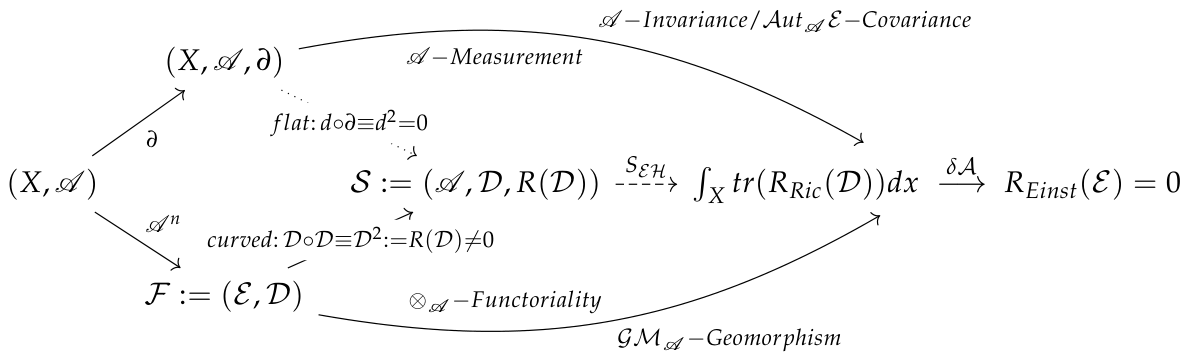
3.3. Diagram II: Linear 10-Storey Bottom-Up Tower of the Basic Skeletal Backbone Structures Supporting the Aufbau of ADG-Gravity
- The general and in principle arbitrary base topological space X is relegated to ‘subterranean’ Level as its sole functional role is as a kind of surrogate space for the sheaf-theoretic localisation of our variable generalised local coordinate measurements in of the dynamically variable vacuum Einstein ADG-gravitational gauge -connection field . As such a surrogate base space, X plays no actual role in the vacuum Einstein ADG-gravitational dynamics in (24), but it ensures that the ADG-gravitational dynamics is continuous with respect to its (’s) topology, no matter what topology we choose that X has. (As noted at the start of the paper, one could in principle choose any base topological space for the sheaf-theoretic localisation and gauging of the generalised coordinate measurement algebras in and, in extenso, of the -modules in ).
- At the fundamental, ground Level 0 lies the structure sheaf , which in turn defines a -algebraised space, on which the entire aufbau of ADG-gravity rests and from which the entire aufbau of ADG-gravity derives, as the present paper contends and shows. (The tower effectively starts from and progressively builds the whole mathematical (ADG-theoretic) structure supporting ADG-gravity).
- The penultimate Level 8 at the top pertains to the autonomous (self-closed, self-sustaining and external spacetimeless) sheaf cohomological third quantisation theoretical scenario for vacuum Einstein gravity and free Yang–Mills theories originally proposed and developed in [21] and recently refined in [3]. We will revisit it briefly in the next section when we discuss the intrinsically and inherently quantal character of the vacuum Einstein ADG-gravitational field .
- At the very top (Level 9) we find a still highly speculative fully covariant (path integral) quantisation scheme for vacuum Einstein gravity briefly mentioned earlier, which has already been anticipated to involve a Radon-type measure on the kinematical affine moduli space of -gauge equivalent vacuum Einstein ADG-gravitational -connections [2,3,5,18,21]. Alas, we still lack the full mathematical development of ADG-theoretic integration on such orbifold spaces of Mallios’s gauge equivalent -connections. One of our guiding principles in developing an abstract integration theory along ADG-theoretic lines is that the relevant integrals, effectuated by Radon functional type of measures on the relevant algebra and vector sheaves, should be, like the inherently algebraic mechanism of ADG, -functorial—what Mallios coined -invariant [2,3,5,33,35,61].
4. Five ‘Innate’ and ‘Intrinsic’ Properties of the Vacuum Einstein ADG-Gravitational Field
- is purely algebraic (relational), as it derives from the structure algebra sheaf , or its associated differential -module , and it is defined homological-algebraically (categorically) as a sheaf morphism acting on the relevant algebra and vector sheaves’ (local) sections; (The flat connection ∂ derives from and acts on ’s local sections as in (3), while the curved connection derives from and acts on ’s local sections as in (5), respectively).
- is external (background geometrical) spacetime manifoldless, as it needs no base locally Euclidean space to support it, unlike the usual GR which is fundamentally based on a background pseudo-Riemannian spacetime manifold M;
- is purely gauge, as there is no background geometrical spacetime manifold external to it, carrying its own, external to , symmetries. The local dynamical symmetries of the vacuum Einstein law (24) that the field defines as a differential equation proper are purely internal or intrinsic to the field itself, being represented by the principal group sheaf of -automorphisms (relative to a chosen structure sheaf of generalised local coordinate measurements or gauge localisations of ). These are the dynamical auto-symmetries or self-invariances of the vacuum Einstein ADG-gravitational field and of the field law (24) that it defines.
Apophthegm 8: The vacuum Einstein ADG-gravitational field is a purely algebraic, purely gauge, external (background geometrical) spacetime manifoldless and dynamically autonomous field system.
4.1. Long Shots in the Quantum Deep: Two ‘Inherent’ and ‘Intrinsic’ Quantum Traits of Vacuum Einstein ADG-Gravity
- The intrinsic, autonomous, self-contained and self-consistent sheaf cohomological third quantisation scenario for the vacuum Einstein gravitational (and free Yang–Mills) ADG-fields that was originally explored in [21] and further developed recently in [3]. We will recall and outline its main tenets and characteristics in the next subsection.
- In a subtle sense, which we are going to explicate and explain below, can be regarded as an -closed quantum system relative to our generalised local coordinate measurements in that, furthermore, because of its inherent spacetime manifoldlessness mentioned above, it draws no fundamental spacetime Planck scale ‘cut-off’ and does not distinguish or posit a theoretically ad hoc Heisenberg schnitt between a classical exosystem and a quantum endosystem like the (quantum state in the) usual Copenhagen Interpretation of Quantum Theory (CIQT) does.
Canonical-Type of Sheaf Cohomological Third Quantisation of ADG-Gravity
- The local sections of the vector sheaf represent local quantum particle position states of the ADG-field. In turn, is the associated (self-)representation sheaf of the principal group sheaf of ’s automorphisms [6,7,8,42,43,44], physically representing ’s local dynamical internal (gauge) self-symmetries that we saw earlier. Moreover, from a geometric pre-quantisation and second quantisation perspective [7,8,21,22,23], the local sections of line sheaves (vector sheaves of rank 1) represent local quantum particle states of Bosons, while the sections of vector sheaves of higher rank represent quantum particle states of Fermions.
- The action of the -connection field on ’s local sections represents local (differential) wave-momentum-like changes of the said local quantum particle position states: (’s local sections). (This is conceptually in much the same way that the momentum operator in the usual QT represents changes in the position operator ).
- Certain local sheaf cohomological (matrix/operator valued) characteristic forms, that fully characterise locally and , are seen to obey non-trivial canonical position-momentum type of local quantum commutation relations that close within the field itself. (In the sense that the said local quantum commutation relations close locally within (), the noncommutative matrix group sheaf that is locally isomorphic to —the noncommutative local principal transformation self-symmetry group sheaf of the vacuum Einstein gravitational field and the dynamics (24) that it defines, as we saw earlier).
- Here, it must be emphasised that, although our generalised local coordinate measurements of the vacuum Einstein ADG-gravitational field in are commutative, (As is an abelian algebra structure sheaf.) the aforesaid generalised position-momentum relations are noncommutative (quantal). This is a generalised ADG-theoretic version of Bohr’s Correspondence Principle (BCP) in the usual Copenhagen Interpretation of Quantum Theory (CIQT)—cf. especially [66], but also [33,34,35,61].
- A fortiori, it must also be emphasised that all of the above is accomplished without invoking, or depending on, any external (background) to the ADG-field itself geometrical spacetime manifold like in the usual (flat) QFTs of matter in Minkowski space or in the canonical (Hamiltonian) or the covariant path integral quantisation approaches to QGR. (This third quantisation of ADG-gravity evades altogether the equal-time commutation relations imposed on spacelike hypersurfaces (in -global hyperbolically decomposed spacetime manifolds) between the gravitational field and its conjugate momentum field (in either the second-order Einstein–Riemann or the first-order Palatini–Ashtekar formalisms) [67,68]). Moreover, in the said sheaf cohomological canonical local quantum commutation relations, there does not appear any ad hoc assumed Planck constant (ℏ) or any other fundamental spacetime scale, as there is no background spacetime geometry to begin with. Further to this point, as there is no background spacetime geometry at all in our scheme, but only the purely algebraic (relational), purely gauge and dynamically autonomous vacuum Einstein ADG-theoretic -connection gauge field , there is no need for us to quantise spacetime geometry like; for example, in the Loop QG scenario in which we find quantised expressions for spacetime area and volume. In canonical QGR, for instance, since the spacetime manifold-based GR is regarded as a theory of gravity based on a curved spacetime geometry (i.e., the curvature of spacetime, expressed via the spacetime metric , represents the gravitational field strength), it is expected that a quantisation of the gravitational field should inevitably ‘result’ in, or be accompanied by, a concomitant quantisation of spacetime itself.
4.2. Remarks on the Role of as the Module of Sheaf Cohomological Coefficients in ADG and ADG-Gravity
- In the usual (singular) cohomology theories with fixed or constant of coefficients like or and a fixed abelian cohomology group G, the coefficient module and the group convey important geometrical (topological) information about the underlying space;
- Sheaf cohomology is a generalisation of the usual cohomology theories with constant coefficient module , whereby now is a sheaf of coefficients (normally, a sheaf of abelian groups, rings or algebras) usually referred to as the structure sheaf (our in ADG), that keeps track of what local data are glued together to form cohomology groups.
- By using variable (a sheaf!), instead of constant, coefficients, sheaf cohomology uses the local data provided by the local sections of the coefficient module structure sheaf to determine whether a problem that can be solved locally can also be solved globally. In other words, sheaf cohomology, by contrast to cohomology with constant coefficients, determines or measures the obstructions to solving a problem globally by using local information encoded in the local sections of .
- Sheaf cohomology is richer and more flexible than constant coefficients’ (singular) cohomology as it uses the structure sheaf and the cohomology groups to detect and characterise the topological and the geometric properties of the underlying space, such as its characteristic (topological) invariants like dimension and other important (topological) properties like connectedness, the presence of holes and other global obstructions, etc.
- The choice of coefficient sheaf module (structure sheaf ) in a cohomology theory is crucial, because it influences the calculated cohomology groups and hence determines the nature of the invariants being measured, affecting how the theory behaves with different algebraic structures and what properties of the underlying space it can capture. In toto, different choices of result in different properties and geometrical/topological invariants of the underlying space being revealed and computed.
- The remark above brings us to the most important observation about sheaf cohomology in view of our present paper, namely that different choices of coefficient module or structure sheaf lead to different algebraic structures and thus result in different invariants being computed. Also, a specific or particular choice of coefficient module sheaf may be more suitable or appropriate for revealing specific geometric (topological) properties of the underlying space. By using different types of algebraic coefficient structure sheaves, one can probe different aspects of the underlying space’s structure. For instance, a particular choice of may reveal topological obstructions in the base space, while another one may not.
(Q3): “In essence, selecting coefficient sheaf for a cohomology theory is like choosing the measuring tool. You select a tool [a specific structure sheaf] that is appropriate for the task of revealing the specific topological or algebraic properties you are interested in.”
- In other words,
Apophthegm 9: Different choices of result in measuring, calculating or revealing different geometric aspects and properties of the underlying space. Different structure sheaves suitable for different spaces and geometric purposes.
Close Affinity with the PARD of ADG-Gravity, but with a Difference
Apophthegm 10: The choice of structure sheaf (or sheaf module of coefficients ) affects the [geometrical (topological) properties of the] underlying space one chooses to study. On the other hand, given that the inherently algebraic differential geometric mechanism of ADG originates from and it is a fortiori -invariant (or -functorial) according to the principles of PARD, and , the said inherently algebraic differential mechanism of ADG is independent of the space (and the properties thereof) one chooses to study. ADG, unlike CDG, is not a theory of differential geometry that derives from, and essentially requires the mediation and geometrical interpretation afforded by, a background locally Euclidean geometrical space(time) manifold. Rather, it is a purely relational (algebraic), more Leibnizian rather than Newtonian, type of Differential Calculus that derives directly from the algebraic relations (structure) between the ‘geometrical objects’—the (local sections of the) structure algebra sheaves and their associated differential -module vector sheaves —that live on a surrogate base topological space X, which is devoid of any physical significance as it does not partake in the -invariant vacuum Einstein ADG-gravitational dynamics in (24).
- We now turn to the second intrinsic quantum trait of the vacuum Einstein ADG-field : its -closed quantum system character.
4.3. The -Closed Quantum System Character of the ADG-Gravitational Field
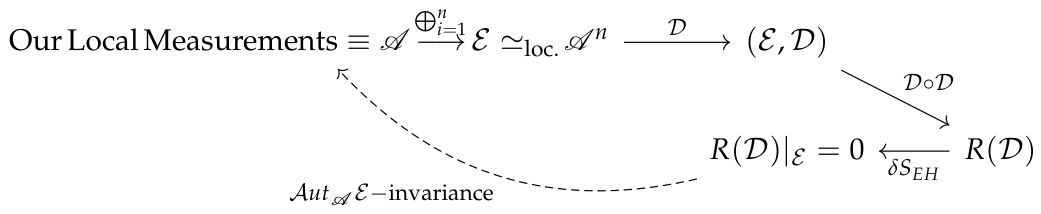
4.3.1. Diagram III: Horizontal Bottom-Up Diagram–Flowchart of the Unfolding and Aufbau of Vacuum Einstein ADG-Gravity
- Key Observation: From Diagram III above, we especially highlight the occurrence of the -Coordinates’ Measurement process, leading to -Invariance and -Covariance (top bent arrow side) of the ADG-gravitational dynamics and their equivalent functorial expressions in the guise of -Functoriality and the -geometric morphism (bottom bent arrow side) defined in (25) earlier.
4.3.2. The Dynamically Autonomous, -Circular and -Closed Quantum System Character of the ADG-Gravitational Field
- Fundamental Observation (FO) about : On the one hand, as we showed and argued in the present paper, the structure sheaf is the origin and source of the gravitational -connection field , while the physical law (dynamics) that the latter defines as a differential Equation (24) via its curvature is -invariant. Equivalently, the dynamics is -functorial, -covariant and geometric morphism -functorial. On the other hand, as we have emphasised throughout this paper (cf. Important Note 0 earlier) and our work on applying ADG to vacuum Einstein gravity (and free Yang–Mills theories), physically represents (i.e., it is physically interpreted as) the sheaf of generalised local coordinate measurements or local gauge determinations of the gravitational -connection field in much the same way that the structure sheaf of smooth functions on the differential spacetime manifold M’s point events represents the local smooth coordinate measurement values of the ten gravitational potentials-entries of the smooth spacetime metric relative to an atlas of local coordinate patches (charts) covering M (cf. opening quote (Q1) from [1]).
- We thus observe the following fundamental -cycle in ADG-gravity: we start from our generalised local coordinate measurements of the ADG-gravitational field in and we end up with an -invariant gravitational dynamics, a dynamics that respects and, conversely, is respected by, our generalised local coordinate measurements of the vacuum Einstein ADG-gravitational field in .
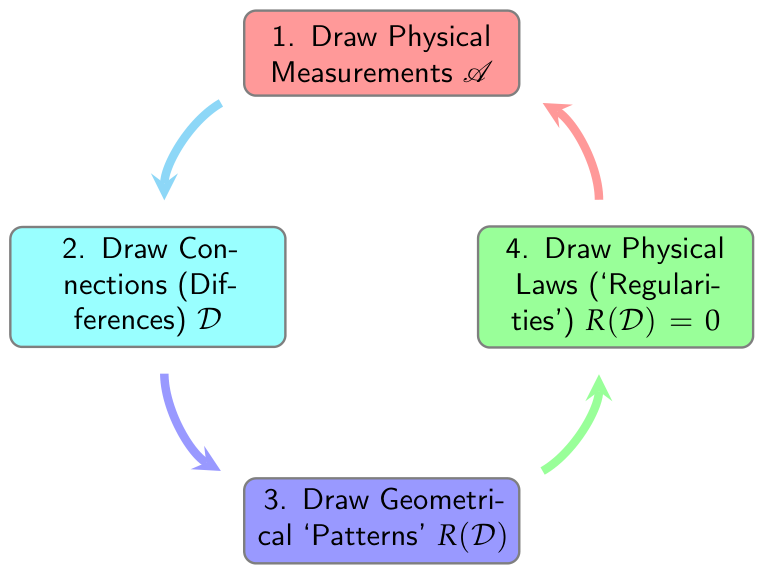
- At the basis, we have our theory of the physical fields as partaking in the dynamical Laws of Nature that we discover by our observations of those dynamical fields and wish to mathematically describe, represent or model by (differential) geometric means—tacitly assuming, of course, that the said physical laws are local, thus that they should be somehow mathematically modelled after differential equations.En passant, we note that in Greek, ‘theory’ () means ‘generalised observation’, ‘a general, epoptic way of looking at things’. In our ADG-gravity, as we showed and argued earlier, our entire theory of ADG-gravity is based on , hence our appellation of the structure sheaf as our theoretical generalised local coordinate measurements of the gravitational -connection field .This theory, following Bohr’s Correspondence Principle (BCP) dictum in the standard CIQT—which in turn fundamentally splits the World into a classical exosystem (observer) and a quantum endosystem (observed)—should involve commutative c-number-like entities living in abelian algebras (Not to be confused with the connection’s local gauge potentials that we saw in Section 2.) to represent our (quantum) field measurements.However, at the same time, if our theory is to be regarded as being physical, it should be variable, that is to say, dynamical.So, gauging or localising our generalised observations into our structure sheaf of generalised arithmetics, coefficients or coordinate measurements (and its associated vector sheaf -module ) relative to an open gauge covering the underlying in principle arbitrary topological space X, entails such a dynamical variability. (By definition, a sheaf of any mathematical objects—such as sets, groups, rings, modules, etc.—is a mathematical structure of localised, variable objects—‘gauged’ objects that vary continuously with respect to the (topology of the) surrogate base topological space X over which the sheaves are localised [6,7,8,10,56]. At the same time, we also abide by the general result and motto in Sheaf Theory that a sheaf is its local sections, as the global sheaf space can be stitched up from, or result from the collation of, all the local sections’ data in ( covering X) [6,10,56]). This dynamical variability is then expressed via the -connection field , which derives from as we discussed earlier in connection with (5).
Fundamental Apophthegm of ADG-field Theory: Since, as we argued earlier, ADG as a theory of Differential Geometry—which is fundamentally based on the notion of Mallios’s -connection—effectively boils down to , we coin (local sections of) the latter (relative to our choice of a system of local open gauges covering X), our theoretical generalised observations or local coordinate measurements/determinations.
- 2.
- Thus, from our dynamical (localised or gauged) generalised measurements in , that are a fortiori organised into the vector sheaf , we draw/derive ‘connections’ or ‘differences’ (Both metaphorically and literally speaking.) and thereby we generate ∂ (from in Equation (3)) and (from in Equation (5)) in terms of which the field dynamics—Nature’s Field Law of vacuum Einstein gravity—is represented differential geometrically, by differential equations proper as in (24). (Thus, in the -cyclic ‘Ouroboros’ diagram (OD2) above, the transition arrow . is analogous to the -linear and Leibnizian flat and curved connection defining sheaf morphisms and in Equations (3) and (5), respectively).
- 3.
- From the said connections we then draw/derive (geometrical) patterns/regularities, thus the said dynamics will be properly observable if it is expressed solely in terms of observable (measurable; -tensorial or -functorial) ‘quantities’. (Thus, in the -cyclic ‘Ouroboros’ diagram (OD2) above, the transition arrow . is analogous to the curvature defining morphism in Equation (11) that we saw early in the paper).
- 4.
- Indeed then, the said dynamical field laws are derived from a variational Lagrangian action principle and are expressed (differential) geometrically in terms of the principal ‘geometrical’ object/entity—the curvature of the -connection , which is an -functorial observable (an -tensor). (Thus, in the -cyclic ‘Ouroboros’ diagram (OD2) above, the transition arrow . is analogous to the variational action principle from which the vacuum Einstein equations (24) that we saw earlier in the paper derive.) Moreover, as we emphasised throughout this paper, that field dynamics is -functorial and -covariant: in other words, the dynamics respects and in turn it is respected by our generalised local coordinate measurements (arithmetics) in .
- 5.
- Finally, the geometrical observable object (curvature) via which the field laws are expressed yields, upon local observation/measurement relative to a given , generalised coordinate c-numbers (arithmetics or coefficients) in the abelian structure sheaf , (That is, effectively, from (12), the local value of at some , may be taken to be, for example, , which is effectively a local section of in .) thus the -cycle closes in itself. (In the -cyclic ‘Ouroboros’ diagram (OD2) above, this corresponds to the transition arrow ., thus closing the -cycle).
- Note: The reader should notice that points 1–4 in the analysis of the -cyclic ‘Ouroboros’ diagram (OD2) above match item-for-item the entries and arrow-flow steps of our first -cyclic ‘Ouroboros’ diagram (OD1) in (Figure 4) earlier; more notably:which leads us to the following Apophthegm, our 11th one and second fundamental principle of ADG-gravity:
Apophthegm 11: The Principle of ‘-Recycling’ (PAR) ADG fundamentally starts with and originates from, the structure sheaf and its differential -module , then defines an -connection , and then proceeds to do Geometry via ’s geometric morphism -image, which corresponds to the curvature of the connection, which features in defining the -functorial (Mallios’s -invariant, -functorial or -covariant) vacuum Einstein ADG-gravitational purely gauge field auto-dynamics in (24). In effect, ADG-gravity starts from and ends with .
Highlight 1: We may cumulatively refer to the ADG-field theoretic -Connection-Dynamics-Measurement Invariance Cycle above as Generalised -Measurements Recycling or The Principle of Conservation of Generalised Measurements in , and it may be thought of as the ADG-theoretic generalised analogue of Noether’s Theorem for the PARD and its associated -functoriality. As the usual statement of Noether’s Theorem maintains that with every continuous symmetry of the Lagrangian dynamical action principle there is an associated conserved (invariant) dynamically measurable (observable) quantity (alias, current) in the resulting dynamical equations of motion on the spacetime continuum, here too, as a result of the PARD and the -functoriality (the -covariance) of the ADG-gravitational field auto-dynamics, we maintain that what is conserved here is the differential geometric form of the dynamical differential equations of ADG-gravity (here, the vacuum Einstein equations), which is expressed via the -invariant curvature form of the connection , which in turn originated from in the first place.
Highlight 2: The curvature of the -connection field is the abstract ADG-field theoretic analogue of a conserved current in Noether’s Theorem, in the sense that it is the differential geometrical form-invariant, -tensorial observable or -invariant conserved quantity associated with the PARD and the -functoriality (the -covariance) of the ADG-gravitational field auto-dynamics in (24). We will come to discuss this more in the sequel, when we remark on sheaf cohomology with coefficients in and characteristic form .
5. Epilogue: Summary of Results by ‘Justifying’ the Title of the Paper with a Novel Mathematical and Philosophical Outlook Towards Future Quantum Gravity Research
- On the one hand, in the title of the present paper, we contended that ADG-gravity is a general theory of gravity, an abstract and generalised General Relativity.
- On the other hand, we contended that ADG-gravity is based on, and that it derives from, the structure sheaf of generalised arithmetics, coefficients or coordinates.
- Moreover, in connection with both features of ADG-gravity above, we also contended that ADG-gravity has certain ‘inherent’, ‘intrinsic’ or ‘innate’ traits that can shed light and potentially resolve some key conceptual and structural issues in current QG research that appear to be incurably problematic and insuperable obstacles on our way to QG exactly because they are based on the background geometrical manifold dependent concepts, methods and constructions of CDG, as well as on the manifold’s physical interpretation as a spacetime continuum in the CDG-based GR. We discuss the potential outlook of ADG-gravity in future QG research at the very end of the paper with various pertinent quotes and heuristic philosophical smatterings based on them.
5.1. ADG-Gravity as a Generalised General Theory of Relativity
- ADG-gravity, unlike GR, is not CDG-based; hence, it is manifestly not background geometrical spacetime manifold dependent. In other words, ADG-gravity is a genuinely background-independent theory of gravity.
- ADG-gravity is based on an arbitrarily chosen algebra structure sheaf of generalised, possibly also non-functional, coordinates (and it is not necessarily based on the usual structure sheaf of smooth coordinate functions on a differential point-set manifold M, like the CDG-based GR is)—the structure algebra sheaf itself being localised on a general and in principle arbitrary base topological space X, which serves as a surrogate space for the sheaf-theoretic localisation (gauging) of and —as long as and provide us with linear and Leibnizian algebraic -connections ∂ (flat -connection) and (curved -connection), which in turn act categorically as sheaf morphisms on (the local sections of) the relevant algebra and vector (-module) sheaves, respectively.
- ADG-gravity, as a dynamical theory, is based solely on the fundamental notion of an algebraic -connection field variable , the cornerstone structure of ADG regarded as an abstract and general mathematical theory of differential geometry, as it was repeatedly highlighted and explained in this paper. As also emphasised in this paper, the notion of a Mallios -connection is purely algebraic (homological-algebraic, i.e., sheaf and category-theoretic) and thus ADG is a purely algebraic (relational) theory of differential geometry that is not at all dependent on a background geometrical locally Euclidean substratum for either its formal technical (calculational and structural) support or for its conceptual-semantic (physico-philosophical) interpretation.
- ADG-gravity is not a theory of curved spacetime geometry—i.e., the ADG-gravitational field is not represented by the smooth spacetime metric as in the usual spacetime manifold-based GR (second-order formalism), but rather, it is a pure gauge theory of a gravitational -connection vacuum Einstein field . In this respect, it is similar to the Palatini–Ashtekar formalism (first-order formalism), but without the spacetime metric implicit in the vierbein variables there. As we explained in Section 2, in ADG-gravity, the -metric is an auxiliary and ‘bonus’ structure, while its compatibility with is an optional condition. (The reader should note here that, because is the sole dynamical variable in the theory, we do not talk about the compatibility of the connection ∇ with the metric as in the usual Christoffel theory (GR). Rather, we talk about the compatibility of the -metric ρ with the connection ).
- The invariance group of ADG-gravity, by contrast to the CDG and spacetime manifold M-based GR, is not the spacetime diffeomorphism group , but the principal group sheaf of the local vacuum Einstein field -automorphisms, the local self-symmetries of the vacuum Einstein ADG-gravitational field equations (24). As we saw earlier, for a vector sheaf of rank n, the principal group sheaf of automorphisms of is locally isomorphic to , which is the ADG-theoretic matrix group generalisation of the general linear symmetry group of GR.
- From the fact above, it follows that in ADG-gravity there is no distinction between external (spacetime) and internal (gauge) symmetries like in the usual, both classical and quantum, field theories of matter. The vacuum Einstein ADG-gravitational field is a dynamically autonomous entity whose dynamical symmetries are purely internal (gauge) or intrinsic to the field itself, without recourse to or dependence on an external (to the gravitational field itself) geometrical spacetime continuum. The -symmetries of the ADG-gravitational vacuum Einstein field and of the dynamical equations (24) that it defines via its curvature form are internal (gauge) self-symmetries.
- For any chosen structure sheaf of generalised coordinates, the -functoriality and -invariance of the ADG theory secure and guarantee that the vacuum Einstein equations in (24) hold no matter how ‘problematic’, ‘pathological’ or ‘singular’ the chosen and employed structure sheaf [16,17,18,19,28,29,30] may seem to be from the classical background geometrical manifold-based perspective of CDG, or equivalently, from the vantage of the usual Differential Calculus or Analysis [62,63].
- The generalisation of the PGC of GR, which is represented by the invariance group of spacetime diffeomorphisms of the background geometrical differential spacetime manifold M, to the PARD, which, as we saw earlier, is represented by certain functorial, natural transformation type of morphisms between the relevant ADG-theoretic sheaf categories involved. The generalised general relativistic meaning of the PARD is that one may change (naturally transform) freely between differential structure sheaves of generalised coordinates, but the intrinsically relational (algebraic) differential geometric mechanism of ADG remains invariant, so that the dynamical vacuum Einstein ADG-gravitational equations—which are functorially expressed via the curvature form of the -connection , which is an -tensor—hold intact, do not break down in any differential geometric sense and are not assailed by singularities or unphysical infinities like the manifold and CDG-cum-Analysis-based GR [62,63]. In fact, as we highlighted earlier, the vacuum Einstein ADG-gravitational equations are seen to hold on pointless finitary-reticular [16,17,18,19,20] and densely singular [28,29,30] spaces that seem unmanageably granular, pathological and problematic from the CDG-Analytic and manifold-based perspective of GR.
5.2. ADG-Gravity Originates and Derives from the Structure Sheaf
Apophthegm 8: ADG-gravity originates and derives from , because the fundamental notion and foundational structure of an -connection (flat ∂ or curved ) on which the entire ADG-theoretic edifice rests and is built upon as a mathematical theory of Differential Geometry proper, and via which the law of vacuum Einstein ADG-gravity is formulated as a differential equation proper hence also the physical theory is expressed as a pure gauge field theory as explained in the last subsection, has its source or domain of definition, and it derives from, the structure algebra sheaf , as the defining expressions for ∂ in (3) and for in (5) show, respectively. This is essentially the aftermath and gist of Apophthegms 1 and 2 earlier.
5.3. The Need for New Mathematical Ideas and Physico-Philosophical Concepts: Implications for Current and Future Quantum Gravity Research
(Q3): “ …Quantum gravity is notoriously a subject where problems vastly outnumber results…”
(Q4): “…The problems of quantum gravity are much more than purely technical ones. They touch upon very essential philosophical issues…”
The Background Differential Spacetime Manifold Just Gets in Our Way Towards QG
- The Problem of Singularities: Singularities in the classical, CDG-based field theory of gravity (GR) are viewed as loci in spacetime where the gravitational field equations of Einstein somehow break down and physically measurable geometrical quantities such as the spacetime curvature blow up without bound [62,63]. It is widely accepted that singularities and the associated breakdown of the physical law of the classical relativistic field theory of gravity (GR) are due to their assumption of a background smooth spacetime manifold, which can in principle pack an uncountable infinity of events in a finite spacetime region (volume). For example, it is generally supposed that only the true quantum theory of gravity will be able to reveal what happens in the interior (past the horizon) of, say, a Schwarzschild black hole, in the vicinity of the inner point-mass singularity, where Einstein’s field law supposedly breaks down as a differential equation and hence physical predictability is supposedly impossible.
- The Problem of Unphysical Infinities: The singularities of GR are formidable ‘obstacles’ to the physical law of gravity way before quantisation of the gravitational field becomes an issue. However, the spacetime continuum is also responsible for the similarly unphysical infinities that assail the usual quantum field theories of matter, which are also based on a spacetime continuum; albeit, in the absence of gravity, on a flat one (Minkowski space). Moreover, if one wishes to apply the usual CDG or Differential Calculus-based analytical techniques, one gets nonsensical ultraviolet divergences and infinities that come from contributions of the uncountably infinite degrees of freedom of the continuous matter and gauge fields. The heuristic process of renormalisation to remove by hand, as it were, the unphysical infinities has been criticised as being theoretically ad hoc.
- The Problem of Background Independence: Overall, in view of the fact that the background differential spacetime manifold M of GR is a fixed structure in the theory, the basic intuition is that in the realm of QG that fixed ether-like background spacetime continuum will give way to a more reticular-finitistic (discrete) and, perhaps more importantly, dynamically variable structure. Field quantities cannot be referred to a fixed background (Minkowski) metric with respect to which, for example, the perturbation expansion (renormalisation) will be referred to, especially when the metric itself is supposed to be the basic dynamic variable in GR.
- The Problem of Time and the Inner Product Problem in (both canonical and covariant) QG research: Both are due to the -invariance of the classical theory (GR) which, when carried over to the (either canonically or covariantly) quantised theory, gives us formidable technical and conceptual problems, such as in the following examples: (i) Defining physically meaningful states that are annihilated by the Hamiltonian operator (constraint), which is the generator of timelike diffeomorphisms (dynamical evolutions) in the theory. (ii) In defining a positive definite inner product between those physical states so that the theory has a cogent and consistent probabilistic physical interpretation, one that in principle does not allow for physically nonsensical negative norm states.
- The Problem of Defining Autonomous, Closed Dynamical (Field) Systems and the Measurement Problem in QC: In Quantum Cosmology (QC) research, the fundamental assumption is that the Universe is a closed quantum system. On the other hand, the usual Copenhagen Interpretation of QT fundamentally splits the world into a classical exosystem (the observer) and a quantum endosystem (the observed) by the famous Heisenberg Schnitt underlying the Quantum Measurement Problem. Thus, for QC we need to develop a theory of closed, dynamically autonomous systems, with quantum traits built in, for which there is no distinction between (classical) external observer and (quantum) observed system as there is nothing standing ‘outside’ the quantum universe ‘observing’ it. (In this regard, see; for example, Wheeler’s paper in the celebrated volume [75]).
- The Problem of a Fundamental Spacetime Scale: Hand in hand with defining dynamically autonomous systems, with some intrinsic quantum traits, comes the problem of having a fundamental spacetime scale—that of Planck length and Planck time, which are ‘concocted’ from the constants of the three basic theories of Nature that we possess: Special Relativity (c), General Relativity (G) and Quantum Theory (ℏ). (Recall from above that the Planck length is expressed as , while the Planck time is ). This is supposed to be a fundamental Heisenberg Schnitt type of cut-off scale below which the elusive QG is supposed to hold, but above which GR and the usual (flat) QFTs of matter are supposed to be in force. There have recently been aired theories maintaining that the fundamental constants may be regarded as hindrances to genuine unification, while a fundamental (field) theory, one that is unitary and holistic across all our fundamental field theories (electromagnetism and Yang–Mills), should, ‘deep down inside the quantum deep’, be spacetime scale independent [74]. In fact, in the same line of thought, it has been argued that our usual conceptions and concepts of space and time, especially in their spacetime continuum guise, cannot and therefore should not be carried over in the QG domain [74]. In fact, Wheeler in the aforementioned paper [75] in connection with the dynamically autonomous and observationally closed system conception of the Universe, posits that “in the realm of QG there is No Space and No Time”. (See the Postscriptum section at the end of the paper in which we briefly discuss current ideas on Spacetimelessness in current QG research).
- Mutatis mutandis for Quantisation: One would expect an intrinsic and ‘self-referential’ (autonomous) theoretical scheme for quantisation, one that goes directly to and involves solely the force fields in themselves, without the mediation of an external (to the fields themselves) background geometrical spacetime continuum structure, which is reminiscent of the luminiferous ether of Maxwellian electrodynamics, which acts but is not acted upon [76]. At the same time, if there is any physical spacetime geometry at all, that will be the outcome of the algebraic field dynamics—a ‘spectral geometry’ built into the algebra structure sheaf from which the ADG-gravitational -connection field arises [36], not a passive kinematical stage on which the fields dynamically interact and dynamically propagate, but by and in itself it has no directly observable effects. The a priori absence of a spacetime interpretation in ADG-gravity makes the quest for quantising spacetime beg the question in the first place: a scheme that directly quantises the fields themselves is in no need of quantising a fiducial spacetime background that does not physically exist anyway.
5.4. Five Basic Questions About the Future of Quantum Gravity Research from an ADG-Gravitational Point of View
- Question 1 (QU1): What is the potential import, both technical and conceptual, as well as the physical significance, of having an entirely algebraic field theory of gravity, like ADG-gravity is, having no background geometrical spacetime manifold conceptual and technical dependences, geometrical representations and associated physical interpretations?
- Question 2 (QU2): Closely related to Q1 above, what is the potential import, both technical and conceptual, as well as the physical significance, of having an entirely algebraic (sheaf and category-theoretic) theory of Differential Geometry, like ADG is, in which we can do Calculus—i.e., construct, calculate and do field Physics—in the very presence of singularities and other differential geometric anomalies on which the usual manifold-based CDG stumbles, stalls and, in general, comes short of delivering physically meaningful constructions, calculations and results in both GR (singularities) and QFT (non-renormalisable infinities).
- Question 3 (QU3): What is the potential import, both technical and conceptual, as well as the physical significance, of having a purely gauge field theory of gravity, like ADG-gravity is, having no external (background to the gravitational -connection field itself) differential spacetime manifold geometry and its own, also external to the gravitational -connection field itself, -symmetries?
- Question 4 (QU4): What is the potential import, both technical and conceptual, as well as the physical significance, of having a completely dynamically autonomous and closed system-like structure and conception of a gravitational field, with innate (intrinsic and built-in) quantum traits from the very start, like the vacuum Einstein ADG-gravitational -connection field is?
- Question 5 (QU5): What is the potential import, both technical and conceptual, as well as the physical significance, of having a completely background geometrical spacetimeless and, in extenso, spacetime scale-less theory of gravity, like ADG-gravity is, which on the one hand has no a priori background geometrical spacetime interpretation and representation of the mathematical structures involved in ADG, and on the other, it draws no fundamental scale distinctions and therefore posits no theoretically ad hoc cut-offs in terms of fundamental constants that typically delimit the range of validity of the physical law that the gravitational -connection field itself defines in the first place? Such supposedly fundamental cut-off scales also posit ‘fiducial’ mathematical pseudo-problems and quandaries such as whether, in the quantum deep, spacetime is continuous or discrete in nature and, related to it, whether a Quantum Theory of Gravity, regarded as Quantum General Relativity, should be accompanied by, or even result in, some kind of quantisation of the curved spacetime continuum itself in much the same way that the supposedly in principle continuous classical radiation spectrum of the hydrogen atom, upon quantisation (solution of the Schrodinger equation of its sole valence electron), revealed the reticular (discrete) nature of its electron orbitals.
5.4.1. (QU1) Einstein: A Purely Algebraic Theory for the Description of Reality in the Quantum Deep
followed by(Q5): “ …Is it conceivable that a [continuous] field theory permits one to understand the atomistic and quantum structure of reality?…[Quantum phenomena do] not seem to be in accordance with a [spacetime] continuum theory, and must lead to an attempt to find a purely algebraic theory for the description of reality. But nobody knows how to obtain the basis of such a theory…” (1956) [31]
also followed by(Q6): “…You have correctly grasped the drawback that the continuum brings. If the molecular view of matter is the correct (appropriate) one; i.e., if a part of the universe is to be represented by a finite number of points, then the continuum of the present theory contains too great a manifold of possibilities. I also believe that this ‘too great’ is responsible for the fact that our present means of description miscarry with quantum theory. The problem seems to me how one can formulate statements about a discontinuum without calling upon a continuum space-time as an aid; the latter should be banned from theory as a supplementary construction not justified by the essence of the problem—a construction which corresponds to nothing real. But we still lack the mathematical structure unfortunately (Our emphasis.). How much have I already plagued myself in this way [of the spacetime manifold]…” (1916) [77]
and finally, he agnostically admitted,(Q7): “…An algebraic theory of physics is affected with just the inverted advantages and weaknesses, aside from the fact that no one has been able to propose a possible logical schema for such a theory. It would be especially difficult to derive something like a spatio-temporal quasi-order from such a schema. I cannot imagine how the axiomatic framework for such a physics would appear, and I do not like it when one talks about it in dark apostrophes. But I hold it entirely possible that the development will lead there; for it seems that the state of any finite spatially limited system may be fully characterized by a finite set of numbers. This seems to speak against a continuum with its infinitely many degrees of freedom. The objection is not decisive only because one does not know, in the contemporary state of mathematics, in what way the demand for freedom from singularity (in the continuum theory) limits the manifold of solutions…” (Again, our emphasis.) [77]
In ‘response’ to the points made and issues raised by Einstein in quotes (Q5–8) above, we present the following apophthegm, our twelfth one:(Q8): “…Your objections regarding the existence of singularity-free solutions which could represent the field together with the particles I find most justified. I also share this doubt. If it should finally turn out to be the case, then I doubt, in general, the existence of a rational and physically useful continuous field theory. But what then? Heine’s classical line comes to mind: ‘And a fool waits for the answer’…” (1954) [77]
Apophthegm 12: ADG and its physical application offshoot, ADG-gravity, is a competent candidate for Einstein’s envisaged purely algebraic theory for the description of reality (Q5) in the quantum domain, as it is a purely homological-algebraic theory. Moreover, ADG-gravity is a differential geometrically formulated field theory that is not dependent at all on a background geometrical locally Euclidean spacetime continuum—it is a field theory proper that is not at all calling upon a continuum space-time as an aid (Q6). In fact, ADG-field theory, and ADG-gravity in particular, passes through the horns of the continuum vs. discretum dichotomy and dilemma of Einstein (Q6–7), as the character of the base topological space X—whether reticular or continuous—on which the algebra and vector sheaves are localised, plays no role whatsoever in the inherently algebraic (relational) differential geometric mechanism, which derives from the stalks (the algebraic structure) of, or the algebraic relations between, the ‘objects’ (the s and the s involved) that live on that surrogate base localisation space X. Furthermore, in ADG-gravity, we are indeed able to show the existence of ‘singularity-free’ solutions (structure algebra and vector sheaf spaces on which the vacuum Einstein field equations hold) which represent the field together with the particles (Q8). In fact, as we explained in this paper, the vacuum Einstein field represents exactly the gravitational connection field together with its representation vector sheaf of local quantum particle states on which the vacuum Einstein equations (24) hold intact. A fortiori, we saw that the ADG-gravitational field is intrinsically quantum from our purely algebraic, sheaf cohomological third quantisation perspective.
5.4.2. (QU2) Einstein–Feynman-Isham: The No-Go and Miscarrying of CDG in the Quantum Deep and the Quest for a New Mathematical Theory
and then Isham:(Q9): “…the theory that space is continuous is wrong, because we get…infinities [viz. ‘singularities’] and other similar difficulties …[while] the simple ideas of [differential] geometry, extended down to infinitely small, are wrong…” [78]
(Q10): “…at the Planck–length scale, classical differential geometry is simply incompatible with quantum theory…[so that] one will not be able to use differential geometry in the true quantum-gravity theory…” [79]
Apophthegm 13: It is not exactly that one cannot use ideas, concepts and constructions of Differential Geometry per se in, say, QG research. After all, how else can we formulate the local laws of Nature other than as differential equations proper? Rather, it is that the point manifold-based CDG and its Analysis is inadequate and comes short in addressing QG issues, as it is marred by singularities, non-removable infinities and other differential geometric pathologies coming from our a priori assumption of a smooth background geometrical manifold supporting, both mathematically and conceptually, our fundamental field-theoretic conceptions of Nature, with a spacetime continuum physical interpretation on top.
(Q11):“…The locality principle seems to catch something fundamental about nature…Having learned that the world need not be Euclidean in the large, the next tenable position is that it must at least be Euclidean in the small, a manifold. The idea of infinitesimal locality presupposes that the world is a manifold. But the infinities of the manifold (the number of events per unit volume, for example) give rise to the terrible infinities of classical field theory and to the weaker but still pestilential ones of quantum field theory. (Our emphasis.) The manifold postulate freezes local topological degrees of freedom which are numerous enough to account for all the degrees of freedom we actually observe…”
- (Q5): We have in our hands a purely algebraic (sheaf and categorical) theory for a field theoretic description of vacuum Einstein gravity (and free Yang–Mills theories), with quantum features built into our theory and theoretical formalism from the very start.
- (Q6): We can indeed formulate gravity differential geometrically, with inherent or innate quantum characteristics built into the formalism, without at all calling upon a spacetime continuum as an aid, which anyway, in Einstein’s words, corresponds to nothing real.
- (Q7): In ADG and ADG-gravity, we have indeed drawn the basis of a novel axiomatic mathematical framework [9] in which to formulate QG [33,34] in the very presence of singularities and in an infinities-free fashion as there are no infinities in Algebra. Infinities creep into our calculations (i.e., ultimately into our Calculus) via the locally Euclidean continuum that supports and mediates our standard Differential Calculus’ calculations and associated Analysis. The background manifold is the carrier space of all our infinitesimal (differential) calculations and, as a result, their physically unacceptable infinities yielding pathologies.
- (Q8): In ADG-gravity, we indeed have a theoretical scenario according to which we can represent a field together with its quantum particles and the dynamical law that guides them in an inherently and manifestly singularities and infinities-free fashion.
- (Q9): It is not exactly that differential geometric ideas are wrong in the quantum domain as Feynman put it. Rather, it is that when differential geometric ideas, constructions and calculations are applied in the quantum deep (below Planck scale) via the mediation of a spacetime continuum to support and geometrically represent as well as to physically interpret our calculations (i.e., our Calculus), we get physically nonsensical singularities, regarded as regions where the physical law breaks down, together with non-removable (non-renormalisable) unphysical infinities, hence CDG appears to miscarry, or even better, be out of its depth, with Quantum Theory. To use a pun, CDG miscarries into the quantum domain exactly because of its carrier background locally Euclidean spacetime.
- (Q10): Isham’s words are valid insofar as we insist on applying the background geometrical smooth manifold-based CDG and Analysis to QG research. A purely algebraic, genuinely background manifold-independent and infinities-free differential geometry like ADG fares differently in the quantum domain as it is able to address problems and resolve issues that CDG is simply unable to due to its a priori assumption of a base spacetime manifold.
- (Q11): In ADG, we are still able to formulate the local laws of physics differential geometrically (i.e., as differential equations proper), but without at all the employment of a background locally Euclidean spacetime (manifold). All our ADG sheaf-theoretic concepts, constructions and calculation tools are purely algebraic and strictly local, as “the methods of sheaf theory are essentially algebraic and local” [56].
(Q12) “Germs. We may take it as the central message of Quantum Field Theory that all information characterizing the theory is strictly local, i.e., expressed in the structure of the theory in an arbitrarily small neighbourhood of a point. (Our emphasis.) For instance, in the traditional approach the theory is characterized by a Lagrangian density. Since the quantities associated with a point are very singular objects, it is advisable to consider neighbourhoods. This means that instead of a fibre bundle one has to work with a sheaf. The needed information consists then of two parts: first the description of the germs, secondly the rules for joining the germs to obtain the theory in a finite region (Again, emphasis is ours.)…”
- This is precisely how we think about stitching and collating all our generalised local coordinates’ measurement data in , (Strictly speaking, the germs of the local continuous sections of in , which inhabit the stalks of the structure sheaf [6,7,8,56].) as the open U ranges through the system of local open gauges covering the base topological space X.
5.4.3. (QU3) In the Spirit of Feynman: Gravity as a Pure Gauge Theory
(Q13): “…Thus it is no surprise that Feynman would recreate general relativity from a non-geometrical viewpoint. The practical side of this approach is that one does not have to learn some ‘fancy-schmanzy’ (as he liked to call it) differential geometry in order to study gravitational physics. (Instead, one would just have to learn some quantum field theory.) However, when the ultimate goal is to quantize gravity, Feynman felt that the geometrical interpretation just stood in the way. From the field theoretic viewpoint, one could avoid actually defining upfront the physical meaning of quantum geometry, fluctuating topology, space-time foam, etc., and instead look for the geometrical meaning after quantization…Feynman certainly felt that the geometrical interpretation is marvellous, ‘but the fact that a massless spin-2 field can be interpreted as a metric was simply a coincidence that might be understood as representing some kind of gauge invariance’ (Our emphasis of Feynman’s words as quoted by Bryan Hatfield in [81].)…”
- In view of (Q13) above, we distil our ADG-theoretic stance towards gravity as a gauge theory to the following Apophthegm:
Apophthegm 14: From an ADG-theoretic point of view, gravity is a background spacetime-manifold-independent, purely gauge theory that is formulated solely in terms of an algebraic -connection field acting categorically as a sheaf morphism on (the local sections of) its associated representation vector sheaf of local quantum gravitational particle (‘graviton’) states. The combination of the two into the ‘unitary’ pair represents, always from an ADG-theoretic standpoint, the dynamically autonomous, intrinsically quantum and external spacetimeless vacuum Einstein gravitational gauge field, as we have maintained and shown throughout this paper.
- This ‘unified’, or better, ‘unitary’, purely algebraic, purely gauge, background spacetime manifoldless, dynamically autonomous and intrinsically quantal conception of the ADG-gravitational field had been originally intuited very early on in the trilogy [16,17,18], further elaborated subsequently in [4,5,20,21] and further refined and distilled recently in [2,3].
5.4.4. (QU4–5) Cutting the Gordian Knot: No Background Geometrical Spacetime Manifold, No Inner Product Problem, No Problem of Time, No Need to Quantise Spacetime
- Since ADG-gravity does not involve a background geometrical spacetime manifold and its symmetry group, there is no Problem of Time. That is, there is no Hamiltonian operator, which normally acts as the generator of dynamical time evolution (temporal diffeomorphisms), that has to annihilate, as a primary constraint, the physical states in the theory, (This is the content of the Wheeler–deWitt equation: .) since there is no a priori background spacetime continuum to begin with.
- Similarly, because ADG-gravity is background spacetime manifoldless, there is no need to find a -invariant inner product to calculate the physical amplitudes for the dynamical transitions between the aforesaid physical states. In ADG-gravity, physical states are the local sections of on which the connection sheaf morphism acts and defines its own -covariant dynamical vacuum Einstein equations (12) via its own -invariant curvature form.
- Mutatis mutandis, since ADG-gravity is not based on a background spacetime continuum, it is not impeded, let alone breaks down, by singularities and their associated analytical infinities [62].
- Moreover, as we also contended earlier, since no spacetime continuum is involved at all in ADG-gravity, there is no a priori need to quantise it; furthermore, there are no cut-off spacetime scales (like Planck’s) to invoke in order to regularise a spacetime continuum-based field theory. The ADG-gravitational field is inherently quantum—i.e., it is intrinsically quantised, alias, sheaf cohomologically third-quantised.
5.4.5. (QU5) No Fundamental Planck Length and Time Scales or Fundamental Constants: A New Mathematical Theory Is Needed for a Genuinely Background Spacetimeless Gauge Field Theory
and further down in the book [74], Unzicker highlights the importance of ‘Spacetimelessness’ and, like Einstein urged us above, of the need to develop a new mathematical theory in order to address fields and their particle quanta together in a unified fashion:(Q14): “…Despite all progress, however, physics still needs some fundamental constants to describe nature’s behaviour. And it is precisely here that our knowledge, which is certainly far advanced, reaches its limits. Unlike most physicists, I am convinced that these constants of nature do not represent an absolute limit to our knowledge, but mark our currently still limited understanding. Ultimately, these constants of nature are arbitrary, unexplained numbers that have allowed academics to find peace of mind by declaring the unexplained to be unexplainable. However, a thorough historical and methodological reflection forces us to consider an alternative: The alleged existence of fundamental constants simply means that we have not yet understood the laws of nature down to their origin. There are no constants of nature, just as there are no gods…”
(Q15): “…A thorough analysis of the history of physics leads to the conclusion that there is a serious problem with what have been considered the basis of reality for centuries: Space and Time. These may be the most accessible concepts for human perception, but are probably unsuitable for a basic understanding of nature…
…Yet a new perspective unfolds that clarifies which problems of fundamental physics can and must be solved in order to achieve a satisfactory understanding of reality. Ultimately, we search for mathematical objects whose properties describe the various physical phenomena in purely mathematical terms…
We hereby contend that ADG and ADG-gravity provide us with such a new paradigm of theory construction that “goes beyond the concepts of space and time” and focuses directly on the dynamical algebraic relations between the physical fields themselves, without recourse or reference to a fixed, ether-like spacetime continuum external to them, with all its theoretically arbitrary fixed parameters (constants) and fundamental cut-off scales based on them, as well as its inherent singularities and unphysical field infinities.…[Mathematicians, physicists and even non-specialists,] once they become familiar with the historical-methodological approach outlined in the following chapters, will easily understand that physics needs a new paradigm that goes beyond the concepts of space and time…”
(Q16): “Time and space are modes by which we (Our emphasis.) think, not conditions in which we live.”
- At the same time, ADG is a type of essentially algebraic, Relational Mathematics, that seems to be tailor-cut for the mathematics needed in QG research, as Mallios contends in [34]. To further reinforce this point, we recall that back in 1999, the year after Mallios’s first 2-volume monograph Geometry of Vector Sheaves (ADG) was published [6], there was a Russian referee’s/reviewer’s report about (the first Russian translation of) the monograph-book by saying [quoting his remarks almost verbatim from memory below]. (If this author’s memory serves him well, the aforementioned Russian reviewer/referee was the late Professor Alexander Khelemskii, Department of Mechanics and Mathematics, Lomonosov Moscow State University (Russia)).
(Q17): “…This book is a more than welcome addition to new theoretical developments in Differential Geometry, especially nowadays that the need has arisen to move away from a smooth background [differential manifold] ‘space’ and focus directly on the [algebraic] relations between the ‘geometrical objects’ that live on that ‘space’…”
- Ultimately, it may well turn out to be that concepts like Space, Time and their fusion into the Spacetime Continuum of classical relativistic (GR) and quantum relativistic field theory (QFT) and their mathematical modelling by CDG-theoretic means are inappropriate for addressing QG issues and they hinder our progress on that research front. Yet again, Einstein comes to warn us about our almost religious abiding by old, tried-and-tested concepts [85]:
(Q18): “…Concepts which have proved useful for ordering things easily assume so great an authority over us, that we forget their terrestrial origin and accept them as unalterable facts. They then become labelled as ‘conceptual necessities’, ‘a priori situations’, etc. (Think for instance of the apparently fundamental notion of the ‘spacetime continuum’.) The road of scientific progress is frequently blocked for long periods by such errors. It is therefore not just an idle game to exercise our ability to analyze familiar concepts, and to demonstrate the conditions on which their justification and usefulness depend, and the way in which these developed, little by little…"
(Q19):“…Einstein’s quest for the ultimate correct [unified or unitary] field theory is generally considered to have failed. I think that this did not really surprise Einstein, because he often entertained the idea that vastly new mathematical models would be needed, that possibly the field-theoretical approach through the kind of mathematics that he knew and in which he could do research would not, could not, lead to the ultimate answer, that the ultimate answer would require a kind of mathematics that probably does not yet exist and may not exist for a long time. (Our emphasis.) However, he did not have the slightest doubt that an ultimate theory does exist and can be discovered.”
- The need of developing new mathematics for QG research, always in connection with and through the prism of ADG-gravity, has been amply emphasised in previous works of ours with a philosophical slant [2,3,5]. Especially for the purpose of our discussion here, we borrow and emphasise from [5] the need to develop new, abstract and axiomatic mathematics which will serve as the very foundational substrate on which to build a conceptually sound and calculationally efficacious QG. To this end, we would like to borrow a quote from Ludwig Faddeev’s paper [87] about some telling remarks made by Paul Dirac in [88]: (The quotation below is split into two paragraphs (I and II), on which we comment separately following it).
(Q20): “ …The steady progress of physics requires for its theoretical foundation a mathematics that gets continually more advanced. This is only natural and to be expected. What, however, was not expected by the scientific workers of the last century was the particular form that the line of advancement of the mathematics would take, namely, it was expected that the mathematics would get more complicated, but would rest on a permanent basis of axioms and definitions, while actually the modern physical developments have required a mathematics that continually shifts its foundation and gets more abstract…It seems likely that this process of increasing abstraction will continue in the future and that advance in physics is to be associated with a continual modification and generalization of the axioms at the base of mathematics rather than with logical development of any one mathematical scheme on a fixed foundation. (Our emphasis.) (I)
There are at present fundamental problems in theoretical physics awaiting solution […] (Dirac here mentions a couple of outstanding mathematical physics problems of his times. We have omitted them.) the solution of which problems will presumably require a more drastic revision of our fundamental concepts than any that have gone before. Quite likely these changes will be so great that it will be beyond the power of human intelligence to get the necessary new ideas by direct attempt to formulate the experimental data in mathematical terms. The theoretical worker in the future will therefore have to proceed in a more indirect way. The most powerful method of advance that can be suggested at present is to employ all the resources of pure mathematics in attempts to perfect and generalise the mathematical formalism that forms the existing basis of theoretical physics, and after (Dirac’s own emphasis.) each success in this direction, to try to interpret the new mathematical features in terms of physical entities (Again, our emphasis throughout.…) (II)”
- (I) The words from this paragraph to be highlighted with ADG-gravity in mind are ‘a mathematics that gets more abstract’ and ‘advance in physics is to be associated with a continual process of abstraction [leading to a] modification and generalisation of the axioms at the base of mathematics’.Indeed, our axiomatic Abstract Differential Geometry essentially involves an abstraction of the fundamental notions of modern differential geometry (e.g., connection), resulting in an entirely algebraic (sheaf-theoretic) modification and generalisation of the latter’s basic axioms [6,7,8,9]. And it is precisely this abstract and generalised character of ADG and its offshoot application, ADG-gravity, that makes us hope that their further development and application could advance significantly (theoretical) physics, and in particular, QG research.
- (II) In this paragraph, what should be highlighted is on the one hand Dirac’s prompting us ‘to generalize the mathematical formalism that forms the existing basis of theoretical physics’, and on the other, ‘to try to interpret the new mathematical features in terms of physical entities’. Again, ADG comes to fulfil Dirac’s vision, since the (or at least the bigger part of the) mathematics that lies at the heart of current theoretical physics—namely, (the formalism of) the smooth manifold-based Classical Differential Geometry (CDG)—is abstracted and generalised, while after this abstraction and generalisation has been achieved, the physical application and interpretation (of ADG’s novel concepts and features) has been carried out, especially in the theoretical physics’ field of quantum gauge theories and gravity research.Following Dirac’s words above, we believe that ADG is a powerful theory and method for advancing QG research indeed.
6. A Brief Postscriptum on the Fundamental Background Spacetimelessness of ADG-Gravity Vis-à-Vis the Metaphysics of Quantum Gravity Research
(Q21): “…Approaches to quantum gravity are not yet fully worked-out theories. Nevertheless, they already provide a certain partial understanding of physical reality in different ways.
Remarkably, they do so with a striking similarity: they virtually all deny the existence of some features usually regarded as essential to the existence of spacetime (Our emphasis.) (or space and/or time) such as its four-dimensionality, the existence of distances and durations between events, or even the very partial ordering of events.
This observation is particularly noteworthy, considering the pervasive influence of spatial and temporal organisation on the human mind across various facets of daily life and theoretical thinking, ranging from most ancient religions to contemporary scientific worldviews.
The metaphysics of quantum gravity takes the puzzling observation that physics could teach us that space and time are not fundamental as its starting point. (Our emphasis.) It draws on resources from traditional metaphysics to tackle a set of issues related to the possible non-fundamentality of spacetime, and investigates its potential implications for venerable traditional issues in metaphysics.
The metaphysics of quantum gravity is a relatively small and new research field, and thus as of now, its focus has been on explaining how spacetime could emerge from a more fundamental and non-spatiotemporal ontology (Again, our emphasis.) …”
- Then, the authors of [89] give general theoretical non-approach-specific, as well as particular approach-specific, arguments about the non-fundamental ontological character of spacetime in QG research. In the approach-specific arguments, they draw ideas from arguably the three currently most popular and so far perhaps most fruitful approaches to and research programmes for QG, namely, string theory, loop quantum gravity (Canonical or covariant.) and causal set theory. (See the references in [89] and in the present paper for those three approaches to QG.)
- In what sense is ADG-gravity fundamentally and ontologically background spacetimeless (FOBS)?
- What is ADG-gravity’s sole ontological entity and the theory’s commitment to it—i.e., the theory’s only axiomatically assumed fundamental ur-structure and its aufbau based on it? (The epithet ur in German means primitive, original, elementary, basic, atomic, irreducible and/or fundamental. The German word aufbau, as we saw earlier, means progressive building or construction (from the bottom up)).
6.1. ADG-Gravity Is Fundamentally and Ontologically Spacetimeless (FOBS)
- No background (base) locally Euclidean differential spacetime manifold is employed in the theory.
- No background (smooth) spacetime metric is employed in the theory.
- As a result, the theory, which is of a purely algebraic (relational) character, does not have an up-front, a priori geometrical and physical interpretation in terms of spacetime structures and concepts; hence, the notion of spacetime is not of a fundamental ontological character in the theory.
- Mutatis mutandis then for four issues that are ‘of basic concern’ in the three aforementioned approaches to QG, but not in ADG-gravity as we discussed earlier, as follows:
- The issue of whether spacetime is discrete or continuous.
- The issue of a possible quantisation of spacetime itself.
- The issue of fundamental constants and their role in the fundamental spacetime scales of Planck that are regarded as some kind of basic regularisation ‘cut-offs’ of the base spacetime continuum, which turn it into a ‘reticular’ substratum so as to ‘regularise’ the continuous (ultraviolet, for example) field infinities based on it. (Throughout our works on formulating ADG-theoretically a finitary, causal and quantal version of vacuum Einstein–Lorentzian gravity [2,3,4,11,12,13,14,16,17,18,19,20,21], we have used the epithets ‘discrete’/‘reticular’ and the verbs ‘to discretise’/‘to reticularise’ interchangeably.).
- Closely related to all three issues (i–iii) above is the issue of the emergence of the classical spacetime continuum (the curved base manifold of GR and the flat background Minkowski space of the QFTs of matter) at scales greater than Planck’s as some kind of (formal) classical/Bohr continuum/correspondence limit/principle. (In connection with our ADG-theoretic formulation of a locally finite, causal and quantal version of vacuum Einstein–Lorentzian gravity, see especially [13,14,18,19,20]).
6.2. The Basic Ontological Entity in ADG-Gravity
(Q22): “An ontological entity (Our emphasis.) in a theory is any‘thing’—object, property, process, or concept—that a theory asserts or assumes to exist. It defines the fundamental building blocks of that theory’s reality, acting as the inventory of what must exist for the theory to be true, (Our emphasis.) such as electrons in physics, or social classes in sociology…A theory is ‘ontologically committed’ to the entities that must exist for its statements to be true. (Again, our emphasis.) For example, a theory of gravity is committed to the existence of gravitational fields or the atomic theory of matter to the existence of atoms. The types of Entities can be physical (chairs, atoms), abstract (numbers, sets), or conceptual (social structures, minds)…”
- The following is our concluding apothegm about the basic ontological entity in ADG-gravity and how the theory is committed to it:
- Concluding Apophthegm (15): The sole basic ontological entity in ADGgravity is the following triplet of closely entwined structures
- The structure algebra sheaf of abstract arithmetics, sheaf cohomological coefficients and generalised coordinates
- The structure algebra sheaf of abstract arithmetics, sheaf cohomological coefficients and generalised coordinates.
- The vector sheaves (differential -modules) that are essentially based on and derive from . Most importantly, however, the key ontological entity in ADG and ADG-gravity is the following point:
- The notion of an algebraic -connection field on the relevant differential -modules , which
- We can merge all three structures above into the following unitary ontological triplet of ADG-gravity——which in turn can be reduced to the pair , since an ADG-field is defined as the pair as we saw earlier in (13).
6.3. The Ontological Commitment and Vital Dependence of ADG-Gravity on
Aphorism 3: ADG-gravity is fundamentally based on, derives from, and can be reduced to the basic unitary ontological triplet .
- This reflects the very title of the present paper.
A Brief Concluding Note on the Principle of Pure Field Realism
- An external (background) spacetime manifoldless entity (structure).
- A relational, dynamically autonomous and self-symmetric structure.
- An intrinsically quantum and closed gauge field system.
- An -invariant (-functorial) structure with respect to our generalised coordinate measurements in .
Funding
Data Availability Statement
Acknowledgments
Conflicts of Interest
References
- Fragoulopoulou, M.; Papatriantafillou, M.H. Smooth manifolds vs differential triads. arXiv 2013, arXiv:1311.6489v1. [Google Scholar]
- Raptis, I. A Heuristic Philosophical Discourse on Various Applications of Abstract Differential Geome-try in Quantum Gravity Research. Int. J. Theor. Phys. 2024, 64, 270. [Google Scholar]
- Raptis, I. Functoriality in Finitary Vacuum Einstein Gravity and Free Yang-Mills Theories from an Ab-stract Differential Geometric Perspective. arXiv 2025, arXiv:2401.13283v3. [Google Scholar]
- Raptis, I. ‘Iconoclastic’ Categorical Quantum Gravity. Int. J. Theor. Phys. 2006, 45, 1495. [Google Scholar] [CrossRef] [Scilit]
- Raptis, I. A Dodecalogue of Basic Didactics from Applications of Abstract Differential Geometry to Quantum Gravity. Int. J. Theor. Phys. 2007, 46, 3009. [Google Scholar] [CrossRef] [Scilit]
- Mallios, A. Geometry of Vector Sheaves: An Axiomatic Approach to Differential Geometry; Kluwer Academic Publishers: Dordrecht, The Netherlands, 1998; Volume 1–2. [Google Scholar]
- Mallios, A. Modern Differential Geometry in Gauge Theories: Maxwell Fields, Volume I; Birkhäuser: Basel, Switzerland, 2006. [Google Scholar]
- Mallios, A. Modern Differential Geometry in Gauge Theories: Yang–Mills Fields, Volume II; Birkhäuser: Basel, Switzerland, 2010. [Google Scholar]
- Mallios, A. On an Axiomatic Treatment of Differential Geometry via Vector Sheaves. Appl. Math. Jpn. (Int. Plaza) 1998, 48, 93. [Google Scholar]
- MacLane, S.; Moerdijk, I. Sheaves in Geometry and Logic: A First Introduction to Topos Theory; Springer: New York, NY, USA, 1992. [Google Scholar]
- Raptis, I. Algebraic Quantization of Causal Sets. Int. J. Theor. Phys. 2000, 39, 1233–1240. [Google Scholar] [CrossRef] [Scilit]
- Raptis, I. Finitary Spacetime Sheaves. Int. J. Theor. Phys. 2000, 39, 1703–1716. [Google Scholar] [CrossRef] [Scilit]
- Raptis, I.; Zapatrin, R.R. Quantization of discretized spacetimes and the correspondence principle. Int. J. Theor. Phys. 2000, 39, 1. [Google Scholar] [CrossRef] [Scilit]
- Raptis, I.; Zapatrin, R.R. Algebraic description of spacetime foam. Class. Quant. Grav. 2001, 20, 4187. [Google Scholar] [CrossRef] [Scilit]
- Sorkin, R.D. Finitary Substitute for Continuous Topology. Int. J. Theor. Phys. 1991, 30, 923. [Google Scholar] [CrossRef] [Scilit]
- Mallios, A.; Raptis, I. Finitary Spacetime Sheaves of Quantum Causal Sets: Curving Quantum Causality. Int. J. Theor. Phys. 2001, 40, 1885–1928. [Google Scholar] [CrossRef] [Scilit]
- Mallios, A.; Raptis, I. Finitary Čech-de Rham Cohomology. Int. J. Theor. Phys. 2002, 41, 1857. [Google Scholar] [CrossRef] [Scilit]
- Mallios, A.; Raptis, I. Finitary, Causal and Quantal Vacuum Einstein Gravity. Int. J. Theor. Phys. 2003, 42, 1479–1619. [Google Scholar] [CrossRef] [Scilit]
- Raptis, I. Finitary-Algebraic ‘Resolution’ of the Inner Schwarzschild Singularity. Int. J. Theor. Phys. 2006, 45, 79. [Google Scholar] [CrossRef] [Scilit]
- Raptis, I. Finitary Topos for Locally Finite, Causal and Quantal vacuum Einstein Gravity. Int. J. Theor. Phys. 2007, 46, 688–739. [Google Scholar] [CrossRef] [Scilit]
- Raptis, I. ‘Third’ Quantization of vacuum Einstein Gravity and Free Yang-Mills Theories. Int. J. Theor. Phys. 2007, 46, 1137. [Google Scholar] [CrossRef] [Scilit]
- Mallios, A. On an axiomatic approach to geometric prequantization: A classification scheme à la Kostant-Souriau-Kirillov. J. Math. Sci. 1999, 95, 2648. [Google Scholar] [CrossRef] [Scilit]
- Mallios, A. K-Theory of topological algebras and second quantization. Acta Univ. Ouluensis—Sci. Rerum Nat. 2004, A408, 145. [Google Scholar]
- Mallios, A. Abstract Differential Geometry, General Relativity and Singularities. In Unsolved Problems in Mathematics for the 21st Century: A Tribute to Kiyoshi Iséki’s 80th Birthday; Abe, J.M., Tanaka, S., Eds.; IOS Press: Amsterdam, The Netherlands, 2001; p. 77. [Google Scholar]
- Mallios, A. Remarks on “singularities”. arXiv 2002, arXiv:gr-qc/0202028. [Google Scholar]
- Mallios, A. Abstract Differential Geometry, Singularities and Physical Applications. In Topological Algebras with Applications to Differential Geometry and Mathematical Physics, Proceedings of a Fest-Colloquium in Honour of Professor AnastasiosMallios (16–18/9/1999); Strantzalos, P., Fragoulopoulou, M., Eds.; Department of Mathematics, University of Athens Publications: Athens, Greece, 2002. [Google Scholar]
- Mallios, A. Quantum gravity and “singularities”. Note Mat. 2006, 25, 57. [Google Scholar]
- Mallios, A.; Rosinger, E.E. Abstract Differential Geometry, Differential Algebras of Generalized Functions and de Rham Cohomology. Acta Appl. Math. 1999, 55, 231. [Google Scholar] [CrossRef] [Scilit]
- Mallios, A.; Rosinger, E.E. Space-Time Foam Dense Singularities and de Rham Cohomology. Acta Appl. Math. 2001, 67, 59. [Google Scholar] [CrossRef] [Scilit]
- Mallios, A.; Rosinger, E.E. Dense Singularities and de Rham Cohomology. In Topological Algebras with Applications to Differential Geometry and Mathematical Physics, Proceedings of a Fest-Colloquium in Honour of Professor Anastasios Mallios (16–18/9/1999); Strantzalos, P., Fragoulopoulou, M., Eds.; Department of Mathematics, University of Athens Publications: Athens, Greece, 2002. [Google Scholar]
- Einstein, A. The Meaning of Relativity, 5th ed.; Princeton University Press: Princeton, NJ, USA, 1956. [Google Scholar]
- Einstein, A. The Principle of Relativity: A Collection of Original Memoirs on the Special and General Theory of Relativity; Dover Books on Physics; Dover Publishers: New York, NY, USA, 1923. [Google Scholar]
- Mallios, A. -Invariance: An axiomatic approach to quantum relativity. Int. J. Theor. Phys. 2008, 47, 1929. [Google Scholar] [CrossRef] [Scilit]
- Mallios, A. Relational Mathematics: A Response to Quantum Gravity; Publications École Normale Supérieur: Rabat, Morocco, 2010; pp. 61–68. [Google Scholar]
- Mallios, A. On Utiyama’s Theme Through “-Invariance”. Complex Anal. Oper. Theory 2012, 6, 775. [Google Scholar]
- Mallios, A.; Zafiris, E. Differential Sheaves and Connections: A Natural Approach to Physical Geometry; Series on Concrete and Applicable Mathematics; World Scientific: Singapore, 2015; Volume 18. [Google Scholar]
- Zafiris, E.; (University of Athens, Athens, Greece). Physical Principles of Functorial Gauge Localization and Dynamics. With a View Toward Quantum General Relativity. 2012; Monograph in preparation.
- Zafiris, E. The Quest for Quantum Gravity: Abstract Differential Geometry as a Unifying Framework (Eulogy for the teacher and friend Anastasios Mallios). In The Architectonic Weave: Unraveling the Architectonic Weave of Physical Geometry; Festschrift in Memory of Professor Anastasios Mallios; Zafiris, E., Ed.; Technical University of Vienna (TU Wien) Academic Press: Vienna, Austria, 2025; Foreword Chapter; pp. 1–9. [Google Scholar]
- Zafiris, E. Weaving Quantum Geometry with a Pair of Adjoint Functors from the Central Threading Ex-tensions of its Abelian Symplectic Subobjects. In The Architectonic Weave: Unraveling the Architectonic Weave of Physical Geometry; Festschrift in memory of Professor Anastasios Mallios; Zafiris, E., Ed.; Technical University of Vienna (TU Wien) Academic Press: Vienna, Austria, 2025; Chapter III; pp. 195–244. [Google Scholar]
- Mallios, A.; Raptis, I. ∞-Smooth Singularities Exposed: Chimeras of the Differential Spacetime Manifold. arXiv 2005, arXiv:grqc/0411121. [Google Scholar]
- Göckeler, M.; Schücker, T. Differential Geometry, Gauge Theories and Gravity; Cambridge University Press: Cambridge, UK, 1990. [Google Scholar]
- Vassiliou, E. On Mallios’ -connections as connections on principal sheaves. Note Mat. 1994, 14, 237. [Google Scholar]
- Vassiliou, E. Connections on principal sheaves. In New Developments in Differential Geome-Try; Szenthe, J., Ed.; Kluwer Academic Publishers: Dordrecht, The Netherlands, 1999. [Google Scholar]
- Vassiliou, E. On the geometry of associated sheaves. Bull. Greek Math. Soc. 2000, 44, 157. [Google Scholar]
- Vassiliou, E. Geometry of Principal Sheaves; Mathematics and Its Applications; Springer: Berlin, Germany, 2005; Volume 578. [Google Scholar]
- Mallios, A. On Topological Algebra Sheaves of a Nuclear Type. Stud. Math. 1970, 38, 215. [Google Scholar] [CrossRef] [Scilit]
- Mallios, A. Vector bundles and K-theory over topological algebras. J. Math. Anal. Appl. 1983, 92, 452. [Google Scholar] [CrossRef] [Scilit]
- Mallios, A. Topological Algebras. Selected Topics; North-Holland: Amsterdam, The Netherlands, 1986. [Google Scholar]
- Mallios, A. Continuous vector bundles over topological algebras, II. J. Math. Anal. Appl. 1992, 132, 401. [Google Scholar]
- Mallios, A. On an abstract form of Weil’s integrality theorem. Note Mat. 1992, 12, 167. [Google Scholar]
- Mallios, A. On geometric topological algebras. J. Math. Anal. Appl. 1993, 172, 301. [Google Scholar] [CrossRef] [Scilit]
- Mallios, A. The de Rham-Kähler complex of the Gel’fand sheaf of a topological algebra. J. Math. Anal. Appl. 1993, 175, 143. [Google Scholar] [CrossRef] [Scilit]
- Mallios, A. On Localizing Topological Algebras. arXiv 2002, arXiv:gr-qc/0211032v1. [Google Scholar]
- Papatriantafillou, M.H. The category of differential triads. Bull. Greek Math. Soc. 2000, 44, 129. [Google Scholar]
- Papatriantafillou, M.H. Projective and inductive limits of differential triads. In Steps in Differential Geometry, Proceedings of the Colloquium on Differential Geometry, Debrecen Hungary, 25–30 July 2000; University of Debrecen: Debrecen, Hungary, 2001; p. 251. [Google Scholar]
- Bredon, G.E. Sheaf Theory; McGraw-Hill: New York, NY, USA, 1967. [Google Scholar]
- Papatriantafillou, M.H. Initial and Final Differential Structures. Available online: https://www.researchgate.net/publication/303516476_Initial_and_final_differential_structure (accessed on 17 May 2026).
- Papatriantafillou, M.H.; (University of Athens, Athens, Greece). On a Universal Property of Differential Triads. 2003; preprint.
- Papatriantafillou, M.H.; (University of Athens, Athens, Greece). Abstract Differential Geometry. A Categorical Perspective. 2004; book in preparation.
- Mallios, A. Geometry and physics today. Int. J. Theor. Phys. 2006, 45, 1552. [Google Scholar] [CrossRef] [Scilit]
- Mallios, A. “A-Invariance”, Field Interactions, and all that: Invariant Determination/“Interpretation” of Interactions. In The Architectonic Weave: Unraveling the Architectonic Weave of Physical Geometry; Festschrift in memory of Professor Anastasios Mallios; Zafiris, E., Ed.; Technical University of Vienna (TU Wien) Academic Press: Vienna, Austria, 2025; Chapter I; pp. 116–144. [Google Scholar]
- Clarke, C.J.S. Singularities: Local and Global Aspects. In Topological Properties and Global Structure of Space-Time; NATO ASI Series; Bergmann, P.G., De Sabbata, V., Eds.; Plenum Press: New York, NY, USA; London, UK, 1986. [Google Scholar]
- Clarke, C.J.S. The Analysis of Space-Time Singularities; Cambridge Lecture Notes in Physics; Cambridge University Press: Cambridge, UK, 1993. [Google Scholar]
- Misner, C.W.; Thorne, K.; Wheeler, J.A. Gravitation; Freeman Publishers: San Francisco, CA, USA, 1973. [Google Scholar]
- Finkelstein, D. Past-Future Asymmetry of the Gravitational Field of a Point Particle. Phys. Rev. 1958, 110, 965. [Google Scholar] [CrossRef] [Scilit]
- Mallios, A.; (University of Athens Panepistimioupolis, Athens, Greece). Bohr’s Correspondence Principle (: The Commutative Substance of the Quantum), Abstract (: Axiomatic) Quantum Gravity, and Functor Categories, 2012; preprint.
- Schulz, B. Review of quantum gravity. arXiv 2014, arXiv:1409.7977v1. [Google Scholar]
- Lu, L.; May, P.A. Step-by-Step Canonical Quantum Gravity: Part I: Ashtekar’s New Variables. arXiv 2024, arXiv:2401.06863v1. [Google Scholar]
- Raptis, I.; (Milk Education, Chester, UK). The Evolution of ‘Geometric Space’: From Grothendieck’s Schematic Algebraic Geometry to Mallios’s Abstract Differential Geometry, 2026; work-in-progress.
- Grothendieck, A. A General Theory of Fibre Spaces with Structure Sheaf, 2nd ed.; University of Kansas: Lawrence, KS, USA, 1958. [Google Scholar]
- Meta-AI. The Role of the Coefficient Module in Sheaf Cohomology; Meta-AI: Menlo Park, CA, USA, 2026. [Google Scholar]
- Coleman, S.; Hartle, J.B.; Piran, T.; Weinberg, S. Quantum Cosmology and Baby Universes. In Proceedings of the 7th Jerusalem Winter School for Theoretical Physics, Jerusalem, Israel, 27 December 1989; World Scientific: Singapore, 1991. [Google Scholar]
- ’t Hooft, G. Obstacles on the Way Towards the Quantization of Space, Time and Matter. Stud. Hist. Philos. Sci. Part B Stud. Hist. Philos. Mod. Phys. 2001, 32, 157–180. [Google Scholar] [CrossRef] [Scilit]
- Unzicker, A. The Mathematical Reality: Why Space and Time Are an Illusion; Independent Publisher: Traverse, MI, USA, 2020. [Google Scholar]
- Wheeler, J.A. Information, Physics, Quantum: The Search for Links. In Quantum Theory and Measurement; Princeton Series in Physics; Wheeler, J.A., Zurek, W.H., Eds.; Princeton University Press: Princeton, NJ, USA, 2016. [Google Scholar]
- Finkelstein, D. Theory of Vacuum. In The Philosophy of Vacuum; Saunders, S., Brown, H., Eds.; Clarendon Press: Oxford, UK, 1991. [Google Scholar]
- Stachel, J. Einstein and Quantum Mechanics. In Conceptual Problems of Quantum Gravity; Ashtekar, A., Stachel, J., Eds.; Birkhäuser: Boston, MA, USA; Basel, Switzerland; Berlin, Germany, 1991. [Google Scholar]
- Feynman, R.P. The Character of Physical Law; Penguin Books: London, UK, 1992. [Google Scholar]
- Isham, C.J. Canonical groups and the quantization of geometry and topology. In Conceptual Problems of Quantum Gravity; Ashtekar, A., Stachel, J., Eds.; Birkhäuser: Basel, Switzerland, 1991. [Google Scholar]
- Haag, R. Local Quantum Physics: Fields, Particles, Algebras, 2nd ed.; Springer: Berlin/Heidelberg, Germany; New York, NY, USA, 1996. [Google Scholar]
- Feynman, R.P. Feynman Lectures on Gravitation; Morinigo, F.B., Wagner, W.G., Hatfield, B., Eds.; Penguin Books: London, UK, 1999. [Google Scholar]
- Rocci, A. On first attempts to reconcile quantum principles with gravity. arXiv 2013, arXiv:1309.7336v1. [Google Scholar]
- Rovelli, C. Loop Quantum Gravity. Living Rev. Relativ. 2008, 1, 1. [Google Scholar] [CrossRef] [Scilit]
- Einstein, A. Albert Einstein: Philosopher-Scientist; Schilpp, P.A., Ed.; Evanston, III; The Library of Living Philosophers: Evanston, IL, USA, 1949; Volume 7. [Google Scholar]
- Parshall, K.V.H. Years ago. Math. Intell. 1990, 12, 31. [Google Scholar] [CrossRef] [Scilit]
- Straus, E.G. Reminiscences of Einstein. In Albert Einstein: Historical and Cultural Perspectives; Holton, G., Elkana, Y., Eds.; Dover Publications: New York, NY, USA, 1982. [Google Scholar]
- Faddeev, L.D. Modern Mathematical Physics: What it Should Be. In Mathematical Physics 2000; Fokas, A., Grigoryan, A., Kibble, T., Zegarlinski, B., Eds.; Imperial College Press: London, UK, 2000. [Google Scholar]
- Dirac, P.A.M. Quantized Singularities in the Electromagnetic Field. Proc. R. Soc. Lond. A 1931, 133, 60. [Google Scholar] [CrossRef] [Scilit]
- Le Bihan, B.; Vieser, A. Metaphysics of Quantum Gravity. Internet Encycl. Philos. 2024. Available online: https://iep.utm.edu/m-quantum-gravity/ (accessed on 17 May 2026).
- Meta-AI. The Definition of Ontological Entities in a Theory; Meta-AI: Menlo Park, CA, USA, 2026. [Google Scholar]

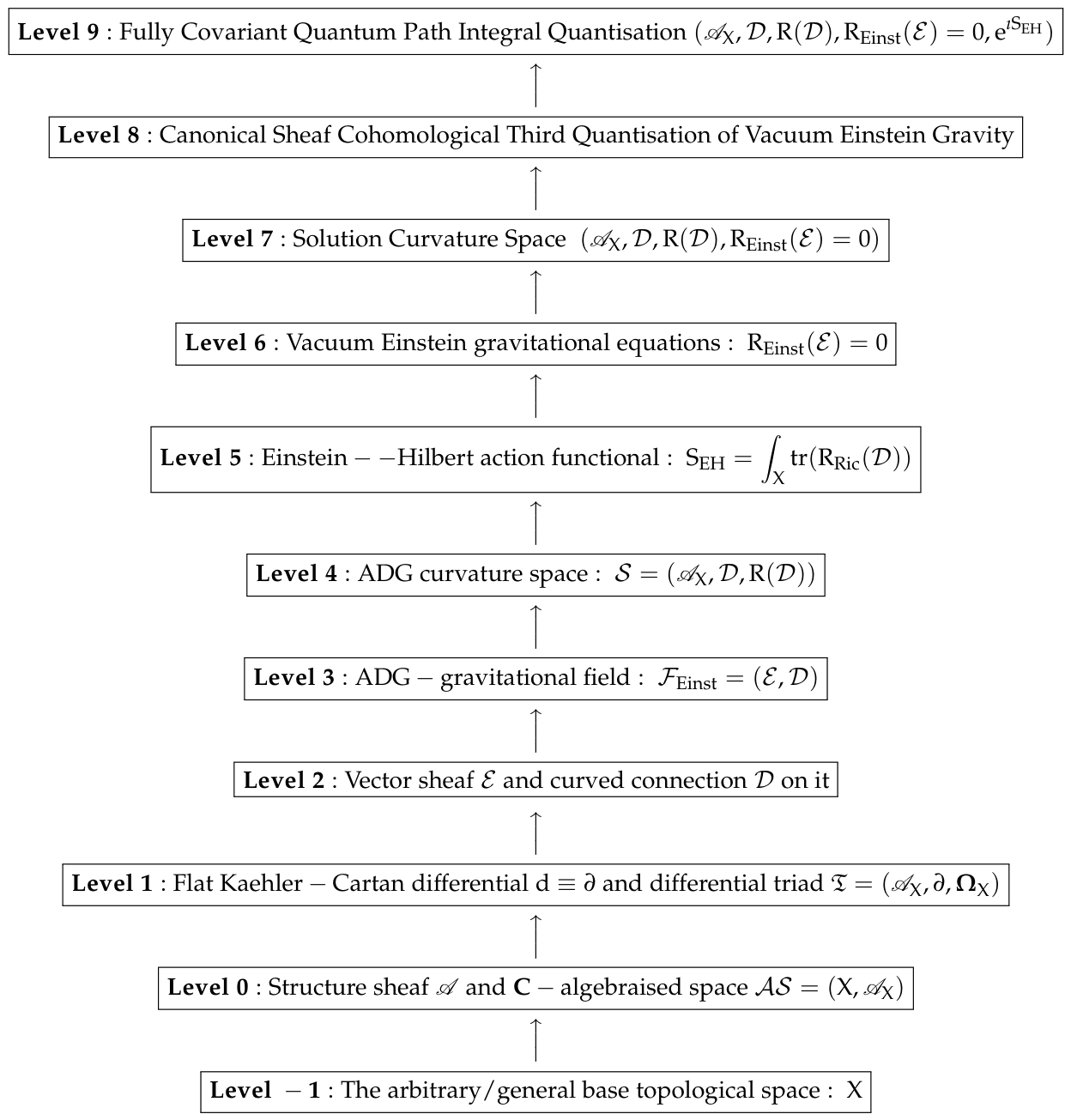


Disclaimer/Publisher’s Note: The statements, opinions and data contained in all publications are solely those of the individual author(s) and contributor(s) and not of MDPI and/or the editor(s). MDPI and/or the editor(s) disclaim responsibility for any injury to people or property resulting from any ideas, methods, instructions or products referred to in the content. |
© 2026 by the author. Licensee MDPI, Basel, Switzerland. This article is an open access article distributed under the terms and conditions of the Creative Commons Attribution (CC BY) license.
Share and Cite
Raptis, I.
Raptis I.
Raptis, Ioannis.
2026. "
Raptis, I.
(2026).