


Abstract
Clostridioides difficile infection (CDI) remains a major cause of healthcare-associated morbidity and mortality, particularly among older adults and patients with recent healthcare exposure, underscoring the need for early risk stratification and accurate prognostic assessment. This retrospective observational study evaluated clinical, laboratory, and therapeutic factors associated with disease severity and in-hospital mortality, and assessed the predictive performance of the ATLAS score and the Charlson comorbidity index. A total of 101 adult inpatients with laboratory-confirmed CDI admitted to a Portuguese tertiary care hospital were included. Data were extracted from clinical records and analysed using comparative statistics, multivariable logistic regression, and Kaplan–Meier survival analysis. Advanced age, elevated white blood cell count, renal dysfunction, and prior exposure to multiple antibiotic classes were independently associated with increased disease severity and mortality. The ATLAS score demonstrated good discriminative ability, particularly for short-term mortality, and showed higher sensitivity compared with the Charlson comorbidity index. These findings provide additional evidence on clinical and laboratory factors associated with severe CDI and in-hospital mortality, while supporting the utility of the ATLAS score as a practical tool for early risk stratification in hospitalised patients.
1. Introduction
Clostridioides difficile infection (CDI) is among the most significant healthcare-associated infections worldwide, posing substantial challenges for clinical management and public health systems [1]. Caused by the spore-forming anaerobic bacterium Clostridioides difficile (C. difficile), CDI primarily affects the colon and is commonly associated with prior exposure to antibiotic therapy. Transmission typically occurs via the faecal–oral route, through ingestion of environmentally resilient spores that contaminate healthcare environments, surfaces, medical equipment, or the hands of healthcare workers, facilitating indirect transmission between patients, particularly in hospital settings [2]. Its pathogenesis is mediated by the production of toxins A and B, which induce inflammation, disrupt the intestinal epithelium, and give rise to a wide spectrum of clinical manifestations, ranging from mild diarrhoea to fulminant colitis and death [2,3,4].
Over recent decades, the epidemiology of CDI has evolved considerably, with a marked increase in incidence both in hospitalised populations and in the community setting [1]. CDI is currently recognised as a leading cause of nosocomial diarrhoea, particularly among older adults and immunocompromised individuals. However, community-acquired infection has also been increasingly recognised in individuals without recent hospitalisation or healthcare exposure [5]. Severe complications, including toxic megacolon, sepsis, and the need for colectomy, have become increasingly frequent, together with high recurrence rates that complicate therapeutic decision-making and long-term disease control [5,6].
The clinical and economic burden of CDI is substantial. In addition to prolonged hospitalisation and increased mortality, the infection is associated with significant direct and indirect healthcare costs. Consequently, strategies aimed at preventing primary infection and recurrence have gained prominence, with particular emphasis on antimicrobial stewardship, infection prevention and control measures, and the use of prognostic tools such as the ATLAS score [6,7,8]. Given the complex interaction between its microbial factors, host vulnerability, environmental persistence, and healthcare practices, CDI requires a comprehensive and multidisciplinary approach that integrates microbiological knowledge, clinical management, infection control, and health system-level strategies.
2. Background
2.1. Historical Context and Pathogenesis
Initially identified in 1935 in the stools of healthy neonates, C. difficile (formerly Clostridium difficile) was initially considered a non-pathogenic component of the intestinal microbiota [9,10]. It was not until the late 1970s that the bacterium was definitively linked to pseudomembranous colitis and antibiotic-associated diarrhoea, coinciding with the widespread use of broad-spectrum antibiotics that disrupted the normal gut flora [11]. This ecological disruption permits the germination of dormant spores and colonisation of the colon, where C. difficile exerts its pathogenic effects by producing exotoxins.
The organism’s spores are metabolically dormant yet highly resistant to environmental stressors, including desiccation, disinfectants, and gastric acid, allowing them to persist for months on surfaces [11,12,13]. These features make C. difficile exceptionally difficult to eradicate within healthcare settings and contribute to its high transmissibility and recurrence rates. Germination into vegetative cells occurs upon exposure to bile salts and other germinants in the intestinal tract, initiating toxin production and clinical disease [11].
2.2. Epidemiology and Global Distribution
The global burden of CDI varies considerably across regions and is influenced by healthcare infrastructure, surveillance systems, diagnostic practices, and antimicrobial usage [1]. In Europe, coordinated surveillance efforts have improved the understanding of CDI epidemiology. The European Centre for Disease Prevention and Control (ECDC) has identified C. difficile as the eighth most frequently reported healthcare-associated pathogen, with incidence rates showing a decline in some regions due to improved infection control and antimicrobial stewardship initiatives [14,15,16].
Conversely, in Asia and Australia, the epidemiological picture is more fragmented. Studies highlight a lack of standardised diagnostic and reporting protocols, which hinders accurate estimation of CDI prevalence and complicates international comparisons [9,17,18,19]. In North America, particularly the United States, there has been a marked increase in community-associated CDI, which now represents approximately 40–42% of total cases [20,21,22]. This shift challenges the long-held assumption that CDI is solely a nosocomial issue and has prompted a re-evaluation of public health strategies [21,23].
Globally, CDI genotyping efforts have provided insights into the spread of hypervirulent strains, including BI/NAP1/027, which are associated with higher toxin production, resistance to fluoroquinolones, and worse clinical outcomes [24]. These findings reinforce the importance of genomic surveillance and international collaboration to track and contain outbreaks effectively.
2.3. Clinical Spectrum and Diagnosis
The clinical presentation of CDI is highly variable. Most commonly, it manifests as profuse, watery diarrhoea accompanied by lower abdominal cramping and systemic signs such as fever and leukocytosis [25]. In more severe cases, patients may develop pseudomembranous colitis, characterised by the formation of yellowish plaques on the mucosa, as well as complications including toxic megacolon, bowel perforation, and septic shock [26]. These life-threatening outcomes are more prevalent in elderly patients, those with comorbid conditions, or those exposed to virulent strains of the bacterium [26].
Depending on symptom onset and healthcare exposure, the infection is broadly categorised as healthcare-associated or community-acquired [11,12]. Healthcare-associated CDI typically occurs after hospitalisation and antibiotic therapy, whereas community-acquired CDI has been increasingly recognised in individuals without recent hospital stays, suggesting broader environmental or community reservoirs.
Diagnosis of CDI requires the detection of toxigenic strains or their products in stool samples. However, distinguishing between actual infection and asymptomatic colonisation remains challenging, as C. difficile can be present without causing symptoms [12]. This distinction is essential to avoid overtreatment and ensure targeted infection control measures.
2.4. Prognosis and Clinical Stratification
The severity of CDI varies widely, ranging from mild diarrhoea to fulminant colitis with a risk of perforation, sepsis, and death. Accurate clinical stratification is, therefore, essential for guiding treatment decisions and anticipating outcomes. Several patient-related factors influence prognosis, including advanced age, comorbidities, immunosuppression, hypoalbuminemia, and renal dysfunction [11,27,28].
Tools such as the ATLAS score have been developed and validated to support bedside risk assessment. The ATLAS score incorporates six clinical variables: Age, Treatment with systemic antibiotics, Leukocyte count, Albumin level, Serum creatinine, and Systemic temperature [29,30]. Each variable is scored, and the total score stratifies patients into mild, moderate, or severe categories. Higher scores are associated with increased mortality, need for colectomy, and treatment failure [31].
Studies have shown that patients scoring eight or above on the ATLAS scale have a near 100% mortality rate, whereas those with scores of 0–3 typically exhibit favourable outcomes without complications [11,31]. This scoring system aids clinicians in the early identification of high-risk cases, allowing for prompt initiation of more aggressive treatment strategies or surgical referrals.
While the ATLAS score is not a reliable predictor of recurrence, it remains a valuable tool for evaluating initial disease severity and supporting triage decisions. Its ease of use and reliance on routinely collected clinical parameters make it especially suitable for application in acute care and high-turnover hospital environments [30,32].
2.5. Prevention and Infection Control Measures
Preventing CDI requires a comprehensive approach centred on minimising transmission and reducing recurrence. The bacterium’s spore-forming ability renders it highly resistant to standard disinfectants, making infection control particularly challenging in healthcare settings [11,13].
Contact precautions, including gloves and gowns, are mandatory when caring for suspected or confirmed CDI cases. Whenever possible, patients should be isolated in single rooms with dedicated sanitary facilities [11,33]. Hand hygiene is essential; however, due to the resistance of spores to alcohol-based solutions, soap and water must be used after patient contact.
Environmental cleaning with sporicidal agents is vital. Surfaces like bed rails, toilets, and medical equipment are frequent contamination points. Routine and terminal cleaning protocols significantly reduce environmental spore burden [33,34].
Antimicrobial stewardship programmes (ASPs) are critical to the prevention of CDI, aiming to reduce unnecessary antibiotic exposure, particularly to agents such as clindamycin and fluoroquinolones that disrupt the gut microbiota and increase susceptibility to CDI [6,7,11,35]. Similarly, the judicious use of proton pump inhibitors (PPIs) is recommended, given their potential association with an increased risk of infection [27,28,36].
Prevention depends on integrated institutional strategies that combine active surveillance, adherence to infection prevention and control measures, environmental hygiene, and rational antimicrobial use across healthcare settings [11,28].
3. Materials and Methods
3.1. Study Aim
The present study aimed to identify and characterise the clinical, laboratory, and therapeutic factors associated with the severity of CDI and to explore their relationship with clinical outcomes, namely the occurrence of complications, in-hospital mortality, and medium-term survival (90 and 180 days). Furthermore, the study sought to assess the predictive capacity of the ATLAS and Charlson clinical scores in forecasting mortality to contribute to a more effective risk stratification in hospital settings.
3.2. Study Design
A retrospective observational analytical study was conducted. This study design is appropriate for investigating exposures related to less frequent outcomes, such as severe forms of CDI, enabling a retrospective analysis of clinical and laboratory data from groups defined by the severity of infection. This study design is appropriate for investigating exposures related to less frequent outcomes, such as severe forms of CDI, enabling a retrospective analysis of clinical and laboratory data from groups defined by the severity of infection.
3.3. Setting
The study was conducted in a tertiary Portuguese public hospital, which serves more than 130,000 residents and an estimated indirect population of 250,000. Data were retrieved from both physical and electronic medical records and the hospital’s digital laboratory platform, covering the period between 2018 and 2019. This timeframe was selected because it provided complete and consistent clinical and laboratory documentation for patients with laboratory-confirmed CDI. Subsequent years were excluded due to inconsistencies in clinical records and documentation during the COVID-19 pandemic, which affected the completeness and comparability of the available data. Data collection took place between June and July 2022.
3.4. Participants
The study included adult inpatients admitted in 2018 and 2019 with a laboratory-confirmed diagnosis of CDI, regardless of the primary reason for hospitalisation. Following the screening of 112 cases, 11 patients were excluded due to incomplete data on the main variables under study, resulting in a final sample of 101 patients. The severity of infection was classified using the ATLAS score: <6 points (mild/moderate) and ≥6 points (severe), allowing the formation of the two analytical groups.
3.5. Data Collection and Operational Definition of Variables
Data used in this study were systematically collected from patients’ physical and electronic medical records and from the institution’s digital laboratory results platform. The laboratory measurements reported correspond to results obtained using the routine equipment and procedures at the hospital during the study period. A single investigator extracted information in a standardised manner, ensuring consistency in data recording and minimising the risk of classification bias. Three main categories of variables were considered: (i) demographic and clinical characteristics, (ii) laboratory data, and (iii) clinical outcomes. Each variable was previously defined and operationalised to ensure consistent and reproducible coding (see Table 1).
Table 1.
Description and analytical role of the variables included in the study.
The data collected included continuous variables, binary categorical variables, and multicategorical variables. Infection severity was defined based on the ATLAS score, calculated for each case using objective clinical and laboratory parameters, and categorised according to the classification commonly used in the literature (<6 points: mild/moderate; ≥6 points: severe) [32]. Variables related to ICU admission and ICU hospitalisation duration were defined based on the patient’s status prior to the diagnosis of CDI, ensuring that only exposures occurring before infection onset were considered in the multivariable analysis. Table 1 summarises the variables included, specifying their type, source, and analytical role.
3.6. Statistical Analysis
Statistical analysis was performed using SPSS version 29.0 (IBM Corp., Armonk, NY, USA). Descriptive statistics were used to characterise the sample. Normality was assessed using the Kolmogorov–Smirnov test, and homogeneity of variances was evaluated with Levene’s test. The two groups were compared using Student’s t-test or the Mann–Whitney U test, depending on the distribution. ANOVA, or the Kruskal–Wallis test, was used for comparisons involving more than two groups. The Chi-square test was employed to compare proportions; Monte Carlo simulation correction or Fisher’s exact test was applied when appropriate. Standardised adjusted residuals were analysed to identify specific contributions.
Only variables occurring prior to the diagnosis of CDI were considered eligible for inclusion in the multivariable models. Binary logistic regression models were constructed to identify factors associated with infection severity and in-hospital mortality, including variables statistically significant in bivariate analyses or those with clinical relevance.
Survival at 90 and 180 days was analysed using Kaplan–Meier curves, with group comparisons performed using the log-rank test. The predictive performance of the ATLAS and Charlson scores in forecasting in-hospital mortality was evaluated through diagnostic validity analysis, including confusion matrix construction and calculation of sensitivity, specificity, positive predictive value, and negative predictive value. The significance level was set at p ≤ 0.01, p ≤ 0.05 or p ≤ 0.001. Cases with missing data in the main variables were excluded prior to analysis.
3.7. Ethical Considerations
The study was approved by the Ethics Committee of the Hospital do Divino Espírito Santo de Ponta Delgada, EPER (approval number CESHDES/12/2022). The requirement for informed consent was waived due to the retrospective nature of the study, which was based exclusively on previously recorded clinical data. All data were processed in an anonymised manner, ensuring confidentiality and full compliance with the General Data Protection Regulation and applicable national legislation.
4. Results
This chapter presents the study’s main findings involving 101 patients diagnosed with CDI, emphasising differences between patients with mild/moderate and severe disease. The results are organised according to the nature of the variables analysed and the statistical methods applied, including the clinical characterisation of the sample, associations with disease severity, and predictors of severity and mortality. The analysis also includes medium-term survival outcomes and the predictive value assessment of two widely used clinical scoring systems.
4.1. Sample Characterisation and Comparison According to Infection Severity
The study sample comprised 101 patients diagnosed with CDI, of whom 70 presented with mild to moderate disease and 31 with severe disease (Table 2). The majority were female (57.4%), with a global mean age of 75.1 ± 14.0 years. Age was significantly higher in the severe disease group (80.7 ± 9.6 vs. 72.6 ± 15.0 years; p = 0.001). The age distribution revealed a higher proportion of patients aged ≥80 in the severe group (77.4% vs. 42.9%).
Table 2.
Demographic, clinical, and hospitalisation characteristics of patients with CDI: comparison between mild/moderate and severe disease.
The mean hospital length of stay was 22.9 ± 17.8 days, with no statistically significant differences between groups. Most hospital admissions were urgent (95%), and the Internal Medicine department accounted for 69.3% of cases. The most common comorbidities were cardiac disease (74.3%), diabetes mellitus (67.3%), and cerebrovascular disease (29.7%). Diabetes mellitus (90.3% vs. 57.1%; p = 0.001), cerebrovascular disease (48.4% vs. 21.4%; p = 0.009), and pulmonary disease (25.8% vs. 8.6%; p = 0.030) were significantly more prevalent in patients with severe disease.
Most infections had a hospital-onset origin (61.4%), with no significant differences between groups (Table 3). The ATLAS severity score was significantly higher in severe cases (7.5 ± 0.8 vs. 3.8 ± 1.6; p = 0.001). The most frequent symptoms were diarrhoea (95.0%), fever (56.0%), and fatigue (54.0%). Fever (76.7% vs. 47.1%; p = 0.008), fatigue (73.3% vs. 45.7%; p = 0.016), and dehydration (73.3% vs. 40.0%; p = 0.004) were more common in patients with severe disease.
Table 3.
Clinical characteristics and origin of CDI: comparison between patients with mild/moderate and severe disease.
Concerning antibiotic exposure (Table 4), patients with severe disease received, on average, a higher number of antibiotics prior to diagnosis (2.8 ± 1.3 vs. 2.1 ± 1.2; p = 0.021) and a greater number of different antibiotic classes (2.5 ± 0.9 vs. 1.9 ± 1.0; p = 0.013). Administration of meropenem (36.4% vs. 8.3%; p = 0.007) and carbapenems in general (59.1% vs. 22.9%; p = 0.006) was significantly more frequent in the severe disease group.
Table 4.
Comparative analysis of clinical, hospitalisation, and antibiotic exposure risk factors between patients with mild/moderate and severe CDI.
Body temperature, white blood cell count, and serum creatinine levels were significantly higher in patients with severe disease, whereas serum albumin levels were lower (Table 5).
Table 5.
Comparison of physiological and laboratory parameters at the time of CDI confirmation according to disease severity.
Complications occurred in 74.3% of patients, with a higher proportion of severe complications among those with severe disease (61.5% vs. 26.5%; p = 0.006) (Table 6). Regarding treatment, oral fidaxomicin was more frequently used in mild/moderate cases, whereas intravenous vancomycin and combination therapies were more common in severe cases. The use of concomitant intravenous antibiotics was also higher in this group (35.5% vs. 5.7%; p = 0.001).
Table 6.
Comparison of complications, antibiotics used, concomitant therapy, and clinical outcomes between patients with mild/moderate and severe CDI.
In-hospital survival was significantly lower among patients with severe disease (67.7% vs. 88.6%; p = 0.022).
4.2. Clinical Characteristics According to Infection Origin
The comparison between the three types of infection (CO-CDI, HO-CDI, and CO-HCFA-CDI) revealed significant differences only in hospital length of stay, which was longer in hospital-onset cases (27.2 ± 18.2 days; p = 0.001) (Table 7). Previous CDI was more prevalent in the CO-HCFA-CDI group (44.4%; p = 0.001), and antibiotic therapy during the current hospitalisation was more frequent in the HO-CDI group (82.3%; p = 0.001) (Table 8).
Table 7.
Comparative analysis of demographic, clinical, and laboratory data according to the type of CDI (CO-CDI, HO-CDI, and CO-HCFA-CDI).
Table 8.
Comparison of clinical history, prior therapy, and clinical evolution among different types of CDI.
4.3. Factors Associated with Disease Severity
In the multivariate analysis, age ≥ 80 years was associated with an increased risk of severe disease: 80–84 years (OR = 4.667; p = 0.032) and ≥85 years (OR = 4.615; p = 0.042). Prior administration of ≥3 antibiotics (OR = 5.538; p = 0.021), body temperature ≥ 37.6 °C (OR up to 4.556; p < 0.05), elevated white blood cell count (OR up to 60.667; p < 0.001), and creatinine ≥ 1.80 mg/dL were all factors associated with greater disease severity. The complete regression model is presented in Appendix A Table A1.
4.4. Factors Associated with In-Hospital Mortality
A white blood cell count ≥25.01 × 10⁹/L (OR = 0.117; p = 0.006) and serum creatinine ≥ 1.80 mg/dL (OR = 0.265; p = 0.033) were the only significant predictors of in-hospital mortality. The complete regression output is provided in Appendix A Table A2.
4.5. Survival and Predictive Value of Clinical Scores
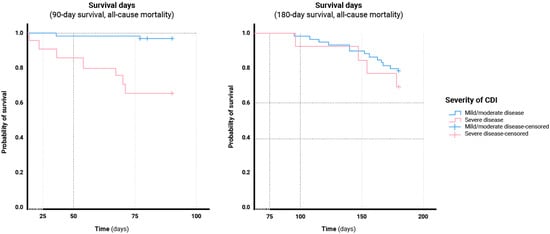
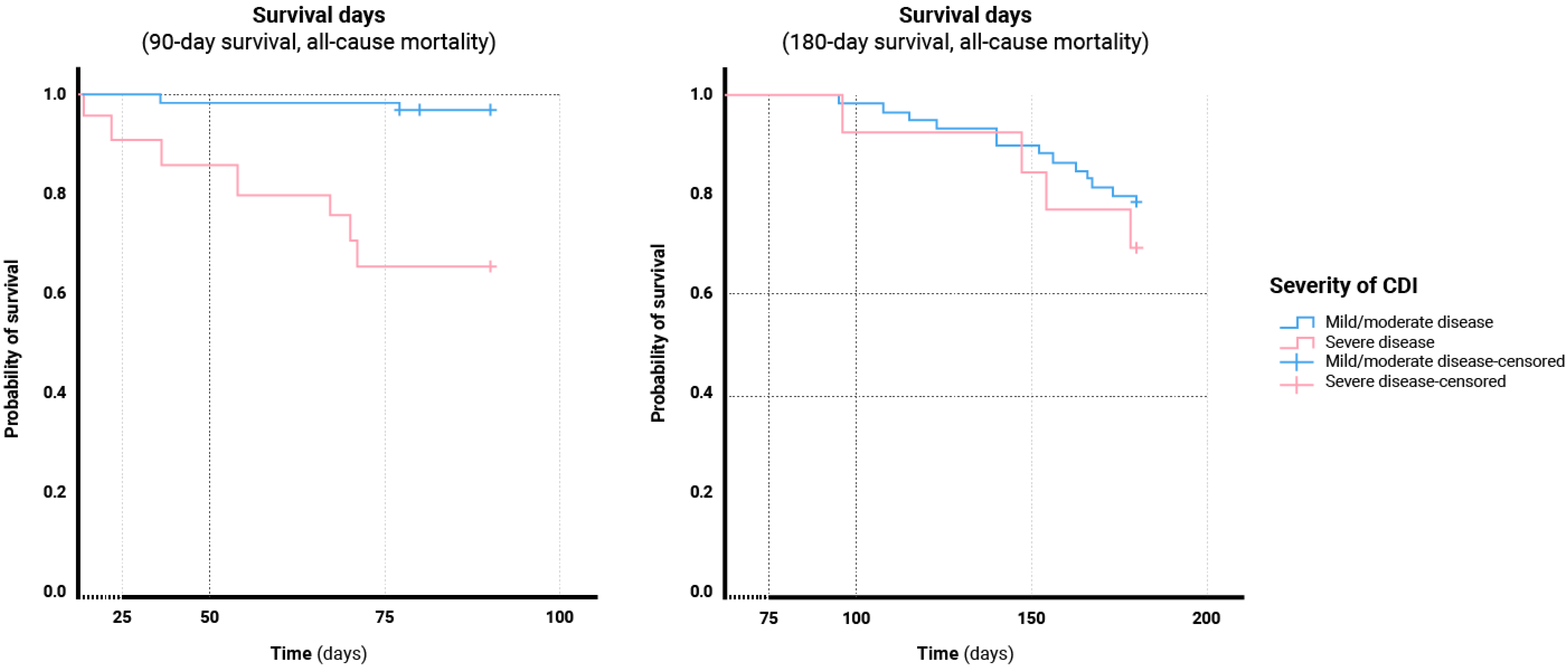
Kaplan–Meier analysis (Table 9; Figure 1) revealed significantly lower 90-day survival among patients with severe disease (p < 0.001), with no statistically significant difference at 180 days (p = 0.477).
Table 9.
Comparison of 90-day and 180-day survival between patients with mild/moderate and severe CDI (log-rank test).
Figure 1.
Kaplan–Meier survival curves at 90 and 180 days according to the severity of CDI. Dashed lines represent reference guide lines to aid visual interpretation of the curves.
The ATLAS score demonstrated good sensitivity (74.7%) and a high positive predictive value (88.6%) for mortality, whereas the Charlson score showed high specificity (94.4%) but low sensitivity (15.7%) (Table 10).
Table 10.
Predictive value of the ATLAS score and Charlson Comorbidity Score for in-hospital mortality among patients with CDI.
5. Discussion
The results of the present study reveal a clinical and epidemiological pattern consistent with existing literature on CDI, with significant implications for clinical practice and hospital management. Advanced age, particularly ≥80 years, emerged as one of the main factors associated with infection severity, in line with previous studies demonstrating that ageing impairs the integrity of the immune response and gastrointestinal recovery, thus increasing the risk of progression to more severe forms of CDI [2,5,8,37].
Similarly, the presence of comorbidities, namely diabetes mellitus, cerebrovascular disease, and pulmonary pathology, was more prevalent among patients with severe infection, supporting the hypothesis that the overall disease burden compromises the body’s ability to limit bacterial proliferation and toxic effects [6,38]. These conditions are described in the literature as predisposing factors for intestinal dysbiosis and increased exposure to antibiotics, both of which are critical in the development and worsening of CDI [25,37,39].
Previous exposure to antibiotics, particularly to multiple classes, and the administration of carbapenems such as meropenem were significantly associated with increased severity. This finding corroborates studies that highlight the extensive disruption of beneficial gut microbiota caused by broad-spectrum antibiotics as a significant risk factor for imbalances favouring C. difficile colonisation and proliferation [11,12,26,40].
In terms of laboratory parameters, the association between severe leukocytosis (≥25 × 109/L), hypoalbuminaemia, and renal insufficiency (creatinine ≥ 1.80 mg/dL) with greater severity and in-hospital mortality is particularly relevant. These indicators reflect the systemic impact of C. difficile toxins and are aligned with the criteria used in several severity scoring systems [13,41].
As applied in this study, the ATLAS score demonstrated high sensitivity and positive predictive value for mortality, proving to be a reliable tool for early risk stratification and clinical decision-making. Although the Charlson score showed reasonable specificity, its lower sensitivity limits its standalone usefulness in predicting fatal outcomes. These results are consistent with previous research suggesting the complementary utility of both scores, with ATLAS being particularly effective in the acute phase of the disease [29,41,42].
The high rate of complications, especially among severe cases, and the increased need for combined or intravenous therapies illustrate the clinical complexity of severe presentations. The lower survival rates observed in this group, both during hospitalisation and at 90 days, reinforce the need for preventive strategies, close clinical monitoring, and early initiation of targeted therapy.
Although the origin of the infection (community-acquired, hospital-acquired, or healthcare-associated) did not show significant differences in mortality or severity, hospital-acquired cases were associated with more extended hospital stays, suggesting greater morbidity. Notwithstanding the above, it is essential to acknowledge that CDI is becoming an increasingly prevalent issue in community settings and, as such, poses a considerable challenge to healthcare professionals working in these contexts, requiring renewed attention and the implementation of containment and mitigation strategies tailored to the community setting [21].
In summary, the results confirm well-established risk factors described in the literature and provide additional evidence supporting judicious antibiotic use [35], systematic laboratory monitoring, and risk stratification based on validated scoring systems to support early and individualised interventions [43].
5.1. Implications
The findings of this study have relevant implications for the multidisciplinary management of CDI in hospital settings. Early recognition of clinical and laboratory indicators of deterioration should be prioritised through coordinated surveillance by healthcare teams, supporting timely risk stratification and clinical decision-making. Systematic monitoring of parameters such as body temperature, hydration status, markers of systemic infection, renal function, and white blood cell count is essential to anticipate disease progression and adverse outcomes.
Infection prevention and control remain critical components of CDI management. Strict adherence to evidence-based measures, including hand hygiene with soap and water, appropriate use of personal protective equipment, and effective environmental decontamination, should be consistently implemented, particularly in high-risk patients and high-burden care environments. Education of patients and caregivers regarding transmission routes, preventive behaviours, and adherence to prescribed therapies further contributes to reducing recurrence and healthcare-associated spread.
Finally, the integration of validated clinical scoring systems, such as the ATLAS score, into routine clinical practice may enhance prognostic assessment and resource allocation. Familiarity with such tools across healthcare professionals can facilitate early identification of patients at increased risk and support timely escalation of care in acute clinical settings.
5.2. Limitations
This study presents several limitations that must be acknowledged. Firstly, the retrospective case–control design, based on data extracted from electronic and paper-based medical records, is inherently susceptible to information bias, particularly due to the variability in clinical documentation and potential missing or incomplete data. Although cases with insufficient information were excluded, the risk of residual data inaccuracy remains.
Secondly, the study was conducted in a single tertiary hospital, which may limit the generalisability of the findings to other healthcare settings with different patient profiles, care protocols, or epidemiological characteristics of CDI.
Thirdly, the classification of CDI severity relied on the ATLAS score, which, although widely used, may not capture the full clinical complexity or dynamic progression of the infection in all cases. Furthermore, some variables, such as prior antibiotic exposure, were collected retrospectively and may be subject to underreporting if not thoroughly documented.
Finally, no matching procedure was applied between cases and controls, and although multivariate models were used to adjust for confounding factors, the possibility of residual confounding cannot be excluded.
6. Conclusions
CDI remains a major clinical and organisational challenge, particularly among older patients and individuals with multiple comorbidities. This study identified key factors associated with increased disease severity and in-hospital mortality, including advanced age, leukocytosis, renal dysfunction, hypoalbuminaemia, and prior exposure to multiple antibiotic classes. Disease severity was consistently reflected in clinical risk scores, with the ATLAS score demonstrating particular value in predicting adverse outcomes.
These findings underscore the importance of integrated, risk-based clinical approaches that combine early recognition, systematic monitoring, and timely therapeutic intervention. The rigorous application of infection prevention and control measures, together with judicious antimicrobial stewardship, remains central to mitigating the burden of CDI. Furthermore, the use of validated risk stratification tools such as the ATLAS score may support informed clinical decision-making and more efficient allocation of healthcare resources, particularly in acute care settings.
Funding
This research received no external funding.
Institutional Review Board Statement
The study was conducted in accordance with the Declaration of Helsinki and approved by the Ethics Committee of the Hospital do Divino Espírito Santo de Ponta Delgada, EPER (protocol code CESHDES/12/2022).
Informed Consent Statement
Patient consent was waived due to the retrospective nature of the study, which was based exclusively on previously recorded clinical data. No direct patient contact or intervention was involved.
Data Availability Statement
The data supporting the findings of this study are not publicly available due to ethical and privacy restrictions. However, the data are available from the corresponding author upon reasonable request.
Conflicts of Interest
The author declares no conflicts of interest.
Appendix A
Appendix A.1. Severe CDI
Table A1.
Appendix A Table A1 presents the full results of the multivariable logistic regression model used to identify factors associated with the development of severe CDI. The table includes all variables entered into the model, together with their regression coefficients (B), standard errors (S.E.), p-values, odds ratios (OR), and 95% confidence intervals. This detailed output is provided to ensure full transparency of the statistical analysis, while the main statistically significant findings are summarised and interpreted in the Section 4 of the manuscript.
Appendix A.2. In-Hospital Mortality
Table A2.
Appendix A Table A2 provides the complete output of the multivariable logistic regression model assessing factors associated with in-hospital mortality among patients with laboratory-confirmed CDI. For each variable included in the model, the table reports the regression coefficients (B), standard errors (S.E.), p-values, odds ratios (OR), and corresponding 95% confidence intervals. The principal results are described in the Section 4, whereas this appendix presents the full model to allow readers to examine the complete set of estimates generated in the analysis.
References
- Akorful, R.; Odoom, A.; Awere-Duodu, A.; Donkor, E.S. The global burden of Clostridioides difficile infections, 2016–2024: A systematic review and meta-analysis. Infect. Dis. Rep. 2025, 17, 31. [Google Scholar] [CrossRef] [Scilit]
- Abreu, A.A.Y.; Velarde-Ruiz Velasco, J.; Zavala-Solares, M.; Remes-Troche, J.; Carmona-Sánchez, R.; Aldana-Ledesma, J.; Camacho-Ortiz, A.; Contreras-Omaña, R.; Díaz-Seoane, R.; Elizondo-Vázquez, C.; et al. Consensus on the prevention, diagnosis, and treatment of Clostridium difficile infection. Rev. Gastroenterol. Mex. 2019, 84, 204–219. [Google Scholar] [CrossRef] [Scilit]
- Lopardo, G.; Morfin-Otero, R.; Moran-Vazquez, I.; Noriega, F.; Zambrano, B.; Luxemburger, C.; Foglia, G.; Rivas, E. Epidemiology of Clostridium difficile: A hospital-based descriptive study in Argentina and Mexico. Braz. J. Infect. Dis. 2015, 19, 8–14. [Google Scholar] [CrossRef] [Scilit]
- Shin, J.; Jackson-Akers, J.; Hoang, S.; Behm, B.; Warren, C. Fulminant Clostridioides difficile infection: A journey into the unknown! Med. Clin. 2025, 109, 721–734. [Google Scholar]
- Hernández-García, R.; Garza-González, E.; Miller, M.; Arteaga-Muller, G.; Galván-de los Santos, A.; Camacho-Ortiz, A. Application of the ATLAS score for evaluating the severity of Clostridium difficile infection in teaching hospitals in Mexico. Braz. J. Infect. Dis. 2015, 19, 399–402. [Google Scholar] [CrossRef] [Scilit]
- Heimann, S.; Cruz Aguilar, M.; Mellinghof, S.; Vehreschild, M. Economic burden and cost-effective management of Clostridium difficile infections. Med. Mal. Infect. 2018, 48, 23–29. [Google Scholar] [CrossRef] [Scilit]
- Liu, E.; Preece, J.; Suson, K. Clostridium difficile: What is the risk? J. Pediatr. Urol. 2022, 18, 785.e1–785.e7. [Google Scholar] [CrossRef] [Scilit]
- Lee, H.; Hsiao, H.; Chia, C.; Cheng, C.; Tsai, T.; Deng, S.; Chen, C.; Chiu, C. Risk factors and outcomes of Clostridium difficile infection in hospitalized patients. Biomed. J. 2019, 42, 99–106. [Google Scholar] [CrossRef] [Scilit]
- Angulo, F.; Ghia, C.; Fletcher, M.; Ozbilgili, E.; Morales, G. The burden of Clostridioides difficile infections in South-East Asia and the Western Pacific: A narrative review. Anaerobe 2024, 86, 102821. [Google Scholar] [CrossRef] [Scilit]
- Rodriguez, C.; Taminiau, B.; Van Broeck, J.; Delmée, M.; Daube, G. Clostridium difficile infection and intestinal microbiota interactions. Microb. Pathog. 2015, 89, 201–209. [Google Scholar] [CrossRef] [Scilit]
- Kunishima, H.; Ohge, H.; Suzuki, H.; Nakamura, A.; Matsumoto, K.; Mikamo, H.; Mori, N.; Morinaga, Y.; Yanagihara, K.; Yamagishi, Y.; et al. Japanese clinical practice guidelines for management of Clostridioides (Clostridium) difficile infection. J. Infect. Chemother. 2022, 28, 1045–1083. [Google Scholar] [CrossRef] [Scilit]
- Furtado, L.C.d.R. Clostridioides difficile: A review of relevant topics for infection prevention and control. Gastrointest. Nurs. 2022, 20, 28–38. [Google Scholar] [CrossRef] [Scilit]
- Czepiel, J.; Dróżdż, M.; Pituch, H.; Kuijper, E.; Perucki, W.; Mielimonka, A.; Goldman, S.; Wultańska, D.; Garlicki, A.; Biesiada, G. Clostridium difficile infection: Review. Eur. J. Clin. Microbiol. Infect. Dis. 2019, 38, 1211–1221. [Google Scholar] [CrossRef] [Scilit]
- Althaqafi, A.; Munshi, A.; Baghlaf, B.; Munshi, E.; Malakah, M.; Almarhabi, H.; Alharbi, M.; Alsaedi, A. The prevalence, risk factors, and complications of Clostridium difficile infection in a tertiary care center, western region, Saudi Arabia. J. Infect. Public. Health 2022, 15, 1037–1042. [Google Scholar] [CrossRef] [Scilit]
- Garcia, M.; Vázquez, O.; Duran, J.; Horcajada, J.; Almendral, A.; Porrón, R.; Limón, E.; Pujol, M. Trends in point-prevalence studies of healthcare-associated infections in long-term care facilities: A nationwide surveillance program in Catalonia, Spain (2013–2022). Enferm. Infecc. Microbiol. Clin. 2025, 43, S11–S18. [Google Scholar] [CrossRef] [Scilit]
- Saydan, S.; Schwab, F.; Holstiege, J.; Bätzing, J.; Behnke, M.; Schneider, S.; Clausmeyer, J.; Gastmeier, P.; Geffers, C.; Maechler, F. Surveillance of Clostridioides difficile on hospital admission and outpatient antibiotic use in Germany: A 9-year ecological analysis. J. Antimicrob. Chemother. 2025, 80, 817–824. [Google Scholar] [CrossRef] [Scilit]
- Luo, R.; Barlam, T. Ten-year review of Clostridium difficile infection in acute care hospitals in the USA, 2005–2014. J. Hosp. Infect. 2018, 98, 40–43. [Google Scholar] [CrossRef] [Scilit]
- Stuart, R.; Marshall, C.; Harrington, G.; Sasko, L.; McLaws, M.; Ferguson, J. ASID/ACIPC position statement—Infection control for patients with Clostridium difficile infection in healthcare facilities. Infect. Dis. Health 2019, 24, 32–43. [Google Scholar] [CrossRef] [Scilit]
- Bai, L.; Xu, T.; Zhang, W.; Jiang, Y.; Gu, W.; Zhao, W.; Luan, Y.; Xiong, Y.; Zou, N.; Zhang, Y.; et al. Abundant geographical divergence of Clostridioides difficile infection in China: A prospective multicenter cross-sectional study. BMC Infect. Dis. 2025, 25, 10552. [Google Scholar] [CrossRef] [Scilit]
- Al-Tawfiq, J.; Rabaan, A.; Bazzi, A.; Raza, S.; Noureen, M. Clostridioides (Clostridium) difficile-associated disease: Epidemiology among patients in a general hospital in Saudi Arabia. Am. J. Infect. Control. 2020, 48, 1152–1157. [Google Scholar] [CrossRef] [Scilit]
- Álvarez-Villalobos, N.; Ruiz-Hernandez, F.; Méndez-Arellano, A.; Azamar-Márquez, J.; Camacho-Ortiz, A. Epidemiologic profile of community-acquired Clostridioides difficile infections: A systematic review and meta-analysis. Epidemiol. Infect. 2025, 153, e20. [Google Scholar] [CrossRef] [Scilit] [PubMed]
- Currie, D.; Lewis, C.; Lutgring, J.; Kazakova, S.; Baggs, J.; Korhonen, L.; Correa, M.; Goodenough, D.; Olson, D.; Szydlowski, J.; et al. Comparison of Medicare claims-based Clostridioides difficile infection epidemiologic case classification algorithms to medical record review by the Emerging Infections Program using a linked cohort, 2016–2021. Infect. Control. Hosp. Epidemiol. 2025, 46, 488–496. [Google Scholar] [CrossRef] [Scilit] [PubMed]
- De-la-Rosa-Martínez, D.; Villaseñor-Echavarri, R.; Vilar-Compte, D.; Mosqueda-Larrauri, V.; Zinser-Peniche, P.; Blumberg, S. Heterogeneity of Clostridioides difficile asymptomatic colonization prevalence: A systematic review and meta-analysis. Gut Pathog. 2025, 17, 6. [Google Scholar] [CrossRef] [Scilit] [PubMed]
- von Müller, L.; Mock, M.; Halfmann, A.; Stahlmann, J.; Simon, A.; Herrmann, M. Epidemiology of Clostridium difficile in Germany based on a single-center long-term surveillance and German-wide genotyping of recent isolates provided to the advisory laboratory for diagnostic reasons. Int. J. Med. Microbiol. 2015, 305, 807–813. [Google Scholar] [CrossRef] [Scilit]
- Choucair, J.; Waked, R.; Haddad, E.; Chedid, M.; Chehata, N.; Saliba, G.; Dahboul, H. Clostridioides difficile infections: Epidemiology, correlations and treatment in a Lebanese cohort with use of ATLAS scoring. J. Infect. Dev. Ctries. 2020, 14, 1461–1465. [Google Scholar] [CrossRef] [Scilit]
- Álvarez-Hernández, D.; González-Chávez, A.; González-Hermosillo-Cornejo, D.; Franyuti-Kelly, G.; Díaz-Girón-Gidi, A.; Vázquez-López, R. Present and past perspectives on Clostridium difficile infection. Rev. Gastroenterol. Mex. 2018, 83, 41–50. [Google Scholar] [CrossRef] [Scilit]
- Ogielska, M.; Lanotte, P.; Le Brun, C.; Valentin, A.; Garot, D.; Tellier, A.; Halimi, J.; Colombat, P.; Guilleminault, L.; Lioger, B.; et al. Emergence of community-acquired Clostridium difficile infection: The experience of a French hospital and review of the literature. Int. J. Infect. Dis. 2015, 37, 36–41. [Google Scholar] [CrossRef] [Scilit]
- Alkhawaja, S.; Abo Arisheh, T.; Acunin, R.; Alawi, F.; Sharaf, A.; Alawainati, M.; Alzamrooni, A.; Husain, H.; Alsalah, S. Incidence, clinical characteristics, and outcomes of Clostridium difficile infection in a tertiary care center in Bahrain. Cureus 2024, 16, e57381. [Google Scholar] [CrossRef] [Scilit]
- Carvalho, F.; Silva, R.; Santos, B.; Diniz, A.; Vilela, E. Clinical outcome and severity of Clostridioides (Clostridium) difficile infection at a tertiary referral hospital in Brazil. Arq. Gastroenterol. 2023, 60, 330–338. [Google Scholar] [CrossRef] [Scilit]
- Knafl, D.; Vossen, M.; Gerges, C.; Lobmeyr, E.; Karolyi, M.; Wagner, L.; Thalhammer, F. Hypoalbuminemia as predictor of recurrence of Clostridium difficile infection. Wien. Klin. Wochenschr. 2019, 131, 68–74. [Google Scholar] [CrossRef] [Scilit]
- Negrut, N.; Bungau, S.; Behl, T.; Khan, S.; Vesa, C.; Bustea, C.; Nistor-Cseppento, D.; Rus, M.; Pavel, F.; Tit, D. Risk factors associated with recurrent Clostridioides difficile infection. Healthcare 2020, 8, 352. [Google Scholar] [CrossRef] [Scilit]
- Miller, M.; Louie, T.; Mullane, K.; Weiss, K.; Lentnek, A.; Golan, Y.; Kean, Y.; Sears, P. Derivation and validation of a simple clinical bedside score (ATLAS) for Clostridium difficile infection which predicts response to therapy. BMC Infect. Dis. 2013, 13, 148. [Google Scholar] [CrossRef] [Scilit]
- Domeniconi, G.; Serafino, S.; Migone De Amicis, M.; Formica, S.; Lanzoni, M.; Maraschini, A.; Sisto, F.; Consonni, D.; Cappellini, M.; Fabio, G.; et al. Clostridium difficile infection epidemiology and management: Comparison of results of a prospective study with a retrospective one in a reference teaching and research hospital in Northern Italy. Am. J. Infect. Control 2016, 44, 1214–1218. [Google Scholar] [CrossRef] [Scilit]
- Bednárik, D.; Földvári-Nagy, K.; Simon, V.; Rancz, A.; Gede, N.; Veres, D.; Paraskevopoulos, P.; Schnabel, T.; Erőss, B.; Hegyi, P.; et al. Comparative effectiveness of different therapies for Clostridioides difficile infection in adults: A systematic review and network meta-analysis of randomized controlled trials. Lancet Reg. Health Eur. 2025, 49, 101151. [Google Scholar] [CrossRef] [Scilit]
- Awada, B.; Zribi, A.; Al Ghoche, A.; Kanj, S. Current trends in antimicrobial use and the role of antimicrobial stewardship in palliative oncology: A narrative review. BMC Palliat. Care 2025, 24, 149. [Google Scholar] [CrossRef] [Scilit]
- Finke, M.; Boven, A.; Vlieghe, E.; Engstrand, L.; Orsini, N.; Brusselaers, N. Proton pump inhibitors and the risk of Clostridioides difficile infection: A systematic review and dose–response meta-analysis. J. Infect. 2025, 90, 106488. [Google Scholar] [CrossRef] [Scilit]
- Martínez-Lozano, H.; Saralegui-Gonzalez, P.; Reigadas, E.; Fueyo-Peláez, P.; García-García, A.; Miranda-Bautista, J.; Alcalá, L.; Nieto, J.; Lobato-Matilla, M.; Marín-Jiménez, I.; et al. Risk factors for Clostridioides difficile infection among patients diagnosed with inflammatory intestinal and rheumatological diseases in the biologic era. BMC Gastroenterol. 2025, 25, 365. [Google Scholar] [CrossRef] [Scilit] [PubMed]
- Eng, L.; Collins Deirdre, A.; Alene Kefyalew, A.; Bory, S.; Theng, Y.; Vann, P.; Meng, S.; Limsreng, S.; Clements Archie, C.; Riley Thomas, V. Clostridioides (Clostridium) difficile infection in hospitalized adult patients in Cambodia. Microbiol. Spectr. 2025, 13, e02747-24. [Google Scholar] [CrossRef] [Scilit]
- Lawson, P.; Citron, D.; Tyrrell, K.; Finegold, S. Reclassification of Clostridium difficile as Clostridioides difficile (Hall and O’Toole 1935) Prévot 1938. Anaerobe 2016, 40, 95–99. [Google Scholar] [CrossRef] [Scilit] [PubMed]
- Mori, N.; Shibata, Y.; Hirai, J.; Asai, N.; Mikamo, H. Days of antibiotic spectrum coverage (DASC) as predictors of recurrent Clostridioides difficile infection: A retrospective cohort study. J. Infect. Chemother. 2025, 31, 102650. [Google Scholar] [CrossRef] [Scilit] [PubMed]
- Nagaoka, H.; Morita, Y.; Ohya, T.; Takahashi, K.; Sato, J.; Miyata, M.; Iwashita, S.; Arai, Y.; Kiuchi, S.; Ozone, H.; et al. Predicting recurrent Clostridioides difficile infection by assessing antimicrobial treatment based on days of antibiotic spectrum coverage and ATLAS scores. J. Infect. Chemother. 2025, 31, 102603. [Google Scholar] [CrossRef] [Scilit] [PubMed]
- Cui, Y.; Dong, D.; Zhang, L.; Wang, D.; Jiang, C.; Ni, Q.; Wang, C.; Mao, E.; Peng, Y. Risk factors for Clostridioides difficile infection and colonization among patients admitted to an intensive care unit in Shanghai, China. BMC Infect. Dis. 2019, 19, 961. [Google Scholar] [CrossRef] [Scilit] [PubMed]
- Pollard, J.; Agnew, E.; Pearce-Smith, N.; Pouwels, K.; Salant, N.; Robotham, J. Umbrella review of economic evaluations of interventions for the prevention and management of healthcare-associated infections in adult hospital patients. J. Hosp. Infect. 2025, 158, 47–60. [Google Scholar] [CrossRef] [Scilit] [PubMed]

Disclaimer/Publisher’s Note: The statements, opinions and data contained in all publications are solely those of the individual author(s) and contributor(s) and not of MDPI and/or the editor(s). MDPI and/or the editor(s) disclaim responsibility for any injury to people or property resulting from any ideas, methods, instructions or products referred to in the content. |
© 2026 by the author. Published by MDPI on behalf of the Hellenic Society for Microbiology. Licensee MDPI, Basel, Switzerland. This article is an open access article distributed under the terms and conditions of the Creative Commons Attribution (CC BY) license.