


Abstract
The COVID-19 pandemic necessitated rigorous infection control protocols across hospital environments, particularly in nutrition services. UV-C light emerged as a viable option due to its shortest wavelength, conferring the greatest capacity for nucleic acid (DNA/RNA) penetration in both microorganisms and human cells. We aim to develop and validate an alternative method for decontaminating food carts using UV-C light. A prototype box was created to cover the meal transport carts, with UV-C lamps strategically positioned for irradiation and decontamination. To validate this technology, four different hygiene protocols were compared: Group 1, positive control, with no sanitization procedure; Group 2, cleaned using the standard protocol of the University Hospital of UFS (HU/UFS) with 70% ethanol solution; Group 3, negative control, cleaned using the standard HU/UFS protocol with 70% ethanol and neutral detergent; and Group 4, exposed to UV-C light irradiation for 10 min after food transport. Microbiological samples were collected from 15 distinct points on the carts. Samples were collected using sterile swabs moistened with 0.85% saline solution and incubated in BHI broth at 37 °C for 24 h for presence/absence testing. Positive samples were plated on selective media (CLED, SS, MacConkey and Blood agar), incubated at 37 °C for 24–48 h, and evaluated for colony-forming unit (CFU) count. A statistically significant association was found between the hygiene method and the presence of microbial contamination (p < 0.001), based on both bacterial plate counts and BHI broth growth. Carts sanitized with 70% alcohol showed a lower probability of contamination compared to the control group (alcohol + detergent), while unsanitized carts showed a higher risk. UV-C light treatment resulted in complete absence of bacterial growth. UV-C disinfection demonstrated superior effectiveness in eliminating microorganisms, indicating a promising alternative to traditional methods.
1. Introduction
Food transport carts are widely used in hospitals in Brazil and internationally to distribute meals to patients and accompanying individuals. In Brazil, however, hospital conditions differ considerably, as budget constraints often require the use of simpler cart models [1].
These models, particularly skeleton-type carts, have been linked to complaints of cold meals and to a heightened risk of contamination and pathogen spread. Such risks affect both patients and food service workers because of increased exposure to the external environment [2]. One measure adopted to mitigate this exposure is the use of plastic wrap to cover meal trays. This practice, however, introduces an additional risk due to the potential for cross-contamination during manual application [2].
Contamination by pathogenic microorganisms in hospital environments remains a major challenge in healthcare because of the clinical conditions of hospitalized patients and the complexity of healthcare-associated infections. These infections are facilitated by the high turnover of individuals, the use of invasive devices and antibiotics, and the presence of immunocompromised patients [3]. The absence of adequate hygiene practices in hospital services exacerbates this scenario, since contaminated surfaces or even healthcare workers may act as reservoirs and vectors for transmission, promoting the proliferation of potentially pathogenic agents [4].
In this context, proper cleaning of hospital surfaces and equipment plays a critical role in preventing and controlling healthcare-associated infections (HAIs). Nonetheless, no universally accepted global guidelines or practical recommendations currently exist for the routine cleaning and disinfection of hospital surfaces [5].
The emergence of the COVID-19 pandemic underscored the need to develop contamination control measures across multiple hospital sectors, including nutrition services [6]. Given the high mobility of manually operated food transport carts used to distribute meals to different hospital wards, the risk of disseminating SARS-CoV-2 and other infectious agents such as bacteria and fungi increases substantially [7].
An alternative approach to this problem involves the use of ultraviolet (UV) light, a form of electromagnetic radiation within a specific wavelength range [8]. Wavelengths from 400 to 780 nanometers (nm) are visible to the human eye. Longer wavelengths correspond to infrared radiation and shorter wavelengths correspond to ultraviolet radiation [9].
Ultraviolet light is subdivided into three bands: UV-A, UV-B and UV-C. Among these, UV-C has the shortest wavelength, ranging from 200 to 290 nm, and therefore the greatest potential to penetrate and damage cellular and genetic material. UV-C induces dose-dependent mutations in cellular DNA that inactivate viruses and bacteria by preventing their replication [10].
Germicidal ultraviolet irradiation (UVGI) is an effective method of surface disinfection [11]. It induces significant alterations in nucleic acids that inhibit the essential metabolic functions of microorganisms [11,12,13]. When a UV system transfers electromagnetic energy from the lamp to the genetic material of an organism, whether DNA or RNA, the radiation penetrates the cell wall and destroys the pathogen’s ability to reproduce.
There is an urgent need for innovative tools that support the decontamination of meal distribution carts. The proposed disinfection system seeks to address this need by automating processes that are currently performed manually and by employing technology to enhance hygiene and safety in hospital food transport operations. This approach can limit the spread of infectious agents such as bacteria, fungi and viruses through an efficient disinfection technique.
It can also reduce contamination within hospital environments and optimize the time required for cleaning meal distribution carts. This model for disinfecting hospital food carts is unprecedented and may provide excellent cost-effectiveness, improved safety and sustainability benefits. Accordingly, this study aims to validate the UV-C irradiation disinfection technique in comparison with other established disinfection methods applied to a meal transport cart.
2. Materials and Methods
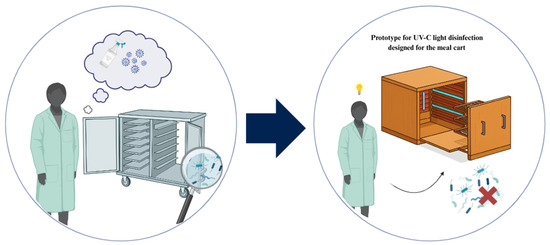
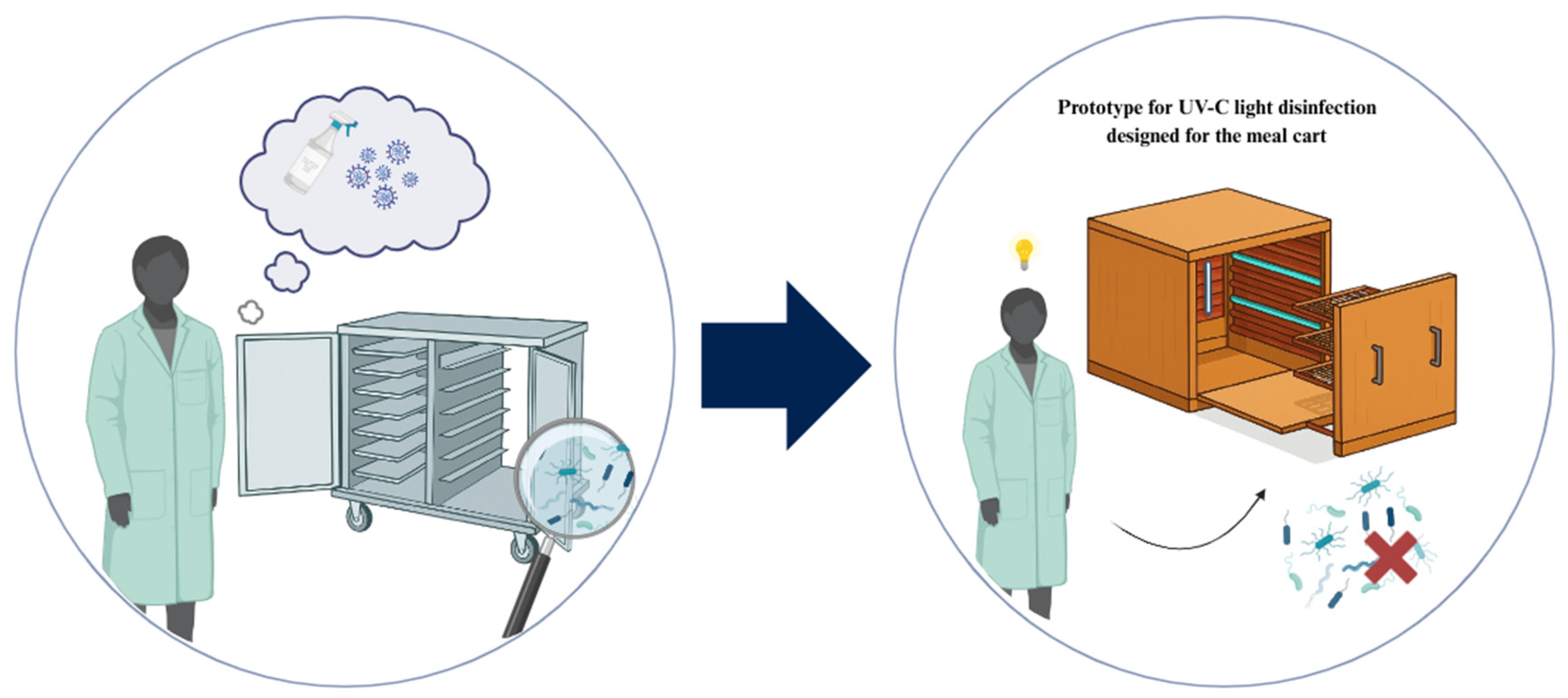
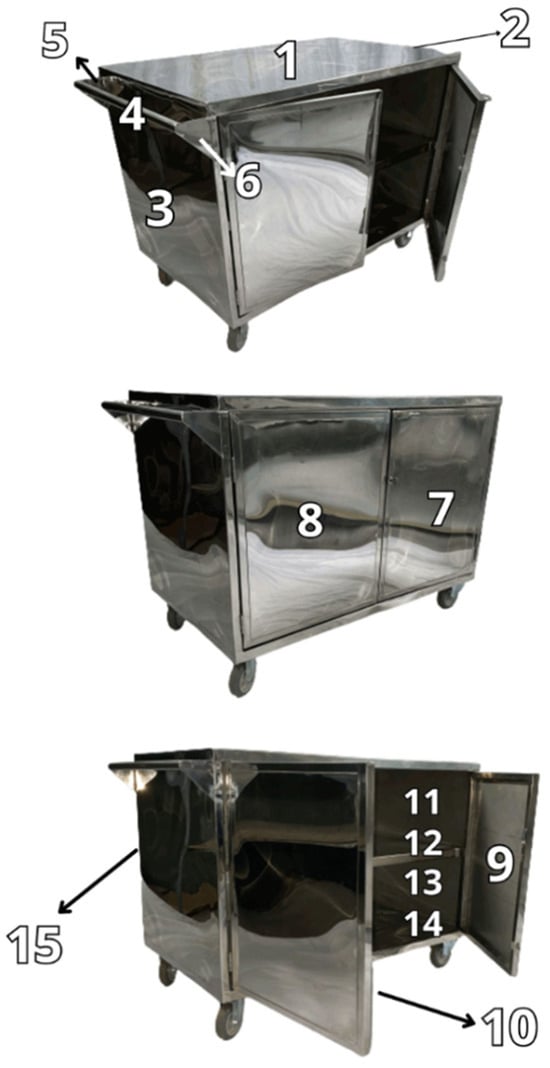
The experiment was conducted in October 2024 at the Federal University Hospital in the city of Aracaju, in the state of Sergipe. The meal cart used by the nutrition department for distributing hospital meals to inpatients was selected for the study. Measurements of the cart were obtained to optimize the arrangement of the UV-C lamps (Signify, Toronto, ON, Canada) inside the device, which was designed to fit over the transport cart and perform the decontamination process. The structure was built from stainless steel and measures 100 cm at its longest dimension, as shown in Figure 1. The model was registered with the Technological Innovation Center of the Federal University of Sergipe under the number NIA6872025.
Figure 1.
Prototype for UV-C light disinfection designed for the meal cart.
We conducted a cost–benefit comparative analysis between disinfection performed with 70 percent ethanol and disinfection using UV-C light. For the measurements, a Solarmeter digital radiometer, model 8.0 UV-C, was used. This radiometer is sensitive in the range from 0 to 199 μW/cm2 with an accuracy of 10 percent (Solarmeter®, Grenoble, France) [https://www.solarmeter.fr/pdf-solarmeter/SOLARMETER-8.0.pdf, accessed on 10 October 2025], under certificate number 01845, issued in June 2020. Its spectral response ranges from 246 to 262 nm, with a peak at 254 nm. The efficacy of surface disinfection was assessed by comparing cleaning protocols with exposure to the UV-C irradiation mechanism.
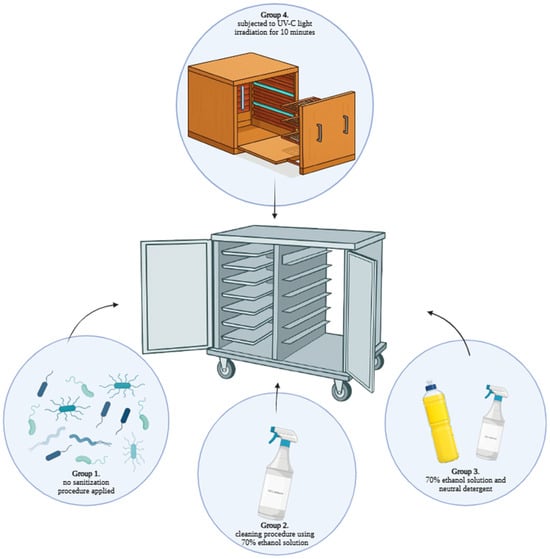
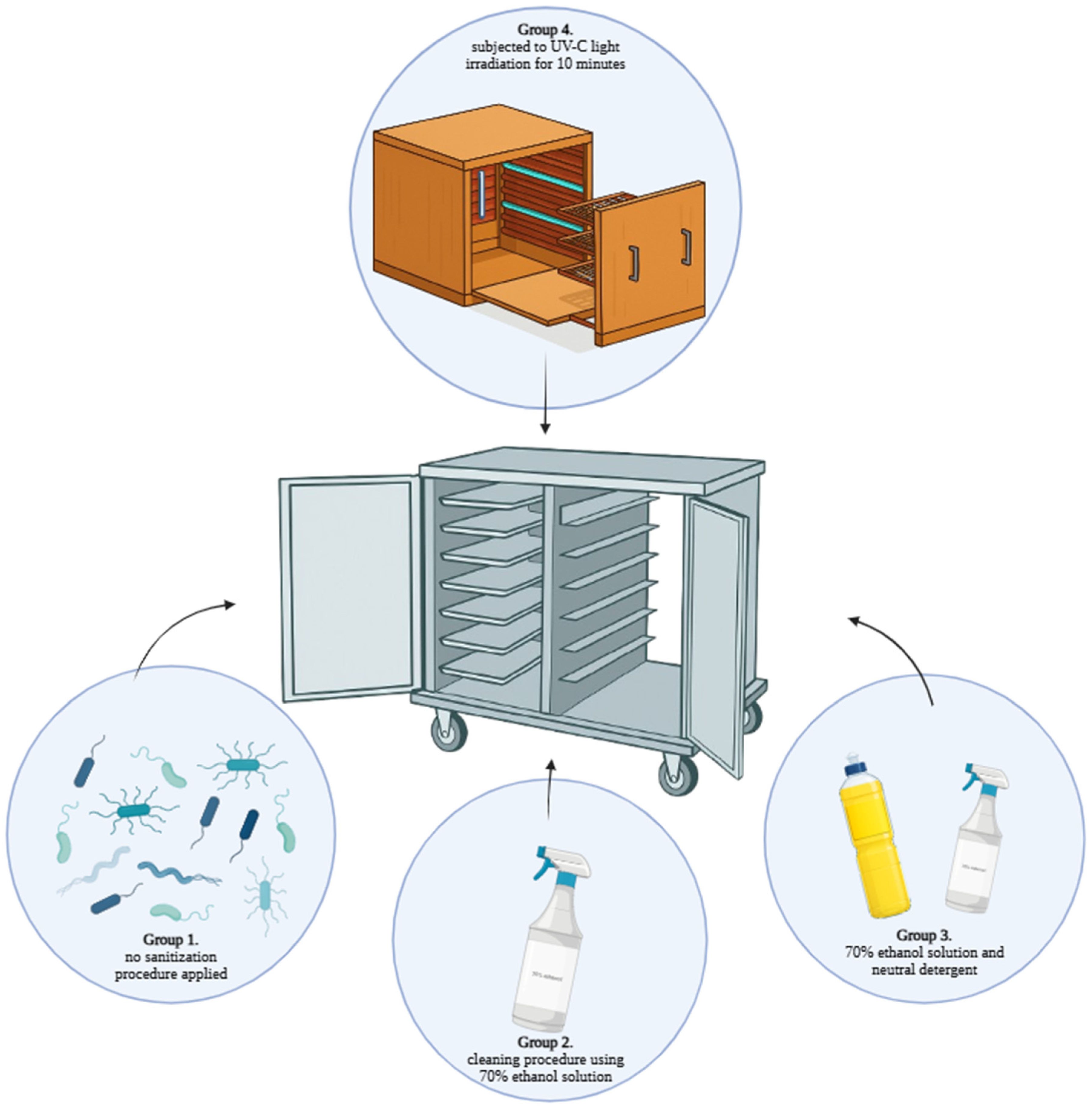
Four distinct cleaning protocols were compared using the same cart at four different time points, defined as follows: Group 1, no sanitization procedure applied; Group 2, standard cleaning procedure used at HU/UFS with 70 percent ethanol solution; Group 3, negative control, standard cleaning procedure at HU/UFS with 70 percent ethanol solution and neutral detergent; Group 4, UV-C irradiation for 10 min after food transport, as illustrated in Figure 2.
Figure 2.
Cleaning protocols used in the study.
The experimental groups were separated temporally, and the same cart was used from the beginning to the end of the study to avoid potential bias. All samples were collected after the sanitization procedures associated with lunch delivery. In the first collection, the cart was sanitized with ethanol only. In the second collection, it was disinfected with detergent followed by ethanol. In the third collection, no disinfection was performed. In the fourth and final collection, the cart was disinfected with UV-C irradiation. Samples were collected immediately after each disinfection process.
2.1. Food Cart Details and Microbiological Analysis
The UV-C disinfection system was developed as an external enclosure designed to be placed over the hospital meal transport cart after food delivery. Alternatively, it can be positioned inside a stainless steel disinfection chamber equipped with fixed UV-C lamps mounted on the internal walls of the device. This configuration allows irradiation of both the external and internal contact surfaces of the cart through direct and reflected exposure once the cart is closed.
After the cart is positioned inside the device and the enclosure is sealed, UV-C irradiation is initiated for a predefined exposure time of 10 min. Ultraviolet emission occurs exclusively within the closed structure. The device does not emit ultraviolet radiation into the external environment, and the cart itself does not glow or emit UV light during operation, ensuring operator safety.
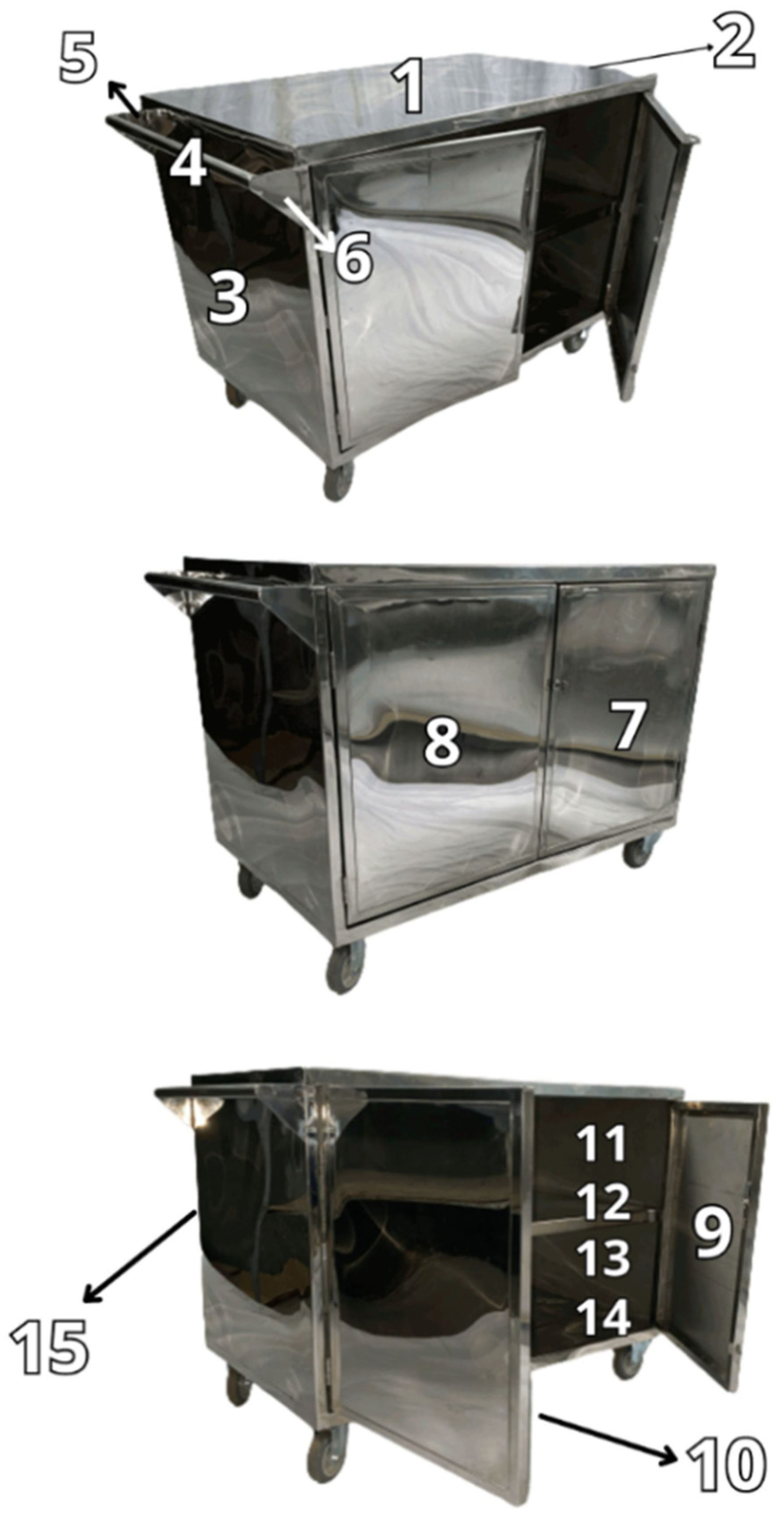
For the microbiological analysis, 15 distinct points on the equipment surface were selected, previously defined according to criteria of frequent manual contact and potential for cross-contamination. These 15 sampling points were standardized and compiled into a printed manual for the study team, which was carried and consulted during each sampling procedure. The exact locations of all sampled points are schematically illustrated in Figure 3.
Figure 3.
Designated points for swab collection.
Samples were collected using sterile swabs following aseptic techniques. Each swab was pre-moistened with sterile saline solution (0.85%) and vigorously rubbed over an area of approximately 25 cm2 at each defined sampling point. The swabs were then placed into tubes containing brain–heart infusion (BHI) broth (Laborclin®, Paraná, Brazil) and incubated at 37 °C for 24 h to assess the presence or absence of bacterial growth. BHI was selected because it serves as a suitable medium for sample preservation and as a non-selective enrichment medium.
Samples that exhibited visible turbidity in BHI broth, indicative of bacterial growth, were subjected to serial decimal dilutions to obtain countable concentrations for plating. For this purpose, 1.0 mL of the enriched culture was aseptically transferred into a tube containing 9.0 mL of sterile saline solution (0.85% NaCl), resulting in a 10−1 dilution. Subsequent dilutions (10−2 to 10−6) were prepared by transferring 1.0 mL from the previous dilution into a new tube containing 9.0 mL of sterile saline, with careful homogenization by vortexing between each dilution step and the use of sterile pipette tips at each transfer to avoid cross-contamination.
From the appropriate dilutions, aliquots of 100 µL were inoculated, in duplicate, onto solid culture media using the spread plate technique. Four selective and differential culture media were subsequently employed for microbiological analysis. Cystine Lactose Electrolyte Deficient (CLED) agar (Newprov®, Paraná, Brazil) [14] was used to enable differential verification of the possible presence of bacteria originating from the sampled surfaces. Salmonella-Shigella (SS) agar (Newprov®, Paraná, Brazil) was selected because it is well established in food biosafety and is specific for enterobacteria, particularly Salmonella spp. and Shigella spp.
MacConkey agar (Newprov®, Paraná, Brazil) was used as a validated medium for identifying and enumerating coliforms. Blood agar (Newprov®, Paraná, Brazil) was included because it is a validated medium for cultivating fastidious bacteria associated with conditions involving hemolysis. The plates were incubated at 37 °C for 24 to 48 h and subsequently evaluated for colony-forming unit (CFU) counts and colony morphological characteristics.
2.2. Data Analysis and Visualization
The results were analyzed using RStudio® software/Version Rstudio R (3.6.0) [15]. Statistical analysis was performed using Cochran’s test, followed by the McNemar post hoc test with Bonferroni correction for pairwise comparisons between groups. A p-value of less than 0.05 was considered statistically significant.
3. Results
Cochran’s test was performed to evaluate the association between the cleaning method or condition of the hospital meal carts and the presence of microbial contamination. Fifteen sampling points on the cart were assessed under four cleaning conditions analyzed independently: (1) carts after routine use without any disinfection protocol; (2) carts cleaned with 70 percent ethanol; (3) carts cleaned with 70 percent ethanol and detergent (control group); and (4) carts disinfected with ultraviolet light. The non-sanitized cart showed microbial contamination in 80 percent of the samples (n = 12).
The cart cleaned only with ethanol presented contamination in 66.6 percent of the samples (n = 10), followed by the cart cleaned with ethanol and detergent, which showed contamination in 33.3 percent of the samples (n = 5). The cart disinfected with ultraviolet light showed complete elimination of microorganisms, with no positive samples (100 percent, n = 15) (p < 0.001) (Table 1).
Table 1.
Description and statistical tests of the effectiveness of disinfection treatments (BHI method).
Highly significant associations were found between the cleaning method/condition and microbial contamination, both by bacterial plate count (χ2(3) = 20.135, p < 0.001; φ = 0.579) and by the BHI method (χ2(3) = 23.367, p < 0.001; φ = 0.624). These results indicate that the cleaning method or condition of the carts significantly influences the presence of microbial contamination. Odds ratio analyses revealed differences in contamination likelihood between the groups compared to the positive control group (70% alcohol and detergent).
Carts cleaned only with 70% alcohol (25/10) showed a lower probability of contamination (bacterial plate: OR = 0.250, 95% CI [0.059, 1.061]; BHI method: OR = 0.242, 95% CI [0.058, 1.006]) compared to the control group, suggesting an unexpectedly superior performance despite the absence of detergent. Dirty carts (30/10) had a higher probability of contamination (bacterial plate: OR = 4.800, 95% CI [0.995, 23.149]; BHI method: OR = 3.438, 95% CI [0.816, 14.479]), highlighting the need for effective cleaning protocols. Notably, carts disinfected with UV light showed no contamination (0% for both bacterial plate and BHI methods), making odds ratio calculation impossible due to absence of events, but indicating superior efficacy.
These findings suggest that the standard cleaning protocol (70% alcohol and detergent) may be suboptimal, with high contamination rates (66.7% for bacterial plate and 73.3% for BHI method). The superior performance of UV light disinfection highlights its potential as a highly effective strategy to reduce microbial contamination on hospital carts, justifying further investigation and consideration for clinical implementation.
In the analysis of the dirty cart, bacterial growth ≥ 100 CFU was observed, indicating intense contamination. The main bacteria isolated were S. aureus, E. coli, Klebsiella sp., and Pseudomonas spp., identified at various points. In the cart cleaned with 70% alcohol, a partial reduction in bacterial load was observed compared to the uncleaned cart. Despite the reduction in colony-forming units (CFU), microbial growth was detected at all sampled points. CFU counts ranged from 50 to 90 per point, with growth observed on all media used. The main bacteria isolated were Staphylococcus aureus and Bacillus spp., repeatedly detected across different points and culture media (Supplementary Tables S1–S5).
In the cart subjected to combined alcohol and detergent treatment, CFU counts varied from 10 to 80, with bacteria from the genera Bacillus spp. and Micrococcus sp. Both bacteria showed equivalent counts across all ranges analyzed, indicating a homogeneous distribution of residual microbiota. The cart exposed to UV-C light revealed a total absence of CFU in all samples evaluated (0 CFU). Furthermore, no bacterial species were detected, indicating that the UV light disinfection protocol promoted effective disinfection against the tested microorganisms (Supplementary Tables S1–S5).
4. Discussion
The results obtained in this study clearly demonstrate the microbiological efficacy of the prototype developed for disinfecting hospital meal distribution carts using UV-C radiation. The device complies with the guidelines proposed by Demeersseman et al. (2023) [16], as it emits UV-C light at 254 nm with proven capacity to inactivate bacterial growth. According to these authors, inactivation occurs through the formation of pyrimidine dimers in microbial DNA and RNA, which alters the expression of genes associated with structures such as viral capsids and bacterial cell walls [16].
The complete absence of bacterial growth in samples exposed to UV-C irradiation indicates that the equipment achieved total elimination of viable microorganisms on the tested surfaces, markedly outperforming conventional cleaning methods. These findings reinforce the potential of the technology as a safe, effective and easily applicable alternative in healthcare settings, particularly in critical care areas such as intensive care units, oncology and neonatology, where reducing microbial load is essential for preventing healthcare-associated infections (HAIs). Comparison with traditional protocols using 70 percent ethanol and detergent showed that although these procedures partially reduce bacterial load, they are insufficient to ensure complete decontamination.
The recurrent detection of pathogens such as Staphylococcus aureus, Escherichia coli, Klebsiella sp. and Pseudomonas spp. on carts that appeared to be cleaned highlights operational limitations of conventional protocols and the risks of cross-contamination in hospital environments. In contrast, no growth of these species was observed on the cart disinfected using the UV-C device. Similar results were reported by Pereira et al. (2023), who demonstrated that UV-C irradiation at wavelengths above 222 nm effectively reduced the growth of several bacterial species, including those identified in our study [17].
In addition to its microbiological effectiveness, the prototype offers advantages related to ease of use, low operational cost and potential for standardizing cleaning processes, thereby reducing dependence on manual procedures susceptible to human error. Casini et al. (2023) described a similar UV-C disinfection protocol that they characterized as environmentally friendly and operationally feasible in hospital environments [18]. The present technology therefore provides an innovative contribution to infection control practices, particularly in the post-pandemic context in which microbiological safety in healthcare facilities has become even more critical.
Fontana (2025) reported comparable findings when evaluating the Ecological Visible Approach protocol, an environmentally friendly cleaning method, in comparison with conventional surface disinfection [19]. In contrast, Romanovski (2024) identified high disinfection potential using ozone and hypochlorite solutions [20]. Together, these studies underscore the relevance of exploring alternative cleaning strategies, although most still rely on chemical agents. The present study differs by employing UV-C irradiation as a sustainable approach, reducing costs associated with distilled water and chemical disinfectant preparation.
This study has some limitations. One of them is the collection of data at a single point in time, constrained by the operational demands of a busy hospital environment. Nonetheless, the methodology was applied rigorously, with two positive controls and one negative control included to strengthen comparison with the UV-C intervention. To our knowledge, this is the first study to assess a sustainable and effective UV-based alternative for disinfecting hospital meal distribution carts. The results demonstrate that this approach is more effective than conventional disinfection with detergent and 70 percent ethanol, indicating its potential for adoption as a strategy to reduce contamination in highly susceptible environments.
5. Conclusions
In summary, the findings validate the use of UV-C radiation as an effective tool applicable to routine hospital operations and support its incorporation as a complementary biosafety strategy. Beyond its efficacy, the prototype demonstrates promise due to its ease of use, low operational cost and potential to standardize cleaning procedures, thereby reducing reliance on manual actions prone to human error. The proposed technology thus represents a relevant and innovative contribution to hospital infection control protocols. Future studies may expand cost–benefit analyses, evaluate the durability of materials exposed to irradiation and explore the applicability of the system to other types of hospital surfaces and equipment.
Supplementary Materials
The following supporting information can be downloaded at: https://www.mdpi.com/article/10.3390/amh71010006/s1; Table S1: Dirty meal cart; Table S2: Meal cart sanitized with 70% alcohol; Table S3: Meal cart sanitized with 70% alcohol and detergent protocol; Table S4: Meal cart disinfected by exposure to UV-C light from the developed device. Table S5: Results of bacterial presence in different methods of sanitizing meal carts.
Author Contributions
Conceptualization, A.B.L.G., L.P.B. and S.d.S.L.; methodology, A.B.L.G., L.P.B., P.H.M.M., M.d.S.B. and D.M.R.R.S.; formal analysis, A.B.L.G., P.H.M.M. and R.S.S.; data curation, A.B.L.G. and R.S.S.; visualization, E.E.D.S.; writing—original draft preparation, A.B.L.G. and E.E.D.S.; writing—review and editing, M.d.S.B., A.B.L.G., E.E.D.S., L.R.d.S.L., A.G.C.d.O., A.K.S.C., P.G.M.d.S. and L.M.d.F.L.; supervision, A.B.L.G., A.G.G., L.A.d.M.S., K.A., R.G.G., L.P.B. and S.d.S.L.; project administration, A.B.L.G., A.G.G., L.A.d.M.S., K.A., R.G.G., G.R., L.P.B. and S.d.S.L. All authors have read and agreed to the published version of the manuscript.
Funding
This research received no external funding.
Institutional Review Board Statement
Not applicable.
Informed Consent Statement
Not applicable.
Data Availability Statement
The data presented in this study are available on request from the corresponding author.
Acknowledgments
The authors gratefully acknowledge the research team for generously providing the original technology model, which served as the Gianpaolo Roina and Francesco D’Errico for its adaptation and application in this study. Their valuable contribution was essential for the development and success of the proposed disinfection system. We extend our sincere gratitude to Zuleide Barros Luna Gomes for her invaluable contribution to the writing of this article. Her expertise, commitment, and insightful input were essential to the development and refinement of this work.
Conflicts of Interest
The authors declare no conflicts of interest.
References
- Haddad, M.T.; Yamaguti, A.; Suiter, É.; Rodrigues, A.L.C.C.; Severine, A.N. Evaluation of a food acceptance instrument for hospitalized patients in a private hospital network in São Paulo, Brazil. BRASPEN J. 2023, 38, 335–342. [Google Scholar] [CrossRef] [Scilit]
- Ferreira, J.S.; Costa, W.L.R.; Cerqueira, E.S.; Carvalho, J.S.; Oliveira, L.C.; Almeida, R.C.C. Food handler-associated methicillin-resistant Staphylococcus aureus in public hospitals in Salvador, Brazil. Food Control 2014, 37, 395–400. [Google Scholar] [CrossRef] [Scilit]
- Kubde, D.; Patel, J.; Choudhari, S.; Bhawnani, D. Importance of Hospital Infection Control. Cureus 2023, 15, e50931. [Google Scholar] [CrossRef] [Scilit] [PubMed]
- Boyce, J.M.; Havill, N.L.; Moore, B.A.; Dumigan, D.G.; Golebiewski, M. Terminal Decontamination of Patient Rooms Using an Automated Mobile UV Light Unit. Infect. Control Hosp. Epidemiol. 2011, 32, 737–742. [Google Scholar] [CrossRef] [Scilit] [PubMed]
- Assadian, O.; Tarka, P.; Koburger-Janssen, T.; Kramer, A.; Christiansen, B. Practical recommendations for routine cleaning and disinfection procedures in healthcare institutions: A narrative review. J. Hosp. Infect. 2021, 113, 104–114. [Google Scholar] [CrossRef] [Scilit] [PubMed]
- Nguyen, P.H.; Headey, D.; Pecenka, C.; Avula, R.; Ruel, M.T.; Menon, P. COVID-19 Disrupted Provision and Utilization of Health and Nutrition Services in Uttar Pradesh, India: Insights from Service Providers, Household Phone Surveys, and Administrative Data. J. Nutr. 2021, 151, 2305–2316. [Google Scholar] [CrossRef] [Scilit]
- Sanchez, E.; Fung, K.M.; Pietrolungo, L.; Vinson, A.; Thompson, J.J.; Widener, M.J. Providing Food and Nutrition Services during the COVID-19 Surge at the Javits New York Medical Station. Int. J. Environ. Res. Public Health 2021, 18, 7430. [Google Scholar] [CrossRef] [Scilit]
- Gottardo De Almeida, M.T.; Gottardo De Almeida, B.; Zen Siqueira, J.P.; Byzynski Soares, G.; Sigari Morais, V.; Mitsue Yasuoka, F.M.; Ghiglieno, F. Ultraviolet-C Light-Emitting Device Against Microorganisms in Beauty Salons. Pathog. Immun. 2022, 7, 49–59. [Google Scholar] [CrossRef] [Scilit] [PubMed]
- Carvalho, L.V.S.; Silva, M.E.C.; Santos, E.C.L.; Costa, A.A. Discursos sobre tecnologias de desinfecção pós-pandêmicas: Luz ultravioleta germicida, fotocatálise e ozônio. Rev. Casos Consult. 2022, 13, e27985. [Google Scholar]
- Daud, N.S.S.; Dunn, M.; Moncayo-Nieto, O.L.; Hay, A. Is the Combination of UV-C Light and Bleach Less Effective than Bleach Alone for Intensive Care Unit Surface Disinfection? Infect. Prev. Pract. 2023, 5, 100307. [Google Scholar] [CrossRef] [Scilit] [PubMed]
- Wang, C.-P.; Hong, J.-W. Improving the Efficiency of Ultraviolet-C Light-Emitting Diode Water Disinfection Reactors by Using Light Guide Plates. J. Photochem. Photobiol. A 2025, 469, 116601. [Google Scholar] [CrossRef] [Scilit]
- Weber, D.J.; Rutala, W.A.; Sickbert-Bennett, E.E.; Kanamori, H.; Gergen, M.F. Continuous room decontamination technologies for disinfection of the healthcare environment. Am. J. Infect. Control 2019, 47, A72–A78. [Google Scholar] [CrossRef] [Scilit] [PubMed]
- Laborclin®. Brain Heart Infusion. Available online: https://www.laborclin.com.br/wp-content/uploads/2024/09/172072.pdf (accessed on 28 November 2025).
- Newprov. Available online: https://www.newprov.com.br/ (accessed on 28 November 2025).
- RStudio® Software. Available online: https://posit.co/products/open-source/rstudio/ (accessed on 5 August 2025).
- Demeersseman, N.; Saegeman, V.; Cossey, V.; Devriese, H.; Schuermans, A. Shedding a light on ultraviolet-C technologies in the hospital environment. J. Hosp. Infect. 2023, 132, 85–92. [Google Scholar] [CrossRef] [Scilit] [PubMed]
- Pereira, A.R.; Braga, D.F.O.; Vassal, M.; Gomes, I.B.; Simões, M. Ultraviolet C Irradiation: A Promising Approach for the Disinfection of Public Spaces? Sci. Total Environ. 2023, 879, 163007. [Google Scholar] [CrossRef] [Scilit] [PubMed]
- Casini, B.; Tuvo, B.; Scarpaci, M.; Totaro, M.; Badalucco, F.; Briani, S.; Luchini, G.; Costa, A.L.; Baggiani, A. Implementation of an Environmental Cleaning Protocol in Hospital Critical Areas Using a UV-C Disinfection Robot. Int. J. Environ. Res. Public Health 2023, 20, 4284. [Google Scholar] [CrossRef] [Scilit] [PubMed]
- Fontana, R.; Vogli, L.; Buratto, M.; Caproni, A.; Nordi, C.; Pappadà, M.; Facchini, M.; Buffone, C.; Bandera, B.; Marconi, P. Sustainable vs. Conventional Cleaning in Healthcare: Microbiological and Life Cycle Insights. Sustainability 2025, 17, 1114. [Google Scholar] [CrossRef] [Scilit]
- Romanovski, V.; Paspelau, A.; Kamarou, M.; Likhavitski, V.; Korob, N.; Romanovskaia, E. Comparative Analysis of the Disinfection Efficiency of Steel and Polymer Surfaces with Aqueous Solutions of Ozone and Sodium Hypochlorite. Water 2024, 16, 793. [Google Scholar] [CrossRef] [Scilit]

Disclaimer/Publisher’s Note: The statements, opinions and data contained in all publications are solely those of the individual author(s) and contributor(s) and not of MDPI and/or the editor(s). MDPI and/or the editor(s) disclaim responsibility for any injury to people or property resulting from any ideas, methods, instructions or products referred to in the content. |
© 2026 by the authors. Published by MDPI on behalf of the Hellenic Society for Microbiology. Licensee MDPI, Basel, Switzerland. This article is an open access article distributed under the terms and conditions of the Creative Commons Attribution (CC BY) license.