


Abstract
People living with HIV (PLWH) receiving effective antiretroviral therapy (ART) continue to exhibit chronic immune activation and systemic inflammation despite virological suppression. The viral envelope glycoprotein gp120, which binds the CD4 receptor and mediates viral entry, has been implicated in pro-inflammatory and pro-apoptotic effects in neuronal and endothelial cells. Although gp120 is expressed on the viral surface, its oligomeric structure and its ability to form immune complexes with circulating antibodies may reduce the sensitivity of standard detection assays in serum. Soluble gp120 has been associated with increased levels of pro-inflammatory cytokines, including interleukin-6 (IL-6), tumor necrosis factor-α (TNF-α), and interleukin-1β (IL-1β), as well as chemokines. These mediators may contribute to blood–brain barrier dysfunction, endothelial injury, vascular smooth muscle alterations, and subsequent neurodegenerative and cardiovascular complications. Importantly, gp120 shedding may persist due to viral reservoirs and intermittent reactivation, even during ART. Fostemsavir inhibits the interaction between gp120 and CD4, preventing viral entry and potentially limiting gp120-mediated pathogenic effects. Beyond antiviral activity, this mechanism suggests a potential role in attenuating gp120-mediated inflammation. This review discusses the biological effects of gp120 and the rationale for targeting it therapeutically in PLWH.
1. Introduction
People living with human immunodeficiency virus (HIV) (PLWH) continue to experience chronic inflammation and premature aging despite effective antiretroviral therapy (ART) [1]. The mechanisms underlying this persistent immune activation remain incompletely understood. Among potential contributors, the HIV envelope glycoprotein gp120 is a biologically plausible driver, as it can be shed into plasma even when viremia is undetectable [2]. Circulating gp120 levels correlate with pro-inflammatory cytokines, including interleukin-6 (IL-6), tumor necrosis factor-α (TNF-α), and interleukin-1β (IL-1β), as well as with CD4/CD8 ratios [3,4]. We hypothesize that soluble and tissue-associated gp120 contributes directly to chronic inflammation in PLWH independently of detectable viral replication, via pro-inflammatory and pro-apoptotic effects on endothelial, immune, and neuronal cells [2]. This persistent inflammatory signaling can cause tissue damage and organ dysfunction. In the central nervous system, gp120 disrupts the blood–brain barrier (BBB) and promotes neuronal apoptosis, contributing to cognitive impairments collectively referred to as HIV-associated neurocognitive disorders (HAND) [5,6].
Outside the CNS, gp120, along with other viral proteins such as transactivator of transcription (Tat), may facilitate cardiovascular disease through direct and indirect atherogenic effects on endothelial cells [7]. Overall, the apoptotic and inflammatory actions of gp120 are central drivers of immune activation and disease progression in PLWH [8]. Elucidating these mechanisms is crucial for developing therapeutic strategies to mitigate inflammation and its detrimental consequences in individuals living with HIV.
2. Exploring the Detection of Gp120
The HIV envelope protein, composed of gp120 and gp41 subunits, forms a trimeric structure on the viral surface, facilitating interaction with target cells, including CD4+ T cells, macrophages, and dendritic cells [9]. The initial stage of HIV infection involves gp120 binding to CD4 and co-receptors (CCR5 or CXCR4), a process that mediates membrane fusion and viral entry; subsequent signaling events and downstream pathogenic mechanisms contribute to immune activation and inflammation [10].
The inflammatory role of gp120 is well documented, as its presence in plasma and tissues is associated with immune dysfunction, cytokine release, and neurological and cardiovascular complications in PLWH [2].
Early studies highlighted the challenges in detecting gp120 due to its association with host antibodies. Oh et al. [11] reported that gp120/160 could be identified in AIDS patients using ELISA, but detection often required dissociation from immune complexes. Similarly, Klasse et al. [12] demonstrated that spiked gp120 in HIV-positive sera was variably masked by endogenous anti-gp120 antibodies, complicating accurate quantification.
Tissue studies indicate that gp120 is more abundant in lymphoid tissues than in plasma. Santuosso et al. [13] showed that gp120 concentrations were higher in spleen and lymph nodes compared to serum, with cell-free tissue extracts often containing more gp120 than tissue lysates. Sunila et al. [14] observed gp120 on the plasma membranes of apoptotic CD4+ and LCA+ lymphocytes in lymph nodes, suggesting a possible link with cell-cycle disruption and apoptosis. Overall, these studies emphasize that gp120 is difficult to detect in circulation due to its oligomeric form, immune complex formation, and preferential tissue localization. See Table 1.
Table 1.
gp120 percentage on the membrane of apoptotic and normal cells [14].
3. Investigating the Impact of Gp120 on Immune Cell Dynamics
Numerous studies have demonstrated that the HIV envelope glycoprotein gp120 can act as a potent pro-inflammatory molecule, influencing multiple immune cell types [15,16]. Gp120 exposure induces the release of pro-inflammatory cytokines, including TNF-α, IL-6, IL-8, IL-10, and chemokines such as CCL2 and CCL4, engaging both innate and adaptive immune responses. Initial in vitro studies first demonstrated cytokine induction by gp120 [17], which was later confirmed ex vivo using plasma from patients with acute or early HIV infection [18]. Different populations of PBMCs respond variably to gp120. Levast et al. [15] showed that CD14+ monocytes are the primary source of multiple cytokines, including IL-1, IL-6, IL-10, IL-18, IL-23, IL-27, CCL2, CCL4, CCL20, CXCL2, CXCL13, TSLP, and TNF-α. Among these, IL-6, IL-1, IL-10, and CCL2 were particularly prominent. Mechanistic studies using gp120 mutants confirmed that binding to CD4 is essential for cytokine induction: mutants unable to engage CD4 failed to trigger cytokine production, and addition of soluble CD4 or the VRC01 antibody reduced IL-10 production by monocytes [15,16].
Other immune cells, such as neutrophils, can also produce chemokines in response to gp120, highlighting a broader role of non-T-cell populations in gp120-driven immune activation. Basophils exposed to gp120 release histamine, LTC4, and IL-4 in a concentration-dependent manner via interaction with the VH3 domain of IgE, suggesting a superantigen-like effect [19]. Longitudinal studies in PLWH revealed that detectable plasma gp120 correlates with elevated IL-6, TNF-α, and IL-10 levels independent of viral load or ART, confirming that gp120 can sustain chronic immune activation in vivo [18].
Together, these findings elucidate mechanistic pathways of gp120-induced cytokine production, integrating effects across monocytes, neutrophils, and basophils, and provide a framework to understand persistent inflammation in HIV infection despite effective viral suppression.
4. Unveiling the Role of gp120: A Key Player in the Development of Neurologic Disease
To date, approximately 40 million people are affected by HIV worldwide, and up to 69% of them may experience neurocognitive impairments. HIV-associated neurocognitive disorders (HAND) encompass a spectrum from mild attention and memory deficits, emotional changes such as depression or apathy, to severe forms including HIV-associated dementia [20]. Despite effective antiretroviral therapy (ART), the prevalence of HAND remains high. HIV-1 and its proteins, including gp120 and Tat, are associated with alterations in the blood–brain barrier (BBB) and neuroinflammation, potentially exposing the central nervous system to immune and microbial challenges [21]. Mechanistic studies demonstrate that gp120 can induce apoptosis in mouse neurons and in primary hippocampal, neocortical, cerebellar, and retinal ganglion cell cultures. In glial cells, gp120 stimulates the production of cytokines and reactive nitrogen species, which act synergistically with glutamate to activate N-methyl-D-aspartate (NDMA) receptors, contributing to neurotoxicity [4].
Notably, gp120 from different HIV-1 strains—reflecting natural viral diversity influenced by host factors and therapeutic exposure—shows variable capacities to induce nitric oxide (NO), TNF-α, and IL-6 in murine glial cells [4].
Endothelial cells are also affected: gp120 exposure in rat brain endothelial cells (RBE4) increases oxidative stress, decreases intracellular glutathione, and alters antioxidant enzyme activity, highlighting the protein’s role in promoting reactive oxygen species-mediated damage [22].
In HIV gp120 transgenic mice, neuroinflammatory responses vary by brain region and immune status, with the hippocampus particularly susceptible, as evidenced by changes in cytokine expression and reduced synaptophysin levels [23].
Overall, these findings suggest that gp120 may contribute to neuroinflammation and neuronal dysfunction underlying HAND, although direct causality remains to be fully established.
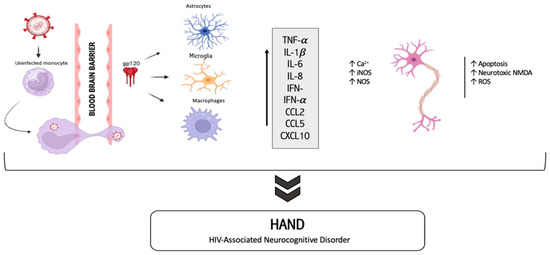
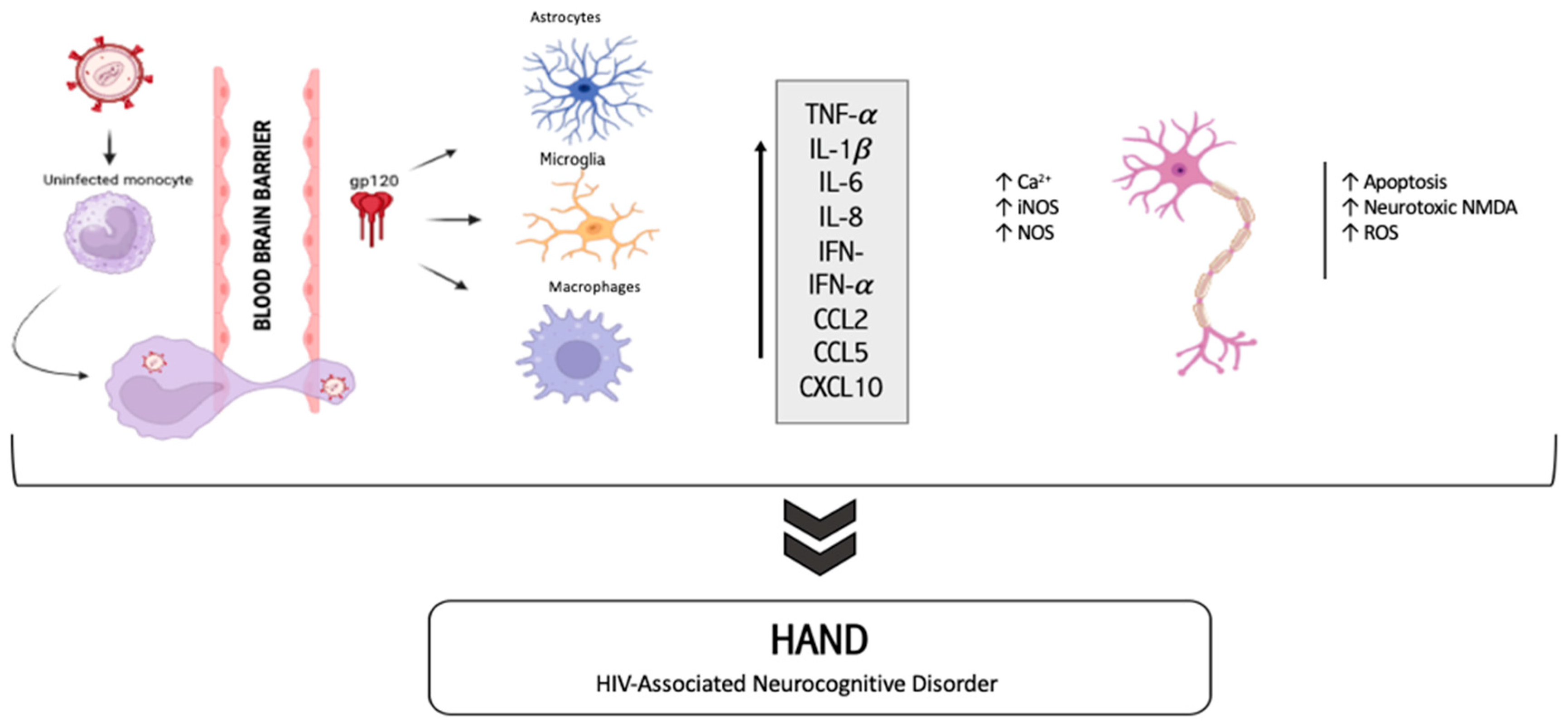
As illustrated in Figure 1, gp120 released from infected cells interacts with CD4+ T cells, monocytes, and microglia, triggering the release of pro-inflammatory cytokines (e.g., TNF-α, IL-1β, IL-6, IL-8, IFN-α) and chemokines (CCL2, CCL5, CXCL10), which collectively contribute to neuronal apoptosis, oxidative stress, and the pathogenesis of HIV-associated neurocognitive disorder (HAND).
Figure 1.
Effect of the envelope glycoprotein gp120 on CNS cells and the development of HAND. The increased production, gp120-mediated, of cytokines and chemokines leads to apoptosis, neurotoxicity, and cell death in the nervous system. Image created with Biorender.com.
5. Deciphering gp120: Unraveling Its Impact on Cardiovascular Health
Emerging research suggests a potential association between HIV infection and the onset of cardiovascular disease (CVD), with gp120 potentially contributing to vascular dysfunction [24]. While immunodeficiency remains the primary consequence of HIV infection, chronic HIV infection has been linked to an increased risk of CVD, and despite advances in ART, cardiovascular complications continue to pose a significant concern in PLWH. Understanding the interplay between HIV-associated factors, such as gp120, and CVD development is essential to improve preventive strategies and long-term outcomes. Mechanistic studies indicate that gp120 can activate endothelial cells and induce dysfunction, which may impact vascular integrity and contribute to atherosclerosis [24].
Kim et al. [25] identified a gp120 receptor potentially involved in vascular smooth muscle cell (VSMC) hyperplasia. An octapeptide sequence of gp120, peptide T, related to vasoactive intestinal peptide (VIP), can inhibit gp120 binding and block its neurotoxicity in vitro and in vivo. Additionally, gp120 shares homology with neuropeptide Y (NPY), which regulates vascular and cardiac contraction, hypertrophy, proliferation, chemotaxis, and angiogenesis; gp120 can mimic NPY effects on VSMCs, promoting mitogenic activity.
Huang et al. [26] showed that gp120 induces apoptosis in human umbilical vein endothelial cells (HUVECs) via chemokine receptors, primarily CXCR4.
Clinical evidence supports these mechanistic findings. Benlarbi et al. [27] measured soluble gp120 (sgp120) and anti–cluster A antibodies in 386 PLWH, finding that detectable sgp120 correlated with higher IL-6 and TNF-α levels, lower CD4+ T-cell counts, and, in subsets, with subclinical CVD markers such as coronary artery plaque size on computed tomography coronary angiography (CCTA). Although sgp120 or antibody levels were not directly associated with CVD presence, correlations with plaque size suggest that sgp120 may act as an “effect modifier,” contributing to chronic inflammation and premature cardiovascular comorbidities.
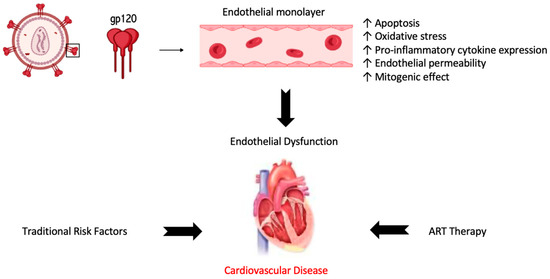
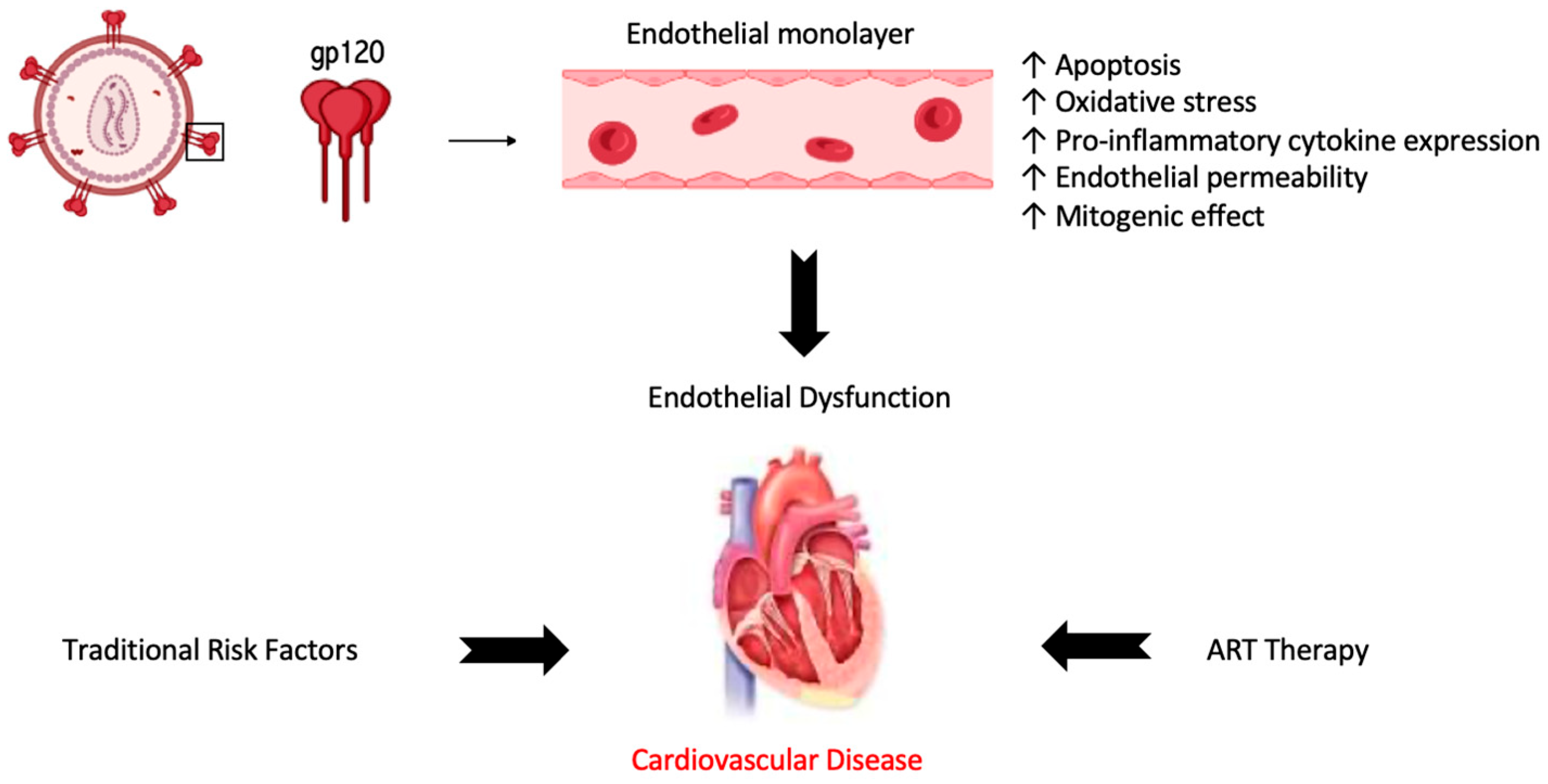
Additional studies have linked viral reservoirs with subclinical CVD in ART-treated PLWH [28,29]. Investigations into HIV cardiomyopathy (HIVCM) detected HIV-1 RNA and DNA in cardiac tissue but not in cardiomyocytes, whereas gp120 was present, indicating possible viral protein-mediated effects without active replication [30]. Collectively, these data suggest that gp120 may contribute to endothelial dysfunction, immune activation, and cardiovascular pathology in PLWH Figure 2.
Figure 2.
Interaction between the envelope glycoprotein gp120 and endothelial cells. Image created with Biorender.com.
Further mechanistic and clinical studies are warranted to clarify its precise role and to guide early detection and preventive strategies.
6. Fostemsavir
Despite the efficacy of combination antiretroviral therapy in managing HIV-1 infection, virologic failure persists as a challenge for certain individuals. This failure not only raises the likelihood of drug resistance but also constrains future treatment alternatives, consequently affecting morbidity and mortality rates [31]. Understanding the intricate involvement of gp120 in the pathogenesis of neurologic disease and CVD not only sheds light on the complex interplay between HIV infection and these pathologies but also underscores the importance of comprehensive management strategies in this vulnerable population [32,33]. One of the potential avenues to follow is certainly to evaluate therapeutic strategies aimed at the mechanisms mediated by gp120. HIV therapies are categorized into six groups according to their targets. These groups comprise nucleoside/nucleotide reverse transcriptase inhibitors (NRTIs), protease inhibitors (PIs), non-nucleoside reverse transcriptase inhibitors (NNRTIs), entry inhibitors, integrase strand transfer inhibitors (INSTIs), and capsid inhibitors. Entry inhibitors are further classified as pre-attachment inhibitors, post-attachment inhibitors, CCR5 antagonists, and fusion inhibitors [1].
According to the WHO’s brief 2024 HIV drug resistance report, the prevalence of acquired and transmitted HIV drug resistance has increased significantly worldwide [34]. The suppressive combination antiretroviral regimen cannot be administered to heavily treatment-experienced (HTE) individuals who present with multidrug resistance, toxicities, or intolerance to antiretroviral drugs.
For this delicate group of subjects, it is necessary to introduce drugs on the market that are well tolerated and do not have cross-resistance with therapies currently on the market [35].
Fostemsavir, a novel antiretroviral therapy, has emerged as an important option for individuals with multidrug-resistant HIV-1 infection, offering a new mechanism of action within the armamentarium of HIV therapeutics [36]. As a prodrug of temsavir, fostemsavir belongs to the class of attachment inhibitors and exerts its primary antiviral effect by directly binding to the viral envelope glycoprotein gp120. Specifically, it targets a conserved site near the CD4 binding region beneath the b20–21 loop, locking gp120 in a closed conformation and preventing the structural rearrangements necessary for viral attachment and entry into CD4+ T cells and other susceptible immune cells [37]. By inhibiting this critical early step in the viral life cycle, fostemsavir effectively reduces viral replication, as demonstrated in clinical trials.
The BRIGHTE study (NCT02362503) evaluated the efficacy and safety of fostemsavir in combination with optimized background therapy in heavily treatment-experienced adults with multidrug-resistant HIV-1 [38]. Participants in both the randomized and non-randomized cohorts achieved significant reductions in HIV-1 RNA levels and improvements in CD4+ T-cell counts up to Week 96. Among participants experiencing protocol-defined virologic failure, no consistent pattern of genotypic or phenotypic changes in temsavir susceptibility was observed, suggesting that multiple host and viral factors contribute to individual treatment outcomes [39].
Case reports further illustrate fostemsavir’s utility in complex clinical scenarios. For example, a 35-year-old woman with vertically acquired HIV-1 infection and end-stage renal disease, who had experienced sequential treatment failure due to extensive drug resistance and adherence challenges, was successfully treated with a combination of lenacapavir, fostemsavir, and lamivudine [40]. These data highlight fostemsavir’s role in providing viable therapeutic options for patients with limited alternatives.
Beyond its well-established antiviral activity, preclinical studies have suggested that temsavir may modulate gp120-induced immune activation. The viral envelope protein gp120 is known to trigger pro-inflammatory cytokine release, including TNF-α, IL-6, and IL-10, from monocytes and other immune cells, contributing to persistent inflammation even in virally suppressed patients [41]. By preventing gp120-CD4 interactions, temsavir could theoretically reduce this cytokine induction. However, it is important to note that these immunomodulatory effects remain speculative, and further studies are required to confirm their relevance in clinical practice.
Overall, fostemsavir represents a dual opportunity: a potent antiviral therapy for multidrug-resistant HIV-1 and a potential modulator of gp120-related inflammation. Nevertheless, additional clinical and mechanistic investigations are necessary to clarify its long-term impact on residual viral proteins and chronic immune activation, ensuring a cautious interpretation of any anti-inflammatory potential.
Altogether, the evidence discussed in this review highlights that gp120 is not merely a structural component required for viral entry, but a biologically active protein capable of sustaining immune activation, apoptosis, endothelial dysfunction, and tissue injury even in the setting of suppressive antiretroviral therapy. The persistence of soluble and tissue-associated gp120 may contribute to chronic inflammation and non-AIDS comorbidities, including cardiovascular and neurocognitive complications, in people living with HIV (PLWH). Therefore, while current antiretroviral strategies effectively control viral replication, addressing gp120-mediated pathogenic mechanisms could represent an additional therapeutic dimension. At present, anti-gp120 therapy is clearly justified from an antiviral standpoint; whether it is needed as a strategy to mitigate chronic inflammation and long-term comorbidities remains an open but increasingly relevant clinical question.
Author Contributions
Conceptualization, A.M. (Alessia Mirabile) and D.B.; methodology, G.N.C.; investigation, A.M. (Andrea Marino), B.M.C. and G.S.; writing—original draft preparation, P.F., S.M. and S.S.; writing—review and editing, G.N.; supervision, B.M.C. and G.N. All authors have read and agreed to the published version of the manuscript.
Funding
This research received no external funding.
Institutional Review Board Statement
Not applicable.
Informed Consent Statement
Not applicable.
Data Availability Statement
The original contributions presented in this study are included in the article.
Conflicts of Interest
The authors declare no conflicts of interest.
References
- Spampinato, S.; Saia, A.G.; Russotto, Y.; Micali, C.; Marino, A.; Ceccarelli, M.; Rullo, E.V.; Pellicanò, G.F.; Nunnari, G. Real-life efficacy and satisfaction of long-acting ART Cabotegravir-Rilpivirine in HIV-infected individuals. Infect. Dis. Trop. Med. 2023, 9, 1–5. [Google Scholar]
- Benlarbi, M.; Richard, J.; Bourassa, C.; Tolbert, W.D.; Chartrand-Lefebvre, C.; Gendron-Lepage, G.; Sylla, M.; El-Far, M.; Messier-Peet, M.; Guertin, C.; et al. Plasmatic HIV-1 soluble gp120 is associated with immune dysfunction and inflammation in ART-treated individuals with undetectable viremia. medRxiv 2023, arXiv:08.15.23294128. [Google Scholar] [CrossRef] [Scilit]
- Hirano, T. IL-6 in inflammation, autoimmunity and cancer. Int. Immunol. 2020, 33, 127–148. [Google Scholar] [CrossRef] [Scilit]
- Kong, L.Y.; Wilson, B.C.; McMillian, M.K.; Bing, G.; Hudson, P.M.; Hong, J.S. The effects of the HIV-1 envelope protein gp120 on the production of nitric oxide and proinflammatory cytokines in mixed glial cell cultures. Cell Immunol. 1996, 172, 77–83. [Google Scholar] [CrossRef] [Scilit]
- Borrajo, A.; Spuch, C.; Penedo, M.A.; Olivares, J.M.; Agís-Balboa, R.C. Important role of microglia in HIV-1 associated neurocognitive disorders and the molecular pathways implicated in its pathogenesis. Ann. Med. 2021, 53, 43–69. [Google Scholar] [CrossRef] [Scilit]
- Smith, L.K.; Kuhn, T.B.; Chen, J.; Bamburg, J.R. HIV Associated Neurodegenerative Disorders: A New Perspective on the Role of Lipid Rafts in Gp120-Mediated Neurotoxicity. Curr. HIV Res. 2018, 16, 258–269. [Google Scholar] [CrossRef] [Scilit]
- Hijmans, J.G.; Stockelman, K.; Levy, M.; Brewster, L.M.; Bammert, T.D.; Greiner, J.J.; Connick, E.; DeSouza, C.A. Effects of HIV-1 gp120 and TAT-derived microvesicles on endothelial cell function. J. Appl. Physiol. 2019, 126, 1242–1249. [Google Scholar] [CrossRef] [Scilit] [PubMed]
- Mu, W.; Patankar, V.; Kitchen, S.; Zhen, A. Examining Chronic Inflammation, Immune Metabolism, and T Cell Dysfunction in HIV Infection. Viruses 2024, 16, 219. [Google Scholar] [CrossRef] [Scilit] [PubMed]
- Prabakaran, P.; Dimitrov, A.S.; Fouts, T.R.; Dimitrov, D.S. Structure and Function of the HIV Envelope Glycoprotein as Entry Mediator, Vaccine Immunogen, and Target for Inhibitors. Adv. Pharmacol. 2007, 55, 33–97. [Google Scholar] [CrossRef] [Scilit]
- Rao, M.; Peachman, K.K.; Kim, J.; Gao, G.; Alving, C.R.; Michael, N.L.; Rao, V.B. HIV-1 Variable Loop 2 and its Importance in HIV-1 Infection and Vaccine Development. Curr. HIV Res. 2013, 11, 427–438. [Google Scholar] [CrossRef] [Scilit]
- Oh, S.K.; Cruikshank, W.W.; Raina, J.; Blanchard, G.C.; Adler, W.H.; Walker, J.; Kornfeld, H. Identification of HIV-1 envelope glycoprotein in the serum of AIDS and ARC patients. J. Acquir. Immune. Defic. Syndr. 1992, 5, 251–256. [Google Scholar] [CrossRef] [Scilit]
- Klasse, P.J.; Moore, J.P. Is there enough gp120 in the body fluids of HIV-1-infected individuals to have biologically significant effects? Virology 2004, 323, 1–8. [Google Scholar] [CrossRef]
- Santosuosso, M.; Righi, E.; Lindstrom, V.; Leblanc, P.R.; Poznansky, M.C. HIV-1 envelope protein gp120 is present at high concentrations in secondary lymphoid organs of individuals with chronic HIV-1 infection. J. Infect. Dis. 2009, 200, 1050–1053. [Google Scholar] [CrossRef] [Scilit]
- Sunila, I.; Vaccarezza, M.; Pantaleo, G.; Fauci, A.S.; Orenstein, J.M. gp120 is present on the plasma membrane of apoptotic CD4 cells prepared from lymph nodes of HIV-1-infected individuals: An immunoelectron microscopic study. AIDS 1997, 11, 27–32. [Google Scholar] [CrossRef] [Scilit]
- Levast, B.; Barblu, L.; Coutu, M.; Prévost, J.; Brassard, N.; Peres, A.; Stegen, C.; Madrenas, J.; Kaufmann, D.E.; Finzi, A. HIV-1 gp120 envelope glycoprotein determinants for cytokine burst in human monocytes. PLoS ONE 2017, 12, e0174550. [Google Scholar] [CrossRef] [Scilit]
- Conti, L.; Fantuzzi, L.; Del Cornò, M.; Belardelli, F.; Gessani, S. Immunomodulatory effects of the HIV-1 gp120 protein on antigen presenting cells: Implications for AIDS pathogenesis. Immunobiology 2004, 209, 99–115. [Google Scholar] [CrossRef] [Scilit] [PubMed]
- Ameglio, F.; Capobianchi, M.R.; Castilletti, C.; Cordiali Fei, P.; Fais, S.; Trento, E.; Dianzani, F. Recombinant gp120 induces IL-10 in resting peripheral blood mononuclear cells; correlation with the induction of other cytokines. Clin. Exp. Immunol. 1994, 95, 455–458. [Google Scholar] [CrossRef] [Scilit]
- Rychert, J.; Strick, D.; Bazner, S.; Robinson, J.; Rosenberg, E. Detection of HIV gp120 in plasma during early HIV infection is associated with increased proinflammatory and immunoregulatory cytokines. AIDS Res. Hum. Retroviruses 2010, 26, 1139–1145. [Google Scholar] [CrossRef] [Scilit] [PubMed]
- Florio, G.; Petraroli, A.; Patella, V.; Triggiani, M.; Marone, G. The immunoglobulin superantigen-binding site of HIV-1 gp120 activates human basophils. AIDS 2000, 14, 931–938. [Google Scholar] [CrossRef] [Scilit] [PubMed]
- Elendu, C.; Aguocha, C.M.; Okeke, C.V.; Okoro, C.B.; Peterson, J.C. HIV-related neurocognitive disorders: Diagnosis, Treatment, and Mental Health Implications: A Review. Medicine 2023, 102, e35652. [Google Scholar] [CrossRef] [Scilit]
- Avdoshina, V.; Mocchetti, I. Recent Advances in the Molecular and Cellular Mechanisms of gp120-Mediated Neurotoxicity. Cells 2022, 11, 1599. [Google Scholar] [CrossRef] [Scilit]
- Price, T.O.; Ercal, N.; Nakaoke, R.; Banks, W.A. HIV-1 viral proteins gp120 and Tat induce oxidative stress in brain endothelial cells. Brain Res. 2005, 1045, 57–63. [Google Scholar] [CrossRef] [Scilit]
- Arabatzis, T.J.; Wakley, A.A.; McLane, V.D.; Canonico, D.; Cao, L. Effects of HIV gp120 on Neuroinflammation in Immunodeficient vs. Immunocompetent States. J. Neuroimmune Pharmacol. 2021, 16, 437–453. [Google Scholar] [CrossRef] [Scilit] [PubMed]
- Anand, A.R.; Rachel, G.; Parthasarathy, D. HIV Proteins and Endothelial Dysfunction: Implications in Cardiovascular Disease. Front. Cardiovasc. Med. 2018, 5, 185. [Google Scholar] [CrossRef] [Scilit] [PubMed]
- Kim, J.; Ruff, M.; Karwatowska-Prokopczuk, E.; Hunt, L.; Ji, H.; Pert, C.B.; Zukowska-Grojec, Z. HIV envelope protein gp120 induces neuropeptide Y receptor-mediated proliferation of vascular smooth muscle cells: Relevance to AIDS cardiovascular pathogenesis. Regul. Pept. 1998, 75–76, 201–205. [Google Scholar] [CrossRef] [Scilit] [PubMed]
- Huang, M.B.; Khan, M.; Garcia-Barrio, M.; Powell, M.; Bond, V.C. Apoptotic effects in primary human umbilical vein endothelial cell cultures caused by exposure to virion-associated and cell membrane-associated HIV-1 gp120. J. Acquir. Immune Defic. Syndr. 2001, 27, 213–221. [Google Scholar] [CrossRef] [Scilit]
- Benlarbi, M.; Richard, J.; Bourassa, C.; Tolbert, W.D.; Chartrand-Lefebvre, C.; Gendron-Lepage, G.; Sylla, M.; El-Far, M.; Messier-Peet, M.; Guertin, C.; et al. Plasma Human Immunodeficiency Virus 1 Soluble Glycoprotein 120 Association with Correlates of Immune Dysfunction and Inflammation in Antiretroviral Therapy-Treated Individuals with Undetectable Viremia. J. Infect. Dis. 2024, 229, 763–774. [Google Scholar] [CrossRef] [Scilit]
- McLaughlin, M.M.; Ma, Y.; Scherzer, R.; Rahalkar, S.; Martin, J.N.; Mills, C.; Milush, J.; Deeks, S.G.; Hsue, P.Y. Association of Viral Persistence and Atherosclerosis in Adults with Treated HIV Infection. JAMA Netw. Open 2020, 3, e2018099. [Google Scholar] [CrossRef] [Scilit]
- Turcotte, I.; El-Far, M.; Sadouni, M.; Chartrand-Lefebvre, C.; Filali-Mouhim, A.; Fromentin, R.; Chamberland, A.; Jenabian, M.-A.; Baril, J.-G.; Trottier, B.; et al. Association Between the Development of Subclinical Cardiovascular Disease and Human Immunodeficiency Virus (HIV) Reservoir Markers in People with HIV on Suppressive Antiretroviral Therapy. Clin. Infect. Dis. Off. Publ. Infect. Dis. Soc. Am. 2023, 76, 1318–1321. [Google Scholar] [CrossRef] [Scilit]
- Fiala, M.; Popik, W.; Qiao, J.-H.; Lossinsky, A.S.; Alce, T.; Tran, K.; Yang, W.; Roos, K.P.; Arthos, J. HIV-1 induces cardiomyopathyby cardiomyocyte invasion and gp120, Tat, and cytokine apoptotic signaling. Cardiovasc. Toxicol. 2004, 4, 97–107. [Google Scholar] [CrossRef] [Scilit]
- Foka, F.E.T.; Mufhandu, H.T. Current ARTs, Virologic Failure, and Implications for AIDS Management: A Systematic Review. Viruses 2023, 15, 1732. [Google Scholar] [CrossRef] [Scilit]
- Yuan, S.; Shi, Y.; Chen, J.; Zhou, X.; Li, G.; Gelman, B.B.; Lisinicchia, J.G.; Carlton, S.M.; Ferguson, M.R.; Tan, A.; et al. Gp120 in the pathogenesis of human HIV-associated pain. Ann. Neurol. 2014, 75, 837–850. [Google Scholar] [CrossRef] [Scilit]
- d’Ettorre, G.; Ceccarelli, G.; Pavone, P.; Vittozzi, P.; De Girolamo, G.; Schietroma, I.; Serafino, S.; Giustini, N.; Vullo, V. What happens to cardiovascular system behind the undetectable level of HIV viremia? AIDS Res. Ther. 2016, 13, 21. [Google Scholar] [CrossRef] [Scilit] [PubMed]
- Fact Sheet: HIV Drug Resistance. Available online: https://www.who.int/news-room/fact-sheets/detail/hiv-drug-resistance (accessed on 5 March 2026).
- Brizzi, M.B.; Cable, T.L.; Patel, D.C.; Williams, K.; Adjei, Z.; Fichtenbaum, C.J. Heavily treatment-experienced patients with HIV: Are new mechanisms of action enough? J. Int. Med. Res. 2024, 52, 03000605241301883. [Google Scholar] [CrossRef] [Scilit]
- Hiryak, K.; Koren, D.E. Fostemsavir: A Novel Attachment Inhibitor for Patients with Multidrug-Resistant HIV-1 Infection. Ann. Pharmacother. 2021, 55, 792–797. [Google Scholar] [CrossRef] [Scilit]
- Lataillade, M.; Zhou, N.; Joshi, S.R.; Lee, S.; Stock, D.A.; Hanna, G.J.; Krystal, M.; AI438011 Study Team. Viral Drug Resistance Through 48 Weeks, in a Phase 2b, Randomized, Controlled Trial of the HIV-1 Attachment Inhibitor Prodrug, Fostemsavir. J. Acquir. Immune Defic. Syndr. 2018, 77, 299–307. [Google Scholar] [CrossRef] [Scilit]
- Gartland, M.; Cahn, P.; DeJesus, E.; Diaz, R.S.; Grossberg, R.; Kozal, M.; Kumar, P.; Molina, J.-M.; Mendo Urbina, F.; Wang, M.; et al. Week 96 Genotypic and Phenotypic Results of the Fostemsavir Phase 3 BRIGHTE Study in Heavily Treatment-Experienced Adults Living with Multidrug-Resistant HIV-1. Antimicrob. Agents Chemother. 2022, 66, e0175121. [Google Scholar] [CrossRef] [Scilit]
- Richard, J.; Prévost, J.; Bourassa, C.; Brassard, N.; Boutin, M.; Benlarbi, M.; Goyette, G.; Medjahed, H.; Gendron-Lepage, G.; Gaudette, F.; et al. Temsavir blocks the immunomodulatory activities of HIV-1 soluble gp120. Cell Chem. Biol. 2023, 30, 540–552.e6. [Google Scholar] [CrossRef] [Scilit]
- Bigirimana, F.; Van den Wijngaert, S.; Fosso, C.; Stoffels, K.; Martin, C.; Maillart, E.; Clevenbergh, P. Lenacapavir with Fostemsavir in a Multidrug-Resistant HIV-Infected Hemodialysis Patient. Case Rep. Infect. Dis. 2023, 2023, 8865265. [Google Scholar] [CrossRef] [Scilit] [PubMed]
- Ronaldson, P.T.; Bendayan, R. HIV-1 viral envelope glycoprotein gp120 triggers an inflammatory response in cultured rat astrocytes and regulates the functional expression of P-glycoprotein. Mol. Pharmacol. 2006, 70, 1087–1098. [Google Scholar] [CrossRef] [Scilit] [PubMed]

Disclaimer/Publisher’s Note: The statements, opinions and data contained in all publications are solely those of the individual author(s) and contributor(s) and not of MDPI and/or the editor(s). MDPI and/or the editor(s) disclaim responsibility for any injury to people or property resulting from any ideas, methods, instructions or products referred to in the content. |
© 2026 by the authors. Published by MDPI on behalf of the Hellenic Society for Microbiology. Licensee MDPI, Basel, Switzerland. This article is an open access article distributed under the terms and conditions of the Creative Commons Attribution (CC BY) license.