


Abstract
Silages produced from different forage species exhibit substantial variability in chemical composition, digestibility, and fermentation characteristics, which may influence forage quality and preservation efficiency in livestock systems. This study evaluated the nutritional and fermentative variability of silages produced from six forage species (Zea mays L., Sorghum bicolor L., Medicago sativa L., Helianthus annuus L., Cenchrus purpureus, and Saccharum officinarum L.) using multivariate analytical approaches. A database comprising 237 observations, obtained from 24 independent ensiling experiments, was analyzed. Chemical composition, fermentative parameters, and in vitro dry matter digestibility were evaluated through principal component analysis (PCA), canonical discriminant analysis (CDA), and Pearson correlation analysis. Significant differences among forage species were detected (p < 0.05). PCA explained 76.2% of the total variance in the chemical dataset and 85.1% in the fermentative dataset, revealing clear multivariate patterns among silage types. Chemical composition traits provided greater discrimination among silages than fermentative variables, particularly through differences in fiber fractions, soluble carbohydrates, digestibility, and buffering capacity. Corn and sorghum silages were associated with greater starch availability and favorable fermentation profiles, whereas elephant grass and sugarcane exhibited higher fiber concentrations. Alfalfa showed greater crude protein concentration and digestibility, while sunflower was characterized by elevated lignin concentration. Overall, multivariate analyses provided an integrated interpretation of nutritional and fermentative relationships among silages, highlighting species-specific responses to ensiling and their implications for forage conservation and livestock production systems.
1. Introduction
Silage production is an agricultural practice widely recognized for its operational simplicity and efficiency and is considered one of the most suitable techniques for large-scale livestock production systems. In addition, it is highly compatible with a significant diversity of crops [1]. A silage of high quality and nutritional value is achieved by harvesting the crop at the optimum stage of maturity, inhibiting the activity of plant enzymes and undesirable epiphytic microorganisms, and promoting the dominance of lactic acid bacteria (LAB) [2]. Key ensilability criteria include dry matter (DM) content, sugar concentration, and buffering capacity (resistance to acidification). In this context, corn is considered the ideal crop, while alfalfa presents greater challenges for its conservation. Grasses, in general, have more water-soluble carbohydrates (WSCs) and less resistance to acidification than legumes [3].
Climatic conditions strongly influence forage availability in livestock systems, particularly in tropical regions characterized by seasonal feed shortages. In this context, silage production represents an important strategy for preserving surplus forage and maintaining animal productivity during periods of reduced pasture availability [4,5,6].
The nutritional value of the final silage depends on both controllable and uncontrollable factors throughout the ensiling process, including harvesting conditions, forage maturity, storage structure, use of additives, and environmental conditions [7,8].
In warm regions, silage production may be affected by high temperatures, rapid aerobic deterioration, and undesirable fermentations, particularly in tropical grasses and sugarcane [9]. These factors contribute to substantial variability in the nutritional and fermentative profiles of silages, reinforcing the importance of integrated analytical approaches for evaluating forage conservation quality.
The chemical composition of forage at harvest is one of the main determinants of silage quality. Concentrations of dry matter, water-soluble carbohydrates, starch, crude protein, and cell-wall components directly influence microbial activity during fermentation and the nutritional value of the final silage [10,11,12]. Forages rich in fermentable carbohydrates generally favor lactic acid production and rapid pH decline, whereas high concentrations of structural carbohydrates may reduce digestibility and limit fermentation efficiency. Consequently, differences in compositional attributes among forage species can lead to distinct nutritional and fermentative outcomes after ensiling [12,13,14,15].
Buffering capacity is another important factor affecting silage preservation because it reflects the resistance of plant tissues to pH reduction during fermentation. Forages with elevated buffering potential, particularly those with high protein and mineral concentrations, often require greater acid production to achieve adequate preservation [16,17,18]. Consequently, this characteristic interacts with substrate availability and microbial activity, influencing fermentation pathways, organic acid production, and the overall stability of silages [19,20,21]. Understanding the relationships among buffering capacity, chemical composition, and fermentation characteristics is therefore essential for evaluating silage quality across forage species.
Although the individual effects of forage composition and fermentation characteristics on silage quality have been extensively investigated, studies integrating nutritional composition, digestibility, and fermentation traits through multivariate approaches remain limited, particularly when comparing multiple forage species under similar ensiling conditions. Therefore, this study aimed to evaluate the nutritional and fermentative variability of forage silage used in tropical livestock systems using multivariate analytical approaches to integrate chemical composition, digestibility, and fermentation traits among forage species.
2. Materials and Methods
2.1. Dataset Origin and Ensiling Procedures
The dataset used in this study was compiled from 24 independent ensiling experiments conducted at the Department of Nutrition and Animal Production, School of Veterinary Medicine and Animal Science, University of São Paulo, Brazil. All individual observations were retained for statistical analyses, resulting in a database comprising 237 observations distributed among elephant grass (n = 85), corn (n = 44), sorghum (n = 16), alfalfa (n = 48), sugarcane (n = 28), and sunflower (n = 16). Information regarding cultivars, harvest stage, harvest age, particle size, storage period, and number of observations for each forage species is summarized in Table 1.
Table 1.
Main characteristics of the original ensiling experiments included in the compiled database, including forage species, cultivar(s), harvest stage, harvest age, particle size, storage period, and number of observations.
Experimental plots were located at the University of São Paulo, Brazil (21°59′ S, 47°26′ W; 634 m above sea level), in a region classified as Cwa according to the Köppen climate system, characterized by hot, wet summers and dry winters, with a mean annual temperature of approximately 22 °C and average annual precipitation of around 1200 mm. The predominant soil type in the region is Red Latosol. Crops were generally grown during the rainy season (October to April) without irrigation. Prior to crop establishment, soil preparation, liming, and fertilization were performed according to regional agronomic recommendations and the requirements of each forage species [22].
Forage harvesting and processing procedures varied among the original experiments. In general, forages were manually harvested, chopped, and homogenized prior to ensiling. Alfalfa was pre-wilted for 4 h before chopping when required by the original protocol. Although silo characteristics, compaction procedures, and storage periods differed among studies, all experiments followed conventional laboratory-scale ensiling practices involving forage compaction, hermetic sealing, and anaerobic storage. Forage material was compacted to the target density established for each study, and silos were opened after the storage period defined in the original experimental protocol for subsequent nutritional and fermentative evaluations.
2.2. Laboratory Analysis
2.2.1. Before Ensiling
After chopping, representative samples of fresh forage were collected and stored at −20 °C for subsequent analyses of dry matter (DM), crude protein (CP), neutral detergent fiber (NDF), acid detergent fiber (ADF), lignin, hemicellulose, cellulose, starch, water-soluble carbohydrates (WSCs), in vitro dry matter digestibility (IVDMD), and buffer capacity (BC). Fresh samples were analyzed simultaneously with silage samples to minimize analytical variation.
2.2.2. After Ensiling
Silos were opened after 60 to 228 days according to the forage-specific storage periods established in the original studies (Table 1). Following silo opening, the superficial silage layer was discarded, and samples were collected from each experimental silo. Samples were homogenized and subsampled for chemical and fermentative analyses. All laboratory determinations were performed in triplicate following the respective analytical methodologies. Dry matter and crude protein were determined according to AOAC (1995) [23]. Neutral detergent fiber (NDF), acid detergent fiber (ADF), and lignin were analyzed following Van Soest et al. (1991) [24] using heat-stable amylase and expressed exclusive of residual ash. Starch concentration was determined as described by Pereira and Rossi (1995) [25], whereas water-soluble carbohydrates were quantified following Johnson et al. (1966) [26]. Buffer capacity was determined according to McDonald et al. (1991) [27] and expressed as mEq H+ required to reduce pH from 6.0 to 4.0. Silage juice was extracted using a hydraulic press. The pH was measured immediately after extraction using a digital pH meter (Procyon, model 310, São Paulo, Brazil). calibrated with standard buffer solutions (pH 4.0 and 7.0). Organic acids and ethanol concentrations were determined by gas chromatography following Erwin et al. (1961) [28]. Ammoniacal nitrogen (NH3-N) concentration was measured using the colorimetric method of Kulasek (1972) [29], as adapted by Foldager (1977) [30].
2.3. In Vitro Digestibility
In vitro dry matter digestibility (IVDMD) was determined according to Tilley and Terry (1963) [31]. Approximately 0.5 g of oven-dried and ground samples were weighed into filter bags (ANKOM Technology Corporation, Macedon, NY, USA) and incubated in duplicate with artificial saliva McDougall (1948) [32] and ruminal inoculum obtained from three steers maintained under standardized feeding conditions and fed Brachiaria decumbens pasture supplemented with corn silage and mineral salt ad libitum. Samples were incubated anaerobically at 39 °C for 48 h, followed by a second 48 h incubation in a 0.2% pepsin solution (1:10,000 activity; 50 mL per tube) at 39 °C. Bags were then washed, dried, and weighed to determine IVDMD.
2.4. Statistical Analysis
Data were analyzed using SAS 9.4 software (SAS Institute Inc., Cary, NC, USA). Descriptive statistics were calculated for fresh forages and silages and are presented as means and standard errors of the mean (SEM). For univariate analyses, forage species was considered the fixed effect in models fitted using PROC MIXED. Denominator degrees of freedom were estimated using the Kenward–Roger method (DDFM = KR). Least-squares means were compared using protected least significant difference (LSD) tests, and different letters indicate significant differences among forage species. Statistical significance was declared at p < 0.05. Multivariate procedures were used to evaluate relationships among nutritional and fermentative variables and to identify compositional patterns among forage species. Principal component analysis (PCA) was used as an exploratory dimensionality-reduction technique to summarize the main sources of variability among variables. Prior to analysis, variables were log-transformed, and PCA was performed using the correlation matrix, thereby minimizing the influence of differences in measurement units and variances among traits. Graphical representations were based on variable loadings projected onto the first two principal components. Pearson correlation coefficients were calculated to assess associations among nutritional and fermentative traits, and results were visualized using correlation heatmaps. Canonical discriminant analysis (CDA) was used to evaluate grouping patterns among forage species based on chemical composition and fermentative characteristics.
3. Results
3.1. Chemical Composition of the Forages Used in Silage Production at the Time of Formulation of the Treatments and Fermentation Tests
Significant differences were observed in the chemical composition of the evaluated forages (Table 2).
Table 2.
Chemical and nutritional composition of fresh forage (g/100 g DM).
For fiber concentrations, elephant grass showed the highest NDF and ADF contents (75.51 and 47.22 g/100 g DM, respectively), reflecting its fibrous structure, while corn and sorghum presented intermediate fiber concentrations. Alfalfa stood out with the highest CP (19.10 g/100 g DM), in vitro digestibility (71.25 g/100 g DM), and BC (62.92 mEq/100 g DM), confirming its higher nutritive value compared with tropical grasses. In contrast, sugarcane exhibited the lowest CP (2.52 g/100 g DM) and buffer capacity (7.89 mEq/100 g DM), consistent with its energy-rich but protein-deficient profile. Sunflower presented intermediate values but was notable for its elevated lignin content (24.70 g/100 g DM), which may have negatively affected digestibility. Starch and water-soluble carbohydrate (WSC) contents differed markedly among forage species. Corn (29.16 g/100 g DM) and sorghum (16.45 g/100 g DM) exhibited the highest starch concentrations, reflecting their grain-bearing morphology and confirming their role as major sources of rapidly fermentable energy in ruminant diets. In contrast, sugarcane showed negligible starch levels but the highest WSC concentration (34.37 g/100 g DM), consistent with its physiological specialization in sucrose accumulation. These results confirm clear contrasts between forage types, highlighting legumes for their protein and digestibility advantages and tropical grasses and sugarcane for their higher fiber concentrations.
3.2. Silage’s Chemical and Nutritional Composition
Silage composition differed significantly among forage species (Table 3).
Table 3.
Chemical, nutritional and fermentative composition of ensiled forages (g/100 g DM, unless otherwise indicated).
Alfalfa presented the highest crude protein (18.1 g/100 g DM), digestibility (62.1 g/100 g DM), and buffer capacity (73.9 mEq/100 g DM), which reflects its superior nutritional value but also indicates greater resistance to pH decline during fermentation. In contrast, sugarcane silage had the lowest protein and buffer capacity (3.15 and 19.05 g/100 g DM, respectively), favoring rapid acidification but limiting its nutritive potential. Corn and sorghum were distinguished by their high starch concentrations (21.41 and 17.02 g/100 g DM), providing fermentable substrates for silage fermentation. Elephant grass and sugarcane had the highest NDF concentrations (NDF > 73.0 g/100 g DM), associated with reduced digestibility. Sunflower silage contained exceptionally high lignin (26.3 g/100 g DM), which is unfavorable for fiber degradation. Fermentation characteristics also varied among silages. Corn and sorghum were characterized by high lactic acid concentrations (7.04 and 6.86 g/100 g DM) and low pH, indicating efficient acidification. Interestingly, sunflower silage also showed high lactic acid levels (8.44 g/100 g DM), despite its higher lignin content, suggesting that sufficient soluble substrates were available to support lactic fermentation. Alfalfa silages showed elevated acetic acid (3.84 g/100 g DM) and NH3-N (14.62 g/100 g CP) values, consistent with slower pH decline due to their high buffer capacity. Sugarcane silages exhibited high ethanol content (16.09 g/100 g DM), reflecting the presence of soluble sugars and yeast activity.
3.3. Fresh Forage Composition Influence on the Silage Fermentative Pattern
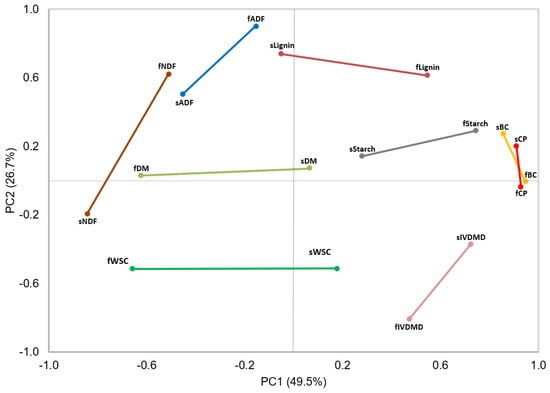
Principal component analysis (PCA) provided an exploratory representation of the relationships among chemical and nutritional traits measured in fresh forages and their corresponding silages (Figure 1). The first two principal components explained 76.2% of the total variance in the chemical dataset (PC1 = 49.5% and PC2 = 26.7%). PC1 was mainly characterized by fiber-related attributes (NDF, ADF, and lignin) in contrast to digestibility-related traits, whereas PC2 was primarily influenced by starch, crude protein, and buffering capacity. The PCA loading plot revealed changes in the relative positioning of chemical and nutritional traits between fresh forages and their corresponding silages, reflecting compositional modifications associated with the ensiling process. Traits related to buffering capacity and crude protein exhibited relatively small positional changes, whereas starch, digestibility, and fiber fractions displayed greater displacement. The magnitude and direction of these changes differed among traits, suggesting that some compositional characteristics were more responsive to ensiling than others.
Figure 1.
Principal component analysis (PCA) loading plot of chemical and nutritional variables measured in fresh forages (f) and their corresponding silages (s). The first two principal components explained 76.2% of the total variance (PC1 = 49.5%, PC2 = 26.7%). Lines connecting fresh forage (f) and silage (s) loadings were included to facilitate visualization of compositional changes associated with the ensiling process. The figure represents variable loadings projected onto the first two principal components rather than sample scores.
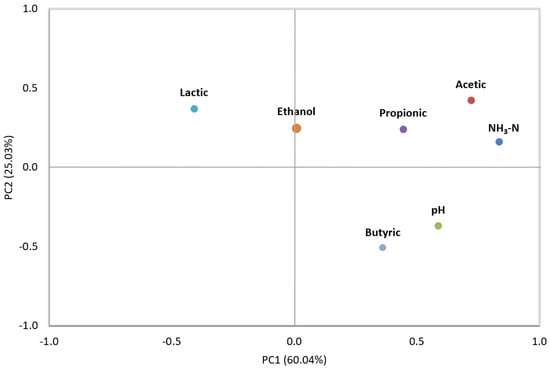
Across all forage species, the first two principal components explained 85.07% of the total variance in the fermentative dataset (PC1 = 60.04%, PC2 = 25.03%; Figure 2). The PCA loading plot revealed distinct relationships among fermentation variables. Acetic acid, NH3-N, pH, and propionic acid were positively associated with PC1, whereas lactic acid was positioned on the opposite side of the axis. Along PC2, acetic acid showed the highest positive loading, while butyric acid and pH were located in the negative region of the component. These patterns indicate that different fermentation products contributed differently to the multivariate structure of the fermentative dataset.
Figure 2.
Principal component analysis (PCA) loading plot of fermentative variables measured in tropical silages, including organic acids, ethanol, NH3-N, and pH. The first two principal components explained 85.07% of the total variance (PC1 = 60.04%, PC2 = 25.03%).
3.4. Pearson Correlation Analysis
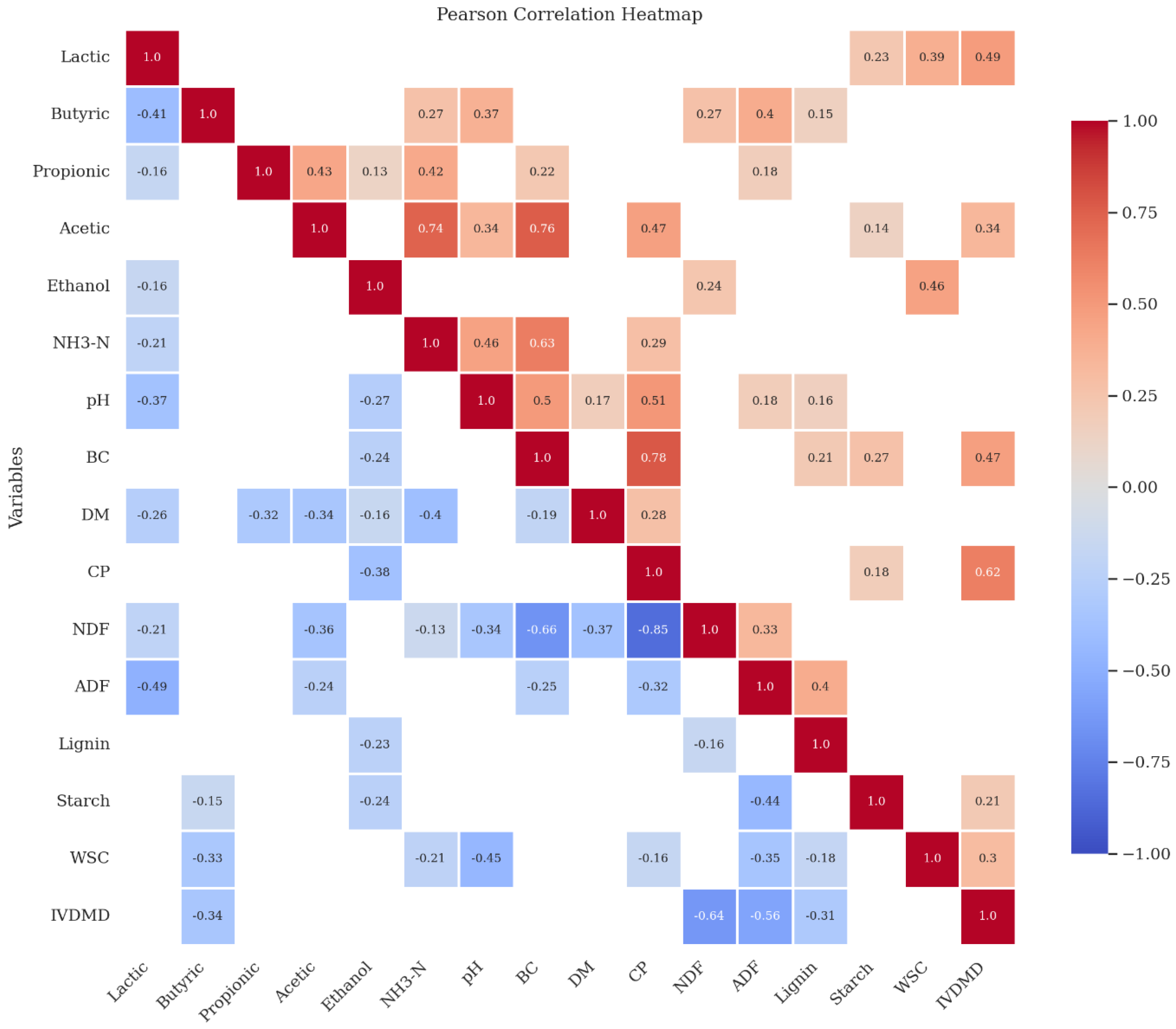
Pearson correlation analysis revealed consistent relationships between nutritional and fermentative traits among silages (Figure 3). Water-soluble carbohydrates (WSCs) were positively associated with lactic acid production and in vitro dry matter digestibility (IVDMD), whereas fiber fractions (NDF and ADF) and lignin showed negative correlations with digestibility-related variables. Buffer capacity exhibited strong positive associations with acetic acid and NH3-N, indicating a close relationship between buffering potential and proteolytic fermentation patterns. In contrast, butyric acid was positively correlated with pH and fiber fractions, while negatively associated with WSCs and digestibility, suggesting contrasting fermentation profiles among silages. Starch was positively associated with digestibility and negatively correlated with ADF, reinforcing the contribution of readily fermentable carbohydrates to the silage’s nutritional quality.
Figure 3.
Heatmap of Pearson correlation coefficients among chemical, nutritional, and fermentative traits of tropical silages. Positive correlations are shown in red and negative correlations in blue. Only statistically significant moderate-to-strong correlations were displayed to improve visualization and interpretation. Blank cells represent weak and/or non-significant correlations and do not indicate missing values. The complete Pearson correlation matrix, including all correlation coefficients and corresponding p-values, is provided in Supplementary Table S1.
3.5. Canonical Discriminant Analysis (CDA)
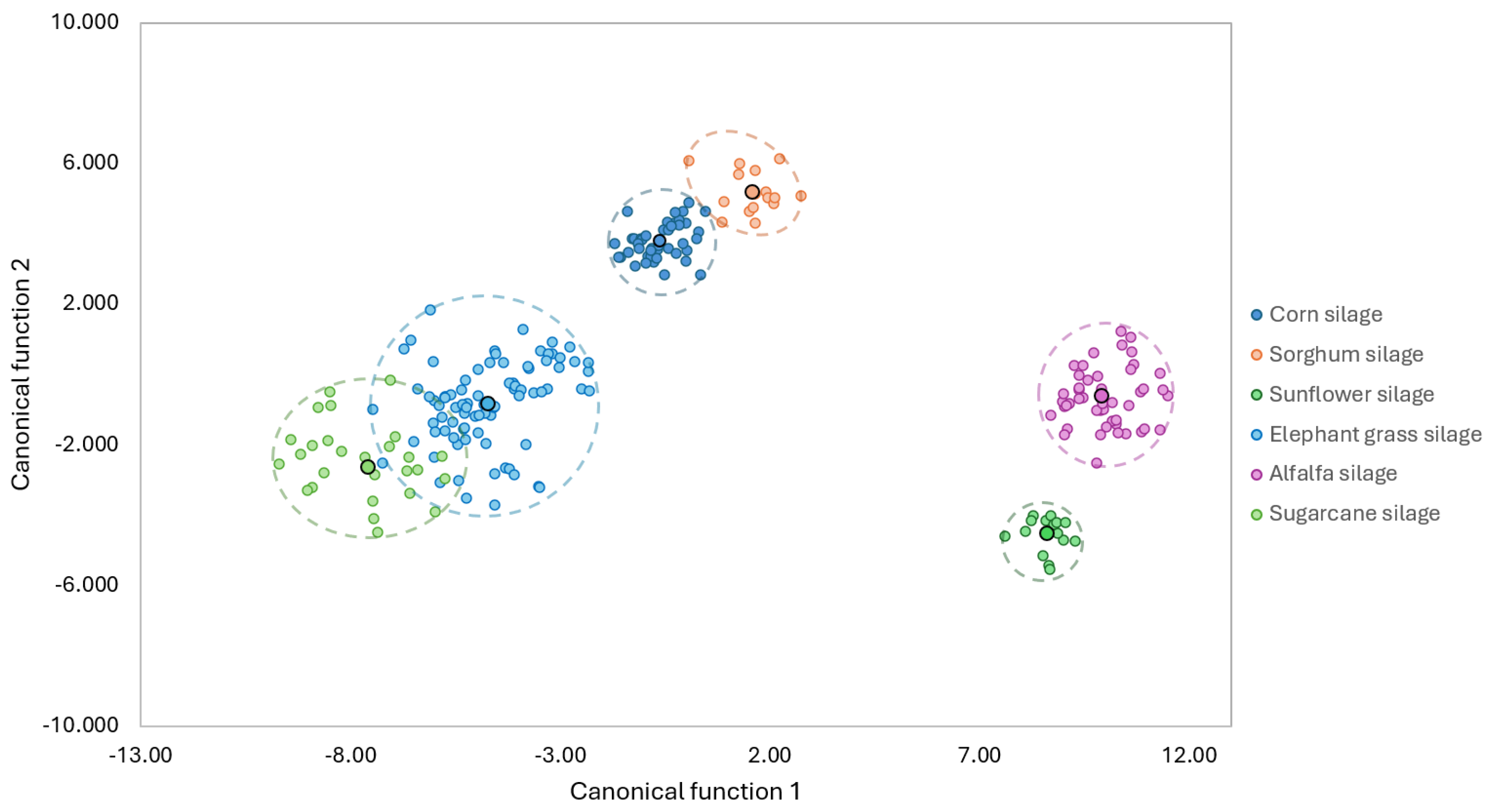
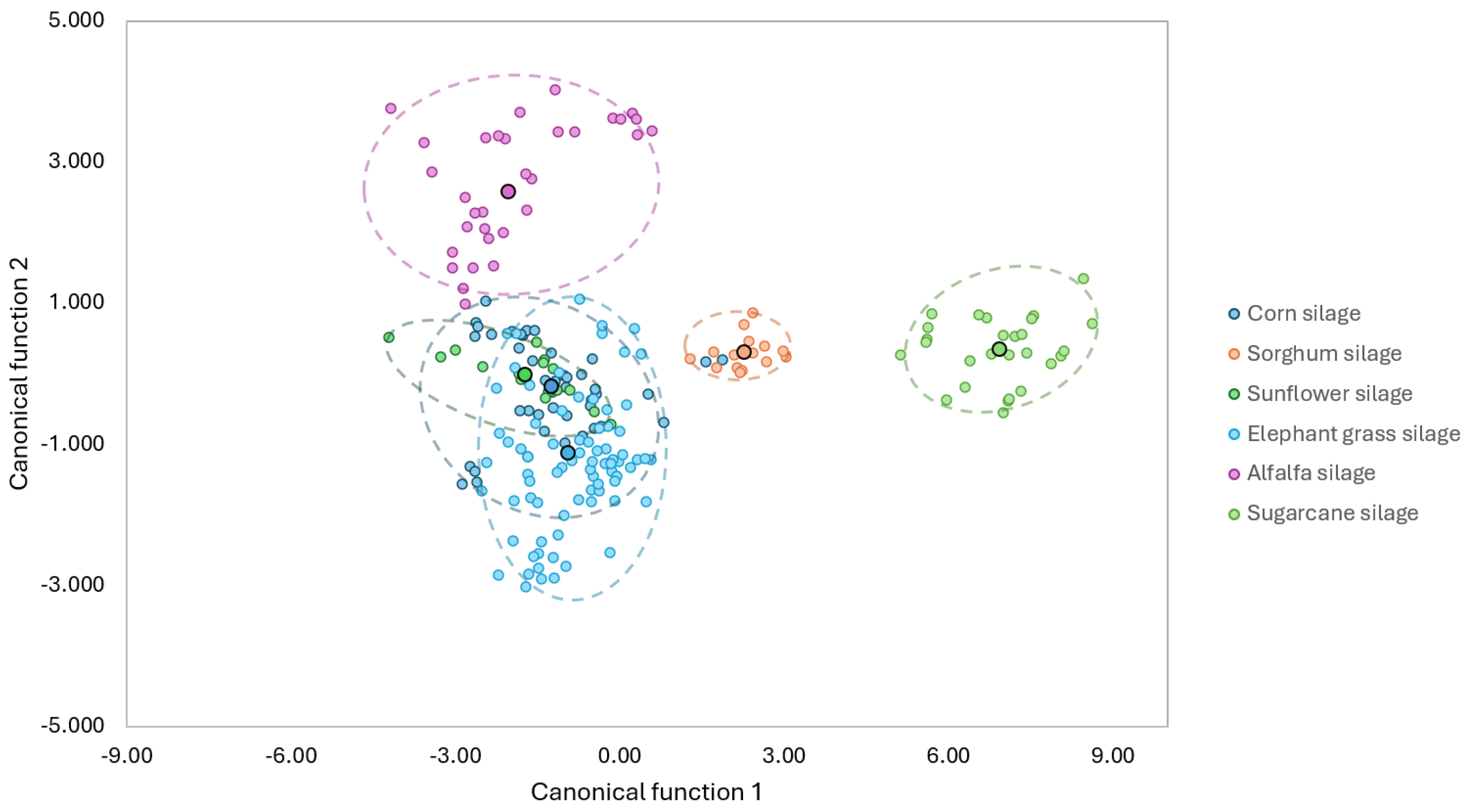
Canonical discriminant analysis (CDA) based on chemical composition revealed clear multivariate separation among silage species (Wilks’ Lambda = 0.00032; F = 112.10; df = 45, 996.16; p < 0.0001; Figure 4). The first two canonical functions explained 93.03% of the canonical variation (Can1 = 79.24% and Can2 = 13.80%), demonstrating that most of the discriminatory information was captured by these dimensions.
Figure 4.
Canonical discriminant analysis (CDA) of silage species based on chemical composition traits. The first two canonical functions explained 93.03% of the canonical variation (Can1 = 79.24%, Can2 = 13.80%). Ellipses represent the dispersion of observations within each silage group. The overall discriminant model was highly significant (Wilks’ Lambda = 0.00032; p < 0.0001).
Corn and sorghum clustered closely in the canonical space, whereas elephant grass and sugarcane occupied more distant positions characterized by contrasting compositional profiles. Alfalfa and sunflower also formed distinct groups, reflecting differences in their nutritional characteristics. Canonical structure coefficients (Supplementary Table S2) indicated that Can1 was primarily associated with crude protein, neutral detergent fiber, and buffering capacity, whereas Can2 was mainly related to starch and acid detergent fiber. Cross-validation of the discriminant model resulted in 100% classification accuracy, confirming the strong discriminatory power of chemical composition traits among silage species.
Canonical discriminant analysis (CDA) based on fermentative traits revealed multivariate separation among silage species, although with greater overlap among some forage groups than observed for chemical composition (Wilks’ Lambda = 0.0210; F = 38.06; df = 35, 885.82; p < 0.0001; Figure 5). The first two canonical functions explained 92.0% of the canonical variation (Can1 = 77.12%, Can2 = 14.88%).
Figure 5.
Canonical discriminant analysis (CDA) of silage species based on fermentative traits. The first two canonical functions explained 92.0% of the canonical variation (Can1 = 77.12%, Can2 = 14.88%). Ellipses indicate the dispersion of observations within each silage group, and black circles represent group centroids. The overall discriminant model was significant (Wilks’ Lambda = 0.0210; p < 0.0001).
Alfalfa silages occupied a distinct position in the canonical space, whereas sugarcane silages formed a separate group characterized by contrasting fermentative profiles. Corn, sorghum, and elephant grass showed partial overlap, reflecting similarities in their fermentation characteristics. Canonical structure coefficients (Supplementary Table S2) indicated that Can1 was primarily associated with ethanol production, whereas Can2 was mainly associated with pH and acetic acid concentration. Cross-validation of the discriminant model resulted in an overall classification accuracy of 82.2%, supporting the ability of fermentative variables to discriminate among forage species despite the greater overlap observed in canonical space.
4. Discussion
According to McDonald et al. (1991) [27], NH3-N concentrations below approximately 10% of total nitrogen are generally indicative of satisfactory fermentation and limited proteolysis, whereas higher values may reflect undesirable fermentative activity. Likewise, forage nutritive value is strongly influenced by cell wall constituents, with increasing NDF and ADF concentrations typically associated with reduced digestibility. Buffering capacity also plays a central role in silage preservation because forages with greater resistance to acidification require more extensive acid production to achieve adequate pH decline during fermentation.
4.1. Chemical Composition of Fresh Forages
The marked differences observed among forage species are consistent with their intrinsic chemical characteristics and known ensiling behavior. Because forage species differ substantially in protein concentration, fermentable carbohydrate availability, fiber composition, and buffering capacity, their fermentation dynamics and preservation efficiency are also expected to differ. Consequently, silage quality should be interpreted within the context of the specific characteristics of each forage species [27].
Fresh forage composition showed wide variability among species, reflecting differences in plant physiology, structural characteristics, and growth habits. Alfalfa exhibited the highest crude protein and digestibility values, consistent with its leguminous nature and high leaf-to-stem ratio [33,34,35]. Its elevated buffering capacity and protein concentration are also associated with greater resistance to rapid acidification during ensiling, which may contribute to higher fermentation pH values [27]. Conversely, elephant grass and sugarcane were characterized by high NDF and ADF concentrations, indicative of fibrous cell wall structures and advanced lignification. Such values are known to limit voluntary intake and reduce energy availability, particularly when NDF exceeds 55% of DM [36,37]. Sugarcane also exhibited low crude protein concentrations, reinforcing its classification as a low-quality forage when offered as the sole feed resource [38].
Corn and sorghum were distinguished by their high starch concentrations, which support efficient fermentation and energy supply to rumen microorganisms. These findings agree with Johnson et al. (2020) and Guo et al. (2025) [39,40], who highlighted the importance of starch-rich silages for ruminal fermentation and animal performance. In contrast, sunflowers exhibited unusually high lignin concentrations, potentially compromising digestibility despite its moderate protein content, as previously reported by Ziebell et al. (2013) [41]. Collectively, these results indicate that no single forage species maximizes all desirable nutritional characteristics, underscoring the importance of strategic forage selection and complementation in tropical livestock systems.
4.2. Chemical and Nutritional Composition of Silages
Ensiling substantially modified forage composition. Overall, silages tended to exhibit higher crude protein, ADF, lignin, and buffering capacity values, whereas DM, starch, and WSCs generally decreased, reflecting the utilization of soluble carbohydrates by fermentative microorganisms. These changes are consistent with the biochemical processes of ensiling, in which readily fermentable substrates are converted into organic acids while structural components remain relatively stable [11,42,43]. Digestibility decreased after ensiling for most species; however, sorghum represented an exception, exhibiting greater IVDMD in silage than in fresh forage. This finding suggests that sorghum may undergo partial cell-wall disruption during ensiling, enhancing digestibility, a response previously reported in cereal silages under controlled conditions [44].
Fiber fractions may also be affected by the ensiling process. The reduction in NDF observed after ensiling may reflect partial degradation or redistribution of less recalcitrant cell-wall components, whereas ADF was comparatively less affected, indicating limited changes in the most resistant structural fractions. This pattern agrees with the findings of Köhler et al. (2019) [45], who reported reductions in NDF concentration in grass and maize silages, suggesting a greater effect of fermentation on less resistant structural carbohydrates, as previously described by McDonald et al. (1991) [27].
4.3. Influence of Fresh Forage Composition on Fermentation Pattern
The apparent increase in lignin concentration after ensiling likely reflects dry matter losses of more digestible components, particularly starch and water-soluble carbohydrates (WSCs), rather than a true increase in lignin content [46]. This phenomenon highlights the concentration effect commonly observed during fermentation and reinforces the role of lignin as a structural component associated with forage quality [14].
Fermentation characteristics further differentiated the evaluated silages. Corn and sorghum produced high concentrations of lactic acid and achieved low final pH values, indicating efficient fermentation. Interestingly, sunflower also exhibited elevated lactic acid concentrations despite its relatively high lignin content, suggesting that sufficient fermentable substrates remained available to support lactic fermentation [47].
In contrast, alfalfa silages were characterized by higher acetic acid, NH3-N, and pH values, indicating a less efficient fermentation process. These responses are consistent with the elevated crude protein concentration and buffering capacity of alfalfa, which can hinder rapid acidification and favor proteolysis during ensiling. Consequently, alfalfa often requires specific management strategies, such as wilting or microbial inoculation, to improve fermentation efficiency and preservation quality [19,21].
Sugarcane silages stood out for their exceptionally high ethanol concentrations, reflecting the activity of yeasts on residual soluble sugars, as previously reported for tropical sugarcane silages [48]. This response is consistent with the high concentration of fermentable carbohydrates in sugarcane and its well-documented susceptibility to alcoholic fermentation. Overall, these findings indicate that fermentation profiles are strongly influenced by forage-specific characteristics, substrate availability, and buffering properties.
4.4. Multivariate Analysis
Multivariate analyses provided an integrative perspective of the nutritional and fermentative characteristics of the evaluated silages. The PCA of chemical traits explained more than 76% of the total variance, separating fiber-related attributes (NDF, ADF, and lignin) from digestibility and soluble carbohydrate variables. The displacement observed between fresh forages and silages was consistent with reductions in WSC and starch and increases in buffering capacity and NH3-N following ensiling. In the fermentative dataset, PCA highlighted contrasting relationships among fermentation products, with lactic, acetic, and propionic acids grouped separately from butyric acid and pH.
Canonical discriminant analysis further supported the differentiation among forage species. Chemical composition traits promoted clearer multivariate separation, particularly distinguishing starch-rich forages such as corn and sorghum from fiber-rich materials such as elephant grass and sugarcane. Although starch and water-soluble carbohydrates are recognized as important fermentable substrates, Pearson correlation analysis revealed only weak to moderate associations between these fractions and individual fermentation end-products. These findings suggest that fermentation outcomes are influenced not only by substrate availability but also by buffering capacity, protein concentration, and other forage-specific characteristics. When fermentative traits were analyzed separately, greater overlap among species was observed, particularly between corn and sorghum. This pattern is biologically plausible because fermentative variables represent microbial metabolic products generated under anaerobic conditions rather than inherent plant characteristics. Although forage species differ substantially in chemical composition and substrate availability, lactic acid bacteria tend to drive fermentation toward similar preservation outcomes, including organic acid production and pH reduction. Consequently, partial convergence among fermentative profiles would be expected, resulting in less pronounced multivariate separation compared with the chemical composition dataset. From a practical perspective, these findings indicate that standardized ensiling practices may partially mitigate quality differences among forage resources, thereby expanding the potential use of alternative feed materials in livestock systems. However, complete convergence was not observed because intrinsic plant characteristics, including buffering capacity, protein concentration, and soluble carbohydrate availability, continued to influence fermentation efficiency and final silage quality.
This study has some limitations that should be acknowledged. The database was compiled from independent experiments conducted over different years and originally designed for distinct research objectives. Although standardized analytical procedures were used and only control treatments were included, differences in environmental conditions, cultivars, harvest age, epiphytic microbial communities, and ensiling protocols may have contributed to part of the observed variability. Therefore, the findings should be interpreted as an exploratory comparative assessment rather than as evidence derived from a single controlled experiment. An additional limitation is the absence of IVNDFD measurements. Although IVDMD provided an overall estimate of forage digestibility, IVNDFD could offer a more detailed assessment of fiber utilization and should be considered in future studies.
Future studies should evaluate a broader range of forage species under standardized experimental conditions and investigate how agronomic management, microbial inoculants, and storage practices influence the relationships between nutritional composition and fermentation characteristics. Integrating nutritional, fermentative, and microbiological variables may further improve the understanding of silage quality determinants across forage systems.
5. Conclusions
This study demonstrated substantial differences in the chemical composition, nutritive value, and fermentation characteristics of forage silages, highlighting the importance of species-specific traits in determining silage quality. Although ensiling markedly altered nutritional and fermentative profiles, intrinsic differences among forage species remained evident after conservation. Chemical composition variables accounted for a greater degree of differentiation among silages than fermentative traits, particularly those related to fiber fractions, digestibility, and soluble carbohydrates. Among the evaluated species, corn and sorghum silages exhibited the most balanced nutritional and fermentative profiles, combining favorable digestibility with efficient fermentation characteristics. In contrast, alfalfa silage presented challenges associated with its high buffering capacity and protein concentration, whereas sugarcane silage was limited by elevated ethanol production. Elephant grass was characterized by high fiber concentrations and reduced digestibility, while sunflower displayed intermediate nutritional and fermentative characteristics. Multivariate analyses complemented conventional evaluations by identifying the main nutritional and fermentative factors responsible for differentiating silage species, thereby providing a more integrated assessment of silage quality. These findings highlight the importance of aligning forage species selection with production objectives and silage management strategies in tropical and subtropical livestock systems.
Supplementary Materials
The following supporting information can be downloaded at https://www.mdpi.com/article/10.3390/grasses5030025/s1; Table S1: Complete Pearson correlation matrix among chemical, nutritional, and fermentative traits of tropical silages. Correlation coefficients are presented in the upper cells and corresponding p-values in the lower cells; Table S2: Canonical structure coefficients for the chemical and fermentative canonical discriminant analyses (CDA).
Author Contributions
Conceptualization, W.M.R.R. and A.J.F.; methodology, P.H.M.R.; software, W.M.R.R., A.J.F. and P.H.M.R.; validation, F.P.J. and P.H.M.R.; formal analysis, P.H.M.R.; investigation, W.M.R.R., A.J.F., T.A.d.C., R.P.N. and R.J.T.; resources, P.H.M.R.; data curation, W.M.R.R., A.J.F. and F.P.J.; writing—original draft preparation, W.M.R.R.; writing—review and editing, W.M.R.R., A.J.F., T.A.d.C., F.P.J., R.P.N., R.J.T. and P.H.M.R.; visualization, W.M.R.R., A.J.F. and T.A.d.C.; supervision, F.P.J. and P.H.M.R.; project administration, P.H.M.R.; funding acquisition, P.H.M.R. All authors have read and agreed to the published version of the manuscript.
Funding
This research was funded by CAPES (Coordenação de Aperfeiçoamento de Pessoal de Nível Superior—001) and CNPq (Conselho Nacional de Desenvolvimento Científico e Tecnológico—132717/2025-5) through graduate fellowships awarded to the authors.
Data Availability Statement
The datasets generated and analyzed during the current study are available from the corresponding author upon reasonable request.
Acknowledgments
Generative AI tools were not used for text generation, the literature review, data interpretation, or statistical analysis. All statistical analyses were conducted using SAS software by the authors. Julius AI (version 1.2 Lite) was used solely to assist in the graphical generation of the correlation heatmap based on author-generated data and specifications. The authors reviewed, verified, and approved the final figure and take full responsibility for all content presented in the manuscript.
Conflicts of Interest
The authors declare no conflicts of interest.
Abbreviations
The following abbreviations are used in this manuscript:
| ADF | Acid detergent fiber |
| BC | Buffer capacity |
| CDA | Canonical discriminant analysis |
| CE-FSN | Centre of Excellence in Agri-food Systems and Nutrition |
| CP | Crude protein |
| DM | Dry matter |
| FZEA | School of Animal Science and Food Engineering |
| FMVZ | School of Veterinary Medicine and Animal Science |
| IVDMD | In vitro dry matter digestibility |
| LAB | Lactic acid bacteria |
| NDF | Neutral detergent fiber |
| NH3-N | Ammoniacal nitrogen |
| PCA | Principal component analysis |
| WSCs | Water-soluble carbohydrates |
References
- Bolsen, K.K. New technology in forage conservation-feeding systems. In Proceedings of the XV International Grassland Congress, Kyoto, Japan, 24–31 August 1985; pp. 82–88. [Google Scholar]
- Zhu, L.; Zhao, M.; Yan, Y.; Sun, P.; Yan, X.; Liu, M.; Na, R.; Jia, Y.; Cha, S.; Ge, G. Characteristics of isolated lactic acid bacteria at low temperature and their effects on the silage quality. Microbiol. Spectr. 2025, 13, e03194-24. [Google Scholar] [CrossRef] [Scilit] [PubMed]
- Bolsen, K.K.; Ashbell, G.; Weinberg, Z.G. Silage fermentation and silage additives. Asian-Australas. J. Anim. Sci. 1996, 9, 483–493. [Google Scholar] [CrossRef] [Scilit]
- Monteiro, I.J.G.; De Abreu, J.G.; Da Silva Cabral, L.; De Almeida, R.G.; Dos Reis, R.H.P.; Neto, A.B.; Cabral, C.E.A.; De Barros, L.V.; Avelino, A.C.D.; Penso, S. Ensiling of elephant grass with soybean hulls or rice bran. Semin. Cienc. Agrar. 2016, 37, 4203–4212. [Google Scholar] [CrossRef] [Scilit]
- Amorim, D.S.; Edvan, R.L.L.; Nascimento, R.R.; Bezerra, L.R.; Araújo, M.J.; Silva, A.L.; Mielezrski, F.; Nascimento, K.S. Fermentation profile and nutritional value of sesame silage compared to usual silages. Ital. J. Anim. Sci. 2020, 19, 230–239. [Google Scholar] [CrossRef] [Scilit]
- Batista, K.; Campos, F.P. Qualitative production of mixture silage within a sustainable concept. Sustainability 2024, 16, 6398. [Google Scholar] [CrossRef] [Scilit]
- Wilkinson, J.M.; Davies, D.R. The aerobic stability of silage: Key findings and recent developments. Grass Forage Sci. 2013, 68, 1–19. [Google Scholar] [CrossRef] [Scilit]
- Mahanna, B.; Chase, L.E. Practical Applications and Solutions to Silage Problems. Silage Sci. Technol. 2003, 42, 855–895. [Google Scholar] [CrossRef] [Scilit]
- Bernardes, T.F.; Daniel, J.L.P.; Adesogan, A.T.; McAllister, T.A.; Drouin, P.; Nussio, L.G.; Huhtanen, P.; Tremblay, G.F.; Bélanger, G.; Cai, Y. Silage review: Unique challenges of silages made in hot and cold regions. J. Dairy Sci. 2018, 101, 4001–4019. [Google Scholar] [CrossRef] [Scilit] [PubMed]
- Kung, L.; Shaver, R.D.; Grant, R.J.; Schmidt, R.J. Silage Review: Interpretation of Chemical, Microbial, and Organoleptic Components of Silages. J. Dairy Sci. 2018, 101, 4020–4033. [Google Scholar] [CrossRef] [Scilit] [PubMed]
- Udén, P. Fresh and Ensiled Forage Plants—Total Composition, Silage Losses and the Prediction of Silage Composition from the Crop. Grass Forage Sci. 2018, 73, 420–431. [Google Scholar] [CrossRef] [Scilit]
- Van Soest, P.J. Development of a Comprehensive System of Feed Analyses and Its Application to Forages. J. Anim. Sci. 1967, 26, 119–128. [Google Scholar] [CrossRef] [Scilit]
- Amer, S.; Hassanat, F.; Berthiaume, R.; Seguin, P.; Mustafa, A.F. Effects of Water Soluble Carbohydrate Content on Ensiling Characteristics, Chemical Composition and in Vitro Gas Production of Forage Millet and Forage Sorghum Silages. Anim. Feed Sci. Technol. 2012, 177, 23–29. [Google Scholar] [CrossRef] [Scilit]
- Raffrenato, E.; Fievisohn, R.; Cotanch, K.W.; Grant, R.J.; Chase, L.E.; Van Amburgh, M.E. Effect of Lignin Linkages with Other Plant Cell Wall Components on in Vitro and in Vivo Neutral Detergent Fiber Digestibility and Rate of Digestion of Grass Forages. J. Dairy Sci. 2017, 100, 8119–8131. [Google Scholar] [CrossRef] [Scilit] [PubMed]
- Rodrigues, P.H.M.; Pinedo, L.A.; Meyer, P.M.; da Silva, T.H.; Guimarães, I.C.d.S.B. Sorghum Silage Quality as Determined by Chemical–Nutritional Factors. Grass Forage Sci. 2020, 75, 462–473. [Google Scholar] [CrossRef] [Scilit]
- Jasaitis, D.K.; Wohlt, J.E.; Evans, J.L. Influence of Feed Ion Content on Buffering Capacity of Ruminant Feedstuffs In Vitro. J. Dairy Sci. 1987, 70, 1391–1403. [Google Scholar] [CrossRef] [Scilit]
- Li, H.; Zeng, T.; Du, Z.; Dong, X.; Xin, Y.; Wu, Y.; Huang, L.; Liu, L.; Kang, B.; Jiang, D.; et al. Assessment on the Fermentation Quality and Bacterial Community of Mixed Silage of Faba Bean With Forage Wheat or Oat. Front. Microbiol. 2022, 13, 875819. [Google Scholar] [CrossRef] [Scilit] [PubMed]
- Playne, M.J.; McDonald, P. The Buffering Constituents of Herbage and of Silage. J. Sci. Food Agric. 1966, 17, 264–268. [Google Scholar] [CrossRef] [Scilit]
- Jones, B.A.; Satter, L.D.; Muck, R.E. Influence of Bacterial Inoculant and Substrate Addition to Lucerne Ensiled at Different Dry Matter Contents. Grass Forage Sci. 1992, 47, 19–27. [Google Scholar] [CrossRef] [Scilit]
- Mogodiniyai Kasmaei, K.; Dicksved, J.; Spörndly, R.; Udén, P. Separating the Effects of Forage Source and Field Microbiota on Silage Fermentation Quality and Aerobic Stability. Grass Forage Sci. 2017, 72, 281–289. [Google Scholar] [CrossRef] [Scilit]
- Seale, D.R.; Henderson, A.R.; Pettersson, K.O.; Lowe, J.F. The Effect of Addition of Sugar and Inoculation with Two Commercial Inoculants on the Fermentation of Lucerne Silage in Laboratory Silos. Grass Forage Sci. 1986, 41, 61–70. [Google Scholar] [CrossRef] [Scilit]
- van Raij, B.; Cantarella, H.; Quaggio, J.A.; Furlani, A.M.C. Recomendações de Calagem e Adubação para o Estado de São Paulo; Boletim Técnico, 100; Instituto Agronômico/Fundação IAC: Campinas, Brazil, 1996; pp. 14–19.
- AOAC. Official Methods of Analysis, 16th ed.; Association of Official Analytical Chemists: Rockville, MD, USA, 1995. [Google Scholar]
- Van Soest, P.J.; Robertson, J.B.; Lewis, B.A. Methods for Dietary Fiber, Neutral Detergent Fiber, and Nonstarch Polysaccharides in Relation to Animal Nutrition. J. Dairy Sci. 1991, 74, 3583–3597. [Google Scholar] [CrossRef] [Scilit] [PubMed]
- Pereira, J.R.A.; Rossi, P., Jr. Practical Manual of Feedstuffs Nutritional Evaluation, 1st ed.; FEALQ: Piracicaba, Brazil, 1995. [Google Scholar]
- Johnson, R.R.; Balwan, T.L.; Johnson, L.J.; McClure, K.E.; Dehority, B.A. Corn plant maturity. II. Effect on in vitro cellulose digestibility and soluble carbohydrate content. J. Anim. Sci. 1966, 25, 617–623. [Google Scholar] [CrossRef] [Scilit]
- McDonald, P.; Henderson, N.; Heron, S.J.E. The Biochemistry of Silage; Chalcombe Publishing: Marlowe, UK, 1991. [Google Scholar]
- Erwin, E.S.; Marco, G.J.; Emery, E.M. Volatile fatty acid analyses of blood and rumen fluid by gas chromatography. J. Dairy Sci. 1961, 44, 1768–1771. [Google Scholar] [CrossRef] [Scilit]
- Kulasek, G. A micromethod for determining urea in blood plasma, whole blood and blood corpuscles with the use of urease and phenol reagent. Pol. Arch. Weter. 1972, 15, 801–810. [Google Scholar] [PubMed]
- Foldager, J. Protein Requirement and Non-Protein Nitrogen for High Producing Cows in Early Lactation. Doctoral Dissertation, Michigan State University, East Lansing, MI, USA, 1977. [Google Scholar]
- Tilley, J.M.A.; Terry, R.A. A two-stage technique for the in vitro digestion of forage crops. Grass Forage Sci. 1963, 18, 104–111. [Google Scholar] [CrossRef] [Scilit]
- McDougall, E. Studies on Ruminant Saliva. The Composition and Output of Sheep’s Saliva. Biochem. J. 1948, 43, 99–109. [Google Scholar] [PubMed]
- Bhandari, K.B.; Rusch, H.L.; Heuschele, D.J. Alfalfa stem cell wall digestibility: Current knowledge and future research directions. Agronomy 2023, 13, 2875. [Google Scholar] [CrossRef] [Scilit]
- Heuschele, D.J.; Gamble, J.; Vetsch, J.A.; Shaeffer, C.C.; Coulter, J.A.; Kaiser, D.E.; Lamb, J.A.; Lamb, J.A.F.S.; Samac, D.A. Influence of potassium fertilization on alfalfa leaf and stem yield, forage quality, nutrient removal, and plant health. Agrosystems Geosci. Environ. 2023, 6, e20346. [Google Scholar] [CrossRef] [Scilit]
- Ovani, V.S.; Pérez-Márquez, S.; da Silva, B.T.N.; Louvandini, H.; Abdalla, A.L.; Olival, A.d.A. Potential of Chloroleucon acacioides trees as an alternative feed supplement for grazing ruminants in a tropical silvopastoral system. J. Agric. Food Res. 2023, 11, 100524. [Google Scholar] [CrossRef] [Scilit]
- Shi, R.; Dong, S.; Mao, J.; Wang, J.; Cao, Z.; Wang, Y.; Li, S.; Zhao, G. Dietary Neutral Detergent Fiber Levels Impacting Dairy Cows’ Feeding Behavior, Rumen Fermentation, and Production Performance during the Period of Peak-Lactation. Animals 2023, 13, 2876. [Google Scholar] [CrossRef] [Scilit] [PubMed]
- Truong, N.B.; Tuan, T.T. Influence of dietary neutral detergent fiber on feed intake and nutrient digestibility of crossbred Black Angus cattle. Asian J. Agric. Biol. 2023, 2023, 2021420. [Google Scholar] [CrossRef] [Scilit]
- Molavian, M.; Ghorbani, G.R.; Rafiee, H.; Beauchemin, K.A. Substitution of wheat straw with sugarcane bagasse in low-forage diets fed to mid-lactation dairy cows: Milk production, digestibility, and chewing behavior. J. Dairy Sci. 2020, 103, 8034–8047. [Google Scholar] [CrossRef] [Scilit] [PubMed]
- Johnson, J.A.; Sutherland, B.D.; McKinnon, J.J.; McAllister, T.A.; Penner, G.B. Effect of feeding barley or corn silage with dry-rolled barley, corn, or a blend of barley and corn grain on rumen fermentation, total tract digestibility, and nitrogen balance for finishing beef heifers. J. Anim. Sci. 2020, 98, skaa002. [Google Scholar] [CrossRef] [Scilit] [PubMed]
- Guo, W.; Na, M.; Liu, S.; Li, K.; Du, H.; Zhang, J.; Na, R. Rumen-degradable starch improves rumen fermentation, function, and growth performance by altering bacteria and its metabolome in sheep fed alfalfa hay or silage. Animals 2025, 15, 34. [Google Scholar] [CrossRef] [Scilit] [PubMed]
- Ziebell, A.L.; Barb, J.G.; Sandhu, S.; Moyers, B.T.; Sykes, R.W.; Doeppke, C.; Gracom, K.L.; Carlile, M.; Marek, L.F.; Davis, M.F.; et al. Sunflower as a biofuels crop: An analysis oflignocellulosic chemical properties. Biomass Bioenergy 2013, 59, 208–217. [Google Scholar] [CrossRef] [Scilit]
- Finch, H.J.S.; Samuel, A.M.; Lane, G.P.F. Conservation of grass and forage crops. In Lockhart and Wiseman’s Crop Husbandry Including Grassland; Woodhead Publishing: Delhi, India, 2014; pp. 513–526. [Google Scholar] [CrossRef] [Scilit]
- Rooke, J.A.; Hatfield, R.D. Biochemistry of Ensiling. In Agronomy Monographs; Wiley: Hoboken, NJ, USA, 2003; pp. 95–139. [Google Scholar] [CrossRef] [Scilit]
- de Castro Silva, B.; Pacheco, M.V.C.; Godoi, L.A.; Alhadas, H.M.; Pereira, J.M.V.; Rennó, L.N.; Detmann, E.; Paulino, P.V.R.; Schoonmaker, J.P.; Valadares Filho, S.C. Reconstituted and ensiled corn or sorghum grain: Impacts on dietary nitrogen fractions, intake, and digestion sites in young Nellore bulls. PLoS ONE 2020, 15, e0237381. [Google Scholar] [CrossRef] [Scilit] [PubMed]
- Köhler, B.; Taube, F.; Ostertag, J.; Thurner, S.; Kluß, C.; Spiekers, H. Dry-matter losses and changes in nutrient concentrations in grass and maize silages stored in bunker silos. Grass Forage Sci. 2019, 74, 274–283. [Google Scholar] [CrossRef] [Scilit]
- Hristov, A.N.; Harper, M.T.; Roth, G.; Canale, C.; Huhtanen, P.; Richard, T.L.; DiMarco, K. Effects of ensiling time on corn silage neutral detergent fiber degradability and relationship between laboratory fiber analyses and in vivo digestibility. J. Dairy Sci. 2020, 103, 2333–2346. [Google Scholar] [CrossRef] [Scilit] [PubMed]
- Abedi, E.; Hashemi, S.M.B. Lactic acid production—Producing microorganisms and substrate sources: State of the art. Heliyon 2020, 6, e04974. [Google Scholar] [CrossRef] [Scilit] [PubMed]
- Carvalho, B.F.; Ávila, C.L.S.; Pinto, J.C.; Neri, J.; Schwan, R.F. Microbiological and chemical profile of sugarcane silage fermentation inoculated with wild strains of lactic acid bacteria. Anim. Feed Sci. Technol. 2014, 195, 1–13. [Google Scholar] [CrossRef] [Scilit]

Disclaimer/Publisher’s Note: The statements, opinions and data contained in all publications are solely those of the individual author(s) and contributor(s) and not of MDPI and/or the editor(s). MDPI and/or the editor(s) disclaim responsibility for any injury to people or property resulting from any ideas, methods, instructions or products referred to in the content. |
© 2026 by the authors. Licensee MDPI, Basel, Switzerland. This article is an open access article distributed under the terms and conditions of the Creative Commons Attribution (CC BY) license.