1. Introduction
Nitrogen fertilization is one of the most widely adopted management practices for enhancing forage production in tropical grasslands, playing a central role in determining both herbage accumulation and canopy structure. In tropical forage species, nitrogen availability directly influences morphogenetic processes such as leaf appearance, elongation, and tillering, resulting in increased plant height and biomass production [
1,
2]. In this context, sward height has been used as a practical structural indicator for pasture management, as it reflects canopy development and plant responses to management practices [
3].
Beyond its effects on productivity, nitrogen fertilization also affects forage nutritive value by altering morphological composition, particularly the proportion of leaves and stems within the canopy. Higher nitrogen availability generally promotes leaf growth and increases crude protein concentration, which can improve animal performance [
4,
5]. However, these responses are not always linear and may depend on interactions with defoliation management and environmental conditions, especially when canopy structure becomes a limiting factor [
1,
6].
Among tropical grasses,
Megathyrsus maximus (syn.
Panicum maximum) stands out due to its high productive potential and responsiveness to fertilization, being widely used in intensively managed pasture systems in Brazil [
7]. The cultivar Aruana has been shown to respond positively to nitrogen fertilization, with improvements in morphogenic and structural characteristics, although responses may vary depending on management strategy and growth conditions [
8]. Despite its high forage quality and adaptability, its performance is strongly dependent on the balance between nutrient supply and defoliation intensity [
9].
Defoliation management, particularly residual height after grazing or cutting, is a key factor regulating regrowth dynamics and pasture productivity. Residual height determines the amount of remaining leaf area, which directly affects photosynthetic capacity and the speed of canopy recovery after defoliation [
4]. More severe defoliation can increase forage harvest efficiency and modify canopy structure, whereas lenient defoliation may favor stem elongation and reduce forage quality [
5,
10]. Additionally, defoliation intensity interacts with nitrogen fertilization, influencing plant regrowth dynamics and pasture utilization efficiency, as well as grazing behavior and forage use by animals [
9,
11,
12].
Previous studies have demonstrated that nitrogen fertilization and defoliation management individually affect forage production and structure in tropical grasses; however, their interaction remains inconsistent. Nitrogen fertilization has been shown to enhance forage production in
Megathyrsus maximus and related grasses [
3,
13], but responses may be influenced by grazing intensity and residual height [
5,
14]. Likewise, defoliation strategies can modulate forage accumulation and regrowth patterns depending on canopy structure and nutrient availability [
4].
Despite advances in pasture management research in Brazil, there is still a lack of integrated studies evaluating nitrogen fertilization and defoliation management simultaneously for Aruana grass under irrigated conditions. Moreover, inconsistencies in reported responses highlight the need for further evaluation under factorial experimental designs to better understand the interaction between these factors [
7,
8].
Therefore, this study aimed to evaluate forage production and morphological composition of Aruana grass under different nitrogen rates and post-cutting residual heights. We hypothesized that plant response to nitrogen fertilization depends on defoliation intensity and that optimizing canopy management may be as important as nutrient supply for maximizing pasture productivity.
2. Materials and Methods
2.1. Experimental Site and Environmental Conditions
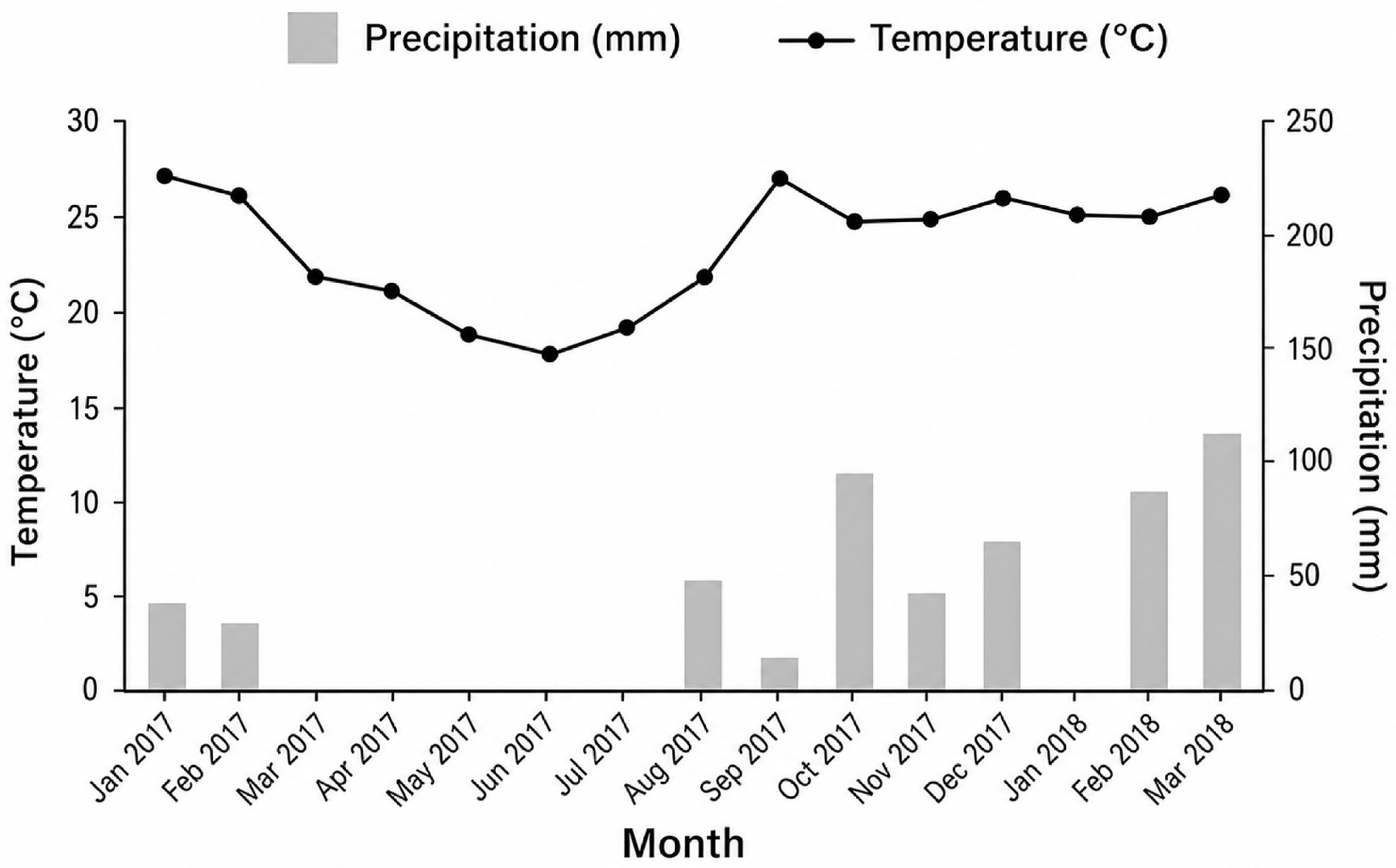
The experiment was conducted at the Faculty of Agricultural Sciences of the Federal University of Grande Dourados (UFGD), located in Dourados, Mato Grosso do Sul, Brazil (22°13′16″ S, 54°17′01″ W; 430 m above sea level). The climate is classified as humid subtropical (Cwa, Köppen classification). The experimental period was characterized by an average air temperature of 23.33 °C, with minimum and maximum values of 0.5 °C and 38.2 °C, respectively. Total precipitation was 553.4 mm, corresponding to a mean daily precipitation of 1.4 mm day
−1. (
Figure 1). The experimental period extended from February 2017 to March 2018, encompassing one complete growing season.
The soil in the experimental area is classified as a dystroferric Red Latosol according to EMBRAPA [
15], presenting 26.7 g kg
−1 of organic matter, pH of 5.8, and base saturation of 78%. Soil chemical analysis revealed 15.2 mg dm
−3 of available P (Mehlich
−1), 0.18 cmolc dm
−3 of exchangeable K, and 4.2 cmolc dm
−3 of Ca + Mg.
2.2. Pasture Establishment and Management
The forage species used was Aruana grass (Megathyrsus maximus cv. Aruana), established in January 2017 using 6 kg ha−1 of pure viable seeds (85% germination). Sowing was carried out manually in rows spaced 0.50 m apart. At establishment, 80 kg ha−1 of P2O5 (single superphosphate) and 60 kg ha−1 of K2O (potassium chloride) were applied.
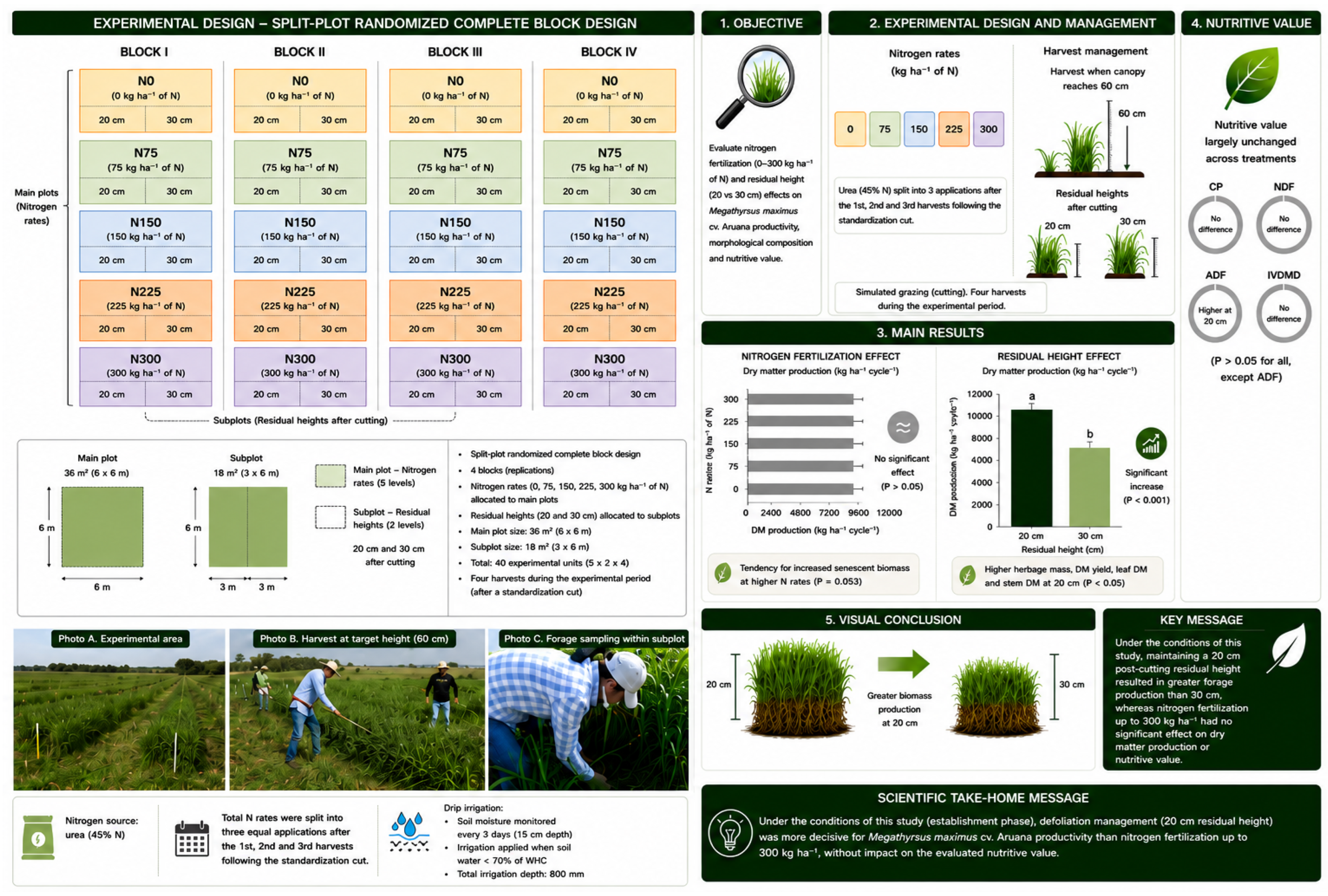
Pasture management was conducted under simulated grazing conditions. A standardization cut was performed 30 days after emergence to ensure uniform establishment among experimental units. Thereafter, forage was harvested whenever the canopy reached 60 cm in height, as determined from four height measurements taken at randomly selected points within each subplot using a graduated ruler. The standardization cut performed 30 days after emergence was considered the first harvest; therefore, a total of four harvests were conducted throughout the experimental period.
At each harvest, all forage above the target residual height (20 or 30 cm, according to treatment) was collected from the useful area of each subplot. Fresh forage mass (herbage mass) was weighed immediately after harvesting and expressed as kg ha−1. A representative subsample was collected and dried in a forced-air oven at 55 °C until constant weight to determine dry matter concentration and dry matter yield. The dried material was manually separated into leaf blades, stems (stem + sheath), and senescent material to quantify leaf dry matter, stem dry matter, and senescent dry matter yields, respectively.
Productive variables were recorded at each harvest event, and values presented represent the mean production per harvest throughout the experimental period. Harvests were performed whenever the canopy reached the predetermined target height of 60 cm, resulting in differences in harvest timing and frequency among treatments. For descriptive purposes, dry matter yield at each harvest and cumulative dry matter production throughout the experimental period are presented in
Appendix A Table A1.
2.3. Experimental Design and Treatments
The experimental design was a split-plot randomized complete block design with four replicates. Nitrogen rates (0, 75, 150, 225, and 300 kg ha
−1 of N) were allocated to main plots, while post-cutting residual heights (20 and 30 cm) were assigned to subplots, totaling 40 experimental units. Main plots measured 36 m
2 (6 × 6 m) and subplots 18 m
2 (3 × 6 m). A schematic representation of the experiment is provided in
Appendix A.
Nitrogen was supplied as urea (45% N). The total N rates were divided into three equal applications, which were broadcast by hand immediately after the first, second, and third experimental harvests following the standardization cut. Applications were made immediately after cutting and watered in with 10 mm of irrigation to minimize volatilization losses.
2.4. Irrigation Management
Irrigation was performed using a drip system equipped with Petrodrip® Manari (Petroísa Irrigação, Avaré, São Paulo, Brazil) drip tapes, with emitters spaced at 0.20 m, flow rate of 1.5 L h−1, and operating pressure of 8 m water column. One irrigation line was installed per pasture row with emitters positioned at the soil surface between plant rows.
Irrigation was applied every three days, preferably in the morning, based on soil volumetric moisture monitored using a Hidrofarm (model HFM2010) sensor installed at 15 cm depth in each block. Irrigation was scheduled every three days; however, it was only applied when soil water holding capacity decreased below 70%, which was used as the threshold to prevent water deficit stress. The total irrigation depth applied during the experimental period was 800 mm.
2.5. Forage Sampling and Processing
Forage samples were collected using a 0.25 m2 quadrat, with one sample per experimental unit, maintaining a 0.50 m border to avoid edge effects. Samples were cut at the respective residual heights according to treatments using electric scissors.
After collection, samples were immediately weighed for fresh mass determination, and a representative 300 g subsample was separated for morphological composition (leaf blade and stem + sheath). Senescent material was also quantified separately. Samples were dried in a forced-air oven at 55 °C for 72 h to determine dry matter yield. Subsequently, dried samples were ground using a knife mill with a 2 mm screen.
For laboratory analyses, samples were further ground in a Wiley mill with a 1 mm sieve and stored in airtight plastic containers at room temperature until analysis.
2.6. Chemical Analyses
Chemical analyses were conducted at the Animal Nutrition Laboratory (LANA-UFGD). Dry matter (DM; method 930.15) and crude protein (CP; method 976.05) were determined according to AOAC [
16]. Crude protein was calculated as N × 6.25, where N was determined by the Kjeldahl method.
Neutral detergent fiber (NDF) was determined without sodium sulfite and corrected for ash, following Mertens [
17]. Acid detergent fiber (ADF) was determined according to Van Soest [
18], and lignin was quantified using potassium permanganate oxidation Van Soest and Wine [
19]. All fiber analyses were performed in duplicate, and results were expressed on a dry matter basis.
2.7. In Vitro Digestibility
In vitro dry matter digestibility (IVDMD) was determined according to Tilley and Terry [
20], as modified by Goering and Van Soest [
21], using a TE-150 incubator (Tecnal
®, Piracicaba, SP, Brazil) maintained at 39 °C with continuous agitation at 60 rpm.
Rumen fluid was collected from two rumen-cannulated, castrated crossbred steers (average body weight 380 ± 50 kg), maintained on Urochloa brizantha cv. Marandu pasture supplemented with mineral salt ad libitum. Animals were fasted for 12 h before rumen fluid collection. Samples were collected in the morning before feeding via the rumen cannula and immediately filtered through four layers of cheesecloth and maintained at 39 °C under a CO2 atmosphere until use.
2.8. Statistical Analysis
Data were analyzed using a two-way analysis of variance (ANOVA) in a split-plot randomized complete block design with four replicates. Nitrogen fertilization (five levels: 0, 75, 150, 225, and 300 kg ha−1 of N) was assigned to main plots, and residual height (two levels: 20 and 30 cm) to subplots. Blocks were considered random effects, while nitrogen rate (N), residual height (RH), and their interaction (N × RH) were treated as fixed effects.
The statistical model was
where Yijk is the observed value, μ is the overall mean, Bi is the block effect, Nj is the effect of nitrogen fertilization, (BN)ij is the main plot error, Hk is the effect of residual height, (NH)jk is the interaction between nitrogen and residual height, and εijk is the subplot error.
Normality and homogeneity of variance were verified using the Shapiro–Wilk and Levene tests, respectively. When significant effects were detected (p < 0.05), means were compared using Tukey’s test. Although the interaction term (N × RH) was included in the model, it was not significant for any response variable; therefore, results are presented and discussed based on main effects.
3. Results
No significant interaction was observed between nitrogen fertilization and residual canopy height for any of the evaluated variables (p > 0.05), indicating that the effects of these factors were independent.
Herbage mass and dry matter yield components are presented in
Table 1 and
Table 2. Nitrogen fertilization did not significantly affect any productive variables of
Megathyrsus maximus cv. Aruana, including herbage mass (
p = 0.977), dry matter yield (
p = 0.270), leaf dry matter (
p = 0.597), stem dry matter (
p = 0.203), senescent biomass (
p = 0.053), or leaf:stem ratio (
p = 0.630).
In contrast, residual canopy height significantly influenced forage production (
Table 2). Reducing stubble height from 30 to 20 cm increased herbage mass (
p = 0.004), dry matter yield (
p < 0.001), leaf dry matter (
p < 0.001), and stem dry matter (
p < 0.001). Senescent dry matter (
p = 0.193) and leaf:stem ratio (
p = 0.332) were not affected by cutting height. Overall, the 20 cm residual height resulted in higher forage accumulation compared with 30 cm.
For descriptive purposes, cumulative dry matter production throughout the experimental period is presented in
Appendix A Table A1. Numerically, cumulative production tended to increase with nitrogen fertilization, particularly under the 20 cm residual height. However, because harvest frequency differed among treatments and cumulative production was not included in the statistical analysis, these values should be interpreted descriptively only.
For chemical composition and in vitro dry matter digestibility (
Table 3), nitrogen fertilization significantly affected only dry matter content (
p = 0.046). Dry matter percentage increased at higher nitrogen rates, particularly at 225 and 300 kg ha
−1 N. No significant effects of nitrogen fertilization were observed for crude protein (
p = 0.537), neutral detergent fiber (
p = 0.323), acid detergent fiber (
p = 0.930), lignin (
p = 0.974), or in vitro dry matter digestibility (
p = 0.524).
Residual canopy height did not influence most chemical attributes or digestibility (
Table 4), with no significant effects on dry matter content (
p = 0.313), neutral detergent fiber (
p = 0.500), crude protein (
p = 0.672), lignin (
p = 0.175), or in vitro dry matter digestibility (
p = 0.436). However, acid detergent fiber was significantly affected (
p = 0.040), with higher values observed at 20 cm compared with 30 cm.
4. Discussion
The absence of interaction between nitrogen fertilization and residual height indicates that these management factors acted independently on the productive and nutritional responses of Aruana grass. More importantly, the results obtained under the conditions of this experiment suggest that forage accumulation was more strongly influenced by canopy management than by nitrogen supply.
Nitrogen fertilization did not affect herbage mass, dry matter yield, leaf dry matter, stem dry matter, leaf ratio, or forage nutritive value. Although cumulative dry matter production tended to be greater under intermediate nitrogen rates (
Appendix A Table A1), these values were not statistically analyzed because harvest frequency differed among treatments. Consequently, no inference can be made regarding the effect of nitrogen fertilization on total biomass accumulation over the experimental period.
Giacomini et al. [
22] also found no effect of nitrogen fertilization on dry matter accumulation in Aruana grass grown in pots, whereas Sacramento et al. [
8] reported a positive quadratic response in cumulative dry matter production, with dry matter production increasing from 5840 to 8863 kg DM ha
−1 as nitrogen rates increased from 0 to 225 kg ha
−1. These contrasting findings suggest that nitrogen responsiveness in Aruana grass is strongly influenced by environmental conditions and management practices.
The absence of productive responses observed in the present study may also be associated with intrinsic characteristics of the cultivar. Pereira et al. [
23] reported a forage accumulation rate of 14.5 kg DM ha
−1 day
−1. Although this variable is not directly comparable with the mean dry matter yield per harvest evaluated in the present study, it likewise indicates the relatively low productive potential of the Aruana cultivar.
This interpretation is supported by the tendency for increased senescent biomass at higher nitrogen rates (
p = 0.053). Although not statistically significant at the adopted probability level, senescent dry matter increased numerically as nitrogen supply increased, suggesting greater tissue turnover within the canopy. Similar responses were reported by Sacramento et al. [
8], who observed increased leaf appearance, leaf elongation, and senescence rates in Aruana grass fertilized with nitrogen. Likewise, Garcez and Monteiro [
24] demonstrated that increasing nitrogen supply altered biomass allocation patterns, reducing root biomass proportion while increasing biomass partitioning to leaves and stems. These findings suggest that nitrogen fertilization may have stimulated canopy dynamics and tissue flow without resulting in measurable increases in net forage accumulation.
In contrast to nitrogen fertilization, residual canopy height significantly influenced forage production. Reducing the post-cutting height from 30 to 20 cm increased herbage mass, dry matter yield, leaf dry matter, and stem dry matter production. The simultaneous increase in leaf and stem biomass indicates that the lower residual height stimulated overall regrowth rather than selectively favoring one morphological component. This interpretation is reinforced by the absence of differences in leaf ratio, indicating that the additional forage produced at 20 cm maintained a similar structural composition to that observed at 30 cm.
The positive response to the lower residual height is consistent with the known defoliation tolerance of Aruana grass. Zanini et al. [
25] reported that grazing management based on 95% light interception and post-grazing heights around 15 cm promoted greater forage accumulation while controlling stem elongation. Similarly, Giacomini et al. [
9] demonstrated that more severe defoliation (10 cm) stimulated compensatory growth, resulting in greater leaf biomass accumulation, larger leaf area, and higher leaf ratio when adequate nitrogen was supplied. These studies indicate that Aruana grass possesses considerable morphological plasticity and an efficient capacity for canopy recovery following defoliation.
The greater forage accumulation observed at the 20 cm residual height likely resulted from improved light penetration into the lower canopy strata, stimulating tiller activity and accelerating leaf appearance. Importantly, the increased productivity obtained at the lower residual height was not accompanied by increases in senescent biomass, demonstrating that forage accumulation increased without accelerating tissue losses. This response may represent a management advantage because it increases forage harvest efficiency while maintaining canopy stability.
The limited effects of nitrogen fertilization on forage chemical composition further reinforce the predominance of structural rather than nutritional responses in Aruana grass. Nitrogen supply affected only dry matter concentration, which increased slightly at the highest nitrogen rates. However, crude protein concentration, fiber fractions, lignin concentration, and in vitro dry matter digestibility remained unchanged. These results indicate that increasing nitrogen supply did not improve forage nutritional value, despite the expected role of nitrogen in promoting protein synthesis [
26]. Similar observations have been reported for Aruana grass, in which nitrogen often exerts stronger effects on morphogenetic processes than on chemical composition [
8].
Residual height also had little influence on forage quality. The only significant effect was observed for acid detergent fiber, which was higher at the 20 cm residual height. This increase may reflect the greater stem production observed under the more intensive defoliation strategy [
27]. Nevertheless, the increase in ADF was not accompanied by reductions in digestibility, suggesting that the magnitude of the change was insufficient to negatively affect forage utilization by animals. Therefore, the higher productivity achieved at the 20 cm residual height occurred without substantial deterioration in nutritional value.
Taken together, the present results suggest that, under the environmental and management conditions evaluated, residual canopy height exerted a greater influence on per-harvest forage production than nitrogen fertilization. However, because this study was conducted at a single site during one growing season in a newly established irrigated pasture, these findings should be interpreted as preliminary and require validation across different environments and years before broader recommendations can be made.
Although crude protein concentration was determined from total nitrogen measured by the Kjeldahl method, this variable represents nitrogen concentration in the forage rather than total plant nitrogen acquisition. Because nitrogen uptake, nitrogen accumulation, and nitrogen-use efficiency were not quantified, the present study cannot determine the fate of the applied nitrogen or whether the absence of productive responses resulted from limited plant uptake or from other processes affecting nitrogen dynamics. Future studies integrating nitrogen balance measurements with forage production are needed to clarify these mechanisms.
A limitation of this study is that seasonal effects were not analyzed separately because harvests were scheduled according to canopy height rather than fixed sampling dates. Consequently, harvest frequency differed among treatments, reflecting differences in regrowth dynamics. Although this approach allowed comparisons at a common structural stage (60 cm canopy height), future studies evaluating repeated harvests at common dates or using mixed models that explicitly account for temporal variation would improve the understanding of seasonal responses to nitrogen fertilization and defoliation management.





 ,
,