


Abstract
Cerebrospinal fluid (CSF) liquid biopsy has been recently recommended by the National Comprehensive Cancer Network (NCCN) as a molecular diagnostic tool for central nervous system (CNS) lymphoma that offers a minimally invasive method to detect key biomarkers when traditional diagnostics are limited by sensitivity or feasibility. This brief report describes the clinical use of two novel CLIA/CAP-approved CSF liquid biopsy tests from Belay Diagnostics, Summit™ and Vantage™, to aid in the diagnosis and management of CNS lymphoma. Results from both tests were reviewed for 50 CSF samples in the context of clinical information provided with the test order. Summit™ and Vantage™ detected clinically significant alterations in CNS lymphoma-associated genes such as MYD88, CD79B, and TP53 as well as MGMT methylation when other modalities (e.g., CSF cytology, MRI, or brain biopsy) were inconclusive. In several cases of suspected secondary CNS lymphoma, Summit™ detected pathogenic genomic variants as well as mild to high levels of aneuploidy, suggesting CNS involvement. Belay testing impacted management in 41 of 50 (82%) cases by informing CNS lymphoma diagnosis, stratification, or progression as well as therapeutic response with an overall false negative rate of 18% (2/11). This report contributes to the growing body of literature that demonstrates how comprehensive molecular profiling of CSF enhances detection and characterization of CNS lymphoma and offers a promising adjunct to conventional diagnostics.
1. Introduction
Liquid biopsy using cerebrospinal fluid (CSF) is emerging as a minimally invasive diagnostic tool for central nervous system (CNS) lymphoma. With growing opportunities for targeted therapies to improve prognosis, a genomic diagnostic strategy is particularly promising [1]. Traditional diagnostic methods include biopsy with subsequent pathology and solid tumor genomic profiling, magnetic resonance imaging (MRI), and CSF cell analysis (cytology and/or flow cytometry), each being associated with its own set of limitations. Biopsy is not always feasible depending on lesion location and presents risks inherent to any surgical procedure. MRI and CSF cell analysis both have limited sensitivity and can be further impacted by corticosteroid therapy use, a common tool for symptom management in CNS lymphoma [2,3,4]. Additionally, recent research suggests the integrity of the blood–brain barrier (BBB) can be variably altered in different tumor regions of PCNSL, compromising the ability of MRI to reliably assess tumor burden since an intact BBB can limit contrast agent distribution [5,6]. Lastly, while plasma liquid biopsy is becoming standard practice for other cancer types, sensitivity is lower in CNS lymphoma, likely due to the BBB [7,8,9].
Analysis of tumor-derived DNA (tDNA) from CSF can identify driver mutations and other biomarkers in diseases confined to the CNS (primary CNS lymphoma, PCNSL) and cases of systemic involvement or isolated CNS relapse (secondary CNS lymphoma, SCNSL) [7,8,9]. The National Comprehensive Cancer Network (NCCN) Guidelines recommend analysis of the MYD88 gene in diagnostic work-up for PCNSL. In addition to MYD88, CD79B and TP53 are associated with clinical utility in NCCN Guidelines for diffuse large B-cell lymphoma (DLBCL) [10]. Other biomarkers such as TERT and MGMT promoter methylation are gaining recognition in the literature as recurrent alterations and potential therapeutic targets in CNS lymphoma [11,12,13,14,15,16].
The Belay CSF liquid biopsy tests, Summit™ and Vantage™, together leverage duplex next-generation sequencing (NGS) and low-pass whole-genome sequencing (WGS) to detect single nucleotide variants (SNVs), multi-nucleotide variants (MNVs), and chromosomal arm-level alterations as well as MGMT promoter methylation in CSF derived tDNA [17,18]. With an overall clinical sensitivity and specificity of 90% and 95% (n = 124), respectively, Summit™ detected clinically actionable variants in all cases of SCNSL (n = 4) assessed during the assay’s clinical validation [17]. To evaluate the impact of Belay tests in CNS lymphoma, 461 orders received from September 2024 to September 2025 were reviewed. Suspicion of or a prior diagnosis of CNS lymphoma was specified for 45 test orders. Summit™ detected key CNS lymphoma gene variants in an additional five cases for which the provisional diagnosis was broader or did not include CNS lymphoma. In total, clinical information provided with the test order was reviewed for 50 specimens across 48 cases (longitudinal testing submitted for two patients) in the context of Summit™/Vantage™ results.
2. Results
2.1. Summit™ Informs CNS Lymphoma Diagnosis
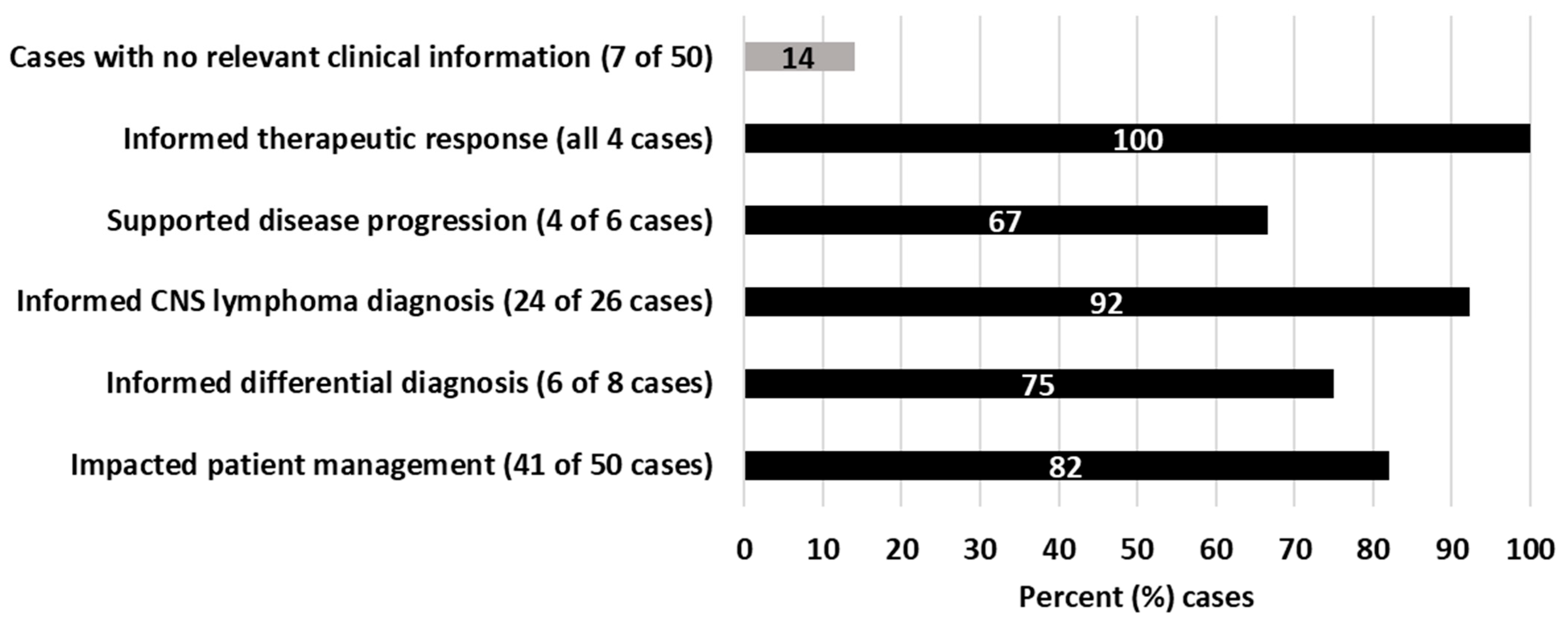
Clinically significant variants (gene level alteration, chromosomal arm level alteration, and/or MGMT promoter methylation) with Tier 1 or 2 classification per AMP/ASCO/CAP guidelines were detected in 32 of 50 specimens (64%) (Figure 1A) [19]. Clinical follow-up of the negative cases post-Belay testing confirmed 9 of 18 (50%) to be true negative; 2 were confirmed to be false negatives and no clinical follow-up was provided for the remaining 7 cases (Table 1 and Table 2). Belay CSF liquid biopsy tests demonstrated impact on management of CNS lymphoma in 41 of 50 (82%) cases by informing diagnosis, supporting clinical suspicion of disease progression or recurrence, and confirming therapeutic response (Figure 2).
Of the 50 specimens received for testing with a provisional or confirmed diagnosis of lymphoma, Belay CSF testing identified a clinically significant variant in 32 cases (64%) (Figure 1A) with MYD88 being the most commonly altered gene followed by TP53 (Figure 1B). Gene level variants were observed in 100% (17/17) of positive cases with a provisional or final diagnosis of PCNSL and 60% (9/15) of positive SCNSL cases. In contrast, aneuploidy was detected in only 29% (5/17) of positive PCNSL cases and 73% (11/15) of SCNSL. Belay testing was ordered as part of the initial diagnostic work-up for 37 of the 50 cases (a prior diagnosis of CNS lymphoma was established in 13 cases) (Table 1). Clinically actionable variants were detected in 26 of 37 (70%) specimens, aiding in diagnosis (Table 1).
Table 1.
Impact of Summit™ and Vantage™ in 37 CSF specimens when testing was ordered as part of diagnostic work-up.
Table 2.
Impact of Summit™ and Vantage™ in 13 CSF samples when CNS lymphoma was diagnosed prior to Belay testing.
Figure 1.
Belay tests detection yield. (A) Clinically actionable variants including gene level variants, aneuploidy, and MGMT promoter methylation were detected in 32 (64%) cerebrospinal fluid (CSF) specimens submitted to Belay Diagnostics for testing due to concern for central nervous system (CNS) lymphoma. (B) Summit™ testing results from individual specimens are grouped by a broad differential diagnosis (DDx), provisional diagnosis of primary CNS lymphoma (PCNSL), or a provisional diagnosis of secondary CNS lymphoma (SCNSL). Single nucleotide variants (SNVs) were most frequently detected in MYD88, primarily in specimens submitted with the provisional diagnosis of PCNSL. Variants in several other genes including CD79B and TP53 were found in PCNSL specimens as well as those submitted with a provisional diagnosis of SCNSL or a broad DDx. Twenty-four specimens had no clinically significant, or reportable, genomic variants detected (not reportable). Mild to high levels of chromosomal arm level aneuploidy were detected in 14 specimens.
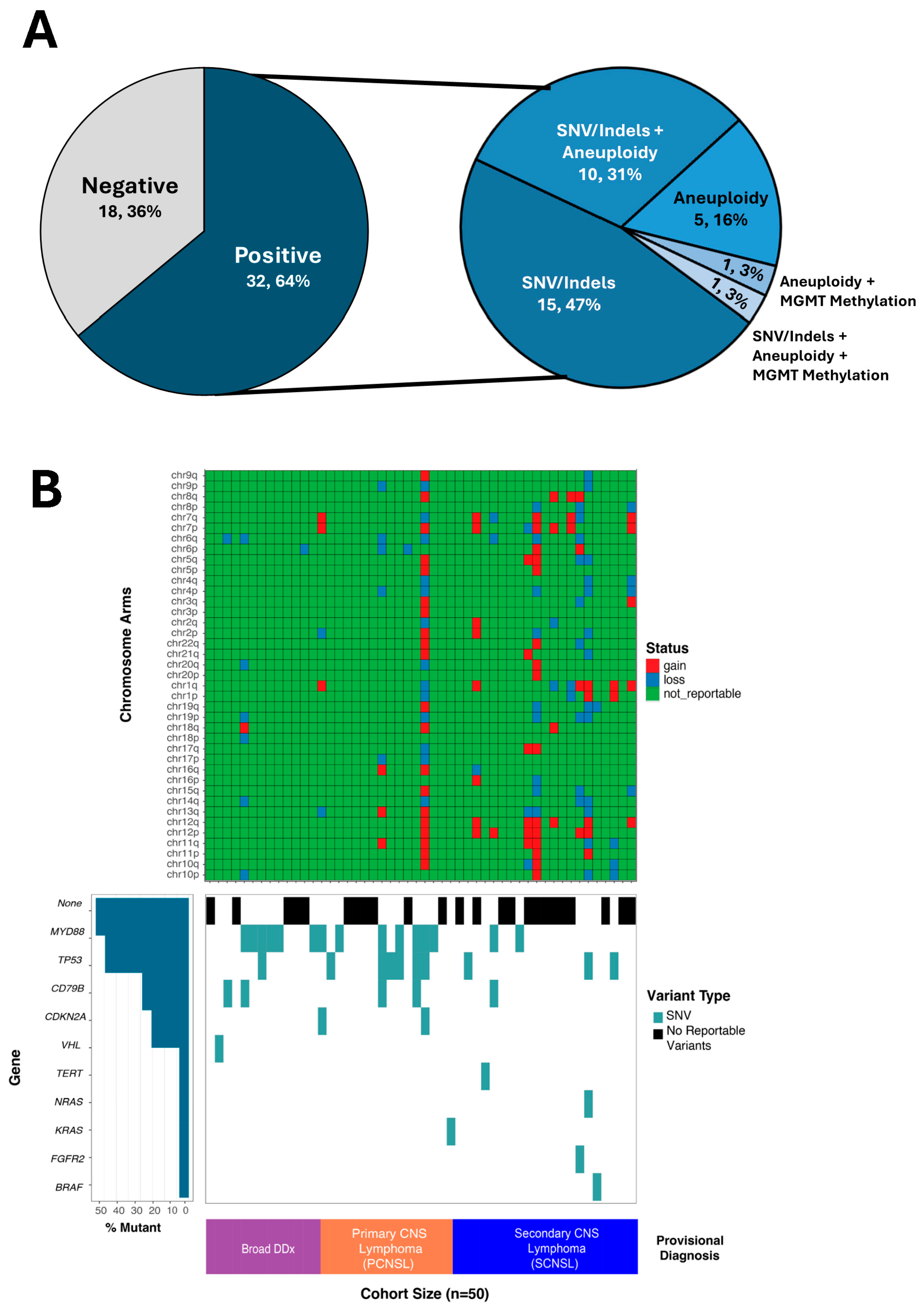
Figure 2.
Belay testing impacted patient care in 82% of all cases evaluated. The indication for Belay testing, test positivity or negativity, and post-testing information availability was considered when calculating the percentage of cases impacted in each context. Seven cases (grey bar) had no relevant clinical information available. Central nervous system, CNS.
In one case (study ID 22), PCNSL was suspected though diagnostic work-up had been largely inconclusive due to negative CSF cytology, indeterminate pathology from brain biopsy, and negative allele-specific polymerase chain reaction (PCR) for MYD88 L265P in blood. Summit™ reported both MYD88 L265P and CD79B Y196H hotspot variants as well as several chromosomal alterations, providing evidence of CNS disease when other diagnostic methods were unsuccessful. Five cases with concern for secondary CNS DLBCL were found to have high levels of aneuploidy with five or more chromosomal arm level gains or losses, though no clinically significant SNVs were detected. High levels of aneuploidy are associated with chromosomal instability, a driver of metastasis in DLBCL literature, supporting clinical concern for DLBCL CNS involvement in the context of confirmatory diagnostic work-up [20,21,22,23].
In a case of primary intraocular lymphoma (PIOL) (study ID 4), Summit™ results informed disease stratification. PIOL is considered a rare subset of PCNSL in which the eye, often the retina or vitreous fluid, is affected with or without CNS involvement. Determining CNS involvement, seen in an estimated 56–90% of PIOL cases, can guide whether treatment is administered systemically or locally to the intraocular space [24]. The MYD88 L265P variant had previously been detected in vitreous fluid for study ID 4 and was subsequently found in CSF using Summit. This finding supported CNS involvement and the patient was subsequently treated with systemic methotrexate.
Summit™ and Vantage™ demonstrated similar impact when the provisional diagnosis included a broader differential with other cancer types such as glioma or even nonmalignant etiologies. Summit™ detected MYD88 L265P and/or a CD79B Y196 variant in 7 out of 13 cases for which the provisional diagnosis included malignancies other than CNS lymphoma or the order was received only with ICD10 code R94.02, abnormal brain scan. For one case (study ID 14), the provisional diagnosis was high-grade glioma with lesion location unamendable to biopsy for pathologic confirmation. Belay testing reported MYD88 L265P, CD79B Y196S, aneuploidy, and MGMT promoter methylation, directly informing diagnosis of CNS lymphoma and guiding treatment. An emerging biomarker in PCNSL, MGMT promoter methylation is observed in roughly 32–68% of cases and may have therapeutic implications; response to temozolomide monotherapy has particularly been studied in elderly patients [11,12,13,14]. By identifying key biomarkers in CSF, Summit™ and Vantage™ aided in differentiating CNS lymphoma from other etiologies.
In another case (study ID 6), the differential broadly included PCNSL, glioma, and demyelinating disease. Summit™ identified an oncogenic variant in VHL at a variant allelic frequency (VAF) of 42.9%, suggesting a possible germline variant associated with von Hippel–Lindau disease and hemangioblastoma rather than CNS lymphoma. Per established guidelines and regulatory requirements, reports that include potential germline variants have a disclaimer which specifies, “Summit™ does not include paired sample analysis and consequently cannot distinguish between somatic and germline variants”. The ordering provider of study ID 6 was made aware of the testing limitation and confirmatory genetic testing and genetic counseling was recommended at clinician discretion.
Of the 37 orders that were part of initial diagnostic work-up, negative reports were returned for 10 cases. For five cases, the lack of oncogenic variant detection in the CSF aligned with other clinical findings and supported a nonmalignant diagnosis, confirming these cases to be true negatives (Table 1). False negative results were returned for two orders that were confirmed to be CNS lymphoma upon further diagnostic work-up after Belay testing, resulting in an overall false negative rate of 18% (2/11) among cases with known outcomes. Possible test limitations include VAF below the limit of detection in CSF (<0.3%), alterations in genes not included on the Summit™ panel, and tumor heterogeneity. Regarding the remaining three samples, it is unclear whether negative Summit™ and Vantage™ results were due to testing limitations or a true lack of malignancy in the CNS as minimal clinical information was provided.
2.2. Summit™ Supports Clinical Suspicion of CNS Lymphoma Progression/Recurrence or Therapeutic Response
For 13 of the 50 specimens, PCNSL or SCNSL was diagnosed prior to testing through Belay (Table 2). Summit™ detected clinically significant variants in 6 of 13 cases; all 6 were found to have at least one loss of function variant in TP53 (Figure 1B). Alterations in tumor suppressor gene TP53 are commonly seen across cancer types including DLBCL, though they are more frequently observed in systemic disease than PCNSL [25]. In one case (study ID 20), BCL6 rearrangement had been detected in a brain biopsy sample. The patient completed six cycles of high-dose methotrexate and rituximab about 3 months prior to Summit™ testing which identified TP53 R181fs, suggesting possible disease progression or lack of therapeutic response. Loss of function variants in TP53, particularly when seen alongside BCL6 rearrangements in high-grade DLBCL, are associated with worse prognosis [26].
Clinician follow-up was unavailable for four of the eight cases with negative Summit™ findings, limiting impact conclusions. For the remaining four negative cases with previously established CNS lymphoma diagnoses, clinician follow-up confirmed therapeutic response in the patient following treatment. Two specimens were submitted for longitudinal testing after treatment following initial detection of clinically significant variants (study IDs 7 and 48 followed study IDs 4 and 18, respectively). The absence of the previously detected SNVs in both longitudinally collected specimens suggested therapeutic response and further informed management and therapy dosage. Recent research in CSF analysis attests that changes in VAF are associated with clinical response and imaging findings [7,27]. While a larger longitudinal testing cohort is warranted, these two cases support CSF liquid biopsy as a means of disease monitoring.
3. Discussion
In the first year following clinical validation, liquid biopsy assays Summit™ and Vantage™ informed the management of CNS lymphoma by identifying the presence or critical absence of key biomarkers in CSF. In 41 of 50 cases (82%), findings informed CNS lymphoma diagnosis, supported clinical suspicion of disease progression or recurrence, or confirmed therapeutic response (Table 1 and Table 2, Figure 2).
A variety of alterations were reported including MYD88 L265P, CD79B Y196H, TERT promoter variants, and chromosomal loss and gain (Figure 1B). Oncogenic variants in MYD88 and CD79B have been demonstrated as key features of primary CNS lymphoma as they drive oncogenesis via NF-κB activation and may predict response to R-MPV (rituximab, high-dose methotrexate, procarbazine, and vincristine) [28,29]. Evaluation of MYD88 and CD79B is included in recommended diagnostic work-up per NCCN Guidelines for DLBCL; clinical utility of MYD88 analysis is additionally recognized in NCCN Guidelines for PCNSL [10]. TERT promoter variants are recurrent in primary CNS DLBCL though they are rarely reported in secondary DLBCL that arise outside of the CNS [15,16]. While several chromosomal arm-level alterations such as chr6q loss and chr18q gain are recurrent in PCNSL, a high level of aneuploidy overall suggests chromosomal instability, a key driver of metastasis across cancer types [20,30,31]. High aneuploidy findings in this report align with clinical validity literature that demonstrates aneuploidy detection in CSF can improve diagnosis of brain metastasis and leptomeningeal disease in other cancer types, namely breast cancer [32,33]. Further characterization is warranted in CNS lymphoma.
The impact of Belay testing communicated in this report is subject to several limitations. Notably, the authors of the report are employees of Belay Diagnostics and disclose considerable conflict of interest in evaluating the impact of Summit™ and Vantage™. The impact of negative Belay testing could not be concluded for seven cases due to absence of clinician confirmation. Inherently, this design introduces verification bias and could exaggerate perceived impact. Among negative cases with known outcomes, the false negative rate was found to be 18% (2/11). Further studies with defined clinical criteria and third-party review of test impact on patient management are warranted.
The vignettes in this brief report support the recent literature that show a molecular approach to diagnosing and monitoring CNS lymphoma improves detection and characterization of a dynamic disease [7,8,9]. Following clinical validation, this is the first demonstration of Summit™ and Vantage™ impact in a larger cohort, bolstering what case reports have similarly demonstrated in other disease types such as glioma, leptomeningeal disease, and breast cancer brain metastasis [34,35,36,37]. While a minority of instances where no clinically significant variants were identified represent false negative cases, these instances could be due to testing limitations such as variants present at low VAF or in genes/regions outside the panel being evaluated. In recent clinical validation of the expanded Belay Summit™2.0 test, clinical sensitivity increased from 90% to 96% [38]. The updated version of the assay includes analysis of SNVs, MNVs, and indels in an additional 488 genes as well as copy-number variants in 62 genes, fusions involving 27 genes, tumor mutational burden, and microsatellite instability. Overall, CSF liquid biopsy marks a meaningful shift in the diagnosis and treatment of CNS lymphoma, increasing sensitivity and opening doors for targeted therapy.
4. Materials and Methods
Between September 2024, and September 2025, 50 CSF specimens from 48 patients (two patients completed longitudinal testing) were collected and sent to Belay Diagnostics, Chicago, USA for genomic profiling via the Summit™ and/or Vantage™ tests due to concern for or previously diagnosed CNS lymphoma. Orders were placed as part of initial CNS lymphoma diagnostic work-up for 37 samples and 13 orders were placed in the context of an established CNS lymphoma diagnosis based on the order test requisition form. Summit™ interrogates SNVs and MNVs in a 32 gene panel using duplex NGS powered by proprietary MethylSaferSeqS [39] as well as chromosomal arm-level gains and losses using low-pass WGS [17]. Detected alterations are classified and reported as clinically significant (Tier 1 or 2) according to AMP/ASCO/CAP guidelines [19]. High levels of aneuploidy are indicated in samples with 5 or more chromosomal arm level gains or losses. Summit™ is validated in CSF with a clinical sensitivity and specificity of 90% and 95%, respectively, and a limit of detection of 0.3% VAF [17]. The Vantage™ assay evaluates methylation status of the MGMT promoter using enzymatic conversion followed by quantitative PCR [18].
Clear indication for testing including parallel diagnostic work-up results was available for 43 of the 50 test orders, with post-testing clinical decision-making provided for a subset of orders. Summit™ and/or Vantage™ findings for these 43 orders were reviewed in the context of accompanying clinical documentation including cancer history, encounter notes detailing differential diagnoses, CSF cytology, tumor pathology, prior tumor genomic profiling, and oncology treatment history. The amount of clinical information provided at the time of testing varied across orders. All orders included a provisional diagnosis/ICD10 code. Belay test impact was determined by review of variant clinical actionability per AMP/ASCO/CAP classification guidelines and incorporation of NCCN/WHO guidelines in the context of the provisional and differential diagnosis and oncology history for each case as well as clinician follow-up, when available [10,19].
Author Contributions
The study was conceived, designed, and overseen by H.V.R. All authors contributed to data collection and analysis. J.N.A., R.J., A.A., B.A.D., S.A.V., T.P. and D.S.—specimen processing; V.U., A.L., V.K., Q.N. and K.F.S.—Data analysis and curation. The first draft of the manuscript was written by A.L. and Q.N. All authors have read and agreed to the published version of the manuscript.
Funding
This study did not receive any specific grant from funding agencies in the public, commercial, or not-for-profit sectors.
Institutional Review Board Statement
The study was approved by Advarra institutional review board (Pro00088250) on 20 June 2025.
Informed Consent Statement
Informed consent for participation is not required as per the principles of the Declaration of Helsinki and the Health Insurance Portability and Accountability Act.
Data Availability Statement
The data presented in this study are available upon reasonable request from the corresponding author due to patient privacy concerns.
Conflicts of Interest
All authors are employees of Belay Diagnostics and receive a salary and stock options.
References
- Roschewski, M.; Hodson, D.J. Diffuse large B-cell lymphoma involving the central nervous system: Biologic rationale for targeted therapy. Haematologica 2024, 109, 388–400. [Google Scholar] [CrossRef] [Scilit]
- Baraniskin, A.; Schroers, R. Liquid Biopsy and Other Non-Invasive Diagnostic Measures in PCNSL. Cancers 2021, 13, 2665. [Google Scholar] [CrossRef] [Scilit] [PubMed]
- Scheichel, F.; Marhold, F.; Pinggera, D.; Kiesel, B.; Rossmann, T.; Popadic, B.; Woehrer, A.; Weber, M.; Kitzwoegerer, M.; Geissler, K.; et al. Influence of preoperative corticosteroid treatment on rate of diagnostic surgeries in primary central nervous system lymphoma: A multicenter retrospective study. BMC Cancer 2021, 21, 754. [Google Scholar] [CrossRef] [Scilit]
- Velasco, R.; Mercadal, S.; Vidal, N.; Alañá, M.; Barceló, M.I.; Ibáñez-Juliá, M.J.; Bobillo, S.; Agud, R.C.; Molina, E.G.; Martínez, P.; et al. Diagnostic delay and outcome in immunocompetent patients with primary central nervous system lymphoma in Spain: A multicentric study. J. Neuro-Oncol. 2020, 148, 545–554. [Google Scholar] [CrossRef] [Scilit]
- Ambady, P.; Fu, R.; Netto, J.P.; Kersch, C.; Firkins, J.; Doolittle, N.D.; Neuwelt, E.A. Patterns of relapse in primary central nervous system lymphoma: Inferences regarding the role of the neuro-vascular unit and monoclonal antibodies in treating occult CNS disease. Fluids Barriers CNS 2017, 14, 16. [Google Scholar] [CrossRef] [Scilit] [PubMed]
- Calimeri, T.; Marcucci, F.; Corti, A. Overcoming the blood-brain barrier in primary central nervous system lymphoma: A review on new strategies to solve an old problem. Ann. Lymphoma 2021, 5, 1–11. [Google Scholar] [CrossRef] [Scilit]
- Bobillo, S.; Crespo, M.; Escudero, L.; Mayor, R.; Raheja, P.; Carpio, C.; Rubio-Perez, C.; Tazón-Vega, B.; Palacio, C.; Carabia, J.; et al. Cell free circulating tumor DNA in cerebrospinal fluid detects and monitors central nervous system involvement of B-cell lymphomas. Haematologica 2021, 106, 513–521. [Google Scholar] [CrossRef] [Scilit]
- Mutter, J.A.; Alig, S.K.; Esfahani, M.S.; Lauer, E.M.; Mitschke, J.; Kurtz, D.M.; Kühn, J.; Bleul, S.; Olsen, M.; Liu, C.L.; et al. Circulating Tumor DNA Profiling for Detection, Risk Stratification, and Classification of Brain Lymphomas. J. Clin. Oncol. 2023, 41, 1684–1694. [Google Scholar] [CrossRef] [Scilit] [PubMed]
- Navrkalova, V.; Mareckova, A.; Hricko, S.; Hrabcakova, V.; Radova, L.; Kubes, V.; Porc, J.; Reigl, T.; Pospisilova, S.; Kotaskova, J.; et al. Reliable detection of CNS lymphoma-derived circulating tumor DNA in cerebrospinal fluid using multi-biomarker NGS profiling: Insights from a real-world study. Biomark. Res. 2025, 13, 71. [Google Scholar] [CrossRef] [Scilit]
- Zelenetz, A.D.; Gordon, L.I.; Abramson, J.S.; Advani, R.H.; Andreadis, B.; Bartlett, N.L.; Budde, L.E.; Caimi, P.F.; Chang, J.E.; Christian, B.; et al. NCCN Guidelines® Insights: B-Cell Lymphomas, Version 6.2023. J. Natl. Compr. Cancer Netw. 2023, 21, 1118–1131. [Google Scholar] [CrossRef] [Scilit]
- Kristensen, L.S.; Treppendahl, M.B.; Asmar, F.; Girkov, M.S.; Nielsen, H.M.; Kjeldsen, T.E.; Ralfkiaer, E.; Hansen, L.L.; Grønbæk, K. Investigation of MGMT and DAPK1 methylation patterns in diffuse large B-cell lymphoma using allelic MSP-pyrosequencing. Sci. Rep. 2013, 3, 2789. [Google Scholar] [CrossRef] [Scilit]
- KKurzwelly, D.; Glas, M.; Roth, P.; Weimann, E.; Lohner, H.; Waha, A.; Schabet, M.; Reifenberger, G.; Weller, M.; Herrlinger, U. Primary CNS lymphoma in the elderly: Temozolomide therapy and MGMT status. J. Neuro-Oncol. 2009, 97, 389–392. [Google Scholar] [CrossRef] [Scilit]
- Toffolatti, L.; Scquizzato, E.; Cavallin, S.; Canal, F.; Scarpa, M.; Stefani, P.M.; Gherlinzoni, F.; Tos, A.P.D. MGMT promoter methylation and correlation with protein expression in primary central nervous system lymphoma. Virchows Arch. 2014, 465, 579–586. [Google Scholar] [CrossRef] [Scilit]
- Zheng, M.; Perry, A.M.; Bierman, P.; Loberiza, F.; Nasr, M.R.; Szwajcer, D.; Del Bigio, M.R.; Smith, L.M.; Zhang, W.; Greiner, T.C. Frequency of MYD88 and CD79B mutations, and MGMT methylation in primary central nervous system diffuse large B-cell lymphoma. Neuropathology 2017, 37, 509–516. [Google Scholar] [CrossRef] [Scilit] [PubMed]
- Chen, D.; Gu, W.; Li, W.; Liu, X.; Yang, X. Primary diffuse large B-cell lymphoma of the central nervous system: A case report and literature review. Oncol. Lett. 2016, 11, 3085–3090. [Google Scholar] [CrossRef] [Scilit] [PubMed]
- Lam, G.; Xian, R.R.; Li, Y.; Burns, K.H.; Beemon, K.L. Lack of TERT Promoter Mutations in Human B-Cell Non-Hodgkin Lymphoma. Genes 2016, 7, 93. [Google Scholar] [CrossRef] [Scilit]
- Nie, Q.; Schilter, K.F.; Hernandez, K.M.; Adams, J.N.; Jagadish, R.; Acevedo, A.; Larson, A.; Domagala, B.A.; Vo, S.A.; Khurana, S.; et al. Analytical Validation and Clinical Sensitivity of the Belay Summit Assay for the Detection of DNA Variants in Cerebrospinal Fluid of Primary and Metastatic Central Nervous System Cancer. J. Mol. Diagn. 2025, 27, 615–629. [Google Scholar] [CrossRef] [Scilit]
- Schilter, K.F.; Nie, Q.; Adams, J.N.; Jagadish, R.; Acevedo, A.; Larson, A.; Vo, S.A.; Domagala, B.A.; Hernandez, K.M.; Douville, C.; et al. Analytical validation of the Belay Vantage™ assay for evaluation of MGMT promoter methylation using enzymatically converted tumorDNA from cerebrospinal fluid. Cancer Genet. 2025, 294–295, 94–98. [Google Scholar] [CrossRef] [Scilit]
- Li, M.M.; Datto, M.; Duncavage, E.J.; Kulkarni, S.; Lindeman, N.I.; Roy, S.; Tsimberidou, A.M.; Vnencak-Jones, C.L.; Wolff, D.J.; Younes, A.; et al. Standards and Guidelines for the Interpretation and Reporting of Sequence Variants in Cancer: A Joint Consensus Recommendation of the Association for Molecular Pathology, American Society of Clinical Oncology, and College of American Pathologists. J. Mol. Diagn. 2017, 19, 4–23. [Google Scholar] [CrossRef] [Scilit]
- Zhakula-Kostadinova, N.; Taylor, A.M. Patterns of Aneuploidy and Signaling Consequences in Cancer. Cancer Res. 2024, 84, 2575–2587. [Google Scholar] [CrossRef] [Scilit] [PubMed]
- Holland, A.J.; Cleveland, D.W. Boveri revisited: Chromosomal instability, aneuploidy and tumorigenesis. Nat. Rev. Mol. Cell Biol. 2009, 10, 478–487. [Google Scholar] [CrossRef] [Scilit]
- Tijhuis, A.E.; Johnson, S.C.; McClelland, S.E. The emerging links between chromosomal instability (CIN), metastasis, inflammation and tumour immunity. Mol. Cytogenet. 2019, 12, 17. [Google Scholar] [CrossRef] [Scilit] [PubMed]
- Bakhoum, S.F.; Danilova, O.V.; Kaur, P.; Levy, N.B.; Compton, D.A. Chromosomal Instability Substantiates Poor Prognosis in Patients with Diffuse Large B-cell Lymphoma. Clin. Cancer Res. 2011, 17, 7704–7711. [Google Scholar] [CrossRef] [Scilit]
- Tang, L.-J.; Gu, C.-L.; Zhang, P. Intraocular lymphoma. Int. J. Ophthalmol. 2017, 10, 1301–1307. [Google Scholar] [CrossRef] [Scilit]
- Bertoni, F.; Montesinos-Rongen, M. Primary diffuse large B-cell lymphoma of the central nervous system: Molecular and biological features of neoplastic cells. Ann. Lymphoma 2022, 6. [Google Scholar] [CrossRef] [Scilit]
- Landsburg, D.J.; Morrissette, J.J.; Nasta, S.D.; Barta, S.K.; Schuster, S.J.; Svoboda, J.; Chong, E.A.; Bagg, A. TP53 mutations predict for poor outcomes in patients with newly diagnosed aggressive B-cell lymphomas in the current era. Blood Adv. 2023, 7, 7243–7253. [Google Scholar] [CrossRef] [Scilit]
- Li, M.; Chen, J.; Zhang, B.; Yu, J.; Wang, N.; Li, D.; Shao, Y.; Zhu, D.; Liang, C.; Ma, Y.; et al. Dynamic monitoring of cerebrospinal fluid circulating tumor DNA to identify unique genetic profiles of brain metastatic tumors and better predict intracranial tumor responses in non-small cell lung cancer patients with brain metastases: A prospective cohort study (GASTO 1028). BMC Med. 2022, 20, 398, Erratum in BMC Med. 2023, 21, 15. https://doi.org/10.1186/s12916-022-02718-1. [Google Scholar] [CrossRef] [Scilit] [PubMed]
- Suzuki, T.; Fujii, K.; Matsunaga, N.; Sasaki, H.; Kanamori, T.; Asano, A.; Kinoshita, S.; Narita, T.; Masaki, A.; Sanda, T.; et al. Impact of MYD88 and/or CD79B mutations on central nervous system relapse in patients with diffuse large B-cell lymphoma. Br. J. Haematol. 2025, 207, 92–100. [Google Scholar] [CrossRef] [Scilit]
- Yamaguchi, J.; Ohka, F.; Lushun, C.; Motomura, K.; Aoki, K.; Takeuchi, K.; Nagata, Y.; Ito, S.; Mizutani, N.; Ohno, M.; et al. CD79BY196 mutation is a potent predictive marker for favorable response to R-MPV in primary central nervous system lymphoma. Cancer Med. 2023, 12, 7116–7126. [Google Scholar] [CrossRef] [Scilit]
- Boonstra, R.; Koning, A.; Mastik, M.; van den Berg, A.; Poppema, S. Analysis of chromosomal copy number changes and oncoprotein expression in primary central nervous system lymphomas: Frequent loss of chromosome arm 6q. Virchows Arch. 2003, 443, 164–169. [Google Scholar] [CrossRef] [Scilit]
- Rickert, C.H.; Dockhorn-Dworniczak, B.; Simon, R.; Paulus, W. Chromosomal Imbalances in Primary Lymphomas of the Central Nervous System. Am. J. Pathol. 1999, 155, 1445–1451. [Google Scholar] [CrossRef] [Scilit]
- Angus, L.; Deger, T.; Jager, A.; Martens, J.W.M.; de Weerd, V.; van Heuvel, I.; van den Bent, M.J.; Sillevis Smitt, P.A.E.; Kros, J.M.; Bindels, E.M.J.; et al. Detection of Aneuploidy in Cerebrospinal Fluid from Patients with Breast Cancer Can Improve Diagnosis of Leptomeningeal Metastases. Clin. Cancer Res. 2021, 27, 2798–2806. [Google Scholar] [CrossRef] [Scilit] [PubMed]
- Morganti, S.; Parsons, H.A.; Lin, N.U.; Grinshpun, A. Liquid biopsy for brain metastases and leptomeningeal disease in patients with breast cancer. npj Breast Cancer 2023, 9, 43. [Google Scholar] [CrossRef] [Scilit]
- Bobustuc, G.; Larson, A.; Udane, V.; Schilter, K.F.; Nie, Q.; Reddi, H.V. Serial Testing of Tumor-Derived DNA in Cerebrospinal Fluid to Monitor Leptomeningeal Disease and Assess Therapeutic Response in Lung Cancer Metastasis to the Central Nervous System—A Case Report. Ann. Clin. Case Rep. 2025, 10, 2783. [Google Scholar] [CrossRef]
- Youssef, M.; Larson, A.; Udhane, V.; Keo, V.; Schilter, K.F.; Nie, Q.; Reddi, H.V. Molecular Analysis of Cerebrospinal Fluid Tumor-Derived DNA to Aid in the Diagnosis and Targeted Treatment of Breast Cancer Brain Metastasis. Diseases 2025, 13, 336. [Google Scholar] [CrossRef] [Scilit] [PubMed]
- Youssef, M.; Larson, A.; Udhane, V.; Schilter, K.F.; Nie, Q.; Reddi, H.V. Analysis of cerebrospinal fluid tumor-derived DNA to obviate biopsy of IDH-mutant brainstem glioma in an adult. J. Liq. Biopsy 2025, 9, 100318. [Google Scholar] [CrossRef] [Scilit] [PubMed]
- Youssef, M.; Udhane, V.; Larson, A.; Schilter, K.; Nie, Q.; Reddi, H. Cerebrospinal Fluid based liquid biopsy to inform diagnosis and management of Leptomeningeal Metastases in EGFR-Mutant Lung Cancer—A Case Report. Med. Res. Arch. 2025, 13. [Google Scholar] [CrossRef] [Scilit]
- Khurana, S.; Keo, V.; Larson, A.; Udhane, V.; Adams, J.N.; Acevedo, A.; Peltier, T.; Sanchez, D.; Domagala, B.A.; Vo, S.A.; et al. Analytical Validation and Clinical Sensitivity of the Belay Summit™ 2.0 Cerebrospinal Fluid Liquid Biopsy Test—An Expanded Comprehensive Genomic Profiling Platform for Central Nervous System Malignancies. Cancers 2026, 18, 256. [Google Scholar] [CrossRef] [Scilit]
- Wang, Y.; Douville, C.; Cohen, J.D.; Mattox, A.; Curtis, S.; Silliman, N.; Popoli, M.; Ptak, J.; Dobbyn, L.; Nehme, N.; et al. Detection of rare mutations, copy number alterations, and methylation in the same template DNA molecules. Proc. Natl. Acad. Sci. USA 2023, 120, e2220704120. [Google Scholar] [CrossRef] [Scilit]
Disclaimer/Publisher’s Note: The statements, opinions and data contained in all publications are solely those of the individual author(s) and contributor(s) and not of MDPI and/or the editor(s). MDPI and/or the editor(s) disclaim responsibility for any injury to people or property resulting from any ideas, methods, instructions or products referred to in the content. |
© 2026 by the authors. Licensee MDPI, Basel, Switzerland. This article is an open access article distributed under the terms and conditions of the Creative Commons Attribution (CC BY) license.