


Abstract
Carbapenem-resistant Acinetobacter baumannii (CRAB) is classified by the World Health Organization among the critical-priority pathogens, reflecting high mortality, near-ubiquitous nosocomial spread, and a depleted therapeutic pipeline. No antibiotic chemical class with a genuinely novel target and activity against A. baumannii reached patients for more than fifty years, and current options—sulbactam–durlobactam, cefiderocol, polymyxins, high-dose ampicillin–sulbactam and tetracyclines—are constrained by toxicity, inconsistent efficacy, or emerging resistance. Against this background, zosurabalpin (RG6006), the first member of the tethered macrocyclic peptide (MCP) class, represents a potentially important conceptual advance. Identified through whole-cell phenotypic screening of nearly 45,000 macrocyclic peptides and optimized into a zwitterionic clinical candidate, zosurabalpin inhibits the LptB2FGC complex, the inner-membrane ATP-binding-cassette transporter that initiates lipopolysaccharide (LPS) export. By trapping LPS within the transporter, the drug causes lethal accumulation of the molecule at the inner membrane. This mechanism is structurally distinct from that of every clinically used antibiotic and, in preclinical studies, is not affected by the major currently recognized CRAB resistance mechanisms. Zosurabalpin shows potent, narrow-spectrum activity essentially restricted to the Acinetobacter baumannii–calcoaceticus complex, retaining activity in vitro against isolates resistant to cefiderocol and last-line agents; its clinical efficacy in patients, however, remains to be established. Here we review the discovery, structural mechanism, microbiological spectrum, and clinical development of zosurabalpin, and we situate it within a broader revival of pathogen-specific (narrow-spectrum) antibiotic development, discussing the diagnostic, stewardship, and economic implications of this paradigm.
1. Introduction
Antimicrobial resistance (AMR) is among the leading global health threats of the present century. A systematic analysis estimated that bacterial AMR was directly responsible for 1.27 million deaths and associated with 4.95 million deaths worldwide in 2019, a burden comparable to that of HIV and malaria combined [1]. More recent global modelling has confirmed an upward trajectory, projecting that AMR could contribute to tens of millions of cumulative deaths over the coming decades unless effective countermeasures are deployed [2]. Within this landscape, Acinetobacter baumannii occupies a position of particular concern. In its 2024 update of the Bacterial Priority Pathogens List, the World Health Organization (WHO) confirmed carbapenem-resistant A. baumannii (CRAB) in the critical-priority tier, on the basis of high mortality, transmissibility within healthcare settings, and the paucity of effective treatments [3]. CRAB is a dominant cause of ventilator-associated and hospital-acquired pneumonia, bloodstream infection, and complicated wound and device-associated infection in critically ill patients, with mortality estimates for invasive disease frequently ranging between 40% and 60% [3,4].
The therapeutic difficulty posed by A. baumannii is a direct consequence of its extraordinary genomic plasticity and its capacity to accumulate resistance determinants spanning every available antibiotic class. Equally important, the drug-development response has been historically inadequate: no antibiotic acting through a genuinely novel mechanism and active against A. baumannii had reached patients in over half a century [5,6,7,8]. The agents that have entered practice most recently—sulbactam–durlobactam and cefiderocol—are valuable additions but act on long-established targets (penicillin-binding proteins and, ultimately, cell-wall synthesis) and remain vulnerable to the resistance trajectories that have eroded their predecessors [6,7].
It is against this background that zosurabalpin (development code RG6006, by Roche in collaboration with academic investigators) has attracted exceptional interest. Zosurabalpin is the first clinical representative of the tethered macrocyclic peptide (MCP) class, and it inhibits an entirely new antibacterial target: the LptB2FGC complex that initiates lipopolysaccharide (LPS) transport across the Gram-negative envelope [8,9]. Beyond its novel mechanism, zosurabalpin embodies a deliberate strategic choice—a deliberately narrow, pathogen-specific spectrum focused on the Acinetobacter baumannii–calcoaceticus complex (ABC). This represents a partial reversal of the decades-long preference for broad-spectrum agents and signals a renewed willingness, supported by improvements in rapid diagnostics, to develop targeted antibacterials [10,11,12].
Zosurabalpin has already been the subject of several reviews, most of which have concentrated on its mechanism of action and preclinical development [13,14,15]. Unlike those reviews, the present article uses zosurabalpin as a case study to discuss the broader revival of pathogen-specific antibiotics and the diagnostic, stewardship, and economic conditions required for their clinical implementation. We first summarize the discovery and medicinal chemistry of the MCP class, the structural basis of LPS-transport inhibition, and the microbiological spectrum and clinical development of zosurabalpin; we then consider what this agent implies for the targeted-therapy paradigm and the systems needed to sustain it.
2. Carbapenem-Resistant Acinetobacter baumannii (CRAB): Burden, Resistance, and the Limits of Current Therapy
2.1. Epidemiology and Clinical Burden
A. baumannii’s ability to survive on dry surfaces, form biofilms, and rapidly acquire resistance determinants facilitates persistence and transmission in hospitals, particularly in intensive care units [16]. These traits promote environmental persistence and facilitate nosocomial transmission, particularly in intensive care and burn units [4,17].
The epidemiology of A. baumannii is strongly regional. Carbapenem-resistant strains are now endemic across much of southern and eastern Europe, the Mediterranean basin, the Middle East, Asia, and Latin America, while remaining comparatively less frequent in northern Europe [4,17]. Italy, in particular, reports some of the highest proportions of carbapenem resistance among A. baumannii isolates in Europe, frequently exceeding 80%, so that the organism is a daily clinical reality in many Italian ICUs [3]. The principal risk factors for CRAB acquisition and infection reflect the hospital context in which it thrives: prolonged ICU and overall hospital stay, mechanical ventilation, central venous and urinary catheterization, recent major surgery or trauma, severe burns, immunosuppression, and prior exposure to broad-spectrum antimicrobials [18].
Clinically, the organism causes a recognizable spectrum of severe infections: ventilator-associated and hospital-acquired pneumonia, primary and catheter-related bloodstream infection, complicated skin and soft-tissue and surgical-site infection (including war-wound and burn injuries), urinary tract infection, and, less commonly, post-neurosurgical meningitis and ventriculitis [4]. These syndromes fall disproportionately on the most fragile patients, and attributable mortality for invasive disease—bloodstream infection and pneumonia in particular—is consistently high, with estimates frequently in the range of 40% to 60% and the upper end observed in septic shock and inadequately treated infection [17,18]. A recurring difficulty, especially with respiratory specimens, is distinguishing true infection from airway or wound colonization, which complicates both treatment decisions and the interpretation of outcome data [18]. The convergence of a highly vulnerable host population, limited and imperfect therapeutic options, and high lethality is precisely what places CRAB in the WHO critical-priority tier and motivates the search for mechanistically novel agents [3].
2.2. Resistance Mechanisms
CRAB exemplifies multidrug resistance achieved through the convergence of several mechanisms. Carbapenem resistance is driven principally by acquired class D carbapenem-hydrolysing oxacillinases (notably OXA-23, OXA-24/40, OXA-58 and the intrinsic OXA-51-like enzymes, frequently upregulated by upstream ISAba insertion sequences), with class B metallo-β-lactamases (e.g., NDM) contributing in some lineages [19]. These are compounded by porin loss and reduced outer-membrane permeability, overexpression of resistance-nodulation-division efflux systems, target-site modifications, and aminoglycoside-modifying enzymes. The outer membrane itself—an asymmetric bilayer whose outer leaflet is composed of LPS—functions as a formidable permeability barrier that limits intracellular accumulation of many antibiotics and underlies the intrinsic recalcitrance of the organism [8]. This same structure, paradoxically, is what the MCP class exploits. Beyond beta-lactam resistance, CRAB also evolves resistance to last-line non-beta-lactam agents. Polymyxin resistance may arise through lipid A modification or loss of LPS biosynthesis, often involving pmrABC- or lpx-associated pathways, thereby reducing binding of colistin to the outer membrane. Cefiderocol resistance is more heterogeneous and may involve altered iron-uptake systems [20], beta-lactamase activity, permeability changes, and heteroresistant subpopulations, while susceptibility testing remains technically demanding. Resistance to tetracyclines, including tigecycline and related agents, is frequently linked to overexpression of multidrug efflux systems such as AdeABC/AdeIJK and, in some settings, acquired tetracycline resistance determinants [21].
2.3. Current Therapeutic Armamentarium and Its Constraints
Contemporary management of CRAB relies on a small set of agents, each with significant limitations. Sulbactam–durlobactam, a β-lactam/β-lactamase-inhibitor combination approved in 2023, is positioned by the 2024 Infectious Diseases Society of America (IDSA) guidance—in combination with a carbapenem—as a preferred strategy for CRAB infection [10]. The pivotal ATTACK trial was a multicentre, randomized, active-controlled, Phase 3 non-inferiority study that enrolled hospitalized adults with serious infections caused by the Acinetobacter baumannii–calcoaceticus complex, including hospital-acquired and ventilator-associated pneumonia, bloodstream infections, and other invasive infections. Patients received sulbactam–durlobactam plus imipenem–cilastatin or colistin plus imipenem–cilastatin. The primary endpoint was 28-day all-cause mortality. Sulbactam–durlobactam demonstrated non-inferiority to colistin for the primary endpoint, while achieving a substantially lower incidence of nephrotoxicity, supporting its favorable benefit-risk profile and establishing it as the regimen supported by the strongest randomized evidence currently available for invasive CRAB infections [6]. Nevertheless, the trial was relatively small; durlobactam does not restore sulbactam activity against all isolates, and metallo-β-lactamase-producing strains remain a gap. Cefiderocol, a siderophore cephalosporin that exploits active iron transport to cross the outer membrane, retains activity against many carbapenemase producers including metallo-β-lactamase strains. Cefiderocol, a siderophore cephalosporin that exploits active iron transport to cross the outer membrane, retains activity against many carbapenemase-producing Gram-negative pathogens, including metallo-β-lactamase producers. The CREDIBLE-CR trial was a randomized, open-label, multicentre, pathogen-focused, descriptive Phase 3 study comparing cefiderocol with best available therapy in patients with serious infections caused by carbapenem-resistant Gram-negative bacteria. The study included patients with nosocomial pneumonia, bloodstream infection or sepsis, and complicated urinary tract infections. Although the trial was not powered for formal efficacy comparisons, the subgroup of patients with A. baumannii infections showed numerically higher all-cause mortality in the cefiderocol arm than in the best available therapy arm, particularly among critically ill patients, prompting continued caution regarding cefiderocol use in CRAB infections despite its potent in vitro activity [7]. Susceptibility testing also remains technically demanding, with iron-depleted media, an area of technical uncertainty, and a trailing effect complicating interpretation [22]. Polymyxins (colistin, polymyxin B) and high-dose ampicillin–sulbactam remain backbone or alternative options but are limited by nephrotoxicity, pharmacokinetic variability, and the existence of heteroresistant subpopulations [23]; tetracyclines such as minocycline and eravacycline have a role but lack robust outcome data [10]. The cumulative picture is one of treatment decisions still partly driven by necessity rather than high-quality evidence, including persistent uncertainty over optimal combinations and treatment duration [24]—precisely the unmet need that a mechanistically novel agent could address.
3. The Lipopolysaccharide Transport Pathway as a Druggable Target
LPS is the defining component of the Gram-negative outer-membrane outer leaflet, a potent endotoxin and a major determinant of the permeability barrier, and it is essential for viability in most species, including A. baumannii [25,26,27]. After synthesis at the inner membrane, LPS must be transported across the periplasm and assembled into the outer leaflet—a vectorial process accomplished by the seven-protein lipopolysaccharide transport (Lpt) machinery [25,26,28,29]. The system is conventionally divided into three modules: the inner-membrane ATP-binding-cassette (ABC) transporter complex LptB2FGC, which extracts LPS from the inner membrane and powers transport through ATP hydrolysis by the cytoplasmic LptB dimer; a periplasmic bridge formed by LptA; and the outer-membrane translocon LptDE, which inserts LPS into the outer leaflet [25,26,28,29]. LptC, associated with the LptB2FG core, participates in handing LPS off from LptF toward LptA and contributes to regulating the ATPase activity of the complex [28,29]. In the prevailing “PEZ” model, successive rounds of ATP-driven extraction push LPS molecules along this protein bridge in a single direction toward the cell surface [26].
Because LPS transport is essential, surface-exposed in its consequences, and absent from human cells, the Lpt pathway has long been regarded as an attractive but technically challenging antibacterial target. The MCP class is the first to translate this rationale into a clinical candidate against A. baumannii, validating the inner-membrane LptB2FGC complex as a druggable node [8,9].
4. Discovery and Medicinal Chemistry of Tethered Macrocyclic Peptides (MCP)
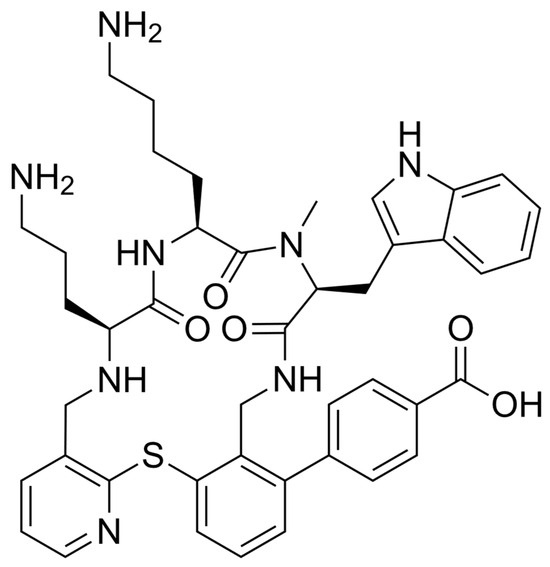
The MCP class emerged from whole-cell phenotypic screening of a library of 44,985 macrocyclic peptides against a panel of Gram-positive and Gram-negative pathogens [8]. Rather than beginning from a defined molecular target, the screen identified compounds with selective whole-cell activity against A. baumannii, and target identification followed. Early hits were optimized through iterative medicinal chemistry to improve potency, physicochemical properties, and tolerability. A key advance was the development of second-generation zwitterionic tethered macrocyclic peptides, which improved potency and the safety margin relative to earlier analogues; this effort yielded the clinical candidate zosurabalpin (RG6006) alongside related tool compounds such as RO7196472 and RO7075573 used in mechanistic studies [8,9]. Figure 1 shows the Zosurabalpin chemical structure.
Figure 1.
Zosurabalpin chemical structure.
Mechanistically informative resistance studies were central to target deconvolution. Serial passage of A. baumannii under increasing drug pressure selected mutants whose genomic analysis revealed numerous mutations clustering in the genes encoding LptF and LptG—components of the inner-membrane LptB2FGC transporter—thereby implicating this complex as the molecular target [9]. The convergence of phenotypic screening, structural biology, and resistance genetics provides an instructive template for modern antibacterial discovery against difficult Gram-negative targets [8,9].
5. Mechanism of Action: Trapping LPS in Its Transporter
The mechanism of the MCP class was elucidated in two back-to-back Nature reports published in January 2024. Zampaloni and colleagues described the identification and optimization of the class and demonstrated that it blocks LPS transport through inhibition of the LptB2FGC complex, leading to efficacy against contemporary CRAB isolates in vitro and in murine infection models [8]. Pahil, Gilman, Kahne and co-workers provided the structural and biochemical basis, using cryo-electron microscopy to show that the antibiotic binds simultaneously to the transporter and to LPS, forming a ternary complex and trapping the transporter in an LPS-bound intermediate state [9].
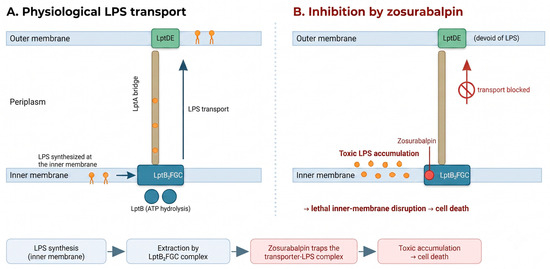
Structurally, the compound inserts into a pocket formed largely by transmembrane helices of LptF, with contributions from LptG, engaging residues that line the lateral gate through which LPS would normally enter the transporter cavity. Binding locks LPS in place and abrogates the conformational cycling required for transport; biochemical assays show that the molecule has greatest affinity for the LptB2FG–LPS assembly when LptC is displaced, consistent with capture of a specific transport intermediate [9,28]. Critically, the lethal event is not depletion of surface LPS but the toxic intracellular accumulation of LPS that cannot be exported: experiments in an Acinetobacter baylyi strain engineered to survive without outer-membrane LPS showed that the compounds still killed by virtue of trapped, accumulating LPS rather than by starving the outer membrane of it [9]. In other words, zosurabalpin does not merely interrupt delivery of LPS to the outer membrane; it converts the LPS transport process itself into a toxic event. This distinction is important because it explains why the presence and accumulation of LPS within the transporter, rather than simple surface LPS depletion, appears central to bacterial killing. This “trap-and-poison” mechanism is mechanistically unprecedented among clinical antibiotics (Figure 2).
Figure 2.
Mechanism of action of zosurabalpin. (A) Physiologically, lipopolysaccharide (LPS) synthesized at the inner membrane is extracted by the ATP-driven LptB2FGC complex and transported across the periplasm along the LptA bridge to the LptDE translocon for insertion into the outer leaflet. (B) Zosurabalpin binds the LptB2FGC–LPS complex and traps it, blocking transport and causing toxic accumulation of LPS at the inner membrane, which is lethal to the cell. Schematic representation; not to scale.
Two consequences follow directly from this mechanism. First, because the target and binding mode share nothing with β-lactams, polymyxins, tetracyclines, aminoglycosides, or fluoroquinolones, zosurabalpin, in preclinical evaluation, is not affected by the carbapenemases, efflux systems, and porin alterations that currently define CRAB resistance, and no meaningful cross-resistance with existing classes has been observed to date [8,9]. Although no data are currently available, we hypothesize that the interaction between zosurabalpin and polymyxins could be either synergistic, as both agents interfere with LPS-related processes at different stages, or antagonistic, if zosurabalpin reduces the pool of LPS available for polymyxin binding. Second, the molecular specificity of the LptF/LptG-binding pocket is the structural origin of the drug’s narrow spectrum, as discussed below.
6. Microbiological Spectrum and In Vitro Activity
Zosurabalpin exhibits potent, highly focused activity against the ABC. In a global surveillance evaluation of 1575 ABC isolates collected in 2024 across Asia-Pacific, Europe, Latin America, and the United States, zosurabalpin inhibited all isolates at ≤2 mg/L and the large majority at ≤1 mg/L, with MIC50/MIC90 values of 0.12/0.5 mg/L, including against carbapenem-resistant and multidrug-resistant subsets, and against isolates resistant to novel agents such as cefiderocol and sulbactam–durlobactam [30]. A single-centre Italian study of 100 clinical CRAB isolates from respiratory and blood specimens reported an MIC90 of 0.25 mg/L; notably, isolates that were resistant to cefiderocol remained fully susceptible to zosurabalpin, underscoring the absence of cross-resistance with that agent [31]. Time–kill and infection-model analyses have demonstrated sustained bactericidal activity [32]. Comparable potency has been reported against geographically distinct collections, including clinical Acinetobacter isolates from China [33]. Table 1 summarizes the main agents to treat CRAB.
Table 1.
Selected agents for carbapenem-resistant A. baumannii: mechanism and key considerations. ABC, A. baumannii–calcoaceticus complex; PBP, penicillin-binding protein; MBL, metallo-β-lactamase; PK, pharmacokinetics; R, resistant.
The spectrum is deliberately and intrinsically narrow. Activity is essentially confined to Acinetobacter spp., with little or no activity against other clinically important Gram-negative pathogens such as Klebsiella pneumoniae or Pseudomonas aeruginosa. Comparative structural and in silico analyses attribute this selectivity to species-level differences in the LptB2FG-binding pocket—differences in pocket geometry, electrostatic surface, and key residues that reduce binding affinity in non-Acinetobacter transporters [34]. Far from being a deficiency, this restricted spectrum is the defining feature of zosurabalpin as a pathogen-specific agent and the basis for its potential stewardship advantages.
7. Pharmacokinetics, Preclinical Efficacy, and Clinical Development
In preclinical characterization, zosurabalpin showed pharmacokinetic behaviour consistent with intravenous administration and translated its in vitro potency into in vivo efficacy across murine models of sepsis and of thigh and lung infection, including infections caused by extensively and pan-drug-resistant A. baumannii strains, with substantial reductions in bacterial burden [8,9]. These data supported selection of zosurabalpin as the clinical development candidate.
In first-in-human Phase 1 evaluation, single intravenous doses spanning a wide range (reported from 10 mg up to 2000 mg) were generally safe and well tolerated in healthy participants, with a pharmacokinetic profile supporting further development; multiple-ascending-dose and mass-balance studies were also conducted [35]. On the strength of these results, the drug advanced toward pivotal testing. According to public reporting, a Phase 3, randomized, controlled trial comparing zosurabalpin with standard-of-care therapy in approximately 400 hospitalized patients with invasive CRAB infection at risk of death was planned across sites in Europe, the Americas, and Asia (no trial registration number was publicly available at the time of writing) [36]. If positive, such a trial would mark the first prospective demonstration of clinical efficacy for a mechanistically new antibacterial class against A. baumannii in over fifty years. Zosurabalpin is also reported to be developed alongside other new-mechanism candidates targeting Gram-negative pathogens, reflecting renewed pharmaceutical engagement with this space [35,36].
8. Zosurabalpin and the Revival of Pathogen-Specific Antibiotics
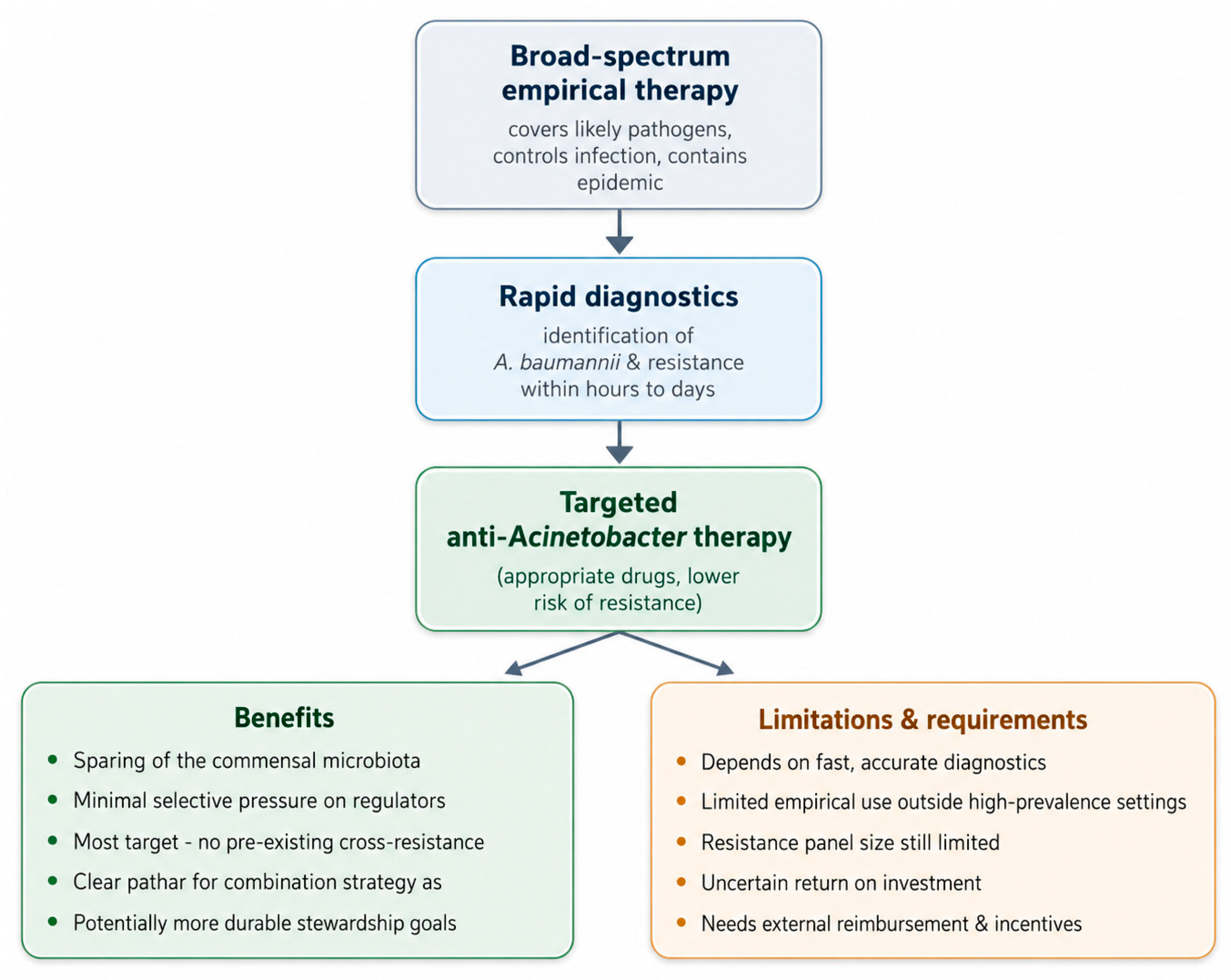
For most of the modern antibiotic era, development favoured broad-spectrum agents able to cover a wide range of pathogens empirically. This preference was rational in an environment of slow diagnostics and undifferentiated sepsis, but it has costs: broad exposure accelerates collateral resistance selection, disrupts the commensal microbiota, and increases the population at risk of Clostridioides difficile infection and other consequences of dysbiosis [37]. Zosurabalpin embodies the alternative paradigm—a deliberately narrow, pathogen-specific agent designed to do one thing extremely well. Its case illustrates both the promise and the requirements of this approach (Figure 3).
Figure 3.
From broad-spectrum to pathogen-specific antibiotic development. Rapid diagnostic identification of A. baumannii and its resistance phenotype enables a shift from broad empirical therapy to targeted treatment with a pathogen-specific agent such as zosurabalpin, with the principal benefits and the corresponding limitations and requirements summarized below.
The advantages are considerable. A drug active essentially only against Acinetobacter spares the wider microbiota, exerts minimal selective pressure on bystander organisms, and—because its target and binding mode are unique—encounters no known resistance and offers a clean partner for combination or sequential strategies [8,9]. In principle, narrow-spectrum agents are also more durable stewardship assets, since their limited use footprint slows resistance emergence [38,39].
The corresponding requirement is diagnostic: a pathogen-specific antibiotic can only be used rationally if the pathogen is identified rapidly. The viability of the narrow-spectrum paradigm is therefore tightly coupled to the maturation of rapid molecular and antigen-based diagnostics capable of identifying A. baumannii and its resistance phenotype within clinically actionable time frames. In practice, zosurabalpin is likely to be deployed either as targeted therapy once CRAB is confirmed, or empirically in defined high-prevalence settings (for example, units with documented CRAB outbreaks), frequently as part of a combination regimen during the diagnostic window [10]. This marriage of targeted therapeutics with precise diagnostics mirrors the trajectory already established for carbapenem-resistant Enterobacterales and represents a maturation of antimicrobial stewardship rather than a retreat from it [23].
Finally, the economic and regulatory dimension cannot be separated from the science. The development of zosurabalpin—a high-risk, narrow-spectrum agent directed at a single critical-priority pathogen—has depended on the convergence of scientific opportunity with an incentive environment shaped by priority-pathogen designations and push/pull funding mechanisms. A defining feature of the pathogen-specific model, however, is that it concentrates risk on one organism: a substantial, long-term development program is tied to a single target, so that if the agent ultimately fails in the clinic, or if resistance erodes its activity soon after launch, the entire investment is lost, with no broader indication to absorb the cost. This argues not so much for concern about constrained revenue—priority-pathogen designation is precisely intended to address that—as for two practical safeguards: maintaining a diversified portfolio of pathogen-specific candidates rather than relying on any single agent and coupling each agent with robust resistance surveillance so that any loss of activity is detected early. Sustaining such a pipeline will nonetheless require continued refinement of how research funding and incentives are allocated, so that targeted innovation remains viable—particularly given that its benefits may accrue mainly to settings with advanced diagnostic infrastructure [38,40].
9. Challenges and Future Perspectives
Several uncertainties temper the enthusiasm surrounding zosurabalpin. First and most importantly, definitive clinical efficacy and safety in patients with invasive CRAB infection remain to be demonstrated; the outcome of the Phase 3 programme will be decisive, and the history of CRAB therapeutics—where promising in vitro and preclinical profiles have not always translated into superior clinical outcomes, as the cefiderocol experience illustrates—counsels caution [7,36]. Second, resistance is a foreseeable concern: target-site mutations in LptF and LptG can be selected in the laboratory, and the fitness cost, frequency, and clinical relevance of such mutations under real-world exposure require careful surveillance [9]. Third, the narrow spectrum that confers stewardship benefits simultaneously demands diagnostic infrastructure that is not yet universally available, particularly in the low- and middle-income settings that bear a disproportionate CRAB burden [2,3].
As a tethered macrocyclic peptide, zosurabalpin is administered intravenously and lacks an oral formulation; this restricts its use to hospitalised patients and removes the option of oral step-down or OPAT-based continuation that is available with some comparator agents. In practice, however, this limitation is mitigated by the fact that invasive CRAB infection occurs almost exclusively in critically ill, hospitalised patients with established vascular access.
Looking ahead, the validation of the LptB2FGC complex as a druggable target opens a broader avenue. Structure-guided efforts may extend Lpt-pathway inhibition to other Gram-negative pathogens by adapting binding to their distinct transporter pockets, and the trap-and-poison principle may inspire additional mechanistically novel chemotypes [9,34]. Combination approaches—pairing zosurabalpin with agents that perturb the outer membrane or with existing backbones—warrant systematic evaluation, as do pharmacokinetic/pharmacodynamic studies to define optimal dosing in critically ill patients. The integration of such agents with rapid diagnostics, robust stewardship, and reformed reimbursement will ultimately determine whether the pathogen-specific paradigm becomes a durable component of the response to AMR [38,39,40].
10. Conclusions
Zosurabalpin represents a potentially important conceptual advance in the approach to A. baumannii. By inhibiting the LptB2FGC transporter and trapping LPS within it, it kills CRAB in vitro and in animal models through a mechanism wholly distinct from that of any agent in clinical use, and in preclinical studies it is not affected by the resistance determinants that define this pathogen; its efficacy in patients, however, remains to be demonstrated. Equally important is what it represents: a deliberate, scientifically grounded return to pathogen-specific antibiotic development, made possible by the convergence of structural biology, resistance genetics, and improved diagnostics. Whether zosurabalpin fulfils its promise depends on the forthcoming Phase 3 results and on the broader systems—diagnostic, stewardship, and economic—needed to deploy a narrow-spectrum agent responsibly. Regardless of its individual fate, it has shown that previously intractable Gram-negative targets are druggable and that targeted antibacterials deserve a central place in the strategy against antimicrobial resistance.
Author Contributions
Conceptualization, A.M.; investigation, A.M. and S.S.; writing—original draft preparation, A.M. and S.S.; writing—review and editing, A.M. and S.S. All authors have read and agreed to the published version of the manuscript.
Funding
This research received no external funding.
Institutional Review Board Statement
Not applicable.
Informed Consent Statement
Not applicable.
Data Availability Statement
Not applicable since no new data were generated.
Conflicts of Interest
The authors declare no conflicts of interest.
References
- Antimicrobial Resistance Collaborators. Global burden of bacterial antimicrobial resistance in 2019: A systematic analysis. Lancet 2022, 399, 629–655, Erratum in: Lancet 2022, 400, 1102. https://doi.org/10.1016/S0140-6736(21)02653-2. [Google Scholar] [CrossRef] [Scilit] [PubMed]
- GBD 2021 Antimicrobial Resistance Collaborators. Global Burden of Bacterial Antimicrobial Resistance 1990–2021: A Systematic Analysis with Forecasts to 2050. Lancet 2024, 404, 1199–1226. [Google Scholar] [CrossRef] [Scilit] [PubMed]
- Sati, H.; Carrara, E.; Savoldi, A.; Hansen, P.; Garlasco, J.; Campagnaro, E.; Boccia, S.; Castillo-Polo, J.A.; Magrini, E.; Garcia-Vello, P.; et al. The WHO Bacterial Priority Pathogens List 2024: A Prioritisation Study to Guide Research, Development, and Public Health Strategies Against Antimicrobial Resistance. Lancet Infect. Dis. 2025, 25, 1077–1087. [Google Scholar] [CrossRef] [Scilit] [PubMed]
- Wong, D.; Nielsen, T.B.; Bonomo, R.A.; Pantapalangkoor, P.; Luna, B.; Spellberg, B. Clinical and Pathophysiological Overview of Acinetobacter Infections: A Century of Challenges. Clin. Microbiol. Rev. 2017, 30, 409–447. [Google Scholar] [CrossRef] [Scilit] [PubMed]
- Boucher, H.W.; Talbot, G.H.; Bradley, J.S.; Edwards, J.E.; Gilbert, D.; Rice, L.B.; Scheld, M.; Spellberg, B.; Bartlett, J. Bad Bugs, No Drugs: No ESKAPE! An Update from the Infectious Diseases Society of America. Clin. Infect. Dis. 2009, 48, 1–12. [Google Scholar] [CrossRef] [Scilit] [PubMed]
- Kaye, K.S.; Shorr, A.F.; Wunderink, R.G.; Du, B.; Poirier, G.E.; Rana, K.; Miller, A.; Lewis, D.; O’DOnnell, J.; Chen, L.; et al. Efficacy and Safety of Sulbactam–Durlobactam Versus Colistin for the Treatment of Patients with Serious Infections Caused by Acinetobacter baumannii–calcoaceticus Complex (ATTACK): A Multicentre, Randomised, Active-Controlled, Phase 3, Non-Inferiority Trial. Lancet Infect. Dis. 2023, 23, 1072–1084. [Google Scholar] [CrossRef] [Scilit] [PubMed]
- Bassetti, M.; Echols, R.; Matsunaga, Y.; Ariyasu, M.; Doi, Y.; Ferrer, R.; Lodise, T.P.; Naas, T.; Niki, Y.; Paterson, D.L.; et al. Efficacy and Safety of Cefiderocol or Best Available Therapy for the Treatment of Serious Infections Caused by Carbapenem-Resistant Gram-Negative Bacteria (CREDIBLE-CR): A Randomised, Open-Label, Multicentre, Pathogen-Focused, Descriptive, Phase 3 Trial. Lancet Infect. Dis. 2021, 21, 226–240. [Google Scholar] [CrossRef] [Scilit] [PubMed]
- Zampaloni, C.; Mattei, P.; Bleicher, K.; Winther, L.; Thäte, C.; Bucher, C.; Adam, J.-M.; Alanine, A.; Amrein, K.E.; Baidin, V.; et al. Author Correction: A Novel Antibiotic Class Targeting the Lipopolysaccharide Transporter. Nature 2024, 631, E17. [Google Scholar] [CrossRef] [Scilit] [PubMed]
- Pahil, K.S.; Gilman, M.S.A.; Baidin, V.; Clairfeuille, T.; Mattei, P.; Bieniossek, C.; Dey, F.; Muri, D.; Baettig, R.; Lobritz, M.; et al. Author Correction: A New Antibiotic Traps Lipopolysaccharide in Its Intermembrane Transporter. Nature 2024, 631, E18. [Google Scholar] [CrossRef] [Scilit] [PubMed]
- Tamma, P.D.; Aitken, S.L.; Bonomo, R.A.; Mathers, A.J.; van Duin, D.; Clancy, C.J. Infectious Diseases Society of America 2024 Guidance on the Treatment of Antimicrobial-Resistant Gram-Negative Infections. Clin. Infect. Dis. 2024, ciae403. [Google Scholar] [CrossRef] [Scilit] [PubMed]
- Nicolosi, A.; Bonanno Ferraro, G.; Brandtner, D.; Veneri, C.; Artuso, I.; Marchetti, M.; La Rosa, G.; Stefani, S.; Stracquadanio, S. Integrated wet lab and in silico discovery and characterization of bacteriophages with antibiotic synergy against multidrug resistant Acinetobacter baumannii. Sci. Rep. 2026, 16, 15091. [Google Scholar] [CrossRef] [Scilit] [PubMed]
- Marino, A.; Stracquadanio, S.; Cosentino, F.; Maraolo, A.E.; Colpani, A.; De Vito, A.; Geremia, N.; Nicolosi, A.; Oliva, A.; Cacopardo, B.; et al. Phage to ESKAPE: Personalizing Therapy for MDR Infections-A Comprehensive Clinical Review. Pathogens 2025, 14, 1011. [Google Scholar] [CrossRef] [Scilit] [PubMed] [PubMed Central]
- Weng, Q.; Zhang, F.; Zheng, Q. Zosurabalpin: A Novel Tethered Macrocyclic Peptide Antibiotic That Kills Carbapenem-Resistant Acinetobacter baumannii. MedComm 2024, 5, e696. [Google Scholar] [CrossRef] [Scilit] [PubMed]
- Terzi, I.; Panagopoulos, P.; Rafailidis, P. Zosurabalpin: An Antibiotic with a New Mechanism of Action Against Carbapenem-Resistant Acinetobacter baumannii. Infez. Med. 2025, 33, 175–181. [Google Scholar] [CrossRef] [Scilit] [PubMed]
- Que, W.; Deng, Z.; Gao, J. Clinical Crusade: Zosurabalpin’s Charge Against Antibiotic Resistance. Trends Mol. Med. 2024, 30, 420–422. [Google Scholar] [CrossRef] [Scilit] [PubMed]
- Harding, C.M.; Hennon, S.W.; Feldman, M.F. Uncovering the Mechanisms of Acinetobacter baumannii Virulence. Nat. Rev. Microbiol. 2018, 16, 91–102. [Google Scholar] [CrossRef] [Scilit] [PubMed]
- Peleg, A.Y.; Seifert, H.; Paterson, D.L. Acinetobacter baumannii: Emergence of a Successful Pathogen. Clin. Microbiol. Rev. 2008, 21, 538–582. [Google Scholar] [CrossRef] [Scilit] [PubMed]
- Russo, A.; Gullì, S.P.; Vena, A.; Spadafora, L.; Bernardi, M.; Corcione, S.; Ceccarelli, G.; Alessandri, F.; Mastroianni, C.M.; Oliva, A.; et al. Predictors of Mortality and Therapeutic Efficacy in Carbapenem-Resistant Acinetobacter baumannii Bacteremia. J. Infect. 2026, 92, 106742. [Google Scholar] [CrossRef] [Scilit] [PubMed]
- Evans, B.A.; Amyes, S.G.B. OXA β-Lactamases. Clin. Microbiol. Rev. 2014, 27, 241–263. [Google Scholar] [CrossRef] [Scilit] [PubMed]
- Stracquadanio, S.; Nicolosi, A.; Privitera, G.F.; Massimino, M.; Marino, A.; Bongiorno, D.; Stefani, S. Role of transcriptomic and genomic analyses in improving the comprehension of cefiderocol activity in Acinetobacter baumannii. mSphere 2024, 9, e0061723. [Google Scholar] [CrossRef] [Scilit] [PubMed]
- Su, W.; Wang, W.; Li, L.; Zhang, M.; Xu, H.; Fu, C.; Pang, X.; Wang, M. Mechanisms of tigecycline resistance in Gram-negative bacteria: A narrative review. Eng. Microbiol. 2024, 4, 100165. [Google Scholar] [CrossRef] [Scilit] [PubMed]
- Stracquadanio, S.; Nicolosi, A.; Marino, A.; Calvo, M.; Stefani, S. Issues with Cefiderocol Testing: Comparing Commercial Methods to Broth Microdilution in Iron-Depleted Medium—Analyses of the Performances, ATU, and Trailing Effect According to EUCAST Initial and Revised Interpretation Criteria. Diagnostics 2024, 14, 2318. [Google Scholar] [CrossRef] [Scilit] [PubMed]
- Tsuji, B.T.; Pogue, J.M.; Zavascki, A.P.; Paul, M.; Daikos, G.L.; Forrest, A.; Giacobbe, D.R.; Viscoli, C.; Giamarellou, H.; Karaiskos, I.; et al. International Consensus Guidelines for the Optimal Use of the Polymyxins. Pharmacotherapy 2019, 39, 10–39. [Google Scholar] [CrossRef] [Scilit] [PubMed]
- Marino, A.; Augello, E.; Bellanca, C.M.; Cosentino, F.; Stracquadanio, S.; La Via, L.; Maniaci, A.; Spampinato, S.; Fadda, P.; Cantarella, G.; et al. Antibiotic Therapy Duration for Multidrug-Resistant Gram-Negative Bacterial Infections: An Evidence-Based Review. Int. J. Mol. Sci. 2025, 26, 6905. [Google Scholar] [CrossRef] [Scilit] [PubMed]
- Ruiz, N.; Kahne, D.; Silhavy, T.J. Transport of Lipopolysaccharide across the Cell Envelope: The Long Road of Discovery. Nat. Rev. Microbiol. 2009, 7, 677–683. [Google Scholar] [CrossRef] [Scilit] [PubMed]
- Okuda, S.; Sherman, D.J.; Silhavy, T.J.; Ruiz, N.; Kahne, D. Lipopolysaccharide Transport and Assembly at the Outer Membrane: The PEZ Model. Nat. Rev. Microbiol. 2016, 14, 337–345. [Google Scholar] [CrossRef] [Scilit] [PubMed]
- Raetz, C.R.H.; Whitfield, C. Lipopolysaccharide Endotoxins. Annu. Rev. Biochem. 2002, 71, 635–700. [Google Scholar] [CrossRef] [Scilit] [PubMed]
- Whitfield, C.; Trent, M.S. Biosynthesis and Export of Bacterial Lipopolysaccharides. Annu. Rev. Biochem. 2014, 83, 99–128. [Google Scholar] [CrossRef] [Scilit] [PubMed]
- Li, Y.; Orlando, B.J.; Liao, M. Structural Basis of Lipopolysaccharide Extraction by the LptB2FGC Complex. Nature 2019, 567, 486–490. [Google Scholar] [CrossRef] [Scilit] [PubMed]
- Maher, J.; Castanheira, M.; Fedler, K.A.; Louvel, S. Activity of Zosurabalpin and Comparator Antimicrobial Agents Tested Against Acinetobacter baumannii–calcoaceticus Complex Isolates Collected Worldwide in 2024. Open Forum Infect. Dis. 2026, 13, ofaf695.1521. [Google Scholar] [CrossRef] [Scilit]
- Diaco, F.; Torrini, L.; Caivano, L.; Rossi, M.; Dominelli, F.; Puggioni, G.; Sacco, F.; Viscido, A.; Louvel, S.; Antonelli, G. In vitro evaluation of the novel antibiotic zosurabalpin against carbapenem-resistant Acinetobacter baumannii clinical isolates. J. Glob. Antimicrob. Resist. 2026, 49, 45–48. [Google Scholar] [CrossRef] [Scilit] [PubMed]
- Erbetti, I.; Ferrari, L.; Ortombina, A.; Savoia, P.; Felici, A.; Bissantz, C.; Zampaloni, C. In Vitro and In Vivo Killing Kinetics of Zosurabalpin (RG6006) Against Acinetobacter baumannii. Open Forum Infect. Dis. 2023, 10, ofad500.1733. [Google Scholar] [CrossRef] [Scilit]
- Hawser, S.; Kothari, N.; Valmont, T.; Louvel, S.; Zampaloni, C. Activity of the Novel Antibiotic Zosurabalpin (RG6006) Against Clinical Acinetobacter Isolates from China. Open Forum Infect. Dis. 2023, 10, ofad500.1754. [Google Scholar] [CrossRef] [Scilit]
- Magri, M.; Eljaoudi, R.; Belyamani, L.; Ibrahimi, A.; Bouricha, E.M. In silico analysis of zosurabalpin-LptB2FG binding in Acinetobacter spp., Klebsiella pneumoniae, and Shigella flexneri: Mechanisms underlying its differential efficacy. Silico Pharmacol. 2025, 13, 62. [Google Scholar] [CrossRef] [Scilit] [PubMed] [PubMed Central]
- Guenther, A.; Millar, L.; Messer, A.; Giraudon, M.; Patel, K.; Deurloo, E.J.; Lobritz, M.; Gloge, A. Safety, Tolerability, and Pharmacokinetics in Healthy Participants Following Single-Dose Administration of Zosurabalpin, a Novel Pathogen-Specific Antibiotic for the Treatment of Serious Acinetobacter Infections. Open Forum Infect. Dis. 2023, 10, ofad500.1749. [Google Scholar] [CrossRef] [Scilit]
- Dall, C. Roche to Launch Phase 3 Trial for New Antibiotic Targeting Acinetobacter baumannii; Center for Infectious Disease Research and Policy (CIDRAP), University of Minnesota: Minneapolis, MN, USA, 27 May 2025; Available online: https://www.cidrap.umn.edu/antimicrobial-stewardship/roche-launch-phase-3-trial-new-antibiotic-targeting-acinetobacter (accessed on 14 June 2026).
- Langdon, A.; Crook, N.; Dantas, G. The Effects of Antibiotics on the Microbiome throughout Development and Alternative Approaches for Therapeutic Modulation. Genome Med. 2016, 8, 39. [Google Scholar] [CrossRef] [Scilit] [PubMed]
- Theuretzbacher, U.; Outterson, K.; Engel, A.; Karlén, A. The Global Preclinical Antibacterial Pipeline. Nat. Rev. Microbiol. 2020, 18, 275–285. [Google Scholar] [CrossRef] [Scilit] [PubMed]
- Theuretzbacher, U.; Jumde, R.P.; Hennessy, A.; Cohn, J.; Piddock, L.J.V. Global Health Perspectives on Antibacterial Drug Discovery and the Preclinical Pipeline. Nat. Rev. Microbiol. 2025, 23, 474–490. [Google Scholar] [CrossRef] [Scilit] [PubMed]
- Årdal, C.; Balasegaram, M.; Laxminarayan, R.; McAdams, D.; Outterson, K.; Rex, J.H.; Sumpradit, N. Antibiotic Development—Economic, Regulatory and Societal Challenges. Nat. Rev. Microbiol. 2020, 18, 267–274. [Google Scholar] [CrossRef] [Scilit] [PubMed]

Disclaimer/Publisher’s Note: The statements, opinions and data contained in all publications are solely those of the individual author(s) and contributor(s) and not of MDPI and/or the editor(s). MDPI and/or the editor(s) disclaim responsibility for any injury to people or property resulting from any ideas, methods, instructions or products referred to in the content. |
© 2026 by the authors. Licensee MDPI, Basel, Switzerland. This article is an open access article distributed under the terms and conditions of the Creative Commons Attribution (CC BY) license.