
Drug Recall Systems in Pharmaceutical Regulation: Regulatory Frameworks, Procedures, and Global Perspectives


Abstract
1. Introduction
1.1. Background of Pharmaceutical Product Recalls
1.2. Public Health Significance of Drug Recalls
1.3. Evolution of Global Recall Regulations
1.4. Scope and Objectives of the Review
1.5. Rationale and Novelty of the Present Review
1.6. Literature Search Strategy and Study Selection
2. Fundamentals of Drug Recall Systems
2.1. Definition and Regulatory Concept of Drug Recall
2.2. Objectives of Drug Recall
2.3. Classification of Drug Recalls
2.4. Recall Severity and Risk-Based Approach
2.5. Impact of Drug Recalls on Healthcare Systems and Industry
3. Major Causes of Pharmaceutical Product Recalls
3.1. Manufacturing and GMP Deficiencies
3.2. Microbial and Chemical Contamination
3.3. Nitrosamine and Genotoxic Impurities
3.4. Labeling and Packaging Errors
3.5. Stability Failures and Degradation Products
3.6. Counterfeit and Substandard Medicines
3.7. Adverse Drug Reactions and Pharmacovigilance Signals
4. Regulatory Frameworks Governing Drug Recalls
4.1. Drug Recall Regulations in India
4.2. Role of CDSCO and DCGI in Recall Management
4.3. US FDA Recall Framework
4.4. European Medicines Agency (EMA) Recall System
4.5. China National Medical Products Administration (NMPA) Recall System
4.6. WHO Guidelines on Pharmaceutical Recalls
4.7. Comparative Analysis of International Recall Systems
5. Drug Recall Classification and Risk Assessment
5.1. Class I Recalls
5.2. Class II Recalls
5.3. Class III Recalls
5.4. Health Hazard Evaluation and Risk Assessment Models
5.5. Recall Prioritization Based on Patient Safety
6. Drug Recall Process and Supply Chain Management
6.1. Recall Initiation and Decision-Making
6.2. Regulatory Notification and Rapid Alert Systems
6.3. Recall Communication Strategies
6.4. Product Traceability and Batch Tracking
6.5. Product Retrieval, Quarantine, and Disposal
6.6. Recall Closure and Effectiveness Checks
6.7. Role of ICH Guidelines in Recall Prevention and Future Regulatory Development
7. Role of Pharmacovigilance and Post-Marketing Surveillance
7.1. Adverse Drug Reaction Monitoring
7.2. Signal Detection and Safety Assessment
7.3. Integration of Pharmacovigilance with Recall Systems
7.4. Real-World Evidence in Recall Decisions
8. Emerging Trends in Pharmaceutical Recalls
8.1. Increase in Sterile Product Recalls
8.2. Nitrosamine-Related Global Recalls
8.3. Data Integrity and Digital Compliance Issues
8.4. Biologics and Advanced Therapy Product Recalls
8.5. Recalls Involving Oral Solid Dosage Forms and Conventional Pharmaceutical Products
9. Product- and Quality-Related Factors Influencing Pharmaceutical Recalls
10. Challenges in Current Drug Recall Systems
10.1. Inefficient Product Traceability
10.2. Delayed Recall Communication
10.3. Global Supply Chain Complexity
10.4. Regulatory Harmonization Issues
10.5. Recall Management in Low- and Middle-Income Countries
10.6. Economic and Reputational Impact on Pharmaceutical Companies
11. Future Perspectives and Innovations
11.1. Blockchain-Based Pharmaceutical Traceability
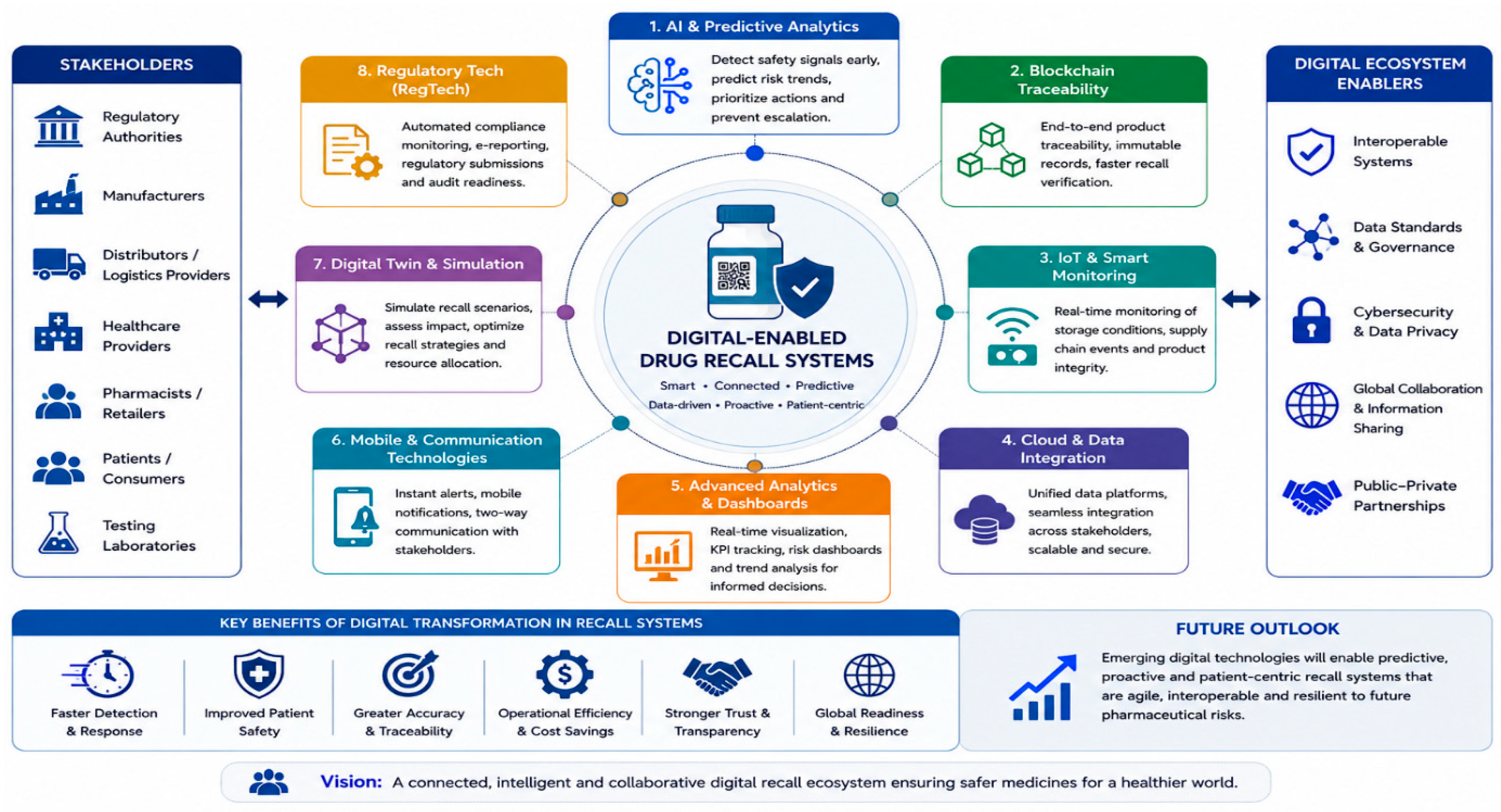
11.2. Digital Recall Management Systems
11.3. Global Regulatory Harmonization Initiatives
11.4. Strengthening Recall Preparedness Through Mock Recall Programs
12. Recommendations
12.1. Strengthening GMP and Quality Risk Management
12.2. Enhancing International Regulatory Collaboration
12.3. Improving Recall Communication Infrastructure
12.4. Integration of Pharmacovigilance and Quality Systems
12.5. Capacity Building and Industry Training
13. AI and Predictive Analytics in Recall Prevention
Artificial Intelligence in Recall Surveillance
14. Future Directions and Conclusions
Author Contributions
Funding
Data Availability Statement
Acknowledgments
Conflicts of Interest
References
- Natof, T.; Pellegrini, M.V. Food and Drug Administration Recalls. In StatPearls; StatPearls Publishing: Treasure Island, FL, USA, 2026. Available online: https://ncbi.nlm.nih.gov/sites/books/NBK570589/ (accessed on 9 May 2023).
- US Food and Drug Administration. Recalls, Market Withdrawals, & Safety Alerts: Enforcement Reports; FDA: Silver Spring, MD, USA. Available online: https://www.fda.gov/safety/recalls-market-withdrawals-safety-alerts/enforcement-reports (accessed on 9 May 2026).
- US Food and Drug Administration. Recalls Background and Definitions; FDA: Silver Spring, MD, USA. Available online: https://www.fda.gov/safety/industry-guidance-recalls/recalls-background-and-definitions (accessed on 9 May 2026).
- Miglani, A.; Saini, C.; Musyuni, P.; Aggarwal, G. A review and analysis of product recall for pharmaceutical drug product. J. Generic Med. 2022, 18, 72–81. [Google Scholar]
- World Health Organization. Risk Communication and Community Engagement Readiness and Response Toolkit: Substandard and Falsified Medicines; WHO: Geneva, Switzerland, 2026; Available online: https://iris.who.int/server/api/core/bitstreams/d4d9165c-e254-4f35-a7a8-621b579112f5/content (accessed on 13 May 2026).
- US Food and Drug Administration. FDA 101: Product Recalls; FDA: Silver Spring, MD, USA, 2025. Available online: https://www.fda.gov/consumers/consumer-updates/fda-101-product-recalls (accessed on 13 May 2026).
- Hassen, H.K.; Mekasha, Y.T.; Tegegne, A.A.; Ozalp, Y. A narrative review on problems in product quality, regulatory system constraints, and the concept of quality by design as a solution for quality assurance of African medicines. Front. Med. 2024, 11, 1472495. [Google Scholar] [CrossRef] [PubMed] [PubMed Central]
- Fryze, I.; Naughton, B.D. Substandard and falsified medicine recalls in the legitimate supply chain: A systematic review of evidence. BMJ Open 2025, 15, e103672. [Google Scholar] [CrossRef] [PubMed] [PubMed Central]
- Lin, I.D.; Hertig, J.B. Risk control drives risk assessment and risk review: A cause and effect model of pharmaceutical drug recall on patient safety. J. Med. Access. 2023, 7, 27550834231170075. [Google Scholar] [CrossRef] [PubMed] [PubMed Central]
- Świeczkowski, D.; Zdanowski, S.; Merks, P.; Szarpak, Ł.; Vaillancourt, R.; Jaguszewski, M.J. The plague of unexpected drug recalls and the pandemic of falsified medications in cardiovascular medicine as a threat to patient safety and global public health: A brief review. Cardiol. J. 2022, 29, 133–139. [Google Scholar] [CrossRef] [PubMed] [PubMed Central]
- US Food and Drug Administration. Archive for Recalls, Market Withdrawals & Safety Alerts; FDA: Silver Spring, MD, USA. Available online: https://www.fda.gov/safety/recalls-market-withdrawals-safety-alerts (accessed on 9 May 2026).
- Patel, R.; Vhora, A.; Jain, D.; Patel, R.; Khunt, D.; Patel, R.; Dyawanapelly, S.; Junnuthula, V. A retrospective regulatory analysis of FDA recalls carried out by pharmaceutical companies from 2012 to 2023. Drug Discov. Today 2024, 29, 103993. [Google Scholar] [CrossRef] [PubMed]
- Mattingly, A.N.; Mattingly, T.J., 2nd; Nguyen Phan, A.L.; Negash, K. Categorization and comparisons of drug recalls for manufacturers and compounders. J. Am. Pharm. Assoc. 2022, 62, 1344–1350. [Google Scholar] [CrossRef] [PubMed]
- McManus, D.; Naughton, B.D. A systematic review of substandard, falsified, unlicensed and unregistered medicine sampling studies: A focus on context, prevalence, and quality. BMJ Glob. Health 2020, 5, e002393. [Google Scholar] [CrossRef] [PubMed]
- Eissa, M.E. Drug recall monitoring and trend analysis: A multidimensional study. Glob. J. Qual. Saf. Healthc. 2019, 2, 34–39. [Google Scholar] [CrossRef]
- Hall, K.; Stewart, T.; Chang, J.; Freeman, M.K. Characteristics of FDA drug recalls: A 30-month analysis. Am. J. Health Syst. Pharm. 2016, 73, 235–240. [Google Scholar] [CrossRef] [PubMed]
- Oliveira, C.L.C.G.; Machado, V.F.; de Freitas Tavares, H.; Ribeiro, G.L.M.; Arrais, P.S.D. Recall of substandard medicines in Brazil during the period 2010–2018. BMC Health Serv. Res. 2023, 23, 238. [Google Scholar] [CrossRef] [PubMed] [PubMed Central]
- Bahizi, M.; Nyirimigabo, E.; Ntirenganya, L.; Umuhoza, M.I.; Habyalimana, V.; Bikorimana, G.; Ukwishaka, J. A four-year assessment of the characteristics of Rwandan FDA drug recalls. BMC Public Health 2024, 24, 1784. [Google Scholar] [CrossRef] [PubMed] [PubMed Central]
- Carleton, B.C.; Smith, M.A.; Gelin, M.N.; Heathcote, S.C. Paediatric adverse drug reaction reporting: Understanding and future directions. Can. J. Clin. Pharmacol. 2007, 14, e45–e57. [Google Scholar] [PubMed]
- Herdeiro, M.T.; Figueiras, A.; Polónia, J.; Gestal-Otero, J.J. Influence of pharmacists’ attitudes on adverse drug reaction reporting: A case-control study in Portugal. Drug Saf. 2006, 29, 331–340. [Google Scholar] [CrossRef] [PubMed]
- Eichler, H.G.; Abadie, E.; Breckenridge, A.; Flamion, B.; Gustafsson, L.L.; Leufkens, H.; Rowland, M.; Schneider, C.K.; Bloechl-Daum, B. Bridging the efficacy-effectiveness gap: A regulator’s perspective on addressing variability of drug response. Nat. Rev. Drug Discov. 2011, 10, 495–506. [Google Scholar] [CrossRef] [PubMed]
- Talati, R.K.; Gupta, A.S.; Xu, S.; Ghobadi, C.W. Major FDA medical device recalls in ophthalmology from 2003 to 2015. Can. J. Ophthalmol. 2018, 53, 98–103. [Google Scholar] [CrossRef] [PubMed]
- McCormick, D.; Woolhandler, S.; Wolfe, S.M.; Bor, D.H. Relationship between low quality-of-care scores and HMOs’ subsequent public disclosure of quality-of-care scores. J. Am. Med. Assoc. 2002, 288, 1484–1490. [Google Scholar]
- Almutairi, M.; Algabbani, A.; Alasiri, A.; Alhomaidan, A.; Alqahtani, A.S. Human Medicines Recall Announcements in Saudi Arabia Between 2017 and 2022: An Analysis of Saudi Food and Drug Authority (SFDA) Reports. Ther. Innov. Regul. Sci. 2024, 58, 689–695. [Google Scholar] [CrossRef] [PubMed]
- Psaty, B.M.; Burke, S.P. Protecting the health of the public--Institute of Medicine recommendations on drug safety. N. Engl. J. Med. 2006, 355, 1753–1755. [Google Scholar] [CrossRef] [PubMed]
- Strom, B.L. How the US drug safety system should be changed. JAMA 2006, 295, 2072–2075. [Google Scholar] [CrossRef] [PubMed]
- Wiktorowicz, M.; Lexchin, J.; Moscou, K. Pharmacovigilance in Europe and North America: Divergent approaches. Soc. Sci. Med. 2012, 75, 165–170. [Google Scholar] [CrossRef] [PubMed]
- Downing, N.S.; Shah, N.D.; Aminawung, J.A.; Pease, A.M.; Zeitoun, J.D.; Krumholz, H.M.; Ross, J.S. Postmarket Safety Events Among Novel Therapeutics Approved by the US Food and Drug Administration Between 2001 and 2010. JAMA 2017, 317, 1854–1863. [Google Scholar] [CrossRef] [PubMed] [PubMed Central]
- Almuzaini, T.; Choonara, I.; Sammons, H. Substandard and counterfeit medicines: A systematic review of the literature. BMJ Open 2013, 3, e002923. [Google Scholar] [CrossRef] [PubMed] [PubMed Central]
- Neupane, A.; Bastakoti, M.; Tamang, S.; Giri, B. Review of drug recalls and quality of pharmaceutical products in Nepal. BMJ Open 2022, 12, e053479. [Google Scholar] [CrossRef] [PubMed] [PubMed Central]
- Nagaich, U.; Sadhna, D. Drug recall: An incubus for pharmaceutical companies and most serious drug recall of history. Int. J. Pharm. Investig. 2015, 5, 13–19. [Google Scholar] [CrossRef] [PubMed]
- Moore, T.J.; Cohen, M.R.; Furberg, C.D. Serious adverse drug events reported to the Food and Drug Administration, 1998–2005. Arch. Intern. Med. 2007, 167, 1752–1759. [Google Scholar] [CrossRef] [PubMed]
- Budnitz, D.S.; Lovegrove, M.C.; Shehab, N.; Richards, C.L. Emergency hospitalizations for adverse drug events in older Americans. N. Engl. J. Med. 2011, 365, 2002–2012. [Google Scholar] [CrossRef] [PubMed]
- Poland, G.A. Vaccines against Lyme Disease: What Happened and What Lessons Can We Learn? Clin. Infect. Dis. 2011, 52, s253–s258. [Google Scholar] [CrossRef] [PubMed]
- Rhodes, P.; Parry, P.I. Pharmaceutical product recall and educated hesitancy towards new drugs and novel vaccines. Int. J. Risk Saf. Med. 2024, 35, 317–333. [Google Scholar] [CrossRef] [PubMed]
- Livingston, A.N.; Mattingly, T.J., 2nd. Drug and medical device product failures and the stability of the pharmaceutical supply chain. J. Am. Pharm. Assoc. 2021, 61, e119–e122. [Google Scholar] [CrossRef] [PubMed] [PubMed Central]
- Wang, B.; Gagne, J.J.; Choudhry, N.K. The epidemiology of drug recalls in the United States. Arch. Intern. Med. 2012, 172, 1109–1110. [Google Scholar] [CrossRef] [PubMed][Green Version]
- Algabbani, A.M.; Alkeridy, W.A.; Alessa, M.A.; Alrwisan, A.A. The inadvertent consequences of drug recalls: A case study of a recall of pantoprazole generics from the markets. Saudi Pharm. J. 2023, 31, 1181–1185. [Google Scholar] [CrossRef] [PubMed] [PubMed Central]
- Connor, M.J.; Tringale, K.; Moiseenko, V.; Marshall, D.C.; Moore, K.; Cervino, L.; Atwood, T.; Brown, D.; Mundt, A.J.; Pawlicki, T.; et al. Medical Device Recalls in Radiation Oncology: Analysis of US Food and Drug Administration Data, 2002–2015. Int. J. Radiat. Oncol. Biol. Phys. 2017, 98, 438–446. [Google Scholar] [CrossRef] [PubMed] [PubMed Central]
- Day, C.S.; Park, D.J.; Rozenshteyn, F.S.; Owusu-Sarpong, N.; Gonzalez, A. Analysis of FDA-Approved Orthopaedic Devices and Their Recalls. J. Bone Joint. Surg. Am. 2016, 98, 517–524. [Google Scholar] [CrossRef] [PubMed]
- Vajapey, S.P.; Li, M. Medical Device Recalls in Orthopedics: Recent Trends and Areas for Improvement. J. Arthroplast. 2020, 35, 2259–2266. [Google Scholar] [CrossRef] [PubMed]
- Giezen, T.J.; Mantel-Teeuwisse, A.K.; Straus, S.M.; Schellekens, H.; Leufkens, H.G.; Egberts, A.C. Safety-related regulatory actions for biologicals approved in the United States and the European Union. JAMA 2008, 300, 1887–1896. [Google Scholar] [CrossRef] [PubMed]
- Yom-Tov, E. Predicting Drug Recalls from Internet Search Engine Queries. IEEE J. Transl. Eng. Health Med. 2017, 5, 4400106. [Google Scholar] [CrossRef] [PubMed] [PubMed Central]
- Kilbridge, P.M.; Campbell, U.C.; Cozart, H.B.; Mojarrad, M.G. Automated surveillance for adverse drug events at a community hospital and an academic medical center. J. Am. Med. Inform. Assoc. 2006, 13, 372–377. [Google Scholar] [CrossRef] [PubMed] [PubMed Central]
- Fontanarosa, P.B.; Rennie, D.; DeAngelis, C.D. Postmarketing Surveillance—Lack of Vigilance, Lack of Trust. JAMA 2004, 292, 2647–2650. [Google Scholar] [CrossRef] [PubMed]
- McNaughton, R.; Huet, G.; Shakir, S. An investigation into drug products withdrawn from the EU market between 2002 and 2011 for safety reasons and the evidence used to support the decision-making. BMJ Open 2014, 4, e004221. [Google Scholar] [CrossRef] [PubMed] [PubMed Central]
- Gadgil, M.; Pavlakos, R.; Carini, S.; Turner, B.; Elder, I.; Hess, W.; Houle, L.; Huff, L.; Johanson, E.; Ramos-Izquierdo, C.; et al. Automating Individualized Notification of Drug Recalls to Patients: Complex Challenges and Qualitative Evaluation. JMIRx Med. 2026, 7, e68345. [Google Scholar] [CrossRef] [PubMed]
- Kesselheim, A.S.; Sinha, M.S.; Avorn, J. Determinants of Market Exclusivity for Prescription Drugs in the United States. JAMA Intern. Med. 2017, 177, 1658–1664. [Google Scholar] [CrossRef] [PubMed]
- Carpenter, D.; Zucker, E.J.; Avorn, J. Drug-review deadlines and safety problems. N. Engl. J. Med. 2008, 358, 1354–1361. [Google Scholar] [CrossRef] [PubMed]
- Banzi, R.; Gerardi, C.; Bertele’, V.; Garattini, S. Approvals of drugs with uncertain benefit-risk profiles in Europe. Eur. J. Intern. Med. 2015, 26, 572–584. [Google Scholar] [CrossRef] [PubMed]
- Hamburg, M.A.; Sharfstein, J.M. The FDA as a public health agency. N. Engl. J. Med. 2009, 360, 2493–2495. [Google Scholar] [CrossRef] [PubMed]
- Aronson, J.K. Medication errors: Definitions and classification. Br. J. Clin. Pharmacol. 2009, 67, 599–604. [Google Scholar] [CrossRef] [PubMed] [PubMed Central]
- Edwards, I.R.; Aronson, J.K. Adverse drug reactions: Definitions, diagnosis, and management. Lancet 2000, 356, 1255–1259. [Google Scholar] [CrossRef] [PubMed]
- Shimabukuro, T.T.; Nguyen, M.; Martin, D.; DeStefano, F. Safety monitoring in the Vaccine Adverse Event Reporting System (VAERS). Vaccine 2015, 33, 4398–4405. [Google Scholar] [CrossRef] [PubMed] [PubMed Central]
- Lasser, K.E.; Allen, P.D.; Woolhandler, S.J.; Himmelstein, D.U.; Wolfe, S.M.; Bor, D.H. Timing of new black box warnings and withdrawals for prescription medications. JAMA 2002, 287, 2215–2220. [Google Scholar] [CrossRef] [PubMed]
- Furberg, C.D.; Levin, A.A.; Gross, P.A.; Shapiro, R.S.; Strom, B.L. The FDA and Drug Safety: A Proposal for Sweeping Changes. Arch. Intern. Med. 2006, 166, 1938–1942. [Google Scholar] [CrossRef] [PubMed]




| Aspect | Drug Recall | Drug Withdrawal |
|---|---|---|
| Definition | A drug recall refers to the removal of a pharmaceutical product from the market because it violates regulatory standards or is found to have quality, safety, labeling, packaging, or manufacturing defects. | Drug withdrawal refers to the permanent or long-term removal of a drug from the market when its overall risks are considered greater than its therapeutic benefits. |
| Primary Reason | Usually initiated due to contamination, incorrect labeling, packaging defects, potency variation, microbial contamination, or manufacturing errors. | Generally occurs because of serious adverse drug reactions, toxicity, lack of efficacy, or unfavorable risk–benefit profile identified after marketing. |
| Nature of Action | Mostly corrective and may involve removal of a specific batch, lot, or affected production series. | Often involves discontinuation of the entire product from the market. |
| Regulatory Basis | Conducted when the product violates standards established by regulatory authorities such as the FDA. | Occurs after reassessment of the drug’s safety and therapeutic effectiveness by regulatory agencies. |
| Initiation | Usually initiated voluntarily by manufacturers or requested by regulatory authorities. | Commonly initiated or mandated by regulatory authorities after scientific evaluation of risk. |
| Scope | May affect only selected lots or batches of a drug product. | Typically affects the entire drug product and all marketed batches. |
| Risk to Patients | Risk may range from minor quality defects to serious health hazards depending on recall classification. | Usually associated with significant or unacceptable risks to patient health. |
| Classification | Classified into Class I, Class II, and Class III recalls depending on severity of harm. | Does not generally follow recall classification categories. |
| Possibility of Reintroduction | The product may return to the market after correction of the identified defect and regulatory approval. | Reintroduction is uncommon unless substantial new evidence proves safety and efficacy. |
| Example Situations | Presence of impurities, sterility failure, labeling mistakes, or defective packaging. | Withdrawal due to severe adverse effects such as hepatotoxicity, cardiotoxicity, or carcinogenic risk. |
| Public Health Objective | To rapidly prevent exposure to defective or potentially harmful products already distributed in the market. | To protect public health by discontinuing drugs whose risks outweigh therapeutic benefits. |
| Regulatory Authority | Country/Region | Public Recall Information Source | Information Available |
|---|---|---|---|
| FDA | United States | FDA Drug Recall Database and MedWatch | Recall notices, safety alerts, enforcement reports |
| EMA | European Union | EMA Safety Communications and Rapid Alert System | Quality defects, safety alerts, regulatory actions |
| MHRA | United Kingdom | Drug Alerts and Central Alerting System (CAS) | Recall notifications and safety communications |
| CDSCO | India | CDSCO Drug Safety Alerts and Recall Notices | Recall notifications and regulatory updates |
| WHO | Global | WHO Global Surveillance and Monitoring System | Alerts on substandard and falsified medicines |
| TGA | Australia | System for Australian Recall Actions (SARA) | Therapeutic goods recalls and safety actions |
| PMDA | Japan | PMDA Safety Information Portal | Recall information and post-marketing safety notices |
| NMPA | China | NMPA Recall and Safety Announcement System | Drug recall and quality defect notifications |
| Swissmedic | Switzerland | Swissmedic Safety and Recall Communications | Product quality and recall announcements |
| ANVISA | Brazil | ANVISA Safety Alert and Recall Portal | Recall information and pharmacovigilance alerts |
| Regulatory Authority | Country/Region | Recall Information System | Pharmacovigilance Integration | Major Regulatory Role |
|---|---|---|---|---|
| FDA | United States | Recall Enterprise System, MedWatch | FAERS | Product recalls, GMP enforcement, post-marketing surveillance |
| EMA | European Union | Rapid Alert System (RAS) | EudraVigilance | EU-wide recall coordination and safety monitoring |
| MHRA | United Kingdom | CAS | Yellow Card Scheme | Drug alerts, recalls, quality defect investigations |
| CDSCO | India | National Rapid Alert System | PvPI | Recall coordination, quality monitoring, regulatory oversight |
| WHO | Global | Global Surveillance and Monitoring System | International pharmacovigilance networks | International coordination and guidance |
| TGA | Australia | Recall Actions Database | DAEN | Risk-based recalls and medicine safety monitoring |
| Swissmedic | Switzerland | Quality Defect and Recall Notifications | National Pharmacovigilance Network | Recall oversight and product quality surveillance |
| PMDA | Japan | Safety Information and Recall Alerts | JADER | Post-marketing safety monitoring and recall management |
| NMPA | China | National Recall and Safety Reporting Systems | National ADR Monitoring System | Recall enforcement and supply chain supervision |
| ANVISA | Brazil | Health Product Alert System | Notivisa | Recall management and pharmacovigilance activities |
| Recall System Component | Primary Objective | Regulatory Focus | Risk Assessment Approach | Communication Strategy | Expected Outcome |
|---|---|---|---|---|---|
| Product Safety Protection | Prevent patient exposure to defective medicines | Public health protection | Evaluation of potential patient harm | Safety alerts and recall notices | Reduction in morbidity and mortality |
| Quality Assurance | Ensure compliance with approved quality standards | GMP compliance and quality oversight | Defect severity assessment | Regulatory notifications | Maintenance of product quality |
| Pharmacovigilance Integration | Identify safety signals and adverse events | Post-marketing surveillance | Benefit–risk assessment | Healthcare professional communication | Early detection of safety concerns |
| Supply Chain Control | Remove affected products from distribution channels | Traceability and inventory management | Exposure assessment | Distributor and wholesaler notification | Effective product retrieval |
| Risk-Based Recall Management | Prioritize recalls according to severity | Recall classification (Class I, II, III) | Hazard and exposure analysis | Targeted risk communication | Efficient allocation of regulatory resources |
| Regulatory Compliance | Ensure adherence to legal and regulatory requirements | Enforcement and corrective actions | Compliance evaluation | Regulatory actions and inspections | Improved industry accountability |
| Public Confidence | Maintain trust in medicines and healthcare systems | Transparency and communication | Assessment of public health impact | Public advisories and alerts | Sustained confidence in regulatory systems |
| Common Cause of Recall | Examples of Affected Products | Associated Patient Safety Risks | Typical Recall Class | Regulatory Actions | Corrective and Preventive Actions (CAPA) | Supply Chain Implications | Pharmacovigilance/GMP Considerations |
|---|---|---|---|---|---|---|---|
| Nitrosamine contamination | Ranitidine, valsartan, losartan, metformin | Long-term carcinogenicity risk due to NDMA/NDEA exposure | Class I or II | FDA, EMA, and MHRA initiated market withdrawal, impurity testing mandates, and revised acceptable intake limits | API process redesign, impurity risk assessment, enhanced analytical surveillance | Global shortages of antihypertensive and antidiabetic agents; API supplier disruption | Emphasis on ICH M7 compliance, continuous quality verification, and risk-based impurity monitoring [8,10]. |
| Sterility failures | Injectable anesthetics, ophthalmic solutions, parenteral nutrition products | Sepsis, bloodstream infections, mortality in critically ill patients | Class I | Manufacturing site inspections, import alerts, mandatory recalls, warning letters | Environmental monitoring reinforcement, aseptic process validation, personnel retraining | Hospital procurement disruption and increased reliance on alternative suppliers | Strong linkage with GMP deviations and contamination control strategies [7,16]. |
| Microbial contamination | Liquid oral formulations, non-sterile syrups, compounded medicines | Opportunistic infections, pediatric toxicity, immunocompromised patient harm | Class I or II | Product seizure, public health advisories, recall expansion | Water system remediation, microbiological testing enhancement | Interrupted distribution in pediatric and critical care sectors | Need for robust microbial quality surveillance and pharmacovigilance reporting integration [30]. |
| Labeling errors | Incorrect strength labeling, wrong dosage instructions | Medication errors, overdose, therapeutic failure | Class II or III | Safety alerts, relabeling orders, recall notices | Barcode verification systems, packaging line automation | Retail pharmacy confusion and inventory reconciliation burdens | Medication error prevention and human factor risk assessment remain central concerns [52]. |
| Data integrity violations | Manipulated QC records, falsified batch documentation | Release of potentially unsafe or substandard medicines | Class II | FDA warning letters, EMA GMP non-compliance notices, import bans | Electronic data governance, audit trail monitoring, quality culture strengthening | Supplier disqualification and interruption of international trade | Increasing regulatory focus on ALCOA+ data integrity principles and digital compliance systems [9]. |
| Cross-contamination | Hormonal products, beta-lactam antibiotics | Unexpected pharmacological exposure, allergic reactions | Class I or II | Facility shutdowns, mandatory remediation plans | Dedicated manufacturing lines, HVAC redesign, cleaning validation | Reduced manufacturing capacity and delayed product availability | GMP failures in segregation and cleaning procedures are common underlying causes [31]. |
| Incorrect potency | Sub-potent antibiotics, super-potent cardiovascular agents | Therapeutic failure or toxicity | Class I or II | Recall classification based on dose deviation severity | Process validation review, analytical recalibration, in-process controls | Clinical substitution burden and increased pharmacoeconomic costs | Ongoing post-marketing quality surveillance is critical for dose consistency [37]. |
| Presence of particulate matter | Injectable biologics and infusion products | Embolism, inflammatory reactions, vascular injury | Class I | Immediate recall and clinical advisories for healthcare institutions | Enhanced visual inspection systems and container closure integrity testing | Hospital stock quarantines and emergency redistribution | Sterile manufacturing oversight and container compatibility remain critical GMP domains [39]. |
| Packaging defects | Blister leakage, container closure failures | Product degradation, reduced stability, contamination | Class II or III | Packaging redesign requests and targeted recalls | Packaging qualification studies and transport validation | Distribution delays and increased reverse logistics costs | Stability monitoring and packaging integrity testing are increasingly emphasized [36]. |
| Counterfeit/substandard medicines | Falsified cardiovascular and anti-infective medicines | Therapeutic failure, toxicity, antimicrobial resistance | Class I | WHO alerts, customs enforcement, international recall coordination | Serialization, track-and-trace implementation, anti-counterfeiting technologies | Severe disruption of legitimate supply chains and public trust erosion | Integration of pharmacovigilance with anti-counterfeiting surveillance is increasingly necessary [8,29]. |
| Regulatory Authority | Recall Classification System | Legal Authority | Mandatory vs. Voluntary Recalls | Rapid Alert System | Public Notification Mechanism | Traceability Requirements | Pharmacovigilance Integration | Post-Recall Effectiveness Checks | Digital Serialization Requirements | Major Regulatory Challenges |
|---|---|---|---|---|---|---|---|---|---|---|
| FDA (United States) | Class I, II, III | Federal Food, Drug, and Cosmetic Act | Primarily voluntary, mandatory authority in selected cases | FDA Recall Enterprise System | Public recall database and MedWatch alerts | DSCSA track-and-trace requirements | Strong integration with FAERS and post-marketing surveillance | Extensive effectiveness audits | Mandatory serialization under DSCSA | Globalized supply chains and API dependency |
| EMA (European Union) | Class I, II, III and caution-in-use | EU pharmaceutical legislation and member-state enforcement | Combination of voluntary and regulatory-directed recalls | RAS | EMA and national competent authority alerts | Falsified Medicines Directive serialization | EudraVigilance-linked safety surveillance | Coordinated EU market withdrawal verification | Mandatory serialization and verification systems | Cross-border harmonization across member states |
| MHRA (United Kingdom) | Class I, II, III, IV–recalls | Human Medicines Regulations | Regulatory authority may mandate recalls | CAS | Drug Alert notices and healthcare communication systems | National serialization framework | Yellow Card Scheme integration | Recall effectiveness assessments | Continued post-Brexit serialization adaptation | Regulatory divergence after Brexit |
| CDSCO (India) | Class I, II, III (adopted framework) | Drugs and Cosmetics Act | Predominantly voluntary with regulatory oversight | National Rapid Alert System evolving | CDSCO notices and state regulator alerts | Limited nationwide digital traceability | PvPI integration remains developing | Variable implementation across states | Emerging barcode and QR initiatives | Fragmented enforcement capacity and informal distribution networks |
| Health Canada | Type I, II, III recalls | Food and Drugs Act | Voluntary but strongly regulated | Recall and Safety Alerts Database | Public advisories and risk communications | Drug establishment licensing oversight | Canada Vigilance Program linkage | Recall monitoring and compliance verification | Progressive serialization adoption | Cross-border coordination with US supply chains |
| WHO International Framework | Risk-based advisories | Non-binding international guidance | Collaborative coordination model | WHO Global Surveillance and Monitoring System | International medical product alerts | Encourages traceability strengthening | Integrated global pharmacovigilance support | Country-level implementation variability | Encourages digital track-and-trace systems | Limited enforcement authority in LMICs |
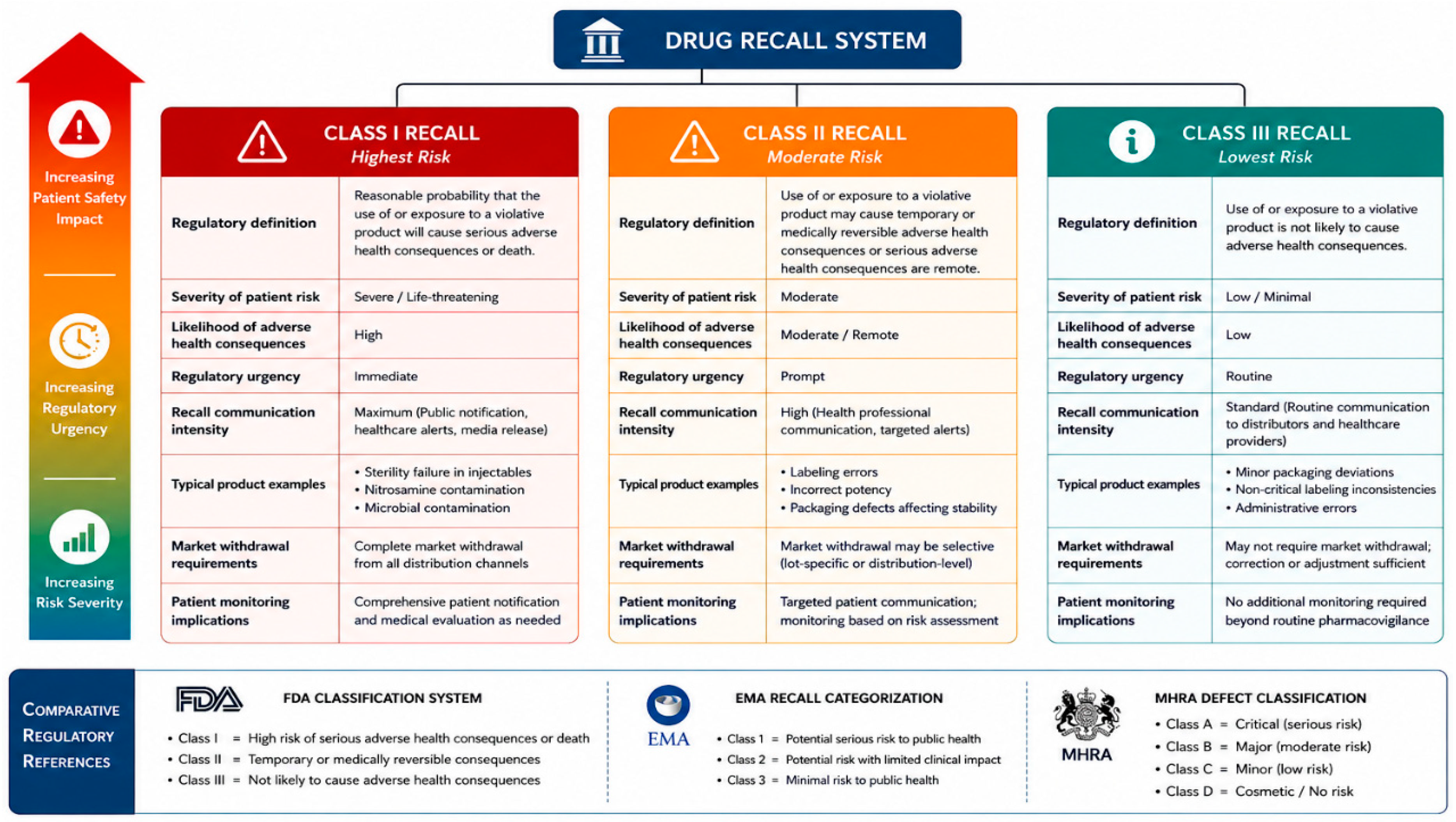
| Parameter | Class I Recall | Class II Recall | Class III Recall |
|---|---|---|---|
| Regulatory Definition | Reasonable probability of serious adverse health consequences or death | Temporary or medically reversible adverse effects possible | Unlikely to cause adverse health consequences |
| Severity of Hazard | Life-threatening | Moderate clinical risk | Minimal clinical risk |
| Potential Clinical Consequences | Mortality, severe toxicity, irreversible injury | Reversible toxicity, reduced therapeutic effect | Minor quality deviation |
| Typical Examples | Sterile injectable contamination, nitrosamine carcinogen exposure | Incorrect labeling, sub-potent products | Packaging defects without clinical impact |
| Regulatory Urgency | Immediate | Rapid but less critical | Routine corrective action |
| Recall Communication Intensity | Extensive public alerts and media dissemination | Targeted healthcare communication | Limited distributor-level communication |
| Product Retrieval Requirements | Immediate market withdrawal and patient-level retrieval | Supply chain retrieval and pharmacy quarantine | Controlled inventory correction |
| Patient Monitoring Needs | Active clinical follow-up often required | Monitoring based on exposure assessment | Usually unnecessary |
| Pharmacovigilance Implications | Intensive signal monitoring and adverse event tracking | Focused surveillance for emerging safety signals | Limited pharmacovigilance intervention |
| Recent Recall Examples | NDMA-contaminated ranitidine | Mislabeling of antihypertensive products | Carton labeling inconsistencies |
| Regulatory Authority | Region | Pharmacovigilance System | Adverse Event Reporting Platform | Signal Detection Mechanism | Integration with Recall Decisions |
|---|---|---|---|---|---|
| FDA | United States | FDA Pharmacovigilance Program | FAERS and MedWatch | Data mining, signal evaluation, post-marketing surveillance | Direct integration with recall classification and regulatory actions |
| EMA | European Union | EU Pharmacovigilance Framework | EudraVigilance | Centralized signal management and risk assessment | Supports EU-wide recall and safety communications |
| MHRA | United Kingdom | National Pharmacovigilance System | Yellow Card Scheme | Continuous safety monitoring and risk evaluation | Integrated with Drug Alerts and Central Alerting System |
| CDSCO/PvPI | India | Pharmacovigilance Programme of India (PvPI) | ADR Monitoring Centres and PvPI database | ADR reporting and regulatory review | Increasing integration with recall decision-making processes |
| PMDA | Japan | Japanese Pharmacovigilance System | JADER Database | Signal detection and benefit–risk assessment | Supports post-marketing regulatory interventions |
| NMPA | China | National ADR Monitoring System | National ADR Reporting Network | Centralized monitoring and quality surveillance | Supports national recall and safety actions |
| TGA | Australia | Pharmacovigilance Framework | Database of Adverse Event Notifications (DAEN) | Signal review and risk evaluation | Supports therapeutic goods recalls and safety actions |
| WHO | International | WHO Programme for International Drug Monitoring | VigiBase | Global signal detection and international surveillance | Facilitates international safety alerts and information sharing |
| Drug | Nitrosamine Impurity | Year(s) of Recall | Major Regulatory Agencies Involved | Source of Contamination | Potential Risk | Regulatory Response | Manufacturing/API Findings | Supply Chain Consequences | Public Health Implications |
|---|---|---|---|---|---|---|---|---|---|
| Ranitidine | NDMA | 2019–2020 | FDA, EMA, MHRA, WHO | Molecular instability during storage | Probable carcinogenicity | Global market withdrawal | Degradation-associated impurity formation | Worldwide shortages of acid-suppressive therapy | Loss of public confidence in OTC medicines |
| Valsartan | NDMA/NDEA | 2018 | FDA, EMA, Health Canada | Solvent/process modification in API synthesis | Long-term cancer risk | Large-scale international recall | API manufacturing deviations in overseas facilities | Major antihypertensive shortages | Triggered intensified API oversight |
| Losartan | NDMA/NDEA | 2018–2021 | FDA, EMA, MHRA | Contaminated API synthesis pathways | Carcinogenic exposure concern | Expanded impurity testing requirements | Multi-site manufacturing variability | Repeated recall cycles and supplier instability | Increased scrutiny of generic manufacturing |
| Metformin | NDMA | 2020 | FDA, Health Canada, EMA | Stability-related impurity formation | Chronic carcinogenic exposure | Targeted extended-release product recalls | Manufacturing and storage-related concerns | Disruption in diabetes medicine supply | Patient adherence concerns due to recall anxiety |
| Rifampicin | MNP impurity | 2020–2021 | WHO, EMA | Nitrosamine generation during manufacturing | Theoretical mutagenic risk | Temporary acceptable intake guidance | Limited alternative suppliers | Tuberculosis treatment continuity concerns | Risk–benefit balancing in essential medicines |
| Varenicline | N-nitroso-varenicline | 2021 | FDA, EMA | API impurity contamination | Potential carcinogenicity | Recall and manufacturing review | Impurity control deficiencies | Smoking cessation therapy shortages | Interrupted cessation programs |
| Sitagliptin and related agents | Nitroso impurities | 2022–2023 | FDA, EMA | API-related contamination pathways | Long-term carcinogenic concern | Risk-based temporary limits permitted | Ongoing impurity assessment programs | Selective supply interruption | Regulatory shift toward lifecycle impurity management |
| Major Challenge | Root Cause | Patient Safety Impact | Regulatory Implications | Supply Chain Consequences | Proposed Solutions | Future Strategies |
|---|---|---|---|---|---|---|
| Inefficient traceability | Fragmented distribution systems | Delayed removal of harmful products | Reduced recall effectiveness | Incomplete product retrieval | Blockchain-enabled track-and-trace systems | Global interoperable serialization |
| Delayed recall communication | Weak digital infrastructure | Continued patient exposure | Public trust erosion | Retail-level confusion | Real-time digital alert systems | AI-assisted communication platforms |
| Global supply chain complexity | Outsourced API manufacturing | Increased contamination risk | Inspection limitations | Multi-country shortages | Supplier diversification and risk mapping | International manufacturing transparency |
| Data integrity failures | Manual documentation and weak oversight | Release of compromised products | Regulatory sanctions and import bans | Supplier disqualification | Electronic quality management systems | AI-driven audit trail surveillance |
| Lack of harmonized regulations | Variable legal frameworks | Inconsistent patient protection | Cross-border enforcement gaps | Recall coordination delays | ICH-aligned recall standards | Expanded WHO-led harmonization |
| Counterfeit medicine infiltration | Weak market surveillance | Toxicity and therapeutic failure | Customs and enforcement burden | Disruption of legitimate markets | Serialization and authentication technologies | Integrated anti-counterfeit intelligence networks |
| Weak pharmacovigilance integration | Siloed safety and quality systems | Delayed signal recognition | Incomplete risk assessment | Poor recall prioritization | Unified PV-quality databases | Predictive pharmacovigilance ecosystems |
| Inadequate recall preparedness | Limited mock recall exercises | Operational delays during crises | Non-compliance findings | Inventory management failures | Routine mock recalls and simulation exercises | Recall readiness benchmarking programs |
| Limited digital infrastructure in LMICs | Resource constraints | Under-reporting and delayed recalls | Weak enforcement capability | Informal market penetration | International technical assistance | Cloud-based recall management platforms |
Disclaimer/Publisher’s Note: The statements, opinions and data contained in all publications are solely those of the individual author(s) and contributor(s) and not of MDPI and/or the editor(s). MDPI and/or the editor(s) disclaim responsibility for any injury to people or property resulting from any ideas, methods, instructions or products referred to in the content. |
© 2026 by the authors. Licensee MDPI, Basel, Switzerland. This article is an open access article distributed under the terms and conditions of the Creative Commons Attribution (CC BY) license.
Share and Cite
Kumar, S.; Chaturvedi, S. Drug Recall Systems in Pharmaceutical Regulation: Regulatory Frameworks, Procedures, and Global Perspectives. Drugs Drug Candidates 2026, 5, 39. https://doi.org/10.3390/ddc5030039
Kumar S, Chaturvedi S. Drug Recall Systems in Pharmaceutical Regulation: Regulatory Frameworks, Procedures, and Global Perspectives. Drugs and Drug Candidates. 2026; 5(3):39. https://doi.org/10.3390/ddc5030039
Chicago/Turabian StyleKumar, Sachin, and Saurabh Chaturvedi. 2026. "Drug Recall Systems in Pharmaceutical Regulation: Regulatory Frameworks, Procedures, and Global Perspectives" Drugs and Drug Candidates 5, no. 3: 39. https://doi.org/10.3390/ddc5030039
APA StyleKumar, S., & Chaturvedi, S. (2026). Drug Recall Systems in Pharmaceutical Regulation: Regulatory Frameworks, Procedures, and Global Perspectives. Drugs and Drug Candidates, 5(3), 39. https://doi.org/10.3390/ddc5030039