


Abstract
The effects of virtual reality (VR) exergaming on muscular force in children remain unclear. This exploratory randomized controlled trial compared a structured Beat Saber exergaming programme with self-selected recreational VR gaming in male youth basketball players. Eighty players aged 10–12 years (mean age 11.1 ± 0.8 years) were randomized 1:1. Both groups completed three 60-min basketball sessions and three supervised 30-min VR sessions weekly for three months; VR frequency and duration were matched between groups. Peak isometric force during the deadlift and shoulder flexion, extension, abduction, and adduction was assessed at baseline and after three months using the MAT Muscle Meter. Changes were analysed using a 2 × 2 mixed-design repeated-measures analysis of variance, with between-group differences in mean change reported with 95% confidence intervals. Compared with self-selected VR gaming, Beat Saber was associated with greater increases in shoulder-flexion force (+0.74 kgf, 95% CI 0.29 to 1.19), shoulder-abduction force (+0.78 kgf, 95% CI 0.32 to 1.23), and shoulder-extension force (+0.99 kgf, 95% CI 0.60 to 1.37). The estimated between-group differences were +0.01 kgf (95% CI −1.82 to 1.84) for deadlift force and +0.13 kgf (95% CI −0.05 to 0.32) for shoulder-adduction force. Mild transient dizziness occurred during the first week in 2/40 participants in the Beat Saber group and 4/40 in the self-selected VR group; no serious adverse events or intervention-related injuries occurred. No primary outcome or a priori sample-size calculation was prospectively specified; therefore, the efficacy analyses should be interpreted as exploratory. Structured Beat Saber exergaming was associated with greater improvements in selected shoulder-force outcomes than self-selected recreational VR gaming, although these exploratory findings require confirmation in prospectively registered trials. Trial registration: ClinicalTrials.gov NCT07753213 (retrospectively registered).
1. Introduction
Virtual reality (VR) is defined as a computer-generated, three-dimensional environment that enables highly controllable and interactive user experiences, and it has had a considerable impact on entertainment, education, and communication [1]. Because VR provides rich three-dimensional spatial and temporal visual information, it can be applied in virtual reality exercise (VRE) programs designed to support the learning of spatial movement, for example acquiring dance skills by imitating a virtual instructor or engaging in immersive VR exergames that promote full-body physical activity [2,3]. In contrast to conventional screen-based gaming, exergames use motion-sensing technology to translate the player’s body movements into game commands, so that gameplay itself becomes a form of structured physical activity.
To date, the effectiveness of VR-based interventions has been investigated most extensively in adult rehabilitation. In particular, a substantial body of research has examined the effects of VR training on balance and walking ability in people with chronic stroke [4,5]. Evidence in pediatric populations is more limited but promising [6]: VR-based interventions have been shown to have beneficial effects on body mass, particularly in participants classified as obese [7]. However, this work has focused largely on weight and body-composition outcomes, whereas the effect of VR exergaming on muscular strength in children remains largely unexamined. This is an important gap, because muscular strength is a distinct outcome that is not fully captured by changes in body mass, and it is directly relevant to motor competence, sports performance, and long-term musculoskeletal health in children.
This gap is particularly relevant in the context of current epidemiological trends. Although the overall prevalence of pediatric obesity appears to have stabilized in many high-income countries, the prevalence of severe obesity in children and adolescents has continued to increase [8,9,10,11]. At the same time, VR gaming is becoming an increasingly common form of entertainment among children. Despite this growing exposure, the potential side effects of regular VR use in this age group have not yet been systematically recorded and characterized in the literature, with the exception of reported cybersickness symptoms, which were not severe enough to prevent participants from continuing to use the equipment [12]. Investigating VR gaming in children therefore addresses both a scientific gap and an emerging public health question [13,14,15].
Exergaming has been proposed as a promising strategy for promoting physical activity in the general population [16]. Its interactive, game-based design is expected to contribute to enjoyment, which in turn supports engagement with, and adherence to, the activity. Furthermore, the demographics of gaming have shifted considerably in recent years, with an increasing number of both children and adults playing video games regularly [17,18,19]. Promoting forms of gaming that also provide health benefits is therefore a logical and potentially scalable approach to increasing physical activity in populations that are already motivated to play [20,21,22,23,24].
Therefore, the present study aimed to compare changes in peak isometric force during the deadlift and shoulder flexion, extension, abduction, and adduction between a three-month structured Beat Saber exergaming programme and self-selected recreational VR gaming in male youth basketball players.
2. Materials and Methods
2.1. Reporting Guidelines
This trial report was prepared in accordance with the applicable CONSORT 2025 reporting recommendations and the CONSORT-C 2026 extension for randomized trials involving children and adolescents. Completed CONSORT 2025 and CONSORT-C 2026 checklists are provided as Supplementary Materials.
2.2. Study Design
This three-month, two-arm, individually randomized controlled trial with an active comparison group was conducted at the physiotherapy clinic of the OH Sport Complex in Cluj-Napoca, Romania. Participants were recruited and assessed for eligibility over a two-week period, from 15 January to 31 January 2026. Baseline assessments and individual randomization were completed during the recruitment period and before the intervention commenced. The three-month intervention was delivered from 1 February to 1 May 2026. Post-intervention assessments were conducted during each participant’s final study session, immediately after completion of the intervention. No additional or long-term follow-up assessment was performed. Study procedures and assessments were conducted primarily by the principal investigator, who is a licensed physiotherapist.
All VR sessions were performed at the study clinic under staff supervision; no VR gameplay was undertaken at home. Attendance at basketball and VR sessions was recorded for all participants. Each participant was scheduled to complete 36 VR sessions during the intervention. In the Beat Saber group, 16 of 40 participants completed all 36 sessions, while 24 missed one session, resulting in 1416 of 1440 scheduled sessions being completed (98.3%; mean 35.40 ± 0.50 sessions per participant). In the self-selected VR group, 25 of 40 participants completed all 36 sessions, 13 missed one session, and two missed two sessions, resulting in 1423 of 1440 scheduled sessions being completed (98.8%; mean 35.58 ± 0.59 sessions per participant). Short-term illness was the most common reason for absence. No participant discontinued the intervention because of non-adherence, and no participant missed more than two scheduled VR sessions. Participants’ diet, sleep, physical activity outside the study, and motivation were not monitored or recorded.
2.3. Trial Registration
The study received ethical approval from the Ethics Committee of Babeș-Bolyai University before participant recruitment (reference no. 559/10.06.2025). However, the trial was not prospectively registered in a public clinical trial registry. Following completion of the intervention, the trial was retrospectively registered on ClinicalTrials.gov (NCT07753213; first posted on 7 August 2026; https://clinicaltrials.gov/study/NCT07753213 (accessed on 9 August 2026)). No separate formal study protocol or Statistical Analysis Plan was prospectively registered, published, or made publicly available before the analysis. Accordingly, no single primary outcome or strategy for addressing multiplicity had been prospectively registered. The retrospective nature of the trial registration is explicitly acknowledged, and the efficacy analyses are therefore interpreted as exploratory.
2.4. Participants and Randomization
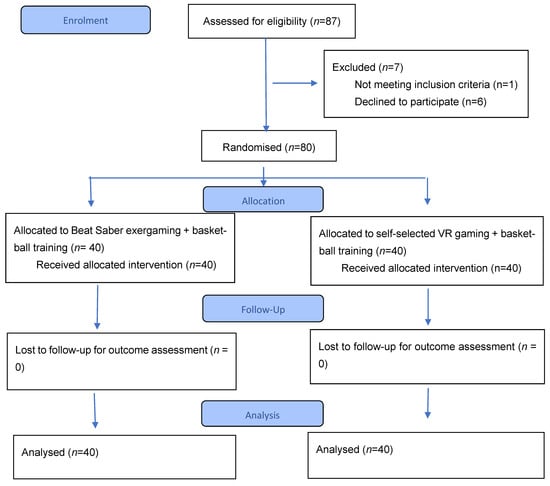
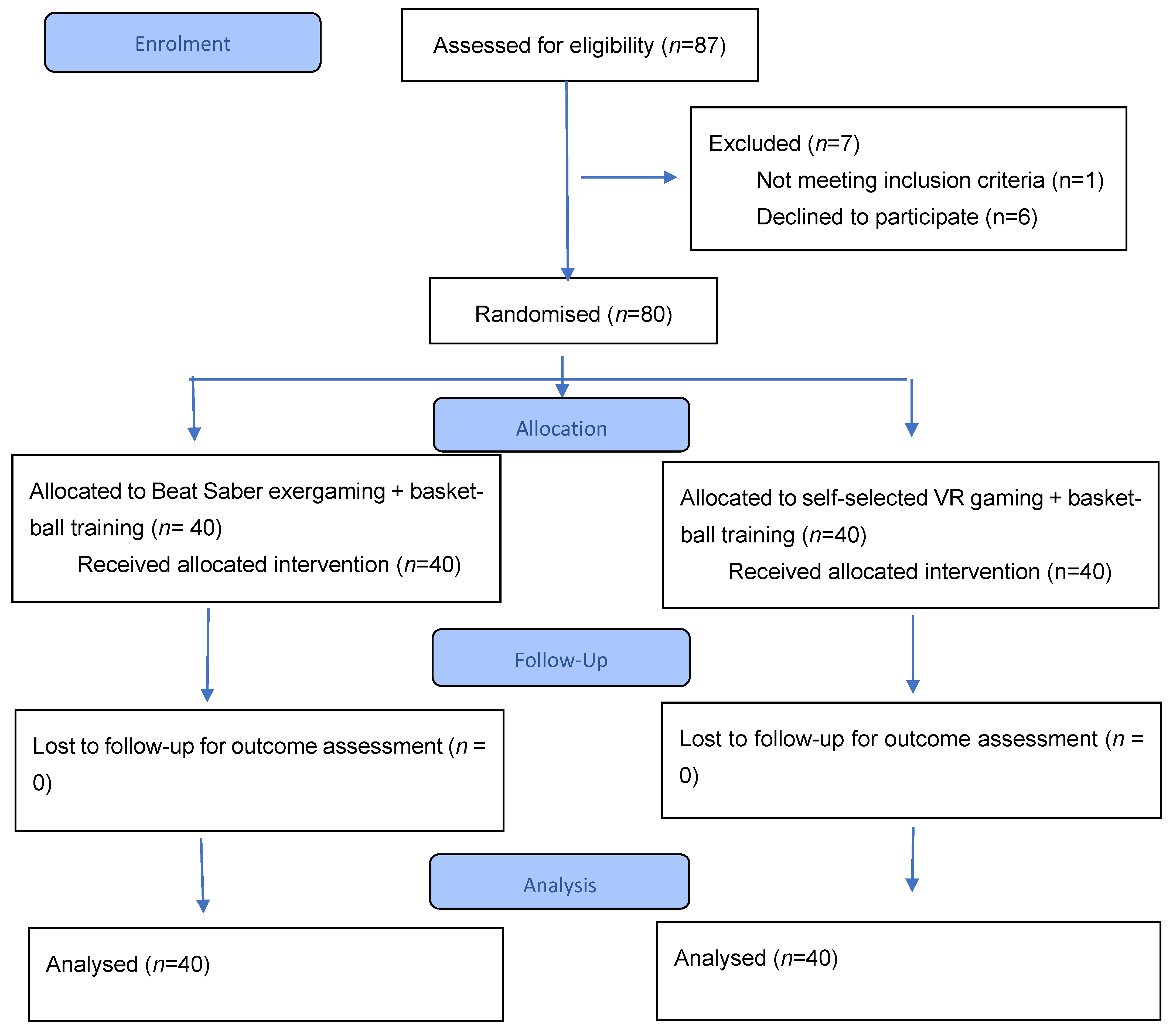
Participants were recruited from four youth basketball teams. During the predefined recruitment period, all available players aged 10–12 years from these teams were approached for potential participation. Study invitations were initially communicated to the teams’ coaches and trainers and were subsequently provided to the parents or legal guardians of potentially eligible players for consideration and approval. Eligibility was then assessed according to the predefined inclusion and exclusion criteria. All enrolled participants had at least six months of basketball training experience, as unrestricted participation in basketball games within the participating teams required a minimum of six months of prior training. A total of 87 children were assessed for eligibility. Seven were excluded before randomization: one did not meet the inclusion criteria and six declined to participate. The remaining 80 participants were randomly allocated in a 1:1 ratio to either the Beat Saber group or the self-selected VR group, with 40 participants assigned to each group. Patients, participants, parents, and members of the public were not involved in the design, conduct, analysis, or reporting of the study. Participant recruitment, allocation, follow-up, and analysis are summarized in Figure 1.
Figure 1.
CONSORT 2026 Flow Diagram. Flow diagram of the progress through the phases of a randomised trial of two groups (that is, enrolment, intervention allocation, follow-up, and data analysis).
Overweight status was based on classification by the participant’s family physician during the mandatory pre-participation medical examination required for basketball participation; measured body mass, standing height, and BMI were not collected as part of the study.
All participants were physically active children who practiced basketball as their main sport. Eligibility and study procedures were explained to the children and their parents or legal guardians before enrolment.
The inclusion criteria were being clinically healthy, having no known medical conditions or underlying diseases, regularly participating in basketball training, being physically able to complete the study procedures safely, and providing both parental or legal guardian consent and child assent. The exclusion criteria were the absence of parental or legal guardian consent or child assent and the presence of any medical, neurological, musculoskeletal, or other condition that could limit participation in physical activity or prevent the safe completion of the study procedures.
Before enrolment, the study procedures, expected activities, potential benefits, and possible risks were explained separately in age-appropriate language to the children and in greater detail to their parents or legal guardians. Written informed consent was obtained from a parent or legal guardian, and written assent was obtained from each child before participation. Children were informed that participation was voluntary, that they could decline any procedure or request to stop participation at any time, and that doing so would not affect their basketball training or usual care. Any expression of unwillingness to continue would have been respected regardless of parental consent.
All randomized participants completed the three-month intervention and post-intervention assessment. There were no withdrawals or losses to follow-up, and all 80 participants were included in the final analysis.
2.5. Sample Size
No a priori sample-size calculation was performed. All eligible participants who met the inclusion criteria and provided consent during the predefined recruitment period were included, resulting in 80 randomized participants, with 40 allocated to each group. Because the sample size was not prospectively determined on the basis of a prespecified primary outcome, expected effect size, statistical power, or anticipated attrition, the efficacy analyses are considered exploratory. Interpretation therefore emphasizes the estimated between-group differences and their 95% confidence intervals, which provide information regarding both the magnitude and precision of the observed effects.
Initial recruitment was facilitated by the basketball coaches and trainers. Potential participants and their parents or legal guardians were subsequently contacted by the research team, which included the principal investigator, the study coordinator, and additional assisting staff. Eligibility for participation was reviewed collectively by the research team according to the predefined inclusion and exclusion criteria before randomization. No interim analyses were planned or conducted, and no formal stopping guidelines were prespecified.
2.6. Randomization and Allocation
Following completion of recruitment and eligibility assessment, the 80 enrolled participants were listed alphabetically and assigned numerical study identifiers from 1 to 80. Group allocation was then generated using the randomizr package in R for Windows (version 4.6.1; R Core Team, R Foundation for Statistical Computing, Vienna, Austria), with participants allocated in a 1:1 ratio to the Beat Saber group or the self-selected VR group. The randomization sequence was generated only after all participants had been enrolled and assigned their study identifiers; therefore, the research team did not know individual group assignments during recruitment or eligibility assessment. Once the randomization output was generated, participants were assigned to the intervention corresponding to their numerical study identifier. After randomization, group allocation was known to the investigators and staff responsible for delivering and supervising the interventions. Because the two groups performed visibly different VR activities, participants could not be blinded to their assigned intervention.
However, the groups trained separately and participants were not informed about the other group’s protocol. To reduce the risk of contamination between conditions, sessions were scheduled separately, and participants were instructed not to share games, movement strategies, or details of their assigned VR condition.
Complete randomization was used, with allocation constrained to 40 participants per group; no stratification was applied.
2.7. Intervention
Both groups completed three basketball training sessions per week, delivered by a licensed basketball coach under the direct supervision of the principal investigator. Each basketball session followed a standardized structure consisting of a 10–15 min warm-up, 15–20 min of technical and shooting drills, 10–15 min of one-on-one play and small-sided game situations, followed by a full-team basketball game for the remainder of the approximately 60-min session.
In addition to basketball training, participants in both groups completed supervised VR gaming sessions three times per week throughout the three-month intervention. VR exposure was matched between groups for session frequency and duration, with each session lasting 30 min and taking place after basketball training. Sessions were conducted continuously, without scheduled rest intervals. If a participant experienced dizziness or other symptoms during or immediately after VR exposure, further VR participation was discontinued for that day.
Participants in the experimental group exclusively played Beat Saber using a Meta Quest 3 headset (Meta Platforms, Inc., Menlo Park, CA, USA). All participants began on the Easy difficulty level. Progression was individualized according to gameplay performance: participants progressed to a higher difficulty after they were able to complete maps with only a small number of errors. No fixed numerical threshold for errors was predefined. Easy difficulty was generally used only during the first week, after which participants progressed according to their individual skill development. Participants were allowed to select the music album and song they wished to play. They commonly repeated the same map while progressing through difficulty levels; after reaching higher difficulty levels, they could select other songs. Participants were also permitted to change to another song at a lower or moderate difficulty if they no longer wished to continue attempting a particular map. Failed songs could be restarted as many times as desired. All gameplay was performed individually in single-player mode, and no game modifiers were prescribed.
No formal technical coaching or movement instruction was provided during Beat Saber gameplay. Supervisors primarily monitored participant safety, including maintaining an appropriate distance from physical boundaries such as walls and windows, and intervened when necessary to reduce the risk of collision or injury. The intended approach was to allow participants to engage naturally with the game while progressing according to their developing gameplay ability.
Participants in the active comparison group completed VR sessions of the same frequency and duration but were permitted to select any available VR game. Game titles, movement patterns, difficulty levels, and physical demands were not standardized or systematically recorded. Informal observation indicated substantial variability in game selection, including social VR applications, shooting games, golf games, and, in some cases, Beat Saber. Because individual game use and movement intensity were not logged, the physical-activity dose and specific movement exposure of the comparison condition cannot be quantified. Accordingly, the comparison represents unrestricted self-selected VR gaming rather than a standardized alternative VR intervention.
All VR sessions were supervised by study staff. Before each session, the play area was checked to ensure sufficient clearance from walls, windows, furniture, and other potential hazards. Participants were monitored during gameplay for dizziness, discomfort, loss of balance, or other symptoms. If symptoms occurred, the session was stopped and the participant was not permitted to resume VR gameplay that day. No participant was required to continue a session if they reported discomfort or wished to stop.
Participants were monitored for adverse events during and immediately after every supervised VR session. Study staff specifically observed for dizziness, nausea, loss of balance, discomfort, collision-related injury, or any other symptom that could interfere with safe participation. Participants were also encouraged to report any discomfort during or after gameplay. When dizziness occurred, VR exposure was discontinued for the remainder of that day and the participant was monitored until symptoms resolved. Adverse events were recorded by the supervising research staff. No participant was required to continue VR exposure while symptomatic.
2.8. Outcomes
No single primary outcome was prospectively designated before the analysis. The study evaluated a family of five efficacy outcomes: peak isometric force during the deadlift and shoulder flexion, extension, abduction, and adduction. Each outcome was measured at baseline and after the three-month intervention. The principal comparison for each outcome was the between-group difference in change over time. Because no hierarchy of outcomes was prospectively specified, the efficacy analyses were considered exploratory. Harm outcomes included dizziness, intervention-related injuries, and discontinuation because of adverse events.
Maximal isometric force was assessed at two timepoints: at baseline, before the start of the training programme, and after the three-month intervention, using the MAT Muscle Meter (Movement Assessment Technologies, Braeside, VIC, Australia).
Before data collection, correct operation of the MAT Muscle Meter was verified. The device had undergone calibration before delivery by the supplier/manufacturer. In addition, prior to participant testing, its force readings were compared with those obtained using a Lafayette handheld dynamometer under the same applied force, and comparable readings were observed. This procedure was used as an operational agreement check rather than as a formal calibration or criterion-validity assessment. No manual recalibration or adjustment of the MAT Muscle Meter was performed. The device was also checked for correct operation and zero reading before testing sessions.
Testing was conducted before the training session while participants were in a rested state and was preceded by a brief, light warm-up intended to prepare them for maximal effort without inducing fatigue. Peak isometric force was measured during the deadlift and four shoulder movements: flexion, extension, abduction, and adduction. Each participant performed three maximal voluntary isometric contractions for each movement, and the highest recorded value was retained for analysis. The device output was recorded in kilogram-force (kgf). All assessments were performed by the principal investigator. Because the principal investigator both delivered the intervention and performed the force assessments, the outcome assessor was not blinded to group allocation.
The principal investigator had familiarized himself with the MAT Muscle Meter using the accompanying instructional application and manufacturer guidance, which were consistent with dynamometry procedures previously learned during university training. The same assessor performed all baseline and post-intervention measurements. Testing positions, dynamometer placement, verbal instructions, and verbal encouragement were kept consistent between assessment time points. Three members of the research team were present during testing to verify participant positioning and to help ensure that the same standardized position was reproduced for each participant at baseline and follow-up. Participants were instructed to exert maximal force during each trial and received consistent verbal encouragement.
Standardized isometric testing positions were used for each shoulder movement, consistent with the make-test positions recommended for the MAT Muscle Meter and with common handheld dynamometry practice. For all shoulder tests the participant was seated upright with the feet supported and the trunk in a neutral position, and the tested arm was held with the elbow extended and the forearm neutral. Shoulder flexion was tested with the shoulder flexed to 90°, with the dynamometer placed against the anterior aspect of the distal forearm or wrist, while the participant pushed forward and upward without extending the trunk or elevating the shoulder. Shoulder extension was tested from the same 90° flexed position, with the dynamometer placed under the distal forearm or wrist, while the participant pushed downward and backward without moving the trunk. Shoulder abduction was tested with the shoulder abducted to 90° in the scapular plane, with the arm positioned approximately 30° anterior to the frontal plane and the dynamometer placed against the lateral aspect of the distal arm or forearm, while the participant pushed outward and upward without leaning sideways or elevating the shoulder. Shoulder adduction was tested from a 90° abducted position in the scapular plane, with the dynamometer placed against the medial aspect of the distal arm or forearm, while the participant pulled downward and inward toward the trunk without side-bending. In each position the assessor stabilized the dynamometer so that the contraction remained isometric.
Peak isometric deadlift force was assessed using a fixed handle connected to the dynamometer and secured so that no movement occurred during the contraction. The participant stood with the feet approximately hip to shoulder-width apart and flat on the floor, with the handle positioned centrally between the feet over the midfoot. The starting position replicated a conventional deadlift, with the hips and knees flexed, the spine in a neutral position, the arms fully extended with the elbows locked, both hands holding the fixed handle, and the head and neck neutral. On command, the participant pulled vertically upward as forcefully as possible, without jerking, bending the elbows, or changing body position.
A rest period of approximately 60 s was allowed between the three maximal attempts for each movement to minimize the influence of fatigue.
2.9. Statistical Analysis
All data were entered into Microsoft Excel (Microsoft Corporation, Redmond, WA, USA) and analysed using jamovi (version 2.7.13) and R Commander. Descriptive statistics were calculated for each maximum isometric force outcome by group and assessment time and are presented as means and standard deviations.
The mixed-design ANOVA was retained as the principal analysis because the study involved two randomized groups assessed at the same two time points, and the time × group interaction directly tests whether the mean change from baseline to post-intervention differed between groups. With two assessment time points, this interaction corresponds to the between-group comparison of change over time.
No adjustment for multiple comparisons was prespecified. Therefore, a post hoc Bonferroni correction was applied to the five time × group interaction tests. The resulting two-sided significance threshold was p < 0.01. Exact unadjusted p values are reported and were interpreted using the Bonferroni-adjusted significance threshold.
Between-group differences in mean change were calculated as the change in the Beat Saber group minus the change in the self-selected VR group and are reported with 95% confidence intervals.
A baseline-adjusted analysis of covariance (ANCOVA) was conducted post hoc as an exploratory sensitivity analysis. For each outcome, the post-intervention score was entered as the dependent variable, group as the fixed factor, and the corresponding baseline score as the covariate. The group × baseline interaction was examined to assess the homogeneity-of-regression-slopes assumption. This assumption was satisfied only for shoulder adduction and was violated for the other outcomes. Consequently, conventional ANCOVA group effects for outcomes violating this assumption were not interpreted as evidence regarding the intervention effect. The mixed-design ANOVA therefore remained the principal analysis for all efficacy outcomes.
3. Results
No serious adverse events or intervention-related injuries occurred during the study. Mild, transient dizziness was reported during the first week of VR exposure by 2 of 40 participants (5.0%) in the Beat Saber group and 4 of 40 participants (10.0%) in the self-selected VR group. Symptoms occurred during or immediately after VR exposure, resolved rapidly, required no medical treatment, and did not recur after the first week. VR participation was discontinued for the remainder of the day when dizziness occurred. No participant discontinued the intervention because of dizziness or any other adverse event.
All 80 randomized participants completed the study and had available baseline and three-month post-intervention data for each of the five efficacy outcomes. Accordingly, every outcome analysis included 40 participants in the Beat Saber group and 40 participants in the self-selected VR group. No participants were lost to follow-up, excluded from the analyses, or had missing outcome data.
Participants were analysed according to the groups to which they were originally randomized. Baseline participant characteristics are presented in Table 1, descriptive statistics for the efficacy outcomes in Table 2, estimated between-group differences in mean change with 95% confidence intervals in Table 3, and mixed-design ANOVA results in Table 4.
Table 1.
Baseline characteristics of participants by groups.
Table 2.
Descriptive statistics for peak isometric force outcomes by group and time point.
Table 3.
Estimated between-group differences in mean change for each efficacy outcome.
Table 4.
Repeated-measures ANOVA results for each strength outcome (degrees of freedom = 1, 78).
The group × baseline interaction was significant for all outcomes except shoulder adduction, indicating that the homogeneity-of-regression-slopes assumption was not satisfied for most outcomes. Accordingly, conventional ANCOVA group effects for those outcomes were not interpreted. For shoulder adduction, the assumption was satisfied; however, because the ANCOVA was conducted post hoc, it was treated only as an exploratory sensitivity analysis and did not replace the principal mixed-design ANOVA.
3.1. Peak Isometric Deadlift Force
Peak isometric deadlift force increased from 53.70 ± 13.26 kgf to 55.75 ± 12.56 kgf in the Beat Saber group and from 52.00 ± 15.75 kgf to 54.04 ± 13.85 kgf in the self-selected VR group (Table 2). The estimated between-group difference in mean change was +0.01 kgf (95% CI −1.82 to 1.84; unadjusted p = 0.994), indicating little evidence of a differential change between groups. The time × group interaction was F(1, 78) < 0.01, ηp2 < 0.01. The main effect of time was F(1, 78) = 19.79, p < 0.001, ηp2 = 0.20.
3.2. Peak Isometric Shoulder Force
The estimated between-group difference in mean change favored the Beat Saber group for shoulder flexion (+0.74 kgf, 95% CI 0.29 to 1.19; unadjusted p = 0.002), shoulder abduction (+0.78 kgf, 95% CI 0.32 to 1.23; unadjusted p = 0.001), and shoulder extension (+0.99 kgf, 95% CI 0.60 to 1.37; unadjusted p < 0.001) (Table 3). The corresponding time × group interactions were F(1, 78) = 10.65, ηp2 = 0.12 for shoulder flexion; F(1, 78) = 11.39, ηp2 = 0.13 for shoulder abduction; and F(1, 78) = 26.47, ηp2 = 0.25 for shoulder extension. All three unadjusted p values met the post hoc Bonferroni-adjusted significance threshold of p < 0.01.
For shoulder adduction, the estimated between-group difference in mean change was +0.13 kgf (95% CI −0.05 to 0.32; unadjusted p = 0.154), and the time × group interaction was F(1, 78) = 2.07, ηp2 = 0.03. This outcome did not meet the Bonferroni-adjusted significance criterion. The within-group descriptive changes and percentage changes are presented in Table 2.
Using the adjusted threshold, the time × group interactions for shoulder flexion, shoulder abduction, and shoulder extension met the p < 0.01 criterion, whereas those for deadlift force and shoulder adduction did not.
4. Discussion
This exploratory randomized controlled trial compared a structured Beat Saber exergaming intervention with self-selected recreational VR gaming, with both conditions delivered alongside regular basketball training. Over the three-month intervention, the estimated between-group differences in mean change favored the Beat Saber group for shoulder flexion (+0.74 kgf, 95% CI 0.29 to 1.19), shoulder abduction (+0.78 kgf, 95% CI 0.32 to 1.23), and shoulder extension (+0.99 kgf, 95% CI 0.60 to 1.37). In contrast, there was little evidence of a between-group difference in change for peak isometric deadlift force (+0.01 kgf, 95% CI −1.82 to 1.84) or shoulder-adduction force (+0.13 kgf, 95% CI −0.05 to 0.32). Overall, the observed between-group differences were movement-specific and primarily involved shoulder actions emphasized during Beat Saber gameplay.
4.1. Baseline Imbalance and the Robustness of the Shoulder-Extension Finding
The shoulder-extension result produced the largest time × group interaction effect in the trial (ηp2 = 0.25), but it should be interpreted with particular caution because the groups were not balanced at baseline for this outcome. The self-selected VR group had a baseline mean of 4.62 ± 0.56 kgf, whereas the Beat Saber group had a baseline mean of 4.00 ± 0.95 kgf. Although randomization can result in chance baseline imbalances, the present study cannot determine the extent to which this imbalance contributed to the observed between-group difference in change. A post hoc baseline-adjusted ANCOVA was explored; however, the homogeneity-of-regression-slopes assumption was violated for shoulder extension, and the conventional ANCOVA group effect was therefore not interpreted as evidence regarding the intervention effect. Consequently, the shoulder-extension finding should be regarded as less robust than the findings for shoulder flexion and abduction, for which the groups were closely matched at baseline (6.24 versus 6.25 kgf and 5.88 versus 5.85 kgf, respectively).
A related concern is that the self-selected VR group showed small decreases in shoulder flexion, abduction, and extension force over the three-month intervention. These decreases should be interpreted cautiously. Because the MAT Muscle Meter has not been independently validated in this pediatric population and no test–retest reliability assessment was performed in the present sample, measurement variability cannot be excluded. In addition, the outcome assessor was not blinded to group allocation, and participants were aware of the VR activity they performed. Factors such as participant effort, motivation, sleep, diet, and physical activity outside the study were not systematically monitored and may also have influenced the observed measurements. However, the present study cannot determine whether any of these factors contributed to the decreases observed in the self-selected VR group. Accordingly, these within-group decreases should be regarded as observed changes requiring cautious interpretation rather than evidence of a true reduction in strength or of any specific underlying mechanism.
4.2. Movement-Specific Effects of VR Exergaming
The clearest pattern was that between-group differences favouring Beat Saber were limited to shoulder movements, whereas peak isometric deadlift force increased similarly in both groups. This finding is consistent with the movement demands of Beat Saber, which is predominantly an upper-body activity. Accelerometer data collected in young players indicate that most active time during gameplay is spent performing arm movements, with comparatively little whole-body or lower-limb activity [12]. The greater improvements observed in specific shoulder actions, but not in the isometric deadlift, are also consistent with the principle of training specificity. In children and adolescents, strength adaptations are influenced by the movement pattern, contraction type, and velocity used during training [24]. The absence of a significant between-group difference in shoulder adduction follows the same pattern, as adduction is less strongly emphasized than the outward, upward, and diagonal slicing movements that characterize Beat Saber gameplay.
4.3. Comparison with Previous Research
These findings are consistent with a growing but heterogeneous body of literature on VR exergaming and muscular strength. In a 12-week randomized controlled trial involving young adults, an immersive VR resistance exergame produced greater improvements in upper- and lower-body one-repetition-maximum strength than a self-directed control programme, while requiring less time per session and being rated as enjoyable [25,26,27]. Although that study used a resistance-cable system in adults rather than a commercial rhythm-based game in children, it supports the present finding that a structured VR activity can provide a meaningful strength stimulus [28,29,30].
At the review level, meta-analyses have reported positive but inconsistent effects of active video games on muscular fitness and motor competence in children and adolescents. The structured and repetitive upper-limb movement pattern of Beat Saber may have contributed to the larger increases in measured shoulder force observed in the Beat Saber group [27,31]. However, this interpretation remains hypothetical. Because participants in the active comparison group used heterogeneous self-selected VR games, including occasional Beat Saber, and individual game exposure and physical demand were not systematically recorded, the present study cannot determine which specific characteristics of the intervention were responsible for the observed between-group differences.
4.4. Intensity, Enjoyment, and Mechanisms
Beat Saber has been classified as a light-to-moderate-intensity activity in children based on heart-rate and oxygen-uptake responses [12]. One possible explanation for the observed shoulder-force changes is the repeated performance of rapid upper-limb movements combined with neuromuscular adaptations. However, this mechanism was not directly assessed in the present study and should therefore be regarded as hypothetical. This interpretation is consistent with youth strength-training literature suggesting that strength gains in children may involve neural adaptations, including changes in motor-unit recruitment, firing patterns, and intermuscular coordination [24].
Enjoyment may represent an additional advantage of VR exergaming. Games such as Beat Saber have been rated as highly enjoyable by children [12], while immersive VR exercise has been reported to be more enjoyable and time-efficient than non-immersive alternatives. Because enjoyment may support continued participation in physical activity, structured VR exergaming may offer an engaging and well-tolerated method of delivering targeted exercise to children. However, the present findings should be interpreted as evidence of differences between structured Beat Saber exergaming and self-selected VR gaming, rather than as evidence of an effect of VR exposure compared with no VR exposure [25,27,31].
4.5. Limitations
Several limitations should be considered. First, the principal investigator both delivered the intervention and performed all force assessments; therefore, the outcome assessor was not blinded to group allocation, introducing a potential risk of measurement bias. Participants could not be blinded to the VR activity they performed, although they were not informed about the other group’s protocol.
Second, participants in the active comparison group were allowed to select their VR games. Although VR frequency and session duration were matched between groups, the selected games were not standardized according to title, movement pattern, physical demand, engagement, or workload. In addition, some participants in the self-selected VR group occasionally selected Beat Saber. Because individual game titles and exposure durations were not systematically recorded, the extent of overlap between the intervention conditions and the physical-activity dose of the comparison condition cannot be quantified. Consequently, the observed between-group differences cannot be attributed exclusively to Beat Saber itself and may reflect differences in the structure, movement characteristics, intensity, or consistency of the VR activities performed.
Third, randomization did not produce baseline balance for shoulder-extension force. The self-selected VR group had a higher baseline mean than the Beat Saber group, and the extent to which this imbalance contributed to the observed between-group difference in change cannot be determined. A post hoc baseline-adjusted ANCOVA was explored; however, the homogeneity-of-regression-slopes assumption was violated for shoulder extension and for most of the other outcomes. Accordingly, conventional ANCOVA group effects for outcomes violating this assumption were not interpreted as evidence regarding the intervention effect. The shoulder-extension finding should therefore be interpreted with particular caution.
The small within-group decreases observed in some shoulder-force outcomes in the self-selected VR group should also be interpreted cautiously. The present study cannot determine whether these changes represent true changes in isometric force, measurement variability, differences in participant effort or motivation, or the influence of other unmeasured factors. Diet, sleep, physical activity outside the study, and motivation were not systematically monitored. Although adherence to the scheduled sessions was high in both groups, differences in engagement with the assigned activities cannot be excluded.
Fourth, all participants were male, healthy, physically active basketball players within a narrow age range. These characteristics limit the generalizability of the findings to girls, less active children, broader age groups, and clinical populations. Body mass, standing height, BMI, and biological maturation were not directly measured as part of the study; therefore, their potential influence on between-participant differences in isometric force could not be examined. In addition, the MAT Muscle Meter assessed maximal isometric force rather than dynamic strength, and the findings should therefore not be generalized to measures such as one-repetition maximum performance.
Fifth, the MAT Muscle Meter has not, to our knowledge, been independently validated specifically in children aged 10–12 years. Although the device had undergone calibration before delivery and its readings were compared with those obtained using a Lafayette handheld dynamometer before participant testing, this procedure represented an operational agreement check rather than a formal criterion-validity or calibration study. No test–retest reliability assessment was performed in the present sample. Standardized testing positions, consistent dynamometer placement, identical verbal instructions and encouragement, and the same assessor at baseline and follow-up were used to reduce measurement variability; however, these procedural controls cannot substitute for formal validation of the instrument in this pediatric population. Measurement error therefore remains an important limitation.
Finally, no a priori sample-size calculation was performed, and no single primary outcome or multiplicity strategy was prospectively specified. The sample size may therefore have provided insufficient precision to detect smaller between-group effects, and the efficacy analyses should be interpreted as exploratory. The post hoc Bonferroni correction reduces, but does not eliminate, concerns arising from testing multiple outcomes.
4.6. Future Directions
Future studies should use a standardized, time-matched active VR comparison condition and systematically record the games played, session duration, movement intensity, external load, adherence, and game difficulty. This would help distinguish the effects of a structured Beat Saber protocol from differences in game selection, movement demands, and overall training stimulus. Future trials could also directly compare commercial rhythm-based VR games with resistance-based VR systems.
Longer interventions with follow-up assessments are needed to determine whether the observed gains are maintained over time. Because Beat Saber primarily involves the upper body, studies using whole-body VR games should examine whether similar improvements can be achieved in lower-limb maximal isometric force and dynamic strength. Future research should also include girls, wider age ranges, and participants with different fitness levels, together with additional outcomes such as motor competence, body composition, and functional performance.
5. Conclusions
In this exploratory randomized controlled trial, a three-month structured Beat Saber exergaming programme was associated with greater increases in peak isometric force during shoulder flexion, abduction, and extension than self-selected recreational VR gaming, while both groups continued regular basketball training and completed matched-duration VR sessions. Little evidence of a between-group difference was observed for peak isometric deadlift force or shoulder-adduction force. The observed between-group differences were therefore movement-specific and primarily involved shoulder actions emphasized during Beat Saber gameplay. However, the findings should be interpreted cautiously because no primary outcome or a priori sample-size calculation was prospectively specified, the trial was retrospectively registered, the outcome assessor was not blinded, the comparator condition was heterogeneous, and the measurement instrument has not been independently validated in this pediatric population. These findings should therefore be regarded as preliminary and require confirmation in prospectively registered trials with a prespecified primary outcome, an a priori sample-size calculation, standardized comparator conditions, blinded outcome assessment where feasible, and validated measurement procedures.
Supplementary Materials
The following supporting information can be downloaded at: https://www.mdpi.com/article/10.3390/virtualworlds5040062/s1, File S1: Completed CONSORT-Children and Adolescents (CONSORT-C) 2026 reporting checklist for the randomized controlled trial [32].
Author Contributions
Conceptualization, H.D.G. and V.T.G.; methodology, H.D.G. and C.H.-G.; formal analysis, H.D.G., P.L.H. and M.N.O.; investigation, H.D.G. and S.D.M.; resources, H.D.G., E.F.G. and S.D.M.; data curation, H.D.G., P.L.H. and M.N.O.; writing—original draft preparation, H.D.G.; writing—review and editing, H.D.G. and N.M.; visualization, H.D.G.; supervision, H.D.G., E.F.G. and V.T.G.; project administration, H.D.G. All authors have read and agreed to the published version of the manuscript.
Funding
The article processing charge (APC) was funded by ‘1 Decembrie 1918’ University of Alba Iulia, Romania. The funder had no role in the design, conduct, analysis, interpretation, or reporting of the study.
Institutional Review Board Statement
The study was conducted in accordance with the Declaration of Helsinki and approved by the Ethics Committee of Babeș-Bolyai University, Cluj-Napoca, Romania (reference no. 559/10.06.2025), issued to the principal investigator, Horatiu Dacian Ghejan.
Informed Consent Statement
Written informed consent was obtained from the parents or legal guardians of all participants prior to enrolment. Written assent was also obtained from all child participants.
Data Availability Statement
The de-identified participant-level dataset and accompanying data dictionary may be available from the corresponding author upon reasonable request and subject to appropriate ethical and data-protection requirements. Statistical analysis code is not publicly available because the analyses were conducted using jamovi and R Commander and no standalone analysis script was retained.
Conflicts of Interest
The authors declare no conflicts of interest.
Abbreviations
The following abbreviations are used in this manuscript:
| kgf | Kilogram-force |
| ANCOVA | Analysis of covariance |
| ANOVA | Analysis of variance |
| APC | Article processing charge |
| CC BY | Creative Commons Attribution |
| MAT | Movement Assessment Technologies |
| VR | Virtual reality |
| VRE | Virtual reality exercise |
| ηp2 | Partial eta square |
References
- Barnes, S.J. Understanding Virtual Reality in Marketing: Nature, Implications and Potential; SSRN Scholarly Paper 2016, No. 2909100; SSRN: Rochester, NY, USA, 2017. [Google Scholar] [CrossRef] [Scilit]
- Chan, J.C.P.; Leung, H.; Tang, J.K.T.; Komura, T. A Virtual Reality Dance Training System Using Motion Capture Technology. IEEE Trans. Learn. Technol. 2011, 4, 187–195. [Google Scholar] [CrossRef] [Scilit]
- Finkelstein, S.; Nickel, A.; Lipps, Z.; Barnes, T.; Wartell, Z.; Suma, E.A. Astrojumper: Motivating Exercise with an Immersive Virtual Reality Exergame. Presence Teleoperators Virtual Environ. 2011, 20, 78–92. [Google Scholar] [CrossRef] [Scilit]
- Krohn, M.; Rintala, A.; Immonen, J.; Sjögren, T. The Effectiveness of Therapeutic Exercise Interventions with Virtual Reality on Balance and Walking Among Persons with Chronic Stroke: Systematic Review, Meta-Analysis, and Meta-Regression of Randomized Controlled Trials. J. Med. Internet Res. 2024, 26, e59136. [Google Scholar] [CrossRef] [Scilit]
- Rodrigues-Baroni, J.M.; Nascimento, L.R.; Ada, L.; Teixeira-Salmela, L.F. Walking Training Associated with Virtual Reality-Based Training Increases Walking Speed of Individuals with Chronic Stroke: Systematic Review with Meta-Analysis. Braz. J. Phys. Ther. 2014, 18, 502–512. [Google Scholar] [CrossRef] [Scilit]
- Amaya, M.C.; Gacharna, G.; Carvajal, A.I.; Hernandez Rincon, E.H. Virtual Reality and Active Video Games (Exergames) to Promote Physical Activity in Children and Adolescents: A Scoping Review and Future Perspectives. J. Public Health 2026. [Google Scholar] [CrossRef] [Scilit]
- Wang, J.; Qin, Y.; Wu, Q.; Zeng, D.; Gao, X.; Wang, Q.; Li, Z.; Ni, Y.; Li, H.; Zhang, P.; et al. An Adaptive AI-Based Virtual Reality Sports System for Adolescents with Excess Body Weight: A Randomized Controlled Trial. Nat. Med. 2025, 31, 2255–2268. [Google Scholar] [CrossRef] [Scilit]
- Jebeile, H.; Kelly, A.S.; O’Malley, G.; Baur, L.A. Obesity in Children and Adolescents: Epidemiology, Causes, Assessment, and Management. Lancet Diabetes Endocrinol. 2022, 10, 351–365. [Google Scholar] [CrossRef] [Scilit]
- Garnett, S.P.; Baur, L.A.; Jones, A.M.D.; Hardy, L.L. Trends in the Prevalence of Morbid and Severe Obesity in Australian Children Aged 7–15 Years, 1985–2012. PLoS ONE 2016, 11, e0154879. [Google Scholar] [CrossRef] [Scilit]
- Spinelli, A.; Buoncristiano, M.; Kovacs, V.A.; Yngve, A.; Spiroski, I.; Obreja, G.; Starc, G.; Pérez, N.; Rito, A.I.; Kunešová, M.; et al. Prevalence of Severe Obesity among Primary School Children in 21 European Countries. Obes. Facts 2019, 12, 244–258. [Google Scholar] [CrossRef] [Scilit]
- Ogden, C.L.; Fryar, C.D.; Hales, C.M.; Carroll, M.D.; Aoki, Y.; Freedman, D.S. Differences in Obesity Prevalence by Demographics and Urbanization in US Children and Adolescents, 2013–2016. JAMA 2018, 319, 2410–2418. [Google Scholar] [CrossRef] [Scilit]
- Bexson, C.; Oldham, G.; Wray, J. Safety of Virtual Reality Use in Children: A Systematic Review. Eur. J. Pediatr. 2024, 183, 2071–2090. [Google Scholar] [CrossRef] [Scilit]
- Boots, B.; Berg, D.; Hewitt, E.; Naugle, K.; Naugle, K. Physical Activity and Enjoyment in Active Virtual Reality Games in Youth: Comparative Analysis of Gorilla Tag and Beat Saber. JMIR Serious Games 2025, 13, e66593. [Google Scholar] [CrossRef] [Scilit]
- Alharbi, M.; Harris, D.; Dodd, H.; Wood, G.; Buckingham, G. Home-Based Immersive Virtual Reality to Improve Motor Performance in Children and Adolescents with Developmental Coordination Disorder: Crossover Study. JMIR Serious Games 2026, 14, e84995. [Google Scholar] [CrossRef] [Scilit]
- Tychsen, L.; Foeller, P. Effects of Immersive Virtual Reality Headset Viewing on Young Children: Visuomotor Function, Postural Stability, and Motion Sickness. Am. J. Ophthalmol. 2020, 209, 151–159. [Google Scholar] [CrossRef] [Scilit]
- Moller, A.C.; Sousa, C.V.; Lee, K.J.; Alon, D.; Lu, A.S. Active Video Game Interventions Targeting Physical Activity Behaviors: Systematic Review and Meta-analysis. J. Med. Internet Res. 2023, 25, e45243. [Google Scholar] [CrossRef] [Scilit]
- Festl, R.; Scharkow, M.; Quandt, T. Problematic Computer Game Use among Adolescents, Younger and Older Adults. Addiction 2013, 108, 592–599. [Google Scholar] [CrossRef] [Scilit]
- Fullerton, S.; Taylor, A.W.; Dal Grande, E.; Berry, N. Measuring Physical Inactivity: Do Current Measures Provide an Accurate View of “Sedentary” Video Game Time? J. Obes. 2014, 2014, 287013. [Google Scholar] [CrossRef] [Scilit]
- Haagsma, M.C.; Pieterse, M.E.; Peters, O. The Prevalence of Problematic Video Gamers in the Netherlands. Cyberpsychol. Behav. Soc. Netw. 2012, 15, 162–168. [Google Scholar] [CrossRef] [Scilit]
- Farič, N.; Yorke, E.; Varnes, L.; Newby, K.; Potts, H.W.W.; Smith, L.; Hon, A.; Steptoe, A.; Fisher, A. Younger Adolescents’ Perceptions of Physical Activity, Exergaming, and Virtual Reality: Qualitative Intervention Development Study. JMIR Serious Games 2019, 7, e11960, Correction in JMIR Serious Games 2019, 7, e15657. [Google Scholar] [CrossRef] [Scilit]
- McMichael, L.; Farič, N.; Newby, K.; Potts, H.W.W.; Hon, A.; Smith, L.; Steptoe, A.; Fisher, A. Parents of Adolescents Perspectives of Physical Activity, Gaming and Virtual Reality: Qualitative Study. JMIR Serious Games 2020, 8, e14920. [Google Scholar] [CrossRef] [Scilit]
- Ramírez-Granizo, I.A.; Ubago-Jiménez, J.L.; González-Valero, G.; Puertas-Molero, P.; San Román-Mata, S. The Effect of Physical Activity and the Use of Active Video Games: Exergames in Children and Adolescents: A Systematic Review. Int. J. Environ. Res. Public Health 2020, 17, 4243. [Google Scholar] [CrossRef] [Scilit]
- Chen, Y.; Guan, L.; Wu, W.; Ye, L.; He, Y.; Zheng, X.; Li, S.; Guan, B.; Ming, W.K. Factors That Influence Young Adults’ Preferences for Virtual Reality Exergames in a Weight Control Setting: Qualitative Study. J. Med. Internet Res. 2024, 26, e58422. [Google Scholar] [CrossRef] [Scilit]
- Comeras-Chueca, C.; Marin-Puyalto, J.; Matute-Llorente, A.; Vicente-Rodriguez, G.; Casajus, J.A.; Gonzalez-Aguero, A. The Effects of Active Video Games on Health-Related Physical Fitness and Motor Competence in Children and Adolescents with Healthy Weight: A Systematic Review and Meta-Analysis. Int. J. Environ. Res. Public Health 2021, 18, 6965. [Google Scholar] [CrossRef] [Scilit]
- Mologne, M.S.; Hu, J.; Carrillo, E.; Gomez, D.; Yamamoto, T.; Lu, S.; Browne, J.D.; Dolezal, B.A. The Efficacy of an Immersive Virtual Reality Exergame Incorporating an Adaptive Cable Resistance System on Fitness and Cardiometabolic Measures: A 12-Week Randomized Controlled Trial. Int. J. Environ. Res. Public Health 2023, 20, 210. [Google Scholar] [CrossRef] [Scilit]
- Viana, R.B.; de Oliveira, V.N.; Dankel, S.J.; Loenneke, J.P.; Abe, T.; da Silva, W.F.; Morais, N.S.; Vancini, R.L.; Andrade, M.S.; de Lira, C.A.B. The Effects of Exergames on Muscle Strength: A Systematic Review and Meta-Analysis. Scand. J. Med. Sci. Sports 2021, 31, 1592–1611. [Google Scholar] [CrossRef] [Scilit]
- Liu, W.; Zeng, N.; McDonough, D.J. Effect of Active Video Games on Healthy Children’s Fundamental Motor Skills and Physical Fitness: A Systematic Review. Int. J. Environ. Res. Public Health 2020, 17, 8264. [Google Scholar] [CrossRef] [Scilit]
- Comeras-Chueca, C.; Villalba-Heredia, L.; Perez-Lasierra, J.L.; Marín-Puyalto, J.; Lozano-Berges, G.; Matute-Llorente, Á.; Vicente-Rodríguez, G.; Gonzalez-Aguero, A.; Casajús, J.A. Active Video Games Improve Muscular Fitness and Motor Skills in Children with Overweight or Obesity. Int. J. Environ. Res. Public. Health 2022, 19, 2642. [Google Scholar] [CrossRef] [Scilit]
- Godfrey, C.A.; Oody, J.F.; Conger, S.A.; Steeves, J.A. Active Virtual Reality Games: Comparing Energy Expenditure, Game Experience, and Cybersickness to Traditional Gaming and Exercise in Youth Aged 8-12. Games Health J. 2025, 14, 42–48. [Google Scholar] [CrossRef] [Scilit]
- Grzywacz, Ż.; Jaśniewicz, J.; Koziarska, A.; Macierzyńska, J.; Majorczyk, E. The Effects of Gamified Virtual Reality on Muscle Strength and Physical Function in the Oldest Old—A Pilot Study on Sarcopenia-Related Functional Outcomes. J. Clin. Med. 2026, 15, 621. [Google Scholar] [CrossRef] [Scilit]
- Comeras-Chueca, C.; Marin-Puyalto, J.; Matute-Llorente, A.; Vicente-Rodriguez, G.; Casajus, J.A.; Gonzalez-Aguero, A. Effects of Active Video Games on Health-Related Physical Fitness and Motor Competence in Children and Adolescents with Overweight or Obesity: Systematic Review and Meta-Analysis. JMIR Serious Games 2021, 9, e29981. [Google Scholar] [CrossRef] [Scilit]
- Baba, A.; Smith, M.; Potter, B.K.; Chan, A.-W.; Moher, D.; Toulany, A.; Doherty-Kirby, A.; Nafria Escalera, B.; Stratton, C.; Gale, C.; et al. CONSORT-Children and Adolescents (CONSORT-C) 2026 Extension Statement: Enhancing the Reporting and Impact of Paediatric Randomised Trials. BMJ 2026, 392, e085061. [Google Scholar] [CrossRef] [Scilit]

Disclaimer/Publisher’s Note: The statements, opinions and data contained in all publications are solely those of the individual author(s) and contributor(s) and not of MDPI and/or the editor(s). MDPI and/or the editor(s) disclaim responsibility for any injury to people or property resulting from any ideas, methods, instructions or products referred to in the content. |
© 2026 by the authors. Licensee MDPI, Basel, Switzerland. This article is an open access article distributed under the terms and conditions of the Creative Commons Attribution (CC BY) license.