


Abstract
Intercultural communicative competence (ICC) has become an essential outcome of language education, yet many learners cannot access study-abroad or face-to-face exchange programs because of financial, logistical, and geographical constraints. Virtual world environments (VWEs) offer a route for developing ICC, but the literature has not yet synthesized the range of interventions, strategies, and challenges involved. This review examines how VWEs contribute to ICC development. It asks how VWEs are employed for ICC training, what implementation and design strategies enhance their effectiveness, and what challenges hinder their use. A thematic review of 27 peer-reviewed articles (2014–2024) was conducted following PRISMA guidance and framed by Byram’s model of ICC. VWEs support ICC through immersive cultural simulations, collaborative intercultural exchanges, learner motivation, and intracultural awareness. These environments approximate authentic cultural contexts and improve learners’ communication skills. Significant challenges remain: technological barriers, inequities in access, oversimplified cultural representations, and pedagogical difficulties, including limited teacher training. Future research should prioritize longitudinal designs, comparative studies across VWE technologies, standardized ICC assessment tools, teacher training models, and equity-sensitive implementation frameworks.
1. Introduction
Global mobility and digital communication have made intercultural communicative competence (ICC) a core outcome of language education [1]. Traditionally, ICC has developed through various approaches, from direct cultural immersion experiences and study-abroad programs to structured classroom interventions and cross-cultural exchange initiatives [2,3]. These conventional methods, while valuable, have often been limited by geographical, temporal, and resource constraints, particularly in the context of language acquisition, where cultural competence is closely linked to language-learning outcomes. According to Khan et al. [4], although direct cultural immersion experiences and study-abroad programs allow learners to engage with the target culture in authentic contexts and develop deeper understanding, such opportunities are not universally accessible due to financial, logistical, or personal constraints, which can limit their effectiveness and reach. Given these limitations, educators and researchers have turned to technological innovations to close the accessibility gap in ICC development.
Virtual world environments (VWEs) have expanded the options for ICC development by making simulated cultural encounters and experiential learning possible [5,6]. According to Ghanbarzadeh and Ghapanchi [7], virtual worlds include networked environments that support collaboration and problem-solving among users, working across physical boundaries and generating a sense of presence within the virtual learning environment. According to Syahrin et al. [8], VWEs provide structured spaces that approximate authentic cultural contexts, in which learners can take part in cross-cultural interactions, develop cultural awareness, and practice intercultural communication skills without the logistical challenges of physical travel or face-to-face exchange. These digital platforms create immersive experiences that can approximate a range of cultural contexts, allowing learners to encounter and work through cultural differences in safe, structured environments.
Recently, VWEs have gained attention in scholarly discussions related to language acquisition. The integration of these VWEs in language education has changed how ICC is approached, offering scalable and accessible methods for cultural competence training. The virtual environment influences language acquisition through three commonly cited mechanisms. First, it provides immersion, enabling learners to practice language in realistic, situational contexts that support language retention and intuitive communication [9]. Second, it supports collaborative interactions with speakers from other backgrounds, prompting dialogue that improves both linguistic fluency and intercultural understanding [10]. Third, it often uses game-like elements, which increase learners’ motivation and engagement [11]. Through these mechanisms, VWEs speed up language acquisition and build intercultural communicative competencies as learners work with a range of cultural norms and perspectives in a structured setting. The Section 3 develops a further, less frequently discussed dimension—intracultural awareness—that is prominent in more recent studies (Section 3.1.4).
1.1. Conceptual Clarification: VWEs and Related Technologies
The literature uses several overlapping terms interchangeably. However, these technologies differ in immersion, interactivity, and pedagogical potential. To avoid ambiguity, this review uses VWE as an umbrella term. A VWE is any digital environment that simulates a spatial world in which learners are represented and can act—through an avatar, a headset, or a spherical video viewer. Table 1 defines the technologies under this umbrella and locates them in the dimensions of immersion and interactivity. In the Results, we identify the specific technology used in each reviewed study.
Table 1.
Key terms used in this review and their distinctions.
1.2. Theoretical Framework: Intercultural Communicative Competence
This review is anchored in Byram’s model of ICC [12]. Byram defines ICC through five components: (1) attitudes (savoir être); (2) knowledge of social groups, products, and practices in one’s own and the interlocutor’s culture (savoirs); (3) skills of interpreting and relating (savoir comprendre); (4) skills of discovery and interaction (savoir apprendre/faire); and (5) critical cultural awareness (savoir s’engager). We also draw on Deardorff’s process model [13], which frames intercultural competence as a developmental cycle from attitudes through knowledge and skills to outcomes. For each theme in the Results, we indicate which ICC components the reviewed interventions primarily support. The full mapping appears in the Discussion.
1.3. Research Gaps, Objective, and Research Questions
Existing studies have explored the intersection of VWEs and ICC in language acquisition. However, three primary gaps remain. First, while studies such as Shadiev et al. [14] on 360-degree video, DeWitt et al. [5] on VR with Malaysian students, and Liaw [6] on open social VR each report specific interventions, the literature lacks a systematic assessment of their integration or relative effectiveness. This fragmented focus documents specific applications but does not systematically evaluate how these interventions complement each other or identify the most effective combinations for developing intercultural communicative competencies in language learners. Secondly, it is unclear what implementation, and design strategies could aid in achieving these intervention strategies. No systematic assessment of how to integrate intercultural competencies within virtual language-learning environments has been conducted. Existing studies such as Liaw [6], Shadiev et al. [14], and DeWitt et al. [5] have primarily focused on isolated aspects—social VR environments, EFL course integration, and quasi-experimental designs, respectively. Their results are useful in specific contexts, but no single study combines implementation planning (including timeline management and risk assessment) with design strategies (such as immersive simulations and gamified activities) tailored to language learners developing intercultural competencies in virtual settings. Finally, although challenges are reported in the implementation of virtual environments for ICC, focused research on these challenges within language acquisition and the development of intercultural communicative competencies is still limited.
We define VWEs as immersive digital platforms that simulate authentic cultural environments, enabling collaborative learning and intercultural engagement beyond physical limitations. We define ICC, following Byram [12], as a set of attitudes, knowledge, skills, and critical awareness that learners deploy and adjust in cross-cultural interaction. The purpose of this study is therefore to synthesize the existing literature on the role of VWEs in developing ICC within language learning. This objective is operationalized through three research questions, each of which examines one facet of that role including interventions, strategies, and challenges:
- What types of VWE-based training interventions have been used to develop intercultural communicative competencies among language learners, and which aspects of ICC do these interventions support?
- What implementation and design strategies within VWEs are used to enhance intercultural competence among language learners?
- What challenges are most frequently reported regarding VWEs in intercultural competencies training among language learners?
2. Methodology
2.1. Review Approach and Analytical Framework
To achieve the objective of this study, a thematic literature review approach is employed. The analysis followed the six-phase framework of Braun and Clarke [15]: familiarization, initial coding, searching for themes, reviewing themes, defining themes, and producing the report. Identification, screening, and selection of articles followed PRISMA 2020 guidance [16], adapted to a thematic review. This approach identifies recurring themes, patterns, and gaps in the literature on VWEs and ICC in second language learning.
2.2. Data Sources and Search Strategy
For data collection, Web of Science and Google Scholar databases are chosen as primary sources. These databases offer extensive, high-quality academic literature in education, communication, and technology fields, providing a reliable foundation for gathering peer-reviewed research relevant to our study’s focus. The use of both databases ensures a broad scope of interdisciplinary studies, increasing the likelihood of capturing varied approaches to VWEs in intercultural and language education. We acknowledge that databases such as Scopus, ERIC, and ProQuest were not searched. This restriction is discussed as a limitation of this review in Section 5.1.
To capture relevant articles, the following keywords were used: (“Virtual Worlds” OR “Virtual Reality” OR “Immersive Learning Environments” OR “3D Learning Environments”) AND (“Intercultural Communication” OR “Intercultural Competence” OR “Cultural Awareness” OR “Intercultural Communicative Competence”) AND (“Language Acquisition” OR “Language Learning” OR “Second Language Learning” OR “Foreign Language Learning”). The three clusters map onto the three constructs shared by all research questions: the technology (VWEs), the outcome (ICC), and the population (language learners). Terms such as “training intervention”, “implementation strategies”, and “design strategies” were not used as search keywords. These aspects are labeled inconsistently across studies and using them as search terms would exclude relevant articles that report interventions without naming them as such. Instead, interventions, strategies, and challenges were extracted from the retrieved articles during coding (Section 2.4).
2.3. Inclusion and Exclusion Criteria and Screening Procedure
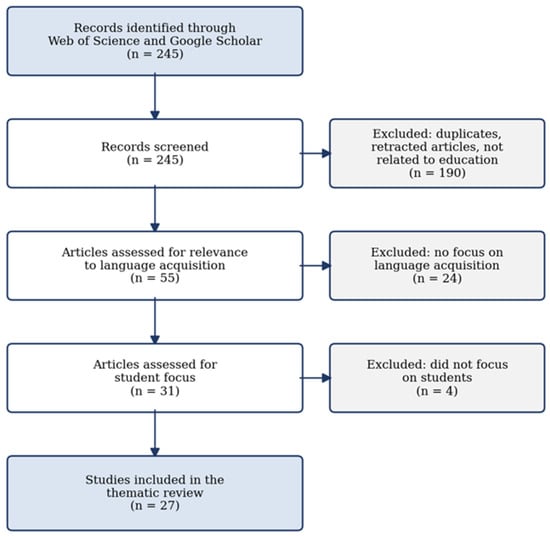
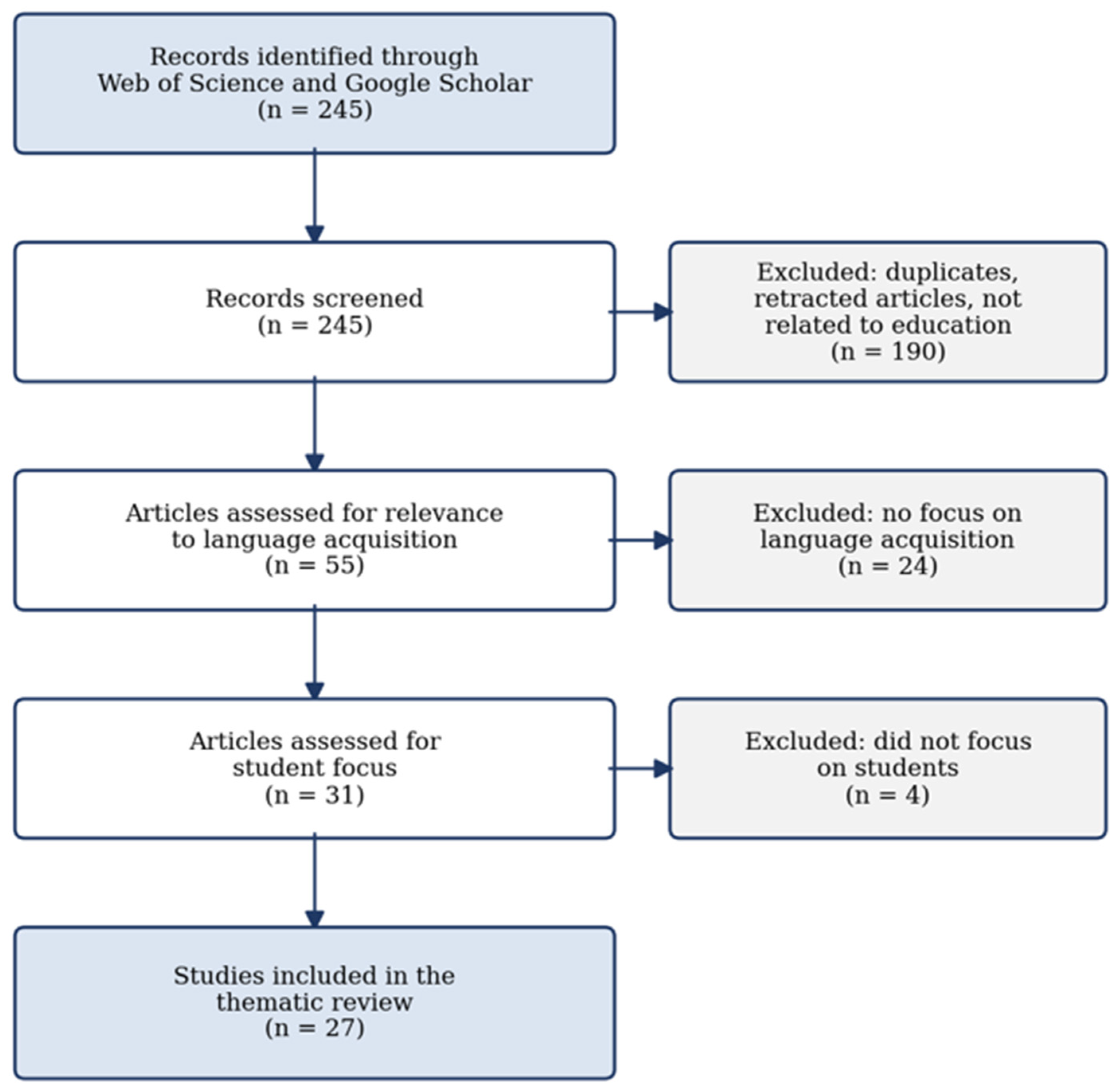
We focus on articles published from 2014 to 2024 as this timeframe allows us to examine current practices and challenges while excluding older studies that may not reflect recent innovations in virtual learning technologies. Note that this window applied only to the reviewed corpus; two earlier background sources [10,11] are cited in the Introduction for context only and are not part of the analysis. Articles were included if they (a) were peer-reviewed journal articles, conference papers, book chapters, or research syntheses; (b) addressed a VWE technology as defined in Table 1; (c) addressed intercultural or intracultural competence; and (d) were situated in a language-learning or language teacher education context with student (or student teacher) participants. Articles were excluded if they were duplicates, retracted, unrelated to education, not focused on language acquisition, or not focused on students. Initially, 245 articles were identified. Next, we removed duplicates, retracted articles, and those not related to education. 190 articles were excluded, narrowing the number of articles to 55. Next, 24 articles that did not emphasize language acquisition were excluded, leaving 31 articles. Finally, 4 articles that did not focus on students were excluded, bringing the final dataset to 27 articles. The selection process is summarized in Figure 1. Screening was conducted in two stages. The first author screened all titles and abstracts against the criteria, and both authors examined the full texts of candidate articles. Disagreements were resolved through discussion until consensus was reached.
Figure 1.
Review article selection process.
2.4. Coding, Theme Generation, and Reliability
A hybrid deductive–inductive coding process was used. The deductive layer was defined a priori and followed the structure of the research questions. Each article was coded for: (a) the type of training intervention and the ICC outcomes it supported (RQ1); (b) reported implementation and design strategies (RQ2); and (c) reported challenges (RQ3). Descriptive attributes—educational level, context, participants, technology, and study design—were also extracted. Within each a priori category, specific themes were generated a posteriori from the data. This produced four intervention themes for RQ1, four implementation and four design strategies for RQ2, and five challenge themes for RQ3. Both authors independently coded a subset of articles, compared their coding, and refined theme definitions until full agreement was reached. The remaining articles were then coded using the agreed scheme, with uncertain cases resolved jointly.
2.5. Treatment of Different Source Types and Quality Appraisal
The final corpus contains both empirical studies and secondary sources (literature reviews and meta-analyses), and these were not given equal weight. Empirical studies served as the primary evidence base for the thematic claims in Section 3. Each thematic table identifies the empirical studies supporting the theme. Secondary sources were used to contextualize and cross-check the findings, and conclusions drawn from them are attributed as review-based (e.g., the meta-analysis by Yu and Duan [17]). We also appraised each empirical study’s design, sample size, duration, and assessment instruments. This appraisal informs the critical synthesis at the start of Section 3 and the limitations in Section 5.1.
3. Results
The selected articles represent diverse geographical and linguistic settings, examining virtual environments’ impact on intercultural communicative competence across various language-learning scenarios (Table 2). Of the 27 articles, 18 are empirical studies, seven are literature reviews or research syntheses (including one meta-analysis of 41 studies [17] and one qualitative meta-synthesis [18]), and two are conceptual or curriculum-design papers [19,20]. Nineteen articles are situated in higher education (including one at college level), one in a vocational school [14], and seven span multiple educational levels. In terms of target language, nine articles focus on English (as a foreign language or for specific purposes), two on Spanish, and one each on German, Mandarin, and Persian; the remaining thirteen address multiple or unspecified languages. The technologies examined include 360-degree video (n = 3), social or open social VR (n = 4), desktop 3D virtual worlds (n = 4), virtual exchange platforms (n = 4), and, in single studies, immersive head-mounted VR, monitor-displayed VR, learner VR content creation, and a web-based platform; the reviews cover multiple technologies.
The empirical studies also show substantial methodological heterogeneity. Sample sizes range from 15 university students [21] to 513 educators [22]. Only two studies used a quasi-experimental design: DeWitt et al. [5], with pre- and post-measures on 31 polytechnic students, and Rico García and Ferreira da Silva [23], with experimental and control groups. Most other studies are small-scale case studies or mixed-methods designs without controls [14,24,25,26]. Intervention durations are typically short; the longest structured program was a six-week virtual exchange [21]. ICC was assessed almost exclusively through self-report—questionnaires, interviews, journals, and observations—and no standardized ICC measure recurred across studies. Positive outcome claims, especially those about motivation and engagement, should therefore be read as suggestive rather than as established causal effects. This appraisal shapes the interpretation of the themes below, where empirical evidence is distinguished from review-based conclusions.
Table 2.
Overview of the 27 articles included in the analysis.
3.1. Virtual Environment Training Interventions for Developing Intercultural Communicative Competencies Among Language Learners
Our review has found four areas by which VWEs serve as a training intervention: (1) immersive cultural experiences and simulations, (2) collaborative intercultural interactions, (3) enhanced learner engagement and motivation, and (4) intracultural awareness development. Table 3 summarizes the findings in relation to the first question. These four themes address both parts of RQ1: they describe the types of intervention used and, through the “Key Findings Related to ICC” column, the aspects of ICC each intervention supports. In terms of Byram’s model [12], immersive experiences mainly develop attitudes and cultural knowledge, collaborative interactions mainly build the skills of discovery and interaction, and intracultural awareness activities build critical cultural awareness; engagement and motivation act as enabling conditions rather than as an ICC component in themselves.
Table 3.
VWE training interventions for developing ICC.
3.1.1. Immersive Cultural Experiences and Simulations
VWEs offer a distinctive opportunity to place learners in authentic cultural environments and engage them in simulations that support ICC development and language acquisition. For instance, Shadiev et al. [14] integrated 360-degree video technology to create an immersive environment where Chinese English as a foreign language (EFL) students partnered with Indonesian university students. By creating and sharing content related to their cultures in English, students built their cultural awareness and empathy while also improving their EFL speaking and writing skills. Similarly, DeWitt et al. [5] used VR to improve ICC among Malaysian students learning Mandarin as a Foreign Language (MFL). Students produced immersive VR environments related to Chinese culture, leading to a significant increase in their attitudes towards the target culture and understanding of cultural practices, and to gains in their MFL vocabulary and speaking skills. Tafazoli [27] investigated the affordances of VR for teaching culture to in-service language teachers of Persian. Despite initial skepticism, teachers perceived VR as useful for cultural immersion and for simulating authentic cultural experiences. The study suggests that VR can be used to train teachers to integrate cultural elements into their Persian language instruction, and in turn support students’ ICC and language acquisition. Shadiev, Fayziev et al. [33] used 360-degree video technology in cross-cultural learning activities, allowing participants to take part in cultural exchanges and reporting notable improvements in their language abilities, cultural understanding, and communication skills. In terms of Byram’s model, these interventions primarily target attitudes toward the target culture and cultural knowledge (savoirs) [12].
3.1.2. Collaborative Intercultural Interactions
VWEs provide platforms for collaborative intercultural interactions, allowing learners to take part in authentic communication with peers from different cultural backgrounds and to develop language use in context. Liaw [6], for example, investigated the effects of using open social VR for university EFL learners’ intercultural communication learning. While students were initially doubtful, they greatly enjoyed interacting with international interlocutors and showed improved ICC, particularly in adaptability and negotiation of meaning. Their EFL speaking and listening skills also improved in a real-world communicative setting. Shadiev et al. [41] created a common learning space where Chinese and Indonesian students collaborated on VR Tour production. This activity supported information literacy and intercultural competence development, specifically perspective-taking and collaborative problem-solving, through collaborative interactions and discussions in English. The same activity also developed the English language skills of presenting and providing constructive feedback. Gruber and Wagner [21] combined VR and virtual exchange to investigate the development of intercultural citizenship among German language learners. Students from the US and Germany collaborated in VR on projects addressing societal and environmental problems, and their intercultural competence and critical language awareness developed accordingly. The same project developed their German language skills, particularly the ability to express opinions and take part in discussions on complex topics. Hoter et al. [28] explored the impact of multi-user interactions and group work in VWEs on language learning and intergroup empathy. Participants took part in collaborative learning experiences and perspective-taking simulations, and reported improvements in language proficiency, confidence, and empathy. These interventions chiefly exercise the skills of discovery and interaction and the skills of interpreting and relating in Byram’s terms [12].
3.1.3. Enhanced Learner Engagement and Motivation
The immersive and interactive character of VWEs can raise learner engagement and motivation in language learning and, in turn, improve the acquisition of language skills. Yu and Duan [17] reported, on the basis of a meta-analysis of 41 studies, that VR technologies improve motivation, performance, satisfaction, and self-efficacy in language learning compared to traditional methods. Jauregi-Ondarra and Canto [26] analyzed the influence of games played in an intercultural setting using Spanish as a lingua franca in VWEs and video-communication platforms; interaction games increased students’ engagement and prompted intercultural communication in virtual exchanges. Wiboolyasarin et al. [22] identified key factors underlying communication in 3D virtual worlds that can improve the communication skills of L2 learners and identified learner motivation as central to effective communication and language development. Canto et al. [25] investigated engagement, willingness to communicate, and sense of presence in a social VR environment where students collaborated in international dyads using Spanish as a lingua franca. Their findings suggest that VR can lower the perceived stakes of speaking practice for language learners and prompt them to interact with others, and in turn support language acquisition. It should be noted, however, that most of this evidence rests on self-reported engagement collected during short interventions; the possibility of a novelty effect cannot be excluded, as discussed in Section 4.
3.1.4. Intracultural Awareness Development
A fourth, less frequently examined intervention type uses VWEs to develop learners’ awareness of their own culture as a foundation for intercultural communication. VWEs can facilitate the development of intracultural awareness, which is crucial for effective intercultural communication and successful language acquisition. Ismailov [30] explored the potential of applying an inquiry-based strategy in developing students’ intra-cultural awareness to enhance the quality of their intercultural communication. The findings suggest that online exploration of their own culture could improve the quality of future intercultural exchanges by expanding students’ intra-cultural knowledge. Yeh et al. [32] investigated how making VR content helped students enhance their intracultural learning in Taiwan. The results demonstrated that students developed better intracultural awareness through the features of VR technology, including panorama, audio, interaction, and structuring. This enhanced awareness of their own culture can improve their ability to communicate effectively with individuals from other cultures, thereby supporting language acquisition in a globalized context. This theme corresponds most closely to critical cultural awareness, the component of Byram’s model that requires learners to evaluate perspectives in their own culture as well as in others [12].
3.2. Implementation Strategies to Enhance Intercultural Competence
Our review has identified four specific implementation strategies namely, timeline and resource allocation, risk management, ongoing evaluation and refinement, and testing and validation. These can be used to achieve the interventions. Table 4 summarizes the findings and lists implementation strategies for enhancing intercultural competence. Only five of the 27 sources explicitly documented their implementation processes, and three of these sources recur across the strategies. This scarcity is not an artifact of our search as it reflects the fact that most primary studies report learning outcomes rather than the planning and management of the intervention itself. Implementation reporting is therefore an underdeveloped area of this literature, and the strategies below should be read as an initial framework derived from the few studies that describe their processes in detail.
Table 4.
Implementation strategies for enhancing ICC in VWEs.
3.2.1. Timeline and Resource Allocation
Effective planning has been identified as a critical element for the successful implementation of virtual intercultural learning experiences. Several studies have highlighted the importance of clear timelines and structured resource allocation for intercultural activities in VWEs. Liaw [6] employed a two-stage implementation strategy, which involved an initial phase of activity design followed by the implementation of activities in an open social VWE. This was further exemplified by Shadiev et al. [14], who integrated intercultural learning activities into an English as a Foreign Language course, adhering to a clear timeline. Similarly, DeWitt et al. [5] utilized a quasi-experimental design with a structured approach to assessing the effectiveness of VR in promoting ICC. Gruber and Wagner [21] also implemented a six-week virtual exchange program designed specifically to foster intercultural dialogue and global citizenship, aligning their activities with a carefully structured timeline to ensure effective learning outcomes.
3.2.2. Risk Management
The successful implementation of virtual intercultural learning is not without its challenges, particularly in managing the risks associated with unfamiliarity with the VR medium. Tafazoli [27] points out the potential risks posed by a lack of prior VR experience, which can undermine the success of VR-based intercultural learning activities. Such risks can be mitigated through proper training and support systems, ensuring that educators are equipped to handle the demands of teaching in VWEs.
3.2.3. Ongoing Evaluation and Refinement
The process of continuous improvement is a central theme across several studies that have emphasized the need for ongoing evaluation and adaptation of virtual intercultural learning programs. Shadiev et al. [14,41] have stressed the importance of reflection and iterative changes in the design of intercultural learning activities. By incorporating regular evaluations, the authors suggest that intercultural learning outcomes can be enhanced over time. DeWitt et al. [5] also advocated for iterative improvement, highlighting the potential for refining VR-based learning activities based on learner feedback. In a similar vein, Gruber and Wagner [21] underline the significance of collecting feedback from learners to make necessary adjustments to virtual exchange programs, ensuring that the program remains effective in fostering intercultural competence.
3.2.4. Testing and Validation
To test whether VWEs support ICC, several studies have used rigorous methods of testing and validation. Shadiev et al. [14,41] used a mixed-methods approach, combining quantitative data with qualitative accounts to assess the impact of VR-based intercultural activities. DeWitt et al. [5] used a range of data collection methods, including surveys, interviews, and observations, to evaluate whether virtual environment interactions support intercultural competence. Gruber and Wagner [21] used pre- and post-project surveys, weekly journal entries, and project presentations to assess the development of learners’ intercultural skills across their virtual exchange programs.
3.3. Design Strategies to Enhance Intercultural Competence
Based on the reviewed literature, several key strategies emerge for enhancing intercultural competence in VWEs. Table 5 summarizes the findings and highlights the design strategies for enhancing ICC in VWEs among language learners. To clarify the structure of Table 5: the column “Design strategy” names the overall pedagogical design approach; “Pedagogical rationale” states why the design is expected to foster ICC; “Instructional format” lists the concrete activities through which the design was delivered; and “Reflection and feedback mechanisms” identifies how learner reflection and feedback were elicited. The design strategies are thus pedagogical constructs realized through particular technologies, rather than technology labels themselves.
Table 5.
Design strategies for enhancing ICC in VWEs.
3.3.1. Immersive Contextual Simulations
Immersive simulations using VWEs have been widely used to replicate real-life cultural interactions. For example, Liaw [6] reported that English as a Foreign Language learners engaged in open social VR environments experienced a strong sense of social and physical presence. This strategy allowed learners to interact with international peers, fostering intercultural communicative competence by applying their language skills in culturally diverse settings. The rationale for this design is to emulate authentic intercultural contexts without geographical or logistical barriers, promoting deep cultural immersion. Typically, these simulations involved structured tasks like role-play or scenario-based discussions, often guided by instructors to facilitate engagement. Reflection and feedback were integral as learners reviewed their interactions to identify cultural nuances and improve future communication.
3.3.2. Gamified Intercultural Activities
Gamification of learning tasks has been instrumental in enhancing ICC through VWEs. Jauregi-Ondarra and Canto [26] utilized games like cultural quizzes and virtual treasure hunts in Spanish as a lingua franca. These interactive tasks motivated learners to actively explore cultural differences. The rationale here is to combine fun with learning to increase engagement and retention of intercultural principles. Instruction forms included collaborative problem-solving games and team-based challenges designed to foster dialogue and exchange. Reflection was captured through journals and interviews, helping learners articulate cultural insights gained during gameplay.
3.3.3. 360-Degree Video-Based Cultural Exploration
360-degree video is a spherical video recorded with a multi-lens camera whose images are stitched into a single panorama. Viewers can look in any direction while the video plays, either on a conventional screen or through a head-mounted display, although they cannot alter the recorded events. Importantly, learners can also record and edit such videos themselves, turning the technology into a tool for documenting and narrating their own cultural practices. The integration of 360-degree video technology offers a structured yet immersive space for learners to experience cultural difference. Shadiev et al. [14] incorporated this technology into an EFL course, and had students create and share videos documenting their cultural practices. This strategy emphasized participatory learning, in which learners actively contributed content and took ownership of their cultural narratives. Instruction took the form of guided workshops on video creation and intercultural storytelling, followed by structured peer feedback sessions. Reflection involved reviewing peer contributions to compare cultural themes and, in the process, build intercultural awareness.
3.3.4. Inquiry-Based Virtual Exchanges
Inquiry-based approaches, as seen in Ismailov [30], ask learners to examine their own cultural identities before taking part in cross-cultural interactions. This strategy uses virtual exchanges in which students from different cultures collaborate on shared projects. The rationale is to build a strong base of self-awareness, from which more substantive intercultural dialogue can follow. Instruction often involved pre-exchange preparation tasks, such as cultural research and presentations, followed by collaborative online discussions. Feedback and reflection included group debriefings to assess the effectiveness of communication and understanding of cultural concepts.
3.4. Challenges in the Implementation of a Virtual Environment for Intercultural Competencies Training
Several challenges have been reported in the literature regarding the implementation of VR-based intercultural training. This review identifies five key themes of challenges frequently reported in the use of VR and VWEs for ICC training: technological limitations, cultural representation issues, learner engagement and motivation, pedagogical challenges, and access and equity concerns. Table 6 summarizes the findings. As with the implementation strategies, challenges were explicitly documented in only a minority of the 27 sources, with roughly one or two studies supporting each theme. Most articles in this field emphasize affordances rather than difficulties, which itself constitutes a reporting bias in the literature and explains the thin evidence base in Table 6. Each theme is elaborated below.
Table 6.
Challenges reported in VWEs for ICC.
3.4.1. Technological Limitations
Technical barriers remain the most concretely documented challenge. Hein et al. [29] reported device and system incompatibility as well as connectivity problems when deploying the Interaction Suitcase in social VR for EFL education. Shadiev et al. [14] encountered slow load times, reduced video quality, and hardware incompatibilities when using 360-degree video technology. Such disruptions break the sense of presence that these environments are designed to create. They also consume instructional time and can shift learners’ attention from intercultural content to troubleshooting.
3.4.2. Cultural Representation Issues
A second challenge concerns how culture itself is depicted in virtual spaces. Gruber and Wagner [21] observed that the platform used in their exchange represented cultural diversity inaccurately. Tafazoli [27] similarly found that VR depictions of Persian culture were generalized and simplified. When environments reduce a culture to a small set of artifacts or stereotypes, they risk reinforcing the very misunderstandings that ICC training aims to dismantle. Ensuring authentic and diverse representation therefore requires the involvement of members of the represented cultures in content design.
3.4.3. Learner Engagement and Motivation
Although engagement is one of the strongest affordances of VWEs (Section 3.1.3), it is not automatic. Liaw [6] reported that learners were initially doubtful about interacting with strangers in an open social virtual environment, and Canto et al. [25] found varying degrees of engagement across international dyads. First encounters with the medium can also produce anxiety before the environment’s anonymity begins to ease it [25]. Sustaining engagement beyond the novelty phase thus requires deliberate task design rather than reliance on the technology alone.
3.4.4. Pedagogical Challenges
Pedagogical challenges are, in our assessment, the most consequential barrier, and they begin with the teachers themselves. Very few language teachers receive any training in the elements of VWE-based instruction. Tafazoli [27] showed that teachers’ lack of prior VR experience constitutes a direct risk to implementation, and Hein et al. [29] argued that successful integration requires comprehensive training programs that address technical and cultural competencies together, not separately. Beyond teacher preparation, adapting existing curricula to incorporate VWEs is demanding: instructors must redesign tasks, align virtual activities with course objectives and assessment, and moderate intercultural interactions in real time [5,21]. Assessment is a further difficulty, since no standardized instrument exists for measuring ICC gains in virtual settings (Section 3). Until teacher training models and curricular integration frameworks are developed, the pedagogical potential documented in Section 3.1 will remain difficult to realize at scale.
3.4.5. Access and Equity Concerns
Finally, VWEs may reproduce or even deepen educational inequities. Li [35] situates technology-enhanced intercultural learning within broader digital divides: learners without reliable devices, bandwidth, or technological literacy are excluded from precisely the experiences designed to widen access to intercultural contact. Immersive hardware compounds the problem, as head-mounted displays remain costly for many institutions, and usability and accessibility barriers persist in cultural VR applications [42]. Paradoxically, a technology adopted to democratize intercultural experience can thereby create new forms of exclusion, a tension that equity-sensitive implementation frameworks must address.
4. Discussion
Addressing our first research question regarding how VWEs have been used as training interventions for intercultural communicative competencies, our findings have revealed that VWEs function through four primary mechanisms: immersive cultural experiences, collaborative interactions, enhanced engagement, and intracultural awareness development. These mechanisms align with Shadiev, Wang and Shen [43] research on experiential learning in intercultural development and show VWEs’ capacity to connect theoretical understanding with practical application of intercultural skills. The reported effects of immersive cultural experiences in VWEs are consistent with Kolb and Kolb [44] experiential learning theory, which emphasizes the role of concrete experience and active experimentation in learning. However, Chong et al. [42] suggest that virtual cultural immersion still falls short of real-world experience, indicating a need for continued technological development to raise authenticity. The evolution of collaborative aspects in VWEs also speaks to our first research question, showing a clear shift from early implementations. Whereas initial virtual exchanges focused primarily on language practice [45], contemporary applications integrate intercultural learning objectives more fully. This shift reflects a broader move in language education toward integrated approaches that combine linguistic and cultural competencies.
Mapped onto Byram’s five savoirs [12], the reviewed literature covers the components of ICC unevenly. Attitudes (savoir être) and cultural knowledge (savoirs) are the most frequently reported outcomes, particularly in immersive simulation studies [5,14,33]. Skills of interpreting and relating (savoir comprendre) and skills of discovery and interaction (savoir apprendre/faire) appear mainly in collaborative-interaction studies [6,21,41]. Critical cultural awareness (savoir s’engager)—the ability to evaluate perspectives, practices, and products of one’s own and other cultures—is the least developed, addressed explicitly in only a small number of studies focused on intracultural awareness and inquiry-based exchange [30,32]. This unevenness suggests that current VWE-based interventions cultivate the affective and cognitive components of ICC more readily than its critical-evaluative dimension.
In response to our second research question, our analysis identifies a close relationship between technological capabilities and pedagogical considerations. The identified strategies, particularly in timeline management and risk assessment, show that VWE deployment is becoming more systematic. Fantini [46] suggests that successful implementation requires greater attention to cultural context and institutional support systems than previously recognized, which is consistent with our findings on the role of ongoing evaluation and refinement. Sukmayadi and Gunara [47] argue that design strategies must adjust to accommodate a wider range of learning environments and cultural perspectives. The emphasis on gamified elements and inquiry-based approaches marks a shift from earlier, more didactic virtual learning environments and speaks to another aspect of our second research question. This shift is consistent with contemporary educational theories that emphasize learner autonomy and engagement [48,49]. The success of these strategies, however, depends on technological infrastructure and teacher preparation, both of which need further development.
On our third research question about challenges in implementing VWEs for ICC development, our findings reflect broader issues in educational technology integration. Technical limitations remain important, though they appear to be diminishing as technology advances. Gruber and Wagner [21] suggest that challenges around cultural authenticity and representation may be more central than previously recognized, particularly with regard to how culture itself is conceptualized and represented in virtual spaces. The equity concerns identified in our study echo broader discussions about digital divides in education [35]. While VWEs offer potential solutions for accessibility in intercultural learning, they may at the same time create new forms of exclusion based on technological access and literacy. This tension deserves careful attention in future implementations. Pedagogical challenges have also moved from basic questions of tool usage to more complex issues of cultural sensitivity and authentic representation. Existing studies [27,29] show that successful integration of VWEs requires training programs that address both technical and cultural competencies.
Taken together, our findings indicate that VWEs offer clear opportunities for ICC development in language learning. Their successful implementation requires careful attention to technological, pedagogical, and cultural considerations. Their claimed effects require confirmation through more rigorous designs.
5. Limitations and Directions for Future Research
5.1. Limitations of This Review
This review has several limitations. First, the search was restricted to Web of Science and Google Scholar; additional work may exist in Scopus, ERIC, ProQuest, and other databases. Future reviews should broaden database coverage. Second, we included only English-language, peer-reviewed publications from 2014 to 2024, which may under-represent work in other languages, book chapters, and the gray literature. Third, the corpus is methodologically and contextually heterogeneous, with small samples, few controlled designs, and no shared ICC instrument. This limited the analytical depth of the synthesis and prevented formal meta-analytic pooling. Fourth, we did not apply a formal quality-appraisal instrument such as CASP or MMAT; coding decisions were checked between the two authors, but our appraisal remained narrative rather than scored. These limitations mirror those of the field and motivate the research directions in Section 5.2.
5.2. Directions for Future Research
Future research on VWEs for ICC in language learning should pursue five concrete directions. (1) Longitudinal studies. Studies that follow learners across semesters or years are needed to distinguish durable ICC development from novelty-driven engagement and to trace transfer from virtual to face-to-face contexts. (2) Comparative studies across VWE technologies. Studies contrasting 360-degree video, desktop 3D worlds, social VR, and virtual exchange within matched pedagogical designs would clarify which affordances contribute to which components of ICC. This would move the field beyond single-technology case studies. (3) Standardized ICC assessment tools. Instruments adapted for virtual settings, aligned with an explicit framework such as Byram [12] or Deardorff [13], and combining self-report with performance-based tasks and discourse analysis would allow findings to accumulate across studies. (4) Teacher training and professional development models. Programs specific to VWE-based intercultural pedagogy should be designed and tested. As Section 3.4.4 shows, teacher preparation is currently the weakest link in the implementation chain. (5) Equity-sensitive implementation frameworks. Frameworks preventing the reproduction of digital divides through immersive technologies should specify low-bandwidth alternatives, device-sharing models, and inclusive design for participants with different access, ability, and literacy profiles. Emerging technologies such as generative AI and augmented reality also open new options for adaptive cultural interlocutors and location-anchored intercultural tasks. These should be examined together with, rather than in isolation from, existing VWE research.
6. Conclusions
This review has examined the use of VWEs for developing intercultural communicative competence in language-learning contexts. By synthesizing 27 peer-reviewed studies published between 2014 and 2024, we identified four intervention mechanisms (immersive experiences, collaborative interactions, enhanced engagement, and intracultural awareness), four implementation strategies, four design strategies, and five categories of challenge. Mapped onto Byram’s model of ICC, the reviewed interventions most strongly develop attitudes, cultural knowledge, and the skills of interpreting and interacting. Critical cultural awareness remains comparatively underdeveloped. Positive findings on motivation and engagement, though recurrent across studies, rest largely on short interventions and self-report data and should be interpreted with caution. Making effective use of VWEs for ICC will therefore require continued technological refinement, teacher training, standardized assessment, and equity-sensitive implementation. Longitudinal and comparative research are also needed to consolidate the evidence base.
Author Contributions
Conceptualization, P.T. and S.P.; methodology, P.T. and S.P.; formal analysis, P.T.; investigation, P.T.; writing—original draft preparation, P.T.; writing—review and editing, S.P.; supervision, S.P. All authors have read and agreed to the published version of the manuscript.
Funding
This research received no external funding.
Institutional Review Board Statement
Not applicable.
Informed Consent Statement
Not applicable.
Data Availability Statement
No new data were created or analyzed in this study. Data sharing is not applicable to this article.
Conflicts of Interest
The authors declare no conflicts of interest.
References
- Gong, Y.F.; Lai, C.; Gao, X.A. Language teachers’ identity in teaching intercultural communicative competence. Lang. Cult. Curric. 2022, 35, 134–150. [Google Scholar] [CrossRef] [Scilit]
- Andueza, P. Intercultural competence in instructed language learning: Bridging theory and practice by Paula Garret-Rucks. Hispania 2017, 100, 331–332. [Google Scholar] [CrossRef] [Scilit]
- Wickline, V.B.; Shea, A.M.; Young, C.D.; Wiese, D. Increasing intercultural competence in undergraduate education: Study abroad is a viable way, but not the only way. Front. Interdiscip. J. Study Abroad 2020, 32, 126–155. [Google Scholar] [CrossRef] [Scilit]
- Khan, I.U.; Ahmed, A.; Saeed, K. Analyzing the models of intercultural communicative competence (ICC) and constructivist EFL pedagogy: A review study. J. Commun. Cult. Trends 2023, 5, 128–147. [Google Scholar] [CrossRef] [Scilit]
- DeWitt, D.; Chan, S.F.; Loban, R. Virtual reality for developing intercultural communication competence in Mandarin as a foreign language. Educ. Technol. Res. Dev. 2022, 70, 615–638. [Google Scholar] [CrossRef] [Scilit]
- Liaw, M.L. EFL learners’ intercultural communication in an open social virtual environment. Educ. Technol. Soc. 2019, 22, 38–55. [Google Scholar]
- Ghanbarzadeh, R.; Ghapanchi, A.H. Antecedents and consequences of user acceptance of three-dimensional virtual worlds in higher education. J. Inf. Technol. Educ. Res. 2020, 19, 855–889. [Google Scholar] [CrossRef] [Scilit] [PubMed]
- Syahrin, S.; Akmal, N.; Spromberg, S.; DePriest, J. Promoting intercultural competence in preservice teacher education through virtual exchange. Stud. Media Commun. 2023, 11, 1–11. [Google Scholar] [CrossRef] [Scilit]
- Chen, C.H.; Hung, H.T.; Yeh, H.C. Virtual reality in problem-based learning contexts: Effects on the problem-solving performance, vocabulary acquisition and motivation of English language learners. J. Comput. Assist. Learn. 2021, 37, 851–860. [Google Scholar] [CrossRef] [Scilit]
- Canto, S.; Jauregi, K.; van den Bergh, H. Integrating cross-cultural interaction through video-communication and virtual worlds in foreign language teaching programs: Is there an added value? ReCALL 2013, 25, 105–121. [Google Scholar] [CrossRef] [Scilit]
- Berns, A.; Gonzalez-Pardo, A.; Camacho, D. Game-like language learning in 3-D virtual environments. Comput. Educ. 2013, 60, 210–220. [Google Scholar] [CrossRef] [Scilit]
- Byram, M. Teaching and Assessing Intercultural Communicative Competence; Multilingual Matters: Clevedon, UK, 1997. [Google Scholar]
- Deardorff, D.K. Identification and assessment of intercultural competence as a student outcome of internationalization. J. Stud. Int. Educ. 2006, 10, 241–266. [Google Scholar] [CrossRef] [Scilit]
- Shadiev, R.; Yu, J.; Sintawati, W. Exploring the impact of learning activities supported by 360-degree video technology on language learning, intercultural communicative competence development, and knowledge sharing. Front. Psychol. 2021, 12, 766924. [Google Scholar] [CrossRef] [Scilit] [PubMed]
- Braun, V.; Clarke, V. Using thematic analysis in psychology. Qual. Res. Psychol. 2006, 3, 77–101. [Google Scholar] [CrossRef] [Scilit]
- Page, M.J.; McKenzie, J.E.; Bossuyt, P.M.; Boutron, I.; Hoffmann, T.C.; Mulrow, C.D.; Shamseer, L.; Tetzlaff, J.M.; Akl, E.A.; Brennan, S.E.; et al. The PRISMA 2020 statement: An updated guideline for reporting systematic reviews. BMJ 2021, 372, n71. [Google Scholar] [CrossRef] [Scilit] [PubMed]
- Yu, Z.; Duan, P. Meta-analyses of anxiety, motivation, performance, satisfaction, and self-efficacy in virtual reality-assisted language education. Foreign Lang. Ann. 2024, 57, 550–580. [Google Scholar] [CrossRef] [Scilit]
- Çiftçi, E.Y.; Savaş, P. The role of telecollaboration in language and intercultural learning: A synthesis of studies published between 2010 and 2015. ReCALL 2018, 30, 278–298. [Google Scholar] [CrossRef] [Scilit]
- Song, J. Enhancing intercultural competence with 360-degree virtual reality videos. Korean Lang. Am. 2019, 23, 85–98. [Google Scholar] [CrossRef] [Scilit]
- Zhai, N. The application of virtual reality technology in building immersive foreign language teaching environment. In Proceedings of the Asia-Pacific Engineering and Technology Conference (APETC 2017), Kuala Lumpur, Malaysia, 25–26 May 2017; pp. 212–216. [Google Scholar] [CrossRef] [Scilit] [PubMed][Green Version]
- Gruber, A.; Wagner, M. Fostering interdisciplinary intercultural citizenship with virtual reality in a world language virtual exchange project. Intercult. Commun. Educ. 2024, 7, 1304. [Google Scholar] [CrossRef] [Scilit]
- Wiboolyasarin, K.; Wiboolyasarin, W.; Kamonsawad, R.; Tiranant, P.; Boonyakitanont, P.; Jinowat, N. Exploring factors affecting communication in three-dimensional virtual worlds for second language learning: Development and validation of a scale. Int. J. Inf. Learn. Technol. 2024, 41, 86–98. [Google Scholar] [CrossRef] [Scilit]
- Rico García, M.; Ferreira da Silva, P. Acquisition of language and intercultural competences in tourism and hospitality studies through active experimentation in Second Life. Teach. Engl. Technol. 2018, 18, 69–92. [Google Scholar]
- Shadiev, R.; Wang, X.; Huang, Y.M. Promoting intercultural competence in a learning activity supported by virtual reality technology. Int. Rev. Res. Open Distrib. Learn. 2020, 21, 157–174. [Google Scholar] [CrossRef] [Scilit]
- Canto, S.; Jauregi-Ondarra, K.; Gruber, A. High-immersion virtual reality-mediated intercultural virtual exchange: A case study. In Telecollaboration Applications in Foreign Language Classrooms; IGI Global: Hershey, PA, USA, 2023; pp. 136–159. [Google Scholar] [CrossRef] [Scilit]
- Jauregi-Ondarra, K.; Canto, S. Interaction games to boost intercultural communication in virtual worlds and video-communication: A case study. In Digital Games in Language Learning: Case Studies and Applications; Routledge: London, UK, 2022; pp. 158–182. [Google Scholar] [CrossRef] [Scilit]
- Tafazoli, D. From virtual reality to cultural reality: Integration of virtual reality into teaching culture in foreign language education. J. Multicult. Educ. 2024, 18, 6–24. [Google Scholar] [CrossRef] [Scilit]
- Hoter, E.; Yazbak Abu Ahmad, M.; Azulay, H. Enhancing language learning and intergroup empathy through multi-user interactions and simulations in a virtual world. Virtual Worlds 2024, 3, 333–353. [Google Scholar] [CrossRef] [Scilit]
- Hein, R.; Steinbock, J.; Eisenmann, M.; Latoschik, M.E.; Wienrich, C. Development of the Interaction Suitcase in virtual reality to support inter- and transcultural learning processes in English as foreign language education. In Proceedings of the DELFI 2021, Online, 13–15 September 2021; pp. 91–96. [Google Scholar]
- Ismailov, M. Virtual exchanges in an inquiry-based learning environment: Effects on intra-cultural awareness and intercultural communicative competence. Cogent Educ. 2021, 8, 1982601. [Google Scholar] [CrossRef] [Scilit]
- Nurmatova, S.; Noori, N.M. Examining the synergistic impact of cross-cultural communication and virtual reality on young adults’ English language proficiency. Int. J. Soc. Sci. Educ. Stud. 2023, 11, 18–30. [Google Scholar] [CrossRef] [Scilit]
- Yeh, H.C.; Tseng, S.S.; Heng, L. Enhancing EFL students’ intracultural learning through virtual reality. Interact. Learn. Environ. 2022, 30, 1609–1618. [Google Scholar] [CrossRef] [Scilit]
- Shadiev, R.; Fayziev, M.; Shadiev, N. Transforming language and cultural learning in virtual reality with 360-degree video technology. In Proceedings of the International CALL Research Conference, Tokyo, Japan, 13–15 September 2024; pp. 235–246. [Google Scholar]
- Palamar, S.; Brovko, K.; Semerikov, S. Enhancing foreign language learning in Ukraine: Immersive technologies as catalysts for cognitive interest and achievement. CEUR Workshop Proc. 2023, 3624, 69–81. [Google Scholar]
- Li, X. Promoting English learners’ intercultural competence through technology-enhanced model. In Proceedings of the 2021 2nd International Conference on Information Science and Education (ICISE-IE); IEEE: New York, NY, USA, 2021; pp. 1592–1595. [Google Scholar] [CrossRef] [Scilit]
- Uzun, L. Utilising technology for intercultural communication in virtual environments and the role of English. Procedia Soc. Behav. Sci. 2014, 116, 2407–2411. [Google Scholar] [CrossRef] [Scilit]
- O’Dowd, R.; Dooly, M. Intercultural communicative competence development through telecollaboration and virtual exchange. In The Routledge Handbook of Language and Intercultural Communication, 2nd ed.; Routledge: London, UK, 2020; pp. 361–375. [Google Scholar] [CrossRef] [Scilit]
- Petropoulou, Z. Virtual classroom experiences for second language learning and cultural exchange. Int. J. Technol. Teach. Learn. 2020, 16, 49–60. [Google Scholar] [CrossRef] [Scilit]
- Sharma, V.K.; Kumar, K.K.; Sreejana, S.; Murthy, N.S.V. Using literary texts in developing intercultural competence of foreign English language learners in virtual space. Arab World Engl. J. Spec. Issue CALL 2023, 18–28. [Google Scholar] [CrossRef] [Scilit]
- Potolia, A.; Derivry-Plard, M. (Eds.) Virtual Exchange for Intercultural Language Learning and Teaching: Fostering Communication for the Digital Age; Routledge: London, UK, 2022. [Google Scholar]
- Shadiev, R.; Dang, C.; Sintawati, W.; Yi, S.; Huang, Y.M. Facilitating information literacy and intercultural competence development through the VR Tour production learning activity. Educ. Technol. Res. Dev. 2023, 71, 2507–2537. [Google Scholar] [CrossRef] [Scilit]
- Chong, H.T.; Lim, C.K.; Ahmed, M.F.; Tan, K.L.; Mokhtar, M.B. Virtual reality usability and accessibility for cultural heritage practices: Challenges mapping and recommendations. Electronics 2021, 10, 1430. [Google Scholar] [CrossRef] [Scilit]
- Shadiev, R.; Wang, X.; Shen, S. Effects of immersion and interactive strategies on students’ intercultural competence in virtual learning environments. Educ. Inf. Technol. 2025, 30, 5883–5919. [Google Scholar] [CrossRef] [Scilit]
- Kolb, A.Y.; Kolb, D.A. Experiential learning theory as a guide for experiential educators in higher education. Exp. Learn. Teach. High. Educ. 2022, 1, 7–44. [Google Scholar] [CrossRef] [Scilit]
- Dooly, M.; Vinagre, M. Research into practice: Virtual exchange in language teaching and learning. Lang. Teach. 2022, 55, 392–406. [Google Scholar] [CrossRef] [Scilit]
- Fantini, A.E. Reconceptualizing intercultural communicative competence: A multinational perspective. Res. Comp. Int. Educ. 2020, 15, 52–61. [Google Scholar] [CrossRef] [Scilit]
- Sukmayadi, Y.; Gunara, S. Intercultural competencies for education and training the prospective music teachers. In Proceedings of the International Conference on Arts and Design Education (ICADE 2018); Atlantis Press: Dordrecht, The Netherlands, 2019; pp. 267–269. [Google Scholar] [CrossRef] [Scilit]
- Sadaf, A.; Martin, F.; Ahlgrim-Delzell, L. Student perceptions of the impact of Quality Matters–certified online courses on their learning and engagement. Online Learn. J. 2019, 23, 214–233. [Google Scholar] [CrossRef] [Scilit]
- Zacharia, Z.C.; Manoli, C.; Xenofontos, N.; de Jong, T.; Pedaste, M.; van Riesen, S.A.N.; Kamp, E.T.; Mäeots, M.; Siiman, L.; Tsourlidaki, E. Identifying potential types of guidance for supporting student inquiry when using virtual and remote labs in science: A literature review. Educ. Technol. Res. Dev. 2015, 63, 257–302. [Google Scholar] [CrossRef] [Scilit]

Disclaimer/Publisher’s Note: The statements, opinions and data contained in all publications are solely those of the individual author(s) and contributor(s) and not of MDPI and/or the editor(s). MDPI and/or the editor(s) disclaim responsibility for any injury to people or property resulting from any ideas, methods, instructions or products referred to in the content. |
© 2026 by the authors. Licensee MDPI, Basel, Switzerland. This article is an open access article distributed under the terms and conditions of the Creative Commons Attribution (CC BY) license.