


Abstract
Higher education in health professions often faces a pedagogical disconnect between theoretical basic science instruction and the development of clinical empathy, social responsibility, and interprofessional competencies. To address this gap, this study evaluated a campus-based living laboratory model integrating service-learning and therapeutic horticulture into preclinical health curricula to foster active knowledge construction and inclusive community engagement. A single-cohort, post-intervention pilot evaluation within a qualitative-driven, convergent mixed-methods action-research pilot study was implemented with pharmacy students (N = 19) collaborating alongside physiotherapy peers and local organizations supporting individuals with cerebral palsy and psychological functional diversity (ASPACE and Inclusión Activa). Academic evaluation data showed that 89.5% of participating pharmacy students (n = 17/19) achieved high-performance marks (≥7.0/10.0) in Pharmacognosy assessment components addressing plant identification and secondary metabolite biosynthesis. Qualitative triangulation identified six core themes: applied learning, interdisciplinary collaboration, teamwork, social engagement, instructor impact, and overcoming fear. Interprofessional activities were co-designed with physiotherapy peers, while pharmacy students reported enhanced adaptive communication and clinical translation abilities. Embedding inclusive living laboratories within health curricula may offer a scalable approach that warrants further multi-cohort and multi-institutional evaluation to connect abstract scientific theory with human-centered healthcare practice.
1. Introduction
Pharmacognosy is a foundational discipline in pharmacy education; however, basic pharmaceutical sciences often rely on highly theoretical lectures that can fail to fully engage students’ clinical and practical interests [1]. At Loyola University, this challenge is compounded by a curricular gap in the pharmacy degree program, where no specific foundational botany course is currently offered. As a result, students may lack essential hands-on knowledge regarding the identification, cultivation, and understanding of medicinal plants. To address this, there is a critical need to incorporate practical, plant-based approaches into the pharmacognosy curriculum, reinforcing the vital role of natural sources in pharmacological sciences while simultaneously fostering professional and humanistic skills. This structural challenge reflects a broader issue in higher health sciences education: the ‘silo effect’ of basic sciences, where abstract theoretical concepts are disconnected from clinical practice, social determinants of health, and patient-centered communication. Campus-based ‘living laboratories’, interactive, real-world learning environments, have emerged as an innovative solution to bridge this pedagogical gap, transforming passive learning spaces into dynamic arenas for experiential knowledge construction. In this context, the ecological garden functioned as a living laboratory by providing a real-world environment in which students and community partners contributed to the co-creation, implementation, observation, and reflection of educational activities through an iterative process.
Service-learning (SL) has emerged as a transformative educational approach that combines academic instruction with meaningful community service to enhance learning and social responsibility [2]. Unlike traditional volunteer work, SL integrates structured learning outcomes with guided reflection, ensuring mutual benefits for both students and the community [3]. This methodology is particularly relevant in health professions education. A systematic review by Gonzales et al., 2020 [4] highlighted that SL in pharmacy curricula significantly enhances students’ empathy, communication skills, and awareness of social determinants of health. Furthermore, student-led initiatives interacting directly with communities have been shown to improve critical thinking, civic engagement, and overall academic performance [5,6,7].
By participating in SL, pharmacy students gain hands-on experience addressing health and social disparities, preparing them for comprehensive patient care [8,9].
Despite these benefits, the effectiveness of SL relies heavily on structured implementation. Authentic SL requires clear learning objectives, active student engagement, and reciprocity, moving beyond a student-centric model to facilitate bidirectional learning experiences where both students and community members develop interpersonal skills and a heightened sense of responsibility [10].
Structured reflection is another critical component, enabling students to connect theoretical knowledge with practical experiences and internalize key lessons [3,11]. Programs that effectively incorporate these elements, alongside exposure to diverse and vulnerable populations, help students develop greater awareness of social justice, break down biases, and foster a lifelong commitment to community service [9,12].
Grounded in Constructivist Learning Theory and Kolb’s Experiential Learning Model, this paper presents ‘Cultivating Health and Community’, an innovative living lab initiative implemented at Loyola University. By integrating an ecological campus garden into preclinical health education, the project aligns experiential fieldwork with structured cognitive scaffolding and interprofessional engagement. Specifically, pharmacy students collaborated with physiotherapy peers and community members with cerebral palsy and psychological diversity. The main objectives of this study were to: (1) evaluate the efficacy of a living laboratory in bridging abstract scientific theory with practical application; (2) analyze the impact of interprofessional collaboration and inclusive community engagement on student empathy and adaptive communication; and (3) establish a potential scalable, sustainable framework for social-learning-driven curricular design in higher education.
2. Materials and Methods
2.1. Study Design and Participants
This study utilized a single-cohort, post-intervention pilot evaluation within a qualitative-driven, convergent mixed-methods, action-research design to evaluate the pedagogical and humanistic impact of the living laboratory model. The intervention was implemented as a structured pilot project within the mandatory preclinical curriculum at Loyola University during a single academic semester (N = 19 pharmacy students). Although a sub-group of second-year physiotherapy students (n = 12) participated in co-designing accessible campus walks and adaptive games, quantitative survey data were gathered exclusively from the primary pharmacy cohort (N = 19), who were formally enrolled in the mandatory Pharmacognosy course. The action-research cycle (Plan, Act, Observe, Reflect) guided the project phases, from initial needs assessment with community partners (Plan) to agricultural execution (Act), observation during joint sessions (Observe), and structured journal reflection (Reflect). Participation in the research evaluation (surveys and reflective journal analysis) was strictly voluntary, anonymous, and uncoupled from formal academic grading to eliminate potential bias from educational hierarchy. Ethical approval was granted by the Institutional Review Board of Loyola University (Protocol ID: 250217 CE25574). Informed assent for vulnerable community participants was obtained via partner organization representatives, under direct oversight of qualified clinical staff during all joint activities.
2.2. Educational Activity and Intervention
The pedagogical intervention, which integrated project-based and experiential learning through the creation and maintenance of an ecological university garden, was conducted exclusively within the mandatory 2nd-year Pharmacognosy course. To fulfill the SL requirements, the project was conducted in direct collaboration with ASPACE (Asociación Sevillana de Atención a Personas con Parálisis Cerebral) and Inclusión Activa, two local organizations dedicated to supporting individuals with cerebral palsy and psychological functional diversity.
The implementation of the SL project spanned six months and was structured into five progressive phases to ensure a seamless integration of theoretical knowledge with practical community engagement:
- Phase 1: Contextualization and research. Students received foundational training through workshops on pharmacognosy, therapeutic properties of medicinal plants, and sustainable agriculture. Concurrently, students met with representatives from the partner organizations to understand the specific needs of the participating individuals with functional diversity, ensuring the project’s social relevance.
- Phase 2: Planning and organization. Students transitioned to project design. Working in small groups, they selected suitable medicinal plants based on climate adaptability and therapeutic profiles. Students developed planting schedules, assigned roles (e.g., project coordination, community outreach), and created educational materials, including digital dissemination strategies like an Instagram account (@huertoloyolasevilla) to foster digital community awareness. It should be noted that social media engagement metrics were not formally evaluated as part of the quantitative or qualitative research protocol.
- Phase 3: Execution. This phase involved hands-on implementation. Students prepared the soil, constructed planting beds, sowed seeds, and applied sustainable agronomic practices. Community members from the partner organizations actively participated alongside the students in these therapeutic horticulture activities, fostering an inclusive and reciprocal learning environment.
- Phase 4: Evaluation. Continuous assessment was conducted throughout the project using learning journals and group evaluation sessions. This allowed for self-reflection and the monitoring of academic and social objectives.
- Phase 5: Dissemination. The ecological garden was established as a permanent educational resource. Findings and experiences were shared through academic forums and digital content, ensuring long-term sustainability and providing a model for future interdisciplinary initiatives.
2.3. Data Collection Instruments
To comprehensively assess the project’s impact, data was collected across three primary dimensions: Academic, Social, and Environmental.
- Quantitative data: To evaluate student-perceived satisfaction, pedagogical engagement, and subjective learning experiences, an end-of-course satisfaction questionnaire comprising 7 items was administered via Google Forms at the conclusion of the project. The instrument adapted established Likert-scale items evaluating active learning and service-learning satisfaction in health education. Items were scored on a 5-point Likert scale (1 = Strongly Disagree to 5 = Strongly Agree) to record self-perceived improvements in theoretical understanding, collaborative skills, and methodology satisfaction (µ > 4.5). The full item wording is provided in the Results section. All 19 participating pharmacy students completed the questionnaire, corresponding to a 100% response rate. No missing responses were recorded for any of the seven Likert-scale items. It is important to note that while this Likert questionnaire captures student satisfaction and perceived pedagogical benefit, objective post-intervention knowledge acquisition and academic learning gains were evaluated independently through formal course examinations, laboratory practicals, and taxonomic identification quizzes.
- Qualitative data: Qualitative insights were gathered through student reflective journals maintained by all 19 pharmacy students across the project duration. Additionally, descriptive qualitative feedback was gathered during joint activities with community partner organizations (ASPACE and Inclusión Activa) to document social interaction and project implementation. All qualitative textual data were anonymized prior to thematic analysis.
2.4. Data Analysis
Quantitative surveys were collected via Google Forms and analyzed descriptively using Microsoft Excel (version 365; Microsoft Corp., Redmond, WA, USA) and Matlab 2025a (version R2025a; MathWorks, Natick, MA, USA), reporting absolute frequencies, percentages, mean scores (µ), and standard deviations (σ). Due to the single-cohort post-test design, no comparative inferential statistics were computed. Results across the evaluated domains (Academic, Social, and Environmental) were summarized as frequencies, percentages, and average ratings based on a 5-point Likert scale. Qualitative text from reflective journals and community interviews were evaluated using thematic analysis to identify recurring patterns related to empathy development, civic engagement, and knowledge retention. The integration of both data types allowed for a triangulated assessment of the SL pedagogical effectiveness. Methodological rigor and trustworthiness were established through data source triangulation (cross-referencing student journals, instructor observations, and community partner feedback) and investigator triangulation. Two independent coders (R.M.S.-G. and A.R.-L.) conducted initial line-by-line coding and iterative category generation. Discrepancies were resolved through peer debriefing until full consensus was achieved. Qualitative textual data from all 19 pharmacy student reflective journals were analyzed using thematic analysis. Thematic saturation was assessed across the entire set of 19 journals and was achieved after analyzing 14 journals, as no new codes or sub-themes emerged from subsequent reading.
During the preparation of this work the authors used Google Gemini (Gemini 1.5 Pro version; Google LLC, Mountain View, CA, USA) to improve readability and language structure. After using this tool, the authors reviewed and edited the content as needed and took full responsibility for the content of the publication.
3. Results
3.1. Academic and Pedagogical Outcomes
The pedagogical intervention was evaluated using a mixed-methods research design to assess the academic, social, and institutional outcomes of integrating an ecological garden into a mandatory second-year pharmacognosy course. The target cohort comprised second-year pharmacy students (N = 19) enrolled at Loyola University. Data collection involved quantitative student surveys, periodic academic assessments, structured reflective journals, and qualitative semi-structured focus groups and interviews with community partner representatives from ASPACE (supporting individuals with cerebral palsy) and Inclusión Activa (supporting psychological functional diversity).
The academic assessment conducted as part of the Pharmacognosy course showed that 89.5% of the participating pharmacy students (n = 17/19) achieved high-performance marks (≥7.0/10.0) in the assessed components addressing plant identification and secondary metabolite biosynthesis. This high-performance rate refers specifically to the Pharmacognosy assessment components addressing plant identification and secondary metabolite biosynthesis, rather than to the entire course assessment battery. These results describe overall course performance under the implemented pedagogical approach and cannot be attributed specifically to the ecological garden in the absence of a pre-intervention baseline, control group, or comparison with previous cohorts. This cognitive advancement was reported through structured course examinations, laboratory practicals, and taxonomic classification (macroscopic/microscopic plant identification) was evaluated through direct laboratory practical exams and weekly identification quizzes. Secondary metabolite biosynthesis pathways (e.g., phenolic and terpene pathways) were evaluated through formal written mid-term and final course examinations using structured short-answer and pathway-mapping questions. The assessment also included students’ abilities to classify raw medicinal plants, identify microscopic and macroscopic diagnostic features, explain secondary metabolite biosynthesis, and propose rational, plant-based pharmaceutical formulations. Academic performance data were used to assess students’ abilities to classify raw medicinal plants, identify microscopic and macroscopic diagnostic features, explain secondary metabolite biosynthesis, and propose rational, plant-based pharmaceutical formulations.
To track the performance of the educational intervention systematically, the research team implemented a multi-dimensional evaluation matrix. This matrix mapped key project indicators against assessment methods and observed outcomes, summarized in Table 1.
Table 1.
Multi-dimensional impact evaluation of the service-learning garden project.
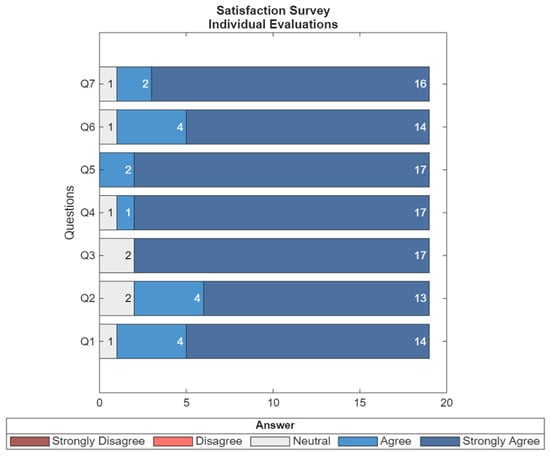
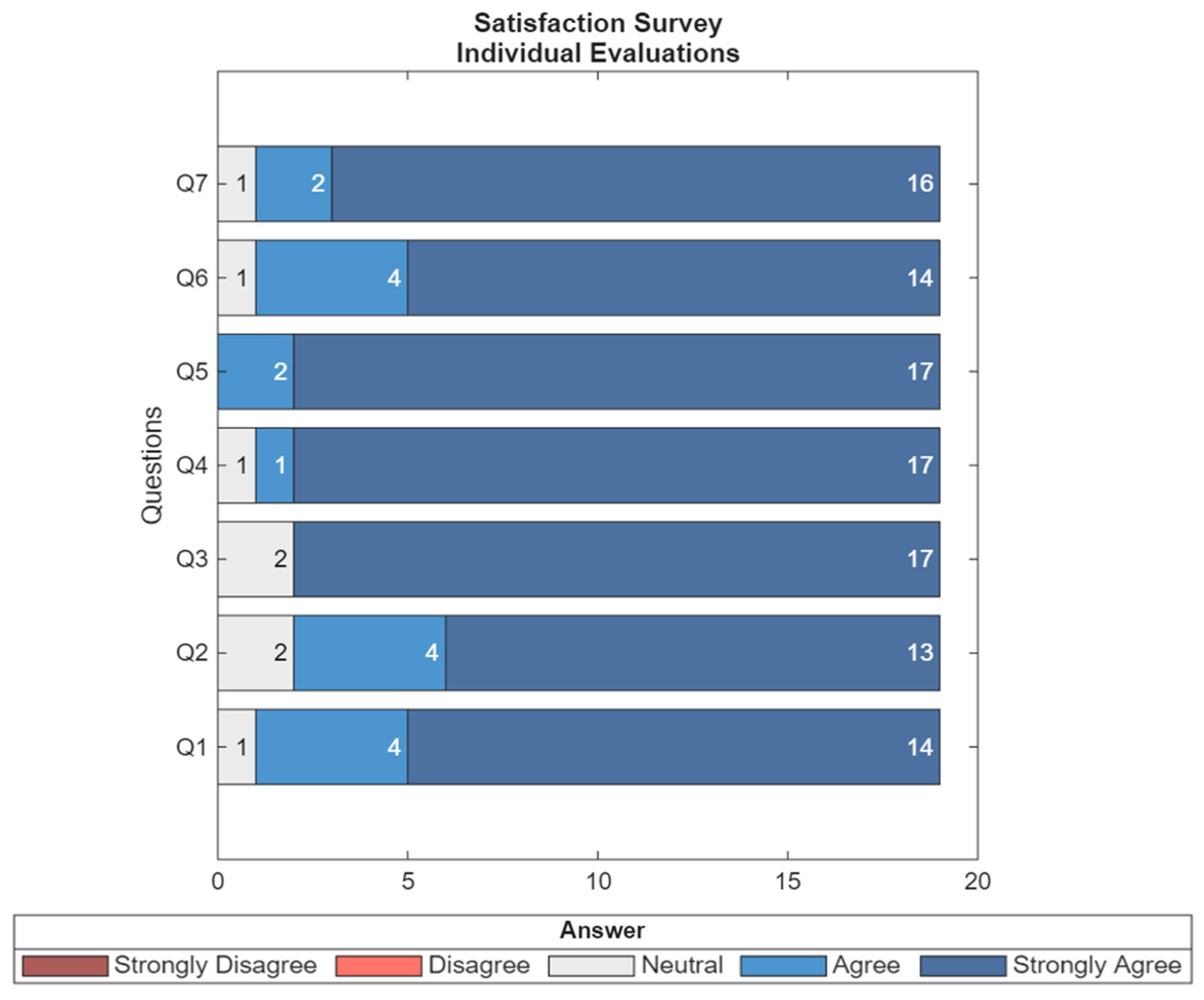
At the conclusion of the academic semester, students completed an anonymous satisfaction survey utilizing a 5-point Likert scale to evaluate the specific pedagogical components of the project. The raw frequency data from this survey are visually compiled in Figure 1, which presents the horizontal distribution of student marks across seven targeted survey questions (Q1 to Q7).
Figure 1.
Distribution of student satisfaction survey responses. Horizontal pedagogical scaffolding model. The survey results visualized in the graph represent the absolute frequency of student responses across a 5-point Likert scale, (Strongly Disagree, Disagree, Neutral, Agree, and Strongly Agree) for items Q1–Q7. The color-coded segments denote the distribution of responses for each survey item (Q1–Q7), providing a visual summary of student consensus regarding the pedagogical efficacy of the project.
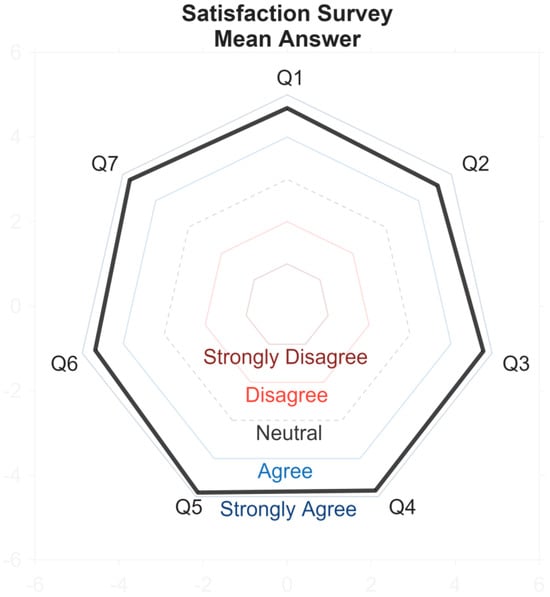
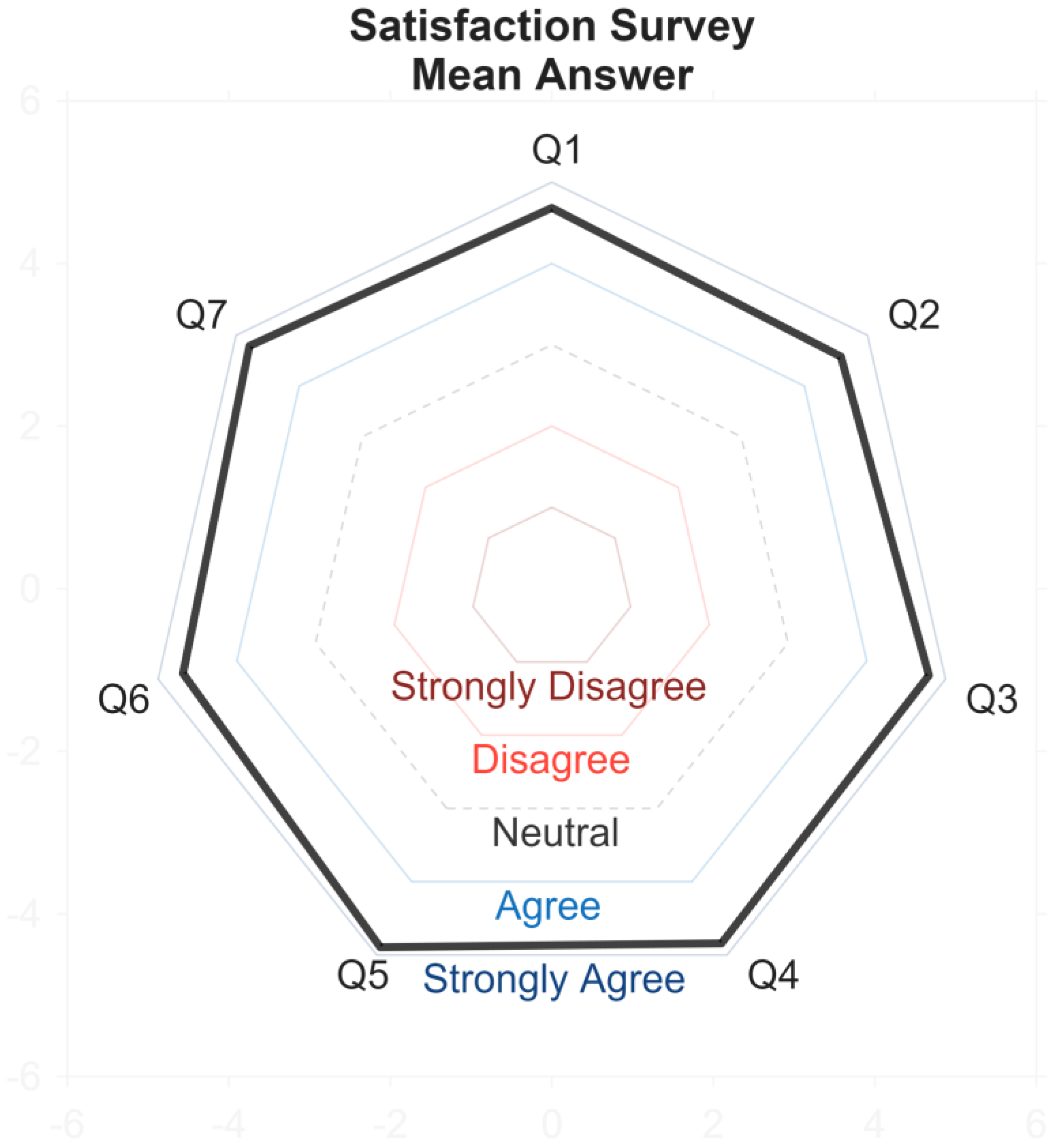
The corresponding mean scores µ are plotted geometrically in Figure 2, a heptagonal radar chart illustrating the highly positive student consensus across all evaluated domains.
Figure 2.
Geometric representation of pedagogical assessment results. This heptagonal radar chart visually synthesizes the multi-dimensional impact of the service-learning project across seven targeted survey items (Q1–Q7). The radiating axes represent the evaluated pedagogical domains, with numerical gradients derived from a 5-point Likert scale at the outer boundary, color-coded and with corresponding labels for the 5-point Likert scale. The plotted polygon connects the corresponding mean scores (µ), providing a geometrical profile of overall student consensus.
To ensure complete transparency and data integrity, Table 2 compiles the mean scores and sample standard deviations for each of these items, corresponding directly to the radial points plotted in Figure 2.
Table 2.
Student responses to the service-learning satisfaction survey based on a 5-point Likert scale.
3.2. Social Impact
The social dimensions of the project were evaluated to explore students’ perceptions of civic engagement, professional development, and empathy. Post-intervention satisfaction survey findings indicated that 89.5% of the pharmacy cohort (n = 17/19, item Q6) agreed or strongly agreed that teamwork and interaction with community partners (ASPACE and Inclusión Activa) enriched their professional and personal development.
To facilitate this community-wide scientific engagement, pharmacy students collaborated with a peer subgroup of second-year physiotherapy students (n = 12) to co-design two inclusive activities. First, pharmacy and physiotherapy peers structured an accessible botanical walking tour tailored for the partner associations. While the physiotherapy students analyzed the campus terrain to guarantee barrier-free physical mobility, the pharmacy students explained the therapeutic properties of the local flora to the community participants. Second, the students co-designed and adapted physical educational games tailored specifically to the cognitive and motor abilities of the partner association members.
Qualitative reflections from pharmacy students and descriptive feedback from partner staff indicated that these joint activities provided a meaningful platform for pharmacy students to perceive and practice adaptive communication, peer collaboration, and community-based engagement. These interprofessional findings therefore reflect pharmacy students’ perceptions and qualitative reflections regarding their collaboration with physiotherapy peers, rather than a formal assessment of interprofessional outcomes across both student cohorts.
3.3. Sustainability and Institutional Impact
The garden was successfully established as a long-term educational resource, fostering interdisciplinary collaborations and continuous student engagement. By integrating the project into multiple pharmacy courses, including pharmacognosy, analytical chemistry, and technology-based formulation courses, the initiative ensured ongoing participation and knowledge transfer across academic years. The project’s sustainability was further reinforced through structured maintenance plans and student-led initiatives.
The university recognized the ecological garden as a model for environmentally conscious education, setting a precedent for similar sustainability-driven projects across other faculties. The initiative sparked interest from different academic departments, including environmental sciences, and social work, opening the door for interdisciplinary research and teaching collaborations.
3.4. Student Reflection and Qualitative Insights
To capture the subjective, transformative dimensions of the service-learning experience, an inductive thematic analysis was performed on students’ longitudinal reflective journals. The coding process achieved thematic saturation, identifying six core themes: Applied Learning, Interdisciplinary Work, Teamwork, Social Engagement, Instructor Impact, and Overcoming Fear.
The qualitative thematic matrix in Table 3 displays the conceptual definitions of these themes alongside representative student quotations.
Table 3.
Representative student comments, organized by thematic focus.
4. Discussion
The present pilot study suggests that integrating a SL ecological garden into the preclinical pharmacognosy curriculum may represent a pedagogically viable approach to experiential pharmacy education. By shifting the educational focus from passive memorization to community-embedded engagement, the intervention provided a meaningful framework for humanizing pharmacy education, supporting a transition from grade-centric learning to a purpose-driven social engagement.
The pedagogical value of this living laboratory model may lie in the combination of experiential fieldwork and deliberate cognitive scaffolding. While direct engagement with botanical raw materials stimulates situational interest and initial curiosity, our findings highlight the importance of combining sensory exposure with structured cognitive processing mechanisms, although knowledge retention cannot be established from the present post-intervention design. The positive academic performance observed in the present cohort, with 89.5% of students achieving high-performance marks (≥7.0/10.0) in the assessed components, describes overall course performance under the implemented pedagogical approach and cannot be attributed specifically to the ecological garden. This aligns with Constructivist Learning Theory, which posits that deep learning occurs when students actively organize information, transforming empirical observations into systematic pharmaceutical competencies [13,14].
A key qualitative finding from this pilot evaluation was the student-reported phenomenon of ‘overcoming fear.’ Participants noted that the perceived technical difficulty of pharmacognosy, often viewed as a memorization-heavy hurdle, became surmountable when contextualized within a tangible, socially responsible framework. This reframing supported academic self-efficacy and catalyzed reflection on the ethical dimensions of healthcare. Engaging in joint activities with physiotherapy peers (n = 12) and community members from ASPACE and Inclusión Activa required students to translate complex pharmacological concepts into accessible, human-centered language, a process of “clinical translation” that constitutes an essential competency for contemporary pharmacy practice [8].
Furthermore, peer-to-peer collaboration during the co-design of accessible botanical tours and adapted therapeutic interventions provided pharmacy learners with meaningful early exposure to interprofessional teamwork. Because quantitative data were collected exclusively from the pharmacy student cohort, the interprofessional education findings should be interpreted as preliminary qualitative perceptions of interprofessional collaboration rather than as evidence of measured competency gains across both disciplines. These student-reported qualitative insights align with interprofessional education frameworks that emphasize early collaborative practice to bridge theoretical instruction and multidisciplinary care. Future multi-cohort evaluations should include both pharmacy and physiotherapy students and incorporate validated IPE assessment instruments to formally evaluate interprofessional competencies across both disciplines. To strengthen sustainability and scalability the approach will be continued in subsequent academic cycles with larger student cohorts, allowing the generation of a broader body of data beyond the present pilot experience. Longitudinal follow-up of these cohorts into advanced clinical clerkships will also provide an opportunity to explore whether the empathy and adaptive communication developed during the preclinical experience are sustained in real-world hospital and community pharmacy rotations.
Moreover, the interprofessional collaboration between pharmacy and physiotherapy students provided an opportunity for experiential learning and collaborative engagement. By co-designing accessible botanical tours and therapeutic interventions, students from both disciplines were exposed to real-world collaborative healthcare, an approach consistent with accreditation standards for interprofessional education and the development of mutual understanding of their respective roles in patient care [15]. In the present study, however, these activities were not accompanied by a formal assessment of interprofessional competencies across both student cohorts.
Welcoming historically marginalized groups onto the university campus helped dismantle long-standing institutional barriers and fostered an academic culture of diversity and civic responsibility. This direct engagement reinforced the importance of patient-centered care and accessibility, values that students explicitly identified as priorities for their future professional careers. This model illustrates how preclinical instruction can extend beyond traditional boundaries to connect academic training with social engagement.
Based on these preliminary findings, we propose a strategic framework for health sciences curricular design. First, programs can address conceptual gaps in basic sciences through campus-based “living laboratories”. For curricula lacking formal botany, an ecological garden offers a sensory-rich environment that bridges the gap between raw botanical sources and molecular pharmacognosy, rendering abstract natural product chemistry physically tangible. Second, experiential fieldwork must be paired with structured cognitive scaffolding. Third, early interprofessional collaboration and adaptive communication should be integrated into preclinical years to foster empathy and humanized clinical communication. Finally, the integration of this model into a vertical curricular loop supports long-term institutional sustainability and optimizes academic resources [16,17,18]. While the present pilot implementation was conducted exclusively within the 2nd-year Pharmacognosy course, we propose expanding this living laboratory model into a prospective vertical scaffolding loop encompassing Analytical Chemistry, Pharmacology, and Pharmaceutical Technology in future academic iterations. This holistic framework aims to reduce the educational “silo effect” while optimizing academic resources.
While these findings provide initial proof-of-concept for integrating a service-learning ecological garden into pharmaceutical education, several methodological limitations must be highlighted. First, the evaluation was conducted with a single small cohort of pharmacy students () at a single institution without a parallel control group or pre-intervention baseline measurement, which limits the statistical generalizability of the quantitative metrics. Rather than serving as a large-scale population study, this work represents a structured pilot implementation and proof-of-concept for health sciences education. Second, reliance on post-intervention self-reported survey instruments and satisfaction scales reflective journals introduce potential response, social-desirability, and recall biases. However, these qualitative self-assessments were contextualized through triangulation with examination objective academic performance metrics and direct observational evaluation. Future studies should employ prospective, multi-cohort controlled designs with pre- and post-testing to objectively quantify long-term knowledge retention and empathetic behavior in clinical practice.
5. Conclusions
This study provides a proof-of-concept for integrating a service-learning ecological garden into the pharmacognosy curriculum as an experiential approach to undergraduate pharmacy education. By embedding experiential, human-centric learning into basic pharmaceutical sciences, this pedagogical model provides opportunities to connect botanical theory and clinical application while promoting engagement with community partners. The active participation of students with community partners provided opportunities to develop essential non-technical competencies, including empathy, adaptive communication, and social responsibility, alongside technical learning. However, the interprofessional education findings remain preliminary and qualitative, as quantitative data were restricted to the pharmacy student cohort and no validated IPE competency measures were collected across both disciplines. Therefore, these findings should not be interpreted as evidence of measured interprofessional competency gains or as demonstrating a causal effect of the ecological garden on learning outcomes. Future research should extend the evaluation to larger multi-cohort and multi-institutional settings, including both pharmacy and physiotherapy students and incorporating validated IPE assessment tools. Such studies could help determine the reproducibility, scalability, and educational effects of this experiential model across different curricular and institutional contexts. The proposed vertically scaffolded, interprofessional curricular loops may provide a framework for such future evaluation.
Author Contributions
A.R.-L. conceptualized the study. R.M.S.-G. drafted the original manuscript. I.G.-D. and C.G.-M. participated in the investigation and execution of the educational activity. E.A. was responsible for data visualization and figure design. A.R.-L. secured funding, managed resources, directed project administration, and supervised the study. E.A., I.G.-D., C.G.-M. and A.R.-L. critically reviewed and edited the final manuscript. All authors have read and agreed to the published version of the manuscript.
Funding
This project was made possible through financial support from Loyola University’s Innovation in Teaching Grant. The funding covered essential resources for the garden’s establishment, including seeds, gardening tools, and educational materials. The authors declare that no competing financial interests influenced the design, execution, or reporting of this study.
Institutional Review Board Statement
This study was conducted in accordance with the ethical guidelines established by Loyola University for research involving human participants. Ethical approval was obtained from the university’s Institutional Review Board prior to the commencement of the project Protocol ID: 250217 CE25574. All participants provided informed consent before engaging in activities, ensuring their voluntary participation. Additionally, measures were taken to protect the privacy and confidentiality of all individuals involved, particularly in interactions with members of ASPACE and Inclusión Activa. Any potential risks were minimized, and the study adhered to principles of beneficence and respect for persons throughout its implementation.
Informed Consent Statement
Informed consent was obtained from all subjects involved in the study.
Data Availability Statement
The data presented in this study are available on request from the corresponding author. The data are not publicly available due to privacy and ethical considerations regarding student and community participant responses.
Acknowledgments
The authors would like to extend their sincere gratitude to Loyola University for its institutional support in the development and execution of this project. Special thanks are also due to the students who actively participated in the initiative, demonstrating enthusiasm and dedication in bridging academic learning with community service. We deeply appreciate the collaboration of ASPACE and Inclusión Activa, whose members provided invaluable contributions and engagement, enriching the learning experience for all involved. Finally, we acknowledge the faculty and administrative staff who facilitated the logistics, provided mentorship, and contributed their expertise to ensure the success of this initiative.
Conflicts of Interest
The authors declare that they have no known competing financial interests or personal relationships that could have appeared to influence the work reported in this paper.
Abbreviations
The following abbreviations are used in this manuscript:
| SL | Service-learning |
| ASPACE | Asociación Sevillana de Atención a Personas con Parálisis Cerebral |
References
- Abdel-Halim, H. Enhancing Medicinal Chemistry Knowledge and Student Interest: Incorporating Pharmacy Practice Related Case Studies and Active-Learning Strategies. Pharm. Educ. 2020, 20, 168–178. [Google Scholar] [CrossRef] [Scilit]
- Bringle, R.G.; Hatcher, J.A. Implementing Service Learning in Higher Education. J. High. Educ. 1996, 67, 221–239. [Google Scholar] [CrossRef] [Scilit]
- Schlesselman, L.; Borrego, M.; Bloom, T.J.; Mehta, B.; Drobitch, R.K.; Smith, T. An Assessment of Service-Learning in 34 US Schools of Pharmacy Follow up on the 2001 Professional Affairs Committee Report. Am. J. Pharm. Educ. 2015, 79, 116. [Google Scholar] [CrossRef] [Scilit] [PubMed]
- Gonzales, A.D.; Harmon, K.S.; Fenn, N.E. Perceptions of Service Learning in Pharmacy Education: A Systematic Review. Curr. Pharm. Teach. Learn. 2020, 12, 1150–1161. [Google Scholar] [CrossRef] [Scilit] [PubMed]
- Astin, A.W.; Vogelgesang, L.J.; Ikeda, E.K.; Yee, J.A. How Service Learning Affects Students; Higher Education Research Institute, UCLA: Los Angeles, CA, USA, 2000. [Google Scholar]
- Fredericksen, P.J. Does Service Learning Make a Difference in Student Performance? J. Exp. Educ. 2000, 23, 64–74. [Google Scholar] [CrossRef] [Scilit]
- Lee, J.J.; Bell, L.F.; Shaulskiy, S.L. Exploring Mentors’ Perceptions of Mentees and the Mentoring Relationship in a Multicultural Service-Learning Context. Act. Learn. High. Educ. 2017, 18, 243–256. [Google Scholar] [CrossRef] [Scilit]
- Hébert, A.; Hauf, P. Student Learning through Service Learning: Effects on Academic Development, Civic Responsibility, Interpersonal Skills and Practical Skills. Act. Learn. High. Educ. 2015, 16, 37–49. [Google Scholar] [CrossRef] [Scilit]
- Eyler, J.; Giles, D.E., Jr. Where’s the Learning in Service-Learning? Chapt. 2–3; Jossey-Bass: San Francisco, CA, USA, 1999; pp. 23–82. [Google Scholar]
- Dicks, M.; Mitchell, T. Service or Disservice? Ensuring Pharmacy Students Provide Authentic Service-Learning. Am. J. Pharm. Educ. 2019, 83, 1442–1445. [Google Scholar] [CrossRef] [Scilit] [PubMed]
- Ash, S.L.; Clayton, P.H.; Atkinson, M.P. Integrating Reflection and Assessment to Capture and Improve Student Learning. Mich. J. Community Serv. Learn. 2005, 11, 49–60. [Google Scholar]
- Dunlap, M.R. Voices of students in multicultural service-learning settings. Mich. J. Community Serv. Learn. 1994, 5, 58–67. [Google Scholar]
- Afanasenko, O.V.; Nizhenkovska, I.V.; Holovchenko, O.I.; Glushachenko, O.O. Technology-Enhanced Constructivist Learning Environment for Pharmacy Students. Pharm. Educ. 2022, 22, 778–787. [Google Scholar] [CrossRef] [Scilit]
- Kang, L.O.; Brian, S.; Ricca, B. Constructivism in Pharmacy School. Curr. Pharm. Teach. Learn. 2010, 2, 126–130. [Google Scholar] [CrossRef] [Scilit]
- Reeves, S.; Perrier, L.; Goldman, J.; Freeth, D.; Zwarenstein, M. Interprofessional Education: Effects on Professional Practice and Healthcare Outcomes. Cochrane Database Syst. Rev. 2013, 2013, CD002213. [Google Scholar] [CrossRef] [Scilit] [PubMed]
- Prince, M. Does Active Learning Work? A Review of the Research. J. Eng. Educ. 2004, 93, 223–231. [Google Scholar] [CrossRef] [Scilit]
- Brandt, B.; Lutfiyya, M.N.; King, J.A.; Chioreso, C. A Scoping Review of Interprofessional Collaborative Practice and Education Using the Lens of the Triple Aim. J. Interprof. Care 2014, 28, 393–399. [Google Scholar] [CrossRef] [Scilit] [PubMed]
- Haack, S. Engaging Pharmacy Students with Diverse Patient Populations to Improve Cultural Competence. Am. J. Pharm. Educ. 2008, 72, 124. [Google Scholar] [CrossRef] [Scilit] [PubMed]

Disclaimer/Publisher’s Note: The statements, opinions and data contained in all publications are solely those of the individual author(s) and contributor(s) and not of MDPI and/or the editor(s). MDPI and/or the editor(s) disclaim responsibility for any injury to people or property resulting from any ideas, methods, instructions or products referred to in the content. |
© 2026 by the authors. Published by MDPI on behalf of the Academic Society for International Medical Education. Licensee MDPI, Basel, Switzerland. This article is an open access article distributed under the terms and conditions of the Creative Commons Attribution (CC BY) license.