


Abstract
Background: Gaps in obesity medicine education remain in undergraduate and graduate medical education. As obesity impacts many chronic diseases, this gap is significant for the overall educational program. Our aim was to develop and evaluate a multi-institutional collaborative approach with content expertise for implementing an obesity medicine curriculum in undergraduate medical education, while addressing documented implementation barriers and documenting lessons learned. Activity: Eight geographically, institutionally diverse U.S. medical schools participated in this study. A three-phase study (planning, implementation, evaluation) from 2023 to 2025 was implemented. Local faculty champions comprehensively evaluated the program using a logic model framework with a mixed methods design. Results: Acceptability was high: 100% of faculty champions agreed the project was worth their time and were satisfied with outcomes. Feasibility was strong, with minimal content displacement and most (87.5%) reporting sustainability. Most champions (87.50%) perceived that student knowledge and preparedness to care for patients with obesity had improved. Key benefits included collaboration, networking, and gap identification; major challenges included limited curricular space, timeline alignment, and faculty/student interest. Lessons learned highlighted stakeholder engagement, faculty development for knowledge and obesity bias, strategic integration, evaluation, and multi-institutional collaboration. Discussion: The lessons learned from this novel approach can support other institutions implementing obesity education in undergraduate medical education curricula.
1. Background
Obesity is one of the most prevalent noncommunicable diseases worldwide and carries substantial medical, social, and economic consequences [1]. To advance obesity care, the American College of Physicians and its Council of Subspecialty Societies convened to reaffirm their commitment to improving obesity education and practice through collaborative development of resources [2]. Despite longstanding recommendations from professional organizations, including the American Medical Association [3], and implementation efforts [4] persistent gaps in obesity education remain in undergraduate and graduate medical education [5,6] which results in residents and physicians being insufficiently prepared to care for patients with obesity [7,8]. These gaps persist in part because obesity medicine education faces unique implementation barriers [5], including inconsistent presence of obesity medicine content experts in curricular development, lack of recognition of obesity medicine as an independent discipline, and de-prioritization of obesity topics in relation to the study of its complications.
Our aim was to develop and evaluate a multi-institutional educational collaborative to accelerate the effective, scalable implementation of obesity medicine curriculum in undergraduate medical education, addressing documented implementation barriers through a novel approach. Prior national curricular initiatives have demonstrated that multi-institutional collaboration, guided by social constructivist and competency-based educational frameworks, can successfully drive curricular change [9,10,11]. In these models, working groups with representatives from each participating school guided curriculum development and implementation to ensure relevance, feasibility, and shared ownership across institutions.
Building on these successful models, we developed a pilot national, multi-institutional approach focused on obesity medicine competencies [12] that intentionally paired external expertise with dedicated funding to support faculty time, enabling consistent and scalable implementation across diverse medical schools. This approach addresses the documented reality that successful implementation depends on the presence of local clinical champions while overcoming the resource constraints that have historically limited obesity education [5]. Faculty champions who led this collaborative at their institutions evaluated this approach by assessing its feasibility, acceptability, and educational outcomes. Most importantly, they will provide lessons learned that other institutions could use when adopting this approach. This work is particularly timely given the American Association of Medical Colleges (AAMC)’s recent call for multi-institutional strategies to strengthen nutrition education in the context of chronic diseases (such as obesity), based on 36 nutrition competencies, of which twenty-five align with the obesity medicine competencies [13,14].
2. Activity
Setting: A six-member steering committee of experts in obesity medical education guided this project under the guidance of The Obesity Society (TOS). Medical schools were recruited via TOS, AAMC, and the Society of Teachers in Family Medicine (STFM). The steering committee interviewed applicants, assessing preparedness, administrative support, experience with educational interventions, and institutional commitment. Selection criteria included geographic region, enrollment size, school type (public/private), institutional mission, and training pathway (allopathic/osteopathic). Schools where steering committee members held appointments were excluded. The steering committee selected the participating schools by majority vote between May and July 2023. Ten schools were initially selected and each conducted a needs analysis of their curriculum [6]. Of these, eight schools completed the full three-phase intervention study: Oakland University William Beaumont School of Medicine, Rochester, MI; University of Texas Health San Antonio Long School of Medicine, San Antonio, TX; University of Illinois School of Medicine, Chicago, IL; University of California San Diego School of Medicine, San Diego, CA; Michigan State University College of Osteopathic Medicine, East Lansing, MI; John A. Burns School of Medicine, Honolulu, HI; Loma Linda University School of Medicine, Loma Linda, CA; and Case Western Reserve University School of Medicine, Cleveland, OH. The two remaining schools completed the Phase 1 needs analysis and planning but did not progress to Phase 2 implementation or Phase 3 evaluation because they were unable to secure the required school-official approvals in time to proceed within the study timeline, reflecting competing institutional priorities. Because these two schools contributed no implementation or evaluation data, they were not included in the feasibility, acceptability, educational outcome, or competency-coverage analyses, which are based on the eight schools (N = 8) that completed all three phases.
Each participating school that completed all three phases selected a faculty champion to serve as its institutional representative in the initiative. Chosen for their interest in obesity medicine education and capacity to lead curricular change, these faculty champions joined the steering committee to form the working group. The working group met monthly to share updates, address challenges, and facilitate collaboration through a shared platform that housed educational resources organized by ACGME competency domains. Faculty champions established local task forces with key stakeholders (students, content experts, curricular and administrative leaders) to support implementation. In November 2024, participants convened at ObesityWeek 2024 to review progress and pre-implementation findings.
Program description: The study was conducted in three phases. Phase 1 (September 2023–September 2024) focused on collaborative planning and curriculum development. Each local task force group worked under the guidance of the faculty champion to review shared obesity education resources and to develop or refine institution-specific obesity curricula for implementation during the 2024–2025 academic year. Prior educational exposure to obesity medicine reflected each school’s existing undergraduate medical curriculum and was assessed by the faculty champion using the 32 obesity medicine competencies rather than through direct testing of individual learners. These findings were used to identify local curricular gaps and guide each institution’s selection of one to three educational interventions. Because individual educational activities often addressed multiple competencies simultaneously, the intended learning outcomes spanned multiple competency domains rather than a single area of knowledge or experience. Each faculty champion was paired with a mentor from the steering committee for one-on-one meetings to optimize the proposed interventions. Based on this, each school developed a specific, measurable implementation plan targeting one to three educational interventions. To support this process, the steering committee shared a broad range of educational resources as possible options, including: (a) teaching materials published in peer-reviewed journals, such as MedEdPORTAL; (b) teaching resources previously implemented and validated by steering committee members at their own institutions (which are to be placed on an educational platform of The Obesity Society [15]); and (c) the FORWARD obesity curriculum [16]. Faculty champions were not required to use any of the shared materials and could instead adapt selected resources, combine them with other evidence-based content, or develop their own original educational interventions. Phase 2 (October 2024–June 2025) was implementing the planned obesity education interventions at each institution. Curricular activities spanned across all four years of undergraduate medical education. Phase 3 (July–November 2025) focused on evaluation and reflection. Faculty champions reassessed the extent to which each of the 32 obesity medicine competencies was addressed following implementation and completed reflective assessments of their experience with the program.
Evaluation framework: We evaluated the multi-institutional collaborative approach using a logic model framework [17]. First, acceptability and feasibility (short-term outcomes) were assessed. Second, educational outcomes (intermediate outcomes) examined the intervention’s impact. Third, lessons learned captured facilitators, barriers, adaptations, planned improvements, sustainability considerations, and unexpected outcomes to inform future multi-institutional curricular interventions (long-term impact).
Data analysis: This study used a mixed-methods design integrating qualitative and quantitative approaches. Data were collected through an electronic survey; the survey items and response scales are provided in Supplementary Material S1. Because the narrative comments reflected personal accounts of lived experience, qualitative data were analyzed using the Braun and Clarke thematic analysis approach [18], with 2 independent raters coding the data, developing the themes and comparison until the point of saturation Quantitative data were analyzed in Stata 18.0 using frequency statistics, including medians and interquartile ranges (IQRs) for competency domains. Because of the small number of participating institutions and the ordinal nature of the competency coverage scores, pre- and post-intervention competency coverage was compared using two-sided Wilcoxon signed-rank tests. Statistical significance was defined as p < 0.05.
3. Results
3.1. Acceptability, Feasibility, and Educational Outcomes
All (100%) faculty champions from participating schools agreed/strongly agreed that the project was worth their time, and they were satisfied with the overall outcome of the project. They also agreed/strongly agreed that most local curriculum administrators (75%) and local faculty (87.5%) were satisfied with the project, as in Supplementary Material S2.
Regarding feasibility, only 2 faculty champions reported reducing the time spent on other curricular topics. Additionally, most faculty champions (87.5%) agreed/strongly agreed that the educational interventions are sustainable over time in the curriculum. They identified several resources for sustainability: continuous support from teaching faculty and leadership, faculty development in obesity medicine, unbranded teaching materials, and ongoing collaborations with other institutions and obesity medicine experts from the steering committee.
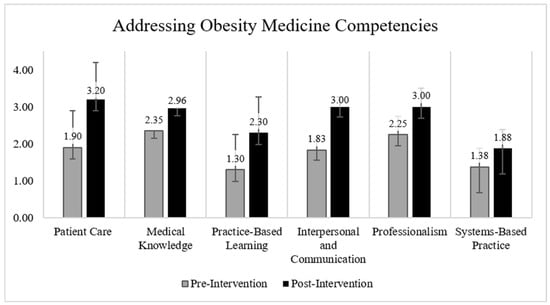
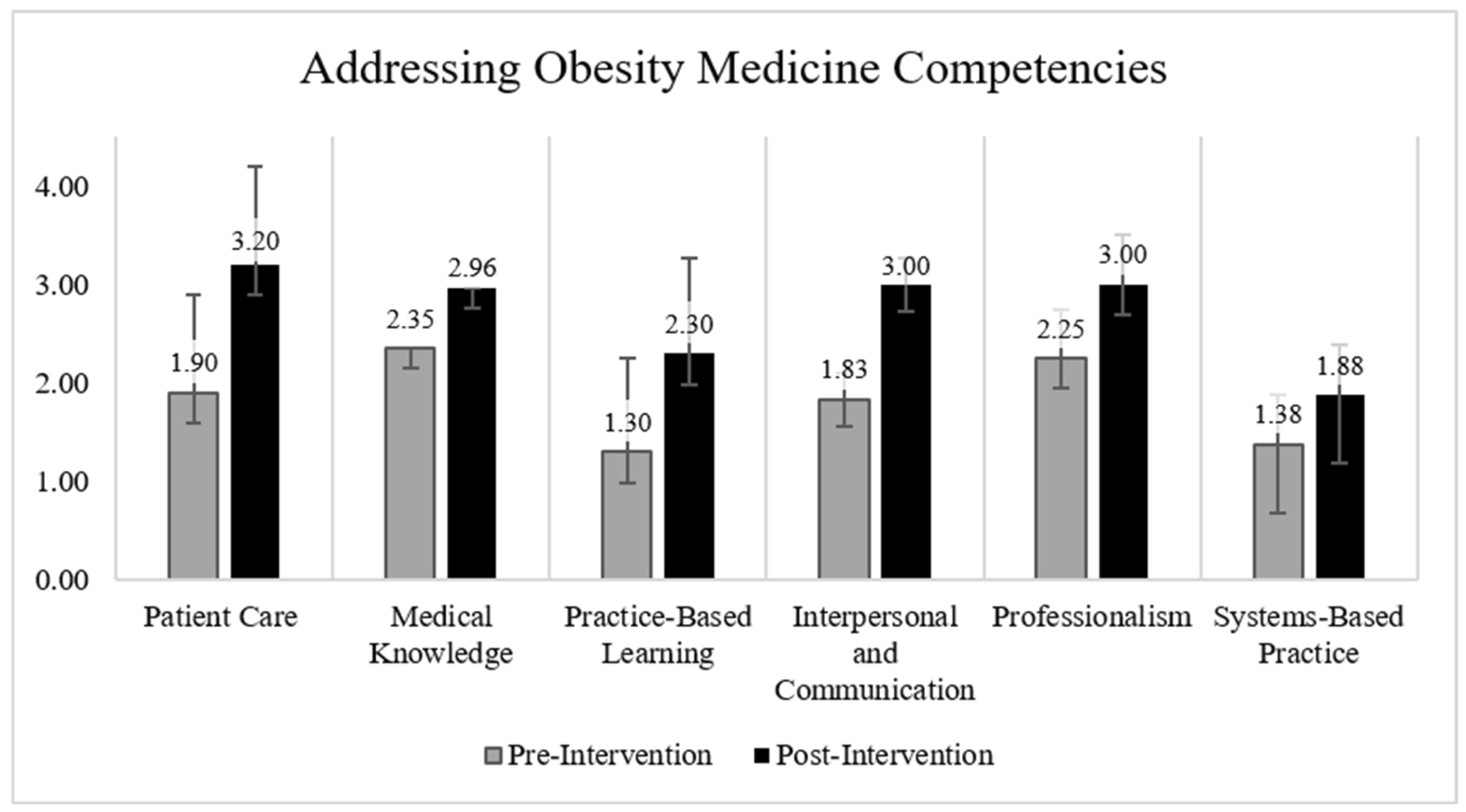
Pre-intervention, median curricular coverage was highest for Medical Knowledge (Mdn = 2.35, IQR = 2.04–3.01). The largest curricular gaps were observed in Practice-Based Learning and Improvement (Mdn = 1.30, IQR = 1.00–1.80), Systems-Based Practice (Mdn = 1.38, IQR = 1.00–1.88), and Interpersonal and Communication Skills (Mdn = 1.83, IQR = 1.50–2.67). Post-intervention, median competency coverage increased across all six domains (Figure 1). However, statistically significant increases were observed only for Practice-Based Learning and Improvement (Mdn = 2.30, z = 2.103, p = 0.04) and Interpersonal and Communication Skills (Mdn = 3.00, z = 2.46, p = 0.02). These values represent aggregate institution-level assessments of curricular coverage rather than directly measured changes in individual student knowledge or skills. Additionally, most faculty champions (87.50%) agreed/strongly agreed that, in their perception, students’ knowledge of obesity medicine improved as a result of the intervention and that students were better prepared to provide care for patients with obesity.
Figure 1.
Change in obesity competency coverage at the participating schools pre- and post-interventions. Each of the 32 obesity medicine competencies was rated using a 4-point Likert scale (1 = not addressed; 2 = needs substantial improvement; 3 = needs some improvement; 4 = adequately addressed) and then grouped by the 6 domains. Values are presented as Median and IQR.
3.2. Benefits, Challenges, and Barriers
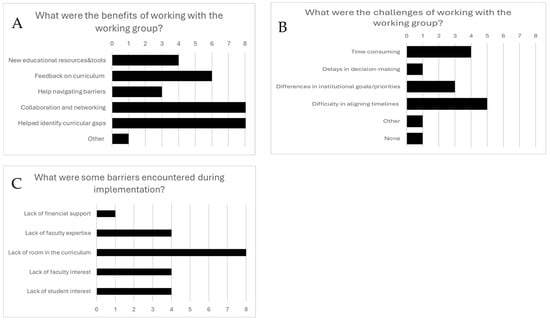
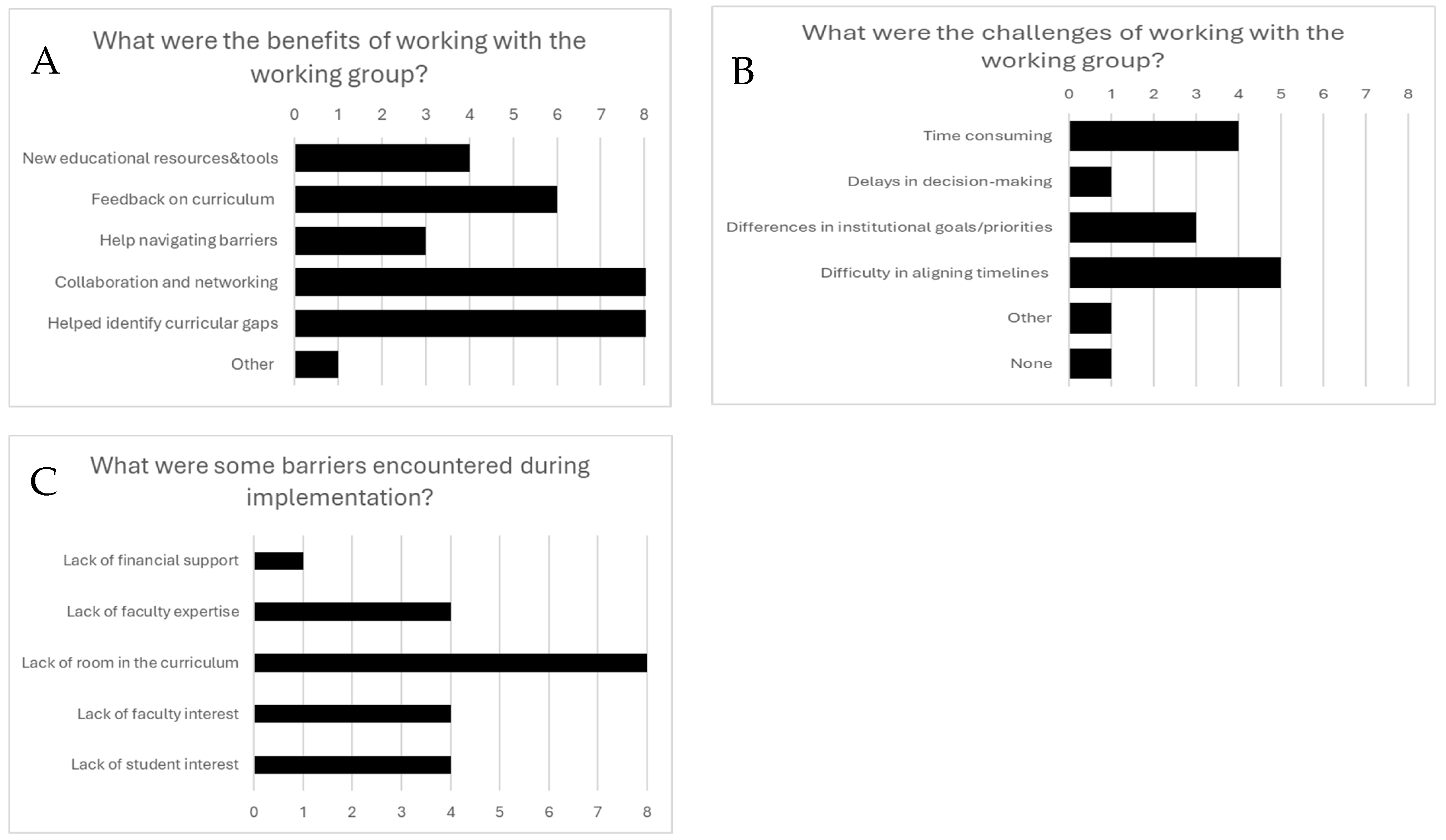
The highest-rated (100%) benefits of this approach were opportunities for collaboration and networking, as well as the ability to identify curricular gaps in obesity medicine. Getting constructive feedback on the curriculum content and implementation, help in navigating institutional or logistical barriers, and access to new educational tools were also reported by 37.5–75% of faculty champions (Figure 2). There were some notable unexpected benefits: reductions in faculty bias, increased clinical faculty engagement, enhanced understanding of the four-year curriculum, and identification of curricular gaps extending beyond obesity medicine.
Figure 2.
Benefits, challenges and barriers noted with this approach. These (A) benefits, (B) challenges, and (C) barriers to implementation were noted by faculty champions at the participating medical schools (N = 8).
The highest-rated challenge of this approach (62.5%) was difficulty aligning timelines (because schools had different academic-year start times). Other challenges identified were time-consuming (50%); differences in institutional goals (37.5%), and delay in the decision-making process clarified as obtaining the IRB approval (12.5%).
The highest-rated implementation barrier was lack of room in the curriculum (100%), followed by lack of student (50%) and faculty interest (50%) and lack of faculty expertise (50%). Lack of financial support from the institution for additional faculty time was noted by only 1 faculty champion (12.5%).
The lessons learned (Table 1) clustered into four categories: essential groundwork, faculty preparation, strategic design, and ongoing refinement and sustainability. Essential groundwork focused on early stakeholder engagement and collaborative partnerships to build alignment and reduce barriers. Faculty preparation highlighted the importance of assessing faculty expertise and readiness to teach obesity without stigma. Strategic design emphasized integration across courses, adaptation to local context, active learning, alignment with learner needs, and use of unbranded materials. Ongoing refinement and sustainability centered on embedding evaluation for quality improvement, maintaining implementation support, and sustaining collaborations for long-term impact.
Table 1.
Lessons Learned.
4. Discussion
This multi-institutional collaborative approach with the addition of content experts was found successful and resulted in 12 lessons learned that could be used by other institutions looking to develop educational interventions in obesity medicine.
Stakeholder satisfaction and sustainability reports demonstrate the approach’s acceptability and feasibility. Faculty-reported perception of improved student knowledge and preparedness to care for patients with obesity, along with increased curriculum coverage, suggest successful implementation across participating institutions. Only 2 faculty champions reduced time spent on other curricular topics, suggesting successful integration without substantially compromising existing priorities, a key factor in sustainable curricular change [19]. The unexpected benefits of reduced faculty bias, increased clinical faculty engagement, and the identification of curricular gaps beyond obesity medicine suggest that the collaborative process itself served as a form of faculty development and organizational learning.
The 12 lessons learned provide a comprehensive framework for curricular change in obesity medicine. Several lessons align with best practices in medical curriculum development [19,20], including early stakeholder engagement and collaborative partnerships, strategic design to incorporate local adaptation, active learning, and alignment with learners’ baseline knowledge, ongoing refinement, sustainability, and support. However, this study identified several steps critical to obesity medicine educational interventions. Faculty preparation should incorporate screening for weight-bias attitudes and providing targeted anti-bias education. This step is particularly critical because physicians report a lack of knowledge and skills in obesity medicine [5,6,7] and weight bias [21]. Obesity medicine educational interventions should be incorporated through strategic integration across most courses rather than isolation into one course, as obesity affects multiple organ systems [1,22]. Most importantly, because of the critical lack of faculty expertise [7,8] and the inadequate implementation of obesity education across medical schools [5,6], sustaining collaborations with obesity medicine experts is critical for iterative improvement. These lessons learned can be applied to nutrition education also, as it overlaps with obesity medicine and faces similar challenges [13,14].
This study has several limitations. Reliance on faculty champion self-report may have introduced bias, although this is acceptable in a study designed to capture implementation experiences, perceptions, and lessons learned. The small sample size limited statistical power to detect differences in competency coverage, which is consistent with the expected constraints of a pilot study. The enhancement of student knowledge is a qualitative observation from the perspective of the obesity medicine content experts at each medical school, and objective assessments were not performed to corroborate. Evaluation of a single implementation cycle precluded assessment of long-term sustainability. Future research should include objective student learning outcomes and longer follow-up.
In conclusion, this multi-institutional collaboration provides a replicable model for accelerating the implementation of obesity medicine curricula in undergraduate and graduate medicine education.
Supplementary Materials
The following supporting information can be downloaded at: https://www.mdpi.com/article/10.3390/ime5040110/s1, Supplementary Material S1: Survey items; Supplementary Material S2: Acceptability, feasibility, and outcomes.
Author Contributions
M.P. and A.V.L. collected and analyzed the data. M.P. was the principal writer for the manuscript, data analysis, and interpretations. D.-A.C., C.C., R.C., E.G., M.J., M.A., V.U. and S.T.V. contributed data. R.F.K., M.P., A.V.L., M.A., D.-A.C., C.C., R.C., E.G., M.J., V.U. and S.T.V., A.V. and G.S. reviewed, edited, and approved the manuscript. All authors have read and agreed to the published version of the manuscript.
Funding
This study was funded by an unrestricted educational grant awarded to The Obesity Society (TOS) by Novo Nordisk. TOS worked on the grant independently of Novo Nordisk, without promoting any products developed, manufactured, or marketed by the pharmaceutical company. Research or consultant funding by Novo Nordisk was provided to R.F.K., M.P., A.V.L., D.A.C., C.C., R.C., E.G., M.S.J., A.M., J.P. (FORWARDQI Group), K.P. (FORWARDQI Group), V.U., S.T.V. and A.V.
Informed Consent Statement
The Northwestern University Institutional Review Board determined this project to be non-human subject research; therefore, informed consent was not required.
Data Availability Statement
The authors report that generative AI was not used in their research or preparation of this manuscript.
Acknowledgments
FORWARDQI group: Amber Mirando-Department of Pediatrics, Ann & Robert H. Lurie Children’s Hospital of Chicago, Northwestern Feinberg School of Medicine, Chicago, IL, USA; Julie Loza-Department of Family and Community Medicine, University of Illinois College of Medicine at Chicago, Chicago, IL, USA; Andrew Mock-Department of Preventive Medicine, Loma Linda University School of Medicine, Loma Linda, CA, USA; Jonathan Q Purnell-Department of Medicine, Oregon Health & Science University, Portland, OR, USA; Kim Pfotenhauer-Michigan State University College of Osteopathic Medicine, East Lansing, MI, USA.
Conflicts of Interest
R.F.K. and J.P. (FORWARDQI Group) are on the advisory board for Novo Nordisk. E.G. is a consultant for Novo Nordisk. B.G.S. (FORWARDQI Group) is an employee of Novo Nordisk. The paper reflects the views of the scientists, and not the company. The other authors declare that they have no competing interests.
References
- Lingvay, I.; Cohen, R.V.; Roux, C.W.L.; Sumithran, P. Obesity in adults. Lancet 2024, 404, 972–987. [Google Scholar] [CrossRef] [Scilit] [PubMed]
- Wee, C.C.; Arbaje, A.I.; Bering, H.; Blount, L.; Joseph, J.J.; Kahan, S.; Apovian, C.M.; White-Faines, A. Unifying Efforts to Empower Equitable Obesity Care: Synopsis of an American College of Physicians and Council of Subspecialty Societies Summit. Ann. Intern Med. 2025, 178, 725–736. [Google Scholar] [CrossRef] [Scilit] [PubMed]
- American Medical Association. Recognizing and Taking Action in Response to the Obesity Crisis; American Medical Association: Chicago, IL, USA, 2017. [Google Scholar]
- Siddiqui, H.B.; Nearing, G.; Regalado, S.M.; Delaney, K.Z.; Cameron, E. A Scoping Review of Obesity Educational Interventions in Undergraduate and Postgraduate Medical Education. Obes. Rev. 2025, 26, e13938. [Google Scholar] [CrossRef] [Scilit] [PubMed]
- Butsch, W.S.; Kushner, R.F.; Alford, S.; Smolarz, B.G. Low priority of obesity education leads to lack of medical students’ preparedness to effectively treat patients with obesity: Results from the U.S. medical school obesity education curriculum benchmark study. BMC Med. Educ. 2020, 20, 23. [Google Scholar] [CrossRef] [Scilit] [PubMed]
- Pasarica, M.; Kushner, R.F.; Leary, A.V.; Agarwal, M.; Carpenter, D.-A.; Croniger, C.; Correa, R.; Grunvald, E.; Johnson, M.S.; Loza, J.; et al. Uncovering Gaps in Obesity Medicine Competencies: Insights from Ten U.S. Medical Schools. Med. Sci. Educ. 2026, 36, 539–544. [Google Scholar] [CrossRef] [Scilit] [PubMed]
- Anees, A.; Saeed, Z.I.; Kemper, S.; Haggerty, T.; Davisson, L. Surveying the Knowledge and Practices of Primary Care Residents in Managing Adult Patients with Obesity. J. Gen. Intern Med. 2024, 39, 1698–1703. [Google Scholar] [CrossRef] [Scilit] [PubMed]
- Laddu, D.; Neeland, I.J.; Carnethon, M.; Stanford, F.C.; Mongraw-Chaffin, M.; Barone Gibbs, B.; Ndumele, C.E.; Longenecker, C.T.; Chung, M.L.; Rao, G.; et al. Implementation of Obesity Science into Clinical Practice: A Scientific Statement from the American Heart Association. Circulation 2024, 150, e7–e19. [Google Scholar] [CrossRef] [Scilit] [PubMed]
- Cruess, R.L.; Cruess, S.R.; Steinert, Y. Medicine as a Community of Practice: Implications for Medical Education. Acad. Med. 2018, 93, 185–191. [Google Scholar] [CrossRef] [Scilit] [PubMed]
- Chen, S.F.; Deitz, J.; Batten, J.N.; DeCoste-Lopez, J.; Adam, M.; Alspaugh, J.A.; Amieva, M.R.; Becker, P.; Boslett, B.; Carline, J.; et al. A Multi-Institution Collaboration to Define Core Content and Design Flexible Curricular Components for a Foundational Medical School Course: Implications for National Curriculum Reform. Acad. Med. 2019, 94, 819–825. [Google Scholar] [CrossRef] [Scilit] [PubMed]
- Skochelak, S.E.; Stack, S.J. Creating the Medical Schools of the Future. Acad. Med. 2017, 92, 16–19. [Google Scholar] [CrossRef] [Scilit] [PubMed]
- Kushner, R.F.; Horn, D.B.; Butsch, W.S.; Brown, J.D.; Duncan, K.; Fugate, C.S.; Gorney, C.; Grunvald, E.L.; Igel, L.I.; Pasarica, M.; et al. Development of Obesity Competencies for Medical Education: A Report from the Obesity Medicine Education Collaborative. Obesity 2019, 27, 1063–1067. [Google Scholar] [CrossRef] [Scilit] [PubMed]
- Colleges AAoM. Letter from AAMC to Secretaries Kennedy and McMahon. Available online: https://www.aamc.org/media/85871/download (accessed on 1 December 2025).
- Eisenberg, D.M.; Cole, A.; Maile, E.J.; Salt, M.; Armstrong, E.; Broad Leib, E.; Findley, T.; Massa, J.; Albin, J.; Alston, M.; et al. Proposed Nutrition Competencies for Medical Students and Physician Trainees: A Consensus Statement. JAMA Netw. Open 2024, 7, e2435425. [Google Scholar] [CrossRef] [Scilit] [PubMed]
- The Obesity Society. On-Deman Education. Science from the Obesity Society. Available online: https://www.obesity.org/meetings-education/on-demand-education/ (accessed on 14 April 2026).
- Medical, N.N. FORWARD: Focus on Obesity Education Curriculum; Novo Nordisk Inc.: Plainsboro, NJ, USA, 2023. [Google Scholar]
- Melle, E.V. Using a Logic Model to Assist in the Planning, Implementation, and Evaluation of Educational Programs. Acad. Med. 2016, 91, 1464. [Google Scholar] [CrossRef] [Scilit] [PubMed]
- Braun, V.; Clarke, V. Using thematic analysis in psychology. Qual. Res. Psychol. 2006, 3, 77–101. [Google Scholar] [CrossRef] [Scilit]
- Bland, C.J.; Starnaman, S.; Wersal, L.; Moorehead-Rosenberg, L.; Zonia, S.; Henry, R. Curricular change in medical schools: How to succeed. Acad. Med. 2000, 75, 575–594. [Google Scholar] [CrossRef] [Scilit] [PubMed]
- de Oliveira, M.A.C.; Miles, A.; Asbridge, J.E. Modern medical schools curricula: Necessary innovations and priorities for change. J. Eval. Clin. Pract. 2024, 30, 162–173. [Google Scholar] [CrossRef] [Scilit] [PubMed]
- Lawrence, B.J.; Kerr, D.; Pollard, C.M.; Theophilus, M.; Alexander, E.; Haywood, D.; O’Connor, M. Weight bias among health care professionals: A systematic review and meta-analysis. Obesity 2021, 29, 1802–1812. [Google Scholar] [CrossRef] [Scilit] [PubMed]
- Yanovski, S.Z.; Yanovski, J.A. Approach to Obesity Treatment in Primary Care: A Review. JAMA Intern. Med. 2024, 184, 818–829. [Google Scholar] [CrossRef] [Scilit] [PubMed]

Disclaimer/Publisher’s Note: The statements, opinions and data contained in all publications are solely those of the individual author(s) and contributor(s) and not of MDPI and/or the editor(s). MDPI and/or the editor(s) disclaim responsibility for any injury to people or property resulting from any ideas, methods, instructions or products referred to in the content. |
© 2026 by the authors. Published by MDPI on behalf of the Academic Society for International Medical Education. Licensee MDPI, Basel, Switzerland. This article is an open access article distributed under the terms and conditions of the Creative Commons Attribution (CC BY) license.