


Abstract
Background: This systematic review aimed to evaluate the effect of dentin pretreatment strategies on bond strength to natural caries-affected dentin (NCAD) in permanent human teeth. Methods: A systematic search was conducted in PubMed, Web of Science, and Scopus databases up to April 2026, following PRISMA guidelines. Experimental and quasi-experimental in vitro studies evaluating the bond strength of resin restorations to NCAD after the application of dentin pretreatment strategies prior to adhesive procedures were included. Studies involving modified adhesive systems, artificial caries-affected dentin, or primary teeth were excluded. Risk of bias was assessed using the QUIN tool. Due to methodological heterogeneity, a qualitative synthesis was performed. Results: A total of 1071 studies were identified, of which 9 met the inclusion criteria. Pretreatment strategies were categorized into cross-linking/biomodulation, remineralization, and fluoride-based approaches. Cross-linking strategies, particularly flavonoid-based agents, consistently improved bond strength. Remineralization approaches, including CPP-ACP, demonstrated condition-dependent effects, particularly under aging conditions. Fluoride-based strategies showed more variable outcomes. Most included studies presented moderate risk of bias. Conclusions: Cross-linking/biomodulation strategies demonstrated the most favourable bond strength outcomes to NCAD, while remineralization approaches showed potential benefits under aging conditions. However, the available evidence remains limited and methodologically heterogeneous, indicating the need for further standardized studies.
1. Introduction
Stable adhesive bonding to dentin is essential in contemporary restorative dentistry. However, achieving stable and long-term adhesion to natural caries-affected dentin (NCAD) remains a clinical challenge due to its altered structure and composition [1,2]. Compared to sound dentin, NCAD is characterized by partial demineralization, increased porosity, and a disorganized collagen matrix [3,4,5]. These characteristics can compromise resin infiltration and reduce bond strength to restoration materials [6,7].
In modern dentistry, the preservation of caries-affected dentin has been widely encouraged as part of minimally invasive procedures, aiming to maintain tooth structure while removing only the infected dentin layer [8,9]. However, the intrinsic properties of NCAD negatively influence the formation of a stable hybrid layer, leading to reduced immediate bond strength and compromised long-term durability [10,11].
To overcome these limitations, several dentin pretreatment strategies have been proposed to alter the substrate prior to adhesive application [12,13]. These approaches include remineralization strategies, such as calcium-based agents like CPP-ACP, aimed at restoring mineral content [14,15]; biomodification strategies using cross-linking agents, including flavonoids such as proanthocyanidins or grape seed extract, which enhance collagen stability [16,17,18]; and fluoride-based agents, like silver diamine fluoride, intended to control residual caries activity [19,20]. These strategies seek to enhance the properties of NCAD and improve the performance of the adhesive systems [21].
Beyond improving immediate bond strength, these pretreatment strategies are also intended to preserve the integrity of the resin–dentin interface over time [16,17]. Depending on their mechanism of action, they may stabilize the exposed collagen matrix, inhibit endogenous matrix metalloproteinases (MMPs), promote remineralization of partially demineralized dentin, or enhance the physicochemical properties of the substrate before adhesive application. Consequently, these approaches have attracted increasing interest as adjunctive procedures for improving the long-term durability of the adhesive interface on natural caries-affected dentin [12,21].
Regardless of the increasing number of studies investigating these pretreatment strategies, the published literature remains heterogeneous, without consistent findings regarding the effectiveness in improving bond strength [3,22]. Additionally, previous reviews have focused on bonding to caries-affected dentin in general or on specific classes of pretreatment strategies, often relying on artificial caries-affected dentin models [12,23]. Consequently, evidence on pretreatment approaches applied to natural caries-affected dentin remains limited, and a comprehensive synthesis under clinically relevant conditions is still lacking.
Therefore, the aim of this systematic review is to evaluate the effect of dentin pretreatment strategies on bond strength to NCAD, comparing with and without treatment, in in vitro studies. The null hypothesis tested was that dentin pretreatment strategies would not influence the bond strength of adhesive systems to NCAD.
To date, no systematic review has specifically synthesized the available evidence regarding dentin pretreatment strategies applied exclusively to natural caries-affected dentin. Since natural lesions differ substantially from artificially demineralized substrates, restricting the review to NCAD provides findings that are potentially more clinically relevant for minimally invasive restorative dentistry.
2. Materials and Methods
2.1. Focused Review Question
This systematic review was conducted in accordance with the Preferred Reporting Items for Systematic Reviews and Meta-Analyses (PRISMA) guidelines [24] and the review protocol was registered in PROSPERO database (CRD420261351644).
The completed PRISMA 2020 checklist is provided as Supplementary Material (Supplementary File S1).
The focused research question of this systematic review was “Do dentin pretreatment strategies applied prior to adhesive bonding positively influence the bond strength of resin restorations to natural caries-affected dentin?” The PICO question was structured as follows:
- Population (P): Natural caries-affected human permanent teeth;
- Intervention (I): Dentin pretreatment strategies;
- Comparison (C): With or without dentin pretreatment strategies;
- Outcome (O): Bond strength;
2.2. Literature Search Strategies
Three electronic databases, namely PubMed, ISI Web of Science and Scopus, were searched for studies published up to 8 April 2026. In addition, the reference lists of included studies and relevant systematic reviews were manually screened. A complementary search of the grey literature was performed; however, no additional eligible studies meeting the predefined inclusion criteria were identified. No language restrictions were applied during the search process. The search strategy combined terms related to caries-affected dentin, dentin pretreatment strategies, and bond strength outcomes.
PubMed: 839 retrieved records
#1 “Dentin”[Mesh] OR “Dental Caries”[Mesh] OR “caries-affected dentin”[tw] OR “carious dentin”[tw] OR “NCAD”[tw] OR “CAD”[tw] OR “human carious dentin”[tw]
#2 “Dental Bonding”[Mesh] OR “Adhesives”[Mesh] OR “Shear Strength”[Mesh] OR “Tensile Strength”[Mesh] OR “bond strength”[tw] OR “adhesion”[tw] OR “microtensile”[tw] OR “microshear”[tw] OR “μTBS”[tw] OR “μSBS”[tw] OR “bond stability”[tw] OR “bond integrity”[tw]
#3 “reminerali*” OR “biomimetic*” OR “bioactive*” OR “proanthocyanidin” OR “grape seed extract” OR “CPP-ACP” OR “silver diamine fluoride” OR “SDF” OR “Moringa” OR “propolis” OR “hesperidin” OR “calcium silicate” OR “eggshell” OR “peptide” OR “niobophosphate” OR “bio-glass”
#1 AND #2 AND #3
ISI Web of Science: 124 retrieved records
#1 “caries-affected dentin” OR “carious dentin” OR “natural caries” OR “human dentin caries” OR “NCAD” OR “affected dentin” (All Fields)
#2 “reminerali*” OR “biomimetic*” OR “bioactive*” OR “proanthocyanidin” OR “grape seed extract” OR “CPP-ACP” OR “silver diamine fluoride” OR “SDF” OR “Moringa” OR “propolis” OR “hesperidin” OR “calcium silicate” OR “eggshell” OR “peptide” OR “niobophosphate” OR “bio-glass” (All Fields)
#3 “bond strength” OR “adhesive strength” OR “microtensile” OR “microshear” OR “SBS” OR “TBS” OR “adhesion” OR “bond durability” OR “bond stability” (All Fields)
#1 AND #2 AND #3
SCOPUS: 108 retrieved records
#1 TITLE-ABS-KEY (“caries-affected dentin” OR “carious dentin” OR “natural caries” OR “human dentin caries” OR “NCAD” OR “affected dentin”)
#2 TITLE-ABS-KEY (reminerali* OR biomimetic* OR bioactive* OR proanthocyanidin OR “grape seed” OR “CPP-ACP” OR “silver diamine fluoride” OR SDF OR moringa OR propolis OR hesperidin OR “calcium silicate” OR eggshell OR peptide OR P11-4)
#3 TITLE-ABS-KEY (“bond strength” OR “adhesive strength” OR “tensile” OR “*shear” OR “SBS” OR “TBS” OR “adhesion” OR “bond durability” OR “bond stability”)
#1 AND #2 AND #3
2.3. Outcomes
The primary outcome of this systematic review was to analyse the adhesive bond strength to natural caries-affected dentin, comparing specimens with and without dentin pretreatment strategies. Subgroup analyses were performed according to the type of adhesive strategy (etch-and-rinse or self-etch) and the type of pretreatment.
2.4. Eligibility Criteria
The following inclusion criteria were established: experimental or quasi-experimental in vitro studies evaluating the effect of dentin pretreatment strategies on the bond strength of the adhesive interface to natural caries-affected dentin; the use of extracted human permanent teeth; the presence of a control group consisting of untreated natural caries-affected dentin; application of pretreatment strategies directly to the dentin surface prior to adhesive procedures; and outcomes assessed using shear, micro-shear, or micro-tensile bond strength tests (SBS, µSBS, or µTBS).
Exclusion criteria included studies involving modified adhesive systems, incorporation of bioactive agents into adhesive materials, use of artificially demineralized dentin, or primary (deciduous) teeth.
Bond strength values reported in the included studies were expressed in megapascals (MPa).
Pretreatment strategies were defined as any intervention applied directly to the dentin surface prior to adhesive procedures, aiming to modify the substrate (e.g., through remineralization, biomodification or disinfection) without altering the adhesive system itself.
2.5. Data Extraction and Collection
Firstly, two authors (RC and PM) independently screened titles and abstracts to identify eligible studies. Disagreements were resolved through discussion until consensus was reached. Full texts of selected articles were retrieved and independently assessed by the same authors, who also extracted the relevant data. Reference lists of included studies were additionally screened.
In case of missing or unclear data (e.g., missing bond strength values, standard deviations or sample sizes) or inconsistencies between reported results, corresponding authors were contacted via e-mail. Two follow-up attempts were made at one-week intervals.
Search results were imported to Endnote20 (Clarivate, Philadelphia, PA, USA) for duplicate removal. The Rayyan web application (https://www.rayyan.ai/) [25] was used to assist in study selection and screening. Data were extracted using a custom-designed Excel spreadsheet.
The following data were extracted: authors, year of publication, study design, characteristics of caries-affected dentin (extension, removal methods and assessment of NCAD prior to the application of the pretreatment strategies), type of pretreatment strategy, sample size, mean and standard deviation values, adhesive strategy (etch-and-rinse, self-etch, or universal), outcome measurement (bond strength testing method), predominant failure mode (adhesive, cohesive or mixed) and time of outcome assessment (24 h or after artificial aging).
Pretreatment strategies were classified according to the type of intervention into three groups: remineralization, cross-linking/biomodulation and disinfection (fluoride-based).
2.6. Risk of Bias Assessment
Two authors (RC and PM) independently assessed the risk of bias in the included in vitro studies according to the QUIN tool [26]. Disagreements were resolved by discussion until a consensus was achieved. Studies were classified as having low (>70%), moderate (50–70%), or high (<50%) risk of bias based on the final score.
2.7. Data Synthesis
Due to substantial methodological and clinical heterogeneity, a quantitative meta-analysis was considered inappropriate. Sources of heterogeneity included differences in bond strength testing methods (SBS, µSBS and µTBS), adhesive strategies (etch-and-rinse, self-etch and universal systems), dentin pretreatment protocols, aging procedures (thermocycling, thermomechanical cycling and long-term storage), methods used to identify and prepare natural caries-affected dentin, and variability in outcome reporting. Therefore, a qualitative narrative synthesis supported by summary tables was performed. A descriptive analysis was conducted of study characteristics, methodological quality, and outcomes was performed, and the main findings were presented using a narrative approach supported by summary tables, providing a clear overview of individual study characteristics, main results, and risk of bias assessments.
3. Results
3.1. Search Results
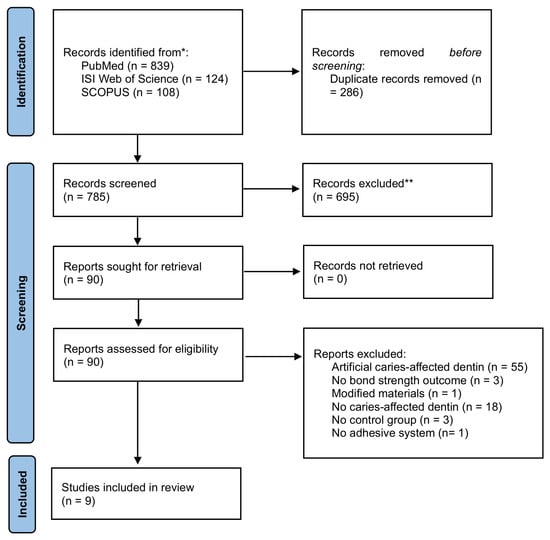
The literature search identified 1071 studies, including 839 from PubMed, 124 from Web of Science and 108 from Scopus. After removal of duplicates, titles and abstracts were screened, and 90 studies were selected for full-text assessment. Following full-text evaluation, 81 studies were excluded for not meeting the inclusion criteria. Ultimately, nine in vitro studies were included in the qualitative synthesis. The study selection process is presented in the PRISMA flow diagram (Figure 1).
Figure 1.
PRISMA flow diagram illustrating the study selection process for the included studies.
3.2. Characteristics of Included Studies
The characteristics, interventions, results, and risk of bias assessment of the included studies are presented in Table A1. All nine studies were in vitro investigations conducted using extracted human permanent teeth with natural caries-affected dentin, including five experimental [16,27,28,29,30] studies and four quasi-experimental studies [8,31,32,33]. A total of 50 experimental groups were identified across the studies, evaluating different dentin pretreatment strategies applied prior to adhesive procedures.
All the included studies involved occlusal caries lesions, except for one study in which the location of the lesion was not reported [27]. Among the studies, three defined lesion depth as extending to the middle third of dentin [27,31,33], while the others considered lesions approximately reaching half of the dentin thickness [8,28,29,30,32]. Additionally, four studies confirmed lesion depth using radiographic assessment [8,30,31,33].
Dentin surface preparation varied among the included studies. In most cases, infected dentin was selectively removed using mechanical excavation methods, often supported by caries detector solutions or visual and tactile criteria to expose the underlying caries-affected dentin. Only two studies did not use caries detector solutions [29,33]. Four studies reported the use of a diamond bur in a low-speed handpiece to assist in the removal of infected dentin [8,30,31,33]. In four studies, caries detection solutions were also used to confirm the removal endpoint [8,29,30,31].
Pretreatment strategies were categorized into remineralization, cross-linking/biomodulation and antimicrobial approaches. Remineralization approaches primarily involved calcium-based compounds such as CPP-ACP. Cross-linking strategies included both natural agents, such as flavonoids (e.g., proanthocyanidin and green tea extract) and synthetic agents such as glutaraldehyde. Fluoride-based strategies included silver diamine fluoride (SDF), Riva Star and nano-silver fluoride.
Different adhesive strategies were used, including etch-and-rinse, self-etch and universal adhesives [16,33]. In some studies, phosphoric acid etching was performed prior to adhesive procedures for up to 45 s [30,33]. Bond strength was assessed using shear (SBS) [27,28,29,30], micro-shear (µSBS) [31,32,33] or micro-tensile (µTBS) [8,16] testing methods. Most studies evaluated bond strength at 24 h, while some included additional assessments after artificial aging procedures, such as thermocycling [28,29] or storage in solution [31,32].
Overall, bond strength outcomes varied according to the type of pretreatment strategy, adhesive approach, and evaluation conditions. Cross-linking/biomodulation approaches generally demonstrated more favourable bond strength outcomes, whereas remineralization and fluoride-based strategies showed more variable effects across studies.
Regarding evaluation time, cross-linking strategies were associated with higher immediate bond strength values, whereas under aging conditions, particularly thermomechanical cycling, remineralization strategies such as CPP-ACP tended to maintain or improve bond strength relative to controls. Fluoride-based approaches demonstrated less consistent effects over time.
Considering analysis of failure patterns, adhesive and mixed failures were the most frequently reported patterns among untreated treatments. Cross-linking/biomodification strategies frequently demonstrated cohesive or mixed failures. In contrast, remineralization and fluoride-based approaches showed more variable failure patterns across studies. One study did not report failure mode distribution [33].
Overall, cross-linking/biomodification strategies showed the most consistent positive effect on bond strength across different conditions, while remineralization approaches demonstrated condition-dependent effects and fluoride-based strategies showed more variability.
Table A2 presents the main findings of the included studies together with the commercial brands of the adhesive systems and resin composite materials evaluated.
3.3. Risk of Bias
Overall, the methodological quality of the included studies ranged from moderate to low risk of bias, according to the QUIN tool [26]. Three studies were classified as having low risk of bias [16,27,29], while the remaining six studies were categorized as having moderate risk of bias.
The included studies clearly reported their aims, methodological procedures, outcome measurement methods, and statistical analyses. However, several methodological limitations were consistently identified: operator details, blinding procedures, and outcome assessor information were frequently not reported. Additionally, sample size calculation and randomization methods were often inadequately described or absent. Despite these limitations, most studies provided sufficient methodological detail to allow interpretation and partial replication of the results.
4. Discussion
According to the findings of the included studies, dentin pretreatment strategies may positively influence the bond strength of adhesive systems to natural caries-affected dentin (NCAD), although the effects varied according to the type of strategy, adhesive approach, and aging conditions. Cross-linking/biomodification strategies, particularly flavonoid-based agents such as proanthocyanidin, grape seed extract, and hesperidin, demonstrated the most favourable bond strength outcomes across the included studies. However, the magnitude of these effects varied between studies, and some interventions produced only modest improvements or no statistically significant differences. In contrast, remineralization and fluoride-based strategies showed more variable and condition-dependent outcomes. Therefore, the null hypothesis of the present systematic review was partially rejected.
The promising results of cross-linking/biomodulation strategies observed in the included studies may be associated with their ability to stabilize the exposed collagen matrix of NCAD [34]. Caries-affected dentin presents partial demineralization, increased water content, and structural disorganization of collagen fibrils, which may compromise resin infiltration and reduce the long-term stability of the hybrid layer [30]. The improved bond strength observed after the application of flavonoid-based agents, such as proanthocyanidin, grape seed extract, and hesperidin [16,27,28,32,33], may be attributed to increased dentin collagen stability due to the formation of additional collagen cross-links, resulting in reduced collagen degradation and improved mechanical properties of the dentin matrix [35,36]. In addition, these agents may inhibit endogenous proteolytic enzymes, particularly matrix metalloproteinases (MMPs), contributing to improved interface stability and bond durability over time [16,33].
Although cross-linking agents demonstrated favourable laboratory outcomes across different adhesive systems, it remains difficult to determine whether these improvements were exclusively attributable to the pretreatment itself or were partially influenced by differences in adhesive formulations. Variations in solvent composition, functional monomers, and application protocols may also contribute to the observed bond strength differences [3,37,38]. Consequently, the interaction between pretreatment strategies and adhesive systems should be further investigated in future standardized studies.
In contrast, remineralization strategies demonstrated more variable and condition-dependent outcomes across the included studies. CPP-ACP-based approaches did not consistently improve immediate bond strength values when compared to untreated NCAD [8,32], possibly due to mineral deposition on the dentin surface partially interfering with adhesive infiltration into the demineralized collagen matrix [15,30,39,40]. However, some studies reported improved bond strength of CPP-ACP-treated groups under aging conditions, particularly after thermomechanical cycling [28,29], suggesting that remineralization strategies may contribute primarily to preserving the integrity of the adhesive interface over time rather than substantially enhancing immediate bond strength, although this hypothesis requires confirmation through further standardized studies.
Fluoride-based pretreatment strategies, including silver diamine fluoride (SDF), Riva Star, and nano-silver fluoride formulations, demonstrated heterogeneous outcomes across the included studies. While some fluoride-based approaches showed improved immediate bond strength values compared to untreated groups, these effects were not consistently maintained after aging procedures [29,31]. Such variability may be related to differences in fluoride concentration, mineral precipitation on the dentin surface, and possible interference with adhesive infiltration into the demineralized dentin matrix [31,41]. In addition, the antimicrobial and remineralizing properties of fluoride-based agents may not necessarily correspond to improved adhesive durability under all experimental conditions [31,42,43]. Since these materials were primarily developed to arrest caries progression and promote remineralization, any improvement in bond strength should be considered a potential additional benefit rather than their principal therapeutic objective [19,41,42].
The adhesive strategy also appeared to influence the effect of dentin pretreatment approaches on bond strength outcomes. In general, more pronounced differences between treated and untreated groups were observed under etch-and-rinse conditions compared with self-etch approaches [8,13,33]. This finding may be associated with the greater demineralization promoted by phosphoric acid etching, which exposes a larger collagen network and may facilitate the interaction of pretreatment agents with the dentin substrate. In contrast, self-etch systems partially preserve the smear layer and promote more superficial demineralization, potentially limiting the effect of pretreatment strategies on adhesive infiltration and hybrid layer formation [3,44,45].
Methodological and substrate-related heterogeneity among the included studies should also be considered when interpreting these findings. Variations in lesion depth, radiographic confirmation, methods used to identify natural caries-affected dentin, excavation protocols, and use of caries detector dyes may have influenced the structural characteristics of the dentin substrate and consequently affected adhesive performance [3,22]. Such methodological variability further limited direct comparisons between studies and contributed to the overall heterogeneity of the available evidence. Artificial aging procedures, including thermomechanical cycling and long-term water storage, also influenced bond strength outcomes across the included studies [28,29,31,32]. Aging is known to promote hydrolytic degradation of the hybrid layer and activation of endogenous proteolytic enzymes, compromising the long-term stability of adhesive interfaces [46,47,48]. In this context, the more stable long-term performance observed in some cross-linking and remineralization groups may indicate a protective effect against collagen degradation and interface deterioration over time [32]. However, thermocycling, thermomechanical cycling, and long-term water storage simulate different degradation mechanisms and challenge the adhesive interface through distinct pathways. Consequently, comparisons of long-term adhesive performance across different aging protocols should be interpreted with caution [46,47,48].
The methodological quality assessment revealed that most included studies presented moderate risk of bias, mainly due to insufficient reporting of randomization procedures, operator details, blinding, and sample size calculation. These limitations are commonly observed in in vitro adhesive studies and may influence the reproducibility and comparability of the reported outcomes [26]. Therefore, the findings of the present review should be interpreted with caution. No consistent relationship was identified between methodological quality and the type of pretreatment strategy evaluated, as studies presenting both low and moderate risk of bias were observed across the different intervention categories. Nevertheless, the frequent absence of randomization, examiner blinding, and sample size calculation reduces confidence in the available evidence and highlights the need for more standardized experimental designs in future in vitro studies [26].
Despite these promising findings, the available evidence remains limited by the small number of studies and considerable methodological heterogeneity regarding substrate preparation, adhesive strategies, aging protocols, and bond strength testing methods. Such variability may partially explain the inconsistent outcomes observed among remineralization and fluoride-based approaches and limited the possibility of direct comparison between studies. Although three major electronic databases were systematically searched and a complementary search of grey literature was performed, no additional eligible studies were identified. Furthermore, the methodological heterogeneity and variability in outcome reporting prevented the execution of quantitative meta-analysis. Therefore, the conclusions should be interpreted with caution.
From a clinical perspective, cross-linking strategies appear to represent the most promising approach for improving adhesive bonding to natural caries-affected dentin. Nevertheless, most of these biomodification agents remain experimental and have not yet been incorporated into routine restorative protocols or commercially available adhesive systems. Therefore, although the available laboratory evidence is encouraging, further translational research and well-designed clinical studies are needed before these strategies can be recommended for widespread clinical application.
Future research should prioritize the development of standardized experimental protocols, including uniform methods for lesion identification, dentin excavation, adhesive application, artificial aging, and bond strength testing. Well-designed laboratory investigations should be complemented by clinical studies evaluating the long-term effectiveness of these pretreatment strategies under clinically relevant conditions.
5. Conclusions
Within the limitations of the available evidence, dentin pretreatment strategies may improve the bond strength of adhesive systems to natural caries-affected dentin. Cross-linking/biomodulation approaches demonstrated the most favourable bond strength outcomes across different experimental conditions, while remineralization strategies showed potential benefits for preserving the stability of the adhesive interface. However, the current evidence remains limited by the small number of available studies and considerable methodological heterogeneity, indicating the need for further standardized laboratory investigations and well-designed clinical studies.
Supplementary Materials
The following supporting information can be downloaded at: https://www.mdpi.com/article/10.3390/applbiosci5030073/s1. The completed PRISMA 2020 checklist is provided as Supplementary Material (Supplementary File S1).
Author Contributions
R.C. contributed to concepts, design, the definition of intellectual content, literature search, data acquisition, and article preparation. A.C.S., A.P., J.C.F. and P.T.P. contributed to the definition of intellectual content and article preparation. P.M. contributed to concepts, design, the definition of intellectual content and critically revised the manuscript. All authors have read and agreed to the published version of the manuscript.
Funding
This research received no external funding.
Institutional Review Board Statement
Not applicable.
Informed Consent Statement
Not applicable.
Data Availability Statement
Data are available on valid request by contacting the corresponding author via mail.
Acknowledgments
The authors appreciate the help of Faculty of Dentistry, University of Porto.
Conflicts of Interest
The authors declare no conflicts of interest.
Appendix A
Table A1.
Characteristics of the included studies.
Table A2.
Main findings and commercial adhesive systems and resin composite materials used in the included studies.
References
- Isolan, C.; Sarkis-Onofre, R.; Lima, G.; Moraes, R. Bonding to Sound and Caries-Affected Dentin: A Systematic Review and Meta-Analysis. J. Adhes. Dent. 2018, 20, 7–18. [Google Scholar] [CrossRef] [Scilit] [PubMed]
- Pashley, D.H.; Tay, F.R.; Breschi, L.; Tjaderhane, L.; Carvalho, R.M.; Carrilho, M.; Tezvergil-Mutluay, A. State of the art etch-and-rinse adhesives. Dent. Mater. 2011, 27, 1–16. [Google Scholar] [CrossRef] [Scilit] [PubMed]
- Nakajima, M.; Kunawarote, S.; Prasansuttiporn, T.; Tagami, J. Bonding to caries-affected dentin. Jpn. Dent. Sci. Rev. 2011, 47, 102–114. [Google Scholar] [CrossRef] [Scilit]
- Pereira, P.N.; Nunes, M.F.; Miguez, P.A.; Swift, E.J., Jr. Bond strengths of a 1-step self-etching system to caries-affected and normal dentin. Oper. Dent. 2006, 31, 677–681. [Google Scholar] [CrossRef] [Scilit] [PubMed]
- Zheng, L.; Nakajima, M.; Higashi, T.; Foxton, R.M.; Tagami, J. Hardness and Young’s modulus of transparent dentin associated with aging and carious disease. Dent. Mater. J. 2005, 24, 648–653. [Google Scholar] [CrossRef] [Scilit] [PubMed]
- Scholtanus, J.D.; Purwanta, K.; Dogan, N.; Kleverlaan, C.J.; Feilzer, A.J. Microtensile bond strength of three simplified adhesive systems to caries-affected dentin. J. Adhes. Dent. 2010, 12, 273–278. [Google Scholar] [CrossRef] [Scilit] [PubMed]
- Wei, S.; Sadr, A.; Shimada, Y.; Tagami, J. Effect of caries-affected dentin hardness on the shear bond strength of current adhesives. J. Adhes. Dent. 2008, 10, 431–440. [Google Scholar] [PubMed]
- Bahari, M.; Savadi Oskoee, S.; Kimyai, S.; Pouralibaba, F.; Farhadi, F.; Norouzi, M. Effect of Casein Phosphopeptide-amorphous Calcium Phosphate Treatment on Microtensile Bond Strength to Carious Affected Dentin Using Two Adhesive Strategies. J. Dent. Res. Dent. Clin. Dent. Prospects 2014, 8, 141–147. [Google Scholar] [CrossRef] [Scilit] [PubMed]
- Nakajima, M.; Ogata, M.; Okuda, M.; Tagami, J.; Sano, H.; Pashley, D.H. Bonding to caries-affected dentin using self-etching primers. Am. J. Dent. 1999, 12, 309–314. [Google Scholar] [PubMed]
- Taniguchi, G.; Nakajima, M.; Hosaka, K.; Iwamoto, N.; Ikeda, M.; Foxton, R.M.; Tagami, J. Improving the effect of NaOCl pretreatment on bonding to caries-affected dentin using self-etch adhesives. J. Dent. 2009, 37, 769–775. [Google Scholar] [CrossRef] [Scilit] [PubMed]
- Kunawarote, S.; Nakajima, M.; Foxton, R.M.; Tagami, J. Effect of pretreatment with mildly acidic hypochlorous acid on adhesion to caries-affected dentin using a self-etch adhesive. Eur. J. Oral Sci. 2011, 119, 86–92. [Google Scholar] [CrossRef] [Scilit] [PubMed]
- Dawasaz, A.A.; Togoo, R.A.; Mahmood, Z.; Ahmad, A.; Thirumulu Ponnuraj, K. Remineralization of Dentinal Lesions Using Biomimetic Agents: A Systematic Review and Meta-Analysis. Biomimetics 2023, 8, 159. [Google Scholar] [CrossRef] [Scilit] [PubMed]
- Costa, R.; Reis-Pardal, J.; Arantes-Oliveira, S.; Ferreira, J.C.; Azevedo, L.F.; Melo, P. Biomimetic Remineralization Strategies for Dentin Bond Stability—Systematic Review and Network Meta-Analysis. Int. J. Mol. Sci. 2025, 26, 3488. [Google Scholar] [CrossRef] [Scilit] [PubMed]
- Maheshappa, S.K.; Bagchi, A.; Bankur, P.K.; Melitt, A.P.; Ibrahim, R.M.; AlDhelai, T.A. Evaluation of the Shear Bond Strength at Resin Interface after Pretreatment with Three Dentine Biomodifiers on Primary Teeth: An In Vitro Study. J. Contemp. Dent. Pr. 2026, 27, 1–4. [Google Scholar] [CrossRef] [Scilit] [PubMed]
- Adebayo, O.A.; Burrow, M.F.; Tyas, M.J. Dentine bonding after CPP-ACP paste treatment with and without conditioning. J. Dent. 2008, 36, 1013–1024. [Google Scholar] [CrossRef] [Scilit] [PubMed]
- MacEdo, G.V.; Yamauchi, M.; Bedran-Russo, A.K. Effects of chemical cross-linkers on caries-affected dentin bonding. J. Dent. Res. 2009, 88, 1096–1100. [Google Scholar] [CrossRef] [Scilit] [PubMed]
- Al-Ammar, A.; Drummond, J.L.; Bedran-Russo, A.K. The use of collagen cross-linking agents to enhance dentin bond strength. J. Biomed. Mater. Res. B Appl. Biomater. 2009, 91, 419–424. [Google Scholar] [CrossRef] [Scilit] [PubMed]
- Green, B.; Yao, X.; Ganguly, A.; Xu, C.; Dusevich, V.; Walker, M.P.; Wang, Y. Grape seed proanthocyanidins increase collagen biodegradation resistance in the dentin/adhesive interface when included in an adhesive. J. Dent. 2010, 38, 908–915. [Google Scholar] [CrossRef] [Scilit] [PubMed]
- Ko, A.K.; Matsui, N.; Nakamoto, A.; Ikeda, M.; Nikaido, T.; Burrow, M.F.; Tagami, J. Effect of silver diammine fluoride application on dentin bonding performance. Dent. Mater. J. 2020, 39, 407–414. [Google Scholar] [CrossRef] [Scilit] [PubMed]
- Stevens, M.; Morrow, B.R.; Hill, A.E.; Vinall, C.V.; Garcia-Godoy, F. Effects of 38 Percent Silver Diammine Fluoride on Adhesive Shear Bond Strength of Resin Composite to Permanent Dentin: A Preliminary Assessment. Pediatr. Dent. 2025, 47, 87–89. [Google Scholar] [PubMed]
- Alnakib, Y.; Majeed, M.A.; Sauro, S. Advancing universal dental adhesives: Biomimetic strategies for enhanced hybrid layer remineralisation and bond durability. Eur. J. Oral Sci. 2026, 134, e70078. [Google Scholar] [CrossRef] [Scilit] [PubMed]
- Voinot, J.; Bedez, M. Pretreatments to bonding on enamel and dentin disorders: A systematic review. Evid. Based Dent. 2024, 25, 215. [Google Scholar] [CrossRef] [Scilit] [PubMed]
- Cao, C.Y.; Mei, M.L.; Li, Q.-L.; Lo, E.C.M.; Chu, C.H. Methods for Biomimetic Remineralization of Human Dentine: A Systematic Review. Int. J. Mol. Sci. 2015, 16, 4615–4627. [Google Scholar] [CrossRef] [Scilit] [PubMed]
- Page, M.J.; McKenzie, J.E.; Bossuyt, P.M.; Boutron, I.; Hoffmann, T.C.; Mulrow, C.D.; Shamseer, L.; Tetzlaff, J.M.; Akl, E.A.; Brennan, S.E.; et al. The PRISMA 2020 statement: An updated guideline for reporting systematic reviews. BMJ 2021, 372, n71. [Google Scholar] [CrossRef] [Scilit] [PubMed]
- Ouzzani, M.; Hammady, H.; Fedorowicz, Z.; Elmagarmid, A. Rayyan—A web and mobile app for systematic reviews. Syst. Rev. 2016, 5, 210. [Google Scholar] [CrossRef] [Scilit] [PubMed]
- Sheth, V.H.; Shah, N.P.; Jain, R.; Bhanushali, N.; Bhatnagar, V. Development and validation of a risk-of-bias tool for assessing in vitro studies conducted in dentistry: The QUIN. J. Prosthet. Dent. 2022, 22, 00345–00346. [Google Scholar] [CrossRef] [Scilit] [PubMed]
- Al Wadei, M.H.D.; Qasim, M.; Alsaeed, A.Y.; Alshehri, F.H.; Abrar, E. Effect of Dentin Bio-Modifiers Grape Seed Extract, Hesperidin on Shear Bond Strength and Microleakage: A Scanning Electron Microscopic Assessment. Microsc. Res. Tech. 2025, 88, 839–846. [Google Scholar] [CrossRef] [Scilit] [PubMed]
- Alkhudhairy, F.; Bin-Shuwaish, M.S.; Aljamhan, A.S. Effect of Casein Phosphopeptide-Amorphous Calcium Phosphate, Proanthocyanidin, Carbon Dioxide Laser Remineralization on the Bond Integrity of Composite Restoration Bonded to Caries-Affected Dentin. Photobiomodul. Photomed. Laser Surg. 2024, 42, 350–355. [Google Scholar] [CrossRef] [Scilit] [PubMed]
- Alkhudhairy, F.; Maawadh, A.; Almohareb, T. Effect of casein phosphopeptide-amorphous calcium phosphate, Riva Star, and Moringa oleifera-based nano-silver fluoride on caries affected dentin remineralization bonded to composite resin. Eur. Rev. Med. Pharmacol. Sci. 2024, 28, 23–29. [Google Scholar] [CrossRef] [Scilit] [PubMed]
- Doozandeh, M.; Firouzmandi, M.; Mirmohammadi, M. The Simultaneous Effect of Extended Etching Time and Casein Phosphopeptide-Amorphous Calcium Phosphate containing Paste Application on Shear Bond Strength of Etch-and-rinse Adhesive to Caries-affected Dentin. J. Contemp. Dent. Pract. 2015, 16, 794–799. [Google Scholar] [CrossRef] [Scilit] [PubMed]
- Firouzmandi, M.; Mohaghegh, M.; Jafarpisheh, M. Effect of silver diamine fluoride on the bond durability of normal and carious dentin. J. Clin. Exp. Dent. 2020, 12, e468–e473. [Google Scholar] [CrossRef] [Scilit] [PubMed]
- Jowkar, Z.; Firouzmandi, M.; Tabibi, S. The effect of proanthocyanidin and casein phosphopeptide-amorphous calcium phosphate on the bond strength durability to caries-affected dentin. Clin. Exp. Dent. Res. 2021, 7, 338–343. [Google Scholar] [CrossRef] [Scilit] [PubMed]
- Govil, S.A.; Asthana, G.; Sail, V.A. Bonding strategies to deal with caries-affected dentin using cross-linking agents: Grape seed extract, green tea extract, and glutaraldehyde—An in vitro study. J. Conserv. Dent. 2023, 26, 108–112. [Google Scholar] [CrossRef] [Scilit] [PubMed]
- Bedran-Russo, A.K.; Pashley, D.H.; Agee, K.; Drummond, J.L.; Miescke, K.J. Changes in stiffness of demineralized dentin following application of collagen crosslinkers. J. Biomed. Mater. Res. B Appl. Biomater. 2008, 86, 330–334. [Google Scholar] [CrossRef] [Scilit] [PubMed]
- Han, B.; Jaurequi, J.; Tang, B.W.; Nimni, M.E. Proanthocyanidin: A natural crosslinking reagent for stabilizing collagen matrices. J. Biomed. Mater. Res. A 2003, 65, 118–124. [Google Scholar] [CrossRef] [Scilit] [PubMed]
- Bedran-Russo, A.K.; Pereira, P.N.; Duarte, W.R.; Drummond, J.L.; Yamauchi, M. Application of crosslinkers to dentin collagen enhances the ultimate tensile strength. J. Biomed. Mater. Res. B Appl. Biomater. 2007, 80, 268–272. [Google Scholar] [CrossRef] [Scilit] [PubMed]
- Yao, C.; Ahmed, M.H.; Okazaki, Y.; Van Landuyt, K.L.; Huang, C.; Van Meerbeek, B. Bonding Efficacy of a New Self-Adhesive Restorative onto Flat Dentin vs Class-I Cavity-bottom Dentin. J. Adhes. Dent. 2020, 22, 65–77. [Google Scholar] [CrossRef] [Scilit] [PubMed]
- Walter, R.; Miguez, P.A.; Arnold, R.R.; Pereira, P.N.; Duarte, W.R.; Yamauchi, M. Effects of natural cross-linkers on the stability of dentin collagen and the inhibition of root caries in vitro. Caries Res. 2008, 42, 263–268. [Google Scholar] [CrossRef] [Scilit] [PubMed]
- Borges, B.C.; Souza-Junior, E.J.; da Costa Gde, F.; Pinheiro, I.V.; Sinhoreti, M.A.; Braz, R.; Montes, M.A. Effect of dentin pre-treatment with a casein phosphopeptide-amorphous calcium phosphate (CPP-ACP) paste on dentin bond strength in tridimensional cavities. Acta Odontol. Scand. 2013, 71, 271–277. [Google Scholar] [CrossRef] [Scilit] [PubMed]
- Adebayo, O.A.; Burrow, M.F.; Tyas, M.J. Resin-dentine interfacial morphology following CPP-ACP treatment. J. Dent. 2010, 38, 96–105. [Google Scholar] [CrossRef] [Scilit] [PubMed]
- Kucukyilmaz, E.; Savas, S.; Akcay, M.; Bolukbasi, B. Effect of silver diamine fluoride and ammonium hexafluorosilicate applications with and without Er:YAG laser irradiation on the microtensile bond strength in sound and caries-affected dentin. Lasers Surg. Med. 2016, 48, 62–69. [Google Scholar] [CrossRef] [Scilit] [PubMed]
- Chu, C.H.; Lo, E.C. Microhardness of dentine in primary teeth after topical fluoride applications. J. Dent. 2008, 36, 387–391. [Google Scholar] [CrossRef] [Scilit] [PubMed]
- Quock, R.L.; Barros, J.A.; Yang, S.W.; Patel, S.A. Effect of silver diamine fluoride on microtensile bond strength to dentin. Oper. Dent. 2012, 37, 610–616. [Google Scholar] [CrossRef] [Scilit] [PubMed]
- Chittem, J.; Sajjan, G.S.; Varma, K.M. Comparative evaluation of microshear bond strength of the caries-affected dentinal surface treated with conventional method and chemomechanical method (papain). J. Conserv. Dent. 2015, 18, 369–373. [Google Scholar] [CrossRef] [Scilit] [PubMed]
- Müller, C.; Rosa, G.; Teixeira, G.; Krejci, I.; Bortolotto, T.; Susin, A. Effect of caries-affected dentin on one-step universal and multi-step etch-and-rinse adhesives’ bond strength. Rev. Odontol. UNESP 2017, 46, 273–277. [Google Scholar] [CrossRef] [Scilit]
- Pashley, D.H.; Tay, F.R.; Yiu, C.; Hashimoto, M.; Breschi, L.; Carvalho, R.M.; Ito, S. Collagen degradation by host-derived enzymes during aging. J. Dent. Res. 2004, 83, 216–221. [Google Scholar] [CrossRef] [Scilit] [PubMed]
- Mobarak, E.H. Effect of chlorhexidine pretreatment on bond strength durability of caries-affected dentin over 2-year aging in artificial saliva and under simulated intrapulpal pressure. Oper. Dent. 2011, 36, 649–660. [Google Scholar] [CrossRef] [Scilit] [PubMed]
- Lenzi, T.L.; Calvo, A.F.; Tedesco, T.K.; Ricci, H.A.; Hebling, J.; Raggio, D.P. Effect of method of caries induction on aged resin-dentin bond of primary teeth. BMC Oral Health 2015, 15, 79. [Google Scholar] [CrossRef] [Scilit] [PubMed]
Disclaimer/Publisher’s Note: The statements, opinions and data contained in all publications are solely those of the individual author(s) and contributor(s) and not of MDPI and/or the editor(s). MDPI and/or the editor(s) disclaim responsibility for any injury to people or property resulting from any ideas, methods, instructions or products referred to in the content. |
© 2026 by the authors. Licensee MDPI, Basel, Switzerland. This article is an open access article distributed under the terms and conditions of the Creative Commons Attribution (CC BY) license.