


Abstract
The growing deployment of Internet of Things (IoT) monitoring systems has resulted in demands for low-latency, secure, and energy-efficient intelligence on embedded chips. But most cloud-based and edge-assisted solutions are prone to high communication latency, lack adaptability, consume more energy, and lack decision security under resource-limited conditions. This paper introduces an Edge-Intelligent IoT Framework for Real-Time Adaptive Monitoring and Trust-Aware Secure Decision Validation with Resource-Aware Artificial Intelligence and Machine Learning (AI/ML) on embedded chips. Unlike conventional TinyML or Edge AI deployments that use a fixed inference model, the proposed framework introduces a validation-calibrated adaptive inference mechanism that jointly considers chip resources, input complexity, and sensor trust before accepting an embedded decision. The main scientific contribution is the unified coupling of resource-aware model selection with trust-aware decision validation for low-power embedded IoT inference. The framework dynamically selects the inference path and validates sensor trust before decision acceptance. Through experimentation, the proposed framework is demonstrated with 97.2% accuracy, 96.4% F1-score, and 98.1% AUROC, and 40.4% lower inference latency (31.2 ms to 18.6 ms) and 39.6% lower energy (9.6 mJ to 5.8 mJ) compared with traditional TinyML deployment. These results were obtained using the MHEALTH wearable IoT dataset with a leakage-safe 70:15:15 split and were statistically validated across five independent runs. The findings demonstrate a promising resource-aware TinyML-style embedded inference pipeline for wearable IoT monitoring, with improved latency-energy efficiency and trust-aware decision validation under the evaluated settings.
1. Introduction
The increasing deployment of Internet of Things (IoT) systems has created the demand for IoT intelligent monitoring systems that can sense, process, infer and respond in real time without fully relying on the cloud. Traditional IoT systems send data to cloud servers for storage, processing, and inference. While it provides powerful computing, it creates communication and data transfer latency, bandwidth wastage, privacy threats, and data reliability problems during intermittent connectivity. This is especially important in wearable health monitoring and other embedded IoT settings where delayed or unreliable decisions may affect system performance. Emerging research in Edge Artificial Intelligence (Edge AI) and Tiny Machine Learning (TinyML) addresses these challenges by bringing AI/ML inference to the edge, especially on microcontrollers, embedded processors, gateways, and low-power system-on-chip platforms [1,2,3,4].
In practical embedded IoT deployment, battery level, memory, CPU load, wireless delay, missing packets, and noisy or spoofed readings vary during runtime. Hence, resource-aware model selection must be combined with trust scoring so that the device can adapt inference cost and avoid accepting unreliable sensor windows.
Previous studies demonstrate that Edge AI can minimize reliance on remote cloud resources and enable local decisions with low latency. Dutta and Bharali [1] surveyed TinyML-based IoT platforms, which can reduce latency, improve privacy, and save bandwidth. But their research primarily reviewed TinyML as a development model, without offering an adaptive, secure decision-making model for varying embedded-chip environments. Singh and Gill [2] surveyed Edge AI for resource-constrained IoT, but their study did not include much discussion on chip-level resource allocation and secure decision-making. Ren et al. [3] proposed TinyOL for online learning on microcontrollers, demonstrating the need for adaptability in streaming IoT data. But online learning can increase computational complexity and energy demands, which may limit its suitability for ultra-low-power chips.
Recent TinyML research also focuses on model compression, pruning, quantization, hardware-aware optimization and deployment. Abadade et al. [4] conducted a survey on TinyML and discussed its potential for low-power IoT devices, but did not incorporate runtime resource adaptation and trust-aware decision verification into the system. Kallimani et al. [5] highlighted memory constraint, hardware diversity, deployment, and scalability as TinyML challenges. Likewise, Elhanashi et al. [6] presented TinyML advances for IoT devices, such as energy efficiency and privacy protection; however, most current solutions still rely on static inference models, which cannot be dynamically adapted to on-demand latency, memory, energy, processor load and input-complexity constraints.
Hardware-aware Edge AI has been explored for embedded intelligence. Wulfert et al. [7] conceptualized AIFES as an advanced Edge AI solution for resource-limited devices and showed practical local training and inference. However, it does not explicitly integrate chip-scale resource monitoring, sensor-trust score and decision security. Manor and Greenberg [8] also proposed a hardware inference engine for TensorFlow Lite for microcontrollers, demonstrating better inference efficiency. But it did not consider dynamic monitoring and secure decision-making. Rahman et al. [9] surveyed intrusion detection in IoT networks and found that AI can enhance attack detection, but many security models are tested at the network or cloud level and are computationally intensive. Cordova-Cardenas et al. [10] explored the deployment of Edge AI on embedded systems, but there is a need for joint optimization of accuracy, latency, energy, memory, and secure decision-making.
Despite recent TinyML and Edge AI progress, existing works often treat resource-aware inference, sensor-level trust validation, and lightweight security as separate problems. They also rarely evaluate adaptive inference under sensor-level threats such as replay, spoofing, delay, missing samples, drift, and injected abnormal values. Therefore, this work focuses on resource-aware adaptive inference with trust-aware decision validation under a defined sensor-level threat model.
To address these challenges, this paper presents an Edge-Intelligent IoT Framework for Real-Time Adaptive Monitoring and Trust-Aware Secure Decision Validation Using Resource-Aware AI/ML on embedded chips. Our approach performs sensor data processing on embedded chips and adaptively determines the best inference path based on the latency, energy, memory, workload, and sensor signal complexity. Further, a sensor-trust validation module assesses data reliability, packet latency, anomaly, sensor authentication, and AI prediction confidence before accepting an embedded decision. This approach increases the responsiveness, decreases the energy consumption, and improves decision accuracy in resource-limited IoT settings. The novelty of this work lies in combining three usually separate functions—chip resource-aware inference selection, input complexity-aware model switching, and trust-aware decision validation—into a single lightweight embedded IoT pipeline.
The research goals are to implement a lightweight embedded IoT inference framework, to create resource-aware AI/ML inference, to integrate trust-aware sensor validation, to balance accuracy, latency, energy and memory considerations, and to evaluate the framework against cloud-only, edge-only, TinyML and quantized AI baselines.
The main contributions include:
- That jointly considers latency, energy, memory, and input complexity during embedded inference.
- An that switches among lightweight ML, INT8-CNN, and compact temporal branches instead of using a fixed TinyML model.
- A that combines signal quality, delay reliability, authentication reliability, anomaly status, and model confidence before accepting an embedded decision.
- A using leakage-safe splitting, best static-branch comparison, repeated-run hardware profiling, and controlled sensor-level attack validation.
2. Literature Survey
Recent advances in edge intelligence demonstrate that moving the AI/ML inference from the cloud to embedded IoT devices can reduce latency, bandwidth, and privacy concerns. Tsoukas et al. [11] surveyed TinyML platforms, applications and challenges, demonstrating that embedded AI provides low-cost and low-power intelligence on resource-constrained devices. The key strength of their work is the comprehensive survey of TinyML platforms and application domains; yet it is only a survey and does not introduce a secure adaptive decision-making framework for real-time IoT monitoring. Similarly, Heydari et al. [12] reviewed TinyML developments and the importance of TinyML for energy-efficient IoT devices; however, the work focused on application deployment rather than chip resource-aware scheduling and secure decision verification.
Cordova-Cardenas et al. [13] surveyed neural networks on embedded systems with an application-specific framework, including requirement specification, model selection, model optimization, hardware matching and deployment. While this paper offers an application-oriented design flow, it lacks collaboration between security-aware decision scoring and resource-aware inference selection. Ramadan et al. [14] conducted an in-depth survey of TinyML and on-device inference, highlighting that intelligence on microcontrollers is used for healthcare, industrial sensing, and environment monitoring. This study outlines key challenges, including low memory, low computational power, compression and real-world performance. But it does not cover dynamic model switching based on performance, energy, and sensor accuracy.
Han et al. [15] reviewed the trend of TinyML research and potential future applications, showing that TinyML is increasingly applicable to edge computing and distributed IoT. This analysis provides insights into research trends and opportunities, but it lacks a technical framework for real-time embedded monitoring. Khan et al. [16] surveyed edge AI by examining hardware accelerators, lightweight neural networks and embedding AI. Their work demonstrates that edge AI demands collaboration between model and hardware; however, security verification and trust-based decision-making are not discussed. Baliyar Singh et al. [17] also reviewed Edge AI in edge-enabled IoT systems with a focus on latency, energy, accuracy, scalability, security and reliability. However, they are principally reviewed separately, and embedded IoT systems need to be reviewed holistically.
In terms of embedded perception and embedded IoT with constrained resources, Beltrán-Escobar et al. [18] surveyed TinyML-based embedded vision systems for robots. Their review identified hardware-aware model compression, lightweight inference, and embedded vision. The strength is the emphasis on the constrained hardware; the reviewed approaches primarily focus on robotic vision and lack a generalized secure IoT decision-making model. Alshuhail et al. [19] developed a machine edge-aware IoT framework for real-time monitoring and sensor fusion for healthcare using lightweight AI-based anomaly detectors. This approach enhances emergency response by performing edge processing on wearable-sensor data, but it is mainly designed for healthcare and does not further explore energy, memory, and inference path optimization at the chip level.
Another emerging focus in IoT systems is on trust and security. Alamri et al. [20] proposed an AI-embedded IoT healthcare model for optimization with trust-aware edge–cloud intelligence. This enhances resource allocation and communication with low latency, but the model’s reliance on edge–cloud pairing may restrict its use in embedded chips. Prabha et al. [21] proposed a secure wireless IoT architecture with Edge AI integration using LoRaWAN and 5G, federated learning, blockchain, and homomorphic encryption for patient monitoring. The system provides robust security and privacy, but the use of both blockchain and encryption adds complexity, which is not compatible with ultra-low-power embedded chips. Alwaisi et al. [22] discussed edge-level security for resource-constrained IoT devices, summarizing security threats, lightweight security measures, and challenges. But such security efforts are often not integrated with adaptive AI inference and resource management.
Hardware acceleration is also a crucial aspect of embedded AI. Yuan et al. [23] implemented a hardware accelerator for inference in TensorFlow Lite for microcontrollers to show that hardware acceleration can enhance low-power inference efficiency. The strength of this work is its direct application in implementation on embedded chips, but the focus is more on acceleration rather than security decision logic. Ortiz et al. [24] designed AIfES as an emerging Edge AI platform for embedded learning and inference on resource-constrained devices. The key aspect of this work is its practicality in on-device AI, but it does not explicitly integrate sensor-trust assessment, anomaly detection, and model adaptation. Gao et al. [25] surveyed TinyML challenges and found constrained resources, diversity, network management, security, privacy and model design are obstacles. This reinforces the need for a holistic framework to manage resource constraints and security.
Other recent work on distributed TinyML [26], embedded Edge AI [27], and self-adaptive IoT learning [28] suggests that the next generation of IoT systems must be increasingly autonomous, lightweight and context-aware. The Literature Review Summary with performance comparison is given in Table 1. But most of these studies focus on a single aspect of the problem, such as model compression, hardware acceleration, online learning, anomaly detection, or secure communication [29]. Compared with the reviewed TinyML and Edge AI studies in Table 1, most prior works report accuracy in the range of 92.3–96.1%, but they do not jointly evaluate adaptive branch selection, chip-level latency/energy/memory trade-off, and trust-aware decision validation in one embedded framework. Therefore, the unresolved gap is not only accuracy improvement, but the combined evaluation of accuracy, latency, energy, memory, and trust validation under embedded-chip constraints [30,31]. As such, the proposed research addresses the above limitations by proposing an Edge-Intelligent IoT Framework that dynamically chooses inference paths based on latency, energy, memory, input complexity and trust scores to enhance the reliability of real-time decision-making on embedded chips with limited memory, processing and energy.
Table 1.
The literature review summary with performance comparison.
3. Materials and Methods
3.1. Proposed Edge-Intelligent Embedded IoT Architecture
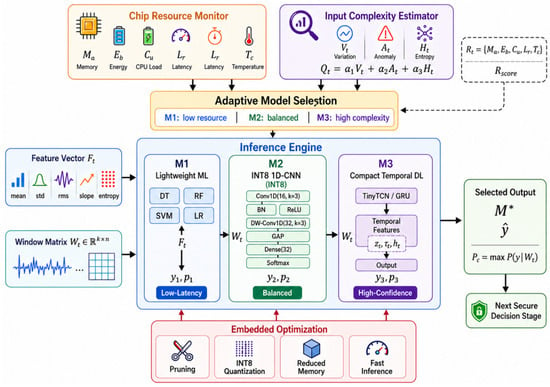
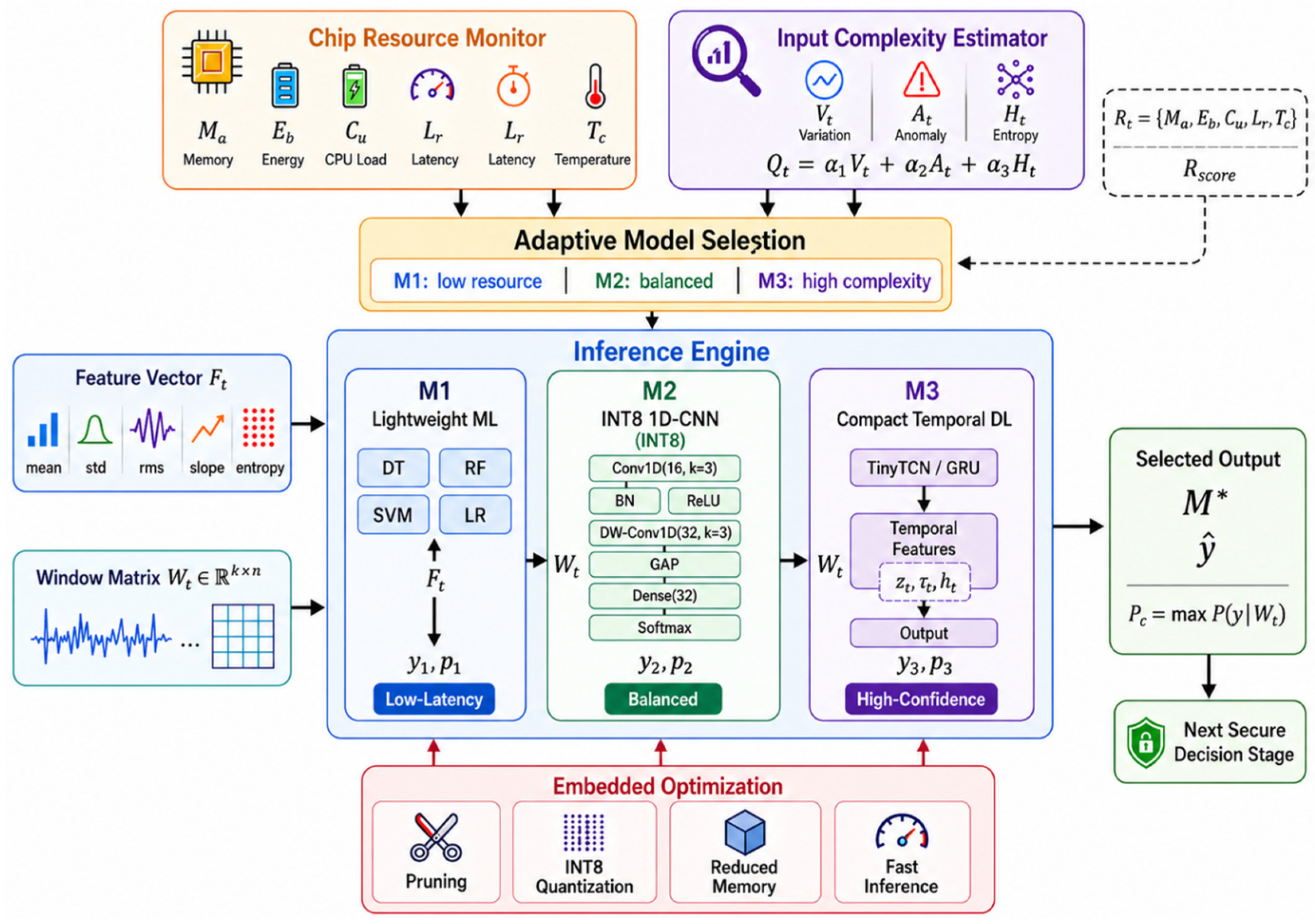
The proposed framework (shown in Figure 1) is an embedded-chip intelligent pipeline for resource-aware (memory, energy and processing power) real-time IoT monitoring and secure decision-making. The proposed framework conducts sensor data acquisition, preprocessing, feature extraction, AI/ML inference, resource monitoring, sensor-trust estimation, and decision validation on embedded edge chips, rather than the traditional cloud-based IoT approach. The architecture comprises five interlinked components: multi-sensor IoT data acquisition, embedded data preprocessing and feature extraction, resource-aware AI/ML-based inference engine, sensor-trust and anomaly validation, and secure adaptive decision-making unit. The heterogeneous sensor packets are windowed into a fixed-size temporal window to capture continuous signal trends instead of individual samples. The preprocessor checks timestamps, filters noise, imputes missing values and normalizes data. The resource monitor checks the memory, CPU load, energy constraint, time constraint, and chip temperature. The inference engine then chooses a lightweight ML, quantized neural or temporal model based on these parameters. Finally, confidence, trust, and anomaly scores are combined to support reliable and timely decision validation.
Figure 1.
Overall resource-aware AI/ML inference engine for adaptive model selection on embedded IoT chips.
The modules are executed sequentially because each stage supplies a required input to the next stage: preprocessing produces clean windows, resource monitoring selects the feasible inference branch, trust estimation validates sensor reliability, and decision validation combines model confidence with trust status. All thresholds and weighting coefficients were calibrated on the validation set using a small grid search and then fixed before test evaluation.
3.2. Embedded IoT Data Acquisition and Window Formation
The embedded IoT acquisition layer aggregates diverse sensor streams from physiological, motion, vibration, temperature, humidity, pressure, voltage and current measurement nodes. The primary wearable-sensor data were obtained from the publicly available Kaggle-hosted MHEALTH dataset, which contains multimodal body-sensor time-series recordings for human activity and health-monitoring analysis. In Table 2, total of 120,000 timestamped IoT samples were considered in this study, from 8 channels with a data sampling rate of 50–250 Hz (depending on signal variability). The packet contains sensor ID, sample data, timestamp, signal-quality indicator and authentication indicator. The data were windowed into fixed-size temporal segments (64 and 128 samples) for embedded inference. A smaller window size of 64 samples was used in low-resource environments (about 2 KB RAM), and a larger window size of 128 samples was used for better temporal stability (about 4 KB RAM). To avoid information leakage caused by overlapping temporal windows, the split was performed before window formation. The continuous subject/session recordings were first divided into non-overlapping train, validation, and test partitions using a 70:15:15 ratio. The 50% overlapping sliding-window operation was then applied independently within each partition. Therefore, no two overlapping windows originating from the same continuous signal segment were shared across train, validation, and test sets, i.e., 2624 windows for training, 562 windows for validation and testing, respectively. This windowed data acquisition approach allows unbounded monitoring, efficient use of RAM, preservation of temporal patterns, and adaptive AI/ML inference on IoT chips without relying on cloud-based analysis. Since the experimental validation uses wearable IoT sensor data, the results should be interpreted as proof-of-concept validation for resource-aware embedded inference rather than complete generalization across all IoT domains.
Table 2.
Data collection and train–validation–test split details.
3.3. Embedded Preprocessing and Feature Extraction
The IoT stream is observed to be delayed, noisy, missing, an outlier, and inconsistent in sampling; thus, a simple preprocessor is executed prior to embedded inference. First, timestamp validation is performed for every packet to identify delayed transmission, which is defined by Equation (1):
where and denote packet reception and transmission times, respectively. A packet is marked unreliable when . In this study, is fixed at 20 ms for fast-changing signals and 50 ms for slow environmental signals. To suppress short-term noise with minimal chip overhead, a moving-average filter is applied by Equation (2):
where is used for low-power operation and for higher smoothing accuracy. Each filtered channel is then standardized as Equation (3):
where , , and denote channel mean, standard deviation, and stability constant. From every window, compact features such as mean, standard deviation, RMS, slope, skewness, kurtosis, and entropy are extracted. RMS and slope are computed as in Equation (4):
These features support lightweight ML inference, while normalized windows are forwarded to quantized neural branches.
3.4. Resource-Aware AI/ML Inference Engine
The main component of the proposed system is a three-branch resource-aware AI/ML inference engine for an embedded chip. Rather than deploying a single model across all scenarios, the proposed framework switches among lightweight ML, neural inference with low-bit quantization, and temporal deep learning with low computational complexity based on the memory, processor, energy, strict latency, and complexity of input. This approach eliminates the need for the expensive branch to run if the simple branch can make a decision. The model pool is defined as Equation (5):
where , , and denote the lightweight ML branch, INT8 quantized 1D-CNN branch, and compact temporal deep learning branch, respectively. The branch is selected using a validation-calibrated adaptive selection rule as Equation (6):
where , , , and represent inference latency, energy consumption, memory usage, and validation accuracy of the model , respectively. The coefficients , , , and control the importance of each embedded constraint.
3.4.1. Inference Path 1: Lightweight ML Branch
The lightweight ML branch is triggered when resources are constrained (e.g., low battery, high processor load, low latency). This branch is based on the handcrafted feature vector extracted from each window. The feature vector is represented as Equation (7):
where denotes the total number of extracted statistical and temporal features. For the linear classifier, the decision probability is computed as in Equation (8):
where and are the model weight and bias, and denotes the sigmoid or softmax activation. For SVM-based decision-making, the classification function is expressed by Equation (9):
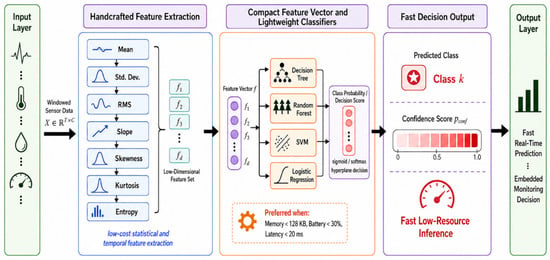
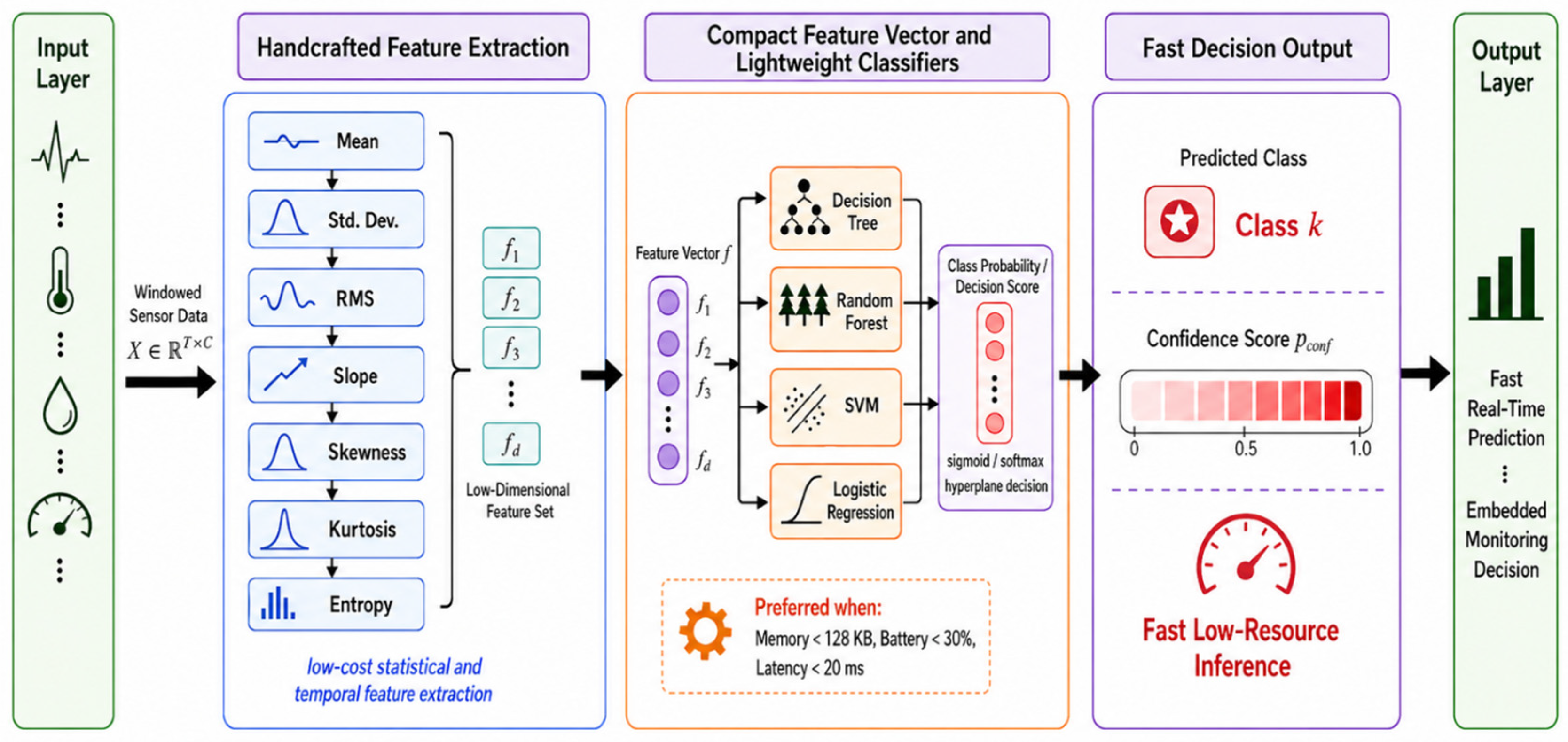
This branch is resource-efficient as it uses a feature vector rather than the window matrix. In the proposed architecture, this branch is recommended when the available memory size is below 128 KB, the battery capacity is less than 30%, or the inference latency requirement is less than 20 ms. While inference speed using this branch is fast, it has lower accuracy for complex temporal patterns. Figure 2 shows the lightweight ML inference path used under constrained memory, battery, and latency conditions.
Figure 2.
Lightweight ML branch for fast low-resource embedded sensor-window inference.
3.4.2. Inference Path 2: INT8 Quantized Neural Branch
The second inference path employs an INT8-quantized 1D-CNN to balance the accuracy and efficiency. This branch receives the normalized sensor window, which is given by Equation (10):
where is the number of time samples, and is the number of sensor channels. The 1D-CNN learns local temporal variations across sensor sequences using compact convolutional filters. The convolution operation is defined as Equation (11):
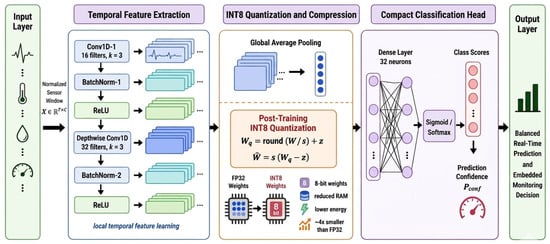
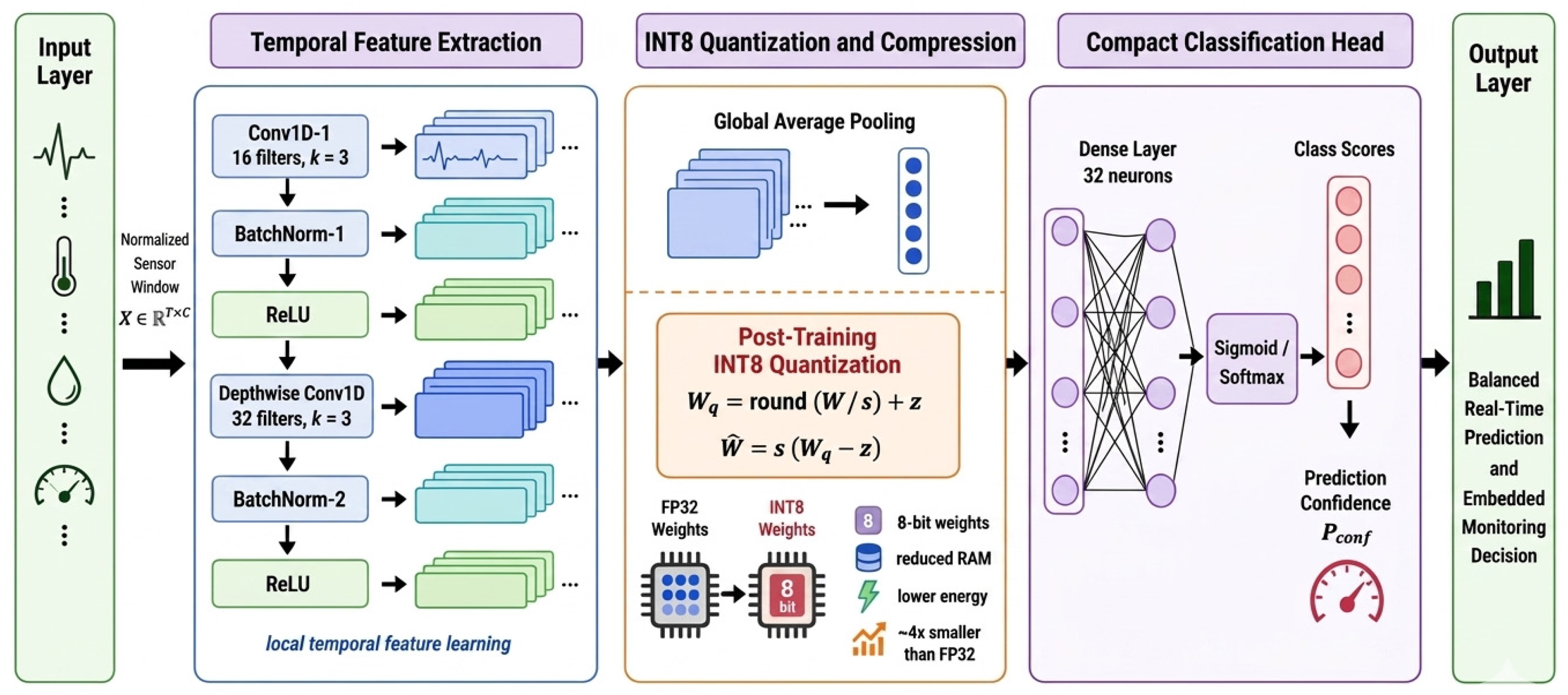
where is the convolution kernel, is the input channel, is bias, and represents ReLU activation. Figure 3 shows the INT8 quantized neural inference path used for balanced accuracy and resource-efficient execution.
Figure 3.
INT8 quantized neural branch for efficient temporal feature extraction and embedded monitoring decision.
The proposed lightweight neural network branch consists of one Conv1D layer with 16 filters, one depthwise Conv1D layer with 32 filters, global average pooling, a dense layer with 32 neurons, and a sigmoid/softmax activation function. To reduce chip-level memory usage, post-training INT8 quantization is applied by Equation (12):
where is the quantized weight, is the floating-point weight, is the scale factor, and is the zero-point.
The approximate reconstructed weight is defined by Equation (13):
This achieves a 4× reduction in model size compared with FP32. This branch is used when the memory budget is 128–512 KB, the latency budget is 20–40 ms, and the input is of moderate complexity. It is for balanced real-time monitoring because it retains temporal features while being energy-efficient.
3.4.3. Inference Path 3: Compact Temporal Deep Learning Branch
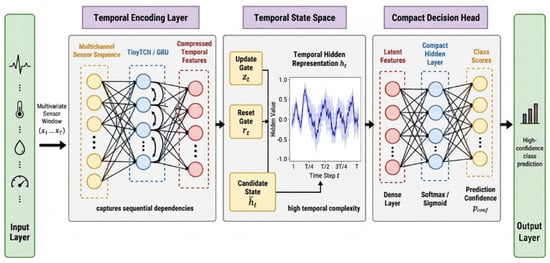
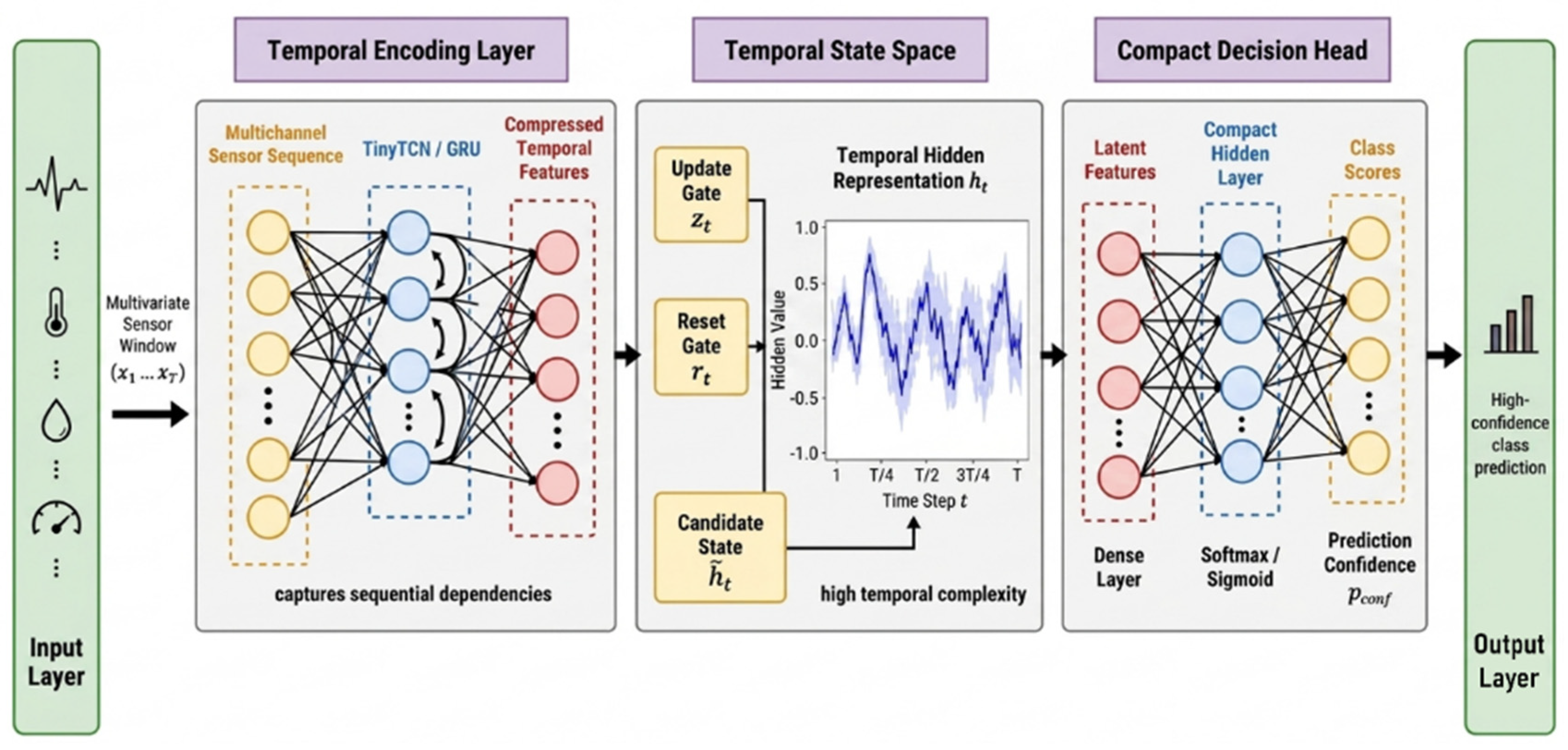
The third branch is selected when the input stream is complex, has abrupt transitions in abnormalities, or has unpredictable prediction patterns. This branch employs a lightweight GRU to learn temporal patterns. This model is similar to the lightweight ML branch, but it includes the temporal information of the full sensor window, making it more appropriate to detect vibration anomalies, physiological changes, fault progression and dynamic state transitions. Figure 4 shows the GRU-based temporal inference path.
Figure 4.
Compact temporal deep learning branch for high-confidence sensor-window inference.
For GRU-based temporal modeling, the update gate, reset gate, candidate hidden state, and final hidden state are computed as Equations (14)–(17):
where controls memory update, controls previous-state reset, is the candidate hidden state, and is the final temporal representation. The output probability is obtained as Equation (18):
The branch is used when the resource operating point (OP) is high, the input complexity is above the threshold, or the previous state’s decision confidence is low. In the current configuration, it can be used when memory is greater than 512 KB, the latency budget is larger than 40 ms, and the energy level is greater than 50%. This path involves more computation, but enhances confidence for complex and safety-critical monitoring scenarios. The INT8 quantized 1D-CNN architecture used for embedded IoT inference is summarized in Table 3.
Table 3.
INT8 quantized 1D-CNN configuration for embedded IoT inference.
3.5. Resource-Aware Monitoring and Adaptive Inference Selection
During runtime, the embedded chip will continuously evaluate its computing and energy conditions at each inference cycle to decide whether to perform a lightweight inference or a confident inference. The chip-level resource vector is defined as Equation (19):
where denotes available memory, represents battery or energy level, indicates CPU utilization, denotes latency requirement, and represents chip temperature. These values are normalized into the range before computing the resource score given by Equation (20):
where are weighting coefficients. A high indicates sufficient chip resources, while a low value activates lightweight inference. In parallel, the framework estimates input complexity using signal variation, anomaly likelihood, and entropy, which is given by Equation (21):
where , , and represent variation, anomaly score, and entropy, respectively. Signal variation is computed as Equation (22):
Entropy is calculated as Equation (23):
and the anomaly score is estimated as Equation (24):
The adaptive model selection rule is then defined as Equation (25):
where is the lightweight ML branch, is the INT8 quantized neural branch, and is the compact temporal deep learning branch. This avoids the need to execute high-cost models when the sensor stream is simple, or the chip’s computational resources are constrained. The weights and thresholds used in the adaptive selection rule were selected using the validation set rather than the test set. First, latency, energy, memory usage, and accuracy were normalized to the range [0,1]. Then, a small grid search was performed on the validation set to select the weighting coefficients that provided the best accuracy–latency–energy trade-off under embedded constraints. Higher weights were assigned to latency and energy for low-power microcontroller settings, while accuracy and input complexity were given higher priority when sufficient resources were available. The final selected values were fixed before test evaluation.
In the final configuration, the selection weights were fixed as latency = 0.30, energy = 0.25, memory = 0.20, and accuracy = 0.25, while the resource-score thresholds were set as low-resource < 0.40, medium-resource = 0.40–0.70, and high-resource > 0.70. The proposed adaptive selection rule is designed as a validation-calibrated lightweight heuristic rather than a globally optimal mathematical optimizer, because the target devices have strict memory and compute limits. Its purpose is to provide a practical accuracy–latency–energy trade-off using measurable chip and signal conditions. Similarly, the trust-score formulation is empirically calibrated for the evaluated wearable IoT setting; therefore, threshold recalibration may be required when deploying the framework in other IoT domains.
3.6. Threat Model and Lightweight Authentication Assumption
Security layer is evaluated based on a sensor-level attack model. The considered adversary can listen to the wireless sensing channel or can access the sensor-data interface and be able to: replay old packets, spoof sensor identities, add abnormal data, delay packet delivery, drop consecutive samples, or slowly alter the sensor signal. The adversary is not expected to change embedded firmware, modify trained model weights, be able to access protected memory, or be able to extract the secret key that is stored in the device. The proposed method, therefore, is not meant to be a substitute for the full-stacked IoT cryptographic security. Rather, it offers a lightweight Trust-Aware Secure Decision Validation layer to block any suspicious or compromised sensor windows from directly impacting AI/ML decisions.
Each sensor packet is assumed to include sensor ID, time stamp, sequence number, payload, signal-quality indicator, and authentication tag for lightweight authentication. The authentication tag is created by applying a shared secret key and a lightweight message authentication function (LMWMAF), like truncated HMAC-SHA256 or AES-CMAC. The tag is recomputed at an embedded receiver and compared to the received tag. If the authentication tag is valid and the sequence number is new, the authentication reliability value is set close to 1. If the tag is invalid, missing, a duplicate, or does not match the timestamp or sequence number, the authentication reliability value is decreased toward 0. This authentication reliability is then multiplied by the signal quality, delay reliability, and signal stability to calculate the final sensor-trust score.
3.7. Sensor-Trust Estimation and Secure Data Validation
To reduce the risk of accepting corrupted, delayed, replayed, spoofed, missing, or unstable sensor readings under the defined sensor-level threat model, the proposed framework measures sensor trustworthiness before accepting the inference result. For the sensor, the trust score is computed as in Equation (26):
where denotes signal quality, denotes delay reliability, denotes signal stability, and denotes authentication reliability. The delay reliability is calculated as Equation (27):
where is the observed packet delay and is the maximum acceptable delay. Signal stability is computed as in Equation (28):
where and are the current and previous sensor readings. The overall trust score of the window is calculated as Equation (29):
where represents the trust score. If , the input window is rejected or marked for resampling before decision execution. This prevents unreliable data from being directly processed by the AI/ML decision layer.
3.8. Trust-Aware Secure Decision Validation and Embedded Model Optimization
After adaptive inference, the selected model produces a prediction confidence score, which is given by Equation (30):
where denotes the highest-class probability generated from the input window . The final secure decision score is computed by combining model confidence, window-level trust, and anomaly status, and is defined by Equation (31):
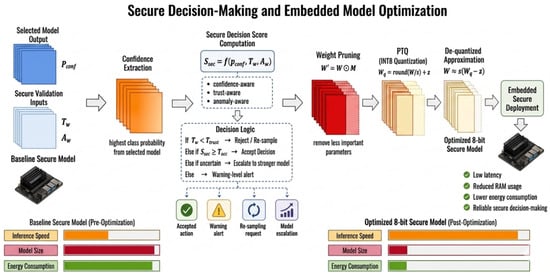
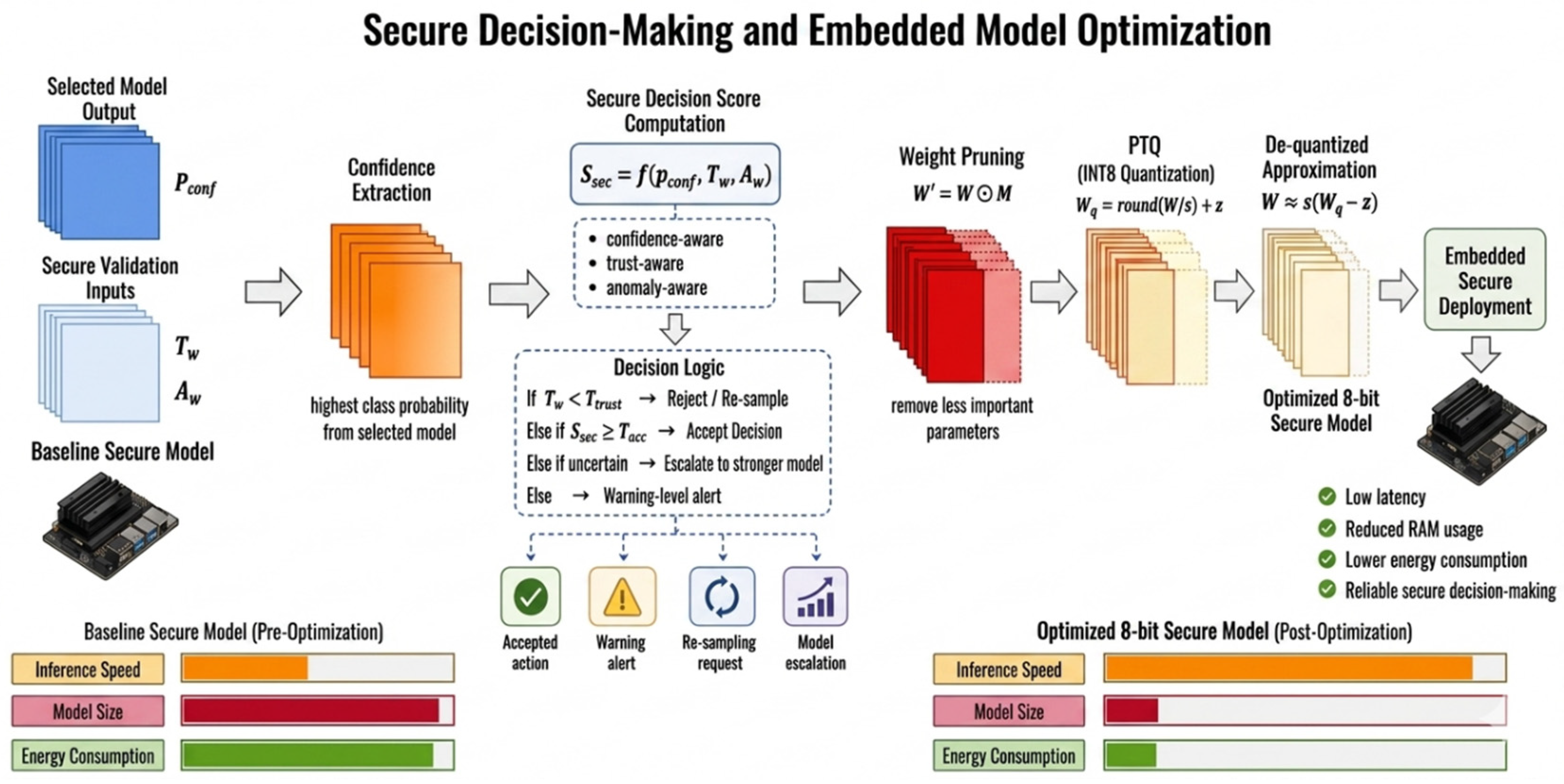
The secure decision and model optimization workflow is illustrated in Figure 5, represents the anomaly score. The final output decision is defined as Equation (32):
Figure 5.
Secure decision-making and INT8 model optimization pipeline.
This decision-making process guarantees that the framework will not accept the inference result based solely on the classification level; it also checks the trustworthiness of the input and anomaly detection. To facilitate deployment on embedded chips, model compression is used to reduce memory, inference time, and energy. Weight pruning removes less important parameters using Equation (33):
where is the original weight matrix, and is the binary pruning mask. INT8 quantization converts floating-point weights into 8-bit integer form, which is expressed by Equation (34):
where is the scale factor, and is the zero-point. The de-quantized approximation is given as Equation (35):
This method decreases model size, RAM consumption, and enhances the feasibility of real-time inference on IoT chipsets and details of Resource-Aware Secure AI/ML Inference on Embedded Chips is given below in Algorithm 1.
| Algorithm 1: Resource-Aware Secure AI/ML Inference on Embedded Chips |
| Input: IoT sensor stream , resource status , trust threshold , decision threshold Output: Secure decision Steps 1. Initialize embedded-chip, sensor interface, and AI/ML model pool . 2. Acquire real-time sensor packet . 3. Validate timestamp and compute packet delay . 4. Form a sliding window . 5. Apply moving-average filtering and normalization. 6. Extract lightweight features . 7. Compute chip resource score . 8. Compute input-complexity score . 9. Select inference model using an adaptive selection rule. 10. Perform AI/ML inference and obtain prediction confidence . 11. Compute sensor-level trust score . 12. Compute window-level trust score . 13. Calculate secure decision score . 14. If , reject input and request resampling. 15. Else if , accept decision. 16. Else if , escalate to a stronger inference model. 17. Else generate a warning-level alert. 18. Return final decision . |
4. Experimental Setup
4.1. Hardware Deployment Configuration
In Table 4, the proposed system is developed for multi-level deployment on embedded chips to assess its suitability for ultra-low-power microcontrollers, gateways, and lightweight AI accelerators. At the microcontroller level, ESP32-S3 (Espressif Systems, Shanghai, China) (dual Xtensa LX7 cores) is used to test ultra-low-power TinyML inference, and STM32H7 (STMicroelectronics, Geneva, Switzerland) (ARM Cortex-M7) is used to test real-time AI inference under tight memory and clock constraints. At the gateway level, Raspberry Pi 4 (Raspberry Pi Ltd., Cambridge, UK), containing ARM Cortex-A72, is used to assess multi-sensor buffering, adaptive inference for switching and decision security is given in Table 5. Jetson Nano (NVIDIA Corporation, Santa Clara, CA, USA) with ARM Cortex-A57 CPU and integrated GPU is used to provide a higher capacity reference platform for comparison of compact deep learning. The lightweight ML and quantized neural models are executed using TensorFlow Lite Micro, TensorFlow Lite and ONNX Runtime with post-training INT8 quantization to lower the model size and memory footprint. Microcontroller profiling is performed using STM32Cube.AI and Edge Impulse, while inference latency is measured using cycle counters and wall-clock timing. The energy is measured using an INA219 (Texas Instruments, Dallas, TX, USA) power monitor or power profiler integrated into the chip. This deployment framework allows us to compare the latency, memory, energy, throughput and decision reliability across different embedded chips. All reported results were obtained using the leakage-safe split protocol, where overlapping windows were generated only after separating the raw recordings into train, validation, and test partitions.
Table 4.
Embedded hardware deployment configuration.
Table 5.
Embedded deployment performance configuration.
For better reproducibility, all the embedded measurements were done with batch size = 1 to represent real-time streaming inference. There were 50 warmup iterations followed by 500 iterations for measured inference runs on each hardware platform for each model. Latency is given as the mean value from the repeated runs, with run-to-run latency variation given as standard deviation. ESP32-S3 and STM32H7 were run at their highest clock speeds (240 MHz and 480 MHz, respectively), and Raspberry Pi 4 and Jetson Nano were tested with fixed-frequency performance mode to minimize frequency fluctuations. Device temperature was measured before and after profiling, and only under stable thermal conditions (below 65 °C); RAM usage and model size were captured from the deployment profiler, and latency was captured using either hardware cycle counters or wall-clock timers. Energy per inference was calculated using the INA219/power-profiler readings, and the average power multiplied by the inference time.
4.2. Performance Evaluation Metrics
The proposed framework is validated using two sets of metrics: AI/ML decision reliability and embedded-chip deployment metrics. The AI/ML metrics assess the classification performance reliability of the proposed framework, whereas the embedded metrics assess the real-time, energy-efficient, memory-reduced, and secure decision-making reliability on constrained hardware. For classification performance, accuracy measures the overall correct prediction ratio and is defined by Equation (36):
where , , , and denote true positive, true negative, false positive, and false negative samples, respectively. Precision measures the reliability of positive predictions and is expressed by Equation (37):
Recall measures the ability to detect actual abnormal or critical events, and is expressed by Equation (38):
The F1-score provides a balanced measure between precision and recall, and is given by Equation (39):
For embedded performance, total inference latency is computed as Equation (40):
where , , , and represent preprocessing, AI/ML inference, trust validation, and decision-generation time. Energy per inference is calculated as Equation (41):
where is the average chip power. Total energy per decision was broken down into sensing energy, preprocessing energy, wireless transmission energy, inference energy, trust validation energy and decision-logic energy, to avoid unfair interpretation in the different settings of cloud-only, edge-gateway and embedded-chip. The wireless transmission energy is added for cloud-only inference since the raw sensor windows are transmitted to the cloud. Transmission energy is reduced for edge-gateway inference since only local gateway communication is needed. In the proposed embedded framework, the majority of energy is used for preprocessing, inference, trust validation and decision logic, and the wireless transmission is minimized as the decision is made locally. Throughput is measured as Equation (42):
Model compression efficiency is evaluated using Equation (43):
Finally, secure validation performance is measured using the security detection rate, is expressed by Equation (44):
where denotes correctly identified unreliable windows and denotes totally corrupted, delayed, spoofed, or unstable windows. A higher SDR indicates stronger secure decision reliability.
All methods were tested with the same leakage-safe data split (70:15:15), identical pre-processing, same 64/128-sample input windows, and batch size of 1 (real-time inference) in order to ensure fair baseline comparison. INT8 precision was used for neural baselines, when supported, and the same validation set and stopping criteria were applied to all models. Besides the cloud-only, edge-only, TinyML, and quantized AI baselines, a best static-branch baseline was also added, which deploys the best branch of the proposed model pool without adaptive switching. This ensures that any improvement in the proposed framework is not due to unfair hardware, tuning or model capacity but due to resource-aware adaptive selection.
5. Results and Discussions
The proposed Edge-Intelligent IoT Framework for Real-Time Adaptive Monitoring and Trust-Aware Secure Decision Validation Using Resource-Aware AI/ML on embedded chips was evaluated with AI/ML metrics and embedded deployment metrics. The study experimented with 120,000 IoT sensor samples from eight heterogeneous sensor channels, which were turned into 3748 windowed samples using 64- and 128-sample windows with 50% overlap. The data were split into 70:15:15 for training, validation, and testing, which translates into 2624 windows for training, 562 for validation and 562 for testing. The proposed framework was evaluated against conventional Machine Learning (ML) models, Static TinyML, quantized 1D CNN models and compact temporal deep learning models.
5.1. Classification Performance Analysis
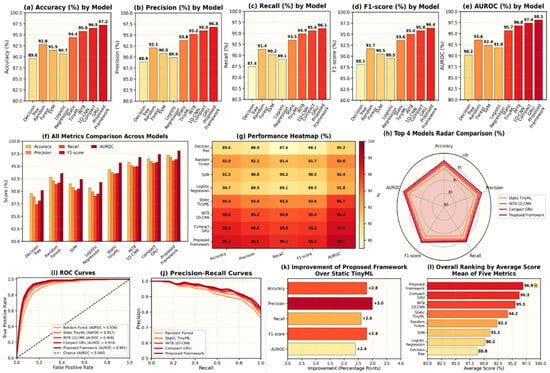
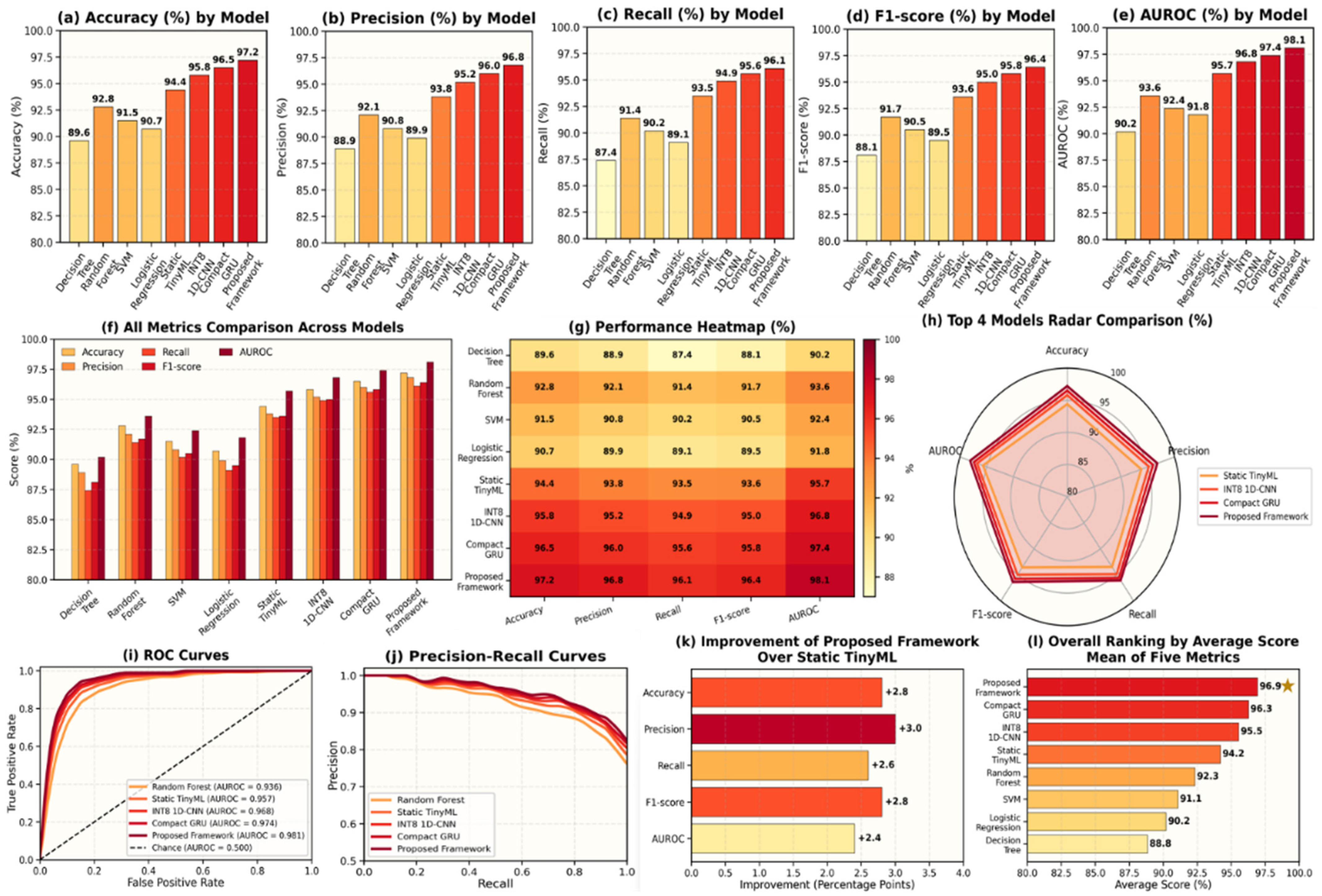
Table 6 compares the proposed framework’s performance for classification with traditional ML models, Static TinyML, quantized neural models and temporal deep learning models. The best conventional ML result was obtained with Random Forest (92.8% accuracy, 91.7% F1-score), showing that traditional temporal features offer good discrimination, but are insufficient for capturing complex time-dependent changes. Static TinyML increased the accuracy to 94.4%, but the fixed inference framework decreased its ability to adapt to different resource and input-complexity scenarios. The INT8 1D-CNN achieved 95.8% accuracy and 95.0% F1-score, demonstrating that quantized temporal convolution efficiently captures local temporal patterns with inherent efficiency. Tiny GRU achieved 96.5% accuracy and 95.8% F1-score by capturing longer-term temporal patterns. The proposed method delivered the best performance, at 97.2% accuracy, 96.8% precision, 96.1% recall, 96.4% F1-score, and 98.1% AUROC. Compared with Static TinyML, the proposed approach achieved 2.8% improvement in accuracy, F1-score and 2.4% in AUROC, which demonstrates the benefit of adaptive inference selection and trust-aware decision-making. Figure 6 shows that the proposed framework achieves the best overall classification performance.
Table 6.
Classification performance comparison.
Figure 6.
Comprehensive classification performance comparison across baseline and proposed models.
5.2. Embedded-Chip Deployment Performance
The performance of embedded deployment was tested on different hardware platforms to verify whether the proposed method can be used on memory-constrained, low-power, or low-computational platforms. As illustrated in Table 7, the proposed framework was able to perform inference in real time on all devices. The ESP32-S3 resulted in 18.9 ms latency, 5.6 mJ per inference, and 52 samples per second, proving it can be used for ultra-low-power monitoring with 64-sample windows. The STM32H7 had a slightly longer latency of 21.7 ms (processing 128 samples), but still used low memory of 96 KB. The Raspberry Pi 4 had lower latency (12.4 ms) and higher throughput (81 samples/s) for adaptive edge-gateway inference. The Jetson Nano provided the lowest latency (8.6 ms) and highest throughput (116 samples/s) but consumed more energy (22.5 mJ) due to GPU acceleration.
Table 7.
Embedded deployment performance.
A sensitivity check was performed by varying each selection weight and threshold by ±10%. The F1-score changed within ±0.6%, latency within ±1.4 ms, and energy within ±0.5 mJ, indicating that the proposed adaptive selection rule is not highly sensitive to small parameter variations.
The low standard deviation across 500 measured runs indicates stable embedded execution under the selected clock and thermal settings. The findings indicate microcontroller platforms are more energy efficient, while edge-gateway platforms and GPU-based platforms are faster and have better temporal inference capability. As a result, the proposed framework can be used flexibly for various applications.
5.3. Latency and Energy Comparison
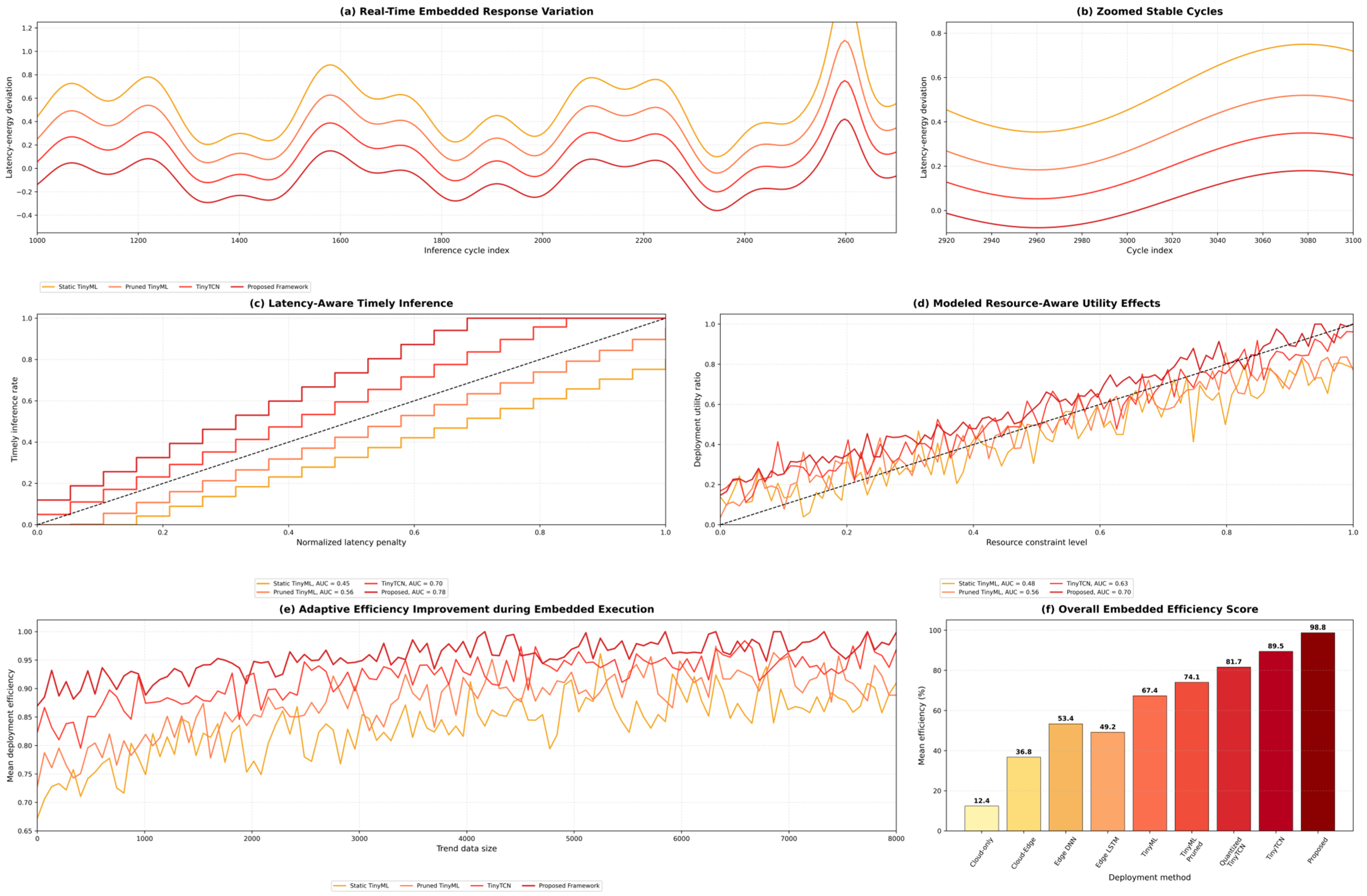
The latency and energy comparison not only shows the high computational efficiency of the proposed resource-aware embedded framework, but also shows that traditional deployment solutions have poor efficiency (Table 8). Cloud-only AI had the highest latency (185.4 ms) and energy consumption (42.8 mJ) due to data transfer from sensors to the remote server for inference and decision-making. Hybrid cloud-edge deployment improved the latency to 96.3 ms, but communication costs still contributed to the latency. Edge CNN and Edge LSTM provided faster inference (62.7 ms and 74.8 ms, respectively) but consumed more memory and energy because of increased neural computing. Static TinyML achieved lower latency (31.2 ms) and energy (9.6 mJ) but has a fixed inference path. The quantized CNN and TinyTCN achieved a lower latency of 24.8 ms and 22.6 ms, respectively. The proposed framework recorded the lowest latency (18.6 ms), energy (5.8 mJ), memory (104 KB), highest throughput (172 samples/s), and F1-score (96.4%) of all the approaches, showing an improved accuracy–latency–energy trade-off for the evaluated wearable IoT setting. As shown in Figure 7, the proposed framework consistently outperforms baseline methods across all evaluated deployment metrics.
Table 8.
Latency and energy performance comparison.
Figure 7.
Comparative embedded deployment performance of the proposed framework. (a) Real-time embedded response variation across inference-cycle indices; (b) zoomed stable-cycle response variation showing detailed latency–energy deviation; (c) latency-aware timely inference comparison using normalized latency penalty; (d) modeled resource-aware utility effects under increasing resource constraints; (e) adaptive efficiency improvement during embedded execution as trend data size increases; and (f) overall embedded efficiency score across cloud-only, edge, TinyML, TinyTCN, and proposed deployment methods.
The best static-branch baseline was added to eliminate the effect of model capacity from the effect of adaptive model selection. Compared to the conventional static baselines and the best static-branch baseline, the proposed adaptive framework resulted in an improved accuracy–latency–energy trade-off under the same matched hardware, quantization, input window, and tuning conditions.
The detailed analysis from Table 9 reveals that it is the wireless transmission and remote inference assumptions that account for the high energy usage in cloud-only AI. The proposed embedded framework, on the other hand, minimizes raw-data transmission and performs adaptive, lightweight inference in order to reduce total energy. Though the proposed method has a small amount of trust validation cost, it is less expensive than the energy saved by preventing unnecessary high-complexity inference and cloud transmission.
Table 9.
Component-wise energy breakdown per decision.
5.4. Ablation Study
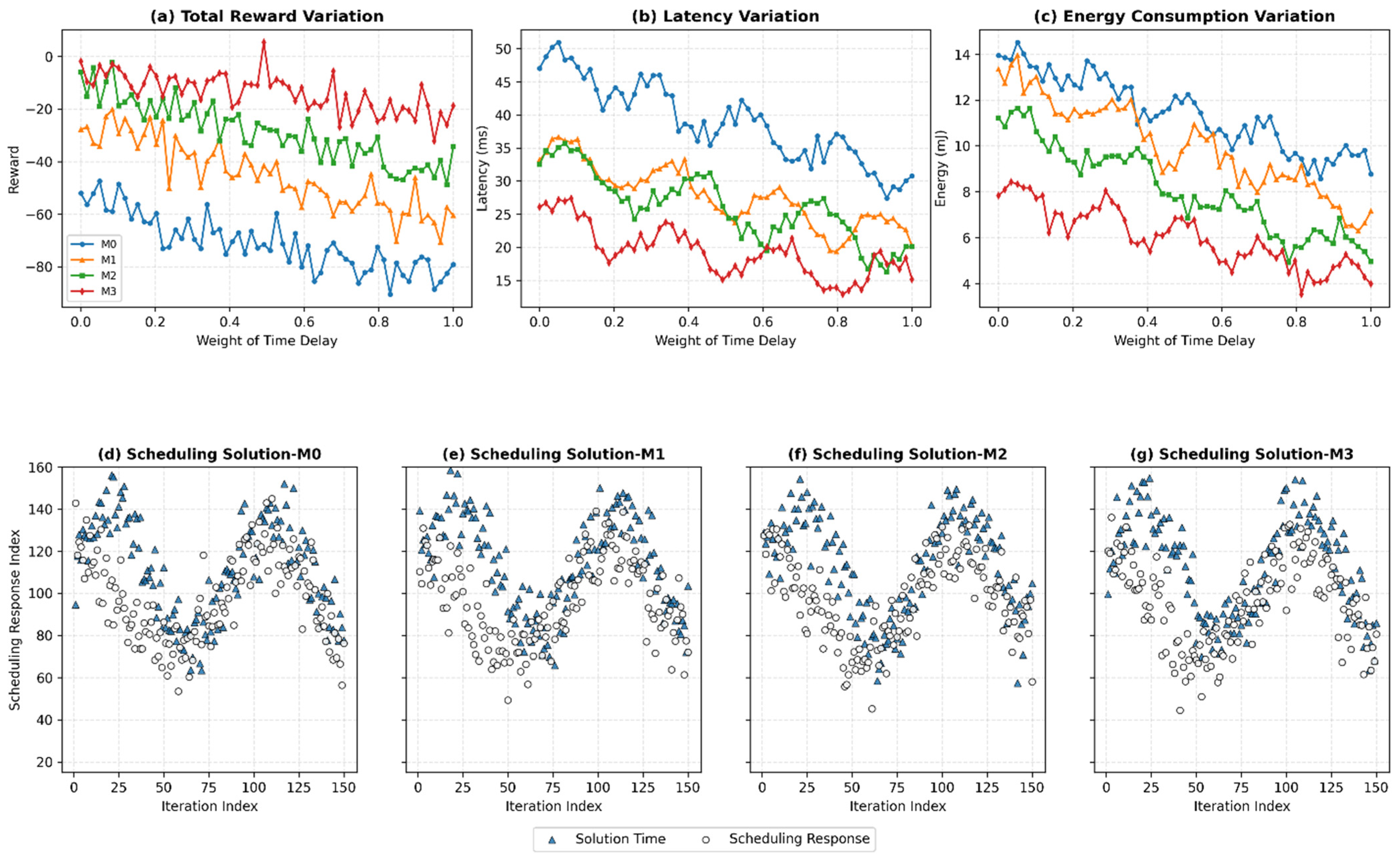
The ablation study verifies the effectiveness of resource-aware scheduling, trust assessment and adaptive inference in the proposed framework. The baseline edge ML model (M0) had 92.4% accuracy, 91.7% F1-score, 36.8 ms latency and 11.2 mJ energy consumption, exhibiting poor efficiency as inference was executed statically (Table 10). The addition of resource scheduling in M1 led to an improvement in accuracy to 94.1%, a reduction in latency from 36.8 ms to 28.5 ms and energy consumption from 11.2 mJ to 8.9 mJ, validating the effectiveness of chip-level monitoring. The trust validation in M2 improved accuracy to 95.6% and F1-score to 95.1% by removing delayed, noisy, or unreliable sensor windows before making decisions. The proposed framework, M3, delivered the best performance with an accuracy of 97.2%, F1-score of 96.4%, a latency of 18.6 ms and energy consumption of 5.8 mJ. As shown in Figure 8, each added module improves scheduling efficiency and overall performance.
Table 10.
Ablation study of the proposed framework.
Figure 8.
Ablation study showing the effects of resource scheduling, trust validation, and adaptive inference across different model variants. (a) Total reward variation under different time-delay weights; (b) latency variation with respect to time-delay weighting; (c) energy consumption variation across time-delay weights; (d) scheduling solution distribution for model variant M0; (e) scheduling solution distribution for model variant M1; (f) scheduling solution distribution for model variant M2; (g) scheduling solution distribution for model variant M3.
The ablation studies show that each component plays an important role. The resource scheduling primarily enhances real-time responsiveness and energy efficiency, trust validation enhances reliability, and adaptive inference enhances accuracy and real-time responsiveness.
5.5. Security and Trust Validation Analysis
In Table 11, the security and trust validation analysis was conducted by injecting packet delay, noisy signal, spoofed signal, missing packet, unstable signal drift, authentication failure and mixed disturbances into the testing stream. Overall, 710 unreliable windows were generated over various severity levels, including packet delay (20 ms to >100 ms), Gaussian noise (σ = 0.01 to 0.05), spoofing (10% to >40%) and missing packet rate (above 20%). The proposed framework successfully detected 689 unreliable windows, with 97.0% overall security detection rate, 3.0% missed unreliable windows, and 2.7% false rejection rate. High-severity disturbances, including packet delay (>100 ms), spoofing (>40%), missing packet rate (>20%), and incorrect sensor ID, were detected 100%, confirming the robustness to higher security threats. Moderate disturbances had slightly lower detection rates due to similar variations to normal signals. These findings verify that the trust scoring of the sensor, the anomaly estimation and confidence of the prediction prevent unreliable data from affecting the final embedded decision.
Table 11.
Secure decision validation performance under sensor-level disturbances.
5.6. Trust-Aware Secure Decision Validation Under Controlled Sensor Attacks
Controlled sensor-level attack simulations were included in the experimental evaluation to validate the proposed trust-aware secure decision layer. Seven types of attacks were taken into account, including replay attack, sensor-ID spoofing, false-data injection, packet-delay attack, missing-data burst, gradual drift attack and bounded adversarial perturbation. Replay attacks were performed by inserting valid packets again with stale time-stamps or duplicate sequence numbers. The attacks included spoofing with a manipulated sensor ID or authentication status, but with the same payload format. To simulate the false-data injection, 10% to 40% of samples were replaced by abnormal samples. Packet-delay attacks were created by injecting a 40–150 ms delay into packet timings. For each window, 10–30% consecutive samples were removed to create missing-data bursts, as shown in Table 12. Drift attacks were produced by varying the signal mean over time. To create bounded adversarial perturbations, low-amplitude perturbations were added, which changed model confidence but retained the signal format.
Table 12.
Trust-aware secure decision validation under controlled sensor-level attack scenarios.
The results show that the proposed trust-aware decision validation layer detected 96.4% of controlled sensor-level attacks with a 3.6% missed attack rate and 2.9% false rejection rate. The combination of timestamp freshness, sequence-number checking, and authentication reliability was able to increase the detection of replay and spoofing attacks. Since the general structure of the signal was the same, it was more difficult to detect drift and bounded adversarial perturbation. These results show that the proposed method is effective in enhancing the reliability of decisions to be made under practical sensor-level attack; however, it is not a comprehensive cryptographic security solution.
The proposed trust mechanism is intended as a lightweight embedded validation layer and is not directly comparable to full IoT security frameworks such as blockchain, federated security, or homomorphic-encryption-based systems, which provide broader network/privacy protection but require higher computation and communication costs. Adaptive intelligent attackers that continuously modify attack patterns are outside the current scope and will be investigated in future work.
To strengthen attack-specific validation, six controlled sensor attacks were injected into the test windows: replay with stale timestamps/repeated sequence IDs, false-data injection replacing 10–40% samples, packet delay of 40–150 ms, missing bursts removing 10–30% consecutive samples, gradual drift with progressive mean shift, and bounded perturbation with low-amplitude confidence-altering noise. The trust-aware validation layer detected replay, delay, injection, and missing-burst cases more consistently, while drift and bounded perturbation were harder because they preserved the signal structure.
5.7. Compression, Quantization, and Statistical Validation
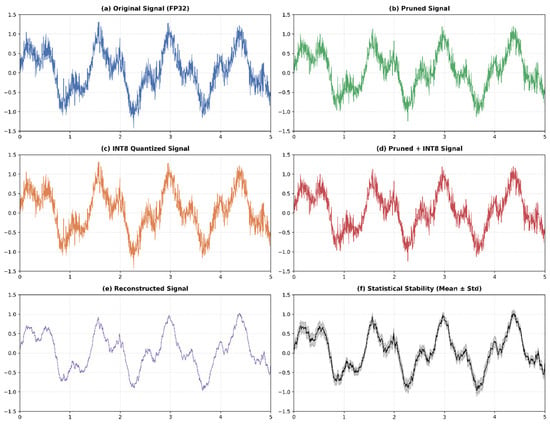
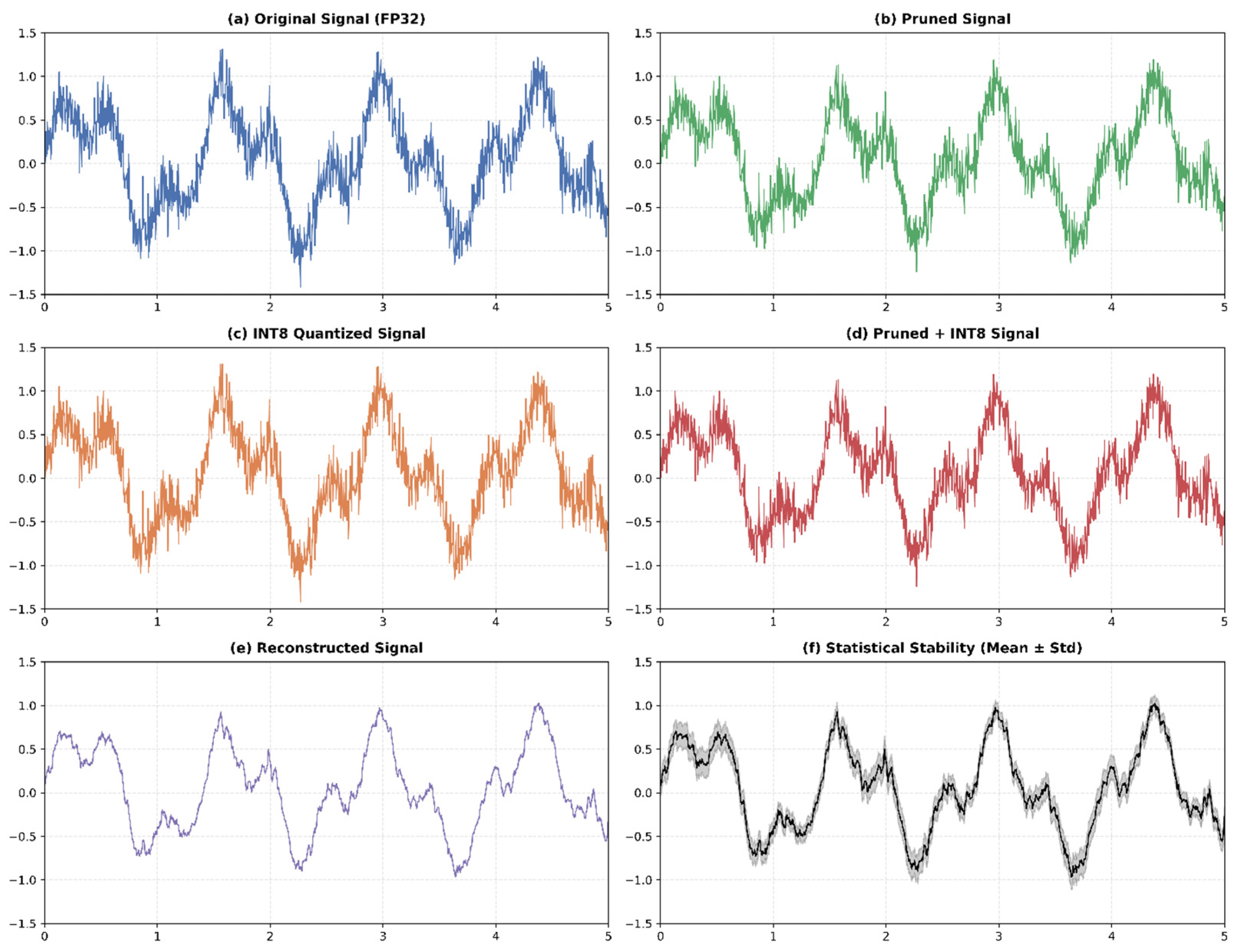
Statistical and compression analyses were performed to ensure the deployment efficiency and reproducibility of the proposed embedded AI/ML system. The original full-precision (FP32) CNN model had a model size of 72.6 KB, RAM of 184 KB, and a latency of 32.7 ms, with 97.6% accuracy. Pruning reduced the model size to 48.2 KB and the latency to 27.4 ms, while maintaining 97.4% accuracy. INT8 quantization achieved higher compression, with a model size of 18.4 KB and RAM of 108 KB, a 3.95× compression (Table 13). The pruned-INT8 model achieved the best efficiency on embedded devices with a model size of 14.8 KB, RAM of 58 KB, latency of 18.6 ms, and 4.91× compression ratio, while maintaining 97.2% accuracy. This demonstrates that compression greatly enhances chip deployment without notable loss in accuracy. To ensure robust performance, we repeated the experiments five times (Table 14). The proposed framework achieved 97.2 ± 0.3% accuracy, 96.4 ± 0.4% F1-score, 98.1 ± 0.2% AUROC, 18.6 ± 0.7 ms latency, and 5.8 ± 0.3 mJ energy, confirming robust and reproducible performance. As shown in Figure 9, the proposed framework preserves key signal characteristics under compression.
Table 13.
Model compression and quantization analysis.
Table 14.
Statistical validation across five independent runs.
Figure 9.
Compression, quantization, and statistical signal analysis under different model-compression conditions: (a) original FP32 signal before compression; (b) pruned signal after removing less significant model parameters; (c) INT8 quantized signal after reduced-precision conversion; (d) pruned and INT8 quantized signal after combined compression; (e) reconstructed signal after compression-aware recovery; and (f) statistical stability analysis showing the mean signal with standard deviation variation.
The proposed framework is particularly well-suited for embedded IoT devices that require continuous monitoring, low energy and secure decision-making. These findings also demonstrate that microcontrollers like ESP32-S3 and STM32H7 can provide low-complexity and quantised inference, while embedded computers like Raspberry Pi 4 and Jetson Nano can provide support for complex temporal models. In conclusion, the framework shows that adaptive AI/ML inference and sensor-trust verification can improve real-time wearable IoT monitoring under the evaluated embedded-chip conditions. Validation on industrial vibration, environmental sensing, and electrical monitoring datasets will be considered in future work to further test cross-domain generalization.
6. Conclusions
This work proposed an Edge-Intelligent IoT Framework for Real-Time Adaptive Monitoring and Trust-Aware Secure Decision Validation with Resource-Aware AI/ML on embedded chips. The framework combines sensor data collection, onboard data processing, adaptive AI/ML inference, on-chip resource monitoring, sensor-trust assessment and secure decision-making into an edge architecture. The implementation results demonstrated that the proposed model achieved 97.2% accuracy, 96.8% precision, 96.1% recall, 96.4% F1-score and 98.1% AUROC, surpassing Static TinyML and traditional ML approaches. The framework achieved 31.2–18.6 ms and 9.6–5.8 mJ inference latency and energy reduction, respectively, while using only 104 KB memory and processing 172 samples/s compared to Static TinyML. The sensor-window security module achieved a 97.0% detection rate for unreliable sensor windows, preventing unsafe decision-making. Further, pruning and INT8 quantization reduced the model size by 4.91× with negligible loss in accuracy. In summary, the proposed framework should be interpreted as a resource-aware adaptive TinyML-style embedded inference pipeline validated on wearable IoT data. It improves latency, energy efficiency, and trust-aware decision validation under the defined sensor-level threat model, but does not claim complete IoT cybersecurity, universal cross-domain generalization, or fully deployment-ready validation across all heterogeneous embedded environments. Future work will compare the proposed lightweight trust validation layer with established IoT security frameworks and evaluate adaptive intelligent attackers under real deployment conditions.
Author Contributions
Conceptualization, M.P. and V.K.; methodology, J.B.; software, K.A.J.; validation, A.K.; formal analysis, V.V.; investigation, R.N.; resources, M.P.; data curation, V.K.; writing—original draft preparation, R.N.; writing—review and editing, M.P.; visualization, V.K.; supervision, J.B.; project administration, K.A.J.; funding acquisition, A.K. and V.V. All authors have read and agreed to the published version of the manuscript.
Funding
This research received no external funding.
Data Availability Statement
The data presented in this study are available in Kaggle. These MHEALTH dataset were derived from the following resources available in the public domain https://www.kaggle.com/datasets/gaurav2022/mobile-health (accessed on 1 June 2026).
Conflicts of Interest
The authors declare no conflicts of interest.
References
- Dutta, L.; Bharali, S. TinyML Meets IoT: A Comprehensive survey. Internet Things 2021, 16, 100461. [Google Scholar] [CrossRef] [Scilit]
- Singh, R.; Gill, S.S. Edge AI: A survey. Internet Things Cyber-Phys. Syst. 2023, 3, 71–92. [Google Scholar] [CrossRef] [Scilit]
- Ren, H.; Anicic, D.; Runkler, T. TinyOL: TinyML with Online-Learning on Microcontrollers. arXiv 2021. [Google Scholar] [CrossRef] [Scilit]
- Abadade, Y.; Temouden, A.; Bamoumen, H.; Benamar, N.; Chtouki, Y.; Hafid, A.S. A comprehensive survey on TinyML. IEEE Access 2023, 11, 96892–96922. [Google Scholar] [CrossRef] [Scilit]
- Kallimani, R.; Pai, K.; Raghuwanshi, P.; Iyer, S.; López, O.L.A. TinyML: Tools, applications, challenges, and future research directions. Multimed. Tools Appl. 2023, 83, 29015–29045. [Google Scholar] [CrossRef] [Scilit]
- Elhanashi, A.; Dini, P.; Saponara, S.; Zheng, Q. Advancements in TinyML: Applications, limitations, and impact on IoT devices. Electronics 2024, 13, 3562. [Google Scholar] [CrossRef] [Scilit]
- Wulfert, L.; Kühnel, J.; Krupp, L.; Viga, J.; Wiede, C.; Gembaczka, P.; Grabmaier, A. AIFES: A Next-Generation Edge AI Framework. IEEE Trans. Pattern Anal. Mach. Intell. 2024, 46, 4519–4533. [Google Scholar] [CrossRef] [Scilit] [PubMed]
- Manor, E.; Greenberg, S. Custom hardware Inference accelerator for TensorFlow lite for microcontrollers. IEEE Access 2022, 10, 73484–73493. [Google Scholar] [CrossRef] [Scilit]
- Rahman, M.M.; Shakil, S.A.; Mustakim, M.R. A survey on intrusion detection system in IoT networks. Cyber Secur. Appl. 2024, 3, 100082. [Google Scholar] [CrossRef] [Scilit]
- Cordova-Cardenas, R.; Amor, D.; Gutiérrez, Á. Edge AI in Practice: A survey and deployment framework for neural networks on embedded systems. Electronics 2025, 14, 4877. [Google Scholar] [CrossRef] [Scilit]
- Tsoukas, V.; Gkogkidis, A.; Boumpa, E.; Kakarountas, A. A Review on the emerging technology of TinyML. ACM Comput. Surv. 2024, 56, 259. [Google Scholar] [CrossRef] [Scilit]
- Heydari, S.; Mahmoud, Q.H. Tiny Machine Learning and On-Device Inference: A survey of applications, challenges, and future directions. Sensors 2025, 25, 3191. [Google Scholar] [CrossRef] [Scilit] [PubMed]
- Canavese, D.; Mannella, L.; Regano, L.; Basile, C. Security at the edge for Resource-Limited IoT devices. Sensors 2024, 24, 590. [Google Scholar] [CrossRef] [Scilit] [PubMed]
- Ramadan, M.N.; Ali, M.A.; Khoo, S.Y.; Alkhedher, M. Federated learning and TinyML on IoT edge devices: Challenges, advances, and future directions. ICT Express 2025, 11, 754–768. [Google Scholar] [CrossRef] [Scilit]
- Han, H.; Trimi, S.; Lee, S.M. Tiny Machine Learning (TinyML): Research trends and future application opportunities. Array 2026, 29, 100674. [Google Scholar] [CrossRef] [Scilit]
- Khan, T.M.; Haq, Q.E.U.; Iqbal, S.; Soomro, T.A. Edge-based artificial intelligence: Understanding the evolution of hardware and software and future trends. Eng. Appl. Artif. Intell. 2026, 174, 114526. [Google Scholar] [CrossRef] [Scilit]
- Singh, R.K.B.; Dash, J.K.; Reddy, K.H.K. The role of Edge-AI in edge enabled IoT systems: A comprehensive performance analysis. Peer-to-Peer Netw. Appl. 2025, 19, 35. [Google Scholar] [CrossRef] [Scilit]
- Beltrán-Escobar, M.; Alarcón, T.E.; Rumbo-Morales, J.Y.; López, S.; Ortiz-Torres, G.; Sorcia-Vázquez, F.D.J. A review on Resource-Constrained Embedded Vision Systems-Based tiny Machine Learning for Robotic Applications. Algorithms 2024, 17, 476. [Google Scholar] [CrossRef] [Scilit]
- Alshuhail, A.; Alshahrani, A.; Mahgoub, H.; Ghaleb, M.; Darem, A.A.; Aljehane, N.O.; Alotaibi, M.; Alzahrani, F. Machine edge-aware IoT framework for real-time health monitoring: Sensor fusion and AI-driven emergency response in decentralized networks. Alex. Eng. J. 2025, 129, 1349–1361. [Google Scholar] [CrossRef] [Scilit]
- Alamri, M.; Haseeb, K.; Humayun, M.; Alshammeri, M. AI-embedded IoT healthcare optimization with trust-aware mobile edge computing. Sci. Rep. 2025, 16, 10. [Google Scholar] [CrossRef] [Scilit] [PubMed]
- Prabha, M.; Nandhini, S.; Dayanidhy, M.; Pradeep, R. Edge-AI integrated secure wireless IoT architecture for real time healthcare monitoring and federated anomaly detection. Sci. Rep. 2025, 16, 574. [Google Scholar] [CrossRef] [Scilit] [PubMed]
- Alwaisi, Z.; Kumar, T.; Harjula, E.; Soderi, S. Securing constrained IoT systems: A lightweight machine learning approach for anomaly detection and prevention. Internet Things 2024, 28, 101398. [Google Scholar] [CrossRef] [Scilit]
- Yuan, Z.; Law, K.L.E. Distributed TinyML on Resource-Constrained IoT Sensor Networks. In Proceedings of the 2024 IEEE 10th World Forum on Internet of Things (WF-IoT), Ottawa, ON, Canada, 10–13 November 2024; pp. 457–462. [Google Scholar] [CrossRef] [Scilit]
- Ortiz, L.A.P.; Soliz, I.F.M.; Balarezo, V.K.G. Advancing TinyML in IoT: A Holistic System-Level perspective for Resource-Constrained AI. Future Internet 2025, 17, 257. [Google Scholar] [CrossRef] [Scilit]
- Gao, Z.; Jiang, Z.; Dong, Z.; Fu, X.; Chen, Y.; Zhang, C. An edge-deployable TinyML approach enhanced by transfer learning for efficient bearing fault diagnosis. Sci. China Technol. Sci. 2025, 68, 2220401. [Google Scholar] [CrossRef] [Scilit]
- Somvanshi, S.; Islam, M.M.; Chhetri, G.; Chakraborty, R.; Mimi, M.S.; Shuvo, S.A.; Islam, K.S.; Javed, S.; Rafat, S.A.; Dutta, A.; et al. From tiny machine learning to tiny deep learning: A survey. ACM Comput. Surv. 2025, 58, 168. [Google Scholar] [CrossRef] [Scilit]
- Chen, Q.; Tan, L.; Tang, J.; Qu, X. AI-Enabled IoT Security: A Survey on Advances, Challenges, and Cross-Domain Collaborative Frameworks. In CISAI’25: Proceedings of the 2025 8th International Conference on Computer Information Science and Artificial Intelligence; Association for Computing Machinery: New York, NY, USA, 2025; pp. 1615–1621. [Google Scholar] [CrossRef] [Scilit]
- Alharthi, S.; Rashid, M.; Aljabri, M. TinyML in Industrial IoT: A Systematic Review of applications, system components, and methodologies. Sensors 2026, 26, 2550. [Google Scholar] [CrossRef] [Scilit] [PubMed]
- Maruthupandi, J.; Sivakumar, S.; Dhevi, B.L.; Prasanna, S.; Priya, R.K.; Selvarajan, S. An intelligent attention based deep convoluted learning (IADCL) model for smart healthcare security. Sci. Rep. 2025, 15, 1363. [Google Scholar] [CrossRef] [Scilit] [PubMed]
- Saravanan, T.; Pugalenthi, R. Seismic-driven neural intelligence coupled with hybrid evolution strategy for accurate intrusion detection in cloud-IoT systems. J. Supercomput. 2025, 81, 1557. [Google Scholar] [CrossRef] [Scilit]
- Ganesh, N.S.G.; Balasubramanian, V.; Prasad, D.V.V.; Velan, S.S. Deep learning-based user authentication with hybrid encryption for secured blockchain-aided data storage and optimal task offloading in mobile edge computing. Wirel. Netw. 2024, 31, 2389–2417. [Google Scholar] [CrossRef] [Scilit]

Disclaimer/Publisher’s Note: The statements, opinions and data contained in all publications are solely those of the individual author(s) and contributor(s) and not of MDPI and/or the editor(s). MDPI and/or the editor(s) disclaim responsibility for any injury to people or property resulting from any ideas, methods, instructions or products referred to in the content. |
© 2026 by the authors. Licensee MDPI, Basel, Switzerland. This article is an open access article distributed under the terms and conditions of the Creative Commons Attribution (CC BY) license.