


Abstract
This research investigated the effect of sugarcane bagasse ash (SCBA), an agricultural waste, on the alkaline activation of uncalcined clay (UC)-based pastes. The solid precursor consisted of UC partially replaced with SCBA at levels ranging from 5 to 30 wt.%. The solid-to-liquid mass ratio was maintained at 2.0, and the alkaline activator consisted of sodium hydroxide (NaOH, 10 M) and sodium silicate (Na2SiO3) at a mass ratio of 3:1. The mechanical, thermal, mineralogical, chemical, and microstructural properties of the resulting pastes were evaluated. The results showed that the incorporation of SCBA did not produce a monotonic response in the properties investigated. The highest compressive strength, 4.333 MPa, was obtained at 30 wt.% SCBA, whereas the lowest thermal conductivity, 0.4765 W m−1 K−1, was measured at 20 wt.% SCBA. SCBA. XRD, FTIR, and SEM revealed changes in the crystalline phase assemblage, chemical environment, and microstructural morphology with increasing SCBA content. The findings demonstrate the potential of this waste-derived alkali-activated system for construction applications where moderate mechanical performance and reduced thermal conductivity are required.
1. Introduction
The increasing global demand for construction materials, together with their high energy consumption and associated greenhouse gas (GHG) emissions, has positioned the construction industry as a major contributor to climate change and environmental degradation [1]. Among conventional construction materials, fired clay bricks are widely used in both developed and developing countries. Approximately 1.391 × 10⁹ fired clay bricks were produced worldwide in 2013, and the demand for clay-based construction materials has continued to increase with population growth and rapid urbanization, particularly in developing countries [2,3]. Conventional brick manufacturing requires firing in continuous or intermittent kilns at temperatures ranging from 900 to 1150 °C. This process has been reported to consume approximately 2 kWh per brick and generate a carbon footprint of about 0.4 kg CO2 per brick [4]. The environmental impact of brick production is further intensified by the use of non-renewable fuels, including coal and natural gas.
The cement industry is likewise a major source of anthropogenic CO2 emissions. In 2016, global process emissions associated with cement production were estimated at approximately 1.45 Gt CO2 [5,6]. Cement production is therefore an important contributor to global GHG emissions, primarily from limestone decarbonation during clinker production and from the combustion of fuels required to reach temperatures above 1400 °C. Although strategies such as the incorporation of supplementary cementitious materials and improvements in kiln efficiency have been implemented to reduce the environmental impact of cement production, substantial decarbonization of the sector remains challenging.
These environmental concerns have stimulated the development of alternative construction materials capable of reducing energy consumption and GHG emissions while maintaining the mechanical and functional performance required for engineering applications. Alkali-activated materials (AAMs) have emerged as promising alternatives because they can be produced from aluminosilicate-containing precursors through activation with alkaline solutions. Depending on the precursor composition and reaction conditions, alkali activation can produce cementitious or geopolymeric binding phases with potential applications in a wide range of construction materials [7]. In recent years, considerable attention has been given to the incorporation of industrial, agricultural, and municipal wastes as alternative precursors or partial replacements for conventional raw materials. This approach can simultaneously reduce the consumption of virgin resources, divert waste from disposal, and promote waste valorization within the framework of the circular economy [8].
For example, El-Naggar et al. [9] demonstrated the feasibility of producing geopolymer-based materials incorporating 5% aluminum waste and 15% de-aluminated kaolin waste as partial substitutes for conventional fired clay brick waste. The resulting material exhibited a thermal conductivity of 0.26 W m−1 K−1, a porosity greater than 50%, a bulk density of approximately 1000 kg m−3, and a compressive strength of 1.4 MPa, demonstrating its potential for the production of lightweight and thermally efficient construction units. Similarly, Hany et al. [10] explored waste-derived stabilization systems to enhance the mechanical and thermal performance of compressed earth construction materials. Beyond alkali-activated and earth-based systems, waste materials have also been investigated as constituents of cement-based mortars. For example, Liao et al. [11] examined the effects of waste oyster shell powder on the properties of cement–metakaolin mortar, whereas Chen et al. [12] evaluated eco-friendly mortars incorporating crushed waste oyster shells and supplementary cementitious materials. The suitability of each waste-derived constituent must be assessed in relation to the composition of the material, the intended performance requirements, and the specific engineering application.
In this regard, agricultural wastes generated from biomass combustion processes have received considerable attention because of their availability and aluminosilicate content [13]. According to Yaseen et al. [14], the development of these waste-derived precursors has enabled their application in a variety of construction systems, including wall panels, grout injection systems, deep soil mixing, and masonry mortars. Representative biomass ashes include rice husk ash [15], palm oil fuel ash (POFA) [16,17], corn cob ash [18], sawdust ash [19], and sugarcane bagasse ash (SCBA) [20].
SCBA has attracted particular interest because of its potential as a supplementary cementitious material and as a component of alkali-activated systems. In cementitious matrices, the reactive silica and alumina present in SCBA can participate in pozzolanic reactions with calcium hydroxide generated during cement hydration [21,22]. Furthermore, the large quantities of sugarcane residues generated in sugar-producing regions provide an opportunity for their valorization in construction materials. In Chiapas, Mexico, for example, annual sugarcane production has been reported to reach approximately 2.97 million metric tons [23], indicating a substantial local resource for the development of waste-derived construction materials [24].
Several studies have investigated the use of SCBA in alkali-activated systems. Yadav et al. [20] evaluated SCBA in combination with metakaolin and investigated the effects of the SiO2/Al2O3 ratio, activator-to-binder ratio, and Na2SiO3/NaOH ratio on the performance of the resulting materials. A maximum compressive strength of 25.32 MPa was reported at a SiO2/Al2O3 ratio of 2.5, while optimum activator-to-binder and Na2SiO3/NaOH ratios of 0.50 and 2.50, respectively, were identified. On the other hand, Pantongsuk et al. [25] developed geopolymer foams based on metakaolin and SCBA, with SCBA contents ranging from 10 to 30 wt.%. The systems were activated with NaOH and Na2SiO3 and foamed using H2O2. Curing at 50 °C for 24 h followed by ambient storage resulted in thermal conductivity values as low as 0.1532–0.1857 W m−1 K−1 for mixtures containing 1–1.5 wt.% H2O2 and 10–20 wt.% SCBA, demonstrating the potential of SCBA-containing alkali-activated materials for thermal-insulation applications. Similarly, Rihan et al. [25,26,27] investigated SCBA as a partial replacement for fly ash at replacement levels of 5–20 wt.%. Their mechanical and microstructural analyses indicated that compressive strength increased up to 5 wt.% SCBA, followed by a slight reduction at higher replacement levels, which was attributed to changes in the pore structure and permeability of the material.
Despite these advances, many studies on SCBA-based alkali-activated materials have focused on systems containing metakaolin, fly ash, or other relatively reactive precursors. In comparison, the use of uncalcined natural clay in combination with SCBA remains less extensively investigated. Studies by Faqir et al. [28] demonstrated that untreated kaolin clay can be activated with alkaline solutions to produce geopolymeric materials with construction potential. Likewise, Marsh et al. [29] showed that the mineralogical composition of natural soils, particularly the clay minerals present, strongly influences phase formation and the response of uncalcined materials to alkali activation. These findings indicate that the use of locally available uncalcined clays may provide an alternative route for reducing the energy demand associated with precursor calcination. Supporting its viability, Sore et al. [30] employed lateritic clay combined with a geopolymer based on metakaolin and an alkaline solution ratio of 0.8, achieving thermal conductivity values between 0.71 and 0.80 W m−1 K−1 and compressive strengths of 2.81–8.95 MPa for SCBA contents ranging from 5 to 20 wt.%.
Therefore, this research investigates the effect of sugarcane bagasse ash (SCBA) as a partial substitute for uncalcined clay (UC) in alkali-activated pastes. SCBA was selected because it is an agricultural residue generated by the sugar industry and is locally available, offering an opportunity to valorize waste while reducing the consumption of conventional raw materials. Although waste-derived materials have been widely investigated in construction, the relationships among SCBA content, crystalline phase composition, microstructure, and the mechanical and thermal performance of UC-based alkali-activated pastes remain insufficiently understood. To address this knowledge gap, the study combines experimental characterization with statistical analysis to evaluate changes in the material properties and identify correlations among the measured variables. The findings provide an experimental basis for assessing the potential of SCBA incorporation and for understanding its influence on the properties of these pastes within the investigated composition range.
2. Materials and Methods
2.1. Materials
2.1.1. Origin and Characterization of Raw Materials
The precursor materials used to produce the alkali-activated pastes were selected based on their chemical and mineralogical characteristics, local availability, and potential use as alternative construction materials. Both materials were obtained from the central region of Chiapas, Mexico. The criterion proposed by Liew et al. [31] was considered as a reference criterion for selecting suitable aluminosilicate precursors for alkali activation. Based on these criteria, two precursor materials were selected:
- Uncalcined clay (UC) was collected from the banks of the Grijalva River near the Luis Donaldo Colosio subdivision in Chiapa de Corzo, Chiapas, Mexico, at geographical coordinates of 16°41′47.9″ N and 93°00′32.8″ W. The material was collected in its natural state without thermal treatment or calcination. Its geotechnical characteristics were determined through particle-size distribution and Atterberg limits, and the material was classified according to the Unified Soil Classification System (USCS) [32]. The results indicated that the material corresponds to an inorganic clay of low to medium plasticity (CL), as summarized in Table 1.
- Sugarcane bagasse ash (SCBA) is a residue generated during the combustion of sugarcane bagasse for energy production [33,34]. The SCBA used in this study was collected from the Pujiltic sugar mill, operated by the Mexican company Zucarmex, located in Pujiltic, municipality of Venustiano Carranza, Chiapas, Mexico, at geographical coordinates of 16°16′40.56″ N and 92°27′13.136″ W. The ash was collected after the industrial combustion process associated with sugar production and was subsequently transported to the laboratory for processing and characterization.
Table 1.
Geotechnical characteristics of the UC.
Both raw materials were air-dried at room temperature to remove residual moisture. The dried materials were manually disaggregated to break up agglomerates and subsequently sieved through a No. 40 sieve (425 μm) prior to their use in the mortar formulations. Mineralogical and chemical characterization of the raw materials was performed using X-ray diffraction (XRD) and wavelength-dispersive X-ray fluorescence (WDXRF), respectively.
2.1.2. Alkali Activator
A binary alkaline activator consisting of sodium hydroxide (NaOH) and sodium silicate (Na2SiO3) was used to promote the dissolution of the aluminosilicate precursors and the subsequent formation of the hardened binder [35,36]. The use of combined hydroxide and silicate activators has been widely reported to enhance the dissolution and reorganization of reactive Si- and Al-bearing species, favoring the development of a hardened aluminosilicate network [37,38].
The sodium silicate solution was supplied by EMPACK (McAllen, TX, USA) and had a specific gravity of 1.450 at 20 °C. Sodium hydroxide was supplied in pellet form with a minimum purity of 99%. A 10 M NaOH solution was prepared using deionized water. The NaOH pellets were dissolved in the required amount of water, taking into account the heat released during dissolution. The solution was allowed to cool to room temperature before use in the alkaline activator.
2.2. Preparation of Pastes
2.2.1. Mix Design
The mortar formulations were prepared by partially replacing uncalcined clay with SCBA at replacement levels of 5, 10, 15, 20, 25, and 30 wt.%. The experimental program was designed to compare the formulations within this predefined range rather than to establish a global optimum.
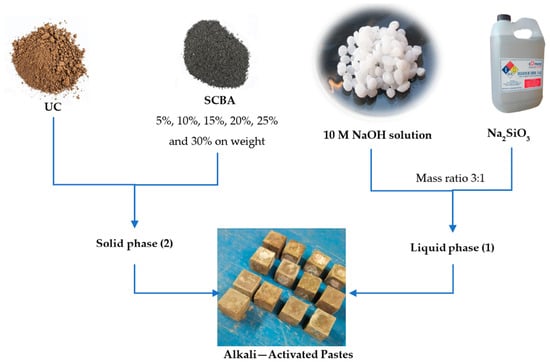
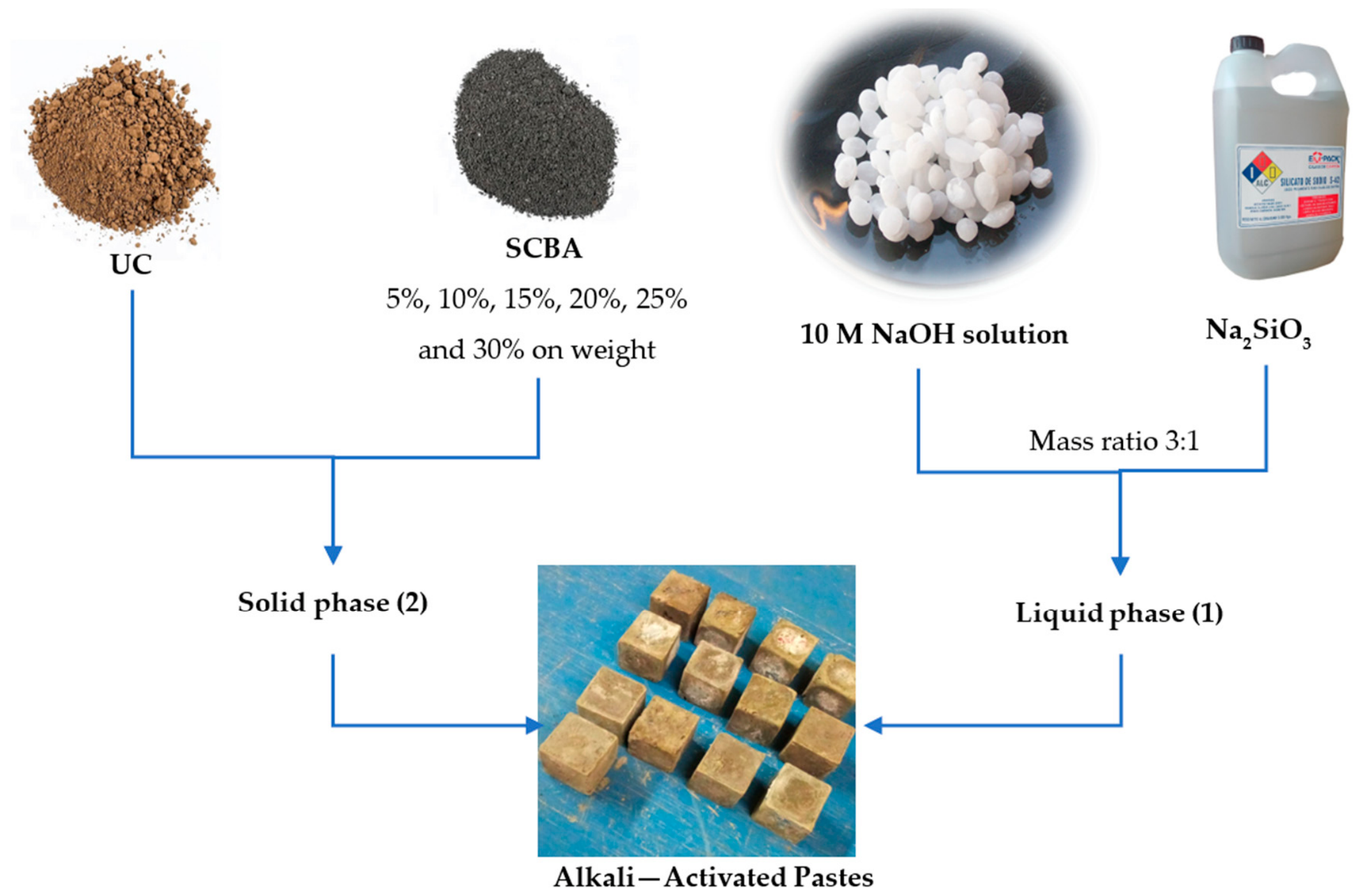
The alkaline activator consisted of a 10 M sodium hydroxide (NaOH) solution and a sodium silicate (Na2SiO3) solution, which were mixed at a constant NaOH/Na2SiO3 mass ratio of 3:1. The total solid-to-liquid (S/L) mass ratio was maintained at 2 for all formulations. Figure 1 presents the mix-design scheme and the proportions used to prepare the pastes.
Figure 1.
Mix-design scheme for the alkali-activated pastes prepared using uncalcined clay (UC) and sugarcane bagasse ash (SCBA). The NaOH/Na2SiO3 mass ratio was maintained at 3:1, and the total solid-to-liquid mass ratio was fixed at 2.
Maintaining a constant S/L ratio allowed the formulations to be compared while minimizing the influence of variations in the amount of activating solution [39,40].
2.2.2. Mixing, Casting, and Curing Procedure
The required amounts of UC and SCBA were first homogenized in the dry state. The alkaline activator was then added gradually while mixing continued until a homogeneous mortar was obtained. The activating solution was prepared 24 h before use and maintained at room temperature before being incorporated into the dry precursors [41].
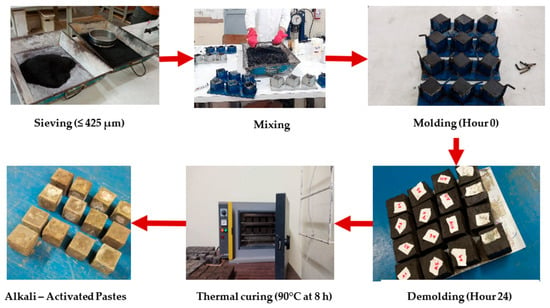
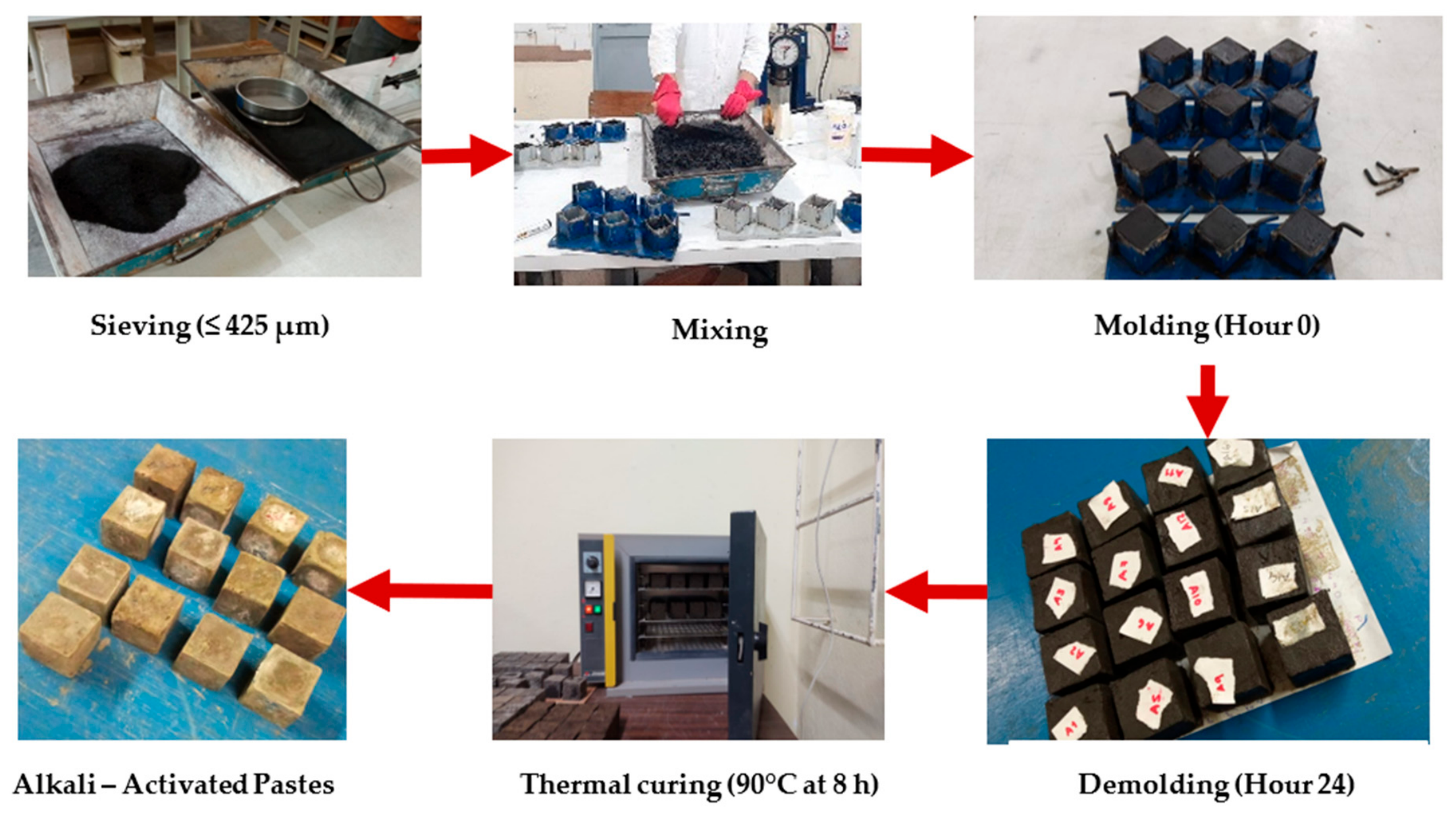
The fresh mortar was cast into cubic molds measuring 50 × 50 × 50 mm3. The specimen geometry was selected in accordance with the applicable Mexican standard NMX-C-486-ONNCCE-2014 for mortar specimens [42]. The molds were filled and the specimens compacted to minimize entrapped air and promote uniformity. The specimens were subjected to a two-stage curing procedure, as illustrated in Figure 2.
Figure 2.
Mixing, molding, demolding, and thermal curing procedure used for the preparation of the alkali-activated specimens.
- Stage 1—Initial curing: The freshly molded specimens were maintained at room temperature for 24 h to allow initial setting and sufficient dimensional stability.
- Stage 2—Thermal curing: After the initial curing period, the specimens were subjected to thermal curing at 90 °C for 8 h in an oven. This thermal treatment was employed to accelerate the alkali-activation reactions and promote the development of the hardened aluminosilicate matrix [43,44].
After thermal curing, the specimens were demolded and stored under ambient laboratory conditions (approximately 23 ± 2 °C and 50 ± 5% relative humidity) until testing at 28 days of age. This period was selected to allow further reaction, microstructural development, and strength maturation of the alkali-activated matrix.
2.3. Characterization of Alkali-Activated Pastes
2.3.1. Compressive Strength
The compressive strength of the alkali-activated pastes was determined at 28 days using cubic specimens measuring 50 × 50 × 50 mm3. The tests were performed using an ELVEC E660-5 electrohydraulic universal testing machine (ELVEC, S.A. de C.V., Mexico City, Mexico) in accordance with the applicable Mexican standard NMX-C-486-ONNCCE-2014 for mortar specimens [42,45]. Each specimen was positioned centrally between the loading platens and subjected to uniaxial compressive loading until failure. The resulting measurements were used to evaluate the effect of SCBA replacement on the mechanical performance of the mortar formulations.
2.3.2. Thermal Conductivity
The thermal conductivity of the hardened alkali-activated pastes was measured using the steady-state guarded hot plate method in accordance with Mexican standard NMX-C-189-ONNCCE-2010 [46]. A ThermoFisher Scientific thermal conductivity (ThermoFisher Scientific, Waltham, MA, USA) apparatus equipped with dual-sided measurement plates was used. The instrument operates within a thermal conductivity range of 0.03–1.00 W m−1 K−1.
The hardened specimens were cut to dimensions of approximately 50 × 50 × 25 mm3 and placed between the measurement plates to ensure adequate contact between the specimen surfaces and the apparatus. Measurements were performed under steady-state conditions, and thermal conductivity was determined from the heat flux through the specimen and the resulting temperature gradient.
Thermal conductivity was measured to assess the effect of SCBA incorporation on the thermal performance of the alkali-activated pastes and to provide complementary information on their potential suitability for construction applications in warm and humid climates [47].
2.3.3. Mineralogical, Chemical, and Microstructural Characterization
The mineralogical composition of the raw materials and hardened alkali-activated pastes was investigated using X-ray diffraction (XRD). The analyses were performed using a Rigaku Ultima IV diffractometer (Rigaku Corporation, Akishima, Tokyo, Japan) equipped with CuKα radiation (λ = 1.54184 Å), operating at 40 kV and 44 mA (1.76 kW), and fitted with a D/teX Ultra silicon strip detector (Rigaku Corporation, Akishima, Tokyo, Japan) in Bragg–Brentano θ–θ geometry. Powdered samples were scanned over a 2θ range of 15–70°, using a step size of 0.02° and a scanning rate of 2°/min. The crystalline phases were identified using the JCPDS Powder Diffraction File database. Rietveld refinement was performed using MAUD software (version 2.99993) to estimate the relative proportions of the identified crystalline phases [48,49]. The amorphous fraction was estimated from the relative integrated area of the amorphous halo with respect to the total integrated diffraction area, while the crystalline contribution was estimated from the integrated areas of the crystalline peaks [50].
Fourier-transform infrared (FTIR) spectroscopy was used to investigate the chemical bonding environment and functional groups present in the raw materials and hardened pastes. Spectra were acquired using a VERTEX 70 FTIR spectrometer (Bruker Optics GmbH & Co. KG, Ettlingen, Germany) at a resolution of 4 cm−1 over the wavenumber range of 400–4000 cm−1. The spectra were analyzed to identify bands associated with Si–O–Si, Si–O–Al, O–H, and carbonate groups and to examine changes in the aluminosilicate bonding environment following alkaline activation [51,52].
The microstructural morphology of the selected hardened mortar specimens was examined by scanning electron microscopy (SEM) using a JEOL JSM-7100F field-emission scanning electron microscope (JEOL Ltd., Akishima, Tokyo, Japan). Observations were conducted under high-vacuum conditions using an accelerating voltage of 10 kV. Micrographs were acquired at magnifications of up to ×5000 to evaluate the morphology, particle distribution, surface characteristics, and microstructural evolution of the alkali-activated matrix. The SEM observations were used in conjunction with the XRD and FTIR results to assess the microstructural changes associated with SCBA incorporation and alkali activation.
3. Results
3.1. Characterization of Raw Material
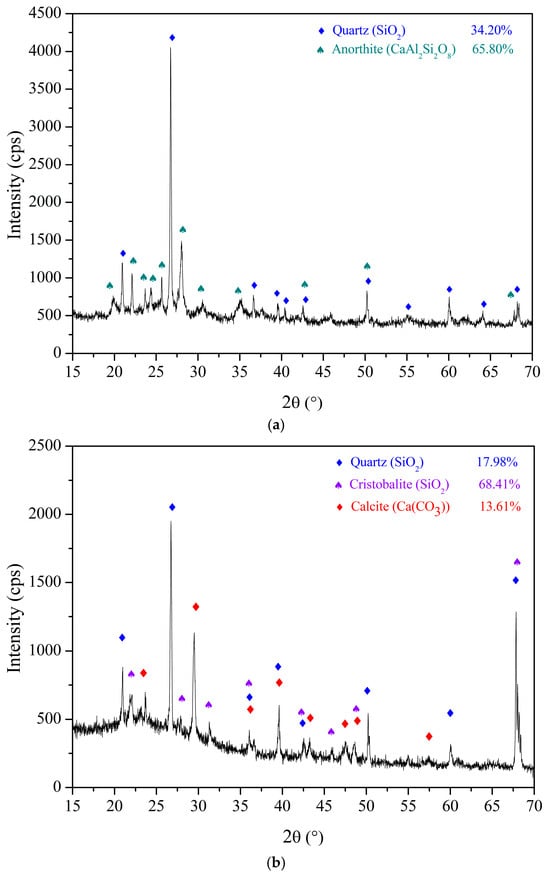
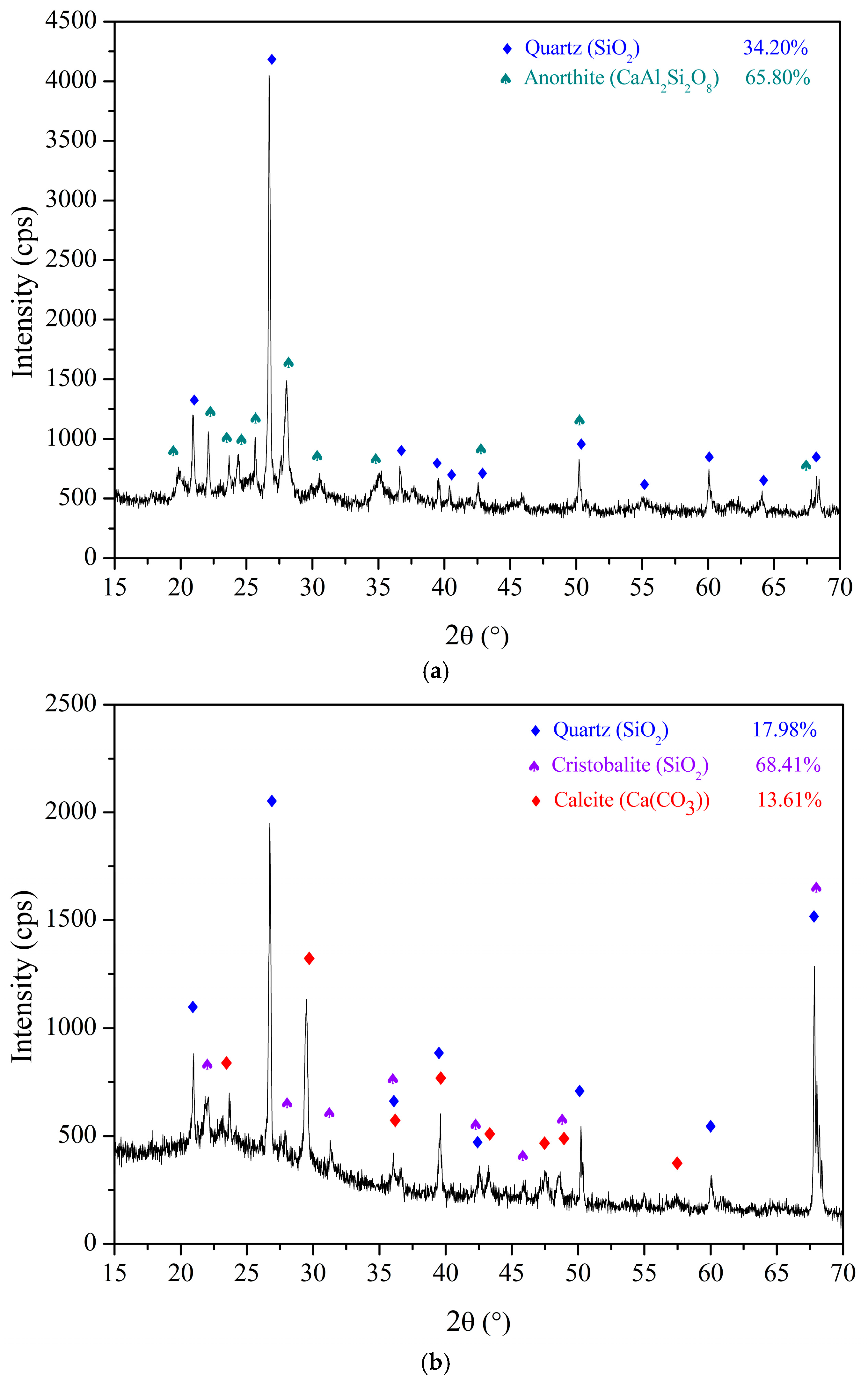
X-ray diffraction (XRD) identified the mineralogical composition of the dry powders of each raw material. The corresponding diffraction patterns are presented in Figure 3. Phase identification was performed using the JCPDS Powder Diffraction File database, while the relative proportions of the identified crystalline phases were determined by Rietveld refinement.
Figure 3.
XRD patterns and Rietveld-refined crystalline-phase proportions of (a) UC and (b) SCBA. Symbols denote the identified crystalline phases listed in the upper-right legend of each figure.
The crystalline phases identified in UC (Figure 3a) were quartz (SiO2) in a hexagonal crystalline structure (JCPDS card No. 01-086-1629) and anorthite in a triclinic structure (JCPDS card No. 00-041-1486), which correspond to 34.20 and 65.80 wt.%, respectively. The refinement yielded Rwp = 8.37% and Rb = 6.62%, indicating a satisfactory agreement between the experimental and calculated diffraction profiles.
The SCBA diffraction pattern (Figure 3b) showed three crystalline phases. Cristobalite (JCPDS card No. 01-074-9378) and quartz (JCPDS card No. 01-086-1628) correspond to polymorphic forms of SiO2. Calcite (CaCO3) was identified according to JCPDS card No. 01-086-2334. The Rietveld refinement showed that cristobalite was the predominant crystalline phase, accounting for 68.41 wt.%, followed by quartz at 17.98 wt.% and calcite at 13.61 wt.%. The refinement parameters were Rwp = 12.38% and Rb = 8.57%.
The chemical compositions of UC and SCBA determined by wavelength-dispersive X-ray fluorescence (WDXRF) (Rigaku Corporation, Akishima, Tokyo, Japan) are presented in Table 2. A comparison of the two raw materials shows that SCBA contained a higher CaO content than UC (43.58 vs. 36.04 wt.%), whereas UC presented slightly higher SiO2 and Al2O3 contents. The Fe2O3 content was also relatively high in both materials, reaching 8.28% in UC and 9.51% in SCBA. These differences are relevant because the relative availability of Ca, Si, and Al influences the dissolution and subsequent precipitation processes occurring during alkaline activation [31].
Table 2.
Determination of the elemental composition of UC and SCBA (wt.%).
3.2. Characterization of Alkali-Activated Pastes
3.2.1. Compressive Strength
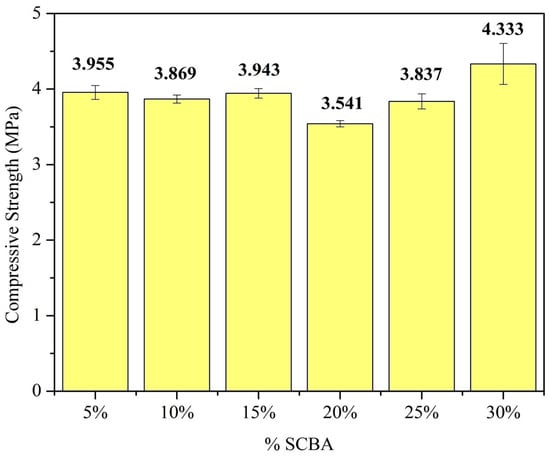
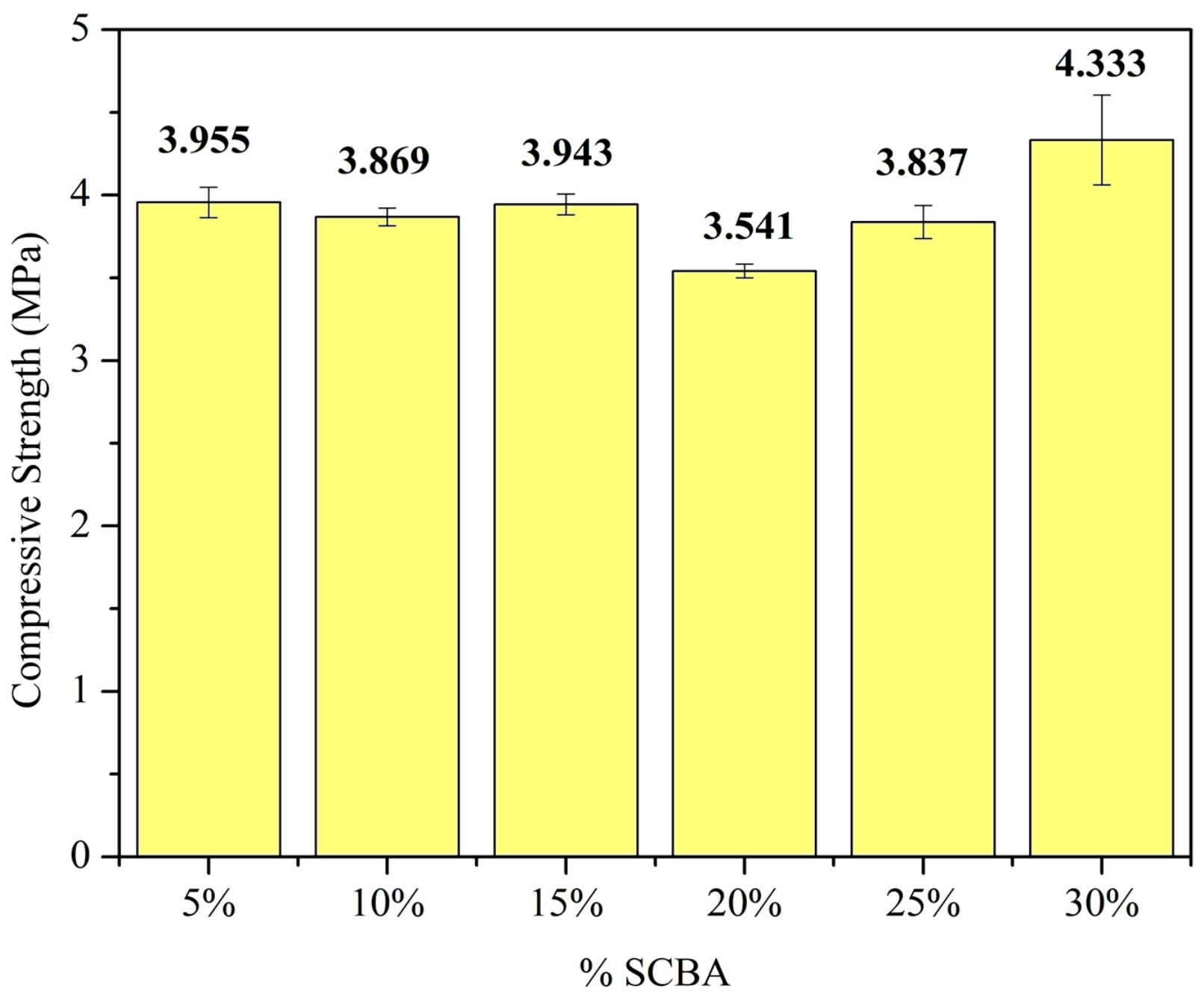
Compressive strength of the alkali-activated pastes was determined for all formulations proposed in the experimental matrix (Figure 1). To improve the statistical reliability of the results, fifteen specimens were tested for each mixture. The average values, together with the corresponding standard error and 95% confidence intervals, are presented in Figure 4.
Figure 4.
Compressive strength of alkali-activated pastes with partial replacement of UC by SCBA at 28 days of curing. Error bars represent the standard error of the mean, calculated from 15 specimens per formulation.
The values ranged from 3.54 MPa for the 20 wt.% SCBA mixture to 4.333 MPa for 30 wt.% SCBA. Most formulations exhibited strengths close to or above 40 kg/cm2 (3.92 MPa), corresponding to the minimum compressive strength specified for Type III structural mortars according to NMX-C-486-ONNCCE-2014 [42].
The results show that compressive strength did not vary monotonically with SCBA content. Within the investigated range, the mean compressive strength varied by approximately 22.4%. This composition exhibited the highest compressive strength among the mixtures tested; however, it cannot be considered a global optimum. The non-monotonic response indicates that compressive strength is governed by the combined effects of precursor chemistry, phase evolution, reaction matrix development, and microstructure rather than by SCBA content alone.
The absence of a clear monotonic trend may be associated with the mineralogical and chemical characteristics of the precursors. The partial replacement of UC with SCBA modifies the relative availability of Si-, Al-, and Ca-bearing species within the precursor mixture. Because the nature and development of reaction products in alkali-activated systems are strongly influenced by the relative proportions and availability of these elements, variations in SCBA content may affect precursor dissolution and the subsequent formation and development of binding phases [53,54,55].
Furthermore, previous studies on clay-based alkali-activated systems have demonstrated that the incorporation of reactive materials can substantially influence strength development, depending on precursor composition and curing conditions [56]. For example, Rihan et al. [57] reported an increase in compressive strength with SCBA incorporation up to 5 wt.% when SCBA was used as a partial replacement for fly ash, followed by a decrease at higher replacement levels. Pojhan et al. [54] further highlighted the important role of calcium in alkali-activated systems, particularly through its contribution to the formation of calcium-containing silicate and aluminosilicate gels. The reported strength development in calcium-rich fly ash/clay systems supports the interpretation that Ca availability can significantly influence the mechanical performance of alkali-activated materials.
On the other hand, the compressive strengths obtained in the present research were higher than those reported for some clay-based alkali-activated stabilization systems. Abdullah & Shahin [58], for example, reported a maximum compressive strength of approximately 1.8 MPa for alkali-activated clay/fly ash mixtures. More recently, Yu et al. [56] reported a maximum unconfined compressive strength of 3.71 MPa after 28 days for a high-plasticity clay stabilized with construction and demolition waste and a geopolymer containing fly ash and ground granulated blast-furnace slag (GGBFS).
Overall, these findings demonstrate the feasibility of incorporating SCBA as an agricultural waste-derived component in alkali-activated pastes. The observed mechanical performance highlights the importance of optimizing the precursor composition and activation conditions to maximize the potential of SCBA as a supplementary precursor for more sustainable construction materials.
3.2.2. Thermal Conductivity
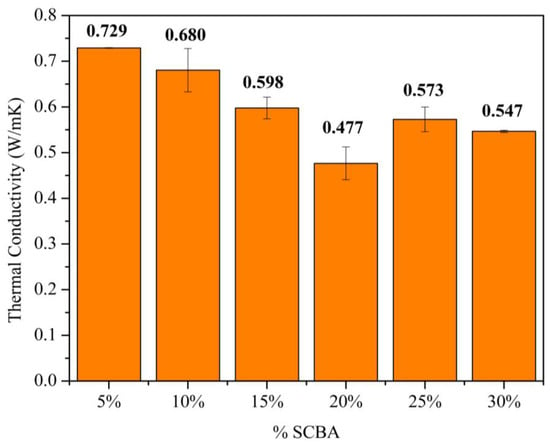
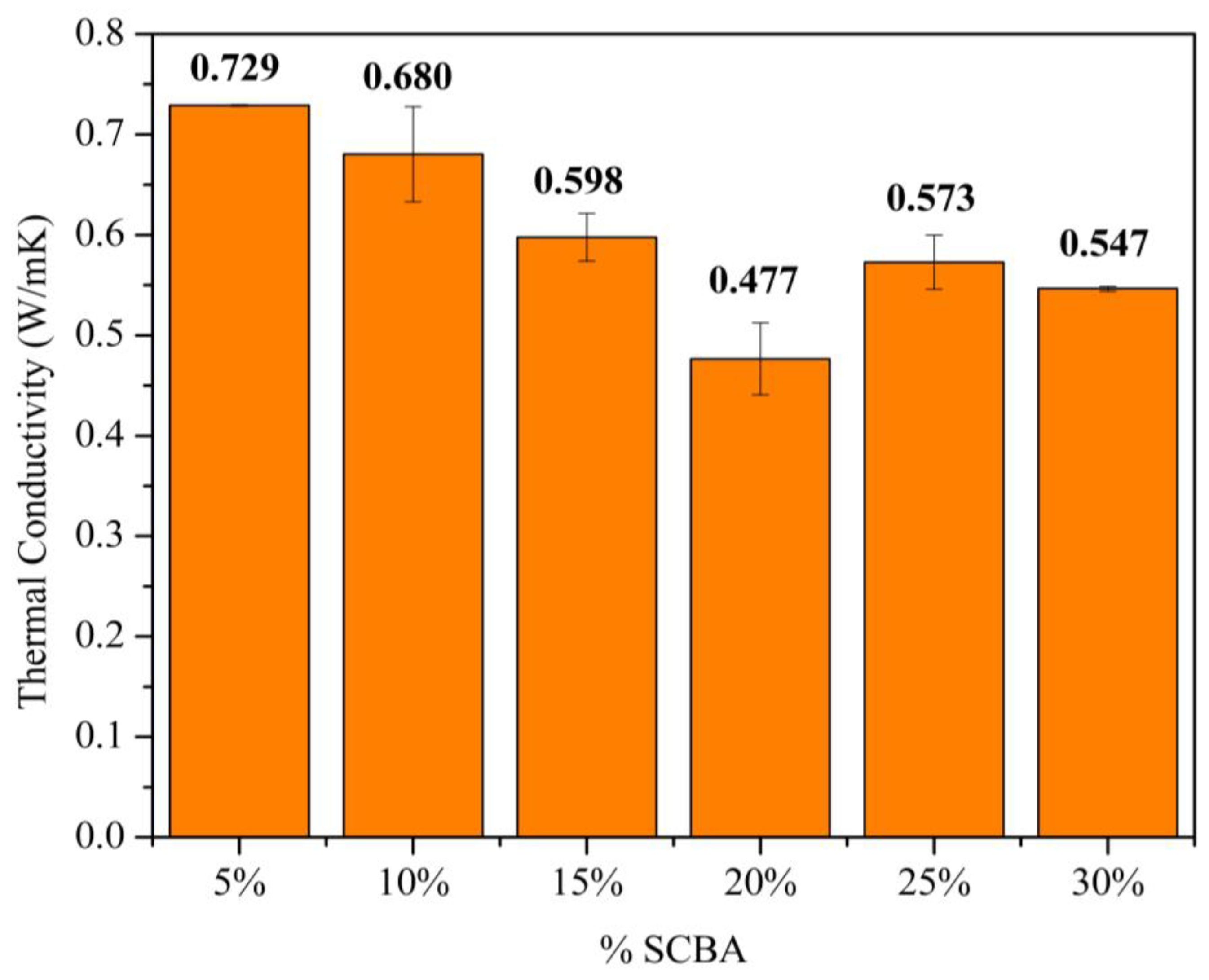
Figure 5 presents the thermal conductivity of the alkali-activated pastes for the investigated SCBA replacement levels. The measurements were performed using specimens with a standard exposed area of 25 cm2 and a thickness of 25 mm (1 in). The measurements were obtained from three replicate measurements for each formulation, presented in Figure 5.
Figure 5.
Thermal conductivity of alkali-activated pastes with partial replacement of UC by SCBA. Error bars represent the standard error of the mean, calculated from three replicate measurements per formulation.
The results are consistent with previous studies on waste-derived alkali-activated materials. For example, Morsy et al. [59] reported reduced thermal conductivity in geopolymer-based materials incorporating agricultural ash, demonstrating the potential of biomass-derived residues to enhance the thermal performance of construction materials.
On the other hand, the lowest thermal conductivity was obtained for the mortar containing 20 wt.% SCBA, which also exhibited the lowest compressive strength among the mixtures evaluated. This concurrent behavior suggests a possible relationship between the mechanical and thermal performance of the alkali-activated pastes. In alkali-activated materials, thermal conductivity is strongly influenced by bulk density, total porosity, and pore structure, whereas compressive strength is generally associated with the integrity and connectivity of the solid matrix [60,61]. Previous studies have reported strong correlations between thermal conductivity, bulk density, and porosity in geopolymeric materials, while the relationship between thermal conductivity and compressive strength is comparatively weaker [60]. Therefore, the reduction in thermal conductivity observed in the present study may be associated with changes in the internal pore structure induced by SCBA incorporation.
The decrease in thermal conductivity observed with increasing SCBA content up to 20 wt.% may be associated with changes in pore volume and connectivity. An increase in the volume fraction of appropriately distributed pores can reduce the effective thermal conductivity of a composite because the presence of air-filled voids limits heat transfer through the solid matrix [61]. Similar behavior has been reported for porous geopolymeric systems, in which increasing porosity generally results in lower thermal conductivity. However, this effect depends not only on the total porosity but also on pore connectivity and morphology [62]. Thus, changes in the pore structure resulting from SCBA incorporation may contribute to the reduction in thermal conductivity observed in the present pastes.
Nevertheless, the thermal conductivity did not decrease continuously with increasing SCBA content. After reaching the minimum value at 20 wt.% SCBA, thermal conductivity increased at 25 wt.% and subsequently decreased slightly at 30 wt.%. Instead, the thermal response is likely governed by the combined effects of particle packing, reaction-product development, pore volume, and pore connectivity. Similar non-linear relationships between thermal conductivity and porosity have been reported for alkali-activated materials, indicating that an increase in porosity does not necessarily result in a proportional reduction in thermal conductivity when pore interconnectivity and morphology vary simultaneously [61].
3.2.3. Mineralogical Analysis by XRD
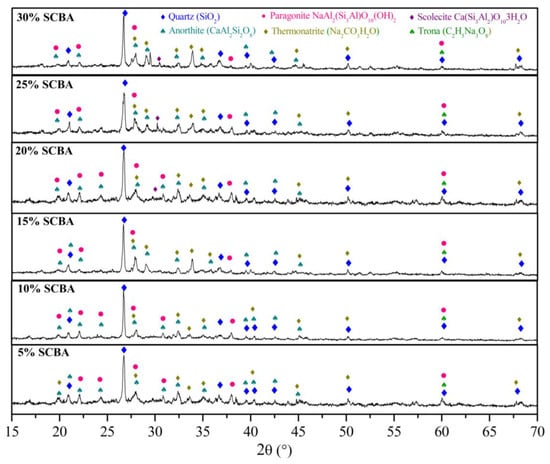
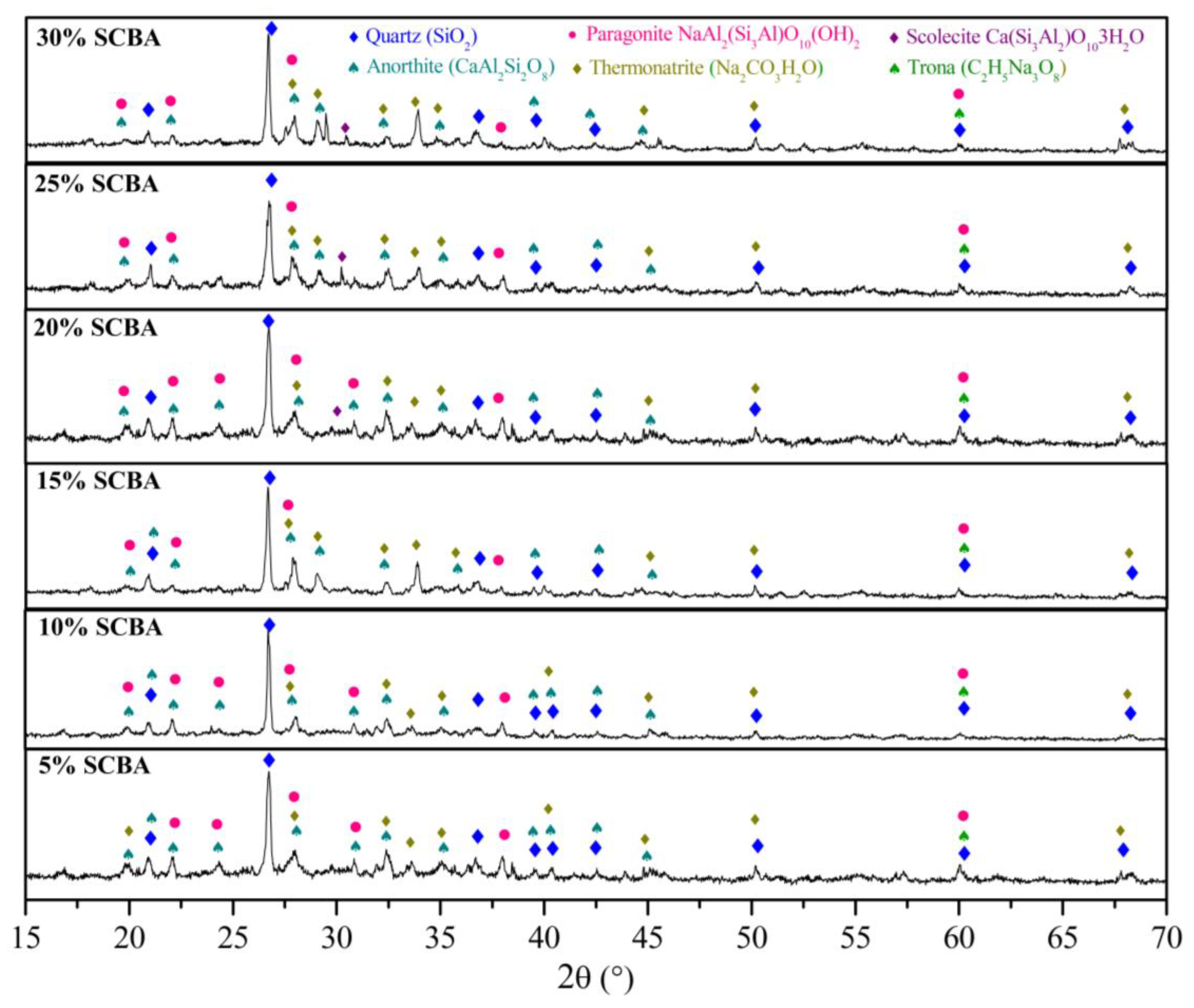
X-ray diffraction (XRD) analysis was performed on all alkali-activated mortar formulations defined in the experimental matrix after 28 days of curing. XRD patterns were analyzed to identify the crystalline phases retained from the precursor materials and to assess changes in the relative abundance of the identified phases after alkaline activation, as presented in Figure 6.
Figure 6.
XRD patterns of alkali-activated pastes. Symbols denote the identified crystalline phases listed in the upper-right legend of each figure.
Quantitative phase analysis was performed using Rietveld refinement, while the amorphous phase content was estimated from the relative integrated area of the amorphous halo with respect to the total integrated diffraction area, summarized in Table 3.
Table 3.
Relative proportions of the crystalline phases obtained by Rietveld refinement and estimated amorphous-phase contribution for the alkali-activated formulations.
The main crystalline phases identified were anorthite (CaAl2Si2O8; JCPDS No. 01-075-1587) and quartz (SiO2; JCPDS No. 01-070-7344), both of which were also detected in the precursor materials. Quartz remained relatively stable after alkaline activation, which is consistent with its high resistance to dissolution under alkaline conditions, particularly in systems prepared from uncalcined precursors [61]. Therefore, the persistence of its characteristic reflection near 2θ ≈ 26° indicates that a substantial fraction of the crystalline quartz remained unreacted after 28 days of curing.
Anorthite was also retained as a major crystalline phase in all formulations. Its presence is relevant because this Ca–Al–Si-bearing mineral contributes to the overall availability of calcium, aluminum, and silicon within the precursor system. These elements can participate in the formation of calcium- and aluminosilicate-containing reaction products during alkaline activation [63]. However, the presence of anorthite itself should not be considered direct evidence of the formation of a specific reaction gel, since the main binding products in alkali-activated systems can be poorly crystalline or predominantly amorphous.
In addition to the precursor-derived phases, several secondary crystalline phases were identified, including paragonite, trona, thermonatrite, scolecite, and larnite. Their relative abundance varied considerably with SCBA content, indicating changes in the mineralogical assemblage of the activated pastes. Paragonite [NaAl2(AlSi3O10)(OH)2; JCPDS No. 01-076-5967] decreased markedly as the SCBA content increased, from 22.17 wt.% at 5 wt.% SCBA to only 0.006 wt.% at 30 wt.% SCBA. This phase is a Na-bearing aluminosilicate phase whose occurrence indicates the development of Na-containing secondary crystalline phases during curing [64].
In contrast, trona [Na3H(CO3)2·2H2O; JCPDS No. 01-072-1152] exhibited the most pronounced increase, from 0.83 wt.% at 5 wt.% SCBA to 44.72 wt.% at 20 wt.% SCBA, followed by a slight decrease to 41.05 wt.% at 30 wt.% SCBA. Thermonatrite [Na2CO3·H2O; JCPDS No. 00-008-0448] showed the opposite trend, decreasing from 27.05 wt.% at 5 wt.% SCBA to 5.25 wt.% at 30 wt.% SCBA. This performance, together with the increase in trona, indicates a change in the relative stability and precipitation conditions of Na-carbonate phases as the precursor composition was modified. The formation of these phases is relevant because the availability of alkali species and their interaction with atmospheric CO2 can influence the chemical evolution of alkali-activated matrices [65,66,67].
Scolecite [CaAl2Si3O10·3H2O; JCPDS No. 01-074-3163] and larnite [Ca2SiO4; JCPDS No. 00-033-0302] were detected in comparatively smaller proportions. Scolecite and larnite were detected in minor proportions, indicating the presence of additional Ca–Al–Si- and Ca–Si-bearing crystalline phases within the activated system [68,69]. Similarly, larnite is compatible with the Ca-rich chemical environment of the precursor mixture [62]. Although these phases occur in relatively low amounts, their presence supports the development of a multiphase Ca–Al–Si–Na system during alkaline activation.
On the other hand, the estimated amorphous phase content ranged from 55.947% to 61.220% across the investigated mixtures (Table 3). The highest estimated value was obtained for the mixture containing 25 wt.% SCBA, whereas the lowest was observed at 5 wt.% SCBA. These results suggest that changes in precursor composition were accompanied by variations in the balance between crystalline and amorphous contributions.
3.2.4. Fourier-Transform Infrared Spectroscopy (FTIR)
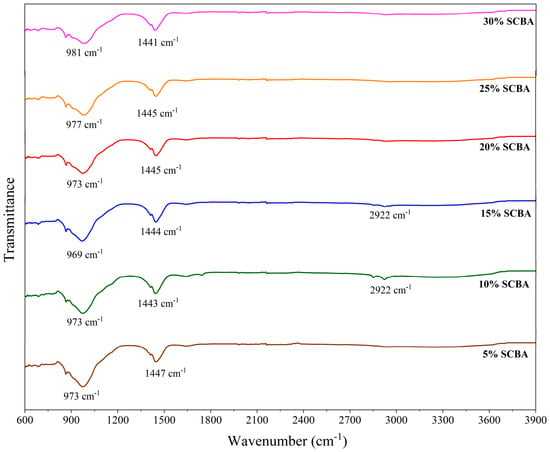
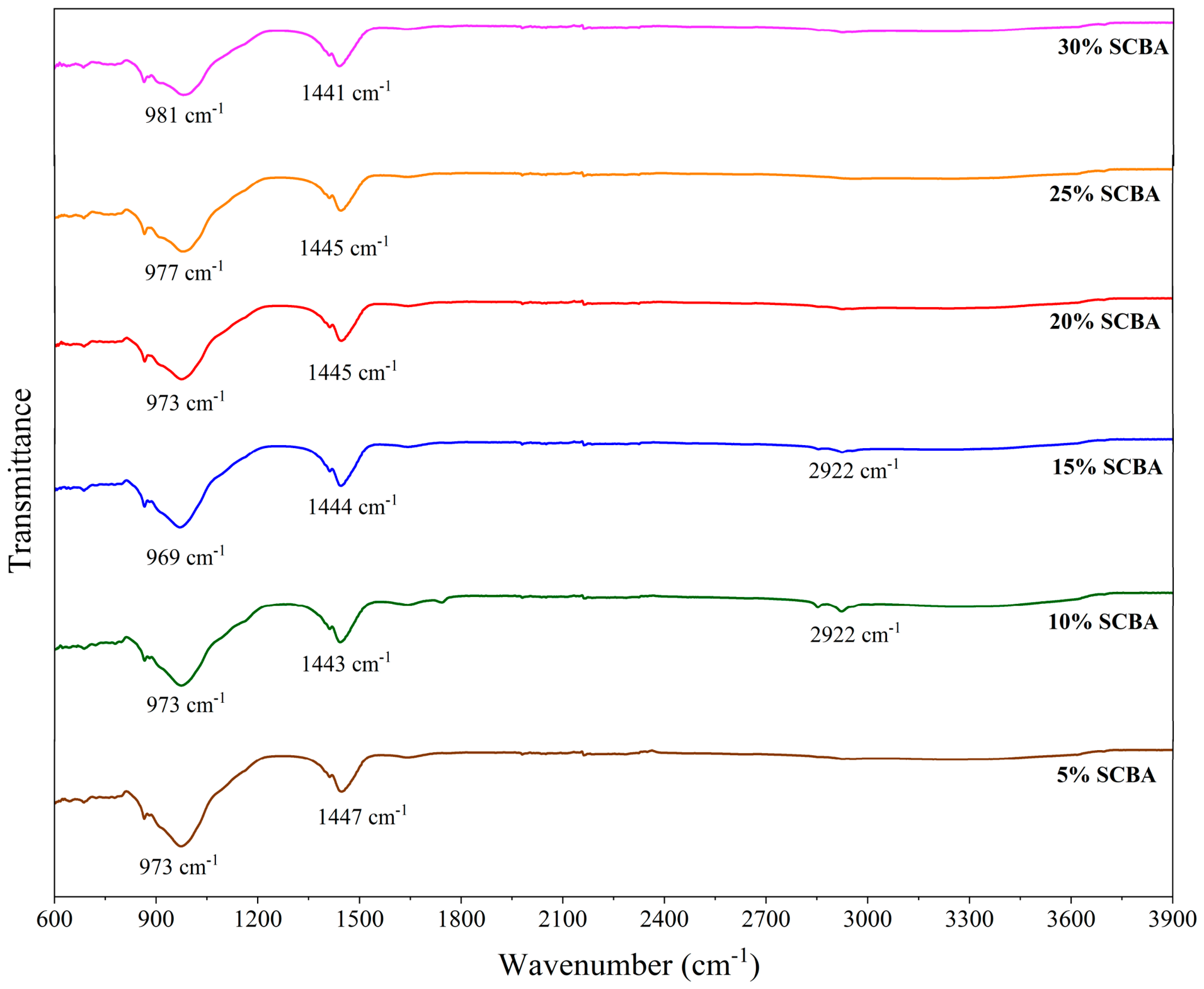
Figure 7 presents the FTIR spectra of the alkali-activated pastes containing 5–30 wt.% SCBA after 28 days of curing. The spectra show similar overall profiles, with the most relevant bands occurring in the regions of approximately 969–981 cm−1 and 1441–1447 cm−1. Additional weak bands were observed at approximately 2922 cm−1 in the formulations containing 10 wt.% and 15 wt.% SCBA.
Figure 7.
FTIR spectra of alkali–activated pastes containing different SCBA contents after 28 days of curing.
The principal band between 969 and 981 cm−1 is associated with asymmetric stretching vibrations of Si–O–T bonds, where T represents tetrahedrally coordinated Si or Al. This region is commonly used to evaluate structural changes in alkali-activated aluminosilicate systems because alkaline dissolution and subsequent polycondensation modify the local bonding environment of the aluminosilicate network [70].
The displacement toward lower wavenumber observed at 15 wt.% SCBA is consistent with a change in the local Si–O–T bonding environment, where T represents tetrahedrally coordinated Si or Al. [71,72]. However, the subsequent shift toward higher wavenumbers at higher SCBA contents indicates that the chemical environment of the aluminosilicate network changed with increasing SCBA incorporation. Such shifts can be affected by the Si/Al ratio, the presence of Ca, the degree of polymerization, and the coexistence of different reaction products; therefore, the FTIR band position alone should not be interpreted as a direct quantitative measure of the Si/Al ratio or degree of geopolymerization [70,71].
The band between 1441 and 1447 cm−1 in all formulations is associated with the asymmetric stretching vibration of carbonate groups (CO32−). Carbonation of alkali-activated materials can result in the formation of sodium carbonate and hydrated carbonate phases, depending on the availability of Na+, moisture conditions, and CO2 exposure [65,66,67,73]. The persistence of the carbonate band, together with the XRD identification of trona and thermonatrite, further confirms the occurrence of carbonate-containing secondary phases.
Weak absorption bands near 2922 cm−1 were additionally observed in the samples containing 10 and 15 wt.% SCBA. This region can be associated with C–H stretching vibrations from residual organic or aliphatic species. In biomass-derived ashes, such signals may be related to incompletely combusted organic matter; however, their assignment should be considered tentative because FTIR alone cannot establish the specific origin or amount of residual carbon. Previous studies of SCBA have reported the presence of unburnt carbon depending on the combustion conditions and the efficiency of the biomass combustion process [72].
3.2.5. Scanning Electron Microscopy (SEM)
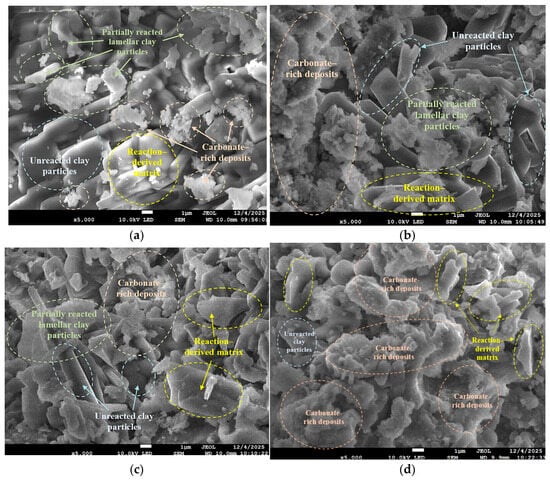
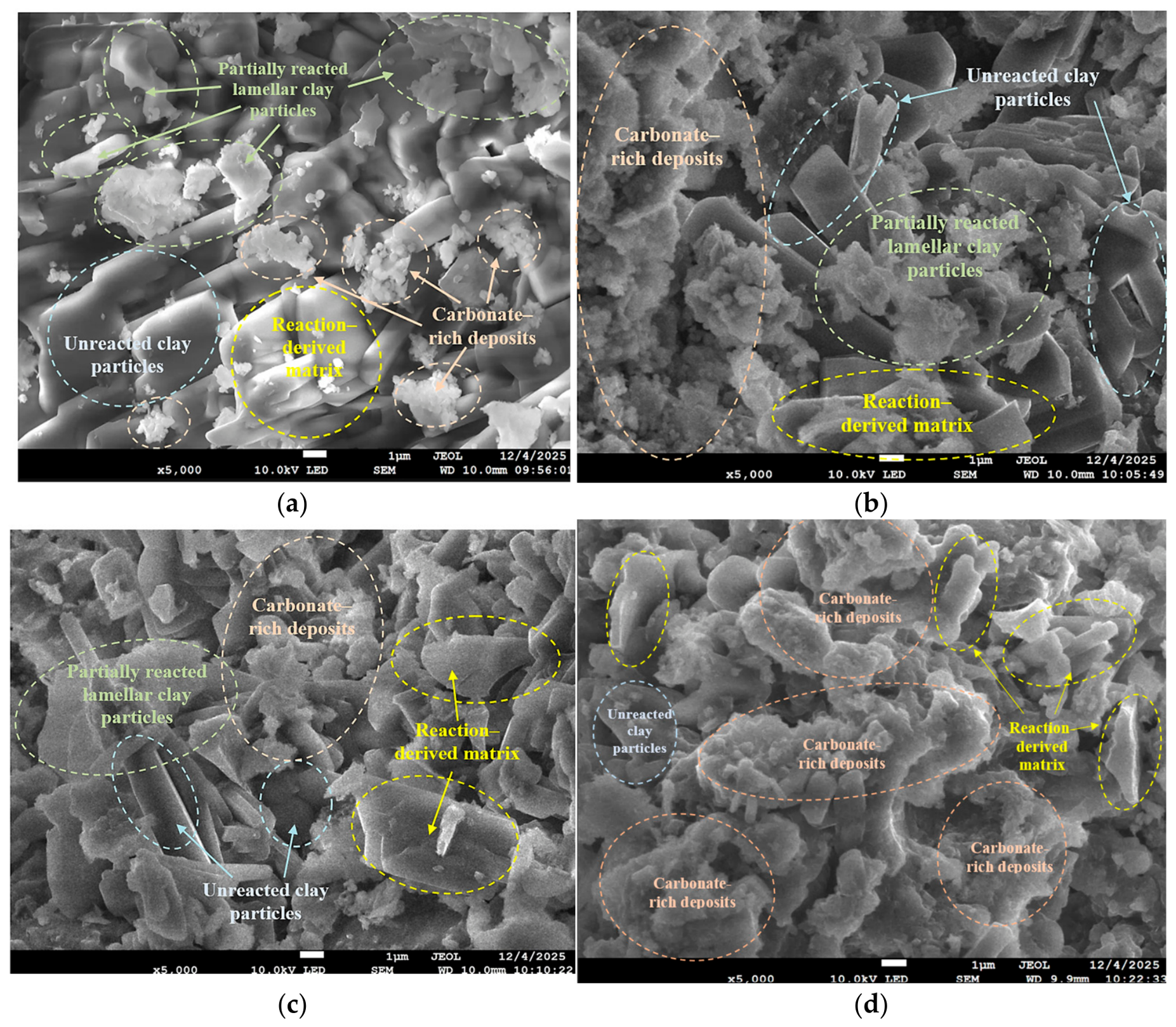
Figure 8 presents SEM micrographs of selected alkali-activated pastes containing 10, 15, 20, and 30 wt.% SCBA after 28 days of curing. All formulations exhibited heterogeneous microstructures, with variations in the preservation of precursor particles, the continuity of the surrounding matrix, and the distribution of localized deposits.
Figure 8.
SEM micrographs of alkali-activated pastes containing (a) 10, (b) 15, (c) 20, and (d) 30 wt.% SCBA after 28 days of curing.
At 10 wt.% SCBA (Figure 8a), relatively well-preserved lamellar and angular particles are embedded in a continuous fine-grained matrix, indicating the coexistence of residual precursor particles and reaction-derived material. Similar coexistence of partially reacted particles and a developed reaction matrix has been reported for SCBA-containing alkali-activated systems [74,75,76,77,78]. Sousa et al. [74], in particular, reported microstructural changes associated with the incorporation of non-calcined SCBA, whereas Tonini de Araújo et al. [76] and Umer et al. [77] related the microstructural development of SCBA-based systems to changes in matrix continuity.
At 15 wt.% SCBA (Figure 8b), the matrix appears more continuous locally, while granular deposits become more evident. These features become more pronounced at 20 wt.% SCBA (Figure 8c), where a heterogeneous matrix with partially preserved particles and localized granular deposits is observed. This morphological evolution is consistent with the progressive changes in the crystalline assemblage identified by XRD, particularly the development of Na-bearing carbonate phases. This interpretation is consistent with the fact that residual alkaline species can react with atmospheric CO2 during curing or subsequent exposure [79].
The mortar containing 30 wt.% SCBA (Figure 8d) exhibits a highly heterogeneous and agglomerated morphology. Partially preserved particles with roughened surfaces are surrounded or partially coated by finer reaction-derived material, suggesting partial precursor transformation and the development of a reaction matrix that bridges adjacent particles. Interparticle cavities and localized voids are also visible, indicating that the matrix was not completely densified. Granular and elongated features are locally present; however, their specific mineralogical identity cannot be established from SEM morphology alone. Considering the XRD results, these secondary features may be associated with the crystalline phases developed during activation, particularly the carbonate-containing phases.
Overall, increasing SCBA content modified the microstructure, but the changes did not follow a uniform or monotonic progression. The SEM observations indicate the coexistence of partially transformed precursor particles, a reaction-derived matrix, secondary deposits, and interparticle voids.
4. Discussion
The results showed that replacing uncalcined clay (UC) with sugarcane bagasse ash (SCBA) modified the mechanical, thermal, mineralogical, chemical, and microstructural characteristics of the alkali-activated pastes. However, the response was not proportional to the SCBA content. This performance is consistent with the differences in the chemical composition of the two precursors. WDXRF analysis showed that SCBA contained a higher CaO content than UC (43.58 and 36.04 wt.%, respectively), whereas the clay presented slightly higher SiO2 and Al2O3 contents. These compositional differences may alter the relative availability of Ca-, Si-, and Al-bearing species during alkaline activation and may consequently influence the development of the hardened matrix and secondary crystalline phases. Similar composition-dependent behavior has been reported for alkali-activated systems based on natural clays, fly ash, and biomass-derived precursors [28,29,53,54,55].
At 28 days, compressive strength ranged from 3.54 MPa at 20 wt.% SCBA to 4.333 MPa at 30 wt.% SCBA, with intermediate formulations showing no monotonic trend. This behavior differs from some SCBA-based systems in which strength increases at low replacement levels and decreases at higher contents [56,57]. Such differences are expected because the present mortar uses uncalcined clay as the main precursor, whereas many reported systems are based on fly ash or calcined metakaolin, which generally exhibit different dissolution and reaction characteristics. Yadav et al. [20], for example, reported substantially higher strengths for SCBA/metakaolin systems, while lower strengths have been reported for some clay-based stabilization systems [56,58].
The lowest thermal conductivity, 0.4765 W m−1 K−1, was measured at 20 wt.% SCBA. The fact that the composition with the lowest thermal conductivity was not the composition with the highest compressive strength illustrates that mechanical and thermal performance did not reach their best measured values at the same replacement level. This distinction is relevant when considering the design of alkali-activated materials because the selection of a formulation depends on the relative importance of mechanical resistance, thermal behavior, and other application-specific requirements.
The XRD results revealed changes in the crystalline-phase assemblage associated with SCBA incorporation, alongside a substantial contribution from non-crystalline material to the overall diffraction signal. The integrated-area method provided a separate estimate of the relative contribution of the amorphous halo. Anorthite and quartz remained among the predominant crystalline phases, whereas paragonite decreased markedly and sodium carbonate-containing phases, particularly trona, became more prominent in some formulations. Overall, these changes suggest that SCBA incorporation modified the phase assemblage and the chemical environment of the Na–Ca–Al–Si system. The presence of sodium carbonate phases is consistent with the interaction of residual alkaline species with atmospheric CO2 during curing or subsequent exposure, as previously reported for sodium-activated materials [65,66,67,73].
The FTIR spectra showed changes in the local bonding environment of the activated matrix. The main Si–O–T band, with T representing Si or Al in tetrahedral coordination, shifted from approximately 969–973 cm−1 at lower SCBA contents toward 981 cm−1 at 30 wt.% SCBA. This evolution is consistent with changes in the local Si–O–T environment associated with precursor dissolution. However, the band displacement should not be interpreted as direct evidence of a specific gel composition or of a quantitative change in the Si/Al ratio.
The SEM micrographs show partially preserved lamellar and angular particles embedded in a heterogeneous matrix, with granular secondary deposits becoming more evident at intermediate and high SCBA contents. The 30 wt.% SCBA formulation exhibits roughened and partially coated particles, local particle bridging, and interparticle cavities, indicating that precursor transformation and matrix development occurred simultaneously but did not result in complete densification. These observations are consistent with the persistence of crystalline anorthite and quartz observed by XRD and with the carbonate-related FTIR response. Importantly, the SEM morphology alone does not permit assignment of individual features to specific mineral phases; therefore, the interpretation of secondary deposits is based on the combined SEM–XRD–FTIR evidence [74,75,76,77,78].
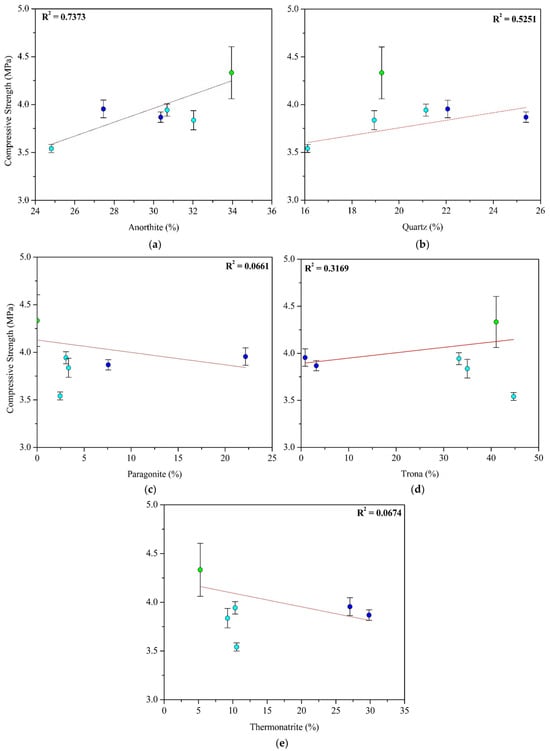
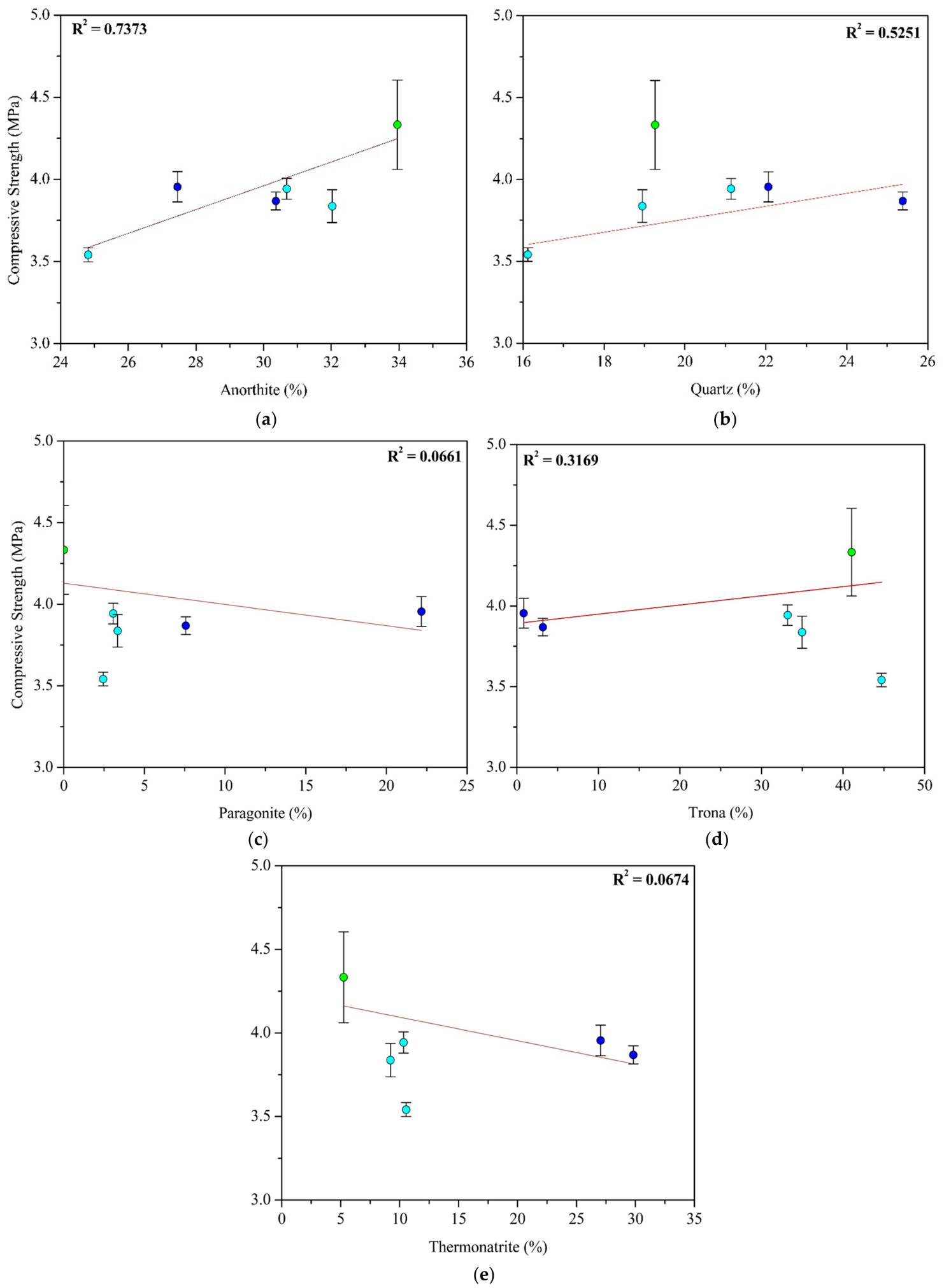
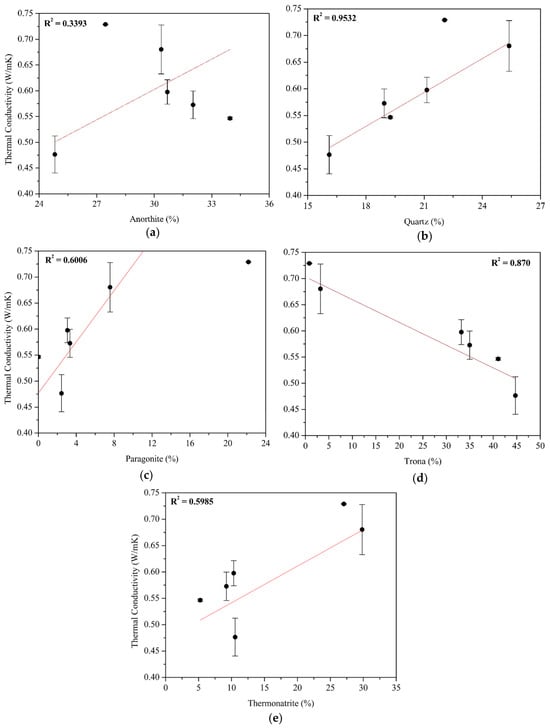
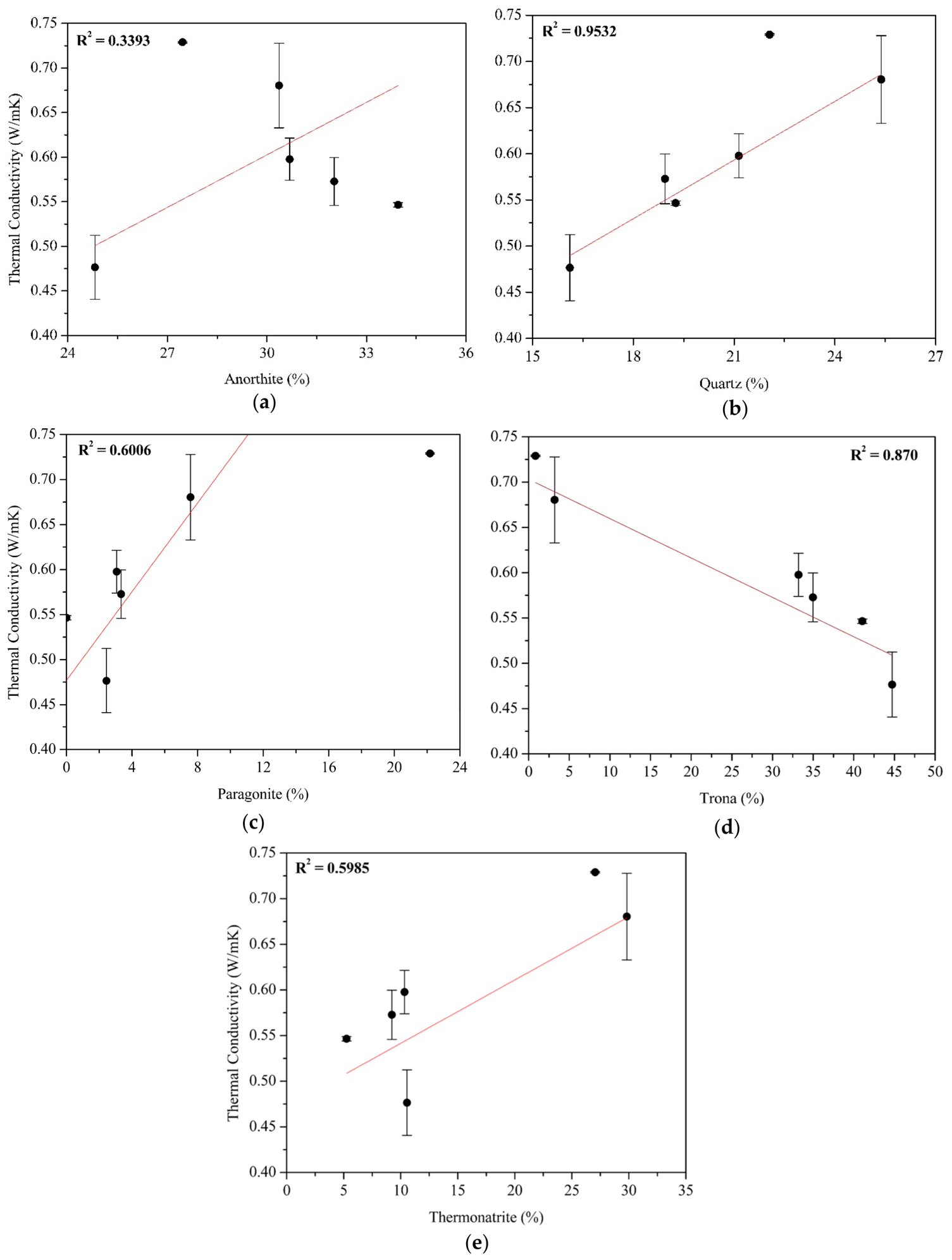
The regression analyses presented in Figure 9 and Figure 10 were conducted to explore associations between crystalline phase contents and compressive strength and thermal conductivity, respectively. The coefficients of determination (R2) indicate the goodness of fit of the regression models but do not establish causal relationships. These associations were interpreted cautiously, as the measured properties may be influenced by precursor composition, crystalline and amorphous phase contents, reaction products, and microstructural characteristics.
Figure 9.
Correlations between compressive strength and the Rietveld-refined contents of (a) anorthite, (b) quartz, (c) paragonite, (d) trona, and (e) thermonatrite for alkali-activated pastes. The dots represent the individual experimental samples, while the redline indicates the trend in the correlations between the corresponding parameters.
Figure 10.
Correlations between thermal conductivity and the Rietveld-refined contents of (a) anorthite, (b) quartz, (c) paragonite, (d) trona, and (e) thermonatrite for alkali-activated pastes. The dots represent the individual experimental samples, while the redline indicates the trend in the correlations between the corresponding parameters.
Regarding compressive strength (Figure 9), anorthite exhibited the strongest association (R2 = 0.7373), followed by quartz (R2 = 0.5251). Trona, thermonatrite, and paragonite showed weaker associations (R2 = 0.3169, 0.0674, and 0.0661, respectively). These results reflect variations in the mineralogical assemblage rather than direct evidence of individual phase contributions to strength. The association with anorthite may be related to its variation alongside the overall matrix composition, whereas quartz may contribute through particle packing and filler effects, although its direct participation in the reaction is expected to be limited.
For thermal conductivity (Figure 10), quartz showed the strongest positive association (R2 = 0.9532), while trona exhibited a strong negative association (R2 = 0.8700). Paragonite and thermonatrite showed moderate positive associations (R2 = 0.6006 and 0.5985, respectively), whereas anorthite showed a weaker association (R2 = 0.3393). These trends indicate that changes in mineralogical composition coincided with changes in heat-transfer behavior. The association with quartz may reflect variations in the crystalline solid fraction, but it does not represent the intrinsic thermal conductivity of quartz within the composite. Similarly, the negative association with trona may be related to concurrent changes in phase distribution, matrix continuity, and pore structure. Overall, these correlations are exploratory and do not establish the independent or causal influence of individual crystalline phases on the measured properties.
The novelty of this study lies in the integrated characterization of alkali-activated pastes produced from UC and SCBA, without thermal treatment of the main clay precursor. By examining SCBA replacement levels of 5–30 wt.%, the study relates precursor composition and crystalline-phase evolution to FTIR response, microstructure, compressive strength, and thermal conductivity.
Differences in mechanical and thermal performance between this and other SCBA-based materials highlight the importance of precursor characteristics, mixture composition, activation conditions, curing procedures, and pore structure. Therefore, the performance of these materials cannot be attributed to SCBA content alone or directly compared without considering differences in formulation and processing. The results demonstrate the feasibility of producing alkali-activated pastes from uncalcined natural clay and SCBA under the investigated laboratory conditions and provide an experimental basis for further mixture optimization. However, the measured properties do not establish equivalence with higher-strength metakaolin-based binders or purpose-designed insulating foams.
The potential applications of these pastes should be considered cautiously. Their measured mechanical and thermal properties may be relevant to the development of non-structural or function-specific construction materials.
5. Conclusions
This study demonstrated the feasibility of incorporating sugarcane bagasse ash (SCBA) as a supplementary precursor in alkali-activated pastes based on uncalcined clay (UC), without requiring thermal treatment of the main clay precursor. Within the investigated replacement range (5–30 wt.% SCBA), the incorporation of this agricultural waste modified the mechanical and thermal performance of the resulting materials. The highest compressive strength (4.333 MPa) was obtained at 30 wt.% SCBA, whereas the lowest thermal conductivity (0.4765 W m−1 K−1) was recorded at 20 wt.% SCBA. The fact that these values occurred at different replacement levels demonstrates that the mechanical and thermal responses were not governed by a single compositional trend. Consequently, the selection of an appropriate formulation should consider the intended application and the balance required between mechanical resistance and thermal performance, rather than relying exclusively on the maximum replacement level.
The integrated mineralogical, chemical, and microstructural characterization provided further insight into the changes associated with SCBA incorporation. XRD analysis revealed modifications in the crystalline-phase assemblage, particularly the marked reduction in paragonite and the increased presence of trona at intermediate and higher SCBA contents, while anorthite and quartz remained among the predominant crystalline phases. Complementarily, FTIR analysis showed a shift in the main Si–O–T absorption band toward higher wavenumbers, indicating changes in the local chemical bonding environment of the activated matrix. SEM observations also revealed a heterogeneous microstructure, with partially preserved precursor particles, surface deposits, and interparticle cavities. Taken together, these findings indicate that SCBA incorporation influences the mineralogical evolution and microstructural development of the activated system, although the observed changes cannot be attributed to a single crystalline phase or to SCBA content alone.
Overall, the results establish an experimental basis for the development of alkali-activated materials combining uncalcined natural clay with an agricultural waste-derived precursor. The contribution of this research lies in relating changes in precursor composition to the mineralogical, chemical, and microstructural characteristics of the resulting pastes, while simultaneously evaluating their mechanical and thermal behavior. Although the measured properties suggest potential for non-structural and function-specific construction applications, further studies are necessary to optimize the formulations and assess their durability, long-term performance, and suitability under practical service conditions. This approach offers a basis for exploring the valorization of SCBA and the development of alternative construction materials using locally available raw materials.
Author Contributions
Conceptualization, J.E.A.-J. and N.F.-V.; methodology, J.E.A.-J.; software, J.E.A.-J.; validation, N.F.-V., C.A.M.-A. and G.C.-N.; formal analysis, J.E.A.-J.; investigation, J.E.A.-J. and N.F.-V.; resources, N.F.-V., C.A.M.-A. and G.C.-N.; data curation, J.E.A.-J. and E.A.C.-M.; writing—original draft preparation, J.E.A.-J.; writing—review and editing, J.E.A.-J. and E.A.C.-M.; visualization, E.A.C.-M.; supervision, J.E.A.-J.; funding acquisition, N.F.-V., C.A.M.-A. and G.C.-N. All authors have read and agreed to the published version of the manuscript.
Funding
This research received no external funding.
Informed Consent Statement
Not applicable.
Data Availability Statement
The original contributions presented in this study are included in the article. Further inquiries can be directed to the corresponding author.
Acknowledgments
This research is a collaboration between the Universidad Autónoma de Ciencias y Artes de Chiapas, the Faculty of Architecture of the Benemérita Universidad Autónoma de Chiapas, and Laboratorio Nacional de Vivienda y Comunidades Sustentables (LNVCS). J.E. Aguilar-Joo is grateful for the scholarship (number 823322) given by the Secretariat of Science, Humanities, Technology and Innovation (SECIHTI).
Conflicts of Interest
The authors declare no conflicts of interest.
Abbreviations
The following abbreviations are used in this manuscript:
| AAM | Alkali-activated material |
| AM | Amorphous phase |
| FTIR | Fourier-transform infrared spectroscopy |
| GGBFS | Ground granulated blast-furnace slag |
| GHG | Greenhouse gas |
| GOF | Goodness of fit |
| ICDD | International Centre for Diffraction Data |
| JCPDS | Joint Committee on Powder Diffraction Standards |
| MAUD | Materials Analysis Using Diffraction |
| NMX | Mexican Standard (Norma Mexicana) |
| ONNCCE | Organismo Nacional de Normalización y Certificación de la Construcción y Edificación |
| POFA | Palm oil fuel ash |
| R2 | Coefficient of Determination |
| SCBA | Sugarcane bagasse ash |
| SEM | Scanning electron microscopy |
| UC | Uncalcined clay |
| USCS | Unified Soil Classification System |
| WDXRF | Wavelength-dispersive X-ray fluorescence |
| XRD | X-ray diffraction |
References
- Dikmen, N.; Ozkan, S.T.E. Unconventional Insulation Materials. In Insulation Materials in Context of Sustainability; InTech: London, UK, 2016. [Google Scholar] [CrossRef] [Scilit] [PubMed]
- Zhang, L. Production of Bricks from Waste Materials—A Review. Constr. Build. Mater. 2013, 47, 643–655. [Google Scholar] [CrossRef] [Scilit]
- Shubbar, A.A.; Sadique, M.; Kot, P.; Atherton, W. Future of Clay-Based Construction Materials—A Review. Constr. Build. Mater. 2019, 210, 172–187. [Google Scholar] [CrossRef] [Scilit]
- Muñoz Velasco, P.; Morales Ortíz, M.P.; Mendívil Giró, M.A.; Muñoz Velasco, L. Fired Clay Bricks Manufactured by Adding Wastes as Sustainable Construction Material—A Review. Constr. Build. Mater. 2014, 63, 97–107. [Google Scholar] [CrossRef] [Scilit]
- Andrew, R.M. Global CO2 Emissions from Cement Production. Earth Syst. Sci. Data 2018, 10, 195–217. [Google Scholar] [CrossRef] [Scilit]
- Patil, P.P.; Katare, V.D. Development of Sustainable Alkali-Activated Binder for Building Products Using Sugarcane Bagasse Ash. A Review. Mater. Today Proc. 2023. [Google Scholar] [CrossRef] [Scilit]
- Boulingui, J.E.; Nkoumbou, C.; Njoya, D.; Thomas, F.; Yvon, J. Characterization of Clays from Mezafe and Mengono (Ne-Libreville, Gabon) for Potential Uses in Fired Products. Appl. Clay Sci. 2015, 115, 132–144. [Google Scholar] [CrossRef] [Scilit]
- Ren, B.; Zhao, Y.; Bai, H.; Kang, S.; Zhang, T.; Song, S. Eco-Friendly Geopolymer Prepared from Solid Wastes: A Critical Review. Chemosphere 2021, 267, 128900. [Google Scholar] [CrossRef] [Scilit] [PubMed]
- El-Naggar, K.A.M.; Amin, S.K.; El-Sherbiny, S.A.; Abadir, M.F. Preparation of Geopolymer Insulating Bricks from Waste Raw Materials. Constr. Build. Mater. 2019, 222, 699–705. [Google Scholar] [CrossRef] [Scilit]
- Hany, E.; Fouad, N.; Abdel-Wahab, M.; Sadek, E. Investigating the Mechanical and Thermal Properties of Compressed Earth Bricks Made by Eco-Friendly Stabilization Materials as Partial or Full Replacement of Cement. Constr. Build. Mater. 2021, 281, 122535. [Google Scholar] [CrossRef] [Scilit]
- Liao, Y.; Wang, X.; Wang, L.; Yin, Z.; Da, B.; Chen, D. Effect of waste oyster shell powder content on properties of cement-metakaolin mortar. Case Stud. Constr. Mater. 2022, 16, e01088. [Google Scholar] [CrossRef] [Scilit]
- Chen, D.; Zhang, P.; Pan, T.; Liao, Y.; Zhao, H. Evaluation of the eco-friendly crushed waste oyster shell mortars containing supplementary cementitious materials. J. Clean. Prod. 2019, 237, 117811. [Google Scholar] [CrossRef] [Scilit]
- Doan, T.; Arulrajah, A.; Zhou, A.; Horpibulsuk, S. Utilizing Calcined Agricultural Biomass for the Geopolymer Stabilization of Demolition Wastes. Results Eng. 2025, 26, 104787. [Google Scholar] [CrossRef] [Scilit]
- Yaseen, N.; Irfan-ul-Hassan, M.; Saeed, A.-u.-R.; Rizwan, S.A.; Afzal, M. Sustainable Development and Performance Assessment of Clay-Based Geopolymer Bricks Incorporating Fly Ash and Sugarcane Bagasse Ash. J. Mater. Civ. Eng. 2022, 34, 04022036. [Google Scholar] [CrossRef] [Scilit]
- Emdadi, Z.; Asim, N.; Amin, M.; Ambar Yarmo, M.; Maleki, A.; Azizi, M.; Sopian, K. Development of Green Geopolymer Using Agricultural and Industrial Waste Materials with High Water Absorbency. Appl. Sci. 2017, 7, 514. [Google Scholar] [CrossRef] [Scilit]
- Maleki, A.; Mohammad, M.; Emdadi, Z.; Asim, N.; Azizi, M.; Safaei, J. Adsorbent Materials Based on a Geopolymer Paste for Dye Removal from Aqueous Solutions. Arab. J. Chem. 2020, 13, 3017–3025. [Google Scholar] [CrossRef] [Scilit]
- Aguilar-Joo, J.E.; Arroyo-Serena, B.; Rodríguez-Serralde, D.P.; Hernández-García, M.D.; López-Vázquez, F.M.; Izquierdo-Tapia, A.; Ramírez-Lizcano, J. Mineralogical Influence of the Partial Replacement of Palm Oil Fuel Ash on the Mechanical Performance of Alkali-Activated Mortars. Powders 2026, 5, 19. [Google Scholar] [CrossRef] [Scilit]
- Matalkah, F.; Soroushian, P.; Abideen, S.U.; Peyvandi, A. Use of Non-Wood Biomass Combustion Ash in Development of Alkali-Activated Concrete. Constr. Build. Mater. 2016, 121, 491–500. [Google Scholar] [CrossRef] [Scilit]
- Duan, P.; Yan, C.; Zhou, W.; Luo, W. Fresh Properties, Mechanical Strength and Microstructure of Fly Ash Geopolymer Paste Reinforced with Sawdust. Constr. Build. Mater. 2016, 111, 600–610. [Google Scholar] [CrossRef] [Scilit]
- Yadav, A.L.; Sairam, V.; Muruganandam, L.; Srinivasan, K. An Overview of the Influences of Mechanical and Chemical Processing on Sugarcane Bagasse Ash Characterisation as a Supplementary Cementitious Material. J. Clean. Prod. 2020, 245, 118854. [Google Scholar] [CrossRef] [Scilit]
- Abdalla, T.A.; Hussein, A.A.E.; Ahmed, Y.H.; Semmana, O. Strength, Durability, and Microstructure Properties of Concrete Containing Bagasse Ash—A Review of 15 Years of Perspectives, Progress and Future Insights. Results Eng. 2024, 21, 101764. [Google Scholar] [CrossRef] [Scilit]
- Kurian, S.T.N.; Dominic, J. Experimental Study on Rubberized Geopolymer Concrete with Sugarcane Bagasse Ash. E3S Web Conf. 2024, 529, 01027. [Google Scholar] [CrossRef] [Scilit]
- Arreaga-Cancino, A.; López-Grijalva, A.; Sulbarán-Rangel, B. Residuos Agroindustriales Del Estado de Chiapas Susceptibles a La Generación de Energía. In Agua y Energía: Actualidad y Retos Para un Desarrollo Sostenible; Coronado-Mendoza, A., Gurubel-Tun, K.J., Eds.; Comunicación Científica: Ciudad de México, Mexico, 2024; pp. 227–241. [Google Scholar]
- Singh, K. Experimental Study on Metakolin and Baggashe Ash Based Geopolymer Concrete. Mater. Today Proc. 2021, 37, 3289–3295. [Google Scholar] [CrossRef] [Scilit]
- Pantongsuk, T.; Kittisayarm, P.; Muenglue, N.; Benjawan, S.; Thavorniti, P.; Tippayasam, C.; Nilpairach, S.; Heness, G.; Chaysuwan, D. Effect of Hydrogen Peroxide and Bagasse Ash Additions on Thermal Conductivity and Thermal Resistance of Geopolymer Foams. Mater. Today Commun. 2021, 26, 102149. [Google Scholar] [CrossRef] [Scilit]
- Rihan, M.A.M.; Onchiri, R.O.; Gathimba, N.; Sabuni, B. Mechanical and Microstructural Properties of Geopolymer Concrete Containing Fly Ash and Sugarcane Bagasse Ash. Civ. Eng. J. 2024, 10, 1292–1309. [Google Scholar] [CrossRef] [Scilit]
- Rihan, M.A.M.; Onchiri, R.O.; Gathimba, N.; Sabuni, B. Effect of Sugarcane Bagasse Ash Addition and Curing Temperature on the Mechanical Properties and Microstructure of Fly Ash-Based Geopolymer Concrete. Open Ceram. 2024, 19, 100616. [Google Scholar] [CrossRef] [Scilit]
- Faqir, N.M.; Shawabkeh, R.; Al-Harthi, M.; Wahhab, H.A. Fabrication of Geopolymers from Untreated Kaolin Clay for Construction Purposes. Geotech. Geol. Eng. 2019, 37, 129–137. [Google Scholar] [CrossRef] [Scilit]
- Marsh, A.; Heath, A.; Patureau, P.; Evernden, P.; Walker, P. Influence of Clay Minerals and Associated Minerals in Alkali Activation of Soils. Constr. Build. Mater. 2019, 229, 116816. [Google Scholar] [CrossRef] [Scilit]
- Sore, S.O.; Messan, A.; Prud’homme, E.; Escadeillas, G.; Tsobnang, F. Stabilization of Compressed Earth Blocks (CEBs) by Geopolymer Binder Based on Local Materials from Burkina Faso. Constr. Build. Mater. 2018, 165, 333–345. [Google Scholar] [CrossRef] [Scilit]
- Liew, Y.-M.; Heah, C.-Y.; Mohd Mustafa, A.-B.; Kamarudin, H. Structure and Properties of Clay-Based Geopolymer Cements: A Review. Prog. Mater. Sci. 2016, 83, 595–629. [Google Scholar] [CrossRef] [Scilit]
- ASTM D2487-17; Standard Practice for Classification of Soils for Engineering Purposes (Unified Soil Classification System). ASTM International: West Conshohocken, PA, USA, 2017. [Google Scholar] [CrossRef] [Scilit]
- Tchakouté, H.K.; Rüscher, C.H.; Hinsch, M.; Djobo, J.N.Y.; Kamseu, E.; Leonelli, C. Utilization of Sodium Waterglass from Sugar Cane Bagasse Ash as a New Alternative Hardener for Producing Metakaolin-Based Geopolymer Cement. Geochemistry 2017, 77, 257–266. [Google Scholar] [CrossRef] [Scilit]
- Deepika, S.; Anand, G.; Bahurudeen, A.; Santhanam, M. Construction Products with Sugarcane Bagasse Ash Binder. J. Mater. Civ. Eng. 2017, 29, 04017189. [Google Scholar] [CrossRef] [Scilit]
- Upadhyay, D.; Chanda, A.; Thakkar, S. Mixture Design of High-Strength Geopolymer Concrete. Mater. Today Proc. 2023, 93, 335–339. [Google Scholar] [CrossRef] [Scilit]
- Alghannam, M.; Albidah, A.; Abbas, H.; Al-Salloum, Y. Influence of Critical Parameters of Mix Proportions on Properties of MK-Based Geopolymer Concrete. Arab. J. Sci. Eng. 2021, 46, 4399–4408. [Google Scholar] [CrossRef] [Scilit]
- Shoaei, P.; Musaeei, H.R.; Mirlohi, F.; Zamanabadi, S.N.; Ameri, F.; Bahrami, N. Waste Ceramic Powder-Based Geopolymer Mortars: Effect of Curing Temperature and Alkaline Solution-to-Binder Ratio. Constr. Build. Mater. 2019, 227, 116686. [Google Scholar] [CrossRef] [Scilit]
- Heah, C.Y.; Kamarudin, H.; Mustafa Al Bakri, A.M.; Bnhussain, M.; Luqman, M.; Khairul Nizar, I.; Ruzaidi, C.M.; Liew, Y.M. Study on Solids-to-Liquid and Alkaline Activator Ratios on Kaolin-Based Geopolymers. Constr. Build. Mater. 2012, 35, 912–922. [Google Scholar] [CrossRef] [Scilit]
- Mustafa, S.; Hameed, M.A.; Dulaimi, A. Eco-friendly geopolymer concrete: A critical review. AIP Conf. Proc. 2023, 2876, 040043. [Google Scholar] [CrossRef] [Scilit]
- Mohammed, A.-S.S.K.; Géber, R. Effect of Liquid-Solid Ratio on Metakaolin-Based Geopolymer Binder Properties. Pollack Period. 2025, 20, 110–116. [Google Scholar] [CrossRef] [Scilit]
- Aouan, B.; Alehyen, S.; Fadil, M.; EL Alouani, M.; Khabbazi, A.; Atbir, A.; Taibi, M. Compressive Strength Optimization of Metakaolin-based Geopolymer by Central Composite Design. Chem. Data Collect. 2021, 31, 100636. [Google Scholar] [CrossRef] [Scilit]
- NMX-C-486-ONNCCE-2014; Mampostería–Morteros Para Uso Estructural–Especificaciones y Métodos de Ensayo. ONNCCE: Ciudad de México, Mexico, 2014.
- Mustafa Al Bakria, A.M.; Kamarudin, H.; BinHussain, M.; Khairul Nizar, I.; Zarina, Y.; Rafiza, A.R. The Effect of Curing Temperature on Physical and Chemical Properties of Geopolymers. Phys. Procedia 2011, 22, 286–291. [Google Scholar] [CrossRef] [Scilit]
- Nurruddin, M.F.; Haruna, S.; Mohammed, B.S.; Sha’aban, I.G. Methods of Curing Geopolymer Concrete: A Review. Int. J. Adv. Appl. Sci. 2018, 5, 31–36. [Google Scholar] [CrossRef] [Scilit]
- Wang, T.; Fan, X.; Gao, C. Development of High-Strength Geopolymer Mortar Based on Fly Ash-Slag: Correlational Analysis of Microstructural and Mechanical Properties and Environmental Assessment. Constr. Build. Mater. 2024, 441, 137515. [Google Scholar] [CrossRef] [Scilit]
- NMX-C-189-ONNCCE-2010; Materiales Termoaislantes—Determinación de la Transmisión Térmica Con Aparato de Placa Caliente Aislada. ONNCCE: Ciudad de México, Mexico, 2010.
- Soe, P.S.; Sornlar, W.; Wannagon, A.; Chaysuwan, D. Mechanical and Thermal Properties of Bottom Ash-Based Porous Geopolymer as Thermal Insulation Material for Construction. J. Mater. Cycles Waste Manag. 2023, 25, 2964–2975. [Google Scholar] [CrossRef] [Scilit]
- Lutterotti, L. Maud: A Rietveld Analysis Program Designed for the Internet and Experiment Integration. Acta Crystallogr. A 2000, 56, s54. [Google Scholar] [CrossRef] [Scilit]
- Zhang, L.; Zhou, J.; He, X.; Chen, C. XRD-Rietveld Method for Evaluating the Leaching Characteristics of Hardened Cement Paste in Flowing Water. Adv. Civ. Eng. 2020, 2020, 6715271. [Google Scholar] [CrossRef] [Scilit]
- Hazarika, A.; Huang, L.; Erlingsson, S.; de Weerdt, K.; Löfgren, I.; Iftikhar, S.; Babaahmadi, A. Characterization, activation and reactivity—A case study of Nordic volcanic materials for application as Supplementary Cementitious Materials. Case Stud. Constr. Mater. 2024, 22, e04096. [Google Scholar] [CrossRef] [Scilit]
- Nasrazadani, S.; Springfield, T. Application of Fourier Transform Infrared Spectroscopy in Cement Alkali Quantification. Mater. Struct. 2014, 47, 1607–1615. [Google Scholar] [CrossRef] [Scilit]
- Onutai, S.; Osugi, T.; Sone, T. Alumino-Silicate Structural Formation during Alkali-Activation of Metakaolin: In-Situ and Ex-Situ ATR-FTIR Studies. Materials 2023, 16, 985. [Google Scholar] [CrossRef] [Scilit] [PubMed]
- Puttala, S.; Hiranphattararoj, W.; Homwuttiwong, S. Development of a Geopolymer Made from Bagasse Ash for Use as a Cementitious Material. Asia-Pac. J. Sci. Technol. 2021, 26, 1–10. [Google Scholar] [CrossRef]
- Phojan, W.; Luepongpattana, S.; Wonglakorn, N.; Thumrongvut, J.; Tabyang, W.; Keawsawasvong, S.; Suksiripattanapong, C. Mechanical and Environmental Characteristics of High Calcium Fly Ash Geopolymer Stabilized Soft Bangkok Clay Contaminated with Zinc Sludge. Case Stud. Chem. Environ. Eng. 2023, 8, 100480. [Google Scholar] [CrossRef] [Scilit]
- Adisa, M.A.; Odeyemi, S.O.; Wilson, U.N.; Subomi, I.S.; Olarewaju, A.F.; Adebimpe, A.S. Mechanical Properties of Geopolymer Concrete with Partial Replacement of Fly Ash by Agricultural Waste Ashes. Discov. Civ. Eng. 2025, 2, 113. [Google Scholar] [CrossRef] [Scilit]
- Yu, X.; Ding, G.; Peng, A.; Liu, Z.; Chen, M.; Hayano, K.; Jiang, B.; Li, Y.; Kang, X. Mechanical Stabilization of High-Plasticity Clay Subgrades Using CDW-Geopolymer Composites for Differential Settlement Mitigation in Highway Widening: Laboratory Evaluation and Numerical Modeling. Results Eng. 2025, 28, 107412. [Google Scholar] [CrossRef] [Scilit]
- Rihan, M.A.M.; Alahmari, T.S.; Onchiri, R.O.; Gathimba, N.; Sabuni, B. Impact of Alkaline Concentration on the Mechanical Properties of Geopolymer Concrete Made up of Fly Ash and Sugarcane Bagasse Ash. Sustainability 2024, 16, 2841. [Google Scholar] [CrossRef] [Scilit]
- Abdullah, H.H.; Shahin, M.A. Geomechanical Behaviour of Clay Stabilised with Fly-Ash-Based Geopolymer for Deep Mixing. Geosciences 2022, 12, 207. [Google Scholar] [CrossRef] [Scilit]
- Morsy, M.I.; Alakeel, K.A.; Ahmed, A.E.; Abbas, A.M.; Omara, A.I.; Abdelsalam, N.R.; Emaish, H.H. Recycling Rice Straw Ash to Produce Low Thermal Conductivity and Moisture-Resistant Geopolymer Adobe Bricks. Saudi J. Biol. Sci. 2022, 29, 3759–3771. [Google Scholar] [CrossRef] [Scilit] [PubMed]
- Jaya, N.A.; Liew, Y.-M.; Heah, C.-Y.; Abdullah, M.M.A.B.; Hussin, K. Correlation between Pore Structure, Compressive Strength and Thermal Conductivity of Porous Metakaolin Geopolymer. Constr. Build. Mater. 2020, 247, 118641. [Google Scholar] [CrossRef] [Scilit]
- Tchio, J.A.; Fekoua, J.N.N.; Kaze, C.R.; Nemaleu, J.G.D.; Yliniemi, J.; Kamseu, E.; Chinje, F.U.; Leonelli, C. Improving thermal insulation and thermal resistance properties of laterite-based geopolymer foams by direct foaming. Int. J. Appl. Ceram. Technol. 2024, 22, e14959. [Google Scholar] [CrossRef] [Scilit]
- Tchekwagep, J.J.K.; Li, Z.; Shifeng, H.; Huang, J.; Tchakouté, H.K. Transforming Waste into Sustainable Insulation: A Novel Thermal Insulation Board Utilizing Treated Rice Husk Ash, Bagasse Ash, and Expanded Vermiculite in Calcium Sulfoaluminate Cement Composite. J. Clean. Prod. 2025, 512, 145699. [Google Scholar] [CrossRef] [Scilit]
- Riascos, M.; Aponte, D.; Barra, M.; Rincon, O. Use of Binder Based on Palm Oil Fuel Ash for Stabilization of Tropical Clay Soils. Transp. Geotech. 2026, 56, 101752. [Google Scholar] [CrossRef] [Scilit]
- Šuránek, M.; Melichová, Z.; Mirković, M.M.; Ivanović, M.; Pavlović, V.B.; Kljajević, L.; Nenadović, S. The Study of Cu(II) Adsorption onto Synthetically Modified Geopolymers. Sustainability 2023, 15, 2869. [Google Scholar] [CrossRef] [Scilit]
- Moro, D.; Fabbri, R.; Romano, J.; Ulian, G.; Calafato, A.; Solouki, A.; Sangiorgi, C.; Valdrè, G. Thermal, X-Ray Diffraction and Oedometric Analyses of Silt-Waste/NaOH-Activated Metakaolin Geopolymer Composite. J. Compos. Sci. 2021, 5, 269. [Google Scholar] [CrossRef] [Scilit]
- Bernal, S.A.; de Gutierrez, R.M.; Provis, J.L.; Rose, V. Effect of Silicate Modulus and Metakaolin Incorporation on the Carbonation of Alkali Silicate-Activated Slags. Cem. Concr. Res. 2010, 40, 898–907. [Google Scholar] [CrossRef] [Scilit]
- Puertas, F.; Palacios, M.; Vázquez, T. Carbonation Process of Alkali-Activated Slag Mortars. J. Mater. Sci. 2006, 41, 3071–3082. [Google Scholar] [CrossRef] [Scilit]
- Mendes, B.C.; Pedroti, L.G.; Vieira, C.M.F.; Carvalho, J.M.F.; Ribeiro, J.C.L.; Albuini-Oliveira, N.M.; Andrade, I.K.R. Evaluation of Eco-Efficient Geopolymer Using Chamotte and Waste Glass-Based Alkaline Solutions. Case Stud. Constr. Mater. 2022, 16, e00847. [Google Scholar] [CrossRef] [Scilit]
- Samadi, M.; Murali, G.; Wong, L.S.; Kurpińska, M.; Abdelgader, H.S.; Abdulkadir, I.; Lim, N.H.A.S.; Avudaiappan, S.; Abdellatief, M. Enhanced Impact Resistance of Novel Sustainable Preplaced Aggregate Geopolymer Concrete Reinforced with Steel Mesh and 5D Fibers. Sci. Rep. 2025, 15, 29564. [Google Scholar] [CrossRef] [Scilit] [PubMed]
- Lima, V.M.E.; Estolano, A.M.L.; Almeida, Y.M.B.; Henrique, M.A.; Araújo, F.W.C.; Melo Neto, A.A. Mechanical, Microstructural and Energetic Evaluation of Conventional and One-Part Alkali-Activated Mixtures with Raw Sugarcane Bagasse Ash. Constr. Build. Mater. 2023, 394, 132168. [Google Scholar] [CrossRef] [Scilit]
- Xu, Y.; Wang, X.; Yang, L.; Liu, Y.; Gao, T.; Li, H.; Wang, Y.; Xie, N.; Meng, J.; Ou, J.; et al. Geopolymer Modified with Insoluble Calcite and Various Silica Fumes Originated from Different Manufacturing Processes. Materials 2025, 18, 2795. [Google Scholar] [CrossRef] [Scilit] [PubMed]
- Yadav, A.L.; Sairam, V.; Srinivasan, K.; Muruganandam, L. Synthesis and Characterization of Geopolymer from Metakaolin and Sugarcane Bagasse Ash. Constr. Build. Mater. 2020, 258, 119231. [Google Scholar] [CrossRef] [Scilit]
- Abbas, R.; Abdelzaher, M.A.; Shehata, N.; Tantawy, M.A. Production, Characterization and Performance of Green Geopolymer Modified with Industrial by-Products. Sci. Rep. 2024, 14, 5104. [Google Scholar] [CrossRef] [Scilit] [PubMed]
- Sousa, L.N.; Figueiredo, P.F.; França, S.; de Moura Solar Silva, M.V.; Borges, P.H.R.; Bezerra, A.C.d.S. Effect of Non-Calcined Sugarcane Bagasse Ash as an Alternative Precursor on the Properties of Alkali-Activated Pastes. Molecules 2022, 27, 1185. [Google Scholar] [CrossRef] [Scilit] [PubMed]
- Chuewangkam, N.; Nachaithong, T.; Chanlek, N.; Thongbai, P.; Pinitsoontorn, S. Mechanical and Dielectric Properties of Fly Ash Geopolymer/Sugarcane Bagasse Ash Composites. Polymers 2022, 14, 1140. [Google Scholar] [CrossRef] [Scilit] [PubMed]
- Tonini de Araújo, M.; Tonatto Ferrazzo, S.; Mansur Chaves, H.; Gravina da Rocha, C.; Cesar Consoli, N. Mechanical Behavior, Mineralogy, and Microstructure of Alkali-Activated Wastes-Based Binder for a Clayey Soil Stabilization. Constr. Build. Mater. 2023, 362, 129757. [Google Scholar] [CrossRef] [Scilit]
- Umer, M.; Ahmad, J.; Abdullah, M.S.; Khan, H.A.; Ali, S.; Younas, M.U. Mechanical Properties and Life Cycle Assessment of Sugarcane Bagasse and Corn Cob Ashes-based Geopolymer Concrete to Promote Circular Economy. Struct. Concr. 2023, 24, 7482–7505. [Google Scholar] [CrossRef] [Scilit]
- Khan, A.; Khattak, M.J.; Pesacreta, T.C. Development of Geopolymer-Based Green Construction Materials for Highway Infrastructure Using High-Content Sugarcane Bagasse Ash. Transp. Res. Rec. 2026, 2680, 121–137. [Google Scholar] [CrossRef] [Scilit]
- Lamaa, G.; Duarte, A.P.C.; Silva, R.V.; de Brito, J. Carbonation of Alkali-Activated Materials: A Review. Materials 2023, 16, 3086. [Google Scholar] [CrossRef] [Scilit] [PubMed]

Disclaimer/Publisher’s Note: The statements, opinions and data contained in all publications are solely those of the individual author(s) and contributor(s) and not of MDPI and/or the editor(s). MDPI and/or the editor(s) disclaim responsibility for any injury to people or property resulting from any ideas, methods, instructions or products referred to in the content. |
© 2026 by the authors. Licensee MDPI, Basel, Switzerland. This article is an open access article distributed under the terms and conditions of the Creative Commons Attribution (CC BY) license.