


Abstract
The application of machine learning in neuroscience has expanded substantially in recent decades, driven by advances in data acquisition technologies and computational methodologies. However, the relationship between predictive performance and mechanistic explanation remains insufficiently characterized within this literature. This study presents a systematic bibliometric review of machine learning applications in neuroscience research. A structured search was conducted in the Scopus database using predefined inclusion and exclusion criteria, and bibliometric analyses were performed using the bibliometrix package in R to examine publication trends, authorship patterns, and keyword distributions. The resulting dataset comprises 4473 documents published between 1975 and 2026, indicating sustained growth, particularly following 2015. Keyword analysis reveals a pronounced emphasis on data-driven approaches, with terms such as electroencephalography, deep learning, and brain–computer interface dominating the literature, while mechanistic and biologically grounded modeling remains comparatively underrepresented. These findings indicate that predictive and data-driven approaches are more prominently represented in the literature than mechanistic and biologically grounded approaches. This study identifies a corresponding disparity in the relative emphasis placed on predictive performance and mechanistic explanation, suggesting that further consideration of modeling frameworks integrating both objectives may contribute to a more comprehensive characterization of neural phenomena.
1. Introduction
The integration of Machine Learning (ML) into neuroscience research has accelerated markedly over the past decade, propelled by advances in data acquisition technologies and the expanding availability of large-scale neural, imaging, and behavioral datasets within the intersecting domains of computational neuroscience and ML [1,2]. Contemporary experimental methodologies, encompassing high-resolution neuroimaging, electrophysiological recording techniques, and single-cell measurement approaches, routinely generate data of considerable complexity and dimensionality, thereby exceeding the analytical capacity of many traditional methods [3,4]. Within this evolving landscape, ML has become an increasingly prominent analytical framework for identifying statistical patterns and examining neural activity across diverse spatial and temporal scales [5].
One of the most prominent applications of ML in neuroscience lies in predictive modeling. Supervised learning algorithms, including deep neural networks, are widely used to decode neural signals, classify brain states, and predict cognitive or behavioral outcomes, often achieving high predictive performance within defined datasets and experimental settings. Such approaches have demonstrated considerable efficacy in areas such as brain–computer interfaces, clinical neuroimaging, and the decoding of cognitive states [6,7]. Nevertheless, predictive performance alone does not establish that a model captures the biological mechanisms underlying the observed phenomena. Such performance is necessarily evaluated with respect to data acquired through specific experimental modalities, which provide selective representations of neural activity rather than exhaustive accounts of the underlying biological dynamics [8].
In contrast, mechanistic modeling approaches are oriented toward characterizing the biological, biophysical, and dynamical processes underlying observed neural activity. Drawing on approaches such as dynamical systems theory, probabilistic inference, and network-based modeling, these frameworks aim to relate model components to empirically observed neural processes and, where possible, to biologically plausible mechanisms [9,10]. While mechanistic models offer interpretability and theoretical grounding, they often face scalability constraints and may achieve lower predictive performance when evaluated on high-dimensional neural datasets acquired under specific experimental and measurement conditions [11].
The tension between predictive performance and mechanistic explanation thus constitutes a central challenge in contemporary neuroscience research. Although this issue has attracted increasing scholarly attention, the existing literature remains conceptually heterogeneous, with comparatively few systematic frameworks for classifying models according to their explanatory scope and objectives [5,11]. Furthermore, emergent hybrid methodologies designed to bridge this divide are themselves diverse and currently lack standardized evaluation benchmarks [12].
In response to these challenges, the present study offers a systematic review of ML applications in neuroscience research, with particular emphasis on the distinction between predictive and mechanistic modeling paradigms. The review seeks to synthesize current methodological approaches, identify prevailing trends and limitations, and critically assess the extent to which existing models contribute to predictive performance and mechanistic explanation. By delineating this conceptual terrain, the study aims to inform the development of integrative modeling frameworks that combine predictive performance with mechanistic explanation, thereby contributing to a more theoretically and biologically grounded understanding of neural phenomena.
2. Materials and Methods
This study employs a systematic bibliometric review to identify and critically analyze trends in the application of ML techniques in neuroscience research. By integrating systematic literature search procedures with quantitative bibliometric methods, the review examines both the methodological orientations and the thematic evolution of the field. The literature search was conducted using the Scopus database, selected for its extensive coverage of peer-reviewed scientific publications across a broad range of interdisciplinary domains [13,14]. The search was performed on 31 January 2026 and included records published between 1 January 1975 and 31 January 2026. A structured, comprehensive search query was developed to capture studies at the intersection of ML and neuroscience. This query combined relevant keywords and was systematically applied to titles, abstracts, and keywords. The full search query was specified as follows:
TITLE-ABS-KEY ((“machine learning” OR “deep learning” OR “neural network*”) AND (neuroscience OR “brain” OR “neural data” OR “brain activity” OR “neuroimaging” OR fMRI OR EEG OR MEG OR “electrophysiology” OR “neural recording*”) AND (“prediction” OR “classification” OR “decoding” OR “computational model*” OR “dynamical system*” OR “Bayesian” OR “inference” OR “network model*”)) AND NOT TITLE-ABS-KEY ((cancer OR tumor OR oncology OR radiology OR “medical imaging” OR “disease prediction” OR “clinical trial” OR diagnosis OR “male” OR “female” OR “adult” OR “child” OR “patient”)) AND (LIMIT-TO (SUBJAREA, “NEUR”)) AND (LIMIT-TO (DOCTYPE, “ar”) OR LIMIT-TO (DOCTYPE, “cp”) OR LIMIT-TO (DOCTYPE, “re”))
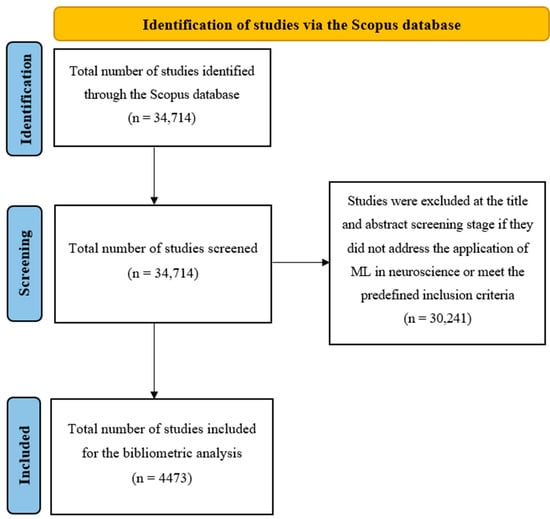
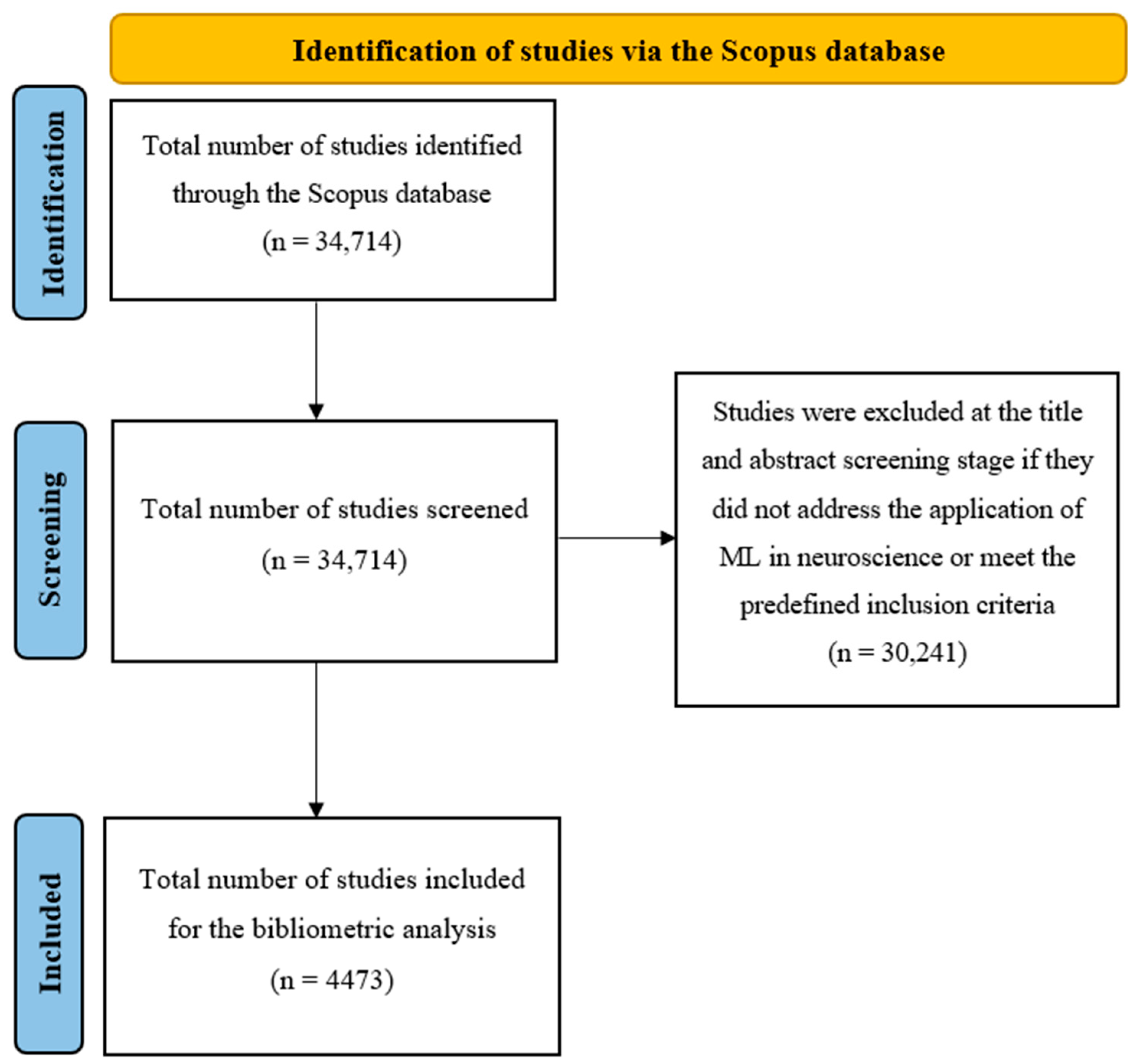
The study selection process was implemented in two sequential stages. First, titles and abstracts were screened to assess the relevance of each record, with exclusions applied to studies that did not address the application of ML within a neuroscientific context or failed to meet the predefined inclusion criteria. This was followed by a full-text evaluation based on explicitly defined inclusion and exclusion criteria. Studies were considered eligible if they comprised peer-reviewed journal articles or conference proceedings that applied ML methodologies to neuroscience data, including, but not limited to, neuroimaging, electrophysiological, and behavioral datasets. Exclusion criteria included studies not directly related to neuroscience applications, those focusing exclusively on methodological developments without empirical neural data, non-English publications, and non-peer-reviewed works. Title and abstract screening was independently conducted by both authors. Potentially eligible studies subsequently underwent full-text assessment. Any possible disagreements regarding eligibility were resolved through discussion and consensus. No specialized systematic review management software, such as Covidence, was used; records were managed using Scopus export files and Microsoft Excel. The reporting process adhered to the PRISMA 2020 statement [15], thereby ensuring transparency, methodological rigor, and reproducibility in the identification, screening, and selection of studies (see Figure 1).
Figure 1.
PRISMA 2020 flow diagram of the selection process.
Ultimately, a bibliometric analysis was conducted using the Bibliometrix package (version 5.2.1) [16], enabling a comprehensive quantitative assessment of publication trends, keyword co-occurrence structures, and thematic development within the literature. All analytical procedures and visualizations were performed exclusively in R (version 4.5.2; R Foundation for Statistical Computing, Vienna, Austria), thereby ensuring methodological consistency and enhancing the reproducibility of the entire analytical workflow.
3. Results
This section presents the results of the bibliometric analysis, examining descriptive indicators, temporal patterns in scientific production, and the distribution of author keywords to delineate the field’s structural and thematic profile.
3.1. Descriptive Statistics Results
As seen in Table 1, the dataset comprises 4473 documents published between 1975 and 2026, originating from 376 distinct sources, including academic journals, conference proceedings, and other scholarly outlets. The field exhibits sustained, robust growth, as reflected in an annual growth rate of 10.39%, indicating consistent expansion of research output over time. The average document age of 9.25 years suggests that the literature is both relatively recent and dynamically evolving. In terms of scholarly impact, the mean citation count per document is 45.29, while the corpus collectively contains 371,656 references. This substantial volume of citations points to a high level of engagement with prior scholarship and underscores the density and interconnectedness of the field’s citation network.
Table 1.
Descriptive Statistics.
From a content-oriented perspective, the dataset reveals a pronounced degree of thematic heterogeneity. A total of 17,409 Keywords Plus and 9547 author-defined keywords were identified, reflecting considerable variation in terminology and conceptual framing across studies. Such dispersion is indicative of the inherently interdisciplinary character of the field, which integrates diverse research domains and methodological traditions across ML and neuroscience. At the same time, the breadth and inconsistency in keyword usage suggest the absence of a fully standardized vocabulary, a condition that may contribute to conceptual fragmentation and limit the development of cumulative knowledge.
The authorship structure further highlights the collaborative nature of research in this domain. In total, 11,343 authors contributed to the dataset, of whom only 295 were single-authors. Correspondingly, just 342 documents were produced by a single author, whereas the average number of co-authors per document was 4.01, indicating that the vast majority of studies are conducted within multi-author teams. The proportion of international co-authorships stands at 28.44%, suggesting a moderate, though not fully pervasive, level of cross-national collaboration. With respect to document typology, journal articles constitute the predominant mode of dissemination (n = 3780), followed by review articles (n = 456) and conference papers (n = 237). This distribution indicates a clear preference for journal-based publication, with conference outputs playing a comparatively limited, albeit still relevant, role in the dissemination of research findings (see Table 1).
3.2. Annual Scientific Production Results
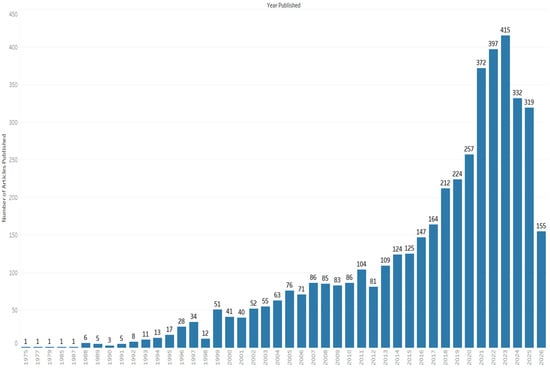
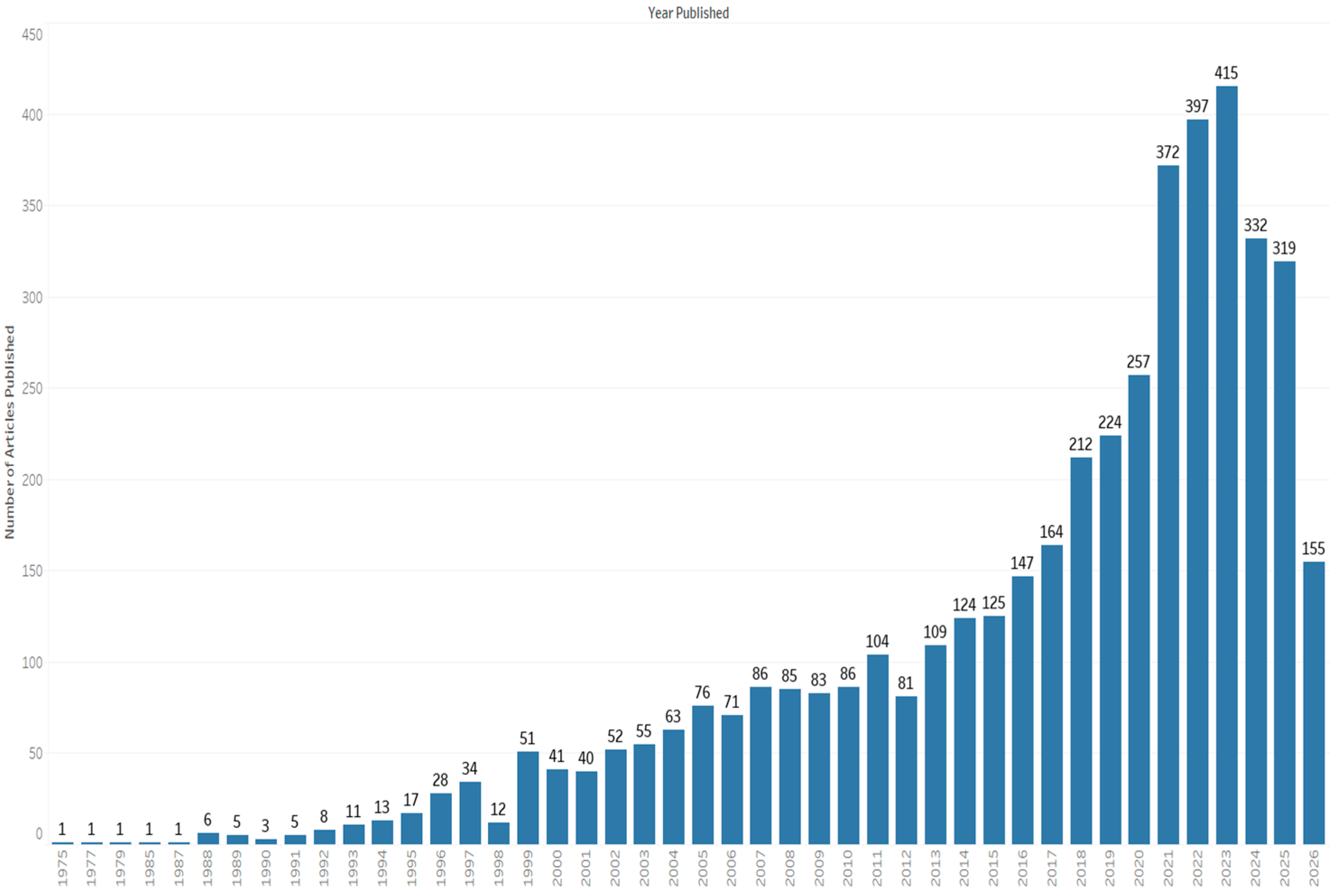
The temporal distribution of publications in Figure 2 reveals a sustained long-term expansion of research activity, marked by clearly distinguishable phases of development. During the initial period, spanning from 1975 to the late 1980s, contributions remained sporadic, with annual outputs consistently below ten publications. A gradual but discernible increase emerged throughout the 1990s, during which the number of publications rose from single-digit levels to 51 articles by 1999. This phase reflects the early consolidation of computational methodologies within neuroscience and the initial integration of data-driven analytical approaches. The upward trajectory persisted into the early 2000s, with annual publication volumes stabilizing at approximately 40–80 articles through the end of the decade, indicating a phase of steady but moderate growth.
Figure 2.
Annual Scientific Production.
A more pronounced period of expansion becomes evident after 2010, when annual output surpassed 100 publications, reaching 147 articles by 2016. From this point onward, the field entered a phase of accelerated growth, characterized by a substantial and continuous increase in research output. Notably, the number of publications rose from 164 in 2017 to 224 in 2019, then to 257 in 2020. This expansion culminated in a peak period between 2021 and 2023, during which annual production reached 372, 397, and 415 publications, respectively, representing the highest levels of scientific output observed within the dataset.
A modest decline is observed after 2023, with 332 publications in 2024 and 319 in 2025, followed by a lower count in 2026 (155 articles). This reduction should be interpreted with caution, as it is likely attributable to incomplete indexing of the most recent year rather than a substantive contraction in research activity. Taken together, the temporal pattern reflects a transition from an emergent, relatively marginal research area to a rapidly expanding, highly active field, particularly over the past decade. This trajectory coincides with the broader proliferation of ML techniques and the increasing availability of large-scale neuroscience datasets (see Figure 2).
3.3. Most Relevant Author Keywords Results
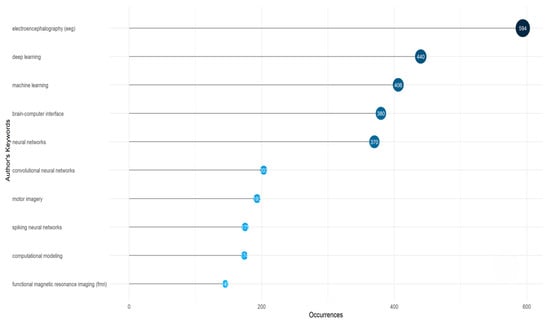
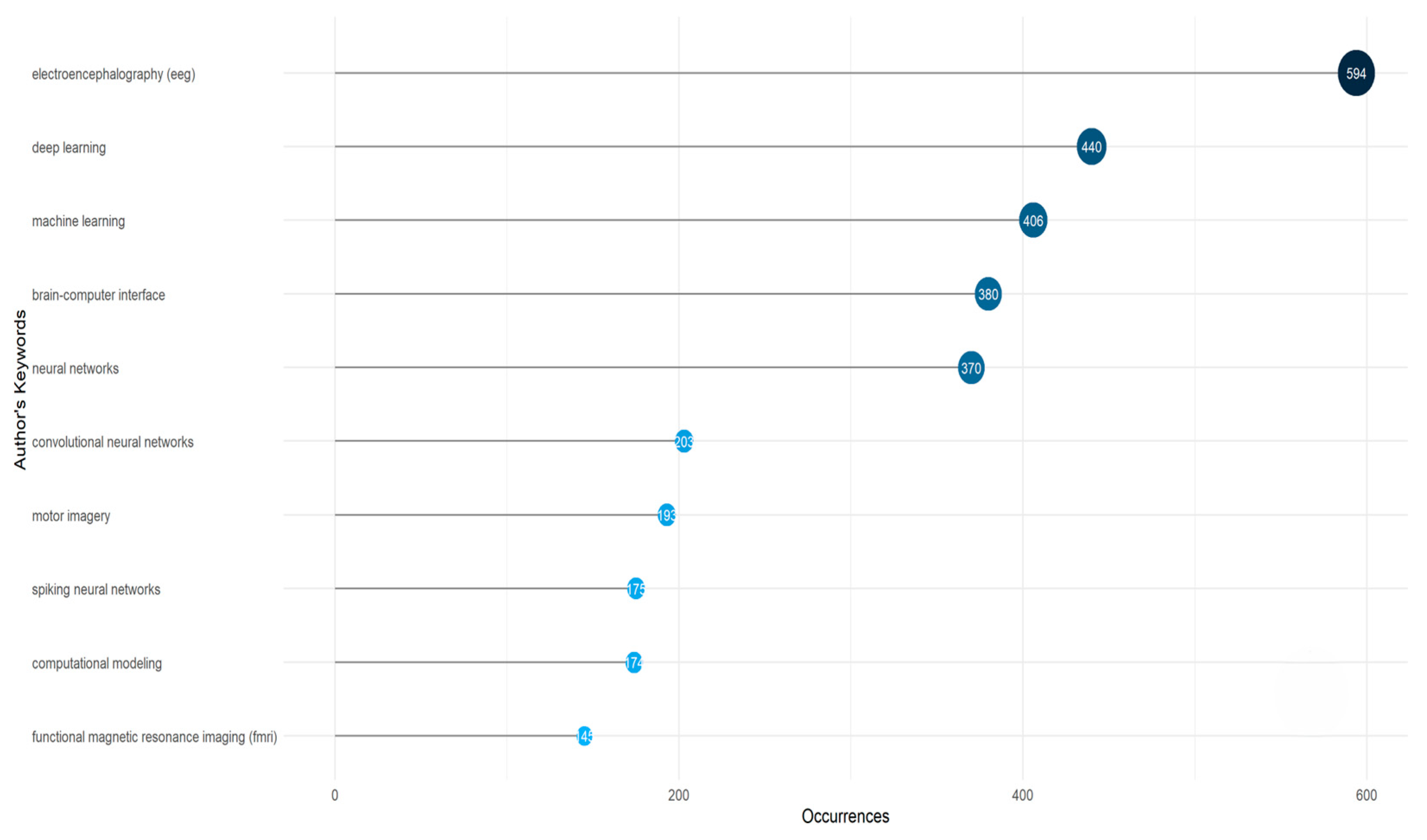
The analysis of author-defined keywords in Figure 3 reveals a pronounced concentration of research activity around specific methodological approaches and application domains at the intersection of ML and neuroscience. The most frequently occurring term is electroencephalography (EEG) (n = 594), followed by deep learning (n = 440) and machine learning (n = 406), indicating a strong and sustained emphasis on the data-driven analysis of neural signals through advanced computational techniques. The prominence of brain–computer interface (BCI) research (n = 380) further underscores the field’s applied orientation, particularly in areas focused on real-time neural decoding and human–machine interaction. In a similar vein, the high frequency of neural networks (n = 370), alongside more specialized architectures such as convolutional neural networks (CNNs) (n = 203), reflects the widespread adoption of deep learning models for the analysis of neural data.
Figure 3.
Most Relevant Author Keywords.
Beyond methodological terminology, several keywords point to dominant experimental paradigms and data modalities. Motor imagery (n = 193) emerges as a central application domain, most commonly associated with EEG-based BCI systems, while functional magnetic resonance imaging (fMRI) (n = 145) highlights the continued relevance of neuroimaging data within machine learning applications. The presence of terms such as spiking neural networks (SNNs) (n = 175) and computational modeling (n = 174) indicates an ongoing, albeit comparatively less prominent, engagement with biologically inspired and theoretically grounded approaches. Taken together, the distribution of author keywords indicates that the literature is predominantly framed around predictive modeling and signal-decoding applications, whereas terminology explicitly associated with mechanistic or biologically grounded approaches is comparatively less prominent (see Figure 3).
4. Discussion
The findings of this bibliometric review provide a comprehensive account of the historical development and current orientation of ML applications in neuroscience research. The temporal distribution of publications clearly demonstrates a transition from a relatively marginal research area into a rapidly expanding and increasingly influential field. This expansion becomes particularly pronounced after 2015, with peak levels of scientific output observed between 2021 and 2023. This trajectory coincides with the progressive integration of data-driven methodologies into neuroscientific inquiry, alongside advances in computational capacity, the refinement of deep learning architectures, and the growing availability of large-scale neural datasets. Moreover, the relatively recent average age of the documents indicates that the field remains in a phase of active expansion and innovation, rather than one characterized by methodological consolidation or theoretical stabilization.
The analysis of keywords and thematic structures further reveals a clear predominance of predictive modeling approaches. This orientation is evidenced by the high frequency of terms such as electroencephalography (EEG), deep learning, machine learning, and brain–computer interface, all of which are closely associated with tasks involving signal decoding, classification, and real-time prediction. The prominence of neural networks, particularly convolutional neural networks, further underscores the centrality of deep learning methodologies in contemporary research practices. By contrast, keywords associated with mechanistic or biologically grounded modeling, such as spiking neural networks and computational modeling, appear less frequently, indicating a comparatively limited emphasis on explanatory frameworks. Taken together, these patterns indicate that the literature is predominantly framed in terms of predictive and data-driven objectives, whereas explicitly mechanistic and biologically grounded perspectives remain comparatively less prominent.
This imbalance reflects the broader distinction between predictive performance and mechanistic explanation outlined in the introduction. While predictive models have demonstrated substantial utility in the analysis of high-dimensional neural data, their predictive performance does not, in itself, establish correspondence between the statistical relationships identified by the model and the biological mechanisms underlying the observed phenomena. Mechanistic approaches, which emphasize interpretability and biological plausibility, remain comparatively underrepresented and present distinct challenges related to scalability, data requirements, and empirical validation. The emergence of hybrid approaches indicates an incipient effort to reconcile these competing paradigms; however, the substantial heterogeneity observed in both methodological implementations and terminological usage suggests that such integrative strategies have not yet been systematically formalized or rigorously evaluated.
The observed distribution of author keywords also raises a broader question concerning the conceptual vocabulary through which methodological orientations are articulated. Terms such as prediction, decoding, and computation denote specific analytical or theoretical constructs, yet their use does not necessarily imply correspondence with the biological mechanisms underlying neural activity [5]. In particular, successful prediction or decoding establishes relationships within the observational and experimental domain in which a model is evaluated, but does not independently demonstrate that the model captures the causal or biophysical processes generating those observations [8]. This distinction is important when assessing the explanatory scope of data-driven approaches and their contribution to mechanistic accounts of neural function [11,12].
The field’s collaborative structure further reflects its inherently interdisciplinary character. The relatively high average number of co-authors per document, together with the presence of international collaborations, indicates that research at this intersection relies on integrating expertise from multiple domains, including computer science, neuroscience, and applied mathematics. At the same time, the extensive proliferation of distinct keywords and the absence of a standardized vocabulary point to a degree of conceptual fragmentation within the literature. Such terminological inconsistency may impede comparability across studies and, consequently, limit the cumulative development of coherent and unified knowledge.
Several limitations of the present study should be acknowledged. First, the analysis is based exclusively on the Scopus database, which, despite its extensive and multidisciplinary coverage, may not encompass all relevant publications in the field. Second, the search strategy was restricted to English-language, peer-reviewed outputs, thereby potentially excluding pertinent studies published in other languages and gray literature, including reports, policy documents, and other non-indexed materials. Third, the dataset reflects the state of database indexing at the time of data collection, thereby delineating the temporal scope of the analysis. Beyond these bibliometric considerations, the interpretation of the reviewed literature should also account for the modality-specific and experimental constraints inherent in neural data acquisition, which shape the observations on which predictive and mechanistic models are developed and evaluated [3,4].
Future research should therefore prioritize the development of integrative frameworks that systematically combine predictive performance with mechanistic explanatory objectives. In this regard, increased attention to model transparency and reproducibility, and to the establishment of standardized evaluation criteria, will be essential for advancing the field. The formulation of clearer conceptual definitions and shared methodological benchmarks may also help to reduce fragmentation and facilitate more coherent knowledge accumulation. Ultimately, the findings suggest that further progress in ML-based neuroscience may benefit from approaches that complement predictive performance with greater attention to the biological mechanisms underlying observed neural phenomena.
5. Conclusions
This study offers a systematic bibliometric examination of the application of ML within neuroscience research, elucidating both the rapid expansion and the increasing methodological complexity that have come to characterize the field over recent decades. The findings reveal a clear predominance of predictive modeling approaches, particularly those grounded in deep learning and neural network architectures, which are extensively employed in tasks such as neural signal decoding, classification, and pattern recognition. By contrast, mechanistic modeling approaches, although present within the literature, remain comparatively less prominent, thereby indicating a limited and uneven emphasis on explanatory, biologically grounded frameworks in the current research landscape.
These results indicate a disparity in the relative emphasis placed on predictive performance and mechanistic explanation, reflecting a broader methodological distinction within contemporary computational neuroscience. While predictive models have demonstrated strong performance in the analysis of high-dimensional neural data, predictive success alone provides limited evidence regarding the biological mechanisms underlying the observed phenomena. Addressing this imbalance will require integrative modeling strategies that combine predictive performance with biological plausibility and mechanistic explanatory value.
Overall, the bibliometric evidence suggests that future progress in the field will depend on establishing more coherent, systematically articulated methodological frameworks. In particular, adopting standardized evaluation criteria and formulating clearer, more consistent conceptual definitions will be essential to reducing fragmentation and enhancing comparability across studies. Within this methodological context, further development should seek to reconcile predictive performance with mechanistic explanatory capacity, thereby strengthening the biological grounding of models used to characterize neural phenomena.
Author Contributions
Conceptualization: N.K. and M.N. Methodology: N.K. and M.N. Software: N.K. and M.N. Validation: N.K. Formal Analysis: M.N. Investigation: N.K. and M.N. Resources: N.K. and M.N. Data Curation: N.K. and M.N. Writing—Original Draft Preparation: N.K. and M.N. Writing—Review and Editing: N.K. Visualization: M.N. Supervision: N.K. Project Administration: N.K. All authors have read and agreed to the published version of the manuscript.
Funding
This research received no external funding.
Data Availability Statement
The data presented in this study are available upon request from the corresponding author.
Conflicts of Interest
The authors declare no conflicts of interest.
Abbreviation
The following abbreviations are used in this manuscript:
| ML | Machine Learning |
References
- Paninski, L.; Cunningham, J. Neural Data Science: Accelerating the Experiment-Analysis-Theory Cycle in Large-Scale Neuroscience. Curr. Opin. Neurobiol. 2018, 50, 232–241. [Google Scholar] [CrossRef] [Scilit]
- LeCun, Y.; Bengio, Y.; Hinton, G. Deep Learning. Nature 2015, 521, 436–444. [Google Scholar] [CrossRef] [Scilit]
- Gao, P.; Ganguli, S. On Simplicity and Complexity in the Brave New World of Large-Scale Neuroscience. Curr. Opin. Neurobiol. 2015, 32, 148–155. [Google Scholar] [CrossRef] [Scilit]
- Stevenson, I.H.; Kording, K.P. How Advances in Neural Recording Affect Data Analysis. Nat. Neurosci. 2011, 14, 139–142. [Google Scholar] [CrossRef] [Scilit]
- Richards, B.A.; Lillicrap, T.P.; Beaudoin, P.; Bengio, Y.; Bogacz, R.; Christensen, A.; Clopath, C.; Costa, R.P.; De Berker, A.; Ganguli, S.; et al. A Deep Learning Framework for Neuroscience. Nat. Neurosci. 2019, 22, 1761–1770. [Google Scholar] [CrossRef] [Scilit]
- Craik, A.; He, Y.; Contreras-Vidal, J.L. Deep Learning for Electroencephalogram (EEG) Classification Tasks: A Review. J. Neural Eng. 2019, 16, 031001. [Google Scholar] [CrossRef] [Scilit]
- Roy, Y.; Banville, H.; Albuquerque, I.; Gramfort, A.; Falk, T.H.; Faubert, J. Deep Learning-Based Electroencephalography Analysis: A Systematic Review. J. Neural Eng. 2019, 16, 051001. [Google Scholar] [CrossRef] [Scilit]
- Rudin, C. Stop Explaining Black Box Machine Learning Models for High Stakes Decisions and Use Interpretable Models Instead. Nat. Mach. Intell. 2019, 1, 206–215. [Google Scholar] [CrossRef] [Scilit]
- Friston, K. The Free-Energy Principle: A Unified Brain Theory? Nat. Rev. Neurosci. 2010, 11, 127–138. [Google Scholar] [CrossRef] [Scilit]
- Dayan, P.; Abbott, L.F. Theoretical Neuroscience: Computational and Mathematical Modeling of Neural Systems; MIT Press: Cambridge, MA, USA, 2001. [Google Scholar]
- Kriegeskorte, N.; Douglas, P.K. Cognitive Computational Neuroscience. Nat. Neurosci. 2018, 21, 1148–1160. [Google Scholar] [CrossRef] [Scilit]
- Schrimpf, M.; Kubilius, J.; Lee, M.J.; Murty, N.A.R.; Ajemian, R.; DiCarlo, J.J. Integrative Benchmarking to Advance Neurally Mechanistic Models of Human Intelligence. Neuron 2020, 108, 413–423. [Google Scholar] [CrossRef] [Scilit]
- Baas, J.; Schotten, M.; Plume, A.; Côté, G.; Karimi, R. Scopus as a Curated, High-Quality Bibliometric Data Source for Academic Research in Quantitative Science Studies. Quant. Sci. Stud. 2020, 1, 377–386. [Google Scholar] [CrossRef] [Scilit]
- Burnham, J.F. Scopus Database: A Review. Biomed. Digit. Libr. 2006, 3, 1. [Google Scholar] [CrossRef] [Scilit]
- Page, M.J.; McKenzie, J.E.; Bossuyt, P.M.; Boutron, I.; Hoffmann, T.C.; Mulrow, C.D.; Shamseer, L.; Tetzlaff, J.M.; Akl, E.A.; Brennan, S.E.; et al. The PRISMA 2020 Statement: An Updated Guideline for Reporting Systematic Reviews. BMJ 2021, 372, n71. [Google Scholar] [CrossRef] [Scilit]
- Aria, M.; Cuccurullo, C. Bibliometrix: An R-Tool for Comprehensive Science Mapping Analysis. J. Informetr. 2017, 11, 959–975. [Google Scholar] [CrossRef] [Scilit]

Disclaimer/Publisher’s Note: The statements, opinions and data contained in all publications are solely those of the individual author(s) and contributor(s) and not of MDPI and/or the editor(s). MDPI and/or the editor(s) disclaim responsibility for any injury to people or property resulting from any ideas, methods, instructions or products referred to in the content. |
© 2026 by the authors. Licensee MDPI, Basel, Switzerland. This article is an open access article distributed under the terms and conditions of the Creative Commons Attribution (CC BY) license.