


Empowering Youth Through the Power of Reflective Journaling: Understanding Life Skills from the Reflections of Youth



Abstract
1. Introduction
1.1. Positive Youth Development Through Sport
1.2. Reflection and Journaling
1.3. Present Study
2. Methods
2.1. Context
2.2. Positionality
2.3. Procedures and Participants
2.4. Data Analysis
3. Results
3.1. Self-Control
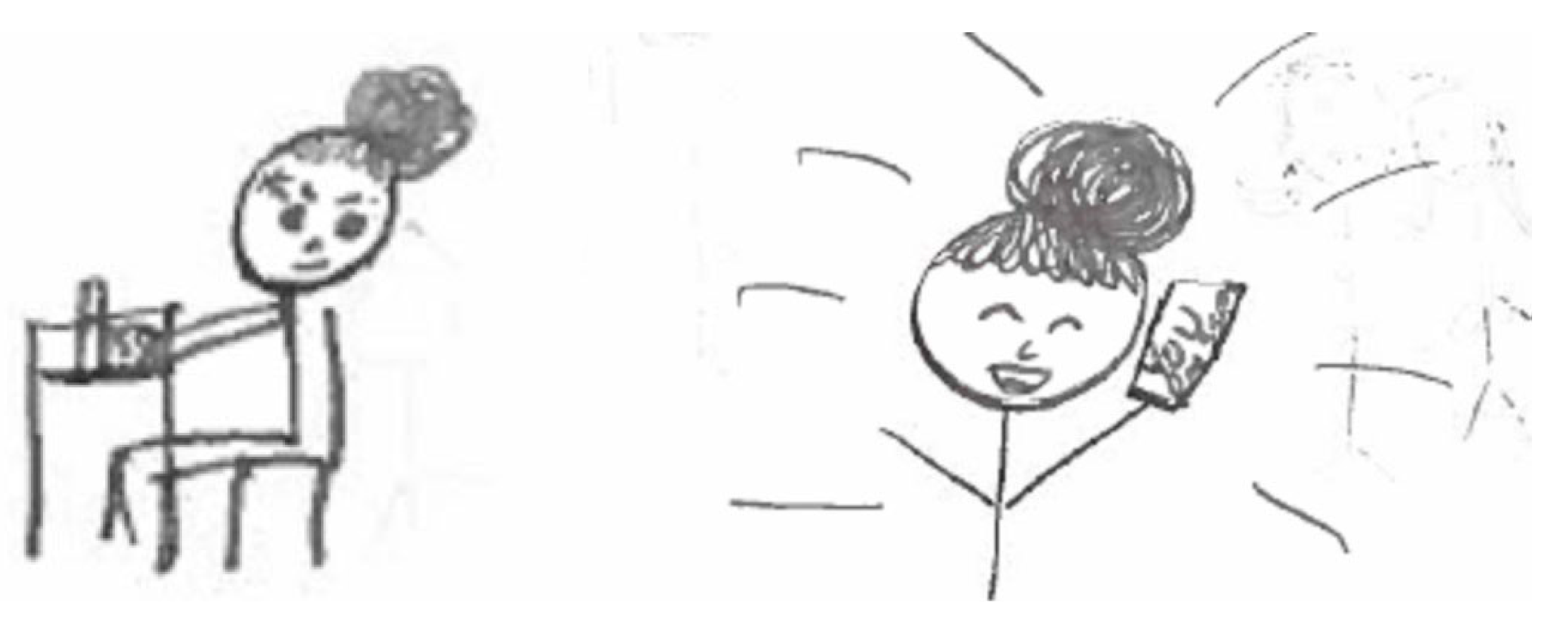
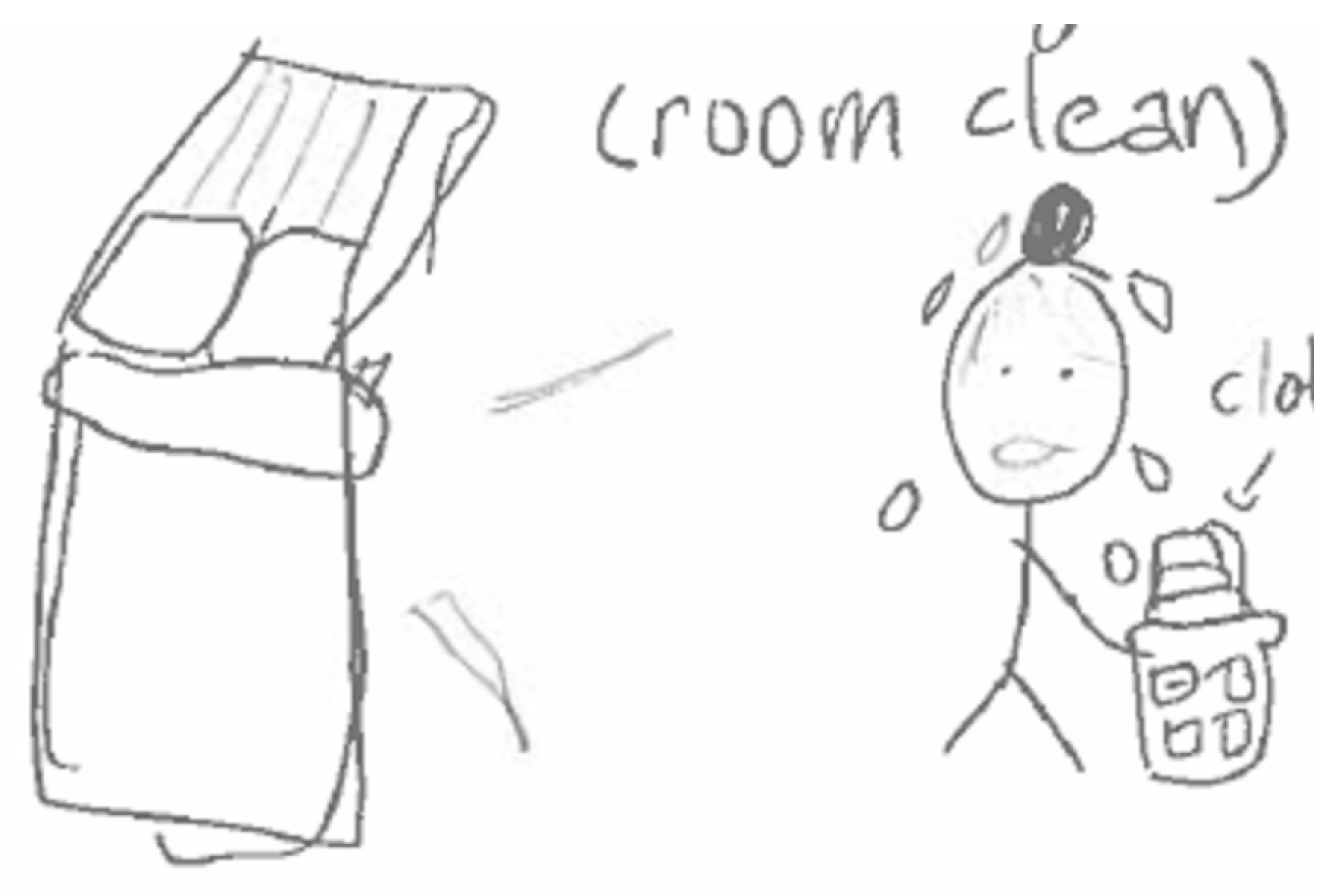
As an example of using Self-control, another girl drew to illustrate how she applies this life skill when feeling mad (see Figure 3).“That you control yourself. It [self-control] looks like this when you walk away from a situation or take a breath and calming down. I showed self control during school when someone said something racist to me I took a breath and calmed down. What happened when I had self control, I didn’t react and didn’t retaliate.”
3.2. Effort
3.3. Teamwork
3.4. Social Responsibility
3.5. Personal Responsibility
3.6. Leadership
3.7. The Transfer and Application of SETS
3.8. Value of SETS Pins
3.9. A Sense of Achievement and Positive Affirmation
4. Discussion
Limitations
5. Conclusions
Author Contributions
Funding
Institutional Review Board Statement
Informed Consent Statement
Data Availability Statement
Conflicts of Interest
References
- Anderson-Butcher, D. (2019). Youth sport as a vehicle for social development. Kinesiology Review, 8(30), 180–187. [Google Scholar] [CrossRef] [Scilit]
- Anderson-Butcher, D., Amorose, A., Bates, S., Newman, T., Okamoto, K., & Volek, A. (2020). Exploring the influence of program staff and parental support on changes in physical health outcomes of vulnerable youth participating in a sport-based positive youth development summer camp. Journal of Sport Behavior, 41(4), 394–414. [Google Scholar]
- Anderson-Butcher, D., Bates, S., Amorose, A., Wade-Mdivanian, R., & Lower-Hoppe, L. (2021). Social-emotional learning interventions in youth sport: What matters in design? Child and Adolescent Social Work Journal, 38, 367–379. [Google Scholar] [CrossRef] [Scilit]
- Anderson-Butcher, D., Martin, E., Paluta, L., & Gould, D. (2018a). Patterns of social skill development over-time among clusters of LiFEsports participants. Children and Youth Services Review, 87, 17–25. [Google Scholar] [CrossRef] [Scilit]
- Anderson-Butcher, D., Riley, A., Amorose, A. J., Iachini, A., & Wade-Mdivanian, R. (2014). Maximizing youth experiences in community sport settings: The design and impact of the LiFE Sports Camp. Journal of Sport Management, 26(2), 236–249. [Google Scholar] [CrossRef] [Scilit]
- Anderson-Butcher, D., Wade-Mdivanian, R., & Davis, J. (2018b). LiFEsports overview and curriculum. College of Social Work, Ohio State University. [Google Scholar]
- Barcza-Renner, K., Anderson-Butcher, D., Amorose, A., & Wade-Mdivanian, R. (2022). Examining the impact of counselor and peer support on social skill development in a sport-based positive youth development program. Journal of Sport Behavior, 45(1), 1–15. [Google Scholar]
- Bean, C., & Forneris, T. (2016). Examining the importance of intentionally structuring the youth sport context to facilitate positive youth development. Journal of Applied Sport Psychology, 28, 410–425. [Google Scholar] [CrossRef] [Scilit]
- Braun, V., & Clarke, V. (2019). Reflecting on reflexive thematic analysis. Qualitative Research in Sport, Exercise and Health, 11(4), 589–597. [Google Scholar] [CrossRef] [Scilit]
- Braun, V., & Clarke, V. (2021). One size fits all? What counts as quality practice in (reflexive) thematic analysis? Qualitative Research in Psychology, 18(3), 328–352. [Google Scholar] [CrossRef] [Scilit]
- Bruner, M. W., Hillier, S., Baillie, C. P. T., Lavallee, L. F., Bruner, B. G., Hare, K., Lovelace, R., & Lévesque, L. (2016). Positive youth development in aboriginal physical activity and sport: A systematic review. Adolescent Research Review, 1, 257–269. [Google Scholar] [CrossRef] [Scilit]
- Camiré, M., Newman, T. J., Bean, C., & Strachan, L. (2021). Reimagining positive youth development and life skills through a social justice lens. Journal of Applied Sport Psychology, 34(6), 1058–1076. [Google Scholar] [CrossRef] [Scilit]
- Camiré, M., Santos, F., Newman, T. J., Vella, S., MacDonald, D., Milistetd, M., Pierce, S., & Strachan, L. (2023). Positive youth development as a guiding framework in sport research: Is it time to plan for a transition? Psychology of Sport & Exercise, 69, 102505. [Google Scholar] [CrossRef] [Scilit]
- Catalano, R. F., Berglund, M. L., Ryan, J. A. M., Lonczak, H. S., & Hawkins, J. D. (2002). Positive youth development in the United States: Research findings on evaluations of positive youth development programs. The Annals of the American Academy of Political and Social Science, 591(1), 98–124. [Google Scholar] [CrossRef] [Scilit]
- Coalter, F. (2013). There is loads of relationships here’: Developing a programme theory for sport-for-change programmes. International Review for the Sociology of Sport, 48(5), 594–612. [Google Scholar] [CrossRef] [Scilit]
- Coalter, F. (2015). Sport-for-change: Some thoughts from a sceptic. Social Inclusion, 3(3), 19–23. [Google Scholar] [CrossRef] [Scilit]
- Colley, B. M., Bilics, A. R., & Lerch, C. M. (2012). Reflection: A key component to thinking critically. The Canadian Journal for the Scholarship of Teaching and Learning, 3(1). [Google Scholar] [CrossRef] [Scilit]
- Eime, R. M., Young, J. A., Harvey, J. T., Charity, M. J., & Payne, W. R. (2013). A systematic review of the psychological and social benefits of participation in sport for children and adolescents: Informing development of a conceptual model of health through sport. The International Journal of Behavioral Nutrition and Physical Activity, 10, 98. [Google Scholar] [CrossRef] [Scilit]
- Epp, S. (2008). The value of reflective journaling in undergraduate nursing education: A literature review. International Journal of Nursing Studies, 45(9), 1379–1388. [Google Scholar] [CrossRef] [Scilit]
- Ginwright, S., & Cammarota, J. (2002). New terrain in youth development: The promise of a social justice approach. Social Justice, 29(4), 82–95. Available online: https://www.jstor.org/stable/29768150 (accessed on 24 February 2025).
- Gould, D., & Carson, S. (2008). Life skills development through sport: Current status and future directions. International Review of Sport and Exercise Psychology, 1(1), 58–78. [Google Scholar] [CrossRef] [Scilit]
- Guba, E. E., & Lincoln, Y. S. (2005). Paradigmatic controversies, contradictions, and emerging confluences. In N. Denzin, & Y. Lincoln (Eds.), The SAGE handbook of qualitative research (3rd ed., pp. 191–216). Sage. [Google Scholar]
- Haudenhuyse, R. P., Theeboom, M., & Skille, E. A. (2014). Towards understanding the potential of sports-based practices for socially vulnerable youth. Sport in Society, 17(2), 139–156. [Google Scholar] [CrossRef] [Scilit]
- Hermens, N., Super, S., Verkooijen, K. T., & Koelen, M. A. (2017). A systematic review of life skill development through sports programs serving socially vulnerable youth. Research Quarterly for Exercise and Sport, 88(4), 408–424. [Google Scholar] [CrossRef] [Scilit] [PubMed]
- Holt, N. L., Neely, K. C., Slater, L. G., Camiré, M., Côté, J., Fraser-Thomas, J., MacDonald, D., Strachan, L., & Tamminen, K. A. (2017). A grounded theory of positive youth development through sport based on results from a qualitative meta-study. International Review of Sport and Exercise Psychology, 10(1), 1–49. [Google Scholar] [CrossRef] [Scilit] [PubMed]
- Jacobs, J. M., & Wright, P. M. (2018). Transfer of life skills in sport-based youth development programs: A conceptual framework bridging learning to application. Quest, 70(1), 81–99. [Google Scholar] [CrossRef] [Scilit]
- Jenkins, J., & Clarke, T. (2017). Engaged journalism: Using experiential learning theory (ELT) for in-class journaling activities. International Journal of Teaching and Learning in Higher Education, 29(1), 154–161. [Google Scholar]
- Jones, M. I., Dunn, J. G., Holt, N. L., Sullivan, P. J., & Bloom, G. A. (2011). Exploring the ‘5Cs’ of positive youth development in sport. Journal of Sport Behavior, 34, 250–267. [Google Scholar]
- Kimiecik, C., Bates, S., & Anderson-Butcher, D. (2020). Examining the impact of a sport-based positive youth development program on adolescent black girls: A mixed method study. Journal of Sport for Development, 9(1), 48–64. [Google Scholar]
- Kolb, D. (1984). Experiential learning: Experience as the source of learning and development. Prentice-Hall. [Google Scholar]
- Lower-Hoppe, L. E., Anderson-Butcher, D., Newman, T., & Logan, J. (2021). The influence of peers on life skill development in a sport-based positive youth development program. Journal of Sport for Development, 9(2), 69–85. [Google Scholar]
- Lower-Hoppe, L. M., Anderson-Butcher, D., Lo, M., & Turner, B. A. (2020). The influence of organizational climate and process on youth outcomes: A case study of a community youth sport organization. Leisure/Loisir, 44(4), 489–520. [Google Scholar] [CrossRef] [Scilit]
- Martinek, T., & Santos, F. (2022). Principles and strategies of reflective journaling in a youth leadership program. Journal of Physical Education, Recreation and Dance, 93(5), 51–55. [Google Scholar] [CrossRef] [Scilit]
- McDonough, M., Ullrich-French, S., Anderson-Butcher, D., Amorose, A. J., & Riley, A. (2013). Social relationships predict social competence among low-income youth in sport-based positive youth development programs. Journal of Applied Sport Psychology, 25, 431–447. [Google Scholar] [CrossRef] [Scilit]
- Newman, T. J. (2020). Life skill development and transfer: “They’re not just meant for playing sports”. Research on Social Work Practice, 30(6), 643–657. [Google Scholar] [CrossRef] [Scilit]
- Newman, T. J., Alvarez, A., & Kim, M. (2017). An experiential approach to sport for youth development. Journal of Experiential Education, 40(3), 308–322. [Google Scholar] [CrossRef] [Scilit]
- Newman, T. J., & Anderson-Butcher, D. (2021). Mechanisms of life skill development and life skill transfer: Interconnections and distinctions. Journal of the Society for Social Work and Research, 12(3), 489–519. [Google Scholar] [CrossRef] [Scilit]
- Newman, T. J., Anderson-Butcher, D., & Amorose, A. J. (2020). Examining the influence of sport program staff and parent/caregiver support on youth outcomes. Applied Developmental Science, 24(3), 263–278. [Google Scholar] [CrossRef] [Scilit]
- Newman, T. J., Anderson-Butcher, D., Bostick, K., & Black, S. (2021a). Psychological processes involved in life skill transfer: Understanding the lived experiences of youth recognized as being socially vulnerable. Child and Adolescent Social Work Journal, 38(4), 423–436. [Google Scholar] [CrossRef] [Scilit]
- Newman, T. J., Black, S., Santos, F., Jefka, B., & Brennan, N. (2023a). Coaching life skill development and transfer: A scoping review of facilitative coaching practices in youth sports. International Review of Sport and Exercise Psychology, 16(1), 619–656. [Google Scholar] [CrossRef] [Scilit]
- Newman, T. J., Jefka, B., Lower-Hoppe, L., Kimiecik, C., Brgoch, S., Dillard, R., Dwyer, K., Rockhill, C., & Ingram, D. (2021b). Youth identity formation: (Mis)alignment between male youth and sport coaches. Children and Youth Services Review, 120, 105733. [Google Scholar] [CrossRef] [Scilit]
- Newman, T. J., Kim, M., Tucker, A., & Alvarez, A. (2018). Learning through the adventure of youth sport. Physical Education and Sport Pedagogy, 23(3), 280–293. [Google Scholar] [CrossRef] [Scilit]
- Newman, T. J., Lee, L., Santos, F., Ferreira, M., & Anderson-Butcher, D. (2025). Photo-based methods to illustrate the what-where-how of life skill transfer. Research on Social Work Practice. [Google Scholar] [CrossRef] [Scilit]
- Newman, T. J., Lee, L., & Stauffer, A. (2024). An experiential approach to understanding PYD from sport-based programs. In N. Holt, & M. McDonough (Eds.), Positive youth development through sport (3rd ed., pp. 1–15). Routledge. [Google Scholar] [CrossRef] [Scilit]
- Newman, T. J., McCray, K., Lower-Hoppe, L., Ingram, D., Rockhill, C., Ohanasian, J., & Simmons-Horton, S. (2023b). Healthy masculinity construction: The influence of race, faith, and athletics. Children & Society, 37(3), 854–874. [Google Scholar] [CrossRef] [Scilit]
- Núñez, P. D. P., Portela-Pino, I., & Martínez-Patiño, M. (2023). Understanding the characteristics of community youth sports programs interventions: A systematic review and recommendations. SAGE Open, 13(2). [Google Scholar] [CrossRef] [Scilit]
- O’Connell, T., & Dyment, J. (2011). The case of reflective journals: Is the jury still out? Reflective Practice, 12(1), 47–59. [Google Scholar] [CrossRef] [Scilit]
- Padgett, D. K. (2016). Qualitative methods in social work research (3rd ed.). Sage. [Google Scholar]
- Pierce, S., Gould, D., & Camiré, M. (2017). Definition and model of life skills transfer. International Review of Sport and Exercise Psychology, 10(1), 186–211. [Google Scholar] [CrossRef] [Scilit]
- Pierce, S., Scheadler, T., Anderson-Butcher, D., Amorose, A., & Wade-Mdivanian, R. (2022). Social skill transfer from a sport-based positive youth development program to the school setting. Sport Social Work Journal, 1(1), 78–95. [Google Scholar] [CrossRef] [Scilit]
- Pozo, P., Grao-Cruces, A., & Pérez-Ordás, R. (2018). Teaching personal and social responsibility model-based programmes in physical education: A systematic review. European Physical Education Review, 24(1), 56–75. [Google Scholar] [CrossRef] [Scilit]
- Raterink, G. (2016). Reflective journaling for critical thinking development in advanced practice registered nurse students. The Journal of Nursing Education, 55(2), 101–104. [Google Scholar] [CrossRef] [Scilit]
- Riley, A., & Anderson-Butcher, D. (2012). Participation in a summer sport-based youth development program for disadvantaged youth: Getting the parent perspective. Children and Youth Services Review, 34(7), 1367–1377. [Google Scholar] [CrossRef] [Scilit]
- Robinson, E., Newman, T., Scheadler, T., Lower-Hoppe, L., & Baeth, A. (2024). The unique lived experiences of LGBQ athletes: A collegiate women’s rugby club team as an inclusive and empowering community. Journal of Homosexuality, 71(4), 1003–1029. [Google Scholar] [CrossRef] [Scilit]
- Scheadler, T. R., Anderson-Butcher, D., & Bates, S. (2024). Long-term life skill transfer from sport-based positive youth development programs. Journal of Youth Development, 19(3), 21–38. Available online: https://open.clemson.edu/jyd/vol19/iss3/2 (accessed on 24 February 2025).
- Spruit, A., Assink, M., Van Vugt, E. S., Van der Put, C. E., & Stams, G. J. J. M. (2016). The effects of physical activity interventions on psychosocial outcomes in adolescents: A meta-analytic review. Clinical Psychology Review, 45, 56–71. [Google Scholar] [CrossRef] [Scilit]
- Stuhr, P. T., De La Rosa, T., Samalot-Rivera, A., & Sutherland, S. (2018). The road less traveled in elementary physical education: Exploring human relationship skills in adventure-based learning. Education Research International, 2018(1), 3947046. [Google Scholar] [CrossRef] [Scilit]
- Tufford, L., & Newman, P. (2012). Bracketing in qualitative research. Qualitative Social Work, 11(1), 80–96. [Google Scholar] [CrossRef] [Scilit]
- Turgeon, S., Newman, T., Lee, L., Nicholas, O., & Bean, C. (2024). Social justice attitudes and behavioral intentions of NCAA student-athletes: The role of life skills. International Journal of Sport and Exercise Psychology, 22(6), 1549–1568. [Google Scholar] [CrossRef] [Scilit]
- Vella, S., Pierce, S., Camiré, M., Newman, T., MacDonald, D., Milistetd, M., Strachan, L., & Santos, F. (2025). What is considered quality youth sport? A Delphi study of international scholar perspectives. Journal of Applied Sport Psychology. [Google Scholar] [CrossRef] [Scilit]
- Vettenburg, N. (1998). Juvenile delinquency and the cultural characteristics of the family. International Journal of Adolescent Medicine and Health, 10, 193–209. [Google Scholar]
- Whitley, M. A., Massey, W. V., Camire, M., Boutet, M., & Borbee, A. (2019). Sport-based youth development interventions in the United States: A systematic review. BMC Public Health, 19, 89. [Google Scholar] [CrossRef] [Scilit]

| Life Skill | Definition | Lesson Plan Topics | Example Curricular Activity |
|---|---|---|---|
| Self-Control |
|
|
|
| Effort |
|
|
|
| Teamwork |
|
|
|
| Social Responsibility |
|
|
|
Disclaimer/Publisher’s Note: The statements, opinions and data contained in all publications are solely those of the individual author(s) and contributor(s) and not of MDPI and/or the editor(s). MDPI and/or the editor(s) disclaim responsibility for any injury to people or property resulting from any ideas, methods, instructions or products referred to in the content. |
© 2025 by the authors. Licensee MDPI, Basel, Switzerland. This article is an open access article distributed under the terms and conditions of the Creative Commons Attribution (CC BY) license (https://creativecommons.org/licenses/by/4.0/).
Share and Cite
Anderson-Butcher, D.; Newman, T.J.; Williams, E. Empowering Youth Through the Power of Reflective Journaling: Understanding Life Skills from the Reflections of Youth. Youth 2025, 5, 60. https://doi.org/10.3390/youth5020060
Anderson-Butcher D, Newman TJ, Williams E. Empowering Youth Through the Power of Reflective Journaling: Understanding Life Skills from the Reflections of Youth. Youth. 2025; 5(2):60. https://doi.org/10.3390/youth5020060
Chicago/Turabian StyleAnderson-Butcher, Dawn, Tarkington J Newman, and Ellen Williams. 2025. "Empowering Youth Through the Power of Reflective Journaling: Understanding Life Skills from the Reflections of Youth" Youth 5, no. 2: 60. https://doi.org/10.3390/youth5020060
APA StyleAnderson-Butcher, D., Newman, T. J., & Williams, E. (2025). Empowering Youth Through the Power of Reflective Journaling: Understanding Life Skills from the Reflections of Youth. Youth, 5(2), 60. https://doi.org/10.3390/youth5020060

