


Abstract
Among cyanobacterial genera, Microcystis spp. dominate aquatic systems and form harmful algal blooms (HABs) under favorable environmental conditions, such as temperature and nitrogen availability. Numerous studies have examined the effects of these drivers on biomass accumulation and microcystins (MCs) production; however, their findings have been inconsistent, with some reporting positive, negative, or neutral correlations. To address this, we synthesized existing data using multilevel meta-analysis. A total of 143 effect sizes were extracted from 18 independent laboratory studies and used to evaluate three main relationships, (i) temperature, nitrate, and biomass; (ii) temperature, nitrate, and microcystin concentration; (iii) biomass and microcystin; while microcystin compartments (intracellular, extracellular, and total microcystin) were used as moderators to determine whether they explain variations in observed patterns. Temperature and nitrate showed positive correlations with biomass accumulation, with nitrate having a stronger effect. However, they showed a weak correlation with microcystin production, with temperature having no statistically significant effect and nitrate showing a moderate positive correlation. Biomass exhibited a consistent positive correlation with microcystin production across all studies, suggesting that it plays a significant role in toxin accumulation. Microcystin compartmentalization revealed that correlation between biomass and microcystins differed by compartment. Extracellular and total microcystin levels showed a stronger correlation with biomass than intracellular microcystin levels. The heterogeneity observed across studies suggests that microcystin production is not only influenced by environmental factors and biomass accumulation but also by differences in genetics, physiology, and toxin compartment dynamics among Microcystis species.
1. Introduction
1.1. Introduction
Anthropogenic activities associated with rapid population growth have accelerated climate change, particularly global warming, and increased nutrient enrichment in aquatic water bodies, creating favorable conditions for the formation of harmful cyanobacterial blooms (CyanoHABS) [1]. The frequency, duration, and water bodies in which they are found have increased over the past decades as environmental conditions have become very favorable for blooms [2]. Among bloom-forming cyanobacteria, Microcystis species dominate aquatic systems and are well known for their ability to produce bioactive secondary metabolites, such as microcystins (MCs), which are cyclic heptapeptide hepatotoxins that mainly inhibit protein phosphatases PP1 and PP2A, resulting in hepatocellular damage [3,4]. This poses significant risks to aquatic ecosystems, livestock, and human health through contaminated drinking water or recreational exposure [5,6]. Although most Microcystis spp. produce MCs, only those that possess the mcy gene cluster are responsible for producing toxins, while species that do not possess it are non-toxic and can commonly coexist in aquatic ecosystems [7]. A notable example is the 1996 incident in Caruaru (PE, Brazil), where patients undergoing hemodialysis were exposed to water contaminated with an M. aeruginosa bloom, resulting in multiple deaths [1,8].
Bloom occurrences and microcystin synthesis are highly influenced by a complex interaction of biotic and abiotic factors, including nutrient availability, microbial interactions, light quality, grazing intensity, and temperature. Among these factors, nutrient availability, especially nitrogen availability, and temperature are known to play vital roles in cyanobacterial physiology and bloom dynamics [9]. Temperature affects cyanobacterial growth rates and secondary metabolism, whereas nitrogen plays a significant role in photosynthesis, cellular metabolism, and toxin biosynthesis [10,11]. Among the nitrogen forms, nitrate is one of the most prevalent in aquatic ecosystems, and its availability has been increasing owing to anthropogenic inputs, thereby influencing Microcystis spp. growth and microcystin production [12,13].
However, most studies evaluating the effects of temperature and nitrate on MCs production have shown inconsistent patterns, with some showing positive relationships and others revealing no relationships or even negative associations [14,15]. For temperature, a high MCs content was reported at 25–30 °C [16], and an increased MC cell quota was noted at 33 °C, followed by a decline at 36 °C [17]. Conversely, some studies reported that temperatures above 27–28 °C reduced MC production [18,19], while other studies found the highest MC production at 20–24 °C [20] and after temperature was reduced from 26 °C to 19 °C [21].
Similarly, nitrogen follows the same pattern; in several studies, high nitrogen availability increased the intensity of microcystin production and directly affected bloom persistence [22]. Wagner et al. [23] and Horst et al. [24] also observed that high nitrogen loading promotes the growth of toxic Microcystis spp. and Planthotrix and increases toxin production with microcystin-producing cell quotas in both laboratory and field studies. Le et al. [25] also observed an increase in extracellular microcystin when nitrogen was abundant, whereas intracellular microcystin remained stable. Conversely, nitrogen limitation has been reported to contribute significantly to the production of toxins and the upregulation of toxin-related genes [15,26].
Challenges contributing to the inconsistency in various studies include the physiological and genetic differences among Microcystis strains. Microcystin production is regulated by mcy gene cluster, which can be regulated by environmental conditions by changing toxin synthesis, cellular metabolism, and growth of Microcystis spp. [27,28]. However, Microcystis spp. populations generally include a mix of toxic and non-toxic strains that respond differently to environmental factors [14,26]. In addition, different microcystin analysis methods and experimental conditions, such as nutrient composition and culture duration, may further contribute to the heterogeneity across studies [29]. Generally, these sources of variation make it difficult to identify patterns from individual studies, highlighting the necessity of synthesizing existing quantitative evidence.
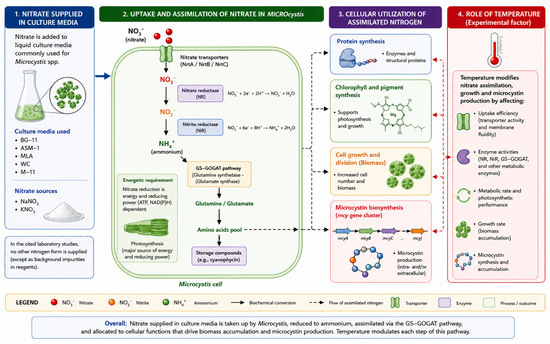
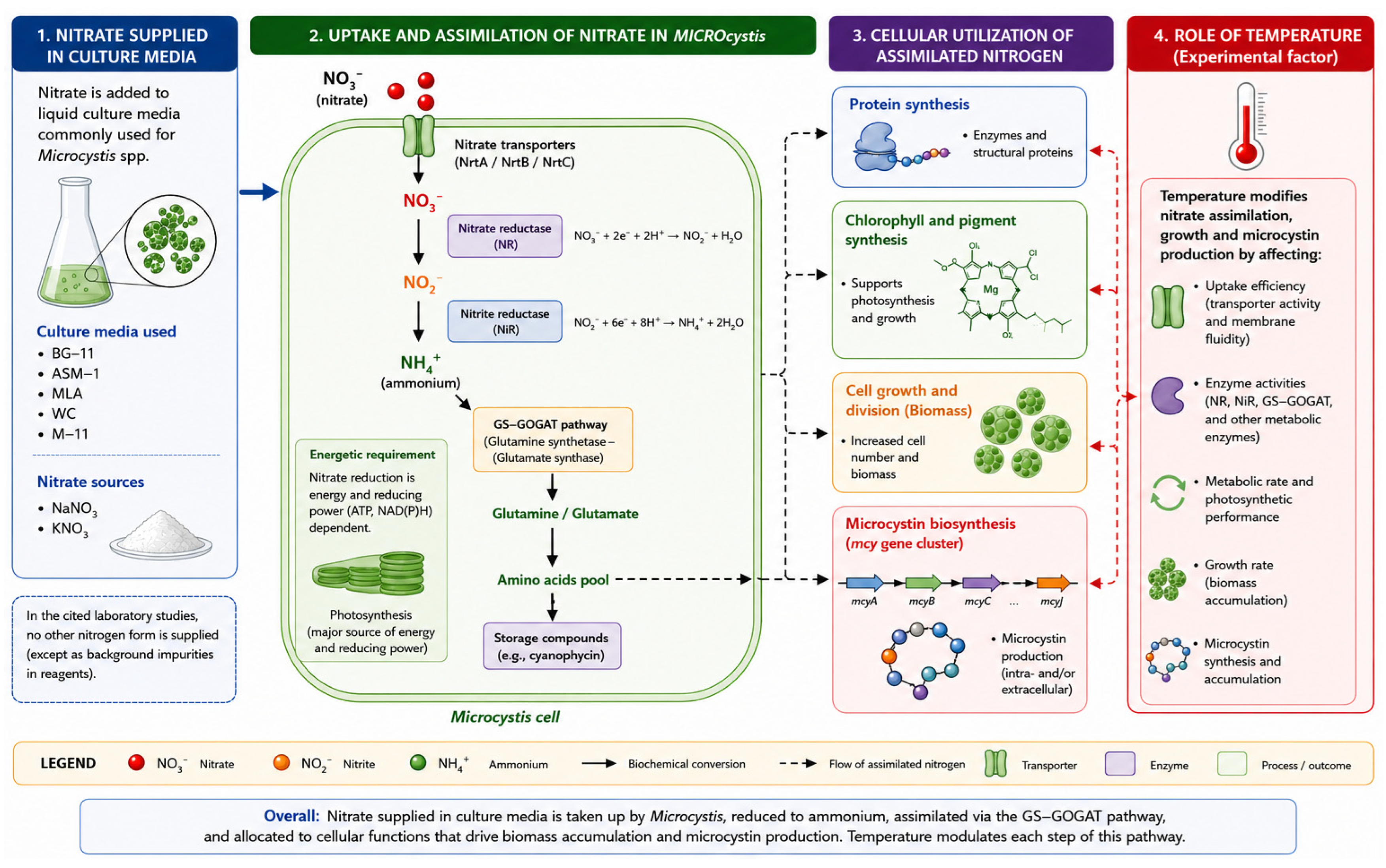
Meta-analysis provides an analytical approach that synthesizes results across studies, allowing for overall effect size estimation and examination of heterogeneity among experimental conditions, accommodating various dependent observations within studies [30,31]. Therefore, this analytical method is vital, particularly for understanding the relationship between temperature, nitrate, and microcystin production, and the role of MC compartmentalization, as little to no previous quantitative synthesis has considered the relationship with the above-stated parameters while explicitly considering toxin compartmentalization as a source of heterogeneity. In this meta-analysis, temperature and nitrate were intentionally focused on because they are the most manipulated environmental parameters in cyanobacterial controlled laboratory studies, and only laboratory-controlled studies were considered to minimize confounding environmental heterogeneity, allowing for an independent comparison of these factors. Figure 1 provides a conceptual framework underlying the laboratory studies included in this meta-analysis. In these studies, nitrate and temperature were independently manipulated as experimental treatments to evaluate their effects on Microcystis physiology. Nitrate is assimilated through well-established nitrogen assimilation pathways to support cellular metabolism, photosynthesis, biomass accumulation, and microcystin biosynthesis, while temperature influences these physiological processes by regulating metabolic activity, nutrient assimilation, and growth. This conceptual overview provides context for the relationships evaluated in the present study.
Figure 1.
Conceptual overview of the roles of nitrate and temperature in biomass accumulation and microcystin production in laboratory cultures of Microcystis spp. Solid arrows (⟶) indicate biochemical conversions or direct physiological processes, dashed black arrows (– – –>) indicate the flow of assimilated nitrogen to downstream cellular functions, and dashed red arrows (– – –>) represent the modulatory effects of temperature on the indicated physiological processes.
1.2. Biomass Scaling Versus Toxin Synthesis Regulation
In Microcystis spp., an increase in biomass accumulation is usually associated with the toxin concentration in the aquatic system. This effect has been noted, especially during algal blooms, where a dense population can generate significant amounts of microcystins [32,33]. Elevated temperature and nutrient availability, which promote biomass accumulation, may simultaneously increase total microcystin concentrations [34]. Furthermore, multiple studies have reported a positive association between biomass accumulation and toxin production during bloom formation [23,35].
However, not all increases in microcystin concentrations are directly related to increased biomass. Toxin biosynthesis may vary independently of biomass owing to the transcriptional and physiological regulation of the mcy gene cluster, which responds to environmental stressors such as interspecific competition, oxidative stress, and nutritional imbalance. These factors may, in turn, affect mcy transcription and toxin production without necessarily producing proportional changes in biomass [27,36,37]. This suggests that the relationship between environmental factors and toxin production works in at least two complementary ways: (i) through indirect regulation by biomass accumulation and (ii) direct physiological and strain-specific toxin synthesis. Understanding both pathways is important to understand the inconsistent relationships noted among different laboratory studies.
1.3. Importance of Microcystin Compartmentalization
Microcystin occurs in both intracellular, extracellular, and total forms, reflecting differences in physiological and ecological roles. Intracellular microcystin is an active toxin produced and retained within living cells, whereas extracellular microcystin is released by cell lysis or bloom senescence and is more directly related to exposure risk [38]. Total microcystins include both intracellular and extracellular MCs, providing a comprehensive total of the microcystin in the ecosystem. These forms are not interchangeable because they reflect different toxin release systems [39].
Despite the biological differences, most studies only report total microcystins, which may obscure the source and release of microcystin, as total microcystin measurements do not differentiate between actively produced intracellular and extracellular microcystin during bloom increases or declines [40]. Variations in analytical processes, sampling methods, and toxin compartmentalization may influence heterogeneity between various studies [40]. Therefore, differentiating microcystin forms in compartments provides valuable insights into whether differences in intracellular, extracellular, and total MCs forms can contribute to the heterogeneity noted across studies. Incorporating compartments as a moderator represents a key aspect of this meta-analysis and may improve our understanding and interpretation of cyanobacterial toxicity and ecological risk.
Given these inconsistencies and knowledge gaps, the objective of this study was to quantitatively synthesize laboratory evidence on the relationships between temperature, nitrate availability, biomass accumulation, and microcystin production in Microcystis spp. Specifically, the study evaluated: (i) the relationships between temperature/nitrate and biomass; (ii) the relationships between temperature/nitrate and microcystin concentration; (iii) the relationship between biomass and microcystin concentration; and (iv) whether intracellular, extracellular, and total microcystin compartments can explain the variations between studies.
2. Materials and Methods
2.1. Literature Search and Study Selection
A comprehensive literature search was conducted to identify laboratory studies investigating the effects of temperature and nitrate on biomass accumulation and microcystin production by Microcystis species. Searches were conducted across three major scientific databases, Web of Science Core Collection (www.webofscience.com), Scopus (https://www.sciencedirect.com/), and Google Scholar (https://scholar.google.com/), covering all available years up to November 2025. The search strategy combined relevant keywords to capture studies addressing cyanobacterial toxin production, biomass dynamics and environmental drivers. The primary search strings used in Web of Science and Scopus were as follows:
TS = (cyanopeptide* or microcystin*) AND TS = (nitrate or nitrogen or temperature) AND TS = (Microcystis OR “blue green algae” OR “blue-green algae” or cyanobacteria).
Additional keyword combinations, including Microcystis, microcystin, cyanobacteria, temperature, nitrate, nitrogen, nutrient enrichment, biomass, and toxin production, were used to ensure broad coverage and maximize the retrieval of the relevant literature.
The initial pool of studies retrieved from the databases was 1243 and screened in two stages. The first screening involved the removal of duplicate records. Subsequently, the titles and abstracts were reviewed to identify potentially relevant studies. This screening resulted in 115 studies being considered eligible for further evaluation. In the second stage, the full texts of these studies were examined, focusing on the methods and results sections to confirm eligibility for data extraction, while studies that met all inclusion criteria were retained for data extraction and analysis.
- Inclusion Criteria
Studies were included in the meta-analysis if they satisfied the following criteria: (1) The studies used monocultures of Microcystis spp. and were conducted under controlled laboratory conditions. (2) The study provides quantitative measurements of biomass and/or microcystin concentrations measured in relation to temperature and/or nitrate experimental manipulation. (3) The study provided sufficient data to compute at least one effect size (Pearson’s correlation coefficient, r) and its corresponding sampling variance. (4) The study reported microcystin compartments (intracellular, extracellular, or total microcystin concentration).
When studies involved multifactorial experimental designs, effect sizes were extracted only from the treatments where the relationship between the environmental variable (temperature or nitrate) and the response variable was directly evaluated without confounding from simultaneously varying experimental factors. Relationships in which independent effects could not be isolated were excluded from the quantitative synthesis.
- Exclusion Criteria
Studies excluded from the analysis were as follows: (1) reviews and theoretical papers without extractable data; (2) studies reporting only total nitrogen without nitrate-specific measurements to reduce confounding effects associated with multiple nitrogen forms; (3) studies in which microcystin concentration and/or Microcystis spp. biomass were not directly quantified; and (4) studies without variation in nitrate concentration and temperature.
Laboratory studies were prioritized to reduce confounding environmental variability that commonly occurs in field studies and allow clearer inferences of the effects of temperature and nitrate.
2.2. Data Extraction and Variable Classification
For each included study, the sample size (n) and corresponding Pearson’s correlation coefficient (r) describing the relationships between temperature, nitrate, biomass accumulation, and microcystin concentration were extracted. When Pearson’s correlation coefficient was not directly reported, other statistics (e.g., slope of linear regression) were extracted and converted to Pearson’s correlation coefficients, following standard conversion procedures [41,42]. When data were presented only graphically, WebPlotDigitizer (Version 5) was used to extract the required numerical values.
Each effect size (r) was treated as an independent relationship between the environmental variables (temperature or nitrate) and the corresponding response variables (biomass and microcystin production), and where several effect sizes came from the same publication, study identity was retained to account for statistical dependence in the multilevel analyses.
Pearson’s correlation coefficient (r) estimates were converted to Fisher’s Zr to stabilize the variance before the statistical analyses [41]. The transformation was calculated as
The sampling variance () for each effect size was calculated as:
where n is the sample size associated with the reported correlations. After fitting the statistical models, Fisher’s Zr values were back-transformed into Pearson’s correlation coefficients (r) for the interpretation of the results.
For each study, additional variables and study characteristics were extracted to characterize the methodological heterogeneity among the studies. These included study identity, Microcystis species and strain, growth medium, light intensity, temperature treatments, nitrate concentrations, biomass metric, photoperiod, culture duration, growth phase sampled, microcystin analytical method, microcystin concentrations, and mcy gene assessment. The included studies were dominated by Microcystis aeruginosa but also represented other Microcystis spp. and strain types. A summary of the Microcystis spp. represented in the meta-analysis is provided in Table 1, while detailed study characteristics for each publication are presented in Supplementary Table S1.
Table 1.
Overview of the distribution of Microcystis species in the laboratory studies included in the meta-analysis.
Microcystin concentrations were further classified according to toxin compartment based on how they were reported in the original studies. These categories included:
Intracellular microcystin—toxin retained within Microcystis cells;
Extracellular microcystin—toxin released into the medium following cell lysis or physiological stress;
Total microcystin—combined intracellular and extracellular toxin pools.
These classifications allowed compartment-specific responses to temperature and nitrate to be evaluated in moderator analyses and their contribution to between-study heterogeneity.
2.3. Biomass as an Associated Response Variable
Temperature/nitrate may influence toxin levels through their association with Microcystis spp. growth and biomass accumulation, as most studies have reported toxin concentrations normalized to cell density or biomass. To account for these associations, biomass was treated as both a response variable to environmental drivers (temperature and nitrate) and as an associated predictor of microcystin concentration. Accordingly, three sets of relationships were examined:
- Temperature/nitrate and biomass;
- Temperature/nitrate and microcystin;
- Biomass and microcystin.
This was to allow the analysis of independent bivariate relationships and the evaluation of pairwise associations among variables.
2.4. Meta-Analytic Models
Data analysis was performed using R version 4.5.1 and the metafor package. Multilevel random-effects models were conducted using the ‘rma.mv()’ function to account for dependent effect sizes by nesting them within the studies. This approach considers that effect sizes vary across studies, not only because of sampling error but also because of true differences across studies (heterogeneity).
Study identity was included as a random effect in the multilevel model to account for the non-independence of effect sizes from the same study and partition variance between and within studies. Heterogeneity among studies was assessed using Cochran’s Q test and I2 statistics. Cochran’s Q evaluated whether the variation in effect sizes exceeded what would be expected from sampling error, whereas I2 quantified the proportion of total variation attributable to true heterogeneity rather than sampling error.
Publication bias was assessed through visual inspection of the funnel plot and Egger’s regression intercept test, and forest plots of effect sizes were generated to facilitate the interpretation of patterns across studies. All statistical tests were two-sided, and a p-value of less than 0.05 was considered statistically significant. Using this model, separate multilevel models were fitted to examine the relationships between environmental drivers, biomass, and microcystins. This included the following parameters: temperature vs. microcystin, nitrate vs. microcystin, temperature vs. biomass, nitrate vs. biomass, and biomass vs. microcystin.
2.5. Moderator Analyses
To evaluate whether the microcystin compartment influenced the observed relationships, microcystin compartments (intracellular microcystin, extracellular microcystin, and total microcystin) were used as categorical moderators in meta-regression models. Intracellular microcystin was used as the reference category because it reflects toxins retained within Microcystis cells before being released into the surrounding medium. Moderator effects were evaluated using Wald-type tests of moderators (QM) implemented in the multilevel meta-analytic models.
Although several study-level variables, including mcy genotype confirmation, growth phase, and culture conditions, were extracted, their inconsistent reporting across studies limited their inclusion in the moderator analyses. However, they are potential contributors to residual heterogeneity.
3. Results
3.1. Overview of the Dataset
The data consisted of 143 effect sizes from 18 independent laboratory studies, representing the relationships between nitrate concentration, temperature, biomass accumulation, and microcystin concentration in Microcystis spp. Substantial heterogeneity was observed across the analyses (Q-test, p < 0.001), indicating variations in the effect sizes among the studies. Likely sources of heterogeneity included differences in Microcystis strains, culture conditions, growth phase, analytical methods, experimental duration, and the microcystin compartment measured among studies.
3.2. Temperature and Nitrate as Environmental Drivers of Biomass Accumulation
Both temperature and nitrate showed positive correlations with biomass accumulation across studies, although their consistency and magnitude varied. Temperature showed a high Pearson’s correlation (r = 0.81, 95% CI: 0.02–0.98) and a statistically significant association with biomass (Fisher’s Z = 1.12, SE = 0.56, p = 0.046). Its wide confidence interval, which started near zero, indicates high uncertainty in the correlation strength observed across studies. Furthermore, the substantial between-study variance (τ2 = 1.87) suggests significant dispersion in the effect sizes, thereby supporting the uncertainty in the positive correlation between temperature and biomass across studies. In contrast, nitrate exhibited a stronger and more consistent positive correlation with biomass (r = 0.95, 95% CI: 0.89–0.98) and highly significant pooled effect sizes (Fisher’s Z = 1.84, SE = 0.22, p < 0.0001). It had an entirely positive and narrow confidence interval, indicating high consistency in the estimated effect size. Although heterogeneity was statistically significant (Q-test, p < 0.001), the between-study variance was substantially lower (τ2 = 0.55), suggesting that nitrate–biomass relationships were relatively consistent across studies.
3.3. Relationships Between Temperature, Nitrate, and Microcystin Concentrations in Microcystis spp.
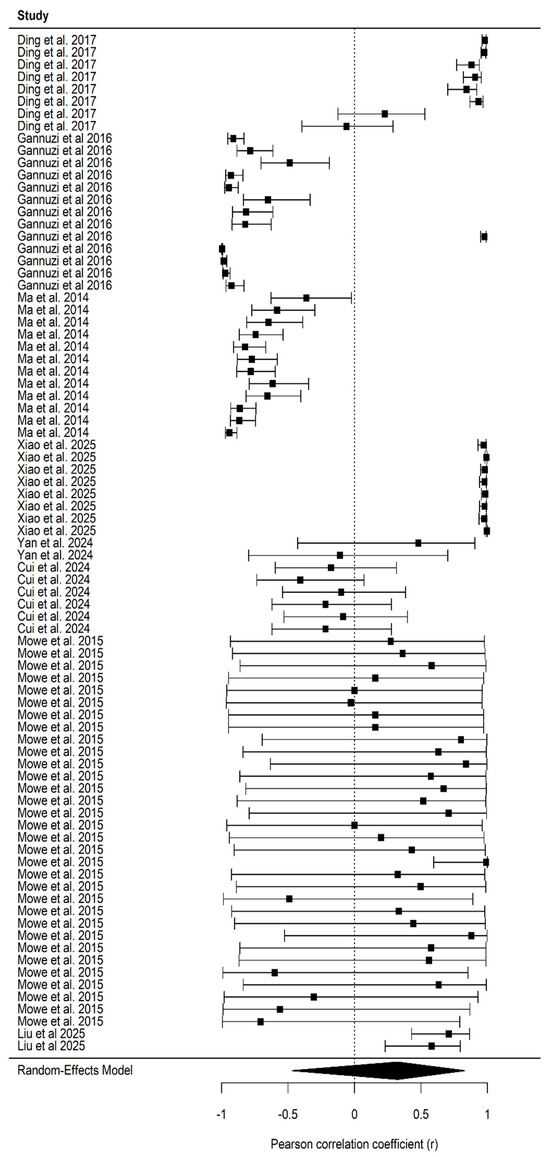
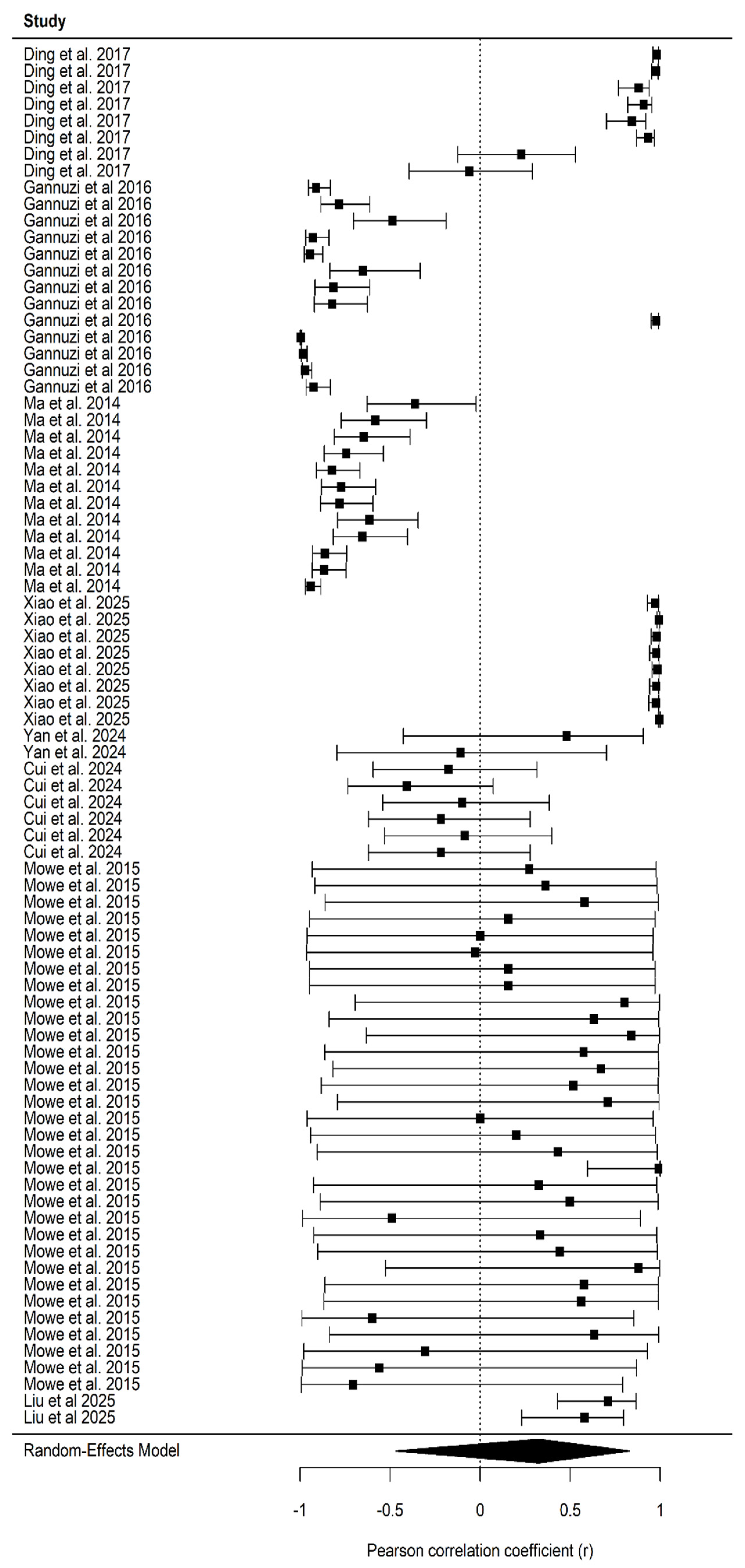
Temperature and nitrate showed weaker and more heterogeneous associations with microcystin concentrations than with biomass accumulation. Temperature showed a moderate correlation (r = 0.39, 95% CI: −0.34 to 0.82) but a non-significant positive relationship with microcystin (Fisher’s Z = 0.41, SE = 0.39, p = 0.29). It had a wide confidence interval that included zero, indicating substantial variation in the magnitude and direction of effect sizes across studies (Figure 2). This variability was also reflected in the observed high heterogeneity (τ2 = 1.33). Nitrate was positively correlated with microcystin concentration (Figure 2) (r = 0.68, 95% CI: 0.21–0.89; Fisher’s Z = 0.83, SE = 0.31, p = 0.0079). Despite high heterogeneity (τ2 = 1.15) and relatively wide confidence intervals, effect sizes trended positively and consistently across the studies (Figure 3).
Figure 2.
Forest plot of study-level correlations between temperature and microcystin levels. Horizontal lines indicate the 95% CIs for each study, squares represent study weights, and diamonds represent the pooled effect. Studies included in the forest plot are [17,34,43,44,46,47,49,51].
Figure 3.
Forest plot of study-level correlations between nitrate and microcystin levels. Horizontal lines indicate the 95% CIs for each study, squares represent study weights, and diamonds represent the pooled effect. Studies included in the forest plot are [15,32,34,45,48,50,52,53,54,55,56].
3.4. Biomass and Microcystin Relationships
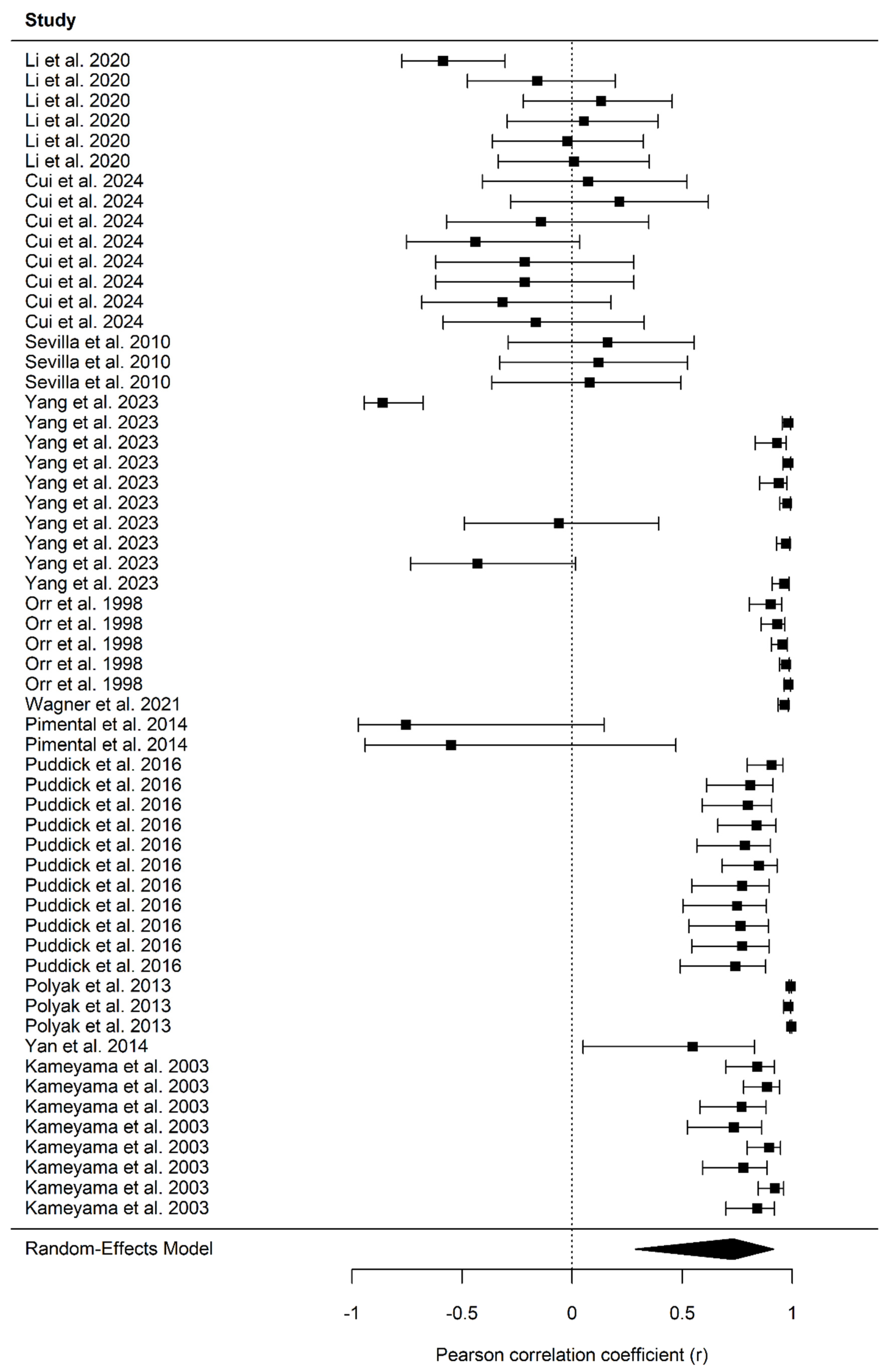
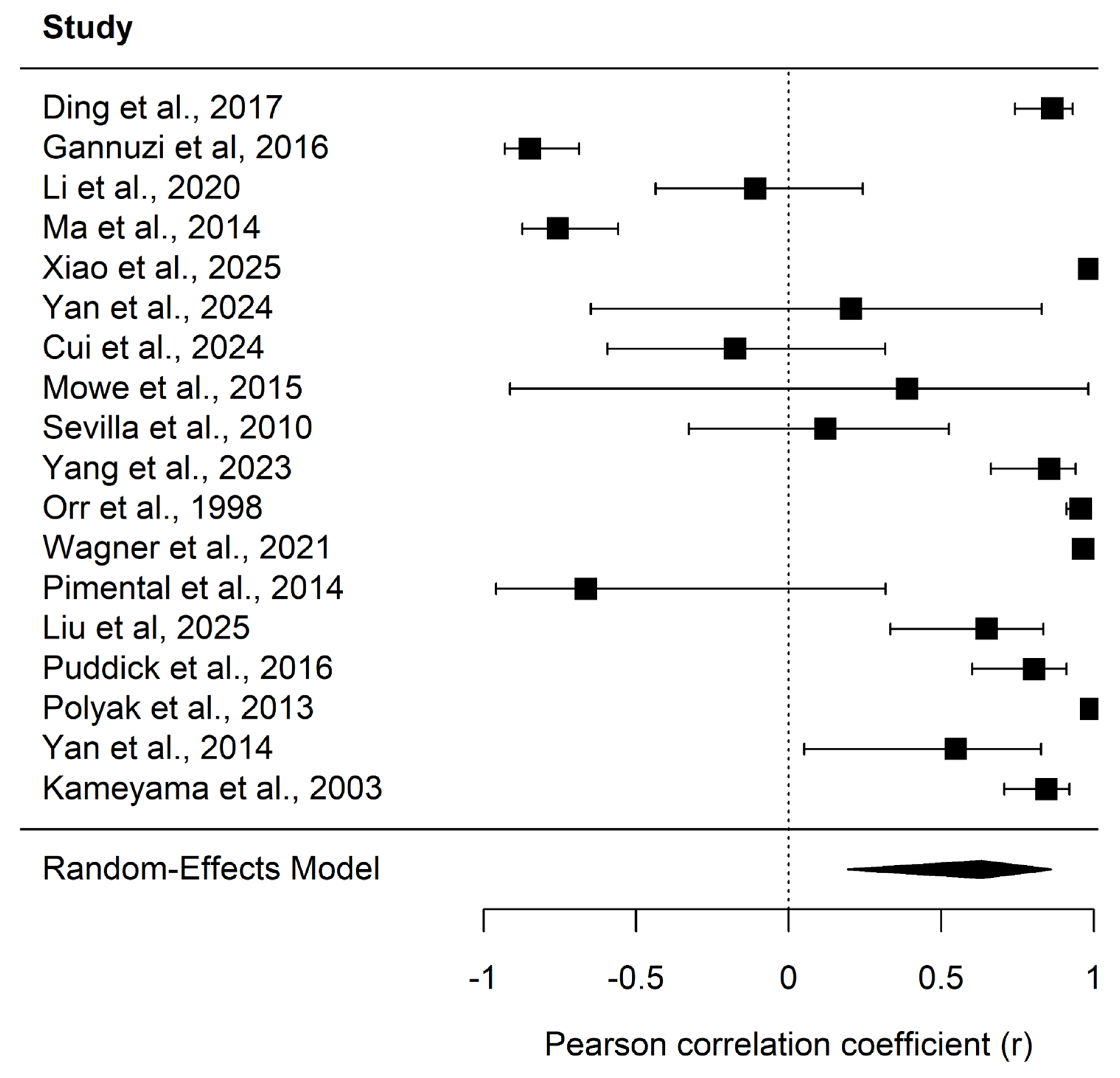
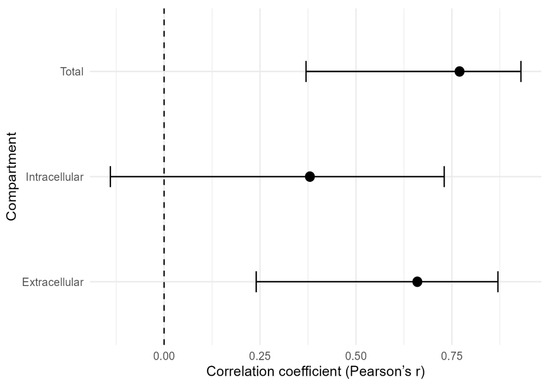
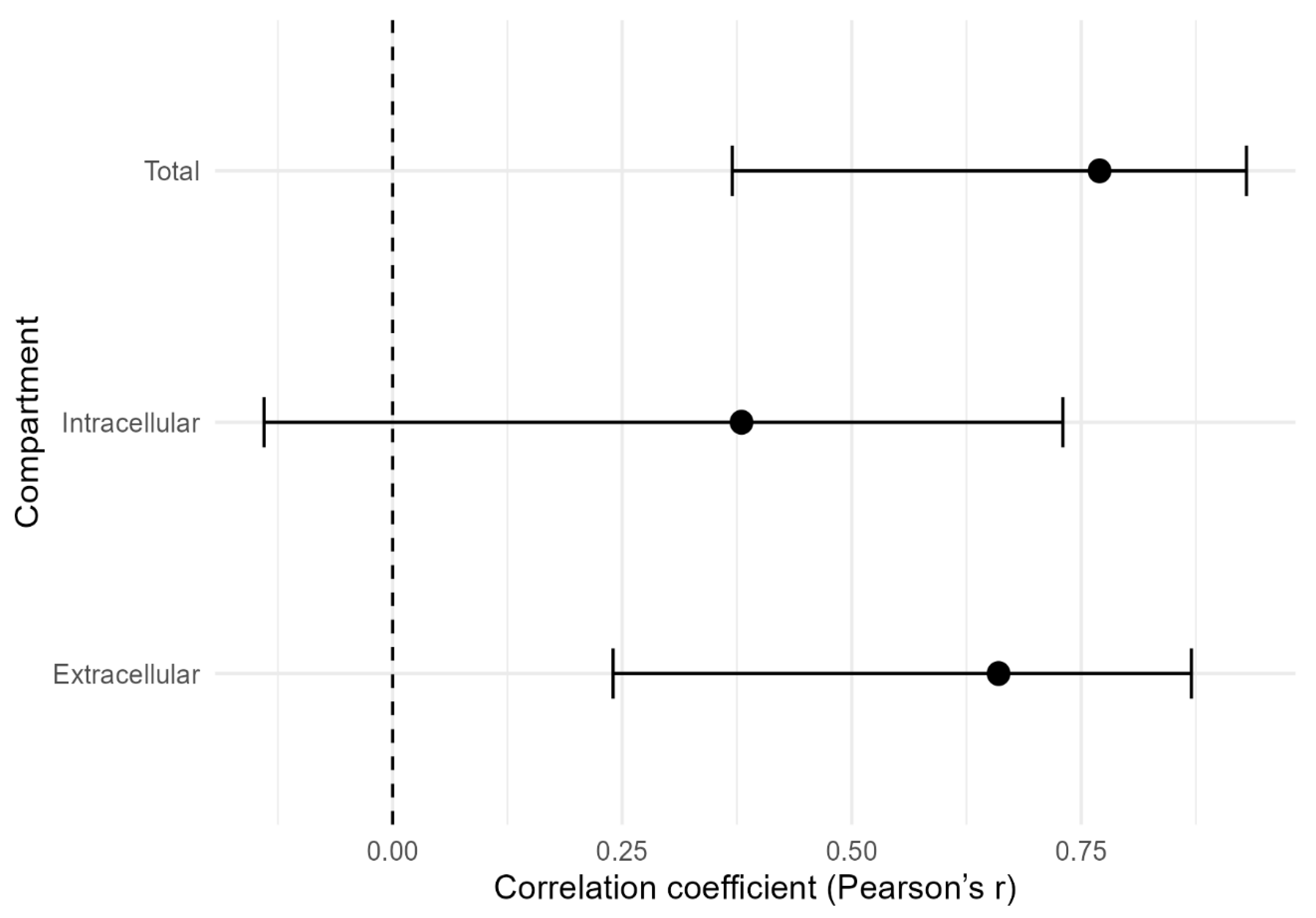
Biomass was strongly correlated (Figure 4) (r = 0.61, 95% CI: 0.20–0.84) with microcystin concentrations, with mostly positive associations across all studies (Fisher’s Z = 0.71, SE = 0.26, p = 0.0065). Although the confidence interval varied and did not include zero, it indicated a positive relationship (Figure 4). Its width and substantial heterogeneity (τ2 = 1.26) also showed that the strength of the association varied between studies. Microcystin compartment used as a moderator (Figure 5), with intracellular microcystin as the reference category, significantly improved model fit (QM(2) = 45.14, p < 0.0001; likelihood ratio test, p < 0.0001), with a slight reduction in heterogeneity (τ2 from 1.26 to 1.20). The biomass–microcystin relationship varied by compartment; intracellular microcystin showed a weak, non-significant association with (r = 0.38, 95% CI: −0.14 to 0.73) with a wide confidence interval that included zero, whereas extracellular microcystin (r = 0.66, 95% CI: 0.24–0.87) and total microcystin (r = 0.77, 95% CI: 0.37–0.93) showed stronger positive associations, both with entirely positive confidence intervals indicating greater consistency.
Figure 4.
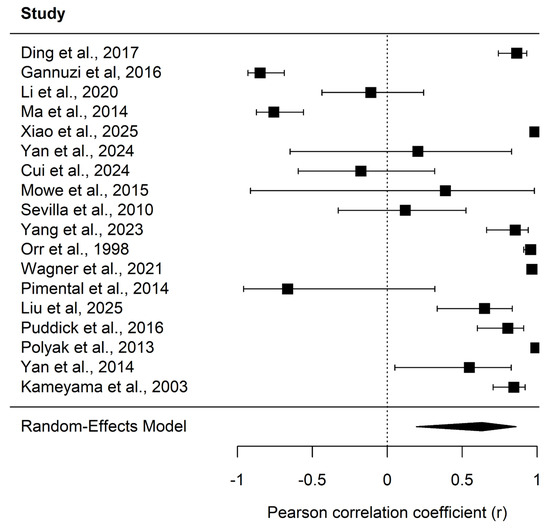
Forest plot of study-level pooled correlations between biomass and microcystin concentrations in Microcystis spp. Each point represents the pooled effect size for an individual study, and the horizontal lines indicate the 95% confidence intervals. The diamond represents the overall pooled correlation across the studies. Studies included in the forest plot are [12,15,17,34,43,44,45,46,47,48,49,50,51,52,53,54,55,56].
Figure 5.
Moderator analysis showing pooled correlations (±95% confidence intervals) between biomass accumulation and intracellular, extracellular, and total microcystin concentrations.
3.5. Summary of Pooled Effect Sizes
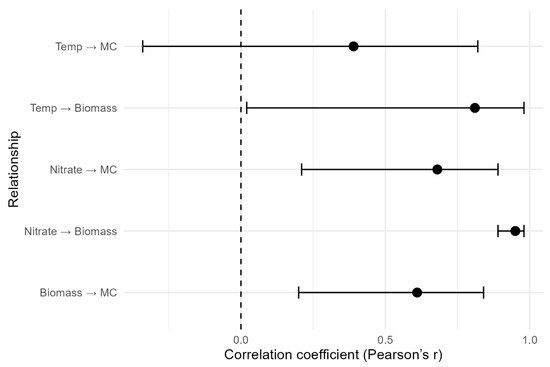
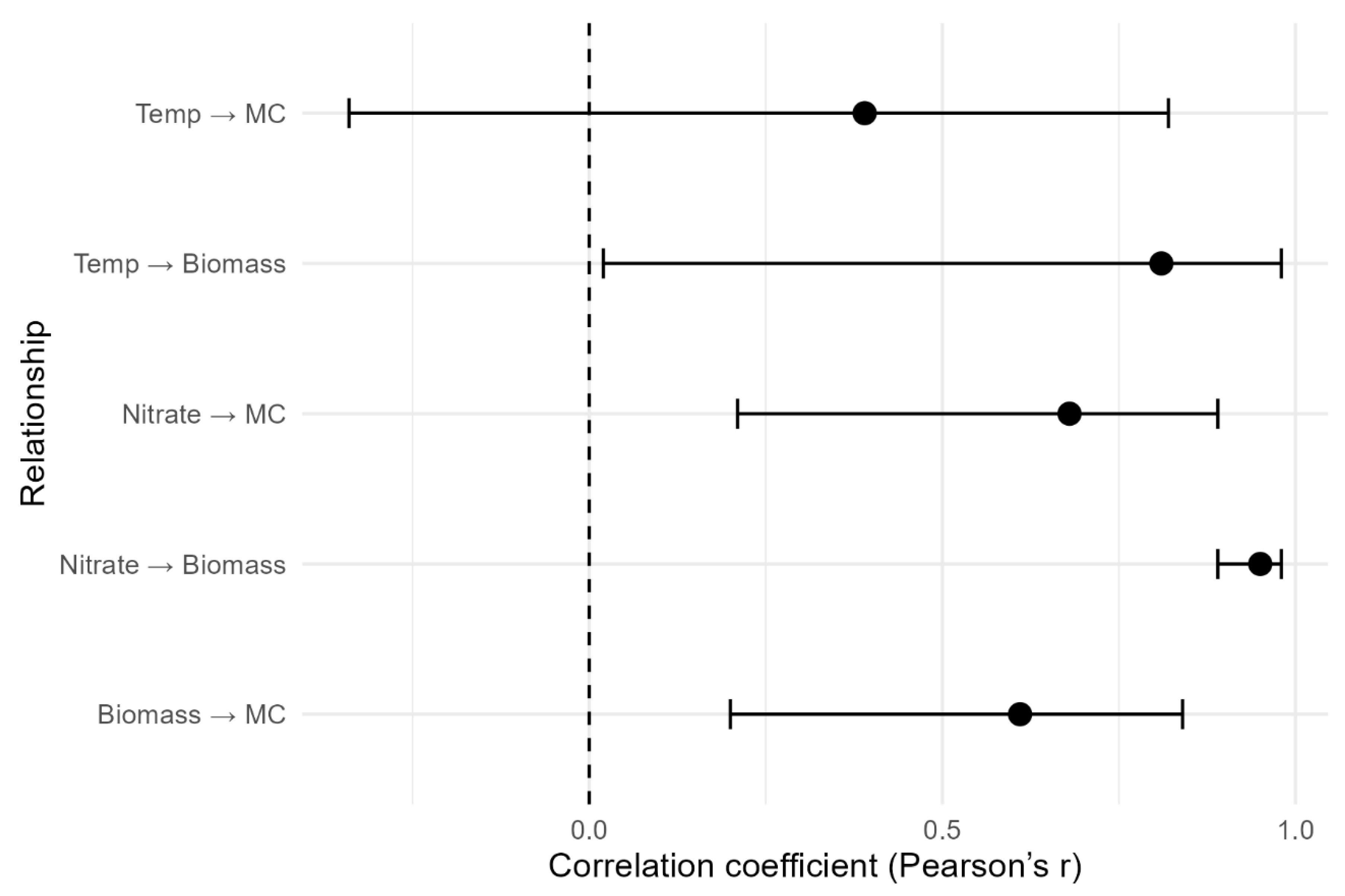
Across all models, there was a clear variation in the strength and consistency of correlations (Table 2; Figure 6). Nitrate showed the most consistent relationship with biomass (k = 58, r = 0.95, 95% CI: 0.89–0.98), with a narrow confidence interval and comparatively lower heterogeneity (τ2 = 0.55), reflecting tightly clustered effect sizes across the studies. In contrast, the temperature–biomass relationship, although comparable in magnitude (k = 37, r = 0.81), showed less consistency, with a wide confidence interval (0.02–0.98) and substantially higher heterogeneity (τ2 = 1.87), indicating a large variation in effect sizes despite statistical significance.
Table 2.
Summary of pooled effect sizes (k), heterogeneity metrics (τ2), and confidence intervals (95% CI) for all meta-analytic models.
Figure 6.
Summary of pooled Pearson correlation coefficients (±95% confidence intervals) describing the associations between environmental drivers, biomass accumulation, and microcystin concentration obtained from multilevel meta-analysis.
For the correlation with microcystin, both temperature and nitrate relationships showed weaker and more variable associations. The temperature and microcystin relationship had the largest effect sizes (k = 83) but was not significant (r = 0.39, 95% CI: −0.34 to 0.82), with a wide confidence interval including zero, and high heterogeneity (τ2 = 1.33). Nitrate showed a significant positive association with microcystin concentrations (k = 58, r = 0.68, 95% CI: 0.21–0.89), although the elevated heterogeneity (τ2 = 1.15) and wide confidence interval indicated considerable variation in effect sizes across studies.
The biomass–microcystin relationship had the largest dataset, with 141 effect sizes (k = 141), and showed a consistently positive correlation (r = 0.61, 95% CI: 0.20–0.84). However, the width of the confidence interval and substantial heterogeneity (τ2 = 1.26) indicated that the strength of this relationship varied across studies despite the overall positive trend.
Generally, the biomass–microcystin relationship showed greater consistency across studies than environmental drivers with microcystin, while heterogeneity remained substantial across all analyses.
3.6. Publication Bias Assessment
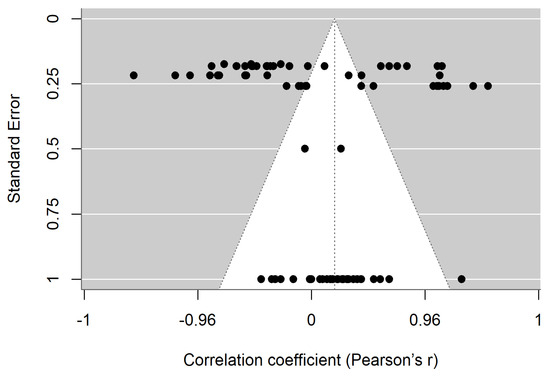
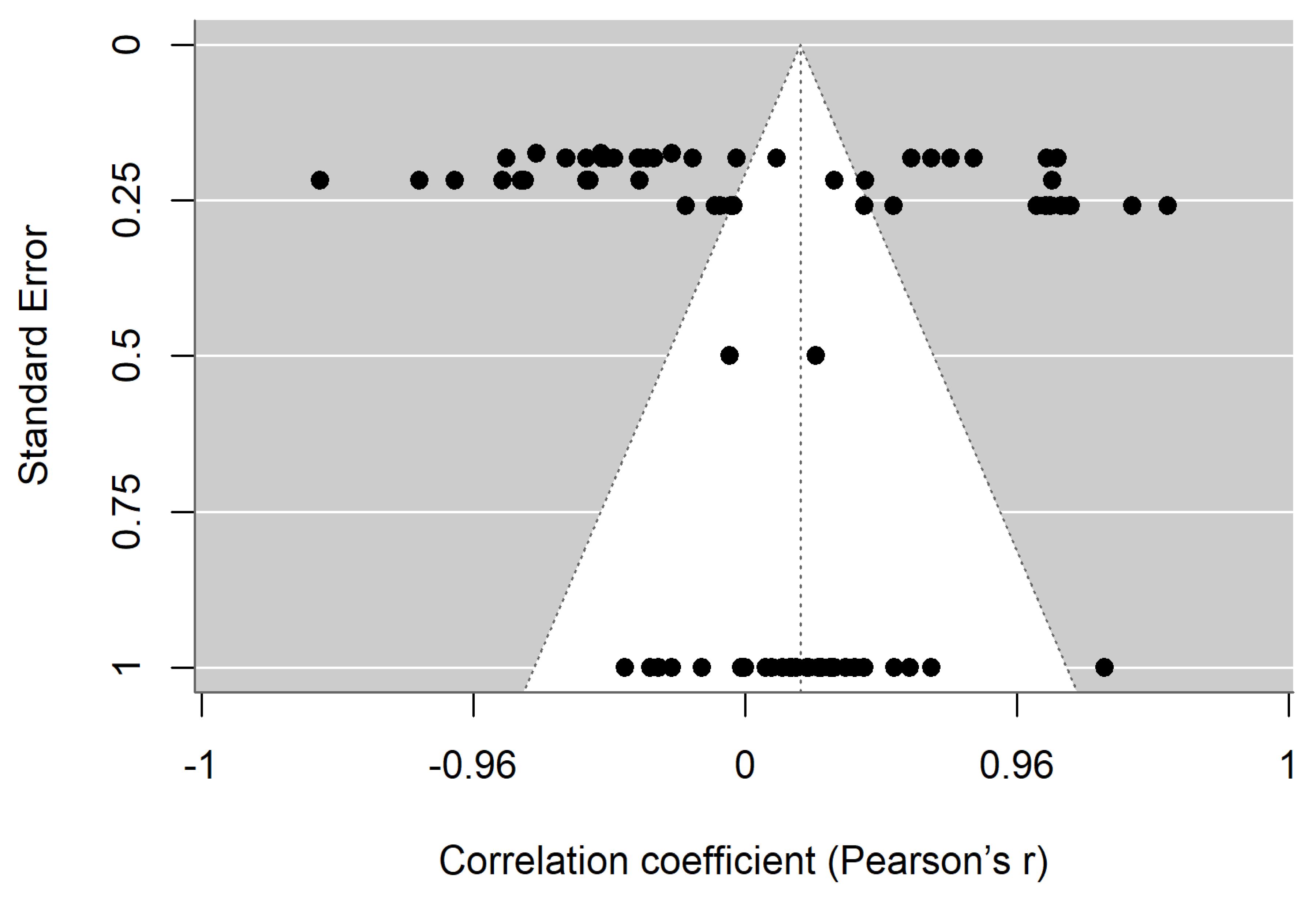
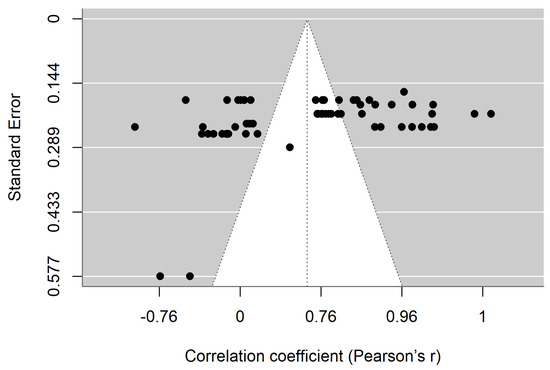
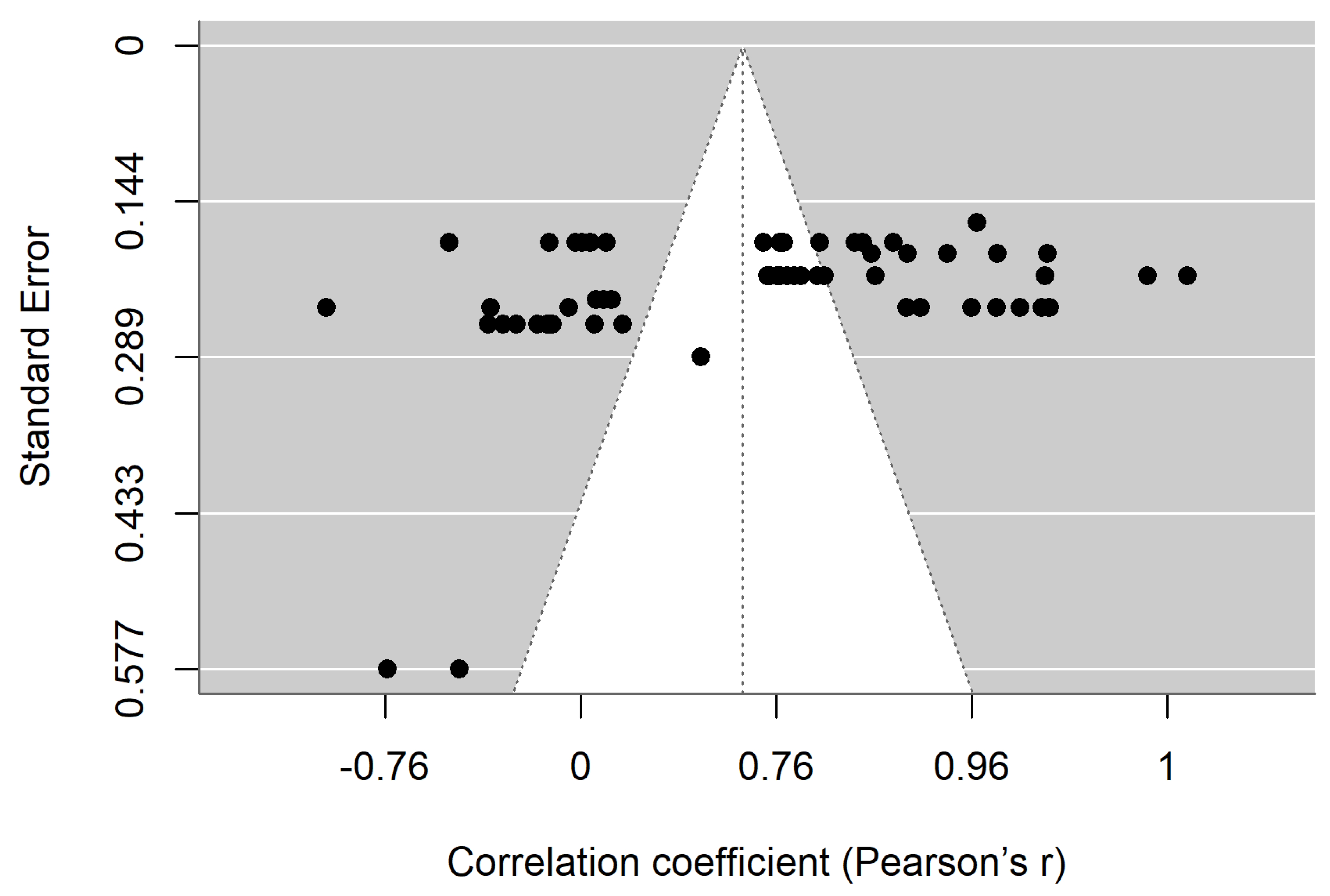
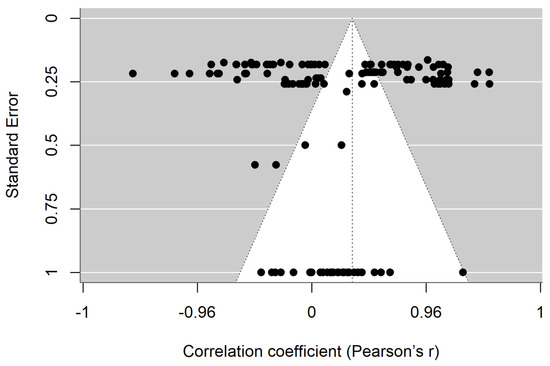
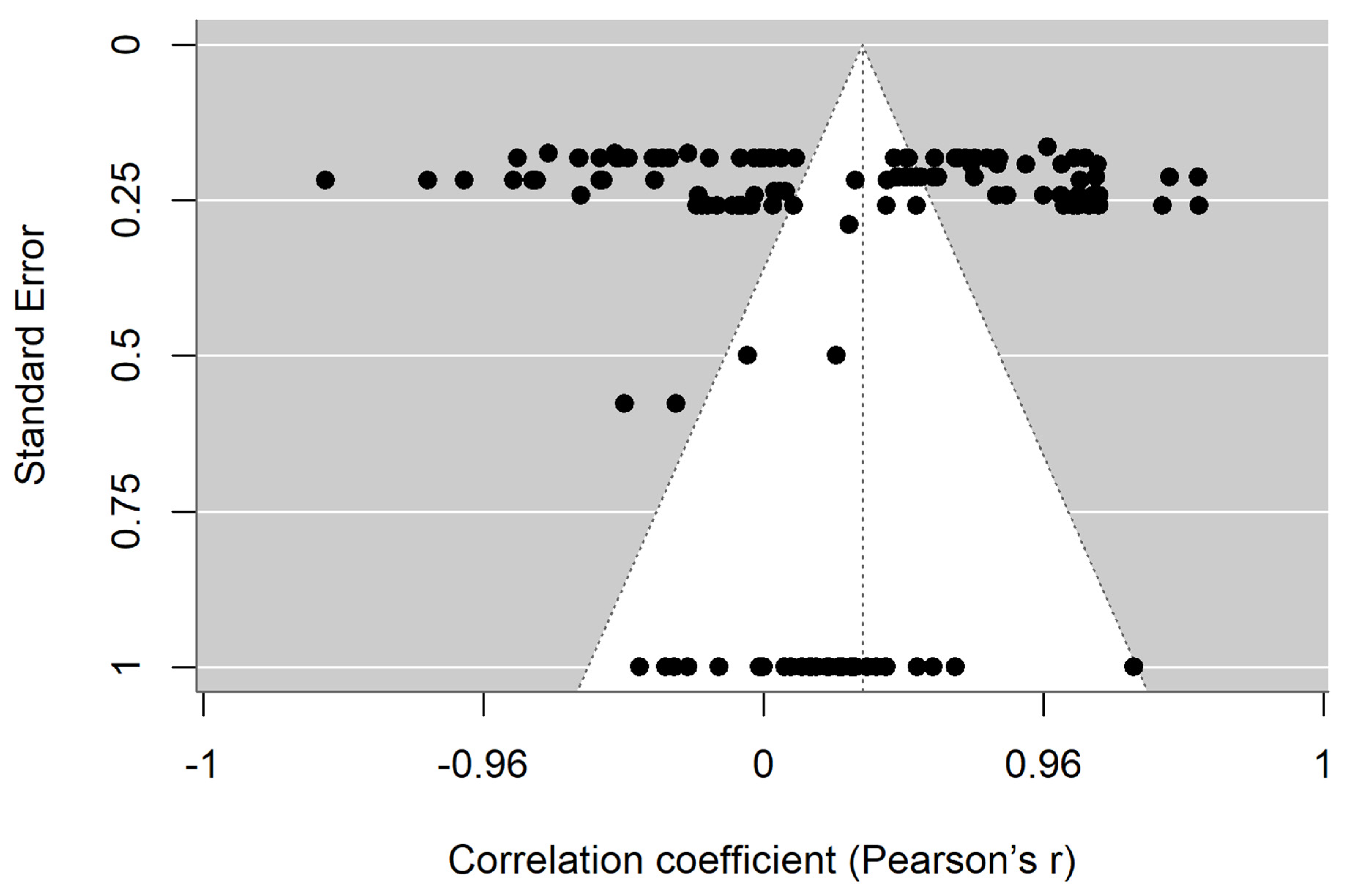
Funnel plots were visually inspected for temperature–microcystin, nitrate–microcystin, and biomass–microcystin relationships (Figure 7, Figure 8 and Figure 9). Visual inspection suggested symmetrical distributions for the temperature–microcystin and biomass–microcystin relationships, whereas the nitrate–microcystin relationship exhibited greater asymmetry.
Figure 7.
Funnel plot assessing publication bias for the temperature–microcystin relationship. The vertical dashed line represents the pooled effect size, and the diagonal dashed lines indicate the pseudo 95% confidence limits. The white triangular region represents the expected distribution of studies in the absence of publication bias.
Figure 8.
Funnel plot assessing publication bias for the nitrate–microcystin relationship. The vertical dashed line represents the pooled effect size, and the diagonal dashed lines indicate the pseudo 95% confidence limits. The white triangular region represents the expected distribution of studies in the absence of publication bias.
Figure 9.
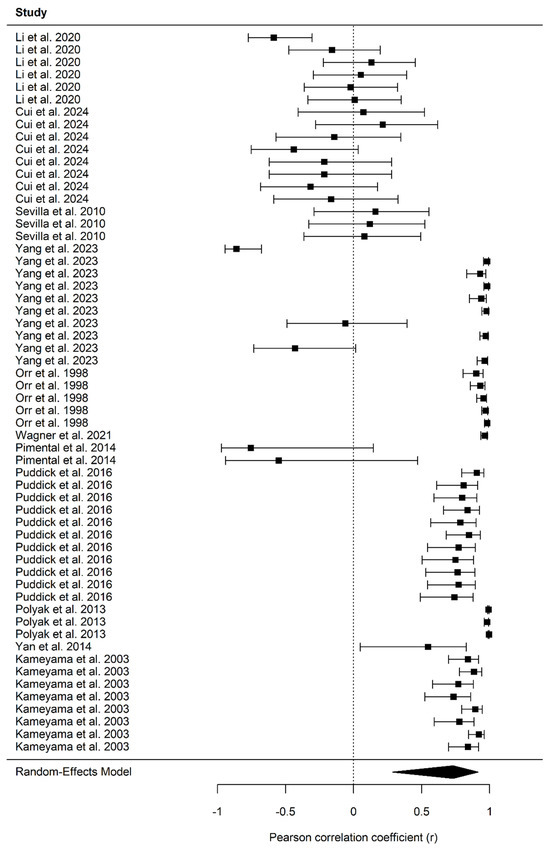
Funnel plot assessing publication bias for the biomass–microcystin relationship. The vertical dashed line represents the pooled effect size, and the diagonal dashed lines indicate the pseudo 95% confidence limits. The white triangular region represents the expected distribution of studies in the absence of publication bias.
Egger’s regression test revealed no significant funnel plot asymmetry for the temperature–microcystin relationship (z = 1.22, p = 0.22). For the biomass–microcystin relationship, asymmetry was not statistically significant (z = 1.88, p = 0.060). In contrast, the nitrate–microcystin relationship showed a significant funnel plot asymmetry (z = −2.99, p = 0.0028), indicating a potential publication bias or small-study effects.
4. Discussion
4.1. Environmental Regulation of Biomass and Microcystin Relationships
One of the key findings of this meta-analysis is that temperature and nitrate showed a stronger relationship with biomass than microcystin concentrations. In addition, the heterogeneity between both factors (temperature and nitrate) and microcystin production was higher than that between the factors and biomass, suggesting that environmental factors are more consistent with biomass production than microcystin production, further highlighting that microcystin production may be influenced by different physiological, ecological, and strain-specific processes other than environmental factors [57].
The significant heterogeneity noted among studies can explain the contrasting reports in the literature. Instead of indicating biological responses, the difference in effect sizes indicates that the influences of nitrate and temperature are largely context-dependent and strain-specific. Earlier studies suggest that the net production of microcystin primarily depends on cellular growth rate, whereas environmental factors affect microcystin production indirectly through the cellular growth rate [58]. For instance, Kieley et al. [57] noted that although nitrate and nitrite were strongly associated with microcystin concentrations in warm monomictic lakes, toxin production varied seasonally and was not consistently aligned with biomass accumulation. In addition, Wagner et al. [12] reported that Microcystis spp. grown under high nitrate conditions produced less biomass, with reduced growth rates and higher microcystin cell quotas and concentrations than those grown with urea. Therefore, these findings suggest that the differences noted across various studies may be primarily due to differences in various laboratory experimental designs and strain-specific rather than contrasting biological responses to environmental factors.
Another important source of heterogeneity noted in this meta-analysis is the type of toxin indices used to measure toxin content. Indices such as biomass, chlorophyll-a, and protein concentrations are often used as indirect measures of microcystin production; however, they are prone to variations in their response to environmental conditions and thus may produce contrasting outcomes regarding the environmental–microcystin relationship [59]. Consequently, studies with similar laboratory experiments may produce different results when different toxin indices are used. To avoid being misled by this approach, the concept of a microcystin cell quota was proposed to provide a more specific measure of microcystin production in response to environmental factors [58]. Sevilla et al. [48] reported that microcystin cell quota is not directly related to the nitrogen concentration in culture medium, suggesting that a high nitrogen concentration may increase cyanobacterial growth without an equal increase in microcystin production. Conversely, nitrate limitation may directly influence microcystin synthesis, where upregulation of microcystin-associated genes occurs under low nitrate concentration [15].
Temperature may also promote microcystin production in different ways. Elevated temperatures may trigger cyanobacterial growth, leading to microcystin production [60,61]. In addition, with a continuous increase in temperature, microcystin production genes may be upregulated [14,28]. However, Martin et al. [21] reported an increase in mcy gene transcription and cellular microcystin in Microcystis aeruginosa with episodic decreases in temperature. Similarly, Mowe et al. [17] suggested that increased water temperatures do not influence the growth rates of some Microcystis species; however, the microcystin cell quota may increase under moderate temperatures depending on the species and strain. This indicates that an increase in temperature may enhance cyanobacterial growth without a noticeable increase in microcystin production. These findings suggest that temperature influences cyanobacterial physiology and toxin production; however, the impact on these pathways depends on the differences between strains and experimental conditions. Altogether, these observations provide comprehensive explanations for why a strong environmental relationship with biomass does not always translate to a proportional total microcystin content.
4.2. Compartmentalization and Implications for Toxin Assessment
This meta-analysis identified distinct differences in the relationship between biomass and microcystin concentrations of Microcystis spp. across the intracellular, extracellular, and total microcystin compartments. The relationship between biomass and both extracellular and total microcystin was stronger than that between intracellular microcystins. Incorporating toxin compartments as a moderator significantly increased the fit model while reducing residual heterogeneity, highlighting that MCs compartment plays a significant role in the variations among studies and may explain the inconsistencies among studies. Most previous studies classified all microcystin concentrations as a single variable, when it can comprise three different compartments that usually represent varying biological and physiological responses.
The stronger relationship between biomass and extracellular is biologically plausible, as extracellular microcystin may result from active secretion, cell breakdown, or environmental stress, and its accumulation is proportional to biomass as blooms grow [62]. Therefore, as the biomass of Microcystis spp. increases and blooms become more intense, cell turnover and lysis increase. Consequently, extracellular microcystin levels are often more closely related to the size and dynamics of blooms [14,63].
Total microcystin showed the strongest association with biomass because total microcystin combines both intracellular and extracellular forms, reflecting the overall active toxin production within living and decaying cells [64]. Several studies have demonstrated that extracellular and total microcystins are more responsive to biomass because they capture dynamic release processes beyond intracellular storage [46,65,66]. Georges des Aulnois et al. [67] indicated a linear relationship between total microcystin levels and growth rate in both freshwater and estuarine strains of M. aeruginosa. Similarly, a mesocosm investigation conducted by Wood et al. [68] showed that an increase in Microcystis cells led to an increase in intracellular microcystin concentrations. Additionally, to cope with environmental stress, Microcystis spp. may upregulate mcyH, enhancing microcystin transport and facilitating active extrusion and exudation [49]. This comprehensive measure reduces the underestimation associated with measuring only one compartment, thereby providing a more comprehensive assessment of bloom toxicity.
Conversely, intracellular microcystin showed the weakest association with biomass, indicating that the toxin level in living cells is influenced by other physiological or biological processes beyond biomass size. Consequently, an increase in biomass does not result in a proportional increase in intracellular microcystins because levels can fluctuate owing to physiological factors such as strain-specific toxin quotas, nutrient availability, and environmental conditions [69]. This suggests that studies quantifying only intracellular MCs may represent only the biological or physiological toxin synthesis in the living cells, while studies measuring total and extracellular microcystin also measure toxin release, cell lysis, and bloom development. The results of this meta-analysis highlight the importance of toxin compartmentalization, as its incorporation would help in better bloom prediction.
4.3. Ecological and Bloom Management Implications
The results of this meta-analysis provide crucial insights into toxic Microcystis spp. blooms amid ongoing global eutrophication and climate change concerns. The strong positive relationship between temperature, nitrate, and biomass across studies suggests that climate warming and increasing nutrient availability may increase the risk of blooms by enhancing the growth and persistence of Microcystis spp. [9,70]. Although temperature, unlike nitrate, did not show a strong association with microcystin in this study, warmer conditions may still indirectly increase ecosystem-level toxin loads by increasing biomass accumulation [71].
Similarly, the strong association observed between biomass and microcystin in this study further suggests that environmental variables that are favorable for biomass accumulation may also be associated with microcystin production. This highlights the significance of concurrently evaluating Microcystis spp. blooms alongside toxin concentrations during ecological risk assessment. As toxigenic Microcystis strains proliferate and form blooms in aquatic ecosystems, they trigger serious ecological consequences [70], such as the formation of dense surface scums that alter water pH, reduce light penetration, and increase chemical oxygen demand. Likewise, the release of organic matter and nutrients during senescence further increases eutrophication, supporting bloom persistence through positive feedback mechanisms [72,73,74].
In addition to degrading water quality and compromising the suitability of water for many aquatic organisms [75], cyanobacterial blooms can modify phytoplankton community structure by displacing green algae and other beneficial taxa, thereby reducing primary producer diversity [76,77] and affecting food resources for zooplankton that depend on them [78]. Likewise, microcystins have been reported to negatively affect aquatic organisms, either through direct toxicity or food-web transfer [78,79,80,81]. Together, these findings show the implications of Microcystis spp. blooms on ecosystem functioning, biodiversity conservation, and public health.
The findings of this meta-analysis also provide crucial insights into bloom monitoring and water quality assessment. The moderator analyses revealed that the strength of the biomass–microcystin relationship differed significantly among the intracellular, extracellular, and total microcystin compartments. This suggests that toxin compartment should be explicitly considered when reporting, evaluating, and interpreting experimental data, as dependence on single-compartment reporting may not accurately represent total toxin availability. This would further improve the comparability among studies and strengthen ecological risk assessments.
4.4. Limitations and Future Directions
This meta-analysis synthesized key relationships among temperature, nitrate, biomass, and microcystin in Microcystis spp. from laboratory studies and revealed patterns obscured in individual reports. However, owing to data constraints from the available primary literature, several limitations should be considered when interpreting the findings of this study.
- Controlled Laboratory Studies and Ecological Realism
Prioritizing controlled laboratory studies reduces environmental variability and enables the isolation of temperature and nitrate effects under standardized conditions. These significantly aided pairwise associations and reduced the confounding influence from field studies, but did not fully reflect the natural variability in nutrient and temperature fluctuations [82,83]. Laboratory experiments cannot fully reproduce the complex interactions between seasonal succession, grazing pressure, and uncontrolled nutrient changes in natural freshwater ecosystems. Hence, the associations identified in this study should be interpreted as mechanistic relationships under controlled conditions and not as direct predictions of bloom dynamics in natural systems.
- Residual Heterogeneity Among Studies
Despite the use of multilevel random-effects models, substantial residual heterogeneity remained unexplained across all models, indicating that other methodological and biological factors contributed to the variability observed between relationships. Primary studies used for synthesis differed in strain identity, growth phase, culture medium, experimental duration, and toxin analytical and quantification methods, which may have contributed to the variability. Although these variables were extracted, their inconsistent reporting across the primary studies precluded their inclusion as moderators. Similarly, environmental variables, such as light intensity, phosphorus availability, pH, and trace metal concentrations, which are known to influence both Microcystis spp. growth and toxin production [84,85], were either experimentally controlled or inconsistently reported, preventing the evaluation of their interactions with temperature and nitrate.
- Strain-Specific Responses and Toxin Regulation
Inconsistent reporting of strain-specific toxicity and mcy gene clusters across primary studies precluded subgroup analyses that could have elucidated the genetic determinants of toxin responses. Toxin biosynthesis depends on both the presence of mcy genes and physiological regulation [86]; therefore, improved reporting of strain identity, genotype, and toxin-producing capacity would substantially improve future analyses. Likewise, many studies did not distinguish nitrogen forms, clearly state the growth phase sampled, or state the toxin compartment analyzed, which could have strengthened the meta-analyses and improved mechanistic understanding of cyanobacterial toxicity.
- Publication Bias and Study Effects
Publication bias was detected only for the nitrate–microcystin relationship, whereas the temperature–microcystin and biomass–microcystin relationships showed no significant asymmetry. Even though study-level dependence was accounted for using multilevel random-effects models, publication bias and small-study effects may have influenced the magnitude of some pooled estimates. Continued publication of both significant and non-significant experimental findings will therefore be essential for improving future quantitative syntheses.
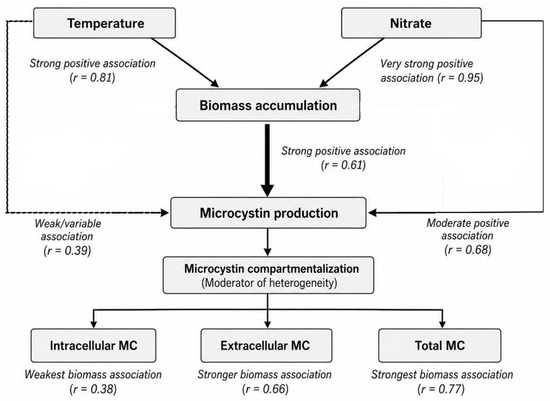
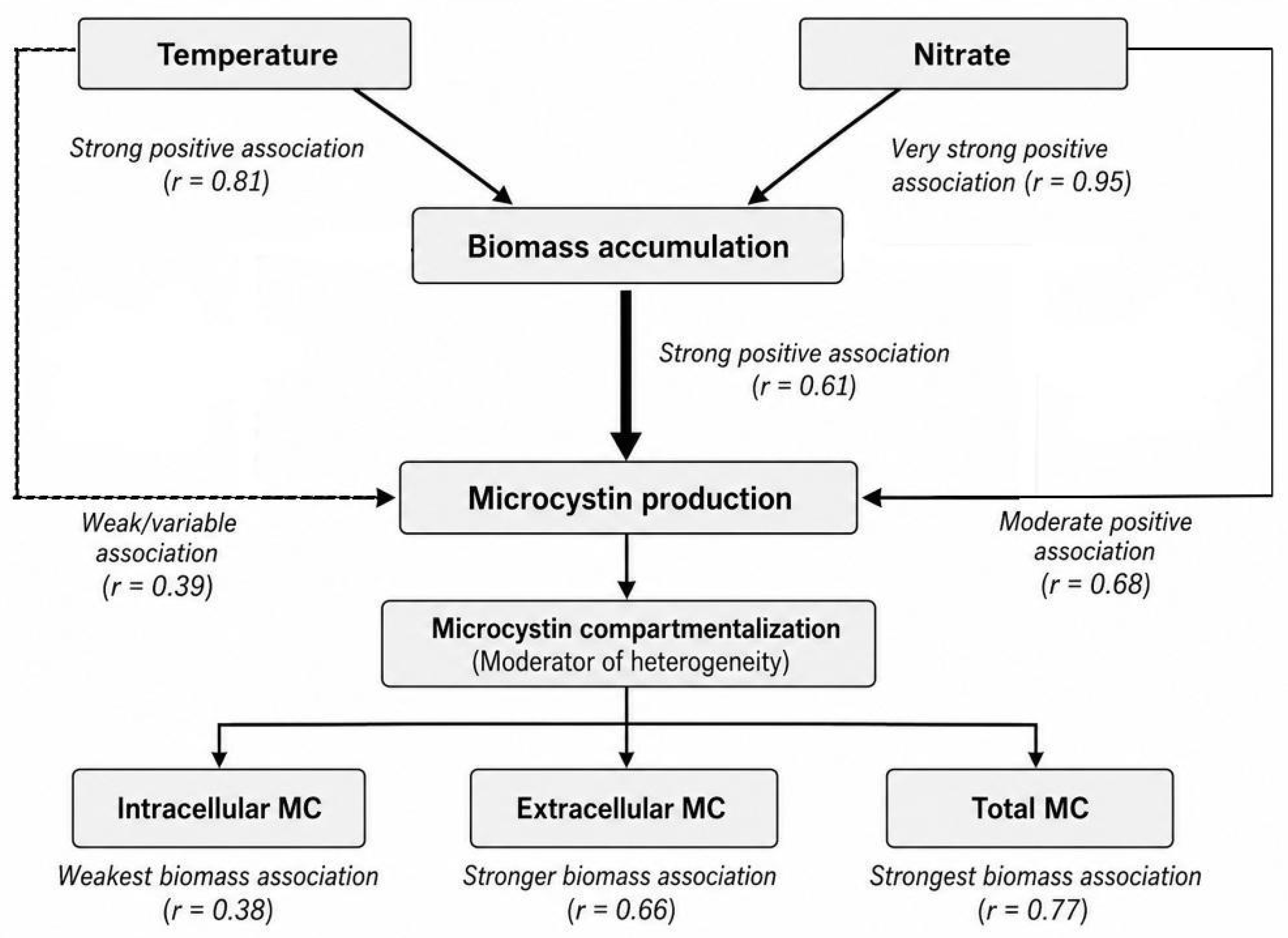
These limitations underscore the need for primary studies that systematically manipulate multiple drivers and report complete covariance structures to enable more rigorous synthetic analyses. Importantly, continued emphasis on toxin compartmentalization will improve understanding of toxin production, release, and environmental exposure, thereby strengthening ecological risk assessment and freshwater management. Overall, the principal findings of this meta-analysis can be summarized in a conceptual framework illustrating the relationships among temperature, nitrate, biomass accumulation, microcystin production, and microcystin compartmentalization (Figure 10).
Figure 10.
Conceptual synthesis of the relationships identified in the multilevel meta-analysis. Arrow styles represent the relative strength of the associations identified in the multilevel meta-analysis and do not imply causality.
4.5. Conclusions
We used a multilevel meta-analysis to synthesize the findings from laboratory studies on the relationships between temperature, nitrate, biomass accumulation, and microcystin production in Microcystis spp. Our results showed that both temperature and nitrate were more strongly associated with biomass than with microcystin, suggesting that these environmental drivers may be more consistently associated with bloom formation than with toxin production. However, biomass consistently exhibited a strong positive association with microcystin production, suggesting that bloom size may more reliably indicate ecosystem toxicity levels than individual environmental variables. These findings provide a possible explanation for the discrepancies observed in previous laboratory studies.
Likewise, this study suggests that microcystin compartmentalization is a significant source of variation among laboratory studies. Extracellular and total microcystin were more strongly associated with biomass than intracellular toxins, highlighting microcystin compartmentalization as a significant moderator, which provides a new context for understanding heterogeneity in studies on cyanobacterial toxin dynamics. This highlights the importance of integrating microcystin compartments when comparing or analyzing experimental studies and bloom toxicity for ecological interpretation and decision-making in water quality monitoring. These results suggest that individual environmental variables alone may not fully explain microcystin production. Other factors, including strain-specific characteristics, genetic variation, and interacting environmental conditions, also contribute to toxin dynamics and could explain a substantial amount of heterogeneity observed across studies. Future studies should integrate comprehensive strain characterization with field experiments encompassing multiple interacting environmental drivers to improve our understanding of bloom toxicity under changing environmental conditions.
Supplementary Materials
The following supporting information can be downloaded at https://www.mdpi.com/article/10.3390/phycology6030077/s1. Figure S1: Study-level forest plot showing the associations between biomass and microcystin concentrations in Microcystis spp. included in the meta-analysis. Table S1: Characteristics of the laboratory studies included in the meta-analysis, including Microcystis species and strains, experimental conditions, environmental drivers, biomass metrics, microcystin compartments, analytical methods, and study metadata.
Author Contributions
Conceptualization, Z.P.A., E.A. and M.A.C.; methodology, Z.P.A.; formal analysis, Z.P.A.; investigation, Z.P.A., E.A., B.A.D., A.K.A., S.D., S.A.S., A.G.Y., J.T.A. and I.Y.O.; data curation, Z.P.A., E.A. and B.A.D.; writing—original draft preparation, Z.P.A., E.A., B.A.D., A.K.A., S.D., S.A.S., A.G.Y., J.T.A. and I.Y.O.; writing—review and editing, Z.P.A., E.A., B.A.D., A.K.A., S.D., S.A.S., A.G.Y., J.T.A., I.Y.O. and M.A.C.; visualization, Z.P.A.; supervision, M.A.C.; project administration, M.A.C.; funding acquisition, M.A.C. All authors have read and agreed to the published version of the manuscript.
Funding
This study was supported by the Fundação de Amparo à Pesquisa do Estado de São Paulo (FAPESP, Brazil). Zubeidat Precious Ahmed acknowledges the FAPESP scholarship (Grant No. 2025/13303-9), Elizabeth Abdulmalik acknowledges the FAPESP scholarship (Grant No. 2025/10635-0), Besna Armando Daniel acknowledges the FAPESP scholarship (Grant No. 2025/08223-6), and Mathias Ahii Chia acknowledges the research grant from FAPESP (Grant No. 2023/00798-4).
Data Availability Statement
The R scripts used for data processing, meta-analytic modeling, figure generation, and publication bias analyses are publicly available at: https://github.com/ahmedzube/Microcystis_MetaAnalysis_R_Code/tree/main (accessed on 11 July 2026). The data analyzed in this study were extracted from previously published articles included in the meta-analysis and will be made available by the authors upon request.
Acknowledgments
The authors thank the anonymous reviewers for their constructive comments and suggestions, which substantially improved the quality of the manuscript.
Conflicts of Interest
The authors declare no conflicts of interest. The funding agency had no role in the design of the study; collection, analysis, or interpretation of data; writing of the manuscript; or the decision to publish the results.
References
- Sousa, B.M. UNESP Estudo Sobre Florações Algais Nocivas (HAB’s) e Seus Efeitos Ambientais: Revisão Bibliográfica. Bachelor’s Thesis, Universidade Estadual Paulista, São Paulo, Brazil, 2025. [Google Scholar]
- Wang, W.; Huang, H.; Zhao, K.; Lv, J.; Liu, X.; Xie, S.; Feng, J. Multiple Influences on Cyanobacterial Abundance and Diversity in the Beijing-Tianjin-Hebei Economic Circle and Nearby Areas of China. Curr. Res. Microb. Sci. 2025, 8, 100400. [Google Scholar] [CrossRef] [Scilit] [PubMed]
- MacKintosh, C.; Beattie, K.A.; Klumpp, S.; Cohen, P.; Codd, G.A. Cyanobacterial Microcystin-LR Is a Potent and Specific Inhibitor of Protein Phosphatases 1 and 2A from Both Mammals and Higher Plants. FEBS Lett. 1990, 264, 187–192. [Google Scholar] [CrossRef] [Scilit] [PubMed]
- Carmichael, W.W. Cyanobacteria Secondary Metabolites—The Cyanotoxins. J. Appl. Bacteriol. 1992, 72, 445–459. [Google Scholar] [CrossRef] [Scilit] [PubMed]
- Harke, M.J.; Steffen, M.M.; Gobler, C.J.; Otten, T.G.; Wilhelm, S.W.; Wood, S.A.; Paerl, H.W. A Review of the Global Ecology, Genomics, and Biogeography of the Toxic Cyanobacterium, Microcystis spp. Harmful Algae 2016, 54, 4–20. [Google Scholar] [CrossRef] [Scilit] [PubMed]
- Melaram, R.; Newton, A.R.; Chafin, J. Microcystin Contamination and Toxicity: Implications for Agriculture and Public Health. Toxins 2022, 14, 350. [Google Scholar] [CrossRef] [Scilit] [PubMed]
- Kaneko, T.; Nakajima, N.; Okamoto, S.; Suzuki, I.; Tanabe, Y.; Tamaoki, M.; Nakamura, Y.; Kasai, F.; Watanabe, A.; Kawashima, K.; et al. Complete Genomic Structure of the Bloom-Forming Toxic Cyanobacterium Microcystis aeruginosa NIES-843. DNA Res. 2007, 14, 247–256. [Google Scholar] [CrossRef] [Scilit] [PubMed]
- Azevedo, S. Toxic Cyanobacteria and the Caruaru Tragedy. J. Venom. Anim. Toxins 1997, 3, 93. [Google Scholar]
- Paerl, H.W.; Otten, T.G. Harmful Cyanobacterial Blooms: Causes, Consequences, and Controls. Microb. Ecol. 2013, 65, 995–1010. [Google Scholar] [CrossRef] [Scilit] [PubMed]
- Walls, J.T.; Wyatt, K.H.; Doll, J.C.; Rubenstein, E.M.; Rober, A.R. Hot and Toxic: Temperature Regulates Microcystin Release from Cyanobacteria. Sci. Total Environ. 2018, 610–611, 786–795. [Google Scholar] [CrossRef] [Scilit] [PubMed]
- Burford, M.A.; Carey, C.C.; Hamilton, D.P.; Huisman, J.; Paerl, H.W.; Wood, S.A.; Wulff, A. Perspective: Advancing the Research Agenda for Improving Understanding of Cyanobacteria in a Future of Global Change. Harmful Algae 2020, 91, 101601. [Google Scholar] [CrossRef] [Scilit] [PubMed]
- Wagner, N.D.; Quach, E.; Buscho, S.; Ricciardelli, A.; Kannan, A.; Naung, S.W.; Phillip, G.; Sheppard, B.; Ferguson, L.; Allen, A.; et al. Nitrogen Form, Concentration, and Micronutrient Availability Affect Microcystin Production in Cyanobacterial Blooms. Harmful Algae 2021, 103, 102002. [Google Scholar] [CrossRef] [Scilit] [PubMed]
- Yang, Z.; Zhang, M.; Yu, Y.; Shi, X. Temperature Triggers the Annual Cycle of Microcystis, Comparable Results from the Laboratory and a Large Shallow Lake. Chemosphere 2020, 260, 127543. [Google Scholar] [CrossRef] [Scilit] [PubMed]
- Davis, T.W.; Berry, D.L.; Boyer, G.L.; Gobler, C.J. The Effects of Temperature and Nutrients on the Growth and Dynamics of Toxic and Non-Toxic Strains of Microcystis during Cyanobacteria Blooms. Harmful Algae 2009, 8, 715–725. [Google Scholar] [CrossRef] [Scilit]
- Pimentel, J.S.M.; Giani, A. Microcystin Production and Regulation under Nutrient Stress Conditions in Toxic Microcystis Strains. Appl. Environ. Microbiol. 2014, 80, 5836–5843. [Google Scholar] [CrossRef] [Scilit] [PubMed]
- Roy, S.; Guljamow, A.; Dittmann, E. Impact of Temperature on the Temporal Dynamics of Microcystin in Microcystis aeruginosa PCC7806. Front. Microbiol. 2023, 14, 1200816. [Google Scholar] [CrossRef] [Scilit] [PubMed]
- Mowe, M.A.D.; Porojan, C.; Abbas, F.; Mitrovic, S.M.; Lim, R.P.; Furey, A.; Yeo, D.C.J. Rising Temperatures May Increase Growth Rates and Microcystin Production in Tropical Microcystis Species. Harmful Algae 2015, 50, 88–98. [Google Scholar] [CrossRef] [Scilit]
- Bui, T.; Dao, T.-S.; Vo, T.-G.; Lürling, M. Warming Affects Growth Rates and Microcystin Production in Tropical Bloom-Forming Microcystis Strains. Toxins 2018, 10, 123. [Google Scholar] [CrossRef] [Scilit] [PubMed]
- van der Westhuizen, A.J.; Eloff, J.N. Effect of Temperature and Light on the Toxicity and Growth of the Blue-Green Alga Microcystis aeruginosa (UV-006). Planta 1985, 163, 55–59. [Google Scholar] [CrossRef] [Scilit] [PubMed]
- Peng, G.; Martin, R.M.; Dearth, S.P.; Sun, X.; Boyer, G.L.; Campagna, S.R.; Lin, S.; Wilhelm, S.W. Seasonally Relevant Cool Temperatures Interact with N Chemistry to Increase Microcystins Produced in Lab Cultures of Microcystis aeruginosa NIES-843. Environ. Sci. Technol. 2018, 52, 4127–4136. [Google Scholar] [CrossRef] [Scilit] [PubMed]
- Martin, R.M.; Moniruzzaman, M.; Stark, G.F.; Gann, E.R.; Derminio, D.S.; Wei, B.; Hellweger, F.L.; Pinto, A.; Boyer, G.L.; Wilhelm, S.W. Episodic Decrease in Temperature Increases Mcy Gene Transcription and Cellular Microcystin in Continuous Cultures of Microcystis aeruginosa PCC 7806. Front. Microbiol. 2020, 11, 601864. [Google Scholar] [CrossRef] [Scilit] [PubMed]
- Gobler, C.J.; Burkholder, J.M.; Davis, T.W.; Harke, M.J.; Johengen, T.; Stow, C.A.; Van de Waal, D.B. The Dual Role of Nitrogen Supply in Controlling the Growth and Toxicity of Cyanobacterial Blooms. Harmful Algae 2016, 54, 87–97. [Google Scholar] [CrossRef] [Scilit] [PubMed]
- Wang, S.; Ding, P.; Lu, S.; Wu, P.; Wei, X.; Huang, R.; Kai, T. Cell Density-Dependent Regulation of Microcystin Synthetase Genes (Mcy) Expression and Microcystin-LR Production in Microcystis aeruginosa That Mimics Quorum Sensing. Ecotoxicol. Environ. Saf. 2021, 220, 112330. [Google Scholar] [CrossRef] [Scilit] [PubMed]
- Horst, G.P.; Sarnelle, O.; White, J.D.; Hamilton, S.K.; Kaul, R.B.; Bressie, J.D. Nitrogen Availability Increases the Toxin Quota of a Harmful Cyanobacterium, Microcystis Aeruginosa. Water Res. 2014, 54, 188–198. [Google Scholar] [CrossRef] [Scilit] [PubMed]
- Le, K.T.N.; Maldonado, J.F.G.; Nguyen, T.-L.; Goitom, E.; Trigui, H.; Ndiaye, N.A.; Terrat, Y.; Shapiro, B.J.; Husk, B.R.; Zamyadi, A.; et al. The Short-Term Effect of Nitrogen on Freshwater Cyanobacteria and Cyanotoxins. Front. Water 2024, 6, 1432183. [Google Scholar] [CrossRef] [Scilit]
- Schampera, C.; Hellweger, F.L. Nitrogen Availability Controls Response of Microcystin Concentration to Phosphorus Reduction: Evidence from Model Application to Multiple Lakes. Harmful Algae 2024, 139, 102711. [Google Scholar] [CrossRef] [Scilit] [PubMed]
- Yin, L.; Xu, L.; Shi, K.; Chen, W.; Zhang, Y.; Wang, J.; An, J.; He, H.; Yang, S.; Ni, L.; et al. Physiology, Microcystin Production, and Transcriptomic Responses of Microcystis aeruginosa Exposed to Calcium and Magnesium. Sci. Total Environ. 2024, 913, 169786. [Google Scholar] [CrossRef] [Scilit] [PubMed]
- Scherer, P.I.; Raeder, U.; Geist, J.; Zwirglmaier, K. Influence of Temperature, Mixing, and Addition of Microcystin-LR on Microcystin Gene Expression in Microcystis aeruginosa. MicrobiologyOpen 2017, 6, e00393. [Google Scholar] [CrossRef] [Scilit] [PubMed]
- Briand, E.; Bormans, M.; Quiblier, C.; Salençon, M.-J.; Humbert, J.-F. Evidence of the Cost of the Production of Microcystins by Microcystis aeruginosa under Differing Light and Nitrate Environmental Conditions. PLoS ONE 2012, 7, e29981. [Google Scholar] [CrossRef] [Scilit] [PubMed]
- Hedges, L.V.; Gurevitch, J.; Curtis, P.S. The Meta-Analysis of Response Ratios in Experimental Ecology. Ecology 1999, 80, 1150–1156. [Google Scholar] [CrossRef]
- Gurevitch, J.; Koricheva, J.; Nakagawa, S.; Stewart, G. Meta-Analysis and the Science of Research Synthesis. Nature 2018, 555, 175–182. [Google Scholar] [CrossRef] [Scilit] [PubMed]
- Wang, Z.; Akbar, S.; Sun, Y.; Gu, L.; Zhang, L.; Lyu, K.; Huang, Y.; Yang, Z. Cyanobacterial Dominance and Succession: Factors, Mechanisms, Predictions, and Managements. J. Environ. Manag. 2021, 297, 113281. [Google Scholar] [CrossRef] [Scilit] [PubMed]
- Li, M.; Zhu, W.; Guo, L.; Hu, J.; Chen, H.; Xiao, M. To Increase Size or Decrease Density? Different Microcystis Species Has Different Choice to Form Blooms. Sci. Rep. 2016, 6, 37056. [Google Scholar] [CrossRef] [Scilit] [PubMed]
- Cui, X.; Yang, N.; Cui, H.; Yang, Q.; Wu, Z.; Shao, B.; Zhao, Y.; Tong, Y. Interspecific Competition Enhances Microcystin Production by Microcystis aeruginosa under the Interactive Influences of Temperature and Nutrients. Water Res. 2024, 265, 122308. [Google Scholar] [CrossRef] [Scilit] [PubMed]
- Weisbrod, B. Dynamics of Toxic Cyanobacteria in Lakes and Artificial Water Reservoirs. Doctoral Dissertation, University of Konstanz, Konstanz, Germany, 2021. [Google Scholar]
- Neilan, B.A.; Pearson, L.A.; Muenchhoff, J.; Moffitt, M.C.; Dittmann, E. Environmental Conditions That Influence Toxin Biosynthesis in Cyanobacteria. Environ. Microbiol. 2012, 15, 1239–1253. [Google Scholar] [CrossRef] [Scilit] [PubMed]
- Hernández-Zamora, M.; Santiago-Martínez, E.; Martínez-Jerónimo, F. Toxigenic Microcystis aeruginosa (Cyanobacteria) Affects the Population Growth of Two Common Green Microalgae: Evidence of Other Allelopathic Metabolites Different to Cyanotoxins. J. Phycol. 2021, 57, 1530–1541. [Google Scholar] [CrossRef] [Scilit] [PubMed]
- Guljamow, A.; Barchewitz, T.; Große, R.; Timm, S.; Hagemann, M.; Dittmann, E. Diel Variations of Extracellular Microcystin Influence the Subcellular Dynamics of RubisCO in Microcystis aeruginosa PCC 7806. Microorganisms 2021, 9, 1265. [Google Scholar] [CrossRef] [Scilit] [PubMed]
- Makower, A.K.; Schuurmans, J.M.; Groth, D.; Zilliges, Y.; Matthijs, H.C.P.; Dittmann, E. Transcriptomics-Aided Dissection of the Intracellular and Extracellular Roles of Microcystin in Microcystis aeruginosa PCC 7806. Appl. Environ. Microbiol. 2015, 81, 544–554. [Google Scholar] [CrossRef] [Scilit] [PubMed]
- Schmidt, J.R.; Wilhelm, S.W.; Boyer, G.L. The Fate of Microcystins in the Environment and Challenges for Monitoring. Toxins 2014, 6, 3354–3387. [Google Scholar] [CrossRef] [Scilit] [PubMed]
- Borenstein, M.; Hedges, L.V.; Higgins, J.P.T.; Rothstein, H.R. Introduction to Meta-Analysis; John Wiley & Sons: New York, NY, USA, 2021; ISBN 978-1-119-55838-5. [Google Scholar]
- Cohen, J. Statistical Power Analysis for the Behavioral Sciences; Routledge: London, UK, 2013; ISBN 978-1-134-74277-6. [Google Scholar]
- Ding, Y.; Gan, N.; Liu, J.; Zheng, L.; Li, L.; Song, L. Survival, Recovery and Microcystin Release of Microcystis Aeruginosa in Cold or Dark Condition. Chin. J. Ocean. Limnol. 2017, 35, 313–323. [Google Scholar] [CrossRef] [Scilit]
- Ma, G.; Pei, H.; Hu, W.; Xu, X.; Ma, C.; Li, X. The Removal of Cyanobacteria and Their Metabolites through Anoxic Biodegradation in Drinking Water Sludge. Bioresour. Technol. 2014, 165, 191–198. [Google Scholar] [CrossRef] [Scilit] [PubMed]
- Yang, N.; Li, Z.; Wu, Z.; Liu, X.; Zhang, Y.; Sun, T.; Wang, X.; Zhao, Y.; Tong, Y. Differential Effects of Nitrate and Ammonium on the Growth of Algae and Microcystin Production by Nitrogen-Fixing Nostoc Sp. and Non-Nitrogen-Fixing Microcystis Aeruginosa. Water Sci. Technol. 2023, 88, 136–150. [Google Scholar] [CrossRef] [Scilit] [PubMed]
- Liu, W.; Semmouri, I.; Bulckaert, S.; Janssen, C.R.; Asselman, J. Temperature and Salinity Affect Growth and Toxin Content of Cyanobacterium Microcystis Aeruginosa (PCC 7806) in Estuarine Environments. Harmful Algae 2025, 146, 102871. [Google Scholar] [CrossRef] [Scilit] [PubMed]
- Giannuzzi, L.; Krock, B.; Minaglia, M.C.C.; Rosso, L.; Houghton, C.; Sedan, D.; Malanga, G.; Espinosa, M.; Andrinolo, D.; Hernando, M. Growth, Toxin Production, Active Oxygen Species and Catalase Activity of Microcystis Aeruginosa (Cyanophyceae) Exposed to Temperature Stress. Comp. Biochem. Physiol. Part C Toxicol. Pharmacol. 2016, 189, 22–30. [Google Scholar] [CrossRef] [Scilit] [PubMed]
- Sevilla, E.; Martin-Luna, B.; Vela, L.; Teresa Bes, M.; Luisa Peleato, M.; Fillat, M.F. Microcystin-LR Synthesis as Response to Nitrogen: Transcriptional Analysis of the mcyD Gene in Microcystis Aeruginosa PCC7806. Ecotoxicology 2010, 19, 1167–1173. [Google Scholar] [CrossRef] [Scilit] [PubMed]
- Xiao, Y.; Yu, X.; Wang, D.; Wu, X.; Lu, L.; Li, Z. Morphology vs. Toxicity: How Temperature Reshapes Microcystis’ Adaptive Strategies in a Warming World? Harmful Algae 2025, 148, 102927. [Google Scholar] [CrossRef] [Scilit] [PubMed]
- Orr, P.T.; Jones, G.J. Relationship between Microcystin Production and Cell Division Rates in Nitrogen-Limited Microcystis Aeruginosa Cultures. Limnol. Oceanogr. 1998, 43, 1604–1614. [Google Scholar] [CrossRef] [Scilit]
- Yan, F.; Li, M.; Zang, S.; Xu, Z.; Bao, M.; Wu, H. UV Radiation and Temperature Increase Alter the PSII Function and Defense Mechanisms in a Bloom-Forming Cyanobacterium Microcystis Aeruginosa. Front. Microbiol. 2024, 15, 1351796. [Google Scholar] [CrossRef] [Scilit] [PubMed]
- Yan, H.; Pan, G.; Zou, H.; Song, L.; Zhang, M. Effects of Nitrogen Forms on the Production of Cyanobacterial Toxin Microcystin-LR by an Isolated Microcystis Aeruginosa. J. Environ. Sci. Health Part A 2004, 39, 2993–3003. [Google Scholar] [CrossRef]
- Polyak, Y.; Zaytseva, T.; Medvedeva, N. Response of Toxic Cyanobacterium Microcystis Aeruginosa to Environmental Pollution. Water Air Soil Pollut. 2013, 224, 1494. [Google Scholar] [CrossRef] [Scilit]
- Li, J.; Luo, L.; Zhang, Z.; Hu, J. Growth and Cellular Responses of Toxigenic Microcystis to Chloramphenicol-Stress at Various Environmentally-Relevant Nitrogen Levels. Bull. Environ. Contam. Toxicol. 2020, 105, 337–344. [Google Scholar] [CrossRef] [Scilit] [PubMed]
- Kameyama, K.; Sugiura, N.; Inamori, Y.; Maekawa, T. Characteristics of Microcystin Production in the Cell Cycle of Microcystis Viridis. Environ. Toxicol. 2004, 19, 20–25. [Google Scholar] [CrossRef] [Scilit] [PubMed]
- Puddick, J.; Prinsep, M.R.; Wood, S.A.; Cary, S.C.; Hamilton, D.P. Modulation of Microcystin Congener Abundance Following Nitrogen Depletion of a Microcystis Batch Culture. Aquat. Ecol. 2016, 50, 235–246. [Google Scholar] [CrossRef] [Scilit]
- Kieley, C.M.; Roelke, D.L.; Park, R.; Campbell, K.L.; Klobusnik, N.H.; Walker, J.R.; Cagle, S.E.; Kneer, M.L.; Stroski, K.M.; Brooks, B.W.; et al. Concentration of Total Microcystins Associates with Nitrate and Nitrite, and May Disrupt the Nitrogen Cycle, in Warm-Monomictic Lakes of the Southcentral United States. Harmful Algae 2023, 130, 102542. [Google Scholar] [CrossRef] [Scilit] [PubMed]
- Long, B.M.; Jones, G.J.; Orr, P.T. Cellular Microcystin Content in N-Limited Microcystis aeruginosa Can Be Predicted from Growth Rate. Appl. Environ. Microbiol. 2001, 67, 278–283. [Google Scholar] [CrossRef] [Scilit] [PubMed]
- Dai, R.; Wang, P.; Jia, P.; Zhang, Y.; Chu, X.; Wang, Y. A Review on Factors Affecting Microcystins Production by Algae in Aquatic Environments. World J. Microbiol. Biotechnol. 2016, 32, 51. [Google Scholar] [CrossRef] [Scilit] [PubMed]
- Lürling, M.; Oosterhout, F.V.; Faassen, E. Eutrophication and Warming Boost Cyanobacterial Biomass and Microcystins. Toxins 2017, 9, 64. [Google Scholar] [CrossRef] [Scilit] [PubMed]
- Godoy, R.F.B.; Trevisan, E.; Battistelli, A.A.; Crisigiovanni, E.L.; do Nascimento, E.A.; da Fonseca Machado, A.L. Does Water Temperature Influence in Microcystin Production? A Case Study of Billings Reservoir, São Paulo, Brazil. J. Contam. Hydrol. 2023, 255, 104164. [Google Scholar] [CrossRef] [Scilit] [PubMed]
- Wang, Z.Y.; Wang, P.F.; Wang, C.; Zhang, S.H.; Hou, J.; Ao, Y.H. Statistical Optimization of Microcystis Growth and Microcystin Production in Natural Phytoplankton Community Using Microcosm Bioassays. J. Environ. Inform. 2022, 40, 1–15. [Google Scholar] [CrossRef] [Scilit]
- Mohamed, Z.A.; Deyab, M.A.; Abou-Dobara, M.I.; El-Raghi, W.M. Occurrence of Toxic Cyanobacteria and Microcystin Toxin in Domestic Water Storage Reservoirs, Egypt. J. Water Supply Res. Technol.-Aqua 2016, 65, 431–440. [Google Scholar] [CrossRef] [Scilit]
- Harris, T.D.; Wilhelm, F.M.; Graham, J.L.; Loftin, K.A. Experimental Manipulation of TN:TP Ratios Suppress Cyanobacterial Biovolume and Microcystin Concentration in Large-Scale in Situ Mesocosms. Lake Reserv. Manag. 2014, 30, 72–83. [Google Scholar] [CrossRef] [Scilit]
- Guo, Y.; Meng, H.; Zhao, S.; Wang, Z.; Zhu, L.; Deng, D.; Liu, J.; He, H.; Xie, W.; Wang, G.; et al. How Does Microcystis aeruginosa Respond to Elevated Temperature? Sci. Total Environ. 2023, 889, 164277. [Google Scholar] [CrossRef] [Scilit] [PubMed]
- Stark, G.F.; Martin, R.M.; Smith, L.E.; Wei, B.; Hellweger, F.L.; Bullerjahn, G.S.; McKay, R.M.L.; Boyer, G.L.; Wilhelm, S.W. Microcystin Aids in Cold Temperature Acclimation: Differences between a Toxic Microcystis Wildtype and Non-Toxic Mutant. Harmful Algae 2023, 129, 102531. [Google Scholar] [CrossRef] [Scilit] [PubMed]
- Georges des Aulnois, M.; Roux, P.; Caruana, A.; Réveillon, D.; Briand, E.; Hervé, F.; Savar, V.; Bormans, M.; Amzil, Z. Physiological and Metabolic Responses of Freshwater and Brackish-Water Strains of Microcystis aeruginosa Acclimated to a Salinity Gradient: Insight into Salt Tolerance. Appl. Environ. Microbiol. 2019, 85, e01614-19. [Google Scholar] [CrossRef] [Scilit] [PubMed]
- Wood, S.A.; Dietrich, D.R.; Cary, S.C.; Hamilton, D.P. Increasing Microcystis Cell Density Enhances Microcystin Synthesis: A Mesocosm Study. Inland Waters 2012, 2, 17–22. [Google Scholar] [CrossRef] [Scilit]
- Beaver, J.R.; Tausz, C.E.; Scotese, K.C.; Pollard, A.I.; Mitchell, R.M. Environmental Factors Influencing the Quantitative Distribution of Microcystin and Common Potentially Toxigenic Cyanobacteria in U.S. Lakes and Reservoirs. Harmful Algae 2018, 78, 118–128. [Google Scholar] [CrossRef] [Scilit] [PubMed]
- Carmichael, W.W. Toxic Microcystis and the Environment. In Toxic Microcystis; CRC Press: Boca Raton, FL, USA, 1995. [Google Scholar]
- Paerl, H.W. Mitigating Toxic Planktonic Cyanobacterial Blooms in Aquatic Ecosystems Facing Increasing Anthropogenic and Climatic Pressures. Toxins 2018, 10, 76. [Google Scholar] [CrossRef] [Scilit] [PubMed]
- Gokce, D. Limnology: Some New Aspects of Inland Water Ecology; IntechOpen: London, UK, 2019; Available online: https://books.google.com.br/books?hl=en&lr=&id=dhT8DwAAQBAJ&oi=fnd&pg=PA13&dq=6.%09Benayache,+N.-Y.,+Nguyen-Quang,+T.,+Hushchyna,+K.,+McLellan,+K.,+Afri-Mehennaoui,+F.-Z.,+%26+Boua%C3%AFcha,+N.+(2019).+An+overview+of+cyanobacteria+harmful+algal+bloom+(CyanoHAB)+issues+in+freshwater+ecosystems.+Limnology+Some+New+Aspects+of+Inland+Water+Ecology,+13%E2%80%9337.&ots=b5HTVfKAJc&sig=juPOH44FxMiPupj8XZQrK_B8H18&redir_esc=y#v=onepage&q&f=false (accessed on 23 June 2026).
- Lakshmikandan, M.; Li, M.; Pan, B. Cyanobacterial Blooms in Environmental Water: Causes and Solutions. Curr. Pollut. Rep. 2024, 10, 606–627. [Google Scholar] [CrossRef] [Scilit]
- Visser, P.M.; Ibelings, B.W.; Mur, L.R.; Walsby, A.E. The Ecophysiology of the Harmful Cyanobacterium Microcystis. In Harmful Cyanobacteria; Huisman, J., Matthijs, H.C.P., Visser, P.M., Eds.; Springer: Dordrecht, The Netherlands, 2005; pp. 109–142. ISBN 978-1-4020-3022-2. [Google Scholar]
- Anas, M.; Khattak, W.A.; Hakki, E.E.; Fahad, S. Introduction to Cyanobacterial Blooms and Global Perspective. In Cyanobacterial Blooms: Ecology, Evolution and Biogeochemical Impacts: Microbial Dynamics and Global Implications; Fahad, S., Saud, S., Song, J., Nawaz, T., Zhou, R., Eds.; Springer Nature: Cham, Switzerland, 2026; pp. 1–24. ISBN 978-3-032-06042-6. [Google Scholar]
- Amorim, C.A.; Moura, A.d.N. Ecological Impacts of Freshwater Algal Blooms on Water Quality, Plankton Biodiversity, Structure, and Ecosystem Functioning. Sci. Total Environ. 2021, 758, 143605. [Google Scholar] [CrossRef] [Scilit] [PubMed]
- Huisman, J.; Codd, G.A.; Paerl, H.W.; Ibelings, B.W.; Verspagen, J.M.H.; Visser, P.M. Cyanobacterial Blooms. Nat. Rev. Microbiol. 2018, 16, 471–483. [Google Scholar] [CrossRef] [Scilit] [PubMed]
- Drugă, B.; Turko, P.; Spaak, P.; Pomati, F. Cyanobacteria Affect Fitness and Genetic Structure of Experimental Daphnia Populations. Environ. Sci. Technol. 2016, 50, 3416–3424. [Google Scholar] [CrossRef] [Scilit] [PubMed]
- Chen, L.; Chen, J.; Zhang, X.; Xie, P. A Review of Reproductive Toxicity of Microcystins. J. Hazard. Mater. 2016, 301, 381–399. [Google Scholar] [CrossRef] [Scilit] [PubMed]
- Kawan, A.; Zhang, T.; Liu, W.; Mukhtar, H.; Zhan, C.; Zhang, X. Recovery of Reproductive Function of Female Zebrafish from the Toxic Effects of Microcystin-LR Exposure. Aquat. Toxicol. 2019, 214, 105240. [Google Scholar] [CrossRef] [Scilit] [PubMed]
- Ye, S.-N.; Ip, J.C.-H.; Yang, Y.; Han, B.-P.; Zhou, G.-J. Ecological Risks of Microcystins and the Implications on Their Adverse Effects to Freshwater Ecosystems under Multiple Temperature Scenarios. Environ. Chem. Ecotoxicol. 2026, 8, 1563–1570. [Google Scholar] [CrossRef] [Scilit]
- Massey, I.Y.; Wu, P.; Wei, J.; Luo, J.; Ding, P.; Wei, H.; Yang, F. A Mini-Review on Detection Methods of Microcystins. Toxins 2020, 12, 641. [Google Scholar] [CrossRef] [Scilit] [PubMed]
- Hellweger, F.L.; Martin, R.M.; Eigemann, F.; Smith, D.J.; Dick, G.J.; Wilhelm, S.W. Models Predict Planned Phosphorus Load Reduction Will Make Lake Erie More Toxic. Science 2022, 376, 1001–1005. [Google Scholar] [CrossRef] [Scilit] [PubMed]
- Facey, J.A.; Violi, J.P.; King, J.J.; Sarowar, C.; Apte, S.C.; Mitrovic, S.M. The Influence of Micronutrient Trace Metals on Microcystis aeruginosa Growth and Toxin Production. Toxins 2022, 14, 812. [Google Scholar] [CrossRef] [Scilit] [PubMed]
- Buley, R.P.; Gladfelter, M.F.; Fernandez-Figueroa, E.G.; Wilson, A.E. Can Correlational Analyses Help Determine the Drivers of Microcystin Occurrence in Freshwater Ecosystems? A Meta-Analysis of Microcystin and Associated Water Quality Parameters. Env. Monit. Assess. 2022, 194, 493. [Google Scholar] [CrossRef] [Scilit] [PubMed]
- Kurmayer, R.; Christiansen, G.; Chorus, I. The Abundance of Microcystin-Producing Genotypes Correlates Positively with Colony Size in Microcystis sp. and Determines Its Microcystin Net Production in Lake Wannsee. Appl. Environ. Microbiol. 2003, 69, 787–795. [Google Scholar] [CrossRef] [Scilit] [PubMed]

Disclaimer/Publisher’s Note: The statements, opinions and data contained in all publications are solely those of the individual author(s) and contributor(s) and not of MDPI and/or the editor(s). MDPI and/or the editor(s) disclaim responsibility for any injury to people or property resulting from any ideas, methods, instructions or products referred to in the content. |
© 2026 by the authors. Licensee MDPI, Basel, Switzerland. This article is an open access article distributed under the terms and conditions of the Creative Commons Attribution (CC BY) license.