
Communication

Pelagic Sargassum Inundation in the Central Atlantic Cabo Verde Archipelago
by
Thierry Tonon
1,*,
Artemisa Gonçalves
2,
Joelma Silva Gomes
2,
Diana Semedo
2,
Lindsay C. Stringer
3,
Leonardo D. Gomez
1 and
Edita Magileviciute
2
1
Centre for Novel Agricultural Products, Department of Biology, University of York, York YO10 5DD, UK
2
ECOCV Associação Cabo-Verdiana de Ecoturismo, Rua da Vila dos Espargos, Palmarejo, Praia 7600, Cape Verde
3
Department of Environment and Geography, York Environmental Sustainability Institute, University of York, Heslington, York YO10 5NG, UK
*
Author to whom correspondence should be addressed.
Phycology 2026, 6(3), 78; https://doi.org/10.3390/phycology6030078
Submission received: 29 May 2026 / Revised: 29 June 2026 / Accepted: 10 July 2026 / Published: 16 July 2026

Abstract

Since 2011, Caribbean and West African countries have experienced the deposit of millions of tonnes of the pelagic brown seaweed sargassum. While these algal blooms are well documented in the Caribbean, less information is available on the occurrence, monitoring and composition of sargassum biomass in West Africa. Cabo Verde (CV), one of the volcanic archipelagos of the Macaronesia region, has experienced sargassum beaching events since 2022, with 2025 being the worst year so far. In this study, high quantities of biomass that were beached in December 2025 (>100 tonnes) were determined in two locations in Santiago—CV’s largest island. Additionally, samples taken in 2024 were analysed to explore the potential valorisation of pelagic sargassum in CV. Elemental composition, amino acid profiling and calculation of NPK ratio suggested that this biomass could be processed for applications towards sustainable agriculture, providing benefits for local development. However, processes would have to include low cost and efficient pre-treatment(s) to manage the content of toxic elements (arsenic, cadmium, and lead). The development of sargassum-derived products for soil amelioration and improvement of crop production could contribute to strengthening communities and empowering local women’s groups, who play key roles in Cabo Verdean agriculture and rural economy.

1. Introduction

Since 2011, Caribbean and West African countries have suffered from the deposit of millions of tonnes of pelagic brown seaweed (or macroalgae) of the morphotypes Sargassum fluitans var. fluitans (S. fluitans III), Sargassum natans var. natans (S. natans I), and S. natans var. wingei (S. natans VIII) [1]. Sargassum beaching events have negative environmental, socio-economic and health impacts [2,3]. For example, accumulation of sargassum causes massive mortality of coralline communities and seagrass beds, affects the health of local community members, and disrupts tourism and fishing, two major income-generating activities in most of the impacted countries. In addition, the negative effects of large scale (mechanical) removal of sargassum biomass are well documented [4,5], but these are outweighed by its risk reduction. In particular, removing the sargassum biomass reduces the risk to native intertidal organisms of smothering and O2 depletion, as well as reducing human health risks linked to the stranded biomass.
Occurrence, monitoring, and composition of pelagic sargassum biomass in the Caribbean has been extensively described [2]. For West Africa, the impact of sargassum events that occurred after 2011—and different aspects of the composition of this biomass—has been described in several countries, including Nigeria [6], Ghana [7], Ivory Coast [8], Senegal [9], Sierra Leone [10], and Benin [11]. An additional report on pelagic sargassum described its presence in Morocco [12]. While sargassum biomass movement and proliferation in the Eastern tropical Atlantic have been described for the period 2011–2022 [13], the impact, challenges, and prospects of the sustainable management of sargassum influxes in West Africa have been recently reviewed [3].
Close to West Africa, the Macaronesia biogeographic area in the Northeast and Central Atlantic includes several volcanic archipelagos that have also been recently (2023–2024) impacted by the arrival of pelagic sargassum: the Azores [14], Madeira [15], and the Canary Islands [16]. Interestingly, pelagic sargassum beaching has not been reported for the most southern archipelago of Macaronesia, Cabo Verde.
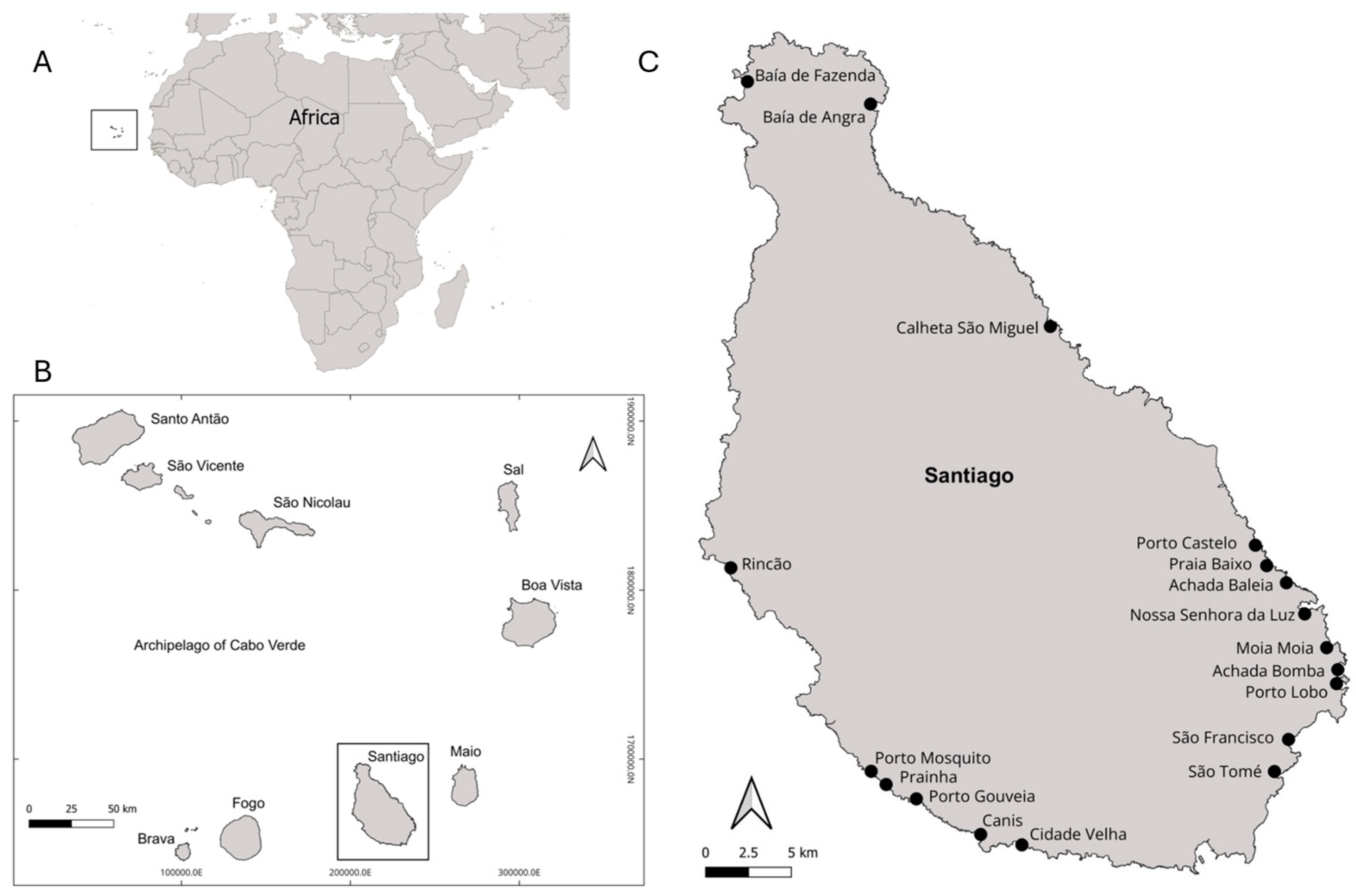
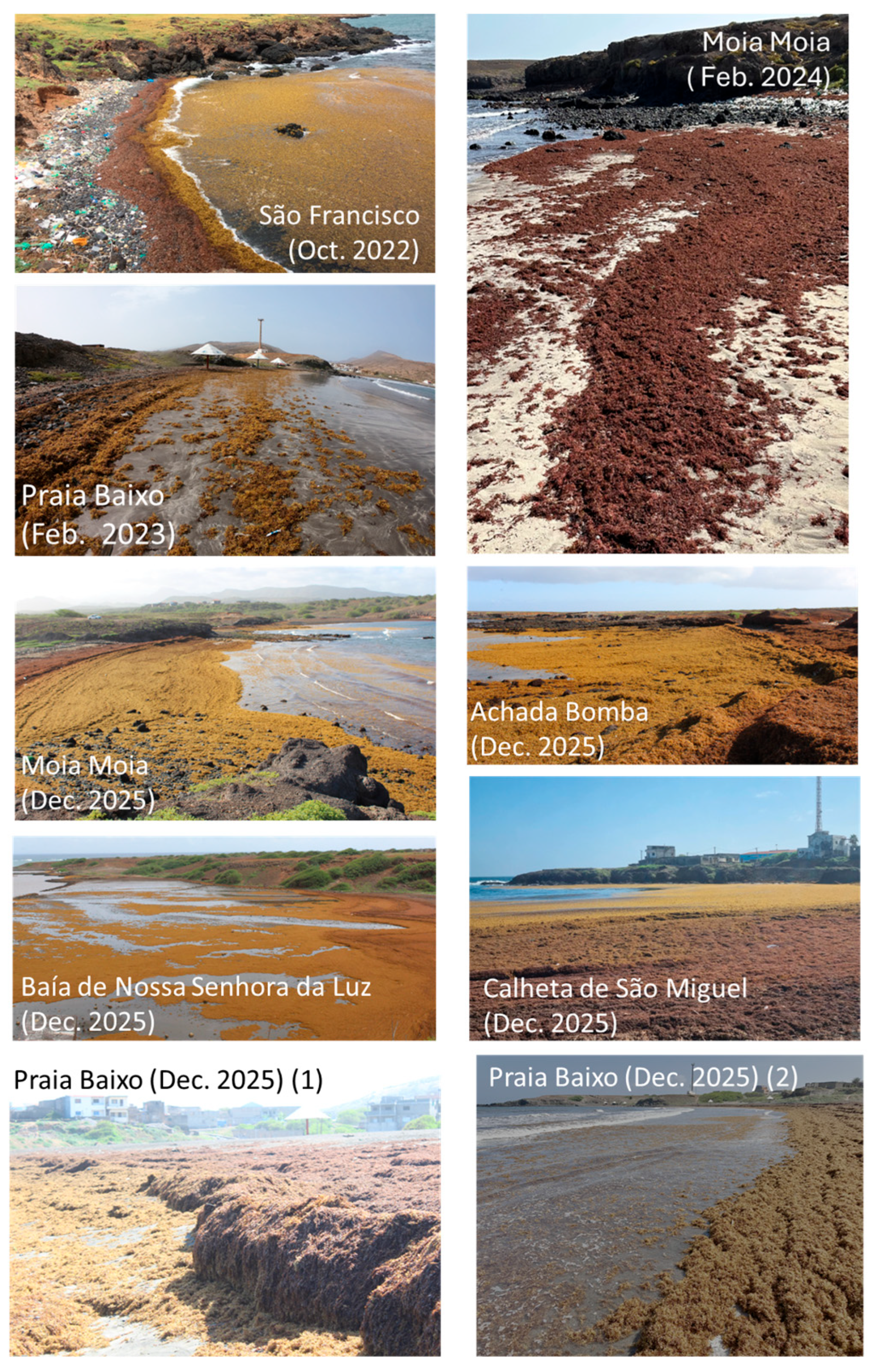
The Cabo Verde (CV) Archipelago is considered a hotspot of marine biological productivity in the oligotrophic central North Atlantic, supporting a highly diverse and unique ecosystems at the crossroad of major currents in this oceanic region [17]. The presence of a pelagic species of sargassum, S. natans (Linnaeus) Gaillon has been previously reported in Cabo Verde [18,19,20], including from the largest and capital island Santiago [21]. Since 2019, pelagic sargassum has been observed floating off the coast of the island by fishermen and during environmental surveys conducted by the non-governmental organisation ECOCV. The first beaching events were reported the 1 October 2022 on the bay of São Francisco, and the 1 November 2022 on the beach of Moia Moia, both located on the east side of Santiago (Figure 1 and Figure 2). Moia Moia Bay has one of the largest coralline communities in Santiago Island, mainly dominated by the lesser starlet coral (Siderastrea radians) platform. Since then, testimonies of local community members and fishermen have described several negative consequences due to the presence of sargassum: floating sargassum covering coastal waters reduces fish movements and it prevents people from swimming as a recreational activity, and from fishing; rotting stranded sargassum causes discomfort due to the bad smell. This latter aspect is in line with health risks such as respiratory, cardiovascular and neurological effects due to the release of hydrogen sulphide gas previously associated with sargassum biomass decomposition [22,23]. Livelihoods in the area are heavily dependent on fishing and agriculture, with women largely responsible for cultivation activities. Agriculture in Cabo Verde is focused on subsistence and the domestic market, and faces challenges such as water scarcity, severe droughts and degraded soils. Tourism is also a growing income stream, and the sargassum events undermine its further development.
In this context, the current study aims at describing recent pelagic sargassum events that occurred in Santiago Island, and to investigate the biochemical and elemental composition of sargassum biomass collected on this island, with a view to identifying if it could support positive community development efforts to support women’s livelihoods. Data obtained helped to address identified challenges (toxic elements contamination and lack of monitoring) associated with pelagic sargassum biomass valorisation in West Africa [3]. They also inform the development of potential practical and effective solutions to valorise this feedstock, with its application as an input to sustainable agriculture within the impacted local communities and beyond.

2. Materials and Methods

2.1. Occurrence and Monitoring of Sargassum in Santiago Island

Total sargassum biomass was estimated in two locations on the east side of Santiago Island, Nossa Senhora da Luz and Moia Moia, during December 2025 (Figure 1). Estimation of the biomass was conducted according to the methodology previously described for the Caribbean [24]. Fifteen measurements of the relative weight/m2 were made per beach, defined by the intersection of three perpendicular and five parallel lanes to the shoreline.

2.2. Sample Collection, Description, and Preparation for Biomass Analysis

Two samples of mixed pelagic sargassum species were manually collected in April 2024, floating in the water, at two different locations: Porto Mosquito (west coast) and Praia Baixo (east coast) of Santiago Island (Table 1 and Figure 1). Solid contaminants (plastic, wood, rubber, and fishing gear debris) were removed before placing the four samples in plastic bags for transport. Starting on the same day of collection, biomass from both locations were placed on trays and dried in the sun for three days, with average maximum temperature of 26 °C during the day and average minimum temperature during the night of 20 °C. Humidity ranged between 61 and 68%. After drying, samples were stored in plastic bags before exporting to York (UK) for analysis. Upon reception at York, sun-dried seaweed samples were milled to 1 mm diameter particle size using a Cyclone Mill Twister (Retsch, Hope Valley, UK) to produce a fine powder that was subsequently stored at room temperature.

2.3. Elemental Composition Analysis by Inductively Coupled Plasma Mass Spectrometry (ICP-MS)

ICP-MS analysis was conducted according to the protocol previously described [25]. Three extractions (technical replicates) were conducted for each sample. Briefly, 8 mL of concentrated HNO3 and 2 mL of 30% H2O2 were added to approximately 0.2 g of sample into a digestion vessel. After sealing, the vessels were placed into a microwave (Milestone Ethos Up, Sorisole, Italy) programmed to heat the contents of the vessels to 200 °C over a period of 30 min. Once at the desired temperature, contents were kept at 200 °C for a period of 15 min. Then, digestion vessels were cooled down before their content was diluted adding 100 mL of distilled water. Ten ml of each sample were used for analysis. A low (Ag, Al, As, Ba, Be, Cd, Co, Cr, Cu, Mo, Ni, Pb, Sb, Se, Th, Tl, U, V, Zn: 10,000 ppb) and high (Ca, Fe, K, Mg, Na: 1,000,000 ppb) concentration calibration standard was produced using an environmental stock calibration fluid (ICP-MS calibration, Agilent part number 5183-4688) with a known concentration of many common elements found in the environment. Sargassum samples and calibration solutions were run on an Agilent (Santa Clara, CA, USA) 7700× ICP-MS equipped with a helium collision cell.

2.4. Assessment of Amino Acid Profiles and of Crude Protein Content

The determination of the crude protein and amino acid contents was done by Sciantec Analytical (Selby, UK), a UKAS and GMP+ accredited laboratory. Dried milled samples were considered as received, and analysis conducted according to protocols implemented by the laboratory: amino acid profile (excluding tryptophan)—protocol TST00001, and tryptophan—protocol TST00019. The crude protein content was determined using protocol TST00307—crude protein (N x 6.25) Dumas method.

2.5. Determination of NPK (Nitrogen-Phosphorus-Potassium) Ratio

The content of phosphorus and potassium was measured by Sciantec Analytical (Selby, UK), a UKAS and GMP+ accredited laboratory. Dried milled samples were considered as received, and analysis conducted according to protocols implemented by this laboratory: mineral extraction preparation—TST00180; and subsequent analysis of phosphorus—TST00195, and potassium—TST00196. The N content was calculated by dividing by 6.25 the results of the crude protein content obtained by the Dumas method. Ratios were calculated by dividing each of the three numbers obtained for each sample by the lowest number.

3. Results and Discussion

3.1. Occurrence and Monitoring of Pelagic Sargassum in Santiago Island

Regular monitoring of pelagic sargassum in Santiago Island started in 2019. Between 2019 and 2022, surveys were conducted two to three times per month in the coastal zones extending from Praia in the south to Porto Rincão on the west coast (Figure 1C). At the start of 2023, surveys expanded to the east coast, from Praia to Calheta São Miguel and the Tarrafal region (Baia de Angra and Baia de Fazenda, northeast and northwest respectively), occurring one to three times per month depending on location and sea conditions. From the end of 2024, weekly surveys were conducted in the zones of Praia Baixo to Moia Moia (east coast), and down south to Praia once or twice a month. In 2025, surveys conducted by ECOCV mapped several locations where high accumulation of morphotypes S. fluitans var. fluitans (S. fluitans III), S. natans var. natans (S. natans I), and S. natans var. wingei (S. natans VIII) was observed (Figure 2). For instance, the accumulation of large quantities of floating and/or rotting sargassum was registered in São Francisco Bay, Praia Baixo, Baia, Calheta São Martinho and Moia Moia bays, all locations on the east coast of Santiago (Figure 1). The east coast of Santiago Island is characterised by more shallow and enclosed bays as compared to the west coast, thus providing more favourable conditions for the accumulation of sargassum in the coastal waters and sandy beaches.
The quantities of pelagic sargassum beaching in December 2025 were observed as the most abundant ever monitored in Santiago Island and to our knowledge in Cabo Verde. This prompted a more accurate estimation of the stranded biomass. As indicated in Table 2, more than one hundred tonnes of sargassum were quantified in the two selected sites, leading to densities above 300 kg/m2 of wet biomass [24].
These results can be compared to some previously obtained in Mexico. Studies conducted on the eastern coast of the Mexican Yucatan Peninsula showed an accumulation ranging between 0 and 100 kg/m2 of wet sargassum during the period 2016–2020 [26], and between 0 and 5.7 kg/m2 of dry biomass measured during a distinct study conducted in September 2018 [27]. These values are lower than those observed in Santiago Island. One possible explanation for this is that beaches surveyed in Mexico are longer and more exposed than the narrower, enclosed and shallow beaches of Nossa Senhora da Luz and Moia Moia.

3.2. Elemental Composition of Pelagic Sargassum Biomass

Results of ICP-MS analysis to determine the content in metals and metalloids of biomass collected in Cabo Verde are presented in Table 3.
It was not possible to conduct a statistical analysis on these results as only technical duplicates were considered for each location, so our observations should be interpreted cautiously. Most of the elements seems to show similar content in biomass harvested on the west and east coast of Santiago Island. This is particularly true for Li, Be, B, Mg, V, Cr, Mn, Ni, Cu, Zn, Se, Sr, Mo, Sn, Sb, Cs, Ba, U, and P. However, some potential differences were observed, with higher content of Na and Ca in samples from Porto Mosquito compared to Praia Baixo. Conversely, amounts of Al, K, Fe, Co, As, Rb, and Nd seem higher in the sargassum biomass collected at Praia Baixo compared to Porto Mosquito. Similarly, our preliminary results indicate that the content in total As was almost double in algae harvested in Praia Baixo compared to Porto Mosquito, while the contents of the other toxic elements Cd and Pb were very similar across the four samples analysed. The contents of As, Cd and Pb can be compared with results obtained from sargassum biomass harvested in Summer 2022 along the Senegalese Coast [9]. The samples from Santiago Island contain at least double the total As compared with the Senegalese samples, four times less Cd, and the same amount of Pb.
Potential differences in some of the element content between the two locations are interesting but challenging to explain. Porto Mosquito is on the west side and Praia Baixo the east side of the Santiago Island. The geology of the coast and the water masses are quite different in both sites and may influence accumulation of elements in sargassum biomass. Porto Mosquito does not have shallow bays, is protected from the winds by the mountain range, and the beaches are made of volcanic pebbles; in contrast, Praia Baixo is more exposed to dominating north-east winds and this site is formed of sandy beaches. In addition, the agriculture practices in the riverbeds on Santiago Island are more concentrated on the flat central east of the island, including the Praia Baixo area, and this could have an impact on the elemental content in seawater nearby.
In previous work conducted in Jamaica, we have investigated the production of mulch and composts from sargassum for mangrove restoration and crop production [28,29]. Considering well-established standards such as the Guidelines outlined by the US Environmental Protection Agency and the Florida Department of Environmental Protection for metal and metalloid concentrations considered as toxicants through environmental exposures [30], total As in the Cabo Verdean collected biomass is the only element that does not meet the guidelines. Additional As speciation analysis would be needed to better evaluate environmental and agricultural risks. All the other elements measured in the Cabo Verdean sargassum biomass and regulated in these guidelines are below the set-up standard concentrations. One-way to circumvent the high content of As could be to mix the sargassum biomass with other organic material as already described [28,29].

3.3. Determination of Crude Protein Content and Amino Acid Profile

One sample from each location was analysed in duplicate. In addition, tryptophan content was analysed in only one of the duplicates. Results are presented in Table 4.
Interestingly, our preliminary results tend to show that samples of sargassum collected at two distinct locations exhibit some differences in their crude protein content and for most of the EAAs. The sample from Praia Baixo contained lower amounts of most of the amino acids compared with the one collected at Porto Mosquito. Values measured for these samples are in the same ranges as those determined using the same analytical methods in samples harvested in different locations in the Caribbean between 2019 and 2021 [31]. In line with individual amino acids, the content in crude protein appears to be lower in samples collected at Praia Baixo compared to those harvested at Porto Mosquito.

3.4. Estimation of NPK (Nitrogen-Phosphorus-Potassium) Ratio

One sample from each location was analysed in duplicate. Results are presented in Table 5.
These preliminary results suggested the content of N and P was slightly higher in the sample from Porto Mosquito compared the one from Praia Baixo. This is in contrast with the amount of K that was almost double in the latter compared to the former sample. This is reflected in the subsequent calculation of the NPK ratio where phosphorus was the main variable within the three elements. The overall trend was K > N > P. The NPK ratio is an important parameter to consider for the use of sargassum biomass for soil improvement.
Although the NPK content present in the sargassum analysed is very different from the average 2-2-2 NPK content in standard compost, the high K content found in sargassum biomass can be beneficial for the production of fruits and induction of stress resistance. The application of seaweed-based products has multiple advantages beyond the nutrient content added to the soil. These beneficial effects of seaweed applications include better absorption of water and increased nutrient availability due to gel forming polysaccharides. There are also multiple effects reported in the literature regarding soil microbiome enhancement and increased plant stress resistance, but the detailed mechanisms of these effects are far from understood [32]. However, the high sodium content measured in seaweed biomass should be taken into consideration when applying seaweed-derived products regarding potential salinisation of the amended soil. Local agronomic trials, treatment tests, and safety assessment would have to be conducted before recommending any of these applications.
In addition to potentially being used as mulch and/or compost, sargassum biomass could be used for the production of liquid biofertilizer and/or biostimulant. A number of pelagic sargassum-derived biostimulant products are already commercially available. The content of total As in the analysed biomass nevertheless exceeded limits recommended for agricultural soils in different countries (15–50 mg/kg DW) [29]. A simple, cheap and effective method for As removal from sargassum was recently described [33]. It reduced As content by up to 88% by using just hot seawater, and up to 97% using hot seawater and citric acid treatment. The method is promising for the production of liquid biofertiliser and/or biostimulant from sargassum biomass, especially with the possibility to use seawater due to the shortage of fresh water in agriculture in Cabo Verde. Another option to further reduce As levels is to mix the sargassum with other organic matter during the process used for production of biofertilizer [34]. Should these methods be successfully applied in the Cabo Verdean study areas, they could offer substantial potential to support local development, particularly for women.
Women play a key role in Cabo Verdean agriculture and rural economy, accounting for a large proportion of the workforce and providing leadership on small family farms. Faced with challenges such as water scarcity and poor soil fertility, many women look for solutions to ensure food security, entrepreneurship and sustainability for their livelihoods. In addition to economic hardships and hard work, rural women also face invisible barriers, such as sexism and rigid cultural traditions, which often restrict their roles in society. In light of our findings, biofertiliser/biostimulant valorisation from macroalgae in Cabo Verde could potentially open a new development pathway, particularly for women, bringing both social and environmental benefits. Realising this potential would nevertheless require further research, as well as institutional development, behavioural and cultural changes. Training and capacity building for activities from sargassum monitoring and collection through to processing, product development and marketing would also be required.

4. Conclusions

Elemental composition, amino acid profiling and calculation of NPK ratio suggest that sargassum biomass has the potential to be processed for use in sustainable agriculture although treatment would be necessary to decrease the content of toxic elements. Sargassum-derived products for soil amelioration and improvement of crop production could be very valuable to support women in rural communities, and to support related livelihood activities such as agroecology and agroecotourism. Such valorisation projects in other locations have been demonstrated to provide important social benefits, including women’s empowerment, improved financial independence, enhanced access to microcredit and a perceived sense of autonomy in decision making [35,36]. Further research is needed in Cabo Verde in order to further explore this potential.

Author Contributions

Conceptualization, T.T. and E.M.; methodology, T.T., L.D.G. and E.M.; investigation, T.T., L.D.G., L.C.S., E.M., A.G., J.S.G. and D.S.; resources, E.M., A.G., J.S.G. and D.S.; data curation, T.T. and E.M.; writing—original draft preparation, T.T.; writing—review and editing, T.T., L.D.G., L.C.S., E.M., J.S.G. and D.S.; project administration, T.T., E.M. and A.G.; funding acquisition, T.T. and E.M. All authors have read and agreed to the published version of the manuscript.

Funding

This project was funded by the Gates Foundation (Grant number INV-074711), and also supported by University of York URP pump priming fund.

Data Availability Statement

The raw data supporting the conclusions of this article will be made available by the authors on request.

Acknowledgments

The authors are very grateful to the AMMAR Women groups in Moia Moia and Praia Baixo for leading participatory monitoring of sargassum and to Laura Faas for milling the sargassum samples. The samples of the seaweed were exported to the UK under the permit No 189/DNA/2025 by the Ministry of Agriculture and Environment of Cabo Verde.

Conflicts of Interest

The authors declare no conflicts of interest. The funders had no role in the design of the study; in the collection, analyses, or interpretation of data; in the writing of the manuscript; or in the decision to publish the results.

References

  1. Siuda, A.N.S.; Blanfuné, A.; Dibner, S.; Verlaque, M.; Boudouresque, C.-F.; Connan, S.; Goodwin, D.S.; Stiger-Pouvreau, V.; Viard, F.; Rousseau, F.; et al. Morphological and Molecular Characters Differentiate Common Morphotypes of Atlantic Holopelagic Sargassum. Phycology 2024, 4, 256–275. [Google Scholar] [CrossRef] [Scilit]
  2. Rodríguez-Martínez, R.E.; Torres-Conde, E.G.; Rosellón-Druker, J.; Cabanillas-Terán, N.; Jáuregui-Haza, U. The Great Atlantic Sargassum Belt: Impacts on the Central and Western Caribbean—A Review. Harmful Algae 2025, 144, 102838. [Google Scholar] [CrossRef] [Scilit] [PubMed]
  3. Saba, A.O.; Fakoya, K.A.; Adet, L.; Sule, H.A.; Ojewole, A.E.; Osho-Abdulgafar, N.F. Sargassum Influxes in West Africa: Impacts, Challenges, and Prospects for Sustainable Management. Harmful Algae 2025, 150, 102982. [Google Scholar] [CrossRef] [Scilit] [PubMed]
  4. Chávez, V.; Uribe-Martínez, A.; Cuevas, E.; Rodríguez-Martínez, R.E.; van Tussenbroek, B.I.; Francisco, V.; Estévez, M.; Celis, L.B.; Monroy-Velázquez, L.V.; Leal-Bautista, R.; et al. Massive Influx of Pelagic Sargassum spp. on the Coasts of the Mexican Caribbean 2014–2020: Challenges and Opportunities. Water 2020, 12, 2908. [Google Scholar] [CrossRef] [Scilit]
  5. Alleyne, K.S.T.; Speede, R.; Oxenford, H.A.; McConney, P. History, Current Status and Future Perspectives of Sargassum Management in the Eastern Caribbean SIDS: A Story from the Frontline. Harmful Algae 2025, 148, 102910. [Google Scholar] [CrossRef] [Scilit] [PubMed]
  6. Oyewumi, O.; Egunyomi, A. Identification and Chemical Studies of Pelagic Masses of Sargassum natans (Linnaeus) Gaillon and S. fluitans (Børgesen) Børgesen (Brown Algae), Found Offshore in Ondo State, Nigeria. Afr. J. Biotechnol. 2014, 13, 1188–1193. [Google Scholar]
  7. Addico, G.N.D.; deGraft-Johnson, K.A.A. Preliminary Investigation into the Chemical Composition of the Invasive Brown Seaweed Sargassum along the West Coast of Ghana. Afr. J. Biotechnol. 2016, 15, 2184–2191. [Google Scholar] [CrossRef] [Scilit]
  8. Ouattara, A.; Yao, K.; Komoe, K.; Kpan, W.B.; Kone, M.W.; Ouattara, D.; Toure, S. Teneur en Composés Phénoliques et Activités Antioxydantes de Sargassum fluitans et Sargassum natans, deux Algues Brunes Invasives des Côtes Ivoiriennes. Eur. Sci. J. 2022, 18, 313. [Google Scholar] [CrossRef] [Scilit]
  9. Bousso, N.C.; Brehmer, P.; Ndiaye, W.; Stiger-Pouvreau, V.; Kane, C.; Gautier, M.; Faye, M.; Fricke, A.; Diadhiou, H.D.; Aroui Boukbida, H.; et al. Unusual Holopelagic Sargassum Mass Beaching in Northwest Africa: Morphotypes, Chemical Composition, and Potential Valorisation. Sci. Total Environ. 2024, 955, 177018. [Google Scholar] [CrossRef] [Scilit] [PubMed]
  10. Foul-Smelling Seaweed Disrupts Sierra Leone’s Fishing and Tourism Industry. Available online: https://www.africanews.com/2022/07/26/foul-smelling-seaweed-disrupts-sierra-leones-fishing-and-tourism-industry/ (accessed on 10 May 2026).
  11. Adjahouinou, D.C.; Hinlin, C.; Kpogue Gangbazo, D.N.S.; Sohou, Z. First Assessment of the Proximate, Amino Acid and Mineral Composition of Sargassum from the Atlantic Ocean Coast in the Benin Republic for Fish Feeding Purposes. J. Appl. Biosci. 2025, 208, 22070–22080. [Google Scholar] [CrossRef] [Scilit]
  12. Kamal, K.; Khaya, K.; Belattmania, Z.; Chaouti, A.; Neiva, J.; Engelen, A.H.; Stiger-Pouvreau, V.; Serrão, E.A.; Sabour, B. Trans-Atlantic Drift of the Holopelagic Sargassum natans and S. fluitans on the Moroccan Atlantic Coast: First Report Linked to Unusual Climatic Event and Ocean Currents in the Northeastern Atlantic Ocean. Aquat. Bot. 2026, 203, 103966. [Google Scholar] [CrossRef] [Scilit]
  13. Fidai, Y.A.; Dash, J.; Tompkins, E.; Atiglo, D.Y.; Jayson-Quashigah, P.-N.; Sowah, W.N.A.; Addo, K.A. Sargassum Biomass Movement and Proliferation in the Eastern Tropical Atlantic. Phycology 2025, 5, 17. [Google Scholar] [CrossRef] [Scilit]
  14. Gabriel, D.; Maridakis, C.; Fredericq, S. Gone with the Wind: An Unexpected Sargassum Inundation in the Mid-Atlantic Azores Archipelago. Mar. Pollut. Bull. 2024, 204, 116522. [Google Scholar] [CrossRef] [Scilit] [PubMed]
  15. Ferreira, S.J.; Kaufmann, M.; Wirtz, P.; Berimbau, L.; Araújo, R. Pelagic Sargassum and Some Associated Mobile Fauna: New Records for the Archipelago of Madeira (Subtropical Eastern Atlantic). J. Mar. Biol. Assoc. UK 2024, 104, e104. [Google Scholar] [CrossRef] [Scilit]
  16. Copernicus. Sargassum Along the Coast of La Palma. Image of the Day. 2024. Available online: https://eo.belspo.be/en/news/sargassum-along-coast-la-palma (accessed on 10 May 2026).
  17. Schütte, F.; Hans, A.C.; Schulz, M.; Hummels, R.; Assokpa, O.; Brandt, P.; Kiko, R.; Körtzinger, A.; Fiedler, B.; Fischer, T.; et al. Linking Physical Processes to Biological Responses: Interdisciplinary Observational Insights into the Enhanced Biological Productivity of the Cape Verde Archipelago. Prog. Oceanogr. 2025, 235, 103479. [Google Scholar] [CrossRef] [Scilit]
  18. Secca, M. A Pesca em Cabo Verde; Publicação da Divisão de Propaganda dos Serviços de Estatística da Colónia de Cabo Verde: Praia, Cape Verde, 1945. [Google Scholar]
  19. Price, J.H.; John, D.M.; Lawson, G.W. Seaweeds of the Western Coast of Tropical Africa and Adjacent Islands: A Critical Assessment. II. Phaeophyta. Bull. Br. Mus. Nat. Hist. Bot. 1978, 6, 87–182. [Google Scholar] [CrossRef] [Scilit]
  20. John, D.M.; Prud’homme van Reine, W.F.; Lawson, G.W.; Kostermans, T.B.; Price, J.H. A Taxonomic and Geographical Catalogue of the Seaweeds of the Western Coast of Africa and Adjacent Islands; Beihefte zur Nova Hedwigia 127; J. Cramer: Stuttgart, Germany, 2004; pp. 1–339. [Google Scholar]
  21. Prud’homme van Reine, W.F.; Haroun, R.J.; Kostermans, L.B.T. Checklists on Seaweeds in the Atlantic Ocean and in the Cape Verde Archipelago. In IV Simpósio Fauna e Flora das Ilhas Atlânticas; Ministério do Ambiente, Agricultura e Pescas: Praia, Cape Verde, 2005; pp. 13–26. [Google Scholar]
  22. Kwak, N.; Tsameret, S.; Mc Intyre, B.; Sobhanian, M.; Diaz-Brunet, D.; Bi, C.; Solo-Gabriele, H.; Li, J. Quantification of Sulfur Compound Emissions from Sargassum Strandings. Mar. Pollut. Bull. 2026, 225, 119262. [Google Scholar] [CrossRef] [Scilit] [PubMed]
  23. Rodríguez-Martínez, R.E.; Ramírez Said, S.; Gómez-Reali, M.A.; Rosales-Fuerte, S.; Pech Figueroa, J.; Costa, M.; Veras, M.M. Assessment of Hydrogen Sulfide Exposure in Shoreline Cleanup Workers During the 2025 Atlantic Sargassum bloom. Harmful Algae 2026, 154, 103092. [Google Scholar] [CrossRef] [Scilit] [PubMed]
  24. Small, M.; Irvine, J.; Baldwin, K.; Weekes, J.; Oxenford, H.A. Sargassum Monitoring Protocol: Monitoring Sargassum Abundance Using Beach Surveys; SargAdapt Good Practice Guide Series 2; University of the West Indies, Centre for Resource Management and Environmental Studies (UWI-CERMES): St. Michael, Barbados, 2022; p. 15. [Google Scholar]
  25. Davis, D.; Simister, R.; Campbell, S.; Marston, M.; Bose, S.; McQueen-Mason, S.J.; Gomez, L.D.; Gallimore, W.A.; Tonon, T. Biomass Composition of the Golden Tide Pelagic Seaweeds Sargassum fluitans and S. natans (Morphotypes I and VIII) to Inform Valorisation Pathways. Sci. Total Environ. 2021, 762, 143134. [Google Scholar] [CrossRef] [Scilit] [PubMed]
  26. García-Sánchez, M.; Graham, C.; Vera, E.; Escalante-Mancera, E.; Álvarez-Filip, L.; van Tussenbroek, B.I. Temporal Changes in the Composition and Biomass of Beached Pelagic Sargassum Species in the Mexican Caribbean. Aquat. Bot. 2020, 167, 103275. [Google Scholar] [CrossRef] [Scilit]
  27. Vázquez-Delfín, E.; Freile-Pelegrín, Y.; Salazar-Garibay, A.; Serviere-Zaragoza, E.; Méndez-Rodríguez, L.C.; Robledo, D. Species Composition and Chemical Characterization of Sargassum Influx at Six Different Locations along the Mexican Caribbean Coast. Sci. Total Environ. 2021, 795, 148852. [Google Scholar] [CrossRef] [Scilit] [PubMed]
  28. Trench, C.; Thomas, S.; Thorney, D.; Maddix, G.; Francis, P.; Small, H.; Machado, C.B.; Webber, D.M.; Tonon, T.; Webber, M.K. Application of Stranded Pelagic Sargassum Biomass as Compost for Seedling Production in the Context of Mangrove Restoration. Front. Environ. Sci. 2022, 10, 932293. [Google Scholar] [CrossRef] [Scilit]
  29. Haye, D.; Machado, C.B.; Young, R.; Webber, D.; Chinthapalli, B.R.; Tonon, T.; Webber, M. Influence of Pelagic Sargassum spp. on Soil Amelioration for Seed Germination and Seedling Growth of Corn (Zea mays), Scotch Bonnet Pepper (Capsicum chinense), and Tomato (Solanum lycopersicum). Phycology 2025, 5, 44. [Google Scholar] [CrossRef] [Scilit]
  30. Abdool-Ghany, A.A.; Pollier, C.G.L.; Oehlert, A.M.; Swart, P.K.; Blare, T.; Moore, K.; Solo-Gabriele, H.M. Assessing Quality and Beneficial Uses of Sargassum Compost. Waste Manag. 2023, 171, 545–556. [Google Scholar] [CrossRef] [Scilit]
  31. Tonon, T.; Machado, C.B.; Webber, M.; Webber, D.; Smith, J.; Pilsbury, A.; Cicéron, F.; Herrera-Rodriguez, L.; Jimenez, E.M.; Suarez, J.V.; et al. Biochemical and Elemental Composition of Pelagic Sargassum Biomass Harvested across the Caribbean. Phycology 2022, 2, 204–215. [Google Scholar] [CrossRef] [Scilit]
  32. Chai, Y.; Schachtman, D. Root Exudates Impact Plant Performance under Abiotic Stress. Trends Plant Sci. 2021, 27, 80–91. [Google Scholar] [PubMed]
  33. Cisneros-Ramos, K.I.; Gutiérrez-Castañeda, M.; Magaña-Gallegos, E.; Villegas-Pañeda, A.G.; Monroy-Velázquez, L.V.; Barba-Santos, M.G.; Gaxiola-Cortés, M.G.; van Tussenbroek, B.I. From Inundations to Golden Opportunity: Turning Holopelagic Sargassum spp. into a Valuable Feed Ingredient through Arsenic Removal. Phycology 2024, 4, 384–393. [Google Scholar] [CrossRef] [Scilit]
  34. Rodríguez-Rodríguez, Y.; Soldevilla-Hernández, L.I.; Guevara, M.Á.; Gandini, G.; Jáuregui-Haza, U.J. Assessment of a Sargassum-Based Liquid Biofertilizer for Enhanced Banana Cultivation in Small-Scale Family Farms. Case Stud. Chem. Environ. Eng. 2025, 12, 101252. [Google Scholar] [CrossRef] [Scilit]
  35. Wulandari, A.; Utoyo, B.; Caturiani, S.I. Women’s empowerment in coastal areas: Waste management based on circular economy paradigm (a case study on Pasaran Island, Bandar Lampung). Int. J. Humanit. Soc. Sci. Manag. 2023, 3, 292–299. [Google Scholar] [CrossRef] [Scilit]
  36. Estrada, M.; Galvin, M.; Maassen, A.; Hörschelmann, K. Catalysing urban transformation through women’s empowerment in cooperative waste management: The SWaCH initiative in Pune, India. Local Environ. 2023, 28, 852–866. [Google Scholar]
Figure 1. Sargassum beaching in the archipelago of Cabo Verde. (A) Map of Africa indicating the location of the Cabo Verdean archipelago (square), approximately 570 km off the coast of Senegal. (B) Map of the ten islands and five islets of the Cabo Verdean archipelago; the square indicates the island of Santiago. (C) Map of the most populous island of Cabo Verde, Santiago. Black dots correspond to locations where sargassum beaching events have been observed since 2019.
Phycology 06 00078 g001
Figure 2. Examples of sargassum beaching events that occurred at different locations on Santiago Island between 2022 and 2025.
Phycology 06 00078 g002
Table 1. Description of sargassum samples considered in this study. PM1 and PM2 refers to the two samples collected at Porto Mosquito, and PB1 and PB2 to the two samples harvested at Praia Baixo.
Sample NameCollection SiteLatitudeLongitudeDate of Collection
PM1 and PM2Porto Mosquito14.95052−23.6906411 April 2024
PB1 and PB2Praia Baixo15.06181−23.471798 April 2024
Table 2. Estimation of total sargassum biomass in two sites on the east coast of the island of Santiago.
LocationDateAverage Depth (cm)Max Depth (cm)Min Depth (cm)Biomass (Tonnes)Area of the Beach
(m2)
Average
Density
(wet kg/m2)
Nossa Senhora da Luz4 December 202535 ± 7.0645 23 186 582 319
Moia Moia1 December 202526 ± 23.1273 5 111 315 350
Table 3. Elemental composition of sargassum samples harvested in Santiago Island. Values are average ± standard deviation of three extraction replicates from the same original sample and are expressed in ppm (or mg/kg) of dry weight (DW) seaweed biomass. Bdl, below detection limit. Samples PM1, PM2, PB1 and PB2 are described in Table 1.
ElementsPM1PM2PB1PB2
Li3.67 ± 1.364.53 ± 0.715.71 ± 2.483.37 ± 1.42
Be1.02 ± 0.380.49 ± 0.700.47 ± 0.330.26 ± 0.37
B270.97 ± 33.95244.17 ± 19.44245.56 ± 37.03188.17 ± 24.62
Na40,048.42 ± 568.2238,359.84 ± 1464.8728,937.18 ± 363.4425,179.86 ± 2254.90
Mg19,444.71 ± 731.2113,659.49 ± 496.0713,134.14 ± 313.2510,143.82 ± 296.11
Al342.29 ± 141.37171.15 ± 27.02447.57 ± 46.09835.70 ± 536.61
K70,871.06 ± 1394.6297,798.13 ± 3839.64145,636.27 ± 4337.65165,702.96 ± 9425.08
Ca113,556.21 ± 4432.2788,122.05 ± 9354.1664,595.82 ± 2747.4852,063.56 ± 5537.34
V3.94 ± 0.456.10 ± 0.313.78 ± 0.654.71 ± 0.99
Cr18.86 ± 2.8711.45 ± 3.3024.14 ± 1.6113.12 ± 2.97
Mn18.90 ± 1.1913.89 ± 0.9220.68 ± 1.1720.80 ± 2.35
Fe297.68 ± 32.69218.12 ± 38.71688.11 ± 43.28897.50 ± 164.60
Co0.76 ± 0.100.68 ± 0.021.05 ± 0.041.25 ± 0.16
Ni9.98 ± 1.909.58 ± 2.389.90 ± 0.8313.19 ± 3.66
Cu9.01 ± 0.207.07 ± 1.277.64 ± 1.805.67 ± 0.51
Zn16.35 ± 3.0616.99 ± 1.9313.68 ± 0.9812.76 ± 3.87
As73.61 ± 2.9191.44 ± 1.51149.94 ± 3.04152.45 ± 4.54
Se3.38 ± 0.622.05 ± 2.023.46 ± 0.832.42 ± 1.71
Rb22.78 ± 0.2731.99 ± 0.4046.69 ± 1.0947.67 ± 2.86
Sr2423.86 ± 71.192775.48 ± 53.202271.71 ± 56.692270.34 ± 77.70
Mo6.65 ± 3.732.88 ± 0.614.19 ± 0.282.66 ± 0.50
AgBdlBdlBdlBdl
Cd1.30 ± 0.221.06 ± 0.351.38 ± 0.231.62 ± 0.54
Sn0.11 ± 0.080.12 ± 0.020.13 ± 0.070.15 ± 0.03
Sb0.07 ± 0.040.05 ± 0.020.04 ± 0.010.07 ± 0.02
Cs6.72 ± 9.400.05 ± 0.040.06 ± 0.020.04 ± 0.02
Ba30.11 ± 1.0021.16 ± 0.6119.62 ± 1.3216.39 ± 0.81
Nd0.79 ± 0.180.97 ± 0.431.44 ± 0.071.85 ± 0.09
HgBdlBdlBdlBdl
Pb1.31 ± 1.100.48 ± 0.142.56 ± 1.331.65 ± 1.03
U0.63 ± 0.010.71 ± 0.050.51 ± 0.020.59 ± 0.04
P1218.88 ± 50.43929.41 ± 185.101062.32 ± 96.811055.83 ± 216.03
Table 4. Crude protein and amino acid content in selected sargassum samples harvested in Santiago Island. Values are expressed in % of dry weight seaweed biomass. NA, not analysed. Essential amino acids are indicated in bold. Bdl, below detection limit. PM1.1 and PM1.2 represent duplicate analysis of sample PM1, and PB2.1 and PB2.2 duplicate analysis of sample PB2.
PM1.1PM1.2PB2.1PB2.2
Cystine0.120.120.120.12
Aspartic acid0.860.870.60.59
Methionine0.130.14BdlBdl
Threonine0.340.340.230.23
Serine0.380.390.240.23
Glutamic acid1.341.320.750.73
Glycine0.660.640.340.34
Alanine0.510.510.260.27
Valine0.340.330.220.21
Isoleucine0.250.250.150.15
Leucine0.430.430.270.27
TyrosineBdlBdlBdlBdl
Phenylalanine0.320.310.190.24
HistidineBdl0.11BdlBdl
Lysine0.360.340.250.27
Arginine0.370.350.250.25
Proline0.370.360.210.24
TryptophanNA0.07NA0.06
Crude Protein 9.19.366
Table 5. Ratio NPK of selected seaweed samples harvested in Santiago Island. Values of nitrogen, phosphorus and potassium content are expressed in % of dry weight seaweed biomass. PM1.1 and PM1.2 represent duplicate analysis of sample PM1, and PB2.1 and PB2.2 duplicate analysis of sample PB2.
TestsPM1.1PM1.2PB2.1PB2.2
Nitrogen (N)1.461.490.960.96
Phosphorus (P)0.140.140.10.1
Potassium (K)4.544.449.39.55
Ratio NPK10.4-1-3210.6-1-31.79.6-1-939.6-1-95.5
Disclaimer/Publisher’s Note: The statements, opinions and data contained in all publications are solely those of the individual author(s) and contributor(s) and not of MDPI and/or the editor(s). MDPI and/or the editor(s) disclaim responsibility for any injury to people or property resulting from any ideas, methods, instructions or products referred to in the content.