


Simple Summary
The low economic value of male dairy calves remains a major challenge for dairy production systems. This study evaluated whether Holstein × Angus crossbreeding could improve feedlot performance, carcass traits, meat quality, and profitability. Twenty-four bulls (Holstein, Angus, and crossbred) were finished for 130 days under identical nutritional conditions. While growth performance, feed efficiency, and nutrient digestibility were unaffected by genetic group, crossbred cattle showed greater carcass yield, improved ruminal fermentation, superior meat quality attributes, and higher economic returns than Holsteins. These findings demonstrate that Holstein × Angus crossbreeding is an effective strategy to increase the value and profitability of male dairy calves.
Abstract
The use of crossbreeding between dairy and beef breeds has been adopted as a strategy to add value to male calves from dairy systems, improve productive efficiency, and reduce economic and animal welfare concerns. This study evaluated the effects of Holstein × Angus crossbreeding on productive performance, metabolism, ruminal fermentation, nutrient digestibility, carcass characteristics, meat quality, and fatty acid profile during the feedlot finishing phase. Twenty-four uncastrated male cattle (8 Holstein, 8 Angus, and 8 crossbreds) were confined for 130 days and fed an isoenergetic and isonitrogenous diet. No significant differences were observed among breeds for weight gain, dry matter intake, feed efficiency, or nutrient digestibility (p > 0.05). However, Angus and crossbred cattle showed higher carcass yield compared to Holstein cattle (p ≤ 0.05). Angus and crossbred animals presented higher concentrations of total volatile fatty acids, acetate, and propionate in the rumen (p ≤ 0.05). Breed differences were also observed in erythrocyte indices and serum urea concentrations (p ≤ 0.05). Meat from crossbred animals showed superior quality attributes compared to Holstein, including lower ultimate pH, higher lightness, greater water-holding capacity, and an intermediate lipid profile between the parental breeds (p ≤ 0.05). It is concluded that Holstein × Angus crossbreeding improves carcass yield, ruminal fermentation efficiency, and meat quality, without compromising productive performance, representing a viable strategy for adding value to male calves from dairy herds under tropical production conditions.
1. Introduction
The practice of crossbreeding dairy and beef cattle is becoming increasingly widespread globally. In the United States, the use of beef sires on dairy dams, a strategy known as “beef-on-dairy,” has gained significant traction since 2018 [1]. Illustrating this trend, sales of beef semen increased from 25% to 47.6% between 2013 and 2020, driven by the adoption of beef-on-dairy crossbreeding [2]. A similar pattern has been observed in northern Europe, where countries like Denmark, Sweden, and the Netherlands, report that 20 to 25% of dairy cows are inseminated with beef semen [3]. With fluctuating milk prices, dairy producers are seeking alternative revenue streams, and the beef-on-dairy model has emerged as a viable strategy, as the resulting crossbred calves are more profitable than purebred dairy calves when channeled into beef system or when raised for meat [4,5].
Concurrent advances in genetics, animal welfare, and nutrition have driven a steady increase in milk production efficiency, intensifying selection pressure within dairy herds. This intensification has resulted in a growing of male dairy calves, an outcome that is undesirable, they are frequently culled shortly after birth, a practice that has ignited considerable debate regarding animal welfare [6,7]. The low market value of purebred Holstein males is a consequence of their inferior growth performance and extended time required to reach a desirable slaughter weight [8]. This poor performance is often exacerbated by suboptimal rearing practices, such as providing limited quantities of milk or unsalable milk during the pre-weaning phase [8]. Subsequently, these animals are often managed in extensive systems, receiving unbalanced or solely forage-based diets, conditions that impede development and compromise the growth and finishing phases, further undermining their economic viability [9].
The inherent limitations of purebred dairy cattle for beef production can be effectively mitigated by crossbreeding with beef breeds. This approach has been shown to improve health, feed efficiency, and carcass yield compared to purebred dairy animals [1,5,10]. Furthermore, the meat from crossbred animals exhibits quality attributes comparable to that of purebred beef cattle, allowing it to be marketed similarly [1].
Although intact Holstein bulls in feedlot systems can achieve respectable average daily gains (e.g., 1.62 kg), they typically produce carcasses with little fat cover [11]. While it is well-established that beef-on-dairy crossbreeding can improve carcass yield and growth performance, the underlying physiological, biochemical, and ruminal mechanisms driving these advantages remain incompletely characterized. Specifically, little is known about how host genetics modulates ruminal fermentation patterns, metabolic parameters, and microbial community structure in beef-on-dairy animals, particularly under tropical production conditions. Furthermore, the absence of data generated in Brazilian systems limits the practical applicability of international findings, given the distinct management, climate, and production structure in Brazil. Establishing finishing protocols tailored for beef-on-dairy animals under tropical conditions represents an important unmet need. This knowledge gap limits our ability to optimize these production systems and fully exploit the potential of the beef-on-dairy strategy. Therefore, the goal of this study was to conduct a comprehensive evaluation of blood, ruminal fluid, fecal, and meat biomarkers to compare purebred Holstein, purebred Angus, and their F1 crossbreed (beef-on-dairy) male offspring.
2. Materials and Methods
The study was approved by UDESC Ethics Committee on Animal Use protocol number 9183240423, approved on 26 May 2023. All procedures were conducted in accordance with the guidelines established by the Brazilian National Council for the Control of Animal Experimentation (CONCEA).
2.1. Animals, Facilities, Experimental Design, and Diet
The experiment was conducted at the Experimental Farm (FECEO) of the Universidade do Estado de Santa Catarina (UDESC), and lasted 130 days. Twenty-four bulls were used: 8 Holstein, 8 Angus, and 8 Holstein × Angus crossbreeds. The initial age was approximately 9.8 ± 0.2 months for Holstein and crossbreeds, and 8.3 ± 0.3 months for Angus.
Holstein and crossbreed animals were raised at FECEO from birth in a confinement system comprising three phases: (1) 60 days in individual suspended cages receiving cow’s milk (4 L/day), concentrate (average of 1.5 kg DM/day), and Tifton hay ad libitum; (2) 90 days in collective pens fed a diet of 50% concentrate, 30% corn silage, and 20% Tifton hay; and (3) 90 days fed 50% concentrate and 50% corn silage. Angus animals were purchased from a commercial farm (15 km from FECEO, Guatambu, SC, Brazil), where they were raised in an extensive system with their dams on pasture and access to creep-feed. Angus calves were weaned at 7.5 months of age and transported to FECEO. Upon arrival, all animals underwent a 20-day pre-experimental adaptation period in individual pens, receiving a transition diet: days 1–10 (35% hay, 35% corn silage, 30% concentrate), days 11 to 15 (60% corn silage, 40% concentrate), and days 16–20 (50% corn silage, 50% concentrate). After this period, all groups received the same experimental diet.
Animals were housed in individual pens (18 m2) with a concrete floor, partially covered (30%), and equipped with individual feed bunks and water troughs. The 130-day trial consisted of a 30-day adaptation period to the final experimental diet. This extended adaptation was adopted to ensure complete ruminal microbial acclimatization to the high-concentrate diet (65% concentrate), minimizing the risk of subacute ruminal acidosis and standardizing the metabolic state of all animals prior to data collection (35:65 roughage: concentrate ratio) followed by a 100-day experimental period (days 31 to 130) for data collection.
The diet was formulated according to BR-Corte 2016 guidelines to target an ADG of 1.5 kg, using corn silage and a commercial concentrate (Cooperativa Agroindustrial Alfa, Chapecó, Brazil). Silage and concentrate were weighed individually and manually mixed for each steer. Samples of the total mixed ration (TMR) were collected throughout the experiment (days 30, 65, 93, and 123) for chemical composition analysis. A pool of these samples was used, and the analyses were performed in triplicate.
2.2. Feed Analysis
Total Mixed Ration (TMR) samples were pre-dried in a forced-air oven at 55 °C for 72 h to determine partial dry matter. Subsequently, samples were ground in a Wiley mill (Model MA340, Marconi, Piracicaba, SP, Brazil) using a 1-m screen. Dry matter (DM), crude protein, ash, neutral detergent fiber (NDF), and ether extract were determined according to the methodologies described by AOAC and Van Soest [12,13] for DM, crude protein (Kjeldahl method), ash and ether extract. The results are presented in Table 1.
Table 1.
Composition of the Total Mixed Ration (TMR) used in the experiment.
2.3. Data and Sample Collection
Body weight (BW) was recorded with animals subjected to a 12-h total fast, and blood was collected on days 1, 30, 81, and 130. Weighting and handling were performed in a squeeze chute equipped with a scale, allowing for the calculation of total weight gain and average daily gain (ADG). Dry matter intake (DMI) was determined by weighing the daily feed offered and the orts (refusals). Feed efficiency was calculated as the ratio between ADG and DMI.
Blood samples were collected on days 1, 30, 81, and 130, always in the morning (8:00 AM) before the first feeding, via coccygeal vein puncture using vacuum tubes. Samples were drawn into two types of tubes: one without anticoagulant (for serum biochemistry and oxidative status) and one containing EDTA (for hematological analysis). Samples were transported in coolers with ice packs and processed within 2 h. Serum was obtained by centrifugation at 3500 rpm for 10 min and stored in labeled microtubes at −20 °C until analysis.
On days 81 and 130, 200 mL of ruminal fluid was collected three hours after feeding using a 1.5 m, 11 mm internal diameter silicone oro-gastric probe connected to a suction pump. Immediately after collection, pH was measured using a portable digital pH meter (Model AK103, Akso Electronic Products Ltd., São Leopoldo, RS, Brazil). The remaining liquid was filtered through triple layers of gauze, and aliquots for volatile fatty acid (VFA) analysis were stored in 5 mL microtubes and frozen at −20 °C.
From days 120 to 124, fecal samples were collected immediately after the animal defecated naturally, prioritizing a sample free of environmental contamination. Collections occurred three times daily (8:00 AM, 12:00 PM, and 5:00 PM) and then samples were frozen. At the end of the five days, samples collected from each animal were combined to form a pool for chemical composition analysis and digestibility coefficient calculations.
At the end of the experimental period (day 131), the animals were slaughtered in a commercial abattoir. All slaughter and inspection procedures were carried out by a veterinarian; a pneumatic stunner was used to stun the animals, followed by exsanguination. Hot carcass weight (HCW) was recorded. Samples of the Longissimus dorsi muscle were collected before chilling for fatty acid profile evaluation.
2.4. Complete Blood Count and Serum Biochemistry
Hematological parameters, including hemoglobin concentration, red blood cell (RBC) count, white blood cell (WBC) count, hematocrit, and leukocyte differentiation counts, were analyzed immediately after collection using an automated veterinary hematology analyzer (3 parts EQUIP VET 3000®, Equip, São Paulo, Brazil).
Serum concentrations of total protein, albumin, and urea were determined using commercial kits (Analisa, Belo Horizonte, MG, Brazil) and semi-automated biochemistry analyzer (BIO PLUS 2000®, Barueri, SP, Brazil), according to the manufacturer’s instructions. Globulin concentration was calculated by subtracting albumin from total protein.
2.5. Determination of Short-Chain Fatty Acids (SCFA) in Ruminal Liquid
Rumen fluid samples were thawed at 5 °C and homogenized. Aliquots (1 mL) were transferred to a 2 mL polypropylene microtubes and centrifuged at 12,300 g for 5 min. A 250 μL aliquot of the supernatant was transferred to a new microtube containing 250 μL of formic acid and homogenized. Subsequently, 250 μL of this mixture was transferred to an injection vial and added to 500 μL of 3-octanol solution (665 μg/mL in methanol; internal standard) and homogenized [14].
Samples were analyzed using a gas chromatograph equipped with a flame ionization detector (GC-FID; Varian Star 3600, Palo Alto, CA, USA) and an autosampler (Varian 8200CX, Palo Alto, CA, USA). A 1 μL sample volume was injected in split mode (1:10) using hydrogen as the carrier gas at a constant pressure of 20 psi. Analytes (acetic, propionic, butyric, valeric, and isovaleric acids) were separated on a CP-WAX 52CB capillary column, where the initial column temperature was set at 80 °C (held for1 min), increased to 120 °C at 8 °C/min, and then to 230 °C at 15 °C/min (held for 1 min). Injector and detector temperatures were set at 250 °C.
Method validation parameters (selectivity, linearity, linear range, repeatability, precision, LOD, and LOQ) are presented in Supplemental Material (Table S1). The results are expressed in mmol L−1 in ruminal fluid.
2.6. Apparent Digestibility Coefficient
Individual fecal samples were collected three times daily (8:00 AM, 1:00 PM, and 6:00 PM) for three consecutive days, totaling nine samples per animal. Samples were frozen immediately after collection. For analysis, samples were thawed at room temperature and pooled by animal on a wet weight basis to obtain a single composite sample per steer.
The apparent digestibility coefficients (ADCs) of nutrients were determined according to AOAC [12]. Daily fecal excretion was estimated using indigestible neutral detergent fiber (iNDF) as an internal marker. The iNDF is considered an ideal internal marker because it is virtually indigestible and passes through the gastrointestinal tract without being fermented or absorbed; its concentration ratio between feed and feces allows the estimation of total fecal output without the need for total feces collection. The iNDF content in feed, orts, and feces was determined by in situ digestibility technique, followed by measurement of DM and NDF percentages.
The final residue from the NDF analysis was the incubation in fistulated animals, which allowed the calculation of fecal excretion: estimated by the difference between the ingested NDF and the iNDF excreted in feces (kg DM/day). Subsequently, the apparent digestibility coefficient (ADC) of DM was determined by the difference between the amount consumed and that obtained in feces, following the same methodology used to determine the ADC of the other nutrients.
2.7. Carcass Grading
Carcasses were graded subjectively for fat cover and conformation. Fat cover was scored on a 5-point scale: 1 (absent), 2 (scarce), 3 (average), 4 (uniform), and 5 (excessive). Carcass conformation was classified as 1 (concave), 2 (subrectilinear), 3 (rectilinear), 4 (subconvex), and 5 (convex).
2.8. Total Lipids and Fatty Acids in Meat
Total lipids were extracted according to Bligh and Dyer [15]. Briefly, 2.8 g of muscle tissue were homogenized with 4.3 mL of water, 16 mL of methanol, and 8 mL of chloroform were added into a 50 mL polypropylene tube using a tissue homogenizer for complete sample disintegration, followed by mechanical agitation for 60 min. Subsequently, 8 mL of chloroform and 1.5% Na2SO4 solution were added to promote phase separation. The mixture was vortexed for 2 min and centrifuged at 2000 rpm for 15 min. The chloroform phase containing the lipids was collected for fatty acid analysis.
FA methylation was performed using a transesterification method described by Hartman and Lago [16]. Extracted lipids were mixed with 1 mL of 0.4 M (moles) KOH, vortexed for 1 min, and heated in water bath at boiling point for 10 min. After cooling to room temperature, 3 mL of 1 M methanolic solution were added; the mixture was vortexed and heated again for 10 min. After cooling, 2 mL of hexane was added, and the samples were centrifuged at 2000 rpm for 10 min. The supernatant containing fatty acid methyl esters (FAMEs) was collected for gas chromatography.
FAMEs were analyzed using a gas chromatograph (TRACE 1310, Thermo Scientific, Waltham, MA, USA) equipped with a flame ionization detector and a split/splitless injector. A 1-μL sample was injected in split mode (1:10) at 250 °C, using hydrogen as the carrier gas (1.5 mL/min constant flow). Separation was performed on an RT 2560 column (100 m × 0.25 mm × 0.20 μm; Restek Corporation, Bellefonte, PA, USA). The oven temperature program was: 100 °C for 5 min; increased to 180 °C at 8 °C/min; increased to 210 °C at 4 °C/min; and finally increased to 240 °C at 20 °C/min, holding for 20 min. Detector temperature was set at 250 °C. FAMEs were identified by comparing retention times with those of a standard mix (FAME Mix-37, Sigma Aldrich, St. Louis, MO, USA). Results were expressed as a percentage of total identified FA, considering the chain size equivalent factor of FAME for FID and conversion factor of ester to the respective acid, according to Visentainer and Franco [17].
2.9. Rumen Microbiota
On day 130, ruminal fluid was collected three hours after feeding using a 1.5 m, 11 mm internal diameter silicone oro-gastric probe connected to a suction pump and frozen at −80 °C. For analysis, samples were thawed, and equal volumes (0.5 mL) from each animal within a group (n = 8) were combined to form a composite sample per treatment (Holstein, Angus, and Crossbred), totaling three pooled samples. These samples were vortexed for 15 s, and aliquots were transferred to 3M™ Quick swabs (3M Company, St. Paul, MN, USA) for metagenomic analysis.
Sequencing of the 16S rRNA gene was performed by the commercial laboratory (BPI—Research and Innovation in Biotechnology®, Botucatu, SP, Brazil). Total DNA was extracted from 200 mg of samples using the ZR Fun-gal/Bacterial DNA MiniPrep kit (Zymo Research Corp., Irvine, CA, USA). The V3-V4 region of the bacterial 16S rRNA gene was amplified using primers 341F (5′-CCTAYGGGRBGCASCAG-3′) and 806R (5′-GGACTACNNGGGTATCTAAT-3′). Libraries were quantified by qualitative and quantitative PCR using the Kapa Library Quantification kit (Illumina, San Diego, CA, USA) and normalized to a final concentration of 2 nM. Sequencing was performed on an Illumina MiSeq platform (2 × 250 cycles). Taxonomic classification was conducted using the Green Genes database.
2.10. Meat Quality Analysis
Muscle pH was measured in the hot carcass immediately after slaughter and again after 24 h of chilling using a portable digital pH meter (Testo 205, da Testo SE & Co. KGaA, Lenzkirch, Germany) at random points.
Meat color was assessed using a CR-400 chromometer (Minolka, Osaka, Japan). CIE 1976 L*, a*, and b*, with a standard illuminant D65, were compared with a CIE 1931 standard observer (x2λ, y λ, z λ), and a calibration plate (number 1849-701). These values were defined as lightness (L*), dark red (a*), and yellow (b*), and were measured at three random sampling points.
Subcutaneous fat thickness was measured with a digital caliper. Water retention capacity was determined using the methodology adapted from Honikel and Hamm [18]. Briefly, a meat sample (0.5 g) was placed on filter paper (15 × 15 cm) between two acrylic plates and subjected to a 2 kg weight force for 5 min. The sample was then reweighed, and water loss was calculated by difference in weight, expressed as a percentage of the initial weight.
2.11. Statistical Analysis
Data were originally screened for normality of residuals using the Shapiro–Wilk test and Levene’s test for homogeneity of variances. Linearity and outliers were assessed using descriptive statistics. All data were analyzed using the PROC MIXED procedure (SAS Inst. Inc., Cary, NC, USA; version 9.4), using the Satterthwaite approximation, to determine the degrees of freedom of the denominator for the fixed-effects test. Performance (weight gain, ADG, and feed efficiency) and carcass/meat quality data were analyzed using the following model: Yij = μ + Ti + εij, where Yij is the response variable, μ is the overall mean, it is the fixed effect of treatment (i = Holstein, Angus, Crossbred), and εij is the residual error. Animal nested within treatment was included as a random variable. Body weight, feed intake and other variables (blood and ruminal fluid) were analyzed as repeated measures. The model included fixed effects of treatment, day, and treatment × day interaction, with animal as subject. Baseline values (day 1) were tested as covariates and retained in the model when significant (p ≤ 0.05). Means were separated using PDIFF (Tukey’s test). Results were reported as LSMEANS followed by the standard error. Significance was defined as p ≤ 0.05 and tendencies were discussed at 0.05 < p ≤ 0.10.
Paired-end reads were analyzed in QIIME 2 (v. 2026.1) [19]. Primers were trimmed using Cutadapt, and sequence denoising, merging, dereplication, and chimera removal were performed with DADA2 [20]. The resulting ASVs were taxonomically assigned using a Naïve Bayes classifier trained on the V3–V4 region against the Greengenes2 database [21]. To improve taxonomic resolution, the reference database was region-specific and incorporated environment-informed taxonomic priors, following the abundance-weighted classification framework proposed by Kaehler et al. [22], which accounts for the unequal distribution of taxa within microbial ecosystems using plugin q2-clawback. This approach has been shown to increase species-level classification accuracy compared with classifiers that assume uniform taxon frequencies. Finally, ASV abundance and taxonomic tables were imported into R (v4.5.2; R Core Team, 2026) for downstream ecological. To summarize microbial community composition, the most abundant genera were selected and their relative abundances visualized (barplot, heatmap and sankeyplot) using the Phyloseq (v1.52) [23] and Microeco (v1.15.0) [24] packages.
3. Results
3.1. Performance
No significant differences were observed among breeds for initial and final body weight, average daily gain, feed intake, feed efficiency, or carcass weight (p > 0.05; Table 2). However, carcass yield was significantly influenced by breed (p = 0.013), being higher in Angus and Crossbred bulls compared to Holstein.
Table 2.
Growth performance of Holstein, Angus, and Holstein × Angus crossbred cattle.
3.2. Hematology and Serum Biochemistry
Hematological parameters are presented in Table 3 and Table S2. A significant breed x day interaction (p ≤ 0.05) was observed for RBC counts, hemoglobin concentration, and hematocrit. This interaction revealed that Angus bulls had higher RBC counts than other groups on days 81 and 130. For hemoglobin and hematocrit, Angus bulls presented higher values than Crossbreds and Holsteins on day 81; however, on day 130, values for Crossbreds were similar to those of Angus and higher than those of Holsteins. Regarding serum biochemistry (Table 3 and Table S2), no significant effects of breed or day × breed interaction for albumin, total protein, or globulin concentrations (p > 0.05). However, a significant breed × day interaction (p ≤ 0.05) was detected for serum urea levels. Angus bulls exhibited higher urea concentrations compared to Holsteins at all evaluation times (days 30, 81, and 130), while Crossbreds presented intermediate values that did not differ statistically from either purebred group.
Table 3.
Hemogram and serum biochemistry for Holstein, Angus, and Holstein × Angus Crossbred bulls.
3.3. Rumen Short-Chain Fatty Acid Profile and Microbiota
3.3.1. SCFA
The ruminal SCFA profiles are presented in Table 4. Significant breed × day interactions (p ≤ 0.05) were observed for acetic, propionic, butyric acids, and total SCFA concentrations. On days 81 and 130, the Crossbred and Angus bulls had higher acetic acid levels compared to Holsteins. A similar pattern was observed for total SCFA concentrations at both time points. For propionic acid, Angus and Crossbreds exhibited higher concentrations than Holsteins, specifically on day 81. Regarding butyric acid, Angus bulls presented higher concentrations compared to both Crossbred and Holstein bulls on day 130.
Table 4.
Short-chain fatty acids (SCFAs) in ruminal fluid from Holstein, Angus, and Holstein × Angus crossbred bulls.
Results regarding the fatty acid profile proportions are presented in Table S3. There was no treatment effect; instead, there was a treatment-by-day interaction, pertaining only to day 81. The proportion of propionic acid was higher in the crossbred and Angus groups compared to the Holstein group, whereas the proportions of butyric and isovaleric acids were lower in these two groups compared to the Holstein group. The proportion of valeric acid was higher in the Holstein group compared to the crossbred group. In terms of proportion, acetic acid levels did not differ.
3.3.2. Microbiota
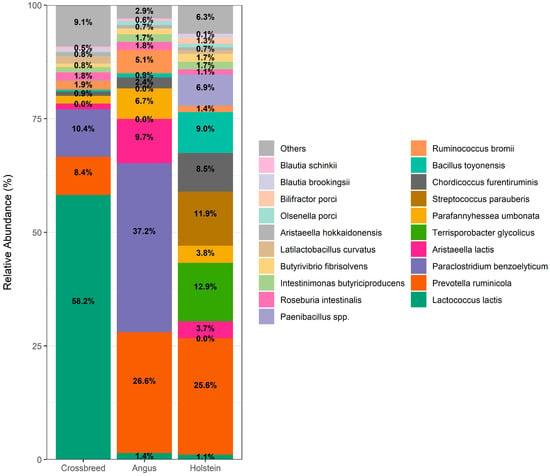
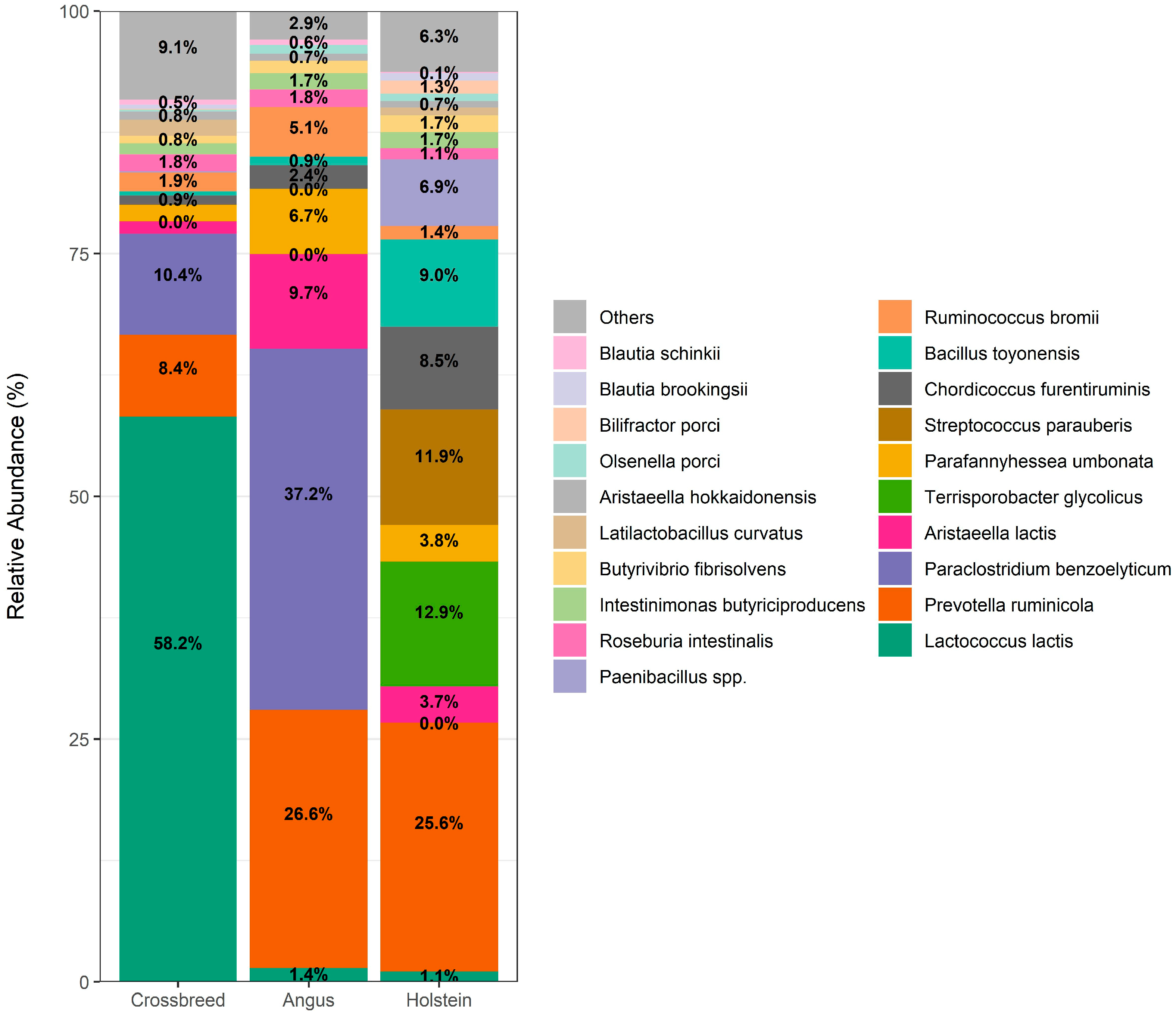
Species-level analysis revealed distinct differences in microbial composition among Angus, Crossbreed, and Holstein cattle. While almost the same subset of taxa dominated the communities across all cohorts, their relative abundances varied markedly, indicating breed-associated structural variation in the microbiota.
In Angus cattle, the community was primarily shaped by Paraclostridium benzoelyticum (37.2%) and Prevotella ruminicola (26.6%), which collectively accounted for nearly two-thirds of the total relative abundance. Other notable contributors included Aristaeella lactis (9.7%), Parafannyhessea umbonata (6.7%), and Ruminococcus bromii (5.1%), while the remaining species persisted at comparatively low abundances (Figure 1).
Figure 1.
Relative abundance of the 20 core microorganisms identified in the ruminal fluid of Crossbreed (Angus × Holstein), Angus and Holstein bulls on the last day of confinement.
Conversely, the Crossbreed microbiota was characterized by a striking predominance of Lactococcus lactis (58.2%). Subsequent in abundance were P. benzoelyticum (10.4%) and P. ruminicola (8.4%), whereas all other taxa contributed only marginally to the overall profile (Figure 1).
Holstein cattle displayed a more heterogeneous microbial profile. While P. ruminicola remained a prominent component (25.6%), several other species contributed substantially, including Terrisporobacter glycolicus (12.9%), Streptococcus parauberis (11.9%), Bacillus toyonensis (9.0%), and Chordicoccus furentiruminis (8.5%). Notably, a diverse assemblage of minor taxa constituted a substantial fraction of the community (13.8%), reflecting a broader distribution across less abundant species. A comprehensive list of relative abundances is provided in the heatmap (Figure S1).
3.4. Apparent Digestibility Coefficient
Apparent digestibility coefficients are presented in Table 5. No significant differences were observed among breeds for the digestibility of dry matter, organic matter, crude protein, ether extract, and NDF (p > 0.05).
Table 5.
Apparent digestibility coefficient (ADC) of nutrients supplied in the diet of Holstein, Angus, and Holstein × Angus crossbred bulls.
3.5. Carcass Characteristics and Meat Quality
Carcass and meat quality traits are presented in Table 6. Initial carcass pH (measured immediately after slaughter) did not differ among breeds (p > 0.05). However, significant were observed for fat cover scores (p ≤ 0.05), with Angus bulls presenting higher scores compared to Holsteins, while Crossbreds presented intermediate values similar to purebreds.
Table 6.
Carcass and meat characteristics of Holstein, Angus, and Holstein × Angus crossbred cattle.
Regarding meat quality, breed effects were detected for all evaluated parameters (p ≤ 0.05). Meat from Holstein bulls presented a higher ultimate pH (24 h) compared to Angus and Crossbred bulls. Conversely, Crossbred and Angus bulls exhibited higher values for lightness, redness, and yellowness compared to Holsteins.
Water retention capacity (WRC) was greater in Crossbred meat compared to Holstein (p ≤ 0.01). Furthermore, Angus bulls presented greater fat thickness and higher intramuscular fat content than both Crossbred and Holstein bulls.
3.6. Meat Fatty Acid Profile
The fatty acid profile of meat was significantly influenced by breed (p ≤ 0.05), as detailed in Table 7. Among the most abundant fatty acids, palmitic acid (C16:0) concentrations were higher in Angus meat compared to Holstein, with Crossbreeds presenting intermediate values. Stearic acid (C18:0) did not differ among breeds. Oleic acid (C18:1 cis-9) was higher in meat from Angus and Crossbreeds compared to Holstein. Conversely, linoleic acid (C18:2 n-6) presented higher percentages in Holstein meat compared to Angus and Crossbreeds.
Table 7.
Fatty acid profile in meat from Holstein, Angus, and Holstein × Angus crossbred cattle.
Regarding lipid classes, the total saturated fatty acids were higher in Angus meat compared to Holstein, while Crossbreeds showed intermediate values. Total monounsaturated fatty acids were higher in Angus and Crossbreed meat compared to Holstein. In contrast, total polyunsaturated fatty acids were highest in Holstein male meat compared to other groups. Crossbreeds presented greater PUFA values when compared to Angus bulls.
4. Discussion
Crossbreeding dairy and beef cattle have emerged as a promising strategy to valorize male dairy calves, improving meat production efficiency and reducing early culling. This study demonstrated that beef-on-dairy crossbreeding can be a viable alternative to overcome the productive limitations of purebred Holstein cattle, resulting in a higher-quality product without compromising feedlot performance. Aside visceral mass, body conformation tends to give beef breeds a blocky conformation and higher carcass yield. To initiate the experiment, a 31-day adaptation period was implemented because the Angus group animals came from an extensive rearing system at a different farm; furthermore, they were younger and had a lower average weight than the crossbred and Holstein animals, which had been raised in a confinement system since birth. These factors may have influenced the weight gain of the Angus males and, therefore, could represent a limitation of the study.
No differences were observed in weight gain, dry matter intake, or feed efficiency among genetic groups, indicating that under the high-concentrate diet (65% concentrate:35% roughage) conditions of this study, Holstein bulls performed similarly to beef breeds. However, Angus and Crossbred bulls presented superior carcass yield compared to Holsteins. This difference reflects the distinct selection history of these breeds. Dairy cattle are selected for metabolic efficiency towards lactation and are reported to possess proportionally larger visceral organs and gastrointestinal tracts than beef breeds, which reduces carcass yield relative to live weight [25,26]. Although visceral organ mass was not directly measured in the present study, the literature consistently reports this anatomical difference as a key driver of lower dressing percentage in Holstein-type cattle. It is also worth noting that Holstein bulls, as a later-maturing genotype, might have achieved better carcass characteristics with a longer finishing period, future studies should evaluate the effect of confinement duration on carcass traits in dairy-type animals. Carcass yield is defined as the ratio between hot carcass weight and live weight without head, tail, hide, hooves, mammary glands or testicles, and viscera, and is a fundamental indicator of the productive performance of cattle during their development. Interestingly, the lack of difference in apparent nutrient digestibility coefficients among breeds reinforces that the variation in carcass yield was not driven by digestive efficiency. Instead, it suggests a divergence in post-absorptive nutrient partitioning. Beef breeds and their crosses prioritize the allocation of metabolizable energy towards muscle accretion and adipose tissue deposition, whereas Holstein cattle tend to have higher maintenance energy requirements due to greater relative visceral mass [25,27,28]. Thus, the beef-on-dairy strategy successfully introduced favorable carcass traits of the Angus breed into the Holstein background.
Volatile fatty acids (VFAs) are the primary source of energy derived from ruminal fermentation, and their concentrations and molar proportions are influenced by dietary composition, fermentation patterns, and host-related factors [29,30]. In the present study, Angus and Crossbred bulls exhibited higher ruminal concentrations of total SCFA, acetate, and propionate than Holsteins, particularly on days 81 and 130. However, when expressed as molar proportions, acetate did not differ among groups, whereas propionate showed a similar pattern to that observed for absolute concentrations, with differences detected only on day 81 (Table S3). In contrast, Holsteins exhibited greater proportional concentrations of butyrate, isovalerate, and valerate. These findings highlight the importance of interpreting SCFA data using both absolute concentrations and relative proportions, as changes in concentration do not necessarily reflect changes in the overall distribution of fermentation products. Importantly, SCFA concentrations in the present study were expressed per unit volume of ruminal fluid; therefore, differences among breeds should not be interpreted as differences in total ruminal SCFA production. Given that rumen volume may differ among cattle types, particularly between dairy and beef-influenced animals, direct measurements of rumen volume and SCFA outflow would be necessary to determine whether the observed differences reflect greater total SCFA production, differences in rumen volume, or altered rates of absorption and turnover.
The differences in SCFA profiles may reflect differences in the way beef- and dairy-influenced cattle utilize the same diet. Dairy cattle have historically been selected for high feed intake and milk production, whereas beef cattle are selected primarily for growth, feed efficiency, and carcass characteristics, which may contribute to differences in ruminal fermentation and nutrient utilization [31,32,33]. Acetate is an important substrate for fatty acid synthesis in ruminant tissues, whereas propionate is the major gluconeogenic precursor and contributes substantially to the glucose supply of growing cattle [29,32]. Therefore, the greater concentrations of acetate and propionate observed in Angus and Crossbred bulls may indicate differences in the availability of major fermentation products, although the underlying mechanisms cannot be determined from the present data. The absence of differences in apparent nutrient digestibility suggests that the distinct SCFA profile was not accompanied by measurable differences in overall nutrient digestibility. Nevertheless, the greater concentrations of acetate and propionate in beef-influenced cattle occurred alongside differences in carcass characteristics and meat fatty acid composition, suggesting that breed-related differences in ruminal fermentation may contribute to differences in nutrient partitioning and tissue lipid metabolism. These associations should, however, be interpreted cautiously because SCFA concentration alone does not provide a direct estimate of ruminal SCFA production, absorption, or post-ruminal energy supply.
The higher erythrocyte counts, hemoglobin concentration, and hematocrit observed in Angus bulls may suggest a superior oxygen-carrying capacity, potentially linked to the higher metabolic demands of muscle tissue accretion. Breed differences in erythrocyte profiles are well documented and often associated with higher red blood cell mass and greater feed efficiency and adaptation to high-energy diets in beef genotypes [34,35,36]. Taurine breeds suitable for beef production, such as Angus, tend to have higher hemoglobin and hematocrit concentrations, which may favor tissue oxygenation and support greater muscle metabolic activity [37,38,39]. Furthermore, the significant breed × day interaction indicates that this erythropoietic response is dynamic, likely adjusting to the increasing growth rate and physiological maturity over the feeding period. Importantly, the lack of difference in leukocyte parameters confirms that these variations were physiological rather than indicative of immune challenge or inflammation. Regarding serum biochemistry, the elevated urea concentrations in Angus bulls may reflect a more intense rate of protein turnover or greater amino acid catabolism, consistent with the higher muscle growth rate observed in beef breeds [40,41]. Since albumin and total proteins were similar among groups, the variation in urea does not indicate nutritional deficiency or hepatic dysfunction but rather reflects a distinct metabolic setpoint for amino acid catabolism and recycling in Angus cattle compared to Holsteins.
Meat quality is defined by a set of characteristics valued by consumers, primarily color, texture, tenderness, flavor, and juiciness [10,42,43]. In the present study, meat from Holstein bulls presented higher ultimate pH and darker color, characteristics often associated with DFD (dark, firm, and dry) meat. Normal meat pH typically ranges from 5.5 to 5.7, and values above this range result in meat with a darker color and reduced shelf life, characteristic of DFD (dark, firm, and dry) meat [43,44]. The elevated pH in Holsteins suggests a lower glycolytic potential at slaughter, likely due to pre-slaughter glycogen depletion [44,45]. Although pre-slaughter stress caused by transport, prolonged fasting, and dehydration can deplete muscle glycogen reserves and impair post-mortem acidification [45]. Therefore, differential pre-slaughter stress is an unlikely explanation for the higher ultimate pH observed in Holstein bulls. The elevated pH more likely reflects an intrinsically lower glycolytic capacity in dairy-type cattle, potentially related to a lower proportion of glycolytic muscle fibers or a lower pre-slaughter muscle glycogen content associated with their metabolic specialization [1,9]. However, we would like to emphasize that a meat pH of 6.34 in Holstein cattle alone is not sufficient to conclude that the meat is unacceptable for human consumption, since we did not measure muscle glycogen reserves before slaughter or assess pre-slaughter stress through plasma lactate or cortisol concentrations immediately after transportation. Although this finding deserves attention, additional information would be necessary to confirm whether the meat should be classified as DFD, as the observed difference in ultimate pH may also reflect breed-related differences in muscle metabolism rather than an adverse pre-slaughter stress response.
The fatty acid composition of beef is a key determinant of its nutritional value, flavor, and shelf life and is influenced by factors such as age, breed, and diet [42,46]. It is well established that as intramuscular fat content increases, the proportions of specific fatty acids change differentially. The accumulation of triglycerides in adipocytes (marbling) favors the deposition of saturated fatty acids (SFAs) and monounsaturated fatty acids (MUFAs), whereas polyunsaturated fatty acids (PUFAs) are largely associated with the phospholipid fraction of cell membranes, which remains relatively constant [33,46,47]. This physiological pattern is consistent with the results observed in the present study. Angus and Crossbred bulls, which had higher intramuscular fat content, consequently presented higher concentrations of SFAs and MUFAs. In contrast, the leaner Holstein meat had a higher relative proportion of PUFAs because membrane phospholipids represented a larger fraction of the total lipid pool. Because PUFAs are more susceptible to oxidative degradation than saturated fatty acids, their greater relative contribution to membrane lipids may have implications for the oxidative stability of meat. This pattern is also consistent with the differences observed in ruminal fermentation: the higher acetate concentrations in Angus and Crossbred bulls may have contributed to a greater availability of lipogenic substrates, consistent with the greater deposition of triglycerides and higher SFA and MUFA concentrations observed in their meat.
The observed differences in microbiota composition among genetic groups appear to be associated with variations in ruminal fermentation patterns and, consequently, productive performance. Furthermore, it is worth noting another limitation of these data: they originate from a pool of eight animals per group, which precluded statistical analysis and allowed only for a descriptive assessment. However, the aim was to gain a preliminary understanding of whether breed could influence the microbiota, even when the animals were kept in the same environment and fed the same diet. Consequently, the data discussed below have been interpreted with caution.
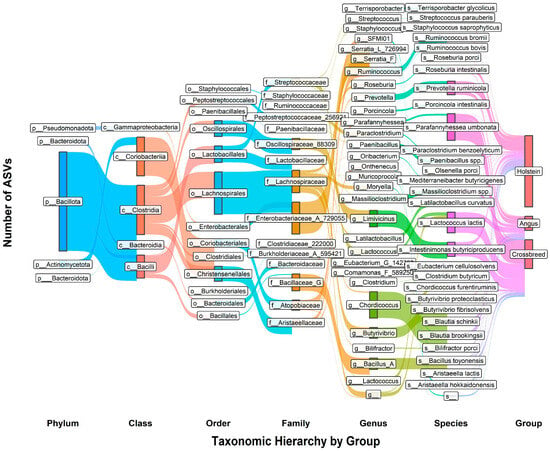
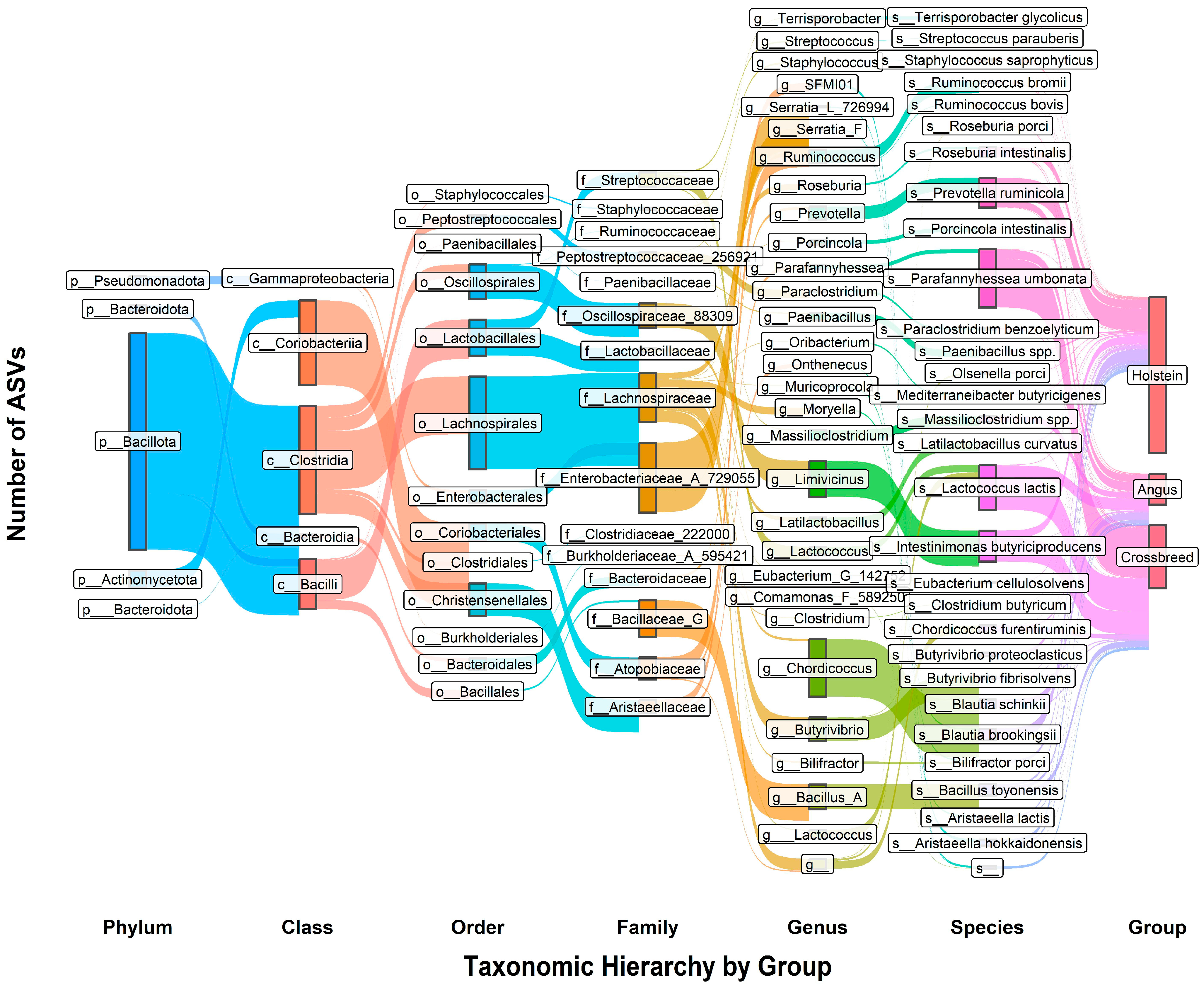
Prevotella ruminicola was consistently among the most abundant taxa across all genetic groups. Members of the genus Prevotella are widely recognized as key contributors to ruminal carbohydrate and protein degradation and are frequently associated with the production of succinate and propionate precursors, thereby playing a central role in ruminal energy metabolism [48,49]. The high abundance of P. ruminicola observed in Angus and Holstein cattle suggests that this species may have contributed substantially to fermentative activity and SCFA production. Holstein cattle exhibited a more diverse distribution of abundant taxa, including T. glycolicus, S. parauberis, B. toyonensis, and C. furentiruminis. Although the functional roles of several of these species in the rumen remain poorly understood, their presence indicates a microbial community structured differently from that of Angus cattle. In contrast, Angus animals were characterized by the co-dominance of P. benzoelyticum and P. ruminicola, suggesting a more concentrated microbial profile dominated by taxa commonly associated with fermentative processes. It is important to acknowledge that the observed microbiota differences may reflect not only host genetic effects but also differences in the animals’ pre-experimental life history. Angus bulls were raised extensively with their dams on pasture, whereas Holstein and Crossbred bulls were reared in confinement from birth. Early-life nutritional and environmental exposures are known to influence microbial colonization and rumen development, and these contrasting management conditions may have contributed to the differences detected among groups. Consequently, the microbiota patterns observed in this study should be interpreted as the combined result of cattle breed and previous environmental influences. Overall, the results support the existence of breed-associated differences in microbial community structure and suggest that these variations may influence ruminal fermentation efficiency and energy metabolism. In Crossbred cattle, Lactococcus lactis was the predominant bacterial species, accounting for 58.2% of the identified community. Although L. lactis is a lactic acid bacterium capable of fermenting soluble carbohydrates primarily to lactic acid, its occurrence in the rumen has been described as potentially transient, likely reflecting its introduction through the diet rather than stable ruminal colonization [50]. Therefore, its marked abundance in Crossbred cattle may reflect differences in substrate availability or microbial community structure associated with breed, although the functional contribution of this species to the fermentation profile cannot be established from 16S rRNA sequencing alone. The weighted taxonomic flow analysis revealed that the three genetic groups shared a common microbial backbone dominated by the phyla Bacillota, Bacteroidota, and Actinomycetota (Figure 2). At higher taxonomic ranks, the microbiota was primarily represented by the classes Clostridia and Bacteroidia, with major contributions from the orders Lachnospirales, Oscillospirales, Lactobacillales, and Bacteroidales. However, despite this apparent similarity at broader taxonomic levels, a progressive differentiation became evident at the genus and species levels. Genera such as Prevotella, Ruminococcus, Roseburia, Butyrivibrio and Lactococcus displayed distinct distributions among Holstein, Angus, and Crossbred animals, indicating genotype-associated shifts in microbial composition.
Figure 2.
Weighted microbial taxonomic flow of ruminal microbiota in Holstein, Angus, and Holstein × Angus crossbred cattle. The diagram illustrates the hierarchical distribution of bacterial taxa from phylum (left) to species (right) and their association with each genetic group. Flow width is proportional to the number of ASVs of each taxon; only taxa with >1% relative abundance are displayed. This visualization highlights the dominant microbial lineages and the differential contribution of specific taxa to the ruminal ecosystem of each breed.
Several of the dominant taxa identified are recognized members of the ruminal and intestinal core microbiome [51]. For example, Prevotella spp. are important degraders of proteins and non-structural carbohydrates, whereas Ruminococcus, Butyrivibrio, and Roseburia are associated with fiber degradation and short-chain fatty acid production, particularly butyrate [49,52]. The differential representation of these species suggests that host genetic background may influence the ecological niches available to specific microbial populations. Such host-driven selection has previously been linked to differences in feed intake, ruminal retention time, immune regulation, and digestive physiology among cattle breeds [53,54]. Despite the taxonomic divergence observed at lower hierarchical levels, the persistence of functionally related bacterial groups across all genetic backgrounds suggests a high degree of functional redundancy within the gastrointestinal microbiota. Functional redundancy is a hallmark of ruminant microbial ecosystems and contributes to maintaining essential metabolic processes despite variations in community structure [49,55]. In the present study, the recurrent presence of fibrolytic and saccharolytic taxa, including Ruminococcus, Butyrivibrio, Roseburia, and Prevotella, indicates that the core fermentative capacity was preserved across groups. Consequently, differences in productive performance are unlikely to be explained by the loss of key metabolic functions, but rather by subtle changes in the abundance of taxa involved in carbohydrate utilization and volatile fatty acid production. Such shifts may alter fermentation efficiency and energy harvesting, potentially contributing to breed-specific differences in nutrient utilization and carcass traits.
In summary, despite the previously mentioned limitations of this study, these data generated under Brazilian tropical conditions contributed to filling the knowledge gap on beef-on-dairy systems in non-temperate environments and support the development of breed-specific finishing protocols for crossbred animals in tropical production systems. Future studies should address the effect of confinement duration, pre-experimental life history standardization, and direct measurement of visceral organ mass to further characterize the physiological differences between beef and dairy genotypes in feedlot settings.
5. Conclusions
Holstein × Angus crossbreeding was an effective strategy to improve carcass yield and selected meat quality traits without compromising growth performance, feed efficiency, or apparent nutrient digestibility. Crossbred bulls generally exhibited an intermediate phenotype between Holstein and Angus for carcass and meat characteristics, including the fatty acid profile. Angus and Crossbred bulls also showed higher ruminal concentrations of total SCFA, acetate, and propionate than Holsteins, indicating breed-associated differences in ruminal fermentation patterns. However, these differences should not be interpreted as direct evidence of greater ruminal SCFA production or fermentative efficiency, as SCFA concentrations were determined per unit volume of ruminal fluid. Overall, the results demonstrate that beef-on-dairy crossbreeding can add value to male calves from Holstein cows by improving carcass and meat characteristics while maintaining productive and digestive performance under tropical feedlot conditions.
Supplementary Materials
The following supporting information can be downloaded at https://www.mdpi.com/article/10.3390/ruminants6030070/s1: Table S1. Standardization of measurement of short-chain fatty acids; Table S2. Treatment × day interaction for erythrogram and urea variables. Table S3. Short-chain fatty acids (SCFAs) in ruminal fluid from Holstein, Angus, and Holstein × Angus crossbred steers; results presented as proportions (%). Figure S1. Heatmap of relative abundance of the 40 core microorganisms in the ruminal fluid of cattle from different experimental groups.
Author Contributions
Conceptualization, J.Z., S.A.M. and A.S.d.S.; methodology, G.C.G., N.T., J.G.W.W., and G.L.D.; software, M.M.B. and A.S.d.S.; formal analysis, V.C.d.L. and F.M.J.; resources and data curation, R.W., and G.V.K.; writing—original draft preparation, G.C.G. and N.T.; writing—review and editing, all of authors; supervision, D.d.C.C.; project administration and funding acquisition, A.S.d.S. All authors have read and agreed to the published version of the manuscript.
Funding
This research received no external funding.
Institutional Review Board Statement
The study was approved by UDESC Ethics Committee on Animal Use (CEUA-UDESC; protocol number 9183240423, approved on 26 May 2023).
Informed Consent Statement
Not applicable.
Data Availability Statement
The data presented in this study are available on request from the corresponding author. (This research is still ongoing with other batches of animals).
Acknowledgments
We thank UDESC for the operational and structural support, as well as the CooperAlfa cooperative for the technical support.
Conflicts of Interest
The authors declare no conflicts of interest.
References
- Foraker, B.A.; Frink, J.L.; Woerner, D.R. Invited review: A carcass and meat perspective of crossbred beef × dairy cattle. Transl. Anim. Sci. 2022, 6, txac027. [Google Scholar] [CrossRef] [Scilit] [PubMed]
- AHDB (Agriculture and Horticulture Development Board). Jump in Use of Sexed Dairy Semen; AHDB: Warwickshire, UK, 2021; Available online: https://ahdb.org.uk/news/jump-in-use-of-sexed-dairy-semen (accessed on 16 August 2026).
- DAFC (Danish Agriculture & Food Council). Benchmark Analysis 2021: Danish Beef and Veal within a European Perspective; DAFC: Copenhagen, Denmark, 2021; Available online: https://lf.dk/media/ouuluffw/danish-beef-benchmark-cn-2021.pdf (accessed on 30 April 2024).
- McCabe, E.D.; King, M.E.; Fike, K.E.; Odde, K.G. Effects of Holstein and beef-dairy crossbreed description on the sale price of feeder and weaned calf lots sold through video auctions. Appl. Anim. Sci. 2022, 38, 70–78. [Google Scholar] [CrossRef] [Scilit]
- Baisel, B.L.; Felix, T.L. Board Invited Review: Crossbreeding beef × dairy cattle for the modern beef production system. Transl. Anim. Sci. 2022, 6, txac025. [Google Scholar] [CrossRef] [Scilit] [PubMed]
- Reed, L.M.; Renaud, D.L.; Devries, T.J. Male dairy calf welfare: A Canadian perspective on challenges and potential solutions. Can. Vet. J. 2022, 63, 187–193. [Google Scholar] [PubMed]
- Webb, L.; Verwer, C.; Bokkers, E. The future of surplus dairy calves—An animal welfare perspective. Front. Anim. Sci. 2023, 4, 1228770. [Google Scholar] [CrossRef] [Scilit]
- Wilson, D.J.; Pempek, J.A.; Cheng, T.-Y.; Habing, G.; Proudfoot, K.L.; Winder, C.B.; Renaud, D.L. A survey of male and female dairy calf care practices and opportunities for change. J. Dairy Sci. 2023, 106, 703–717. [Google Scholar] [CrossRef] [Scilit] [PubMed]
- Vestergaard, M.; Jørgensen, K.F.; Çakmakçı, C.; Kargo, M.; Therkildsen, M.; Kristensen, T. Performance and carcass quality of crossbred beef x Holstein bull and heifer calves in comparison with purebred Holstein bull calves slaughtered at 17 months of age in an organic production system. Livest. Sci. 2019, 223, 184–192. [Google Scholar] [CrossRef] [Scilit]
- Rezagholivand, A.; Nikkhah, A.; Khabbazan, M.H.; Mokhtarzadeh, S.; Dehghan, M.; Mokhtabad, Y.; Sadighi, F.; Safari, F.; Rajaee, A. Feedlot performance, carcass characteristics and economic profits in four Holstein–beef crosses compared with pure-bred Holstein cattle. Livest. Sci. 2021, 244, 104358. [Google Scholar] [CrossRef] [Scilit]
- Giacomelli, C.M.; Marchiori, M.S.; Nascimento, A.L.; de Vitt, M.G.; Molosse, V.L.; de Oliveira, F.C.; Wagner, R.; Milarch, C.F.; Vedovatto, M.; da Silva, A.S. Encapsulated pepper blend in the diet of confined Holstein bullocks: Effect on ruminal volatile fatty acid profiles, growth performance, and animal health. Trop. Anim. Health Prod. 2023, 55, 114. [Google Scholar] [CrossRef] [Scilit] [PubMed]
- AOAC International; Latimer, G.W., Jr. Official Methods of Analysis of AOAC International, 20th ed.; Oxford University Press: Oxford, UK, 2023. [Google Scholar]
- Van Soest, P.V.; Robertson, J.B.; Lewis, B.A. Methods for dietary fiber, neutral detergent fiber, and nonstarch polysaccharides in relation to animal nutrition. J. Dairy Sci. 1991, 74, 3583–3597. [Google Scholar] [CrossRef] [Scilit] [PubMed]
- De Vitt, M.G.; Signor, M.H.; Corrêa, N.G.; Breancini, M.; Wolschick, G.J.; Klein, B.; Silva, L.E.L.; Wagner, R.; Jung, C.T.K.; Kozloski, G.V.; et al. Combination of Phytoactives in the Diet of Lactating Jersey Cows: Effects on Productive Efficiency, Milk Composition and Quality, Ruminal Environment, and Animal Health. Animals 2024, 14, 2518. [Google Scholar] [CrossRef] [Scilit] [PubMed]
- Bligh, E.G.; Dyer, W.J. A rapid method of total lipid extraction and purification. Can. J. Biochem. Physiol. 1959, 37, 911–917. [Google Scholar] [CrossRef] [Scilit] [PubMed]
- Hartman, L.; Lago, R.C. Rapid preparation of fatty acid methyl esters from lipids. Lab. Pract. 1973, 22, 475–477. [Google Scholar] [PubMed]
- Visentainer, J.V.; Franco, M.R.B. Ácidos Graxos em Óleos e Gorduras: Identificação e Quantificação; Varela: São Paulo, Brasil, 2006. [Google Scholar]
- Honikel, K.O.; Hamm, R. Measurement of water-holding capacity and juiciness. In Quality Attributes and their Measurement in Meat, Poultry and Fish Products; Pearson, A.M., Dutson, T.R., Eds.; Springer: Boston, MA, USA, 1994; pp. 125–161. [Google Scholar]
- Bolyen, E.; Rideout, J.R.; Dillon, M.R.; Bokulich, N.A.; Abnet, C.C.; Al-Ghalith, G.A.; Alexander, H.; Alm, E.J.; Arumugam, M.; Asnicar, F.; et al. Reproducible, interactive, scalable and extensible microbiome data science using QIIME 2. Nat. Biotechnol. 2019, 37, 852–857. [Google Scholar] [CrossRef] [Scilit] [PubMed]
- Callahan, B.J.; Mcmurdie, P.J.; Rosen, M.J.; Han, A.W.; Johnson, A.J.; Holmes, S.P. DADA2: High-resolution sample inference from Illumina amplicon data. Nat. Methods 2016, 13, 581–583. [Google Scholar] [CrossRef] [Scilit] [PubMed]
- McDonald, D.; Jiang, Y.; Balaban, M.; Cantrell, K.; Zhu, Q.; Gonzalez, A.; Morton, J.T.; Nicolaou, G.; Parks, D.H.; Karst, S.M.; et al. Greengenes2 unifies microbial data in a single reference tree. Nat. Biotechnol. 2024, 42, 715–718. [Google Scholar] [CrossRef] [Scilit] [PubMed]
- Kaehler, B.D.; Bokulich, N.A.; McDonald, D.; Knight, R.; Caporaso, J.G.; Huttley, G.A. Species abundance information improves sequence taxonomy classification accuracy. Nat. Commun. 2019, 10, 4643. [Google Scholar] [CrossRef] [Scilit] [PubMed]
- McMurdie, P.J.; Holmes, S. Phyloseq: An R package for reproducible interactive analysis and graphics of microbiome census data. PLoS ONE 2013, 8, e61217. [Google Scholar] [CrossRef] [Scilit] [PubMed]
- Liu, C.; Cui, Y.; Li, X.; Yao, M. microeco: An R package for data mining in microbial community ecology. FEMS Microbiol. Ecol. 2021, 97, fiaa255. [Google Scholar] [CrossRef] [PubMed]
- Berry, D.P. Invited review: Beef-on-dairy—The generation of crossbred beef × dairy cattle. J. Dairy Sci. 2021, 104, 3789–3819. [Google Scholar] [CrossRef] [Scilit] [PubMed]
- Foraker, B.A.; Johnson, B.J.; Brooks, J.C.; Miller, M.F.; Starkey, J.D.; Herring, A.D.; Woerner, D.R. Carcass yield and subprimal cutout value of beef, high-yielding beef × dairy, low-yielding beef × dairy, and dairy steers. Meat Muscle Biol. 2024, 8, 17004. [Google Scholar] [CrossRef] [Scilit]
- Bellmann, O.; Wegner, J.; Rehfeldt, C.; Teuscher, F.; Schneider, F.; Voigt, J.; Derno, M.; Sauerwein, H.; Weingärtner, J.; Ender, K.J. Beef versus dairy cattle: A comparison of metabolically relevant hormones, enzymes, and metabolites. Livest. Prod. Sci. 2004, 89, 41–54. [Google Scholar] [CrossRef] [Scilit]
- Pflugh, R.; Bellmann, O.; Kühn, C.; Teuscher, F.; Ender, K.; Wegner, J. Beef versus dairy cattle: A comparison of feed conversion, carcass composition, and meat quality. Arch. Anim. Breed. 2007, 50, 59–70. [Google Scholar] [CrossRef] [Scilit]
- Bergman, E.N. Energy contributions of volatile fatty acids from the gastrointestinal tract in various species. Physiol. Rev. 1990, 70, 567–590. [Google Scholar] [CrossRef] [Scilit] [PubMed]
- Zhao, Y.; Chen, H.; Zhao, P.; Zhang, C.; Wu, Y.; Li, X.; Huangfu, M.; Chen, Z.; Wang, C.; Liu, B.; et al. Effect of different genetic backgrounds on rumen microbiota and serum metabolic phenotypes in beef cattle. Sci. Rep. 2024, 14, 24005. [Google Scholar] [CrossRef] [Scilit] [PubMed]
- Bauman, D.E.; Griinari, J.M. Nutritional regulation of milk fat synthesis. Annu. Rev. Nutr. 2003, 23, 203–227. [Google Scholar] [CrossRef] [Scilit] [PubMed]
- Owens, F.N.; Secrist, D.S.; Hill, W.J.; Gill, D.R. Acidosis in cattle: A review. J. Anim. Sci. 1998, 76, 275–286. [Google Scholar] [CrossRef] [Scilit] [PubMed]
- Park, S.J.; Beak, S.H.; Jung, D.J.S.; Kim, S.Y.; Jeong, I.H.; Piao, M.Y.; Kang, H.J.; Fassah, D.M.; Na, S.W.; Yoo, S.P.; et al. Genetic, management, and nutritional factors affecting intramuscular fat deposition in beef cattle—A review. Asian-Australas. J. Anim. Sci. 2018, 31, 1043–1061. [Google Scholar] [CrossRef] [Scilit] [PubMed]
- Kramer, J.W. Normal hematology of cattle, sheep, and goats. In Schalm’s Veterinary Hematology, 5th ed.; Feldman, B.F., Zinkl, J.G., Jain, N.C., Eds.; Lippincott Williams & Wilkins: Philadelphia, PA, USA, 2000. [Google Scholar]
- Contiero, B.; Gottardo, F.; Cassandro, M.; Bertoli, G.; Cestaro, L.; Stefani, A.L. Source of variation of hematology and blood biochemical profiles of Holstein Friesian bulls in performance test. Livest. Sci. 2018, 213, 51–53. [Google Scholar] [CrossRef] [Scilit]
- Oliveira, W.D.C.; Silva, T.P.D.E.; Araújo, M.J.D.; Edvan, R.L.; Oliveira, R.L.; Bezerra, L.R. Changes in hematological biomarkers of Nellore cows at different reproductive stages. Acta Sci. Anim. Sci. 2019, 41, e45725. [Google Scholar] [CrossRef] [Scilit]
- Jain, N.C. Essentials of Veterinary Hematology; Lea & Febiger: Philadelphia, PA, USA, 1993. [Google Scholar]
- Kaneko, J.J.; Harvey, J.W.; Bruss, M.L. Clinical Biochemistry of Domestic Animals, 6th ed.; Academic Press: San Diego, CA, USA, 2008. [Google Scholar]
- Guyot, H.; Legroux, D.; Eppe, J.; Bureau, F.; Cannon, L.; Ramery, E. Hematologic and serum biochemical characteristics of Belgian Blue cattle. Vet. Sci. 2024, 11, 222. [Google Scholar] [CrossRef] [Scilit] [PubMed]
- Huntington, G.B.; Archibeque, S.L. Practical aspects of urea and ammonia metabolism in ruminants. J. Anim. Sci. 2000, 77, 1–11. [Google Scholar] [CrossRef] [Scilit]
- Reynolds, C.K. Metabolism of nitrogenous compounds by ruminant liver. J. Nutr. 1992, 122, 850–854. [Google Scholar] [CrossRef] [Scilit] [PubMed]
- Warren, H.E.; Scollan, N.D.; Nute, G.R.; Hughes, S.I.; Wood, J.D.; Richardson, R.I. Effects of breed and a concentrate or grass silage diet on beef quality in cattle of 3 ages. I: Animal performance, carcass quality and muscle fatty acid composition. Meat Sci. 2008, 78, 256–269. [Google Scholar] [CrossRef] [Scilit] [PubMed]
- Kerry, J.P. (Ed.) Meat Processing: Improving Quality; CRC Press: Boca Raton, FL, USA, 2005. [Google Scholar]
- Wulf, D.M.; Emnett, R.S.; Leheska, J.M.; Moeller, S.J. Relationships among glycolytic potential, dark cutting (dark, firm, and dry) beef, and cooked beef palatability. J. Anim. Sci. 2002, 80, 1895–1903. [Google Scholar] [CrossRef] [Scilit] [PubMed]
- Lawrie, R.A.; Toldra, F. Lawrie’s Meat Science, 8th ed.; Woodhead Publishing: Duxford, UK, 2017. [Google Scholar]
- De Smet, S.; Raes, K.; Demeyer, D. Meat fatty acid composition as affected by fatness and genetic factors: A review. Anim. Res. 2004, 53, 81–98. [Google Scholar] [CrossRef] [Scilit]
- Dinh, T.T.N.; To, K.V.; Schilling, M.W. Fatty acid composition of meat animals as flavor precursors. Meat Muscle Biol. 2021, 5, 34. [Google Scholar] [CrossRef] [Scilit]
- Russell, J.B.; Rychlik, J.L. Factors that alter rumen microbial ecology. Science 2001, 292, 1119–1122. [Google Scholar] [CrossRef] [Scilit] [PubMed]
- Henderson, G.; Cox, F.; Ganesh, S.; Jonker, A.; Young, W.; Global Rumen Census Collaborators; Janssen, P.H. Rumen microbial community composition varies with diet and host, but a core microbiome is found across a wide geographical range. Sci. Rep. 2015, 5, 14567. [Google Scholar] [CrossRef] [Scilit] [PubMed]
- Doyle, N.; Mbandlwa, P.; Kelly, W.J.; Attwood, G.; Li, Y.; Ross, R.P.; Stanton, C.; Leahy, S. Use of Lactic Acid Bacteria to Reduce Methane Production in Ruminants, a Critical Review. Front. Microbiol. 2019, 10, 2207. [Google Scholar] [CrossRef] [Scilit] [PubMed]
- Whitman, W.B. (Ed.) Bergey’s Manual of Systematic Bacteriology: Volume 5—The Actinobacteria, 2nd ed.; Springer: New York, NY, USA, 2012. [Google Scholar]
- Flint, H.J.; Scott, K.P.; Duncan, S.H.; Louis, P.; Forano, E. Microbial degradation of complex carbohydrates in the gut. Gut Microbes 2012, 3, 289–306. [Google Scholar] [CrossRef] [Scilit] [PubMed]
- Shabat, S.K.B.; Sasson, G.; Doron-Faigenboim, A.; Durman, T.; Yaacoby, S.; Miller, M.E.B.; White, B.A.; Shterzer, N.; Mizrahi, I. Specific microbiome-dependent mechanisms underlie the energy harvest efficiency of ruminants. ISME J. 2016, 10, 2958–2972. [Google Scholar] [CrossRef] [Scilit] [PubMed]
- Difford, G.F.; Plichta, D.R.; Løvendahl, P.; Lassen, J.; Noel, S.J.; Højberg, O.; Wright, A.G.; Zhu, Z.; Kristensen, L.; Nielsen, H.B.; et al. Host genetics and the rumen microbiome jointly associate with methane emissions in dairy cows. PLoS Genet. 2018, 14, e1007580. [Google Scholar] [CrossRef] [Scilit] [PubMed]
- Morgavi, D.P.; Kelly, W.J.; Janssen, P.H.; Attwood, G.T. Rumen microbial (meta)genomics and its application to ruminant production. Animal 2013, 7, 184–201. [Google Scholar] [CrossRef] [Scilit] [PubMed]

Disclaimer/Publisher’s Note: The statements, opinions and data contained in all publications are solely those of the individual author(s) and contributor(s) and not of MDPI and/or the editor(s). MDPI and/or the editor(s) disclaim responsibility for any injury to people or property resulting from any ideas, methods, instructions or products referred to in the content. |
© 2026 by the authors. Licensee MDPI, Basel, Switzerland. This article is an open access article distributed under the terms and conditions of the Creative Commons Attribution (CC BY) license.