


Abstract
Retirement is a major later-life transition, yet existing reviews have often examined selected dimensions of well-being rather than integrating evidence across physical, mental, social, financial and spiritual or meaning-related domains. This umbrella review synthesised systematic review evidence on factors and interventions influencing well-being among retired older adults. Following Joanna Briggs Institute methodology and Preferred Reporting Items for Overviews of Reviews guidance, five databases were searched for systematic reviews published from 2015 onward. The protocol was registered in PROSPERO (CRD420251158970). Screening, quality appraisal and data extraction were completed independently by two reviewers, with disagreements resolved by a third reviewer. Eleven systematic reviews met the inclusion criteria. Findings showed that retirement well-being is multidimensional and context-dependent, shaped by social participation, physical health, psychological resources, retirement preparation, voluntary retirement, financial security and meaningful engagement. Social participation and social integration were among the most consistent determinants, while financial and spiritual or meaning-related well-being were less frequently examined. Intervention evidence was limited and focused mainly on physical activity, health behaviours and volunteerism. Retirement well-being is influenced by interacting personal, social and structural factors, highlighting the need for multidimensional interventions and more consistent measurement across well-being domains.
1. Introduction
Understanding factors influencing well-being among retired older adults is increasingly important amid global population ageing. Adults aged 65 years and older nearly tripled from approximately 260 million in 1980 to over 760 million in the early 2020s, and adults aged 60 years and older are expected to exceed 1.4 billion by 2030 [1]. These demographic shifts underscore the need to understand how well-being is shaped during retirement, a major life transition affecting multiple, interconnected dimensions of well-being.
Retirement refers to the permanent withdrawal from paid employment or working life [2], but it is better understood as a heterogeneous transition that may differ by timing, voluntariness, bridge employment, pension eligibility, health status, financial resources, caregiving roles, and policy context [3]. The distinction between voluntary and involuntary retirement is particularly important because voluntariness reflects perceived choice and control over the transition, which may influence psychological adjustment, identity, financial security, and post-retirement well-being [4,5]. Retirement adjustment refers to the process by which individuals adapt to retirement-related changes in roles, routines, identity, relationships, finances, and daily activities [3,6]. In this review, retirement adjustment was treated as an adaptation-related outcome used in some included reviews, rather than as synonymous with multidimensional well-being.
For employed individuals, retirement is an important life event that can influence well-being both positively and negatively [7,8]. Well-being is a multidimensional construct including mental, physical, social, financial, and spiritual dimensions [9,10,11,12]. Multidimensional well-being refers to a construct that includes several conceptually distinct but related domains of human functioning and life experience. The existing literature supports the value of assessing well-being across multiple domains, but also shows that there is no single agreed-upon way to define or operationalise these domains [9,10,11,12]. Reviews of well-being measures have shown substantial variation in the number and type of dimensions included, with common domains including physical, emotional or mental, social, functional or capability-related, economic, and spiritual dimensions [9,12]. This variation indicates that multidimensionality should not be understood simply as adding separate domains together, but as requiring clear definition of each domain, explicit selection of indicators, and attention to how domains may relate to one another. Therefore, in this umbrella review, physical, mental, social, financial, and spiritual or meaning-related well-being were used as organising domains to synthesise the retirement literature and to identify where evidence was well-developed, inconsistent, or underexamined.
Evidence suggests that physical well-being trajectories vary in retirement. Some older adults adopt healthier routines and replace work time with physical activity [5,13]. However, retirement may also lead to reduced physical activity and more sedentary behaviour, increasing vulnerability to chronic conditions and cognitive decline [14,15,16]. From a psychological and mental health standpoint, some retirees experience high levels of life satisfaction, increased leisure and social engagement, and reduced work-related stress [7,17]. However, other retirees, particularly those who involuntarily retire, experience challenges associated with loss of identity and a higher risk of depression, anxiety, and social isolation [4,5,7,18].
Important changes also take place in relation to financial well-being for retired older adults. Although positive retirement experiences have been associated with financial security and greater leisure engagement [3,7], the decrease in income that usually accompanies retirement can reduce life satisfaction [17]. For example, in Canada, it is estimated that between 17 and 50 per cent of future retired older adults may experience financial shortfalls, leading to a decline in their standard of living [19]. Furthermore, these risks are not experienced equally, as Canadian women encounter greater financial vulnerability in retirement due to ongoing gender income disparities, disrupted workforce participation, and reduced lifetime pension contributions [20].
Retirement can also affect social well-being in positive and negative ways. Some retirees experience less social interaction due to the loss of work-based networks; men are particularly susceptible to the negative social consequences of retirement, as they heavily depend on workplace relationships [18,21,22]. For others, retirement provides opportunities to engage in social and community activities, volunteer, and strengthen familial relationships. All of these activities can provide a sense of purpose and enhance social connectedness [23].
Although spiritual well-being is less explicitly examined within the retirement literature, it plays an important role in ageing. Increased involvement in spiritual or religious practices has been linked with enhanced psychological resilience, lower levels of depression, as well as stronger ego integrity and coping skills among older adults [24,25,26]. For retirees, spirituality may provide an avenue to address existential issues and find meaning during this major life transition.
Despite growing interest in retirement well-being, important gaps persist in the existing evidence. Previous systematic reviews have examined specific aspects of retirement-related well-being, including mental health [27,28], financial preparedness [29], physical well-being [30], or social factors [31]. Similarly, interventions designed to improve well-being in older adults also tend to focus on a single dimension or lifestyle behaviour [32]. Existing umbrella reviews also have limitations in scope. For example, one review examined the effects of retirement on mental and physical well-being, including differences related to financial status, but did not specifically focus on older adults [8]. The review by Teques et al. also highlighted retirement-related well-being in Europe but did not fully address social and spiritual dimensions [33]. Together, this evidence indicates that retirement well-being remains fragmented across domains, populations, and intervention types.
Given these gaps, an umbrella review is appropriate to synthesise higher-level evidence across well-being domains, compare areas of convergence and divergence, examine consistency and contextual variation, and identify gaps in interventions designed to support well-being in retirement. This umbrella review aimed to synthesise evidence from existing systematic reviews on determinants and interventions influencing physical, mental, social, financial, and spiritual or meaning-related well-being among retired older adults, while comparing areas of convergence, divergence, evidence consistency, and contextual variation across the current review-level evidence base. The research questions were:
- What factors influencing physical, mental, social, financial, and spiritual well-being among retired older adults have been reported in existing systematic reviews?
- What interventions aimed at improving physical, mental, social, financial, and spiritual well-being among retired older adults have been examined in existing systematic reviews?
To move beyond identifying factors alone, the synthesis also examined where findings converged or diverged across reviews, which determinants appeared most consistently supported, and which associations varied according to contextual conditions such as culture, gender, retirement pathway, healthcare access, pension systems, migration context, and availability of community resources.
2. Materials and Methods
This study followed the Joanna Briggs Institute (JBI) methodology for umbrella reviews [34]. The review was guided by a prospectively registered protocol in PROSPERO (CRD420251158970). The review protocol was published to ensure transparency, prevent duplication of effort, and reduce bias [35]. Findings were reported following the Preferred Reporting Items for Overviews of Reviews (PRIOR) statement [36] and The Preferred Reporting Items for Systematic reviews and Meta-Analyses (PRISMA) [37].
During the preparation of this work the authors used ChatGPT (Version 5.5) in order to improve readability and language. After using this tool, the authors reviewed and edited the content as needed and took full responsibility for the content of the publication.
2.1. Eligibility Criteria
Studies were selected based on the following criteria:
2.1.1. Population
The population of interest was retired older adults, defined as individuals who had withdrawn from paid employment and were retired, in retirement or post-retirement. Reviews were eligible when they primarily focused on adults aged 50 years and older, an age threshold commonly used in international ageing research and supported by global ageing studies such as the WHO Study on Global AGEing and Adult Health (SAGE) [38]. This threshold supported comparison across countries, where retirement timing, pension eligibility, labour market participation and life expectancy differ. Reviews including younger adult populations were included when retirement was central and findings were applicable to retired older adults through subgroup analyses, stratified findings or retirement-specific interpretation. Reviews focusing on older adults without explicit attention to retirement status, transition or post-retirement experience were excluded. Contextual details such as geographic setting, retirement definitions and policy or population characteristics were extracted where reported.
2.1.2. Interventions and Exposures
Reviews were eligible if they synthesised evidence on factors associated with retired older adults’ well-being, including determinants, predictors, barriers, facilitators, and broader exposures linked to physical, mental, social, financial, or spiritual well-being. Reviews examining interventions or supportive efforts operating at personal, relational, community, organisational, or societal levels were also included when these efforts were designed to improve one or more dimensions of well-being among retired older adults.
2.1.3. Outcomes
Reviews were included if they synthesised evidence on physical, mental, social, financial, or spiritual well-being among retired older adults. Primarily clinical or disease-focused reviews were included only when outcomes were linked to broader well-being, quality of life, or retirement-related adjustment.
2.1.4. Types of Studies
Eligible sources were English-language systematic reviews, with or without meta-analysis, that addressed the review questions using transparent and reproducible methods including a clearly defined review objective or question, a reproducible search strategy, explicit eligibility criteria, and structured study selection and evidence synthesis [39]. Reviews of quantitative, qualitative, or mixed-methods studies were eligible if they met these criteria; non-systematic reviews were excluded.
2.2. Search Strategy
The search strategy was developed with a knowledge synthesis librarian and followed JBI guidance. An exploratory search in CINAHL was used to identify key terms related to retirement, older adults and multidimensional well-being across the five domains. The strategy was refined to optimise sensitivity and relevance. Searches were limited to articles published from January 2015 onward and peer-reviewed by a second librarian using the Peer Review of Electronic Search Strategies guidelines [40]. Final searches were conducted in September 2025 in CINAHL, PsycINFO, MEDLINE, the Cochrane Library and Scopus. Backward and forward citation searching was also conducted using reference lists and Google Scholar. See Table S1 for the full search strategy. The 2015 onward limit was selected to capture contemporary systematic review evidence from the past decade and to ensure relevance to current retirement, ageing, health, social participation, and policy contexts.
2.3. Study Selection
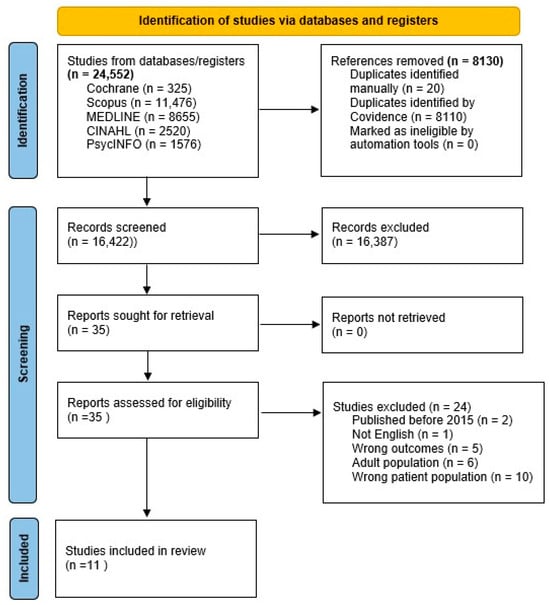
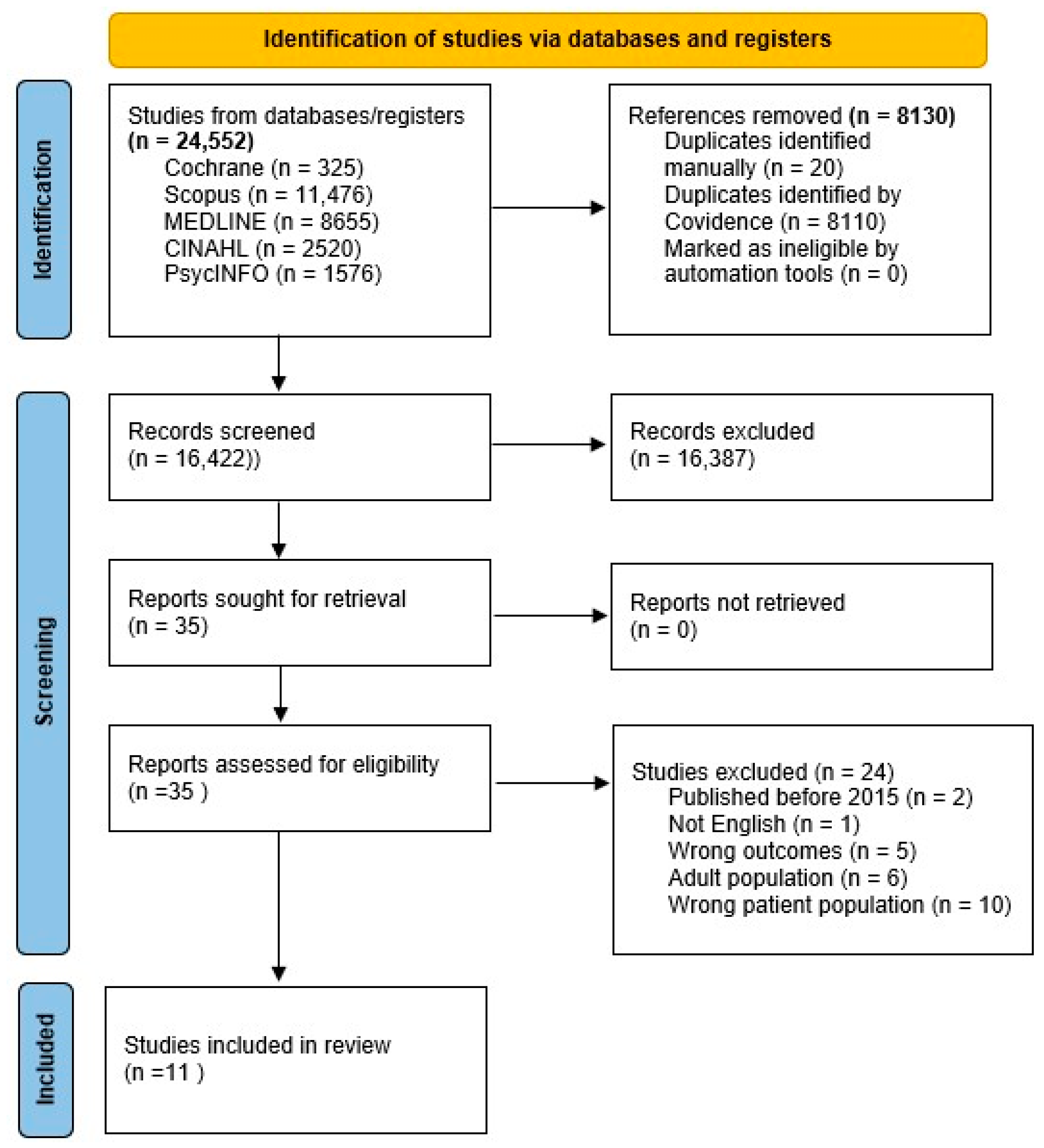
All records were imported into Covidence systematic review software for screening. After duplicate removal, two independent reviewers conducted title/abstract and full-text screening, with disagreements resolved by a third reviewer. Database searches identified 24,552 records from MEDLINE (n = 8655), Scopus (n = 11,476), CINAHL (n = 2520), PsycINFO (n = 1576), and Cochrane (n = 325). After removing duplicates (n = 8130), 16,422 records underwent title and abstract screening, with 16,387 excluded due to irrelevance, non-systematic review study design, or non-target populations. Thirty-five studies underwent full-text review, and 24 of these were excluded due to wrong population (n = 10), older adult but not retired populations (n = 6), wrong outcomes (n = 5), publication prior to 2015 (n = 2), and non-English language (n = 1). Reference checking in Google Scholar did not reveal any useful resources. Ultimately, 11 studies met the inclusion criteria and were included in the final umbrella review. The study selection process is summarised in Figure 1 (PRISMA flow diagram).
Figure 1.
PRISMA Diagram.
2.4. Quality Assessment
The methodological quality of the included systematic reviews was assessed by two independent reviewers using the JBI Critical Appraisal Checklist for Systematic Reviews and Research Syntheses [34]. Discrepancies were resolved by a third reviewer. Overall, the quality of the included studies ranged from moderate to high, with scores ranging from 6 to 10 out of 11 criteria. Most reviews demonstrated strong methodological rigour in key domains including clearly defined inclusion criteria (Q2), appropriate search strategies (Q3), adequate data sources (Q4), and appropriate methods for data synthesis (Q8). Additionally, all studies provided recommendations for policy and practice (Q10) and identified directions for future research (Q11), indicating strong applicability of findings.
However, some methodological limitations were identified. Only a subset of studies reported conducting critical appraisal by two or more independent reviewers (Q6), and methods to minimise errors in data extraction (Q7) were inconsistently applied. Furthermore, assessment of publication bias (Q9) was largely absent across studies, representing a notable limitation in the overall evidence base. A small number of studies also lacked clarity in defining the review question (Q1) or used unclear reporting. Despite these limitations, the overall body of evidence was deemed sufficiently robust to support synthesis and interpretation within this umbrella review. The interpretation of findings therefore considered both the methodological quality of the included reviews and the consistency of evidence across domains, with stronger confidence placed on findings supported across multiple higher-quality reviews and lower confidence assigned to domains with inconsistent definitions, limited review coverage, or mixed findings. See Table 1 for more details.
Table 1.
Methodological Quality Appraisal of Included Systematic Reviews (JBI Checklist).
2.5. Data Extraction
Data were extracted independently by two reviewers using a standardised form developed in accordance with JBI guidance for umbrella reviews [34]. Discrepancies were resolved by a third reviewer. Extracted data included bibliographic details, review objectives, population characteristics, review scope, well-being domains, factors or interventions examined, key findings, authors’ conclusions, and methodological characteristics of included reviews. Data extraction was managed in Covidence and exported for synthesis and reporting. The included reviews were too heterogeneous to statistically combine because they varied in aims, study designs, populations, contexts, well-being domains, and outcome measures. Therefore, a narrative synthesis was used to summarise findings across physical, mental, social, financial, and spiritual or meaning-related well-being domains, with intervention findings synthesised separately.
The included reviews used varied terminology and measures. Therefore, this umbrella review distinguished between four conceptual levels: well-being domains, indicators or outcomes, determinants, and intervention components. Physical, mental, social, financial, and spiritual or meaning-related well-being were treated as broad organising domains. Indicators or outcomes referred to constructs used in the included reviews to assess well-being or adaptation in retirement, such as life satisfaction, quality of life, depressive symptoms, physical functioning, financial adequacy, social connection, purpose, or meaning. Retirement adjustment was treated specifically as an adaptation-related outcome reflecting how individuals adjust to retirement-related changes, rather than as a standalone dimension of well-being. Determinants referred to factors associated with one or more well-being outcomes, such as physical activity, volunteering, retirement preparation, bridge employment, pension access, income security, caregiving roles, or healthcare access. Intervention components referred to strategies designed to influence well-being, such as peer support, goal-setting, motivational interviewing, group-based activity, environmental volunteerism, financial planning, or community engagement. This distinction was used to organise the synthesis and to clarify whether a construct was being reported as an outcome, determinant, or intervention component in the included reviews.
3. Results
3.1. Characteristics of the Included Studies
The umbrella review included 11 systematic reviews published between 2015 and 2025: eight quantitative reviews [3,28,30,33,41,42,43,47], two qualitative reviews [45,46], and one mixed-methods review [44]. Two reviews included meta-analyses [3,33]. Collectively, the reviews synthesised evidence from 408 primary studies published between 1972 and 2024 across diverse geographic contexts, including North America, Europe, Australia, East Asia, and other international settings. Most reviews (n = 8) focused on determinants of well-being in retirement [3,28,30,33,41,42,45,47], while fewer examined interventions (n = 2), including peer-led physical activity programmes [43] and environmental volunteerism [44]. See Table S2 for more details.
Overlap among primary studies was assessed using the Corrected Covered Area (CCA) approach [48]. The 11 included reviews contained 408 primary study occurrences across 329 unique primary studies. The resulting CCA was 0.024, or 2.4%, indicating slight overlap among the included reviews. This suggests that the duplication of primary studies across reviews was low and unlikely to substantially influence the narrative synthesis. See Table S3 for more details.
Across reviews, retirement well-being was examined across physical, mental, social, financial, and spiritual or meaning-related domains, but these domains were operationalised inconsistently. For example, retirement adjustment was used as an outcome in one meta-analysis [3], mental health indicators such as life satisfaction and psychological well-being were used in another review [28], and physical health outcomes were examined in longitudinal retirement studies [47]. In this synthesis, constructs such as life satisfaction, quality of life, retirement adjustment, depressive symptoms, physical functioning, financial adequacy, social connection, purpose, and meaning were treated as indicators or outcomes when used to assess well-being. By contrast, constructs such as physical activity, volunteering, retirement preparation, bridge employment, pension access, caregiving roles, and healthcare access were treated as determinants or intervention components when examined as factors influencing one or more well-being outcomes. Despite this variability, several areas of convergence were identified. Social participation was strongly associated with retirement adjustment in meta-analytic evidence [3], while social integration and social support were reported as important predictors of retirement adjustment in other reviews [41,42]. Physical activity and active leisure were generally supportive of psychological adjustment [30], although broader physical health effects of retirement were more mixed in longitudinal evidence [47]. Financial factors were positively associated with retirement adjustment [3], while income, net worth, and income change were identified as important financial predictors in another review [42]. Spirituality was less directly examined and showed mixed evidence as a predictor of retirement adjustment [41], whereas meaning-related constructs were more often reflected through volunteering, altruism, generativity, contribution, and community belonging [28,44]. Intervention evidence remained limited, with peer-led physical activity interventions [43] and environmental volunteerism [44] representing the main approaches, while one review found no eligible health promotion programmes specifically designed for retirement [46]. Retirement pathway was especially relevant to mental well-being. Voluntary retirement, bridge employment, positive expectations, retirement preparation, and perceived control were generally associated with more favourable adjustment, whereas involuntary retirement showed negative or mixed associations with well-being [3,33,41,42].
3.2. Determinants of Well-Being Among Retired Older Adults
Across reviews, determinants of retirement well-being were organised across physical, mental, social, financial, and spiritual or meaning-related domains. The following sections summarise the main patterns of evidence within each domain, while recognising that the included reviews varied in how well-being indicators, determinants, and adjustment-related outcomes were defined and measured.
3.2.1. Physical Well-Being
Physical well-being was addressed in eight included reviews through indicators such as physical health, subjective health, physical functioning, physical activity, exercise, leisure participation, and mobility [3,28,30,33,41,42,45,47]. Within this domain, physical functioning and health indicators were treated as outcomes, whereas physical activity, exercise, and active leisure were treated as behaviours or determinants that may influence physical and broader well-being outcomes. Across reviews, evidence generally converged on the supportive role of physical activity and active leisure for retirement well-being, particularly in relation to life satisfaction, quality of life, and retirement adjustment [3,28,30,41,42]. However, the evidence was not uniform. Associations varied by activity type, intensity, gender, cultural context, health status, and occupational history [28,30,47]. Evidence concerning the broader health effects of retirement was more mixed. Some longitudinal evidence suggested that retirement was associated with declines in physical functioning and increased mortality risk, while findings related to chronic disease and biomarkers were inconsistent [47]. Health-related factors, including self-rated health, chronic conditions, physical activity, and mortality risk, were associated with well-being in retirement, but the direction and strength of these associations varied across countries, individual characteristics, and social contexts [33]. Contextual barriers were also evident, particularly among international retirement migrants, for whom language barriers, insurance issues, and uncertainty about healthcare access created challenges to maintaining physical well-being [45].
3.2.2. Mental Well-Being
Mental well-being was addressed across eight reviews through indicators such as life satisfaction, psychological well-being, depression, emotional well-being, cognitive functioning, and retirement adjustment [3,28,30,33,41,42,44,45]. Across reviews, evidence converged on the importance of psychological resources and positive retirement transition factors. Positive attitudes toward retirement, optimism, self-efficacy, emotional stability, internal locus of control, goal flexibility, goal continuity, retirement planning, perceived control, and voluntary retirement were generally associated with better retirement adjustment, life satisfaction, or psychological well-being [3,33,41,42]. Staying active after retirement also appeared important. Continued professional or non-professional activity, volunteering, helping others, social participation, educational engagement, physical activity, and environmental volunteerism were associated with better life satisfaction, psychological well-being, cognitive functioning, emotional well-being, self-esteem, reduced depressive symptoms, or sense of purpose [28,30]. In one review, environmental volunteerism was also linked to emotional well-being, self-esteem, life satisfaction, reduced depression, and sense of purpose among older adults [44].
However, mental well-being findings were context-dependent. Retirement pathway was especially relevant to mental well-being. Voluntary retirement, bridge employment, positive expectations, retirement preparation, and perceived control were generally associated with more favourable adjustment, whereas involuntary retirement showed negative or mixed associations with well-being [3,33,41,42]. Variation was also observed across countries and population groups, with education, marital status, social and family networks, care arrangements, employment transitions, and broader country-level contexts shaping mental well-being [33]. Among international retirement migrants, retirement migration could enhance well-being through improved lifestyle, adventure, safety, and satisfaction, but could also create stress related to healthcare access, language barriers, and adaptation to the host country [45].
3.2.3. Social Well-Being
Social well-being was addressed in eight reviews through social participation, social support, social integration, marital and family relationships, volunteering, community engagement, social networks, and social leisure activities [3,28,30,33,41,42,44,45]. Social participation was reported inconsistently across reviews: in some cases, it functioned as an indicator of social well-being, while in others it was examined as a determinant of retirement adjustment, mental well-being, or quality of life. Social support and social integration were associated with better life satisfaction, quality of leisure time, and retirement adjustment [41,42]. Physical activity and leisure were generally positively associated with retirees’ psychological adjustment, including life satisfaction, quality of life, well-being, and mental health [30]. However, retirees were more commonly engaged in passive leisure activities than in active leisure or physical exercise, and findings varied according to activity type, intensity, gender, cultural context, and measurement approaches. Meta-analytic evidence further indicated that social participation had the strongest positive association with retirement adjustment when compared with physical health, marital relationships, finances, and exit conditions [3].
The evidence also showed that social participation was not uniformly protective. Its influence appeared to depend on the type, quality, reciprocity, and meaning of social relationships. Marital relationships, family support, and parenthood were generally supportive of retirement adjustment [42]. Furthermore, family ties and contact with children or grandchildren were associated with better mental well-being [28]. Marital quality and related marital factors were positively associated with retirement adjustment [3]. Family relations, grandparenting, caregiving, and balanced support exchanges influenced well-being, although widowhood, restricted social networks, and intensive caregiving responsibilities were associated with poorer or mixed outcomes [33].
Volunteering and helping others were linked to better social well-being in several reviews, although the mechanisms differed. For example, prosocial behaviour, informal helping, and volunteering contributed to life satisfaction, positive affect, and psychological well-being [28]. Furthermore, environmental volunteerism, including greening, recycling, and project-based activities, enhanced social capital, group interaction, social connection, and usefulness to others [44]. However, among international retirement migrants, language barriers and difficulties integrating into host communities created social challenges, indicating that the benefits of social participation depend partly on cultural, linguistic, and community contexts [45].
3.2.4. Financial Well-Being
Financial well-being was addressed in five included reviews, which examined financial security, income adequacy, pension access, retirement planning, and perceived financial stability as key dimensions of retirees’ post-retirement well-being [3,33,41,42,45]. Financial adequacy and perceived financial stability were treated as indicators of financial well-being, whereas pension access, income, net worth, retirement planning, and cost-of-living conditions were treated as determinants or contextual resources. Evidence generally indicated that financial resources and perceived financial security were relevant to retirement adjustment and well-being, although the specific financial indicators varied across reviews. Receipt of a government pension was associated with quality of life, and retirement planning was associated with life satisfaction [41]. Finances, including net worth, personal income, family income, and changes in income, were among the most frequently studied and consistently positive predictors of retirement adjustment [42]. Meta-analytic evidence showed that financial factors were positively associated with retirement adjustment, although the association was smaller than that observed for social participation and physical health; within this category, income and net worth showed stronger associations than financial preparedness [3].
At the same time, the financial evidence varied according to how financial well-being was measured and the broader retirement context. Pension uncertainty, perceived income adequacy, employment transitions, and socioeconomic conditions shaped well-being, with retirement reducing perceived financial adequacy among some individuals transitioning from employment while improving life satisfaction among some individuals transitioning from unemployment [33]. Among international retirement migrants, lower cost of living and the ability to stretch retirement income supported perceived quality of life and lifestyle opportunities [45]. Overall, the evidence suggests that financial well-being in retirement is influenced by both objective resources, such as income, pensions, and net worth, and subjective perceptions, such as income adequacy and financial stability. However, the relative importance of these factors appears to vary by pre-retirement employment status, socioeconomic position, migration context, pension resources, and cost-of-living conditions.
3.2.5. Spiritual Well-Being
Spiritual or meaning-related well-being was addressed in five included reviews, although it was examined less directly than physical, mental, social, and financial well-being [28,33,42,44,45]. In this domain, spirituality was rarely measured directly as a well-being outcome; instead, meaning-related constructs such as purpose, generativity, contribution, and usefulness to others were often embedded within social, psychological, or community engagement findings. Direct evidence on spirituality was limited. Only one review explicitly examined spirituality as a predictor of retirement adjustment, reporting mixed findings: some studies showed positive associations between spirituality and satisfaction with life, quality of life, or well-being, whereas others found no significant influence [42]. This indicates that spiritual well-being remains less consistently conceptualised and measured within the retirement literature.
Meaning-related evidence was more common but was often embedded within social, psychological, or community engagement findings. Environmental volunteerism supported empowerment, generativity, purpose, and meaningful engagement [44]. Altruism, informal helping, prosocial behaviour, volunteering, and continued professional or non-professional activity were associated with life satisfaction, positive affect, self-efficacy, cognitive functioning, and psychological well-being [28]. International retirement migration fostered meaning for some retirees through adventure, community engagement, belonging, and renewed structure, although these benefits depended on successful adaptation to the host context [45]. Volunteering, caregiving, active ageing, and productive activities also contributed to well-being, although caregiving had both positive and negative effects depending on intensity and context [33]. Overall, spiritual or meaning-related well-being appears important but remains underdeveloped as a distinct and consistently measured domain of retirement well-being.
3.3. Interventions Aimed at Improving Well-Being
Compared to the extensive evidence on determinants, intervention evidence was limited in both scope and number. Only two reviews reported interventions designed to improve well-being among retired older adults [43,44], and one review found no eligible studies evaluating health promotion programmes specifically designed for retirement [46]. Existing intervention evidence therefore remains less developed than determinant-focused evidence.
The available intervention evidence mainly addressed physical activity, health behaviours, and volunteer engagement. Peer-led and multilevel behavioural interventions used goal-setting, motivational interviewing, peer support, group-based engagement, environmental modification, and policy advocacy to promote physical activity and healthy behaviours [43]. These interventions improved physical activity, reduced sedentary behaviour, and improved some health indicators, including weight, blood pressure, functional ability, and falls, but had limited or no significant effects on mental health outcomes such as depression or cognition [43]. This suggests that interventions focused mainly on physical activity may improve behavioural and some physical outcomes, but may be insufficient to address broader mental, social, financial, or spiritual dimensions of retirement well-being.
Environmental volunteerism appeared to address a wider range of well-being domains because it combined activity, social connection, contribution, purpose, and community engagement. Greening, recycling, and project-based environmental volunteerism were associated with benefits across physical, mental, social, and meaning-related well-being, including increased physical activity, strength, mobility, life satisfaction, self-esteem, emotional well-being, social interaction, social capital, purpose, generativity, and usefulness to others [44]. However, this evidence was based on a relatively small number of studies (n = 9) with varied designs. Overall, the intervention evidence suggests that multidimensional approaches may be more promising than single-domain interventions, but rigorous intervention studies specifically designed for retirement remain limited.
4. Discussion
This umbrella review supports the view that retirement well-being is a multidimensional and context-dependent, shaped by personal, social and system-level factors. Retirement was not uniformly beneficial or harmful; rather, well-being depended on health, resources, relationships, expectations, financial security and opportunities for meaningful engagement. Social participation and integration emerged as particularly consistent determinants, alongside physical health, psychological resources, retirement preparation, voluntary retirement and financial security. Variation across populations, countries, work histories, migration contexts and measures suggests that retirement well-being reflects individual, social, structural and policy-related conditions.
The small number of eligible systematic reviews should be interpreted in relation to the broad initial search and the specific focus of this umbrella review. Although more than 24,000 records were identified, most did not meet the eligibility criteria because they were primary studies, non-systematic reviews, did not focus specifically on retired older adults, or did not examine relevant well-being outcomes. The 11 included reviews represented 408 primary study occurrences and 329 unique primary studies, with a Corrected Covered Area of 2.4%, indicating slight overlap. However, the evidence was uneven across domains. Physical, mental, and social well-being were examined more often, whereas financial and spiritual or meaning-related well-being and retirement-specific interventions remained less developed.
The contribution of this umbrella review is not the production of new primary evidence, but the organisation and interpretation of existing review-level evidence across well-being domains. This synthesis shows that the evidence base is uneven. Social participation and social integration appear to be among the most consistent determinants, while financial and spiritual or meaning-related well-being remain less consistently conceptualised and measured. Evidence for physical health and physical activity is generally supportive, but varies by health status, work history, activity type and social context. Intervention evidence is comparatively limited and concentrated in physical activity, health behaviour and volunteer-based programmes. The low corrected covered area suggests that overlap among primary studies was slight, reducing concern that the synthesis was dominated by repeated primary evidence [48]. Therefore, the added value of this umbrella review is to clarify which areas of the literature are relatively robust, which remain conceptually or methodologically inconsistent, and which require more targeted comparative and intervention research.
The distinction between voluntary and involuntary retirement is a key contextual condition shaping post-retirement well-being. Voluntary retirement may support well-being because it is more likely to be accompanied by perceived control, preparation, financial readiness, role continuity, and positive expectations about retirement. In contrast, involuntary retirement may disrupt identity, reduce agency, increase financial strain, and contribute to poorer psychological adjustment. This distinction helps explain why retirement itself was not uniformly beneficial or harmful across reviews. The effects of retirement depended partly on whether older adults experienced retirement as a planned and chosen transition or as an imposed exit from paid work [3,33,41,42].
A key conceptual finding of this umbrella review is that the retirement literature uses well-being-related constructs inconsistently. Retirement well-being was often operationalised through varied indicators or related outcomes, such as life satisfaction, quality of life, depressive symptoms, financial adequacy, social connection, purpose, or meaning. Retirement adjustment was also commonly used in the included reviews, but it is better understood as an adaptation-related outcome reflecting the process of adjusting to retirement rather than as a direct synonym for well-being. This variability is consistent with multidimensional well-being literature, which recognises that well-being includes several domains but also shows that these domains are defined and measured inconsistently across instruments and studies [9,10,11,12]. Therefore, the multidimensional perspective used in this review was operationalised as an organising framework across physical, mental, social, financial, and spiritual or meaning-related domains. These domains should not be interpreted as isolated outcomes, as financial security, physical health, social participation, and meaning-related resources may interact to shape retirement well-being.
A central finding of this umbrella review is that social well-being appears to be one of the most robust and cross-cutting determinants of retirement adjustment. The importance of social participation does not appear to lie simply in the number of activities or contacts retirees have, but in the functions these connections serve. Across reviews, social participation supported well-being by helping retirees replace work-based roles and routines, maintain identity and belonging, access emotional and practical support, remain physically and mentally active, and experience contribution and purpose through family, volunteering, community engagement or peer relationships [3,28,41,42,44]. However, this relationship was not uniformly positive. Social participation appeared more beneficial when relationships were meaningful, reciprocal, supportive and sustainable. In contrast, widowhood, restricted social networks, intensive caregiving responsibilities, language barriers and limited integration into host communities were associated with poorer or mixed outcomes [33,45]. These findings suggest that the key issue is not whether retired older adults are socially active in general, but whether their social environments provide belonging, reciprocity, support, identity and opportunities for meaningful contribution.
Another important interpretation is that retirement well-being is shaped by modifiable resources and contextual conditions, rather than by sociodemographic characteristics alone. Physical activity and active leisure were generally associated with better life satisfaction, quality of life, and mental health, although effects varied by activity type, intensity, gender, and cultural context [28,30]. Psychological resources such as optimism, self-efficacy, emotional stability, goal flexibility, and perceived control supported retirement adjustment [41,42]. Retirement preparation, bridge employment, and perceived control were also generally associated with better adjustment [3,33,41,45]. Financial resources also mattered, but not only as objective income; perceived financial adequacy, pension security, and the ability to maintain a desired lifestyle were important to well-being [3,33,41,45]. Taken together, these findings suggest that older adults’ well-being in retirement is not solely determined by the act of leaving paid work, but by whether retirees have the physical capacity, psychological readiness, financial stability, and social opportunities needed to reconstruct a satisfying post-work life.
This umbrella review also highlights an imbalance between the breadth of determinants identified and the narrower scope of interventions examined. While determinants of retirement well-being were reported across physical, mental, social, financial, and meaning-related domains, interventions were concentrated mainly on physical activity, health behaviours, and volunteer engagement. Peer-led and multilevel interventions using goal-setting, motivational interviewing, group support and environmental or policy advocacy showed positive effects on physical activity and some health indicators, but had limited or inconsistent effects on broader mental health outcomes such as depression or cognition [43]. Similarly, environmental volunteerism appeared to produce broader benefits by combining physical activity, social interaction, purpose, generativity, and usefulness to others, suggesting that interventions may be more effective when they address multiple dimensions of well-being simultaneously rather than focusing only on physical activity or disease prevention [44]. However, the overall intervention evidence remained limited. Loureiro et al. found no eligible studies evaluating health promotion programmes specifically designed for retirement [46]. This suggests that, despite strong evidence on what influences well-being in retirement, the evidence base on how best to improve it remains underdeveloped.
Several determinant-focused reviews also suggested intervention implications, although they did not directly evaluate interventions. Evidence supporting the benefits of staying active, volunteering, social participation, leisure engagement, physical activity and continued purposeful roles suggests that future interventions should integrate physical, social and psychological components rather than focusing on a single domain [28,30,33]. Reviews also pointed to the need for interventions that support retirement preparation, bridge employment options, social integration, financial preparedness, and adaptation to post-retirement identity changes [3,41,42]. However, interventions targeting financial well-being and spiritual or meaning-related well-being were notably limited or absent across the included reviews.
4.1. Implications
The findings suggest that retirement after age 50 should be addressed as a multidimensional life transition, not only an economic or workforce event. Pre- and post-retirement policies and programmes should integrate physical health, mental well-being, social participation, financial security, and meaningful engagement, as a narrow focus on pension eligibility or workforce exit may overlook important determinants of retiree well-being.
Future intervention proposals should include core components that reflect the main determinants identified in this review. These components may include structured retirement preparation, physical activity and active leisure, peer- or group-based social participation, psychological readiness and identity transition support, financial literacy and pension planning, volunteering or purposeful community engagement, healthcare navigation, transportation or mobility support, and access to culturally appropriate community resources. Such interventions should be flexible and responsive to gender, caregiving roles, income level, health status, migration experience, and rural or urban context. Evaluation should include outcomes across multiple domains, including physical health, mental well-being, social connection, financial security, spiritual or meaning-related well-being, and overall quality of life, to determine which components work best, for whom, and under what social and policy conditions.
Community and health organisations should prioritise accessible, low-barrier programmes that combine activity, connection, contribution, and purpose. Retirement preparation programmes should also move beyond financial planning to address mental health, identity transition, relationships, caregiving expectations, physical activity, and community engagement.
Future research should use more rigorous longitudinal, mixed-methods, and intervention designs to test multidimensional strategies across diverse populations and settings. To improve comparability, studies should more consistently define and report the contextual conditions that shape retirement well-being, including geographic region, rural or urban residence, pension system, retirement age and pathway, voluntary or involuntary retirement, bridge employment, healthcare access, income adequacy, housing security, caregiving roles, and availability of community-based services. Cultural and gender-related factors should also be reported more explicitly, including family expectations, caregiving norms, religious or spiritual practices, attitudes toward ageing, lifetime employment patterns, unpaid caregiving responsibilities, pension entitlement, income security, social networks, and gendered expectations about retirement roles. Future research should also prioritise the development and validation of multidimensional tools designed specifically to assess well-being among retired older adults, as current studies use varied measures that limit comparability across findings. Greater attention is needed to underexamined areas, particularly financial and spiritual or meaning-related well-being. Together, these priorities would strengthen the evidence base for culturally, economically, and structurally responsive policies and interventions.
4.2. Strengths and Limitations
This umbrella review has several strengths. First, it provides a comprehensive synthesis of evidence from 11 systematic reviews examining well-being among retired older adults across physical, mental, social, financial, and spiritual or meaning-related domains. This multidimensional approach offers a broader understanding of retirement well-being than previous reviews. Second, the inclusion of both determinant-focused and intervention-focused reviews allowed comparison between factors associated with well-being and strategies that have been examined to improve it. Third, the review synthesised evidence from diverse study designs, populations, and geographic contexts, strengthening the relevance of the findings across different retirement experiences. Finally, the use of systematic review methods and quality appraisal enhanced the transparency and methodological rigour of the synthesis.
Several limitations should also be noted. First, the findings depend on the scope, quality, and reporting of the included reviews; therefore, limitations of the original reviews and their primary studies may have influenced the conclusions. Second, substantial heterogeneity existed across reviews in how retirement, older adulthood, and well-being were defined and measured, limiting direct comparison across studies. Third, most included reviews focused on determinants rather than interventions, meaning that conclusions about effective strategies for improving well-being remain limited. Fourth, financial and spiritual or meaning-related well-being were less frequently examined than physical, mental, and social domains, which may have led to the underrepresentation of these dimensions. Finally, because many findings were based on observational and cross-sectional evidence, causal interpretations should be made with caution.
5. Conclusions
This umbrella review synthesised evidence from 11 systematic reviews on well-being among retired older adults. The findings show that retirement well-being is multidimensional, context-dependent, and shaped by interacting physical, mental, social, financial, and spiritual or meaning-related factors. Social participation, physical health, psychological resources, retirement preparation, voluntary retirement, financial security, and meaningful engagement emerged as important contributors, although their influence varied across populations, cultures, retirement pathways, and policy contexts.
The review also identifies important limitations in the current evidence base. Well-being and retirement adjustment were operationalised inconsistently across reviews, and intervention evidence remained limited compared with the broader literature on determinants. Overall, the findings suggest that retirement should be understood not simply as withdrawal from paid work, but as a complex life transition shaped by personal resources, social relationships, economic security, and structural conditions. A clearer and more consistent multidimensional approach is needed to advance research, intervention development, and policy responses that support well-being in later life.
Supplementary Materials
The following supporting information can be downloaded at https://www.mdpi.com/article/10.3390/jal6030058/s1, Table S1: Full search strategies for CINAHL, PsycINFO, MEDLINE, Scopus and Cochrane Library; Table S2: Characteristics and extracted findings of the included systematic reviews; Table S3: Primary study overlap matrix and Corrected Covered Area calculation.
Author Contributions
Conceptualization, Y.M.Y. and A.A.-H.; methodology, Y.M.Y.; validation, Y.M.Y., A.A.-H., K.M. and E.R.; formal analysis, Y.M.Y.; investigation, Y.M.Y., A.A.-H., K.M. and E.R.; resources, K.M. and R.W.; data curation, L.A.M.G., C.M. and R.W.; writing—original draft preparation, Y.M.Y., A.A.-H., K.M., E.R. and R.M.; writing—review and editing, A.A.-H., K.M. and E.R.; supervision, Y.M.Y.; project administration, Y.M.Y. and R.M.; funding acquisition, Y.M.Y. All authors have read and agreed to the published version of the manuscript.
Funding
This study is funded by the Social Sciences and Humanities Research Council (SSHRC Insight Development Grant, Grant Number 430-2025-00006). The funder had no role in the design of the study, data collection, screening, quality appraisal, data extraction, analysis, interpretation of findings, writing of the manuscript, or the decision to submit the manuscript for publication.
Institutional Review Board Statement
As this umbrella review synthesised evidence from previously published systematic reviews and did not involve direct recruitment of human participants, collection of primary data, or access to identifiable personal information, institutional research ethics approval was not required.
Informed Consent Statement
Informed consent was not applicable because no human participants were directly involved in this study.
Data Availability Statement
The data that supports the findings of this study are available in the Supplementary Materials of this article.
Acknowledgments
During the preparation of this work the authors used ChatGPT (Version 5.5) in order to improve readability and language. After using this tool, the authors reviewed and edited the content as needed and took full responsibility for the content of the publication.
Conflicts of Interest
The authors declared no potential conflicts of interest with respect to the research, authorship, and/or publication of this article.
Abbreviations
The following abbreviations are used in this manuscript:
| CCA | Corrected Covered Area |
| CINAHL | Cumulative Index to Nursing and Allied Health Literature |
| JBI | Joanna Briggs Institute |
| MEDLINE | Medical Literature Analysis and Retrieval System Online |
| PRESS | Peer Review of Electronic Search Strategies |
| PRIOR | Preferred Reporting Items for Overviews of Reviews |
| PRISMA | Preferred Reporting Items for Systematic Reviews and Meta-Analyses |
| PROSPERO | International Prospective Register of Systematic Reviews |
| SAGE | Study on Global AGEing and Adult Health |
| WHO | World Health Organisation |
References
- World Health Organization. International Day of Older Persons 2024: ‘Ageing with Dignity: The Importance of Strengthening Care and Support Systems for Older Persons Worldwide’. Available online: https://www.who.int/srilanka/news/detail/01-10-2024-ageing-with-dignity--the-importance-of-strengthening-care-and-support-systems-for-older-persons-worldwide (accessed on 6 November 2024).
- Merriam-Webster. Retirement. Merriam-Webster.com Dictionary. Available online: https://www.merriam-webster.com/dictionary/retirement (accessed on 20 May 2026).
- La Rue, C.J.; Haslam, C.; Steffens, N.K. A meta-analysis of retirement adjustment predictors. J. Vocat. Behav. 2022, 136, 103723. [Google Scholar] [CrossRef] [Scilit]
- Mosca, I.; Barrett, A. The impact of voluntary and involuntary retirement on mental health: Evidence from older irish adults. J. Ment. Health Policy Econ. 2016, 19, 33–44. [Google Scholar] [CrossRef] [Scilit]
- Kitsaki, M.; Katsiroumpa, A.; Zioga, S.; Moisoglou, I.; Galanis, P. Psychosocial effects of retirement on the elderly: A systematic review. Int. J. Caring Sci. 2024, 17, 755–770. [Google Scholar]
- Wang, M.; Henkens, K.; van Solinge, H. Retirement adjustment: A review of theoretical and empirical advancements. Am. Psychol. 2011, 66, 204–213. [Google Scholar] [CrossRef] [Scilit] [PubMed]
- Chen, S.; Xu, Y.; Jing, H.; Qinggele; Jiang, K.; Chang, S.; Yang, X.; Dong, Y. The effect of retirement experiences on depression and life satisfaction in the older adults: Roles of social participation and grandparental childcare. BMC Public Health 2026, 26, 949. [Google Scholar] [CrossRef] [Scilit] [PubMed]
- Vigezzi, G.P.; Barbati, C.; Maggioni, E.; Stenholm, S.; Odone, A.; Amerio, A.; Ardito, C.; Bertuccio, P.; Costa, G.; d’Errico, A.; et al. Impact of retirement transition on health, well-being and health behaviours: Critical insights from an overview of reviews. Soc. Sci. Med. 2025, 375, 118049. [Google Scholar] [CrossRef] [Scilit] [PubMed]
- Schonhardt, S.; Sullivan, S.; Shisler Marshall, R. A focused review of multidimensional well-being assessments. J. Wellness 2023, 4, 5. [Google Scholar] [CrossRef] [Scilit]
- Bonacchi, A.; Chiesi, F.; Lau, C.; Marunic, G.; Saklofske, D.H.; Marra, F.; Miccinesi, G. Rapid and sound assessment of well-being within a multi-dimensional approach: The Well-being Numerical Rating Scales (WB-NRSs). PLoS ONE 2021, 16, e0252709. [Google Scholar] [CrossRef] [Scilit] [PubMed]
- Ramasubramanian, S.; Choudry, A.; Zirkler, M. Developing an integral well-being model–bridging multidimensional perspectives on human functioning. Proc. World Conf. Soc. Sci. 2025, 4, 27–37. [Google Scholar] [CrossRef] [Scilit]
- Linton, M.-J.; Dieppe, P.; Medina-Lara, A. Review of 99 self-report measures for assessing well-being in adults: Exploring dimensions of well-being and developments over time. BMJ Open 2016, 6, e010641. [Google Scholar] [CrossRef] [Scilit] [PubMed]
- Vigezzi, G.P.; Gaetti, G.; Gianfredi, V.; Frascella, B.; Gentile, L.; d’Errico, A.; Stuckler, D.; Ricceri, F.; Costa, G.; Odone, A.; et al. Transition to retirement impact on health and lifestyle habits: Analysis from a nationwide Italian cohort. BMC Public Health 2021, 21, 1670. [Google Scholar] [CrossRef] [Scilit] [PubMed]
- Chen, F.; Wakabayashi, M.; Yuda, M. The impact of retirement on health: Empirical evidence from the change in public pensionable age in Japan. J. Econ. Ageing 2024, 28, 100513. [Google Scholar] [CrossRef] [Scilit]
- Gorry, D.; Slavov, S.N. The effect of retirement on health behaviors. Health Econ. 2023, 32, 2234–2259. [Google Scholar] [CrossRef] [Scilit] [PubMed]
- Gosselin, C.; Désilets-Jutras, M.; Boller, B. Cognitive decline and retirement: Findings from the Canadian longitudinal study on aging. Innov. Aging 2021, 5, 963. [Google Scholar] [CrossRef] [Scilit]
- Adawi, A.; Ferrara, I.; Malik, S.M. Effect of retirement on life satisfaction in Canada: Evidence from the 2008–2009 canadian community health survey–healthy aging. Can. Public Policy 2023, 49, 48–75. [Google Scholar] [CrossRef] [Scilit]
- Noh, J.-W.; Kwon, Y.D.; Lee, L.J.; Oh, I.-H.; Kim, J. Gender differences in the impact of retirement on depressive symptoms among middle-aged and older adults: A propensity score matching approach. PLoS ONE 2019, 14, e0212607. [Google Scholar] [CrossRef] [Scilit] [PubMed]
- Baldwin, R.D. Assessing the retirement income prospects of Canada’s future elderly: A review of five studies. CD Howe Inst. Comment. 2016. [Google Scholar] [CrossRef] [Scilit]
- Taylor, M.G.; Carr, D.C.; Carpenter, R.; Quesnel-Vallée, A. Work and income instability and retirement financial wellbeing for women and men. J. Women Aging 2024, 36, 197–209. [Google Scholar] [CrossRef] [Scilit] [PubMed]
- Asenka, A. Effect of Retirement on Mental Health and Social Inclusion of the Elderly. Available online: https://www.semanticscholar.org/paper/THE-EFFECT-OF-RETIREMENT-ON-MENTAL-HEALTH-AND-OF-Asenova/031e1d5153a83ad2507f82bf479a8a5e41c1ba14 (accessed on 1 February 2026).
- Kauppi, M.; Virtanen, M.; Pentti, J.; Aalto, V.; Kivimäki, M.; Vahtera, J.; Stenholm, S. Social network ties before and after retirement: A cohort study. Eur. J. Ageing 2021, 18, 503–512. [Google Scholar] [CrossRef] [Scilit] [PubMed]
- Russell, A.R.; Boen, C.E.; Handy, F. Volunteer Retirement and Well-Being in Older Adults: A Longitudinal Study. Nonprofit Volunt. Sect. Q. 2022, 52, 1357–1385. [Google Scholar] [CrossRef] [Scilit]
- Ilyas, Z.; Shahed, S.; Hussain, S. An Impact of Perceived Social Support on Old Age Well-Being Mediated by Spirituality, Self-esteem and Ego Integrity. J. Relig. Health 2020, 59, 2715–2732. [Google Scholar] [CrossRef] [Scilit] [PubMed]
- Lucchetti, G.; Vitorino, L.M.; Nasri, F.; Lucchetti, A.L.G. Impact of Religion and Spirituality in Older Persons. In Spirituality, Religiousness and Health: From Research to Clinical Practice; Lucchetti, G., Prieto Peres, M.F., Damiano, R.F., Eds.; Springer International Publishing: Cham, Switzerland, 2019; pp. 115–130. [Google Scholar]
- Musaddiq, J.; Sabira, K. Psychological well-being: Spirituality and successful aging. Indian J. Health Wellbeing 2014, 5, 66–71. [Google Scholar]
- Cassanet, A.; McKenzie, W.A.; McLean, L.A. Psychosocial interventions to support retirement well-being and adjustment: A systematic review. Educ. Dev. Psychol. 2023, 40, 214–231. [Google Scholar] [CrossRef] [Scilit]
- Kiani, F.S.; Ehsan, S. Association of positive psychological factors with the mental health of older adult retirees: A systematic review. Int. J. Hum. Rights Healthc. 2023, 17, 505–519. [Google Scholar] [CrossRef] [Scilit]
- Kreutz, R.R.; da Silva, W.V.; Vieira, K.M.; Dutra, V.R. State-of-the-art: A systematic review of the literature on financial well-being. Rev. Universo Contábil 2020, 16, 87–109. [Google Scholar] [CrossRef] [Scilit]
- Sharifi, M.; Nodehi, D.; Bazgir, B. Physical activity and psychological adjustment among retirees: A systematic review. BMC Public Health 2023, 23, 194. [Google Scholar] [CrossRef] [Scilit] [PubMed]
- Heaven, B.E.N.; Brown, L.J.E.; White, M.; Errington, L.; Mathers, J.C.; Moffatt, S. Supporting Well-Being in Retirement through Meaningful Social Roles: Systematic Review of Intervention Studies. Milbank Q. 2013, 91, 222–287. [Google Scholar] [CrossRef] [Scilit] [PubMed]
- Rodríguez-Monforte, M.; Fernández-Jané, C.; Martin-Arribas, A.; Costa-Tutusaus, L.; Sitjà-Rabert, M.; Ramírez-García, I.; Canet Vélez, O.; Kopp, J.; Vilaró, J.; Carrillo-Alvarez, E. Interventions across the Retirement Transition for Improving Well-Being: A Scoping Review. Int. J. Environ. Res. Public Health 2020, 17, 4341. [Google Scholar] [CrossRef] [Scilit] [PubMed]
- Teques, A.P.; Carreiro, J.; Duarte, D.; Teques, P. Wellbeing and Retirement in Europe: A Systematic Review with Meta-Analysis. Healthcare 2025, 13, 100. [Google Scholar] [CrossRef] [Scilit] [PubMed]
- Aromataris, E.; Fernandez, R.; Godfrey, C.; Holly, C.; Khalil, H.; Tungpunkom, P. Chapter 10: Umbrella Reviews. In JBI Reviewer’s Manual; Aromataris, E., Munn, Z., Eds.; JBI: North Adelaide, Australia, 2020. [Google Scholar]
- Yasin, Y.M.; Al-Hamad, A.; Metersky, K.; Read, E.; Witherspoon, R. Factors affecting well-being among retired older adults: A protocol for an umbrella review. PLoS ONE 2026, 21, e0351425. [Google Scholar] [CrossRef] [Scilit] [PubMed]
- Gates, M.; Gates, A.; Pieper, D.; Fernandes, R.M.; Tricco, A.C.; Moher, D.; Brennan, S.E.; Li, T.; Pollock, M.; Lunny, C.; et al. Reporting guideline for overviews of reviews of healthcare interventions: Development of the PRIOR statement. BMJ 2022, 378, e070849. [Google Scholar] [CrossRef] [Scilit] [PubMed]
- Page, M.J.; McKenzie, J.E.; Bossuyt, P.M.; Boutron, I.; Hoffmann, T.C.; Mulrow, C.D.; Shamseer, L.; Tetzlaff, J.M.; Akl, E.A.; Brennan, S.E.; et al. The PRISMA 2020 statement: An updated guideline for reporting systematic reviews. BMJ 2021, 372, n71. [Google Scholar] [CrossRef] [Scilit] [PubMed]
- Kowal, P.; Chatterji, S.; Naidoo, N.; Biritwum, R.; Fan, W.; Lopez Ridaura, R.; Maximova, T.; Arokiasamy, P.; Phaswana-Mafuya, N.; Williams, S.; et al. Data Resource Profile: The World Health Organization Study on global AGEing and adult health (SAGE). Int. J. Epidemiol. 2012, 41, 1639–1649. [Google Scholar] [CrossRef] [Scilit] [PubMed]
- Aromataris, E.; Pearson, A. The systematic review: An overview. Am. J. Nurs. 2014, 114, 53–58. [Google Scholar] [CrossRef] [Scilit] [PubMed]
- McGowan, J.; Sampson, M.; Salzwedel, D.M.; Cogo, E.; Foerster, V.; Lefebvre, C. PRESS Peer Review of Electronic Search Strategies: 2015 Guideline Statement. J. Clin. Epidemiol. 2016, 75, 40–46. [Google Scholar] [CrossRef] [Scilit] [PubMed]
- Amorim, S.M.; França, L.H. Retirement well-being: A systematic review of the literature. Trends Psychol. 2019, 27, 155–172. [Google Scholar] [CrossRef] [Scilit]
- Barbosa, L.M.; Monteiro, B.; Murta, S.G. Retirement adjustment predictors-A systematic review. Work Aging Retire. 2016, 2, 262–280. [Google Scholar] [CrossRef] [Scilit]
- Barras, L.; Neuhaus, M.; Cyarto, E.V.; Reid, N. Effectiveness of peer-led wellbeing interventions in retirement living: A systematic review. Int. J. Environ. Res. Public Health 2021, 18, 11557. [Google Scholar] [CrossRef] [Scilit] [PubMed]
- Chen, P.-W.; Chen, L.-K.; Huang, H.-K.; Loh, C.-H. Productive Aging by Environmental Volunteerism: A Systematic Review. Arch. Gerontol. Geriatr. 2022, 98, 104563. [Google Scholar] [CrossRef] [Scilit] [PubMed]
- Haan, M.; Eagers, J.; Chun Tie, Y.; Barnett, F.; Jonsson, H.; Seng-Iad, S. Systematic review of co-occurring transition of retirement and migration: An occupational perspective. Br. J. Occup. Ther. 2025, 88, 667–677. [Google Scholar] [CrossRef] [Scilit] [PubMed]
- Loureiro, H.; Mendes, A.; Rodrigues, R.; Apóstolo, J.; Rodrigues, M.A.; Batista Cardoso, D.; Pedreiro, A.T. The experience of programs to promote health in retirement: A systematic review of qualitative evidence. JBI Database Syst. Rev. Implement. Rep. 2015, 13, 276–294. [Google Scholar] [CrossRef] [Scilit] [PubMed]
- Nazar, G.; Cabezas, M.F.; Alcover, C.M.; Soto-Contreras, E.; Reyes-Molina, D.; Bustos Navarrete, C.; Leiva-Ordóñez, A.M. How does retirement really affect physical health? A systematic review of longitudinal studies. Ageing Soc. 2025, 45, 1925–1942. [Google Scholar] [CrossRef] [Scilit]
- Pieper, D.; Antoine, S.-L.; Mathes, T.; Neugebauer, E.A.M.; Eikermann, M. Systematic review finds overlapping reviews were not mentioned in every other overview. J. Clin. Epidemiol. 2014, 67, 368–375. [Google Scholar] [CrossRef] [Scilit] [PubMed]

Disclaimer/Publisher’s Note: The statements, opinions and data contained in all publications are solely those of the individual author(s) and contributor(s) and not of MDPI and/or the editor(s). MDPI and/or the editor(s) disclaim responsibility for any injury to people or property resulting from any ideas, methods, instructions or products referred to in the content. |
© 2026 by the authors. Licensee MDPI, Basel, Switzerland. This article is an open access article distributed under the terms and conditions of the Creative Commons Attribution (CC BY) license.