1. Introduction
There are several regions characterized by exceptional longevity and lifestyle patterns that promote sustained health and well-being. These regions include Sardinia in Italy, Okinawa in Japan, Ikaria in Greece, Loma Linda in California, USA, and the Nicoya Peninsula in Costa Rica, and they share common behavioral and social characteristics collectively described as nine lifestyle factors linked to longevity [
1]. These principles include regular physical activity, a sense of purpose, stress reduction, plant-based nutrition, social connectedness, and community engagement. While natural movement is a hallmark of populations with exceptional longevity, in more urbanized settings such as Loma Linda, physical activity is often intentional and may vary in intensity and frequency.
Oral health is closely linked to systemic health through shared biological pathways, including chronic inflammation, immune function, and the oral–gut microbiome axis [
2]. Periodontal inflammation and oral dysbiosis have been associated with cardiometabolic diseases, while systemic conditions such as diabetes can exacerbate oral disease progression [
3,
4]. Lifestyle behaviors, including diet, physical activity, and stress management, play a central role in modulating these pathways [
5]. Physical activity, in particular, has been shown to reduce systemic inflammatory burden, improve immune regulation, and influence metabolic health, all of which may contribute to improved oral health outcomes [
6].
Prior research conducted in Loma Linda has shown that residents generally exhibit high adherence to nine lifestyle factors linked to longevity and report favorable oral health-related quality of life (OHRQoL) [
7]. However, this work focused on cumulative lifestyle patterns and did not isolate the specific contribution of physical activity, particularly in terms of intensity and frequency. Studies in other populations suggest that physical activity may be associated with improved oral health outcomes, although these relationships remain inconsistent and are often influenced by other coexisting lifestyle factors [
8].
OHRQoL is commonly assessed using the Oral Health Impact Profile-14 (OHIP-14), a validated instrument capturing functional, psychological, and social impacts of oral conditions [
9]. Population-based studies report a mean OHIP-14 score of 4.9 among U.S. adults [
10], with higher scores observed in certain regional and demographic groups [
11]. In contrast, Loma Linda cohorts demonstrate relatively favorable OHRQoL, although variability persists across subgroups [
7]. Physical activity in this study is measured using the Godin Leisure-Time Exercise Questionnaire (GLTEQ), which classifies individuals based on weighted activity intensity into inactive, moderately active, and active categories [
12].
Despite strong theoretical links between physical activity and oral–systemic health, the independent contribution of physical activity to OHRQoL within a high-adherence lifestyle context remains unclear. Understanding this relationship is particularly important in aging populations, where both systemic and oral health burdens increase, and lifestyle interventions may offer scalable preventive benefits. To our knowledge, this is the first study to examine the independent contribution of physical activity intensity and frequency to OHRQoL within a population with exceptional longevity using multivariable adjustment, building on prior work that focused on cumulative lifestyle adherence without isolating physical activity as a distinct exposure [
7].
Therefore, the objective of this study was to examine whether physical activity level is associated with OHRQoL among Loma Linda adults and whether this association remains after accounting for overall lifestyle adherence and demographic factors. We hypothesized that higher physical activity levels would be associated with favorable OHIP-14 scores, and that this relationship would be attenuated after multivariable adjustment.
2. Materials and Methods
2.1. Study Design and Setting
This cross-sectional study utilized an anonymous, self-administered survey distributed among adult residents of Loma Linda, California. Data were collected over a 6-month period at Loma Linda University campus and local community churches. Surveys were completed in hard-copy format and returned via designated drop boxes to maintain anonymity. The study was approved by the Institutional Review Board of Loma Linda University (IRB #5250456).
2.2. Participants and Recruitment
Eligible participants were adults aged 18 years or older who resided in Loma Linda and were able to read and understand English. Individuals under 18 years of age were excluded. Participants were approached in community settings and invited to complete the survey voluntarily. A cover letter accompanied each survey, and completion of the questionnaire implied informed consent. Approximately 650 surveys were distributed across Loma Linda University campus and community churches over the 6-month data collection period. Of these, 327 surveys were returned (response yield: 50.3%). Six surveys were excluded due to incomplete responses, defined as more than 50% of items left unanswered, yielding a final analytic sample of 321 participants.
2.3. Survey Measures
Demographics: Participants reported age, gender, education level, race, and ethnicity.
Lifestyle Adherence: Adherence to lifestyle behaviors was assessed using a composite lifestyle score adapted from Akkidas et al. [
7]. The instrument comprises nine domains assessed in this study as follows: Sabbath observance, regular moderate exercise, social connectedness with like-minded friends, nut consumption, volunteerism, plant-based diet (avoidance of meat), early light dinner, plant-rich diet, and adequate water intake. Each domain was rated on a 4-point Likert scale (1 = Strongly Disagree to 4 = Strongly Agree), yielding a total score ranging from 9 to 36, with higher scores reflecting greater adherence to nine lifestyle factors linked to longevity. As this instrument was adapted directly from Akkidas et al. [
7], a separate reliability assessment was not performed in the current sample. No missing data were observed for this measure.
Oral Health-Related Quality of Life (OHRQoL): OHRQoL was measured using the Oral Health Impact Profile-14 (OHIP-14), with total scores ranging from 0 to 56; higher scores indicate poorer perceived oral health-related quality of life.
Physical Activity: Physical activity was assessed using the Godin Leisure-Time Exercise Questionnaire (GLTEQ). A Leisure Score Index (LSI) was calculated and categorized as insufficiently active (<14), moderately active (14–23), or active (≥24).
2.4. Sample Size Considerations
A priori sample size calculation was performed using G*Power (Düsseldorf, Germany, version 3.1) for a two-tailed bivariate correlation. A minimum sample size of approximately 200 participants was estimated to detect a small-to-moderate effect size (|r| = 0.20) with 80% power at a two-sided α = 0.05. This effect size was selected based on prior literature reporting modest associations between physical activity and OHRQoL in community-based samples [
7]. To account for incomplete or ineligible responses, approximately 650 surveys were distributed, and the final analytic sample of 321 participants exceeded the minimum requirement, providing adequate power for the primary bivariate analyses.
2.5. Statistical Analysis
Descriptive statistics were used to summarize participant characteristics, lifestyle adherence, physical activity, and OHIP-14 scores. Due to non-normal distributions of OHIP-14 scores, non-parametric methods were employed.
Spearman rank correlations were used to evaluate bivariate associations between lifestyle adherence, physical activity (GLTEQ score), and OHRQoL. Differences in OHIP-14 scores across physical activity categories were assessed using the Kruskal–Wallis test. A trend analysis across ordered activity categories was conducted using Spearman correlation.
Multivariable linear regression models were constructed with OHIP-14 score as the dependent variable. Although OHIP-14 scores were non-normally distributed, linear regression was retained for the adjusted models given its robustness to moderate violations of normality in samples of this size (N = 321). Alternative approaches including quantile regression, negative binomial regression, and zero-inflated models were considered but not pursued, as heteroscedasticity was not detected (Breusch–Pagan LM = 2.35, p = 0.938) and robust standard errors yielded materially identical results, supporting the adequacy of the OLS framework for inference in this sample. Regression diagnostics were conducted to assess model assumptions. Residuals exhibited positive skewness (skewness = 1.80) consistent with the floor effect of the OHIP-14 outcome. Heteroscedasticity was assessed using the Breusch–Pagan test and was not detected (LM = 2.35, p = 0.938). Influential observations were evaluated using Cook’s distance (threshold: 4/n = 0.012) and studentized residuals; 14 observations exceeded Cook’s distance threshold, but the maximum value was 0.057, well below conventional concern levels, and only 2 observations had |studentized residual| > 3. To further address potential bias from non-normal residuals, the primary model was re-estimated using heteroscedasticity-consistent (HC3) robust standard errors. Results were materially unchanged across all predictors, confirming the stability of the original estimates.
Because the composite lifestyle score includes an item assessing regular moderate exercise (“I engage in regular, moderate exercise”), which conceptually overlaps with the GLTEQ physical activity exposure, a sensitivity analysis was conducted to assess potential overadjustment. The multivariable regression model was re-estimated replacing the 9-item composite score with an 8-item score (range: 8–32) from which the exercise item was excluded.
Missing data were minimal across all variables. Race had the highest rate of non-response (n = 7, 2.2%); all other variables had zero or one missing value. Missing data were handled through listwise deletion in multivariable models, with complete case data available for all 321 participants on the primary outcomes (OHIP-14 and GLTEQ).
All statistical analyses were performed using Python (Amsterdam, Netherlands, version 3.11) and R (Auckland, New Zealand, version 4.5.1). Statistical significance was set at p < 0.05.
3. Results
3.1. Participant Characteristics
Participants’ characteristics are summarized in
Table 1. A total of 321 participants were included. The mean age was 44.4 ± 19.8 years (range: 18–89), with an even gender distribution (49.8% male, 49.8% female). Most participants reported higher education (96.0%). The sample was predominantly Asian (57.0%) and White (36.1%), and largely non-Hispanic (83.8%).
The mean physical activity score was 36.3 ± 22.3, and the mean composite lifestyle adherence score was 27.5 ± 4.2, indicating generally high adherence to nine lifestyle factors linked to longevity. OHIP-14 scores ranged from 0 to 56, with a mean of 7.15 (SD = 7.54) and a median of 4.0 (IQR: 1.0–13.0). The distribution was right-skewed (skewness = 1.65, excess kurtosis = 5.04; Shapiro–Wilk W = 0.837, p < 0.001), with 18.1% of participants scoring 0 and 55.8% scoring 5 or below, reflecting the floor effect characteristic of this instrument in healthy community samples.
3.2. Lifestyle Adherence and OHRQoL
Greater lifestyle adherence was associated with lower OHIP-14 scores (Spearman ρ = −0.15, p < 0.01), indicating better oral health-related quality of life among participants with stronger adherence to nine lifestyle factors linked to longevity.
3.3. Physical Activity and OHRQoL
Participants were categorized as active (65.7%), moderately active (19.9%), and insufficiently active (14.3%). OHIP-14 scores differed significantly across activity categories (Kruskal–Wallis H = 6.99,
p = 0.030), with median scores of 5.5 (IQR: 2.0–14.0), 7.0 (IQR: 2.0–13.0), and 4.0 (IQR: 1.0–10.5) for insufficiently active, moderately active, and active participants, respectively (
Table 2).
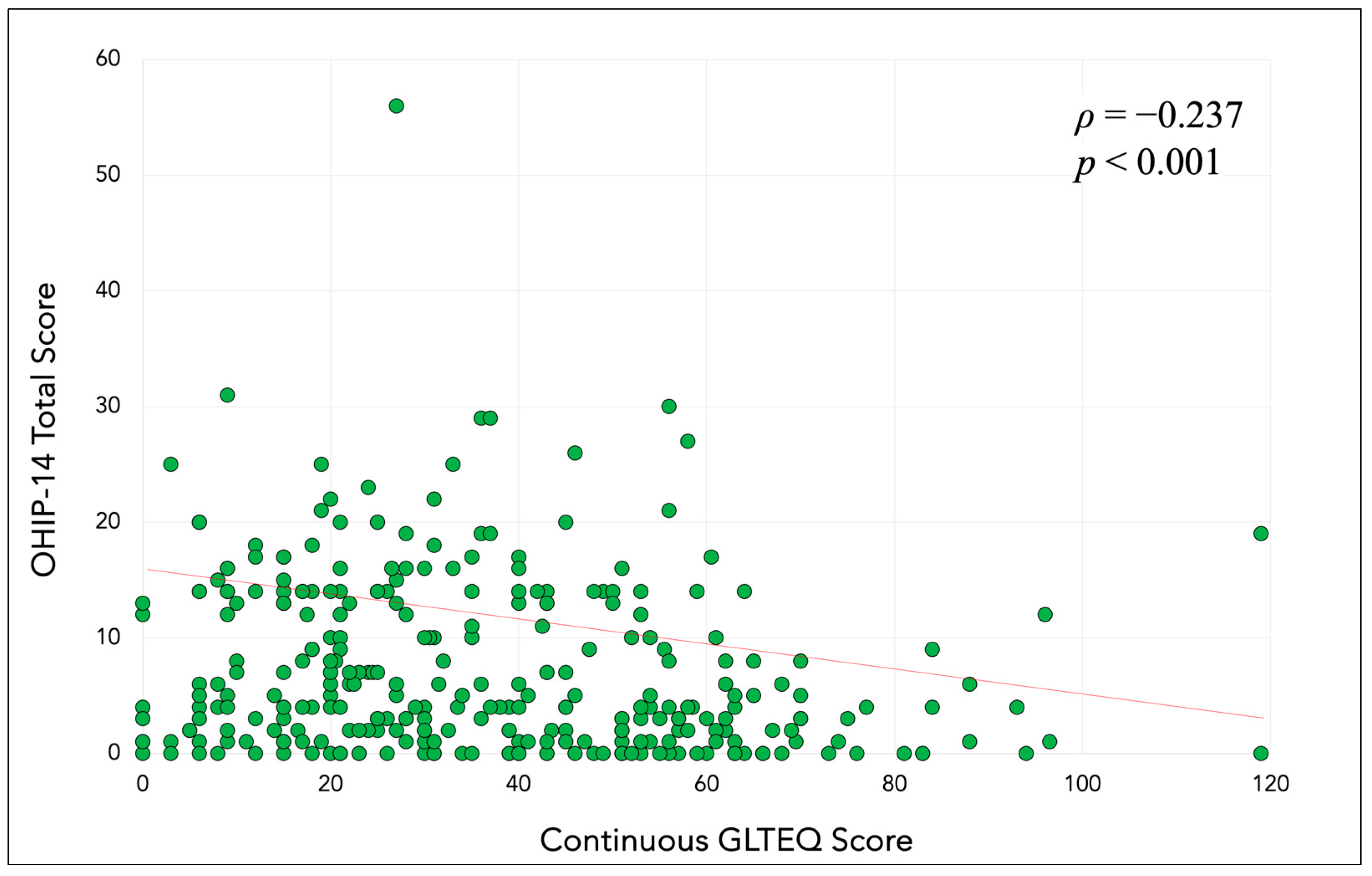
A significant inverse association between continuous physical activity score and OHIP-14 was observed (Spearman ρ = −0.237,
p < 0.001), indicating that higher activity levels were associated with fewer perceived oral health impacts (
Figure 1).
Pairwise Mann–Whitney U tests with Bonferroni correction revealed no statistically significant differences between any individual pair of groups (insufficiently active vs. moderately active: U = 1475.0, p = 1.000; insufficiently active vs. active: U = 5684.0, p = 0.203; moderately active vs. active: U = 7997.5, p = 0.074). Notably, median OHIP-14 scores were not strictly monotonic across ordered categories, with the moderately active group reporting a slightly higher median than the insufficiently active group, precluding a simple dose–response interpretation.
However, formal trend testing supported an overall ordered association between physical activity category and OHIP-14 scores. The Jonckheere–Terpstra test was statistically significant (Z = 2.597, p = 0.009), as was the Spearman rank correlation treating activity category as an ordered variable (ρ = −0.144, p = 0.010). These results indicate a significant overall trend toward lower OHIP-14 scores with increasing physical activity, primarily driven by the contrast between the active group and the two lower-activity groups, rather than a stepwise progression across all three categories.
3.4. Multivariable Analysis
In multivariable models, the association between physical activity and OHRQoL was attenuated. Neither physical activity category nor lifestyle adherence was significantly associated with OHIP-14 after adjustment for age, gender, education, and ethnicity (
Table 3).
Compared to insufficiently active participants, OHIP-14 scores were lower among moderately active (β = −0.54, p = 0.698) and active individuals (β = −1.83, p = 0.154), although these differences were not statistically significant. Lifestyle adherence was also not independently associated with OHRQoL (β = −0.46, p = 0.422). No demographic covariates were significant predictors, although female gender showed a non-significant trend toward higher OHIP-14 scores (p = 0.09).
Variance inflation factor (VIF) values for all predictors in the primary model ranged from 1.01 to 1.95, confirming the absence of multicollinearity.
3.5. Sensitivity Analysis
To address potential overlap between the exercise item within the nine lifestyle factors linked to longevity and the GLTEQ exposure variable, the multivariable model was re-estimated using an 8-item composite lifestyle score with the exercise item removed (range: 8–32; mean = 24.3 ± 3.9). Results were materially unchanged: physical activity category remained non-significantly associated with OHIP-14 (moderately active: β = −0.59, 95% CI [−3.44, 2.26], p = 0.684; active: β = −1.78, 95% CI [−4.20, 0.65], p = 0.151), and the modified adherence score was similarly non-significant (β = −0.04, 95% CI [−0.25, 0.18], p = 0.721). These findings confirm that results were not meaningfully influenced by the inclusion of the exercise item in the lifestyle adherence composite.
4. Discussion
This study examined the relationship between physical activity, lifestyle adherence, and oral health-related quality of life (OHRQoL) among adults residing in the Loma Linda. Consistent with our first hypothesis, higher physical activity levels were associated with more favorable OHIP-14 scores in unadjusted analyses. Additionally, greater adherence to nine lifestyle factors linked to longevity was associated with more favorable OHIP-14 scores in bivariate analyses. In line with our second hypothesis, this association was attenuated after adjustment for overall lifestyle adherence and demographic factors, indicating that the independent effect of physical activity was not statistically significant in multivariable models.
This pattern is consistent with prior research suggesting that health behaviors cluster within broader lifestyle profiles rather than acting independently. Evidence from population-based studies indicates that physical activity is associated with improved oral health outcomes, including lower prevalence and severity of periodontal disease, although these associations may vary across populations and subgroups [
13,
14]. Additionally, research on OHRQoL demonstrates that clinical oral conditions and symptoms, often influenced by behavioral and lifestyle factors, are strongly associated with impairments in daily functioning and overall quality of life [
15]. Similarly, a study in a population with exceptional longevity has shown that higher overall lifestyle adherence is associated with more favorable OHRQoL [
7]. Building on this body of work, the present study incorporates multivariable adjustment to evaluate these relationships within a broader, integrated framework, demonstrating that associations between physical activity and OHRQoL are attenuated when multiple lifestyle and contextual factors are considered. Non-significant results in the context of multivariable adjustment are informative: they demonstrate that the bivariate associations between physical activity and OHRQoL observed in this and other populations are likely confounded by the broader clustering of lifestyle behaviors, rather than reflecting an independent causal effect of physical activity. This contributes to a more accurate understanding of how behavioral determinants of oral health operate in high-adherence populations and supports a holistic rather than single-factor approach to oral health promotion.
These associations were attenuated and no longer statistically significant after adjustment for demographic factors and overall lifestyle adherence, indicating that physical activity does not appear to exert an independent effect on OHRQoL within this high-adherence population. The favorable direction of unadjusted associations likely reflects broader lifestyle clustering rather than a specific effect of physical activity, consistent with the pattern described above. Although no biological markers were measured, prior research suggests that physical activity may influence pathways relevant to oral health—including systemic inflammation, immune regulation, and metabolic control—which have been implicated in periodontal disease and may be particularly relevant in aging populations [
6,
16,
17]. Whether these mechanisms operate in the present population cannot be determined from the current data and is offered as theoretical context rather than a conclusion supported by the present findings.
These findings support the common risk factor approach, which recognizes that oral diseases share modifiable behavioral determinants with other chronic conditions, positioning oral health as part of a broader health continuum rather than an isolated outcome [
5]. This perspective is especially relevant in aging populations where multimorbidity is common and supports integrating oral health promotion with general medical care through interprofessional collaboration. The Loma Linda context further reinforces these points: unlike traditional regions with exceptionally longevity where physical activity is embedded in daily routines, this urbanized setting requires intentional, structured opportunities for movement—an important consideration as populations age and natural activity declines. Community and faith-based norms, shaped by Seventh-day Adventist values emphasizing healthful living, plant-based nutrition, physical activity, and social and spiritual well-being [
18], likely contribute to the high lifestyle adherence observed in this cohort and underscore the broader role of shared beliefs in shaping oral and systemic health outcomes.
Several limitations should be considered. The cross-sectional design precludes causal inference, and recruitment through Loma Linda University campus and affiliated churches likely overrepresents health-conscious, high-adherence individuals, limiting generalizability beyond similar faith-based communities. Furthermore, the sample’s demographic composition, with 96% of participants reporting higher education and 57% identifying as Asian, reflects the specific characteristics of the Loma Linda University community and limits generalizability to other populations. These sociodemographic features may independently shape both health behaviors and oral health perceptions in ways that cannot be fully captured in the current analyses, and findings should not be extrapolated to more diverse or less health-conscious communities. Additionally, reliance on self-reported OHIP-14 scores rather than clinical oral health data means that observed differences in OHRQoL cannot be attributed with certainty to oral disease burden and may instead reflect variation in healthcare access, socioeconomic context, or subjective health perceptions. Future longitudinal studies incorporating clinical oral health assessments and structural equation modeling are needed to clarify causal pathways between physical activity, lifestyle behaviors, and oral health outcomes.