


Abstract
Public housing in the Global South often prioritises the physical delivery of shelter at the expense of the social infrastructures needed to sustain collective life. In Malaysia’s Program Perumahan Rakyat (PPR), participatory efforts are frequently treated as brief consultative exercises that rarely reshape governance relations. This paper reconceptualises iterative participatory urbanism as a process through which community spatial agency is progressively formed through repeated engagement rather than isolated events. Unlike conventional participatory planning or co-production models centred on discrete consultation or project delivery, this approach frames participation as an evolving governance ecology. Drawing on a 12-month embedded case study of the ECHO Project at PPR Sri Cempaka, Kuala Lumpur, the study combines focus group discussions, participatory mapping, co-design workshops, and longitudinal facilitation observations to examine how residents’ relationship to shared space changed over time. Findings reveal a shift from passive expectations of state-led provision toward collective coordination, informal stewardship, and emerging shared governance practices. Spatial agency emerged not through design interventions alone but through relational continuity, visible responsiveness, and evolving shared responsibility. The study contributes to participatory urbanism and spatial agency scholarship while offering a practical framework for housing authorities and urban practitioners to institutionalise community stewardship within state-led housing systems.
1. Introduction
Public housing programmes across the Global South have prioritised quantitative shelter provision while frequently underestimating the social infrastructures needed to sustain collective life. In Malaysia, Program Perumahan Rakyat (PPR) has improved housing access for low-income urban households, yet many estates continue to face persistent challenges related to contested use of communal spaces, fragmented maintenance responsibilities, weak resident participation in management decisions, and limited institutional mechanisms for shared governance. Multipurpose halls, corridors, and ground-floor voids (“kolong”) often function as under-governed or residual territories rather than collectively managed social infrastructure.
These conditions reveal a governance gap between housing delivery and the relational practices needed to sustain resilient urban communities. The challenge is therefore not simply how to design shared space, but how residents may become legitimate co-governors of such spaces under institutional constraints.
Although participatory design, collaborative planning, and co-production have advanced important debates around inclusion and shared decision-making, these approaches often focus on participation as a bounded event, project phase, or procedural mechanism. Far less attention has been given to the mechanisms through which community agency forms progressively through repeated interaction, evolving trust, and informal governance practices over time.
Participatory urbanism has emerged as a response to these conditions, advocating inclusion and co-creation within design processes. However, within public housing contexts, participation is frequently operationalised as a bounded consultative phase rather than a restructuring of spatial authorship. Residents are invited to provide feedback, but not necessarily positioned as co-governors of shared environments. This instrumental framing limits participation’s transformative potential by leaving underlying governance relations largely unchanged.
This paper argues that empowerment in high-density public housing cannot be understood as the outcome of discrete participatory events. Rather, it emerges through an iterative governance process in which trust, collective authorship, and distributed stewardship are progressively constructed. We conceptualise this as iterative participatory urbanism, understood not merely as a consultation method but as a recursive governance ecology linking participation, trust-building, shared authorship, and stewardship. In this paper, governance ecology refers to the evolving relational system through which residents, facilitators, and, where present, institutional actors negotiate responsibility for shared space over time.
Unlike conventional participatory planning or co-production models centred on consultation or project delivery, this framework focuses on the temporal and relational mechanisms through which residents move from consultees to being co-organisers of shared environments.
The research examines the ECHO Project at PPR Sri Cempaka, Kuala Lumpur, through a 12-month embedded case study. Instead of evaluating design outputs, the analysis traces how iterative engagement reshaped residents’ language, responsibility allocation, and informal governance practices. The focus is not on physical transformation alone but on the emergence of distributed stewardship within institutional constraints.
Two research questions guide the inquiry. First, how does iterative participatory engagement contribute to the formation of community spatial agency in public housing environments? Second, through what relational, organisational, and governance mechanisms does sustained participatory engagement enable residents to move from consultation toward shared stewardship?
This study contributes to architectural and urban scholarship in three ways. First, it reframes empowerment as relationally accumulated rather than procedurally granted. Second, it extends spatial agency theory into institutionally managed housing contexts by showing how authorship may emerge through governance practices rather than physical transformation alone. Third, it introduces iterative participatory urbanism as a governance ecology framework that explains how participation, trust-building, collective authorship, and stewardship interact in producing socially reproduced resilience. This contribution is both theoretical and practical, offering implications for institutionalising participatory governance in state-led housing systems.
While grounded in a Malaysian case, the findings speak to broader debates concerning authorship, governance, and shared space in resource-constrained urban environments. To situate and substantiate this argument, the following section reviews scholarship on social infrastructure, participatory urbanism, spatial agency, and governance as the conceptual basis for the proposed framework.
2. Literature Review
2.1. Social Infrastructure and the Lived Production of Shared Space
Shared environments in high-density housing are increasingly recognized not merely as spatial amenities but as critical social infrastructure through which collective life is sustained [1]. Drawing on Lefebvre’s [2] theory of the social production of space, communal areas are understood as outcomes of lived relations and power structures rather than neutral containers. In the Global South, housing provision often prioritizes quantitative shelter delivery, which frequently subordinates the relational infrastructures required to sustain resilient urban communities. In contexts like Malaysia’s Program Perumahan Rakyat (PPR), communal halls and ground-floor voids often operate as residual territories characterized by limited ownership, contested use, and fragmented maintenance. While the concentration of population in high-density housing can promote urban vibrancy, it may also inadvertently erode neighborhood bonds and overwhelm shared resources [3]. Consequently, resilience in these settings is not a material attribute of built form but a socially reproduced condition emerging from negotiated stewardship practices [4].
2.2. Critical Participatory Urbanism: Moving Beyond the Ladder
Participatory urbanism emerged as a critique of technocratic dominance, with Arnstein’s [5] ladder providing a foundational heuristic for distinguishing tokenism from citizen power. However, static level-based models are increasingly criticized for their linearity and inability to account for the temporal and relational processes through which agency develops [6,7]. Contemporary scholarship argues that participation should be viewed as a context-sensitive landscape where formal legal obligations coexist with grassroots “civic conquests”. Many cities still utilize conventional methods like town hall meetings solely to fulfill participation requirements, failing to provide an effective arena for meaningful dialogue [8]. To extend Arnstein [5], participation must be analyzed as a longitudinal governance process—a “recursive participatory process”—where the act of doing and thinking are inseparable, allowing for the constant framing and re-framing of spatial problems [9].
2.3. Spatial Agency, Collective Authorship, and the Grounding of Stewardship
Spatial agency theory redefines architectural practice by distributing authorship across actors who shape space through negotiation, appropriation, and adaptation [10]. Architecture is thus not a static product but an outcome of relational engagement. In institutionally managed housing, where regulatory frameworks limit physical modifications, spatial agency manifests through collective authorship—the shared intellectual task of defining spatial logic and design. Collective stewardship serves as the practical expression of this agency, defined as the shared responsibility for organizing, maintaining, regulating, and caring for communal environments [10]. Stewardship differs from authorship in its focus on the mundane, ongoing care of space, which stabilizes spatial agency within institutional constraints by transforming maintenance from an external service into a relational infrastructure.
2.4. Empirical Studies on Participatory Housing Governance in the Global South
Recent empirical scholarship identifies a significant paradigm shift in Global South housing provision, moving from quantitative, top-down shelter delivery toward what is increasingly defined as “collaborative transformative governance” [11]. This transition aligns with the three pillars of health-promoting housing policy proposed by Chen et al. [12], specifically the participative community initiatives pillar, which emphasizes that housing resilience is a product of social and relational infrastructure rather than built form alone. In Thailand, this collaborative turn is exemplified by “insurgent co-production” in the Baan Mankong program, where a dialectical relationship exists between insurgent networks that open up political space and cooperative networks that mainstream these gains into acceptable state frameworks. Similarly, in São Paulo, housing occupations (ocupações) demonstrate “insurgent regeneration,” where marginalized residents move beyond dwelling to engage in active city-making through the collective repair and governance of abandoned buildings.
Despite this shift, geographic nuances reveal persistent institutional barriers. Recent Indonesian perspectives on inclusionary housing [13] and Nigerian studies on stakeholder engagement [14,15] highlight that participation often stalls due to rigid bureaucratic structures and a lack of clear responsibility allocation among players. In Tanzania, the failure of the large-scale 20,000 Plots Project is attributed to a “governance deficit” where planners worked from “paper, not reality,” ignoring existing social networks and livelihoods. Conversely, successful local implementations, such as the women-led Kudumbashree in Kerala, India, demonstrate that when local authorities systematically partner with community-based organizations, they can produce cost-effective, culturally appropriate housing that achieves nearly 100% occupancy. These cases suggest that agency for action lies not discretely within institutions or communities but across a governance ecology unique to the local social and historical context.
The implementation of Nature-based Solutions (NbSs) in Indonesian kampungs through the “Panrita” process further illustrates the complexity of this ecology. Here, the socio-technical design of water infrastructure is not a one-way technology transfer but an iterative “knowledge interface” where expert engineering is adapted to local realities like informal land tenure (rincik) and social hierarchies. This process highlights that participation is a “multi-scalar and nonlinear process of encounter” where transformative change manifests through intimate, communal shifts. However, a critical gap remains: while existing research validates the benefits of engagement for immediate outcomes like health or disaster risk, it often fails to explain the longitudinal mechanisms through which relational trust and spatial agency are stabilized over time. This study addresses this gap by showing that spatial agency in high-density housing is not a fixed attribute but a relational construct formed through repeated dialogue cycles and visible responsiveness within institutional constraints.
Across these cases, three recurring governance dynamics can be identified. First, participation operates as a negotiated process shaped by institutional constraints rather than as a guaranteed pathway to empowerment. Second, relational trust emerges not from inclusion alone but through repeated interaction and visible responsiveness across time. Third, spatial agency is stabilised not through design intervention alone but through the gradual formation of shared governance practices embedded in everyday life. These patterns highlight the need to move beyond event-based participation toward a processual understanding of governance formation, which this study develops through the concept of iterative participatory urbanism.
2.5. Trust-Building as a Relational Governance Mechanism
Trust is not merely a social precondition but a dynamic governance mechanism that enables spatial authorship. In many developing contexts, trust is eroded by perceived corruption, difficulties in receiving compensation, and alienation from formal planning processes [16]. Relational trust does not emerge from presence alone; it is produced through visible responsiveness—the iterative acknowledgment and incorporation of resident feedback into material changes [5]. Key elements of trust-building as a governance mechanism include:
- Visible Feedback Loops: Signaling that input is recognized and incorporated over time.
- Relational Legitimacy: Formed through repeated “dialogue cycles” (listening, feedback, and revised proposals), allowing residents to reposition themselves from consultees to coordinators.
- Transparency and Promise-Keeping: Essential for overcoming the skepticism common in resource-constrained environments where participation is often viewed as “icing on the cake” rather than fundamental [17].
2.6. Iterative Participatory Urbanism as a Governance Ecology
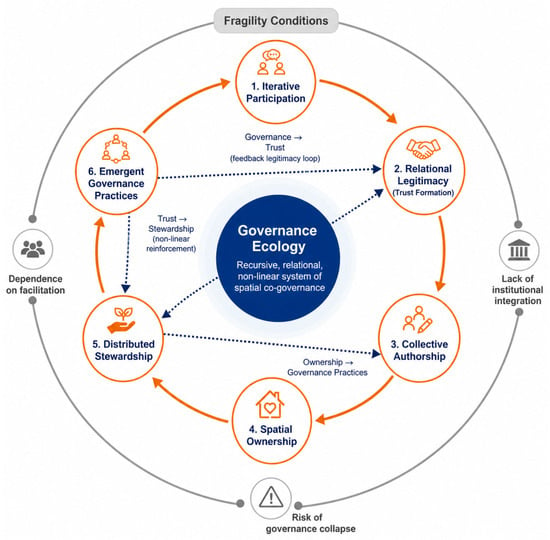
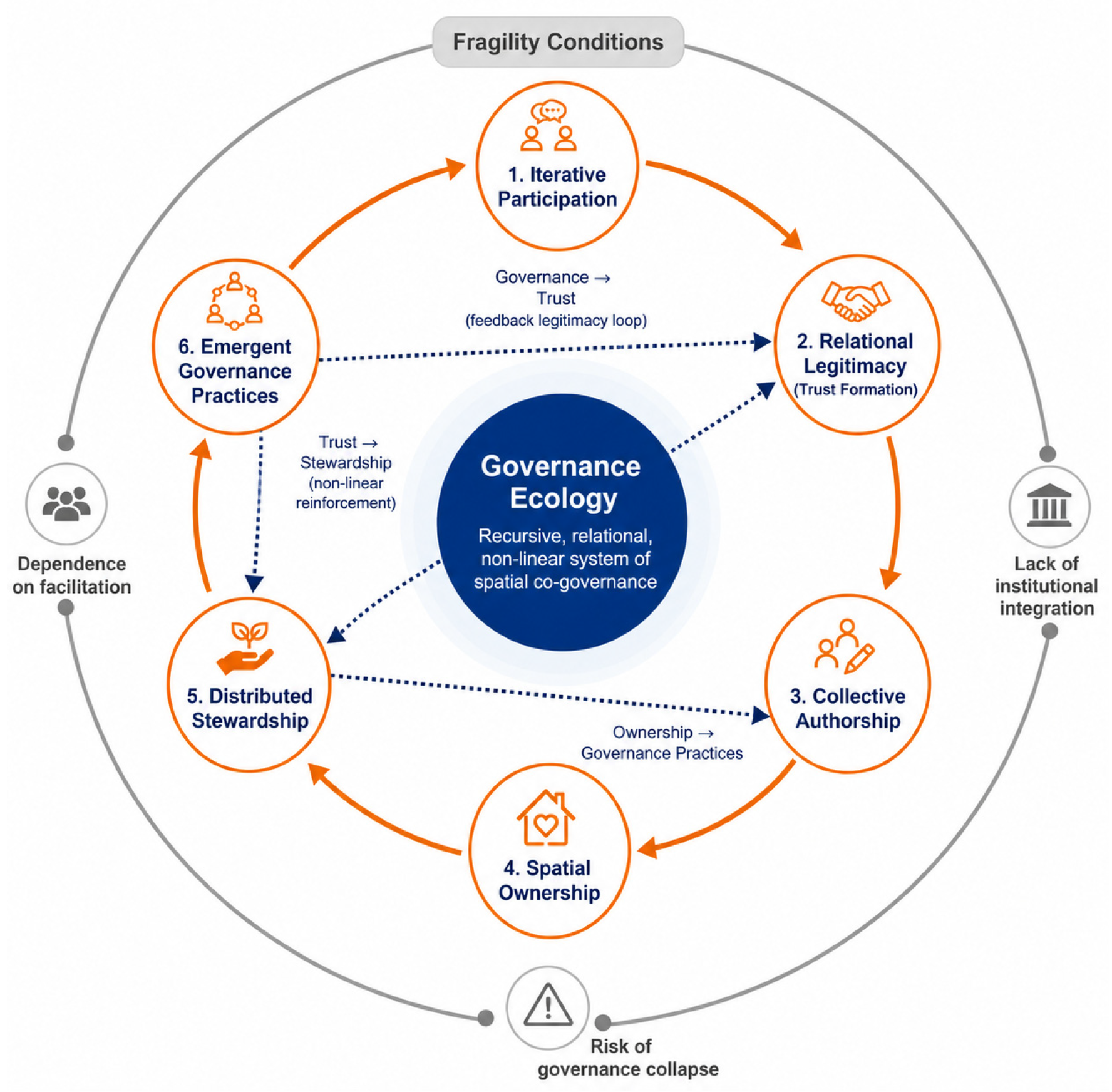
Synthesizing these strands, this study proposes Iterative Participatory Urbanism as a governance ecology. Unlike linear project sequences, a governance ecology is a recursive system where sustained engagement generates relational legitimacy, enabling collective authorship and distributed stewardship. Within this ecology, empowerment is temporally accumulated rather than procedurally granted. This model positions resilience as an adaptive social reproduction—a continuous process of learning and feedback that reinforces the community’s capacity to manage shared environments within institutional constraints [18]. However, such gains remain fragile and require ongoing facilitative presence or formal institutional integration to sustain community agency beyond isolated participation cycles. The proposed iterative participatory urbanism framework as a recursive governance ecology is illustrated in Figure 1.
Figure 1.
Iterative Participatory Urbanism as a Recursive Governance Ecology.
Figure 1 illustrates a non-linear and recursive system in which sustained participatory engagement generates relational legitimacy (trust), enabling collective authorship, spatial ownership, and distributed stewardship. These processes reinforce emergent governance practices, which in turn sustain future cycles of participation. Rather than a causal hierarchy, the model represents mutually reinforcing feedback loops. The outer layer highlights the fragility of these processes in the absence of institutional integration.
While iterative participation often initiates engagement, the framework does not assume a fixed directional sequence. Relational legitimacy may strengthen or weaken at different stages, influencing the emergence of collective authorship and stewardship unevenly. Once distributed stewardship begins to stabilise, it may reinforce trust retrospectively by producing predictable governance practices. The framework therefore operates through recursive feedback loops rather than linear progression, where each component both shapes and is shaped by others across time.
These findings extend Arnstein’s ladder by demonstrating that participation cannot be understood solely as a level of inclusion at a given moment but must be analysed as a temporal process through which agency is progressively formed. Similarly, while the co-production literature emphasises shared problem-solving, this study shows that authorship may emerge through the governance of shared space itself. In this sense, iterative participatory urbanism extends spatial agency theory by situating authorship within institutional constraint rather than design autonomy.
Importantly, the components of this framework were not imposed a priori but were refined abductively through iterative engagement with the empirical material. For instance, observed discursive shifts from individualised complaint to collective coordination informed the conceptualisation of relational legitimacy, while emergent practices such as informal scheduling and shared monitoring informed the articulation of distributed stewardship. In this sense, the framework represents a synthesis of theoretical grounding and empirically observed governance dynamics.
3. Methodology
3.1. Research Design: Embedded Longitudinal Case Study with Process-Tracing
This study adopts a qualitative embedded longitudinal case study design with participatory action research (PAR) elements designed to examine relational and governance mechanisms unfolding over time rather than discrete participatory outcomes. While participatory methods were employed, the study does not constitute a full PAR framework in which participants co-direct the research agenda. Instead, it combines facilitated engagement with analytical observation, allowing the investigation of how spatial agency emerges through iterative interaction.
A process-tracing analytical strategy was employed to identify causal–relational mechanisms linking participation, trust formation, collective authorship, and stewardship. Process tracing is particularly appropriate for small-N studies where the objective is to explain how transformations occur, rather than to measure their frequency or generalise statistically. This aligns with case-based methodological traditions [19,20] where analytical generalisation is prioritised over representational sampling.
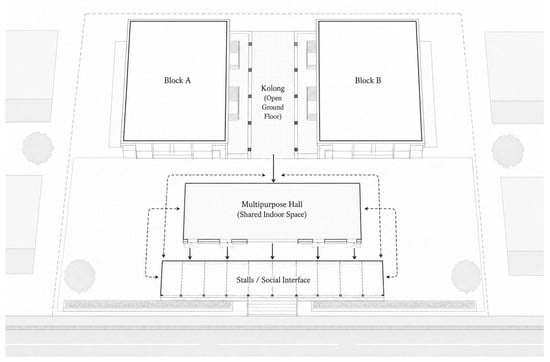
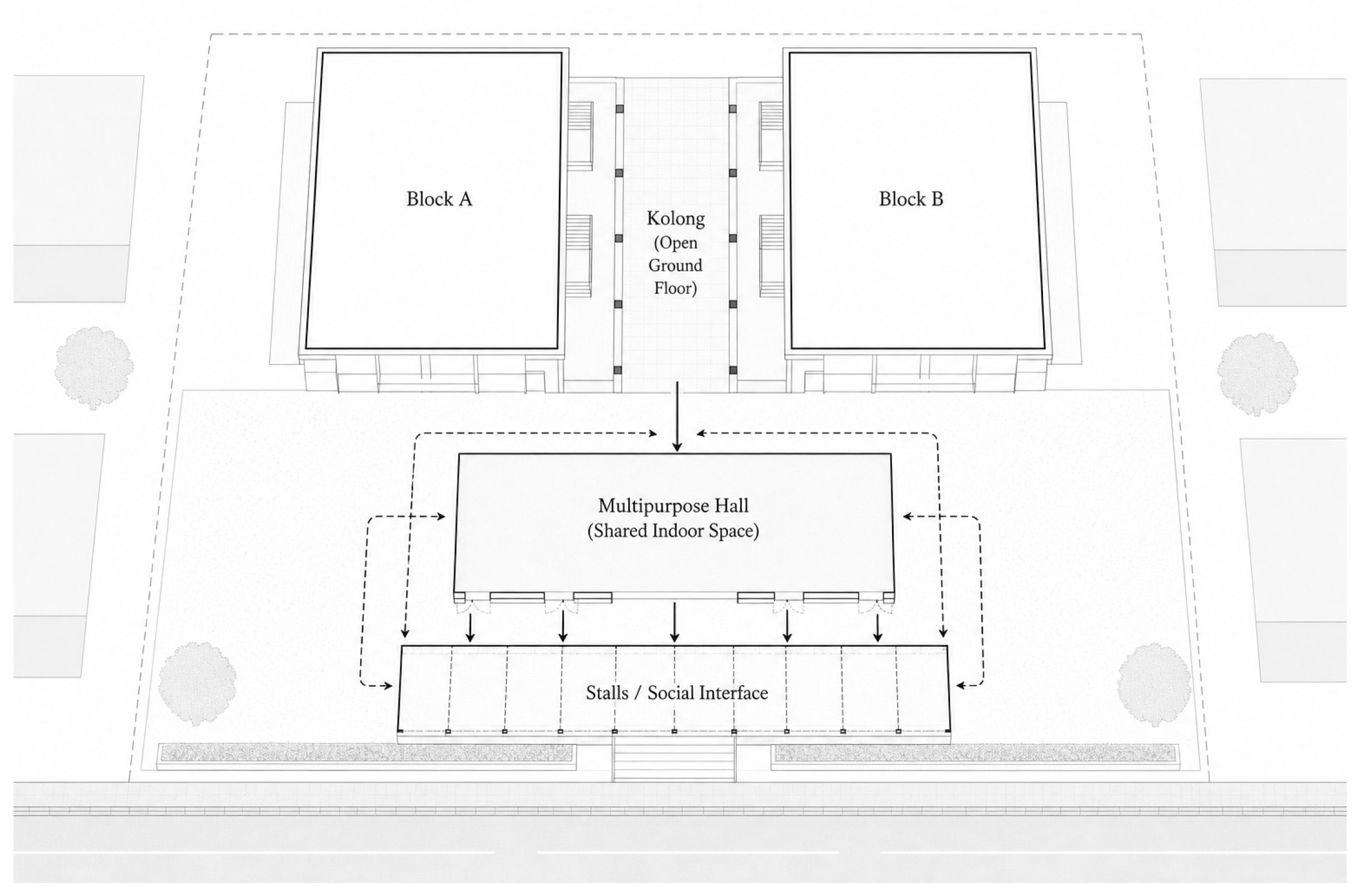
The study was conducted over a 12-month period (January–December 2025) within the ECHO Project at PPR Sri Cempaka. While formal engagement consisted of two focus group discussions and two co-design workshops, the longitudinal dimension lies in continuous relational access, including informal site visits, observational presence during community activities, and iterative feedback exchanges between sessions. This sustained engagement enabled the tracing of discursive and behavioural shifts occurring between formal encounters, which are critical to understanding iterative governance processes. To support spatial understanding of the case study, Figure 2 illustrates the key shared spaces within PPR Sri Cempaka, including the multipurpose hall, kolong (open ground floor), and adjacent social interfaces. These spaces form the primary settings through which participatory activities and everyday governance practices were observed and analysed.
Figure 2.
Site context and key shared spaces at PPR Sri Cempaka.
The diagram illustrates the spatial relationship between the residential blocks (Block A and Block B), kolong (open ground floor), multipurpose hall, and adjacent stalls/social interface. Circulation flows and overlapping activity zones are indicated to support interpretation of participatory dynamics and emerging governance practices discussed in the study.
3.2. Sampling Strategy and Analytical Scope
A purposive sampling strategy was adopted to identify participants actively engaged in the use and informal coordination of communal spaces. Eight long-term residents were selected in consultation with local community representatives to ensure inclusion of individuals involved in organising activities, negotiating shared space use, and participating in community decision-making.
The relatively small sample size is methodologically appropriate given the study’s focus on mechanism identification rather than population representation. In process-tracing and qualitative case study research, depth of relational insight is prioritised over breadth [20]. Participants were selected as key actors within the spatial governance network, enabling close examination of how coordination practices, trust relations, and stewardship behaviours emerge.
The objective is therefore not statistical generalisation but analytical transferability—to generate insights into governance mechanisms that may be conceptually applicable to similar high-density public housing contexts.
3.3. Data Generation: Multi-Modal and Iterative Engagement
Data were generated through four interrelated modes:
- Focus Group Discussions (FGDs)
Two FGDs (90 min each) were conducted and audio-recorded, focusing on shared space use, governance challenges, and coordination practices.
- Participatory Mapping and Co-Design Workshops
Two structured workshops facilitated spatial negotiation through annotated floor plans, zoning proposals, and iterative redesign discussions.
- Ongoing Observational Engagement
The principal investigator maintained an embedded presence during routine community activities (e.g., events, informal gatherings), enabling observation of real-time spatial negotiation and coordination practices.
- Reflexive Field Documentation
Longitudinal field notes captured discursive shifts, moments of hesitation, conflict, and emergent governance practices.
Crucially, interim governance experiments-such as informal scheduling, shared monitoring, and coordination practices-were documented between formal sessions. This allowed the study to capture governance evolution as it unfolded in practice, rather than only within structured participatory settings. The demographic background and preferred public spaces of participants are summarised in Table 1.
Table 1.
List of Participants for the Focus Group Discussion (FGD).
3.4. Analytical Strategy: Abductive Coding and Discursive Process Tracing
Analysis followed an abductive approach, iterating between empirical observations and theoretical constructs. Rather than applying predefined categories, conceptual dimensions such as relational legitimacy, collective authorship, and distributed stewardship emerged through iterative engagement with the data.
The analytical process involved three stages:
- Open Coding: Identification of recurring concepts related to participation, responsibility, coordination, and conflict
- Axial Coding: Grouping into relational mechanisms (e.g., trust formation, governance practices, spatial ownership)
- Process Comparison: Cross-temporal analysis of early vs. later interactions to identify discursive shifts (e.g., “they should fix” → “we should organise”)
Particular attention was given to:
- pronoun shifts (they → we)
- responsibility framing
- emergence of coordination language
These were treated as indicators of redistribution of spatial authority.
3.5. Analytical Rigour and Validation
To ensure methodological robustness, several strategies were employed:
- Triangulation: Cross-analysis of FGDs, workshop artefacts, and observational data
- Iterative cross-checking: Repeated comparison across transcripts and field notes to validate emerging interpretations
- Discrepancy analysis: Differences between stated intentions and observed behaviours were treated as analytically significant
- Reflexive validation: Interpretations were continuously examined against field observations to avoid over-interpretation
Coding was conducted manually to retain contextual sensitivity. Rather than relying on software-based frequency, the analysis prioritised interpretive depth and relational consistency across data sources, which is appropriate for process-oriented qualitative inquiry. To enhance analytical consistency, emerging codes and interpretations were iteratively cross-checked among members of the research team through peer debriefing sessions. Discrepancies in interpretation were discussed and resolved through reference to primary data sources, including transcripts, workshop artefacts, and field notes. This process strengthened the internal validity of the coding structure and ensured that interpretations remained grounded in empirical observations rather than individual researcher bias.
3.6. Researcher Positionality and Embedded Facilitation
The principal investigator acted as both researcher and design facilitator, shaping the participatory environment while simultaneously observing its dynamics. This embedded role is acknowledged as a constitutive element of the governance ecology, rather than a neutral backdrop.
Reflexive memos documented:
- moments of facilitation influence
- participant hesitation
- power dynamics in decision-making
This ensures that findings are understood as co-produced outcomes, emerging through interaction between researchers and participants.
3.7. Limitations and Analytical Contribution
The study does not aim for statistical generalisability. Instead, it contributes by articulating mechanisms of spatial agency formation observable within a bounded case. While the number of formal sessions is limited, the longitudinal design captures relational continuity, which is central to iterative participatory processes. The findings should therefore be interpreted as mechanism-based insights, offering conceptual transferability rather than empirical generalisation.
4. Findings: From Participation to Community Spatial Agency
The findings demonstrate that participatory urbanism at PPR Sri Cempaka operated not as a singular intervention but as an iterative social–spatial process through which residents progressively developed relational legitimacy, spatial ownership, and distributed stewardship. Rather than emerging from discrete participatory events, these transformations unfolded through repeated engagement, visible responsiveness, and incremental shifts in how residents understood responsibility for shared environments.
4.1. Theme 1: From Consultation to Relational Legitimacy
Initial participatory encounters were marked less by enthusiasm than by guarded pragmatism. Residents did not immediately position themselves as collaborators in spatial reorganisation; rather, they framed engagement through the lens of prior experiences with short-term consultations that yielded limited material change. Early discussions were characterised by informational responses rather than propositional dialogue. Participants described spatial shortcomings in descriptive terms such as inadequate ventilation, insufficient storage, and thermal discomfort, but refrained from articulating collective responsibility for change.
In the first focus group session, suggestions remained individualised and infrastructural. One participant noted, “We would probably want air-conditioning in this hall,” while another proposed upgrading the pantry enclosure. These comments, while valid, reflected a consumer-oriented framing of space in which improvements were expected to be delivered externally rather than negotiated collectively. Residents positioned themselves as respondents to a process initiated by others. This positioning was reinforced by prior experiences of limited follow-through. As one participant reflected, “Before this, we just give feedback, but nothing really changes. So we just say what we need and wait.” This highlights how participation was initially understood as a one-directional process rather than a shared governance practice.
However, the continuity of facilitation altered this relational dynamic. Across subsequent sessions, the presence of the same design team, coupled with visible incorporation of prior feedback into revised spatial drawings, signalled responsiveness rather than extraction. Residents began to reference earlier conversations, indicating that participation was not episodic but cumulative. In the second design workshop, discussion shifted from what “should be provided” toward how space “could be organised.” A participant observed, “We just collectively hold the activities simultaneously. We have no official system to divide the space,” marking a discursive movement from infrastructural demand toward governance critique.
This shift was not immediate or uniform. Moments of hesitation persisted, particularly when proposals implied shared enforcement of rules. The suggestion of introducing a booking system initially prompted concerns about fairness and potential conflict. One resident questioned whether scheduling would privilege certain groups over others, reflecting anxieties about internal hierarchy. Rather than dissolving disagreement, these exchanges exposed the latent governance tensions embedded in shared space.
Over time, scepticism gradually gave way to what can be understood as relational legitimacy. Trust did not emerge from formal authority but from iterative acknowledgment. The repetition of dialogue cycles enabled residents to test whether their input would be recognised and incorporated. As responsiveness became visible, language shifted from complaint toward coordination. This shift became increasingly explicit in later sessions. One resident stated, “If we don’t organise it ourselves, then it will always clash. We cannot just wait for others to decide.” Such statements indicate a reorientation from passive expectation toward active coordination. Participants began using collective pronouns such as “we should organise,” “we can schedule,” and “we need to manage,” signalling an expansion of perceived responsibility.
This transformation illustrates that trust functioned as a precondition for authorship. Without relational continuity, participation remained informational. With continuity, residents began to reposition themselves as agents capable of shaping spatial governance. In this sense, trust was not merely an affective state but a structural condition enabling the redistribution of coordination authority. The participatory process thereby moved beyond consultation toward the formation of collective spatial authorship.
Importantly, this relational legitimacy remained fragile. It was sustained through the ongoing presence of facilitation and visible feedback loops. The findings therefore suggest that empowerment is not secured through inclusion alone but through temporal reinforcement. Participation becomes transformative only when iterative engagement reconfigures expectations of accountability and shared responsibility.
This transformation indicates that trust operated as a governance mechanism rather than a purely affective condition, enabling the redistribution of coordination authority within shared space. As one participant reflected, “Now we know we cannot just wait anymore—we have to decide together.” This illustrates the consolidation of relational legitimacy as a shared expectation of coordination.
4.2. Theme 2: From Functional Use to Collective Spatial Ownership
At the outset of the study, the multipurpose hall and the “kolong” open ground floor operated primarily as functional venues for recurring activities. Residents described these spaces in terms of programmatic utility: gatherings, indoor games, weddings, birthday celebrations, meetings, and exercise sessions. The emphasis was on use frequency and adaptability rather than governance. Space was valued because it accommodated activity, not because it was collectively structured.
During early focus group discussions, participants highlighted the flexibility of the hall as its principal asset. The absence of rigid zoning was described positively, allowing simultaneous informal activities to coexist. However, this perceived flexibility concealed underlying tensions. As one participant noted, “Sometimes two activities happen at the same time, and we just adjust. But it can be uncomfortable, especially when it’s noisy.” This illustrates how informal coexistence masked unresolved spatial conflicts. Overlapping uses often resulted in negotiation through ad hoc compromise rather than coordinated management. Activities were “just collectively held simultaneously,” as one participant explained, with no formal system dividing space. Flexibility, therefore, operated as both an enabling condition and a latent source of conflict.
Through participatory mapping exercises, residents began to spatialise these tensions. Annotating floor plans prompted reflection on movement flows, acoustic interference, and informal territorial claims. Rather than merely identifying design deficiencies, participants increasingly articulated concerns related to dignity, comfort, and inclusion. For instance, a participant explained, “When we have our session, suddenly another group comes in and uses the space. We don’t want conflict, so we just keep quiet.” This reflects how a lack of governance disproportionately affected certain user groups. Requests for improved storage or clearer spatial boundaries were accompanied by discussion of how unmanaged overlaps sometimes marginalised quieter groups or constrained women-led activities.
This shift marks a movement from functional use toward collective spatial ownership. Ownership here did not signify legal possession or emotional attachment alone. It emerged through recognition of shared responsibility for how space was structured, scheduled, and protected. As residents proposed zoning adjustments, movable partitions, and clearer circulation paths, they were not simply requesting design improvements. They were articulating spatial governance.
Importantly, this transition was gradual and discursively visible. Early language emphasised provision. Later discussions increasingly framed space as “ours” in a managerial sense rather than merely a communal asset. Participants debated how different user groups might coordinate more equitably, revealing awareness of implicit hierarchies within seemingly open environments. The multipurpose hall was reinterpreted not as neutral infrastructure but as contested territory requiring negotiation.
Participatory design activities served as mediating devices in this transformation. By externalising spatial arrangements onto annotated plans, residents could visualise conflict and propose alternatives collectively. The act of drawing and rearranging space enabled discussion to move from complaint to coordination. Through this process, spatial organisation became a shared intellectual task rather than a professional prerogative.
The emergence of collective spatial ownership therefore preceded formal stewardship structures. Before residents assumed maintenance responsibilities, they first redefined space as collectively governable. Ownership was constituted through discourse and negotiation rather than decree. This aligns with the study’s broader argument that spatial agency forms relationally and iteratively. It is not granted through a participatory invitation but produced when residents begin to conceive of shared environments as subjects of collective decision-making.
Yet this ownership remained provisional. The absence of institutional recognition meant that proposed zoning adjustments and coordination practices relied on informal agreement. Without structural integration into housing management frameworks, collective ownership risked fragmentation. The findings thus reveal ownership as both achievement and vulnerability, contingent upon continued relational reinforcement.
In this sense, the transition from functional use to collective spatial ownership represents a crucial intermediate stage in the formation of spatial agency. Residents moved beyond occupying flexible space toward shaping its organisational logic. Architecture became less a backdrop for activity and more a medium through which governance relationships were negotiated and reproduced.
This shift demonstrates that spatial ownership in high-density housing is not a fixed attribute but a relational construct formed through negotiation, visibility of conflict, and collective redefinition of spatial use. This shift is further reflected in the statement, “It’s not just space for use—it’s something we need to manage properly,” indicating the emergence of collective spatial ownership.
4.3. Theme 3: Gendered and Youth-Led Spatial Agency
The participatory process revealed that spatial agency within PPR Sri Cempaka did not emerge evenly across resident groups. While communal spaces were used by a wide range of occupants, women and youth participants demonstrated distinctive forms of spatial articulation that reshaped how shared environments were understood and prioritised.
Women residents, many of whom were active organisers of community programmes, such as exercise sessions, small-scale economic activities, and informal gatherings, articulated detailed insights into everyday spatial negotiation. Their contributions moved beyond generalised complaints toward granular observations concerning safety, storage, visibility, circulation, and temporal overlap between activities. These concerns were not framed solely in terms of comfort but in relation to dignity and accessibility, particularly for elderly participants and children.
During participatory mapping sessions, women participants frequently identified micro-spatial conflicts that were previously normalised. One participant highlighted this by stating, “We organise activities here, but sometimes it’s hard because the space is not clearly arranged. People just come in.” This reflects how spatial ambiguity translated into organisational challenges. For example, the absence of clear zoning within the multipurpose hall was not merely described as inconvenient; it was linked to disruptions in women-led activities when louder or larger gatherings encroached upon scheduled sessions. Through these discussions, spatial conflict was reframed as a question of equitable governance rather than accidental overlap.
This articulation signalled a form of gendered spatial agency grounded in everyday custodianship. Women participants often positioned themselves not as passive users but as organisers responsible for coordinating programmes and mediating disputes. Their proposals for movable partitions, clearer booking structures, and designated activity zones reflected an attempt to stabilise spatial predictability. In doing so, they implicitly asserted authority within the communal domain.
Youth contributions, though fewer in number, introduced a complementary dimension of spatial imagination. A younger participant suggested, “Maybe we can have flexible zones, not too fixed, so different people can still use it in their own way.” This demonstrates an alternative spatial logic prioritising adaptability over control. Younger participants emphasised flexibility, informality, and identity, advocating for spaces that could accommodate learning, recreation, and social expression without rigid institutional control. Their interventions challenged the assumption that youth in public housing contexts are disengaged or peripheral to governance. Instead, their perspectives highlighted the importance of adaptable environments capable of supporting evolving social practices.
Importantly, the participatory framework created conditions in which these differentiated voices could intersect rather than compete. Women’s emphasis on coordination and safety intersected with youth aspirations for flexibility, producing proposals that balanced structure and openness. The negotiation between predictability and adaptability became central to spatial reorganisation.
However, the emergence of gendered and youth-led agency also exposed internal hierarchies. Proposals that formalised scheduling or zoning occasionally raised concerns regarding the concentration of organisational authority among already active participants. The possibility that structured governance might privilege established groups revealed that redistribution of spatial authorship is neither neutral nor frictionless.
Spatial agency in this context therefore manifested as a negotiated redistribution of voice rather than uniform empowerment. Women and youth participants leveraged participatory tools to articulate spatial priorities, yet their influence remained contingent upon collective recognition and ongoing facilitation. Agency was expressed through discourse, organisation, and everyday coordination rather than through overt physical transformation.
This theme underscores that participatory urbanism does not simply aggregate community input; it reorganises the field of spatial authority. By enabling marginalised or less formally recognised actors to shape spatial governance discussions, iterative engagement redistributed the capacity to define how shared environments should function. Architecture, in this sense, became the terrain upon which social roles were renegotiated.
The findings suggest that spatial agency is not monolithic. It is differentiated, relational, and embedded within existing social structures. Gendered and youth-led contributions reveal how participatory processes can surface latent leadership and reconfigure everyday governance, while simultaneously exposing the fragility and contestation inherent in redistributing authority within constrained institutional settings.
These findings suggest that spatial agency is unevenly distributed and mediated by existing social roles, highlighting the importance of participatory processes in revealing and reconfiguring latent forms of leadership.
4.4. From Improvement Requests to Distributed Stewardship
While early participatory sessions were dominated by requests for infrastructural upgrades, later engagements revealed a more significant transformation in how residents understood maintenance and spatial responsibility. What initially appeared as dissatisfaction with physical conditions gradually evolved into reflection on governance practices and collective accountability.
In early discussions, spatial shortcomings were framed as deficiencies to be rectified by housing authorities. Residents cited thermal discomfort, outdated floor finishes, and inadequate toilet provision. Statements such as “We would probably want air-conditioning in this hall” and “We would like a toilet just for the multipurpose hall” reflected an expectation that improvement would occur through external provision. This was reflected in statements such as, “If the management can upgrade this place, it will be better for everyone.” Such views positioned residents as beneficiaries rather than co-managers of space. Maintenance was implicitly positioned as an institutional obligation rather than a shared responsibility.
However, as participatory sessions progressed, the locus of concern began to shift. Discussions moved beyond material enhancement toward the regulation of use and the sustainability of communal practices. Residents began to question not only the condition of space but the systems governing its occupation. The absence of booking procedures, zoning clarity, and maintenance coordination became focal points of debate. In one session, a participant remarked, “We have no official system to divide the space,” indicating recognition that spatial conflict was not solely a design flaw but a governance issue.
This reframing marked a transition from user-based critique to stewardship-oriented thinking. Rather than solely advocating for infrastructural upgrades, residents began to propose mechanisms for collective monitoring, scheduling, and informal rule-setting. In later discussions, a participant proposed, “Maybe we can create a simple schedule among ourselves first, just to avoid clashes.” This indicates early experimentation with informal governance. Conversations increasingly included language of shared responsibility. Participants discussed rotating oversight for event coordination, collective cleaning efforts after gatherings, and the need to communicate scheduling expectations across user groups.
Importantly, this transition was not seamless. Proposals for structured booking systems generated concerns about potential exclusion or the consolidation of influence within particular resident groups. Questions arose regarding who would administer such systems and how disputes would be resolved. These moments exposed the delicate balance between collective governance and internal hierarchy. Stewardship required not only willingness to participate but agreement on authority distribution.
Over time, however, repeated engagement allowed residents to experiment with provisional coordination practices. Informal scheduling agreements were trialled during overlapping activities, and peer-based reminders emerged regarding post-event cleaning. These practices did not formalise into codified regulations but began to stabilise as shared norms. Maintenance, in this context, became less an external service and more a relational practice embedded in everyday interaction.
This evolution demonstrates that stewardship in public housing is not merely an outcome of design enhancement but a negotiated reconfiguration of responsibility. Spatial agency manifested not through dramatic physical transformation but through the mundane yet significant acts of scheduling, monitoring, and collective care. Agency became infrastructural, embedded within routine governance practices rather than oppositional gestures.
Yet the fragility of this stewardship culture remains evident. Its continuity depended on ongoing facilitative presence and the reinforcement of participatory cycles. Without institutional recognition or structural integration, informal governance practices risk reversion to passive reliance on housing authorities. Stewardship therefore emerged as a contingent achievement rather than a permanent condition.
The findings suggest that maintenance culture in high-density public housing is best understood as a socially reproduced process. Physical upgrades may improve comfort, but durable transformation occurs when residents reinterpret space as collectively governed territory. In this sense, participatory urbanism did not simply generate design proposals; it enabled a gradual redistribution of spatial responsibility. Maintenance became a site of agency formation, signalling a shift from occupancy toward co-governance.
Stewardship therefore represents not an endpoint but an ongoing relational achievement, contingent upon continued coordination, mutual recognition, and the stabilisation of informal governance practices. As another resident noted, “If we take care of it together, it lasts longer,” highlighting how stewardship becomes embedded in everyday practice.
5. Discussion: Iterative Participatory Urbanism and the Reconfiguration of Architectural Authorship
This study advances participatory urbanism scholarship by reconceptualising participation not as a procedural inclusion mechanism but as a temporal process of governance formation. The findings demonstrate that spatial agency in high-density public housing does not emerge through isolated participatory events but through iterative cycles of engagement that progressively redistribute spatial responsibility.
The findings from PPR Sri Cempaka extend participatory design discourse beyond consultation toward a reconfiguration of architectural authorship. Rather than functioning as a methodological supplement to design delivery, iterative participatory engagement operated as a relational infrastructure that redistributed spatial responsibility over time. The study demonstrates that authorship in high-density public housing is neither singular nor static; it is progressively negotiated through sustained interaction, coordination practices, and shared stewardship.
These findings challenge and reconceptualise existing participation frameworks by demonstrating that spatial agency is not achieved through inclusion alone but is progressively constructed through iterative governance processes. Rather than positioning participation as a discrete event or hierarchical status, this study reframes it as a temporal and relational mechanism through which authority, responsibility, and authorship are redistributed over time. First, in contrast to Arnstein’s [5] ladder, which conceptualises participation as a hierarchical level of inclusion at a given moment, this study demonstrates that agency is formed through temporal accumulation rather than positional elevation. Second, while co-production literature emphasises shared problem-solving between state and citizens [20], the findings suggest that authorship may emerge through the governance of space itself, particularly in contexts where physical intervention is constrained. Third, compared to collaborative planning approaches [21], which focus on consensus-building processes, this study foregrounds relational continuity and iterative responsiveness as the mechanisms through which legitimacy and stewardship are stabilised over time.
The temporal dimension of participation is particularly significant. Early scepticism among residents revealed that inclusion alone does not guarantee agency. Through repeated cycles of dialogue and visible responsiveness, alongside transparency, informal rule formation, and emerging coordination structures, residents began to reposition themselves. This suggests that architectural empowerment must be understood as processual rather than event-based. The participatory mechanism does not merely gather input; it restructures expectations of responsibility and accountability.
Importantly, spatial agency manifested infrastructurally rather than through overt resistance. Residents did not radically alter built form; instead, they reconfigured the governance of space through scheduling systems, zoning negotiations, and maintenance norms. Agency therefore emerged within institutional constraints, not outside them. This extends spatial agency theory into contexts where regulatory frameworks limit physical modification yet permit organisational transformation.
However, the embedded role of facilitation introduces critical tension. While iterative engagement catalysed governance shifts, empowerment remained partially contingent upon continued mediation. The transition from facilitated coordination to resident-led governance remains incomplete. This underscores that participatory urbanism risks reproducing dependency if institutional structures do not integrate community governance mechanisms formally. This fragility highlights that participatory gains remain contingent upon both relational continuity and institutional embedding. Without mechanisms that formalise and sustain resident-led coordination, participatory outcomes risk remaining provisional and susceptible to reversal.
The study therefore positions iterative participatory urbanism as both enabling and fragile. It reveals how relational continuity can cultivate distributed stewardship, yet also how structural limitations constrain its durability. For architectural practice, this suggests that participation must be institutionalised rather than episodic if spatial agency is to stabilise beyond project cycles. Iterative participatory urbanism therefore reframes architectural authorship not as a transfer of control but as a gradual redistribution of responsibility mediated through governance practices over time.
5.1. From Participation to Governance: Beyond Existing Frameworks
The findings challenge and extend three dominant frameworks:
- Beyond Arnstein: From Hierarchy to Temporality
While Arnstein’s [5] ladder conceptualises participation as a hierarchical distribution of power, this study demonstrates that agency is not attained through positional elevation but through temporal accumulation of relational legitimacy. Participation is therefore not a level but a process of becoming.
- Beyond Co-Production: From Problem-Solving to Responsibility Redistribution
The co-production literature emphasises collaboration between state and citizens [21], yet often remains centred on service delivery outcomes. This study shows that in constrained public housing contexts, agency emerges not through service co-delivery but through the reconfiguration of everyday governance practices, including scheduling, monitoring, and informal rule-making.
- Beyond Collaborative Planning: From Consensus to Continuity
Collaborative planning [22] prioritises consensus-building but tends to focus on deliberative moments. The findings demonstrate that what stabilises governance is not consensus alone but relational continuity and visible responsiveness across repeated engagement cycles.
5.2. Empirical Formation of Governance Ecology Through Iterative Participation
Building on these insights, the study introduces Iterative Participatory Urbanism as a governance ecology, characterised by:
- Recursive feedback loops between participation, trust, authorship, and stewardship
- Relational legitimacy emerging through repeated interaction
- Distributed stewardship as an operational form of spatial agency
Importantly, the empirical findings show how each component of the framework is grounded in observed mechanisms:
- Relational legitimacy emerged through repeated dialogue cycles and visible feedback incorporation
- Collective authorship developed through participatory mapping and spatial negotiation
- Spatial ownership was articulated through discursive reframing of shared space
- Distributed stewardship materialised through informal coordination practices (e.g., scheduling, monitoring)
This demonstrates that the framework is not merely conceptual but empirically derived through abductive analysis.
5.3. The Fragility of Governance: Precarious Agency and the Risk of Collapse
A critical contribution of this study lies in identifying the fragility of emergent governance practices. While iterative engagement enabled the formation of stewardship behaviours, these remained:
- dependent on facilitation continuity
- vulnerable to institutional absence
- susceptible to internal hierarchy formation
This suggests that participatory urbanism, when not structurally embedded, risks regression into passive dependency.
The transition from functional use to distributed stewardship at PPR Sri Cempaka reveals a profound systemic vulnerability characterized by institutional decoupling. While the ECHO project successfully fostered a “governance ecology” of trust and collective authorship, these gains remain inherently fragile because they exist as informal governance experiments outside the statutory framework of Kuala Lumpur’s housing management. This study identifies several ‘fragility conditions,’ most notably the community’s continued reliance on external facilitators for mediation and the lack of a formal budget to sustain physical and organizational transformations. Without the stabilizing presence of the research team, the emerging shared responsibility is susceptible to potential resident burnout, particularly as the labor of maintenance and scheduling is added to the existing socio-economic burdens of low-income life.
This precarious agency is a hallmark of Global South urbanism, where participatory gains often remain ‘provisional’ and subject to governance collapse once external interventions cease. Addressing Reviewer 1’s concern regarding the ‘keeping of promises’ and the ‘presence of policymakers,’ we argue that trust in this context is not merely an affective state but a dynamic governance mechanism that requires institutional anchoring. In the absence of formalization by local authorities like DBKL, the “relational legitimacy” built through iterative dialogue cycles remains a temporary ‘bubble’. In many developing contexts, citizens revert to parallel informal systems or political patronage when formal planning fails to demonstrate visible responsiveness or promise-keeping over the long term. Consequently, the spatial agency observed in the ECHO project risks being reabsorbed into a consumer-oriented framing—where residents revert to a passive “they should fix it” mindset—if the limits of informal governance are not addressed through structural reform.
To stabilize these fragile gains, the “relational infrastructure” developed during the project must be converted into permanent institutional infrastructures. This necessitates a shift from ‘event-based’ participation to a recursive governance system formally recognized in housing policy. Specific solutions include the institutionalization of resident-led coordination structures, the integration of periodic co-design review cycles into estate management, and the provision of lightweight governance tools such as shared scheduling systems and spatial protocols. Such formal policy recognition would move the community beyond ‘provisional’ ownership toward a transformative co-production model, ensuring that community spatial agency is not merely a transient outcome of a design intervention but a socially reproduced resilience protected against future institutional neglect.
5.4. Implications for Policy and Practice
The findings indicate that effective participatory governance in public housing requires institutionalisation of iterative mechanisms, including:
- resident-led coordination structures
- informal governance recognition
- integration of feedback loops into housing management systems
Rather than treating participation as a one-off consultation, housing authorities must support continuous engagement infrastructures that enable residents to transition from users to co-governors. Beyond the immediate case, this reconceptualisation contributes to broader debates on governance in Global South housing contexts, where institutional constraints often limit formal participation outcomes. By foregrounding iterative engagement as a mechanism of governance formation, the study offers a transferable analytical lens for understanding how communities negotiate authority and responsibility in resource-constrained environments. This shifts the focus of participatory urbanism from design inclusion toward the long-term structuring of collective capacity.
6. Conclusions and Implications
This study has examined how iterative participatory urbanism can foster the formation of community spatial agency within a high-density public housing context. Through a longitudinal embedded case study at PPR Sri Cempaka, the research demonstrates that empowerment does not emerge from isolated consultative events but from sustained relational engagement that reshapes governance practices over time.
By conceptualising participation as a governance ecology rather than a design technique, the paper advances architectural discourse in three ways. First, it reframes empowerment as relationally accumulated rather than procedurally granted. Second, it extends spatial agency theory into institutionally managed housing environments where authorship is negotiated through coordination and stewardship rather than physical alteration. Third, it reconceptualises resilience as socially reproduced through distributed responsibility rather than materially embedded in built form alone.
While grounded in a single case, the mechanisms identified, including relational continuity, discursive transformation, and provisional governance experimentation, offer conceptual insights transferable to other resource-constrained public housing contexts. However, the findings also highlight the fragility of participatory gains in the absence of institutional integration. Without structural support from housing authorities, community-led governance risks remaining informal and contingent. Practically, this suggests that housing authorities should move beyond one-off consultation exercises by embedding iterative engagement mechanisms within management structures. This may include the formal recognition of resident-led coordination systems, integration of feedback loops into maintenance processes, and support for community-based governance practices that sustain shared space over time.
Future research should examine how iterative participatory frameworks can be formalised within housing management systems and evaluated across multiple sites to assess long-term sustainability. For housing authorities, these findings suggest the need to institutionalise iterative participatory mechanisms beyond project-based engagement. This may include the integration of resident-led coordination structures, periodic co-design review cycles, and lightweight governance tools such as shared scheduling systems and spatial protocols. For urban practitioners, the study highlights the importance of sustained facilitation and visible feedback loops in transitioning participation from consultation to co-governance. Ultimately, the transformation of public housing environments depends not solely on architectural redesign but on the sustained cultivation of relational infrastructures through which communities progressively co-govern shared space.
Author Contributions
Conceptualization, F.I.I. and A.S.; methodology, B.M.B. and M.L.; software, M.L.; validation, F.I.I., N.S.N.A.W., A.S. and B.M.B.; formal analysis, Z.S.M.J.; investigation, Z.S.M.J.; resources, F.I.I.; data curation, Z.S.M.J.; writing—original draft preparation, F.I.I.; writing—Z.S.M.J.; visualization, B.M.B.; supervision, F.I.I.; project administration, F.I.I.; funding acquisition, F.I.I. All authors have read and agreed to the published version of the manuscript.
Funding
This research was supported by Taylor’s University through the Taylor’s University Internal Grant Scheme—Impact Lab Grant (TIRGS-ILG/1/2024/SOA/001).
Institutional Review Board Statement
The study was conducted in accordance and approved by the Ethics Committee of Taylor’s University, Malaysia (protocol code HEC 2025/117 and date of approval 4 March 2025).
Informed Consent Statement
Informed consent was obtained from all subjects involved in the study.
Data Availability Statement
The data presented in this study are available on request from the corresponding author. The data are not publicly available due to privacy and ethical restrictions involving human participants.
Acknowledgments
The authors gratefully acknowledge the support of the residents of PPR Sri Cempaka for their participation in the ECHO Project. The authors also thank Niro Ceramic Group for the in-kind sponsorship of materials used in the intervention phase. Administrative and institutional support from Taylor’s University is sincerely appreciated. During the preparation of this manuscript, the authors used ChatGPT (OpenAI, GPT-5.2 version) for language refinement and structural editing. All AI-generated outputs were critically reviewed and substantially revised by the authors, who take full responsibility for the final content of this publication.
Conflicts of Interest
The authors declare no conflicts of interest. The funders had no role in the design of the study; in the collection, analyses, or interpretation of data; in the writing of the manuscript; or in the decision to publish the results.
Abbreviation
The following abbreviation is used in this manuscript:
| PPR | Program Perumahan Rakyat (Low-Cost Public Housing) |
References
- Klinenberg, E. Palaces for the People: How Social Infrastructure Can Help Fight Inequality, Polarization, and the Decline of Civic Life; Crown: New York, NY, USA, 2018. [Google Scholar]
- Lefebvre, H. The Production of Space; Blackwell: Oxford, UK, 1991. [Google Scholar]
- Watson, V. Seeing from the South: Refocusing urban planning on the globe’s central urban issues. Urban Stud. 2009, 46, 2259–2275. [Google Scholar] [CrossRef] [Scilit]
- Pfeiffer, S.; Ekkirala, H.C.; Arlikatti, S.; Cornet, S.; Werners, S.; Ramesh, M.V. Participatory engagement and lived experiences of early warning and preparedness in two rural communities in Kerala, South India. Int. J. Disaster Risk Reduct. 2026, 133, 105986. [Google Scholar]
- Arnstein, S.R. A ladder of citizen participation. J. Am. Inst. Plan. 1969, 35, 216–224. [Google Scholar] [CrossRef] [Scilit]
- Gonçalves, J. Participation beyond the ladder: A critical framework for understanding spatial engagement in Portugal. Urban Gov. 2025, 5, 447–454. [Google Scholar] [CrossRef] [Scilit]
- Törnroth, S.; Day, J.; Fürst, M.F.; Mander, S. Participatory utopian sketching: A methodological framework for collaborative citizen (re)imagination of urban spatial futures. Futures 2022, 139, 102938. [Google Scholar] [CrossRef] [Scilit]
- Bottini, L. The effects of built environment on community participation in urban neighbourhoods: An empirical exploration. Cities 2018, 81, 108–114. [Google Scholar] [CrossRef] [Scilit]
- Schön, D.A. The Reflective Practitioner: How Professionals Think in Action; Basic Books: New York, NY, USA, 1983. [Google Scholar]
- Awan, N.; Schneider, T.; Till, J. Spatial Agency: Other Ways of Doing Architecture; Routledge: London, UK, 2011. [Google Scholar]
- Chisumbe, S.; Aigbavboa, C.; Mwanaumo, E.; Thwala, W. A measurement model for stakeholders’ participation in urban housing development for Lusaka: A neo-liberal perspective. Urban Sci. 2022, 6, 34. [Google Scholar] [CrossRef] [Scilit]
- Chen, W.; Wang, Y.; Jian, I.Y.; Mo, K.H. “Empower and be empowered”: Unveiling how community engagement influences residents’ perceived health in high-density high-rise housing. Soc. Sci. Med. 2026, 393, 119015. [Google Scholar] [PubMed]
- Moschonas, D.; French, M.; Ramirez-Lovering, D.; Marzaman, L.; Latief, I.; Parikh, P. Co-producing nature-based solutions: Integrating knowledge interfaces in informal settlements in Indonesia. Environ. Urban. 2025, 37, 465–486. [Google Scholar]
- Pérez-Restrepo, R.; Armacanqui, D. Collectivism as a sustainable alternative to the housing crisis: Learnings in governance and home-making from São Paulo’s housing occupations. IOP Conf. Ser. Earth Environ. Sci. 2025, 1554, 012137. [Google Scholar]
- Rubio, M.A.; Novak, R.; Hidalgo, L.; Litt, J.; Slater, D.; Kocman, D. “Challenging but worth it!”: The purpose of participatory research in urban health, an evaluation and derived framework. Cities 2026, 169, 106569. [Google Scholar]
- Swapan, M.S.H. Who participates and who doesn’t? Adapting community participation model for developing countries. Cities 2016, 53, 70–77. [Google Scholar]
- Coll-Planas, L.; Carbó-Cardeña, A.; Jansson, A.; Dostálová, V.; Bartova, A.; Rautiainen, L.; Kolster, A.; Masó-Aguado, M.; Briones-Buixassa, L.; Blancafort-Alias, S.; et al. Nature-Based Social Interventions to Address Loneliness among Vulnerable Populations: A Common Study Protocol for Three Related Randomized Controlled Trials in Barcelona, Helsinki, and Prague within the RECETAS European Project. BMC Public Health 2024, 24, 172. [Google Scholar] [CrossRef] [Scilit] [PubMed]
- Folke, C.; Hahn, T.; Olsson, P.; Norberg, J. Adaptive governance of social-ecological systems. Annu. Rev. Environ. Resour. 2005, 30, 441–473. [Google Scholar] [CrossRef] [Scilit]
- Yilmaz, O.C.; Ertekin, O. Experimenting governance for sustainable urban futures: Urban Living Labs in Turkiye. Cities 2026, 169, 106514. [Google Scholar]
- Mitlin, D. With and beyond the state—Co-production as a route to political influence, power and transformation for grassroots organizations. Environ. Urban. 2008, 20, 339–360. [Google Scholar]
- Healey, P. Collaborative Planning: Shaping Places in Fragmented Societies; UBC Press: Vancouver, BC, Canada, 1997. [Google Scholar]
- Cooke, B.; Kothari, U. (Eds.) Participation: The New Tyranny? Zed Books: London, UK, 2001. [Google Scholar]

Disclaimer/Publisher’s Note: The statements, opinions and data contained in all publications are solely those of the individual author(s) and contributor(s) and not of MDPI and/or the editor(s). MDPI and/or the editor(s) disclaim responsibility for any injury to people or property resulting from any ideas, methods, instructions or products referred to in the content. |
© 2026 by the authors. Licensee MDPI, Basel, Switzerland. This article is an open access article distributed under the terms and conditions of the Creative Commons Attribution (CC BY) license.