


Abstract
This study empirically investigates the interplay between two foundational knowledge frameworks in architectural design education: the Vitruvian triad (Architectural Knowledge Traditions—AkT) and the Triple Bottom Line (Sustainability Knowledge Traditions—SkT). Focusing on Ethiopia as a case of non-industrial urbanization in the Global South, where socio-economic realities diverge from Global North contexts, the research examines how the six variables within these frameworks interact within pedagogical practice. Using a mixed-methods approach, the study combines questionnaires from senior architectural design instructors across 13 universities with a critical content analysis of university exit model-examinations. Analyzed through specific theoretical lenses, findings reveal a critical divergence: while instructors demonstrate strong theoretical awareness of complementarity between the two traditions, their model-assessment focuses contradict this stance. The analysis reveals a fundamental skew toward an inherited environmental doctrine, where the Venustas–Environment coupling dominates at the expense of social and economic survival imperatives. The study concludes that these “knowledge overlaps” do not inherently warrant successful integration but instead reflect a “design–reality gap” fueled by globalized doctrines and knowledge coloniality. The study concludes by providing the empirical grounding necessary to dismantle the often-universalized norms, arguing for a localized matrix that centers epistemological autonomy within architectural education in the Global South.
1. Introduction
The contemporary architectural design discourses are saturated with the rhetorics and terminology of sustainability, expressed through the nexus of “social–economic–environment” phrases alongside disciplinary specific terminologies such as socio-spatial, techno-ecological and eco-architecture. Curricula and mission statements of architecture schools across both the Global North and South also extensively use the same narratives. Yet, the concepts of sustainability they convey remain conceptually diverse and often ambiguous. Practical integration of these notions within the architectural knowledge often remains superficial and conceptually blunt [1,2,3]. Both in practice and in educational settings, the complex, multi-dimensional concept of sustainability in the built environment is frequently reduced to a few narrow ideas related to environmental responses and energy efficiency, building with green materials, and ecological footprints, while its potential imperatives of social and economic aspects are often considered subordinate [4,5]. This type of understanding, which is currently skewed towards a predominantly “environmental doctrine” [6], creates significant gap between theoretical depth and practical interpretation of sustainability in the architectural and urban design fields. This type of gap, which resonates between practice and education, is more pronounced in disciplines like architecture, where both realms echo one another through a typical model of project-based and problem-based learning [3,7].
In this regard, critics have long argued that the architectural profession, in general, lacks engagement with the social and economic phenomena that shape urban artifacts [5,8,9]. There are also similar criticisms on the education side that there are implicit values in the architecture learning environment that stand against the incorporation of broader knowledge areas, including sustainability [10]. Despite these apparent gaps, it is common to see architects defending the architectural knowledge tradition for intrinsically incorporating multidisciplinary concerns [11,12]. Such unclarified perceptions of architects towards multidisciplinary knowledge areas require an appropriate investigation. In fact, it is undeniable that architecture is a relatively old knowledge area compared to the sustainability knowledge area, and there are claims on long standing, peculiar, and “designerly way of knowing” in architecture in general [13]. Yet, these areas are not rigid claims, as there is evidence of gaps in the conceptual and contextual interpretations of multidisciplinary knowledge areas including sustainability.
The common discussions and usage of the term sustainability among architects and built environment educators, which paradoxically includes non-industrial contexts such as Ethiopia, also tend to incline towards the same notions of environmental responses. In contexts where dire socioeconomic realities are core urbanization challenges and different from the mainstream conceptions [14,15,16], replication of universalized environmentalism risks a “design–reality gap” [17]. Generic usages of sustainability notion tend to marginalize the inherent merits of localized practices, despite providing functional equivalents to modern sustainability goals [18]. While it is indisputable that most curricular approaches to architecture education in the South are inherited from the North [19], a similar environment-oriented characterization of sustainability in the built environment is echoed in both schools within these contexts [20,21,22]. Superficial integration of sustainability components, often reduced to ‘symbolic’ socio-economic analyses and environmental impact studies, has also become a common norm in architectural practice, frequently bypassing critical investigation congruent to their actual relevance. Hence, a generic understandings of sustainability prevails [23]. Such perpetuation of “One-World” perspective [24] and universalism frequently marginalizes the socio-economic survival imperatives peculiar to non-industrial contexts in the Global South.
Furthermore, institutionalized sustainability frameworks, such as Leadership in Energy and Environmental Design (LEED) and the Building Research Establishment Environmental Assessment Method (BREEAM), streamlined globally, carry risks of maladaptation in non-industrial contexts, as they often neglect the social and economic peculiarities of the Global South, fostering epistemological dependency in architectural education [19,25]. Hence, the response to informal economies, culturally specific social structures, and localized livelihood systems that define sustainable development in a non-industrial urbanization contexts like Ethiopia lacks precision in terms of the breadth of the notion carried by sustainability [26,27]. The dominance of universalized sustainability metrics in the curriculum suggests an epistemological dependency that mirrors Northern industrial priorities, witnessing scholarly reflections on the “coloniality of knowledge” [25,28,29] in architectural pedagogy reflected through internationalization [30]. This necessitates contextual and nuanced research on the perception gaps and the overlaps of the two knowledge traditions: sustainability and architecture.
This paper aims to explicitly portray the gaps and overlaps between components of two knowledge traditions in the built environment pedagogy: sustainability traditions (SkT, represented by a Triple Bottom Line triad) and architecture traditions (AkT, represented by a Vitruvian triad). The research is framed within the context of Ethiopia, as a non-industrial urbanization, where the interaction and interpretation of sustainability and development might differ from the often-universalized industrial contexts [31]. As the principal research question, it addresses the interplay between the two through perception and practice by asking: “How do architectural design course instructors perceive the sustainability knowledge tradition in relation to the components in the architecture tradition?” and “To what extent are gaps and overlaps between the two knowledge traditions reflected in the architectural design learning assessments?” The term ‘tradition’, when applied to sustainability and architecture in this particular research, only refers to the literal dictionary (Oxford) meaning of “… established, trans-generational practices, beliefs, and customs…” rather than an engagement with a specific theoretical paradigm or movement. For this reason, the ‘trans-generational, and custom “notions of these two knowledge areas within the built environment are covered in the literature review.
1.1. Literature Review
The architectural tradition, which is historically established as the Vitruvian triad, has framed theories and practices of architecture since the 1st century BC [32]. In stark contrast, the sustainability tradition, which was formalized as triad by Elkington’s (People/Social, Planet/Environment, Profit/Economy, is a relatively recent concept, with its formal academic foundation dating only to the 1970s [33]. Hence, conducting a unified review of the literature on both is not an easy task, and bridging the temporal gap between these converging knowledge frameworks requires examining the independent historical and conceptual evolution of each knowledge tradition.
1.1.1. The Architecture Triad/Traditions
Architecture, as a profession in general, is built upon a very long history that includes enduring theories and traditions of knowledge regarded as canonical. The knowledge tradition is often traced back to Pablo Vitruvius-De Architectura [32]. While this work of Vitruvius has versatile dimensions; one of its widely referenced concepts is the notion of “good architecture” as triads of firmitas, utilitas, and venustas [32,34]. These components have historically guided architectural design practice and education, which stresses the combined importance of structural integrity, functional efficiency, and esthetic appearance in built forms. For generations, these principles have remained the consensual pillars defining “good architecture” across global contexts. Therefore, it is common to observe that even today, many schools both in the Global North and South utilize this as the principal framework for evaluating architectural outputs.
However, the understanding of this triad in architecture has evolved beyond its original notion, adapting to other realms, scales of components, artifacts, and technologies [35]. Depending on prevailing paradigms and movements these canonic triads were seen to be challenged mutually in favor of one against the other, and sometimes one favored as subordinate to the other by various scholars and architects in the practice. Particularly the architectural movements of the 20th century and beyond saw radical reinterpretations of the triad, often privileging one component over others. Early modernists such as Gropius [36] and Le Corbusier [37] foregrounded utilitas through functionalist thinking, in favor of the Sullivan’s maxim “form follows function.” The Bauhaus movement was a historic shift in this regard as it was focused on explicit critiques of the “formalism” of the Beaux-Arts tradition, and that replaced “styling” with a “biological” and “sociological” necessity [36]. Conversely, postmodernists like Robert Venturi [38] challenged this reductionism, slightly advocating in favor of venustas as a way of adding meaning and complexity. However, the efforts of Modernist and subsequent movements remained largely characterized by a selective favoring of components within the canonical triad, a bias rooted in the cultural logic of modernism and the industrial milieu.
While some recent scholars attempt to endorse the Vitruvian triad as a working canon across contexts [39], others sought to expand the triad to address contemporary challenges and essences beyond these canonic triad notions in the architecture field [6,40,41,42]. The argument in most cases is the triads are not sufficiently exhaustive to accommodate all actual virtues in the contemporary world’s architectural education and practice. For instance, Holl et al. [42] attempted to extend the venustas concept into the realm of sensory and embodied experience, challenging its conception of mere visual esthetics. Some emerging scholarly works like by Fiamma [41] appeal for further dimensions: “digital-as,” arguing that digital technologies characterizing the era necessitate a redefinition as part of architectural nature in a metabolic sense than enduring it as a tool. Similarly, Vandevyvere and Heynen [6] advocate for the “innovation” concept to be integrated as a core pillar, reflecting architecture’s evolving socio-technical landscape. Clarke & Kuipers [40] attempted to propose “dignity of heritage “to be added to the conventional Vitruvian triads, criticizing the excessive pragmatic responses due to today’s real world challenges.
The direct imposition of classical frameworks onto today’s variegated and heterogeneous contexts has been criticized for risking misinterpretation [12,34]. Though contested, the universal applicability of the Vitruvian triad as a dominant metric of “good architecture” remains a common challenge for architectural schools across diverse contexts [12,26,39]. In response to such contextual scrutiny some scholars have also attempted to affirm its relevance, yet with adaptions to the contemporary world, by relating to sustainability and consideration of the global south [39]. Recent scholarship has begun to explicitly map Vitruvian components onto sustainability concerns, with some theorists proposing that firmitas aligns with economic resilience, utilitas with social function, and venustas with environmental response [43,44]). However, these mappings remain untested against empirical data from actual pedagogical practice. Additionally, the nascent conceptualizations present exiting tensions as further dilemma of “splitting triads” in sustainable architecture, distinguishing the ‘black triad’; comprising space–politics–money, from a ‘green triad’ of ecology–economy–culture [43]. While these foundations remain highly relevant, the most critical challenge within such canons lies in the nested meanings of their components, which necessitate contextual interpretation across diverse geographic and temporal settings. Below is a summary of the theoretical meaning and transformations of each element of Vitruvian triad over time (Table 1).
Table 1.
Vitruvian triad transformation summary. Source—authors’ construct.
1.1.2. Sustainability Triad/Traditions
Scholars claim the very concept of sustainability to have first officially emerged in the 1970s by relating it to “the Club of Rome” [33]. Yet, there is no agreed-upon precise origin on the beginning of the concept of sustainability. The widely recognized notion and general interpretation of sustainability was the one reinforced by the Brundtland Report and definition (1987): “a development that meets the needs of the present without compromising the ability of future generations to meet their own needs.” Sustainability has particularly gained significant and growing attention in recent decades, mainly driven by the growing concerns about climate change and environmental degradation, social inequality, and economic instability within the contemporary world. In various fields, including architecture, it is easy to witness a multitude of recent publications focused on sustainability themes [6,10,43,57]. Often the attempts in these works are to relate interpretation and relationship of the sub-components in relation to their disciplinary themes. Parallel to the surge in knowledge production, there are also reservations on trends of considering sustainability as a distinct field or discipline [58].
While “Sustainability” and “Sustainable development” are often intertwined [59], the application of the concept is often operationalized through the sustainability triad. The use of three pillars representing economic, social, and environmental dimensions was widely adapted after Elkington [60] who is claimed to have formally coined the terminology of the Triple Bottom Line (TBL). This framework was subsequently institutionally strengthened by the UN, particularly after the Johannesburg Declaration on Sustainable Development in 2002. This has helped to solidify the usage of the three interconnected pillars. The idea; “Elkington’s triad”, was referred to by scholars as a “far-reaching metaphor” covering wider topics [61]. Nevertheless, these days there are strong and contending triad modifications by scholars from multidisciplinary fields. For instance, Stiglitz [62] is considered to challenge the very concept of sustainability under a rebranded triad of People, Power, and Profits [62] which is regarded for accommodating a broad spectrum of meaning.
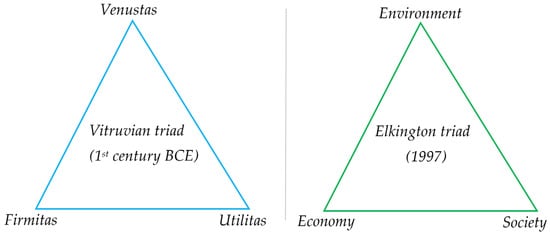
The TBL sustainability concept is usually represented by three-variable models: the social, economic, and environmental variables (Figure 1). Despite the existence of such a unified model, there is a certain degree of split in the literature with regard to the approaches of TBL, concerning whether the three aspects reinforce each other or if there are trade-offs between each of them [57,63]. Similar to the architecture knowledge tradition, concerns about the relationships, hierarchies and the subordinate nature of one pillar over the other remain a contextual issue in this triad as well. Common adaptations include coupled usage of the concepts as boarder terminologies such as “socio-economic”. Hence, key challenges pertaining to the TBL mainly include a lack of systemic measurements and a common unit of measurement among the three pillars [64,65].
Figure 1.
The common triad-representation of architecture, and sustainability knowledge traditions. Source: authors’ construct.
Despite its widespread adoption, Elkington’s framework is criticized for its conceptual ambiguity and the exclusion of critical dimensions such as governance and culture [33] and its incomplete and compartmentalized nature with some overlaps [66,67]. Hence, attempts to expand the scope TBL include themes such as politics and culture [66]. Derivatives have emerged that include governance and societal values in culture as fourth pillars, resulting in alternatives of quadruple bottom line sustainability [66,68]. Some scholars also criticize the exclusion of esthetics in sustainability discourses by arguing for the quality and poetry of life [69]. Most of these expansion attempts occur in particular domains outside of spatial studies, occurring instead in the subject areas of business and corporate sustainability [68]. However, despite these arguments and the recognized limitations, the TBL sustainability (‘three pillars’) has gained widespread acceptance as an overarching umbrella. This is typically realized as the balancing of trade-offs between seemingly equal and desirable goals within the three categorizations [59]. Below is a brief summary of the theoretical meaning and transformations of each triad element of sustainability over time (Table 2).
Table 2.
Elkington’s triad transformation summary: source—authors’ construct.
While it is a globally accepted framework, in non-industrial urbanization contexts like Ethiopia, the relative weight of TBL sustainability’s three pillars may differ fundamentally from the Global North. With a lower per capita environmental footprint but acute social and economic challenges—including the widespread informal employment and rapid urban population growth—the social and economic pillars arguably carry greater urgency [27,78]. Yet, architectural curricula in such contexts often mirror Northern models that prioritize environmental concerns, creating a potential misalignment between pedagogical focus and contextual reality [19].
1.1.3. Existing Blurs Across the Traditions: The Analytical Lens
A growing body of literature has investigated the convergence between sustainability and architectural knowledge traditions through various global models such as “sustainable architecture”, “green building”, and “circular economy” [1,11,43,44,57,77,79]. This scholarly interest has also contributed to opening further scholarly discourses and a surge of publications on sustainability in architecture [80]. Yet, these discourses remain challenged with the conceptual ambiguities inherent within both knowledge frameworks—ambiguities that become particularly evident when translated into architectural pedagogical practice. Based on the global literature, this study identifies three interrelated topics of challenge that act as theoretical anchors for analyzing and mapping such a “design–reality gap” in the specific context of Ethiopia.
Local perception issues at Architecture schools and practice: Architectural education researchers have recognized that how sustainability is assessed may reflect a “hidden curriculum” and implicit values that privilege certain knowledge dimensions over others, regardless of stated learning objectives [2,81]. Architectural educators may be more strongly influenced by globally prevailing discourses and practice norms than by relevant imperatives demanding response to contextual gaps. This gap between overt curriculum (how much they are theoretically valued) and covert curriculum (how they are practically measured) is central to understanding potential gaps between sustainability discourse and pedagogical practice. Some studies confirm that the “hidden curriculum” shapes what students really learn about sustainability more than formal statements do [1]. If unaddressed, such disparity may risk a “design–reality gap” [17] in curricular developments through a failure of relevant knowledge integrations pertinent to particular contexts [3].
This gap could be further cemented by persistent beliefs within the architectural community in its practice. While ongoing discourses suggest that ‘good architecture’ exists beyond traditional architectural triads, architects often perceive sustainability as an inherently nested value [12]. In this view, sustainability is seen as an intrinsic quality already present within architectural learning traditions, rather than a separate component requiring explicit integration. Empirical studies in the global literature witness this fact by an overwhelming advocacy for a rethinking of disciplinary boundaries, rather than treating the implementation of sustainability as a mere supplementary knowledge layer [11]. Catherine Slessor, an editor of the Architectural Review from 1992 to 2015, echoed the same attitude by arguing that the sustainability notion should be seen as a “new mandate for architecture” rather than a mere corrective force for the profession. Although debatable, these positions stem from two interrelated factors: first, the implicit values inherited and embedded in architectural pedagogy [10], and second, the significant temporal discrepancy between the two knowledge traditions. The architectural tradition dates back to the first century [32], while the sustainability tradition emerged only in the 1970s [33].
Globalized Environmentalism in sustainability and architecture: The contextual interpretation and integration of sustainability variables within architectural pedagogy remain deeply rooted and scholarly contested subjects, spanning both the educational and practical domains. Within existing architectural knowledge traditions, blurred boundaries persist, along with a disproportionate focus on the environmental pillar [6,10,82,83]. This globally prevailing environmentalism creates a ‘doctrinal skew’ where industrial context-rooted measurement models, such as LEED and BREEAM, respond only modestly to the holistic dimensions of sustainability [80]. General sustainability practice in architecture also remains focused on ecological concerns, often blaming the socio-cultural emphasis of modernism for the environmental crisis [6]. As an alternative framework, the Circular Economy (CE) principles also exhibit a lack of emphasis on the social and cultural components of sustainability, and definitional imprecision [74,77]. Established measurement systems in the built environment are also primarily focused on “green building,” framing industrialization as the primary culprit [6,57].
Environmental determinism marginalizes other sustainability dimensions through a dominantly ecological interpretation of technology and economy [5,84]. This disproportionate focus on environmentalism is equally prevalent within the African context, where pedagogical and professional discourses often mirror global technical trends [29,83,85]. Added to the challenge, the other pillar, social sustainability, is frequently simplified into narrow concepts [86].
Lack of explicit mutual frameworks: Amid the scholarly discourses regarding architecture and sustainability knowledge traditions, empirical attempts to map the apparent interplay between the two—across spatial and temporal contexts—remain limited. There is also an institutional hesitancy in integrating rigorous sustainability metrics into formal architectural education, often resulting in a lack of standardized assessment protocols in the practice [4]. In response to this conceptual disconnect between the two traditions, scholars such as Bonenberg and Kapliński [43] have attempted to identify general dilemmas within contemporary practice, driven by emerging knowledge trends and public awareness. Similarly, Peltan et al. [44] also utilized a “Six pole model” to conceptualize the theoretical border topics and intra-traditional dilemmas between architecture and sustainability knowledge traditions. Furthermore, various scholars have proposed comprehensive tools and assessment matrices designed to evaluate the intersection of the architectural and sustainability knowledge domains [39,87].
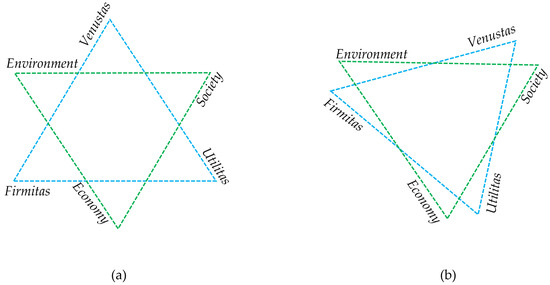
While such types of existing models highlight the trade-offs between the sustainability and architectural knowledge traditions as nascent models, they remain “Eurocentric” and contextually untested against empirical data from actual pedagogical practice elsewhere (Figure 2) Furthermore, the universal validity of the sustainability–architecture triad is increasingly challenged, as it requires rigorous scrutiny across diverse cultural, climatic, and temporal contexts [12,18].
Figure 2.
Authors’ adaptation of: (a) the “intra-traditional scheme” of architecture and sustainability [44], and (b) “Typical Dilemmas” in design paradigms and sustainability [43]. Source: Authors adaptations.
2. Materials and Methods
This study adopts a convergent parallel mixed-methods design [88] to empirically map the interplay between architectural knowledge traditions (AkT) and sustainability knowledge traditions (SkT) within the Ethiopian pedagogical context. Mixed method is preferred in this research as the nature of reality covers both the individual view and real world-based values [88]. The research design is specifically structured to portray and compare what is valued (theoretical intent) and how it is valued (pedagogical assessment) with respect to specific theoretical lenses. Both theoretical discussions and visual maps are used to portray the distance and overlaps across components of the two knowledge traditions within a specific context.
The research utilizes a content analysis of a mandatory holistic exit examination for Ethiopian architecture programs, with questionnaires administered to 37 senior instructors (N = 37) from thirteen universities, where 32 participants (n = 32) completed and returned the questionnaire, yielding a response rate of 86.5%. To ensure a better representativeness, respondents were purposively selected based on their active role of academic leadership, guiding studio, acting as department heads or course coordinators, and participation in model exit exam preparation. The 13 public universities offering architecture programs utilize a centrally harmonized curriculum; these are relatively older institutions that have already graduated several cohorts of students. Data on instructors occurred during a national workshop at Addis Ababa University, where participants, after providing their consent, completed an author-constructed template relating the “Sustainability Triad” to the “Architecture Triad” via a 5-point Likert scale ranging from 1 (negligible) to 5 (strong belief). A pilot questionnaire was reviewed among a group of four senior instructors for its content validity. Then, the questionnaire first required all the participants to indicate their general agreement regarding the perceived relationship between the two traditions. Subsequently, it required instructors to identify the specific strength of the relationship between the components of both knowledge traditions. Furthermore, the instructors were asked to provide the reasoning behind why they categorized certain relationship perceptions as either ‘negligible’ or ‘very strong’.
In addition to the instructor’s perception analysis, the second dataset utilizes “model exit examination” collected from all the thirteen universities (Table 3). While the examination contains other subjects; the scope of this research was restricted to the “architectural design theme” of the examinations, which accounts for 52% of total ECTS credits of the architecture curriculum according to the Ministry of Education’s guidelines. Theoretically, architectural design is assumed as melting pot of all subjects in a typical architectural pedagogy [7]. Analysis focused on model exit examinations available from the 2022, 2023 and 2024 academic years.
Table 3.
Technical summary of the research design.
For inter-rater reliability, an independent architect-educator with more than two decades of experience coded random samples of 50 exam questions using established theoretical rubrics based on the literature review (Table 4). This process yielded about 92% agreement on sustainability components, 88% on architecture components, and 82% on their intersection. Consequently, a Cohen’s Kappa of 0.79 was reached, signifying “substantial agreement” [89] and validating the data for subsequent analysis. Discrepancies were considered as issues that might have occurred because of existence of blur terminologies and concepts both in the exam questions and definitions of the literature.
Table 4.
Theoretical coding rubrics established for the model exam analysis. (Source: Author constructed).
Data analysis:
Both data sets were analyzed with the aid of MAXQDA 2020 (VERBI Software, 2019), a computer-assisted qualitative and mixed-methods data analysis tool used to systematically organize and analyze diverse data types, including text, images, and surveys. Both datasets were imported into MAXQDA as separate document sets. Code systems were then defined by assigning the six variables. All exam questions were coded based on the defined theoretical rubrics. Similarly, the relationship charts filled out by the instructors were meticulously coded. The Likert scale values in the charts were used as weight scores to relate the components across the variables. The software was then configured with the following settings to generate the maps:
For mapping the instructors’ perception: The minimum code frequency considered for generating relation line is 1; intersection of codes in a segment of data document analyzed; three cluster settings were requested to see the distribution; code size (dot size) reflects code frequency; background grid is OFF (for relative distance visualization).
For mapping the exam content: The minimum code frequency considered for generating relation line is 1; intersection of codes in a segment of data document analyzed; three cluster settings were requested to see the distribution; code size (dot size) reflects code frequency; background grid is OFF (for relative distance visualization).
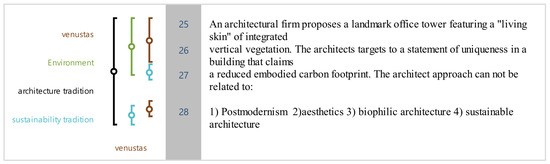
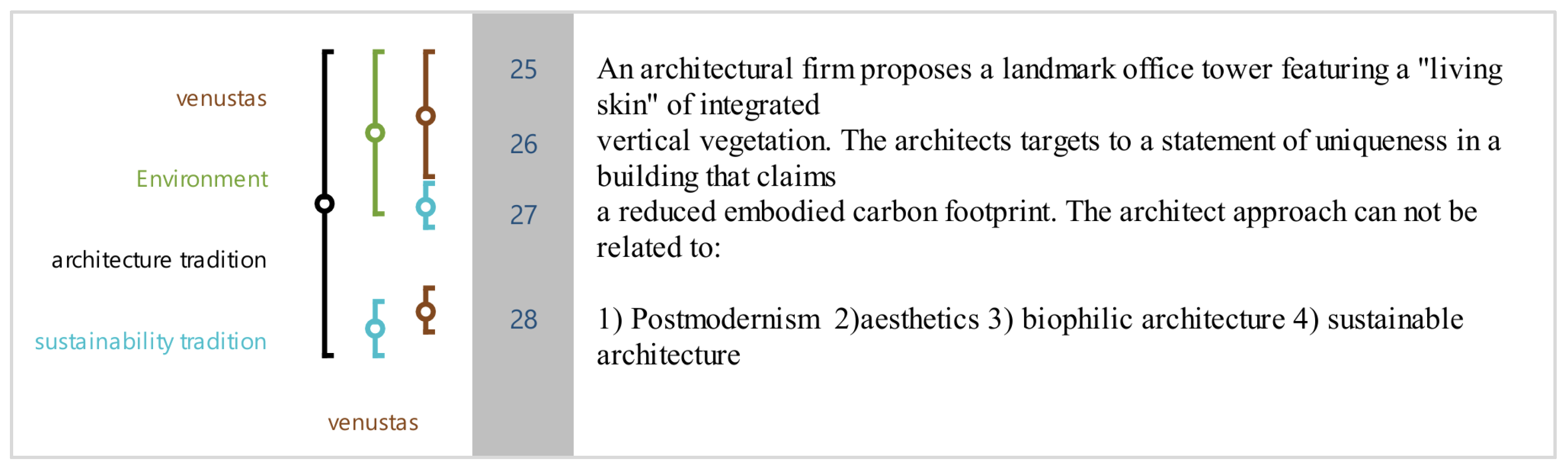
The core focuses of examination questions with respect to the six themes found in both “knowledge traditions” were systematically coded as environment, society, and economy on the TBL side; and venustas, utilitas, and firmitas on the Vitruvian triad side using MAXQDA software. The coding unit is an exam question within the model examinations (see Figure 3 below). Mutual occurrence of the themes across the two traditions, the overlapping in each unit question of the examination were systematically coded and analyzed using MAXQDA-2020 version software.
Figure 3.
Sample MAXQDA coding unit of the model examination. (Colors signify only the coded units and their corresponding segments).
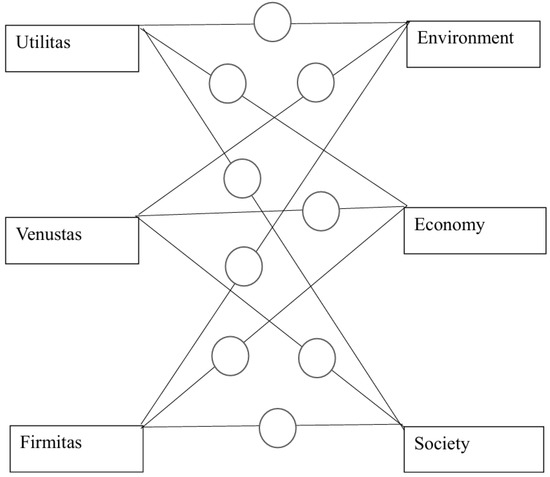
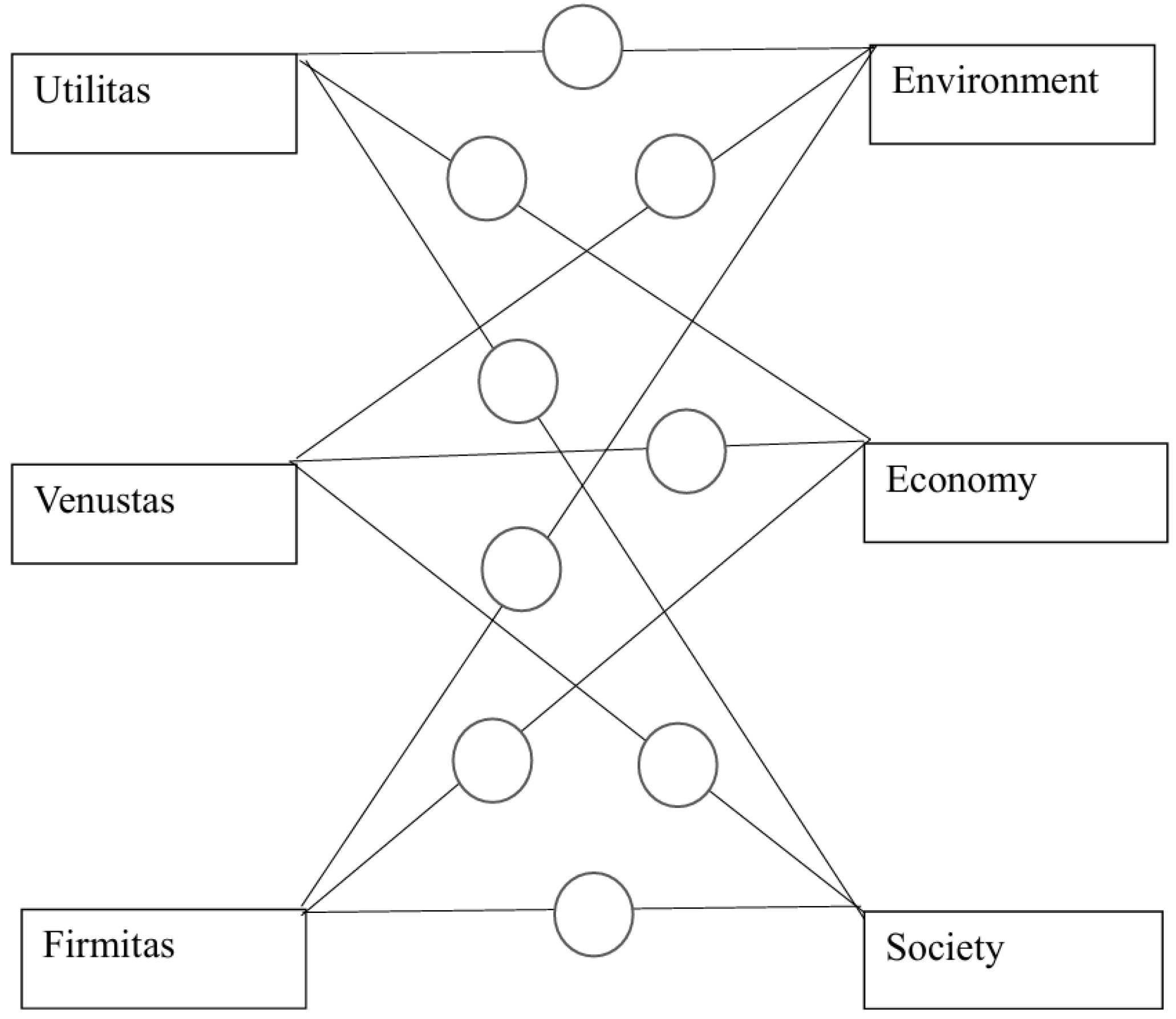
Instructors’ perceptions were collected using a diagram where they completed Likert scale manually (Figure 4).
Figure 4.
The blank relationship matrix provided to respondents for assigning their perceived complementarity between architectural and sustainability variables using a 5-point Likert scale.
Limitations and Delimitations: Model exit exams are normally prepared by the Ethiopian universities as per the recommendations of the Ministry of Education as a preparatory phase of the final version. The final version of the exit examination is a confidential document and a non-publicly accessible document. Yet, the examinations are developed anonymously by senior professionals and academics drawn from the same pool of faculty within the participating universities. Hence, existing model exit examinations developed by each university as a preparatory stage for the final nationwide exit examination were used.
The research recognizes the “difficulty of tracing what designers know” [13] as the learning environment extends beyond the formal, institutional and curricular setups [7,90]. Learning in architecture and design may also have various components beyond schools. This research considers only the school environment, content within an “overt curriculum,” [2,81], and the formal assessment models.
3. Results
The analysis revealed a significant understanding into the relationship between architecture knowledge traditions and sustainability knowledge traditions within architectural design instructors in Ethiopia. The findings also highlight specific couplings and associations between the components of each tradition, shedding light on what are referred to as “border topics” [43]. In slight contrast to nascent models being developed based on European cases [44], a protractor-shaped model which positions the six variables distributed in undefined locations, the result shows an explicit coupling of variables across the traditions instead. In this regard, generic assumptions of cross-cultural knowledge tradition often perceived as “somewhere between” were empirically clarified in the form of coupled-perceptions and relative associations of each component.
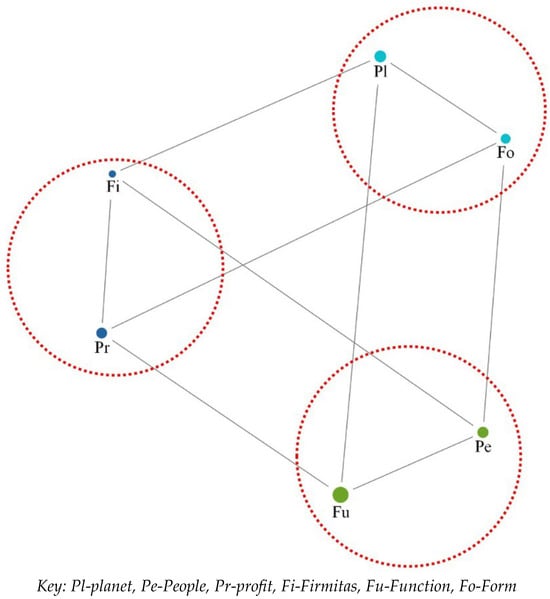
Clustered or coupled variables: Specifically, the data analysis demonstrates a consistent association between the components across the two knowledge traditions:
- -
- The Environment component (planet) and Form (Venustas)
- -
- The Economy component (profit) and Firmitas (Firmitas)
- -
- The Society component (people) and Function (Utilitas)
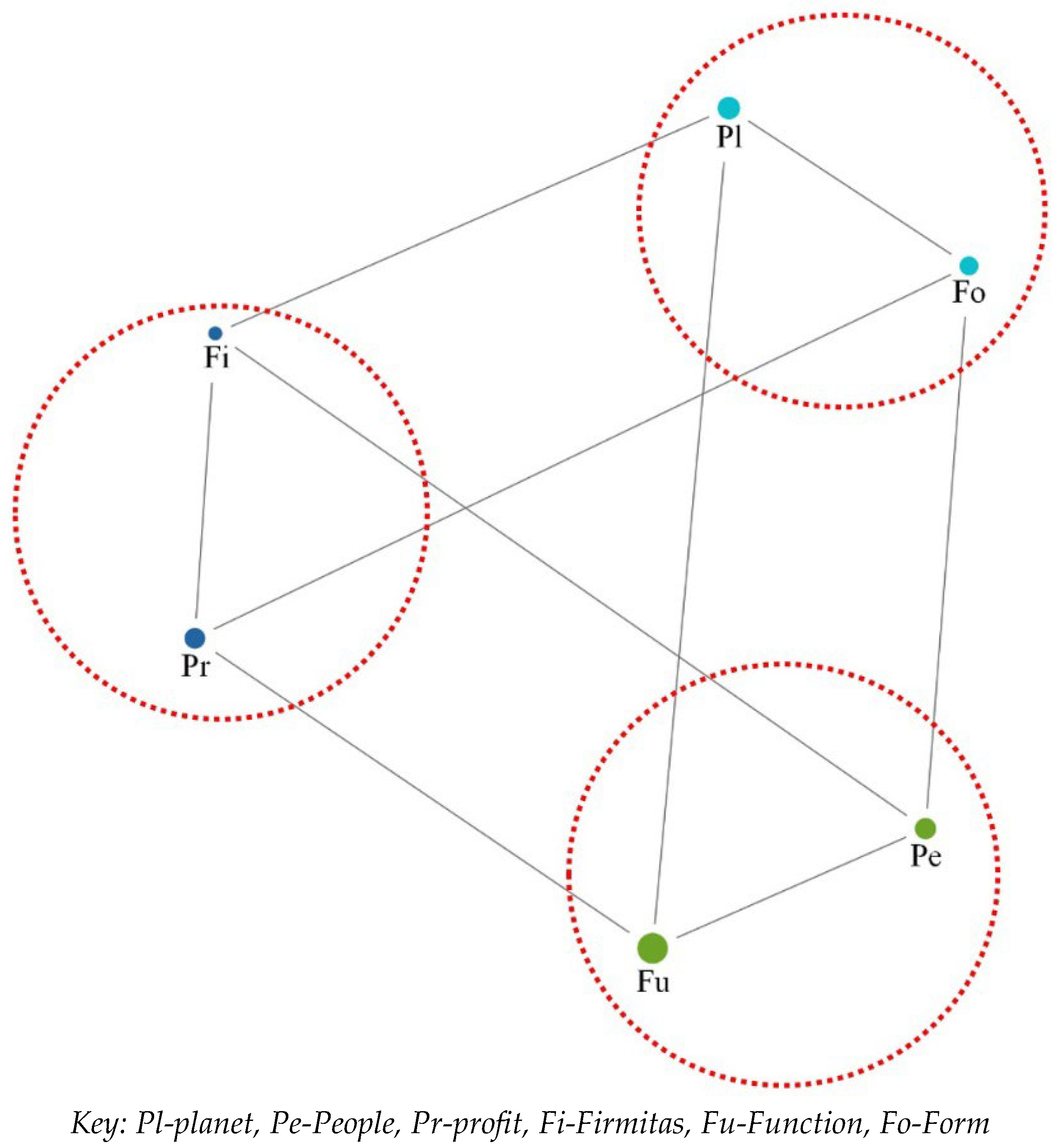
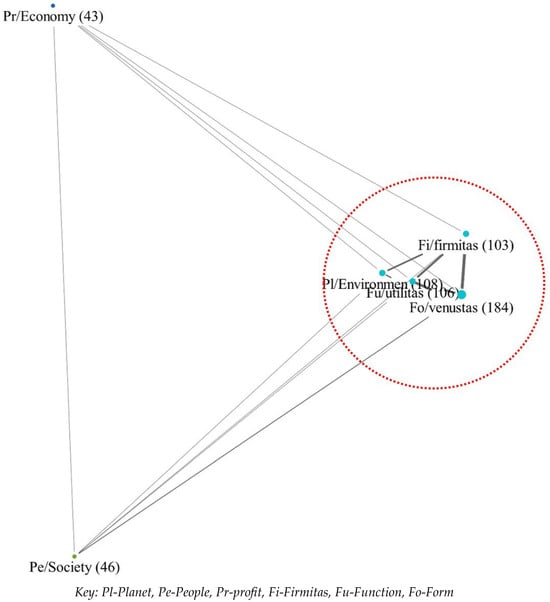
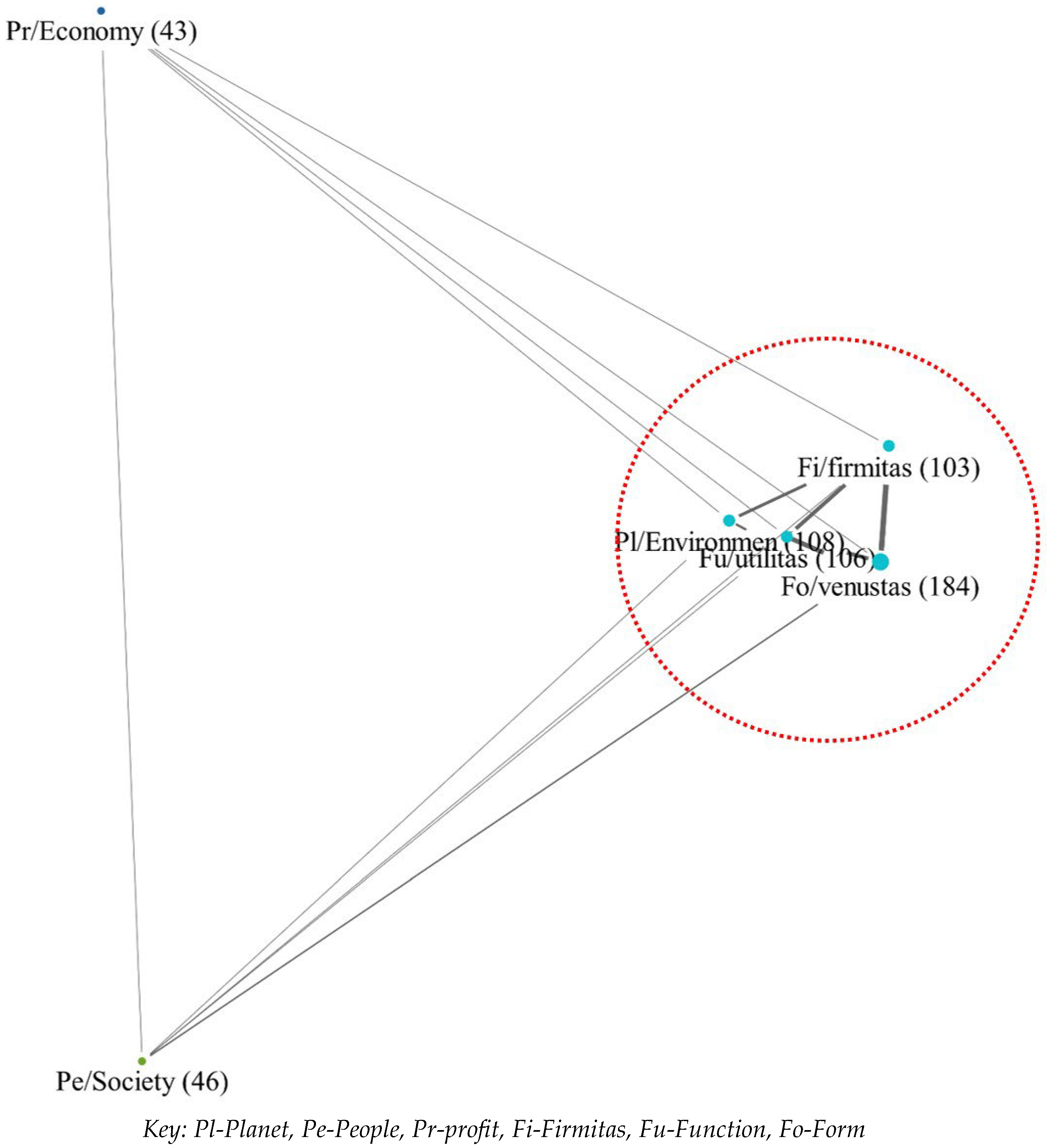
The analysis outputs of both the “instructors’ perception” (Figure 5) and “model exit examination” (Figure 6) revealed that the relationship between the two knowledge traditions does not confirm any type of perfect symmetrical relationship as presented in the theoretical models shown in Figure 2a. Given the data on the model examination, the MAXQDA analysis tool yields a map whereby the six variables are clustered as three, represented by a distinct relationship diagram (Figure 5 and Figure 6). While profiling the holistic examinations, triad components of the sustainability knowledge tradition components were rather integrated with certain corresponding triad components in the architecture knowledge tradition.
Figure 5.
MAXQDA-2020 output showing relative position of triad components in the two knowledge traditions as reflected by the instructors’ perception. Source: Authors’ own work/highlighting circles added by authors to show clusters.
Figure 6.
MAXQDA-2020 output showing relative position of triad components in the two knowledge traditions as reflected on the exist examination. Source: Authors’ own work /highlighting circles added by authors to show cluster.
It was observed that the majority of architectural design examination questions gave a relative emphasis on the form (venustas) or related aspects. Correspondingly, the relationship map from MAXQDA confirmed that all components of the architectural tradition clustered around the environmental pillar of the sustainability tradition. The findings indicated a dominant “form–environment” focus in the schools’ educational assessments, evidenced by the high relative frequency of venustas and Environment components in the exams. Conversely, the economic and social pillars were found to be distant from the general clustering of architectural knowledge components (Figure 6).
The results from both datasets confirmed a perceived complementarity between architectural and sustainability knowledge traditions. A coupling-based relationship model, rather than an assumed symmetrical relationship, was consistently confirmed by both the perception data and the content analysis of the exit examinations. Specifically, instructors’ perceptions connected environmental considerations with formal aspects of design, economic factors with structural integrity, and social concerns with functional performance. However, despite the perceived complementarity, the prevalence of specific components over others was evident in both knowledge traditions:
- -
- The Environment component: Identified through the clustering of all architectural tradition components around its core.
- -
- The Form component (Venustas): Identified as the dominant frequency in holistic assessments.
4. Discussion
This study set out to empirically map the interplay between the Vitruvian and sustainability triads in Ethiopian architectural education. The findings reveal not only a clear pattern of correspondences between specific components—environment with venustas, economy with firmitas, society with utilitas—but also a critical divergence between what instructors perceive and what assessments actually measure. This divergence, and its disproportionate weighting toward the environmental–form coupling, carries significant implications for architectural pedagogy in non-industrializing spatial contexts. The correspondences identified align with global discourses on the relationship between these knowledge domains [43,44,57,79], confirming that Ethiopian architecture educators share a conceptual framework circulating internationally. Yet, this alignment raises a central question: if the conceptual framework is shared, why does assessment practice deviate sharply from it? In order to explain such questions, it is necessary to employ the three theoretical lenses here: Local perception issues at Architecture schools and practice; Globalized Environmentalism in sustainability; and Lack of explicit mutual frameworks.
Beyond confirming complementarity between the two traditions, the research identified a primacy of the environmental pillar of TBL in the Ethiopian architectural design learning context. Such emphasis on environment and its association with form reflects an “environmental doctrine” [6]—a fixation on ecological concerns that marginalizes social and economic dimensions. This doctrinal emphasis is particularly problematic in Global South contexts like Ethiopia, where urbanization and spatial developments exhibit fundamentally different characteristics from the industrial contexts that generated this environmental focus [26,27,78,91,92]. Vandevyvere and Heynen [6] trace the environmental doctrine’s origins to modernism’s response to industrialization, a response encoded in Northern architectural curricula subsequently exported to the Global South [19]. This historical trajectory may explain the “pedagogical mirroring” observed in Ethiopian schools: instructors and assessments instinctively emphasize environment and form not because these are locally prioritized, but because they reflect inherited curricula shaped by Northern industrial challenges. This instinctive alignment resonates with a critique of “form emphasis over rationality trends” [93] in Ethiopian architectural design learning.
Therefore, while these findings overlap with global discourses, the intersections require scrutiny through the lens of temporal and place-based peculiarities rather than simple appraisal. This aligns with common scholarly reservation [31] regarding the generalization of development subjects in Third World contexts, where unique socio-spatial realities are often erased by standardized practices of global modernism. The major concerns highlighted in this regard are, first, instructors’ theoretical perception of overlap across all six components, and second, the apparent hidden curriculum being operationalized in the assessments. These reinforce the argument of globally mirrored practice perceptions and imported pedagogical cultures, respectively. Because urbanization processes diverge fundamentally between industrial and non-industrial settings [94,95], it remains questionable whether conceptual overlaps with European patterns [43,44] genuinely engage Ethiopian socio-spatial realities or merely perpetuate globalized pedagogical frameworks. Failing to bridge such “globally harmonized” notions with local realities risks cementing a Northern-centric architectural sustainability knowledge landscape that remains under-informed about the Global South.
From the perspective of the Triple Bottom Line framework, non-industrial contexts such as Ethiopia present three distinctive characteristics that challenge universalized sustainability pedagogies. First, these contexts often exhibit lower per capita environmental degradation compared to industrial urbanization [92], suggesting that the “environment–form” coupling, while significant, should not automatically assume primacy. Second, they possess culturally specific social structures and identities that resist universalization, necessitating what Parnell and Robinson [26] term the “provincialization” of intellectual space to counter hegemonic discourses. Third, while industrial urbanization drives growth through formal sectors [96]), non-industrial urbanization is characterized by a dominant informal economy that provides livelihoods for the majority [16,27,78]. These characteristics have profound implications for architectural pedagogy, demanding contextual reinterpretation [12] of each Vitruvian category.
Despite these contextual peculiarities, respondents from Ethiopian architecture schools confirmed an emphasis on the environmental pillar that mirrors the approach found in industrial contexts [6]. Consequently, the unique social and informal economic dimensions—arguably more pertinent to Ethiopian urbanization—remain peripheral in both the architectural design discussions and assessments. This neglect leaves critical questions in the architecture tradition unaddressed. What constitutes firmitas for architecture produced within an informal economy where materials, labor, and construction processes diverge from formal sector assumptions? How does utilitas accommodate livelihood activities within informal spaces of blur boundaries? Whose esthetics inform venustas when the majority of buildings are not professionalized? Furthermore, how might the coupling of society with utilitas transform in architectural practice as the social pillar evolves from basic welfare concerns toward deeper imperatives of social justice [70] or indigenous sovereignty [71]? These questions cannot be easily answered by existing frameworks developed in and for industrial contexts. These contexts require a redefinition of knowledge frameworks related to build environment as they are characterized by ephemeral architecture and kinetic urbanism [12,91]. Failure to address these realities within architectural pedagogy risks perpetuating a “design–reality gap” [17]—a disconnect between pedagogical frameworks and the contexts they assume to serve. This research underscores its findings in light of two critical points pertaining to contextual overlaps and gaps amid a converging tendency between the knowledge traditions.
4.1. Overlaps: Sites of Scrutiny
Results confirm complementarity of components across both traditions, yet this alignment warrants scrutiny as it may stem from imported curricular influences rather than contextual relevance [19]. Here, the study interrogates the identified overlaps against the lived realities of Ethiopia and similar non-industrial urbanization contexts. Notable parallelism includes the consistent positioning of Vitruvian components relative to sustainability pillars, as demonstrated in the theoretical model (Figure 2). Firmitas consistently occupies the space between economic and environmental concerns, situated within the dilemma [43] identified between “black” and “green” triads. However, the apparent skew toward a “firmitas–economy” coupling (Figure 5) clarifies an emphasis on firmness understood through economic lenses; resilience and efficiency [46]). This interpretation, while globally circulating, takes on particular significance in a context of limited resources and informal economies, where questions of economy are urgent and pervasive [27,78].
Similarly, the placement of venustas within the Environment–Venustas–Social strand replicates existing global models. While this suggests a trans-contextual consensus on form’s role in mediating ecological performance and social meaning, it also affirms the environmental pillar is closely tied to social values [63]. From the perspective of Global South urbanization contexts possessing distinctive identities [26], this positioning implies a conceptual tension between universalized formal vocabularies and local spatial practices. As understandings of the environment pillar shift from “reducing harm” toward regenerative discourses and planetary boundaries [73], localized interpretation becomes essential. This suggests venustas must be redefined not merely as visual expression with subjective dimensions [56], but as a culturally grounded protective tool [72], responsive to the unique environmental and social landscapes of the South.
The positioning of utilitas within the Social–Utilitas–Economy strand further confirms a shared conceptual framework that transcends contextual divides. This condition stretches understandings of utilitas between the critical poles of society and economy, reinscribing the dilemma between “black” and “green” triads [43]. Contemporary discourse expands utilitas beyond building functionality to include “right to access” [51] and bioclimatic efficiency [53], both of which demand contextual interpretation. These overlaps suggest that global paradigms may override contextual particularities, creating standardized approaches that dilute attention to local conditions [23]. Yet, they also reveal points of potential engagement: if utilitas can accommodate both social and economic imperatives, it may serve as a link for integrating the informal economic realities that define Ethiopian urbanization.
4.2. Gaps: Thematic and Perception Distances
The study identifies two types of gaps in how sustainability knowledge is integrated into Ethiopian architectural education. First (thematic gap), the relative distance of economic and social pillars from the architectural triad cluster (Figure 6) reveals a fundamental disconnect. While environmental concerns are integrated through the venustas-environment coupling, economic and social dimensions remain peripheral. This gap suggests that despite their critical relevance to Ethiopian and similar non-industrial urbanization [26], social and economic sustainability discourses risk isolation from architectural design learning. Such neglect reflects a “weak” sustainability discourse that fails to engage with the built environment’s actual socioeconomic realities [5]. This stands in contrast to global scholarship on sustainability moving toward integrating indigenous sovereignty [71] and context-based epistemologies [70], arguing that genuine sustainability requires centering these broader human dimensions.
The second gap is related to the distance between perception and practice. Divergence between the “overt” curriculum (what is stated and what the instructors confirmed) and the “hidden” curriculum (what is reflected in the apparent assessments focus) suggests that inherited implicit values privilege certain knowledge dimensions over others, regardless of stated learning objectives [2,10,81]. Instructors affirmed complementarity between the two knowledge areas conceptually, yet their assessment practices reflect narrower covert orientations. This pattern reflects what Kamara et al. [97] identify as a knowledge management failure: sustainability knowledge remains tacit and personal to instructors rather than codified in shared assessment practices. The result is an asset not leveraged—individual awareness that fails to transform a collective pedagogy. This translation failure from theory to practice—from what instructors believe regarding sustainability to what assessments measure—exemplifies the “design–reality gap” [17] in architectural education, reflecting the broader challenge of moving beyond imported frameworks to develop pedagogies responsive to Southern urbanization realities.
5. Conclusions
This study concludes that the interplay between the Vitruvian and Sustainability traditions, as reflected in the Ethiopian case, is not a simple matter of alignment or misalignment between triad variables. Rather, it represents a complex, intertwined phenomenon where each variable acts as an independent thread connected to specific contextual realities. The parallel empirical mapping of instructors’ theoretical perceptions against actual assessment focus reveals that structural overlaps between these triads do not inherently warrant a successful integration of sustainability knowledge. Instead, while an overt curriculum claims a balanced consideration of environmental, social, and economic pillars, an operational covert curriculum remains tethered to globalized doctrines. If left unclarified through contextual study, such pedagogical stances risk perpetuating a knowledge coloniality that is not rooted in the grassroots of local realities.
As demonstrated through this research, the dual influence of universal models in spatial studies—specifically, the Vitruvian architectural tradition and sustainability frameworks established within Northern industrial histories—remains blurred when applied to the non-industrialized urban logic of the Global South. As evidenced in the Ethiopian case, the overwhelming dominance of the environment–form coupling is not merely an isolated pedagogical choice, it is an inherited doctrine that risks the erasure of the socio-economic survival imperatives inherent to the local context. By exposing the “tip of the iceberg”—the prevailing environmental doctrinism—this study highlights a deeper structural misalignment that prioritizes ecological esthetics (Venustas–Environment dominance) over the pressing social and informal economic realities of the region.
This study argues that the transition toward a localized “sustainability–architecture knowledge tradition matrix” must move beyond superficial triad comparisons or the development of narrow measurement tools for isolated sustainability components. It requires a fundamental “provincialization” of architectural knowledge that recognizes how Firmitas, Utilitas, and Venustas manifest uniquely within diverse social and economic organizations. By exposing the friction between inherited universal frameworks and actual conditions, this research provides one case of empirical grounding necessary to dismantle the standardized norms that have historically under-informed architectural practice in non-industrial contexts.
While this work is centered on academic environments, its implications extend to the broader dilemma of professional and regulatory disconnects. Future research must move beyond the university setting to explicitly interrogate how the informal economy and socio-spatial indigenous practices can redefine the “Economic” and “Social” pillars of the architectural triad in Southern urbanism [12,91]. Ultimately, closing the current “design–reality gap” requires a transition toward a pedagogy that is both epistemologically autonomous and contextually grounded, ensuring that architectural education in the Global South is a reflection of its own realities rather than a direct mirror of distant contexts.
Author Contributions
Conceptualization, B.G.; Methodology, B.G.; Software, B.G.; Validation, Z.M. and K.W.; Formal analysis, B.G.; Investigation, B.G., Z.M. and K.W.; resources, B.G., Z.M. and K.W. Data curation, B.G.; Writing—original draft, B.G.; Writing—review & editing, B.G., Z.M. and K.W.; Visualization, B.G.; Supervision, Z.M. and K.W.; Project administration, B.G., Z.M. and K.W. All authors have read and agreed to the published version of the manuscript.
Funding
This research received no external funding.
Institutional Review Board Statement
This study involved a voluntary and anonymous survey concerning the architectural education curriculum, which posed minimal risk and involved no sensitive personal or medical data. In accordance with local institutional research norms, the study followed all protocols stipulated in the Addis Ababa University Research & Innovation Policy & Strategy regarding ‘Research Involving Human Subjects’ (6.3.3.1 to 6.3.3.9).
Informed Consent Statement
Informed consent was obtained from all subjects involved in the study.
Data Availability Statement
The data presented in this study are available on request from the corresponding author. Certain portions of the data, specifically the holistic model examination datasets, may require official institutional consent.
Conflicts of Interest
The authors declare no conflict of interest.
References
- Park, H.Y.; Licon, C.V.; Sleipness, O.R. Teaching Sustainability in Planning and Design Education: A Systematic Review of Pedagogical Approaches. Sustainability 2022, 14, 9485. [Google Scholar] [CrossRef] [Scilit]
- Roberts, A.; Pearce, M.; Lieberman, O.; Matzica, W. The development of values in the studio: A hidden curriculum. In Changing Trends in Architectural Design Education; Csaar: Amman, Jordan, 2006; pp. 469–476. [Google Scholar]
- Salama, A.M. A theory for integrating knowledge in architectural design education. ArchNet-IJAR Int. J. Archit. Res. 2008, 2, 100–128. [Google Scholar] [CrossRef] [Scilit]
- Hassanpour, B.; Alpar Atun, R.; Ghaderi, S. From Words to Action: Incorporation of Sustainability in Architectural Education. Sustainability 2017, 9, 1790. [Google Scholar] [CrossRef] [Scilit]
- Lami, I.M.; Mecca, B. Assessing Social Sustainability for Achieving Sustainable Architecture. Sustainability 2020, 13, 142. [Google Scholar] [CrossRef] [Scilit]
- Vandevyvere, H.; Heynen, H. Sustainable development, architecture and modernism: Aspects of an ongoing controversy. Arts 2014, 3, 350–366. [Google Scholar] [CrossRef] [Scilit]
- Schön, D.A. The reflective practitioner: How professionals think in action. In The Reflective Practitioner; Routledge: London, UK, 1992. [Google Scholar] [CrossRef] [Scilit]
- McGrath, B. (Ed.) Urban Design Ecologies: AD Reader; John Wiley & Sons: Hoboken, NJ, USA, 2013. [Google Scholar]
- Rossi, A. The Architecture of the City; MIT Press: Cambridge, UK, 1984. [Google Scholar]
- Grover, R.; Emmitt, S.; Copping, A. Critical learning for sustainable architecture: Opportunities for design studio pedagogy. Sustain. Cities Soc. 2020, 53, 101876. [Google Scholar] [CrossRef] [Scilit]
- Dhaouadi, K.; Leclercq, P. Rethinking architectural education to foster Sustainability: Literature Review of emerging trends and pedagogical approaches. In Proceedings of the 10th International Conference on Higher Education Advances (HEAd’24), Valencia, Spain, 18–21 June 2024. [Google Scholar] [CrossRef] [Scilit]
- Fisher, S. On Guyer’s Vitruvian Normativity. Estet. Eur. J. Aesthet. 2024, 61, 81–89. [Google Scholar] [CrossRef] [Scilit]
- Lawson, B. What Designers Know; Routledge: London, UK, 2004. [Google Scholar]
- Fay, M.; Opal, C. Urbanization Without Growth: A Not-So-Uncommon Phenomenon; World Bank Policy Research Working Paper; World Bank: Washington, DC, USA, 2000. [Google Scholar] [CrossRef] [Scilit]
- Seto, K.C.; Parnell, S.; Elmqvist, T. A global outlook on urbanization. In Urbanization, Biodiversity and Ecosystem Services: Challenges and Opportunities; Springer: Berlin/Heidelberg, Germany, 2013. [Google Scholar] [CrossRef] [Scilit]
- Simone, A. For the City Yet to Come: Changing African Life in Four Cities; Duke University Press: London, UK, 2004. [Google Scholar] [CrossRef] [Scilit]
- Heeks, R. Information systems and developing countries: Failure, success, and local improvisations. Inf. Soc. 2002, 18, 101–112. [Google Scholar] [CrossRef] [Scilit]
- Ibrahimi, M.O.; Gargab, F.Z.; Kousksou, T.; Jamil, A. Urban Sustainability Through Traditional Architecture: A New Combo of Culture, Energy Efficiency and Resilience in Morocco. Urban Sci. 2025, 9, 435. [Google Scholar] [CrossRef] [Scilit]
- Olweny, M. Architectural education in sub-Saharan Africa: An investigation into pedagogical positions and knowledge frameworks. J. Archit. 2020, 25, 717–735. [Google Scholar] [CrossRef] [Scilit]
- Anshebo, M.A.; Mengesha, W.J.; Sokido, D.L. Developing a Green Building Assessment Tool for Ethiopia. Heliyon 2022, 8, e10569. [Google Scholar] [CrossRef] [Scilit] [PubMed]
- Gashaw, R.; Belay, S.; Gizat, A.; Hailu, S.; Rokooei, S.; Matos, J. Development of an integrative green building rating system for the Ethiopian public building projects using analytic hierarchy process. Cogent Eng. 2023, 10, 2283324. [Google Scholar] [CrossRef] [Scilit]
- Yigzaw, M.; Woldesenbet, A.; Shiferaw, A.; Belay, S. Assessment of Sustainability Practices in Recently Constructed Commercial Buildings in Ethiopia. Buildings 2025, 15, 3915. [Google Scholar] [CrossRef] [Scilit]
- Mastrángelo, M.E.; Pérez-Harguindeguy, N.; Enrico, L.; Bennett, E.; Lavorel, S.; Cumming, G.S.; Abeygunawardane, D.; Amarilla, L.D.; Burkhard, B.; Egoh, B.N.; et al. Key knowledge gaps to achieve global sustainability goals. Nat. Sustain. 2019, 2, 1115–1121. [Google Scholar] [CrossRef] [Scilit]
- Escobar, A. Designs for the Pluriverse: Radical Interdependence, Autonomy, and the Making of Worlds; Duke University Press: London, UK, 2018. [Google Scholar]
- De Carvalho, J.J. The Meeting of Knowledges in the Universities. In The Routledge Companion to Architectural Pedagogies of the Global South, 1st ed.; Routledge: London, UK, 2022; pp. 67–76. [Google Scholar] [CrossRef] [Scilit]
- Parnell, S.; Robinson, J. (Re)theorizing cities from the Global South: Looking beyond neoliberalism. Urban Geogr. 2012, 33, 593–617. [Google Scholar] [CrossRef] [Scilit]
- Todaro, M.P.; Smith, S.C. Economic Development; Pearson: Hong Kong, China, 2015. [Google Scholar]
- Mignolo, W.D. DELINKING: The rhetoric of modernity, the logic of coloniality and the grammar of de-coloniality. Cult. Stud. 2007, 21, 449–514. [Google Scholar] [CrossRef] [Scilit]
- Olweny, M.R.O. Questioning conventions of Western architectural pedagogy in East Africa. In The Routledge Companion to Architectural Pedagogies of the Global South, 1st ed.; Routledge: London, UK, 2022; pp. 330–339. [Google Scholar] [CrossRef] [Scilit]
- McGrath, B. Crypto-colonialism and the internationalization of architectural education. In The Routledge Companion to Architectural Pedagogies of the Global South, 1st ed.; Routledge: London, UK, 2022; pp. 301–314. [Google Scholar] [CrossRef] [Scilit]
- Escobar, A. Encountering Development: The Making and Unmaking of the Third World; Princeton University Press: Princeton, NJ, USA, 2012. [Google Scholar] [CrossRef] [Scilit]
- Morgan, M.H. Vitruvius, The Ten Books on Architecture; Harvard University Press: Cambridge, UK, 1914. [Google Scholar] [CrossRef] [Scilit] [PubMed]
- Meadows, D.H.; Meadows, D.L.; Randers, J.; Behrens, W.W. The Limits to Growth: A Report for the Club of Rome’s Project on the Predicament of Mankind; Universe Books: New York, NY, USA, 1972. [Google Scholar] [CrossRef] [Scilit]
- Capon, D.S. Architectural Theory: The Vitruvian Fallacy, a History of the Categories in Architecture and Philosophy (V-1); John Wiley & Sons: Hoboken, NJ, USA, 2000. [Google Scholar]
- Marchwiński, J.; Lucchi, E. Firmitas, Utilitas, and Venustas of photovoltaic architecture. Sol. Energy 2024, 282, 112974. [Google Scholar] [CrossRef] [Scilit]
- Gropius, W. Scope of Total Architecture; Routledge: London, UK, 1956. [Google Scholar] [CrossRef] [Scilit]
- Corbusier, L. Towards a New Architecture; Courier Corporation: North Chelmsford, MA, USA, 1927. [Google Scholar]
- Venturi, R. Complexity and Contradiction in Architecture; Museum of Modern Art: New York, NY, USA, 1977; Volume 1. [Google Scholar]
- Selim, H.S.; Mayhoub, M.; Abuzaid, A. Reinterpreting the Vitruvian model in contemporary architectural education: Integrating empirical insights from five schools of architecture. Front. Educ. 2025, 10, 1528083. [Google Scholar] [CrossRef] [Scilit]
- Clarke, N.; Kuipers, M.C. Acknowledging the dignity of architectural heritage: Adding a fourth virtue to the Vitruvian triad. Athens J. Archit. 2023, 9, 257–280. [Google Scholar] [CrossRef] [Scilit]
- Fiamma, P. Firmitas-Utilitas-Venustas……. “Digital-as”(?). In Who Cares(?): Second International Conference on Critical Digital; Terzidis, K., Ed.; Arnus University Book: Cambridge, MA, USA, 2012; pp. 221–225. [Google Scholar]
- Holl, S.; Pallasmaa, J.; Pérez-Gómez, A. Questions of Perception: Phenomenology of Architecture; William Stout: San Francisco, CA, USA, 1994. [Google Scholar]
- Bonenberg, W.; Kapliński, O. The architect and the paradigms of sustainable development: A review of dilemmas. Sustainability 2018, 10, 100. [Google Scholar] [CrossRef] [Scilit]
- Peltan, T.; Klápště, P.; Hainc, J.; Jaroš, J.; Bečka, M.; Tuček, I. On traditions of architecture and sustainable development: Towards synthesis. In Sborník příspěvků: Workshop W4-2012; České vysoké učení technické v Praze: Prague, Czech Republic, 2012; pp. 106–113. Available online: https://www.researchgate.net/publication/320211767_ON_TRADITIONS_OF_ARCHITECTURE_AND_SUSTAINABLE_DEVELOPMENT_TOWARDS_SYNTHESIS (accessed on 1 December 2025).
- Adam, J.-P. Roman Building: Materials and Techniques; Routledge: London, UK, 1995. [Google Scholar] [CrossRef] [Scilit]
- Billington, D.P. The Tower and the Bridge: The New art of Structural Engineering; Princeton University Press: Princeton, NJ, USA, 1985. [Google Scholar]
- Cernaro, A.; Fiandaca, O.; Lione, R.; Minutoli, F. The Analysis of the Maintained/Disowned Relationship among Firmitas, Utilitas, and Venustas to Preserve the Cultural Heritage: An H-BIM Approach for the Management of Historic Buildings. Buildings 2023, 13, 1045. [Google Scholar] [CrossRef] [Scilit]
- Jung, H.T. Kenneth Frampton, modern architecture: A critical history. Ardeth Mag. Power Proj. 2022, 10–11, 344–345. [Google Scholar] [CrossRef] [Scilit]
- Kruft, H.W. A History of Architectural Theory: From Vitruvius to the Present; Princeton Architectural Press: Princeton, NJ, USA, 1994. [Google Scholar]
- Viollet-le-Duc, E.E. The Architectural Theory of Viollet-le-Duc: Readings and Commentary; Mit Press: Cambridge, MA, USA, 1990. [Google Scholar] [CrossRef] [Scilit]
- Imrie, R. Universalism, universal design and equitable access to the built environment. Disabil. Rehabil. 2012, 34, 873–882. [Google Scholar] [CrossRef] [Scilit] [PubMed]
- Rykwert, J. The Dancing Column: On Order in Architecture; MIT Press: Cambridge, MA, USA, 1996. [Google Scholar]
- Yeang, K. Designing with Nature: The Ecological Basis for Architectural Design; McGraw-Hill: Columbus, OH, USA, 1995. [Google Scholar]
- O’Gorman, F. Ruskin’s Aesthetic of Failure in The Stones of Venice. Rev. Engl. Stud. 2004, 55, 374–391. [Google Scholar] [CrossRef] [Scilit]
- Onians, J. Bearers of Meaning: The Classical Orders in Antiquity, the Middle Ages, and the Renaissance; Princeton University Press: Princeton, NJ, USA, 1988. [Google Scholar] [CrossRef] [Scilit]
- Pallasmaa, J. The Eyes of the Skin: Architecture and the Senses; John Wiley & Sons: Hoboken, NJ, USA, 2005. [Google Scholar]
- Eklová, K. Sustainability of buildings: Environmental, economic and social pillars. Bus. IT 2020, 10, 2–11. [Google Scholar] [CrossRef] [Scilit]
- Komiyama, H.; Takeuchi, K. Sustainability science: Building a new discipline. Sustain. Sci. 2006, 1, 1–6. [Google Scholar] [CrossRef] [Scilit]
- Purvis, B.; Mao, Y.; Robinson, D. Three pillars of sustainability: In search of conceptual origins. Sustain. Sci. 2018, 14, 681–695. [Google Scholar] [CrossRef] [Scilit]
- Elkington, J. The triple bottom line. Environ. Manag. Read. Cases 1997, 2, 49–66. [Google Scholar]
- Henriques, A. Corporate Truth: The Limits to Transparency; Routledge: London, UK, 2007. [Google Scholar] [CrossRef] [Scilit]
- Stiglitz, J.E. People, Power, and Profits: Progressive Capitalism for an Age of Discontent; Penguin UK: London, UK, 2019. [Google Scholar]
- Murphy, K. The social pillar of sustainable development: A literature review and framework for policy analysis. Sustain. Sci. Pract. Policy 2012, 8, 15–29. [Google Scholar] [CrossRef] [Scilit]
- Slaper, T.F.; Hall, T.J. The triple bottom line: What is it and how does it work? Indiana Bus. Rev. 2011, 86, 4–8. [Google Scholar]
- Sridhar, K.; Jones, G. The three fundamental criticisms of the Triple Bottom Line approach: An empirical study to link sustainability reports in companies based in the Asia-Pacific region and TBL shortcomings. Asian J. Bus. Ethics 2013, 2, 91–111. [Google Scholar] [CrossRef] [Scilit]
- Hawkes, J. The Fourth Pillar of Sustainability: Culture’s Essential Role in Public Planning; Common Ground: Thane, MA, USA, 2001. [Google Scholar]
- Lozano, R. Envisioning sustainability three-dimensionally. J. Clean. Prod. 2008, 16, 1838–1846. [Google Scholar] [CrossRef] [Scilit]
- Budsaratragoon, P.; Jitmaneeroj, B. Measuring causal relations and identifying critical drivers for corporate sustainability: The quadruple bottom line approach. Meas. Bus. Excell. 2019, 23, 292–316. [Google Scholar] [CrossRef] [Scilit]
- Kagan, S. Aesthetics of sustainability. In Art and Sustainability: Connecting Patterns for a Culture of Complexity; Transcript Verlag: Bielefeld, Germany, 2011; pp. 217–268. [Google Scholar] [CrossRef] [Scilit]
- Kothari, A.; Salleh, A.; Escobar, A.; Demaria, F.; Acosta Espinosa, A. Pluriverse: A Post-Development Dictionary; Tulika Books: New Delhi, India, 2019. [Google Scholar] [CrossRef] [Scilit]
- Whyte, K. Indigenous environmental justice: Anti-colonial action through kinship. In Environmental Justice; Routledge: London, UK, 2020; pp. 266–278. [Google Scholar] [CrossRef] [Scilit]
- Reed, B. Shifting from ‘sustainability’ to regeneration. Build. Res. Inf. 2007, 35, 674–680. [Google Scholar] [CrossRef] [Scilit]
- Rockström, J.; Steffen, W.; Noone, K.; Persson, Å.; Chapin, F.S.; Lambin, E.F.; Lenton, T.M.; Scheffer, M.; Folke, C.; Schellnhuber, H.J.; et al. A safe operating space for humanity. Nature 2009, 461, 472–475. [Google Scholar] [CrossRef] [Scilit] [PubMed]
- Kirchherr, J.; Reike, D.; Hekkert, M. Conceptualizing the circular economy: An analysis of 114 definitions. Resour. Conserv. Recycl. 2017, 127, 221–232. [Google Scholar] [CrossRef] [Scilit]
- Kramer, M.R.; Porter, M. Creating Shared Value: How to Reinvent Capitalism—And Unleash a Wave of Innovation and Growth; FSG: Boston, MA, USA, 2011; Volume 17. [Google Scholar] [CrossRef] [Scilit]
- Mandičák, T.; Spišáková, M.; Mésároš, P.; Kozlovská, M. Design of economic sustainability supported by enterprise resource planning systems in architecture, engineering, and construction. Buildings 2022, 12, 2241. [Google Scholar] [CrossRef] [Scilit]
- Patil, M.P.; Butt, A.N.; Rigoni, C.; Salama, A.M. Integrating Circular Economy Principles into Architectural Design Pedagogy. Sustainability 2025, 17, 9330. [Google Scholar] [CrossRef] [Scilit]
- Lorato, T.; Tadesse, T.; Mamo, Y.A.; Getinet, B. The urban informal sector as a means of livelihood improvement among youth: Evidence from Hawassa city, Ethiopia. Cogent Econ. Finance 2023, 11, 2185346. [Google Scholar] [CrossRef] [Scilit]
- Feria, M.; Amado, M. Architectural design: Sustainability in the decision-making process. Buildings 2019, 9, 135. [Google Scholar] [CrossRef] [Scilit]
- Bhaskaran, A.S.; Kumarankutty, A.P.; Kurukkanari, C. Traditional architectural knowledge systems and the sustainable development goals. In The Elgar Companion to the Built Environment and the Sustainable Development Goals; Edward Elgar Publishing: Cheltenham, UK, 2024; pp. 420–438. [Google Scholar] [CrossRef] [Scilit]
- Liow, Z. “… This is how things are done”: Dismantling the master-and-apprentice design pedagogy fallacy with social support and growth mindset. In LEARNx Design Conference Series. Singapore Polytechnic; National University of Singapore: Singapore, 2023. [Google Scholar] [CrossRef] [Scilit]
- Abdellatif, M.; Al-Shamma’a, A. Review of sustainability in buildings. Sustain. Cities Soc. 2015, 14, 171–177. [Google Scholar] [CrossRef] [Scilit]
- El-Kholei, A.O.; Yassein, G.A. Embedding sustainability and SDGs in architectural and planning education: Reflections from a KAP survey, Egypt. Archnet-IJAR Int. J. Archit. Res. 2023, 17, 459–477. [Google Scholar] [CrossRef] [Scilit]
- Dusek, V. Philosophy of Technology: An Introduction; Blackwell: Oxford, UK, 2006; Volume 90. [Google Scholar]
- Mba, E.J.; Okeke, F.O.; Igwe, A.E.; Ozigbo, C.A.; Oforji, P.I.; Ozigbo, I.W. Evolving trends and challenges in sustainable architectural design; a practice perspective. Heliyon 2024, 10, e39400. [Google Scholar] [CrossRef] [Scilit] [PubMed]
- Cole, R.J. Building environmental assessment methods: Redefining intentions and roles. Build. Res. Inf. 2005, 33, 455–467. [Google Scholar] [CrossRef] [Scilit]
- Martínez-Ventura, J.; de-Miguel-Arbonés, E.; Sentieri-Omarrementería, C.; Galan, J.; Calero-Llinares, M. A Tool to Assess Architectural Education from the Sustainable Development Perspective and the Students’ Viewpoint. Sustainability 2021, 13, 9596. [Google Scholar] [CrossRef] [Scilit]
- Creswell, J.W.; Clark, V.P. Designing and Conducting Mixed Methods Research, 3rd ed.; SAGE Publications: Thousand Oaks, CA, USA, 2017. [Google Scholar]
- Landis, J.R.; Koch, G.G. The measurement of observer agreement for categorical data. Biometrics 1977, 33, 159–174. [Google Scholar] [CrossRef] [Scilit]
- Kolb, D.A. Experiential Learning: Experience as the Source of Learning and Development; Prentice-Hall: Hoboken, NJ, USA, 1984. [Google Scholar]
- Mehrotra, R. RAHOUL MEHROTRA—The Kinetic City & Other Essays. ZARCH 2024, 22, 226. [Google Scholar] [CrossRef] [Scilit]
- Rees, W.E. Ecological footprints and appropriated carrying capacity: What urban economics leaves out. Environ. Urban. 1992, 4, 121–130. [Google Scholar] [CrossRef] [Scilit]
- Bashir, F. Reflections on architectural design education: The return of rationalism in the studio. Front. Archit. Res. 2014, 3, 424–430. [Google Scholar] [CrossRef] [Scilit]
- Gollin, D.; Jedwab, R.; Vollrath, D. Urbanization with and without industrialization. J. Econ. Growth 2016, 21, 35–70. [Google Scholar] [CrossRef] [Scilit]
- Schindler, S. Towards a paradigm of Southern urbanism. City 2017, 21, 47–64. [Google Scholar] [CrossRef] [Scilit]
- Henderson, J.V. The urbanization process and economic growth: The so-what question. J. Econ. Growth 2003, 8, 47–71. [Google Scholar] [CrossRef] [Scilit]
- Kamara, J.; Augenbroe, G.; Anumba, C.; Carrillo, P. Knowledge management in the architecture, engineering and construction industry. Constr. Innov. Inf. Process Manag. 2002, 2, 53–67. [Google Scholar] [CrossRef] [Scilit]

Disclaimer/Publisher’s Note: The statements, opinions and data contained in all publications are solely those of the individual author(s) and contributor(s) and not of MDPI and/or the editor(s). MDPI and/or the editor(s) disclaim responsibility for any injury to people or property resulting from any ideas, methods, instructions or products referred to in the content. |
© 2026 by the authors. Licensee MDPI, Basel, Switzerland. This article is an open access article distributed under the terms and conditions of the Creative Commons Attribution (CC BY) license.