
Skip Content
You are currently on the new version of our website. Access the old version .

Microplastics, Volume 5, Issue 1

2026 March - 23 articles

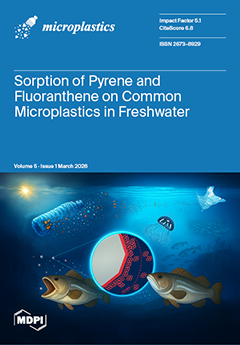
Cover Story: In freshwater environments, microplastics regularly interact with dissolved hydrophobic organic pollutants, which is an interaction that determines their environmental fate. This work demonstrates that common microplastics can adsorb significant quantities of priority polycyclic aromatic hydrocarbons under relevant environmental conditions, i.e., at low particle concentrations. Although all materials were good adsorbers, polyolefin particles showed the greatest capacity. Chemisorption at the microplastic surface is kinetically controlled by the transport of pollutants through the hydrodynamic boundary layer surrounding the microparticle. These findings suggest that microplastics actively influence the movement of pollutants and their degree of toxicity in aquatic environments. View this paper
  • Issues are regarded as officially published after their release is announced to the table of contents alert mailing list .
  • You may sign up for email alerts to receive table of contents of newly released issues.
  • PDF is the official format for papers published in both, html and pdf forms. To view the papers in pdf format, click on the "PDF Full-text" link, and use the free Adobe Reader to open them.

Articles (23)

  • Article
  • Open Access

Quantification of Microplastics in Treated Drinking Water Using µ-FT-IR Spectroscopy: A Case Study from Northeast Italy

  • Giulia Dalla Fontana,
  • Davide Lamprillo,
  • Francesca Dotti,
  • Ada Ferri,
  • Tommaso Foccardi and
  • Raffaella Mossotti

Microplastics spread through the environment in various ways. Inland waters are an ideal medium for their dispersal, as they collect pollutants from various sources and transport them over long distances. From there, microplastics can enter the marin...

  • Review
  • Open Access

Micro- and nanoplastics (MNPs) are a new type of pollutant that are widely present in terrestrial ecosystems due to agricultural plastics, sludge use, deposition, and litter degradation. Plants can absorb them through the soil and atmosphere, with ad...

  • Article
  • Open Access

Separation and Quantification of Microplastics in Black Sea Water Using a Combination of Countercurrent Chromatography and Pyro-GC-MS

  • Mikhail Ermolin,
  • Alexandr Ivaneev,
  • Elena Savonina,
  • Rustam Dzhenloda,
  • Tatiana Maryutina and
  • Petr Fedotov

Development of novel methods for the separation, characterization, and analysis of microplastics is an urgent task. Countercurrent chromatography (CCC) has been proven to be an efficient method for the separation and preconcentration of microplastics...

  • Review
  • Open Access

Beyond Microplastics: Analytical Boundaries, Real-World Barriers, and the Possibilities for Scalable Removal

  • Danka Kiperović,
  • Dimitrije Mara,
  • Saša Đurović,
  • Gordana Racić,
  • Igor Vukelić,
  • Ana R. M. Mendes and
  • Jovana Vunduk

Plastic has transitioned rapidly from a revolutionary material to a global environmental concern, primarily due to mismanagement. Synthetic polymers have quickly gained widespread use due to their versatility, durability, and affordability. However,...

  • Article
  • Open Access
71 Views
16 Pages

An Easily Adopted Workflow for the Preparation, Filtration, and Quantification of Microplastic Standards

  • Karima Mohamadin,
  • Samraa Smadi,
  • Keyla Correia,
  • Dejun Chen,
  • Mostafa M. Nasr and
  • Jesse Meiller

Microplastic (MP) pollution poses an emerging environmental concern, yet current methods for isolation and quantification are often time-consuming, costly, and poorly adapted to real-world variability. In this study, a workflow for the preparation, f...

  • Review
  • Open Access
103 Views
23 Pages

Plastic Microbead Accumulation in Our Freshwaters: North American Great Lakes Assessments and Perspectives

  • Mary Torrance,
  • Emma Gillies,
  • Tristan H. Borchers,
  • Avery Shoemaker,
  • Clarisse Chiche-Lapierre and
  • Christopher J. Barrett

Plastic microbeads, widely incorporated into personal care and cleansing products, have emerged as a pervasive contaminant in freshwater systems, including in North America. Historical estimates indicate that North American consumers alone contribute...

  • Article
  • Open Access
192 Views
20 Pages

Atmospheric deposition of microplastics (MPs) contributes to the contamination of both terrestrial and aquatic environments. Roads show high MP deposition, yet the factors influencing the deposition rate and characteristics (polymer types and sizes)...

  • Review
  • Open Access
151 Views
15 Pages

Research Progress on the Effects of Combined Microplastics and Cadmium Pollution on Plants

  • Jiaxu Zheng,
  • Xiyuan Wang,
  • Lingli Ren,
  • Youqian Zhai,
  • Lei Liu,
  • Zijun Xu and
  • Qingdong Shi

The toxic effects of soil heavy metals and microplastics on plants have been extensively documented, with some researchers having conducted studies exploring the combination of these two factors. Preliminary findings indicate that their combined acti...

  • Article
  • Open Access
287 Views
34 Pages

Seasonal and Cross-Shore Assessment of Large and Small Microplastics Collected on the Ferrara Coast (Italy)

  • Joana Buoninsegni,
  • Giorgio Anfuso,
  • Umberto Tessari,
  • Valentina Giro,
  • Elena Marrocchino and
  • Carmela Vaccaro

Microplastic (MP) contamination along coastlines is a globally recognized environmental concern. This paper investigates the seasonal and cross-shore distribution of large and small microplastics (LMPs and SMPs) at four sites along the Ferrara coast...

  • Article
  • Open Access
246 Views
28 Pages

From Antioxidant Defenses to Transcriptomic Signatures: Concentration-Dependent Responses to Polystyrene Nanoplastics in Reef Fish

  • Manuela Piccardo,
  • Mirko Mutalipassi,
  • Lucia Pittura,
  • Rosa Maria Sepe,
  • Pasquale De Luca,
  • Laurence Besseau,
  • Monia Renzi,
  • Stefania Gorbi,
  • Vincent Laudet and
  • Antonio Terlizzi
  • + 2 authors

Nanoplastics (NPs) pose significant risks due to their small size and ability to penetrate biological tissues. However, the molecular pathways and cellular mechanisms affected by NP exposure in marine teleosts remain poorly understood, especially in...

of 3

Get Alerted

Add your email address to receive forthcoming issues of this journal.

XFacebookLinkedIn
Microplastics - ISSN 2673-8929