Abstract
Synthetic plastics are polymers that are largely produced worldwide, impacting ecosystems and human health. Microplastics are produced from fragmentation and degradation of larger plastics, as a consequence of environmental factors. Low-density polyethylene (LDPE) and polypropylene (PP) are plastic polymers acting as environmental hazards. Challenges in effective plastic waste management include sustainable and environmentally responsible approaches like microbial degradation. In this work, a shotgun metagenomic approach has been applied to analyze the response of the microorganisms living on plastic surfaces (plastispheres) of LDPE and PP to biodeterioration of these plastics (BioProject-NCBI, PRJNA1378224). Low-density polyethylene and polypropylene materials were collected from a waste landfill of intensive greenhouse agriculture. A further functional analysis supported putative roles of enzymes that could be involved in the initial steps of biodeterioration of LDPE and PP, including sarcosine oxidases; bromo- and chloro-peroxidases; cytochrome P450 and alkane monooxygenases; and multicopper oxidases. A CheckM analysis of genes that code for these oxidative enzymes revealed that they were mainly from the bacterial Phyllobacterium genus (Rhizobiaceae family) and, in less abundance, from the archaeon Methanoculleus genus (Methanoculleaceae family). This study supports putative roles of sarcosine oxidases and bromoperoxidases, and other relevant enzymes, in bacterial and archaeal LDPE and PP biodeterioration, highlighting the genomic potential of the microbiomes under study in biodeterioration of these synthetic plastics.
1. Introduction
Synthetic plastics are polymers that have been produced at large scale since the 20th century. The massive production of these materials is related to their physical and chemical properties, such as durability, heat resistance, plasticity, and low production costs. All these characteristics are derived from their chemical inert nature, limited recycling and circular use, making them resistant to environmental degradation. These plastics are classified as emerging pollutants with negative consequences for marine and terrestrial ecosystems and human health [1,2]. Microplastics are polymers ranging from 0.1 to 5000 μm (particle size) that can be synthetized as microplastics or can be produced from fragmentation of plastics (https://doi.org/10.2903/j.efsa.2016.4501). The presence of microplastics has been described in many diverse ecosystems, where they are accumulated through trophic chains, including different tissues/organs of the human body [3].
The global plastic market has been evaluated recently at USD 712 billion, with a projection at more than USD 1050 billion by 2033. Worldwide production of synthetic plastics is estimated to be around 400 Tm, and this amount is expected to increase drastically over the next 20 years [4,5,6]. Approximately half of the total plastic production corresponds to non-aromatic linear polyethylene, of high or low density (HDPE or LDPE, respectively) and polyethylene terephthalate (PET). Linear polyethylene is used mainly in different forms of industrial packaging, while PET is utilized in the manufacture of bottles and textile fibres. The other half of the total plastic production is distributed among polypropylene (PP), polystyrene (PS), polyvinyl chloride (PVC), polyurethane (PUR) and polyamide (PA). Recycling, degradation and upcycling are the three most important ways to solve the problem of plastic pollution [7]. A high proportion of synthetic plastics are not recycled, and therefore they are accumulated in the environment, highlighting the need to implement urgent actions to achieve their elimination. Although in an industrial context some plastics like PET can be depolymerized, few recycling solutions have been developed, prevailing the elevated economical cost of processing over the low purchase price of new synthesized polymers [2,6].
Only a scarce number of microorganisms capable of completely degrading some types of synthetic plastics have been described up to date [4]. The bacterium Ideonella sekaiensis was the first microorganism described to degrade a synthetic plastic, polyethylene terephthalate, through a PET hydrolase. This enzyme is a homologue of other hydrolases like cutinases, but the latter are involved in the hydrolysis of cutin [8]. Degradation of PET by marine bacteria like Rhodococcus pyridinivorans P23 has also been reported, with the involvement of an esterase that is anchored to the plasma membrane facing the extracellular space [9]. Regarding polystyrene, there are a low number of microorganisms described to degrade this polymer, but enzymes that could be involved in its degradation remain unknown [2,4,10,11].
In the case of polyethylene degradation, it can occur by the synergistic action of chemical oxidation (phototreatment, thermal exposure, etc.) and biological activity, but global underlying mechanisms responsible for its biodegradation have not been yet elucidated. Several microorganisms, such as Rhodococcus sp. C-2, have shown the ability to degrade LDPE through a glutathione peroxidase, acting as a depolymerizing enzyme, but with a very low yield [12]. Additionally, bacteria isolated from marine environments, such as the novel strain Pseudalkalibacillus sp. MQ-1, have been described to degrade LDPE [13]. Microorganisms displaying the capability to degrade LDPE have also been isolated from the intestine of the mealworm larvae Tenebrio molitor, including Bacillus subtilis AP-04, among others [14,15]. On the other hand, the fecal bacterium Brevibacillus parabrevis CGK45, isolated from cows fed on HDPE, has been reported to degrade this polymer [16]. Chemical structures of PP and PE are based on non-hydrolysable polymers, which contain hydrocarbons of elevated hydrophobic character [1]. However, PP differs from PE in the presence of a methyl group on its side chain, which confers to this material a higher molar mass and more resistance to biodegradation than PE [17,18,19]. Polypropylene polymers can be degraded by applying chemical or microbial approaches, but chemical methodology results in a more complex and expensive technique than microbial degradation [20,21]. Microbial degradation of PP has been reported based on an initial pretreatment, including physicochemical techniques like pyrolysis and UV-light exposure, followed by a Tenebrio molitor and Zophobas atratus gut microbial depolymerization pathway [22]. Several bacterial strains from Bacillus, Klebsiella, Pseudomonas, Enterobacter and Serratia genera have been described to degrade pretreated polypropylene [23]. Additionally, a metagenomic study from bacteria present in a mangrove soil, performed with a biofilm of polypropylene, reveals the presence of various putative plastic-degrading enzymes, including alcohol dehydrogenase, aldehyde dehydrogenase and alkane hydroxylase [24].
Considering the current progress that has been reported in bacterial biodiversity studies and characterization of novel microbial isolates capable of degrading synthetic plastics, there is still a need to identify new microorganisms with metabolic capacities to deteriorate synthetic plastics. This knowledge can be applied to develop bioremediation processes to detoxify these hazardous wastes, in exclusivity or in combination with chemical treatments. The paucity of archaeal oxidative enzymes that could participate in LDPE and PP deterioration is in the spotlight. There is also a scarcity of in situ-MAG-resolved inventories in agricultural landfills. These biotechnologies could contribute to achieving a cleaner and sustainable environment that can also benefit human health. Shotgun metagenomics includes DNA sequencing and further bioinformatic analyses, which are powerful tools that could help to elucidate potential plastic degradative metabolic pathways of autochthonous bacteria that colonize surfaces of synthetic plastics. In this work, a shotgun metagenomic analysis has been carried out from the plastisphere of LDPE and PP materials collected from a waste landfill located in the municipality of El Ejido (Almería, Spain), an area subjected to intensive greenhouse agriculture. Genes that code for different lipases, esterases and several oxidative enzymes putatively involved in the initial steps of biodeterioration of these synthetic polymers have been identified, and hypothetical biodeterioration pathways are proposed.
2. Materials and Methods
2.1. LDPE and PP Sampling
Plastic materials used in this study (raffia and plastic cover) were collected from an agricultural waste landfill located in El Ejido (Almería, Spain) at 36.7521 latitude and −2.8147 longitude. Plastics were half-buried in the soil. Four different samples of each type of polymer were collected, including the soil adhered to these materials, and transported to the laboratory in sterile bags. Another four samples were collected from nearby soil (bulk soil) that was not in contact with plastics from the waste landfill. This soil was located at 1 m radius from plastic materials and it was used as negative control for further studies.
2.2. DNA Extraction and Purification
Microorganisms from the PP or LDPE plastisphere were collected by recovery of the soil adhered to these plastic films (250 mg of soil), with a sterilized scalpel, and were used for DNA extraction. Additionally, samples from nearby soil (in absence of plastics) containing 250 mg (each sample) were also used for DNA extraction. A total of 12 DNA samples, 4 samples of each type of soil, nearby soil (C 1–4), polypropylene (PP 1–4) and low-density polyethylene (LDPE 1–4), were used for DNA extraction, which was carried out with a DNeasy PowerSoil Pro Kit (QIAGEN, Hilden, Germany). DNA was quantified using a Qubit High Sensitivity dsDNA Assay (Thermo Fisher Scientific, Waltham, MA, USA) (Table S1).
2.3. Metagenomic Library Preparation and Sequencing
Libraries from each type of microbiome (PP, LDPE and nearby soil) were prepared using the Illumina DNA Prep library preparation kit (Illumina, Inc. San Diego, CA, USA), following the instructions of the manufacturer. Preparation of DNA libraries was carried out by AllGenetics & Biology SL (http://www.allgenetics.eu accessed on 15 September 2025). Each library was indexed dually to be pooled together for sequencing and demultiplexed after sequencing. The fragment size distribution of the libraries was evaluated with an Agilent 2100 Bioanalyzer(Santa Clara, CA, USA), using an Agilent HS DNA kit. The finished libraries were pooled in equimolar amounts according to the results of a Qubit dsDNA HS Assay quantification (Thermo Fisher Scientific, Waltham, MA, USA). Library pools were sequenced in a fraction of a NovaSeq PE150 flow cell (Illumina, Inc. San Diego, CA, USA), yielding a total output of 120 gigabases. To achieve quality control and data preprocessing, Illumina paired-end raw data for each library was generated, consisting of forward (R1) and reverse (R2) reads, which were stored in separated files, including read quality scores. Raw FASTQ files were deposited in BioProject-NCBI (https://www.ncbi.nlm.nih.gov/bioproject/ accessed on 20 January 2006) under the accession code PRJNA1378224. Read quality of FASTQ files was assessed with FastQC v2.1.0 software and summarized using MultiQC v1.17 [25,26].
Metagenomic data analysis was performed with nf-core/mag pipeline v3.2.1 [27], which is based on Nextflow workflow manager v24.10.2 [28]. This pipeline was used for assembling, binning, and taxonomic and functional annotations of metagenomes under study (Table S1). The first steps of this pipeline consisted of data filtering, by removing adapter sequences, trimming low-quality regions and excluding reads shorter than 80 base pairs, with Fastp v0.23.4 [29]. Bowtie2 2.4.2 was applied to align the quality-trimmed reads against both the reference genomes of PhiX phage (commonly used as control in Illumina sequencing) and the Ensembl Genome browser Homo sapiens GRCh38. Library read retention and % of reads removed by Bowtie2 against Homo sapiens GRCh38/PhiX were as follows (quality-filtered reads/%): sample C-1 (59371824/17.25%, 59,371,824/17.25%), sample C-2 (57,969,702/10.04%), sample C-3 (45,265,266/17.51%), sample C-4 (55,155,064/18.31%), sample LDPE-1 (55,212,922/19.35%), sample LDPE-2 (18,864,406/22.49%), LDPE-3 (38,371,984/20.85%), LDPE-4 (44,450,610/18.74%), sample PP-1 (36,605,158/19.63%), sample PP-2 (36,605,158/19.63%), sample PP-3 (45,777,792/18.10%), and sample PP-4 (47,015,376/19.91%).
2.4. Metagenomic Assembly and Binning
A metagenomic assembly bioinformatic protocol was achieved to obtain the draft metagenome-assembled genomes (MAGs). In this pipeline, the quality-filtered reads were joined together into larger and continuous sequences (contigs). The different contigs were assigned to different draft genomes (bins or MAGs), considering that identical sequences may come from different genomes within the metagenomic sample (Table S2). To perform assembling, metagenomes were co-assembled with MEGAHIT v1.2.9 software [30], implemented in the nf-core/mag-assembly module with different k-mer sizes in the range ‘21,29,39,59,79,99,119’, and ‘–min-count 2’. The quality metrics of the resulting raw assembly were computed with QUAST 5.0.2 [31]. The number of contigs and the total length (in bp) are shown in Table S2. Resulting assemblies were binned with the nf-core/mag-Binning module using MetaBAT2 v2.15 and MaxBin2 v2.2.7 in parallel [32,33]. The contig-length threshold used for bin construction was set at 1000 bp for MaxBin2 and at 1500 bp for MetaBAT2. To produce the highest quality bin sets in each sample as MAGs, DAS Tool v1.1.6 was used in the same module [34]. This software estimates the quality and completeness of bins using a scoring function (bin score) based on the frequency of bacterial or archaeal reference single-copy genes (SCGs). The refinement includes integration of results of the two binning processes mentioned above to select the optimal version of each bin, considering two parameters, bin score (N50 value) and bin size. The bin refinement, performed applying DAS Tool, allows a reduction in the number of MAGs to 71 (Table S3). To achieve quality of the binning process, an additional tool that focusses on bin completeness and contamination levels was applied with CheckM v1.2.1 software, which conducts a phylogenetic placement of bins within their own species tree, allowing calculation of single-copy marker genes specific to each lineage and enabling the assessment of bin completeness [35]. CheckM analysis provided information on various features of the MAGs. A total of 56 MAGs exceeded thresholds of ≥50% completeness and contamination levels of ≤10%, meeting the criteria for medium-quality draft MAGs based on MIMAG standards [36]. Overall, 15 MAGs from the 71 previously selected achieved the high-quality draft MAG status, with completeness levels of ≥90% and contamination levels of ≤5%. Raw sequencing reads (FASTA files) and MAG sequences (FASTA files) were deposited in BioProject PRJNA1378224. Annotated MAGs (GBK files) have been uploaded to ZENODO (https://doi.org/10.5281/zenodo.17869256).
2.5. MAG Taxonomic Assignments and Biodiversity Analyses
The module nf-core/mag-taxonomic-bin-assignment was used to compute the taxonomic assignment of each MAG, based on the approach of Contig Annotation Tool (CAT)/Bin Annotation Tool (BAT) v5.2.3 [37]. The Contig/Bin Annotation Tool pipeline combines Prodigal, to predict open reading frames (ORFs), and DIAMOND to search for translated ORFs against the NCBI nucleotide non-redundant protein database [38,39]. Assignment of each ORF was determined as the Lowest Common Ancestor (LCA) of all the hits falling within a certain range of the top hit (r parameter was set to 5 hits), with the top-hit bit-score being assigned to the classification (f parameter was set to 0.3). Contig Annotation Tool was used to vote, involving all the classified ORFs, with bit-scores of the ORFs that supported a particular classification that were summed. Metagenome-assembled genomes were taxonomically assigned following the criteria of classification at the lowest taxonomic level reaching the minimum bit-score. Complete taxonomic assignment for each MAG, up to the lowest supported level, was generated along with the corresponding supporting values. Filters were applied to the metagenomic dataset derived from the microbiomes to exclude data from bins (MAGs) that did not meet specific thresholds for robustness and quality, ensuring that the resulting estimates were statistically reliable and comparable across samples. Metagenome-assembled genomes included in the final refined bin set were analyzed with Salmon v1.10.3 and edgeR package v. 4.2.2. to estimate and normalize abundance of each contig across the samples [40].
The quasi-mapping approach was used for quantification. This method maps sequencing reads to target sequences without requiring full alignments and provides accurate abundance estimates, while reducing computational time. Contig-level estimates were used to calculate the average abundance of each MAG across all samples. To complement the taxonomic classifications generated previously using the CAT/BAT v5.2.3 pipeline, an additional taxonomic assignment of both medium- and high-quality MAGs was conducted with Genome Taxonomy Database (GTDB) v2.4.0 [37]. For this purpose, GTDB toolkit (GTDB-Tk) was applied to classify genomes by placing them within a reference phylogenetic tree based on a curated set of marker genes, thus enabling high resolution and reproducibility of the taxonomic assignments [41].
To assess differences in the composition and structure of microbial communities at the genus level, a dissimilarity matrix based on Bray–Curtis distance was generated with the vegdist function of the vegan v. 2.6-10 package in R [42]. Data were transformed (square root) previously to make them compatible with the Ward hierarchical clustering method [43]. Based on the resulting distance matrix, hierarchical clustering (with hclust function and ward.D method) was applied to group genera according to the similarity of their abundance patterns. The heatmaply package was used to generate a heatmap, which facilitates the interpretation of clustering patterns among genera across the groups of samples [44]. The Bray–Curtis distance matrix was used to generate a Non-Metric Multidimensional Scaling (NMDS) plot and the analysis of similarity (ANOSIM), using vegan and ggplot2 in R. Additionally, betadisper and PERMANOVA analyses have been performed using vegan [45].
2.6. Functional Annotation and Analysis of Metabolic Pathways
Functional annotation was performed with the genome annotation of each MAG (Prokka v1.14.6), including nf-core/mag-functional_annotation [46]. To visualize and analyze metabolic pathways from EC numbers generated by Prokka, the iPath3.0 web application was applied to obtain the EC numbers that were associated with specific MAGs, thus identifying enzymic reactions involved in specific putative deterioration pathways to each type of microbiome (LDPE, PP or nearby soil) [47]. Additionally, differential relative gene abundance of genes that encode enzymes of interest was calculated as log2FC (fold change) in PP plastisphere versus bulk soil control and LDPE plastisphere versus bulk soil with DESeq2 version 1-12-3 [48], and p-values were corrected with Benjamini–Hochberg (BH) to control the False Discovery Rate (FDR). Data corresponding to DESeq2 analysis have been uploaded to ZENODO (https://doi.org/10.5281/zenodo.17869256).
3. Results and Discussion
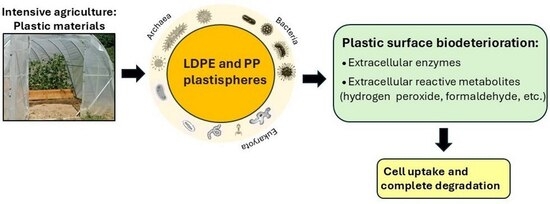
Synthetic plastics are considered essential in modern agriculture worldwide. Intensive agriculture, in particular greenhouse farming, is associated with the production of large amounts of different plastic materials derived from petroleum, including the polymers polyethylene (PE) and polypropylene (PP), among others. These materials are accumulated in agricultural areas, thus polluting soil and water as plastics and microplastics. Plastics are used for many different purposes in agriculture, such as greenhouse covers, mulching films and pipes [5]. The main aim of using these polymers is to elevate crop yield, considering that the human population is drastically increasing. However, these materials have emerged as environmental hazards because they have a negative impact on soil, water and living organisms. Remediation of synthetic plastics plays a key role in achieving sustainability. Among these technologies, the use of microorganisms to initiate biological degradation of these polymers is regarded [49].
In this work, soil samples from the surface of PP and LDPE materials were collected from a waste landfill located in El Ejido (Almeria, Spain), along with samples from bulk soil without plastics that were used as negative controls. Regarding sampling design and controls, this study constituted a first approximation via metagenomic analysis of the LDPE and PP plastic surface microbiomes, using soil samples lacking these polymers as negative control (nearby soil 1 m away from plastics). However, results presented in this work have limitations because the direct effect of the plastic surface cannot be separated from microhabitat differences (shade, additives, moisture, etc.), and this will be addressed in future works. Additionally, a second type of negative control based on non-plastic surfaces like rocks or inert films will be recommended.
The South-East of Spain is considered the major producer of fruits and vegetables, providing large amounts of this type of food to Europe, relying on its extensive greenhouse agriculture. This area, also known as the plastic sea (https://earthobservatory.nasa.gov/images/150070 accessed on 26 January 2026), produces about 2.5–3.5 million tons annually of fruits and vegetables. The plastics collected in this work were raffia, made of polypropylene (PP), and plastic cover based on low-density polyethylene (LDPE), as previously demonstrated by Attenuated Total Reflection Fourier-Transform Infrared Spectroscopy (ATR-FTIR) [50].
3.1. Metagenomic Libraries as an Initial Tool in Analysis of Biodeterioration of PP and LDPE
Environmental metagenomics is considered one of the most powerful techniques to identify genes from uncultivable and cultivable microbial communities. Metagenomics can be applied to develop useful biotechnologies to remediate different environmental hazards of diverse ecosystems. These technologies could include the development of synthetic biology strategies to optimize bioremediation processes, among others [48]. In this study, metagenomic libraries were generated with DNA samples isolated from LDPE, PP and bulk soil (negative control) microbiomes, as described in Section 2. Genomic library construction required an initial step that included Qubit quantification of all DNA samples. DNA sample concentrations ranged from 5.54 to 14.7 ng/μL. The number of reads after data filtering was in the range of 18864406–59371824 (Table S1).
A total of 182200 gene sequences were identified. From these sequences, 25441 were exclusive to the LDPE plastisphere, 9654 were found exclusively in the PP plastisphere and 33367 were exclusive to the bulk soil microbiome (Figure S1). Additionally, 24777 gene sequences were shared between LDPE and PP plastispheres, but they were not present in bulk soil (control). After annotation and binning, a total of 1423444 contigs were assembled with a total length of 1481011207 bp, displaying a 64.69% GC content (Table S2). The draft metagenome-assembled genomes (MAGs) were obtained as described in Section 2. After using the DAS tool, a total of 71 refined MAGs were selected with an average of 41 single-copy genes (SCGs) (Table S3). Only five MAGs presented all SCGs as completely sequenced, including MaxBin-0.002, MetaBAT-0.19, MetaBAT-0.99, MetaBAT-0.177 and MaxBin-0.142. The average SCG completeness for all MAGs was approximately 80.6% (Table S3). The number of contigs in the identified MAGs that may be assigned to different draft genomes (bins) was in the range of 63 to 3032 (MaxBin-0.089–MaxBin-0.035_sub), considering that identical sequences may arise from different genomes within the metagenomic samples. Finally, taxonomic assignment of MAGs was conducted with Genome Taxonomy Database (GTDB) v2.4.0 software, as described in Section 2, allowing correct placing of single-copy genes and highlighting the high-quality draft of 15 MAGs (Table 1). Genomes can be reconstructed by assembling all samples together—this is called co-assembly—or by performing individual assemblies. Co-assembly yields a greater sequence depth and coverage, thus taking advantage of differential coverage of microorganisms across genomes for genome binning. Additionally, co-assembly facilitates identification of microorganisms that are present at lower abundances, but it can result in ambiguous and/or fragmented assemblies when strain variability is elevated. In contrast, individual assembly technology is computationally less demanding and usually is applied to reconstruct genomes of larger data sets and to preserve strain variation between different samples [51]. Recently, it has been demonstrated that co-assembly is the most suitable technology applied to reconstructing airborne microbial genomes and genes, specifically in low-biomass environments [27]. It is very important to correct assembly errors, by mapping individual reads back to assembled contigs. Thus, several assemblers include a correction step by using long reads to polish the assembling, leveraging mapping information [52]. Additionally, risk of chimerism exists during metagenome assembling when unrelated DNA fragments from different sources get incorrectly stitched together, thus forming a false hybrid genome sequence that often complicates interpretation of the results. To avoid this type of error, bioinformatic applications are currently developed, such as the Genome UNClutterer software v.3 to detect and quantify genome chimerism. This software is based on the lineage homogeneity of individual contigs, using a full complement of genes in genomes [53]. In the metagenomic analysis performed in this work, co-assembly effectively increased the combined sequencing depth, improving assembly completeness and allowing for more consistent genomic comparisons between samples. Therefore, in this study co-assembly provided a more robust and comprehensive representation of the communities analyzed than that obtained hypothetically through sample-wise independent assembly.
Table 1.
Characteristics of MAGs computed by CheckM software.
3.2. Biodiversity Analyses
Initial MAG taxonomic assignments, according to supporting values (expressed as %), indicated that Bacteria was the most representative kingdom, although Archaea was predominant in MaxBin-0.140 and MetaBAT-0.115. At the level of phylum, Actinomycetota was very abundant in different MAGs, with more than 30% average (Table S4). This analysis also revealed the existence of a differential bacterial composition among microbiome sample groups based on absence or presence of plastics, and plastic type, primarily indicating that PP samples had distinct abundance profiles and clustered separately from bulk soil and LDPE microbiomes (Table S4).
Considering the level of taxonomic resolution achieved across all MAGs, more in-depth diversity analyses were performed reaching the genus and species levels. The genus-level taxonomic annotations, generated previously with Salmon software,v.2.2.1 containing gene relative abundance values (counts per million, CPM) for MAGs of each microbiome (PP, LDPE or bulk soil), were integrated and collapsed, resulting in a final dataset comprising 45 MAGs assigned to bacterial genera (Table S5).
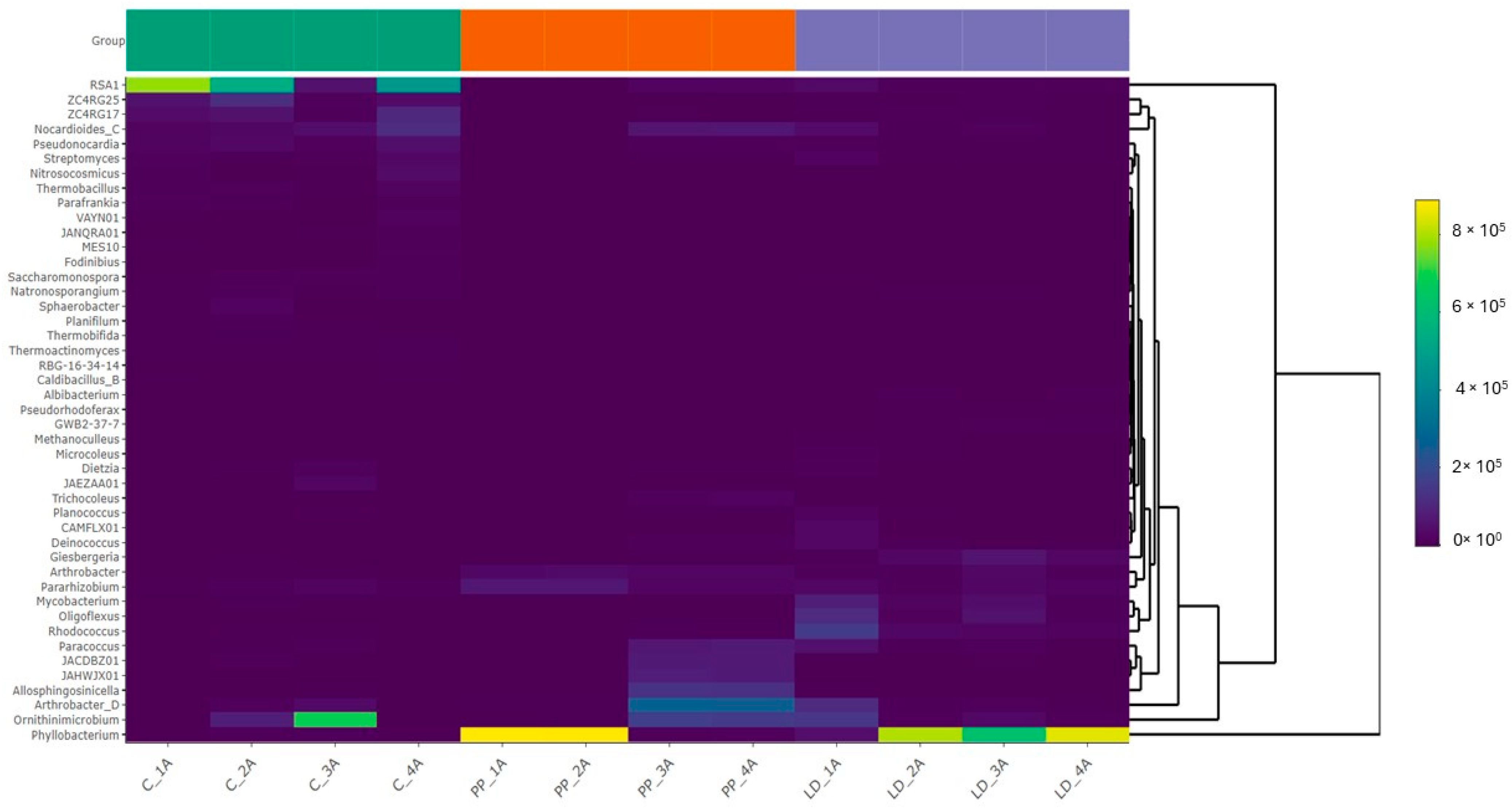
On the other hand, a β-diversity analysis was performed to assess differences among bacterial communities of the three types of microbiomes (PP, LDPE and bulk soil) at the genus level. For this purpose, a dissimilarity matrix using the Bray–Curtis distance was generated and used as the input of a hierarchical clustering analysis and heatmap (Figure 1). Bacterial communities from the three different microbiomes were clustered according to their composition and structure, indicating that all groups of bacterial communities were separated from each other (Figure 1).
Figure 1.
Bray–Curtis heatmap (Ward clustering). The Bray–Curtis distance was generated with the vegdist function of the vegan version 2.6-10 package in R [42]. Data were transformed (square root) with Ward hierarchical clustering method. Four samples of each microbiome were analyzed: C, bulk soil control (C_A1-4A); LD, low-density polyethylene (LD_1A-4A); and PP, polypropylene (PP_1A-4A).
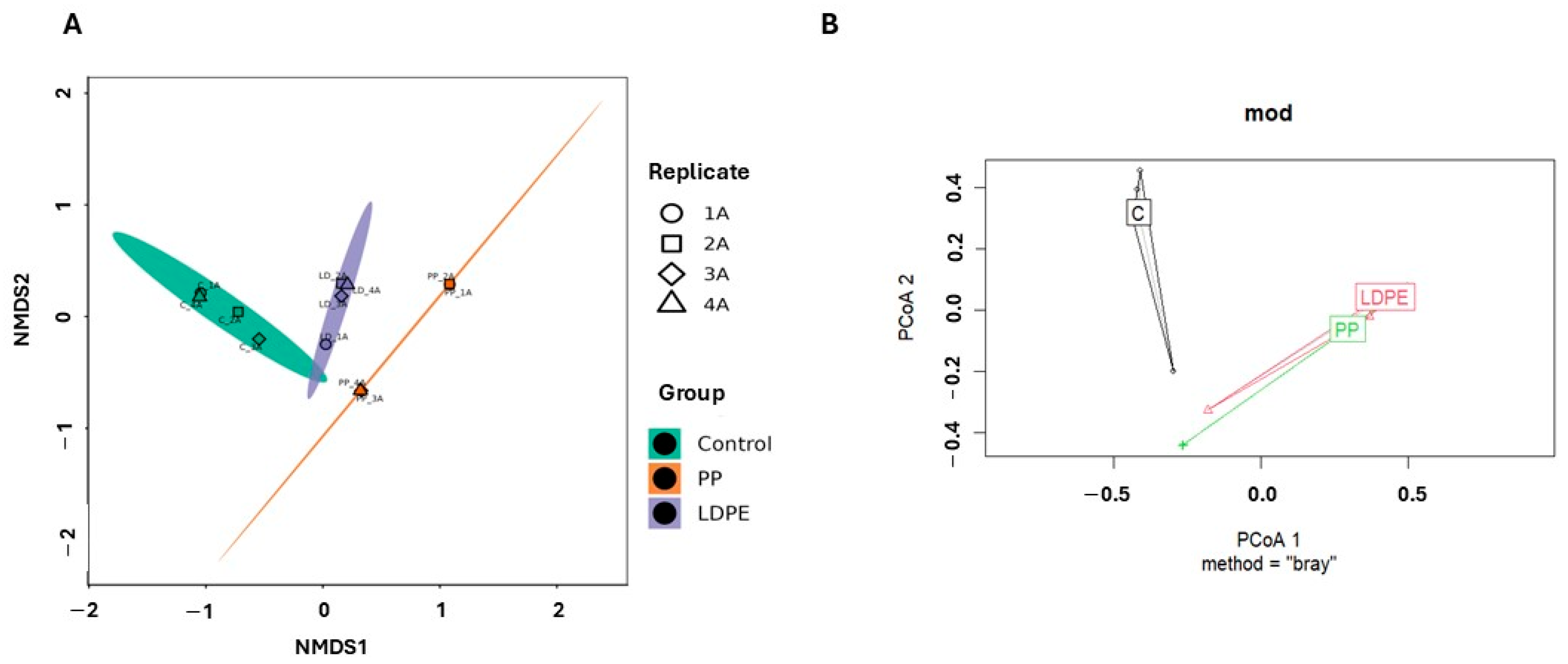
The previously constructed Bray–Curtis distance matrix was utilized to generate a Non-Metric Multidimensional Scaling (NMDS) plot and the analysis of similarity (ANOSIM) [46]. The NMDS plot showed that the bacterial community exhibited significant compositional and structural differences across the three groups of microbiomes (Figure 2A), with an NMDS stress value of 0.026, indicating an appropriate fit for the chosen dimensions, thus representing reliable dissimilarities between the microbiomes under study. These differences were supported by the results of the ANOSIM, which revealed a statistically significant distinction among groups (R = 0.468; p = 0.0162), indicating a moderate degree of dissimilarity in bacterial community composition between groups of different microbiomes, and how the presence or absence of synthetic plastics (polyethylene or polypropylene) influenced their composition. Additionally, the Bray–Curtis distance matrix was used to perform a PERMANOVA in R, using the vegan package [42]. The multivariate homogeneity of group dispersions was previously assessed using the betadisper function, which showed no significant dispersion among different plastispheres or control communities (ANOVA F-value = 0.5225; p-value = 0.61). The PERMANOVA analysis yielded a p-value of 0.012 and an F-value of 3.636, which is considered statistically significant, supporting strong evidence to reject the null hypothesis that microbiome compositions (groups) are the same (Table S6).
Figure 2.
Analyses of bacterial community composition within microbiomes studied. (A). Non-Metric Multidimensional Scaling (NMDS) plot. (B). Betadisper analysis. Samples: bulk soil control (C_A1-4A), low-density polyethylene (LD_1A-4A) and polypropylene (PP_1A-4A).
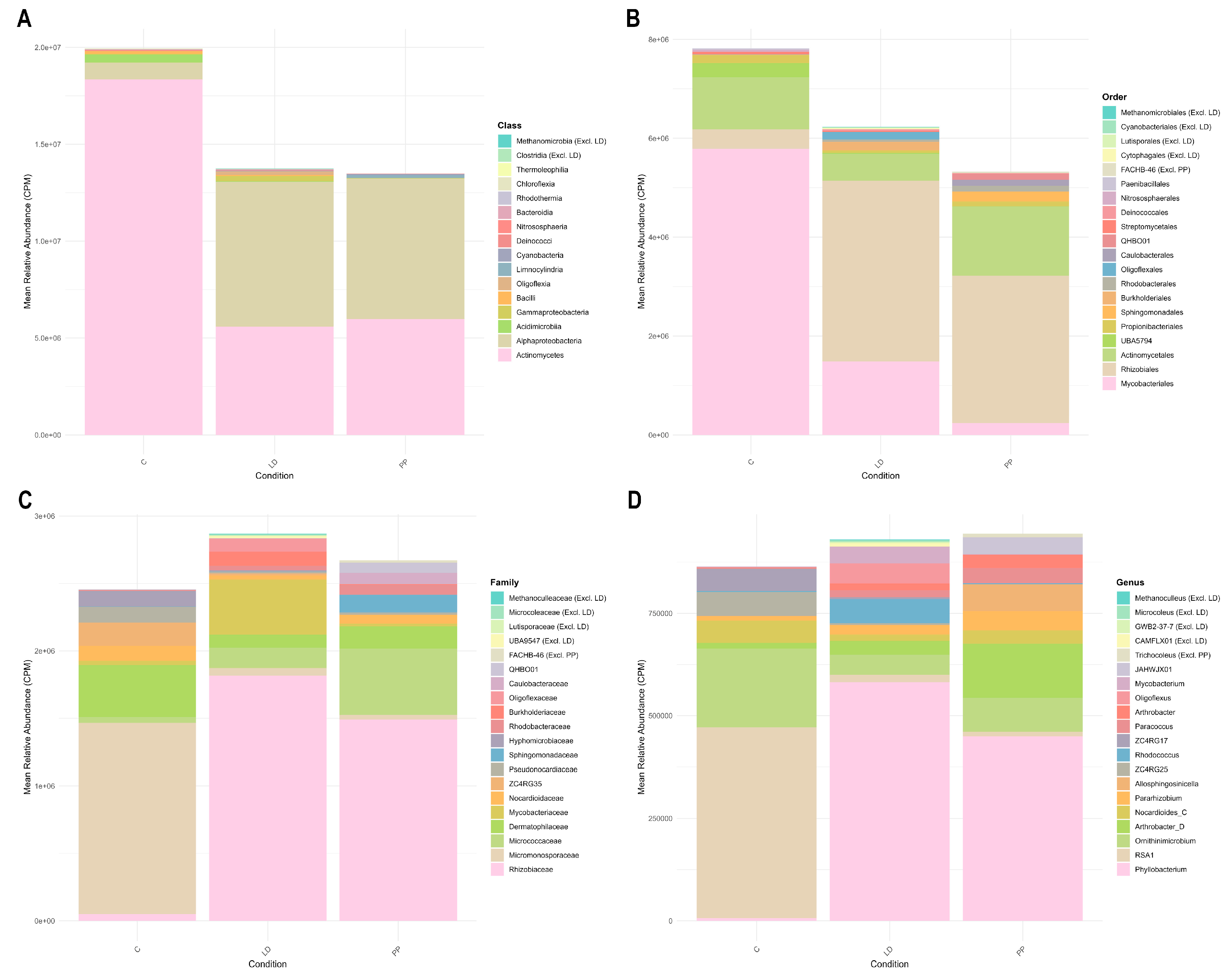
Differences in taxonomic distribution across the different microbiomes can also be observed at the level of class, with α-Proteobacteria as the most abundant in LDPE and PP plastispheres, while Actinomycetes was the predominant class in bulk soil (Figure 3A). Actinomycetes were also found in LDPE and PP plastispheres, but in a lower representation than in bulk soil. The presence of Actinomycetes has been described previously in soil ecosystems contaminated with microplastics based on LDPE [50]. Exclusive classes to LPDE plastisphere included Methanomicrobia and Clostridia, while Candidatus Limnocylindria was distinctive of PP microbiome (Figure 3A). Considering the order taxa, Methanomicrobiales, Cyanobacteriales, Lutisporales and Cytophagales were exclusive to LDPE samples and FACHB-46 was exclusive to PP plastisphere (Figure 3B). Additionally, Rhizobiales order was the most abundant in PP and LDPE plastispheres, while Mycobacteriales order was prevalent in bulk soil microbiome (Figure 3B).
Figure 3.
Mean relative abundance of most representative taxa in the microbiomes analyzed. Mean relative abundance (stacked bar plots), represented as counts per million (CPM) of the 15 most abundant taxonomic groups and those exclusive to each condition, is shown in X axis: C, bulk soil control; LD, low-density polyethylene; and PP, polypropylene. Taxonomic abundances for levels higher than genus were calculated by the summatory of CPM values of their constituent lower-rank taxa. Taxa that were not identified among the top 15 or were not exclusive were grouped into the category of others. Four taxa are represented: class (A), order (B), family (C), genus (D).
Additionally, the bacterial and archaeal families Methanoculleaceae, Microcoleaceae, Lutisporaceae and UBA9547 were exclusive to LDPE samples, while FACHB-46 was exclusive to PP plastisphere (Figure 3C). Rhizobiaceae was the most abundant family in PP and LDPE plastispheres, while Micromonosporaceae was prevalent in bulk soil. In addition, other representative families in PP plastisphere were Micrococcaceae, Sphingomonadaceae and Rhodobacteriaceae. Mycobacteriaceae, Burkholderiaceae and Oligoflexaceae were distinctive families of LDPE plastisphere (Figure 3C). At the level of genus, Methanoculleus, Microcoleus GWB2-37-7 and CAMFLX01 were exclusive to LDPE plastisphere, while Trichocoleus was exclusive to PP plastisphere (Figure 3D). Phyllobacterium genus was also prevalent in PP and LDPE plastispheres. Rhodococcus, Oligoflexus and Mycobacterirum were also predominant in LDPE samples, while Allosphingosinicella, Paracoccus and Arthrobacter were characteristic of PP plastisphere. In the case of bulk soil microbiome, Ornithinimicrobium and RSA1 were characteristic genera (Figure 3D).
Plastic-degrading microorganisms described to date belong to rare taxa within studied communities [54]. Microcoleus genus (Cyanobacteriaceae family) has been described as capable of growing on the surface of an artificial pond based on low-density polyethylene [55]. Information in the literature cannot be found about the capability of the GWB2-37-7 genus to degrade LDPE. However, other related bacteria like the anaerobic thermophile Clostridium thermocellum degrade polyethylene terephthalate (PET) at 60 °C [56]. On the other hand, Actinomycetes like Rhodococcus sp. C-2 and Rhodococcus opacus R7 have been reported to deteriorate polyethylene [12,57]. Additionally, a proteomic analysis of the response of Rhodococcus strain A34 to the biodegradation of polyethylene has demonstrated that 1% weight loss of this polymer was associated with hydrolases and oxidoreductases present in this bacterium [58]. On the other hand, a bacterial strain of Mycobacterium genus (Actinomycetes class) has been identified as part of a consortium, which is also involved in the degradation of pretreated low-density polyethylene [59].
Among the representative genera of PP plastisphere (Figure 3D), it has been reported that Paracoccus, from the Rhodospirillaceae family, degrades a PET-based biofilm [60], but reports have not been found regarding its ability to degrade PP. On the other hand, Arthrobacter sp. (Actinomycetes) has been recently described to degrade PP and LDPE biofilms through aldehyde dehydrogenase and laccase-like multicopper oxidase enzymes [61].
3.3. Enzymes with Putative Role in LPDE and PP Biodeterioration Processes
To perform a functional analysis in more detail, annotated gene sequences from MAGs of high and medium quality were used to generate information about functional abundance using Salmon, focused on the Enzyme Commission (EC) numbers and their corresponding functional annotations. The resulting counts from Salmon software were normalized and expressed as counts per million (CPM), which allowed for accurate comparison of functional gene abundances across samples. Exclusive MAGs were considered when more than 75% of their genes were unique in each of these MAGs (Figure S2).
Metagenome-assembled genomes exclusive to PP microbiome were MaxBin-0.168, MetaBAT-0.100 and MetaBAT-0.128; MAGs exclusive to LDPE plastisphere included MaxBin-0.140, MaxBin-0.160_sub, MetaBAT-0.106, MetaBAT-0.118 and MetaBAT-0.153; and MAGs exclusive to bulk soil microbiome were MaxBin-0.060sub, MaxBin-0.066, MetaBAT-0.115, MetaBAT-0.36_sub and MetaBAT-0.59 (Figure S2). Metagenome-assembled genomes shared between PP and LDPE plastispheres were MaxBin-0.089, MaxBin-0.142, MetaBAT-0.110, MetaBAT-0.155_sub and MetaBAT-0.32 (Figure S2). CheckM software analysis allowed identification of the phylogenetic genus of each MAG of interest (Table 2), highlighting that biodiversity of these microbiomes was restructured.
Table 2.
CheckM analysis of MAGs related to PP, LDPE and control microbiomes.
Genes present in MAGs of interest that were exclusive to PP belong to Cyanobacteria and α-Proteobacteria classes, while MAGs exclusive to LDPE were from Methanomicrobia, Bacteroidia, Cyanobacteria, Oligoflexia and Clostridia. Actinomycetes have lost predominance in PP and LDPE plastispheres, as well as α-Proteobacteria in LDPE microbiome. Additionally, Candidatus Limnocylindria was no longer represented in MAGs that were exclusive to PP microbiome. The most representative bacterial and archaeal genera in LDPE microbiome were Methanoculleus, CAMFLX01, Microcoleus, Oligoflexus and GWB2-37-7, while Trichocoleus, Allosphingosinicella and JAHWJX01 were predominant in PP microbiome (Table 2). Curiously, the MaxBin-0.140 that was exclusive to LDPE plastisphere was represented by the archaeon Methanoculleus (Table 2). According to MIMAG standards, MaxBin-0.140 was classified as a ‘medium-quality draft’, exceeding the 50% completeness threshold and with contamination lower than 10%. The assignment of this bin to the Methanoculleus genus is based on a robust bioinformatic analysis with GTDB-Tk that uses the classification method “taxonomic classification defined by topology and ANI” (Tables S7–S10); phylogenetic analysis of this bin was also performed and uploaded to ZENODO (https://doi.org/10.5281/zenodo.17869256). This methodology allows bins to be located at their corresponding node. The genome of the Methanoculleus genus was the closest to MaxBin-0.140 in the reference phylogenetic tree. In this analysis, specific species could not be assigned because its ANI, with the reference genomes, did not reach the typical threshold for species circumscription (95%) and the alignment fraction value was lower than 0.5 (https://gtdb.ecogenomic.org/faq accessed on 10 July 2025). GTDB-Tk analysis identified 32 marker genes (Table S10), allowing taxonomic assignment of MaxBin-0.140 to Archaea [62].
In this metagenomic study, nine genes encoding putative cutinases were identified, but none of them were exclusive to plastisphere samples (Table S5), and they are unlikely to be potential candidates to be involved in PP or LDPE biodeterioration by the studied microbial communities.
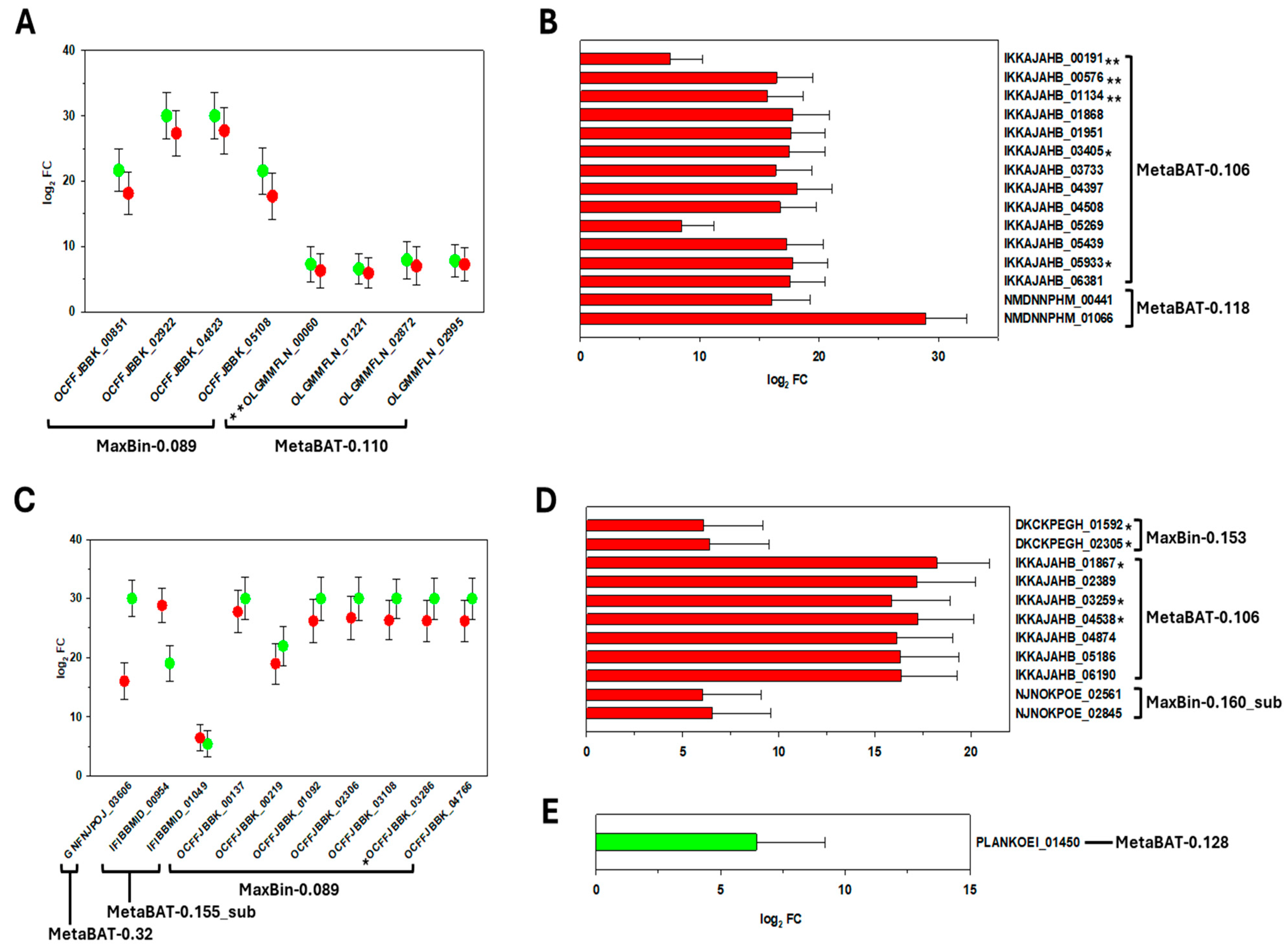
On the other hand, MAGs of interest, which were either exclusive to LDPE plastisphere or shared between PP and LDPE microbiomes, contained 23 genes that encode putative lipases, including monoacylglycerol lipases (E.C. 3.1.1.23), lysophospholipases (E.C. 3.1.1.5), phospholipases (E.C. 3.1.1.-), phospholipase D (E.C. 1.4.4.4), lipases 1 (E.C. 3.1.1.3) and triacylglycerol lipases (E.C. 3.1.1.3) (Table S5). Eight lipase genes were common to PP and LDPE plastispheres and they were found in MaxBin-0.089 and MetaBAT-0.110 (Figure 4A). Additionally, 15 lipase genes were found in MAGs that were exclusive to LDPE microbiome. Among these genes, 13 were found in MetaBAT-0.106 and two in MetaBAT-0.118 (Figure 4B). OCFFJBBK_02929, OCFFJBBK_04823 and NMDNNPHM_01066 genes were the most abundant among all lipases. Lipase genes were unidentified in MAGs that were exclusive to PP plastisphere or to bulk soil microbiome. Predicted lipases encoded by the IKKAJABB_03405 and IKKAJABB_05933 genes are putative proteins secreted extracellularly, and lipases encoded by IKKAJABB_0091, IKKAJABB_00576, IKKAJABB_01134 and OLGMMFLN_00060 are putative outer-membrane proteins (Figure 4A,B). Additionally, the predicted esterases, encoded by DKCKPEGH_01592, DKCKPEGH_02305, IKKAJAHB_01867, IKKAJAHB _03259 and IKKAJAHB _04538 genes, are predicted secreted proteins (Figure 4C,D). Subcellular location analysis was performed with UniProt (http://www.uniprot.org accessed on 10 July 2002).
Figure 4.
Differential analyses of lipase and esterase gene relative abundance enriched in LDPE and PP plastispheres with DESeq2 software. The represented values are expressed as log2 fold change (log2 FC) of gene relative abundances in LDPE/bulk soil control (red) and in PP/bulk soil control (green). In the analysis of LDPE versus bulk soil control or PP versus bulk soil control, positive values show higher gene abundance in LDPE (or PP) than in control. (*) indicates predicted secreted proteins and (**) represents putative outer-membrane proteins according to UniProt (https://www.uniprot.org accessed on 10 July 2002). Only values with log2 FC > 1 and p-value < 0.05 were considered. Taxonomic assignments are indicated on the legend at the lowest level available. Lipases shared between LDPE and PP (A): MaxBin-0.089 (Phyllobacterium): OCFFJBBK_00851, lysophospholipase L2; OCFFJBBK_02922, thermostable monoacylglycerol lipase; OCFFJBBK_04823, non-hemolytic phospholipase C; OCFFJBBK_05108, monoacylglycerol lipase. MetaBAT-0.110 (Pseudorhodoferax): OLGMMFLN_00060, putative phospholipase A1; OLGMMFLN_01221, non-hemolytic phospholipase C; OLGMMFLN_02872, non-hemolytic phospholipase C; and OLGMMFLN_02995, non-hemolytic phospholipase C. Lipases exclusive to LDPE (B): MetaBAT-0.106 (Oligoflexus): IKKAJAHB_00191, lipase 1; IKKAJAHB_00576, lipase 1; IKKAJAHB_01134, lipase 1; IKKAJAHB_01868, lysophospholipase L2; IKKAJAHB_01951, lysophospholipase L2; IKKAJAHB_03405, phospholipase D; IKKAJAHB_03733, lysophospholipase L2; IKKAJAHB_04397, lysophospholipase L2; IKKAJAHB_04508, lysophospholipase L2; IKKAJAHB_05269, monoacylglycerol lipase; IKKAJAHB_05439, lipase 1; IKKAJAHB_05933, triacylglycerol lipase, IKKAJAHB_06381, lysophospholipase L2. MetaBAT-0.118 (Clostridia): NMDNNPHM_00441, thermostable monoacylglycerol lipase; and NMDNNPHM_01066 and phospholipase YtpA. Esterases shared between LDPE and PP (C): MetaBAT-0.32 (Rhizobium): GNFNJPOJ_03606, acetyl esterase. MetaBAT-0.155_sub (Deinococcus): IFIBBMID_00954, phosphatase/phosphodiesterase; IFIBBMID_01049, acetyl esterase. MaxBin-0.089 (Phylobacterium): OCFFJBBK_00137, 3S-malyl-CoA thioesterase; OCFFJBBK_00219, acyl-CoA thioesterase 2; OCFFJBBK_01092, acyl-CoA thioesterase YbgC; OCFFJBBK_02306, acetyl esterase; OCFFJBBK_03108, acetyl esterase; OCFFJBBK_03286, cellulase/esterase CelE; and OCFFJBBK_04766, esterase EstB. Esterases exclusive to LDPE (D): MaxBin-0.153 (Bacteroidota): DKCKPEGH_01592, glycerophosphodiester phosphodiesterase; DKCKPEGH_02305, cellulase/esterase CelE. MetaBAT-0.106 (Oligoflexus): IKKAJAHB_01867, glycerophosphodiester phosphodiesterase; IKKAJAHB_02389, acyl-CoA thioesterase 2; IKKAJAHB_03259, cellulase/esterase CelE; IKKAJAHB_04538, esterase TesA; IKKAJAHB_04874, acetyl esterase; IKKAJAHB_05186, pimeloyl-[acyl-carrier protein] methyl ester esterase; IKKAJAHB_06190, putative esterase. MaxBin-0.160_sub (Oscillatoriales): NJNOKPOE_02561, carboxylesterase 2; and NJNOKPOE_02845, acetyl esterase. Esterase exclusive to PP (E): MetaBAT-0.128 (Pseudomonadota): PLANKOEI_01450.
In this metagenomic analysis, esterase genes were also identified, acting on linear compounds, excluding enzymes that use peptides and proteins as potential substrates, in MAGs of interest. Among these genes, we identified acetyl-CoA thioesterases (E.C. 3.1.1.-), acyl-CoA thioesterases (E.C. 3.1.2.-), (3S)-malyl-CoA thioesterases (E.C. 3.1.2.30), carboxylesterases (E.C. 3.1.1.-), glycerophosphodiester phosphodiesterases (E.C. 3.1.1.46) and cellulases/esterases (E.C. 3.2.1.4) (Table S5). In total, 22 esterase genes with significative relevance (log2 FC > 1 and p-value < 0.05) were identified in seven MAGs of interest, including those exclusive to PP or to LDPE or shared between PP and LDPE (Figure 4C–E). Ten genes could be identified in MAGs shared between PP and LDPE plastispheres (MaxBin-0.089, MetaBAT-0.155_sub and MetaBAT-0.32) (Figure 4C). Only one MAG was exclusive to PP microbiome (MetaBAT-0.128), which contained the esterase gene PLANKOEI_01450 (Figure 4E), while 11 esterase genes were exclusive to LDPE plastisphere (MaxBin-0.153, MaxBin-160_sub, and MetaBAT-106) (Figure 4D). In the case of MAGs specific to bulk soil, several esterases were identified (Table S5). Sixteen esterase genes were very abundant (Figure 4C–E). Cellulases identified in this work might be involved in degradation of cellulose, which is the most abundant natural polymer in the environment, and they could be applied to develop different biotechnological applications like conversion of plant biomass into biofuels [63].
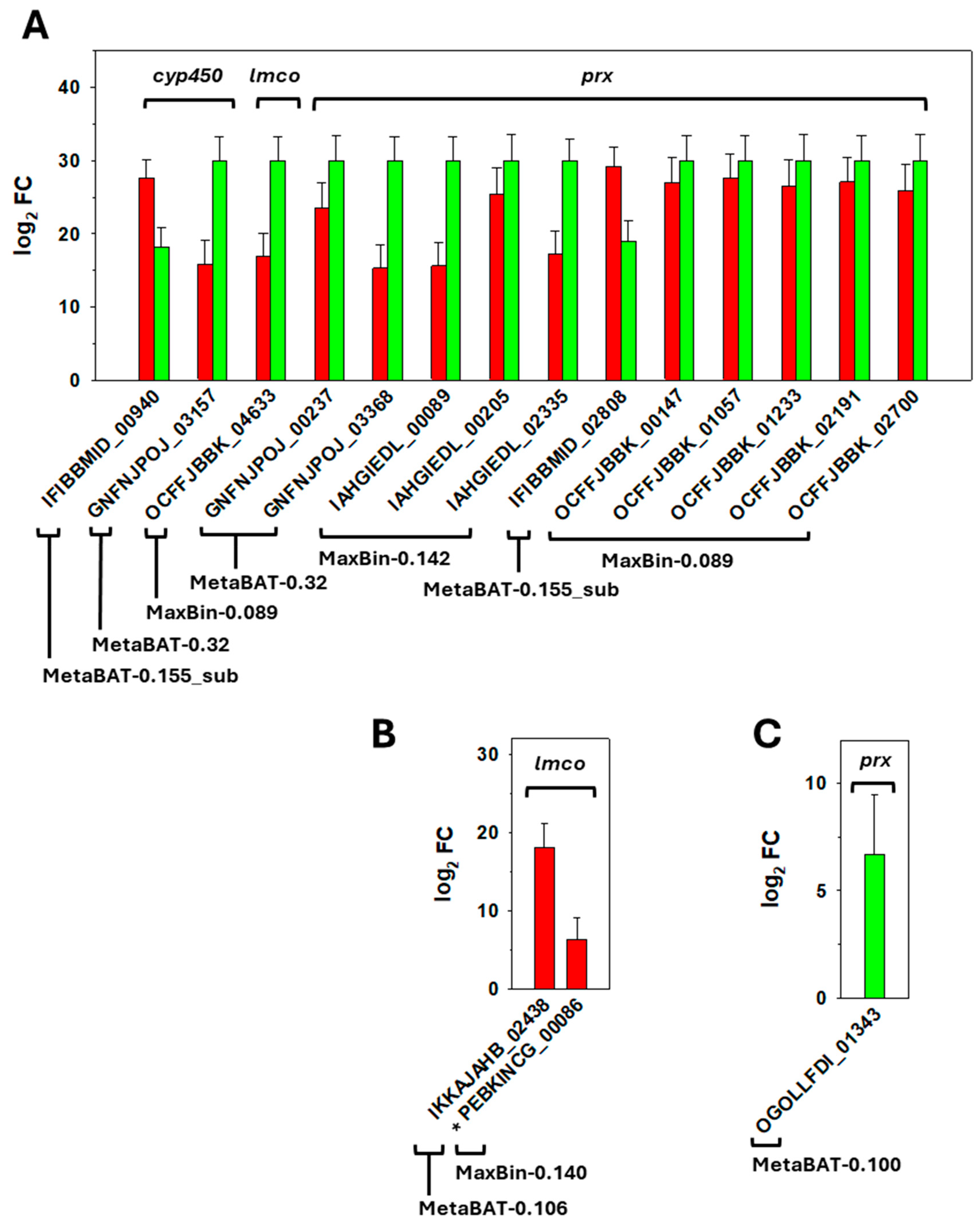
Monooxygenases like cytochrome P450 (CYP450) and alkane monooxygenases (AlkB) have been previously suggested to participate in degradation of synthetic plastics. Cytochrome (cyp450) and alkane (alkB) monooxygenase genes were identified in the microbiomes studied, specifically in MAGs of interest. Thus, two cyp450 genes were identified (Figure 5A). These genes were found in MAGs shared between LDPE and PP plastispheres, in MetaBAT-0.155_sub (IFIBBMID_00940) and MetaBAT-0.32 (GNFNJPOJ_03157). Additionally, co-occurrence analysis of the identified cyp450 genes was performed, without revealing more information because their adjacent genes were predicted to encode hypothetical proteins.
Figure 5.
Differential analyses of oxidative gene relative abundance enriched in LDPE and PP plastispheres with DESeq2 software. Data correspond to log2 fold change (log2 FC) of gene LDPE/bulk soil control (red) and in PP/bulk soil control (green). In the analysis of LDPE/control or PP/control, positive values indicate higher gene abundance in LDPE (or PP) than in bulk soil control. (*) indicates archaeal MAG. Only values with log2 FC > 1 and p-value < 0.05 were considered. Taxonomic assignments are indicated in the legend at the lowest level available. Oxidative genes shared between LDPE and PP (A): MetaBAT-0.32 (Rhizobium): GNFNJPOJ_03157, putative cytochrome P450 132. MetaBAT-0.155_sub (Deinococcus): IFIBBMID_00940, putative cytochrome P450 140. MaxBin-0.089 (Phyllobacterium): OCFFJBBK_04633, multicopper oxidase LMCO. MaxBin-0.089 (Phyllobacterium): OCFFJBBK_00147, non-heme chloroperoxidase; OCFFJBBK_01057, deferrochelatase/peroxidase EfeB; OCFFJBBK_01233, dye-decolorizing peroxidase YfeX; OCFFJBBK_02191, putative non-heme bromoperoxidase BpoC; OCFFJBBK_02700, non-heme chloroperoxidase. MaxBin-0.142 (Micrococcaceae): IAHGIEDL_00089, putative non-heme bromoperoxidase BpoC; IAHGIEDL_00205, putative deferrochelatase/peroxidase EfeN; IAHGIEDL_02335, non-haem bromoperoxidase BPO-A2. MetaBAT-0.155_sub (Deinococcus): IFIBBMID_02808, non-heme chloroperoxidase. MetaBAT-0.32 (Rhizobium): GNFNJPOJ_00237, non-heme chloroperoxidase; GNFNJPOJ_03368, non-heme chloroperoxidase. Oxidative genes exclusive to LDPE (B): MaxBin-0.140 (Methanomicrobiaceae): PEBKINCG_00086, multicopper oxidase LMCO; MetaBAT-0.106 (Oligoflexus): IKKAJAHB_02438, multicopper oxidase LMCO. Oxidative gene exclusive to PP (C): MetaBAT-.100 (Sphingomonadales): OGOLLFDI_01343, non-heme chloroperoxidase.
Regarding alkane monooxygenase genes, only the alkB gene (DHAOFCLG_03189), which encodes an alkane 1-monooxygenase, was identified in MetaBAT-0.116 that was exclusive to LDPE plastisphere. Additionally, two different rubredoxins genes were also detected in two MAGs exclusive to LDPE, in MaxBin-0.140 (PEBKIMCG_01153) and MaxBin-0.160_sub (NJNOKPOE_04074) (Table S5). Co-occurrence and synteny analyses of the DHAOFCLG_03189 gene revealed that two rubredoxin genes were located downstream of the alkB gene, which were annotated as alkG gene (DHAOFCLG_03188) and rubA (DHAOFCLG_03187). This gene arrangement has also been found in the LDPE-degrading bacteria Pseudomonas aeruginosa PAO1 and Rhodococcus sp. C-2 [12,64,65].
Other oxidative enzymes that could be acting on plastic degradation are laccases, which are members of the multicopper oxidase (MCO) family with a cupredoxin-like fold and at least four copper atoms distributed in three copper centres. MCOs oxidize urushiol as the usual substrate, but they can oxidize a wide range of substrates. These enzymes perform a four-electron reduction of oxygen to water. In this work, classical laccases could not be identified, but three laccase-like multicopper oxidases genes were found in MAGs of interest (Figure 5A,B). Laccase-like multicopper oxidase gene (OCFFJBBK_04633) was identified in one MAG shared between PP and LDPE, in MaxBin-0.089 (Figure 5A). Another two lmco genes were identified in MAGs exclusive to LDPE plastisphere, in the archaeal MaxBin-0.140 (PEBKINCG_00086) and in the bacterial MetaBAT-0.106 (IKKAJAHB_02438). The OCFFJBBK_04633 gene was the most abundant among lmco genes (Figure 5A). A third group of oxidases correspond to bacterial peroxidases (PRX), which are oxidoreductases that catalyze a H2O2-dependent oxidation of different substrates. In this metagenomic analysis, 12 prx genes have been identified, including non-heme chloroperoxidases (E.C. 1.11.1.10), non-heme bromoperoxidases (E.C. 1.11.1.18), deferrochelatases/peroxidases (E.C. 1.11.1.-) and dye-decolorizing peroxidases (E.C. 1.11.1.-) (Figure 5A,C). Among these, the OGOLLFDI_01343 gene, identified in MetaBAT-0.100, was exclusive to PP plastisphere (Figure 5C). Additionally, 11 genes were identified in MAGs shared between PP and LDPE, in MaxBin-0.089 (OCFFJBBK_000147, 01057, 01233, 02191 and 02700); in MaxBin-0.142 (IAHGIEDL_00089, 00205 and 02335); in MetaBAT-0.155_sub (IFIBBMID_02808); and in MetaBAT-0.32 (GNFNJPOJ_00237 and 03368).
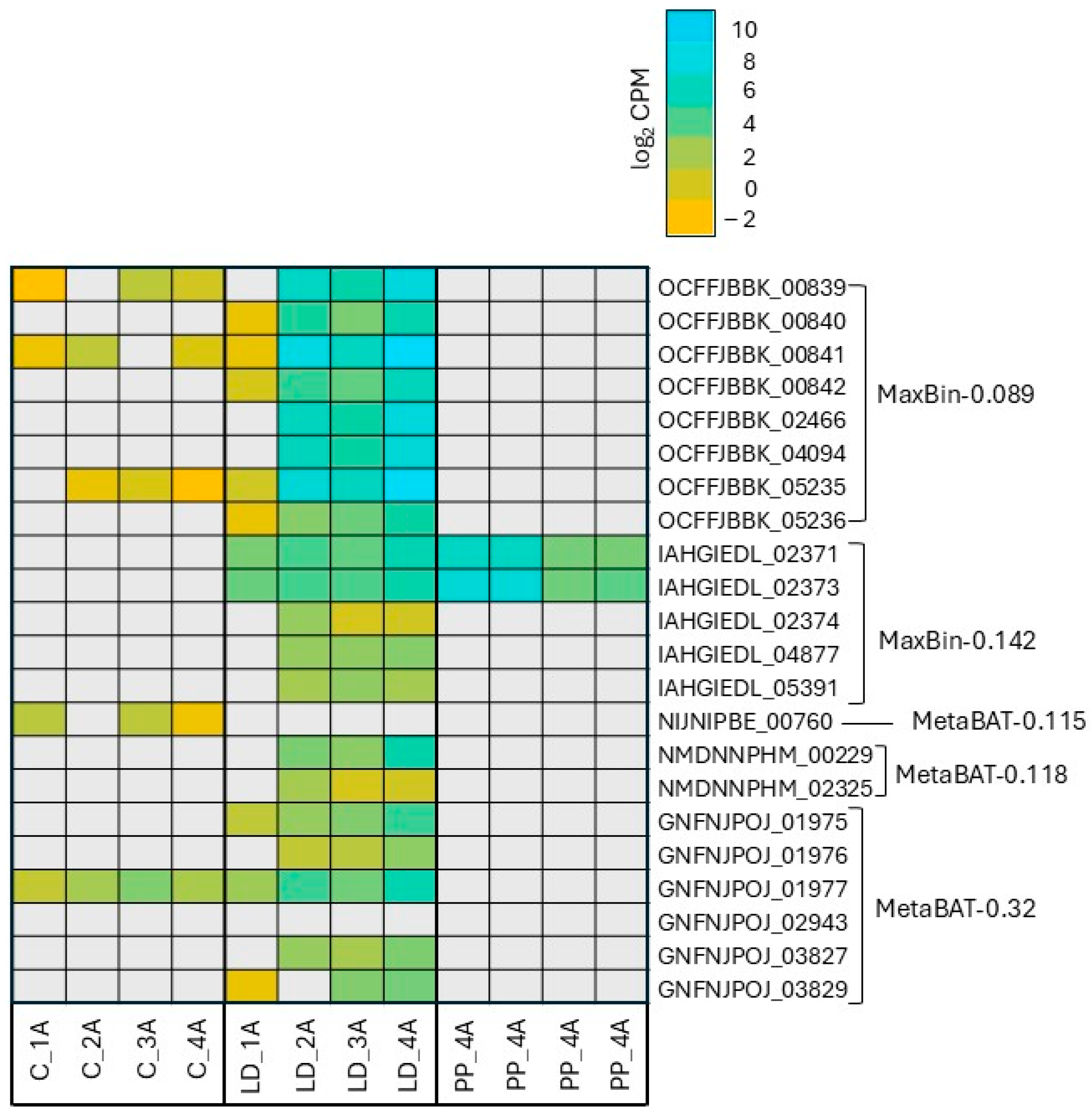
Sarcosine oxidase is another oxidative enzyme that was not associated previously with synthetic plastic degradation. Sarcosine oxidase (sox) genes have been identified through this metagenomic study, revealing that they were present mostly in MAGs shared between PP and LDPE plastispheres. Thus, 19 sox genes were found in MaxBin-0.089, MaxBin-0.142 and MetaBAT-0.32 that were shared between PP and LDPE plastispheres (Figure 6). However, sox genes were very abundant and significative in LDPE plastisphere (Figure 6). Additionally, MetaBAT-0.118, which was exclusive to LDPE plastisphere, also contained two sox genes, NMDNNPHM_00229 and NMDNNPHM_02325. Sarcosine oxidases were also identified in MAGs that were exclusive to bulk soil microbiome, but at a very low relative abundance (Figure 6). Among all sox genes identified, the most abundant were OCFFJBBK_00839, OCFFJBBK_00842 and OCFFJBBK_05235 (Figure 6). Sarcosine oxidase genes could not be identified in Archaea.
Figure 6.
Relative abundance of sarcosine oxidase (sox) genes. The represented values indicate gene relative abundance, as CPM (counts per million), and correspond to the log2 of relative abundance of genes present in a least 3 of the 4 replicates of each microbiome, bulk soil control (C_1A-4A), LDPE (LD_1A-4A) and PP (PP_1A-4A). Grey colour indicates that this gene was not detected in at least 3 of the 4 replicates of each microbiome. Metagenome-assembled genomes with sox genes identified in this study and their taxonomic assignments (at the lowest level achieved). These genes were present in MaxBin-0.089 (Phyllobacterium), MaxBin-0.142 (Micrococcaceae), MetaBAT-0.115 (Candidatus Nitrosocosmicus franklandus), MetaBAT-0.118 (Clostridia) and MetaBAT-0.32 (Rhizobium sp. root482).
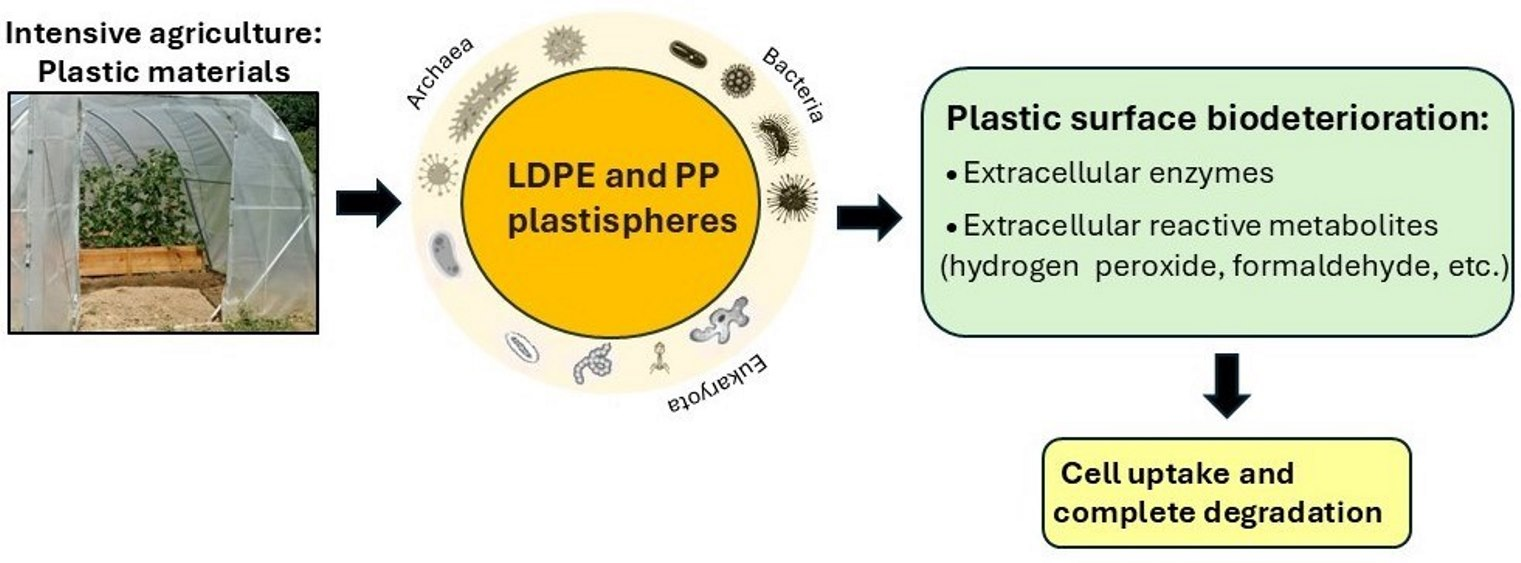
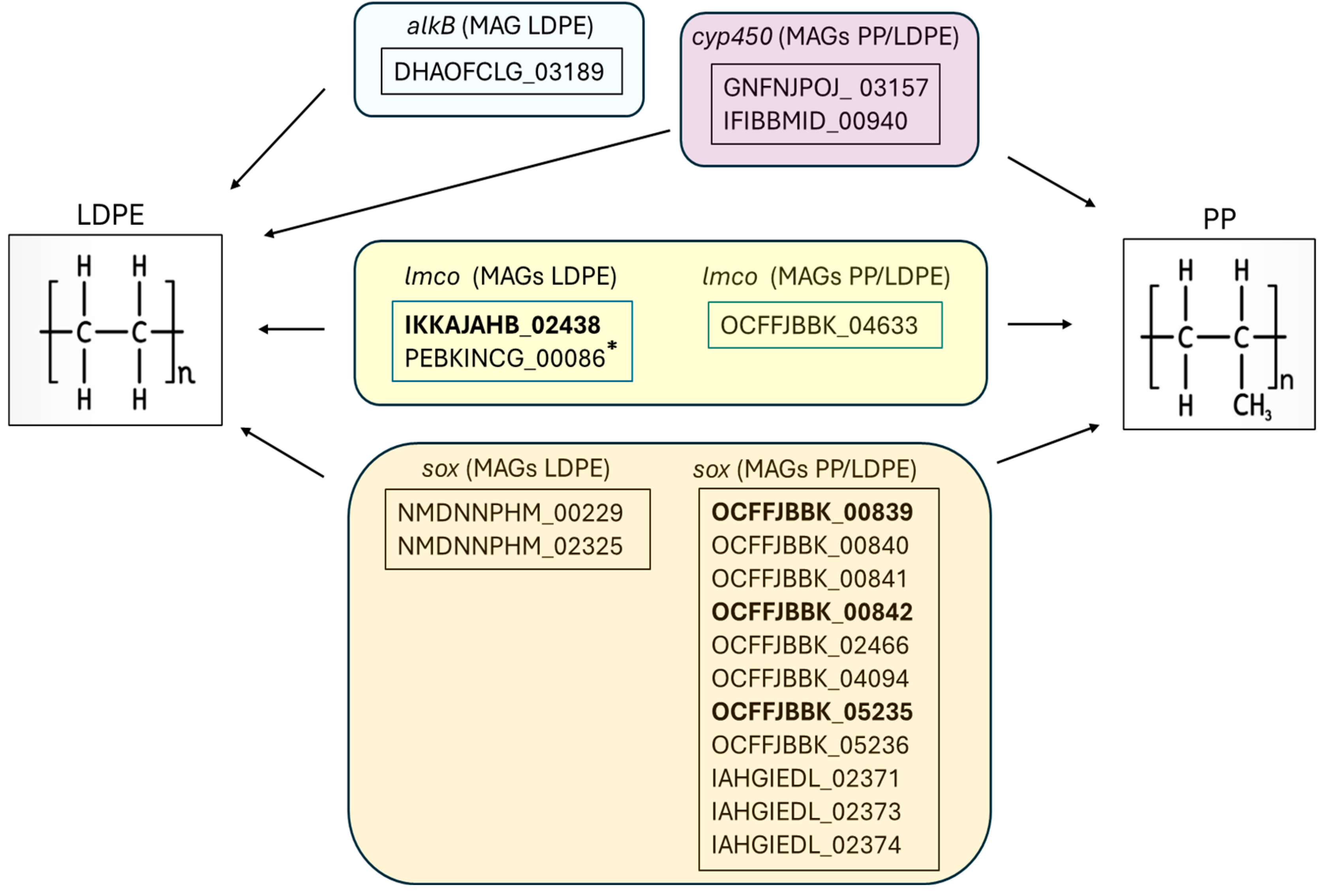
There is great genomic potential within the microbiomes analyzed from PP and LDPE plastispheres for deterioration of these polymers, as described previously. Therefore, hypothetical deterioration pathways for PP and LDPE could be initiated by the sequential action of the following predicted enzymes:
- (a)
- Sarcosine oxidases that may produce hydrogen peroxide and formaldehyde in the cytoplasm: Microorganisms from LDPE and PP plastispheres displayed sox genes that were identified in this study (Figure 6 and Figure 7). Hydrogen peroxide and formaldehyde are small and water-soluble molecules that could be easily extruded from the cytoplasm to the extracellular media. Recently, it has been described that formaldehyde can modify the structure of PP, affecting its thermo-oxidative and photo-oxidative mechanisms [66]. Specifically, formaldehyde accelerates degradation of polypropylene through the generation of tertiary carbon radicals by reacting with tertiary hydrogen, thus causing a significant decrease in the bond energy of the tertiary C-H bond [66]. Bacterial sarcosine oxidases were initially described in Bacillus as flavoenzymes that catalyze the oxidation of secondary and tertiary amines, producing glycine, hydrogen peroxide and formaldehyde. However, new members of this family have been characterized, revealing that different products can be generated from sarcosine, such as L-tryptophan instead of glycine or picolinate in place of glycine and formaldehyde, although hydrogen peroxide is usually produced through this reaction [67].
Figure 7. Oxidative genes hypothetically involved in LDPE and PP deterioration. The most abundant genes, according to their log2 FC (DESeq2 analysis), are highlighted in bold. The archaeal gene is marked with an asterisk. Cytochrome P450 monooxygenases: MetaBAT-0.155_sub (IFIBBMID_00940) and MetaBAT-0.32 (GNFNJPOJ_02897 and 03157); alkane 1-monooxygenase AlkB: MetaBAT-0.116 (DHAOFCLG_03189); multicopper oxidases MCO: MaxBin-0.089 (OCFFJBBK_04633), MaxBin-0.140 (PEBKINCG_00086), MetaBAT-0.106 (IKKAJAHB_02438); sarcosine oxidases: MaxBin-0.089 (OCFFJBBK_00839, OCFFJBBK_00840, OCFFJBBK_00841, OCFFJBBK_00842, OCFFJBBK_02466, OCFFJBBK_04094, OCFFJBBK_05235, OCFFJBBK_05236), MaxBin-0.142 (IAHGIEDL_02371, IAHGIEDL_02373, IAHGIEDL_02374), MetaBAT-0.118 (NMDNNPHM_00229, NMDNNPHM_02325). - (b)
- Specific secreted esterases and lipases (Figure 4) might hydrolyze these plastic polymers, after their initial oxidation with the very reactive molecules hydrogen peroxide and formaldehyde. Lipase genes are ubiquitous in different soil communities, and direct involvement of lipases in PP and LDPE deterioration could be very difficult to demonstrate from this metagenomic approach. However, the most elevated number and gene abundance were identified in either MAGs shared between LDPE and PP microbiomes or those exclusive to LDPE plastisphere. It has been reported that the catalytic activity of a lipase from the fungi Aspergillus niger resulted in 3.8% weight loss of PE [68]. Lipase 1 (PfL1) from the marine anaerobe bacterium Pelosinus fermentans, which was overexpressed in Escherichia coli, catalyzes hydrolysis of ester bonds present in oxidized polyethylene to be depolymerized into low-molecular-weight polymers [69]. Recently, a macrotranscriptomic study of a reconstituted marine bacterial community allowed identification of 10 enzymes putatively capable of directly acting on PE or PET (PEases or PETases). These enzymes were expressed as recombinant proteins in E. coli, showing PE degradation activity, and they were classified according to their enzymic activities as lipases, esterases, cutinases and hydrolases [70]. Additionally, Bacillus licheniformis SARR1 has been described to degrade LDPE through esterases and lipases [71]. However, additional studies will be required to demonstrate the involvement of these putative hydrolytic genes in LDPE and PP deterioration.
- (c)
- Further oxidative reactions might occur on LDPE and PP polymers. In the case of LDPE cytoplasmic cytochrome P450, alkane monooxygenase, laccase-like multicopper oxidase and peroxidase genes have been identified (Figure 5 and Figure 7). Genes with potential biodeterioration oxidative functions in PP have also been identified, including cytochrome P450, laccase-like multicopper oxidases and peroxidase genes (Figure 5 and Figure 7). Non-hydrolyzable polymers like polyethylene and polypropylene have been described to be more likely degraded through oxidative enzymes, such as monooxygenases (cytochrome P450 and alkane monooxygenases), ligninolytic enzymes like laccases, manganese peroxidases, lignin peroxidases, and other unspecified peroxygenases [72].
Alkane monooxygenases (AlkB) have also been reported to participate in the first steps of the degradation of LDPE through hydroxylation of the terminal carbon of alkanes. In the case of PP biodegradation processes, the initial depolymerases that can break it into lower molecular weight products are unknown, but it has been suggested that a combined treatment that includes an initial chemical process like incubation at elevated temperatures can facilitate formation of alkanes, and a further microbial degradation process through the alkane monooxygenase (AlkB) and cytochrome P450 (CyP450) monooxygenase could function in the initial steps of PP degradation. Then, alcohol dehydrogenases and aldehyde dehydrogenases produce fatty acids that can undergo β-oxidation to produce acetyl-CoA [19,73]. However, alkane monooxygenase genes could not be detected in the PP plastisphere (Figure 7, Table S5). The identification of alkane monooxygenase and rubredoxin genes in high abundance in LDPE plastisphere might suggest that alkanes can be produced hypothetically as intermediates during LDPE biodegradation, while in the microbial degradative pathway of polypropylene the formation of alkanes might not be produced, as deduced from the low abundance of these genes in the PP plastisphere. Polyethylene and polypropylene are resistant to microbial degradation, but polyethylene might be more susceptible to biodegradation because its structure is simpler than polypropylene (all atoms of PE are connected by strong single C−C and C−H bonds), while resistance to microbial degradation of polypropylene could be inherent to its chemical structure (with methyl groups as substituents). Another monooxygenase, a phenylalanine monooxygenase (PAH) of P. aeruginosa PAO1 has been described to participate in degradation of LDPE [65]. However, pah genes were not detected in this metagenomic analysis (Table S5).
Cytochrome P450 (CYP450) is a monooxygenase that contains heme and catalyzes the oxidation of C–H bonds in different molecules. Several cyp450 genes were detected in MAGs shared between PP and LDPE, but MAGs exclusive to PP plastisphere or exclusive to bulk soil microbiome were unidentified (Table S5). This result could indicate that this type of oxidative gene might display potential to initiate deterioration of the synthetic LDPE and PP polymers. Cytochrome P450 has been described to catalyze the hydroxylation of alkyl groups of n-alkanes, fatty acids, and fatty alcohols, forming their corresponding oxidized products. Bacillus thuringiensis JNU01 oxidizes PE through a CYP102A5.v1 enzyme, which is dependent on NADPH [74]. In the context of synthetic biology, CYP450 monooxygenases have been proposed as suitable enzymes to depolymerize polyethylene through a hydroxylation mechanism [75].
Bacterial LMCO proteins have been postulated as enzymes that could hypothetically oxidize LDPE and PP polymers in the initial steps of their degradative pathways. Laccase-like multicopper oxidase genes (lmco) have been found in MAGs that were shared between PP and LDPE, and in MAGs exclusive to PP or to LDPE (Figure 5 and Figure 7). Rhodococcus opacus R7 deteriorates polyethylene via a novel laccase-like multicopper oxidase [57]. A laccase enzyme has also been reported to degrade PE and nylon, reducing the molecular weight of these polymers and also producing aldehydes, alcohols and ketones as products. Oxidative fragmentation of LDPE through the purified enzymes LMCO2 and LMCO3 from Rhodococcus opacus R7 has been described [58]. These enzymes have been demonstrated to display great potential to be applied to the development of sustainable enzymatic PE upcycling technologies [76]. Additionally, a proteomic analysis of the response of Rhodococcus strain A34 to the biodegradation of polyethylene demonstrated that 1% weight loss of this polymer was associated with hydrolases and oxidoreductases present in this bacterium [58]. On the other hand, an archaeal putative LMCO enzyme has been identified in MaxBin-0.140, encoded by the PEBKINCG_00086 gene (Figure 5B), suggesting that archaea may initiate deterioration of LDPE polymer via this enzyme. Domains of the predicted laccase-like multicopper oxidase encoded by the PEBKINCG_00086 gene were analyzed by InterPro (https://www.ebi.ac.uk/interpro/search/sequence/ accessed on 1 September 1994) and typical architecture domains of the multi-copper oxidase superfamily were identified (Figure S3). Additionally, a phylogenetic tree of the predicted LMCO encoded by the PEBKINCG_00086 gene was constructed with PhylML software v3.3.20250515 based on phylogenetic tree estimation under the maximum likelihood (ML) principle [77]. The gene products of archaeal multicopper oxidase enzyme homologue PEBKINCG_00086 in this tree are OGD47126.1 (Candidatus Bathyarchaeota), HIH03668.1 (Methanoregulaceae archaeon) and HEY9205586.1 (Candidatus Methanoperedens sp.). These results suggest that the PEBKINCG_00086 gene encodes a multicopper oxidase superfamily member and that its predicted protein is placed within its archaeal homologues. However, bacterial genera are the closest related to the PEBKINCG_00086 gene product (Figure S4).
Peroxidase genes have been identified in this metagenomic study in MAGs shared between PP/LDPE and specific to PP (Figure 5). Recently, a biodegradative process of LDPE has been described for Rhodococcus sp. C-2 that includes depolymerization of this molecule through a glutathione peroxidase (GPx) with the cooperation of its dissociated superoxide anion radical to activate LDPE. Then, GPx catalyzes the chain scission of LDPE with oxygen and a non-heme chloroperoxidase. Other unidentified enzymes successively break this polymer chain to release shorter chain products that are oxidized by membrane-spanning alkane hydroxylases, alcohol dehydrogenases and aldehyde dehydrogenases. Finally, short-chain fatty acids are transported inside the cell through ABC-type transporters to undergo β-oxidation and the tricarboxylic acid cycle to be converted into energy for cells [12]. Peroxidases use organic and inorganic compounds as substrates that are oxidized in the presence of hydrogen peroxide or other peroxides. Bromo-peroxidases are also haloperoxidases that could also hypothetically participate in the degradation of LDPE. This is the first evidence that has revealed that bromo-peroxidase genes, as previously described for chloro-peroxidases, could display great potential in bacterial and archaeal biodeterioration of synthetic plastics like LDPE and PP. Very little is known about biodeterioration of PP and LDPE polymers by Archaea. However, an archaeal feruloyl esterase has been described to be capable of degrading PET [78]. On the other hand, cytoplasmic and periplasmic peroxidases could modulate H2O2 concentration inside and outside the cell to guarantee maximal extracellular oxidation of LDPE, while reducing intracellular toxicity [79,80].
The most abundant oxidative genes (cyp450, alkB, mco, prx and sox), which could be involved in bacterial LDPE and PP biodeterioration, were identified in a single MAG, MaxBin_0.089, except alkB gene (Figure 7). MaxBin_0.089 was shared between LDPE and PP plastispheres and, according to CheckM analysis, these oxidase genes were identified predominantly in the family Rhizobiaceae and, specifically, in the Phyllobacterium genus (Table 2). Additionally, a putative multicopper oxidase LMCO enzyme has been identified in the archaeon Methanoculleus (Figure 5, Table 2), suggesting that archaea could also contribute to the initial steps of deterioration of LDPE polymer (Figure 7). Putative peroxidases have been found in bacterial and archaeal genera, and these enzymes might continue degradation of LDPE to be decomposed into polymers of lower molecular weight.
On the other hand, unique gene sequences from this metagenomic study present in each microbiome, PP, LDPE and bulk soil, were translated into protein and further analyzed with the iPath3.0 web application, allowing identification of enzymes that operate in specific putative pathways of each of microbiome. In LDPE plastisphere, genes that code for unique proteins were involved in lipid biosynthesis, the synthesis of unsaturated fatty acids, glycerophospholipid metabolism, caffeine metabolism, and the biosynthesis of ubiquinone and other terpenoids, among others (Figure S4). Enzymes exclusive to LDPE plastisphere were involved in thiamine metabolism, including glycine oxidase (E.C. 1.4.3.19) (Figure S5). Glycine oxidase catalyzes the oxidation of glycine by oxygen to produce glyoxylate hydrogen peroxide and ammonium. This enzyme has been studied in Bacillus subtilis, which is active with glycine, sarcosine, N-ethylglycine, D-alanine, D-α-aminobutyrate, D-proline, D-pipecolate and N-methyl-D-alanine [81]. Considering that several sarcosine oxidase genes have also been identified as exclusive to LDPE plastisphere (Figure 6), and both enzymes produce hydrogen peroxide, perhaps these two enzymes, sarcosine and glycine oxidases, might be required to produce hydrogen peroxide to initiate the attack on the chemical structure of LDPE-based polymer, but further studies will be required to demonstrate this hypothesis. Another pathway that was identified as exclusive to LDPE plastisphere was the one-carbon pool by folate (Figure S5). Folate plays a crucial role in sarcosine oxidation, acting as a co-substrate of sarcosine oxidase, thus trapping the formaldehyde produced during its catalysis as 5,10-methylenetetrahydrofolate and preventing the release of toxic formaldehyde [81]. On the other hand, formation of unsaturated and saturated fatty acids of different chain lengths during biodegradation of LDPE has been previously described, and a long-chain fatty acid, CoA-ligase, involved in lipid metabolism, has been described to be ligated to polyethylene degradation in Rhodococcus and Pseudomonas [12,82]. Additionally, several enzymes of the carotenoid biosynthesis pathways were relevant to LDPE plastisphere (Figure S5). Phytoene is a C40 acyclic polyene that is the precursor of lycopene, which is a very potent antioxidant. Lycopene acts as an antioxidant and free radical scavenger that could mitigate bacterial cell damage against hydrogen peroxide that might be produced from sarcosine and glycine oxidases, as well as other oxidative enzymes.
In the case of PP plastisphere, unique gene products were identified to participate in the propanoate metabolism and carbon fixation pathways and in lysine degradation and butanoate metabolism. The involvement of several enzymes from the microbiome of PP that participate in propanoate and butanoate metabolism could suggest that these two compounds might be produced as intermediates in the PP degradation pathway by microorganisms colonizing the plastisphere of this polymer. Additionally, the PP microbiome contains, among others, unique gene products involved in the fatty acid elongation/degradation pathway that can be involved in fatty acid degradation, which might be produced during the degradation process of PP (Figure S6).
4. Conclusions
Microbial environmental remediation offers a friendly solution to the global problem related to synthetic plastic pollution, which negatively affects ecosystems and human health. In this work, a metagenomic approach has been applied to analyze the microbiomes present on the surface of LDPE and PP polymers. Several bacterial gene products that could putatively contribute to initial deterioration of these polymers, likely through oxidative pathways, have been identified, including sarcosine oxidase (SOX); bromo- and chloro-peroxidases (PRX); cytochrome P450 (CYP450) and alkane (AlkB) monooxygenases; and multicopper oxidases (LMCO). This work has contributed by highlighting putative archaeal genes that hypothetically could participate in biodeterioration of LDPE through a laccase-like multicopper oxidase (lmco), considering that very little is known about this biodegradative process in Archaea.
Large plastic materials are converted into microplastics by different environmental factors, making them more accessible extracellularly to enzymes and very reactive metabolites. This metagenomic analysis has contributed to elucidating different gene products that might be involved in early microbial deterioration of LDPE and PP, highlighting the genomic potential of microorganisms colonizing LDPE and PP plastispheres to hypothetically deteriorate these plastic materials. However, further studies based on enzymes functionally, as part of synthetic biology, will be required to demonstrate their activity towards these synthetic plastics.
Supplementary Materials
The following supporting information can be downloaded at https://www.mdpi.com/article/10.3390/microplastics5010032/s1: Figure S1: Venn diagram of genes identified in the metagenomic study; Figure S2: Venn diagram with MAGs specific to or shared within microbiomes; Figure S3: Metabolic pathways relevant in LDPE plastisphere; Figure S4: Metabolic pathways relevant in PP plastisphere;Figure S5. Metabolic pathways relevant in LDPE plastisphere; Figure S6. Metabolic pathways relevant in PP plastisphere; Table S1: DNA qubit quantification, number of reads; Table S2: Quality metrics of the metagenome co-assembly; Table S3: Bins selected by DAS Tool; Table S4: MAG taxonomic assignment (supporting values %); Table S5: MAG and gene relative abundance in PP, LDPE and bulk soil microbiomes; Table S6: Permutation test for adonis (PERMANOVA) under reduced model; Table S7: GTDBtk MEGAHIT DASTool taxonomy of MaxBin-0.140; Table S8: MaxBin-0.140 bin summary; Table S9: GTDBtk MEGAHIT Dash Tool marker gene summary: MaxBin 0.140 (Methanoculleus); Table S10: Specific marker genes used in the taxonomic assignment with GTDBtk of MaxBin-0.140 (Methanoculleus).
Author Contributions
Conceptualization, M.D.R.; data curation, L.P.S.; formal analysis, L.P.S., A.O.-A. and M.D.R.; funding acquisition, C.M.-V. and M.D.R.; investigation, D.B., L.P.S. and G.R.-C.; methodology, D.B., L.P.S., G.R.-C., V.M.L.-A. and M.D.R.; project administration, M.D.R.; software, A.O.-A., V.M.L.-A. and M.D.R.; supervision, M.D.R.; visualization, M.D.R.; writing—original draft, M.D.R.; writing—review and editing, C.M.-V., A.O.-A., V.M.L.-A. and M.D.R. All authors have read and agreed to the published version of the manuscript.
Funding
This work was funded by Ministerio de Ciencia e Innovación, Spain (grant PID2021-124174OB-I00), also supported by FEDER, UE; and by University of Córdoba, Spain (Grupo PAIDI BIO117, Junta de Andalucia).
Institutional Review Board Statement
Not applicable.
Informed Consent Statement
Not applicable.
Data Availability Statement
The original contributions presented in this study are included in the article/Supplementary Materials. Further inquiries can be directed to the corresponding author(s). All data generated in this work are free and available in Bioproject-NCBI (under the accession code PRJNA1378224) and in ZENODO (https://doi.org/10.5281/zenodo.17869256). This work has been developed in non-protected sites and does not include experimentation with vertebrates/humans.
Conflicts of Interest
The authors declare no conflicts of interest. The funders had no role in the design of the study; in the collection, analyses, or interpretation of data; in the writing of the manuscript; or in the decision to publish the results.
References
- Wei, R.; Zimmermann, W. Microbial enzymes for recycling of recalcitrant petroleum-based plastics: How far are we? Microb. Biotechnol. 2017, 10, 1308–1322. [Google Scholar] [CrossRef] [PubMed]
- Danso, D.; Chow, J.; Streita, W.R. Plastics: Environmental and biotechnological perspectives on microbial degradation. Appl. Environ. Microbiol. 2019, 85, e01095-19. [Google Scholar] [CrossRef] [PubMed]
- Jenner, L.C.; Rotchell, J.M.; Bennett, R.T.; Cowen, M.; Tentzeris, V.; Sadofsky, L.R. Detection of microplastics in human lung tissue using μFTIR spectroscopy. Sci. Total Environ. 2022, 831, 154907. [Google Scholar] [CrossRef] [PubMed]
- Gambarini, V.; Pantos, O.; Kingsbury, J.M.; Weaver, L.; Handley, K.M.; Lear, G. Phylogenetic distribution of plastic-degrading microorganisms. mSystems 2021, 6, e01112-20. [Google Scholar] [CrossRef] [PubMed]
- Huang, S.; Wang, H.; Ahmad, W.; Ahmad, A.; Ivanovich-Vatin, N.; Mohamed, A.M.; Deifalla, A.F.; Mehmood, I. Plastic waste management strategies and their environmental aspects: A scientometric analysis and comprehensive review. Int. J. Environ. Res. Public Health 2022, 19, 4556. [Google Scholar] [CrossRef]
- Lakhiar, I.A.; Yan, H.; Zhang, J.; Wang, G.; Deng, S.; Bao, R.; Zhang, C.; Syed, T.N.; Wang, B.; Zhou, R.; et al. Plastic pollution in agriculture as a threat to food security, the ecosystem, and the environment: An overview. Agronomy 2024, 14, 548. [Google Scholar] [CrossRef]
- Liu, X.; Park, H.; Ackermann, Y.S.; Avérous, L.; Ballerstedt, H.; Besenmatter, W.; Blázquez, B.; Bornscheuer, U.T.; Branson, Y.; Casey, W.; et al. Exploring biotechnology for plastic recycling, degradation and upcycling for a sustainable future. Biotechnol. Adv. 2025, 81, 108544. [Google Scholar] [CrossRef]
- Yoshida, S.; Hiraga, K.; Takehana, T.; Taniguchi, I.; Yamaji, H.; Maeda, Y.; Toyohara, K.; Miyamoto, K.; Kimura, Y.; Oda, K. A bacterium that degrades and assimilates polyethylene terephthalate. Science 2016, 351, 1196–1199. [Google Scholar] [CrossRef]
- Guo, W.; Duan, J.; Shi, Z.; Yu, X.; Shao, Z. Biodegradation of PET by the membrane-anchored PET esterase from the marine bacterium Rhodococcus pyridinivorans P23. Commun. Biol. 2023, 6, 1090. [Google Scholar] [CrossRef]
- Wang, W.; Yao, S.; Zhao, Z.; Liu, Z.; Li, Q.X.; Yan, H.; Liu, X. Degradation and potential metabolism pathway of polystyrene by bacteria from landfill site. Environ. Pollut. 2024, 343, 123202. [Google Scholar] [CrossRef]
- Zhao, S.; Liu, R.; Lv, S.; Zhang, B.; Wang, J.; Shao, Z. Polystyrene-degrading bacteria in the gut microbiome of marine benthic polychaetes support enhanced digestion of plastic fragments. Commun. Earth Environ. 2024, 5, 162. [Google Scholar] [CrossRef]
- Rong, Z.; Ding, Z.-H.; Wu, Y.-H.; Xuet, X.-W. Degradation of low-density polyethylene by the bacterium Rhodococcus sp. C-2 isolated from seawater. Sci. Total Environ. 2024, 907, 167993. [Google Scholar] [CrossRef] [PubMed]
- Meng, Q.; Yi, X.; Zhou, H.; Song, H.; Liu, Y.; Zhan, J.; Pan, H. Isolation of marine polyethylene (PE)-degrading bacteria and its potential degradation mechanisms. Mar. Pollut. Bull. 2024, 207, 16875. [Google Scholar] [CrossRef] [PubMed]
- He, L.; Yang, S.S.; Ding, J.; Chen, C.X.; Yang, F.; He, Z.L.; Pang, J.W.; Peng, B.Y.; Zhang, Y.; Xing, D.F.; et al. Biodegradation of polyethylene terephthalate by Tenebrio molitor: Insights for polymer chain size, gut metabolome and host genes. J. Hazard. Mater. 2024, 465, 133446. [Google Scholar] [CrossRef]
- Akash, K.; Parthasarathi, R.; Elango, R.; Bragadeeswaran, S. Exploring the plastic-fed Indian mealworm (Tenebrio molitor) gut bacterial strain (Bacillus subtilis AP-04): A potential driver of polyethylene degradation. J. Hazard. Mater. 2025, 486, 137022. [Google Scholar] [CrossRef]
- Gupta, K.K.; Chandra, H.C.; Sagar, K.; Sharma, K.K.; Devi, D. Degradation of high-density polyethylene HDPE through bacterial strain from cow faeces. Biocatal. Agric. Biotechnol. 2023, 48, 102646. [Google Scholar] [CrossRef]
- Jeon, H.J.; Kim, M.N. Comparison of the functional characterization between alkane monooxygenases for low-molecular-weight polyethylene biodegradation. Int. Biodeterior. Biodegrad. 2016, 114, 202–208. [Google Scholar] [CrossRef]
- Arkatkar, A.; Arutchelvi, J.; Bhaduri, S.; Uppara, P.V.; Doble, M. Degradation of unpretreated and thermally pretreated polypropylene by soil consortia. Int. Biodeterior. Biodegrad. 2009, 63, 106–111. [Google Scholar] [CrossRef]
- Rana, A.K.; Thakurb, M.K.; Saini, A.K.; Mokhta, S.K.; Moradi, O.; Rydzkowski, T.; Alsanie, W.F.; Wang, Q.; Grammatikos, S.; Thakur, V.K. Recent developments in microbial degradation of polypropylene: Integrated approaches towards a sustainable environment. Sci. Total Environ. 2022, 826, 154056. [Google Scholar] [CrossRef]
- Kulkarni, A.; Dasari, H. Current status of methods used in degradation of polymers: A review. MATEC Web. Conf. 2018, 144, 02023. [Google Scholar] [CrossRef]
- Bora, R.R.; Wang, R.; You, F. Waste polypropylene plastic recycling toward climate change mitigation and circular economy: Energy, environmental, and technoeconomic perspectives. ACS Sustain. Chem. Eng. 2020, 8, 16350–16363. [Google Scholar] [CrossRef]
- Yang, S.S.; Ding, M.-Q.; He, L.; Zhang, C.-H.; Li, Q.-X.; Xing, D.-F.; Cao, G.-L.; Zhao, L.; Ding, J.; Ren, N.-Q.; et al. Biodegradation of polypropylene by yellow mealworms (Tenebrio molitor) and superworms (Zophobas atratus) via gut-microbe-dependent depolymerization. Sci. Total Environ. 2021, 756, 144087. [Google Scholar] [CrossRef] [PubMed]
- Wróbel, M.; Szymanska, S.; Kowalkowski, T.; Hrynkiewicz, K. Selection of microorganisms capable of polyethylene (PE) and polypropylene (PP) degradation. Microbiol. Res. 2023, 267, 127251. [Google Scholar] [CrossRef] [PubMed]
- Pawano, O.; Jenpuntarat, N.; Streit, W.R.; Pérez-García, P.; Pongtharangkul, T.; Phinyocheep, P.; Thayanukul, P.; Euanorasetr, J.; Intra, B. Exploring untapped bacterial communities and potential polypropylene-degrading enzymes from mangrove sediment through metagenomics analysis. Front. Microbiol. 2024, 15, 1347119. [Google Scholar] [CrossRef]
- Andrews, S. Fastqc: A Quality Control Tool for High Throughput Sequence Data. 2010. Available online: http://www.bioinformatics.babraham.ac.uk/projects/fastqc (accessed on 19 August 2025).
- Ewels, P.; Magnusson, M.; Lundin, S.; Käller, M. MultiQC: Summarize analysis results for multiple tools and samples in a single report. Bioinformatics 2016, 32, 3047–3048. [Google Scholar] [CrossRef]
- Krakau, S.; Straub, D.; Gourlé, H.; Gabernet, G.; Nahnsen, S. Nf-core/mag: A best-practice pipeline for metagenome hybrid assembly and binning. NAR Genom. Bioinform. 2022, 4, lqac007. [Google Scholar] [CrossRef]
- Di Tommaso, P.; Chatzou, M.; Floden, E.W.; Barja, P.P.; Palumbo, E.; Notredame, C. Nextflow enables reproducible computational workflows. Nat. Biotechnol. 2017, 35, 316–319. [Google Scholar] [CrossRef]
- Chen, S.; Zhou, Y.; Chen, Y.; Gu, J. Fastp: An ultra-fast all-in-one FASTQ preprocessor. Bioinformatics 2018, 34, i884–i890. [Google Scholar] [CrossRef]
- Li, D.; Liu, C.-M.; Luo, R.; Sadakane, K.; Lam, T.-W. MEGAHIT: An ultra-fast single-node solution for large and complex metagenomics assembly via succinct de Bruijn graph. Bioinformatics 2015, 31, 1674–1676. [Google Scholar] [CrossRef]
- Gurevich, A.; Saveliev, V.; Vyahhi, N.; Tesler, G. QUAST: Quality assessment tool for genome assemblies. Bioinformatics 2013, 29, 1072–1075. [Google Scholar] [CrossRef]
- Kang, D.D.; Li, F.; Kirton, E.; Thomas, A.; Egan, R.; An, H.; Wang, Z. MetaBAT2: An adaptive binning algorithm for robust and efficient genome reconstruction from metagenome assemblies. PeerJ 2019, 7, e7359. [Google Scholar] [CrossRef] [PubMed]
- Wu, Y.-W.; Simmons, B.A.; Singer, S.W. MaxBin 2.0: An automated binning algorithm to recover genomes from multiple metagenomic datasets. Bioinformatics 2016, 32, 605–607. [Google Scholar] [CrossRef] [PubMed]
- Sieber, C.M.; Probst, A.J.; Sharrar, A.; Thomas, B.C.; Hess, M.; Tringe, S.G.; Banfield, J.F. Recovery of genomes from metagenomes via a de-replication, aggregation and scoring strategy. Nat. Microbiol. 2018, 3, 836–843. [Google Scholar] [CrossRef] [PubMed]
- Parks, D.H.; Imelfort, M.; Skennerton, C.T.; Hugenholtz, P.; Tyson, G.W. CheckM: Assessing the quality of microbial genomes recovered from isolates, single cells, and metagenomes. Genome Res. 2015, 25, 1043–1055. [Google Scholar] [CrossRef]
- Bowers, R.M.; Kyrpides, N.C.; Stepanauskas, R.; Harmon-Smith, M.; Doud, D.; Reddy, T.; Schulz, F.; Jarett, J.; Rivers, A.R.; Eloe-Fadrosh, E.A.; et al. Minimum information about a single amplified genome (MISAG) and a metagenome-assembled genome (MIMAG) of bacteria and archaea. Nat. Biotechnol. 2017, 35, 725–731. [Google Scholar] [CrossRef]
- Von Meijenfeldt, F.B.; Arkhipova, K.; Cambuy, D.D.; Coutinho, F.H.; Dutilh, B.E. Robust taxonomic classification of uncharted microbial sequences and bins with CAT and BAT. Genome Biol. 2019, 20, 217. [Google Scholar] [CrossRef]
- Hyatt, D.; Chen, G.-L.; LoCascio, P.F.; Land, M.L.; Larimer, F.W.; Hauser, L.J. Prodigal: Prokaryotic gene recognition and translation initiation site identification. BMC Bioinform. 2010, 11, 119. [Google Scholar] [CrossRef]
- Buchfink, B.; Xie, C.; Huson, D. Fast and sensitive protein alignment using DIAMOND. Nat. Methods 2015, 12, 59–60. [Google Scholar] [CrossRef]
- Patro, R.; Duggal, G.; Love, M.I.; Irizarry, R.A.; Kingsford, C. Salmon provides fast and bias-aware quantification of transcript expression. Nat. Methods 2017, 14, 417–419. [Google Scholar] [CrossRef]
- Chaumeil, P.A.; Mussig, A.J.; Hugenholtz, P.; Parks, D.H. GTDB-Tk: A toolkit to classify genomes with the Genome Taxonomy Database. Bioinformatics 2019, 36, 1925–1927. [Google Scholar] [CrossRef]
- Oksanen, J.; Blanchet, F.G.; Friendly, M.; Kindt, R.; Legendre, P.; McGlinn, D.; O’HAra, R.; Solymos, P.; Stevens, M.H.H.; Szoecs, E.; et al. Vegan: Community Ecology Package. 2025. Available online: https://github.com/vegandevs/vegan (accessed on 26 January 2026).
- Murtagh, F.; Legendre, P. Ward’s hierarchical agglomerative clustering method: Which algorithms implement ward’s criterion? J. Classif. 2014, 31, 274–295. [Google Scholar] [CrossRef]
- Galili, T.; O’Callaghan, A.; Sidi, J.; Sievert, C. Heatmaply: An R package for creating interactive cluster heatmaps for online publishing. Bioinformatics 2018, 34, 1600–1602. [Google Scholar] [CrossRef] [PubMed]
- Wickham, H. Ggplot2: Elegant Graphics for Data Analysis; Springer: New York, NY, USA, 2016; pp. 1–260. [Google Scholar] [CrossRef]
- Seemann, T. Prokka: Rapid prokaryotic genome annotation. Bioinformatics 2014, 30, 2068–2069. [Google Scholar] [CrossRef] [PubMed]
- Darzi, Y.; Letunic, I.; Bork, P.; Yamada, T. iPath3.0: Interactive pathways explorer v3. Nucleic Acids Res. 2018, 46, W510–W513. [Google Scholar] [CrossRef]
- Love, M.I.; Huber, W.; Anders, S. Moderated estimation of fold change and dispersion for RNA-seq data with DESeq2. Genome Biol. 2014, 15, 550. [Google Scholar] [CrossRef]
- Roldán, M.D.; Olaya-Abril, A.; Sáez, L.P.; Cabello, P.; Luque-Almagro, V.M.; Moreno, C. Bioremediation of cyanide-containing wastes: The potential of systems and synthetic biology for cleaning up the toxic leftovers from mining. EMBO Rep. 2021, 22, e53720. [Google Scholar] [CrossRef]
- Becerra, D.; Rodríguez-Caballero, G.; Marhuenda-Egea, F.C.; Olaya-Abril, A.; Moreno-Vivián, C.; Sáez, L.P.; Luque-Almagro, V.M.; Roldán, M.D. Microbial diversity of the surface of polypropylene and low density polyethylene-based materials (plastisphere) from an area subjected to intensive agriculture. MicrobiologyOpen 2025, 4, e70121. [Google Scholar] [CrossRef]
- Vosloo, S.; Huo, L.; Anderson, C.L.; Dai, Z.; Sevillano, M.; Pinto, A. Evaluating de novo assembly and binning strategies for time series drinking water metagenomes. Microbiol. Spectr. 2021, 9, e0143421. [Google Scholar] [CrossRef]
- Erkorkmaz, B.A.; Zeevi, D.; Rudich, Y. Metagenomic co-assembly uncovers mobile antibiotic resistance genes in airborne microbiomes. Commun. Earth Environ. 2025, 6, 397. [Google Scholar] [CrossRef]
- Orakov, A.; Fullam, A.; Coelho, L.P.; Khedkar, S.; Szklarczyk, D.; Mende, D.R.; Schmidt, T.S.B.; Bork, P. GUNC: Detection of chimerism and contamination in prokaryotic genomes. Genome Biol. 2021, 22, 178. [Google Scholar] [CrossRef]
- Wróbel, M.; Deja-Sikora, E.; Hrynkiewicz, K.; Kowalkowski, T.; Szymańska, S. Microbial allies in plastic degradation: Specific bacterial genera as universal plastic-degraders in various environments. Chemosphere 2024, 363, 142933. [Google Scholar] [CrossRef] [PubMed]
- Asencio, A.D. Diversity and distribution of microphytes and macrophytes in artificial irrigation ponds in a semi-arid mediterranean region (SE Spain). Int. J. Environ. Res. 2014, 8, 531–542. [Google Scholar] [CrossRef]
- Cai, Z.; Li, M.; Zhu, Z.; Wang, X.; Huang, Y.; Li, T.; Gong, H.; Yan, M. Biological degradation of plastics and microplastics: A recent perspective on associated mechanisms and influencing factors. Microorganisms 2023, 11, 1661. [Google Scholar] [CrossRef] [PubMed]
- Zampolli, J.; Mangiagalli, M.; Vezzini, D.; Lasagni, M.; Ami, D.; Natalello, A.; Arrigoni, F.; Bertini, L.; Lotti, M.; Di Gennaro, P. Oxidative degradation of polyethylene by two novel laccase-like multicopper oxidases from Rhodococcus opacus R7. Environ. Technol. Innov. 2023, 32, 103273. [Google Scholar] [CrossRef]
- Tao, X.; Ouyang, H.; Zhou, A.; Wang, D.; Matlock, H.; Morgan, J.S.; Ren, A.T.; Mu, D.; Pan, C.; Zhu, X.; et al. Polyethylene degradation by a Rhodococcous strain isolated from naturally weathered plastic waste enrichment. Environ. Sci. Technol. 2023, 57, 13901–13911. [Google Scholar] [CrossRef]
- Muangchinda, C.; Pinyakong, O. Enrichment of LDPE-degrading bacterial consortia: Community succession and enhanced degradation efficiency through various pretreatment methods. Sci. Rep. 2024, 14, 28795. [Google Scholar] [CrossRef]
- Cheng, Y.; Chen, J.; Bao, M.T.; Yiming, L. Surface modification ability of Paracoccus sp. indicating its potential for polyethylene terephthalate degradation. Inter. Biodeterior. Biodegrad. 2022, 173, 105454. [Google Scholar] [CrossRef]
- Velo, J.; Caipang, C.M.; Noblezada, A.; Banabatac, L.I.; Tan, N.P.; Ferriols, V.M.E. Whole genome sequence of Arthrobacter sp. from Iloilo city landfill soil unveils potential plastic biodegradation genes. Biodegradation 2025, 36, 72. [Google Scholar] [CrossRef]
- Nawrocki, E.P.; Petrov, A.I.; Williams, K.P. Expansion of the tmRNA sequence database and new tools for search and visualization. NAR Genom. Bioinform. 2025, 7, lqaf019. [Google Scholar] [CrossRef]
- Fu, Z.; Zhong, L.; Tian, Y.; Bai, X.; Liu, J. Identification of cellulose-degrading bacteria and assessment of their potential value for the production of bioethanol from coconut oil cake waste. Microorganisms 2024, 12, 240. [Google Scholar] [CrossRef]
- van Beilen, J.B.; Neuenschwander, M.; Smits, T.H.; Roth, C.; Balada, S.B.; Witholt, B. Rubredoxins involved in alkane oxidation. J. Bacteriol. 2002, 184, 1722–1732. [Google Scholar] [CrossRef] [PubMed]
- Kim, H.R.; Lee, Y.E.; Lee, E.; Suh, D.-E.; Choi, D.; Lee, S. Characterization of a low-density polyethylene-oxidizing enzyme in Pseudomonas aeruginosa via transcriptomic and proteomic analysis. J. Hazard. Mater. Adv. 2025, 18, 100726. [Google Scholar] [CrossRef]
- Meng, X.; Yang, R. How formaldehyde affects the thermo-oxidative and photo-oxidative mechanism of polypropylene: A DFT/TD-DFT study. Polymer 2022, 205, 110131. [Google Scholar] [CrossRef]
- Lahham, M.; Jha, S.; Goj, D.; Macheroux, P.; Wallner, S. The family of sarcosine oxidases: Same reaction, different products. Arch. Biochem. Biophys. 2021, 704, 108868. [Google Scholar] [CrossRef]
- Safdar, A.; Ismail, F.; Imran, M. Biodegradation of synthetic plastics by the extracellular lipase of Aspergillus niger. Environ. Adv. 2024, 17, 100563. [Google Scholar] [CrossRef]
- Kim, D.W.; Lim, E.S.; Lee, G.H.; Son, H.F.; Sung, C.; Jung, J.H. Biodegradation of oxidized low density polyethylene by Pelosinus fermentans lipase. Bioresour. Technol. 2024, 403, 130871. [Google Scholar] [CrossRef]
- Jin, J.; Jia, Z. Characterization of potential plastic-degradation enzymes from marine bacteria. ACS Omega 2024, 9, 32185–32192. [Google Scholar] [CrossRef]
- Rani, R.; Rathee, J.; Kumari, P.; Singh, N.P.; Santal, A.R. Biodegradation and detoxification of low-density polyethylene by an indigenous strain Bacillus licheniformis SARR1. J. Appl. Biol. Biotechnol. 2022, 10, 9–21. [Google Scholar] [CrossRef]
- Retnadhas, S.; Ducat, D.; Hegg, E.L. Nature-inspired strategies for sustainable degradation of synthetic plastics. JACS Au 2024, 4, 3323–3339. [Google Scholar] [CrossRef]
- Petrikov, K.V.; Vetrova, A.A.; Ivanova, A.A.; Sazonova, O.I.; Pozdnyakova-Filatova, I.Y. Generalization of classification of AlkB family alkane monooxygenases from Rhodococcus (sensu lato) group based on phylogenetic analysis and genomic context comparison. Int. J. Mol. Sci. 2025, 26, 1713. [Google Scholar] [CrossRef]
- Yun, S.-D.; Lee, C.O.; Kim, H.-W.; An, S.J.; Kim, S.; Seo, M.-J.; Park, C.; Yun, C.-H.; Chi, W.S.; Yeom, S.-J. Exploring a new biocatalyst from Bacillus thuringiensis JNU01 for polyethylene biodegradation. Environ. Sci. Technol. Lett. 2023, 10, 485–492. [Google Scholar] [CrossRef]
- Yeom, S.-J.; Le, T.-K.; Yun, C.-H. P450-driven plastic-degrading synthetic bacteria. Trends Biotechnol. 2022, 40, 166–179. [Google Scholar] [CrossRef] [PubMed]
- Son, H.F.; Hwang, S.; Kim, Y.; Ahn, J.H.; Ko, J.K.; Gong, G.; Um, Y.; Park, J.H.; Park, H.J.; Lee, S.-M. Enzymatic depolymerization of polyethylene using a small laccase and its potential for bio-upcycling. J. Hazard. Mater. 2025, 495, 139021. [Google Scholar] [CrossRef] [PubMed]
- Guindon, S.; Delsuc, F.; Dufayard, J.F.; Gascuel, O. Estimating maximum likelihood phylogenies with PhyML. Methods Mol. Biol. 2009, 537, 113–137. [Google Scholar] [CrossRef]
- Perez-Garcia, P.; Chow, J.; Costanzi, E.; Gurschke, M.F.; Dittrich, J.; Dierkes, R.F.; Molitor, R.; Applegate, V.; Feuerriegel, G.; Tete, P.; et al. The first archaeal PET-degrading enzyme belongs to the feruloyl-esterase family. Nat. Commun. 2023, 6, 193. [Google Scholar] [CrossRef]
- Wolff Leal, T.; Tochetto, G.; Lima, S.V.d.M.; de Oliveira, P.V.; Schossler, H.J.; de Oliveira, C.R.S.; da Silva Júnior, A.H. Nanoplastics and Microplastics in Agricultural Systems: Effects on Plants and Implications for Human Consumption. Microplastics 2025, 4, 16. [Google Scholar] [CrossRef]
- Jia, M.; Shao, L.; Jiang, J.; Jiang, W.; Xin, F.; Zhang, W.; Jiang, Y.; Jiang, M. Mitigating toxic formaldehyde to promote efficient utilization of C1 resources. Crit. Rev. Biotechnol. 2024, 45, 1175–1187. [Google Scholar] [CrossRef]
- Job, V.; Marcone, G.L.; Pilone, M.S.; Pollegioni, L. Glycine oxidase from Bacillus subtilis: Characterization of a new flavoprotein. J. Biol. Chem. 2002, 277, 6985–6993. [Google Scholar] [CrossRef]
- Zampolli, J.; Collina, E.; Lasagni, M.; Di Gennaro, P. Insights into polyethylene biodegradative fingerprint of Pseudomonas citronellolis E5 and Rhodococcus erythropolis D4 by phenotypic and genome-based comparative analyses. Front. Bioeng. Biotechnol. 2024, 12, 1472309. [Google Scholar] [CrossRef]
Disclaimer/Publisher’s Note: The statements, opinions and data contained in all publications are solely those of the individual author(s) and contributor(s) and not of MDPI and/or the editor(s). MDPI and/or the editor(s) disclaim responsibility for any injury to people or property resulting from any ideas, methods, instructions or products referred to in the content. |
© 2026 by the authors. Licensee MDPI, Basel, Switzerland. This article is an open access article distributed under the terms and conditions of the Creative Commons Attribution (CC BY) license.