Article

A Temporal Investigation of Microplastics’ Distribution and Sediment Characteristics in Saltmarshes of the Adriatic Coast of Croatia


1
School of Biological and Environmental Sciences, Liverpool John Moores University, Byrom Street, Liverpool L3 3AF, UK
2
Institute for Oceanography and Fisheries, Šetalište Ivana Meštrovića 63, 21000 Split, Croatia
*
Author to whom correspondence should be addressed.
Microplastics 2026, 5(1), 30; https://doi.org/10.3390/microplastics5010030
Submission received: 4 December 2025 / Revised: 21 January 2026 / Accepted: 1 February 2026 / Published: 9 February 2026

Abstract

Saltmarshes have emerged as important sinks for microplastic (MP) pollution, yet little is known about the long-term accumulation and retention mechanisms of MPs in these environments. This study presents the first chronological record of MPs in Mediterranean saltmarsh sediments, using sediment cores dated via a combination of AMS radiocarbon (14C) and radionuclide (210Pb, 137Cs, 241Am) from two saltmarshes located on the Adriatic Sea coast of Croatia (Blace and Jadrtovac). MPs were extracted and analysed across core depths and assessed in relation to geochemical parameters (organic matter (OM), carbonates, organic carbon (C-org), total nitrogen (TN), phosphorus (P) forms’ content, and grain size distribution). Results show that MPs first appear in sediments dated to 1950 in Jadrtovac and post-1960 in Blace, with concentrations increasing markedly in more recent surface layers. Jadrtovac exhibited higher MP concentrations (up to 0.5 MPs g−1), dominated by fibres (86%) associated with urban and maritime sources, while Blace showed lower concentrations, dominated by fragments (60%), likely from localised sources such as agriculture or single-use packaging. Polymer analysis confirmed contrasting source profiles, with rayon and cellophane dominating in Jadrtovac, and polypropylene and olefin in Blace. MPs positively correlated with OM, C-org, P, TN and sand content, and negatively with clay and carbonate content. Principal component analysis (PCA) confirmed that MPs were associated with organic-rich, sandy sediments. These findings demonstrate that OM composition and sediment texture significantly influence MP retention and highlight the role of saltmarshes as long-term archives of plastic pollution in low-energy coastal settings.

1. Introduction

Microplastic (MP) pollution has been widely documented in marine environments and is increasingly recognized as a significant environmental concern, impacting various ecosystems, including saltmarshes [1,2,3,4]. Saltmarshes are critical coastal habitats that provide essential ecological services for biodiversity and trap sediment providing nature-based coastal protection [5,6]. They also act as a carbon sink, delivering significant benefits for climate change mitigation [7,8], and act as natural water filters that trap and remove pollutants [9,10]. Saltmarsh ecosystems are exceptionally vulnerable to human pressures including pollution, eutrophication and land claim [11], coupled with climate change-driven impacts such as sea-level rise [12]. However, the growing presence of MPs in these environments poses a potentially serious and largely unquantified threat to their ecological integrity and the organisms that depend on them.
MPs, defined as plastic particles smaller than 5 mm in diameter [2,13], originate from diverse sources, including the degradation of larger plastic debris, industrial processes, synthetic fibres from textiles and fishing gear. MPs are distinguished, according to their origin, into primary (produced to be of microscopic dimensions) or secondary (formed through degradation processes in the environment) [14].
Due to their persistence and mobility, MPs have been found in marine environments worldwide, with documented accumulation in oceans, coastal waters and sediments [1,15,16,17]. This has led to MP pollution frequently being considered as a potential proxy material for the dating of stratigraphic sequences associated with the Anthropocene [18]. Saltmarshes have recently been identified as potential MP sinks due to the retention of fine sediments, reducing water movement and disturbance, thereby facilitating pollutant accumulation, including MP entrapment. Saltmarsh sediments can serve as an archive of MP contamination because the dense mat of grass roots and rhizomes provides stability to sediment columns, which can diminish potential bioturbation and hydrodynamic sediment disturbances [3]. The investigations of different wetland systems proved that saltmarsh habitats accumulate the highest abundance of MPs, highlighting the pivotal role of saltmarsh habitats in shaping MPs dynamics in coastal areas [19,20]. The accumulation of MPs in saltmarshes may disrupt sedimentary processes by interacting with natural sediments and colloids to alter their settling behaviour [21], alter habitat structure and pose risks to both resident and migratory species [22,23].
Saltmarshes frequently receive large inputs of nutrients and also particulate and dissolved organic matter during tidal flooding, where they may be buried and serve as a substrate for decomposition processes [24]. Sedimentary OM in saltmarsh coastal wetlands has received special attention because it retains characteristics of its autochthonous, extant and anthropogenic sources [25]. OM plays a fundamental role in saltmarsh ecosystems, influencing nutrient cycling, sediment structure, and microbial activity [26].
A variable proportion of saltmarsh sedimentary organic matter [27,28,29] has an allochthonous source, deriving from suspended particulate organic matter, and is often adsorbed on mineral matter and on estuarine and marine phytoplankton, microphytobenthos, and non-local macrophyte litter carried to the marsh surface by waves and tides. Vertical accretion in saltmarshes is largely driven by organic matter accumulation in relation to inorganic sediment deposition [30,31]. Thus, sedimentary OM accumulation dynamics provide saltmarsh environments with great potential for C storage, as the C captured through plant photosynthesis is buried and preserved in SOM over time [32,33].
Emerging research suggests a potential link between sedimentary OM and MP accumulation in coastal environments. MPs can interact with OM through adsorption, aggregation, or biofilm formation, influencing their transport, degradation and persistence in sediments [34,35]. In saltmarshes, where organic-rich sediments facilitate particle retention, OM may enhance the deposition and stabilization of MPs. Conversely, changes in OM content due to anthropogenic disturbances, eutrophication or climate change could alter MP dynamics by affecting sedimentation rates and decomposition processes [36].
A relatively small number of studies have reported the presence of MPs in saltmarsh sediments in contrast to coastal and open sea sediments [3,37,38,39]. Research in Portuguese saltworks revealed significant MP contamination in sediments, water and salt products, emphasizing the pervasive and ubiquitous nature of MP pollution [40]. Relatively few studies which investigated MPs in estuarine sediments have examined the relationship between MP abundance, particle size and TOC. Results have been conflicting, with some finding a clear link between the parameters where fine-grained sediments and OM abundance increased MP concentrations, while others have failed to confirm one [41]. Investigations in the United Kingdom indicated saltmarshes as important components of MP source-fate-transport networks [42]. Other studies in the United Kingdom have demonstrated that synthetic fibres and plastic fragments dominate MP contamination in saltmarshes, with concentrations strongly influenced by anthropogenic inputs and hydrodynamic conditions [3]. Despite these findings, data on MP contamination in Mediterranean saltmarshes remain unstudied. Given the ecological and socio-economic importance of these habitats [43], there is an urgent need to assess the extent and nature of MP pollution in these coastal environments.
The Adriatic Sea, particularly along the Croatian coast, is increasingly recognised as a hotspot for marine plastic litter, driven by high coastal population density, tourism, intensive fisheries, and maritime transport activities, as well as the transboundary litter transfer [44,45]. Despite this, systematic monitoring of marine litter has historically been limited [44,46]. The DeFishGear project (2013–2016), a pioneering regional initiative, remains the only large-scale effort assessing both macro- and microplastic pollution across various marine compartments, including sea surface, sediments, and fish stomachs. Results from this project revealed widespread plastic contamination on beaches [47], seabed [48,49], on the sea surface and sandy beach sediment [50], and within biota [51], highlighting the extent of anthropogenic impact on the Adriatic ecosystem. These results have been confirmed by other studies [52,53,54,55,56]. Floating plastic fragments and MPs were the dominant litter types [48,50,54], reflecting inputs from both land-based sources and maritime activities [45,47]. These findings underscore the importance of extending research into understudied coastal habitats, such as saltmarshes, which may act as long-term sinks for plastic debris due to their sedimentary characteristics and low hydrodynamic energy. This study builds on that foundation by providing the first MP dataset from Croatian saltmarsh sediments, further contextualising marine plastic pollution in the semi-enclosed sea basin of the Adriatic.
Croatian saltmarshes, primarily located along the Adriatic coastline, exist within karstic environments characterized by nutrient-poor soils and vegetation of low diversity but high ecological importance [43]. These dynamic habitats have developed over millennia, influenced by Holocene relative sea-level changes and anthropogenic activities [57,58]. For example, in the Croatian Neretva Delta, changes in the land use like drainage and other human activities have threatened marsh vegetation and biodiversity [59]. The micro-tidal range of the Adriatic Sea and the enclosed nature of the many coastal bays suggest that Croatian saltmarshes may serve as effective MP traps. However, systematic studies quantifying MP concentrations, sources, and composition in these environments are lacking.
This study aims to address these knowledge gaps by investigating MP pollution and its potential interactions with sedimentary characteristics and OM composition in two Croatian saltmarshes where suitable sediment records exist and have previously been used for relative sea-level change studies [60,61,62]. Using sediment core analyses, chronological dating, and MP identification techniques, this paper seeks to
  • Quantify MP concentrations and spatial distribution in saltmarsh sediments;
  • Identify the types and polymer compositions of the MPs present;
  • Establish a chronology of MP deposition using sediment cores to determine historical trends in contamination;
  • Examine the relationship between MP accumulation and geochemical parameters in sediments (organic matter (OM), carbonates, organic carbon (C-org), total nitrogen (TN), phosphorus (P) forms content, and grain size distribution);
  • Assess the role of sedimentary and environmental factors in MP retention. We hypothesise that (1) MP abundance increases toward the sediment surface, reflecting rising plastic production and coastal population growth, and (2) higher MP retention is associated with OM-rich, fine-grained sediments compared to coarse-grained or carbonate-rich sediments. By exploring the potential interactions between sedimentary OM composition, sediment texture and MPs, this study provides a novel perspective on MP behaviour in Adriatic saltmarsh ecosystems. The findings will contribute to a broader understanding of MP pollution in coastal wetlands and support future monitoring efforts and management strategies in the Adriatic region and beyond.

2. Materials and Methods

2.1. Study Areas

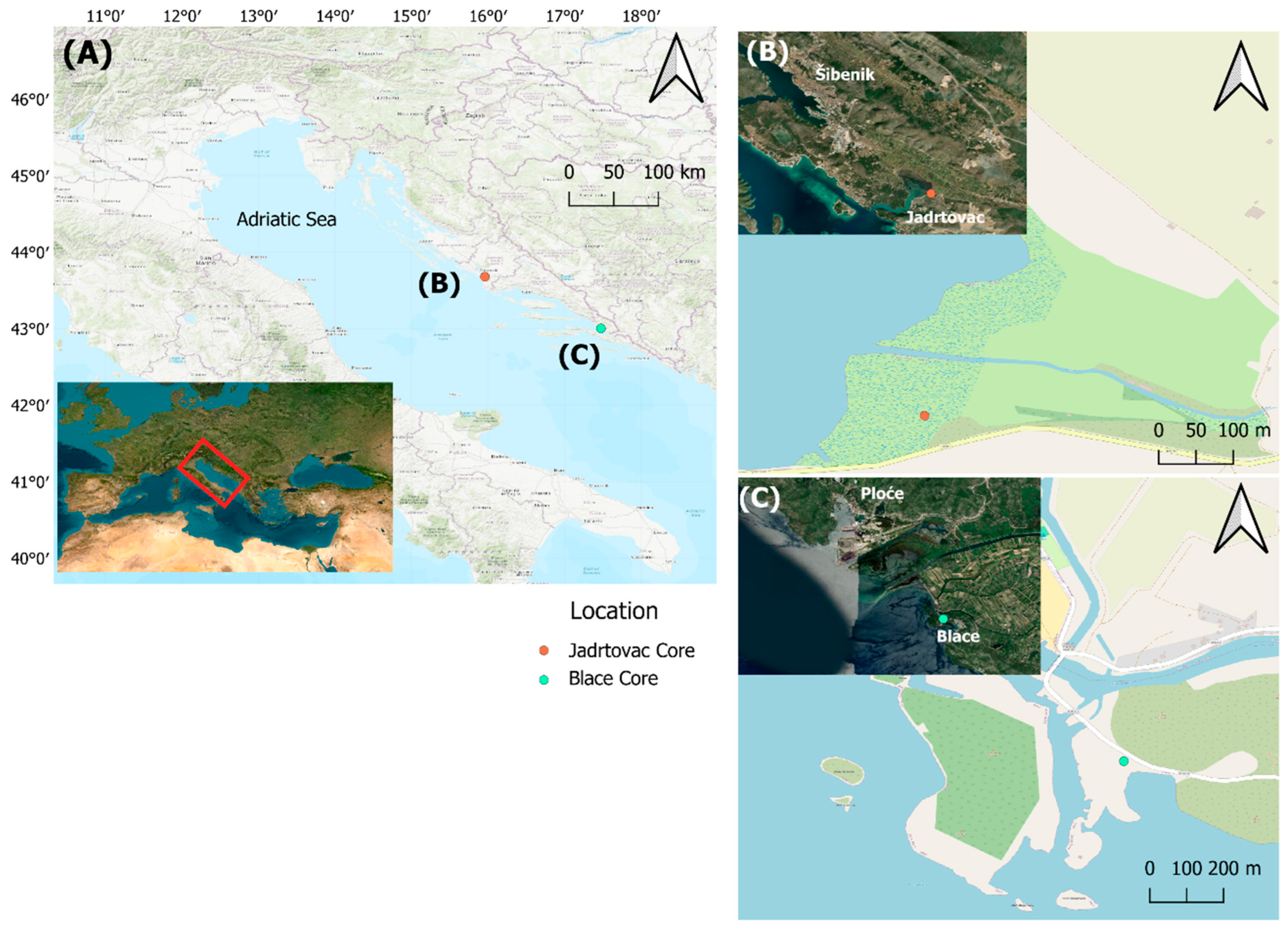
The first site is located on the outskirts of Jadrtovac (171 inhabitants) situated within Morinje Bay (43°40′48″ N, 15°57′24″ E), approximately 3 km south of Šibenik (Figure 1A). The saltmarsh is located on the eastern side of the bay and is roughly 130 m at its widest point. The mean daily tidal range at the site is approximately 23 cm. It is a typical karstic environment with limited vegetation and poor soils on the surrounding slopes. The bay was infilled as relative sea-level rose during the Holocene, resulting in the deposition of 4.5 m of sediment [61].
The second site is situated around 120 km south of Jadrtovac and comprises a remote small pocket of saltmarsh north of Blace, a small fishing village (273 inhabitants) approximately 10 km south of Ploče (Figure 1C). The saltmarsh extends for around 40 m at its widest point, and the mean daily tidal range is identical to Jadrtovac site at 23 cm [61].
Previous sedimentological analyses of the same cores [60] revealed that both Blace and Jadrtovac exhibit variable lithological compositions downcore, with alternating layers of organic-rich mud, muddy sand, and silty sand. These sedimentary transitions suggest that OM content is influenced not solely by diagenetic aging or time since deposition but also by changing depositional environments, including hydrodynamic conditions and vegetation coverage. Such variability provides an important framework for interpreting OM and MP distributions in this study. Due to differences in hydrodynamic conditions and sediment input, the two saltmarshes exhibit contrasting sedimentation rates, with Jadrtovac accumulating more rapidly (0.20–0.25 cm yr−1) than Blace (0.10–0.15 cm yr−1). Consequently, age–depth relationships differ between cores, and chronological comparisons are made within, rather than between, sites.

2.2. Sampling

Four sediment cores were collected using a columnar 50 mm diameter transparent polyvinyl chloride (PVC) core tube. Sediment cores were left in tubes, taped and wrapped securely for transportation to the laboratory for analysis. Two sediment cores were collected from each site (Jadrtovac and Blace), with sliced subsamples taken every 1 cm for geochemical parameters and microplastic analysis, using a metal cutter and edges discarded to avoid contamination. Each core was analysed independently to capture spatial variability within each marsh. For the determination of the C-org, TN, total and inorganic P, OM content and CaCO3 content, sediment cores were also sliced at 1 cm intervals, stored in PVC bags and frozen.

2.3. Age Determination of Samples

In this study, the chronology of the sediment samples was established using previously published data for Jadrtovac and Blace study areas [60]. This approach integrates Accelerator Mass Spectroscopy (AMS) 14C dating with short-lived radionuclides (210Pb, 226Ra, 137Cs, and 241Am) for sediments deposited within the last century. As the original cores used for these chronologies were collected in 2011, minor age corrections were applied to account for the time elapsed between the original sampling and the collection of cores for this study. Linear interpolation of sedimentation rates derived from the published age-depth models was used to estimate surface ages consistent with the 2024 sampling date, under the assumption of relatively constant recent sedimentation rates in these low-energy, micro tidal environments. While there is an acknowledgement that small deviations in recent sedimentation may occur, this approach ensures temporal alignment of the MP and chronological datasets within an acceptable uncertainty range for decadal-scale interpretation.
The sediment cores for MP analysis were obtained from the same locations as the cores used for chronological analysis, ensuring consistency in the stratigraphic framework. Chronological data were derived from previously dated sediment cores at both locations, using a constant rate of supply (CRS) 210Pb model supported by 137Cs fallout horizons and supplemented by AMS 14C dating where available. For the most recent layers (post-2011), linear interpolation was applied, with an estimated uncertainty of ±2–5 years [60]. Full radionuclide profiles and age–depth models are presented in Supplementary Figures S1–S4.

2.4. MP Extraction

All sediment samples were processed once due to limited material availability, using consistent extraction and quantification protocols. MP abundance is expressed as the number of MP particles per gram of dry sediment (MPs g−1). Sediment samples were initially subjected to air-drying, either on a drying rack or in a 40 °C oven, to eliminate any residual moisture. Following this, the dried samples were ground using a mortar and pestle and sieved through a 4.60 mm aperture sieve. Plastics with dimensions exceeding 4.60 mm were manually segregated and retained for further analyses, while the remainder was discarded. The <4.6 mm fraction was selected based on the operational definition of MPs (<5 mm) and to exclude larger MP debris, in line with previous sediment studies (e.g., Hidalgo-Ruz, Gutow [63]).
To remove sedimentary OM, the sieved sediment was placed into a 250 mL beaker and treated with 30% hydrogen peroxide (H2O2) until fully submerged. This beaker was then sealed with a watch glass, and the digestion process was monitored closely for two hours to ensure safety. Following an overnight passive reaction at ambient room temperature, the sample was subjected to a controlled heating regime within a fume cupboard, using a hotplate of <40 °C. During this phase, deionised water was periodically introduced to maintain moisture levels. Post-heating, the sample settled overnight after which the clear supernatant was carefully removed via pipetting.
CaCO3 was removed by adding 2M of hydrochloric acid (HCl) to the sediment sample until the 50 mL mark on the beaker was reached. After an overnight incubation, the sample underwent a warming on a hotplate until the reaction started, situated within a fume cupboard. Once adequately treated, the sample was allowed to cool and settle, a process followed by several rounds of washing with deionised water and subsequent settling to ensure sample purity.
Sediment was removed to a 50 mL centrifuge tube and subjected to centrifugation at 3000 rpm for 3 min. The sediment was then treated with a 1.6 solution of NaCl, followed by another round of centrifugation. The uppermost 10 mL of the solution, rich in floating MPs, was pipetted and preserved for analysis. Density separation using saturated NaCl solution (1.2 g/cm3) was repeated three times per sample to ensure efficient extraction. Supernatants were combined, filtered, and examined under a stereomicroscope.
Finally, the sample underwent filtration utilizing a Hartley pattern filter funnel specifically designed for 25 mm filters. Post-filtration, the residue deposited on the filter paper was relocated to an aluminium tray and subjected to overnight drying in a 40 °C oven. Although no recovery tests were performed during this study due to limited available material, the NaCl density separation is a widely applied method MP extraction from sediment due to its simplicity, non-toxicity and compatibility with a range of polymers. Previous studies report recovery efficiencies for NaCl solutions ranging from approximately 60% to 85%, depending on polymer type, particle shape and size [64,65,66,67,68]. While high-density polymers such as PET and PVC may be underrepresented using this method, the approach remains widely used and validated for low- and medium-density polymers.

2.5. Identification of MPs

MPs were identified and quantified using a stereoscopic microscope (Stemi DV4, Carl Zeiss AG, Oberkochen, Germany) with a magnification range of 8.0× to 32.0×. The microfibers were characterised based on their colour (transparent, black, brown, red, pink/purple, blue, green, yellow, and orange) and based on the roughness of their surfaces. All visually identified particles retained on the filter (>150 μm) were extracted from the filter and placed on a microscope slide to identify their chemical composition with µFTIR (Fourier-Transform Infrared spectroscopy). The µFTIR analysis was performed with a Nicolet iN10 Infrared Microscope (Thermo Fisher Scientific, Waltham, MA, USA), with the spectral range spanning from 7600 to 450 cm−1 and in the 4000–600 cm−1 range, which covers the main polymer fingerprint region. The apparatus is equipped with an ultra-fast motorised stage and with a liquid nitrogen cooled MTC detector (mercury cadmium telluride detector). In total, 64 co-scans were collected with an aperture dimension of 25 × 25 microns on reflectance mode for each particle. All µFTIR measurements were performed using identical acquisition parameters for all samples to ensure analytical consistency and particles smaller than 150 µm were not analysed due to limitations associated with visual sorting, manual handling and stereoscopic identification on GF/F filters. Particles were retrieved employing the OMNICTM PictaTM software and SpectraGryph software (v1.2.16). In this study, reflectance mode was decided as the best method, due to the thickness (4.2 mm) of GF/F [69]. Each polymer spectrum was then compared with specific polymer reference libraries, FLOPP-FLOPP-e using a 70% or greater similarity threshold [70]. Potential spectral overlap and polymer degradation were considered during interpretation.

2.6. Procedural Contamination Controls for MP Determination

All apparatus was rinsed three times with purified water and then dried before use. Plastic equipment was replaced with glassware equipment wherever possible. The plastic equipment was rinsed three times with purified water and dried for 24 h in an oven at 40 °C. The glassware equipment was washed with DECON 90 and placed in a muffle furnace for 4 h at 400 °C. To ensure that all the solutions (H2O2 and NaCl) were free of plastic, they passed through filtration into a glassware flask. The laboratory coats were made from polyester material; thus, it was decided to exclude white polyester fibres from the results. The processing of samples was performed in a contamination-restricted laboratory, in a fume cupboard or in an enclosed glove box where various blanks were positioned to control airborne contamination. Procedural blanks and field blanks were analysed alongside samples, showing negligible contamination.

2.7. Particle Size Analysis

For particle size analysis, the 1 cm thick subsamples were stored at −20° C and freeze-dried. The weighed dry sediment sample was mixed with distilled water, left overnight and sieved through a 0.5 mm sieve. Particles > 0.5 mm were dried and sieved on a sieve set of 0.5, 1, 2 and 4 mm. Particles < 0.5 mm were suspended and measured using laser granulometry (Mastersizer 3000E, Malvern Panalytical Ltd., Malvern, Worcestershire, United Kingdom). Once the results were obtained, the Gradistat v8.0 spreadsheet was used to obtain the sediment particle size distribution. Grain size parameters (Mz—mean size, Md—median, So—sorting, Sk—skewness, Kg—kurtosis) were calculated according to Folk and Ward [71] and sediment types expressed using the Folk classification [72].

2.8. Geochemical Analysis in Sediments

Sediment was divided into subsamples 1 cm thick, frozen (−18 °C) and brought to the Institute of Oceanography and Fisheries in Split, Croatia, for further analysis.
To determine the OM content in subsamples, the weight loss on ignition method was used following treatment with hydrogen peroxide (H2O2) and subsequent heating at 450 °C for six hours [73] (Vdović et al., 1991). Carbonate content, expressed as CaCO3 (%), was assessed as the loss of weight after the digestion with 5 mL of 4 M HCl for two hours, following the method by Loring and Rantala [74].
For analysis of P concentration in sediment, freeze-dried subsamples were ground and sieved (Ф < 250 μm). Extraction of IP and TP was obtained [75]. Orthophosphate concentration in extracts was determined on spectrophotometer UV MINI 1240 (Shimadzu, Analytical Instruments Division, Kyoto, Japan) according to Grasshoff, Kremling [76]. Standard reference material SRM 1646a—Estuarine Sediment (NIST) was used for evaluating the reliability of method (recovery: 96.1%).
C-org and TN in sediment subsamples were analysed using CHNS-O analyser (UNICUBE, Elementar, Frankfurt, Germany). Sediment for C-org analysis was first exposed to concentrated HCl for 24 h to remove inorganic carbon, in accordance with the method described by Verardo, Froelich [77]. CHNS-O analyser performed a daily internal calibration using standard sulphanilamide (C6H8N2O2S) according to the instrument’s protocol. Sample weight for N analysis was 20–30 mg, and 25–35 mg for C-org samples (which started from 1 g of initial weight of sample untreated with HCl). During the analysis, blanks and standards were analysed to check for instrument stability. If the percentage difference between the two replicates was higher than 20%, replicate samples were reanalysed. The limit of detection for C and N was 10 ppm (µg/g).

2.9. Statistical Analysis

All statistical and graphical analyses were performed using R (v.4.3.1, R Core Team, 2023) and Python (v.3.10) within Jupyter Notebooks (v.7.3.2). R packages including ggplot2, patchwork, reshape2, dplyr, tidyverse, FactoMineR, and factoextra were used for data wrangling, visualisation, correlation matrices, non-parametric tests (e.g., Wilcoxon rank-sum), and principal component analysis (PCA).
Python was additionally used to generate specific multi-panel geochemical plots (e.g., C-org, TN, TP, C/N ratios) and to produce figures combining primary and secondary y-axes (e.g., sediment depth and sediment age). Data were handled and visualised using libraries including pandas, matplotlib, and seaborn. This dual-platform approach enabled flexible and reproducible visualisation of depth-resolved trends in MPs and associated sedimentary parameters.

3. Results

3.1. MP Distribution, Concentration and Composition

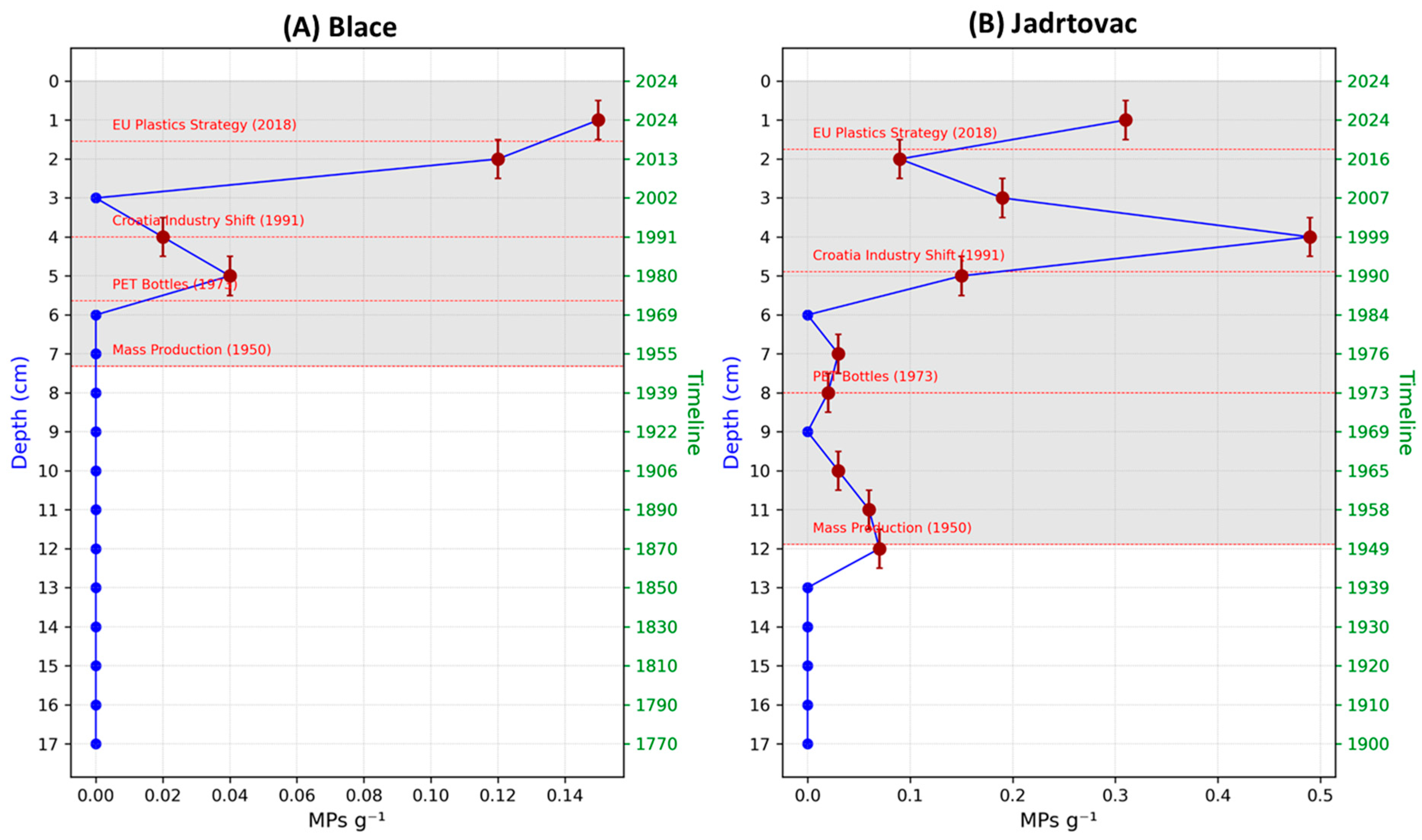
The concentration of MPs in the Blace core was limited to the upper 6 cm of the sediment profile (Figure 2A). The highest concentration was recorded at 1–2 cm depth, with 0.05 MPs g−1., corresponding to the years post-2020. Concentrations fluctuated between 0.03 and 0.04 MPs g−1 from 2 to 6 cm and absent below 6 cm, indicating no detectable MPs before 1960. While a complete age model was extended beyond 11 cm, ages below this depth—approaching 1890—are considered less reliable due to the reduced resolution and increasing uncertainty of the radiometric dating method.
The Jadrtovac core exhibited detectable levels of MP accumulation throughout the upper 13 cm and as far back as 1950 (Figure 2B). The highest concentration, 0.5 MPs g−1, were observed at 4–5 cm depth corresponding to the 1990s. Concentrations ranged between 0.1 and 0.5 MPs g−1 in the upper 13 cm in the 20th century, with values decreasing to undetectable levels in older sediment below 13 cm.
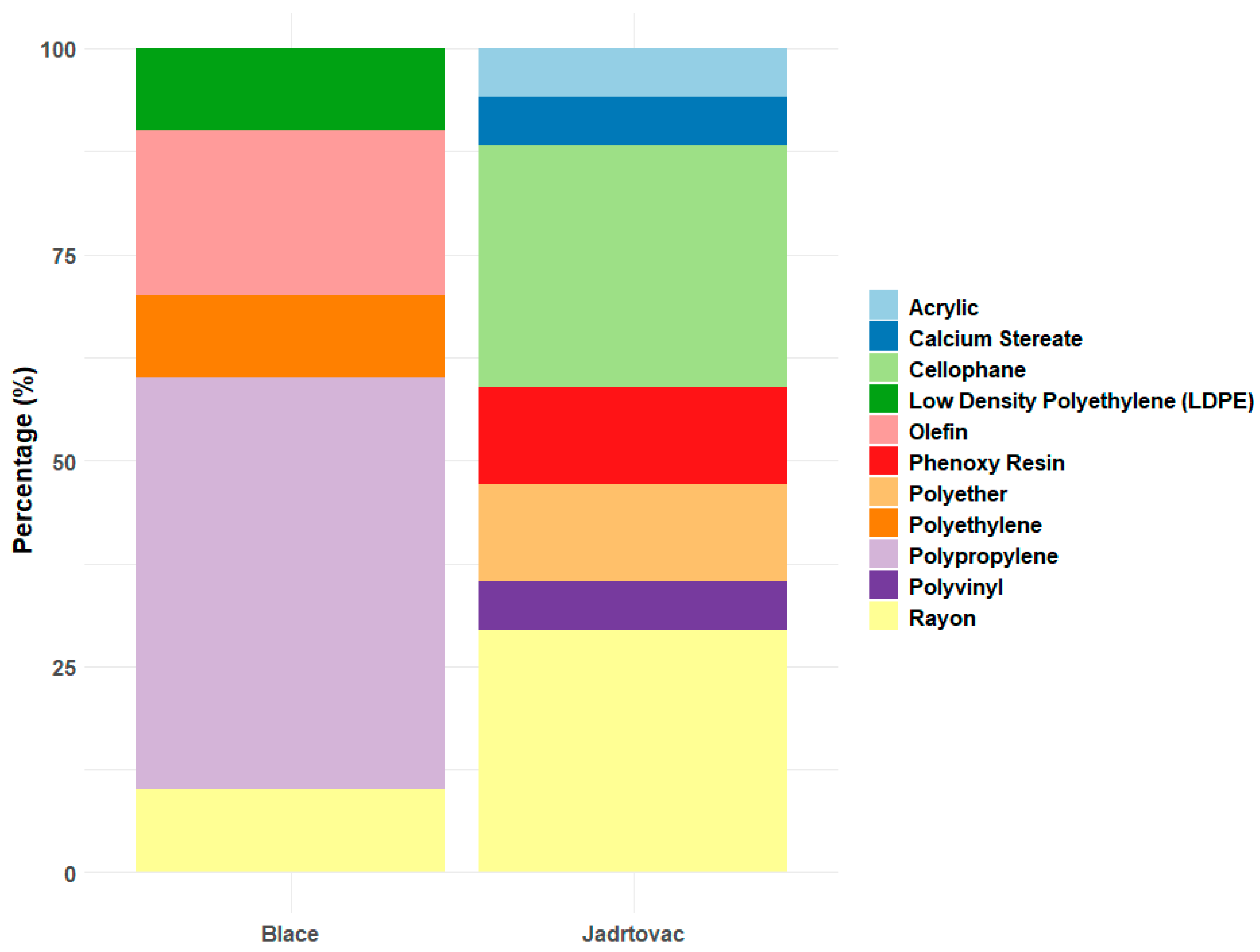
In Blace, fragments dominated (60%), while fibres accounted for 40% of the total MPs recorded (Supplementary Figure S5). In contrast, fibres were dominant in Jadrtovac (86%) with fragments contributing 14%. Polymer analysis (Figure 3) revealed that polypropylene was the most abundant polymer in Blace (50%), followed by olefin (20%), rayon (10%), polyethylene (10%), and low-density polyethylene (LDPE, 10%). In Jadrtovac, rayon and cellophane each constituted 29% of the total polymers, followed by phenoxy resin and polyether (12% each), and smaller contributions from polyvinyl, calcium stearate and acrylic (6% each).

3.2. Geochemical Parameters in Sediment

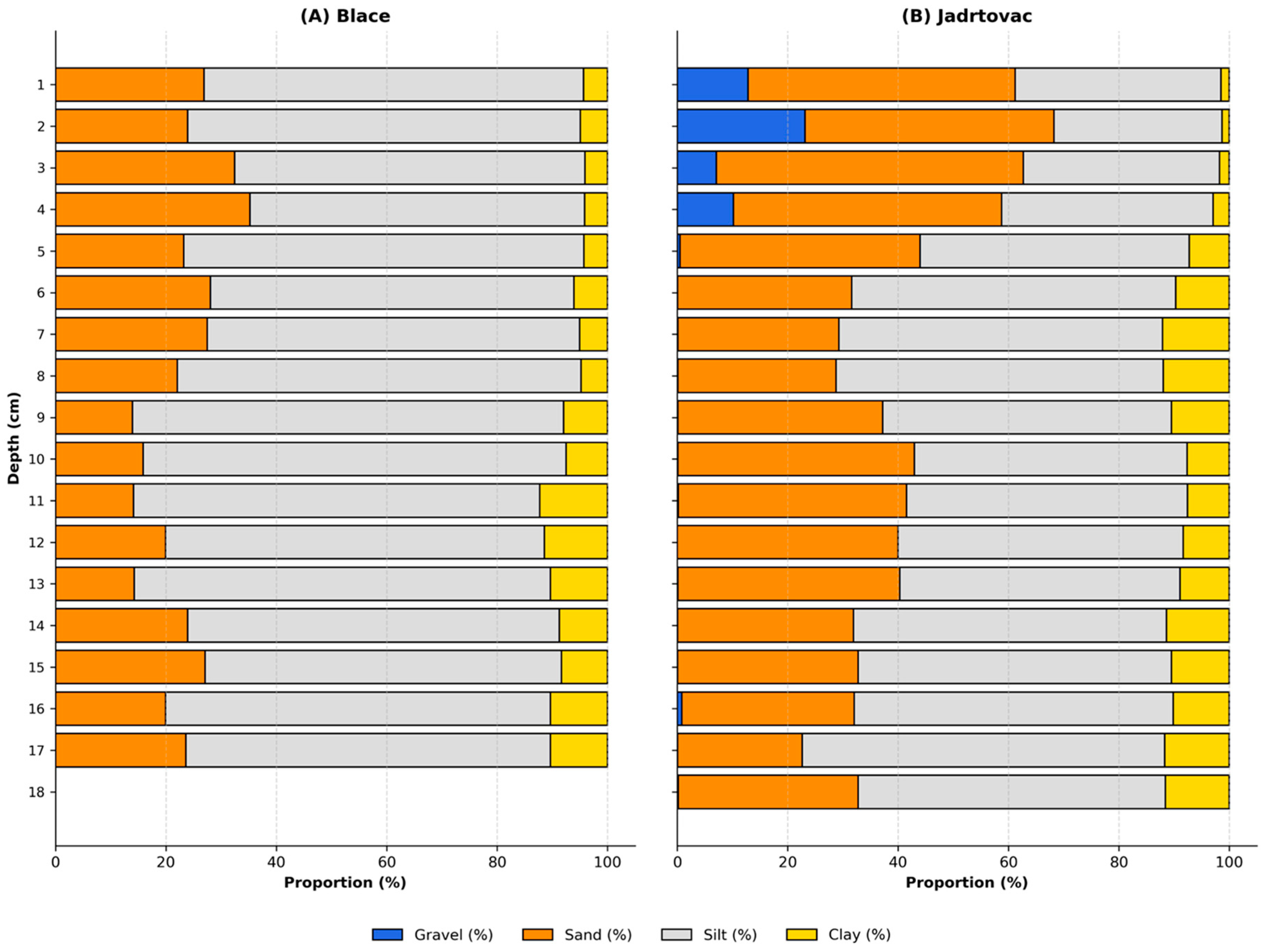
The particle size distribution of sediments reflects different depositional energies and sorting conditions between the two sites, which may influence MP retention capacity. At the Blace, gravel-sized particles are absent, and the most abundant particles are silt-sized, except for the first 4 cm where sand-sized particles prevail (Supplementary Table S1). The values of Mz (mean) and Md (median) in the first 4 cm are fine and very fine sand, with a fining trend to medium and coarse silt and coarse silt below 4 cm. The sediment at Blace is poorly sorted, and below 13 cm it is very poorly sorted. The skew (Sk) and kurtosis (Kg) values indicate that one fraction of particles predominates in the sediment samples; finer particle fractions dominate below 13 cm, while coarser particles are present in samples above this depth.
At Jadrtovac, the most common particles are also silt (Supplementary Table S2), as confirmed by the values of Mz and Md, where the predominant grains are medium and coarse silt. Unlike Blace, gravel sized particles are recorded, particularly in the upper samples above 4 cm. The sediment is very poorly sorted or extremely poorly sorted. The values of Sk and Kg indicate bimodality with an equal proportion of particles in two fractions and a smaller number of samples of finer particles predominating.
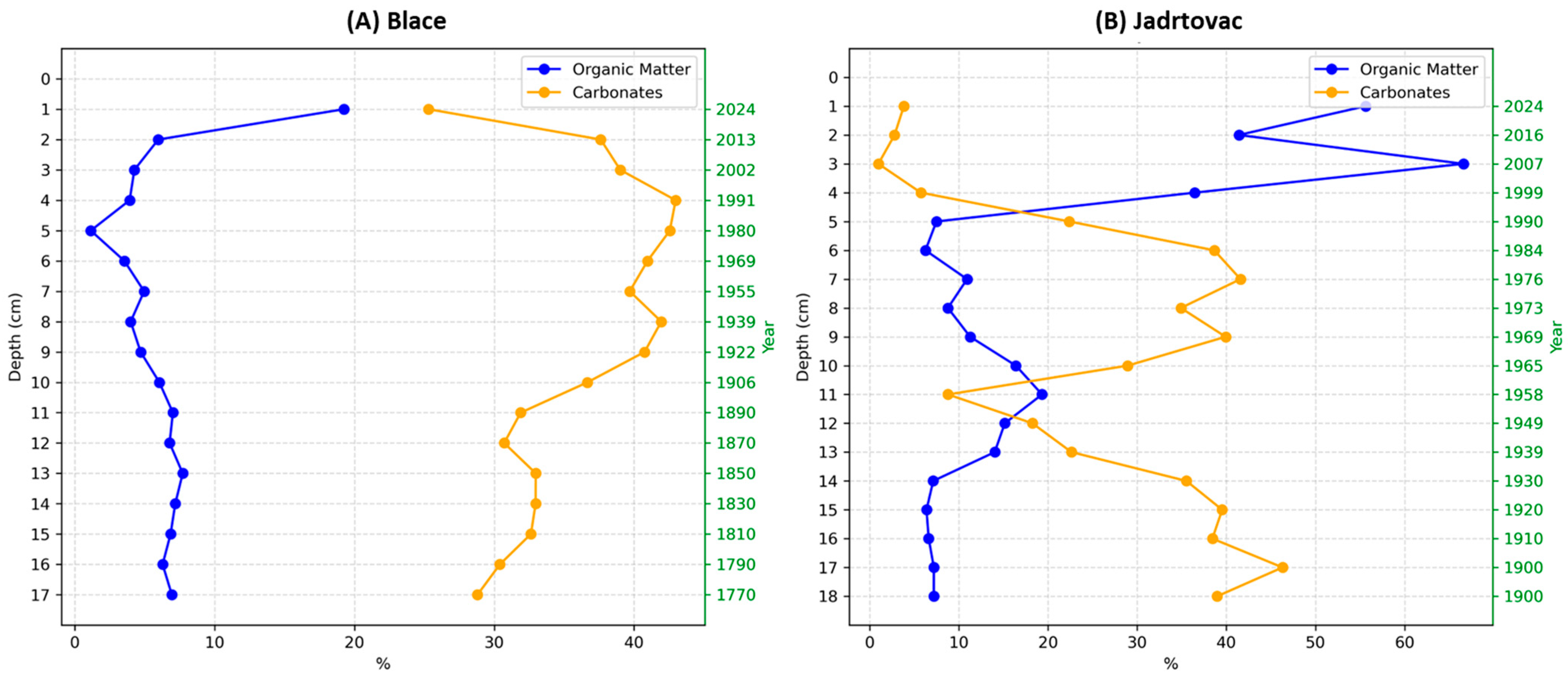
The vertical distribution of OM and carbonate content in sediment cores from Blace and Jadrtovac is presented in Figure 4. In Blace, OM content is low and relatively stable with depth, ranging from 1.6% at 17 cm to a maximum of 8.4% at 2 cm. The carbonate content increases with depth, from 26.3% at 1 cm to 44.3% at 17 cm. In Jadrtovac, OM content is markedly higher in surface layers, peaking at 66.5% at 3 cm, and declines to 6.9% at 18 cm. Carbonate content shows high variability with depth, ranging from 3.2% at 2 cm to 46.1% at 15 cm.
The range of OM content (1.15–19.25%) is less at Blace compared to Jadrtovac (6.26–66.58%). The highest value is recorded in the surface layer, indicating the presence of decomposed OM and input of vegetative detritus. Non-carbonate particles prevail at both sites with a wider range at Jadrtovac (0.98–46.30%) compared to Blace (25.3–42.97%).
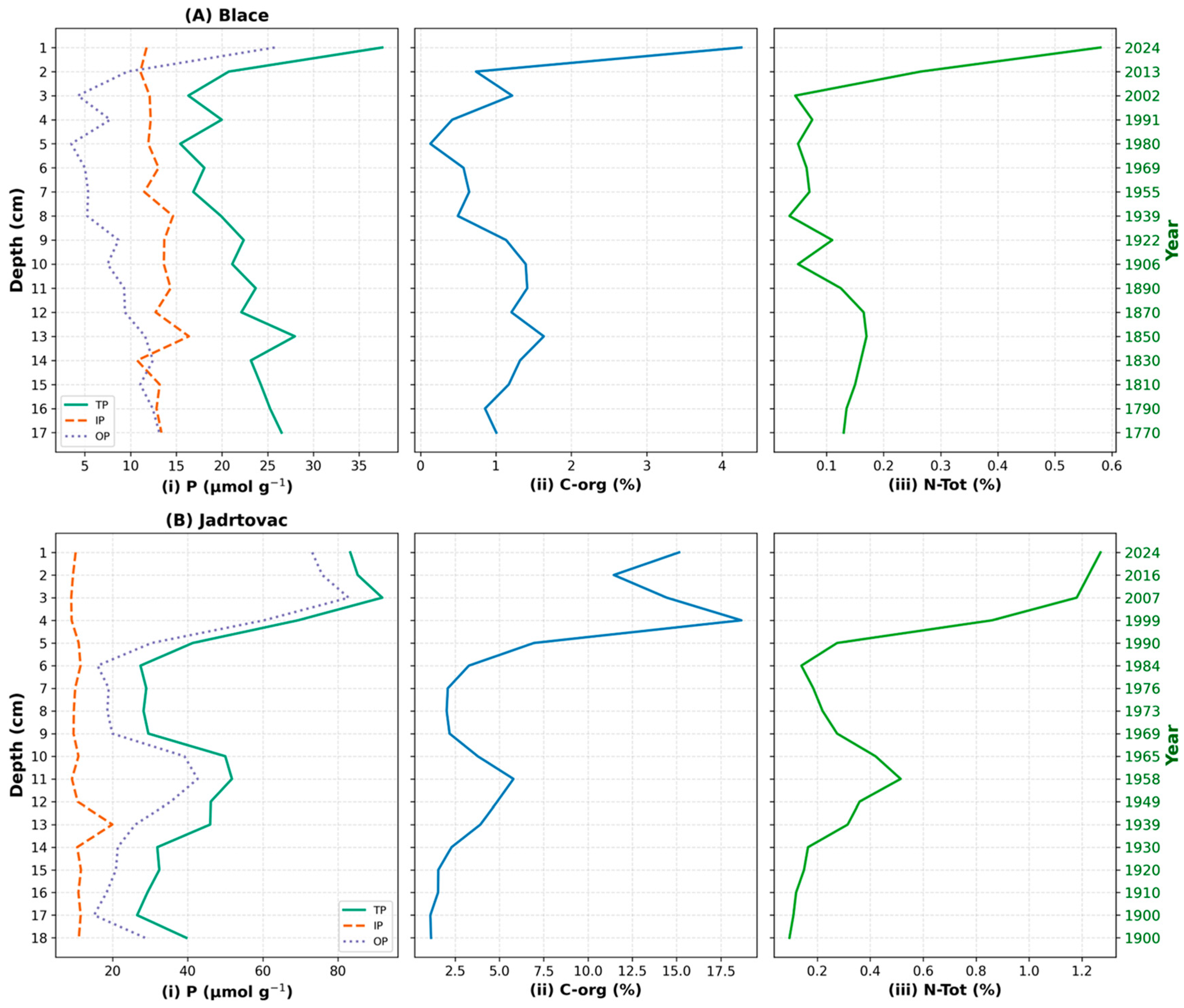
TP at Blace (Figure 5A) ranges from 15.4 µmol g−1 (5–6 cm) to 37.5 µmol g−1 (recorded in 0–1 cm). TP sharply decreases below 2 cm and then exhibits only minor variation with depth. Analysis of P forms showed IP ranging from 10.7 to 16.4 µmol g−1 and relatively even distribution down core. OP ranged from 3.5 µmol g−1 to 25.8 µmol g−1 with the highest value at 1 cm, similar to the TP profile. Calculation of the portion of certain P forms inside the P pool indicates IP form prevailing in the TP with portion of 60% in relation to OP form.
At Jadrtovac TP (Figure 5B) ranges from 26.5 (17 cm) to 91.8 µmol/g (3 cm). TP concentrations sharply decrease from 3 cm to 6 cm. Analysis of P forms showed IP in range from 8.9 to 19.9 µmol g−1 with the vertical profile exhibiting minor variations to 18 cm. OP ranged from 15.0 µmol g−1 to 82.8 µmol g−1 with the profile similar to TP concentrations. At Jadrtovac the calculated portion of P forms inside the P pool showed OP form prevailed with 72% in relation to IP.
C-org at Blace (Figure 5A) ranges from 0.13% (5 cm) to 4.26% (0–1 cm). The C-org profile exhibits a very sharp decrease after the surface sediment layer, and values gradually fluctuate down the core. TN ranged from 0.04 (8 cm) to 0.58 (0–1 cm) with the highest values in the near surface layers and relatively uniform vertical down-core distribution.
At Jadrtovac, C-org values (Figure 5B) ranges from 1.11% (18 cm) to 18.65% (14 cm). The C-org values exhibit a sharp decrease from 4 cm to 6 cm and then gradually fluctuates in the core profile. TN ranges from 0.095 (18 cm) to 1.11 (0 to 1 cm) with minor down-core variation.

3.3. Quantitative Analysis

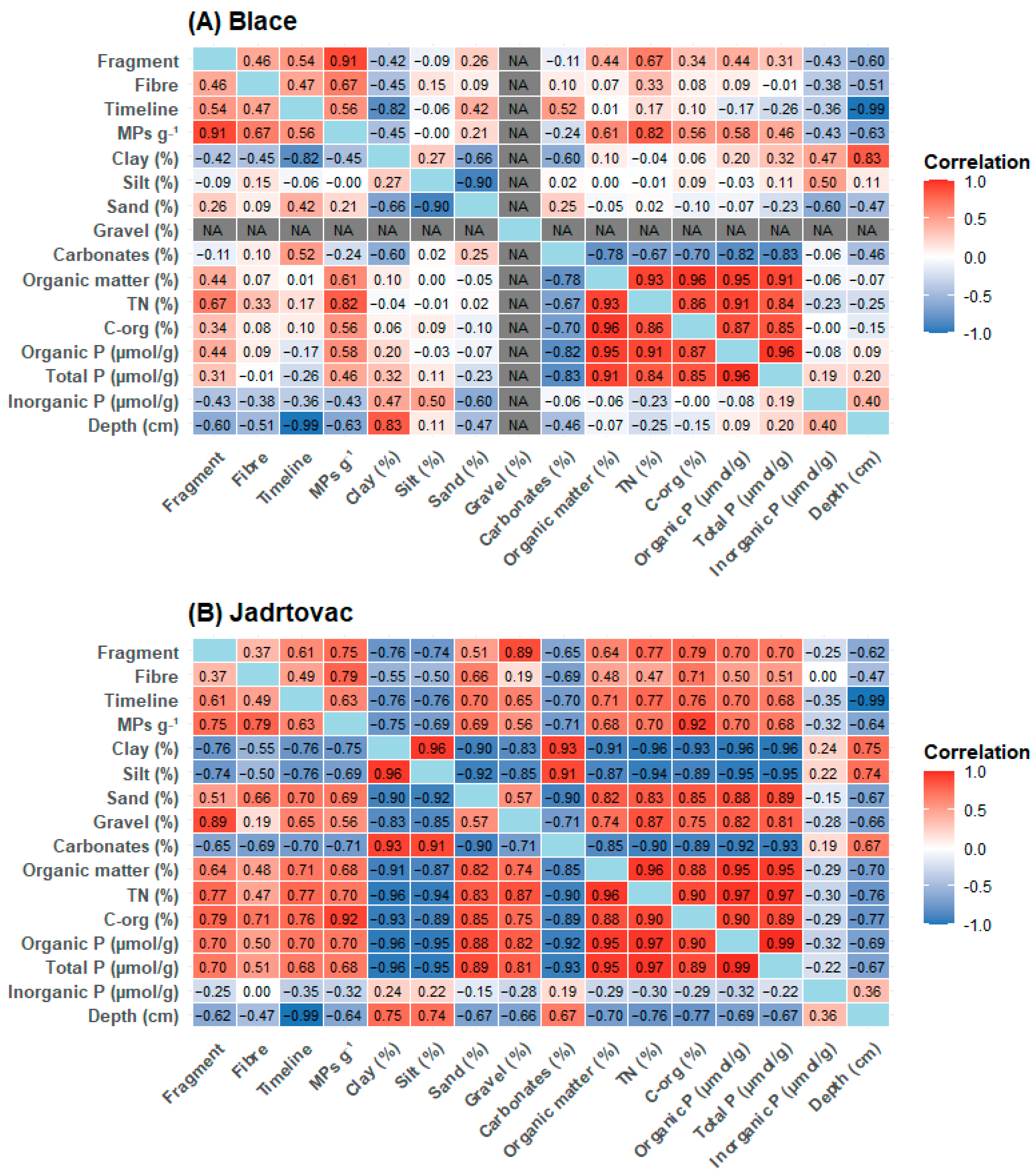
The correlation analysis for Blace (Figure 6A) and Jadrtovac (Figure 6B) reveals distinct but overlapping patterns in the relationships between MP concentrations (MPs g−1) and sedimentary parameters. In both cores, MP concentrations were positively correlated with OM (Blace: r = 0.69; Jadrtovac: r = 0.68) and sand content (Blace: r = 0.21; Jadrtovac: r = 0.69). These are in accordance with positive correlations observed between MPs and C-org, N-TOT and OP in sediment (Blace: r = 0.58; r = 0.56; r = 0.82; Jadrtovac: r = 0.70; r = 0.92; r = 0.80, respectively). Conversely, negative correlations were observed with depth (Blace: r= −0.63; Jadrtovac: r= −0.64), clay content (Blace: r= −0.45; Jadrtovac: r= −0.75), and carbonate content (Blace: r= −0.24; Jadrtovac: r= −0.71).
MP fibre content exhibited similar patterns in both cores, positively correlating with OM and sand content, while showing negative correlation with clay and depth. Conversely, MP fragments showed distinct associations, positively correlating with gravel (Jadrtovac: r = 0.89), while exhibiting negative correlations with clay (Blace: r= −0.42; Jadrtovac: r= −0.76) and depth (Blace: r= −0.60; Jadrtovac: r= −0.62).
These relationships are further contextualised by vertical distribution of grain size fractions in both sediment cores (Figure 7). Blace is characterised by consistently high proportions of silt and clay throughout the profile. In contrast, the Jadrtovac core exhibits greater textual variability, with higher sand and occasional gravel content in surface layers from 0 to 4 cm.
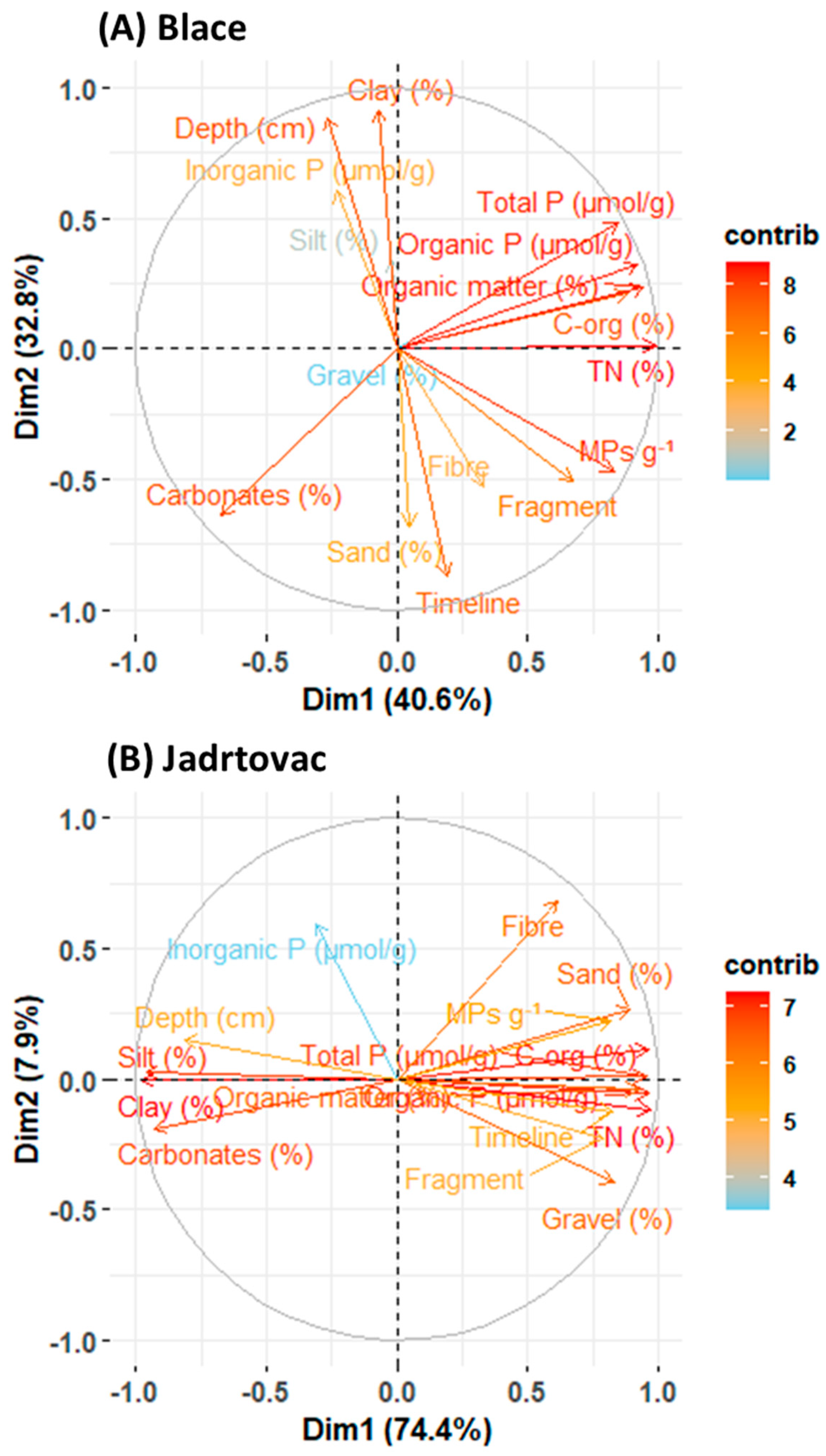
Principal component analysis (PCA) was conducted separately for the Blace and Jadrtovac sites to assess key geochemical and sedimentological drivers of variation in MP distribution (Figure 8).
At Blace (Figure 8A), the first principal component (Dim 1, 40.6%) was driven primarily by OM-related parameters, including C-org (%), TN (%), Total P (µmol/g), and Organic P (µmol/g), all of which were strongly aligned with MPs g−1 and fibre abundance. These variables showed inverse relationships with depth, clay, carbonates, and silt. The second component (Dim 2, 32.8%) was influenced mainly by clay (%) and depth (cm).
In contrast, the Jadrtovac PCA (Figure 8B) revealed a dominant Dim 1 (74.4%) associated with Total P, Organic P, C-org, TN, MPs g−1, and sand (%), indicating strong collinearity between MP concentrations and nutrient-rich, sandy sediment. Dim 2 (7.9%) captured variation related to inorganic P and fibre, with a weaker influence from depth.
Non-parametric Wilcoxon rank-sum tests were conducted to assess significant differences in sedimentary and geochemical parameters between the two saltmarshes (Supplementary Table S3). Results showed significant differences (p < 0.001) for OM content, Organic and Total P and sand content, all of which were markedly higher in Jadrtovac. MP concentrations also differed between sites (p = 0.050), with higher median values recorded at Jadrtovac. Carbonate content showed a weaker difference (p = 0.096), while differences in clay content and C/N ratio were not statistically significant. These results support statistically the observed geochemical and MP distinctions between the sites.

4. Discussion

This study highlights associations between MP distribution and sedimentary characteristics, including organic enrichment and sediment texture, in saltmarsh cores from Croatia. While both sites showed that MP concentrations tend to be elevated in organic-rich and sandier layers, these patterns likely reflect the interplay of sediment properties, depositional processes and temporal trends.
Jadrtovac, located within Morinje Bay and surrounded by a karstic landscape with shallow, nutrient-poor soils and sparse vegetation cover, is subject to inputs from urban, industrial and maritime activities. Land-use data from Šibenik County Planning Office (2022) show that Jadrtovac is adjacent to areas with wastewater outfalls and port activity, corroborating urban and maritime input as potential MP sources. The proximity of the site to Šibenik, a regional urban centre, likely contributes to higher MP concentrations and the dominance of fibres (86.4%), commonly associated with clothing, textile and fishing activities. The enclosed nature of the bay and its limited tidal range may facilitate MP retention, leading to their accumulation over time. Furthermore, the sediment infill from the late Holocene relative sea-level rise [62] suggests a stable depositional environment conducive to preserving MP records in the upper saltmarsh layers. These findings align with studies in UK saltmarshes, where synthetic fibres were found to be the dominant MP type due to proximity to urban centres and wastewater discharge [42,78]. Similarly, Portuguese saltmarshes have been shown to accumulate significant amounts of synthetic fibres, further supporting the role of urban and industrial activities in fibre deposition [79].
In contrast, Blace, a smaller and more remote saltmarsh near Ploče, exhibits lower MP concentrations, with fragments (60%) dominating over fibres. The limited exposure to direct urban or industrial inputs suggests that the MPs in Blace originate primarily from localized sources. The presence of higher proportions of polypropylene (50%) and olefin (20%) suggests inputs from agricultural or packaging-related activities, consistent with the surrounding land-use activities. Polypropylene and polyethylene terephthalate were also found as the main types of MPs affecting some coastal wetlands in Yancheng coastal wetlands [80], in the Pearl River Delta [81] or in Anzali Wetland [82]. These findings are also comparable to saltmarsh studies in the USA, where MP fragments were found in higher proportions in areas with agricultural runoff and lower urban influence [83]. The lower MP concentrations in Blace may also be attributed to the reduced sediment retention capacity of this smaller saltmarsh and its less dynamic tidal environment, a pattern similarly observed in other Mediterranean saltmarshes with limited hydrodynamic energy [3].
To place the observed MP concentrations in a broader European context, values from this study (up to 0.5 MPs g−1 in Jadrtovac and 0.15 MPs g−1 in Blace) were compared to published data from various saltmarshes (Table 1). Blakeney Point (UK) recorded average concentrations of 3.4 MPs g−1, while the Wadden Sea (Germany) reported approximately 2 MPs g−1 [84]. In the Lima Estuary (Portugal), concentrations reached up to 3 MPs g−1 in vegetated marsh zones [79], and in the Venice Lagoon (Italy), values ranged from 0.217 to 0.672 MPs g−1 [85]. A recent core-based study in the Thames Estuary (UK) found MP levels reaching 2.67 MPs g−1 in saltmarsh sediments adjacent to urban and industrial areas [42]. The lower values in our study likely reflect reduced urbanisation and anthropogenic pressures at the Croatian sites, as well as differences in tidal energy and sediment dynamics.
At Jadrtovac, the range of C-org values detected in sediment (0.13–4.26%) was comparable with values from saltmarshes in west Iberian (1.3–10.7%) [86] and with saltmarshes in the UK (3.6–9.0%) [87]. According to the EURO-CARBON database [88], the typical saltmarsh range is 0.1–41.56% with and average value of 5.01 ± 5.96% for European regional seas. Values recorded for Jadrtovac (1.11% to 18.65%) are also inside the wider range as well as within the range found for saltmarshes in Barnegat Bay, USA (3.2–33.7%), [89]. Fluctuations of C-org values in the sediment core can be assigned to geochemical processes in sediment, root activities or the OM input from the vegetation [90,91,92].
In the Jadrtovac area, flysch deposits dominate along the coast [93]. Through the weathering of marl from flysch sediment, larger quantities of muddy sediment appear, and due to the variable proportion of carbonates and silicate particles in the deposited sediment, the carbonate content changes with depth. Blace is located in an area where carbonate rocks of Jurassic age are found at the surface [94], but due to the influx of terrigenous non-carbonate particles from the Neretva River, the carbonate content is lower. These results are consistent with trends in OM and carbonate content from other areas of the eastern Adriatic [95,96,97]. OM content of marsh soils of the Venice Lagoon, measured similarly through LOI, ranged between 1% and 50%, with remarkable variations both among and within the study areas [98]. Vertical trends of OM content showed variable patterns at different sites. Analysis of OM content in 10 saltmarshes of the microtidal Venice Lagoon suggested that changes in the depositional environment are of primary importance in determining OM depth distribution with vertical patterns in OM related to factors such as autochthonous and allochthonous organic inputs, sediment properties, relative sea-level rise, fluvial inputs and wave action [99].
TN range (0.04–0.58%) at Blace was inside the ranges found for Portuguese saltmarshes (0.09–0.84%) [86,100] that were explained by enrichment from the estuary or N inputs from agriculture. TN values at Jadrtovac (0.10–1.11) were similar to those from Barnegat Bay, USA where TN ranged from 0.23 to 1.4%. TP content range found at Blace (0.048–0.116%) was in the range detected in sediments elsewhere in the world, for example, in Blakeney saltmarsh, UK (0.064–0.216%) [87], and in Chinese saltmarshes (0.05–0.07%) [101]. The TP range for Jadrtovac (0.082–0.285) is closer to values found for USA saltmarsh sediments (0.019–0.390%). According to ref. [102], the average TP in saltmarsh sediment in Spain was 0.111 ± 0.002%. The irregular vertical distribution of TP in the marsh sediment cores reflects biogeochemical and physical processes [101] that include adsorption, desorption, bioturbation and oxido-reduction processes, affecting the different P forms, similar to findings in other coastal marine sediments [103].
The N and P contents in Chinese wetlands changed significantly with depth [104] and varied due to climate, hydrological conditions, vegetation types, and the intensity of human disturbance [105,106].
The C/N ratio is often used to distinguish the origin of sedimentary OM from algae or terrestrial plants. Typical C/N ratios for marine algae OM vary between 4 and 10, while OM from terrestrial vascular plants typically has ratios of >20 because it contains cellulose, lignin and tannins [107]. C/N values calculated for the saltmarshes in this study (Blace average 10.24; Jadrtovac average 13.22) indicate a mixture of terrestrial and marine OM. C/N ratios were found for Portuguese saltmarsh sediments that also indicated an OM origin from the mixture of debris from plants, marine algae and bacteria [86,90]. These C/N values are comparable to those reported in other Mediterranean coastal environments. For example, in the Gulf of Trieste (northern Adriatic), C/N ratios in surface sediments ranged from 6.7 to 13.3, reflecting contributions from both marine and terrestrial OM sources [108]. Similarly, surface sediment C/N ratios in the Western Mediterranean have been reported to range from 3.2 to 25, with higher values indicative of terrestrial plant input [109]. These published values reinforce the interpretation that OM in Croatian saltmarsh sediments is derived from both marine algae and terrestrial vegetation. Vertical fluctuations of C/N ratios can be explained by the changes in the OM sources (changes in the balance between marine and terrestrial inputs). Fluctuations can also be driven by changes in sedimentation rate, and sources can be impacted by changes in tidal activity and river discharge at different time scales—driven by anthropogenic activities or climatic events [86].
A very high positive correlation between C-org and TN was found for both investigated Croatian saltmarshes (R2 = 0.90 and R2 = 0.86), followed with a high OP correlation (Figure 6), indicating that these elements share similar sources of OM. Furthermore, positive correlations between all investigated C-org, TN, OP and sedimentary OM confirm this finding. The correlation analysis (Figure 6) and PCA (Figure 8) results highlight that MP concentrations are closely associated with organic-rich and sandy sediments in both cores. At both sites, the first principal component (PC1) represents a composite organic–geochemical enrichment gradient, characterised by strong positive loadings of OM, C-org, TN, and P fractions, together with MPs and fibre abundance. This axis reflects depositional environments where organic-rich and sandier sediments promote MP retention. In contrast, negative loadings along PC1 are associated with greater depth, carbonate content, and finer sediment fractions, indicating reduced MP accumulation under these conditions.
The second principal component (PC2) captures secondary variability related to sediment texture and stratigraphic position, distinguishing contributions from clay, silt, and depth that are not directly aligned with organic enrichment. Importantly, the separation of PCA biplots for Blace and Jadrtovac reveals site-specific depositional controls, with Jadrtovac showing a stronger coupling between MPs, sand content, and organic geochemical parameters, consistent with its enclosed, low-energy depositional setting. These findings reinforce that MP retention in saltmarsh sediments is governed not by grain size alone, but by the interaction between organic enrichment, sediment texture, and depositional regime.
While both OM and MPs tend to increase toward the surface due to recent inputs, this correlation is not purely time-dependent. As shown in the vertical profiles of both cores and supported by stratigraphic and geochemical variability described in previous sedimentological study [60], zones of elevated OM content and MP concentrations are not always co-located with the most recent sediments. Instead, compositional layering and changes in depositional regimes (e.g., a transition from tidal flat to saltmarsh) appear to influence MP distribution.
Although fine-grained sediments are commonly assumed to be more effective at retaining MPs due to their lower permeability and higher surface area, the enrichment of MPs observed in organic-rich, sandy layers suggests that additional mechanisms are involved. In saltmarsh environments, hydrodynamic sorting may concentrate organic particles and MPs in lower-energy depositional phases, even within sand-dominated sediments [42]. OM can enhance MP retention by promoting aggregation, flocculation and biofilm-mediated adhesion, thereby increasing particle stability within the sediment matrix [34,36]. Sandy sediments with elevated organic content may therefore provide sufficient porosity for physical trapping while organic coatings facilitate particle binding. These combined effects likely explain the higher MP concentrations observed in organic-rich sandy sediments, highlighting that MP retention is not governed by grain size alone but by the interaction between sediment texture, organic enrichment and depositional energy.
Positive correlations between MPs and organic matter (r = 0.61–0.68), as well as between MPs and C-org, TN, and OP, indicate that MP accumulation is associated with organic-rich sedimentary environments. However, these relationships should be interpreted as correlative rather than causal, as both OM and MP concentrations are influenced by stratigraphic age, depositional processes, and sedimentary context.
These associations were further confirmed by non-parametric Wilcoxon rank-sum tests (Supplementary Table S3), which revealed significant differences between the two sites in OM content, organic and total P, and sand content (p < 0.001). MPs concentrations also differed significantly (p = 0.050), supporting the observed spatial divergence. Recent studies on the impact of MPs and the physicochemical properties of wetland sediments in China have also shown that MP pollution increases the content of C-org, available P, and TN content [105]. OM has been shown to enhance MP accumulation by increasing adhesion to sediment particles and promoting aggregation through biofilm formation [110,111].
In addition to OM, vegetation may also play a role in enhancing MP retention in saltmarsh sediments. Vegetated areas are known to promote sediment accretion by reducing flow velocities and increasing surface roughness [112], which can facilitate the trapping of both fine particles and MPs. Furthermore, vegetation contributes to OM input through root biomass and decaying litter, indirectly reinforcing MP retention by enhancing aggregation and biofilm formation [113]. Similar findings have been reported in estuarine and saltmarsh environments, where MPs were found to be more concentrated in sediments with high OM content due to the binding capacity of organic particles [34].
Conversely, negative correlations with clay content (r = −0.45 to −0.75) and carbonate content (r = −0.24 to −0.71) found in this study suggest that MPs are less likely to be retained in finer-grained or carbonate-rich sediments, the opposite to the original hypothesis set in this paper. This aligns with the findings from UK estuarine systems, where lower MP retention has been observed in high-carbonate and fine-grained sediments due to reduced binding efficiency [79]. Investigations of the estuarine sediments in UK did not find a strong correlation between MP abundance and particle size, which were explained by complex tidal hydrodynamics [41]. The stronger correlation between MPs and sand content in Jadrtovac compared to Blace suggests that dynamic sedimentary processes in enclosed coastal systems may further influence MP retention, a pattern consistent with studies in intertidal environments [79,114].
The depth profiles of MP concentrations in both sites reflect an increasing accumulation over time, with the highest concentrations recorded in the upper layers, corresponding to the last two to three decades, as hypothesised. This pattern is consistent with global trends in rising plastic pollution since the mid-20th century [115,116,117]. In Jadrtovac, MPs first appear at depths dated back to 1950, coinciding with the onset of global mass production. Sources for such early MP detection are likely to be linked to maritime activity rather than atmospheric deposition given the site context. The predominance of fibres and polyethylene (PE) in the older sediment layers corresponds with the widespread adoption of synthetic ropes and textiles in maritime and fishing sectors [118,119]. In contrast, the increased presence of polypropylene (PP) and olefins in more recent layers—especially in Blace—likely reflects the rise in single-use packaging and agricultural plastics since the 1980s. This depth-dependent shift in polymer composition mirrors global production patterns and supports the influence of changing local land-use practices and MP sources over time. The persistent occurrence of fibres. Often associated with synthetic textiles, also points to urban wastewater discharge and textile-derived microfibres from household laundering as contemporary sources of MPs, introduced via urban drainage systems and wastewater effluent. These findings are consistent with previous research, suggesting that saltmarshes can act as long-term reservoirs of MP pollution, with MPs preserved in deeper sediment layers due to low oxygen conditions and minimal sediment disturbance [42,120].
In Blace, by contrast, MPs appear only after 1950, with detectable concentrations limited to sediments dated post-1960. The absence of microplastics below 6 cm in Blace suggests a more recent introduction, likely reflecting differences in local pollution sources and sedimentation rates. This lag in MP deposition compared to Jadrtovac highlights the contrasting influence of local anthropogenic pressures and remoteness from direct pollution sources.
While the general stratigraphic integrity of the saltmarsh cores is supported by consistent chronological markers [62] and MP trends, we cannot entirely rule out the possibility of some reworking or vertical mixing during sediment deposition [121]. Observations of horizontally aligned sediment structures and laminae in the cores confirmed minimal evidence of burrowing macrofauna, such as crabs or polychaetes, supporting the assumption of limited bioturbation in these low-energy microtidal systems. So, given the low-energy, microtidal nature of the Adriatic saltmarshes, such as those in Jadrtovac and Blace, and the absence of MP in core sediment below 14 cm, the likelihood and extent of sediment mixing is low compared to higher-energy tidal systems [122]. Thus, the observed MP profiles are considered to reflect genuine historical deposition trends.
Overall, the results of this study highlight the complexity of MP retention in saltmarsh environments, where factors such as OM content, sediment texture, and proximity to pollution sources interact to shape MP accumulation. These findings reinforce the role of saltmarshes as important but understudied MP sinks and emphasise the need for further research on the long-term fate of MPs in these coastal systems. Limitations of this study include a small sample size (n = 3 cores per each site), lack of direct hydrological measurements, and limited spatial coverage. Future studies should include additional replicates, sediment trap deployments, and analyses of degradation rates to fully understand MP fate.
A limitation of this study is the absence of replicate analyses and formal recovery testing, due to the restricted quantity of sediment per interval. Although this constrains the quantification of analytical variability and may lead to the underestimation of high-density MPs, the NaCl extraction method used here is widely adopted and typically achieves recovery rates of 60–85% for common polymer types [64,65,66,67,68]. These factors should be considered when interpreting polymer composition results.
Although not directly assessed in this study, the identified concentrations and types of MPs (e.g., fibres and fragments) may pose ecological risks to benthic organisms via ingestion, tissue abrasion, or toxicity. Fibres, in particular, have been associated with intestinal blockage, inflammation, and reduced feeding in sediment-dwelling invertebrates such as polychaetes and bivalves [123,124]. Laboratory experiments have also shown that microplastics can alter burrowing behaviour, metabolic rates, and nutrient cycling in benthic environments [36,125]. These potential ecological effects remain hypothetical in our study but are consistent with observations in similar coastal sedimentary habitats, highlighting the need for further research in the specific context of Croatian saltmarshes.

5. Conclusions

This study demonstrates that the concentration, type and polymer composition of MPs deposited in Croatian saltmarshes are influenced by sedimentary parameters, OM composition, and proximity to local pollution sources; however, with only two sampling locations, such influences remain preliminary and should be interpreted cautiously. Jadrtovac, with its urban and maritime influences, exhibits higher MP concentrations, dominated by fibres from fishing activities and textiles, likely linked to wastewater discharge and clothing-derived microfibres from urban drainage systems. In contrast, Blace, a more remote site, contains lower MP concentrations, with fragments linked to agricultural and packaging-related sources, reflecting contrasting local land-use activity. The strong correlation between MPs and OM composition (OM content, C-org, TN and OP content) suggests that organic-rich sediments enhance MP retention, likely through adhesion and aggregation processes. However, finer-grained and carbonate-rich sediments exhibit lower retention, highlighting the role of sediment composition in MP transport and deposition. The increasing MP concentrations in the upper sediment layers reflect the global rise in plastic pollution since the mid-20th century, with earlier contamination detected in Jadrtovac, potentially linked to maritime activities. Importantly, MPs first appear in the Jadrtovac core around the onset of global mass plastic production (1950); on the other hand, in Blace, they are detected at least a decade later, highlighting the temporal and spatial variability of plastic pollution onset across different saltmarsh environments. These findings reinforce the role of saltmarshes as important MP sinks and emphasise the need for further research on the interactions between OM components and MPs, as well as long-term monitoring of plastic pollution in coastal environments. Finally, this study provides evidence that organic-rich, sandy saltmarsh sediments enhance microplastic retention and that dated sediment cores can serve as historical archives of plastic pollution during the Anthropocene. However, limitations include a small number of cores, possible underestimation of particle degradation, and the absence of additional environmental variables (for example, pH and salinity) that may influence retention. Future studies should integrate broader spatial sampling, assess degradation rates, and incorporate ecological impact assessments.

Supplementary Materials

The following supporting information can be downloaded at: https://www.mdpi.com/article/10.3390/microplastics5010030/s1. Figure S1. Fallout radionuclide concentrations in the Blace core: (a) total 210Pb, (b) unsupported 210Pb, (c) 137Cs and (d) 241AM versus depth. Error bars represent analytical uncertainty (Shaw, 2013) [60]. Figure S2. Fallout radionuclide concentrations in the Jadrtovac core: (a) total 210Pb, (b) unsupported 210Pb, (c) 137Cs and (d) 137Cs/210Pb activity ratio versus depth. Error bars represent analytical uncertainty (Shaw, 2013) [60]. Figure S3. Radiometric chronology for the Blace core, based on CRS 210Pb and 137Cs dates (1963, 1986), with calculated sedimentation rates (Shaw, 2013) [60]. Figure S4. Radiometric chronology for the Jadrtovac core, based on CRS 210Pb and 137Cs dates (1963, 1986), with calculated sedimentation rates (Shaw, 2013) [60]. Figure S5. Cumulative distribution of MP types (fibres and fragments) across all depths in core sediments from Blace and Jadrtovac. Figure S6. FTIR spectra of selected microplastic particles isolated from sediment cores: (a) Green fragment (rayon) from Jadrtovac, (b) White fragment (polyethylene) from Jadrtovac, (c) Blue fibre (cellophane) from Blace, (d) Brown fragment (nylon) from Blace. Table S1. Vertical distribution of biogeochemical, sedimentological, and microplastic parameters in sediment cores from Blace, Croatia, showing temporal trends from 2021 to 1807 based on 1 cm depth intervals. Table S2. Vertical distribution of biogeochemical, sedimentological, and microplastic parameters in sediment cores from Jadrtovac, Croatia, illustrating temporal trends from 2020 to 1884 based on 1 cm depth intervals. Table S3. Results of Wilcoxon rank-sum tests comparing sediment parameters between Blace and Jadrtovac salt-marsh cores. Significant differences are indicated as follows: *** p ≤ 0.001, ** p ≤ 0.01, * p ≤ 0.05, p ≤ 0.1, ns = not significant. Parameters marked “Invalid” were excluded due to missing or incompatible data.

Author Contributions

Conceptualization: S.G., J.R.K. and P.T. Methodology: S.G., S.M. and D.B. Sampling and investigation: S.G., J.R.K., P.T., S.M., D.B., A.Č.-S. and K.M. Microplastic extraction and analysis: S.G. Geochemical analysis: S.M. and D.B. Data curation: S.G. Formal analysis: S.G. Visualization: S.G. Writing—original draft: S.G. Writing—review and editing: S.G., P.T., S.M., D.B. and J.R.K. Supervision: J.R.K. and P.T. All authors have read and agreed to the published version of the manuscript.

Funding

This research was supported by the PRIMOS project, co-financed by the European Union—NextGenerationEU (support for P. Tutman), and by the KLIMPRON project funded by the European Union—NextGenerationEU (support for S. Matijević). Additional support for S. Galata and J.R. Kirby was provided through ERASMUS+ and Turing Scheme mobility funds. No additional external funding was received for this study.

Data Availability Statement

All data supporting the findings of this study are provided in the Supplementary Materials. This includes microplastic counts, polymer identification outputs, sediment geochemical datasets, raw FTIR spectra, grain size datasets and all processed data used for statistical analyses.

Acknowledgments

Pero Tutman was supported through project PRIMOS, funded by European Union—NextGenerationEU. Slavica Matijević was supported through the KLIMPRON project, funded by EU Next Generation Fond. Jason Kirby and Stamatia Galata were supported with funding from ERASMUS+ and Turing Funds.

Conflicts of Interest

The authors declare no conflict of interest. The funders had no role in the design of the study; in the collection, analysis or interpretation of data; in the writing of the manuscript; or in the decision to publish the results.

References

  1. Barnes, D.K.; Galgani, F.; Thompson, R.C.; Barlaz, M. Accumulation and fragmentation of plastic debris in global environments. Philos. Trans. R. Soc. B Biol. Sci. 2009, 364, 1985–1998. [Google Scholar] [CrossRef]
  2. Kershaw, P.J. Sources, fate and effects of microplastics in the marine environment: A global assessment. Agriculture 2015. [Google Scholar] [CrossRef]
  3. Lloret, J.; Pedrosa-Pamies, R.; Vandal, N.; Rorty, R.; Ritchie, M.; McGuire, C.; Chenoweth, K.; Valiela, I. Salt marsh sediments act as sinks for microplastics and reveal effects of current and historical land use changes. Environ. Adv. 2021, 4, 100060. [Google Scholar] [CrossRef]
  4. Qian, J.; Tang, S.; Wang, P.; Lu, B.; Li, K.; Jin, W.; He, X. From source to sink: Review and prospects of microplastics in wetland ecosystems. Sci. Total Environ. 2021, 758, 143633. [Google Scholar] [CrossRef]
  5. Barbier, E.B.; Hacker, S.D.; Kennedy, C.; Koch, E.W.; Stier, A.C.; Silliman, B.R. The value of estuarine and coastal ecosystem services. Ecol. Monogr. 2011, 81, 169–193. [Google Scholar] [CrossRef]
  6. Zhu, Z.; Vuik, V.; Visser, P.J.; Soens, T.; van Wesenbeeck, B.; van de Koppel, J.; Jonkman, S.N.; Temmerman, S.; Bouma, T.J. Historic storms and the hidden value of coastal wetlands for nature-based flood defence. Nat. Sustain. 2020, 3, 853–862. [Google Scholar] [CrossRef]
  7. Duarte, C.M.; Losada, I.J.; Hendriks, I.E.; Mazarrasa, I.; Marbà, N. The role of coastal plant communities for climate change mitigation and adaptation. Nat. Clim. Change 2013, 3, 961–968. [Google Scholar] [CrossRef]
  8. Macreadie, P.I.; Costa, M.D.P.; Atwood, T.B.; Friess, D.A.; Kelleway, J.J.; Kennedy, H.; Lovelock, C.E.; Serrano, O.; Duarte, C.M. Blue carbon as a natural climate solution. Nat. Rev. Earth Environ. 2021, 2, 826–839. [Google Scholar] [CrossRef]
  9. Nelson, J.L.; Zavaleta, E.S. Salt Marsh as a Coastal Filter for the Oceans: Changes in Function with Experimental Increases in Nitrogen Loading and Sea-Level Rise. PLoS ONE 2012, 7, e38558. [Google Scholar] [CrossRef] [PubMed]
  10. Reboreda, R.; Caçador, I. Halophyte vegetation influences in salt marsh retention capacity for heavy metals. Environ. Pollut. 2007, 146, 147–154. [Google Scholar] [CrossRef]
  11. Duarte, B.; Neto, J.M.; Marques, J.C.; Adams, J.B.; Caçador, I. Marine angiosperm indices used to assess ecological status within the Water Framework Directive and South African National Water Act: Learning from differences and common issues. Ecol. Indic. 2017, 83, 192–200. [Google Scholar] [CrossRef]
  12. Caçador, I.; Duarte, B.; Marques, J.C. Climate Change Impacts on Salt Marsh Vegetation Ecophysiology. In Sabkha Ecosystems: Volume VI: Asia/Pacific; Gul, B., Böer, B., Khan, M.A., Clüsener-Godt, M., Hameed, A., Eds.; Springer International Publishing: Cham, Switzerland, 2019; pp. 189–206. [Google Scholar]
  13. Arthur, C.; Baker, J.E.; Bamford, H.A. Proceedings of the International Research Workshop on the Occurrence, Effects, and Fate of Microplastic Marine Debris, Silver Spring, MD, USA, 9–11 September 2008; University of Washington Tacoma: Tacoma, WA, USA, 2009. [Google Scholar]
  14. Cole, M.; Lindeque, P.; Halsband, C.; Galloway, T.S. Microplastics as contaminants in the marine environment: A review. Mar. Pollut. Bull. 2011, 62, 2588–2597. [Google Scholar] [CrossRef] [PubMed]
  15. Cózar, A.; Echevarría, F.; González-Gordillo, J.I.; Irigoien, X.; Úbeda, B.; Hernández-León, S.; Palma, Á.T.; Navarro, S.; García-de-Lomas, J.; Ruiz, A.; et al. Plastic debris in the open ocean. Proc. Natl. Acad. Sci. USA 2014, 111, 10239–10244. [Google Scholar] [CrossRef]
  16. Galloway, T.S. Micro- and Nano-plastics and Human Health. In Marine Anthropogenic Litter; Bergmann, M., Gutow, L., Klages, M., Eds.; Springer International Publishing: Cham, Switzerland, 2015; pp. 343–366. [Google Scholar]
  17. Thompson, R.C.; Olsen, Y.; Mitchell, R.P.; Davis, A.; Rowland, S.J.; John, A.W.G.; McGonigle, D.; Russell, A.E. Lost at Sea: Where Is All the Plastic? Science 2004, 304, 838. [Google Scholar] [CrossRef]
  18. Martin, J.; Lusher, A.L.; Nixon, F.C. A review of the use of microplastics in reconstructing dated sedimentary archives. Sci. Total Environ. 2022, 806, 150818. [Google Scholar] [CrossRef]
  19. Cozzolino, L.; Nicastro, K.R.; Zardi, G.I.; de Los Santos, C.B. Species-specific plastic accumulation in the sediment and canopy of coastal vegetated habitats. Sci. Total Environ. 2020, 723, 138018. [Google Scholar] [CrossRef]
  20. Hale, R.C.; Seeley, M.E.; La Guardia, M.J.; Mai, L.; Zeng, E.Y. A global perspective on microplastics. J. Geophys. Res. Ocean. 2020, 125, e2018JC014719. [Google Scholar] [CrossRef]
  21. Paduani, M. Microplastics as novel sedimentary particles in coastal wetlands: A review. Mar. Pollut. Bull. 2020, 161, 111739. [Google Scholar] [CrossRef]
  22. Athira, T.; Aarif, K.; Thomas, J.A.; Alatawi, A.S.; Muzaffar, S.B.; Nefla, A.; Reshi, O.R.; Jobiraj, T.; Thejass, P. The threat of microplastics: Exploring pollution in coastal ecosystems and migratory shorebirds along the west coast of India. Mar. Pollut. Bull. 2024, 198, 115912. [Google Scholar] [CrossRef]
  23. Chand, N.; Suthar, S. Source, fate, toxicity, and remediation of micro-plastic in wetlands: A critical review. Watershed Ecol. Environ. 2024, 6, 41–53. [Google Scholar] [CrossRef]
  24. Duarte, B.; Valentim, J.M.; Dias, J.M.; Silva, H.; Marques, J.C.; Caçador, I. Modelling sea level rise (SLR) impacts on salt marsh detrital outwelling C and N exports from an estuarine coastal lagoon to the ocean (Ria de Aveiro, Portugal). Ecol. Model. 2014, 289, 36–44. [Google Scholar] [CrossRef]
  25. Kumar, M.; Boski, T.; González-Vila, F.J.; de la Rosa, J.M.; González-Pérez, J.A. Discerning natural and anthropogenic organic matter inputs to salt marsh sediments of Ria Formosa lagoon (South Portugal). Environ. Sci. Pollut. Res. 2020, 27, 28962–28985. [Google Scholar] [CrossRef] [PubMed]
  26. Mitsch, W.J.; Gosselink, J.G. Wetlands; John Wiley & Sons: Hoboken, NJ, USA, 2015. [Google Scholar]
  27. Drexler, J.Z.; Davis, M.J.; Woo, I.; De La Cruz, S. Carbon sources in the sediments of a restoring vs. historically unaltered salt marsh. Estuaries Coasts 2020, 43, 1345–1360. [Google Scholar] [CrossRef]
  28. Middelburg, J.; Nieuwenhuize, J.; Lubberts, R.; Van de Plassche, O. Organic carbon isotope systematics of coastal marshes. Estuar. Coast. Shelf Sci. 1997, 45, 681–687. [Google Scholar] [CrossRef]
  29. Mueller, P.; Do, H.T.; Jensen, K.; Nolte, S. Origin of organic carbon in the topsoil of Wadden Sea salt marshes. Mar. Ecol. Prog. Ser. 2019, 624, 39–50. [Google Scholar] [CrossRef]
  30. Blum, L.K.; Christian, R.R.; Cahoon, D.R.; Wiberg, P.L. Processes influencing marsh elevation change in low-and high-elevation zones of a temperate salt marsh. Estuaries Coasts 2021, 44, 818–833. [Google Scholar] [CrossRef]
  31. Morris, J.T.; Cahoon, D.; Callaway, J.C.; Craft, C.; Neubauer, S.C.; Weston, N.B. Marsh equilibrium theory: Implications for responses to rising sea level. In Salt Marshes; Springer Nature: Berlin/Heidelberg, Germany, 2021. [Google Scholar]
  32. Duarte, C.M.; Middelburg, J.J.; Caraco, N. Major role of marine vegetation on the oceanic carbon cycle. Biogeosciences 2005, 2, 1–8. [Google Scholar] [CrossRef]
  33. Perillo, G.; Wolanski, E.; Cahoon, D.R.; Hopkinson, C.S. Coastal Wetlands: An Integrated Ecosystem Approach; Elsevier: Amsterdam, The Netherlands, 2018. [Google Scholar]
  34. Hurley, R.R.; Lusher, A.L.; Olsen, M.; Nizzetto, L. Validation of a method for extracting microplastics from complex, organic-rich, environmental matrices. Environ. Sci. Technol. 2018, 52, 7409–7417. [Google Scholar] [CrossRef]
  35. Yu, F.; Yang, C.; Zhu, Z.; Bai, X.; Ma, J. Adsorption behavior of organic pollutants and metals on micro/nanoplastics in the aquatic environment. Sci. Total Environ. 2019, 694, 133643. [Google Scholar] [CrossRef]
  36. Besseling, E.; Quik, J.T.K.; Sun, M.; Koelmans, A.A. Fate of nano- and microplastic in freshwater systems: A modeling study. Environ. Pollut. 2017, 220, 540–548. [Google Scholar] [CrossRef]
  37. Khan, M.B.; Prezant, R.S. Microplastic abundances in a mussel bed and ingestion by the ribbed marsh mussel Geukensia demissa. Mar. Pollut. Bull. 2018, 130, 67–75. [Google Scholar] [CrossRef]
  38. Li, Y.; Lu, Z.; Zheng, H.; Wang, J.; Chen, C. Microplastics in surface water and sediments of Chongming Island in the Yangtze Estuary, China. Environ. Sci. Eur. 2020, 32, 15. [Google Scholar] [CrossRef]
  39. Willis, K.; Denise Hardesty, B.; Kriwoken, L.; Wilcox, C. Differentiating littering, urban runoff and marine transport as sources of marine debris in coastal and estuarine environments. Sci. Rep. 2017, 7, 44479. [Google Scholar] [CrossRef]
  40. Soares, A.S.; Pinheiro, C.; Oliveira, U.; Vieira, M.N. Microplastic Pollution in Portuguese Saltworks. In Inland Waters—Dynamics and Ecology; Devlin, A.T., Pan, J., Shah, M.M., Eds.; IntechOpen: London, UK, 2020; Available online: https://www.intechopen.com/chapters/71438 (accessed on 31 January 2026).
  41. Trusler, M.M.; Moss-Hayes, V.L.; Cook, S.; Lomax, B.H.; Vane, C.H. Microplastics pollution in sediments of the Thames and Medway estuaries, UK: Organic matter associations and predominance of polyethylene. Mar. Pollut. Bull. 2024, 208, 116971. [Google Scholar] [CrossRef] [PubMed]
  42. Trusler, M.M.; Cook, S.; Lomax, B.H.; Vane, C.H. Microplastic pollution in salt marsh and urban tributary sediment cores of the River Thames estuary, UK: Spatial and temporal accumulation trends. Mar. Pollut. Bull. 2025, 211, 117360. [Google Scholar] [CrossRef]
  43. Pandža, M.; Franjić, J.; Škvorc, Ž. The salt marsh vegetation on the East Adriatic coast. Biologia 2007, 62, 24–31. [Google Scholar] [CrossRef]
  44. Funduk, M.; Tutman, P.; Farkaš, A.; Tišma, S.; Boromisa, A.-M. Marine Litter in Croatian Adriatic: Sources, Quantities and Stakeholders′ Perspectives. Sustainability 2021, 13, 4691. [Google Scholar] [CrossRef]
  45. Liubartseva, S.; Coppini, G.; Lecci, R.; Creti, S. Regional approach to modeling the transport of floating plastic debris in the Adriatic Sea. Mar. Pollut. Bull. 2016, 103, 115–127. [Google Scholar] [CrossRef] [PubMed]
  46. Tutman, P.; Bojanić-Varezić, D.; Prvan, M.; Božanić, J.; Nazlić, M.; Šiljić, J.; Pavičić, M. Integrated planning to reduce the impact of marine litter, DeFishGear project. Tehnoeko 2017, 67, 2–11. [Google Scholar]
  47. Vlachogianni, T.; Fortibuoni, T.; Ronchi, F.; Zeri, C.; Mazziotti, C.; Tutman, P.; Varezić, D.B.; Palatinus, A.; Trdan, Š.; Peterlin, M.; et al. Marine litter on the beaches of the Adriatic and Ionian Seas: An assessment of their abundance, composition and sources. Mar. Pollut. Bull. 2018, 131, 745–756. [Google Scholar] [CrossRef]
  48. Fortibuoni, T.; Ronchi, F.; Mačić, V.; Mandić, M.; Mazziotti, C.; Peterlin, M.; Prevenios, M.; Prvan, M.; Somarakis, S.; Tutman, P.; et al. A harmonized and coordinated assessment of the abundance and composition of seafloor litter in the Adriatic-Ionian macroregion (Mediterranean Sea). Mar. Pollut. Bull. 2019, 139, 412–426. [Google Scholar] [CrossRef]
  49. Ronchi, F.; Galgani, F.; Binda, F.; Mandić, M.; Peterlin, M.; Tutman, P.; Anastasopoulou, A.; Fortibuoni, T. Fishing for Litter in the Adriatic-Ionian macroregion (Mediterranean Sea): Strengths, weaknesses, opportunities and threats. Mar. Policy 2019, 100, 226–237. [Google Scholar] [CrossRef]
  50. Zeri, C.; Adamopoulou, A.; Bojanić Varezić, D.; Fortibuoni, T.; Kovač Viršek, M.; Kržan, A.; Mandic, M.; Mazziotti, C.; Palatinus, A.; Peterlin, M.; et al. Floating plastics in Adriatic waters (Mediterranean Sea): From the macro- to the micro-scale. Mar. Pollut. Bull. 2018, 136, 341–350. [Google Scholar] [CrossRef] [PubMed]
  51. Anastasopoulou, A.; Kovač Viršek, M.; Bojanić Varezić, D.; Digka, N.; Fortibuoni, T.; Koren, Š.; Mandić, M.; Mytilineou, C.; Pešić, A.; Ronchi, F.; et al. Assessment on marine litter ingested by fish in the Adriatic and NE Ionian Sea macro-region (Mediterranean). Mar. Pollut. Bull. 2018, 133, 841–851. [Google Scholar] [CrossRef] [PubMed]
  52. Blašković, A.; Fastelli, P.; Čižmek, H.; Guerranti, C.; Renzi, M. Plastic litter in sediments from the Croatian marine protected area of the natural park of Telaščica bay (Adriatic Sea). Mar. Pollut. Bull. 2017, 114, 583–586. [Google Scholar] [CrossRef]
  53. Maršić-Lučić, J.; Lušić, J.; Tutman, P.; Bojanić Varezić, D.; Šiljić, J.; Pribudić, J. Levels of trace metals on microplastic particles in beach sediments of the island of Vis, Adriatic Sea, Croatia. Mar. Pollut. Bull. 2018, 137, 231–236. [Google Scholar] [CrossRef] [PubMed]
  54. Palatinus, A.; Kovač Viršek, M.; Robič, U.; Grego, M.; Bajt, O.; Šiljić, J.; Suaria, G.; Liubartseva, S.; Coppini, G.; Peterlin, M. Marine litter in the Croatian part of the middle Adriatic Sea: Simultaneous assessment of floating and seabed macro and micro litter abundance and composition. Mar. Pollut. Bull. 2019, 139, 427–439. [Google Scholar] [CrossRef]
  55. Renzi, M.; Specchiulli, A.; Blašković, A.; Manzo, C.; Mancinelli, G.; Cilenti, L. Marine litter in stomach content of small pelagic fishes from the Adriatic Sea: Sardines (Sardina pilchardus) and anchovies (Engraulis encrasicolus). Environ. Sci. Pollut. Res. 2019, 26, 2771–2781. [Google Scholar] [CrossRef]
  56. Stagličić, N.; Bojanić Varezić, D.; Kurtović Mrčelić, J.; Pavičić, M.; Tutman, P. Marine litter on the shallow seafloor at Natura 2000 sites of the Central Eastern Adriatic Sea. Mar. Pollut. Bull. 2021, 168, 112432. [Google Scholar] [CrossRef]
  57. Ilijanić, N.; Miko, S.; Ivkić Filipović, I.; Hasan, O.; Šparica Miko, M.; Petrinec, B.; Terzić, J.; Marković, T. A Holocene Sedimentary Record and the Impact of Sea-Level Rise in the Karst Lake Velo Blato and the Wetlands on Pag Island (Croatia). Water 2022, 14, 342. [Google Scholar] [CrossRef]
  58. Pratolongo, P.; Leonardi, N.; Kirby, J.R.; Plater, A. Chapter 3—Temperate Coastal Wetlands: Morphology, Sediment Processes, and Plant Communities. In Coastal Wetlands, 2nd ed.; Perillo, G.M.E., Wolanski, E., Cahoon, D.R., Hopkinson, C.S., Eds.; Elsevier: Amsterdam, The Netherlands, 2019; pp. 105–152. [Google Scholar]
  59. Dítě, D.; Dítětová, Z.; Šuvada, R. Rare plant species of salt marshes of the Croatian coast. Hacquetia 2018, 17, 221–234. [Google Scholar] [CrossRef]
  60. Shaw, T. Reconstructing Historical Sea-Level Trends for the Croatian Coast of the Adriatic Sea Using Salt-Marsh Foraminifera. Ph.D. Dissertation, University of Liverpool, Liverpool, UK, 2013. [Google Scholar]
  61. Shaw, T.A.; Kirby, J.R.; Holgate, S.; Tutman, P.; Plater, A.J. Contemporary Salt-Marsh Foraminiferal Distribution From the Adriatic Coast of Croatia and its Potential for Sea-Level Studies. J. Foraminifer. Res. 2016, 46, 314–332. [Google Scholar] [CrossRef]
  62. Shaw, T.A.; Plater, A.J.; Kirby, J.R.; Roy, K.; Holgate, S.; Tutman, P.; Cahill, N.; Horton, B.P. Tectonic influences on late Holocene relative sea levels from the central-eastern Adriatic coast of Croatia. Quat. Sci. Rev. 2018, 200, 262–275. [Google Scholar] [CrossRef]
  63. Hidalgo-Ruz, V.; Gutow, L.; Thompson, R.C.; Thiel, M. Microplastics in the Marine Environment: A Review of the Methods Used for Identification and Quantification. Environ. Sci. Technol. 2012, 46, 3060–3075. [Google Scholar] [CrossRef]
  64. Cashman, M.A.; Ho, K.T.; Boving, T.B.; Russo, S.; Robinson, S.; Burgess, R.M. Comparison of microplastic isolation and extraction procedures from marine sediments. Mar. Pollut. Bull. 2020, 159, 111507. [Google Scholar] [CrossRef]
  65. Cutroneo, L.; Reboa, A.; Geneselli, I.; Capello, M. Considerations on salts used for density separation in the extraction of microplastics from sediments. Mar. Pollut. Bull. 2021, 166, 112216. [Google Scholar] [CrossRef] [PubMed]
  66. Fries, E.; Dekiff, J.H.; Willmeyer, J.; Nuelle, M.-T.; Ebert, M.; Remy, D. Identification of polymer types and additives in marine microplastic particles using pyrolysis-GC/MS and scanning electron microscopy. Environ. Sci. Process. Impacts 2013, 15, 1949–1956. [Google Scholar] [CrossRef] [PubMed]
  67. Radford, F.; Zapata-Restrepo, L.M.; Horton, A.A.; Hudson, M.D.; Shaw, P.J.; Williams, I.D. Developing a systematic method for extraction of microplastics in soils. Anal. Methods 2021, 13, 1695–1705. [Google Scholar] [CrossRef] [PubMed]
  68. Vermeiren, P.; Muñoz, C.; Ikejima, K. Microplastic identification and quantification from organic rich sediments: A validated laboratory protocol. Environ. Pollut. 2020, 262, 114298. [Google Scholar] [CrossRef]
  69. Corami, F.; Rosso, B.; Bravo, B.; Gambaro, A.; Barbante, C. A novel method for purification, quantitative analysis and characterization of microplastic fibers using Micro-FTIR. Chemosphere 2020, 238, 124564. [Google Scholar] [CrossRef]
  70. De Frond, H.; Rubinovitz, R.; Rochman, C.M. μATR-FTIR Spectral Libraries of Plastic Particles (FLOPP and FLOPP-e) for the Analysis of Microplastics. Anal. Chem. 2021, 93, 15878–15885. [Google Scholar] [CrossRef]
  71. Folk, R.L.; Ward, W.C. Brazos River bar [Texas]; a study in the significance of grain size parameters. J. Sediment. Res. 1957, 27, 3–26. [Google Scholar] [CrossRef]
  72. Folk, R.L. The Distinction between Grain Size and Mineral Composition in Sedimentary-Rock Nomenclature. J. Geol. 1954, 62, 344–359. [Google Scholar] [CrossRef]
  73. Vdović, N.; Bišćan, J.; Juraĉić, M. Relationship between specific surface area and some chemical and physical properties of particulates: Study in the northern Adriatic. Mar. Chem. 1991, 36, 317–328. [Google Scholar] [CrossRef]
  74. Loring, D.H.; Rantala, R.T.T. Manual for the geochemical analyses of marine sediments and suspended particulate matter. Earth-Sci. Rev. 1992, 32, 235–283. [Google Scholar] [CrossRef]
  75. Aspila, K.I.; Agemian, H.; Chau, A.S.Y. A semi-automated method for the determination of inorganic, organic and total phosphate in sediments. Analyst 1976, 101, 187–197. [Google Scholar] [CrossRef] [PubMed]
  76. Grasshoff, K.; Kremling, K.; Ehrhardt, M. Methods of Seawater Analysis; John Wiley & Sons: Hoboken, NJ, USA, 2009. [Google Scholar]
  77. Verardo, D.J.; Froelich, P.N.; McIntyre, A. Determination of organic carbon and nitrogen in marine sediments using the Carlo Erba NA-1500 analyzer. Deep Sea Res. Part A Oceanogr. Res. Pap. 1990, 37, 157–165. [Google Scholar] [CrossRef]
  78. Stead, J.L.; Cundy, A.B.; Hudson, M.D.; Thompson, C.E.L.; Williams, I.D.; Russell, A.E.; Pabortsava, K. Identification of tidal trapping of microplastics in a temperate salt marsh system using sea surface microlayer sampling. Sci. Rep. 2020, 10, 14147. [Google Scholar] [CrossRef]
  79. Almeida, C.M.R.; Sáez-Zamacona, I.; Silva, D.M.; Rodrigues, S.M.; Pereira, R.; Ramos, S. The Role of Estuarine Wetlands (Saltmarshes) in Sediment Microplastics Retention. Water 2023, 15, 1382. [Google Scholar] [CrossRef]
  80. Zhou, Y.; Zhou, S.; Chen, S.S.; Li, Y.; Chen, L.; Zhang, Q.; Su, B.; Wang, T. Sedimentary record of microplastics in coastal wetland, eastern China. Water Res. 2024, 249, 120975. [Google Scholar] [CrossRef]
  81. Chen, Z.; Lee, S.Y. Contribution of microplastics to carbon storage in coastal wetland sediments. Environ. Sci. Technol. Lett. 2021, 8, 1045–1050. [Google Scholar] [CrossRef]
  82. Rasta, M.; Sattari, M.; Taleshi, M.S.; Namin, J.I. Identification and distribution of microplastics in the sediments and surface waters of Anzali Wetland in the Southwest Caspian Sea, Northern Iran. Mar. Pollut. Bull. 2020, 160, 111541. [Google Scholar] [CrossRef]
  83. Weinstein, J.E.; Crocker, B.K.; Gray, A.D. From macroplastic to microplastic: Degradation of high-density polyethylene, polypropylene, and polystyrene in a salt marsh habitat. Environ. Toxicol. Chem. 2016, 35, 1632–1640. [Google Scholar] [CrossRef]
  84. Grover, B. The Distribution of Microplastics in Salt Marshes. Ph.D. Dissertation, University of East Anglia, Norwich, UK, 2025. [Google Scholar]
  85. Vianello, A.; Boldrin, A.; Guerriero, P.; Moschino, V.; Rella, R.; Sturaro, A.; Da Ros, L. Microplastic particles in sediments of Lagoon of Venice, Italy: First observations on occurrence, spatial patterns and identification. Estuar. Coast. Shelf Sci. 2013, 130, 54–61. [Google Scholar] [CrossRef]
  86. Jiménez-Morillo, N.T.; Moreno, J.; Moreno, F.; Fatela, F.; Leorri, E.; De la Rosa, J.M. Composition and sources of sediment organic matter in a western Iberian salt marsh: Developing a novel prediction model of the bromine sedimentary pool. Sci. Total Environ. 2024, 907, 167931. [Google Scholar] [CrossRef]
  87. Van de Velde, S.J.; James, R.K.; Callebaut, I.; Hidalgo-Martinez, S.; Meysman, F.J.R. Bioturbation has a limited effect on phosphorus burial in salt marsh sediments. Biogeosciences 2021, 18, 1451–1461. [Google Scholar] [CrossRef]
  88. Graversen, A.E.L.; Lønborg, C.; Addamo, A.M.; Pedersen, S.G.; Chemello, S.; Alejo, I.; Apostolaki, E.T.; Asplund, M.E.; Austin, W.E.N.; Berov, D.; et al. A marine and salt marsh sediment organic carbon database for European regional seas (EURO-CARBON). Data Brief 2025, 60, 111595. [Google Scholar] [CrossRef]
  89. Velinsky, D.J.; Paudel, B.; Belton, T.J.; Sommerfield, C.K. Tidal Marsh Record of Nutrient Loadings in Barnegat Bay, New Jersey. J. Coast. Res. 2017, 78, 79–88. [Google Scholar] [CrossRef]
  90. De la Rosa, J.M.; Araújo, M.F.; González-Pérez, J.A.; González-Vila, F.J.; Soares, A.M.; Martins, J.M.; Leorri, E.; Corbett, R.; Fatela, F. Organic matter sources for tidal marsh sediment over the past two millennia in the Minho River estuary (NW Iberian Peninsula). Org. Geochem. 2012, 53, 16–24. [Google Scholar] [CrossRef]
  91. Lamb, A.L.; Wilson, G.P.; Leng, M.J. A review of coastal palaeoclimate and relative sea-level reconstructions using δ13C and C/N ratios in organic material. Earth-Sci. Rev. 2006, 75, 29–57. [Google Scholar] [CrossRef]
  92. Leng, M.J.; Lewis, J.P. C/N ratios and Carbon Isotope Composition of Organic Matter in Estuarine Environments. In Applications of Paleoenvironmental Techniques in Estuarine Studies; Weckström, K., Saunders, K.M., Gell, P.A., Skilbeck, C.G., Eds.; Springer Netherlands: Dordrecht, The Netherlands, 2017; pp. 213–237. [Google Scholar]
  93. Mamužić, P. Osnovna Geološka Karta SFRJ 1:100.000. Tumač Za List Šibenik K33–8 (Basic Geologic Map of SFRY 1:100.000—Geology of the Šibenik Sheet); Savezni Geološki Zavod: Belgrade, Serbia, 1975. [Google Scholar]
  94. Marinčić, S. Eocenski fliš jadranskog pojasa (Eocene flysch of Adriatic area). Geološki Vjesn. 1981, 34, 27–38. [Google Scholar]
  95. Bogner, D.; Ujević, I.; Barić, A. Trace metals (Cd, Pb, Cu, Zn and Cr) distribution in sediment along east coast of the Adriatic Sea (Croatia). Fresenius Environ. Bull. 2005, 14, 50–58. [Google Scholar]
  96. Buljac, M.; Bogner, D.; Cerjan-Stefanovic, Š.; Bolanča, T.; Margeta, K. Cr and Zn distribution in sediment from the semi-enclosed Kaštela Bay, the Adriatic Sea (Croatia). Fresenius Environ. Bull. 2011, 20, 853–860. [Google Scholar]
  97. Matijević, S.; Bogner, D.; Bojanić, N.; Žuljević, A.; Despalatović, M.; Antolić, B.; Nikolić, V.; Bilić, J. Biogeochemical characteristics of sediments under the canopy of invasive alga Caulerpa racemosa var. cylindracea (Pelješac Peninsula, Adriatic Sea). Fresenius Environ. Bull 2013, 22, 3030–3040. [Google Scholar]
  98. Puppin, A.; Tognin, D.; Ghinassi, M.; Franceschinis, E.; Realdon, N.; Marani, M.; D’Alpaos, A. Spatial patterns of organic matter content in the surface soil of the salt marshes of the Venice Lagoon (Italy). Biogeosciences 2024, 21, 2937–2954. [Google Scholar] [CrossRef]
  99. Puppin, A.; Tognin, D.; D’Alpaos, A. Depth-distribution patterns of Soil Organic Matter in the tidal marshes of the Venice Lagoon (Italy). J. Geophys. Res. Biogeosci. 2024, 130, e2024JG008327. [Google Scholar] [CrossRef]
  100. Cartaxana, P.; Catarino, F. Allocation of nitrogen and carbon in an estuarine salt marsh in Portugal. J. Coast. Conserv. 1997, 3, 27–34. [Google Scholar] [CrossRef]
  101. Zhou, J.; Wu, Y.; Kang, Q.; Zhang, J. Spatial variations of carbon, nitrogen, phosphorous and sulfur in the salt marsh sediments of the Yangtze Estuary in China. Estuar. Coast. Shelf Sci. 2007, 71, 47–59. [Google Scholar] [CrossRef]
  102. Jiménez-Cárceles, F.J.; Álvarez-Rogel, J. Phosphorus fractionation and distribution in salt marsh soils affected by mine wastes and eutrophicated water: A case study in SE Spain. Geoderma 2008, 144, 299–309. [Google Scholar] [CrossRef]
  103. Matijević, S.; Bilić, J.; Ribičić, D.; Dunatov, J. Distribution of phosphorus species in below-cage sediments at the tuna farms in the middle Adriatic Sea (Croatia). Acta Adriat. 2012, 53, 399–412. [Google Scholar]
  104. Wu, Y.; Wu, Z.; Jiang, S.; Lu, S.; Zhou, N. Elemental stoichiometry (C, N, P) of soil in the wetland critical zone of Dongting Lake, China: Understanding soil C, N and P status at greater depth. Sustainability 2022, 14, 8337. [Google Scholar] [CrossRef]
  105. Li, G.; Ran, J.; Dong, J.; Yang, K.; Hu, J.; Shi, J.; Zhang, Y.; Chen, J.; Zhao, Y.; Zhu, E. Effects of microplastics pollution in sediments on physicochemical properties and microbial community distribution in coastal Spartina alterniflora-invaded wetlands. Front. Mar. Sci. 2024, 11, 1535036. [Google Scholar] [CrossRef]
  106. Yu, J.; Zhan, C.; Li, Y.; Zhou, D.; Fu, Y.; Chu, X.; Xing, Q.; Han, G.; Wang, G.; Guan, B. Distribution of carbon, nitrogen and phosphorus in coastal wetland soil related land use in the Modern Yellow River Delta. Sci. Rep. 2016, 6, 37940. [Google Scholar] [CrossRef] [PubMed]
  107. Meyers, P.A. Preservation of elemental and isotopic source identification of sedimentary organic matter. Chem. Geol. 1994, 114, 289–302. [Google Scholar] [CrossRef]
  108. Faganeli, J.; Pezdic, J.; Ogorelec, B.; Mišič, M.; Najdek, M. The origin of sedimentary organic matter in the Adriatic. Cont. Shelf Res. 1994, 14, 365–384. [Google Scholar] [CrossRef]
  109. Ausín, B.; Bossert, G.; Krake, N.; Paradis, S.; Haghipour, N.; Durrieu de Madron, X.; Alonso, B.; Eglinton, T. Sources and Fate of Sedimentary Organic Matter in the Western Mediterranean Sea. Glob. Biogeochem. Cycles 2023, 37, e2023GB007695. [Google Scholar] [CrossRef]
  110. Rummel, C.D.; Jahnke, A.; Gorokhova, E.; Kühnel, D.; Schmitt-Jansen, M. Impacts of Biofilm Formation on the Fate and Potential Effects of Microplastic in the Aquatic Environment. Environ. Sci. Technol. Lett. 2017, 4, 258–267. [Google Scholar] [CrossRef]
  111. Semcesen, P.O.; Wells, M.G. Biofilm growth on buoyant microplastics leads to changes in settling rates: Implications for microplastic retention in the Great Lakes. Mar. Pollut. Bull. 2021, 170, 112573. [Google Scholar] [CrossRef]
  112. Morris, J.T.; Sundberg, K. Responses of Coastal Wetlands to Rising Sea-Level Revisited: The Importance of Organic Production. Estuaries Coasts 2024, 47, 1735–1749. [Google Scholar] [CrossRef]
  113. Ganju, N.K.; Nidzieko, N.J.; Kirwan, M.L. Inferring tidal wetland stability from channel sediment fluxes: Observations and a conceptual model. J. Geophys. Res. Earth Surf. 2013, 118, 2045–2058. [Google Scholar] [CrossRef]
  114. Beaumont, H.; Ockelford, A.; Morris-Simpson, P. Sand bed river dynamics controlling microplastic flux. Sci. Rep. 2024, 14, 29420. [Google Scholar] [CrossRef]
  115. Dong, M.; Luo, Z.; Jiang, Q.; Xing, X.; Zhang, Q.; Sun, Y. The rapid increases in microplastics in urban lake sediments. Sci. Rep. 2020, 10, 848. [Google Scholar] [CrossRef]
  116. Li, J.; Huang, W.; Xu, Y.; Jin, A.; Zhang, D.; Zhang, C. Microplastics in sediment cores as indicators of temporal trends in microplastic pollution in Andong salt marsh, Hangzhou Bay, China. Reg. Stud. Mar. Sci. 2020, 35, 101149. [Google Scholar] [CrossRef]
  117. Ruiz-Fernández, A.C.; Pérez-Bernal, L.H.; Sanchez-Cabeza, J.-A.; Valencia-Castañeda, G.; Ontiveros-Cuadras, J.F.; Alonso-Hernández, C.M. Accelerating microplastic contamination in 210Pb dated sediment cores from an urbanized coastal lagoon (NW Mexico) since the 1990s. Sci. Total Environ. 2024, 951, 175613. [Google Scholar] [CrossRef] [PubMed]
  118. Geyer, R.; Jambeck, J.R.; Law, K.L. Production, use, and fate of all plastics ever made. Sci. Adv. 2017, 3, e1700782. [Google Scholar] [CrossRef]
  119. Jambeck, J.R.; Geyer, R.; Wilcox, C.; Siegler, T.R.; Perryman, M.; Andrady, A.; Narayan, R.; Law, K.L. Plastic waste inputs from land into the ocean. Science 2015, 347, 768–771. [Google Scholar] [CrossRef] [PubMed]
  120. Simon-Sánchez, L.; Grelaud, M.; Lorenz, C.; Garcia-Orellana, J.; Vianello, A.; Liu, F.; Vollertsen, J.; Ziveri, P. Can a Sediment Core Reveal the Plastic Age? Microplastic Preservation in a Coastal Sedimentary Record. Environ. Sci. Technol. 2022, 56, 16780–16788. [Google Scholar] [CrossRef]
  121. Turner, R.E.; Swenson, E.M.; Milan, C.S. Organic and Inorganic Contributions to Vertical Accretion in Salt Marsh Sediments. In Concepts and Controversies in Tidal Marsh Ecology; Weinstein, M.P., Kreeger, D.A., Eds.; Springer Netherlands: Dordrecht, The Netherlands, 2000; pp. 583–595. [Google Scholar]
  122. Allen, J.R.L. Morphodynamics of Holocene salt marshes: A review sketch from the Atlantic and Southern North Sea coasts of Europe. Quat. Sci. Rev. 2000, 19, 1155–1231. [Google Scholar] [CrossRef]
  123. Green, D.S.; Boots, B.; Blockley, D.J.; Rocha, C.; Thompson, R. Impacts of discarded plastic bags on marine assemblages and ecosystem functioning. Environ. Sci. Technol. 2015, 49, 5380–5389. [Google Scholar] [CrossRef]
  124. Wright, S.L.; Thompson, R.C.; Galloway, T.S. The physical impacts of microplastics on marine organisms: A review. Environ. Pollut. 2013, 178, 483–492. [Google Scholar] [CrossRef]
  125. Setälä, O.; Fleming-Lehtinen, V.; Lehtiniemi, M. Ingestion and transfer of microplastics in the planktonic food web. Environ. Pollut. 2014, 185, 77–83. [Google Scholar] [CrossRef] [PubMed]
Figure 1. Study area along the Croatian Adriatic coast showing core sampling locations at Jadrtovac (B) and Blace (C), with insets displaying detailed site views and broader regional context. (A) Regional map showing the Adriatic coast, with a red box indicating the broader geographical context within Europe and the Mediterranean basin (inset). Core sites are marked with red and light blue points, respectively (Basemaps: Esri Satellite and OSM Standard).
Microplastics 05 00030 g001
Figure 2. Microplastic concentrations (MPs g−1) in sediment cores from (A) Blace and (B) Jadrtovac. Red dashed lines indicate key plastic-related events; the shaded area marks the post-1950 “Plastic Era.” Peaks are annotated with estimated ages and ±5-year uncertainty. Linear regression analysis showed significant positive trends of MPs with timeline (p = 0.013) and negative trends with depth (p < 0.001).
Microplastics 05 00030 g002
Figure 3. Cumulative polymer composition of MPs from all depths in core sediments at Blace and Jadrtovac.
Microplastics 05 00030 g003
Figure 4. Vertical profiles of organic matter (%) and carbonate content (%) in sediment cores from two coastal saltmarshes: (A) Blace and (B) Jadrtovac. Depth (cm) is shown on the left y-axis, and the corresponding sediment deposition year (based on 210Pb dating) is shown on the right y-axis.
Microplastics 05 00030 g004
Figure 5. Vertical profiles of phosphorus fractions (i), organic carbon (ii) and total nitrogen (iii) in sediment cores from (A) Blace and (B) Jadrtovac. Depths are shown alongside corresponding years on the right axis, highlighting temporal trends in organic matter and nutrient accumulation.
Microplastics 05 00030 g005
Figure 6. Pearson correlation matrices for MPs, environmental and sedimentary variables in core sediments from (A) Blace and (B) Jadrtovac (The raw data can be found in Supplementary Tables S1 and S2).
Microplastics 05 00030 g006
Figure 7. Vertical distribution of grain size fractions in core sediments from (A) Blace and (B) Jadrtovac.
Microplastics 05 00030 g007
Figure 8. Principal component analysis (PCA) biplots illustrating the contributions of geochemical, textural, and microplastic variables to the first two principal components for sediment core samples. (A) Blace core: Dim 1 and Dim 2 explain 40.6% and 32.8% of the variance, respectively. (B) Jadrtovac core: Dim 1 and Dim 2 explain 74.4% and 9.9% of the variance, respectively.
Microplastics 05 00030 g008
Table 1. Comparison of MP concentrations in European saltmarsh sediments.
LocationMPs (kg−1)MPs (g−1)NotesReference
Blakeney Point, UK3400 ± 3903.4 ± 0.39Remote site, low urban influence; measured using Nile Red fluorescence[84]
Wadden Sea, Germany2000 ± 682.0 ± 0.07Large saltmarsh area; varying deposition zones analysed[84]
Lima Estuary, PortugalUp to 3000Up to 3.0Max concentration in vegetated sediment; values variable by vegetation and site[79]
Venice Lagoon, Italy217–6720.217–0.672Microplastics found in surface sediments, with higher values in tidal channels[85]
Thames Estuary, UKUp to 2670Up to 2.7Enclosed saltmarsh cores with strong OM correlation[42]
Jadrtovac, Croatia (this study)0.03–0.500.03–0.50Highest concentration in surface sediments (4–5 cm)This study
Blace, Croatia (this study)0.02–0.150.02–0.15MPs only found in upper 6 cm, consistent with recent inputsThis study
Disclaimer/Publisher’s Note: The statements, opinions and data contained in all publications are solely those of the individual author(s) and contributor(s) and not of MDPI and/or the editor(s). MDPI and/or the editor(s) disclaim responsibility for any injury to people or property resulting from any ideas, methods, instructions or products referred to in the content.