


Abstract
Microplastics (MPs) are pervasive in marine ecosystems, yet the molecular mechanisms underlying their sublethal effects on zooplankton remain poorly understood. Here, we integrated transcriptomic screening with sequence homology analysis, structural modeling, and molecular dynamics (MD) simulations to examine protein–polymer interaction behavior in the tropical euphausiid Euphausia distinguenda. Transcriptomic analysis identified three MP-responsive proteins; two isoforms (P1, P2) were consistently downregulated following exposure to polyethylene microspheres, while a third candidate (P3) was upregulated but excluded from modeling due to insufficient homology. Structural models of P1 and P2 were generated using AlphaFold2 (ColabFold implementation) and evaluated through comparative structural analyses. MD simulations (100 ns) were conducted using representative polymer oligomers LDPE used as a polyethylene analog and PET and PC included as contrast polymers, which revealed pronounced protein-specific differences and polymer-dependent modulation of interaction stability. Nonbonded Lennard–Jones and Coulomb interaction energies indicated substantially greater intermolecular contact stabilization for P2 than for P1 across all polymers, with LDPE yielding the lowest mean polymer RMSD for P2, and PET for P1. Together, these results indicate that MP–protein interactions in E. distinguenda are consistent with a dominant role of protein structural coherence and dynamic surface compatibility rather than by static structural complementarity or specific binding affinity and provide a reproducible basis for exploring molecular-scale responses to MP exposure in ecologically relevant zooplankton.
1. Introduction
Microplastics (MPs), generally defined as plastic particles smaller than 5 mm, are ubiquitous in the marine environment [1]. The ingestion of plastic by marine organisms has been associated with a variety of effects, ranging from physical injury [2] to physiological changes [3]. Many MPs fall within the same size range as the natural prey of zooplankton, increasing the likelihood of accidental ingestion by those organisms [4]. This ingestion causes concerns as to wider impacts on marine ecosystems, as zooplankton are an important component at the base of pelagic marine food webs, playing a critical role in energy transfer, early life-stage habitat, and biogeochemical cycling [5]. Microplastic ingestion by zooplankton has been documented globally, and associated with reduced feeding efficiency, growth, and reproduction in some planktonic organisms [6]. However, the molecular mechanisms underlying these physiological effects remain poorly understood. Some laboratory studies have shown that MPs can induce oxidative stress, disrupt metabolism, and impair neural function in aquatic animals, with effects varying by particle size, type, and concentration [7].
Among zooplankton, euphausiids (krill), are ecologically significant both in temperate and tropical systems. Euphausia distinguenda Hansen 1911, a relatively large and abundant holoplanktonic crustacean endemic to the Eastern Tropical Pacific, contributes substantially to regional trophic dynamics and carbon flux [8]. While MP ingestion has been documented in euphausiids (e.g., [9]), and E. distinguenda specifically [10], as with zooplankton in general, little is known about their molecular or cellular response to such exposure.
Studies have demonstrated that MP exposure instigates alterations in gene expression that are associated with cellular processes such as oxidative stress, immune response, detoxification, and apoptosis [11,12,13,14]. In addition to supporting pathway-level inference, transcriptomic profiles can be used as a screening layer to prioritize a small number of consistently responsive candidates from large gene sets for downstream, target-focused analyses (including structural evaluation of putative interaction partners) [15]. Such molecular approaches can detect sublethal and early effects before physiological or morphological damage becomes evident [14]. However, most transcriptomic studies have focused on model organisms or commercially important species, and few have explored specific molecular targets or interaction mechanisms in ecologically relevant zooplankton taxa such as euphausiids.
Molecular dynamics (MD) simulations have become indispensable tools in toxicology and molecular biology, enabling detailed analyses of interactions between biological macromolecules and environmental contaminants at atomic resolution. Originally developed for pharmacological research, MD-based in silico studies are increasingly being used to study the interactions between environmental contaminants and biological molecules [16]. Molecular dynamics simulations provide insights into complex stability, conformational flexibility, and interaction dynamics that cannot be captured by static structural approaches. Within MD frameworks, nonbonded Interaction Energies Lennard-Jones (van der Waals) and Coulomb (electrostatic) components are commonly used to characterize the physical forces governing protein polymer interactions. These energy terms allow the relative contributions of hydrophobic contacts and electrostatic interactions to be quantified and enable comparative assessments of interaction strength and stability across different polymer types and protein targets. Recent studies have applied these tools to assess the potential for MPs to disrupt protein functions in aquatic species. For example, Chen et al. [17] demonstrated stable binding between MPs and cytochrome P450 enzymes in zebrafish, while Enyoh et al. [18] highlighted the structural disruption caused by various MP types on key metabolic proteins. These studies underscore the utility of computational methods in uncovering the biochemical basis of MP toxicity.
In this study, we integrate transcriptomic data derived from laboratory exposures of E. distinguenda to polyethylene MPs with sequence homology analysis, structural modeling, and molecular dynamics to evaluate the interaction between transcriptomically responsive candidate proteins and representative plastic polymers. This framework uses transcriptomic responsiveness as an unbiased filter to prioritize molecular targets in a non-model zooplankton species, and structure-informed simulations to assess their plausibility as MP interaction partners prior to targeted laboratory validation. While experimental exposures were conducted exclusively with polyethylene microspheres, in silico simulations were extended to include polyethylene terephthalate (PET), low-density polyethylene (LDPE), and polycarbonate (PC) to compare how polymer-like surface chemistry modulates interaction stability under a shared workflow. Together, this approach provides mechanistically grounded insight into candidate molecular targets and potential sublethal interaction pathways associated with MP ingestion in an ecologically important zooplankton species of the Eastern Tropical Pacific.
2. Materials and Methods
2.1. Experimental Design and Exposure Conditions
Adult E. distinguenda were collected at the NAVI oceanographic station (~90 m depth; 19°09′03″ N, 104°44′50″ W) in the central Mexican Pacific during October of 2023. At approximately 12:00 a.m., samples were taken using a 250 µm mesh plankton net with a 1 m mouth diameter, towed at 10 m depth. To minimize stress, specimens were separated directly from the plankton sample onboard the vessel and placed in a large cooler filled with seawater from the sampling site, avoiding prolonged confinement in the concentrated zooplankton sample. Transport time to the laboratory was <1 h. Upon arrival, all organisms were confirmed as E. distinguenda based on external morphological characteristics, following the euphausiid taxonomic key of Brinton et al. [19]. Only adult individuals were selected based on body size and fully developed diagnostic morphological traits. Adult organisms were then acclimated for 24 h in 3 L glass tanks (10 ind. per tank) containing previously filtered and chlorine-treated seawater maintained at 28 °C to allow for gut clearance and physiological stabilization.
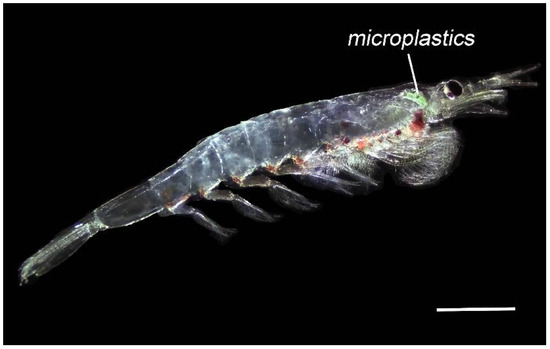
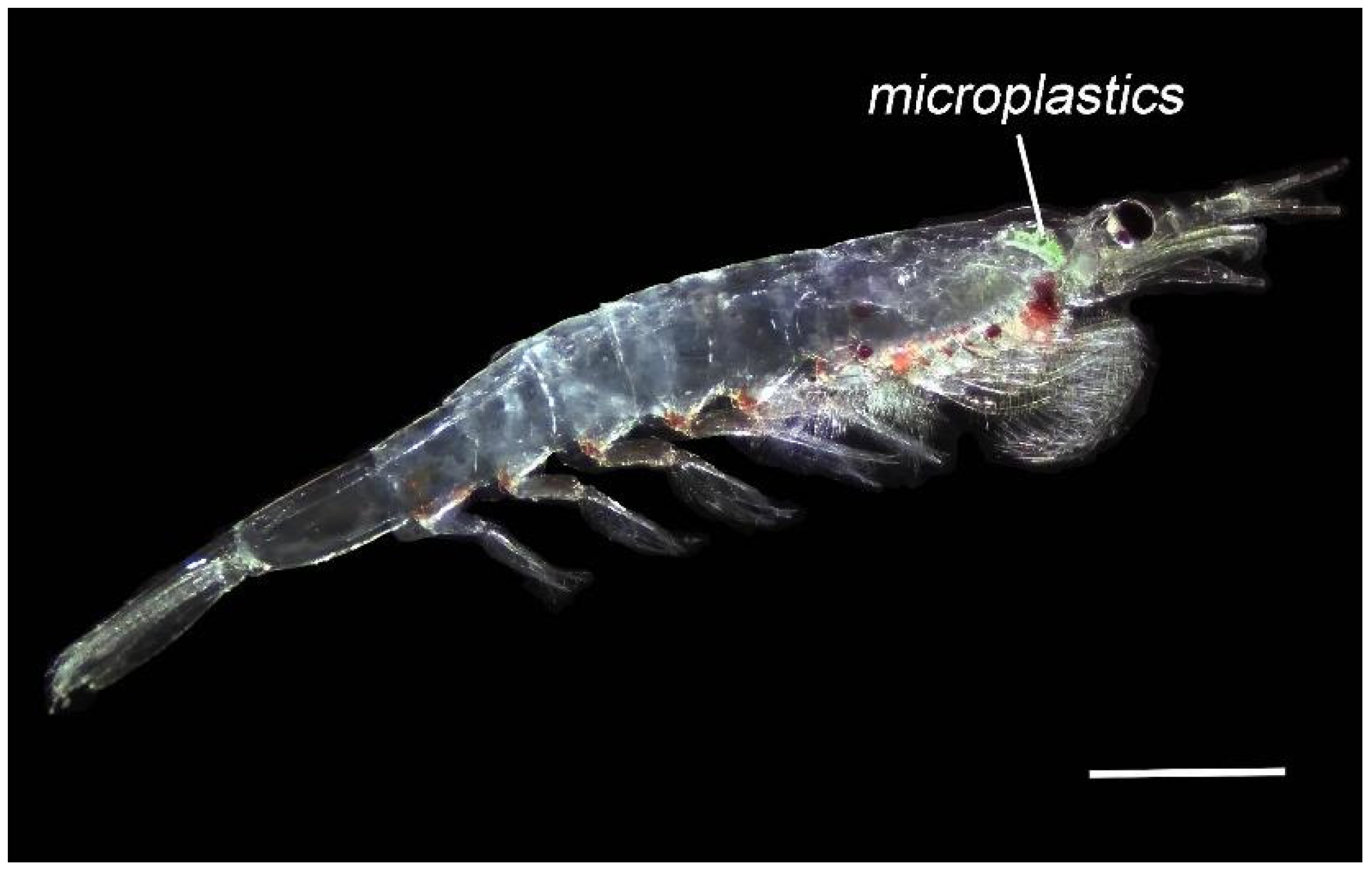
Following acclimation, groups of 3 individuals were transferred to 620 mL glass flasks and exposed to one of five experimental treatments (three replicates per treatment): (T1) no food, no MPs; (T2) no food, 100 MPs/mL; (T3) natural food, no MPs; (T4) natural food, 100 MPs/mL; and (T5) no food, 400 MPs/mL. Natural food consisted of seawater collected from the sampling site and filtered through a 30 µm mesh. MPs were polyethylene microspheres (Cospheric, 20–30 µm diameter). Microplastic exposure solutions were prepared following Valdez-Cibrián et al. [20] by adding the calculated volume of a quantified MP stock solution to each flask after removing an equivalent volume of seawater, maintaining a final volume of 620 mL. All flasks were sealed, rotated on a plankton wheel at 4 rpm, and kept in darkness for six hours to ensure uniform exposure. Following exposure, all individuals from MP treatments (n = 9 per treatment) were visually inspected under a stereomicroscope to verify the presence of fluorescent polyethylene microspheres within the digestive tract (Figure 1). This evaluation was qualitative and used solely to confirm particle uptake prior to organism preservation; ingestion was not quantified. In addition, survival was assessed in each treatment, and no mortality was observed. Survival and qualitative confirmation of MP ingestion were used exclusively to validate biologically relevant exposure conditions. No quantitative phenotypic endpoints were collected for correlation with gene expression, as the experimental design targeted early transcriptional responses rather than downstream organismal effects. Organisms were then flash-frozen in liquid nitrogen, stored on dry ice, and shipped to Laboratorio Nacional de Genómica para la Biodiversidad (LANGEBIO-CINVESTAV, Irapuato-México) for RNA extraction and transcriptomic analysis.
Figure 1.
Adult individual of Euphausia distinguenda with 20–30 µm diameter polyethylene microplastic spheres in its stomach. Scale bar represents 2 mm.
The six-hour exposure duration was selected to capture early transcriptional responses to MP contact and ingestion while minimizing confounding effects associated with prolonged starvation, molting, or secondary stress responses.
Microplastic concentrations of 100 and 400 MPs/mL were chosen to ensure consistent particle encounter and ingestion during short exposures, based on prior laboratory studies in euphausiids and other planktonic invertebrates [10]. The lower concentration represents a moderate exposure sufficient to elicit ingestion under controlled conditions, while the higher concentration was included to assess dose-dependent transcriptional responses without inducing acute mortality.
Although five treatments were applied, only three specific comparisons were retained for transcriptomic interpretation: T1 vs. T2 (effect of lower MP concentration without food), T1 vs. T5 (effect of higher MP concentration without food), and T3 vs. T4 (effect of MPs in the presence of food). Genes also showing significant expression differences in the T1 vs. T3 comparison (food effect in the absence of MPs) were excluded to avoid confounding results by feeding status.
2.2. RNA Extraction and Transcriptomic Analysis
The samples were pulverized with liquid nitrogen, and total RNA was extracted using the TRIzol reagent (Invitrogen, Carlsbad, CA, USA). RNA concentration and purity were assessed using a NanoDrop ND-1000 spectrophotometer (Thermo Scientific, South San Francisco, CA, USA). All samples exhibited A260/280 ratios within the acceptable range (1.8–2.1), while A260/230 ratios were variable but did not preclude downstream sequencing. RNA integrity was assessed by electrophoresis on a 1% agarose gel.
A total of 15 RNA libraries were constructed and sequenced using the DNBSEQ™ platform (MGI Tech Co., Ltd., Shenzhen, China) with 150 bp paired-end chemistry. Each library yielded approximately 32 million high-quality reads. Raw data were processed using SOAPnuke v2.1.9 [21] for adapter removal and quality filtering, retaining reads with >90% of bases at Q30. High-quality reads were assembled de novo using Trinity v2.8.5 [22]. Assembly quality and completeness were evaluated with rnaQUAST v2.2.0 [23]. Redundant contigs were clustered using CD-HIT v4.8.1 [24], resulting in a non-redundant transcriptome of 495,549 sequences. Open reading frames (ORFs) were predicted with TransDecoder v5.7.1, yielding 101,910 putative coding sequences (including complete and partial ORFs). Transcript abundance was estimated using Salmon v0.11.3 in quasi-mapping mode [25], with an average mapping rate of ~50% across libraries.
2.3. Differential Gene Expression Analysis
Transcript abundance estimates from Salmon were analyzed using edgeR in R v4.5.1. The design included two baseline controls: T1 (no food, no MPs) and T3 (food, no MPs). T1 was used as the reference for evaluating MP exposure without food (T1 vs. T2; T1 vs. T5), while T3 served as the reference for assessing MP effects under feeding conditions (T3 vs. T4).
Normalization was applied across libraries and treatments. Because high biological variability and the limited sample size resulted in few transcripts passing FDR correction, adjusted p-values were not used as the primary criterion for exploratory candidate identification. Nominal p-values were therefore used as a screening tool.
Candidate selection followed a tiered exploratory framework: (1) an initial screen for MP-responsive genes, requiring nominal p < 0.005 in all MP-exposure contrasts (T1 vs. T2, T1 vs. T5, and T3 vs. T4) to ensure consistent responses across independent exposure conditions, and (2) a specificity filter using the two controls (T1 vs. T3), in which candidates were required to show no significant difference (p > 0.05) between the no-food/no-MP and food/no-MP treatments, ensuring that expression changes were not driven by feeding status.
This two-step filtering provided internal replication by requiring consistent MP responses and no feeding-related effects, thereby reducing the risk of nominal false positives. Because biological replication was limited (n = 3 per treatment), this approach does not support transcriptome-wide statistical inference. The resulting candidate set was used to prioritize proteins for downstream structural and molecular dynamics analyses, representing a mechanistic extension of transcriptional responses observed under phenotypically validated exposure conditions.
2.4. Homology and Sequence Retrieval
Amino acid sequences of Protein 1 (P1), Protein 2 (P2), and Protein 3 (P3) from E. distinguenda were used as BLASTp queries (BLAST/BLAST+ v2.17.0+) against the NCBI non-redundant (nr) database (updated 26 September 2025), using the web interface and restricting the search to subphylum Crustacea (taxid: 6657). Default parameters of the NCBI BLASTp server were retained, including e-value threshold = 0.05, max_target_seqs = 100, low-complexity filter (SEG) = on, and conditional compositional score matrix adjustment [26]. From the hit list, five homologs per protein were selected prioritizing (i) statistical significance (low E values; e.g., on the order of 1 × 10⁻³³ for the best hits) and (ii) high coverage and identity. No prior numeric thresholds were imposed; however, during curation, isoform redundancies were resolved by retaining the record with the best combination of score and coverage, and species diversity was favored [26,27]. Full-length FASTA sequences of selected hits were downloaded with Entrez Direct (EDirect/efetch).
Selected accessions were:
P1: CAL4075769, XP_066982866, AAP92780, XP_037778318, ACL36281.
P2: CAL4075769, XP_066982866, XP_037778318, AAP92780, XP_037778315.
CAL4075769 was retained as the reference homolog for subsequent analyses. Model confidence was evaluated using AlphaFold2 rank 1 scores to confirm sequence suitability for downstream simulations [28,29] and by preparing them for simulation in CHARMM-GUI https://www.charmm-gui.org (accessed on 15 November 2025).
Although P3 showed increased expression at the transcriptomic level, in BLASTp searches restricted to Crustacea, no homologs with sufficient aligned coverage and identity were recovered to support a reliable structural model; accordingly, preliminary assessments of structural suitability (e.g., fold similarity and modeling confidence with AlphaFold2/ColabFold) did not reach the operational thresholds we require before proceeding to simulation. For rigor and traceability, we opted not to conduct in silico analyses for P3 and to confine its interpretation to the transcriptomic level.
In addition, P1 and P2 were globally aligned in R (Biostrings; BLOSUM62; affine gaps) to quantify isoform-level differences [30]. Substitutions were classified as conservative (BLOSUM62 > 0), neutral (=0), or non-conservative (<0), and termini differences were recorded as isoform-specific extensions or tails. Identity and similarity were computed across aligned non-gap sites.
2.5. Three-Dimensional Structure Prediction
Structures of P1 and P2 were predicted using AlphaFold2 v1.5.5 (ColabFold implementation) with the monomer_ptm preset, without templates, and default parameters [28,29]. Multiple sequence alignments (MSA) were generated via MMseqs2 (ColabFold server) [31,32]. Five models were produced per protein; the rank_1 model was selected for downstream analyses. Full-length sequences were modeled, and the PDB files retained residue-level confidence scores (pLDDT in B-factor column) as well as predicted aligned error (PAE) profiles to distinguish high-confidence structural cores from termini or potential interdomain mobility.
For comparative purposes within Crustacea, a model of the putative ortholog from Meganyctiphanes norvegica (Sars, 1857) was generated under identical conditions. This structure served solely as a reference for fold similarity assessment relative to P1 and P2.
Structural comparison employed two complementary approaches:
UCSF Chimera (production 1.19, build 42556), MatchMaker module, with Cα-based superposition. Both pruned RMSD (core aligned after automatic outlier removal) and global RMSD (all pairs) were recorded, along with respective pair counts, ensuring explicit documentation of flexible/non-alignable regions [33].
TM-align (Zhang Lab server, https://zhanggroup.org/TM-align (accessed on 10 December 2025), reporting normalized TM-score, aligned length (Lali), and RMSD [34]. Coverage was calculated as:
TM-score ≥ 0.5 typically indicates similar global architecture, while Lali/coverage quantifies the fraction of the model superimposable to the reference. This dual approach addresses concerns of insufficient coverage and validates structural relevance.
2.6. Preparation of Receptors and Oligomers
Rank_1 models of P1 and P2 (ColabFold, monomer_ptm) were prepared by adding hydrogens and assigning physiological protonation states (pH 7.4) to termini and side chains. Topological integrity was verified, and a short energy minimization was performed prior to molecular dynamics simulations. The resulting structures were used as initial coordinates for all simulations.
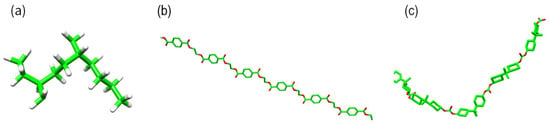
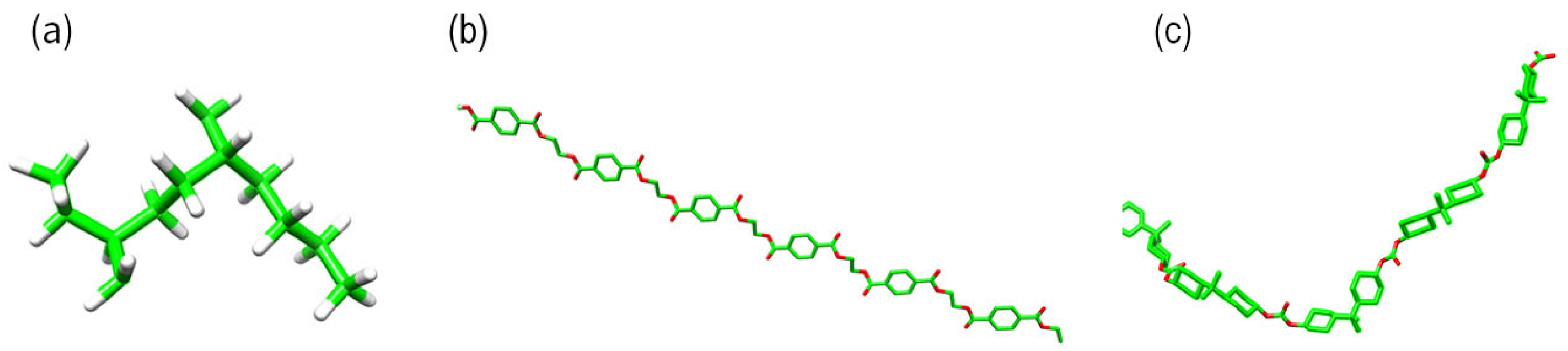
Three-dimensional representations of MP oligomers were constructed and used at physiological pH 7.4 (Figure 2). LDPE was modeled as a saturated aliphatic oligomer generated from the corresponding SMILES string, with an approximate degree of polymerization n ≈ 17 (estimated as #C/2) and CH3/CH3 termini. PET was represented as an oligomer composed of six repeat units (n = 6), treated as neutral under physiological pH without terminal ionization. PC (polycarbonate) was similarly represented as a bisphenol-A–derived oligomer composed of six repeat units (n = 6).
Figure 2.
Polymer fragments used for in silico analyses. (a) LDPE oligomer (n ≈ 17, CH3/CH3 termini), (b) PET oligomer (n = 6), and (c) PC oligomer (n = 6). All structures were geometry-minimized prior to dynamics.
LDPE was modeled with a longer aliphatic fragment (n ≈ 17; CH3/CH3 caps) to create a contiguous hydrophobic patch and minimize end-cap dominated interactions, which can otherwise bias surface contacts in flexible, apolar chains. In contrast, PET and PC (n = 6) already provide repetitive aromatic backbones and polar functional groups (π/π contacts and carbonyls/carbonates) sufficient to represent polymer-like surface chemistry under our protocol without excessive system growth. This choice balances geometric/chemical representativeness, conformational stability of the oligomers, and computational tractability. Because lengths are not size-matched across polymers, between-polymer comparisons are interpreted qualitatively within a homogeneous workflow.
For each MP, a low-energy 3D conformation was generated and geometry-minimized, maintaining torsional flexibility in single bonds and preserving the internal rigidity of rings.
2.7. Molecular Dynamics
Molecular dynamics simulations were performed for P1–MP and P2–MP complexes constructed in CHARMM-GUI using the CHARMM36m force field for proteins and TIP3P water for solvation [35]. Each system was solvated in a cubic box with a 1.0 nm buffer from the protein surface, neutralized, and adjusted to 0.15 M NaCl, with protonation states assigned for pH 7.4. Simulations were carried out in GROMACS 2024.5 with GPU acceleration (NVIDIA RTX 3080, NVIDIA Corporation, Santa Clara, CA, USA) [36,37], using the leap-frog integrator with a 2 fs timestep and LINCS constraints on all bonds involving hydrogen atoms [38,39]. Long-range electrostatics were treated with the particle mesh Ewald method [40], with Coulomb and van der Waals cutoffs of 1.2 nm and a force-switch applied to van der Waals interactions. Temperature was maintained at 300 K using the velocity-rescaling thermostat (τ = 0.1 ps), and pressure was controlled at 1 bar using the Parrinello–Rahman barostat (τ = 2.0 ps; compressibility 4.5 × 10⁻⁵ bar−1), with separate coupling groups defined for the protein–MP complex and solvent–ion components [41,42].
Each system was energy-minimized by steepest descent (5000 steps) and equilibrated in two stages with positional restraints on solute heavy atoms: 1 ns under NVT conditions followed by NPT equilibration with gradual restraint release. Production simulations were run for 100 ns per system (one replica per complex), with initial velocities assigned from a Maxwell–Boltzmann distribution at 300 K.
Trajectory coordinates were saved every 100 ps and energetic quantities every 10 ps. Before analysis, all simulations were centered on the protein–MP complex and corrected for periodic boundary conditions using gmx trjconv. An initial equilibration segment corresponding to the first 20 ns was discarded, and analyses were conducted on the remaining portion of each trajectory. This cutoff was based on stabilization of protein backbone RMSD and polymer positional behavior, indicating completion of initial relaxation following equilibration.
Trajectory behavior was characterized using root mean square deviation (RMSD) metrics. Protein backbone RMSD was calculated to monitor overall conformational drift of the protein during the simulation. Polymer oligomer RMSD was calculated after least-squares fitting of each frame to the protein backbone, providing a measure of the positional variability of the polymer relative to the protein over time. RMSD metrics were used descriptively to compare temporal patterns across systems under identical simulation conditions. Data visualization and plotting were conducted in R version 4.5.1 [43] using RStudio 2025.05.1 [44].
2.8. Nonbonded Lennard–Jones and Coulomb Interaction Energies
Protein–polymer interaction energies were quantified by extracting nonbonded Lennard–Jones (van der Waals) and Coulomb (electrostatic) energy terms from the equilibrated portions of the MD trajectories. Energy components were obtained using the gmx energy module in GROMACS 2024.5. Energy-group interactions between the protein and polymer were averaged over the analysis window (20–100 ns). These values represent total, unnormalized nonbonded interaction energies and were used as comparative indicators of contact stabilization between proteins and polymer oligomers. More negative values indicate stronger overall intermolecular contact stabilization under dynamic conditions.
3. Results
3.1. Candidate Protein Identification and Sequence Retrieval
Differential expression analysis detected between ~2400 and 8000 genes at p < 0.05 depending on the contrast (Table S1, Figure S1). From this dataset, three proteins emerged as consistent responders to MP exposure (Table 1 and Table S2). P1 and P2 (isoforms i1 and i6 of TRINITY_DN16194_c0_g1, respectively) were downregulated across all MP treatments, while P3 (TRINITY_DN28986_c0_g1_i6.p1) was upregulated. P1 and P2 were prioritized as candidates for in silico analyses because their regulation was specific to MP exposure and not confounded by feeding status, whereas P3 was excluded due to limited homology and low structural model quality (see Section 2.3).
Table 1.
Differential expression of selected E. distinguenda proteins under microplastic exposure treatments.
Global alignment of P1 and P2 (Biostrings, BLOSUM62) revealed 96.9% identity and 97% similarity across their shared region, with three substitutions in a cysteine-rich segment (P79-H, T80-R, T89-N; two non-conservative; P1 numbering). In addition, P2 contained a 42-aa N-terminal extension, while P1 retained an 11-aa C-terminal tail (Table S3). These isoform-specific differences provided the basis for treating P1 and P2 as distinct structural and functional candidates.
3.2. Sequence Homology
AlphaFold2 predictions for P1 and P2 yielded models with sufficiently high local confidence to support comparative analyses, although confidence was not uniform across each protein (Table S4). The M. norvegica ortholog was included solely as a comparative reference using its publicly available AlphaFold2 model generated under the same prediction protocol (Figure S2). Detailed residue-level confidence profiles for all three proteins are presented in Section 3.3.
BLASTp searches retrieved putative homologs with consistently high coverage (99–100%) and moderate sequence identity (45–57%), accompanied by very low E-values indicative of robust sequence-level homology (Table S5). Both proteins converged on homologs containing ankyrin repeat, agrin-like, and Kazal-type inhibitor motifs, and both showed alignment to the record CAL4075769 from Atlantic Krill M. norvegica, indicating that conserved sequence elements are shared across Euphausiidae. Sequence identities reached 57% for P1 and 53.7% for P2, corresponding to their top crustacean hits (see accession lists in Table S5).
To further evaluate model suitability, structural superpositions were performed with TM-align (Table S6) and UCSF Chimera/MatchMaker (Table S7). Both proteins aligned with the M. norvegica ortholog over limited regions, with TM-scores of 0.49 (P1) and 0.39 (P2). Query coverage was moderate (63.6% for P1; 47.8% for P2), while target coverage remained low (<7%), reflecting alignment to localized domains rather than the entire reference fold. Chimera superpositions supported this interpretation: only 5–10 residue pairs could be aligned as a conserved core, yielding low pruned RMSD values from structural alignment (~1.39 Å), whereas global RMSD exceeded 24 Å across >100 aligned pairs (Table S7). This contrast underscores that structural similarity is confined to small local regions, while overall fold divergence remains substantial. Together, these results indicate that while overall fold similarity is modest, the conserved cores provide a structural basis for subsequent dynamics analyses.
3.3. AlphaFold2 Structural Confidence of P1 and P2
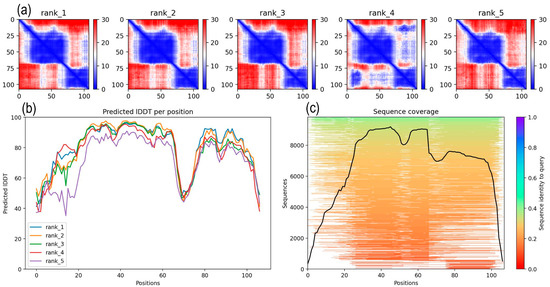
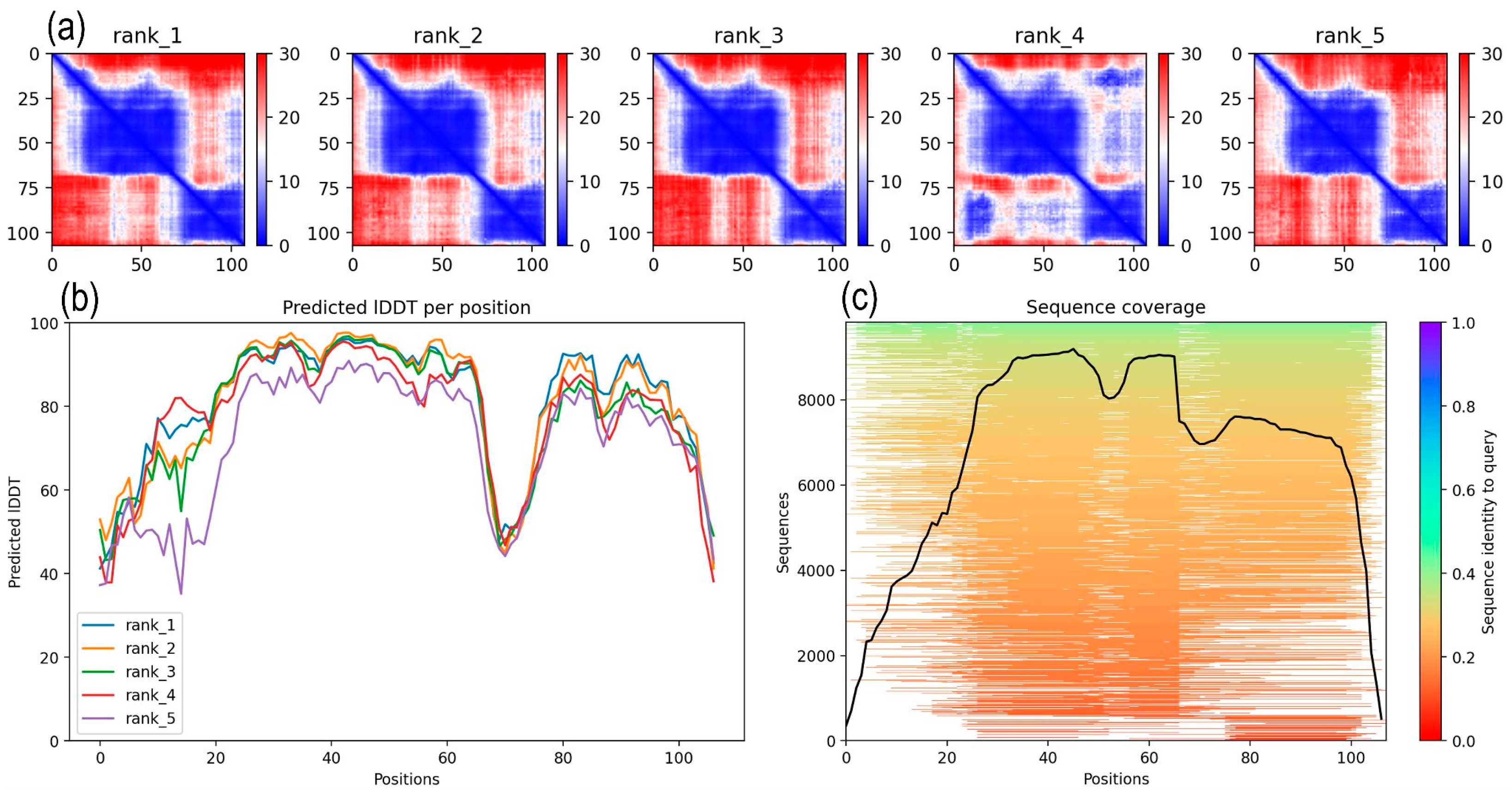
AlphaFold2 structural confidence outputs for P1 (Figure 3) revealed a compact but interrupted folded region. The PAE heatmaps showed a well-defined low-error block across the central portion of the sequence, while both termini and a short internal segment exhibited elevated positional uncertainty relative to the core. The C-terminal residues formed a low-error block internally but displayed higher PAE when compared to the structured domain, indicating that this region is locally coherent yet flexibly positioned (Figure 3a). Consistent with these patterns, the per-residue pLDDT profile showed high confidence from approximately residues 11–60, followed by a pronounced confidence drop around residues 62–75 and additional reductions toward both termini (Figure 3b). MSA coverage likewise showed dense homologous support only across the central region, with a marked decline toward both ends of the sequence, corresponding to the lower-confidence regions observed in the PAE and pLDDT outputs (Figure 3c).
Figure 3.
AlphaFold2 structural confidence outputs for Protein 1 (P1). (a) predicted aligned error (PAE) heatmaps for the five ranked AlphaFold2 models, (b) per-residue pLDDT confidence profiles, and (c) multiple sequence alignment (MSA) coverage.
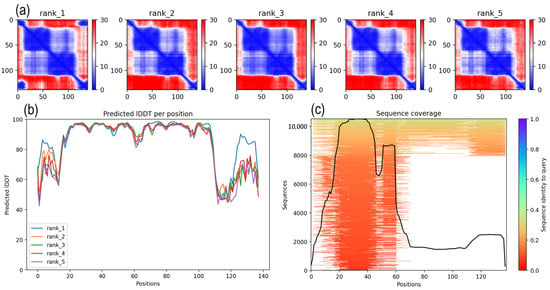
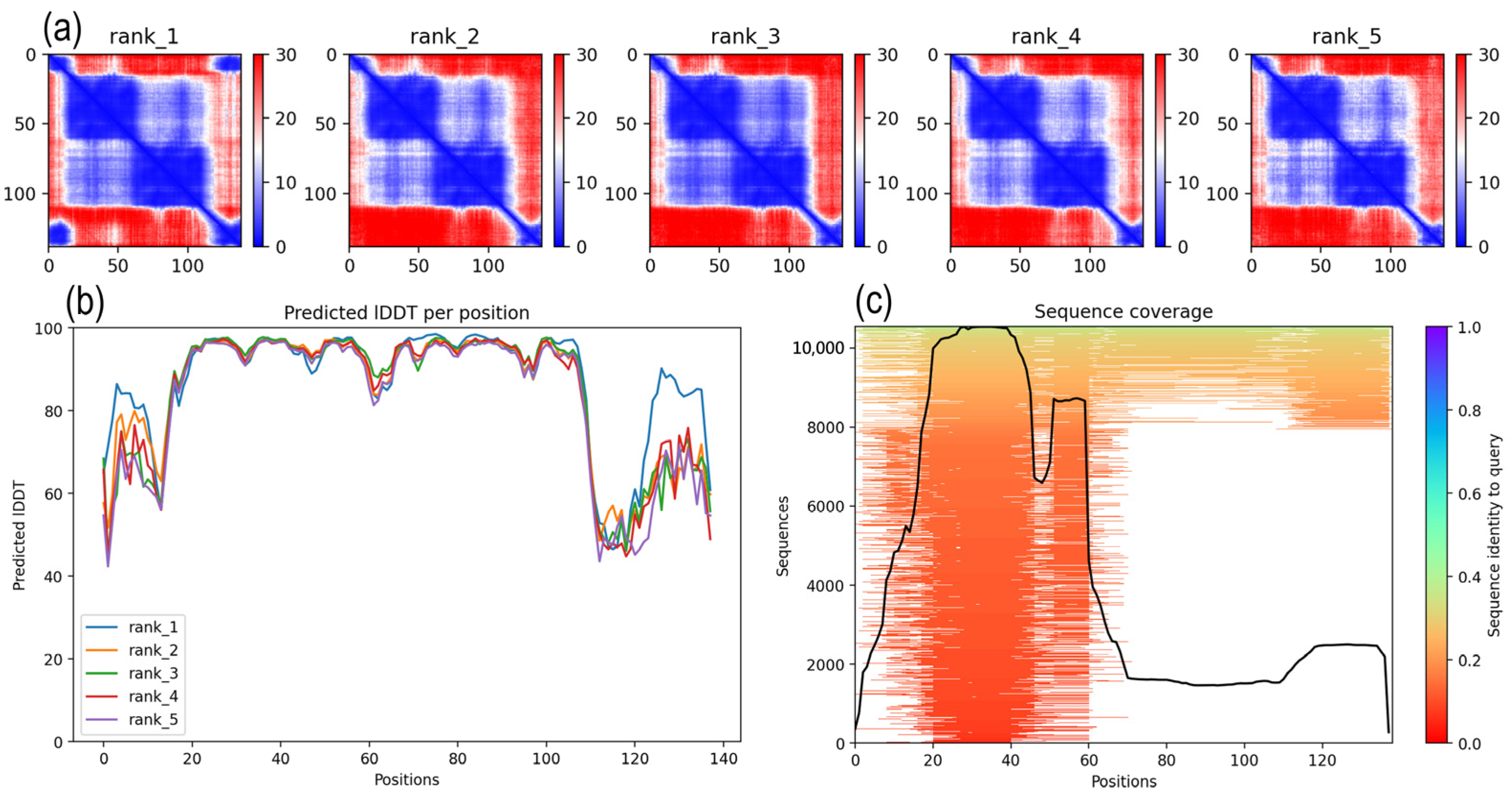
In contrast, P2 displayed a more continuous and coherently defined structured domain (Figure 4). The PAE heatmaps showed a broad low-error region extending across residues ~20–90, with increased uncertainty restricted to the N- and C-terminal segments (Figure 4a). The pLDDT profile mirrored this distribution, exhibiting consistently high confidence across most of the sequence and only modest reductions at the extreme termini (Figure 4b). MSA coverage for P2 was deeper across the structured core and declined only beyond ~60 residues, marking the beginning of a less conserved C-terminal extension (Figure 4c).
Figure 4.
AlphaFold2 structural confidence outputs for Protein 2 (P2). (a) predicted aligned error (PAE) heatmaps for the five ranked AlphaFold2 models, (b) per-residue pLDDT confidence profiles, and (c) multiple sequence alignment (MSA) coverage.
3.4. Molecular Dynamics Simulations
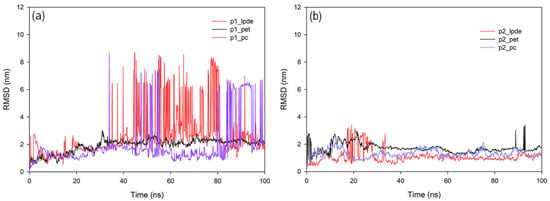
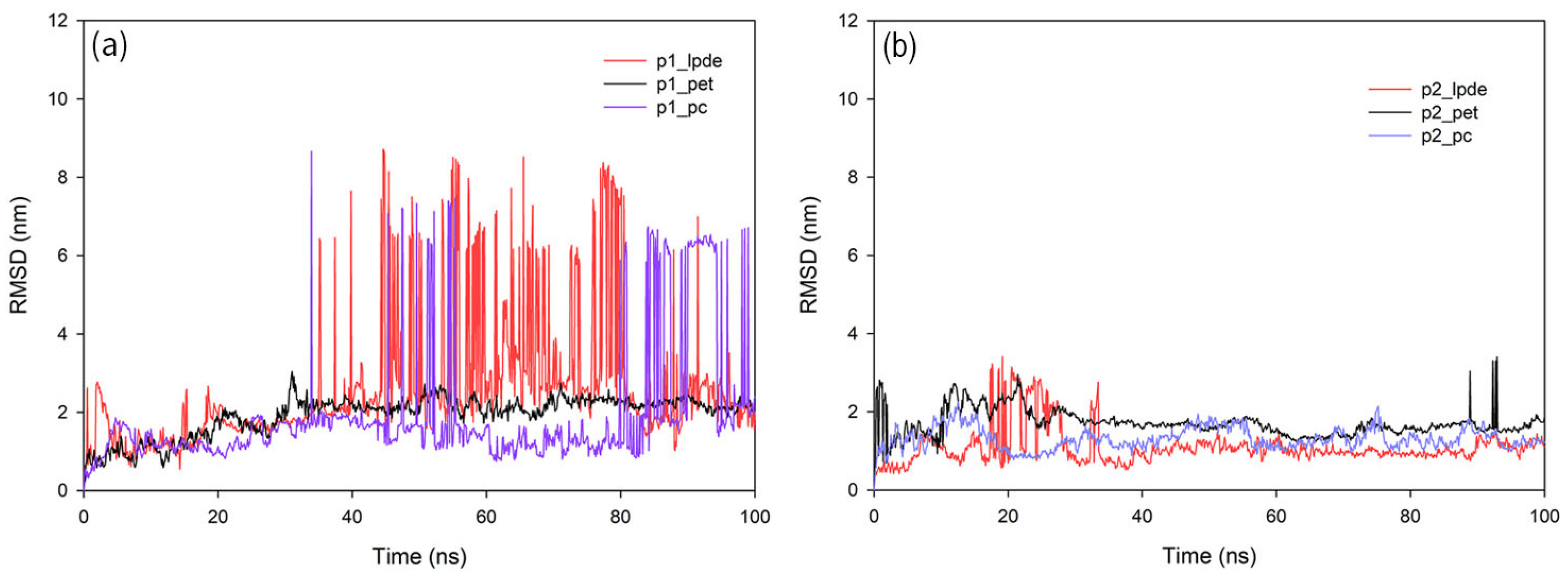
Molecular dynamics simulations (100 ns) revealed consistent protein- and polymer-specific differences in polymer oligomer behavior (Figure 5; Table 2). Polymer oligomer RMSD was calculated after least-squares fitting of each trajectory frame to the protein backbone, such that RMSD reflects oligomer displacement relative to the protein.
Figure 5.
RMSD of polymer oligomers during 100 ns molecular dynamics simulations in complex with (a) Protein 1 (P1) and (b) Protein 2 (P2). Each curve shows the backbone-aligned MP RMSD (nm) over time for LDPE (red), PET (black), and PC (purple), computed relative to the initial complex structure. The x-axis represents simulation time (ns), and the y-axis represents MP RMSD (nm). Oligomer RMSD was computed after superposing each frame to the protein backbone; curves are interpreted as positional stability/confinement measures.
Table 2.
Quantitative analysis of polymer oligomer RMSD. Mean RMSD and standard deviation (nm) for each complex during the production phase of the 100 ns simulation. Means and SD were computed over 20–100 ns. MP behavior was classified from the 20–100 ns RMSD regime as stable (low RMSD, narrow fluctuations), mostly stable with intermittent excursions, persistent but displaced (plateau at elevated RMSD), or unstable (large excursions/high variability). Labels refer to positional stability and spatial confinement from oligomer RMSD traces (fit to backbone).
For P1, no complex reached close or stable surface confinement. P1–LDPE and P1–PC were unstable, with high elevated mean RMSD values and high variability over the post-equilibration interval (20–100 ns), consistent with large-amplitude excursions and loss of confinement (Table 2). P1–PET plateaued after equilibration and fluctuated narrowly, but at an elevated RMSD (~2 nm), indicating a persistent but displaced positional confinement rather than close surface confinement (Figure 5a; Table 2).
In contrast, P2 maintained sustained oligomer proximity across polymers, although stability was reduced for PET relative to LDPE and PC. P2–LDPE and P2–PC showed low mean RMSD, with consistently stable behavior across the post-equilibration interval (Table 2). P2–PET reached a clear plateau but displayed intermittent excursions and a higher mean RMSD than LDPE and PC (Figure 5b; Table 2). Compared to P1, P2 consistently exhibited lower oligomer RMSD values and narrower fluctuations across polymers over the post-equilibration interval.
3.5. Nonbonded Interaction Energies from Molecular Dynamics Simulations
Interaction energies were obtained from the Lennard–Jones and Coulomb terms of the equilibrated portions of the MD trajectories. As non-normalized totals, these LJ/Coulomb values reflected contact stabilization within each system and were directly comparable between proteins for the same polymer, whereas between-polymer comparisons were qualitative under the present workflow. Across all oligomers, interaction energies were consistently more negative for P2 than P1 (Table 3), with P1 values ranging from −373,198 to −671,842 kJ/mol and P2 values from −1,163,800 to −1,527,712 kJ/mol. Across oligomers, P2 interaction energies were approximately two- to four-fold more negative than those observed for P1. These trends co-occurred with the positional confinement patterns (Table 2), where lower oligomer RMSD values were consistently observed for P2 relative to P1 for the same polymer.
Table 3.
Nonbonded Lennard–Jones and Coulomb interaction energies (kJ·mol−1) between proteins P1 and P2 and each polymer oligomer, averaged over the equilibrated portion of the MD trajectories. Values represent total, unnormalized interaction energies summed over all protein–polymer atom pairs. More negative values indicate stronger overall intermolecular contact stabilization.
4. Discussion
Microplastic exposure is increasingly recognized as a source of sublethal stress in marine zooplankton, yet the molecular mechanisms underlying these effects remain poorly resolved, particularly in ecologically relevant non-model taxa [6,45]. In this study, we implemented a screening framework that integrates exploratory transcriptomics with structure-informed molecular dynamics simulations to prioritize and evaluate candidate protein–polymer interactions in E. distinguenda, a dominant euphausiid of the Eastern Tropical Pacific that plays an important role in regional trophic transfer and carbon cycling [46,47,48]. Transcriptomic screening identified proteins consistently responsive to polyethylene exposure, and subsequent in silico analyses revealed protein-specific differences in polymer oligomer interactions under dynamic conditions. P2 formed stable positional confinements with LDPE and PC and a mostly stable positional confinement with PET and exhibited stronger overall intermolecular contact stabilization than P1. In contrast, P1 showed unstable interactions with LDPE and PC and a persistent but displaced positional confinement with PET. Together, these results are interpreted as hypothesis-generating evidence indicating that microplastic–surface of protein interactions in E. distinguenda are shaped by intrinsic protein structural features, while polymer properties modulate interaction stability. These results highlight differential protein–surface compatibility and motivate targeted experimental validation of prioritized candidate proteins [1].
4.1. Identification of Candidate Proteins
Transcriptomic screening has emerged as a powerful tool for identifying sublethal responses to environmental stressors, offering early biomarkers of exposure even in the absence of overt physiological damage [49]. In ecotoxicological studies, differential gene expression analysis provides a first step in revealing candidate pathways and molecular targets affected by contaminants, including MPs [14,45]. The transcriptomic component of this study was designed as a screening step to reduce a very large set of differentially expressed transcripts to a small number of priority candidates suitable for downstream structural and in silico analyses. As is common in ecotoxicogenomic studies of non-model organisms, high biological variability and limited replication constrained transcriptome-wide statistical inference [50], resulting in relatively few transcripts passing false discovery rate (FDR) correction. Therefore, nominal p-values were used to identify genes showing consistent responses across independent microplastic exposure contrasts while excluding feeding-driven effects. These results serve as a prioritization framework for downstream structural modeling and molecular dynamics simulations rather than transcriptome-wide inference or validated biomarkers.
Transcriptomic screening identified three candidate proteins that consistently responded to microplastic exposure while showing no response to food availability in E. distinguenda. P1 and P2 were downregulated across exposure conditions, whereas P3 was upregulated. Although derived from the same transcript cluster, P1 and P2 differ by terminal extensions and non-conservative substitutions in a cysteine-rich region, which can affect folding stability and conformational flexibility and may contribute to their distinct structural confidence and interaction behaviors [51,52]. P3 was a short sequence with no detectable homologs, precluding structural modeling; however, its upregulation suggests a stress-associated candidate for future validation [49].
P1 and P2 diverge in predicted structural organization, which provides a mechanistic basis for their contrasting interaction behaviors. AlphaFold2 confidence metrics (pLDDT and PAE) indicate that P1 contains a limited conserved core flanked by lower-confidence regions, particularly at the termini, consistent with uncertain inter-segment orientation rather than a single rigid fold [53]. Lower pLDDT regions, which often correspond to conformationally flexible or intrinsically disordered segments, can reduce the persistence of surface-mediated contacts [54]. In contrast, P2 shows higher structural confidence across a larger fraction of the sequence, consistent with a more structurally coherent interaction surface under dynamic conditions [52].
4.2. Polymer-Specific Interaction Patterns and Molecular Compatibility
Microplastic–protein interactions are increasingly understood as emergent phenomena arising from the interplay between polymer physicochemical properties and protein surface architecture, rather than as ligand-like binding events [55]. Biological interactions depend strongly on surface-mediated protein compatibility and residence time, with polymer chemistry playing a secondary role [16,56]. In the present study, interaction behavior varied primarily by protein identity, while polymer properties influenced the stability and spatial confinement within each protein–polymer pairing.
A comparison across LDPE, PET, and PC revealed distinct interaction patterns that reflect differences in surface flexibility and interaction geometry rather than interaction strength alone. For Protein 2, LDPE exhibited the lowest mean polymer RMSD, indicating the highest positional stability, consistent with its flexible, hydrophobic nature and ability to accommodate conformational adjustment during sustained surface contact at apolar polymer–protein interfaces [55,57]. PET maintained persistent contact with both proteins but with reduced spatial confinement, consistent with interaction modes reported for polymers with more rigid backbones and polar functional groups that limit surface adaptability [16,17]. In contrast, PC showed strong protein dependence, with stable positional confinement observed for P2 but unstable interactions with P1, suggesting more stringent compatibility requirements at the polymer–protein interface, as reported for aromatic, sterically constrained polymers [16,57].
Across polymers, protein surface properties ultimately determined whether polymer contacts could be stabilized. P1 failed to maintain positional confinement with any polymer, exhibiting transient or spatially unconstrained contacts even when nonbonded interaction energies were favorable. This is consistent with its limited conserved structural core and extended regions of reduced structural confidence, features commonly associated with elevated conformational flexibility and reduced persistence of surface-mediated contacts [53,58]. In contrast, P2 supported stable positional confinement with LDPE and PC and displaced positional confinement with PET, reflecting a compact and structurally coherent fold that provides a continuous interaction surface [57]. Inferences are strictly comparative, based on single 100 ns trajectories per complex under identical simulation conditions.
Although molecular simulations were conducted using LDPE, PET, and PC, transcriptomic responses were elicited by polyethylene microspheres. The integration of experimental and in silico results therefore focuses on surface-interaction principles common to MPs, rather than on polymer-specific toxic mechanisms. As emphasized by Koelmans et al. [1], MP effects are often governed by general particle properties, including surface hydrophobicity, flexibility, and contact persistence, while differences among polymers modulate the stability and spatial characteristics of these interactions. Polyethylene microspheres present a chemically simple, flexible, and hydrophobic surface [59], closely matching the interaction mode observed for LDPE in the simulations. In contrast, PET and PC illustrate how increased polymer rigidity and polarity influence protein compatibility under surface-mediated interactions.
4.3. Functional Implications of Protein–Polymer Interactions
To explore the potential functional relevance of the proteins responsive to MP exposure, conserved domains and sequence homology were examined for P1 and P2, with particular emphasis on features that could modulate susceptibility to sustained surface-mediated interactions with MPs. BLASTp analyses revealed that both P1 and P2 aligned most strongly to CAL4075769.1, an uncharacterized protein from the Atlantic krill Meganyctiphanes norvegica (GenBank accession CAL4075769, direct submission), which is annotated with multiple Kazal-type serine protease inhibitor domains. Beyond this euphausiid hit, subsequent high-scoring alignments included ankyrin repeat–containing proteins, Kazal-type inhibitors, and agrin-like isoforms from penaeid shrimp and Macrobrachium. Ankyrin repeats function as versatile interaction motifs across diverse processes such as cell cycle control, developmental signaling, and inflammatory response [60]. Kazal-type inhibitors are small secretory proteins involved in digestive and immune processes in invertebrates [61]. Agrin-like proteins, while best known in vertebrates for neuromuscular junction assembly, also exert broader effects in proliferation, motility, adhesion, and tissue regeneration [62,63]. Together, these annotations suggest that P1 and P2 are proteins whose biological roles depend on maintaining accessible interaction surfaces, potentially associated with extracellular or membrane-proximal processes. While the convergence of ankyrin-, Kazal-, and agrin-like features complicates direct functional assignment, it is consistent with lineage-restricted regulatory proteins commonly identified from transcriptomic resources [64].
The limited capacity for sustained surface contact in P1 is consistent with predicted structural features which favor reduced persistence of surface-mediated interactions [53,54]. The downregulation of P1 under polyethylene exposure may therefore reflect indirect cellular responses, such as altered regulation of stress- or conditionally expressed proteins, rather than direct perturbation through stable polymer confinement, as reported in other marine invertebrate transcriptomic studies lacking clear molecular targets [7,65,66].
In contrast, the stable positional confinement observed for P2 across polymers supports a greater capacity for persistent surface-mediated interactions. This behavior is consistent with a compact and structurally coherent fold [52]. Given its sequence similarity to ankyrin-, Kazal-, and agrin-like proteins, P2 may function as a regulatory scaffold [67] or extracellularly oriented protein whose activity depends on maintaining accessible interaction surfaces [68]. Comparable modes of surface-mediated interference have been proposed in marine invertebrates exposed to MPs [65].
In this context, sustained spatial proximity with MP surfaces could plausibly alter normal interaction dynamics by modifying spatial availability or contact persistence without invoking high-affinity or site-specific binding mechanisms. Here, positional confinement, reduced RMSD, and contact persistence are interpreted as comparative indicators of sustained surface interaction behavior rather than as evidence of site-specific binding or quantitative affinity [69]. These are testable predictions, suitable for alanine-scanning of surface residues shaping confinement, salinity-dependent modulation of hydrophobic contacts, and polymer length scans to decouple chemistry from surface/size effects.
The difficulty in assigning definitive functions to P1 and P2 underscores persistent limitations in molecular annotation for marine zooplankton. Euphausiids and other planktonic taxa remain underrepresented in curated functional databases, constraining interpretation of transcriptomic responses [70]. This deficiency reinforces the exploratory nature of the study and the need to integrate computational predictions with targeted experimental validation and improved taxon-specific resources [71]. Here, the consistent transcriptional responsiveness of these proteins and their contrasting interaction behaviors observed in silico, supports their prioritization as candidate molecular responders to MP exposure, addressing calls for mechanistic insight into sublethal MP effects in ecologically relevant non-model taxa [72].
4.4. Ecological Implications and Broader Toxicological Context
Although this study focuses on molecular-scale interactions, the protein-specific responses identified have implications for ecologically relevant functions in natural krill populations. Sublethal effects of MP exposure in zooplankton commonly manifest as altered feeding, metabolism, growth, and reproductive output [6]. These outcomes may arise through interference with proteins supporting routine physiological processes, which does not require high-affinity binding or chemical toxicity but may nonetheless translate into localized physiological effects when exposure is persistent [1,2,6]. Disruption of proteins involved in digestive regulation, cytoskeletal organization, or extracellular signaling could reduce feeding efficiency, alter swimming behavior, or impair reproductive processes, even in the absence of overt toxicity [6,45].
Most mechanistic studies linking MPs to biological effects in euphausiids have focused on temperate and polar species. For example, Antarctic krill Euphausia superba can fragment polyethylene MPs into nanoplastics during digestion [66] and efficiently eliminate ingested particles without bioaccumulation, highlighting the importance of evaluating sublethal and chronic effects rather than accumulation alone [73]. In contrast, tropical euphausiids remain largely unstudied despite their ecological importance.
Euphausia distinguenda, a dominant euphausiid in the Eastern Tropical Pacific [8], plays a central role in trophic transfer and vertical carbon export through diel vertical migration, feeding activity, and depth-variable metabolism [74,75]. Proteins such as P1 and P2, which exhibit transcriptional responses to MP exposure and distinct interaction capacities with polymer surfaces, represent potential links between exposure and traits directly relevant for ecological performance. If sustained under chronic exposure, even modest reductions in feeding efficiency or swimming performance may reduce individual condition and reproductive output, with potential consequences for population biomass, trophic transfer and carbon flux [5], particularly in OMZ-structured systems where euphausiids represent one of the few zooplankton groups capable of routinely occupying or migrating within low-oxygen layers [48].
While the ecological consequences of these molecular interactions were not directly measured, these findings emphasize the need to evaluate MP impacts in a species- and habitat-specific context, integrating molecular evidence with organismal and population-level endpoints [76]. Such integration will be essential to translate mechanistic insights into ecosystem-scale assessments of marine plastic pollution.
4.5. Experimental-Simulation Alignment and Limitations
This study integrates transcriptomic profiling with MD simulations and nonbonded interaction analyses to assess surface mediated MP–protein interactions in E. distinguenda, with several limitations. First, protein structures were inferred from transcriptomic sequences without proteomic validation, introducing uncertainty related to annotation and model accuracy. Second, simulated MPs were represented as idealized polymer oligomers and do not capture environmentally relevant features such as aging, oxidation, or sorbed contaminants; results therefore reflect fundamental interaction tendencies rather than full environmental complexity. Although experimental exposures used polyethylene microspheres, additional polymers were included in silico to examine how differences in flexibility and polarity modulate protein compatibility within a shared surface-interaction framework; comparisons among polymers are thus interpreted qualitatively. Third, transcriptomic analyses were based on limited biological replication and nominal p-values and are interpreted strictly as a candidate-filtering step rather than a definitive assessment of transcriptome-wide responses. Independent validation of prioritized candidates using targeted approaches such as fluorescence-based quantitative RT-qPCR will be required in future gene-focused experiments to confirm expression patterns under controlled exposure conditions. Finally, molecular dynamics simulations employed a single 100 ns trajectory per complex; conclusions regarding interaction stability reflect comparative behavior under a homogeneous protocol and do not assess ensemble variability or convergence, nor do they provide definitive affinity estimates. Despite these limitations, the study demonstrates the value of coupling experimental transcriptomics with computational modeling to identify protein–polymer interaction mechanisms and prioritize putative molecular targets of MP stress in ecologically important zooplankton.
5. Conclusions
By integrating transcriptomic responses with molecular dynamics–based interaction analyses, this study establishes a comparative screening framework for exploring MP–protein interactions in a tropical euphausiid. Using transcriptomic responsiveness as an unbiased filter and molecular simulations to evaluate interaction stability and surface confinement, this approach addresses a key challenge in MP ecotoxicology for non-model organisms, where responsive molecular targets are rarely known a priori.
Collectively, the results demonstrate that the capacity of MPs to interact with protein targets depends primarily on protein structural features, with polymer-specific properties shaping dynamic interaction behavior. The combined analyses highlight the importance of interaction stability, spatial confinement, and contact persistence over dynamic timescales when evaluating the potential for molecular-level effects, rather than relying on static structural complementarity or inferred binding affinity alone.
The two candidate proteins identified here exhibited contrasting interaction behaviors despite originating from the same transcriptomic screening pipeline. P1 exhibited weak and unstable interactions with LDPE and PC, and a persistent but displaced positional confinement with PET, suggesting an indirect or stress-mediated response to exposure. In contrast, P2 formed stable positional confinements with LDPE and comparably stable positional confinements with PC, accompanied by stronger nonbonded interaction energies, suggesting a greater potential for direct surface-mediated interference. Notably, LDPE yielded the lowest mean polymer RMSD and the highest average positional stability for P2, despite its chemically simple structure, underscoring the dominant role of protein surface compatibility in shaping interaction outcomes.
Although these proteins aligned most closely with an uncharacterized M. norvegica ortholog, their conserved features provide a comparative reference that strengthens the interpretation of our results in a broader euphausiid context. Importantly, the present framework is not intended to provide definitive evidence of MP–protein binding, but rather to prioritize transcriptomically responsive proteins for targeted laboratory validation. As such, the proteins identified here represent exploratory candidates for experimental characterization, including functional annotation and direct assessment of MP–protein interactions, and offer initial insight into potential sublethal molecular pathways associated with MP ingestion in ecologically important zooplankton.
Supplementary Materials
The following supporting information can be downloaded at: https://www.mdpi.com/article/10.3390/microplastics5010056/s1, Figure S1. Volcano plots showing log2 fold change vs. −log10 p-value for all pairwise treatment comparisons. Differentially expressed genes (red dots) were identified using edgeR with a threshold of p < 0.05. Each plot corresponds to the following contrasts: (a) T1vsT2; (b) T1vsT5; (c) T1 vs T3; (d) T3vsT4. Figure S2. AlphaFold2 structural confidence outputs for the closest krill homolog. (a) Predicted aligned error (PAE) heatmaps for the five ranked AlphaFold2 models, (b) per-residue pLDDT confidence profiles, and (c) multiple sequence alignment (MSA) coverage are shown. Table S1. Number of differentially expressed genes (DEGs; p < 0.05) identified in pairwise comparisons between treatments. Each comparison evaluates the effect of microplastic (MP) exposure and/or food availability. Treatment definitions: T1—no food, no MPs; T2—no food, 100 MPs/mL; T3—natural food, no MPs; T4—natural food, 100 MPs/mL; T5—no food, 400 MPs/mL. Table S2. Amino acid sequences of the three Euphausia distinguenda proteins selected for in silico modeling and analysis. Table S3. Isoform-specific sequence differences between P1 and P2 of Euphausia distinguenda. P2 carries a 42-aa N-terminal extension, while P1 retains an 11-aa C-terminal tail. Within the aligned shared region, three substitutions were identified in a cysteine-rich segment (P79→H, T80→R, T89→N; P1 numbering), two of which were non-conservative according to BLOSUM62 scores. Table S4. Summary of AlphaFold2-Predicted Model Quality Metrics. Table S5. Five most significant homologs for Protein 1, identified by BLASTp in the NCBI database, using the Crustacea filter. Table S6. Structural comparison between each protein (P1, P2) and the M. norvegica reference model using TM-align. The TM-score (normalized by query length) evaluates global fold similarity; Lali is the aligned length; RMSD (Å) represents the root mean square deviation over aligned residues. Coverage (query/target) is calculated as Lali/Lquery and Lali/Ltarget, respectively; higher values indicate that a larger fraction of the protein (or reference) is involved in the superposition. Table S7. Cα superposition using UCSF Chimera (MatchMaker). RMSDpruned (Å) and pruned pairs (n) correspond to the aligned core after iterative outlier pruning; RMSDglobal (Å) and total pairs (n) include all matched residue pairs without pruning. Reporting both values quantifies the quality of the superposition for the conserved core (pruned) and at the global level (unpruned).
Author Contributions
Conceptualization, D.E.N.-Á., J.D.S.-V. and E.R.K.; Formal analysis, D.E.N.-Á., R.A.-G. and J.A.M.-P.; Funding acquisition, E.R.K.; Investigation, D.E.N.-Á., J.D.S.-V. and E.R.K.; Supervision, E.R.K.; Writing—original draft, D.E.N.-Á.; Writing—review & editing, R.A.-G., J.A.M.-P., J.D.S.-V. and E.R.K. All authors have read and agreed to the published version of the manuscript.
Funding
This research was funded by the Secretaría de Innovación, Ciencia y Tecnología (SICyT) and the Consejo Estatal de Ciencia y Tecnología de Jalisco (COECyTJAL) through the program Fondo de Desarrollo Científico de Jalisco para Atender Retos Sociales (FODECIJAL 2024), grant number 11167-2024.
Institutional Review Board Statement
As this research was carried out on planktonic invertebrates, it did not require ethical approval.
Data Availability Statement
The original contributions presented in this study are included in the article/Supplementary Materials. Further inquiries can be directed to the corresponding authors.
Acknowledgments
The authors thank A. Alvizar-Martínez for his technical assistance navigating the panga León Marino and zooplankton sampling.
Conflicts of Interest
The authors declare no conflicts of interest.
References
- Koelmans, A.A.; Redondo-Hasselerharm, P.E.; Nor, N.H.M.; de Ruijter, V.N.; Mintenig, S.M.; Kooi, M. Risk assessment of microplastic particles. Nat. Rev. Mater. 2022, 7, 138–152. [Google Scholar] [CrossRef] [Scilit]
- Wright, S.L.; Thompson, R.C.; Galloway, T.S. The physical impacts of microplastics on marine organisms: A review. Environ. Pollut. 2013, 178, 483–492. [Google Scholar] [CrossRef] [Scilit]
- Wang, W.-X. Environmental toxicology of marine microplastic pollution. Camb. Prism. Plast. 2023, 1, e10. [Google Scholar] [CrossRef] [Scilit]
- Cole, M.; Lindeque, P.; Fileman, E.; Halsband, C.; Goodhead, R.; Moger, J.; Galloway, T.S. Microplastic ingestion by zooplankton. Environ. Sci. Technol. 2013, 47, 6646–6655. [Google Scholar] [CrossRef] [Scilit] [PubMed]
- Steinberg, D.K.; Landry, M.R. Zooplankton and the ocean carbon cycle. Annu. Rev. Mar. Sci. 2017, 9, 413–444. [Google Scholar] [CrossRef] [Scilit]
- Botterell, Z.L.; Beaumont, N.; Dorrington, T.; Steinke, M.; Thompson, R.C.; Lindeque, P.K. Bioavailability and effects of microplastics on marine zooplankton: A review. Environ. Pollut. 2019, 245, 98–110. [Google Scholar] [CrossRef] [Scilit] [PubMed]
- Prokić, M.D.; Radovanović, T.B.; Gavrić, J.P.; Faggio, C. Ecotoxicological effects of microplastics: Examination of biomarkers, current state and future perspectives. TrAC Trends Anal. Chem. 2019, 111, 37–46. [Google Scholar] [CrossRef] [Scilit]
- Ambriz-Arreola, I.; Gómez-Gutiérrez, J.; Franco-Gordo, M.C.; Plascencia-Palomera, V.; Gasca, R.; Kozak, E.R.; Lavaniegos, B.E. Seasonal succession of tropical community structure, abundance, and biomass of five zooplankton taxa in the central Mexican Pacific. Cont. Shelf Res. 2018, 168, 54–67. [Google Scholar] [CrossRef] [Scilit]
- Desforges, J.P.W.; Galbraith, M.; Ross, P.S. Ingestion of microplastics by zooplankton in the Northeast Pacific Ocean. Arch. Environ. Contam. Toxicol. 2015, 69, 320–330. [Google Scholar] [CrossRef] [Scilit]
- Valdez-Cibrián, A.; Kozak, E.R.; Franco-Gordo, C. Microplastic ingestion in marine mesozooplankton species associated with functional feeding traits. Mar. Environ. Res. 2024, 200, 106650. [Google Scholar] [CrossRef] [Scilit]
- Suman, T.Y.; Jia, P.P.; Li, W.G.; Junaid, M.; Xin, G.Y.; Wang, Y.; Pei, D.S. Acute and chronic effects of polystyrene microplastics on brine shrimp: First evidence highlighting the molecular mechanism through transcriptome analysis. J. Hazard. Mater. 2020, 400, 123220. [Google Scholar] [CrossRef] [Scilit] [PubMed]
- Choi, J.S.; Hong, S.H.; Park, J.W. Evaluation of microplastic toxicity in accordance with different sizes and exposure times in the marine copepod Tigriopus japonicus. Mar. Environ. Res. 2020, 153, 104838. [Google Scholar] [CrossRef] [Scilit] [PubMed]
- Jeyavani, J.; Sibiya, A.; Bhavaniramya, S.; Mahboob, S.; Al-Ghanim, K.A.; Nisa, Z.U.; Vaseeharan, B. Toxicity evaluation of polypropylene microplastic on marine microcrustacean Artemia salina: An analysis of implications and vulnerability. Chemosphere 2022, 296, 133990. [Google Scholar] [CrossRef] [Scilit] [PubMed]
- Missawi, O.; Venditti, M.; Cappello, T.; Zitouni, N.; Di Marco, G.; Boughattas, I.; Banni, M. Autophagic event and metabolomic disorders unveil cellular toxicity of environmental microplastics on marine polychaete Hediste diversicolor. Environ. Pollut. 2022, 302, 119106. [Google Scholar] [CrossRef] [Scilit]
- Pabon, N.A.; Xia, Y.; Estabrooks, S.K.; Ye, Z.; Herbrand, A.K.; Süß, E.; Biondi, R.M.; Assimon, V.A.; Gestwicki, J.E.; Brodsky, J.L.; et al. Predicting protein targets for drug-like compounds using transcriptomics. PLoS Comput. Biol. 2018, 14, e1006651. [Google Scholar] [CrossRef] [Scilit]
- Salmaso, V.; Moro, S. Bridging molecular docking to molecular dynamics in exploring ligand-protein recognition process: An overview. Front. Pharmacol. 2018, 9, 923. [Google Scholar] [CrossRef] [Scilit]
- Chen, X.; Li, X.; Li, Y. Toxicity inhibition strategy of microplastics to aquatic organisms through molecular docking, molecular dynamics simulation and molecular modification. Ecotoxicol. Environ. Saf. 2021, 226, 112870. [Google Scholar] [CrossRef] [Scilit]
- Enyoh, C.E.; Wang, Q.; Ovuoraye, P.E.; Maduka, T.O. Toxicity evaluation of microplastics to aquatic organisms through molecular simulations and fractional factorial designs. Chemosphere 2022, 308, 136342. [Google Scholar] [CrossRef] [Scilit]
- Brinton, E.; Ohman, M.D.; Townsend, A.W.; Knight, M.D.; Bridgeman, A.L. Euphausiids of the World Ocean World Biodiversity Database CD-ROM Series; Springer: Paris, France, 2000. [Google Scholar]
- Valdez-Cibrián, A.; Flores-Miranda, M.C.; Kozak, E.R. An accessible method to standardize polyethylene microsphere (<100 μm) concentrations for zooplankton ingestion experiments. Mar. Pollut. Bull. 2023, 194, 115351. [Google Scholar] [CrossRef] [Scilit]
- Chen, Y.; Chen, Y.; Shi, C.; Huang, Z.; Zhang, Y.; Li, S.; Li, Y.; Ye, J.; Yu, C.; Li, Z. SOAPnuke: A MapReduce acceleration-supported software for integrated quality control and preprocessing of high-throughput sequencing data. GigaScience 2018, 7, gix120. [Google Scholar] [CrossRef] [Scilit]
- Haas, B.; Papanicolaou, A.; Yassour, M.; Grabherr, M.; Blood, P.D.; Bowden, J.; Couger, M.B.; Eccles, D.; Li, B.; Lieber, M.; et al. De novo transcript sequence reconstruction from RNA-seq using the Trinity platform for reference generation and analysis. Nat. Protoc. 2013, 8, 1494–1512. [Google Scholar] [CrossRef] [Scilit]
- Bushmanova, E.; Antipov, D.; Lapidus, A.; Suvorov, V.; Prjibelski, A.D. rnaQUAST: A quality assessment tool for de novo transcriptome assemblies. Bioinformatics 2016, 32, 2210–2212. [Google Scholar] [CrossRef] [Scilit]
- Li, W.; Godzik, A. Cd-hit: A fast program for clustering and comparing large sets of protein or nucleotide sequences. Bioinformatics 2006, 22, 1658–1659. [Google Scholar] [CrossRef] [Scilit]
- Patro, R.; Duggal, G.; Love, M.; Irizarry, R.A.; Kingsford, C. Salmon provides fast and bias-aware quantification of transcript expression. Nat. Methods 2017, 14, 417–419. [Google Scholar] [CrossRef] [Scilit]
- Altschul, S.F.; Gish, W.; Miller, W.; Myers, E.W.; Lipman, D.J. Basic local alignment search tool. J. Mol. Biol. 1990, 215, 403–410. [Google Scholar] [CrossRef]
- Altschul, S.F.; Madden, T.L.; Schäffer, A.A.; Zhang, J.; Zhang, Z.; Miller, W.; Lipman, D.J. Gapped BLAST and PSI-BLAST: A new generation of protein database search programs. Nucleic Acids Res. 1997, 25, 3389–3402. [Google Scholar] [CrossRef] [Scilit]
- Mirdita, M.; Schütze, K.; Moriwaki, Y.; Heo, L.; Ovchinnikov, S.; Steinegger, M. ColabFold: Making protein folding accessible to all. Nat. Methods 2022, 19, 679–682. [Google Scholar] [CrossRef] [Scilit]
- Jumper, J.; Evans, R.; Pritzel, A.; Green, T.; Figurnov, M.; Ronneberger, O.; Tunyasuvunakool, K.; Bates, R.; Žídek, A.; Potapenko, A.; et al. Highly accurate protein structure prediction with AlphaFold. Nature 2021, 596, 583–589. [Google Scholar] [CrossRef] [Scilit]
- Huber, W.; Carey, V.J.; Gentleman, R.; Anders, S.; Carlson, M.; Carvalho, B.S.; Bravo, H.C.; Davis, S.; Gatto, L.; Girke, T.; et al. Orchestrating high-throughput genomic analysis with Bioconductor. Nat. Methods 2015, 12, 115–121. [Google Scholar] [CrossRef] [Scilit]
- Steinegger, M.; Söding, J. MMseqs2 enables sensitive protein sequence searching for the analysis of massive data sets. Nat. Biotechnol. 2017, 35, 1026–1028. [Google Scholar] [CrossRef] [Scilit]
- Kallenborn, F.; Chacon, A.; Hundt, C.; Sirelkhatim, H.; Didi, K.; Cha, S.; Dallago, C.; Mirdita, M.; Schmidt, B.; Steinegger, M. GPU-accelerated homology search with MMseqs2. Nat. Methods 2025, 22, 2024–2027. [Google Scholar] [CrossRef] [Scilit]
- Pettersen, E.F.; Goddard, T.D.; Huang, C.C.; Couch, G.S.; Greenblatt, D.M.; Meng, E.C.; Ferrin, T.E. UCSF Chimera—A visualization system for exploratory research and analysis. J. Comput. Chem. 2004, 25, 1605–1612. [Google Scholar] [CrossRef] [Scilit]
- Zhang, Y.; Skolnick, J. TM-align: A protein structure alignment algorithm based on the TM-score. Nucleic Acids Res. 2005, 33, 2302–2309. [Google Scholar] [CrossRef] [Scilit]
- Huang, J.; Rauscher, S.; Nawrocki, G.; Ran, T.; Feig, M.; de Groot, B.L.; Grubmüller, H.; Mackerell, A.D. CHARMM36m: An improved force field for folded and intrinsically disordered proteins. Nat. Methods 2017, 14, 71–73. [Google Scholar] [CrossRef] [Scilit]
- Abraham, M.J.; Murtola, T.; Schulz, R.; Páll, S.; Smith, J.C.; Hess, B.; Lindahl, E. GROMACS: High performance molecular simulations through multi-level parallelism from laptops to supercomputers. SoftwareX 2015, 1–2, 19–25. [Google Scholar] [CrossRef] [Scilit]
- Jorgensen, W.L.; Chandrasekhar, J.; Madura, J.D.; Impey, R.W.; Klein, M.L. Comparison of simple potential functions for simulating liquid water. J. Chem. Phys. 1983, 79, 926–935. [Google Scholar] [CrossRef] [Scilit]
- Hess, B.; Bekker, H.; Berendsen, H.J.C.; Fraaije, J.G.E.M. LINCS: A linear constraint solver for molecular simulations. J. Comput. Chem. 1997, 18, 1463–1472. [Google Scholar] [CrossRef]
- Hess, B. P-LINCS: A Parallel Linear Constraint Solver for Molecular Simulation. J. Chem. Theory Comput. 2007, 4, 116–122. [Google Scholar] [CrossRef] [Scilit]
- Darden, T.; York, D.; Pedersen, L. Particle mesh Ewald: An N⋅log(N) method for Ewald sums in large systems. J. Chem. Phys. 1993, 98, 10089–10092. [Google Scholar] [CrossRef] [Scilit]
- Bussi, G.; Donadio, D.; Parrinello, M. Canonical sampling through velocity rescaling. J. Chem. Phys. 2007, 126, 014101. [Google Scholar] [CrossRef] [Scilit]
- Parrinello, M.; Rahman, A. Polymorphic transitions in single crystals: A new molecular dynamics method. J. Appl. Phys. 1981, 52, 7182–7190. [Google Scholar] [CrossRef] [Scilit]
- R Core Team. R: A Language and Environment for Statistical Computing; R Foundation for Statistical Computing: Vienna, Austria, 2025; Available online: https://www.R-project.org/ (accessed on 10 December 2025).
- Posit Team. RStudio: Integrated Development Environment for R; Posit Software, PBC: Boston, MA, USA, 2025; Available online: http://www.posit.co/ (accessed on 10 December 2025).
- Patra, I.; Huy, D.T.N.; Alsaikhan, F.; Opulencia, M.J.C.; Van Tuan, P.; Nurmatova, K.C.; Majdi, A.; Shoukat, S.; Yasin, G.; Margiana, R.; et al. Toxic effects on enzymatic activity, gene expression, and histopathological biomarkers in organisms exposed to micro- and nanoplastics: A review. Environ. Sci. Eur. 2022, 34, 80. [Google Scholar] [CrossRef] [Scilit]
- Ambriz-Arreola, I.; Gómez-Gutiérrez, J.; Franco-Gordo, M.C.; Lavaniegos, B.E.; Godínez-Domínguez, E. Influence of coastal upwelling−downwelling variability on tropical euphausiid abundance and community structure in the inshore Mexican central Pacific. Mar. Ecol. Prog. Ser. 2012, 451, 119–136. [Google Scholar] [CrossRef] [Scilit]
- Färber Lorda, J.; Färber, B. Autumn vertical distribution of zooplankton in the oxygen minimum zone of the Eastern Tropical North Pacific. Mar. Environ. Res. 2023, 190, 106116. [Google Scholar] [CrossRef] [Scilit]
- Brinton, E. The distribution of Pacific euphausiids. Bull. Scripps Inst. Oceanogr. 1979, 21, 21–270. [Google Scholar]
- Schirmer, K.; Fischer, B.B.; Madureira, D.J.; Pillai, S. Transcriptomics in ecotoxicology. Anal. Bioanal. Chem. 2010, 397, 917–923. [Google Scholar] [CrossRef] [Scilit]
- Head, J.A.; Ewald, J.D.; Basu, N. The DIKW of transcriptomics in ecotoxicology: Extracting information, knowledge, and wisdom from Big Data. Environ. Toxicol. Chem. 2025, 44, 2400–2406. [Google Scholar] [CrossRef] [Scilit]
- Mallela, M.G.K.; Englander, S.W. The N-terminal to C-terminal motif in protein folding and function. Proc. Natl. Acad. Sci. USA 2005, 102, 1053–1058. [Google Scholar] [CrossRef] [Scilit]
- Uversky, V.N. Intrinsically disordered proteins and their “mysterious” (meta)physics. Front. Phys. 2019, 7, 10. [Google Scholar] [CrossRef] [Scilit]
- Worth, C.; Gong, S.; Blundell, T. Structural and functional constraints in the evolution of protein families. Nat. Rev. Mol. Cell Biol. 2009, 10, 709–720. [Google Scholar] [CrossRef] [Scilit]
- Uversky, V.N. The most important thing is the tail: Multitudinous functionalities of intrinsically disordered protein termini. FEBS Lett. 2013, 587, 1891–1901. [Google Scholar] [CrossRef] [Scilit]
- Monopoli, M.; Åberg, C.; Salvati, A.; Dawson, K.A. Biomolecular coronas provide the biological identity of nanosized materials. Nat. Nanotechnol. 2012, 7, 779–786. [Google Scholar] [CrossRef] [Scilit]
- Galloway, T.S.; Cole, M.; Lewis, C. Interactions of microplastic debris throughout the marine ecosystem. Nat. Ecol. Evol. 2017, 1, 0116. [Google Scholar] [CrossRef] [Scilit]
- Norde, W. My voyage of discovery to proteins in flatland and beyond. Colloids Surf. B Biointerfaces 2008, 61, 1–9. [Google Scholar] [CrossRef] [Scilit]
- Wright, P.; Dyson, H. Intrinsically disordered proteins in cellular signalling and regulation. Nat. Rev. Mol. Cell Biol. 2015, 16, 18–29. [Google Scholar] [CrossRef] [Scilit]
- Menéndez-Pedriza, A.; Jaumot, J. Interaction of environmental pollutants with microplastics: A critical review of sorption factors, bioaccumulation and ecotoxicological effects. Toxics 2020, 8, 40. [Google Scholar] [CrossRef] [Scilit]
- Mosavi, L.K.; Cammett, T.J.; Desrosiers, D.C.; Peng, Z.Y. The ankyrin repeat as molecular architecture for protein recognition. Protein Sci. 2004, 13, 1435–1448. [Google Scholar] [CrossRef] [Scilit]
- Rimphanitchayakit, V.; Tassanakajon, A. Structure and function of invertebrate Kazal-type serine proteinase inhibitors. Dev. Comp. Immunol. 2010, 34, 377–386. [Google Scholar] [CrossRef] [Scilit]
- Li, X.; Xu, Y.; Si, J.-X.; Gu, F.; Ma, Y.-Y. Role of Agrin in Tissue Repair and Regeneration: From Mechanisms to Therapeutic Opportunities. Int. J. Mol. Med. 2024, 54, 98. [Google Scholar] [CrossRef] [Scilit]
- Hrus, A.; Lau, G.; Hutter, H.; Schenk, S.; Ferralli, J.; Brown-Luedi, M.; Chiquet-Ehrismann, R.; Canevascini, S. C. elegans Agrin Is Expressed in Pharynx, IL1 Neurons and Distal Tip Cells and Does Not Genetically Interact with Genes Involved in Synaptogenesis or Muscle Function. PLoS ONE 2007, 2, e731. [Google Scholar] [CrossRef] [Scilit]
- Johnson, B.R. Taxonomically restricted genes are fundamental to biology and evolution. Front. Genet. 2018, 9, 407. [Google Scholar] [CrossRef] [Scilit] [PubMed]
- Détrée, C.; Gallardo-Escárate, C. Polyethylene microbeads induce transcriptional responses with tissue-dependent patterns in the mussel Mytilus galloprovincialis. J. Molluscan Stud. 2017, 83, 220–225. [Google Scholar] [CrossRef] [Scilit]
- Dawson, A.L.; Kawaguchi, S.; King, C.K.; Townsend, K.A.; King, R.; Huston, W.M.; Bengtson Nash, S.M. Turning microplastics into nanoplastics through digestive fragmentation by Antarctic krill. Nat. Commun. 2018, 9, 1001. [Google Scholar] [CrossRef] [Scilit] [PubMed]
- Sedgwick, S.G.; Smerdon, S.J. The ankyrin repeat: A diversity of interactions on a common structural framework. Trends Biochem. Sci. 1999, 24, 311–316. [Google Scholar] [CrossRef] [Scilit]
- Hynes, R.O.; Naba, A. Overview of the matrisome—An inventory of extracellular matrix constituents and functions. Cold Spring Harb. Perspect. Biol. 2012, 4, a004903. [Google Scholar] [CrossRef] [Scilit]
- Dror, R.O.; Dirks, R.M.; Grossman, J.P.; Xu, H.; Shaw, D.E. Biomolecular simulation: A computational microscope for molecular biology. Annu. Rev. Biophys. 2012, 41, 429–452. [Google Scholar] [CrossRef] [Scilit]
- Blanco-Bercial, L.; Maas, A.E. A transcriptomic resource for the northern krill Meganyctiphanes norvegica based on a short-term temperature exposure experiment. Mar. Genom. 2018, 38, 25–32. [Google Scholar] [CrossRef] [Scilit]
- Hartline, D.K.; Cieslak, M.C.; Castelfranco, A.M.; Lieberman, B.; Roncalli, V.; Lenz, P.H. De novo transcriptomes of six calanoid copepods (Crustacea): A resource for the discovery of novel genes. Sci. Data 2023, 10, 242. [Google Scholar] [CrossRef] [Scilit]
- Townsend, P.A. Adsorption in Action: Molecular Dynamics as a Tool to Study Adsorption at the Surface of Fine Plastic Particles in Aquatic Environments. ACS Omega 2024, 9, 5142–5156. [Google Scholar] [CrossRef] [Scilit]
- Dawson, A.; Huston, W.; Kawaguchi, S.; King, C.; Cropp, R.; Wild, S.; Eisenmann, P.; Townsend, K.; Bengtson Nash, S. Uptake and depuration kinetics influence microplastic bioaccumulation and toxicity in Antarctic krill (Euphausia superba). Environ. Sci. Technol. 2018, 52, 3195–3201. [Google Scholar] [CrossRef] [Scilit]
- Herrera, I.; Yebra, L.; Antezana, T.; Giraldo, A.; Färber-Lorda, J.; Hernández-León, S. Vertical variability of Euphausia distinguenda metabolic rates during diel migration into the oxygen minimum zone of the Eastern Tropical Pacific off Mexico. J. Plankton Res. 2019, 41, 165–176. [Google Scholar] [CrossRef] [Scilit]
- Cavan, E.L.; Henson, S.A.; Belcher, A.; Sanders, R. Role of zooplankton in determining the efficiency of the biological carbon pump. Biogeosciences 2017, 14, 177–186. [Google Scholar] [CrossRef] [Scilit]
- Cavan, E.L.; Belcher, A.; Atkinson, A.; Hill, S.L.; Kawaguchi, S.; McCormack, S.; Meyer, B.; Nicol, S.; Ratnarajah, L.; Schmidt, K.; et al. The importance of Antarctic krill in biogeochemical cycles. Nat. Commun. 2019, 10, 4742. [Google Scholar] [CrossRef] [Scilit]

Disclaimer/Publisher’s Note: The statements, opinions and data contained in all publications are solely those of the individual author(s) and contributor(s) and not of MDPI and/or the editor(s). MDPI and/or the editor(s) disclaim responsibility for any injury to people or property resulting from any ideas, methods, instructions or products referred to in the content. |
© 2026 by the authors. Licensee MDPI, Basel, Switzerland. This article is an open access article distributed under the terms and conditions of the Creative Commons Attribution (CC BY) license.