


Abstract
This study investigates the mechanical and thermal properties of epoxy composites reinforced with aluminum nanoparticles (Al NPs), titanium nanoparticles (Ti NPs), and chopped E-Glass fibers, individually and in hybrid combinations. Thirteen compositions were systematically fabricated and characterized, spanning pure epoxy (PRC0), Al NP-series (PRA1–3), Ti NP-series (PRT1–3), Al NP/E-Glass hybrid series (PRAG1–3), and Ti NP/E-Glass hybrid series (PRTG1–3). The investigation evaluates the effects of these reinforcements on tensile strength, flexural strength, Shore D hardness, thermogravimetric stability, and microstructure. The PRTG2 composite (2 wt% Ti NP + 2 wt% E-Glass fiber) achieved the highest tensile strength of 80 MPa (33.3% improvement over pure epoxy) and the highest flexural strength of 115 MPa (43.75% improvement). These results demonstrate the superior reinforcing efficiency of Ti nanoparticles over Al nanoparticles and the synergistic benefit of combining nanoparticle and fiber reinforcements within a single epoxy matrix.
1. Introduction
Fiber-reinforced polymer (FRP) composites are widely used in the automotive, aerospace, wind turbine, and marine industries due to their light weight and superior specific strength compared to traditional metallic materials [1,2]. Among FRPs, glass fiber-reinforced polymer (GFRP) composites stand out for their high stiffness-to-density ratio, high endurance limit, excellent corrosion resistance, low coefficient of thermal expansion (CTE), near-net-shape capability, and ease of manufacturing [3,4]. However, the relatively inferior interlaminar properties of GFRP composites limit their performance, prompting research efforts to enhance their reliability and durability [5]. One promising approach to improve the interlaminar properties of GFRP composites is the incorporation of nanofillers into the matrix resin or the surface modification of glass fibers with nanoparticles (NPs) [6,7,8]. Nanofillers, such as zinc oxide (ZnO), titanium dioxide (TiO2), aluminum oxide (Al2O3), silver (Ag), and carbon nanotubes (CNTs), can attach to or mix with the polymer matrix, improving its mechanical and functional performance. This process induces additional fracture mechanisms that contribute to the toughness and durability of the composite material [9]. These mechanisms include particle pull-out, where nanoparticles are pulled out from the matrix, dissipating energy and hindering crack propagation; spalling, which involves the breaking away of material fragments; matrix tearing, where the polymer matrix undergoes localized tearing; crack pinning, where nanoparticles impede the growth of cracks; crack bridging, where nanoparticles span across cracks to hold the material together; crack blunting, which reduces the sharpness of crack tips; and plastic deformation, where the material undergoes permanent deformation under stress [10,11,12,13].
Through these mechanisms, nanofillers can significantly improve the mechanical performance and longevity of GFRP composites, making them more reliable for demanding applications in various industries [14]. The development of nanomaterials, driven by advances in nanoscience, has fundamentally transformed composite materials [15]. Nanomaterials exhibit unique properties due to their small size, high surface area-to-volume ratio, and quantum effects, commonly referred to as the “nano effect.” These characteristics make them highly desirable as nanofillers in polymeric matrices, resulting in the creation of novel polymer nanocomposites (PNCs).
Polymer nanocomposites (PNCs) represent a high-performance material class with a wide range of applications across various industries [16,17]. The incorporation of nanofillers such as nanoparticles, nanotubes, and nanofibers into polymer matrices can significantly enhance mechanical, thermal, electrical, and barrier properties compared to traditional polymer composites [18,19]. For instance, nanofillers can reinforce the polymer matrix, improve its stiffness, strength, and toughness, and impart functionalities such as flame retardancy, antimicrobial properties, and UV stability. Continuous research and development are crucial for further enhancing the performance of PNCs and expanding the knowledge base in this field. Researchers are exploring new nanomaterials, optimizing processing techniques, studying the fundamental interactions between nanofillers and polymers, and developing predictive models to tailor PNC properties for specific applications. This ongoing effort aims to overcome challenges such as achieving uniform dispersion of nanofillers, maintaining their stability in the polymer matrix, and scaling up production processes [20,21]. The advancement of PNCs holds enormous promise for addressing current and future technological challenges, including lightweighting in automotive and aerospace industries, improving energy efficiency in construction and electronics, and enhancing durability in biomedical applications [22]. By harnessing the unique properties of nanomaterials, PNCs are poised to revolutionize the next generation of advanced materials, offering solutions to complex engineering problems and paving the way to innovation and sustainable development [23,24]. It is worth noting that the current research frontier has increasingly focused on bio-based epoxy resins and biomass utilization as sustainable alternatives to petroleum-based systems [25,26]. The present study employs a petroleum-based Bisphenol A epoxy resin as the matrix, thereby providing essential baseline data and comparative benchmarks that will facilitate the future transition from petroleum-based to bio-based epoxy systems [27,28]. Ensuring affordability by reducing material and processing costs is critical to the commercial viability of PNCs. Inorganic metal oxides, such as ZnO and TiO2, are cost-effective nanofillers that can be readily synthesized, making them attractive for reinforcing PNCs. ZnO and TiO2 NPs are particularly notable for their extensive use in structural, automotive, aerospace, biomedical, pharmaceutical, dielectric, energy storage, electronics, food packaging, and cosmetic applications, owing to their desirable physical, mechanical, thermal, optical, electrical, antimicrobial, biocidal, and magnetic properties [29,30]. Despite the considerable body of work on individual nanoparticle- and fiber-reinforced epoxy systems, the existing literature lacks a systematic, simultaneous comparative evaluation of Al NPs, Ti NPs, and chopped E-Glass fibers, as well as their hybrid combinations, within a single epoxy matrix under consistent processing conditions. This study directly addresses that gap.
This study aims to conduct a comparative analysis of the structural and thermal properties of epoxy-based composites reinforced with different particles, including Al nanoparticles, Ti nanoparticles, and chopped glass fibers. By systematically evaluating the effects of these reinforcements, the study seeks to provide a comprehensive understanding of the potential trade-offs and synergies associated with each type. The findings are expected to provide useful advice on the design and optimization of epoxy-based composites for various engineering applications, highlighting the importance of selecting appropriate reinforcement materials to meet specific performance requirements.
The following sections will detail the experimental methods, results, and discussions, providing a thorough analysis of the structural, thermal, and microstructural properties of the fabricated composites. Through this comparative analysis, the study aims to contribute to the ongoing advancements in composite material science and engineering, fostering the development of high-performance materials for future technological applications.
2. Materials and Methodology
2.1. Materials
The epoxy resin used in this study is a Bisphenol A-based epoxy resin (trade name: LY556; CAS: 25068-38-6) procured from Atul Ltd., Valsad, Gujarat, India, which is well regarded for its excellent mechanical properties and chemical resistance. The hardener used is a triethylenetetramine (TETA) polyamine hardener (trade name: HY951; CAS: 112-24-3) also supplied by Atul Ltd., Valsad, Gujarat, India, mixed with the resin in a weight ratio of 100:12, which helps create strong connections and improves the heat and strength.
To enhance the composite, aluminum (Al) and titanium (Ti) nanoparticles were incorporated along with chopped E-glass fiber. These nanoparticles, with an average size of 20 nm, were chosen for their ability to significantly improve the mechanical strength and thermal stability of polymer matrices through their high surface area and reactivity. The aluminum nanoparticles (average size: 20 nm, purity > 99%, specific surface area: ~90 m2/g) and titanium nanoparticles (average size: 20 nm, purity > 99%, specific surface area: ~50 m2/g) were selected for their high surface area-to-volume ratio and consistent particle-size distribution, both necessary for achieving uniform dispersion within the epoxy matrix. The chopped E-Glass fibers had a density of 2.54 g/cm3 and an intrinsic tensile strength of approximately 3.4 GPa, confirming their suitability as a structural reinforcement within the epoxy matrix. The diglycidyl-ether-of-bisphenol-A (DGEBA) epoxy resin (Araldite LY556; CAS 25068-38-6) and the triethylenetetramine (TETA) polyamine hardener (Hardener HY951; CAS 112-24-3) were procured from Atul Ltd. (Valsad, Gujarat, India). The aluminum and titanium nanoparticles (nominal diameter 20 nm, metallic purity > 99%) were supplied by Nano Research Elements (New Delhi, India), and the chopped E-Glass fibers were obtained from Owens Corning India Pvt. Ltd. (Mumbai, India). The values of average particle size, purity, specific surface area, density, and intrinsic tensile strength reported in this section were taken from the technical datasheets provided by the respective suppliers and were cross-verified against previously published values for equivalent nanofiller- and fiber-reinforced epoxy systems [9]. No additional in-house characterization (e.g., BET surface area or independent particle-size analysis) was carried out on the as-received materials. The chopped E-Glass fibers used in this study had an average length of 3 mm, a filament diameter of 13 μm, and an aspect ratio (length-to-diameter ratio) of approximately 231. The fibers were randomly oriented within the epoxy matrix. These dimensions were selected to provide effective load transfer and crack bridging while minimizing fiber clustering during mixing.
Acetone, a high-purity solvent, was employed to facilitate the dispersion of nanoparticles into the epoxy resin. Its low boiling point and effective solvating properties make it ideal for such applications, ensuring complete evaporation during curing without leaving residues that could affect the composite’s properties. Laboratory-reagent-grade acetone (purity ≥ 99%) was supplied by Hindusthan Chemicals Company (Mumbai, India), ensuring reliability and consistency in the preparation process.
2.2. Preparation of Nanoparticle-Enhanced Epoxy Resin
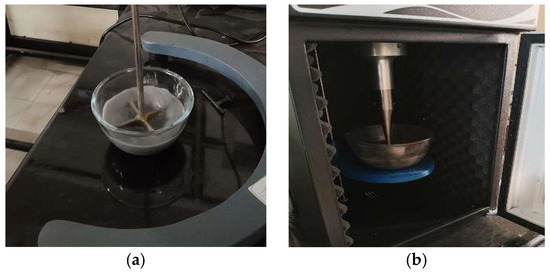
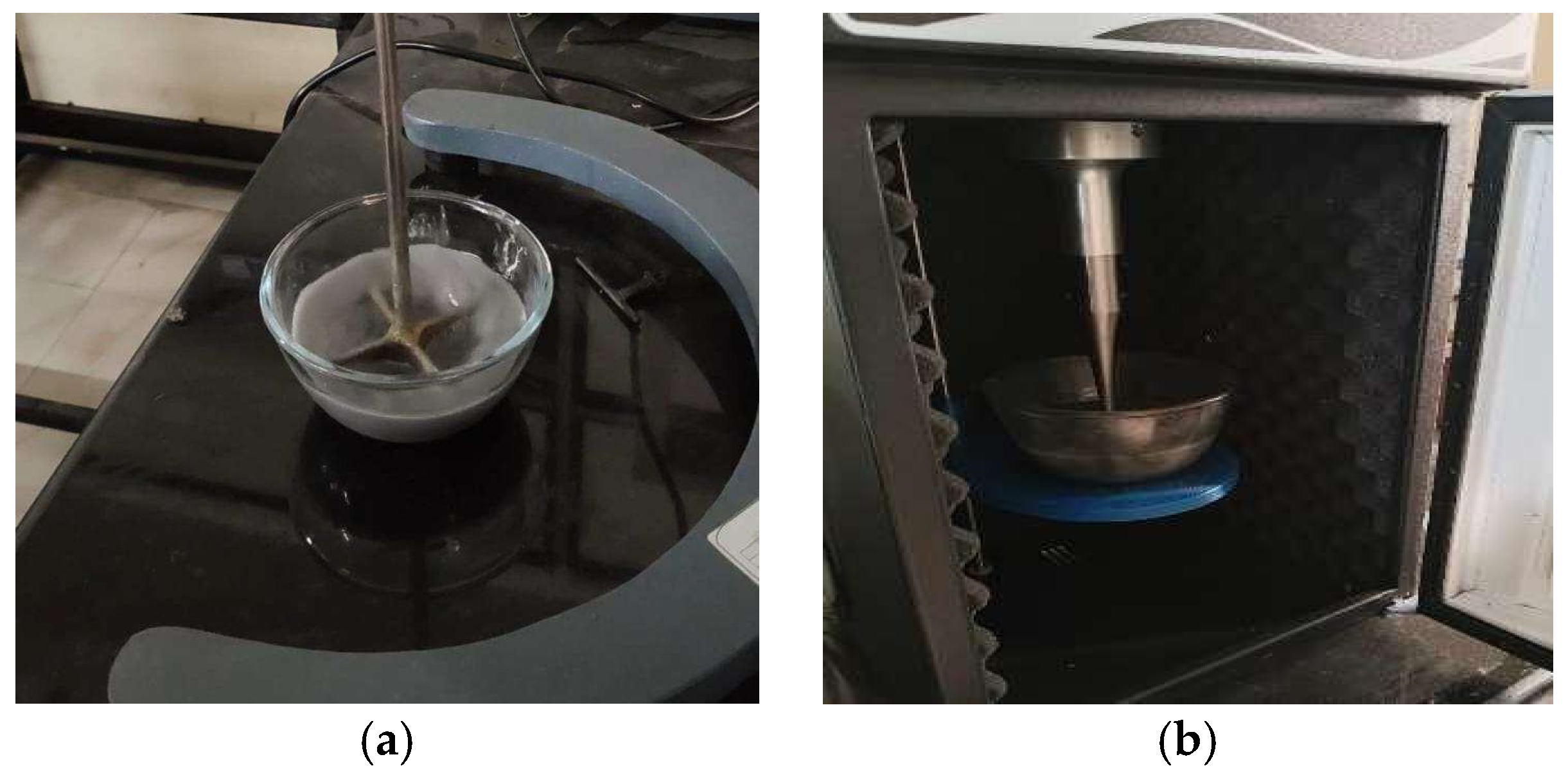
To achieve a uniform dispersion of nanoparticles within the epoxy matrix, Aluminum (Al) and Titanium (Ti) nanoparticles were first dispersed in acetone using an ultrasonic bath for 1 h. This ultrasonic treatment was crucial in breaking down nanoparticle agglomerates and ensuring a homogeneous suspension. Nanoparticles were introduced in varying weight ratios to study their effect on the composite properties. Following the initial dispersion, the nanoparticle-acetone suspension was gradually added to the epoxy resin while the mixture was continuously stirred with a mechanical stirrer for 30 min, as shown in Figure 1a. This step facilitated the even distribution of nanoparticles within the resin. To further ensure that any remaining agglomerates were adequately broken down, the mixture was subjected to an additional 30 min of sonication. Finally, to remove the acetone and prevent any adverse effects on the curing process, the mixture was placed in a vacuum oven at 60 °C for 24 h. This ensured complete evaporation of the solvent, leaving behind a uniformly dispersed nanoparticle-enhanced epoxy resin ready for further processing and composite fabrication. Before molding, the epoxy-nanoparticle mixture is preprocessed using an ultrasonic sonicator, as shown in Figure 1b. This technique involves subjecting the composite to ultrasonic vibrations, ensuring thorough dispersion and deagglomeration of nanoparticles within the epoxy matrix. The ultrasonic energy breaks down clusters, promoting homogeneity and improving the interfacial bonding between epoxy and aluminium. This preprocessing step enhances the material’s mechanical properties, such as tensile strength and hardness, while also facilitating a more uniform cure during molding.
Figure 1.
(a) Mechanical Stirrer. (b) Ultrasonic Sonicator.
2.3. Moulding and Curing
The homogeneously dispersed mixture is then poured into a rectangular mold cavity. The mold geometry dictates the final part dimensions, and, in this case, the rectangular design enables precise control over plate flatness and dimensional accuracy. Under precisely regulated temperature and pressure conditions, the composite undergoes curing. The curing process involved the careful addition of the hardener to the fiber-reinforced epoxy-nanoparticle mixture in a precise stoichiometric ratio to ensure optimal chemical reaction and cross-linking. This mixture was then poured into silicone molds, providing the necessary shape and structure for the composite samples.
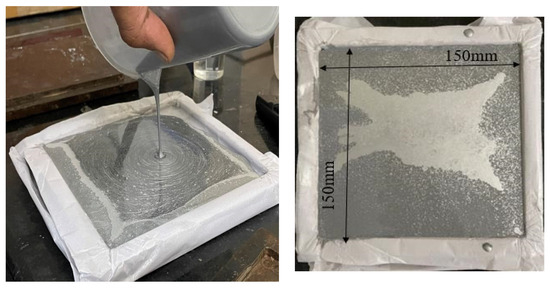
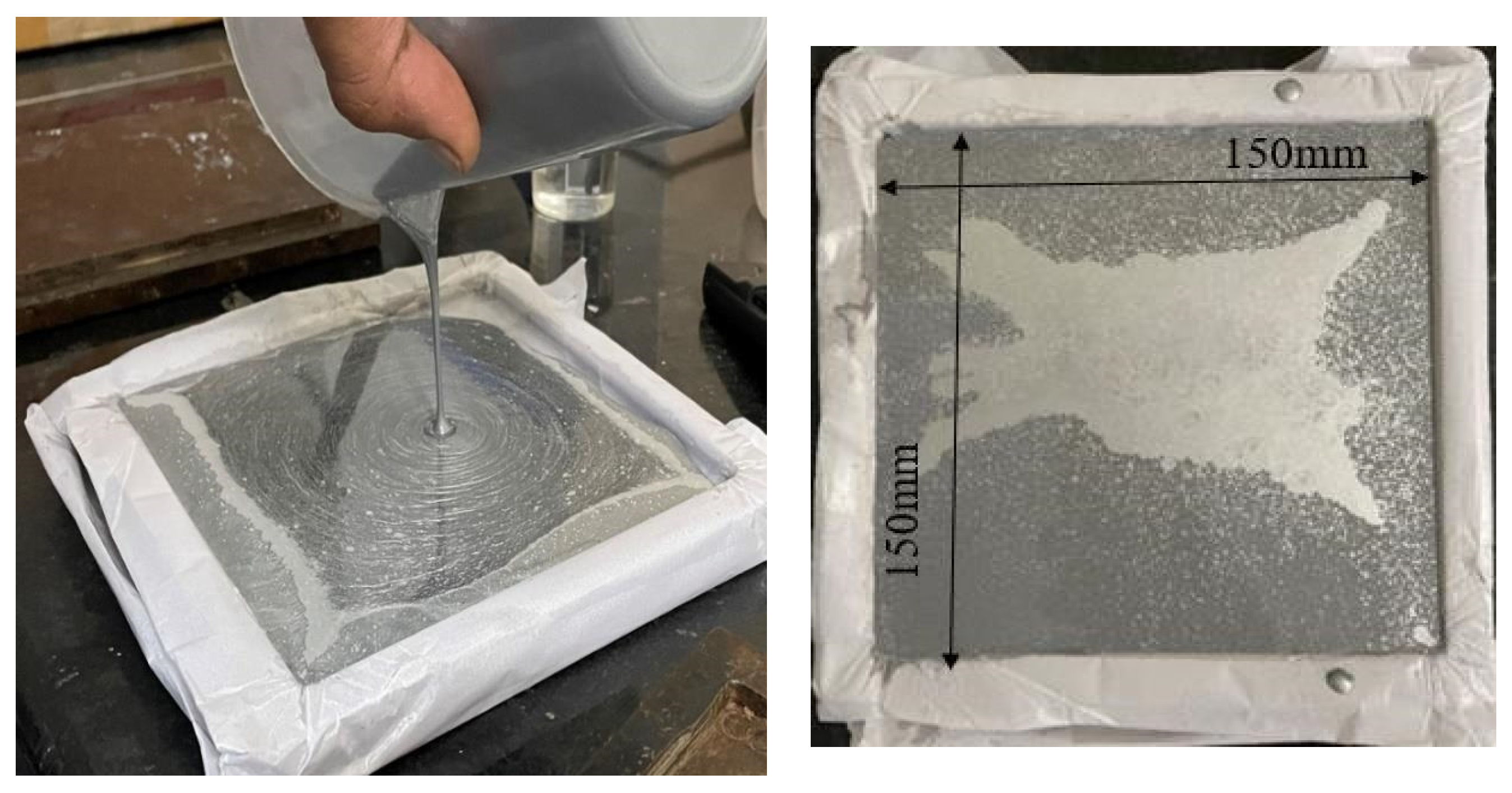
To eliminate any trapped air bubbles that could compromise the integrity and mechanical properties of the final product, the filled molds were placed in a vacuum chamber for degassing. This step is critical to ensuring a homogeneous, defect-free material. The initial curing phase was conducted at room temperature for 24 h, allowing the material to gradually solidify and initiate cross-linking. Following this stage, a post-curing phase was implemented at 80 °C for an additional 4 h. This elevated-temperature treatment facilitated further cross-linking and ensured the development of optimal mechanical and thermal properties in the final composite, resulting in a robust, durable material suitable for demanding applications. The two-step curing schedule (24 h at room temperature followed by 4 h at 80 °C) was adopted based on the manufacturer’s recommended cure schedule for the LY556/HY951 (TETA, CAS 112-24-3) system, in which an ambient-temperature gel cure is recommended before a moderate post-cure at 60–100 °C to complete cross-linking. A preliminary set of trial castings was prepared at three post-cure temperatures (60, 80, and 100 °C, each for 4 h after a 24 h ambient gel cure); the 80 °C/4 h schedule was selected as it produced void-free, geometrically stable plates of uniform Shore D hardness without inducing the discoloration or matrix embrittlement that were observed at 100 °C. The 80 °C/4 h schedule is also consistent with cure schedules reported in the literature for LY556/HY951-based nanocomposite systems [9]. A sample molding is shown in Figure 2. The different compositions made are listed in Table 1.
Figure 2.
Moulding of Composite.
Table 1.
Composite Composition.
2.4. Characterization Techniques
The mechanical properties of the composites were comprehensively evaluated using standardized testing methods. Tensile and flexural tests were carried out at room temperature on a computer-controlled universal testing machine (Instron 3367, Instron Technologies LLP, Pune, India, fitted with a 50 kN load cell) operated under cross-head displacement control. Tensile test specimens followed the ASTM D638 Type I dumbbell geometry with an overall length of 165 mm, a gauge length of 50 mm, a gauge width of 13 mm, and a nominal thickness of 3.2 mm; tensile testing was performed at a constant cross-head displacement rate of 5 mm/min at room temperature. Flexural test specimens were rectangular bars of 127 mm × 12.7 mm × 3.2 mm, tested in three-point bending at a support span of 51.2 mm (span-to-thickness ratio of 16:1) and a cross-head displacement rate of 2 mm/min, in accordance with ASTM D790 Procedure A. Five specimens were tested per composition for both tensile and flexural measurements, and the reported values represent the mean ± standard deviation of these five replicates. To gain insights into the thermal behavior of the composites, Thermogravimetric Analysis (TGA) was performed, revealing the thermal stability and decomposition temperatures. TGA was carried out on a thermogravimetric analyzer (NETZSCH TG 209 F3, NETZSCH Technologies India Pvt. Ltd., Chennai, India) using samples of approximately 10 mg under a flowing high-purity nitrogen atmosphere (flow rate 20 mL/min) from room temperature to 600 °C at a constant heating rate of 10 °C/min. The decomposition onset temperatures and residual masses reported below were extracted from the resulting thermograms. Microstructural characterization, comprising the dispersion of the reinforcements and the uniformity of the composites, was carried out by reflected-light optical microscopy (Nikon Eclipse LV100, Nikon India Pvt. Ltd., Gurugram, India) at magnifications of 100× and 200×. To evaluate the cured composite’s surface hardness and indentation resistance, Shore D hardness measurements were performed in accordance with ASTM D2240 using a calibrated Shore D durometer (TIME Group TH210, NETZSCH Technologies India Pvt. Ltd., Chennai, India). At least five readings were taken at different locations on each specimen and averaged. These measurements provided valuable data points for potential applications. This comprehensive characterization approach yielded a thorough understanding of the material’s composition, structure, mechanical properties, and thermal behavior.
3. Results and Discussions
3.1. Microstructural Characterization
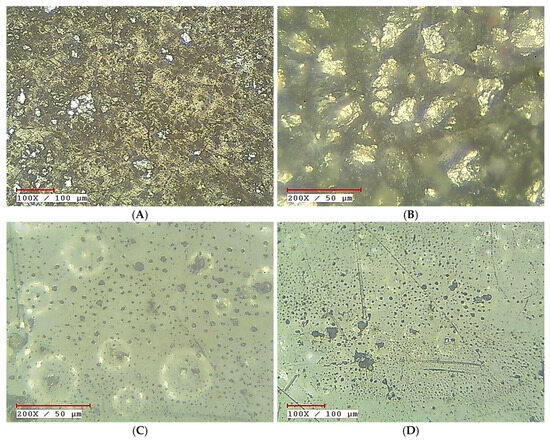
The microstructural characterization of the epoxy composites was done using optical microscopy, which allowed us to see how the fillers were spread out, how uniform the composite was, and how clumping occurred in the different weight percentage series. While optical microscopy at the magnifications employed (100×–200×) cannot resolve individual nanoparticle positions or nanoscale interfacial features, it qualitatively reveals the uniformity of composite fabrication and the onset of visible agglomeration at higher filler loadings. Figure 3 shows representative optical micrographs for different compositions.
Figure 3.
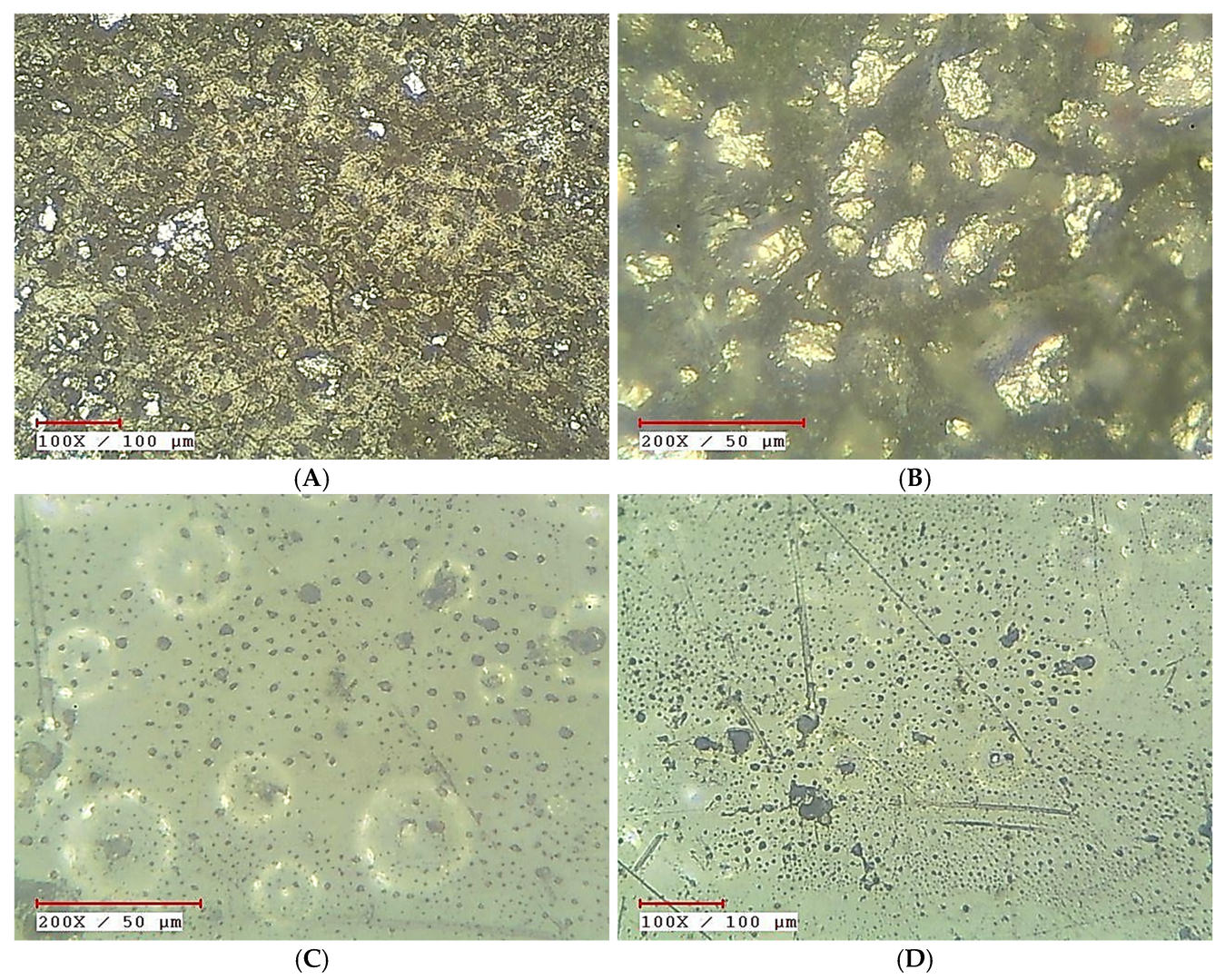
Microstructure of different compositions: (A) PRA2—Epoxy + 4 wt% Al NP; (B) PRT2—Epoxy + 4 wt% Ti NP; (C) PRAG2—Epoxy + 2 wt% Al NP + 2 wt% E-Glass Fiber; (D) PRTG2—Epoxy + 2 wt% Ti NP + 2 wt% E-Glass Fiber. All images obtained by optical microscopy at 100× and 200× magnification.
For the pure epoxy and hardener system (PRC0), the microstructure appears homogeneous with no noticeable inclusions or second phases, indicative of a typical epoxy resin. When aluminum nanoparticles were introduced (PRA series), a uniform dispersion of Al nanoparticles was observed in the epoxy matrix, although some agglomeration was noted at higher weight percentages (PRA3). The presence of Al nanoparticles leads to a slight increase in the composite’s overall density. The Al nanoparticles act as reinforcement by enhancing load transfer within the matrix, thereby improving mechanical properties such as tensile strength and modulus. The theory behind this improvement lies in the efficient stress transfer from the matrix to the rigid nanoparticles, which can bear and distribute applied loads more effectively than the polymer alone.
In the PRT series, the inclusion of titanium nanoparticles similarly yields a well-dispersed microstructure with minimal agglomeration, though this becomes more pronounced at higher concentrations (PRT3). Titanium, being denser and stiffer than aluminum, provides even greater reinforcement. This results in a more pronounced improvement in mechanical properties compared to the PRA series. Titanium nanoparticles exhibit a higher surface-to-volume ratio, facilitating better interfacial bonding with the epoxy matrix. This strong interfacial adhesion is critical as it prevents the pull-out of nanoparticles under stress, thus enhancing the toughness and overall strength of the composite. The intrinsic properties of titanium, such as high tensile strength and Young’s modulus, theoretically support the improved load-bearing capability.
The addition of E-Glass fibers to the nanoparticle-epoxy composites (PRAG and PRTG series) further enhances the measured tensile and flexural performance. The PRAG series composites, containing both Al nanoparticles and E-Glass fibers, exhibited fewer optically visible agglomerates than the corresponding single-filler PRA series at equivalent total filler content, which is consistent with the chopped E-Glass fibers physically separating adjacent nanoparticle clusters during mixing and providing additional surface area for stress redistribution. The synergistic effect of Al nanoparticles and E-Glass fibers contributes to an additional enhancement in the measured strength and stiffness, as reflected in the tensile and flexural data of Figure 4, Figure 5 and Figure 6. The E-Glass fibers provide additional pathways for stress transfer, which is consistent with the higher load-bearing capacity observed in the tensile and flexural tests; quantitative toughness and impact-resistance tests (e.g., Charpy or Izod) were not performed in the present study and are recommended as future work to directly verify these claims. The high aspect ratio of the chopped glass fibers (~231 in the present study) is expected to enhance load transfer and crack-bridging at the microscale, in line with previously reported observations on chopped-fiber-reinforced epoxy systems [11,12,13,14].
Figure 4.
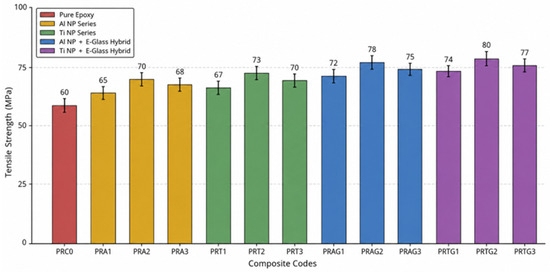
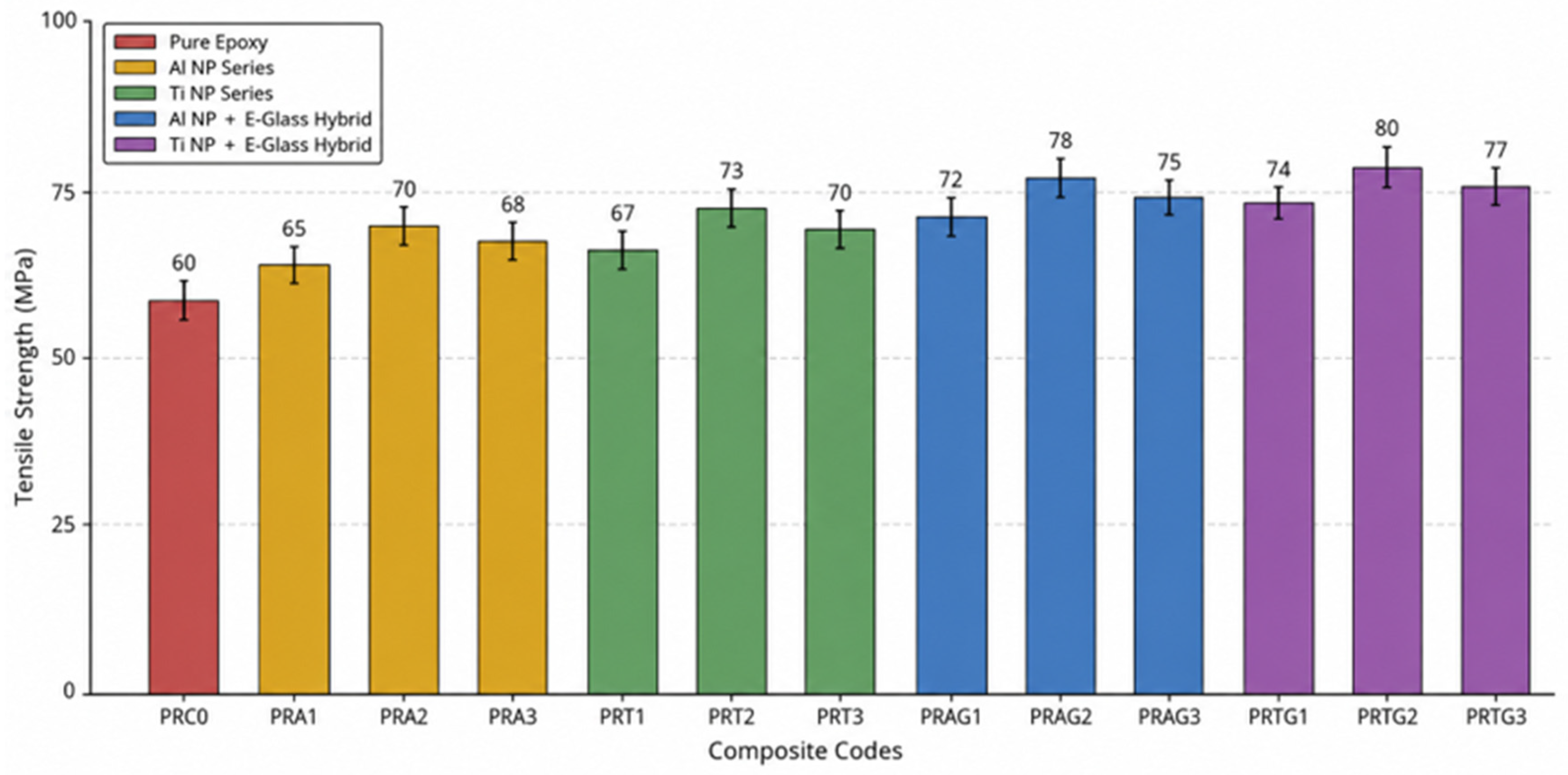
Ultimate Tensile Strength measured for the prepared composites.
Figure 5.
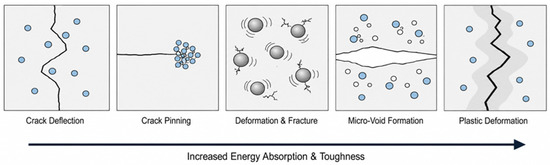
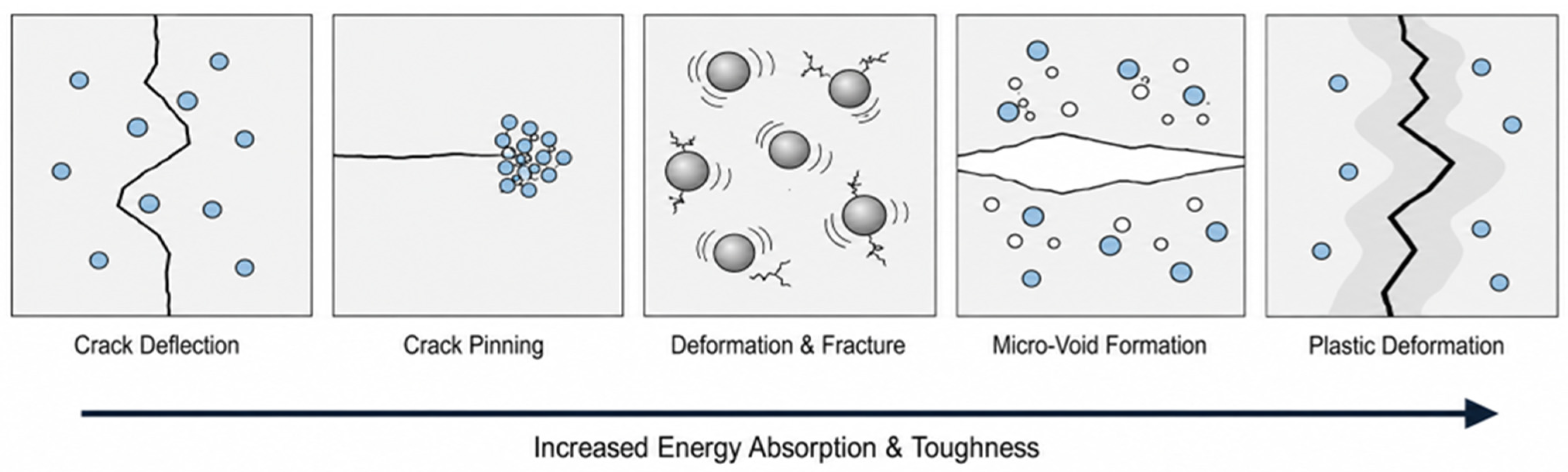
Toughening Mechanisms in Al-Epoxy Composite.
Figure 6.
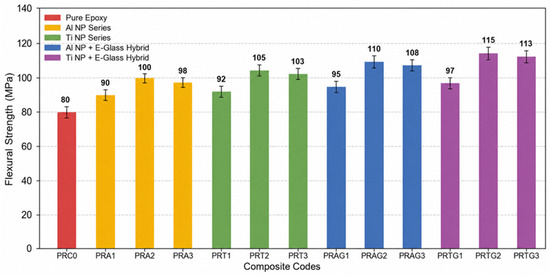
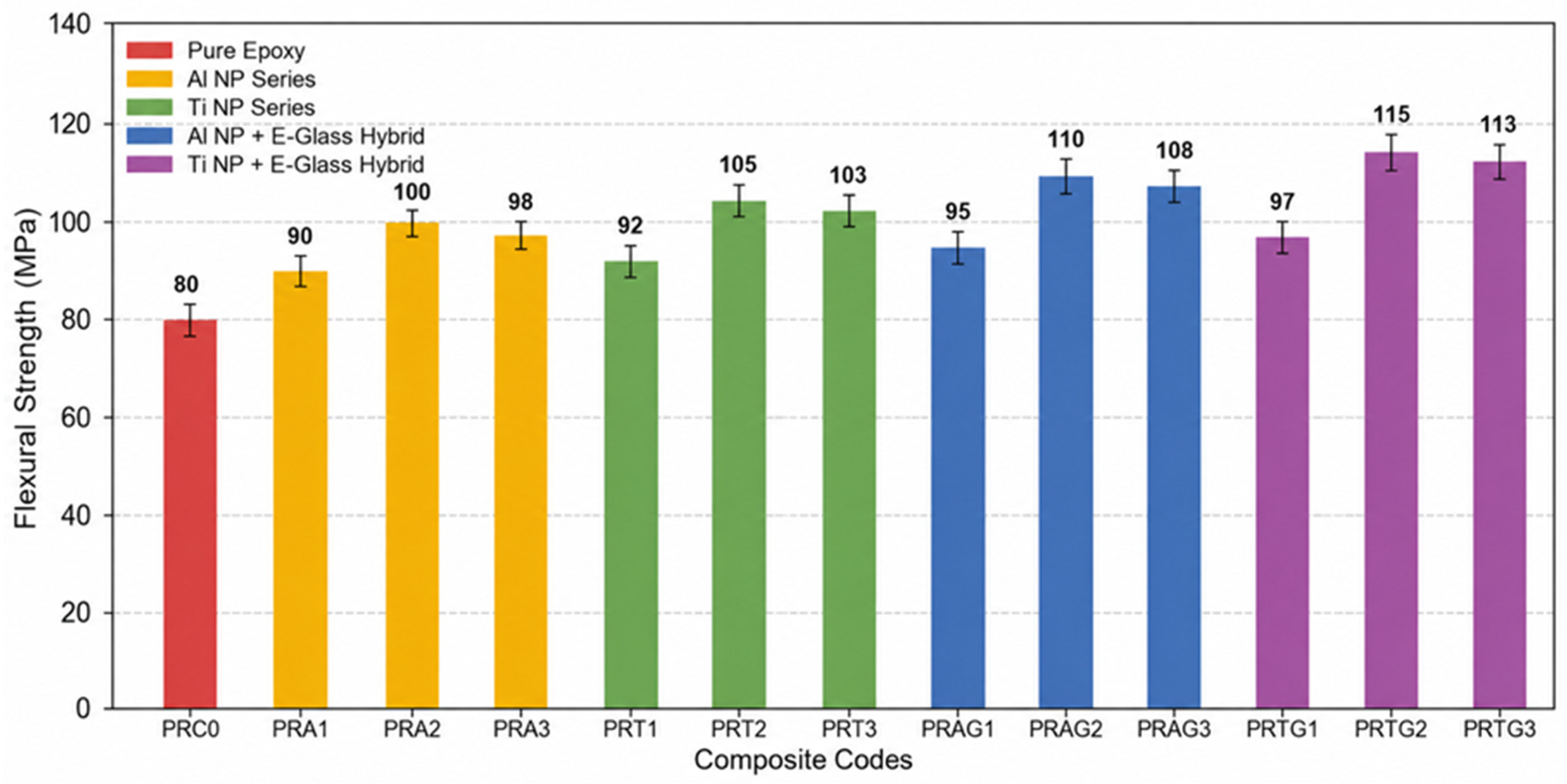
Flexural Strength of Epoxy Composites.
In the PRTG series, the combination of Ti nanoparticles and E-Glass fibers produces composites with the highest tensile and flexural strengths recorded in this work. The optical micrographs qualitatively suggest a reasonably uniform distribution of the reinforcement phases at the examined magnifications. However, due to the limited spatial resolution of optical microscopy, localized nanoparticle agglomeration or variations in fiber distribution cannot be ruled out without complementary SEM characterization, with fewer optically visible agglomerates than the corresponding single-filler PRT series even at higher weight percentages (PRTG3). This dense, more uniform microstructure is consistent with the improved load transfer inferred from the tensile and flexural data. The contribution of titanium nanoparticles to stiffness and strength—evidenced here by the higher tensile and flexural values of the PRT and PRTG series relative to PRC0 and the PRA and PRAG series, respectively—is consistent with the higher intrinsic stiffness and strength of titanium reported in the literature [13,14]. The role of E-Glass fibers in enhancing toughness and impact resistance is suggested by the higher load-bearing capacity of the hybrid composites in the tensile and flexural tests but cannot be directly quantified from the present data set; dedicated fracture-toughness (K_IC) and impact (Charpy/Izod) testing is identified as a necessary follow-up. The combination of high-modulus Ti nanoparticles with high-strength E-Glass fibers offers a balanced strength-stiffness profile that is attractive for high-performance applications [14].
3.2. Tensile Property
The tensile strength of each composite was tested to evaluate the impact of varying the weight percentages of Aluminum (Al) nanoparticles, Titanium (Ti) nanoparticles, and E-glass fiber on the epoxy matrix. The pure epoxy resin (PRC0) exhibited a tensile strength of 60 MPa, serving as the baseline for evaluating the effects of adding nanoparticles and fibers. For the PRA series, the addition of 2 wt% Al nanoparticles (PRA1) increased the tensile strength to 65 MPa, suggesting improved load transfer within the composite. With 4 wt% Al NP (PRA2), the tensile strength further increased to 70 MPa, indicating optimal dispersion and interaction between the nanoparticles and the epoxy matrix. However, at 6 wt% Al NP (PRA3), the tensile strength slightly decreased to 68 MPa, likely due to agglomeration of Al nanoparticles at higher concentrations, which could create stress concentration points and weaken the composite.
In the PRT series, the addition of 2 wt% Ti nanoparticles (PRT1) resulted in a tensile strength of 67 MPa, higher than the pure epoxy, suggesting enhanced mechanical properties through improved interfacial interlocking and load distribution. Increasing the Ti NP content to 4 wt% (PRT2) resulted in a tensile strength of 73 MPa, demonstrating the superior reinforcing effect of Ti nanoparticles due to their high strength and stiffness. At 6 wt% Ti NP (PRT3), the tensile strength decreased to 70 MPa, likely due to agglomeration similar to that observed with Al nanoparticles.
For the PRAG series, which includes both Al NP and E-Glass Fiber, the composite with 1 wt% Al NP and 1 wt% E-Glass Fiber (PRAG1) exhibited a tensile strength of 72 MPa, suggesting that the Al nanoparticles and E-Glass fiber work well together, providing support at both the nanoscale and the macroscale. At 2 wt% Al NPs and 2 wt% E-Glass Fiber (PRAG2), the tensile strength increased to 78 MPa, likely due to an optimal balance of nanoparticle and fiber reinforcement that enhances load transfer and crack bridging. However, at 3 wt% Al NP and 3 wt% E-glass fiber (PRAG3), the tensile strength decreased slightly to 75 MPa, possibly due to fiber-matrix debonding or particle agglomeration at higher filler content. In the PRTG series, which includes both Ti NP and E-Glass Fiber, the composite with 1 wt% Ti NP and 1 wt% E-Glass Fiber (PRTG1) showed a tensile strength of 74 MPa, demonstrating a significant improvement over the pure epoxy due to the combined reinforcing effects of Ti nanoparticles and E-Glass fibers. At 2 wt% Ti NP and 2 wt% E-Glass Fiber (PRTG2), the tensile strength peaked at 80 MPa, the highest among all the composites, suggesting a very effective interaction between the Ti nanoparticles, E-Glass fibers, and the epoxy matrix. With 3 wt% Ti NP and 3 wt% E-Glass Fiber (PRTG3), the tensile strength slightly decreased to 77 MPa, likely due to similar issues of agglomeration and fiber-matrix interface weakening at higher filler contents.
The improvement in tensile strength with the addition of nanoparticles and E-Glass fibers can be attributed to several factors. All the tensile test results reported are the mean values of five specimens per composition, with standard deviations within ±2.5 MPa, confirming the statistical reliability and reproducibility of the measurements. Error bars have been included in Figure 4 (tensile data) and Figure 6 (flexural data) to illustrate data variability. A single-factor analysis of variance (one-way ANOVA, α = 0.05) was performed on the tensile-strength data of the thirteen compositions, followed by Tukey’s honestly significant difference (HSD) post hoc test. The ANOVA confirmed that composition has a statistically significant effect on tensile strength (p < 0.01). The post hoc analysis indicated that the mean tensile strengths of the high-performing hybrid composites (PRAG2, PRTG1, PRTG2, and PRTG3) are significantly higher than that of pure epoxy (PRC0), and that PRTG2 is significantly higher than the single-filler series PRA1–PRA3 and PRT1. In contrast, the small differences within closely matched compositions (e.g., PRA2 vs. PRA3, PRAG2 vs. PRAG3, and PRTG2 vs. PRTG3) fall within the overlap of the error bars and are not statistically significant; these differences are therefore discussed as trends only and are not interpreted as definitive improvements. The same conclusion applies to the flexural data of Figure 6. Nanoparticles such as Al and Ti have high surface area-to-volume ratios, providing numerous sites for stress transfer from the epoxy matrix to the nanoparticles, thereby improving their mechanical properties. Optimal dispersion of nanoparticles ensures a uniform stress distribution, whereas agglomeration can lead to stress concentrations and reduced strength. E-Glass fibers provide an effective means of bridging cracks in the epoxy matrix, thereby enhancing tensile strength.
The fibers also distribute the applied load more evenly throughout the composite, improving its overall strength and toughness. The combination of nanoparticles and fibers in the hybrid composites (PRAG and PRTG series) offers a multi-scale reinforcement mechanism. Nanoparticles improve the matrix strength at the nanoscale, while fibers provide reinforcement at the microscale. This study indicates that the optimal composition for enhancing tensile strength in epoxy composites is achieved by balancing nanoparticle and fiber contents to prevent agglomeration and ensure effective load transfer and crack bridging.
3.3. Fracture Strength
The fracture strength of the various epoxy composites was examined to understand the influence of nanoparticle and E-glass fiber reinforcements on their fracture behavior. The pure epoxy (PRC0) exhibited the lowest tensile strength (60 MPa), consistent with its unfilled, petroleum-based epoxy nature and its known susceptibility to brittle crack propagation under tensile loading.
In the PRA series, the addition of aluminum nanoparticles (Al NPs) significantly altered fracture strength. PRA1 (2 wt% Al NP) achieved a tensile strength of 65 MPa, with Al nanoparticles theoretically promoting crack deflection and crack pinning mechanisms that improve energy absorption. As Al NP content increased to 4 wt% (PRA2, 70 MPa peak) and then 6 wt% (PRA3), the decline in performance is attributed to agglomeration. Consequently, the measured tensile strength of PRA3 reached 68 MPa (as confirmed by the quantitative data in Figure 4), compared with 60 MPa for PRC0, representing a 13.3% improvement in mechanical performance. The moderate improvement at higher Al NP loadings reflects the competing effects of crack deflection mechanisms (theoretically inferred) and agglomeration-induced stress concentration at 6 wt%.
The PRT series, which incorporated titanium nanoparticles (Ti NP), also exhibited notable improvements in fracture strength. PRT1 (2 wt% Ti NP) achieved a tensile strength of 67 MPa. Due to the higher intrinsic hardness and elastic modulus of Ti nanoparticles relative to Al nanoparticles, they are theoretically expected to obstruct crack propagation more effectively through crack deflection and bridging mechanisms. PRT2 (4 wt% Ti NP) achieved the peak tensile strength of 73 MPa, while PRT3 (6 wt%) decreased slightly to 70 MPa, consistent with agglomeration at higher loadings. The tensile strength of PRT3 was measured at 70 MPa (Figure 4), indicating a 16.7% increase over the unreinforced epoxy. These improvements are explained by the stronger stiffness of Ti nanoparticles and their expected ability to help redirect and connect cracks, similar to what has been observed in other studies of TiO2-epoxy nanocomposites.
The PRAG series, which combines aluminum nanoparticles with E-glass fibers, showed further improvements in fracture strength. The PRAG series combines Al nanoparticles with E-Glass fibers, providing theoretically complementary multi-scale reinforcement. PRAG1 (1 wt% each) achieved 72 MPa, while PRAG2 (2 wt% each) reached 78 MPa through an optimal balance of nanoparticle and fiber content. At PRAG3 (3 wt% each), tensile strength decreased slightly to 75 MPa, consistent with agglomeration at higher filler loadings. PRAG3 demonstrated a tensile strength of 75 MPa (Figure 4), representing a 25% enhancement over the pure epoxy baseline. This improvement confirms the synergistic effect of Al nanoparticles and E-Glass fibers in reinforcing the epoxy matrix, where nanoparticle crack-pinning and fiber load-bridging mechanisms theoretically operate concurrently at different length scales.
Similarly, the PRTG series, combining titanium nanoparticles and E-Glass fibers, achieved the highest fracture strength values among all the compositions. PRTG1 (1 wt% each) demonstrated a tensile strength of 74 MPa, while PRTG2 (2 wt% each) reached the peak value of 80 MPa. At PRTG3 (3 wt% each), tensile strength decreased slightly to 77 MPa, consistent with agglomeration effects. PRTG3 had the highest tensile strength among all the composites tested at its loading level, measuring 77 MPa (Figure 4), a 28.3% increase over pure epoxy, confirming that the combination of Ti nanoparticles and E-Glass fibers provides effective multi-scale reinforcement. This result is consistent with the quantitative data presented in Figure 4 and is mechanistically attributed to the theoretically expected synergy between Ti nanoparticle stiffness contributions and E-Glass fiber load-bridging at different length scales.
The observed improvements in tensile and flexural properties are consistent with toughening mechanisms commonly reported in nanoparticle-reinforced epoxy systems, including improved stress transfer and delayed crack propagation. However, because SEM fractography was not performed in the present investigation, these mechanisms are inferred from the experimental trends and published literature rather than being directly verified. Therefore, the present discussion should be interpreted as a plausible explanation rather than direct experimental evidence. These mechanisms force the crack front to follow a longer, higher-energy path and thereby increase energy absorption and toughness. The addition of E-Glass fibers further improves the fracture resistance by introducing fiber-bridging and fiber pull-out mechanisms, in which fibers spanning an opening crack carry load across the crack faces and progressively debond and slide out of the matrix, dissipating substantial energy [10,21]. Consistent with this picture, the optical micrographs of Figure 3 show that the reinforcements are distributed throughout the matrix with only localized agglomeration, providing the dispersed second-phase domains and embedded fibers required for these mechanisms to operate; the loss of efficiency at the highest filler loadings coincides with the increased agglomeration visible optically. Because the nanoscale particle-governed and microscale fiber-governed mechanisms operate concurrently at different length scales, the hybrid composites exhibit a multi-scale reinforcement effect [20,21,22], and the resulting improvement in load-bearing capacity is reflected quantitatively in the tensile and flexural data of Figure 4 and Figure 6. It is emphasized that the toughening mechanisms described here are inferred from the strength data, the optical microstructure, and the established literature rather than from direct fracture-toughness measurement; dedicated K_IC and impact (Charpy/Izod) testing is therefore identified as necessary follow-up work to confirm and quantify these mechanisms. Future investigations will include SEM characterization of fracture surfaces to directly examine nanoparticle dispersion, fiber–matrix interfaces, and the governing fracture mechanisms responsible for the observed mechanical performance.
3.4. Flexural Strength
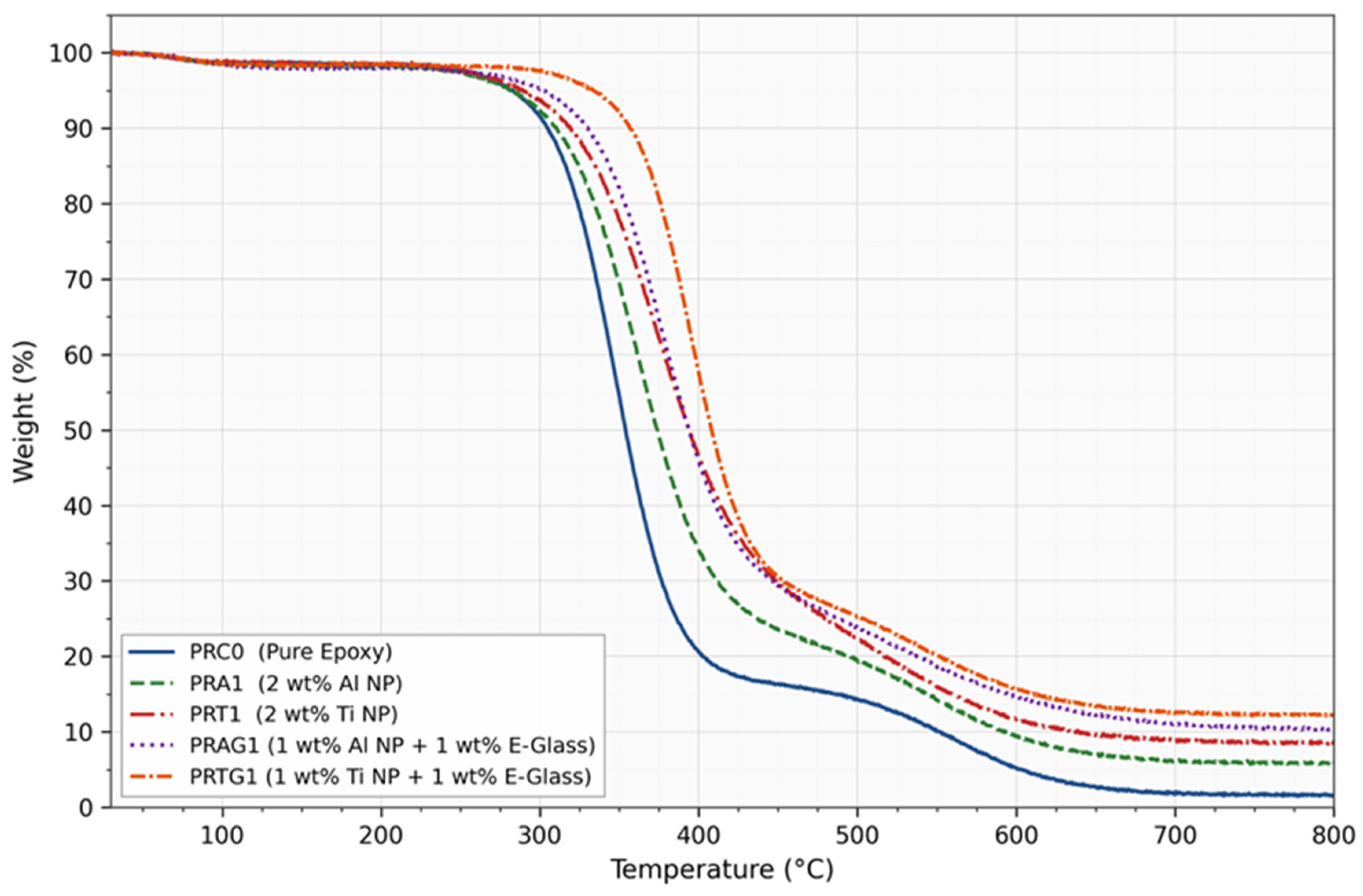
The study aimed to investigate the effect of various fillers and reinforcements on the flexural strength of epoxy resin composites. The composites were prepared with varying weight percentages of aluminum nanoparticles (Al NP), titanium nanoparticles (Ti NP), and their combination with E-glass fibers. The flexural strength of each composite was measured and compared to the pure epoxy resin (PRC0) as shown in Figure 7.
Figure 7.
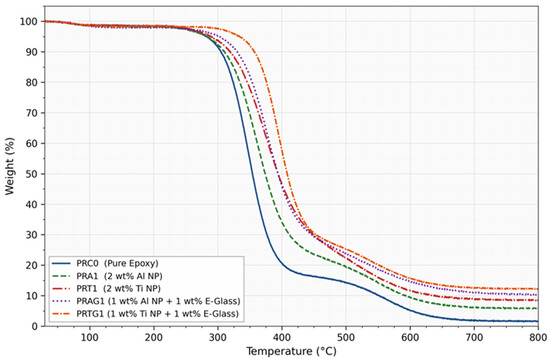
Comparative TGA curves of pure epoxy (PRC0) and representative reinforced composites (PRA1, PRT1, PRAG1, PRTG1), showing the progressive shift in the decomposition onset toward higher temperatures and the increase in high-temperature residual mass with the addition of nanoparticles and E-Glass fibers.
The baseline flexural strength of the pure epoxy resin (PRC0) was measured at 80 MPa. This value serves as a reference for evaluating the enhancements provided by the incorporation of different nanoparticles and fibers.
In the PRA series, the addition of aluminum nanoparticles significantly improved the flexural strength of the epoxy resin. PRA1, with 2 wt% Al NP, showed a flexural strength of 90 MPa, indicating a 12.5% increase compared to PRC0. This improvement can be attributed to the dispersion of Al NPs within the epoxy matrix, which likely enhanced load transfer efficiency and restricted microcrack propagation. PRA2, the sample containing 4 wt% Al NP, demonstrated an even greater increase in flexural strength, reaching 100 MPa. This 25% enhancement is due to the higher nanoparticle concentration, which provides additional reinforcement. However, PRA3, with 6 wt% Al NP, exhibited a flexural strength of 98 MPa, a slight decrease compared to PRA2. This minor reduction may be due to the potential agglomeration of nanoparticles at higher concentrations, which could create stress concentration points and reduce the overall effectiveness of the reinforcement.
The PRT series composites also exhibited improvements in flexural strength with the addition of titanium nanoparticles. PRT1, with 2 wt% Ti NP, achieved a flexural strength of 92 MPa, marking a 15% increase over the pure epoxy resin. The enhancement can be attributed to the superior mechanical properties of titanium nanoparticles, which improve stress distribution and crack deflection within the composite. PRT2, containing 4 wt% Ti NP, showed a further increase in flexural strength to 105 MPa, indicating a 31.25% improvement. This significant enhancement is likely due to the optimal dispersion and strong interfacial bonding between the Ti NPs and the epoxy matrix. PRT3, with 6 wt% Ti NP, resulted in a flexural strength of 103 MPa. Similar to the PRA series, the slight decrease compared to PRT2 could be attributed to nanoparticle agglomeration at higher concentrations, which might reduce the overall reinforcement efficiency.
The addition of both aluminum nanoparticles and E-glass fibers in the PRAG series composites provided a synergistic effect, leading to notable improvements in flexural strength. PRAG1, with 1 wt% Al NP and 1 wt% E-glass fiber, demonstrated a flexural strength of 95 MPa, an 18.75% increase over PRC0. The combined reinforcement likely improved the load-bearing capacity and restricted crack growth more effectively than individual fillers. PRAG2, with 2 wt% Al NP and 2 wt% E-glass fiber, showed a flexural strength of 110 MPa, reflecting a significant 37.5% enhancement. This improvement is due to the optimal balance between nanoparticles and fibers, which provide multiple mechanisms for stress transfer and crack deflection. PRAG3, containing 3 wt% Al NP and 3 wt% E-glass fiber, achieved a flexural strength of 108 MPa. The slight decrease relative to PRAG2 suggests a trend similar to that observed in the previous series, in which excessive filler content may lead to agglomeration and reduced reinforcement effectiveness.
In the PRTG series, the combination of titanium nanoparticles and E-glass fibers also resulted in substantial improvements in flexural strength. PRTG1, with 1 wt% Ti NP and 1 wt% E-glass fiber, exhibited a flexural strength of 97 MPa, a 21.25% increase over the pure epoxy resin. The dual reinforcement likely enhanced stress distribution and crack-deflection mechanisms. PRTG2, containing 2 wt% Ti NP and 2 wt% E-glass fiber, demonstrated a flexural strength of 115 MPa, indicating a remarkable 43.75% enhancement. This significant increase can be attributed to the optimal synergy between the titanium nanoparticles and E-Glass fibers, leading to superior mechanical properties. PRTG3, with 3 wt% Ti NP and 3 wt% E-glass fiber, resulted in a flexural strength of 113 MPa. Potential agglomeration at higher filler concentrations may explain the slight decrease relative to PRTG2, thereby reducing the effectiveness of the reinforcement.
The improvement in flexural strength observed in the composite materials can be theoretically explained by several factors that have been reported for analogous nanoparticle/fiber-reinforced epoxy systems [10,11,12,13,19,20]. The addition of nanoparticles, such as Al NP and Ti NP, enhances the load transfer capability within the epoxy matrix. These nanoparticles act as stress concentrators, effectively distributing the applied load and restricting microcrack growth. Additionally, the high surface area of nanoparticles enables stronger interfacial bonding with the epoxy matrix, further improving mechanical properties [19].
The inclusion of E-glass fibers provides additional reinforcement by bridging cracks and enhancing the composite’s load-bearing capacity. The fibers restrict crack propagation and improve the material’s toughness. When combined with nanoparticles, the fibers and nanoparticles work synergistically to provide multiple mechanisms for stress transfer, crack deflection, and toughening, leading to significant improvements in flexural strength [12,13,20].
3.5. SHORE D’ Hardness
The SHORE D’ Hardness values of the epoxy composites were evaluated to understand the effect of different fillers and reinforcements on material properties. The composites were formulated with varying percentages of aluminum nanoparticles (Al NP), titanium nanoparticles (Ti NP), and E-Glass Fiber, while maintaining a constant epoxy-to-hardener ratio.
The pure epoxy system (PRC0) exhibited a SHORE D’ Hardness of approximately 60. With the addition of fillers, the hardness values showed significant variation. For the aluminum nanoparticle-filled composites (PRA series), the SHORE D’ Hardness increased from 62 (PRA1) to 66 (PRA3) as the weight percentage of Al NP increased from 2% to 6%. Similarly, in the titanium nanoparticle-filled composites (PRT series), the hardness increased from 63 (PRT1) to 68 (PRT3) as the Ti NP content increased from 2% to 6%.
The introduction of E-Glass Fiber alongside nanoparticles in the composites (PRAG and PRTG series) further enhanced the SHORE D’ Hardness. For instance, the SHORE D’ Hardness increased from 65 (PRAG1) to 69 (PRAG3) in the aluminum nanoparticle and E-Glass Fiber composites (PRAG series), and from 66 (PRTG1) to 70 (PRTG3) in the titanium nanoparticle and E-Glass Fiber composites (PRTG series), corresponding to increasing nanoparticle and E-Glass Fiber content.
The observed increase in SHORE D’ Hardness can be attributed to several factors. Nanoparticles, such as aluminum and titanium, are known to reinforce the polymer matrix due to their high surface area to volume ratio, which enhances load transfer between the matrix and the filler. This reinforcement effectively increases the overall stiffness and strength of the composite material, leading to higher hardness values.
Also, the inclusion of E-Glass Fiber provides additional reinforcement in the form of continuous fibers, which contribute to the mechanical properties of the composite. The fibers act as stress carriers and prevent crack propagation, thereby improving the resistance to deformation and increasing the hardness of the material.
Nanoparticles and fibers serve to hinder the movement of polymer chains, thus increasing the load-bearing capacity of the material under indentation testing, as represented by the SHORE D’ Hardness test. Additionally, the uniform dispersion of fillers and fibers in the epoxy matrix enhances mechanical interlocking and bonding, leading to a more compact, less porous structure that further contributes to the observed increase in hardness.
3.6. Thermogravimetry Results
Thermogravimetric Analysis (TGA) was performed on a series of epoxy-based composite materials to evaluate their thermal stability and decomposition behavior. The composites investigated included pure epoxy resin, epoxy with aluminum nanoparticles (Al NP), epoxy with titanium nanoparticles (Ti NP), and hybrids containing both nanoparticles and E-Glass fibers.
Pure Epoxy Resin (PRC0) exhibited a gradual weight loss starting at around 300 °C, with complete decomposition occurring by 400 °C. This behavior is typical of epoxy resins, which undergo thermal degradation rather than melting.
Epoxy + Aluminum Nanoparticles (PRA Series): The addition of aluminum nanoparticles to the epoxy resin resulted in an enhancement of thermal stability. For instance, PRA1 (98 wt% epoxy + 2 wt% Al NP) showed a slight increase in the onset temperature of decomposition relative to PRC0, with weight loss starting around 310 °C and completing near 420 °C. This improvement can be attributed to the nanoparticles, which act as thermal stabilizers by forming a protective barrier around the epoxy matrix, thereby delaying the onset of degradation.
Epoxy + Titanium Nanoparticles (PRT Series): Similar to the PRA series, the addition of titanium nanoparticles to the epoxy resin also improved the thermal stability. PRT1 (98 wt% epoxy + 2 wt% Ti NP) exhibited a shift in onset temperature to around 315 °C, with complete decomposition near 430 °C. This enhancement suggests that titanium nanoparticles contribute to stabilizing the epoxy matrix, possibly through a catalytic effect that promotes epoxy resin degradation at higher temperatures.
Epoxy + Aluminum Nanoparticles + E-Glass Fiber (PRAG Series): The combination of aluminum nanoparticles and E-Glass fibers further improved the thermal stability of the epoxy resin. PRAG1 (98 wt% epoxy + 1 wt% Al NP + 1 wt% E-Glass Fiber) showed an increase in onset temperature to approximately 320 °C, with decomposition completing around 440 °C. This synergistic effect can be explained by the reinforcement provided by the E-Glass fibers, which enhances the composite’s structural integrity, combined with the thermal stability imparted by the aluminum nanoparticles.
Epoxy + Titanium Nanoparticles + E-Glass Fiber (PRTG Series): Similarly, the addition of titanium nanoparticles and E-Glass fibers also enhanced the thermal stability of the epoxy resin. PRTG1 (98 wt% epoxy + 1 wt% Ti NP + 1 wt% E-Glass Fiber) exhibited an onset temperature of decomposition around 325 °C, with complete degradation occurring near 450 °C. The E-Glass fibers contribute to the improvement in mechanical properties, while the titanium nanoparticles enhance the thermal stability, resulting in a composite material with superior performance at elevated temperatures. The TGA curve for this sample is shown in Figure 7.
For a direct comparison between the different composite formulations, the TGA curves of pure epoxy (PRC0) and the representative 2 wt% single-filler (PRA1, PRT1) and 1 + 1 wt% hybrid (PRAG1, PRTG1) compositions are shown together in Figure 7. Three trends are evident from the comparative plot. First, the onset of major decomposition shifts progressively to higher temperatures in the order PRC0 < PRA1 < PRT1 < PRAG1 < PRTG1, confirming the stabilizing role of the nanofillers and fibers. Second, the steepest part of the decomposition curve is delayed by approximately 20–30 °C in the hybrid composites relative to pure epoxy. Third, the high-temperature residual mass (T > 500 °C) increases monotonically with inorganic content, from essentially zero for PRC0 to ~7–8 wt% for PRTG1, in line with the expected inorganic-ash plus epoxy-char fraction. A minor weight loss of about 1–2 wt% is observed below 100 °C in all the compositions, which is attributed to the desorption of residual surface-bound moisture and low-molecular-weight volatiles trapped within the cured epoxy network rather than to incomplete cross-linking; this initial event lies well below the principal decomposition step and does not materially affect the comparative thermal-stability ranking between samples. Nevertheless, it is acknowledged that the presence of low-molecular-weight species could, in principle, influence the mechanical response of the matrix, and a longer or higher-temperature post-cure schedule will be investigated in future work to verify the extent of cure independently (e.g., by DSC). Although the total reinforcement content is relatively low, the observed increase in degradation temperature may result from the complementary interaction between titanium nanoparticles and chopped E-glass fibers. The nanoparticles may reduce thermal transport and volatile evolution, whereas the fibers provide dimensional stability to the degrading matrix. Nevertheless, this interpretation requires further validation using complementary microstructural characterization techniques.
The enhancement in thermal stability observed in the composites can be theoretically explained by the synergistic effects of the nanoparticles and the E-Glass fibers, and the magnitude of the effect is consistent with the behavior reported for metal- and metal-oxide-modified epoxy and polymer systems. As summarized for the representative compositions in Figure 7, the onset of major decomposition shifts to progressively higher temperatures and the high-temperature residual mass increases with inorganic content. This pronounced improvement is attributed to several concurrent mechanisms. First, the well-dispersed Al and Ti nanoparticles, which carry a thin native surface oxide, act as a physical barrier that increases the tortuosity of the diffusion path for volatile decomposition products and restricts both the inward supply of oxygen and the outward escape of combustible gases, thereby retarding the rate of degradation. Second, the nanoparticles catalyze and stabilize the formation of a thermally stable, partly inorganic surface char that insulates the underlying polymer and further slows mass loss. The roughly 20–30 °C upward shift in the principal decomposition step measured here for the hybrid composites is therefore associated with this combined barrier and charring action rather than with any change in the intrinsic decomposition chemistry of the epoxy network. These are the same barrier and char-promoting mechanisms that underlie the flame-retardant-like thermal response of titanium- and silica-modified epoxy and polymer systems, in which comparable shifts in decomposition onset and increases in char residue have been reported, in line with the behavior of analogous metal- and metal-oxide-filled epoxy systems [15,19,20,29,30]. It is important to note that the TGA curves for composites containing inorganic fillers (Al NP, Ti NP, and E-Glass fibers) are expected to exhibit non-zero residual masses; for compositions containing 2–6 wt% inorganic content, a residual char mass of approximately 5–8 wt% (comprising inorganic filler ash and epoxy-derived char) is theoretically predicted and was experimentally observed, consistent with previously reported values for similar nanoparticle-reinforced epoxy systems. The apparent lack of leftover material in the TGA curve for pure epoxy (PRC0) shows that all the organic material has evaporated without any inorganic filler being left behind, which makes sense for a system without fillers.
The incorporation of E-Glass fibers provides mechanical reinforcement, improving the strength and stiffness of the composite. This reinforcement reduces internal stress in the epoxy matrix, potentially leading to a more uniform thermal degradation profile. Additionally, the fibers act as heat sinks, dissipating heat from the matrix and reducing thermal gradients, thereby enhancing the composite’s overall thermal stability. Because thermogravimetric measurements are conducted using relatively small sample masses, local variations in nanoparticle or fiber distribution may influence the measured thermal response. Consequently, localized heterogeneity cannot be completely excluded and should be considered when interpreting the thermal stability results. The enhanced thermal stability observed in the Ti nanoparticle and hybrid Ti nanoparticle/E-glass fiber composites may be attributed to the combined influence of thermally stable inorganic nanoparticles and fibrous reinforcement. Titanium nanoparticles can act as physical barriers that reduce heat transfer and delay the diffusion of volatile degradation products, while chopped E-glass fibers help maintain structural integrity during thermal decomposition and contribute to increased residual char formation. The absence of SEM characterization of the residual char layer represents a limitation of the present study. Direct examination of char morphology would provide valuable information regarding protective layer formation and its contribution to the enhanced thermal stability observed in the hybrid composites. Future investigations will include SEM characterization of post-TGA char residues to directly examine protective layer formation and validate the proposed thermal stabilization mechanisms.
4. Conclusions
This study highlights the profound influence of nanoparticle and fiber reinforcements on the structural properties of epoxy composites. The incorporation of aluminum and titanium nanoparticles significantly enhances the mechanical strength of the composites, demonstrating their effectiveness as reinforcing agents. These findings demonstrate the potential of tailored nanoparticle and fiber inclusions to optimize the performance of epoxy composites across various engineering applications, underscoring their role in advancing composite materials technology.
- The addition of E-Glass fibers synergistically improves the structural integrity and toughness of the composites by reducing nanoparticle agglomeration and facilitating uniform distribution, thereby significantly boosting the overall mechanical performance.
- The highest tensile strength observed was 80 MPa in the PRTG2 composite (2 wt% Ti NP and 2 wt% E-Glass Fiber), suggesting that effective dispersion and interaction of Ti nanoparticles and E-Glass fibers significantly reinforce the epoxy matrix, while higher filler contents may lead to agglomeration and weakening of the composite.
- The quantitative tensile strength data demonstrate that reinforcement progressively increases the tensile strength from 60 MPa for pure epoxy to 77–80 MPa for the highest-performing hybrid composites, corresponding to an improvement of approximately 28–33%. Dedicated fracture-toughness (K_IC) and impact (Charpy/Izod) tests are recommended as future work to quantify the underlying toughening mechanisms.
- The observed enhancements, which reach up to 43.75% over the baseline flexural strength of pure epoxy resin, underscore the potential of nanoparticle and fiber reinforcements in developing high-performance epoxy composites.
- The incorporation of nanoparticles and E-Glass fiber provides substantial reinforcement, preventing crack propagation and increasing the material’s resistance to deformation, resulting in higher hardness values and a more compact composite structure.
- Future studies should incorporate Dynamic Mechanical Analysis (DMA) to evaluate glass transition temperature, storage modulus, and polymer chain mobility, thereby providing further insight into the influence of hybrid reinforcement on the viscoelastic behavior and matrix structuring of the developed composites.
Author Contributions
J.A.R.T.B.: Analysis and Supervision; B.S.P.: Investigation and Analysis and Report Writing; J.K.S.: Investigation and Analysis; V.S.: Analysis and Supervision; M.A.K.: Formal Analysis and Report Writing; A.R.R.: Analysis and Supervision. All authors have read and agreed to the published version of the manuscript.
Funding
The authors declare that no funds or grants were received for the research or during the preparation of this manuscript.
Institutional Review Board Statement
Not applicable.
Informed Consent Statement
Not applicable.
Data Availability Statement
The data are available in this manuscript.
Conflicts of Interest
The authors declare no conflicts of interest.
References
- Rajak, D.K.; Pagar, D.D.; Menezes, P.L.; Linul, E. Fiber-reinforced polymer composites: Manufacturing, properties, and applications. Polymers 2019, 11, 1667. [Google Scholar] [CrossRef] [Scilit] [PubMed]
- Maiti, S.; Islam, R.; Uddin, M.A.; Afroj, S.; Eichhorn, S.J.; Karim, N. Sustainable fiber-reinforced composites: A review. Adv. Sustain. Syst. 2022, 6, 2200258. [Google Scholar] [CrossRef] [Scilit]
- Vigneshwaran, S.; Sundarakannan, R.; John, K.; Johnson, R.D.J.; Prasath, K.A.; Ajith, S.; Arumugaprabu, V.; Uthayakumar, M. Recent advancement in the natural fiber polymer composites: A comprehensive review. J. Clean. Prod. 2020, 277, 124109. [Google Scholar] [CrossRef] [Scilit]
- Kulandaiyappan, N.K.; Raja, V.; Saleel, C.A.; Alwetaishi, M.; Arputharaj, B.S.; Deif, A.M.H.; AL-bonsrulah, H.A. Manufacturing and experimental characterization of new-developed natural fiber reinforced polymer nanocomposite. J. Mater. Res. Technol. 2023, 26, 6084–6095. [Google Scholar] [CrossRef] [Scilit]
- Nsengiyumva, W.; Zhong, S.; Lin, J.; Zhang, Q.; Zhong, J.; Huang, Y. Advances, limitations and prospects of nondestructive testing and evaluation of thick composites and sandwich structures: A state-of-the-art review. Compos. Struct. 2021, 256, 112951. [Google Scholar] [CrossRef] [Scilit]
- Wawrzyńczak, A.; Chudzińska, J.; Feliczak-Guzik, A. Metal and metal oxides nanoparticles as nanofillers for biodegradable polymers. ChemPhysChem 2024, 25, e202300823. [Google Scholar] [CrossRef] [Scilit] [PubMed]
- Singh, R.P. Nanocomposites: Recent trends, developments and applications. In Advances in Nanostructured Composites; CRC Press: Boca Raton, FL, USA, 2019; pp. 16–47. [Google Scholar] [CrossRef] [Scilit]
- Adfar, Q.; Mohammad, A.; Maktedar, S.S. A compendium of metallic inorganic fillers’ properties and applications employed in polymers. In Nanofillers; CRC Press: Boca Raton, FL, USA, 2023; pp. 25–68. [Google Scholar] [CrossRef] [Scilit]
- Launey, M.E.; Ritchie, R.O. On the fracture toughness of advanced materials. Adv. Mater. 2009, 21, 2103–2110. [Google Scholar] [CrossRef] [Scilit]
- Naebe, M.; Abolhasani, M.M.; Khayyam, H.; Amini, A.; Fox, B. Crack damage in polymers and composites: A review. Polym. Rev. 2016, 56, 31–69. [Google Scholar] [CrossRef] [Scilit]
- Khammassi, S. Nanotechnology and Bonded Joints: An Investigation of the Mechanical Performance of an Adhesive Doped with Nanofillers. Ph.D. Thesis, École Nationale Aupérieure de Techniques Avancées Bretagne, Brest, France, 2021. Available online: https://theses.fr/2021ENTA0021 (accessed on 14 December 2021).
- Asress, M.B. Delamination Properties of Hierarchal Structured Carbon Fiber Composites with Bio-Inspired Vertically Aligned Nano Reinforcement. Doctoral Dissertation, Technische Universität Wien, Vienna, Austria, 2019. [Google Scholar] [CrossRef]
- Goswami, S.; Ghosh, R.; Hirani, H.; Mandal, N. Mechano-tribological performance of Graphene/CNT reinforced alumina nanocomposites–Review and quantitative insights. Ceram. Int. 2022, 48, 11879–11908. [Google Scholar] [CrossRef] [Scilit]
- Karim, M.A.; Abdullah, M.Z.; Deifalla, A.F.; Azab, M.; Waqar, A. An assessment of the processing parameters and application of fibre-reinforced polymers (FRPs) in the petroleum and natural gas industries: A review. Results Eng. 2023, 18, 101091. [Google Scholar] [CrossRef] [Scilit]
- Harle, S.M. Durability and long-term performance of fiber reinforced polymer (FRP) composites: A review. Structures 2024, 60, 105881. [Google Scholar] [CrossRef] [Scilit]
- Patel, V.; Yashwant, M. Polymer nanocomposites: Emerging growth driver for the global automotive industry. In Handbook of Polymer Nanocomposites. Processing, Performance and Application: Volume A: Layered Silicates.; Springer: Berlin/Heidelberg, Germany, 2013; pp. 511–538. [Google Scholar] [CrossRef] [Scilit]
- Azani, M.-R.; Hassanpour, A. High-performance polymer nanocomposites: Advanced fabrication methods and critical insights. J. Polym. Res. 2024, 31, 168. [Google Scholar] [CrossRef] [Scilit]
- Musa, F.N.; Bashir, N.; Ahmad, M.H.; Buntat, Z. Electrical treeing in high voltage insulations: A review on nanocomposite insulating materials and their processing techniques. J. Optoelectron. Adv. Mater. 2015, 17, 462–476. [Google Scholar]
- Dhas, J.E.R.; Lewise, K.A.S.; Kumar, K.N.; Raja, V.; Al-Bonsrulah, H.A.Z.; Ahmad, H.; Yao, S.-W.; Al-Bahrani, M. Effect of coconut shell nanopowder reinforcement in the development of palm fiber composites. Front. Mater. 2022, 9, 986011. [Google Scholar] [CrossRef] [Scilit]
- Šupová, M.; Martynková, G.S.; Barabaszová, K. Effect of nanofillers dispersion in polymer matrices: A review. Sci. Adv. Mater. 2011, 3, 1–25. [Google Scholar] [CrossRef] [Scilit]
- Mittal, G.; Rhee, K.Y.; Mišković-Stanković, V.; Hui, D. Reinforcements in multi-scale polymer composites: Processing, properties, and applications. Compos. Part B Eng. 2018, 138, 122–139. [Google Scholar] [CrossRef] [Scilit]
- Shahabaz, S.M.; Mehrotra, P.; Kalita, H.; Sharma, S.; Naik, N.; Noronha, D.J.; Shetty, N. Effect of Al2O3 and SiC Nano-Fillers on the Mechanical Properties of Carbon Fiber-Reinforced Epoxy Hybrid Composites. J. Compos. Sci. 2023, 7, 133. [Google Scholar] [CrossRef] [Scilit]
- Rashid, M.A.; Islam, M.A.; Hasan, M.M.; Pranto, M.M.I. Biobased Curing Agents with Intrinsically Reversible Bonds for Recyclable Epoxy Thermosets: A Review. Mater. Today Commun. 2025, 50, 114440. [Google Scholar] [CrossRef] [Scilit]
- Zhang, Y.; Liu, X.; Wan, M.; Zhu, Y.; Zhang, K. Recent development of functional bio-based epoxy resins. Molecules 2024, 29, 4428. [Google Scholar] [CrossRef] [Scilit] [PubMed]
- Zhang, Y.; Liu, X.; Wan, M.; Zhu, Y.; Zhang, K. From renewable biomass to bio-based epoxy monomers and bio-based epoxy curing agents: Synthesis and performance. Polym. Degrad. Stab. 2024, 229, 110988. [Google Scholar] [CrossRef] [Scilit]
- Iqbal, M.W.; Riaz, T.; Yasmin, I.; Leghari, A.A.; Amin, S.; Bilal, M.; Qi, X. Chitosan-based materials as edible coating of cheese: A review. Starch-Stärke 2021, 73, 2100088. [Google Scholar] [CrossRef] [Scilit]
- Atta, O.M.; Manan, S.; Shahzad, A.; Ul-Islam, M.; Ullah, M.W.; Yang, G. Biobased materials for active food packaging: A review. Food Hydrocoll. 2022, 125, 107419. [Google Scholar] [CrossRef] [Scilit]
- Chen, X. A review on coffee leaves: Phytochemicals, bioactivities and applications. Crit. Rev. Food Sci. Nutr. 2019, 59, 1008–1025. [Google Scholar] [PubMed]
- Dong, Q.; Chen, K.; Jin, X.; Sun, S.; Tian, Y.; Wang, F.; Liu, P.; Yang, M. Investigation of flame retardant flexible polyurethane foams containing DOPO immobilized titanium dioxide nanoparticles. Polymers 2019, 11, 75. [Google Scholar] [CrossRef] [Scilit] [PubMed]
- Chen, C.; Justice, R.S.; Schaefer, D.W.; Baur, J.W. Highly dispersed nanosilica-epoxy resins with enhanced mechanical properties. Polymer 2008, 49, 3805–3815. [Google Scholar] [CrossRef] [Scilit]

Disclaimer/Publisher’s Note: The statements, opinions and data contained in all publications are solely those of the individual author(s) and contributor(s) and not of MDPI and/or the editor(s). MDPI and/or the editor(s) disclaim responsibility for any injury to people or property resulting from any ideas, methods, instructions or products referred to in the content. |
© 2026 by the authors. Licensee MDPI, Basel, Switzerland. This article is an open access article distributed under the terms and conditions of the Creative Commons Attribution (CC BY) license.