


Abstract
Based on the Lie group method (symmetry transformation groups), an analysis of an unsteady (start-up) flow over a flat surface was performed. This approach enabled reducing the number of independent arguments, which significantly simplifies the process of numerical modeling. An unsteady solution was obtained for the velocity profile in the boundary layer. This enabled estimating the dynamics of the velocity profile transformation and its transition to a steady-state mode. It was shown that in the limit of infinite time of the process, the velocity profile tends to the classical steady-state Blasius profile in the boundary layer. The dynamics of the friction coefficient variation over time were elucidated too.
1. Introduction
Modern theoretical fluid mechanics is based on H. Schlichting’s work [1], in which he proposed that the flow around a flat body consists of two regions. The first region is a very thin layer on the surface of the body, called the boundary layer, where friction effects are significant. The thickness of this layer increases along the surface of the body. The second region is the area outside the boundary layer, where friction effects can be neglected. In 1908, Heinrich Blasius proposed a solution for the case of viscous laminar flow over a flat plate [1,2].
Blasius’ studies gave a strong impetus to the development of theoretical research on the dynamics of various flow types, which are closely related to practical applications. The emergence of new fields of science (nano, micro-, biotechnology) associated with flow dynamics effects maintains interest in the study of boundary layers.
Currently, boundary layers are investigated analytically, numerically, and experimentally. The methodology of Computational Fluid Dynamics (CFD) is the most suitable approach for simulating fluid flow. Some examples of CFD techniques applied to flow over a flat surface can be found in [3,4,5]. An example of the numerical solution for the flow and heat transfer of nanofluids, in a case similar to Blasius’ problem, is presented in [6]. This study was conducted numerically using the Runge–Kutta method. This method was also implemented in MATLAB R2024b for modeling fluid flow past a flat plate in [7].
Today, the vast majority of modeling tasks in fluid mechanics involve the analysis and solution of differential equations. Examples of analytical solutions for flow over a flat plate using methods such as the homotopy perturbation method (HPM) [7], and the homotopy analysis method (HPM) [8,9], show good agreement between analytical modeling results and experimental data.
Applications of symmetry groups (Lie groups) [10] to solve various physical problems based on differential equations are widely presented in studies [11,12,13,14,15,16,17,18,19,20].
The classical theory of ordinary differential equations offers a wide variety of specialized methods for solving different kinds of equations. Sophus Lie’s discovery showed [10] that all special analytical methods for integrating differential equations are specific cases of a general integration procedure based on the invariance of the differential equation under a particular symmetry group. The Lie group approach unifies and significantly expands the various specialized methods for integrating certain types of equations, such as homogeneous equations, separable equations, and exact differential equations, among others. The same principle applies to systems of equations.
An analysis of unsteady fluid flows on the basis of symmetry groups was performed in the monograph [10]. This work outlines the laws of time-dependent development that allow for the construction of solutions for the boundary layer. In [18], based on the analysis of symmetry groups, self-similar forms were obtained for the independent variables and functions describing the fields of velocity, temperature, and concentration. These forms made it possible to derive generalized self-similar ordinary differential equations for parabolic flows of nanofluids.
The studies [11,12] present the results of theoretical modeling of accelerating flows of incompressible fluids in a microtube and a rectangular microchannel during a sudden pressure drop. The equation of motion was reduced to a self-similar form based on symmetry analysis. These works demonstrated temporal changes in velocity profiles until fully developed flow is achieved. Relations for calculating the hydraulic resistance coefficient were obtained. The instability of sliding flow in a curved channel formed by two concentric cylindrical surfaces was considered in [13]. The authors revealed the dependence of the flow stability criteria on the channel’s geometric parameters and the slip velocity coefficient on the walls.
The works [14,15,16,17] outline simulations of heat and momentum transfer in nanofluids using Lie group theory. Self-similar solutions for heat transfer in nanofluids were obtained with account for dissipation. Based on the generalized transport equations, the problems of magnetohydrodynamic flow of ferrofluid over a radiating surface [14], film boiling [15], flows of nanofluid with a longitudinal pressure gradient, instability of nanofluid flows [16], and traffic jam in a microchannel [17] were examined.
The results of the analysis (using the symmetry method) of unsteady flow and heat transfer of a viscous fluid on a porous surface are presented in [19]. The unsteadiness of the process was caused by the time-dependent oncoming flow. The influence of process parameters on velocity and temperature profiles was indicated. Solutions for heat transfer in an unsteady three-dimensional laminar boundary layer of viscous incompressible electrically conductive fluid flow over an inclined permeable surface in the presence of a uniform magnetic field were obtained using the Lie group method in [20]. The effects of heat generation/absorption and surface porosity on velocity and temperature profiles were demonstrated.
On the basis of this analysis, substantiation of the Blasius series was found in [21] for the case of a boundary layer development in sudden start-up of motion. A body suddenly subjected to start-up of motion in a quiescent fluid attains its ultimate constant speed very fast. Hence, it starts up in fact instantly. In this case, in a coordinate system rigidly associated with the body, the potential flow velocity is equal to
The boundary conditions are
Here t is time, x is the marching (streamwise) coordinate, y is the transverse coordinate orthogonal to the surface (value y = 0 corresponds to the surface of the body), and U∞ is velocity on the outer boundary of the boundary layer.
Based on this approach, parameters at the point of separation of fluid flow over a round [1] and elliptic [22] cylinders were predicted. Similar computations for a case of gradual speed-up were performed in [23,24].
In a series of investigations, particular types of flows were studied, which possess full symmetries and, hence, also full self-similar forms. For example, in works [25,26,27] cases were investigated where the potential flow velocity complies with the law U∞~1/t.
One more opportunity to apply symmetries consists of use of transformations which allow reducing three independent variables x, y, t to two transformed (at least partially) variables. Authors of work [28] in this case speak about so-called “semi-self-similar” solutions. For example, it is possible to reduce primary variables x, y, t to transformed variables y and x/t. The resulting solutions were named “pseudo-stationary” [29]. A wide variety of such solutions is considered in [30].
The objective of the present research is to model an unsteady Blasius flow over a flat plate in the case where conditions (1) and (2) hold. In doing so, U∞ = const.
The present research includes results of a theoretical study of unsteady incompressible fluid flow over a flat surface (Blasius flow). The novelty of this study consists of the following.
1. The analysis of the system of differential equations was performed for the first time using the classical symmetry group (Lie group) approach. An algorithm for mathematical transformations is presented using an infinitesimal generator (unlike other studies), whose coefficients depend only on independent variables and functions. It was shown how the infinitesimal generator enables finding self-similar variables. This approach reduced the number of independent arguments, significantly simplifying the numerical modeling process.
2. The symmetry group method enabled deriving unsteady self-similar momentum transfer equations describing the time-dependent dynamics of boundary layer development. Based on the derived equation, the velocity profile of the Blasius flow was analyzed. The conditions under which the velocity profile reaches a steady-state flow regime were identified.
3. It was shown that if the boundary conditions satisfy self-similarity requirements, the results of symmetry transformations and numerical calculations are independent of the choice of the type of the marsh variable (time or longitudinal coordinate).
4. The temporal variation in the friction coefficient was quantified and analyzed. The time limit at which the friction coefficient asymptotically reaches the classical value of Blasius’s law was found. It was shown that the present solution provides an asymptotic approximation to the steady-state equation for the friction coefficient, which is consistent with the physics of the process. At the same time, it was shown that the transient solution proposed by Blasius [1] does not fulfill the requirement of transition to the asymptotic steady-state solution.
5. This approach is of an evaluative nature and can be developed further to solve more complex problems of unsteady flows arising in different types of industrial equipment.
2. Mathematical Model and Symmetry Group Analysis
The boundary layer equations for unsteady flow with zero streamwise pressure gradient can be written as follows
where u is the streamwise velocity component, v is the transverse velocity component, and ν is the kinematic viscosity. Initial and boundary conditions for system (3) are given by Equations (1) and (2). It was shown in work [10] that the basic Lie algebra appropriate to system (3) is
where constants C1, C2, C3 correspond to independent symmetries, whereas к1, к2, Φ are arbitrary functions. The constants C1, C2, and C3 have no physical meaning. They represent independent Lie subalgebras, each of which performs symmetry transformations independently of the other.
As known from the literature [1], for a steady-state fluid flow over a flat plate, a solution of system (3) under condition (2) takes the form of a self-similar solution of Blasius. This solution is based on the use of a self-similar variable
which is a consequence of the Lie sub-algebras C2 and C3 of the infinitesimal generator (4).
Let us present the solution for the unsteady Blasius flow as
where
denotes a dimensionless time. Substitution of Equation (6) into system (4) yields the following ordinary differential equation
where
It is evident that Equation (8) is not self-similar. This is in line with expectations, because variables η and ζ were obtained only on the basis of the symmetry corresponding to the steady-state equation. For a correct representation of the self-similar solution it is necessary to take into account the unsteady nature of the initial system of equations, i.e., it is necessary to use the following Lie sub-algebra
On the basis of Equation (10), equations for defining self-similar variables can now be constructed. We need the solution of the unsteady equation to become asymptotically a steady-state form, so one variable must have the form of a Blasius variable, Equation (5). Therefore, the equation for one variable should be taken in the following form
One can find from here
To separate influence of the initial conditions (1) and boundary conditions (2), the second self-similar variable should include only streamwise variables. Based on that, Equation (10) yields
To construct the self-similar function, it is necessary to choose a parametrical variable. For this purpose, a streamwise variable can be chosen. If the streamwise coordinate x is used, the infinitesimal generator (10) results in the following relation:
If time serves as a parametrical variable, one can find from Equation (10)
Using variables (12)–(14), one can obtain from Equation (3) the following self-similar equation:
If function (15) is used, one can obtain the following equation:
As may be seen from Equations (14) and (15), in order for the boundary condition at y ⟶ ∞ to be independent of the longitudinal coordinate, it is necessary to assume that 2C2 = C3. In this case, both Equations (16) and (17) can be reduced to
Initial and boundary conditions should also be presented using the self-similar variables
3. Numerical Results and Discussion
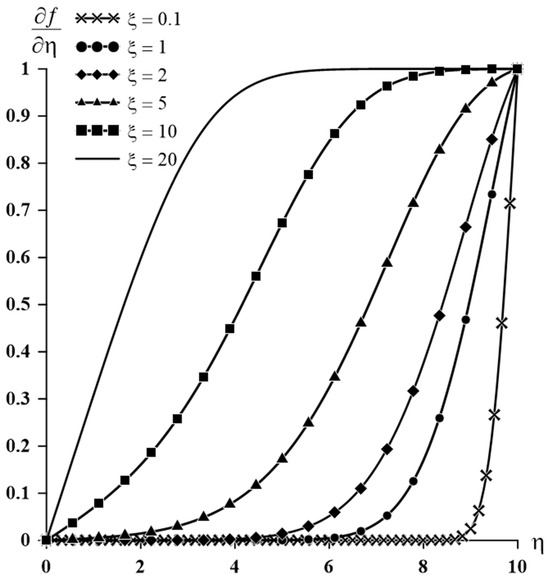
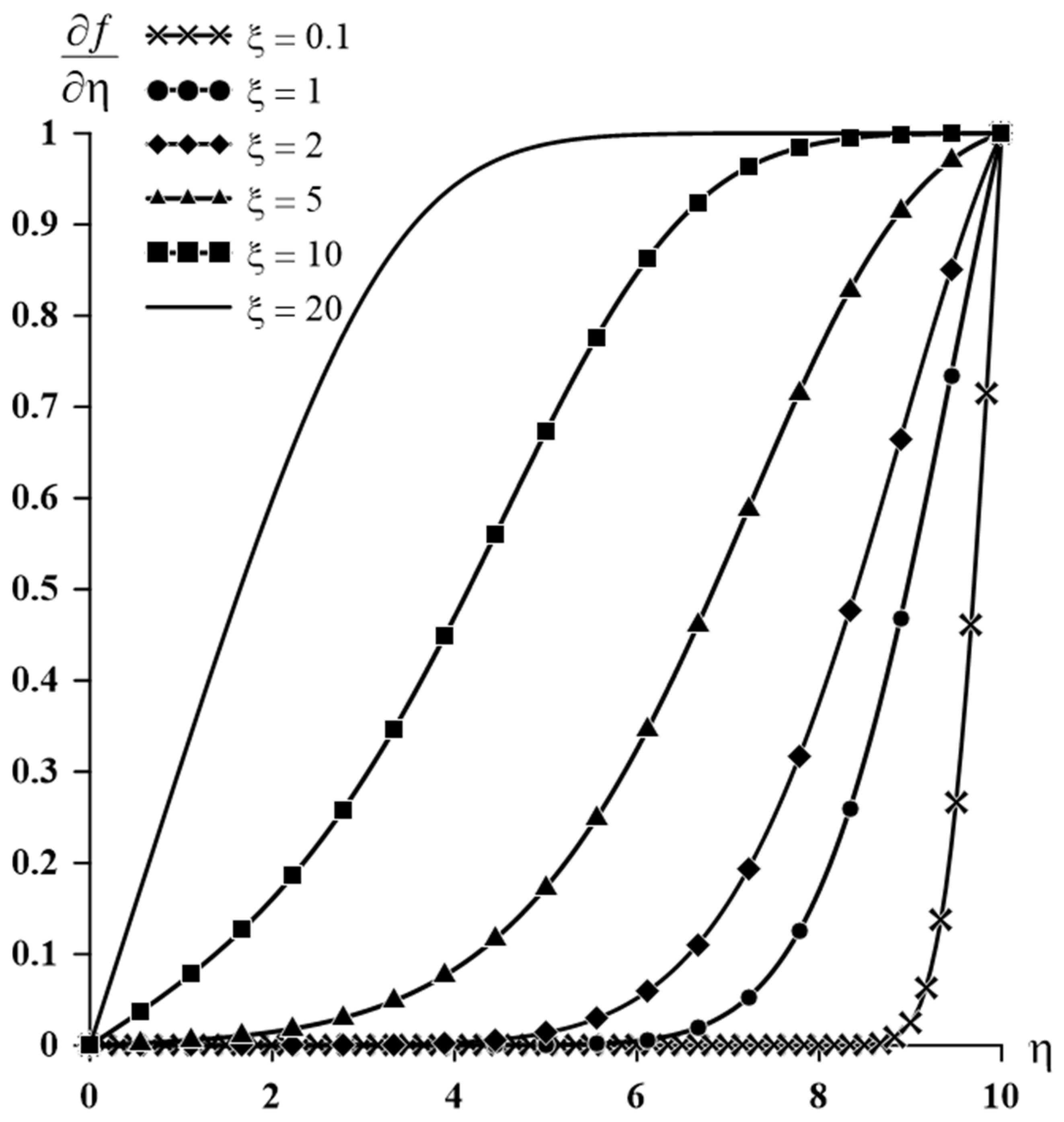
The numerical solution of Equation (18) under conditions (19) was performed in the present study with the help of the MATLAB software. Results of this solution are depicted in Figure 1.
Figure 1.
Blasius flow velocity profiles.
The problem was solved using the marching method along the coordinate with a step of 0.1 in the range of from 0 to 20. In this case, for each step of the -coordinate varied in the range from 0 to 10. This range was divided into 200 steps.
It is evident that during the initial stage of the speed-up the velocity profile has the form characteristic for wake flows, i.e., it has an inflection point. This point disappears at approximately ≈ 13. Then, following the flow development, fullness of the velocity profiles increases. Finally, the velocity profile accepts the classical form of the steady-state flow of Blasius.
Surface friction can be calculated using the following equation:
where μ is the dynamic viscosity, and ρ is the density.
Next, we determine the friction coefficient using the following relation,
Numerical calculations performed on the basis of velocity profiles (Figure 1) enabled approximating the data for the friction coefficient in the following form:
where
is the classical equation for the Blasius friction coefficient for steady-state laminar boundary layer flow on a flat plate.
Equation (22) was obtained by approximating the numerical values of the derivative of with respect to time (variable ) using the least squares method with an accuracy of 3%. The form of this equation itself was chosen in such a way that the time-dependent friction coefficient tended to a steady-state value under the condition .
As known [1], boundary layer flows have a singularity point at x = 0 and t = 0. Therefore, to describe the friction coefficient, approximation (22) was chosen, which takes into account both types of singularity.
Equation (22) shows that the friction coefficient for accelerating flow varies from infinity at ξ = 0 to the classical form of Equation (23) at the value of ξ, which with 99% accuracy is equal to
A similar solution for an unsteady boundary layer was proposed by Blasius [21], which accordingly to [1] has the following form
where
This yields the following equation for the friction coefficient
As can be seen from here, Equation (27), in contrast to the present solution (22), does not provide an asymptotic approximation to the stationary solution (23) at . This does not correspond to the physics of the process.
Thus, on the basis of the symmetry groups for the unsteady boundary layer equation, self-similar variables were obtained, which allowed for reducing the number of independent variables. This simplifies the procedure of numerical integration and the analysis of its results. Obviously, this approach can also be extended for more complicated unsteady flows.
4. Conclusions
This paper presents results of a theoretical investigation of unsteady flow of an incompressible fluid over a flat surface (Blasius flow). The analysis of the system of differential equations was performed using the classical symmetry group approach. An algorithm is presented for mathematical transformations using an infinitesimal generator, whose coefficients depend only on the independent variables and functions.
The symmetry group method enables deriving unsteady self-similar solutions to the system of momentum transfer equations that describe the time-dependent dynamics of the boundary layer development thus enabling reducing the number of independent variables. Based on the derived equations, the influence of unsteady conditions on the velocity profile of the Blasius flow was analyzed. The conditions under which the velocity profile reaches a steady flow regime were revealed.
It was shown that if the self-similarity requirements for the boundary conditions are satisfied, then the results of symmetry transformations and numerical calculations do not depend on the choice of the type of marching variable (time or longitudinal coordinate).
Evidently, this approach is of an evaluative nature and can be extended to solve more complex problems of unsteady flows that occur in various types of technological equipment.
Author Contributions
Conceptualization, A.A.A., I.V.S. and K.F.; methodology, K.F.; formal analysis, validation and investigation, A.A.A., I.V.S., K.F. and O.Y.S.; writing—original draft preparation, A.A.A., I.V.S., K.F. and O.Y.S. ; writing—review and editing, A.A.A., K.F., I.V.S. and O.Y.S. All authors have read and agreed to the published version of the manuscript.
Funding
The research contributions of the authors A.A.A., K.F. and O.Y.S. were funded in frames of the program of research projects of the National Academy of Sciences of Ukraine (No. 6541230), “Support of priority for the state scientific researches and scientific and technical (experimental) developments” 2025–2027 (1230), Project: “Development of distributed energy based on the use of gas turbine and gas piston technologies and local alternative fuels during the period of martial law and the restoration of Ukraine”.
Data Availability Statement
The data that supports the findings of this study are available within the article.
Conflicts of Interest
The authors have no conflicts of interest.
Abbreviations
| CFD | Computational Fluid Dynamics |
| HAM | Homotopy Analysis Method |
| HPM | Homotopy Perturbation Method |
References
- Schlichting, H. Boundary Layer Theory, 7th ed.; McGraw-Hill: New York, NY, USA, 1979. [Google Scholar]
- Puttkammer, P.P. Boundary Layer over a Flat Plate. Bachelor’s Thesis, University of Twente, Enschede, The Netherlands, 2013. [Google Scholar]
- Algaidy, N.; Shrif, A.E. Numerical simulation of the laminar boundary layer flow over a flat plate. J. Alasmarya Univ. Appl. Sci. 2023, 8, 122–135. [Google Scholar] [CrossRef] [Scilit]
- Klazly, M.M.; Bognár, G. Computational fluid dynamic simulation of laminar flow over a flat plate. Des. Mach. Struct. 2019, 9, 29–47. [Google Scholar] [CrossRef] [Scilit]
- Klazly, M.M.; Bognár, G. Comparison of Sakiadis and Blasius Flows Using Computational Fluid Dynamic. In Solutions for Sustainable Development, 1st ed.; CRC Press: London, UK, 2019; 394p. [Google Scholar] [CrossRef] [Scilit]
- Nandeppanavar, M.M.; Shakunthala, S. Blasius flow and heat transfer of a nanofluid due to flat plate. J. Nanofluids 2016, 5, 736–742. [Google Scholar] [CrossRef] [Scilit]
- Banihani, E.; El Haj, M.A. Boundary-layer theory of fluid flow past a flat-plate: Numerical solution using MATLAB. Int. J. Comput. Appl. 2018, 180, 6–8. [Google Scholar] [CrossRef] [Scilit]
- Miansari, M.O.; Miansari, M.E.; Barari, A.; Domairry, G. Analysis of Blasius equation for flat-plate flow with infinite boundary value. Int. J. Comput. Methods Eng. Sci. Mech. 2010, 11, 79–84. [Google Scholar] [CrossRef] [Scilit]
- Liao, S.-J. An explicit, totally analytic solution of laminar viscous flow over a semi-infinite flat plate. Commun. Nonlinear Sci. Numer. Simul. 1998, 3, 53–57. [Google Scholar] [CrossRef] [Scilit]
- Olver, P.J. Applications of Lie Groups to Differential Equations, 2nd ed.; Springer: New York, NY, USA, 2000; 513p. [Google Scholar]
- Avramenko, A.A.; Tyrinov, A.I.; Shevchuk, I.V. An analytical and numerical study on the start-up flow of slightly rarefied gases in a parallel-plate channel and a pipe. Phys. Fluids 2015, 27, 042001. [Google Scholar] [CrossRef] [Scilit]
- Avramenko, A.A.; Tyrinov, A.I.; Shevchuk, I.V. Start-up slip flow in a microchannel with a rectangular cross section. Theor. Comput. Fluid Dyn. 2015, 29, 351–371. [Google Scholar] [CrossRef] [Scilit]
- Avramenko, A.A.; Kuznetsov, A.V. Instability of a slip flow in a curved channel formed by two concentric cylindrical surfaces. Eur. J. Mech. B/Fluids 2009, 28, 722–727. [Google Scholar] [CrossRef] [Scilit]
- Nabwey, H.A.; Khan, W.A.; Rashad, A.M. Lie group analysis of unsteady flow of kerosene/cobalt ferrofluid past a radiated stretching surface with Navier slip and convective heating. Mathematics 2020, 8, 826. [Google Scholar] [CrossRef] [Scilit]
- Avramenko, A.A.; Shevchuk, I.V.; Abdallah, S.; Harmand, S.; Tyrinov, A.I. Symmetry analysis for film boiling of nanofluids on a vertical plate using a nonlinear approach. J. Mol. Liq. 2016, 223, 156–164. [Google Scholar] [CrossRef] [Scilit]
- Avramenko, A.A.; Tyrinov, A.I.; Shevchuk, I.V.; Dmitrenko, N.P. Dean instability of nanofluids with radial temperature and concentration non-uniformity. Phys. Fluids 2016, 28, 034104. [Google Scholar] [CrossRef] [Scilit]
- Kuznetsov, A.V.; Avramenko, A.A. A minimal hydrodynamic model for a traffic jam in an axon. Int. Commun. Heat Mass Transf. 2009, 36, 1–5. [Google Scholar] [CrossRef] [Scilit]
- Avramenko, A.A.; Shevchuk, I.V. Lie group analysis and general forms of self-similar parabolic equations for fluid flow, heat and mass transfer of nanofluids. J. Therm. Anal. Calorim. 2019, 135, 223–235. [Google Scholar] [CrossRef] [Scilit]
- Akgul, B.; Sarı, G.D.; Pakdemirli, M. Lie group analysis of unsteady flow and heat transfer over a porous surface for a viscous fluid. J. Appl. Math. 2012, 1, 675287. [Google Scholar] [CrossRef] [Scilit]
- El-Kabeir, S.M.M.; El-Hakiem, M.A.; Rashad, A.M. Lie group analysis of unsteady MHD three-dimensional natural convection from an inclined stretching surface in a saturated porous medium. J. Comput. Appl. Math. 2008, 213, 582–603. [Google Scholar] [CrossRef] [Scilit]
- Blasius, H. Grenzschichten in Flüssigkeiten mit kleiner Reibung. Z. Math. Phys. 1908, 56, 1–37. [Google Scholar]
- Görtler, H. Grenzschichtentstehung an Zylinder bei Anfahrt aus der Ruhe. Arch. Math. 1948, 1, 138–147. [Google Scholar] [CrossRef] [Scilit]
- Görtler, H. Verdrängungswirkung der laminaren Grenzschicht und Druckwiderstand. Ing.-Arch. 1944, 14, 286–305. [Google Scholar] [CrossRef] [Scilit]
- Watson, E.J. Boundary-layer growth. Proc. R. Soc. Lond. A 1955, 231, 104–116. [Google Scholar] [CrossRef] [Scilit]
- Yang, K.T. Unsteady laminar boundary layers in an incompressible stagnation flow. J. Appl. Mech. 1958, 25, 421–427. [Google Scholar] [CrossRef] [Scilit]
- Geis, T. Bemerkung zu den “ähnlichen” instationären laminaren Grenzschichtströmungen. Z. Angew. Math. Mech. 1956, 36, 396–398. [Google Scholar] [CrossRef] [Scilit]
- Schun, H. Über die “ähnlichen” Lösungen der instationären laminaren Grenzschichtgleichungen. In Fünfzig Jahre Grenzschichtforschung; Vieweg: Braunschweig, Germany, 1955; pp. 147–152. [Google Scholar] [CrossRef] [Scilit]
- Hayasi, N. On semi-similar solutions of the unsteady quasi-two-dimensional incompressible laminar boundary-layer equations. J. Phys. Soc. Jpn. 1962, 17, 194–203. [Google Scholar] [CrossRef] [Scilit]
- Becker, E. Anwendung des numerischen Fortsetzungsverfahrens auf die pseudostationäre, kompressible laminare Grenzschicht in einem Stoßwellenrohr. Z. Für Flugwiss. 1962, 10, 138–147. [Google Scholar]
- Hassan, H.A. On unsteady laminar boundary layers. J. Fluid Mech. 1960, 9, 300–304. [Google Scholar] [CrossRef] [Scilit]
Disclaimer/Publisher’s Note: The statements, opinions and data contained in all publications are solely those of the individual author(s) and contributor(s) and not of MDPI and/or the editor(s). MDPI and/or the editor(s) disclaim responsibility for any injury to people or property resulting from any ideas, methods, instructions or products referred to in the content. |
© 2026 by the authors. Licensee MDPI, Basel, Switzerland. This article is an open access article distributed under the terms and conditions of the Creative Commons Attribution (CC BY) license.