


Abstract
This study introduces and compares online rule-based and optimization-based energy management strategies for a mild hybrid electric vehicle, with their performance evaluated against an offline Dynamic Programming benchmark. A structured rule-based strategy is proposed to enforce engine operation along its optimal efficiency line, while the remaining power demand is balanced by the electric motor. To achieve charge-sustaining battery operation, a soft state of charge regulation mechanism is incorporated. An Equivalent Consumption Minimization Strategy (ECMS) is also developed using a precise formulation of battery equivalent fuel consumption computed from instantaneous engine and electric path efficiencies, instead of constant efficiencies used in the literature. DP, which provides a globally optimal solution over the entire driving cycle, is employed as a benchmark for assessing the rule-based and ECMS strategies. The control strategies are compared under charge-sustaining conditions, considering engine and motor operation characteristics, overall fuel consumption, and battery usage intensity. Furthermore, the influence of load shifting between the internal combustion engine and the electric motor on overall vehicle performance is analyzed. Fuel consumption decreases by 13.5% relative to the engine-only baseline with the proposed ECMS with precise equivalent fuel consumption, and DP yields an additional 1.6% benefit. Compared with the developed rule-based controller, ECMS nearly halves the battery usage intensity, and DP provides 3.1% further reduction relative to ECMS.
1. Introduction
Mildhybrid electric vehicles (MHEVs) use a relatively small battery that adds a small mass and cost compared to full hybrids, and operate primarily in a charge-sustaining mode. By recuperating braking energy through regenerative braking and redeploying it for traction, they can significantly improve overall powertrain efficiency without requiring large energy storage systems [1]. Energy management strategies (EMSs) are crucial in MHEVs as they regulate the amount of power supplied by the electric motor (EM), strongly influencing overall powertrain efficiency. Numerous techniques have been proposed to coordinate the distribution of power between the thermal and the electric machines, and they are typically classified into two broad classes: rule-based methods and optimization-based methods [2]. Each approach has distinct advantages and limitations. Rule-based (RB) control features a straightforward structure and can be implemented with minimal complexity, but it does not guarantee optimal performance. The Equivalent Consumption Minimization Strategy (ECMS) can be implemented in real-time and typically yields a locally optimal solution. Dynamic programming delivers a globally optimal solution, but it is computationally intensive and not suitable for real-time implementation [3].
A rule-based control strategy relies on predefined, static parameters and is typically implemented using if–else logic. These parameters are usually selected according to the operating characteristics and constraints of the EM and internal combustion engine (ICE). The work described in [4] proposed a rule-based strategy that selects the power split using discrete state of charge (SOC) regions and driver power demand. The rules are set heuristically from powertrain characteristics. Rule-based charge-sustaining control for 48 V MHEVs has been compared with Dynamic Programming on standard cycles, indicating near-optimal fuel economy while keeping SOC within a prescribed range [5]. Reference [6] introduced a rule-based energy management approach whose parameters are optimized using dynamic programming (DP), resulting in improved fuel economy for a dual-motor plug-in hybrid electric vehicle (PHEV). Several studies show that keeping the ICE near its optimal operating line (OOL) improves fuel economy, with the EM supplying the remaining torque. For instance, Al-Flehawee and Al-Mayyahi (2022) proposed a rule-based EMS that enforces OOL operation of the ICE, while the motor provides assistance when needed [7]. However, their approach does not incorporate explicit SOC regulation beyond boundary constraints, which may lead to charge-depleting behavior over longer cycles.
ECMS is derived from Pontryagin’s Minimum Principle and reduces overall fuel use by expressing electrical energy consumption as an equivalent fuel cost [8,9]. ECMS has been applied to MHEVs under limited electric power, including implementations with motor power compensation to improve fuel economy in charge-sustaining operation [10]. The literature presents extensive work on ECMS, where different studies introduce distinct considerations and methodological contributions. Recent studies [11,12] highlight the significant impact of battery thermal management, fuel consumption, and battery degradation in ECMS-controlled hybrid electric vehicles. In [13], a genetic algorithm was applied to identify the globally optimal equivalence factor, thereby enhancing the effectiveness of the energy management strategy and reducing total fuel usage in hybrid electric vehicles. The work in [14] proposed an adaptive ECMS for a range-extender electric vehicle that adaptively tunes the equivalent factor during operation using SOC feedback and start–stop penalties, achieving improved fuel economy under worldwide harmonized light vehicles test cycle (WLTC) conditions. In [15], a fuel consumption model accounting for engine transients was incorporated into the ECMS, and its impact on power split and fuel economy was analyzed. Study [16] introduced and assessed an ECMS-based energy management strategy for a fuel cell hybrid electric vehicle using detailed modeling and simulation, showing reduced hydrogen consumption relative to a conventional rule-based approach. The authors in [17] showed that the inclusion of engine rotational inertia in the ECMS objective function improves torque distribution and reduces hybrid electric vehicle (HEV) fuel consumption and CO2 emissions across standard driving cycles.
DP is also widely used as a benchmark solution for hybrid powertrain control, as it is capable of yielding globally optimal results. DP relies on Bellman’s backward optimality principle [18], where the optimal cost-to-go is computed recursively from the end state back to the starting state across the entire driving cycle. By exhaustively evaluating all admissible engine–motor torque combinations and SOC transitions, DP identifies the control sequence that minimizes total fuel consumption for a given cycle. Due to its global optimization capability, DP is frequently employed to benchmark the performance gap between real-time strategies and theoretical optimum solutions [19].
Two issues remain in the literature on MHEV energy management under charge-sustaining evaluation. First, published rule-based EMS for MHEVs does not combine optimal-operating-line engine control with a soft SOC regulation in a single control structure. Second, many ECMS implementations still use constant or averaged efficiencies in the electrical-to-fuel equivalence instead of instantaneous engine and electric-path efficiency maps. A further limitation is that fuel consumption is often reported without a consistent RB–ECMS–DP comparison that also quantifies battery usage intensity under the same charge-sustaining conditions.
To address this gap, the present work introduces a structured rule-based strategy that not only enforces optimal engine operation along the best-efficiency line but also integrates a soft SOC regulation mechanism to maintain charge-sustaining behavior throughout the driving cycle. This ensures that the battery energy remains balanced without compromising the benefits of optimal torque utilization between the engine and the electric machine. While existing ECMS studies commonly compute equivalent fuel consumption using averaged efficiency values of the engine and electric power paths, this work utilizes instantaneous engine and electric machine efficiency maps, resulting in a more accurate evaluation of the battery equivalent fuel consumption. By precisely evaluating the equivalent fuel consumption, the overall ECMS performance can potentially be improved. In this work, DP is implemented within the same optimization framework, where the electric motor torque serves as the control variable, and the battery SOC is defined as the state variable, enabling a fair comparison against the proposed real-time controllers. Moreover, in this study, the performance comparison is carried out under a charge-sustaining framework, in which the battery SOC is constrained to remain close to its initial value. This enables a fair assessment of the control strategies with respect to fuel consumption, battery utilization, and load-shifting characteristics.
2. Vehicle Dynamic Model
A backward modeling approach is used, where the vehicle speed profile is prescribed, and the required tractive force and wheel power are computed from the road-load model. These demands are then propagated upstream through the drivetrain to compute the power requirements of the gearbox, motor, and engine without simulating forward vehicle motion.
The traction force at the wheels is computed by considering the required vehicle acceleration, as well as the rolling resistance and aerodynamic drag forces. Accordingly, the longitudinal road-load [20] can be expressed as:
where is the traction force at the wheels, M is the vehicle mass, is the longitudinal acceleration, g is the gravitational acceleration, is the rolling resistance coefficient, whose value depends on pavement characteristics, tire properties, and operating conditions [21]. is the air density, is the aerodynamic drag coefficient, is the vehicle frontal area, v is the vehicle speed.
The effective tire radius () is modeled as:
where represents the tire deformation coefficient [20]. This parameter depends on tire material properties (rubber stiffness, carcass compliance, inflation pressure), as well as pavement mechanical characteristics such as surface deformation and temperature-dependent stiffness [22]. In this study, the tire is assumed to operate in pure longitudinal motion under normal driving conditions, where longitudinal slip is negligible. Under this assumption, the longitudinal tire force is obtained directly from the vehicle dynamic equilibrium (road-load model), and a nonlinear slip-based tire model is not required. Since the focus is on comparing energy management strategies rather than handling or traction-limit behavior, a higher-fidelity tire model is not expected to materially change the torque-split trends, but would increase model complexity.
is the unloaded (geometrical) wheel radius (m), is the tire deformation coefficient.
Then, the required wheel torque () and rotational speed () are obtained as:
Using the gear ratios of the differential () and the gearbox (), the required wheel torque and rotational speed can be mapped to the corresponding torque () and angular speed () at the gearbox input shaft. This shaft is mechanically coupled to both the engine and the electric motor through a belt–pulley arrangement (P2 off-axis configuration with transmission ratio of the pulley).
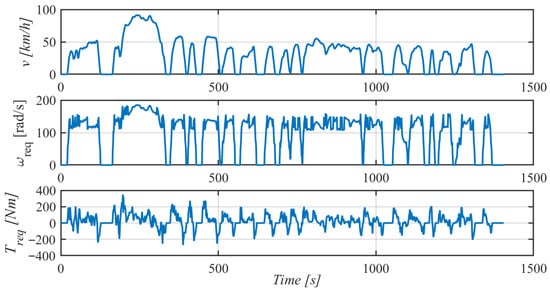
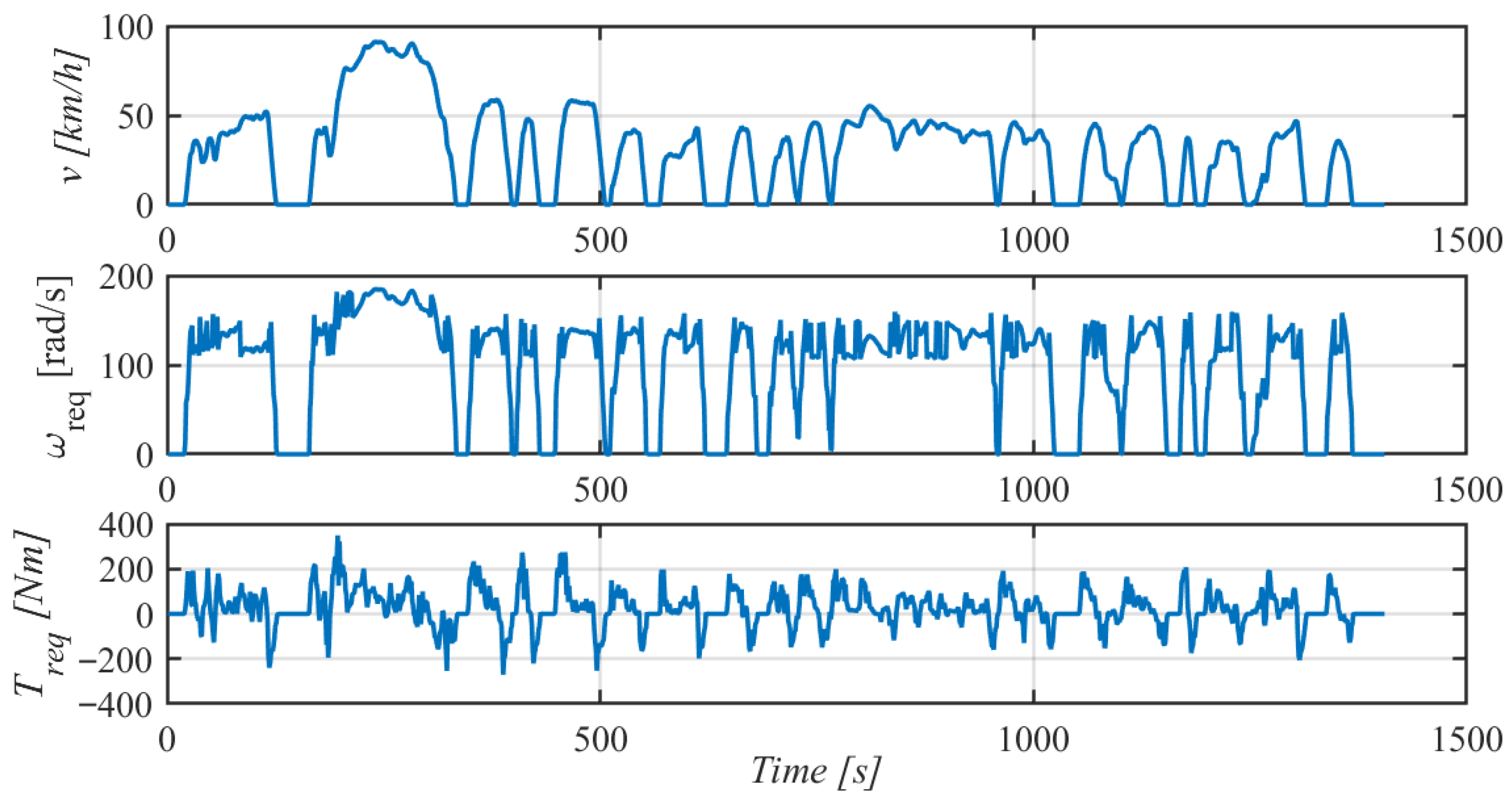
UDDS (Urban Dynamometer Driving Schedule) is a city-driving speed trace with frequent stops and short accelerations, commonly used for chassis-dynamometer evaluation [23]. In this work, the UDDS speed profile is applied as the reference cycle for assessing the proposed energy management strategies. In Figure 1, the driving cycle velocity profile and the corresponding required torque and rotational speed at the gearbox input shaft are illustrated.
Figure 1.
Velocity profile in UDDS driving cycle and corresponding required angular speed and torque profile at the gearbox input level.
The engine’s fuel consumption was calculated using its steady-state efficiency map [24,25]. Similarly, the power demand from the battery was determined by considering the electric motor efficiency map along with the inverter efficiency.
The open circuit voltage is determined using the cell open circuit voltage (which depends on SOC) and the total number of cells connected in series :
The corresponding battery current requested from the battery pack for a given power can be evaluated as [26]:
where R is the internal resistance of the battery.
Then, the battery’s state of charge (SOC) is determined by considering the nominal capacity of an individual cell () and the total number of cells connected in parallel () [27].
Table 1 summarizes the parameters used to build the longitudinal vehicle and powertrain model. These values determine the road-load demand, the torque–speed mapping through the drivetrain, and the operating limits and battery dynamics applied in the energy management simulations. The vehicle-level quantities (mass, , wheel radius, transmission and the engine parameters) are taken from the 2016 Mazda CX-9 as the base conventional vehicle [28]. For engine parameters, the VW EA211 was used [25]. The mild-hybrid powertrain is then modeled by adding a 48 V electric motor and battery model while keeping the same road-load characteristics; the rolling resistance coefficient , drag coeficient and the gear set efficiency are treated as modeling assumptions within commonly reported ranges.
Table 1.
Main vehicle and powertrain parameters used in the model.
The battery pack is specified by the series/parallel cell configuration in Table 1 (), which yields , , and . This energy level is consistent with typical production MHEVs, where battery capacities are generally reported to be below 3 kWh [29].
A detailed explanation of the HEV powertrain model and its validation can be found in previous work (see reference [12]). The current work only focuses on describing the models that are specific to this work.
3. Structured Rule-Based Control
This rule-based control strategy integrates engine and battery management by ensuring the engine operation is maintained along its optimal efficiency line, while the battery is maintained in an energy preservation mode. The optimal operating line is determined by identifying torque values that correspond to the minimum brake-specific fuel consumption (BSFC) for throughout the engine speed range. In the mild hybrid electric vehicle system, the engine strictly follows this line to maximize power utilization efficiency. Meanwhile, the electric motor, which can function in both motoring and generating modes, balances the remaining power demand. Additionally, a soft constraint on the state of charge (SOC) is implemented to maintain charge-sustaining operation throughout the driving cycle.
To accomplish this, the following logic is employed for defining EM torque along the traction phase:
where
- —mean value of open-circuit voltage;
- —battery capacity;
- —electric motor mean efficiency;
- —inverter mean efficiency;
- —battery mean efficiency;
- —electric motor angular velocity;
- —time interval;
- —state of charge;
- — reference state of charge.
For this simulation, and are used, i.e., . The SOC target is selected to satisfy charge-sustaining operation in ECMS and to match the practical operating window of the battery pack. Mild-hybrid systems typically use a mid-SOC setpoint to preserve both assist and regenerative capability and to avoid prolonged operation at high SOC, which is unfavorable for battery life (e.g., [30]). The 42–52% band provides enough headroom for regeneration and assist while keeping SOC variations within a controlled range.
This coefficient represents the proportional gain used to calculate the electric motor torque required to achieve the desired change in the state of charge (SOC) within the time interval [] (which is 5 s in this study). It is important to note that, in this calculation, mean values of the battery pack voltage () and the average efficiency of the electric components (, , and ) are used.
- Subsequently, the engine torque is determined as follows:
During the braking phase, the control strategy directs the electric motor to charge the battery as much as possible within its operational constraints.
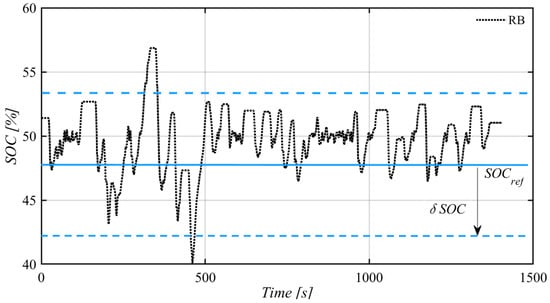
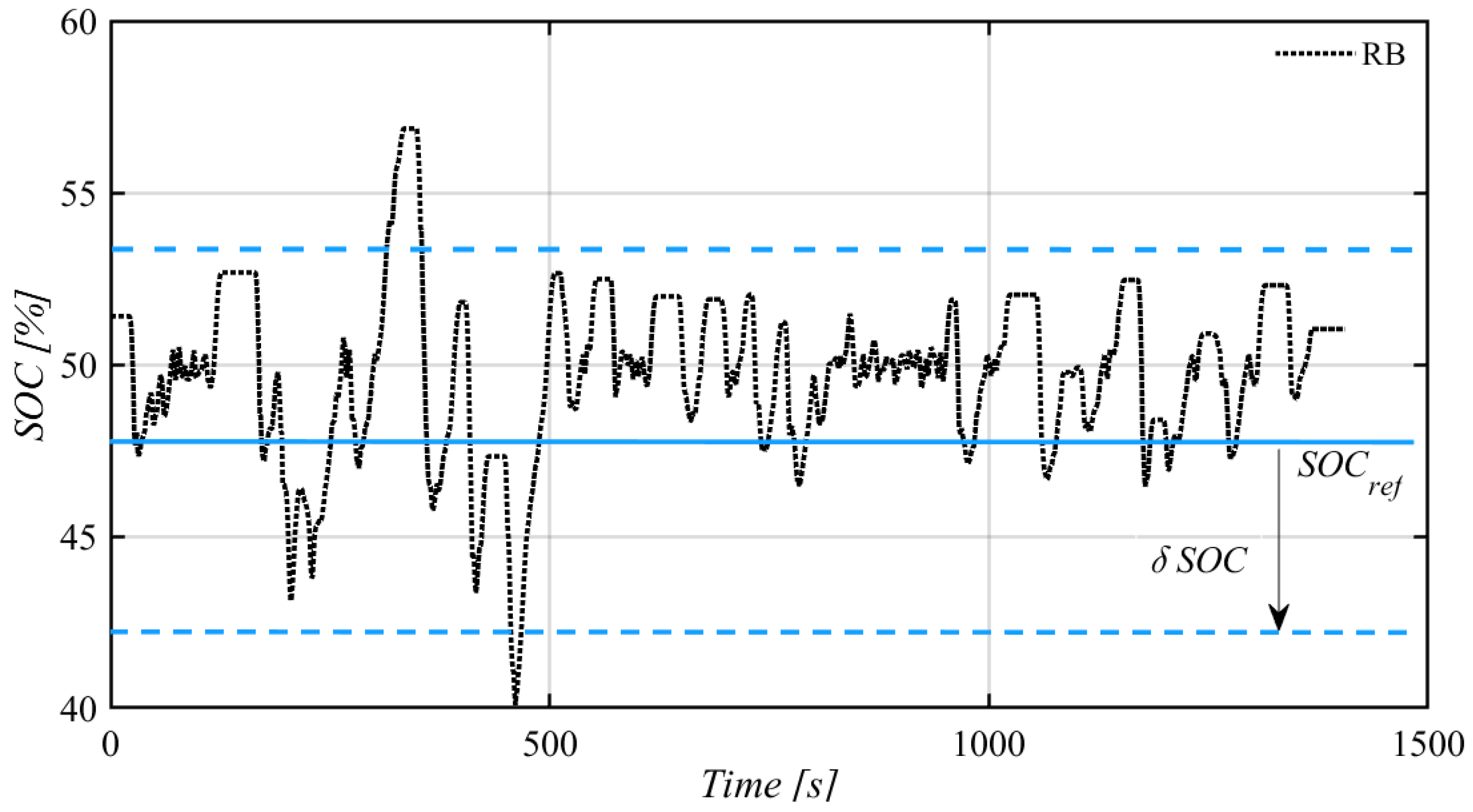
Simulation results demonstrate that this approach effectively maintains the engine’s operation along its optimal efficiency curve while keeping the battery in a charge-sustaining state. Figure 2 shows a short interval during which the SOC temporarily exceeds its control band due to regenerative braking, causing the SOC to rise further beyond the set limits. Subsequently, during the traction phase, the rule-based control shifts the entire torque demand () to the electric motor, enabling the SOC to return within the desired control band.
Figure 2.
SOC profile under RB control strategy showing reference SOC (solid blue line) and its variation range (dashed blue line).
4. ECMS with Precise Equivalent Fuel Consumption
The ECMS-based control strategy seeks to minimize total fuel consumption by combining the engine’s fuel usage with the battery’s equivalent fuel consumption, taking into account the current power demand, the battery’s state of charge, and the operational limits and characteristics of both the electric motor and the internal combustion engine. Thus, for the traction phase, the objective is defined as:
Subject to the following constraints, the required traction torque must be satisfied while ensuring that the operating points remain within the permissible limits of both the engine and the electric motor.
To calculate the battery’s equivalent fuel consumption for given and , the engine’s BSFC for generating the same mechanical power is used by dividing the required battery power accordingly. In this work, instead of using average values, the exact instantaneous values of BSFC and electric motor efficiency are employed, resulting in a more accurate estimation of the equivalent fuel consumption.
The brake-specific fuel consumption (BSFC) map of the engine is provided in units of g/kWh.
Improving the accuracy of the equivalent fuel consumption term in the cost function enhances the torque-splitting performance of the ECMS controller. Furthermore, to properly account for the load-shifting effect under negative electric motor torque conditions during traction, the efficiencies of the electric power path are squared. This occurs because, under these operating conditions, mechanical energy is first transformed into electrical energy and stored in the battery, and then converted back into mechanical energy to drive the vehicle, leading to a two-stage energy conversion process.
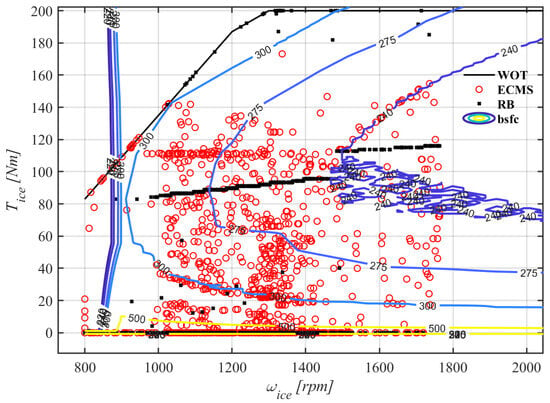
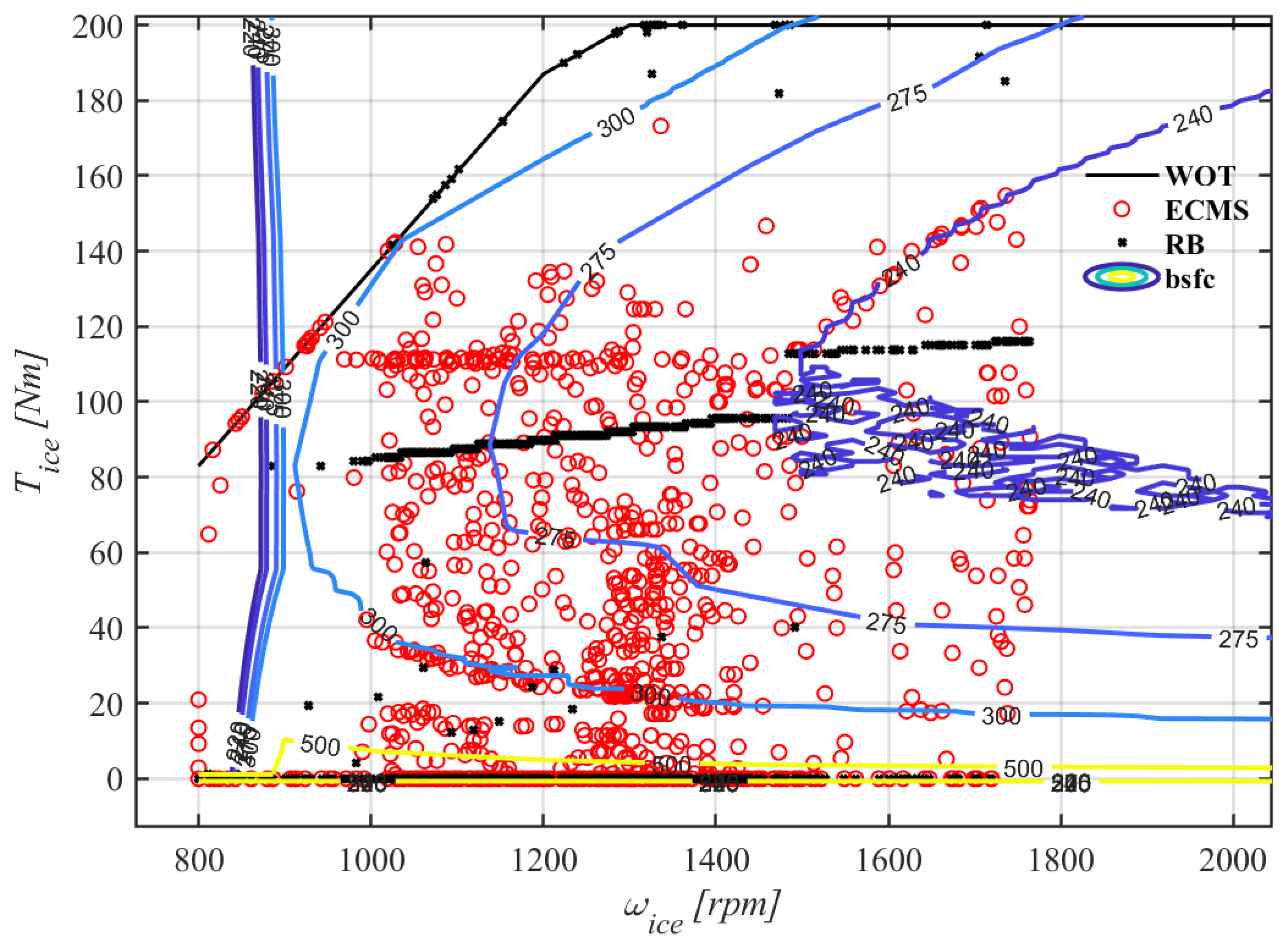
Simulation results confirm that although the engine operation under ECMS is efficient, it is not as optimal as in the rule-based (RB) strategy (see Figure 3). This is because the RB control logic strictly enforces engine operation along the best efficiency line but does not account for the efficiency of the electric powertrain. In contrast, the ECMS approach incorporates the efficiencies of both the engine and electric components, thereby optimizing the operation of both the engine and the electric motor simultaneously.
Figure 3.
Engine operation under ECMS and RB.
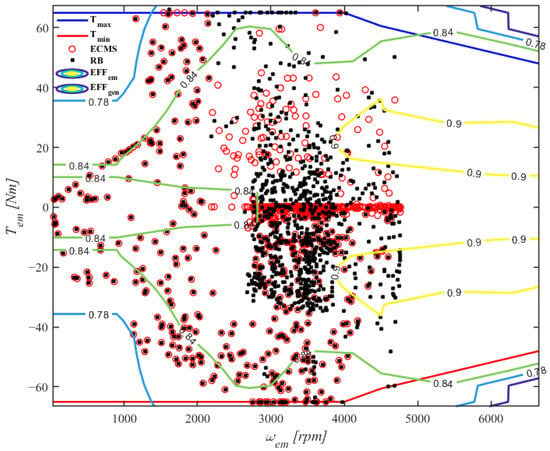
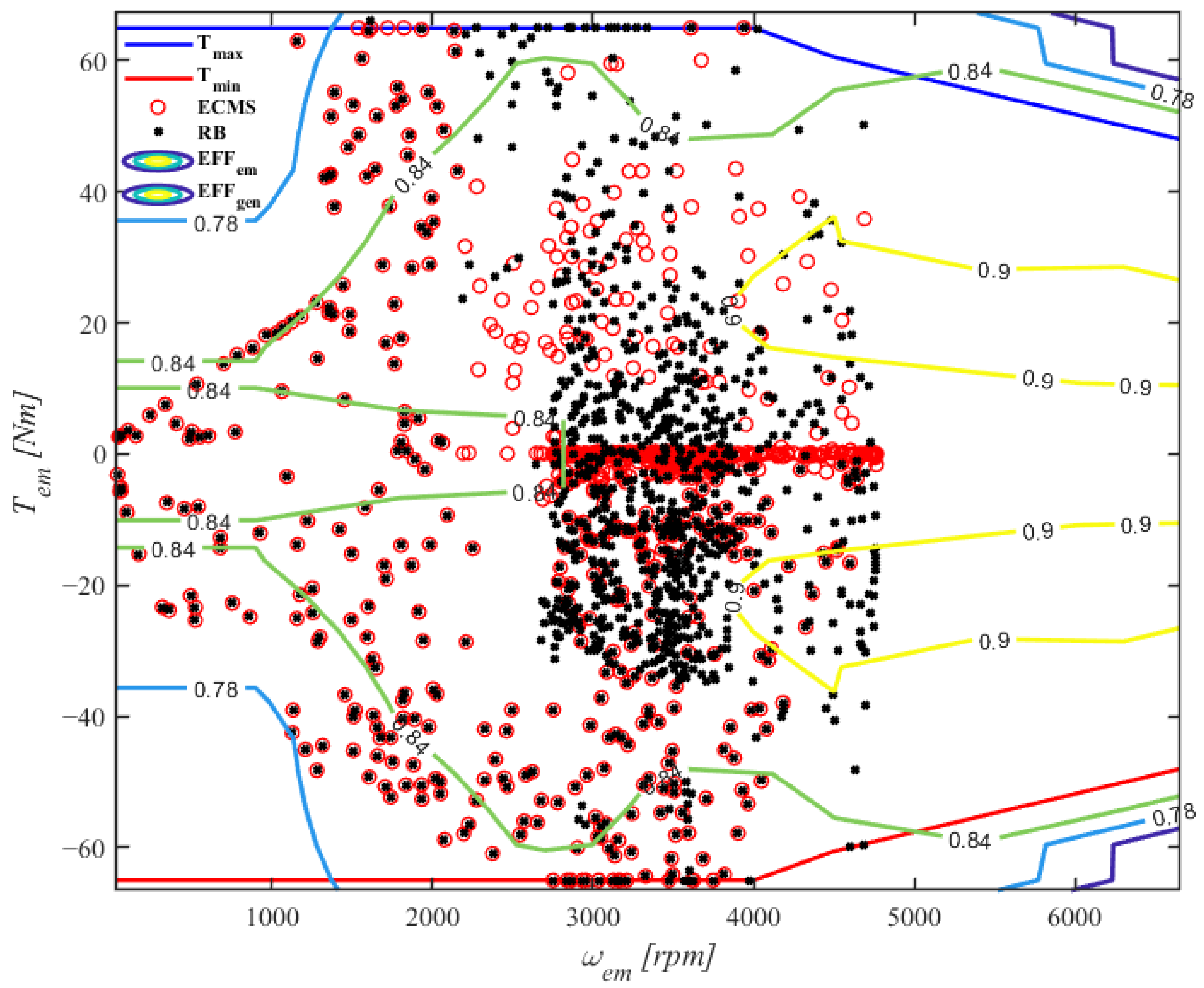
Figure 4 presents a comparison of electric motor (EM) operation under the RB and ECMS control strategies. For motor operation (when > 0) the electric motor operates more efficiently under ECMS compared to the rule-based strategy. Both algorithms utilize the maximum possible regenerative braking, as evidenced by the overlapping points in the negative torque () region, confirming this mode of operation. However, there remain non-overlapping points that indicate differences in load-shifting behavior. Specifically, the RB strategy employs load shifting extensively, whereas the ECMS strategy utilizes load shifting only for a small portion of the power demand, typically at low electric electric motor torque values.
Figure 4.
EM operation under ECMS and RB control strategies.
Table 2 quantifies the different power-split behavior of RB and ECMS on both the engine and motor sides. Under ECMS, the mean engine torque decreases from 39.5 Nm to 32.3 Nm and the engine mechanical energy reduces from 2.11 kWh to 1.69 kWh; in parallel, the motor contribution is lower, with the mean assist torque dropping from 21.6 Nm to 11.2 Nm and the delivered motor energy decreasing from 0.74 kWh to 0.36 kWh, while the absorbed (regenerative) energy also falls from 1.55 kWh to 0.74 kWh. This indicates that RB attains more frequent operation in the low-BSFC region by using more aggressive load shifting, whereas ECMS achieves comparable performance with a more moderate use of the electric path.
Table 2.
Operating-point statistics and energy metrics extracted from the engine and motor operating-point distributions.
5. Dynamic Programming
Dynamic Programming (DP) is an offline optimization technique that computes the globally optimal control policy over an entire driving cycle. As such, it requires full prior knowledge of the driving profile. Using a backward vehicle model and the UDDS driving cycle, the required traction torque and angular speed at gearbox input level, and the corresponding allowable torque limits of both the engine and the electric motor are determined at each time step. In this work, the battery state of charge (SOC) is selected as the state variable and discretized into uniform grids ranging from 35% to 60% with a resolution of 0.006%. The electric motor torque is chosen as the control variable and uniformly discretized from −65 Nm to +65 Nm with a step size of 1 Nm, corresponding to the electric motor’s torque limits. Dynamic Programming (DP) employs a backward recursive optimization framework by discretizing the electric motor torque and estimating the resulting state of charge (SOC) transitions (see Algorithm 1). By systematically evaluating all admissible SOC trajectories over the driving cycle and enforcing a fixed terminal SOC, DP identifies the globally optimal control sequence that minimizes total fuel consumption.
At each time step k, all feasible transitions from the current SOC state to the discrete SOC states at time step are evaluated, while explicitly considering the operational constraints of both the engine and the electric motor. Among these candidates, the transition associated with the minimum fuel consumption is selected, and the corresponding control action is stored.
This backward evaluation is repeated across the entire driving cycle, allowing DP to determine optimal control policies for all admissible initial SOC values that lead to a prescribed final SOC. In particular, the solution satisfying
is selected to ensure charge-sustaining operation.
Although a small approximation is introduced when mapping the electric motor torque to the discrete SOC grid, its impact is minimized by adopting a sufficiently fine SOC discretization.
| Algorithm 1 Backward Dynamic Programming-Based Energy Management Strategy |
|
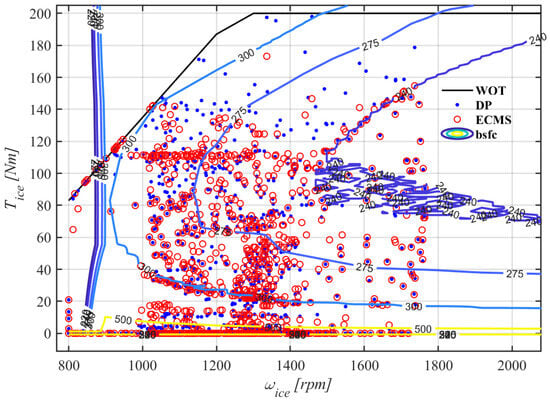
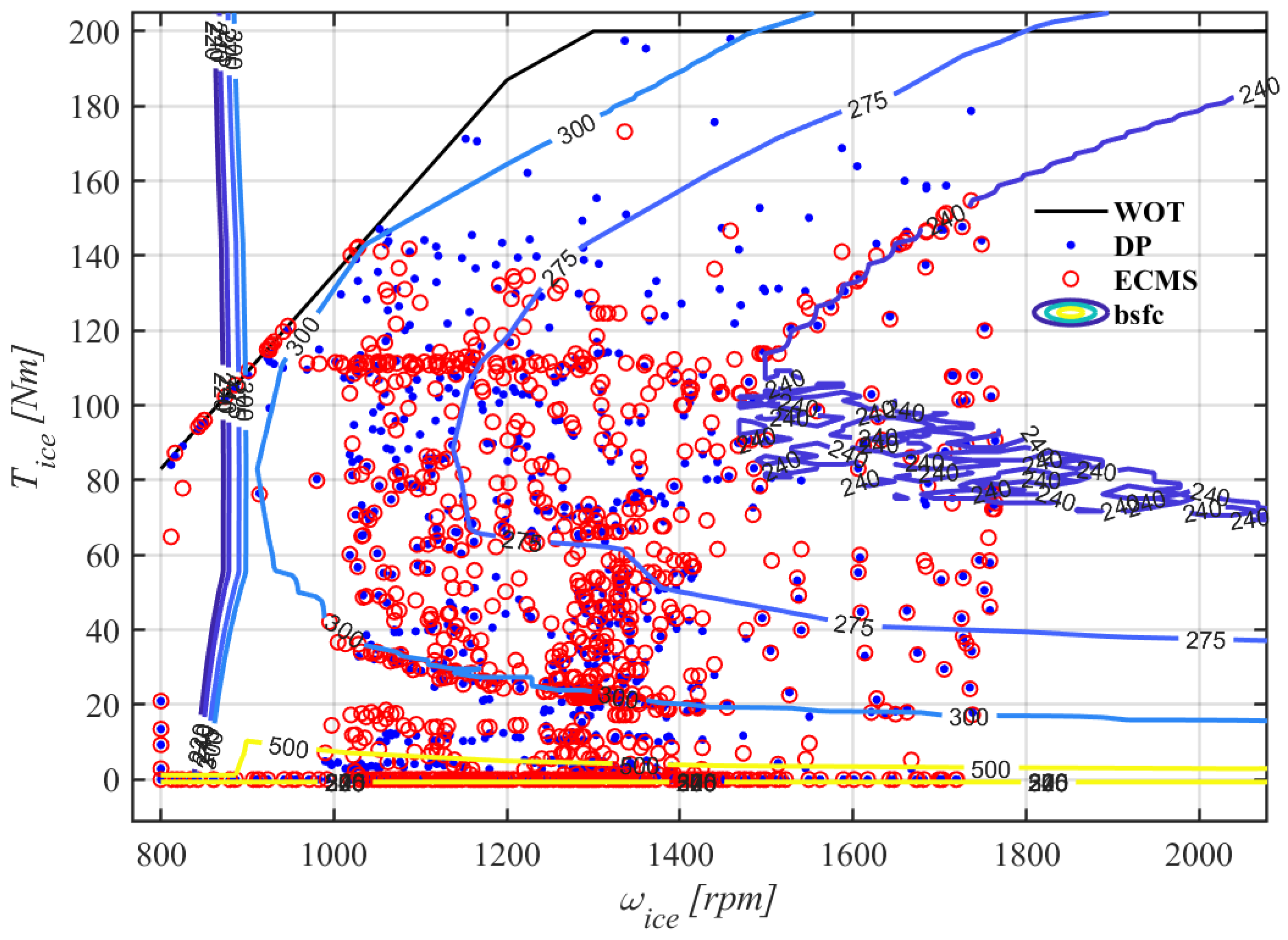
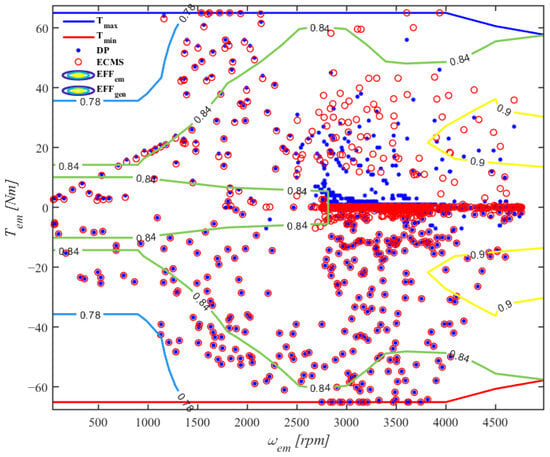
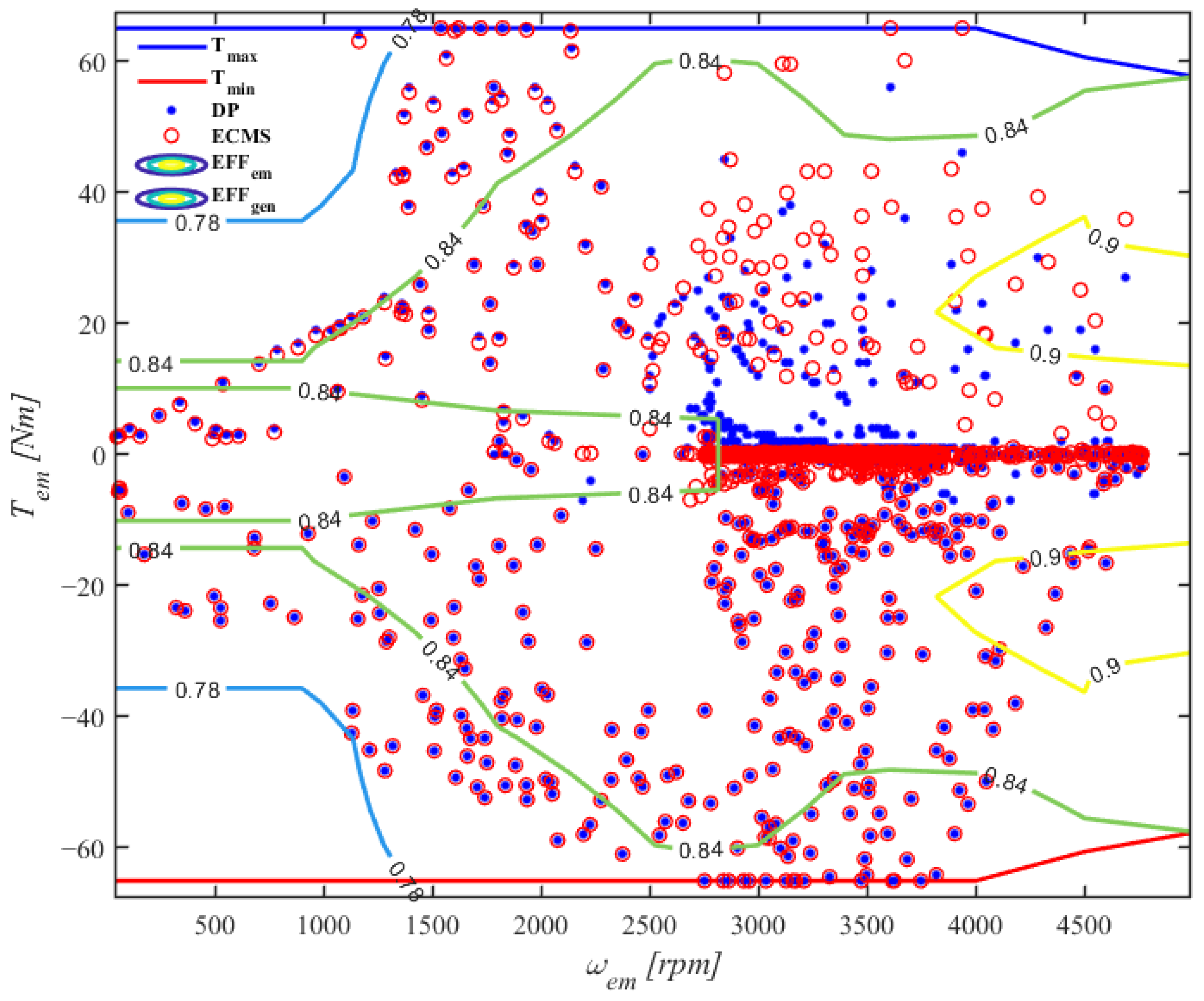
In the following figures, the operating points of the engine (see Figure 5) and the electric motor (see Figure 6) under DP and ECMS control are compared. The results show that DP does not yield a noticeable improvement in operating conditions compared to ECMS. This is because ECMS employs an accurately calibrated battery equivalent factor, resulting in performance that closely matches the DP-based optimal solution.
Figure 5.
ICE operation under ECMS and DP control strategies.
Figure 6.
EM operation under ECMS and DP.
Table 3 also backs this up numerically. ECMS and DP give almost the same engine averages (32.260 vs. 32.254 Nm) and a very similar share of low-BSFC points (17.30% vs. 17.08%), and the engine mechanical energy differs only slightly (1.686 vs. 1.694 kWh). The motor-side energies are likewise nearly unchanged (about 0.36 kWh in motoring and about 0.74 kWh in regeneration), so the gap between DP and ECMS is small in both operating-point distribution and integrated energy terms.
Table 3.
Operating-point statistics and energy metrics for ECMS and DP.
6. Results
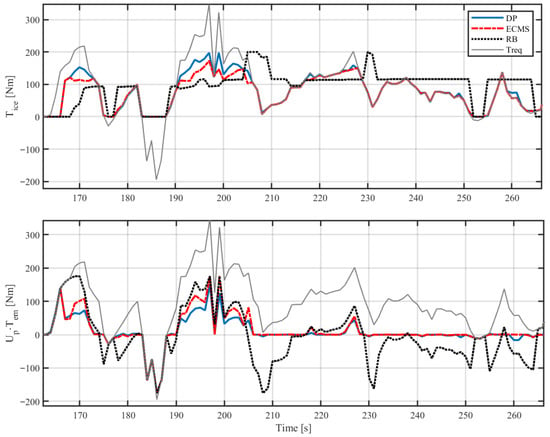
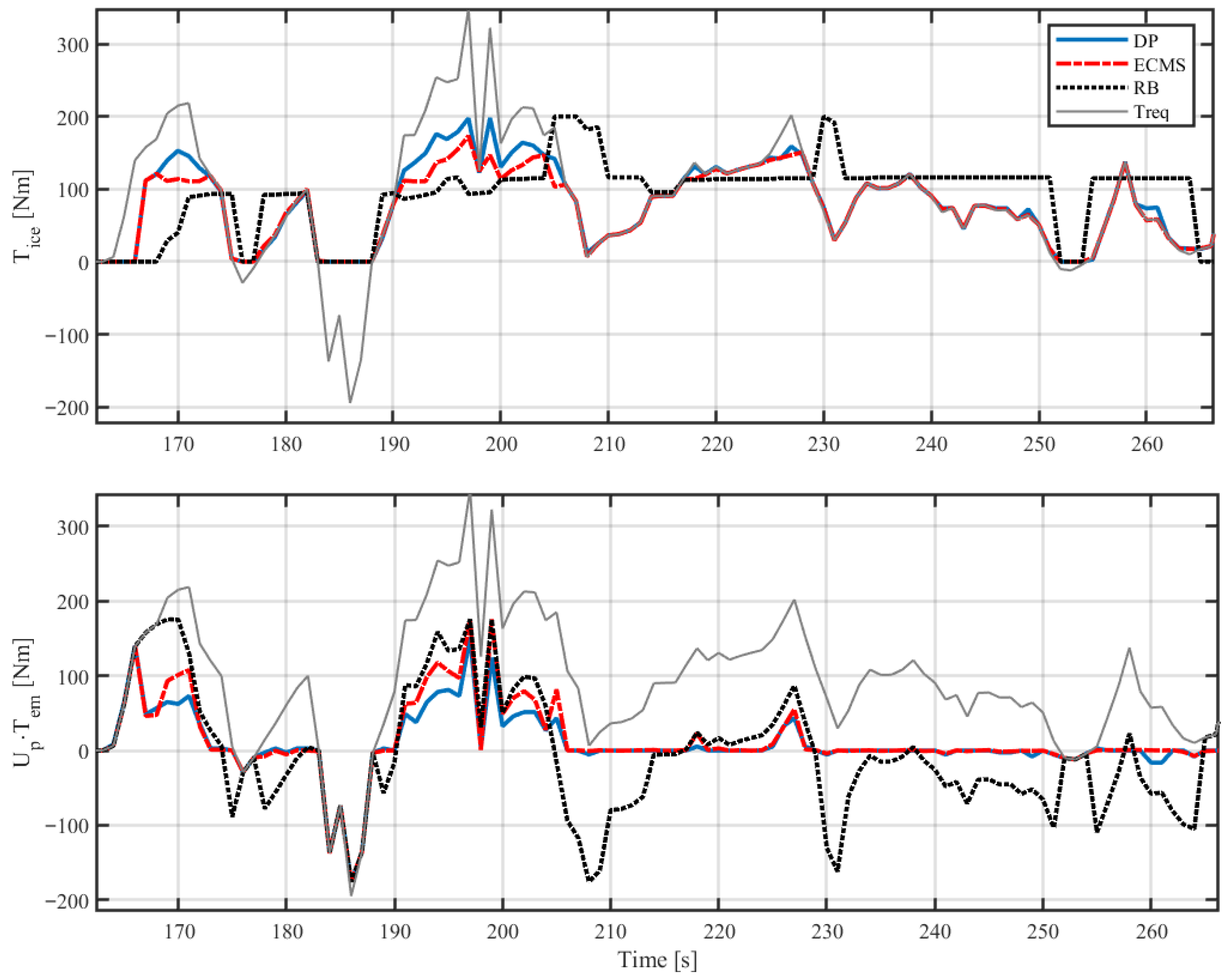
In Figure 7, the torque-splitting results are illustrated by plotting the engine torque, electric motor (EM) torque, and the requested torque under all three control strategies. During the braking phase, the EM torque profiles overlap for all strategies, indicating that maximum regenerative braking is consistently applied to maximize energy recovery.
Figure 7.
Comparison of torque profile of ICE and EM under 3 control strategies.
Under the rule-based (RB) control strategy (shown by black dotted lines), the engine operates predominantly along its best efficiency line, resulting in relatively steady engine operation. In contrast, the EM exhibits more transient behavior, as it compensates for the remaining portion of the demanded torque. Additionally, load-shifting operation is extensively employed in the RB strategy.
For the ECMS strategy (red dashed lines), the operating profiles of both power sources closely match those obtained with DP (solid blue line). This similarity arises from the use of an accurately calibrated equivalent fuel consumption factor for the battery, allowing ECMS to approximate the globally optimal solution. Nevertheless, minor differences between ECMS and DP remain, as DP determines the globally optimal torque split by considering the entire driving cycle, whereas ECMS makes decisions based only on instantaneous operating conditions. It can be observed that load-shifting is rarely employed in DP, and is used even less frequently in ECMS.
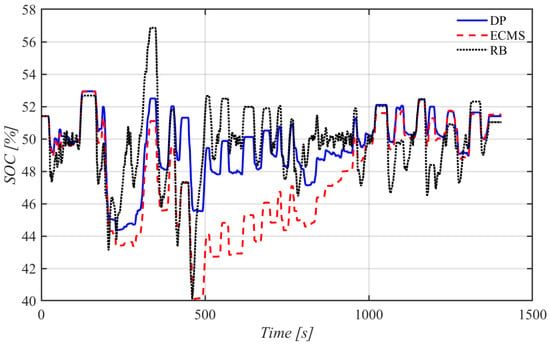
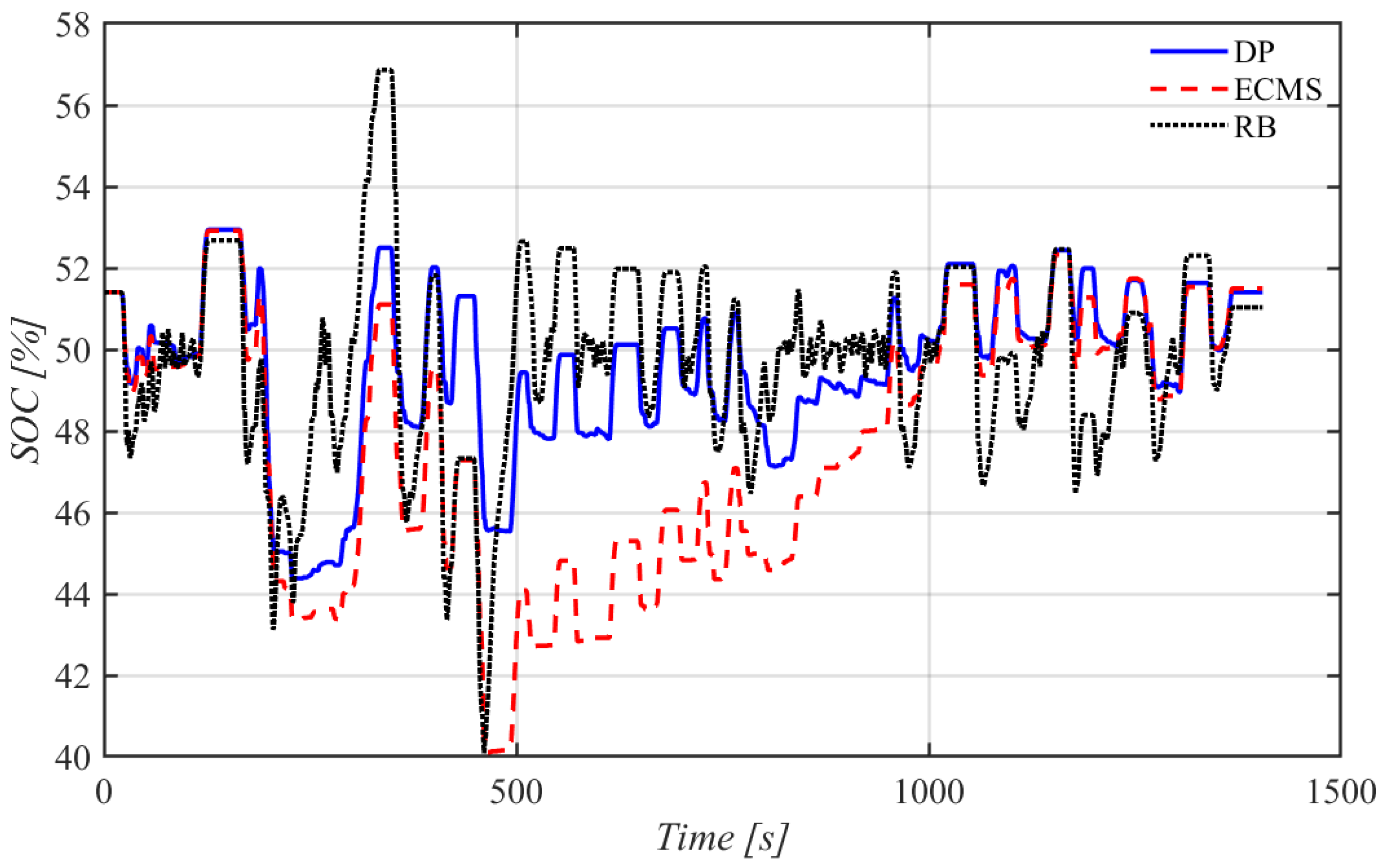
From Figure 8, the SOC profiles of all three control strategies are compared. The largest SOC fluctuations are observed under the rule-based (RB) strategy, which can be attributed to the electric motor operating predominantly in transient conditions. The ECMS strategy shows moderate SOC variations, reflecting a more balanced torque distribution between the engine and the electric motor. In contrast, the DP strategy exhibits the smallest SOC deviation throughout the driving cycle, as it provides a globally optimal energy management solution. It is also evident that, for all three control strategies, the SOC remains nearly the same at the start and end of the driving cycle, confirming charge-sustaining behavior.
Figure 8.
SOC profile under the developed control strategies.
Table 4 summarizes the overall fuel consumption, battery usage intensity, and SOC variation for the developed control strategies. Among all cases, DP yields the best overall performance, achieving the lowest fuel consumption and battery usage intensity. However, its advantage over ECMS is relatively modest, with only a 1.6% reduction in fuel consumption, while battery usage intensity decreases from 1.027 to 0.995 kWh (3.1%). These results align with Figure 7 and Figure 8, since ECMS and DP show similar ICE/EM torque profiles under charge-sustaining operation. Although the rule-based (RB) strategy maintains engine operation along the best efficiency line, its fuel consumption remains higher than that of the conventional vehicle. This is mainly attributed to the frequent use of load-shifting, which involves a double energy conversion process—from mechanical to electrical energy and back to mechanical energy—resulting in increased energy losses.This observation is in line with the stronger load-shifting behavior visible in Figure 7 and Figure 8.
Table 4.
Comparison fuel consumption and battery usage intensity among the control strategies.
Furthermore, the RB strategy leads to significantly higher battery usage intensity, which may accelerate battery state-of-health (SOH) degradation. In contrast, battery usage intensity under ECMS and DP is approximately halved. DP provides the global optimum but is computed offline. For reference, on a PC with Intel(R) Core(TM) Ultra 9 275HX (2.70 GHz) and 32 GB RAM (MATLAB R2024b), solving the UDDS cycle with a 1 s step, 2083 SOC states, and 131 control candidates required approximately [5.5] h. Overall, the results demonstrate that ECMS achieves performance that closely approaches the globally optimal solution provided by DP, while offering a more practical and computationally efficient control strategy.
Table 5 reports the WLTC results obtained with the same controller settings used for UDDS. Compared with the pure ICE baseline, ECMS reduces fuel consumption from 1134 to 988 g while keeping charge-sustaining operation (). The fraction of engine operating points in the low-BSFC region increases (14.08% to 19.05%), and the engine mechanical energy decreases (4.3286 to 3.7929 kWh), indicating that part of the traction demand is covered by the electric path. The motor energies ( kWh and kWh) summarize the assist and regenerative contributions over WLTC.
Table 5.
Performance and operating-point metrics for the WLTC cycle (pure ICE vs. ECMS).
7. Conclusions
In this work, a structured RB strategy, an ECMS with a precise equivalent fuel consumption formulation, and DP were developed, with load-shifting operation explicitly considered in all controllers, and their performance was evaluated under charge-sustaining conditions for a mild hybrid electric vehicle. Although the RB strategy ensures engine operation along the best efficiency line, its extensive reliance on load shifting results in higher fuel consumption and significantly increased battery usage intensity compared to ECMS and DP.
The developed ECMS strategy optimizes torque split by considering both engine efficiency and electric powertrain characteristics. As a result, a fuel consumption reduction of 13.5% is achieved compared to the conventional vehicle, while battery usage intensity is nearly halved relative to the RB strategy. Load-shifting is rarely utilized under ECMS, and its performance closely approaches the global optimum obtained by dynamic programming.
Dynamic programming provides the global optimal solution for the driving cycle, yielding an additional 1.6% fuel economy and a 3.1% reduction in battery usage compared to ECMS. These results confirm that the proposed ECMS strategy achieves close to optimal performance with much lower computational complexity, making it well suited for real-time implementation. Battery aging/thermal effects and state-of-health dynamics are not modeled, so the long-term impact of battery usage intensity is not quantified here. A quantitative real-time profiling of the controllers (execution time, CPU load, and memory usage) is not included, since it depends on the target hardware and implementation; this will be addressed in future embedded validation work.
Author Contributions
Conceptualization, G.S.Y. and S.R.; methodology, G.S.Y. and S.R.; software, G.S.Y. and S.R.; validation, G.S.Y. and S.R.; formal analysis, G.S.Y. and S.R.; investigation, G.S.Y.; resources, G.S.Y. and S.R.; data curation, G.S.Y.; writing—original draft preparation, G.S.Y.; writing—review and editing, G.S.Y. and S.R.; visualization, G.S.Y.; supervision, S.R. All authors have read and agreed to the published version of the manuscript.
Funding
This research was supported by the “Agency of Innovative Development under the Ministry of Higher Education” and “Fund Funding for Science and Support Innovation”, grant number AL-8624042703.
Institutional Review Board Statement
Not applicable.
Informed Consent Statement
Not applicable.
Data Availability Statement
The original contributions presented in this study are included in the article. Further inquiries can be directed to the corresponding author.
Acknowledgments
The authors acknowledge the assistance of ChatGPT (GPT-5.3 version) in improving the readability and polishing of the manuscript text. The authors have reviewed and edited the output and take full responsibility for the content of this publication.
Conflicts of Interest
The authors declare no conflicts of interest.
References
- Pan, Y.; Zhong, K.; Xie, Y.; Pan, M.; Guan, W.; Li, L.; Liu, C.; Man, X.; Zhang, Z.; Li, M. A review of hybrid vehicles classification and their energy management strategies: An exploration of the advantages of genetic algorithms. Algorithms 2025, 18, 354. [Google Scholar] [CrossRef] [Scilit]
- Altun, Y.E.; Kutlar, O.A. Energy management systems’ modeling and optimization in hybrid electric vehicles. Energies 2024, 17, 1696. [Google Scholar] [CrossRef] [Scilit]
- Xue, Q.; Zhang, X.; Teng, T.; Zhang, J.; Feng, Z.; Lv, Q. A comprehensive review on classification, energy management strategy, and control algorithm for hybrid electric vehicles. Energies 2020, 13, 5355. [Google Scholar] [CrossRef] [Scilit]
- Huang, K.D.; Nguyen, M.; Chen, P. A Rule-Based control strategy of driver demand to enhance energy efficiency of hybrid electric vehicles. Appl. Sci. 2022, 12, 8507. [Google Scholar] [CrossRef] [Scilit]
- Sohn, J.; Sunwoo, M.; Min, K.; Shin, J.; Han, M. Power management strategy for the 48 V Mild hybrid electric vehicle based on the Charge-Sustaining Control. Int. J. Automot. Technol. 2019, 20, 37–49. [Google Scholar] [CrossRef] [Scilit]
- Zou, S.; Zhang, J.; Yang, Y.; Zhou, Y.; Liu, Y.; Peng, J.; Feng, X. Rule-Based control strategy for a novel Dual-Motor PHEV improved by dynamic programming. Electronics 2025, 14, 1450. [Google Scholar] [CrossRef] [Scilit]
- Al-Flehawee, M.; Al-Mayyahi, A. Energy management for hybrid electric vehicles using rule based strategy and PI control tuned by particle swarming optimization algorithm. Int. J. Power Electron. Drive Syst./Int. J. Electr. Comput. Eng. 2022, 12, 5938. [Google Scholar] [CrossRef] [Scilit]
- Paganelli, G.; Delprat, S.; Guerra, T.M.; Rimaux, J.; Santin, J.J. Equivalent Consumption Minimization Strategy for Parallel Hybrid Powertrains. In Proceedings of the IEEE 55th Vehicular Technology Conferenc, (Cat. No. 02CH37367), Birmingham, AL, USA, 6–9 May 2002. [Google Scholar]
- Onori, S.; Serrao, L.; Rizzoni, G. Hybrid Electric Vehicles; Springer: London, UK, 2016. [Google Scholar]
- Lv, H.; Song, C.; Zhang, N.; Wang, D.; Qi, C. Energy Management Strategy of mild hybrid electric vehicle considering motor power compensation. Machines 2022, 10, 986. [Google Scholar] [CrossRef] [Scilit]
- Zhou, B.; Rezaei, A.; Burl, J. Effect of Battery Temperature on Fuel Economy and Battery Aging When Using the Equivalent Consumption Minimization Strategy for Hybrid Electric Vehicles. In SAE Technical Paper Series; SAE International: Warrendale, MI, USA, 2020. [Google Scholar]
- Yakhshilikova, G.; Ezemobi, E.; Ruzimov, S.; Tonoli, A. Battery Sizing for Mild P2 HEVs Considering the Battery Pack Thermal Limitations. Appl. Sci. 2021, 12, 226. [Google Scholar] [CrossRef] [Scilit]
- Liu, X.; Qin, D.; Wang, S. Minimum Energy Management Strategy of Equivalent Fuel Consumption of Hybrid Electric Vehicle Based on Improved Global Optimization Equivalent Factor. Energies 2019, 12, 2076. [Google Scholar] [CrossRef] [Scilit]
- Yao, D.; Lu, X.; Chao, X.; Zhang, Y.; Shen, J.; Zeng, F.; Zhang, Z.; Wu, F. Adaptive Equivalent fuel consumption Minimization based Energy Management Strategy for Extended-Range electric vehicle. Sustainability 2023, 15, 4607. [Google Scholar] [CrossRef] [Scilit]
- Yakhshilikova, G.; Ruzimov, S.; Ezemobi, E.; Tonoli, A.; Amati, N. Development of Optimization Based Control Strategy for P2 Hybrid Electric Vehicle including Transient Characteristics of Engine. Appl. Sci. 2022, 12, 2852. [Google Scholar] [CrossRef] [Scilit]
- Usmanov, U.; Ruzimov, S.; Tonoli, A.; Mukhitdinov, A. Modeling, simulation and control Strategy Optimization of fuel cell hybrid electric vehicle. Vehicles 2023, 5, 464–481. [Google Scholar] [CrossRef] [Scilit]
- Yakhshilikova, G.; Ruzimov, S.; Tonoli, A.; Mukhitdinov, A. Impact of engine inertia on P2 mild HEV fuel consumption. World Electr. Veh. J. 2024, 15, 220. [Google Scholar] [CrossRef] [Scilit]
- Sciarretta, A.; Back, M.; Guzzella, L. Optimal control of hybrid electric vehicles. IEEE Trans. Control Syst. Technol. 2004, 12, 352–363. [Google Scholar]
- Gómez-Barroso, Á.; Makazaga, I.V.; Zulueta, E. Optimizing hybrid electric vehicle Performance: A detailed Overview of energy management strategies. Energies 2024, 18, 10. [Google Scholar] [CrossRef] [Scilit]
- Genta, G. Motor Vehicle Dynamics: Modeling and Simulation; Series on Advances in Mathematics for Applied Sciences; World Scientific: Singapore, 1997. [Google Scholar]
- Yunusov, A.; Malikov, M.; Kuvonchbek, M. Comparison of measurement methods of road pavement skid resistance in Central Asia. AIP Conf. Proc. 2025, 3317, 030001. [Google Scholar] [CrossRef] [Scilit]
- Shimanovsky, A.; Karabayev, A.; Krakava, I.; Tsyhanok, V.; Sodikov, I.; Yunusov, A. FEM modelling of the temperature influence on the Stress-Strain state of the pavement. Commun.-Sci. Lett. Univ. Zilina 2022, 25, D1–D9. [Google Scholar] [CrossRef] [Scilit]
- 40 CFR Appendix I to Part 86—Dynamometer Schedules. Available online: https://www.law.cornell.edu/cfr/text/40/appendix-I_to_part_86 (accessed on 2 March 2026).
- Holjevac, N.; Cheli, F.; Gobbi, M. Multi-objective vehicle optimization: Comparison of combustion engine, hybrid and electric powertrains. Proc. Inst. Mech. Eng. Part D J. Automob. Eng. 2019, 234, 469–487. [Google Scholar] [CrossRef] [Scilit]
- Eichler, F.; Demmelbauer-Ebner, W.; Theobald, J.; Stiebels, B.; Hoffmeyer, H.; Kreft, M. Der neue EA211 TSI®evo von Volkswagen. In Internationales Wiener Motorensymposium; Österreichischer Verein für Kraftfahrzeugtechnik (ÖVK): Vienna, Austria, 2016. [Google Scholar]
- Guzzella, L.; Sciarretta, A. Vehicle Propulsion Systems; Springer: Berlin/Heidelberg, Germany, 2012. [Google Scholar] [CrossRef] [Scilit]
- Piller, S.; Perrin, M.; Jossen, A. Methods for state-of-charge determination and their applications. J. Power Sources 2001, 96, 113–120. [Google Scholar] [CrossRef] [Scilit]
- 2023 Mazda CX-9 Touring AWD Features and Specs. Available online: https://www.caranddriver.com/mazda/cx-9/specs (accessed on 2 March 2026).
- Sanjarbek, R.; Mavlonov, J.; Mukhitdinov, A. Analysis of the powertrain component size of electrified vehicles commercially available on the market. Commun.-Sci. Lett. Univ. Zilina 2021, 24, B74–B86. [Google Scholar] [CrossRef] [Scilit]
- Padovani, T.M.; Debert, M.; Colin, G.; Chamaillard, Y. Optimal Energy Management Strategy including Battery Health through Thermal Management for Hybrid Vehicles. IFAC Proc. Vol. 2013, 46, 384–389. [Google Scholar] [CrossRef] [Scilit]

Disclaimer/Publisher’s Note: The statements, opinions and data contained in all publications are solely those of the individual author(s) and contributor(s) and not of MDPI and/or the editor(s). MDPI and/or the editor(s) disclaim responsibility for any injury to people or property resulting from any ideas, methods, instructions or products referred to in the content. |
© 2026 by the authors. Licensee MDPI, Basel, Switzerland. This article is an open access article distributed under the terms and conditions of the Creative Commons Attribution (CC BY) license.