2. Literature Review
Comparative analyses between rail- and bus-based urban and/or metropolitan transit modes have a history spanning several decades. However, previous research is strongly heterogenous in terms of approach, scope of analysis, and methodological framework, which has led to noticeably diverse results. Therefore, the best way to survey the literature on this broad topic is by grouping previous studies according to their different kinds of approach.
Many previous studies address this topic from a more or less general approach, sometimes even through qualitative estimations. D. A. Hensher and W. G. Waters, as authors of [
4], are often regarded as the experts who triggered the debate on the excessive use of LRT systems instead of bus priority systems, concluding that the latter can transport comparable passenger volumes at a lower cost than LRT. Over the years that followed, D. A. Hensher has stimulated and revitalized this debate with several contributions [
5,
6,
7]. The most recent of them, Ref. [
8], remarks the recurrent lack of serious consideration of BRT as an alternative to light rail, particularly in several Australian cities. Some studies taking a general approach have been based on case studies in which the deployment and impacts of new transit systems of one or both types have been analyzed, either focusing on a specific location, region, or country [
9,
10], or taking a wider perspective [
11,
12]. Many other studies that have dealt with this topic with a general approach have been based on a mix of the authors’ own experience and background, knowledge gained from thorough collection and examination of academic and/or empirical information, reviews of available technical data, and other literature surveys [
3,
13,
14,
15,
16,
17]. This is also the case for [
18], which presented a systematic comparison of Light Rail and Bus Semirapid Transit (BST) in order to identify their relative advantages and disadvantages and to define the optimal domains of each, and [
19], in which the author argues again in favor of the term Bus Semirapid Transit (BST) instead of the more ambiguous BRT and summarizes the superiorities of LRT or BST in relation to several characteristics. Sometimes, rail- and bus-based transit modes are compared by means of a meta-analysis [
20], considering costs, capacity, and land use impacts. Finally, there are other studies in which the comparative analysis is focalized on extracting conclusions from the features adopted and the results of a successful real-life case of BHLS/BRT implementation [
21], or through the virtual replacement of an actual LRT with a notional BRT [
22].
Another category of research dealing with the comparative analysis between rail- and bus-based transit modes consists of studies that focus their attention on the demand potential of these systems and their distinct ability to attract travelers. Many of these research efforts aim to elucidate and quantify the hypothetical existence of an inherent preference of PT riders and other potential PT users for one of the two types of systems (usually rail-based modes). One of the first studies that aimed at this goal was Ref. [
23], which analyzed a survey program performed in the city of Dresden (Germany) when some tram lines were replaced with bus services, revealing the presence of a weak but consistent preference for rail-based transport (“rail bonus”). Nevertheless, Ref. [
24] examined the possibility of a preference for rail over bus travel through the estimation of discrete choice models among alternative travel modes, but it concluded that there was no evident preference for rail over bus if quantitative service characteristics are equivalent. With relatively similar objectives, discrete choice models have also been used in [
25,
26,
27], as well as in [
28], which explored travelers’ preferences for BRT or LRT systems in developing countries. Moreover, among the variety of methodological approaches and scopes investigated, we also find the use of a trip attribute approach for examining the relative passenger attractiveness of BRT compared to on-street bus, light rail, and heavy rail systems [
29]; a qualitative study of travelers’ attitudes toward several public transport modes and private cars [
30]; a synthesis of research literature, documented experience from a series of studies, and results of an international bus expert Delphi survey [
31]; the use of focus groups and an attitudinal survey [
32]; a multiple linear regression model to explore possible differences in the ridership drivers of BRT and LRT lines [
33]; and the use of fixed-effects panel regression models to investigate the ridership effect of implementing new LRT and arterial BRT in corridors already well-served by local bus routes [
34].
The third main category of research on the comparison and informed choice between rail- and bus-based transit modes comprises studies that tackle detailed analyses of the costs entailed by both classes of systems and/or that attempt to advance toward a comprehensive evaluation of such transit modes.
The first kind of approach adopted in studies within this category consists of analyzing the costs (mostly producer costs such as initial investments, operation and maintenance costs, etc.) commonly occasioned by the implementation and operation of one or both types of transit technology. In this line of work, the authors of Ref. [
35] developed a parametric cost model to provide both average and marginal cost estimates and to compare the annual operating costs for LRT and BRT. Furthermore, Ref. [
36] presented a tool to assess the most suitable public transit technology for urban and inter-urban corridors by means of a model that calculates total social cost. This model was updated and extended years later in [
37], by incorporating the effect of endogenous demand. Another cost estimating model is found in [
38], which provides the total and annualized capital costs, operating and maintenance costs, and cost per passenger-mile both for LRT and BRT. Also, Ref. [
39] developed a model to assist with choosing between BRT and LRT by computing the annualized capital and operating costs over a wide range of demand for systems with characteristics specified by the user, along with local energy-related emissions for both technologies. Exhaustive, detailed comparisons of implementation costs (capital costs), and operating and maintenance costs, of an LRT/tramway system and a similar-quality BRT have been contributed by [
40] in Germany, and by [
41,
42] in the UK.
Another methodological line advancing toward the comparative appraisal of both PT systems is based on the development of optimization models intended to lead to the selection of the most appropriate transit technology for a corridor or a network. This is the approach taken in [
43], with the development of a model that compares three public transport systems—light rail, heavy rail, and BRT—in an urban network of radial lines, with the objective of minimizing the total cost of public transport service provision, taking into account both operator and user costs; in [
44], where the authors proposed a model for a linear corridor that aims to maximize the society’s welfare derived from transit services by determining the optimal combination of line and service parameters in conjunction with the choice of transit technology (including BRT, LRT, and metro); and in [
45], where a model to select a transit technology (BRT or metro) for a many-to-many travel demand in an urban area by optimizing a society’s welfare function for different levels of population density. Optimization models are also the methodological framework adopted in Ref. [
46], which presented extensions to a base optimization model of a transit line able to evaluate technology choices (buses in mixed traffic, BRT, LRT, and heavy rail) with the adding of optimal stop spacing and transit unit length, crowding cost, and multiperiod generalization, but with fixed demand. In Ref. [
47], the assumption of elastic demand was added, whereas Ref. [
48] improved the representation of the temporal and spatial variability of demand. Moreover, Ref. [
49] formulated a new optimization model for technology selection and transit line design through the development of spatially aggregated (for selection) and spatially disaggregated (for design) models.
Another approach that aims for a comparative assessment of investments in rail- and bus-based transit modes is the development or application of Cost–Benefit Analyses (CBA). In this area of research, Ref. [
50] developed a simplified, parametrical Cost–Benefit model with the aim of determining the set of conditions in which light rail can represent a more worthwhile option than bus systems (however, it is important to note that this study considers conventional bus routes in a corridor, but not a BRT system). There are also some examples of specific applications of CBA, either ex ante or ex post, to case studies of rail- and bus-based alternatives. An example of ex ante application is found in [
51], which modeled and compared, through a simple CBA, some alternative public transport options (busway, LRT, and elevated rail) for a congested corridor in Beijing. Ref. [
52] also used CBA to conduct an ex post assessment of the substitution of a bus line by a modern tramway on a Paris boulevard in 2006, detecting a negative net present value.
Another methodological framework for evaluating plans and projects involving rail- or bus-based transit mode selection comprises multicriteria techniques, which enable the comparison of non-homogeneous criteria, both qualitative and quantitative. Although these methods are less relevant to the goals of this article, research that applies these methods can be found in References [
53,
54,
55,
56,
57].
In addition to the main categories expounded above, there are minority approaches that supplement this literature review on the topic of rail- and bus-based urban/metropolitan transit system analysis. For example, Ref. [
58] investigated the environmental benefits, in terms of air pollution, generated by modal shift from existing car users if a tram system and two levels of BRT were introduced in some illustrative urban areas of South Korea. In [
59], a model was developed to estimate users’ time benefits (in terms of travel and access time) from implementing a median busway in a mixed-traffic bus service, which, in fact, would be the key component for the conversion to BRT. Taking a broader perspective, Ref. [
60] studied the preferences of communities (not only users and potential users) in the choice between BRT and LRT in eight Australian cities, whereas [
61] extended this approach to other geographical areas. In a similar line, Ref. [
62] examined how citizens’ preferences for BRT or LRT change with the different roles they might play (an altruistic resident, a self-interested resident, a tax-payer, or a voter). Finally, some studies, such as [
63,
64,
65], focus on assessing the impact of medium-capacity transit systems, either LRT or BRT, on land value and real estate prices.
Among the most recent research concerning comparative analyses of rail- and bus-based medium-capacity transit systems, some relevant references can be identified and discussed in more detail regarding the methodological frameworks they propose and their notable results and conclusions. As a first assessment approach, the efficiency of public transport in several metropolitan areas in South Korea, as well as of some types of medium-capacity transit systems (light rail, tramways, bimodal trams, and BRT), was compared in [
66] by employing data envelopment analysis (DEA). In relation to construction costs, this analysis ranked tramways first, bimodal trams second, and BRT and light rail third, according to their Variable Returns to Scale (VRS) efficiency scores. On the other hand, as regards operation costs, BRT was ranked first, tramways second, and bimodal trams and light rail third. On the subject of the environmental and economic sustainability of rail- and bus-based medium-capacity transit systems, a comprehensive life cycle assessment of greenhouse gas emissions and expenditures of BRT and Very Light Rail (VLR) was performed in [
67] by analyzing two real case studies from the UK—the Coventry Very Light Rail project and the Cambridgeshire Guided Busway. These specific assessments concluded that the BRT system is not only less expensive but also more effective in terms of reducing greenhouse gas emissions. Also from the point of view of environmental performance (CO
2 emissions), but analyzing energy costs too, Ref. [
68] explored the best options for optimizing a public transport corridor in a peri-urban area of a Portuguese medium-sized city, where a bus line and a railway line operate partially in parallel, offering alternative transport options. This study’s conclusions place focus on the implementation of innovative, complementary services able to adapt to demand variability while optimizing existing infrastructure, as well as on the potential for emissions reduction by means of electric buses, minibuses, or even by a BRT system instead of the railway line. In the field of multicriteria methods, Ref. [
69] proposed a multicriteria group decision-making (MCGDM) framework with the aim of selecting the most suitable public transit system (trams, LRT, metro/subways, BRT, commuter trains, or conventional public buses) in urban contexts, without being restricted to a particular city. To that purpose, the method, based on 11 selection criteria, found the following priority sequence: investment costs, number of accidents, vehicle capacity, CO
2 emissions, frequency, number of passengers per departure, operating costs, operating speed, journey time, energy consumption, and noise. In regard to other complementary approaches, Ref. [
70] explored the type of relationship between bus services and light rail transit in Seattle by applying quantile regression. The authors concluded that the relationship in this case can be regarded as public transit congestion substitution, as LRT does not replace bus services in areas where bus ridership is low, while the substitution is significant in areas where bus ridership was high. Finally, another supplemental approach is found in [
71], which tackles the matter of which segments of a bus line should be upgraded to a BRT such that the number of newly attracted passengers is maximized. To answer this question, the authors developed and solved a bi-objective problem to quantify the trade-off between the number of attracted passengers and the investment budget. Their conclusions showed that the resulting trade-off depends both on the origin–destination demand and on the passengers’ responses to upgrades. In summary, a review of the most recent research on this topic reveals that the same degree of diversity in approaches, scopes of analysis, methodological frameworks, and, thus, heterogeneity of results, is still present, which emphasizes the need to address the research gaps presented in the following paragraph.
In light of this literature review, several research gaps can be identified concerning issues such as the scarcity of studies taking a comprehensive, integral approach that would be able to overcome the limitations of more fragmented or restricted scopes of analysis, found in most of the studies discussed. Other issues include the scarce application of models with thorough integration of mutual, endogenous effects between demand behavior and trip attributes offered by different transport modes; the scarcity of multimodal approaches incorporating the modal attributes not only of the public transit systems but also of other trip alternatives such as private motorized vehicles, and including the assessment of possible changes in the user costs of these alternatives; the weak adoption of multiperiod analyses in order to capture the influence of the full range of demand levels occurring over different hourly/daily periods; the lack of consideration of the negative impacts that the construction phase of new PT systems has on travel costs during that stage; and the almost exclusive focus on deterministic approaches (only sometimes supplemented with basic sensitivity analyses), thus neglecting in most cases the actual existence of important uncertainty effects as well as their impacts on the evaluation and selection of alternative transit systems. Besides the major objectives of this article, this study aims to tackle these research gaps.
3. Methodology: Model Description
The model developed consists of two hypothetical scenarios in which each of the main types of medium-capacity transit systems would be respectively implemented (i.e., two ‘with project/alternative’ scenarios, named Scenario R for the hypothetical LRT construction and Scenario B for the notional BST), along with a baseline scenario in which neither of these two new modes would be implemented (‘without project’ scenario, here abbreviated as Scenario 0).
As a starting point for all of the scenarios, it is assumed that, in the base year, there is a public transport line with the same route, same stop locations, and similar zonal coverage as the hypothetical new LRT or BST line, but operated by means of the most usual transit mode of lower capacity and inferior level of service (namely, conventional buses in mixed traffic). The baseline scenario (Scenario 0) is therefore defined by the assumption that the operation and service of this conventional bus line will be maintained throughout the whole assessment period or horizon. Therefore, the general design of the model is based on the premise that the final aim would be to evaluate the possible replacement of an existing conventional bus line in mixed traffic—presumably subject to demand volumes that are relatively high for this mode—with either an LRT or a BST line with an equivalent route.
Over the assessment period, which, in these cases, usually extends over more than 30 years, the model distinguishes explicitly, for each scenario, different phases in accordance with the distinct circumstances of transport supply and demand that will occur during the implementation and subsequent service operation of public transport systems. Thus, for each of the two scenarios (R and B) in which the proposed medium-capacity transit systems would be deployed, the model defines and analyzes the following phases successively: an implementation phase for the new public transport mode (corresponding to the stages of project design, construction works, test running, etc.) in which the public transit service must be provided still by means of the pre-existing mode, i.e., buses in mixed traffic; a phase of introduction and growth of the new public transport system (over the first few years after start-up, marked by a progressive readjustment of the demand to the new service attributes rendered by the new mode); and a phase of service maturity (the longest stage in the commercial life cycle, commonly with more consolidated and stable demand behavior patterns). For the baseline scenario (0), the model assumes throughout the assessment period that the conventional bus service in mixed traffic is in its maturity phase.
Although the main focus of the model is on public transit modes, it must approach mobility in the analyzed corridor from a multimodal perspective, as the changes in supply and demand brought about by the introduction and service of the new medium-capacity transit modes also affect trip volumes in other transport modes, as well as their respective travel attributes (this kind of relation is also reciprocal among the various modal alternatives). Furthermore, the inclusion of other modal alternatives in the model is necessary to be able to assess possible changes in the users’ surplus of these transport modes, as well as to make it possible to quantify, in later evaluation stages, variations in the external costs generated (for example, as a result of changes in the trips volume made by automobile). Therefore, in addition to the respective public transit modes (LRT, BST, and conventional bus in mixed traffic), the model includes other modal options regarded as the most relevant to urban mobility. Specifically, the private automobile and the motorcycle/moped are incorporated into the modeling as two typical private motorized transport options. In addition, the pedestrian mode (walking trips) and a conjoined alternative of bicycle or/and other personal mobility vehicles (PMVs) are also included as representative modes of non-motorized travel and micromobility (although with limitations, the model manages these modal options of non-motorized travel and micromobility at least as alternatives incorporated into the formulation of the modal split). In summary, each scenario contains, in every phase, five modal alternatives (the respective mode of public transit and the four alternatives stated above).
The developed model allows one or several corridors or routes to be defined in which the hypothetical implementation of a medium-capacity public transit mode would be under consideration, each with its own specific characteristics and data, but a limitation in this regard is that possible interactions or network effects between different corridors are out of the modeling scope (i.e., if there were more than one corridor defined, the model calculations would be independent for each of them). The model also allows for three types of lines to be specified in accordance with their spatial configuration and running directions: conventional lines (longitudinal routes) with two-way running, circle lines with one-way running, and circle lines with two-way operation. Therefore, the model must necessarily differentiate the dissimilar conditions of travel demand and transport supply attributes for each of the two travel directions—when applicable—in every corridor or route.
The model defines and processes separately the different conditions related to demand, supply, travel costs, etc., that may occur in a series of distinguishable time periods corresponding to regular hourly, daily, or weekly patterns, such as peak hours, off-peak hours, intermediate intervals, weekend/holiday periods, or as many others as deemed appropriate. This capability to distinguish several time periods is especially convenient, since analyzing only the situation foreseen for one specific time period (usually the peak hour) and trying to expand or extrapolate the results of that period to the whole PT service span could lead to substantial distortions in the assessment of the project’s benefits.
With regard to long-term evolution, the total duration of the assessment period in each scenario is split by the model into single years as a discretization unit for the purposes of forecasting the progression of the series of future values of the transport and mobility variables over time.
Regarding the set of data that can be entered into the model, a remarkable feature is the wide range of input variables considered, which contributes to enriched opportunities in the analysis of the factors that could potentially influence the results of medium-capacity transit system implementation projects. The sets of input variables subject to potential modification comprise matters such as the schematic configuration of the public transport line; the characteristics of the PT vehicles; the design criteria to be applied in the scheduling, operation, and pricing of the transit service; basic parameters involved in the operating performance of the transit systems; specifications of the initial public transit demand; the assessment period and its split into phases or stages; the mobility characteristics and modal split in the corridors under study; the street/highway capacity and traffic conditions for vehicles in mixed traffic; other features related to trips in private motor vehicles; the variety of unit costs related to travel time; energy consumption and its prices for private motor vehicles; other possible changes in modal costs applied as exogenous measures; etc. Further details about the full list of the model’s data and input variables are provided in
Appendix A (
Table A1).
Another question to be considered in parallel to the definition of the input variables is the treatment of the level of uncertainty predictably associated with each class of data. Depending on their expected degree of uncertainty, a distinction is made in the model data between those for which the specification of a single or fixed value is deemed appropriate (on the assumption that they can generally be known with a sufficient level of certitude and precision) and those considered to be usually subject in practice to a substantial level of uncertainty (it is therefore more proper to treat them as a random variable from the outset of the model). For the latter class of input variables, the model must take as data the parameters specifying their respective probability distributions. In this regard, the model developed makes use of triangular distributions, so these parameters are the mode, lower limit, and upper limit values.
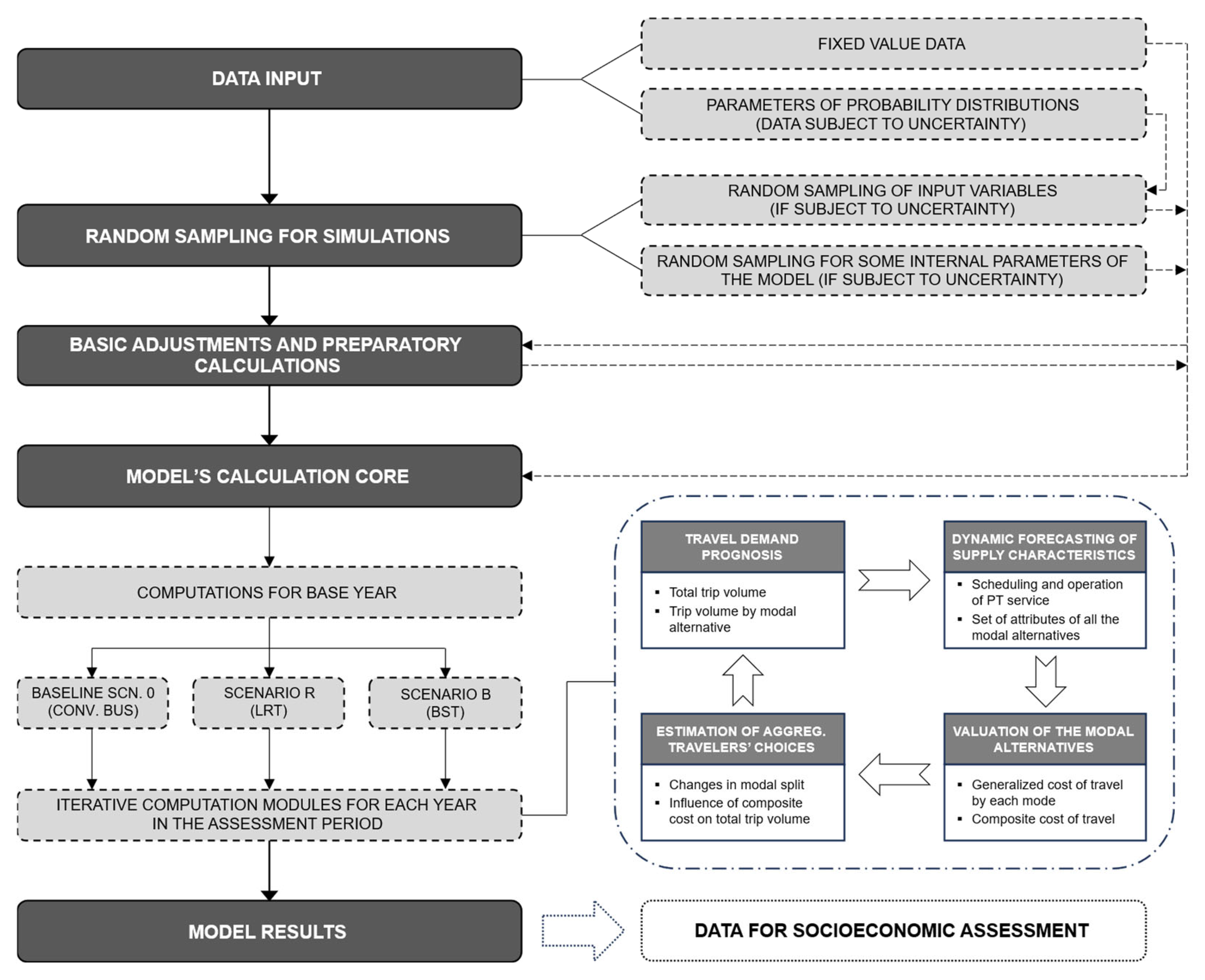
Regarding the main calculation sections, the core of the model represents mathematically, for each of the scenarios and in each stage of the assessment period, the mutual interactions and interdependencies between the following classes of processes:
Travel demand prognosis: This is aimed at forecasting trip volumes (trips/hour) made by each of the modal alternatives, along with the sum or total trip volume for the entire set of alternatives in the analyzed corridor.
Dynamic forecasting of the full set of supply characteristics: This process consists of calculating values for all of the variables involved in the sizing, scheduling, and operation of the public transport service, as well as those representing the features or attributes that the other modal alternatives offer to their potential users. The model incorporates the substantial impact that the trip volume forecast for each modal option has on the values of the supply-side variables (chiefly through the scheduling, headway and resulting waiting time at stops, operating speed, and crowding costs in the public transit systems, and via several congestion costs for the private motorized transport).
Valuation of the modal alternatives: On the basis of the attributes offered by the modal alternatives and the relative value that travelers place on each of these attributes, a comprehensive valuation is performed for each modal option (via the concept of generalized cost of travel), as well as an overall valuation of the full set of available modal alternatives (by means of the composite cost of travel).
Estimation of aggregate travelers’ choices: The valuation of each modal alternative (with the generalized cost of travel for each of them) is used as a basis to forecast changes in the modal split (incorporating considerations of the existence of captive users of any specific mode who lack the opportunity to choose). Moreover, the composite cost of travel for the whole set of alternatives influences, through the trip distribution stage, the expected total trip volume in the corridor under analysis. The results of this process must be returned to the travel demand prognosis in order to check whether they are consistent with the initial forecast, and, if not, they are used to compute a new approximation continuing the loop.
Figure 1 displays a chart that shows the relations between the categories of processes within the core of the model, and also situates this core within the general framework of the model.
The development of the model’s sections intended to forecast travel demand and aggregate travelers’ choices is based on the theoretical reference framework of a gravitational, synthetic model of trip distribution and modal split. A general formulation of this kind of models is commonly specified as shown in Equation (1) (e.g., [
72] (pp. 211–212), originally attributed to [
73]):
where
is the trip volume between origin
i and destination
j made by travelers of segment or type
n by using modal alternative
k (so
represents the whole trip volume from
i to
j made by travelers of segment
n, whichever modal alternative they choose);
is the total trip volume with origin in zone
i made by persons of type
n;
is the total trip volume with destination in zone
j;
and
are balancing factors, respectively, for origin
i (with regard to trips made by travelers of segment
n) and for destination
j, which result from enforcing as model conditions
and
;
is the generalized cost of traveling from zone
i to zone
j by mode
k as perceived by persons of segment
n;
is the composite cost of traveling from
i to
j for persons of type
n;
is a parameter that controls among travelers of segment
n the sensitivity of the modal split to the differences between the generalized cost of the modal options (
λ is actually inversely proportional to the dispersion in mode choice);
is another parameter that regulates the sensitivity of destination choice (in the trip distribution) to the accessibility or ease of access (measured as inversely proportional to the composite cost) between origins and destinations for persons of type
n; and
is the modal share of trips from
i to
j made by modal alternative
k among the group of travelers of segment
n.
Thus, the generalized cost of travel for the different modal alternatives is the main variable governing the behavior of the demand model. The generalized cost of travel is a quantitative measure in which the main attributes associated with the disutility of making a trip via a certain transport mode (i.e., the set of several disincentives or deterrent factors that an individual faces in making that journey) are combined additively in proportion to their relative importance as perceived by the travelers [
72] (pp. 177–178). Therefore, the generalized cost is usually modeled as a linear function of those attributes, weighted by coefficients that represent the relative value that travelers place on them. Thus, the generalized cost converts and adds the different nature and value of this set of attributes (such as the time spent in each trip stage, money spent, other possible disincentives like discomfort, etc.) to a single, common measure, which is usually expressed in terms of equivalent monetary units (sometimes equivalent time). A typical generic specification for the generalized cost of travel may be given by Equation (2):
where
denotes the
h-th cost element—or attribute—of the generalized cost of traveling from origin
i to destination
j via mode
k;
is the coefficient that weights the relative value that persons of segment
n place on the
h-th attribute when traveling via mode
k; and
is a modal penalty—or “bonus” if it diminishes the generalized cost compared to other alternatives—associated with traveling via mode
k from
i to
j, as valued by travelers of type
n (in fact, this modal penalty is assumed to encompass all other possible attributes not explicitly included as
).
The composite cost
is a measure that values (in the same units as the generalized costs of the modal alternatives) the general disutility perceived by persons of segment
n to make a trip from origin
i to destination
j, given the full set of modal options they could choose. In this regard, the composite cost of travel is, as advanced above, an inverse measure of the accessibility or ease of access to a certain destination zone from a given origin. The correct mathematical specification of the composite cost of travel is given by Equation (3) (e.g., [
72] (p. 213), originally attributed to [
74]):
Building on the framework of the gravitational, synthetic modeling of trip distribution and modal split, incremental formulations have been developed and applied successively in the model, resulting in a kind of model that falls under so-called pivot-point modeling. In practice, an advantage of this kind of modeling is the opportunity to forecast future or hypothetical travel demand on the basis of its current or actual levels (e.g., total trip volume and modal shares of the different alternative modes). To do so, it suffices to consider only the expected changes in the cost-attributes or service-level variables of the modal alternatives between the current or actual circumstances and the future or hypothetical situation (i.e., the predicted changes in the generalized cost for each transport mode). This feature of pivot-point models makes it possible to ignore the values of all cost-attributes which can be assumed to not vary from the baseline situation or scenario to the others (in fact, the absolute levels of all of the attribute-variables can remain unknown too, as, in practice, only differences matter).
The incremental formulations for the total trip volume from
i to
j made by travelers of type
n and for the modal split can be expressed, respectively, as shown in Equations (4) and (5):
where the variables marked with the prime symbol refer to the values of such variables in a subsequent or hypothetical situation after a change
in the generalized cost of at least one modal alternative, and the variables without the prime symbol relate to the state regarded as original (i.e., before/without the changes).
Let us define a growth rate
as the proportional increase from the original state to a later situation of the total trip volume from origin
i to destination
j made by travelers of segment
n due to factors not related directly to the travel cost between
i and
j (such as population growth over time, employment changes, income changes, age distribution changes, overall mobility increase, location/relocation of activities attracting trips, etc.). Thus, this growth rate can be expressed as shown in Equation (6):
Then, Equation (7) results from Equations (4) and (6):
and from Equations (7) and (5) results Equation (8):
where the change in composite cost
(i.e.,
) can also be computed through an incremental form, as shown in Equation (9):
As the demand forecasting model employs an incremental formulation, it is necessary for the model to compute the variations in the generalized cost of the modal alternatives over time (i.e., from one year to another), and to subsequently calculate the differences in these generalized costs between scenarios.
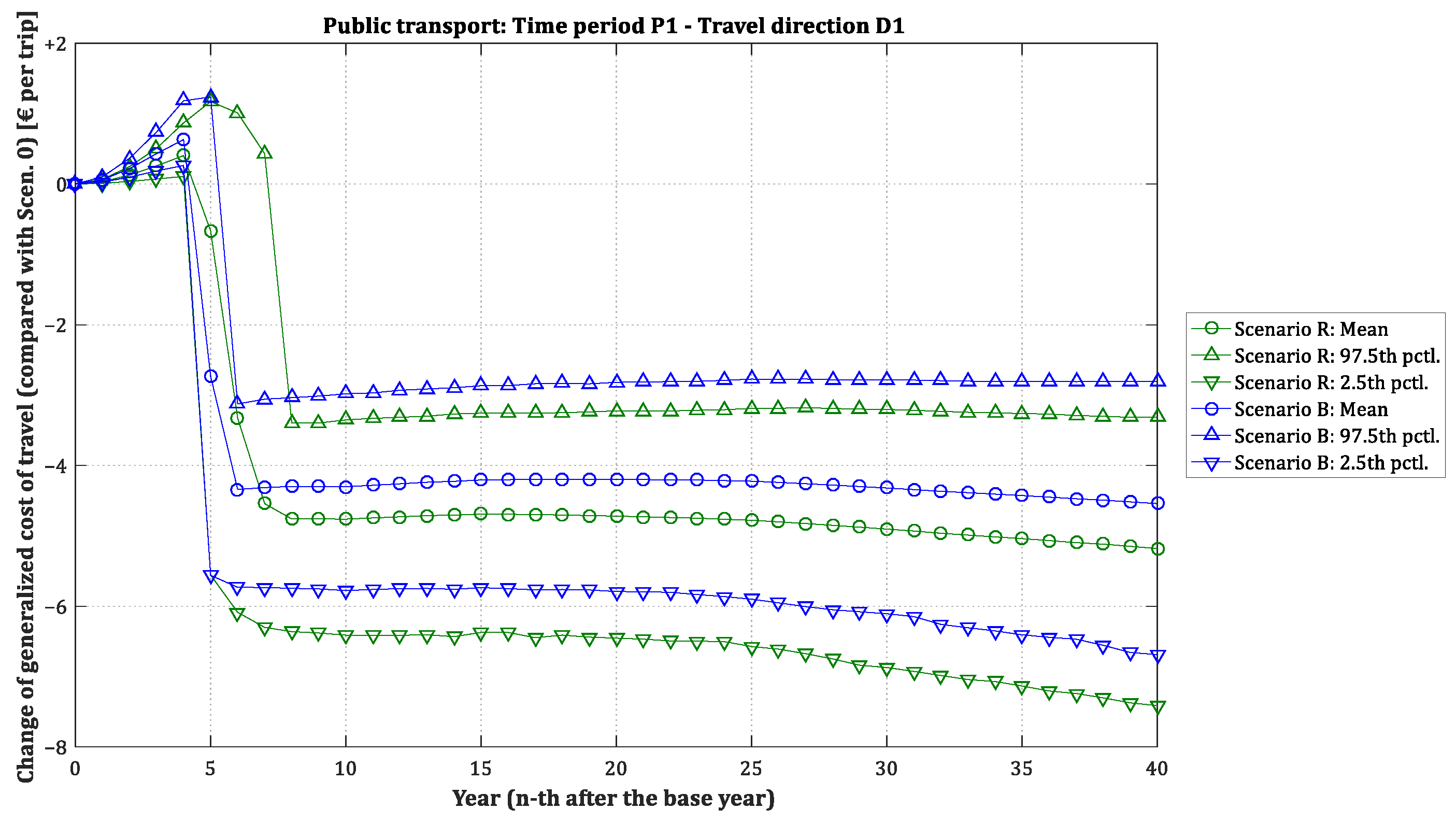
Consequently, for the different modes of public transport, the model computes changes in the following constituents of the generalized cost: the fare paid per trip; the base cost associated with the in-vehicle time in public transport; the potential increase over the base cost of in-vehicle time due to the discomfort derived from the level of crowding of passengers; the cost of the average waiting time at stops or stations; and the additional cost linked to possible deficiencies in the reliability of the public transport service on account of lack of adherence to schedules, potential delays, uncertainty about arrival time, etc. For the medium-capacity transit systems of new implementation, the model also includes a potential reduction in the generalized cost of travel due to the valuation of the modal bonus attributed to either LRT or BST relative to conventional buses.
For the modal alternatives of private motorized transport, the model computes changes in the following components of their generalized cost of travel: the cost of the in-vehicle time in private motor vehicle, including potential increases in the cost per time unit due to unpleasant travel conditions resulting from high road congestion; the cost assumed by the traveler as a result of the variability, unreliability, or unpredictability of travel time via private motor vehicle; the private cost incurred per traveler on account of the vehicle’s energy consumption, in the form of fuel and/or electric power, depending on the type of vehicle; and other possible modal costs involved in the use of private motorized travel (e.g., parking costs, possible urban/metropolitan tolls, effect of other additional restrictions on car use, etc.), which, from the model’s point of view, are considered as exogenously set (i.e., as input variables to be determined by the analyst).
As regards non-motorized and micromobility modes (pedestrian mode, and bicycle and/or other PMVs), the way the model treats changes in the generalized cost of these alternatives is circumscribed to reflecting the value placed by the traveler on the impact of exogenous measures (therefore out of the scope of the model’s internal calculations), so these generalized cost changes must be input as external variables with values expected or known by the analyst. Anyway, the model assigns common values for the three scenarios to each kind of exogenous cost change, so as not to unbalance the equality of external conditions in which the comparative evaluation of public transport systems should be carried out.
Thus, the core of the model developed consists mainly of a calculation stream configured in accordance with the bases described above. In each year of the assessment period, this calculation stream must be sequentially computed for each combination of corridor (if more than one is specified), time period (hourly, daily, or weekly demand pattern), and travel direction.
The calculation stream starts by computing (either as an initial approximation or with the outputs from the previous iteration) the trip volume (trips/hour) for each modal alternative. The trip volume for the public transport mode (LRT, BST, or conventional buses, depending on the scenario and phase or stage) allows to derive the design passenger volume of the transit line to be derived, which is a key parameter for scheduling the service. This step essentially consists of determining the most appropriate headway—rounded down to a clock headway if appropriate—ranging within an interval whose upper endpoint is the policy headway and whose lower endpoint is linked to the capacity limits of the transit system. In the model, this is followed by calculations on the density of standing passengers (prs/m2), both on the maximum load section and average over the line, as a measure of PT crowding.
Then, the model proceeds with some basic calculations concerning the traffic intensity in mixed traffic, with the volume-to-capacity ratio as the final output. This ratio will influence not only the travel conditions for private motor vehicles but also the operating conditions of conventional buses in mixed traffic. It should be noted that the model allows different street/highway capacities to be set before and after the insertion of the new transit system with reserved right-of-way; thus, the street/highway capacity for mixed traffic can differ between scenarios (substantially between scenarios R or B and 0, and slightly between R and B).
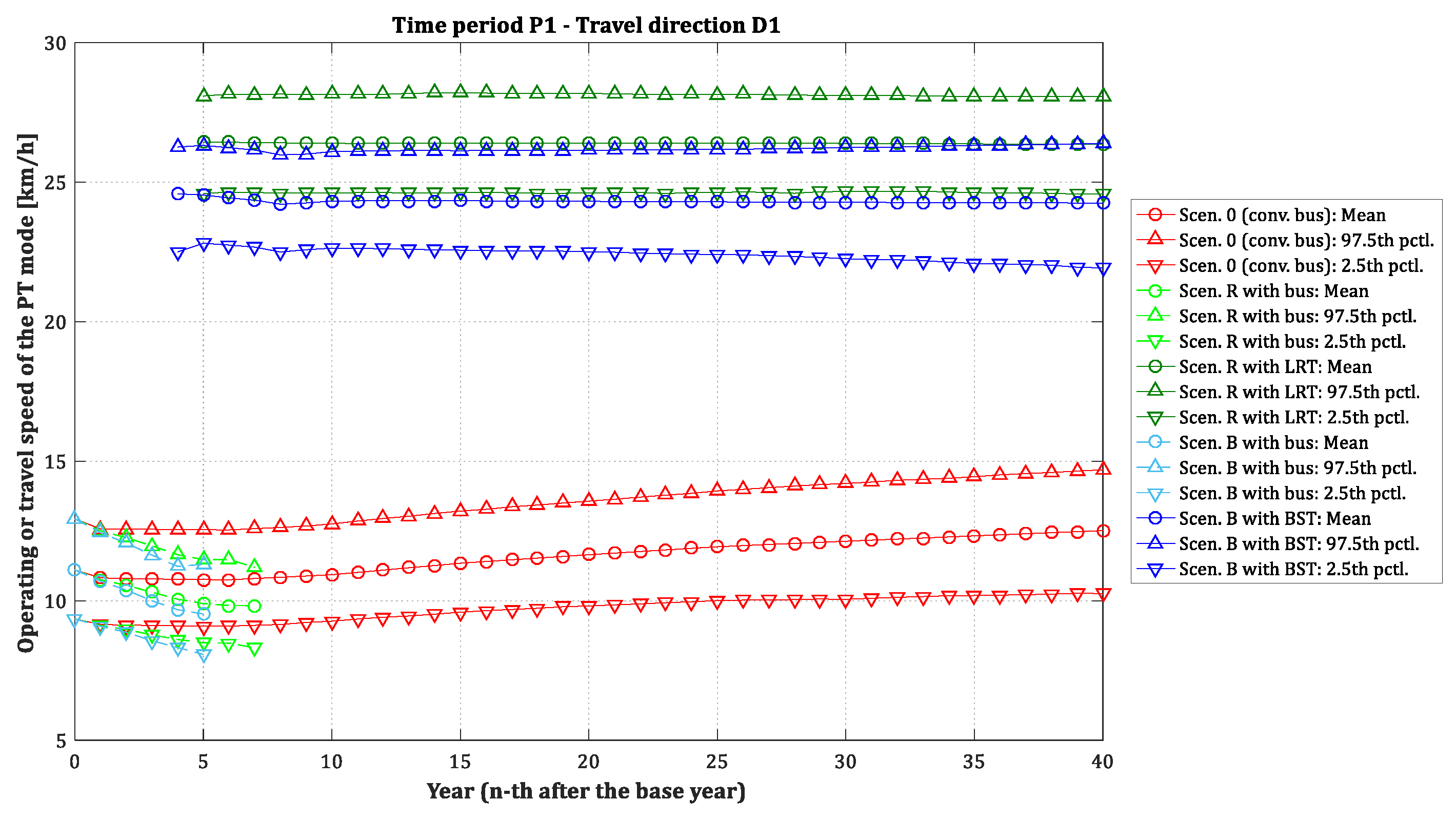
The next procedure consists of computing a series of intermediate variables that lead to the operating or travel speed of each of the public transport modes. The operating time used for this calculation includes, for LRT, the sum of running times (with consideration of reduced effectiveness of Transit Signal Priority systems when frequencies are near the TU line capacity), aggregate passenger service times at stops/stations (longer with higher densities of standing passengers), and aggregate door opening and closing times. The operating time of the BST follows a similar structure but adds to the dwell times an increase factor on account of the possibility of stops failure (if actual headway is near the station headway, a bus arriving at a stop could find the loading area full, exceeding the stop capacity). The operating time for conventional bus is composed of the sum of its running time (computed as a vehicle running on mixed traffic, thus depending on the volume-to-capacity ratio), aggregate passenger service times (influenced by the density of standing passengers), door opening and closing times, and reentry delay for off-line stops (with the sum of the latter three components affected by a stops failure increase factor as the actual headway approaches the station headway).
The operating speed of each public transit mode, along with the average distance that passengers travel on the line, allows one to find the average in-vehicle time for PT users. This in-vehicle time is augmented by a time multiplier that takes into account the inconvenience that passengers experience due to crowding, so it is computed as a function of the density of standing passengers. Next, the model estimates the average waiting time for passengers at stops/stations depending on the service headway, but taking into account a fraction of passengers who will attempt to adjust their arrival to the transit stop to the timetables or real-time predictions in order to reduce their waiting time. Following this, the model proceeds with an indicator of the travel time reliability of the public transit service by estimating the mean lateness for each PT mode. For conventional buses in mixed traffic, it is assumed that the travel time reliability will depend mainly on the volume-to-capacity ratio along the route, decreasing the reliability (increasing the mean lateness) with higher ratios. For transit systems with reserved right-of-way and Transit Signal Priority (that is, LRT and BST), the model assumes that the travel time reliability will diminish for very short headways as the service headway approaches the minimum headway of the line related to line capacity.
Then, the model proceeds to calculate the changes in the generalized cost of the public transport modes according to the specification of the generalized cost of travel
shown in Equation (10) for the average trip length on a line, when it is made by travelers of segment
n using PT mode
k in scenario
s (where the PT mode will be bus in mixed traffic, LRT, or BST, depending on the scenario and its phase or stage):
where
f is the fare paid per trip;
is the in-vehicle travel time;
is the waiting time at stops/stations;
is the mean lateness (cf. ([
75] (p.15)), ([
76] (pp. 79–80)));
Bn is the modal bonus for LRT or BST (set to 0 for conventional buses) measured as generalized in-vehicle time;
MC is the time multiplier accounting for PT crowding [
77,
78,
79];
WR is the waiting ratio, i.e., how many minutes of in-vehicle time are cost-equivalent, from the passenger’s perspective, to a minute of waiting ([
75] (p. 9)), [
80,
81,
82];
LR is the lateness ratio, i.e., how many times greater is the cost of a minute of lateness, as valued by the passenger, compared to a minute of regular in-vehicle time ([
75] (p. 15)), ([
76] (pp. 79–80)), [
82];
is the value of in-vehicle time for public transport; and
represents all other modal costs (penalties) linked to public transport use (assumed to be constant over time during the assessment period and equal between scenarios).
As regards the modes of private motorized transport (automobile and motorcycle/moped), the model calculations are resumed by computing the average travel speed for each of these modes on the corridor under analysis. This is based on the widespread BPR formulation—with adapted parameters—as a volume–delay function, so the calculated speeds capture the influence of the volume-to-capacity ratio. These speeds, along with the average distance on the corridor for the trips in which private motorized modes compete with the public transit line, allow to compute the in-vehicle travel time for private motorized modes. Furthermore, the model computes a rate of incremental cost for congested traffic conditions in addition to the regular value of in-vehicle travel time, with an increasing rate as the volume-to-capacity ratio exceeds two-thirds. Next, the model calculates an estimation of the standard deviation of the travel time for private motorized modes as a measure of journey time variability, which diminishes the reliability or predictability of traveling via these modes and thus results in an increased travel time cost. Moreover, an estimation of the average cost per trip due to the vehicle’s energy consumption—fuel and/or electric power—is computed by the model. In this regard, the model introduces the dependence of the fuel consumption on the average speed by following mainly the guidance of [
83] (pp. 54–80).
The calculations described in the paragraph above allow for the changes or variations in the generalized cost of the private motorized modes to be computed, with the specification of
shown in Equation (11) for the average travel distance along the corridor (where
k is, in this case, either automobile or motorcycle/moped):
where
is the in-vehicle travel time on the corridor or route;
is the estimated standard deviation of the in-vehicle travel time ([
75] (pp. 13–14, 30–31)), [
84,
85,
86];
ACR is the rate of additional travel time cost for congested traffic conditions (cf. [
76] (pp. 65–66));
RR is the reliability ratio for private motorized transport, i.e., how many minutes of travel time are cost-equivalent, from the passenger’s perception, to a variability of one minute of standard deviation ([
75] (p. 14)), ([
76] (p. 80)), [
87,
88,
89,
90,
91];
is the value of the in-vehicle time for private motorized transport;
E is the average energy consumption cost along the corridor per vehicle and trip;
o is the average occupancy per vehicle; and
represents other modal costs (penalties) of private motorized transport modes (assumed to be subject to potential changes over time, but always equal between scenarios).
At the end of the calculation stream, the changes in the generalized cost of the public transport mode and of the private motorized alternatives from a prior year—commonly the immediately preceding—to the analyzed one, along with the respective changes in non-motorized and micromobility modes, enters the calculation of the change in the composite cost of travel (Equation (9)), which then allows for the new trip volume via each modal alternative (Equation (8)) to be computed, which can be disjoined into the total trip volume (Equation (7)) and modal split (Equation (5)).
The series of coupled equations formed from the calculation stream described in the previous paragraphs composes a large, non-linear system of equations, in which the basic variables for solving it (such as the future trip volumes for each transport mode or, alternatively, the future variations in the generalized cost of travel for each of these modes) are some of the unknowns of the problem. Finding solutions for this equation system requires iterative procedures for any year of the assessment period after the base year (i.e., for the model’s forecasting of future values) to be employed. These procedures are performed in the model by means of a set of iterative calculation modules.
The methodological treatment of the uncertainty involved in any forecasting exercise, as well as in the modeling process itself, has been incorporated into the model from the beginning of its development. This uncertainty arises from a combination of limitations in the available information (uncertainty about the reliability or accuracy of the values to be used as input data and, especially, about the future evolution of some of these data) and in the methodological modeling (related to simplifications, accepted assumptions, or other potential sources of inaccuracy). In order to address this issue methodologically, all of the variables that are reasonably expected to be subject to a considerable level of uncertainty have been modeled as random variables, each of them following its own probability distribution. In this regard, the model assumes the use of triangular distributions [
92] (pp. 338–339) to simulate, in practice, the probabilistic behavior of this kind of variable. In addition, it is necessary to bear in mind the foreseeable existence of statistical correlations between some of the model’s variables that are subject to randomness (for example, different input variables that are all linked to travelers’ income or socioeconomic level, the evolution of the price of different fuel types such as gasoline and diesel fuel, etc.), so a reasonable degree of correlation between this kind of variables has been introduced in the preparatives of the randomization process.
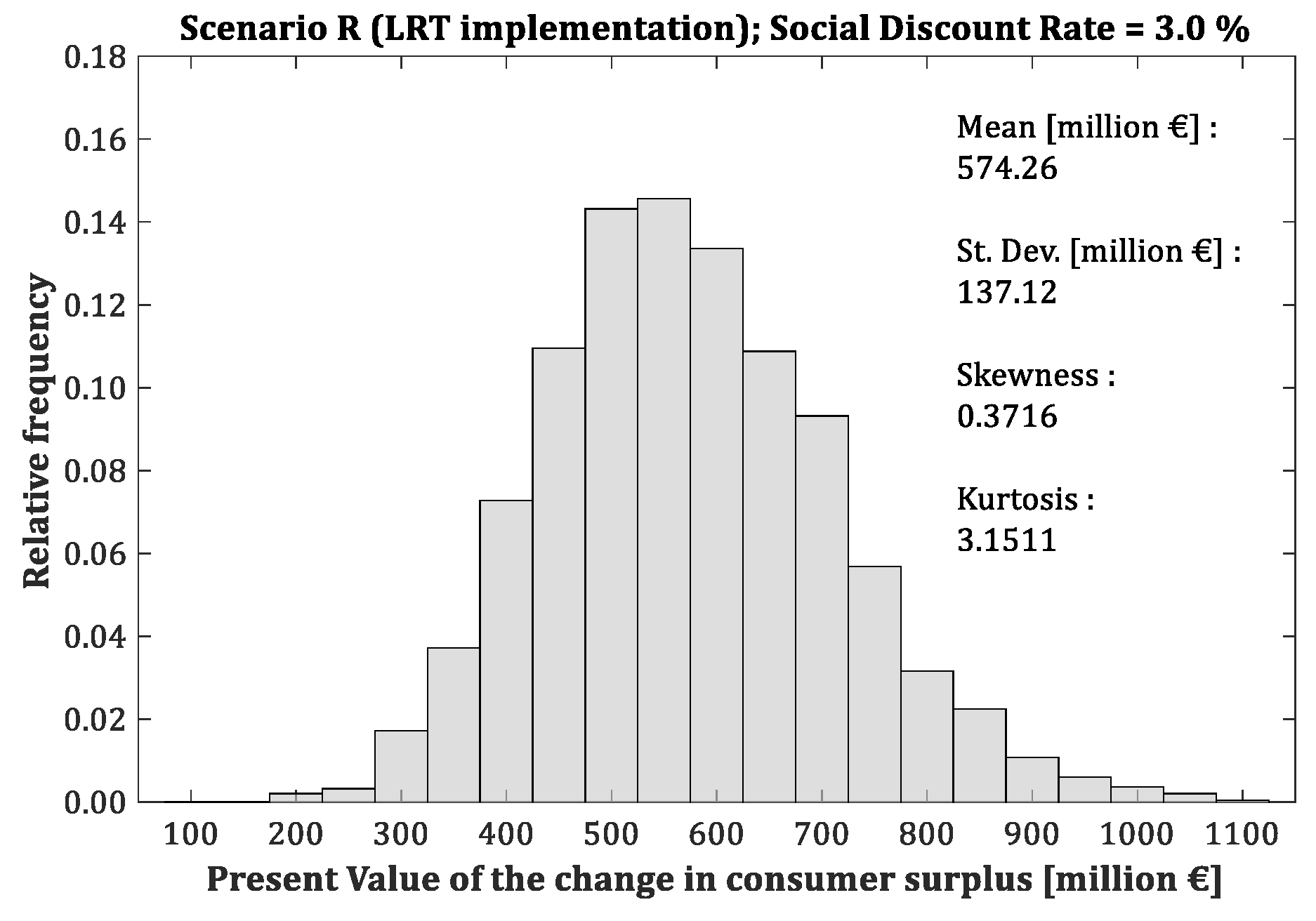
Finally, Monte Carlo simulation techniques, based on repeated random sampling, are applied to the model. The method applied in this case consists of the computational implementation of multiple simulations or executions of the model, each time by using as inputs different sets of random variates that were previously sampled or drawn from the probability distribution of the respective variable according to its probability density function. By performing all of these simulations, the method generates a synthetic sample of multiple values (with a sample size equal to the number of random simulations that have been carried out) for each of the model’s output variables. This sample of potential results for each output variable can be statistically processed and thereby characterized by parameters such as its mean value, standard deviation, percentiles, etc., as well as with histograms of relative frequencies.
5. Conclusions
The model presented in this article provides a sound basis for the forecasting of future values of a wide set of transport and transport-economic variables that are required for a comprehensive, correct qualitative ex ante evaluation of the two main types of medium-capacity transit systems (light-rail based systems such as LRT or modern tramway, and bus semirapid transit systems) when their possible implementation is proposed for a corridor, axis, or route carrying a medium PT-ridership volume, usually as a replacement for a highly loaded conventional bus line in mixed traffic. The proposed model is based on the general framework of a gravitational, synthetic modeling of trip distribution and modal split with incremental formulations; however, its particular development incorporates the effects, both on demand and supply, brought about by the specific characteristics and differences of these two classes of transit systems. In this regard, the model includes a comprehensive set of modal attributes or cost elements susceptible to change between scenarios and over time, not only for public transport modes but also for private motorized alternatives. Furthermore, while the solid formal, analytical principles on which the model is grounded allow us to set equal external conditions and “game rules” for both types of transit systems, the configuration of the set of possible input variables and subsequent design of the model enable sufficient flexibility for its application to a wide variety of case studies, without the necessity to adhere to specific network schemes, distribution of stops, etc.
This model is distinguished by its consistent integration of all the systematic processes covering the travel demand prognosis, the dynamic forecasting of the full set of supply characteristics and trip attributes, the valuation of the possible modal alternatives as a function of those attributes, and the estimation of the aggregate travelers’ choices in the modal split and trip distribution, including the mutual interdependencies between all those coupled processes. This enables the model to provide a wider, more integral approach to the comparison of both kinds of medium-capacity transit systems, in contrast to the more fragmented or restricted approaches observed in much of the literature, which tend to focus on delimited aspects such as their attraction potential for travelers, investment and operation and maintenance costs, user costs for PT riders only, environmental emissions, or even qualitative judgments. Another advantageous feature is the comprehensive range of input variables that can be entered and modified in the model, which enriches the potential analysis of factors that can influence the results of LRT and BST implementation projects.
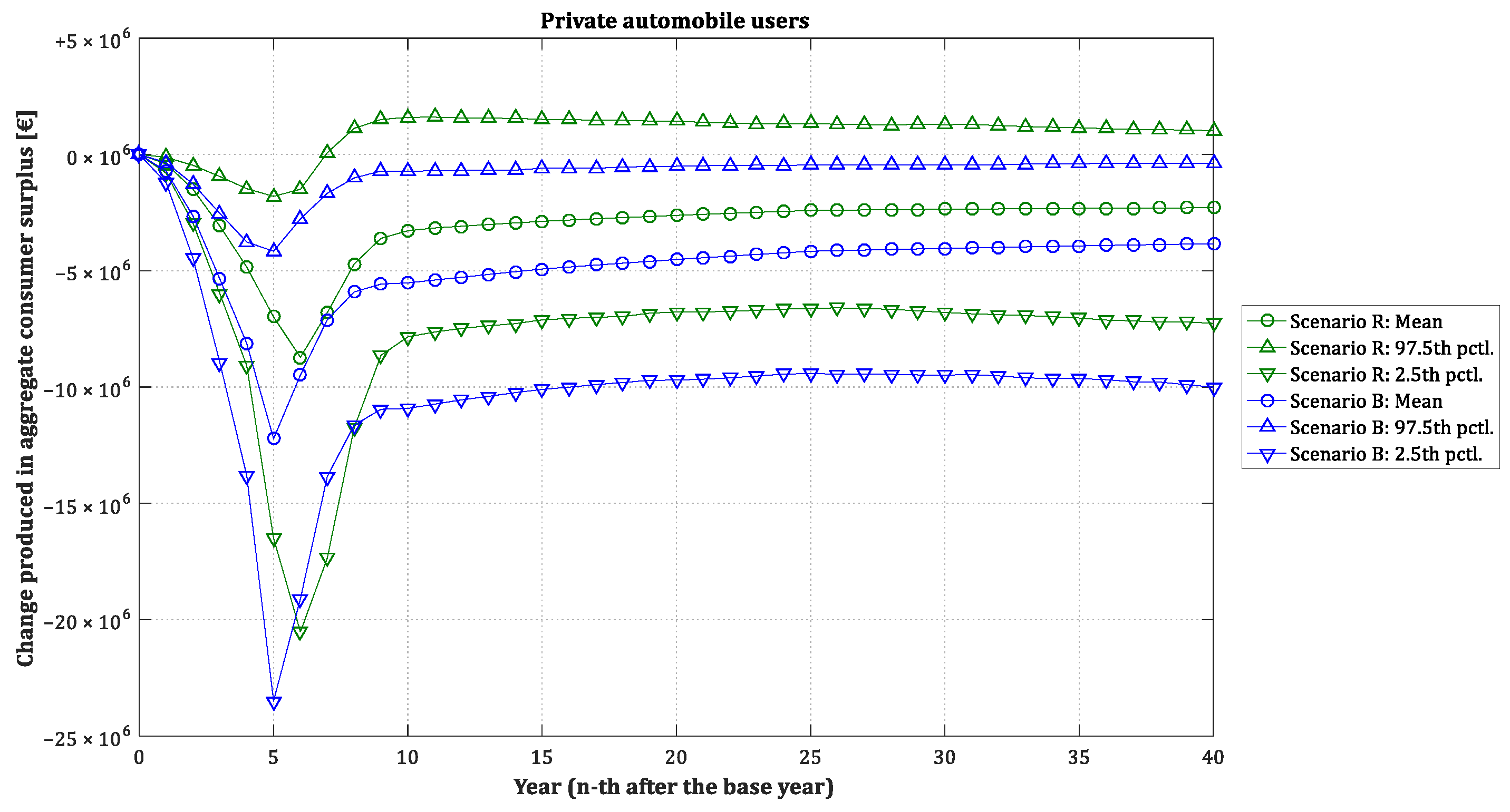
Although this study aimed to compare the results of the implementation of public transport systems, the proposed model incorporates, to a degree, a multimodal approach as a crucial requirement to capture the cross effects between different modal alternatives, both in demand and in travel attributes, instead of limiting the analysis to the performance of the PT modes. These cross effects cannot be neglected, as they can lead to significant changes in the consumer surplus for users of other modal alternatives (e.g., automobile users) and would affect subsequent evaluation stages, such as the assessment of environmental external costs (for example, through changes in trip volume made by automobile and resultant emissions). Another complementary characteristic of the developed model is the explicit distinction of different phases over the assessment period in each alternative scenario, on account of the very dissimilar conditions occurring in the course of the implementation and posterior service operation of the public transport systems. This distinction can be especially relevant for capturing additional congestion costs occasioned by the construction works performed during the implementation phase (with reduced street/highway capacity for mixed traffic) of the new systems. Additionally, the model can capture and separately manage the different travel conditions that delimitate a series of time periods such as peak hours, off-peak hours, or any other period considered appropriate (i.e., multiperiod approach), instead of circumscribing the analysis to only one characteristic time period (typically peak hours).
Another contribution of the proposed model is that its practical implementation is designed to meet the requirements of the highest levels of risk analysis in the assessment of projects or plans, as that design incorporates the methodological treatment of uncertainty from the outset of its development to enable the straightforward execution of multiple model simulations, based on repeated random sampling in application of Monte Carlo simulation techniques. The management of randomness in the model covers the uncertainty from data or input variables as well as from certain internal parameters potentially subject to some degree of uncertainty; in addition, the design of the model takes into account the expected existence of correlations between some of the variables subject to randomness. The resulting level of statistical analysis overcomes the weakness and false security of any deterministic approach, and even the shortcomings of some simplified approaches, such as setting a limited number of ‘optimistic’, ‘normal’, and ‘pessimistic’ scenarios.
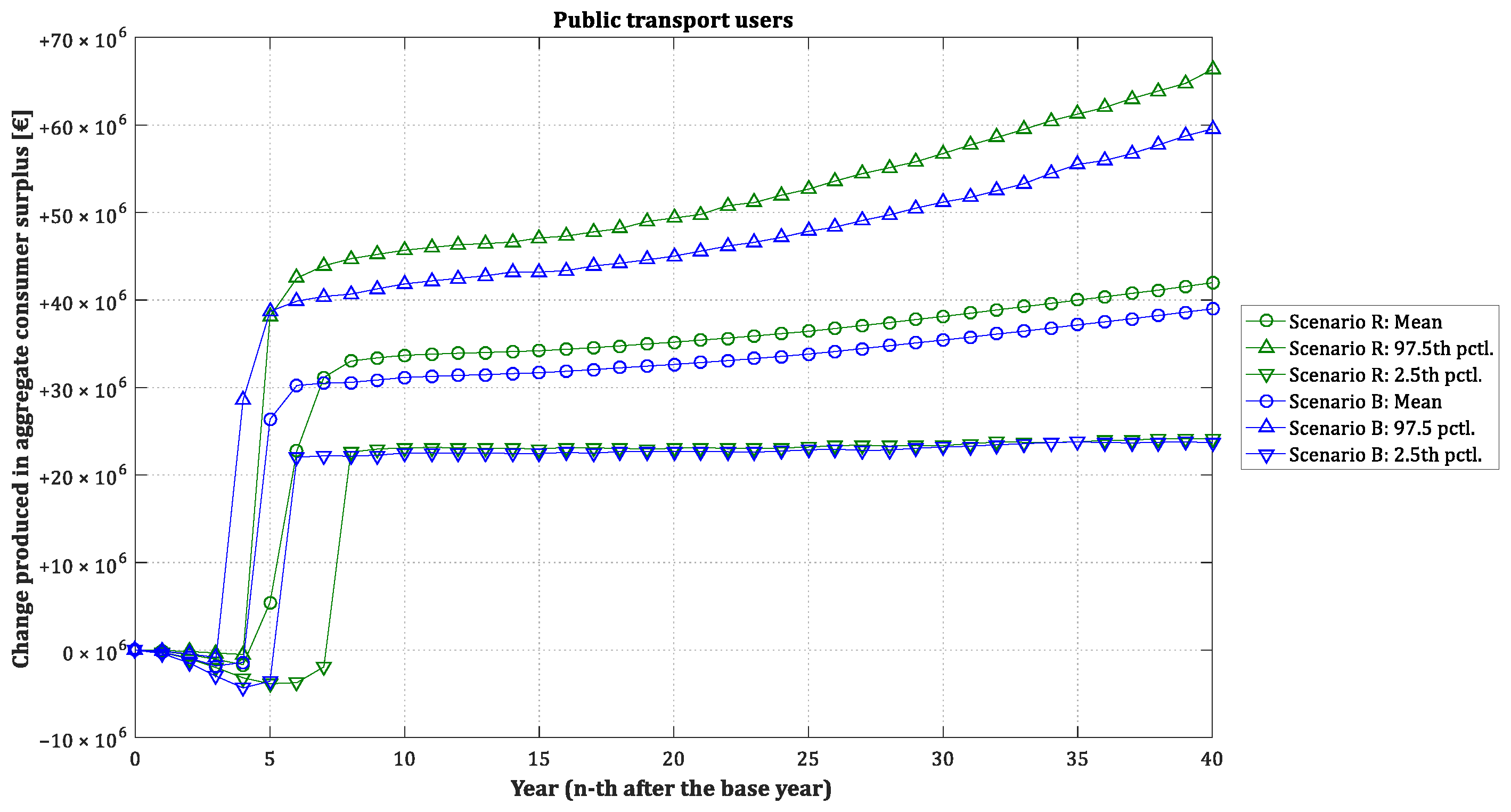
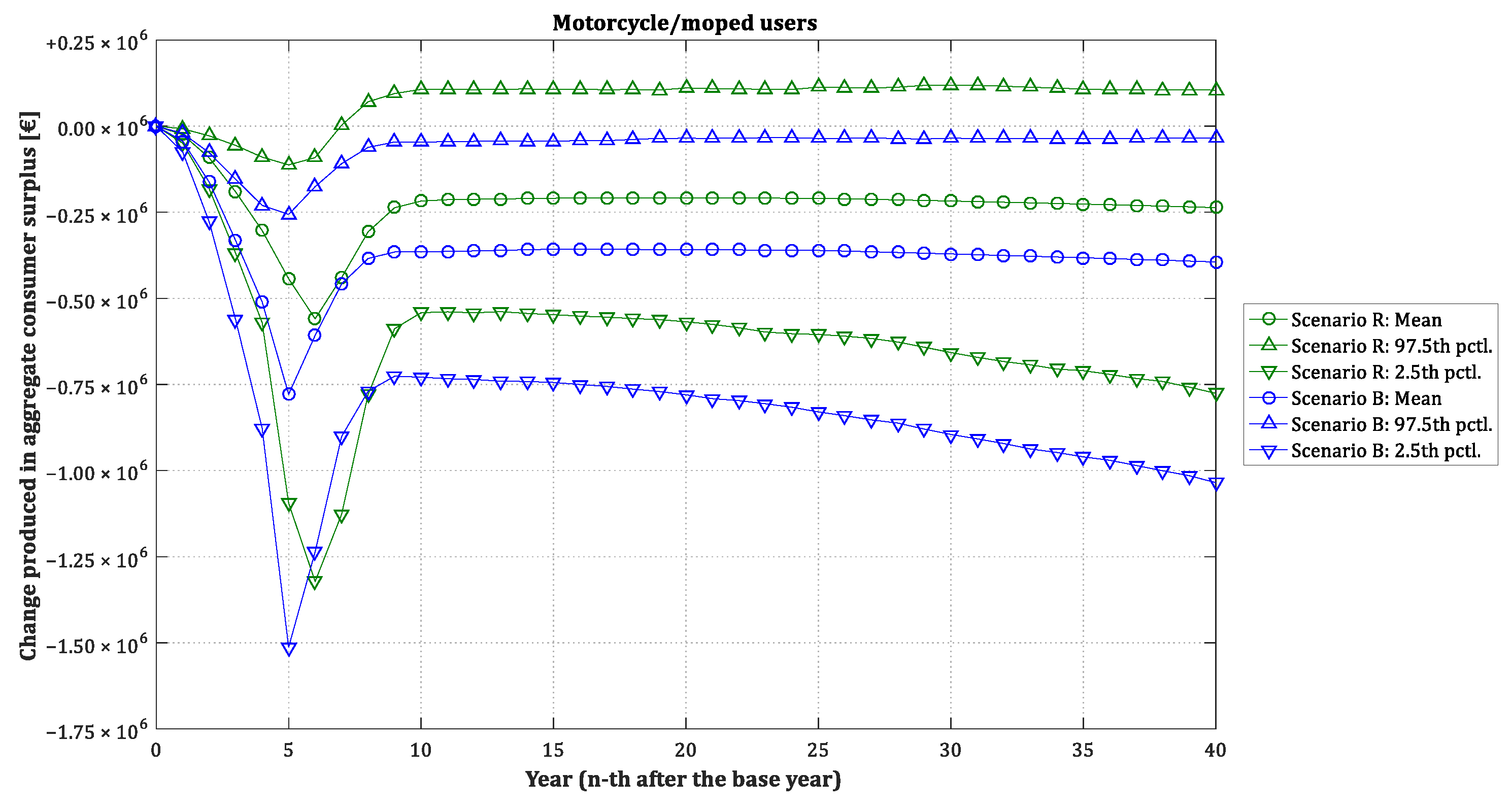
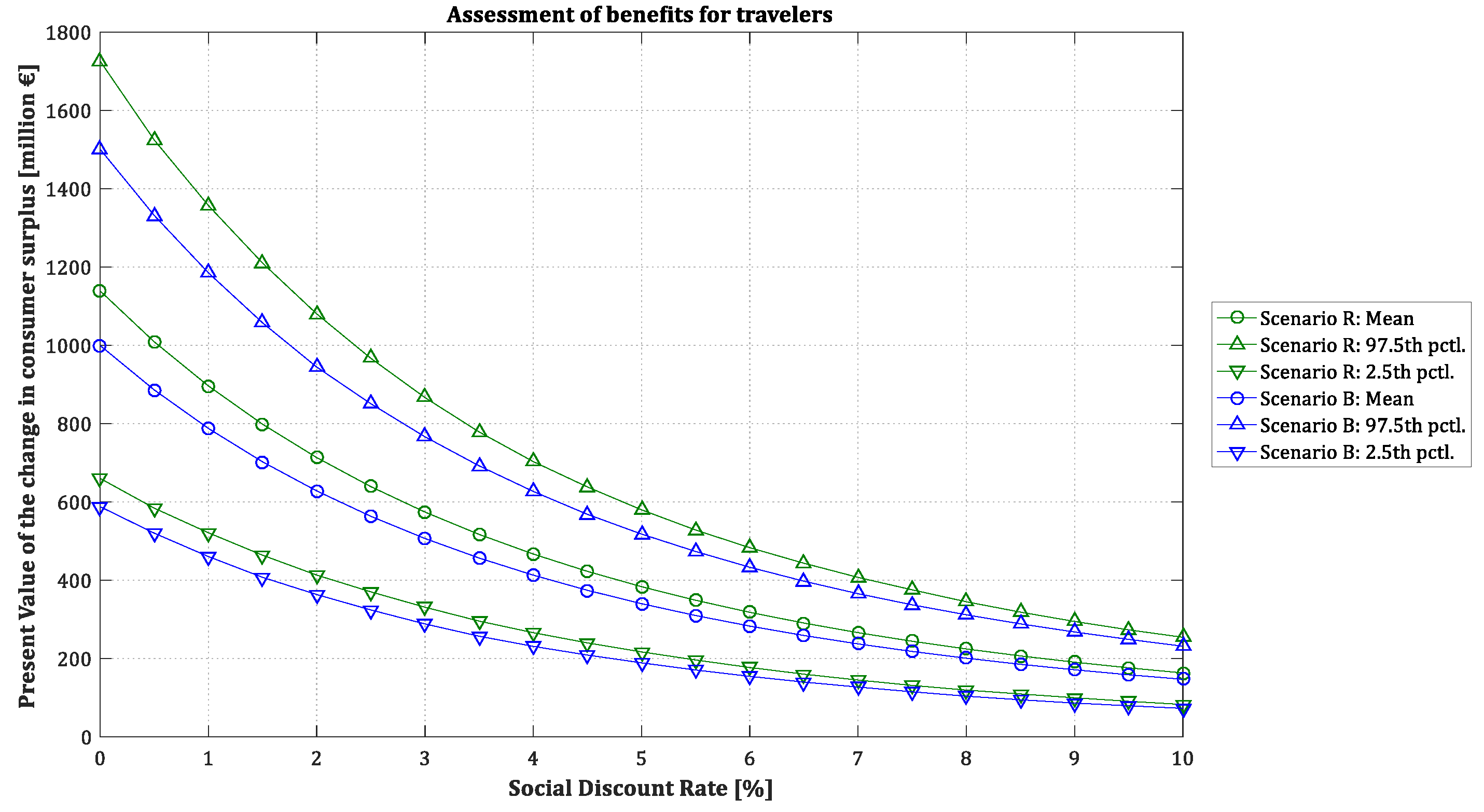
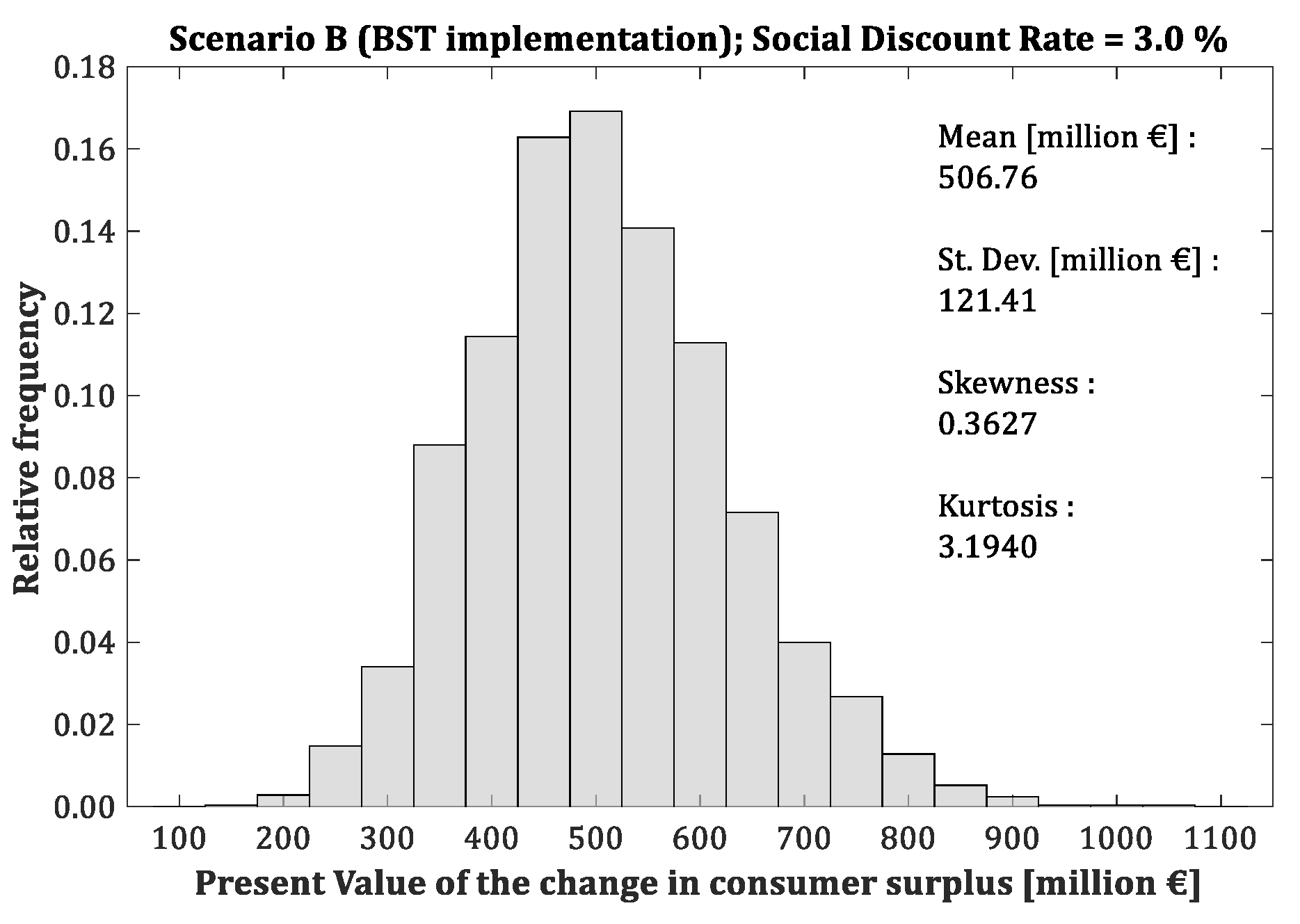
In practice, the model functioning was successfully tested by applying it to an artificial case study specifically designed to be representative of conditions usually found in corridors with medium PT-ridership volumes, mainly in European cities. Although the numerical results, as well as the conclusions derived, are specific to this particular case—or to other very similar cases—and therefore they should not be overgeneralized or immediately extrapolated to other circumstances, an interesting result is that, for the 10 km long PT line considered in the case study, the LRT system would generate a moderately higher benefit for travelers than the BST (difference of €67.5 million in mean values with an SDR of 3%), which turns into a very slight advantage for the BST (€12.5 million) when the required investment costs are deducted. However, this advantage is so narrow that it might be offset by potential differences in operation, maintenance, and external costs, so the result of this comparative preassessment should be rather deemed a tie. Furthermore, in the mid- and long term, the results of this kind of comparative evaluation may be affected significantly by recent and future technological advances in bus-based systems, as electric-powered vehicles with zero local emissions, autonomous driving, connected vehicles, and platooning alternatives might substantially alter the current conditions underlying the BST versus LRT comparisons.
Regarding the limitations of the developed model, some of the main constraints arise from its lack of full ability to incorporate wider network effects that could affect the analyzed corridors (either one or more), which would need to be introduced in an exogenous manner. With regard to the public transit network, this limitation does not enable the model to handle the potential overlapping of several lines in the same corridor. Meanwhile, for the network of urban roads for private motorized transport, that restriction does not allow the model to consider possible choices of alternative routes at the assignment stage. Another limitation is that the model framework requires to set the same stop locations for the LRT and BST lines as those of the preceding conventional bus line, mainly due to the incremental structure of the demand model. Otherwise, a very detailed, full demand model should be developed by considering all its spatial variability, hugely increasing the complexity of the model and its data requirements. Some additional limitations in the demand model stem from the use of aggregate choice models with weighted mean values, as a more refined model would require its successive, separate application to a wide number of population segments, or even the use of discrete choice models, which also would heavily expand the complexity and data requirements. In addition, the model does not require the utilization of specific stop-level data of boarding and alighting passengers. Although this releases the data requirements and thus extends the applicability of the model, the use of such data could have led to the employment of more refined operation and demand models for public transit systems. Finally, regarding the operation of the PT systems, the model is designed to consider conventional operation only. Therefore, it does not cover the potential impacts of possible unconventional strategies such as skip–stop or express services, which are sometimes used in LRT and BST lines.
Future research that may arise from the work presented in this article can be structured around three main lines of research. The first line would consist of complementing the comparative model presented with the analysis and incorporation of other factors that should be included in a complete socioeconomic evaluation of new LRT or BST projects throughout their life cycle, mainly the operating and maintenance costs involved in the service supply of these PT systems as well as changes in several types of external costs (local air pollution, greenhouse gas emissions, noise, traffic accidents, etc.) generated by the whole set of modal options, either public or private, in the new scenarios. The second line of research concerns the methodical analysis of multiple cases of numerical application of the model—such as the one shown in
Section 4—by introducing systematic variations in the values of the main input variables, covering a multidimensional range, in order to analyze the response of the main results to those variations. In this sense, the combined sensitivity of the results to variables such as the line length, annual ridership and modal share of the public transit line in the base year, the average trip length on the line, the value of time, or the street/highway capacity for mixed traffic in the corridor (before and after the intervention) could be systematically analyzed in order to draw more generalizable conclusions, and even develop simplified procedures that depend only on a reduced set of the most influential basic data. Finally, the third line of future research would be intended to surmount some of the limitations and constraints indicated above, aiming to improve the comprehensiveness and accuracy of the current model while keeping the data requirements and computation time within feasible bounds.
In summary, the research work reported here aimed to improve the ex ante evaluation of the main types of medium-capacity transit systems, so that decision making on this topic can be based on prognoses of their future outcomes more reliable, more accurate, and better supported by a consistent theoretical framework. Ultimately, this improvement would contribute, through better-informed decision making, to the selection in each case of the transit system able to yield a higher welfare gain for the society as a whole, resulting in more efficient and sustainable allocation of the funding dedicated to urban and metropolitan public transport policies.