


Abstract
In this work, we aim to enhance the photocatalytic performance of SrTiO3 by constructing a heterojunction with photoactive BiOBr. The novelty of this study lies in demonstrating the dual functionality of the SrTiO3/BiOBr heterojunction in both photocatalytic tetracycline degradation and antibacterial applications and correlating its performance with its interfacial electronic properties. A SrTiO3/BiOBr (50STO) heterojunction was successfully synthesized by combining microwave-assisted sol–gel-derived SrTiO3 with co-precipitated BiOBr via solid-state calcination. XRD analysis revealed that the synthesized composite consisted of crystalline cubic SrTiO3 and tetragonal BiOBr, confirming the successful formation of a 50STO heterojunction while preserving the crystal structures of both components. PL and EIS analyses revealed modified charge-carrier behavior, further supporting the successful formation of the 50STO heterojunction. XPS confirmed the chemical states of the constituent elements and revealed changes in the surface chemical environment following the coupling of SrTiO3 with BiOBr. SEM, elemental mapping, and UV–Vis DRS analyses demonstrated uniform elemental distribution, enhanced visible-light absorption, suppressed electron–hole recombination, and improved interfacial charge transfer. Consequently, the optimized 50STO composite achieved 45% tetracycline degradation under visible-light irradiation within 150 min, whereas pristine SrTiO3 degraded only 2%. The apparent reaction rate constant increased from 6.11 × 10⁻⁷ to 3.2 × 10⁻³ min−1, while the heterojunction remained stable over five reuse cycles. Radical scavenging and LC–MS analyses identified h+ and •OH as the dominant reactive species and revealed successive tetracycline degradation. The composite also exhibited excellent antibacterial activity against E. coli under white-light irradiation.
1. Introduction
Antibiotic contamination in surface waters has become a critical environmental concern due to the widespread use of antibiotics in agriculture and medicine. These pollutants are primarily introduced through wastewater effluents, pharmaceutical discharge, and agricultural runoff, with concentrations reported up to 450 μg/L [1]. Among them, tetracycline (TC) is one of the most frequently detected antibiotics, posing significant ecological risks even at low concentrations. It can disrupt microbial communities, inhibit the growth of aquatic organisms, and contribute to the spread of antibiotic resistance. These impacts highlight the urgent need for effective treatment strategies to mitigate antibiotic pollution in aquatic environments [2].
Conventional treatment methods, including physical [3], chemical [4,5], and biological processes [6], are often insufficient for completely removing persistent organic pollutants such as antibiotics [3]. Photocatalysis is an advanced oxidation process that uses light energy and a semiconductor catalyst to generate reactive species capable of degrading organic pollutants in wastewater. Semiconductor metal oxide catalysts, such as titanium dioxide (TiO2), have been widely investigated for photocatalytic application [7]. TiO2-based photocatalytic nanocomposites have been extensively investigated for the degradation of TC antibiotics in aqueous systems under visible-light irradiation [8]. To explore alternative photocatalytic materials, this study focuses on strontium titanate (SrTiO3, STO), a perovskite-type semiconductor well known for its excellent thermal stability, chemical durability, and favorable charge transport properties [9,10,11,12]. Owing to these intrinsic advantages, SrTiO3 has attracted considerable attention as a promising photocatalyst for environmental remediation. Nevertheless, its photocatalytic performance is significantly hindered by the rapid recombination of photogenerated electron–hole pairs, resulting in low charge separation efficiency and limited photocatalytic activity. Another drawback of SrTiO3 is its wide band gap (approximately 3.2 eV), which restricts light absorption to the ultraviolet (UV) region. Since UV light accounts for only about 4–5% of the solar spectrum, the practical solar-driven photocatalytic efficiency of pristine SrTiO3 is inherently limited. To overcome these limitations, this work employs heterojunction engineering as an effective strategy to improve visible-light utilization and suppress the recombination of photogenerated electron–hole pairs [13]. Previous studies have demonstrated that constructing SrTiO3-based heterojunctions can significantly enhance photocatalytic performance under visible light. For instance, SrTiO3/Ag/Ag3PO4 achieved a maximum degradation efficiency of 79% [14], while SrTiO3/Fe2O3 showed improved tetracycline degradation compared with its individual components [15]. Similarly, Bi2O3/SrTiO3–ZnTiO3 heterojunctions exhibited notable photocatalytic efficiency for TC removal under visible-light irradiation [16].
In this study, p-type bismuth oxybromide (BiOBr) was employed as a visible-light-responsive semiconductor and coupled with SrTiO3. Owing to its relatively narrow band gap (2.61–2.90 eV), BiOBr exhibits excellent visible-light absorption. Furthermore, BiOBr, as a bismuth-based semiconductor, has been widely recognized as a promising photocatalyst for the degradation of organic pollutants in wastewater because of its favorable electronic structure, high stability, and low toxicity [17]. Another reason for selecting BiOBr is its favorable band alignment with SrTiO3, which facilitates efficient interfacial charge transfer and promotes the formation of a type II heterojunction [18]. This heterostructure is expected to promote charge separation and reactive radical generation, thereby enhancing the degradation of organic pollutants [18,19,20,21]. In addition to the photodegradation of organic pollutants, photocatalysis has been widely explored for bacterial inactivation [22]. Accordingly, in this study, Escherichia coli (E. coli) was selected as a representative Gram-negative bacterium due to its widespread occurrence as a pathogenic microorganism in wastewater and natural aquatic environments. The presence of E. coli poses significant risks to human health, including gastrointestinal infections and other waterborne diseases [23]. Recently, the TiO2–ZnO system exhibited effective degradation of oxytetracycline (OTC) and antibacterial activity, showing higher efficacy against Staphylococcus aureus than Escherichia coli, likely due to the simpler cell wall of Gram-positive bacteria [24]. Therefore, this study aimed to modify SrTiO3 through the incorporation of BiOBr to construct SrTiO3/BiOBr composites. Pure SrTiO3 was synthesized via a microwave-assisted sol–gel auto-combustion method, while BiOBr was prepared through a co-precipitation route, followed by composite fabrication using a solid-state method. Comprehensive characterization of pristine and composite materials was conducted to investigate their structural, morphological, and optical properties. Photocatalytic performance was evaluated through (i) TC degradation under visible light, including mechanistic analysis, and (ii) E. coli inactivation under white-light irradiation.
2. Materials and Methods
2.1. Synthesis of SrTiO3 via a Microwave-Assisted Sol–Gel Auto-Combustion Method
Titanium (IV) butoxide (C16H36O4Ti) (Sigma-Aldrich, St. Louis, MO, USA) and strontium nitrate (Sr(NO3)2) (HIMEDIA, Maharashtra, India) were used as the Ti and Sr precursors, respectively, at a molar ratio of 1:1 to synthesize SrTiO3. Glycine (C2H5NO2), ammonium nitrate (NH4NO3), and citric acid monohydrate (C6H8O7·H2O) (Loba Chemie, Maharashtra, India) were dissolved in 100 mL of deionized water at a molar ratio of 2:2.5:2, respectively. Glycine and citric acid served as organic fuels and complexing agents, whereas ammonium nitrate acted as the oxidizing agent. For total homogenization, the combined precursor solution was first heated to 80 °C for 2 h while being continuously stirred, giving it a milky-white appearance. Then, as a polymerization agent to improve the development of the metal–organic gel network and encourage homogeneity, ethylene glycol (EG) (Loba Chemie, Maharashtra, India) was introduced at a concentration of 8 mol before to the sol-to-gel transition. With constant stirring, the liquid was heated to 110 °C until a gel formed. The produced gel was then put in a microwave oven chamber and exposed to 1000 W of microwave power for 5 min, which caused it to burn quickly and produce a foamy, dark brown product. Afterwards, the intermediate product was finely ground and subsequently calcined in a furnace at 1000 °C for 12 h, resulting in the formation of SrTiO3 samples as a white powder. The overall chemical equation describing the addition of the reactants leading to the formation of the final product is presented in Equation (1).
Ti(OC4H9)4 + 2Sr(NO3)2 + O2 → 2SrTiO3 + by products (4C4H9OH + 4NO2)
2.2. Synthesis of BiOBr via Co-Precipitation Method
In the first step, 1.94 g of bismuth nitrate pentahydrate (Bi(NO3)3·5H2O) was dispersed in 20 mL of deionized (DI) water under continuous stirring, immediately producing a milky-white suspension containing hydrolyzed Bi(III) species. Separately, 0.476 g of potassium bromide (KBr) was dissolved in 20 mL of DI water. The KBr solution was then added to the bismuth-containing suspension under continuous magnetic stirring. The Br− ions reacted rapidly with the hydrolyzed Bi(III) species, resulting in the immediate nucleation and precipitation of BiOBr. After mixing, the resulting suspension was continuously stirred and aged for 20 min. Therefore, the specified 20 min represents the post-mixing stirring and aging period rather than the time required to initiate BiOBr formation.
After that, the resulting suspension was centrifuged at 5000 rpm for 5 min, subsequently washed three times with distilled water, and dried at 100 °C for 5 h in a hot-air oven. The dried product was subsequently ground into a fine powder using a laboratory porcelain mortar to obtain the final BiOBr sample. The corresponding chemical reaction is shown in Equation (2).
Bi(NO3)3⋅5H2O (aq) + KBr (aq) + H2O (l) → BiOBr (s) + 3KNO3(aq) + 5H2O
2.3. Synthesis of SrTiO3/BiOBr Composite via Solid-State Method
SrTiO3 and BiOBr powders were combined at a weight ratio corresponding to 50 wt% SrTiO3 relative to BiOBr, and the resulting composite was designated as 50STO. The required amounts of each powder were accurately weighed and thoroughly ground using a laboratory porcelain mortar to ensure homogeneous mixing. The mixture was then subjected to a solid-state reaction by calcination at 350 °C for 2 h in a muffle furnace. The resulting SrTiO3/BiOBr composite was subsequently collected for further characterization and compared with the corresponding pure samples.
2.4. Material Characterization
All synthesized samples were comprehensively characterized to investigate their structural, morphological, and optical properties. X-ray diffraction (XRD, Bruker D2 PHASER, Bruker AXS GmbH, Karlsruhe, Germany) was employed to confirm the crystalline structure and phase composition. The surface morphology and elemental composition of the prepared materials were examined through Field-Emission Scanning Electron Microscopy (FESEM, Apreo S, Thermo Fisher Scientific, Brno, Czech Republic) coupled with Energy-Dispersive X-ray spectroscopy (EDS). Their optical absorption characteristics were investigated using a Shimadzu UV-3101PC spectrophotometer (Shimadzu Corporation, Kyoto, Japan) operated in diffuse reflectance mode. Furthermore, the surface chemical states, elemental composition, and oxygen-vacancy-related species were examined by X-ray Photoelectron Spectroscopy (XPS) at Beamline 3.2Ua, Synchrotron Light Research Institute, Thailand, employing a photon energy of 750 eV and a beam intensity of 1.0 mW mm−2 under ultrahigh vacuum conditions below 4 × 10⁻⁹ mbar at room temperature. The recombination behavior of photogenerated electron–hole pairs was investigated using photoluminescence (PL) spectroscopy (Horiba Fluoromax-4CP). Electrochemical impedance spectroscopy (EIS) measurements were carried out on a Metrohm Autolab B.V. PGSTAT302N (Metrohm Autolab B.V., Utrecht, The Netherlands), with Nyquist plots employed to evaluate the charge transfer resistance and interfacial charge transfer dynamics. The photocatalytic degradation pathway and the corresponding intermediate species were further analyzed using a high-resolution LC-QTOF/MS-MS system (Agilent 1260 Infinity HPLC, QTOF 6540 UHD, Agilent Technologies, Santa Clara, CA, USA), providing insight into the transformation mechanism of organic pollutants during photocatalysis.
2.5. Photocatalytic Degradation
The photocatalytic performances of pure SrTiO3, BiOBr, and the 50STO composite were evaluated for the degradation of TC antibiotic in aqueous solution. The photocatalytic experiments were conducted using two 30 W visible-light LEDs positioned 50 cm above the sample surface. The irradiance at the sample surface was estimated to be approximately 19.1 W m−2. Photocatalytic experiments were conducted at room temperature using 100 mL of pollutant solution with an initial concentration of 10 mg/L and 0.1 g of photocatalyst. Subsequently, 5 mL aliquots were collected at 30 min intervals throughout the experiment, which consisted of 30 min of dark adsorption–desorption equilibration followed by 120 min of visible-light irradiation. The changes in pollutant concentration were monitored by recording the UV–Vis absorption spectra of the collected samples in the wavelength range of 200–600 nm using a UV–Vis spectrophotometer (UH5300, Hitachi, Tokyo, Japan). All photocatalytic experiments were performed independently in triplicate (n = 3). The results are presented as the mean ± standard deviation, with the error bars representing the standard deviation. Data processing and standard deviation calculations were performed using OriginPro 2024 software. The photocatalytic performance of each catalyst was evaluated regarding degradation efficiency (%DE), as defined in Equation (3), and the pseudo-first-order kinetic behavior was analyzed using the linearized form presented in Equation (4):
where C0 represents the initial pollutant concentration and Ct denotes the remaining concentration at a specific time interval (t). The reaction rate constant, k (min−1), represents the reaction rate under the given experimental conditions.
To investigate the active species involved in the photocatalytic process, scavenger experiments were conducted using 1 mM isopropanol (IPA) as a hydroxyl radical (•OH) scavenger, 1 mM disodium ethylenediaminetetraacetate (EDTA-2Na) as a photogenerated hole (h+) scavenger, and 1 mM benzoquinone (BQ) as a superoxide radical (•O2−) scavenger. Each scavenger was added to 100 mL of a 10 mg/L TC solution containing 0.1 g of photocatalyst. The scavenger concentrations were selected based on previous studies [25].
2.6. Antibacterial Activity Test via Photocatalytic Degradation
The antibacterial experiments were conducted at the Interdisciplinary Centre for River Basin Environment, University of Yamanashi, Japan. A standard laboratory strain of E. coli K-12 was used as the model bacterium. A single colony was inoculated into 200 mL of sterile Luria–Bertani (LB) broth and incubated at 35 °C for 24 h in a shaking incubator (150 rpm) to reach the logarithmic growth phase. Following the removal of the top emulsion, phosphate-buffered solution (PBS, pH 7.4) was added. After that, the precipitate was resuspended in PBS to reach a final concentration of around 103 CFU/mL. In a typical experiment, 20 mL of bacterial suspension was mixed with the photocatalyst (0.10 g) in a sterile glass reactor and magnetically stirred in the dark for 30 min to establish adsorption–desorption equilibrium. The experiment was conducted in duplicate to ensure reproducibility of the results. The suspension was then irradiated with a 10 W white light source positioned 6 cm above the reactor. At predetermined intervals (0, 30, and 60 min), aliquots (1 mL) were withdrawn, serially diluted with PBS, and spread on XM-G agar plates. The plates were incubated at 37 °C for 24 h, and a blue to bluish-purple colony was counted to determine bacterial survival.
3. Results and Discussion
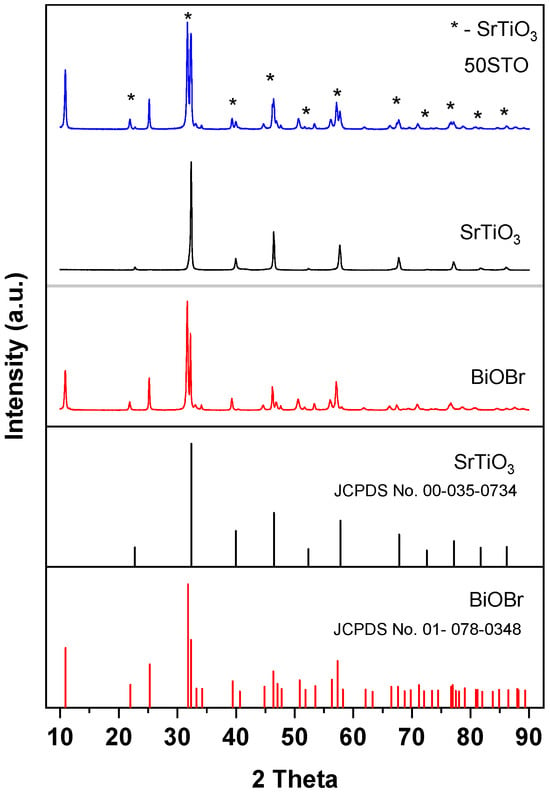
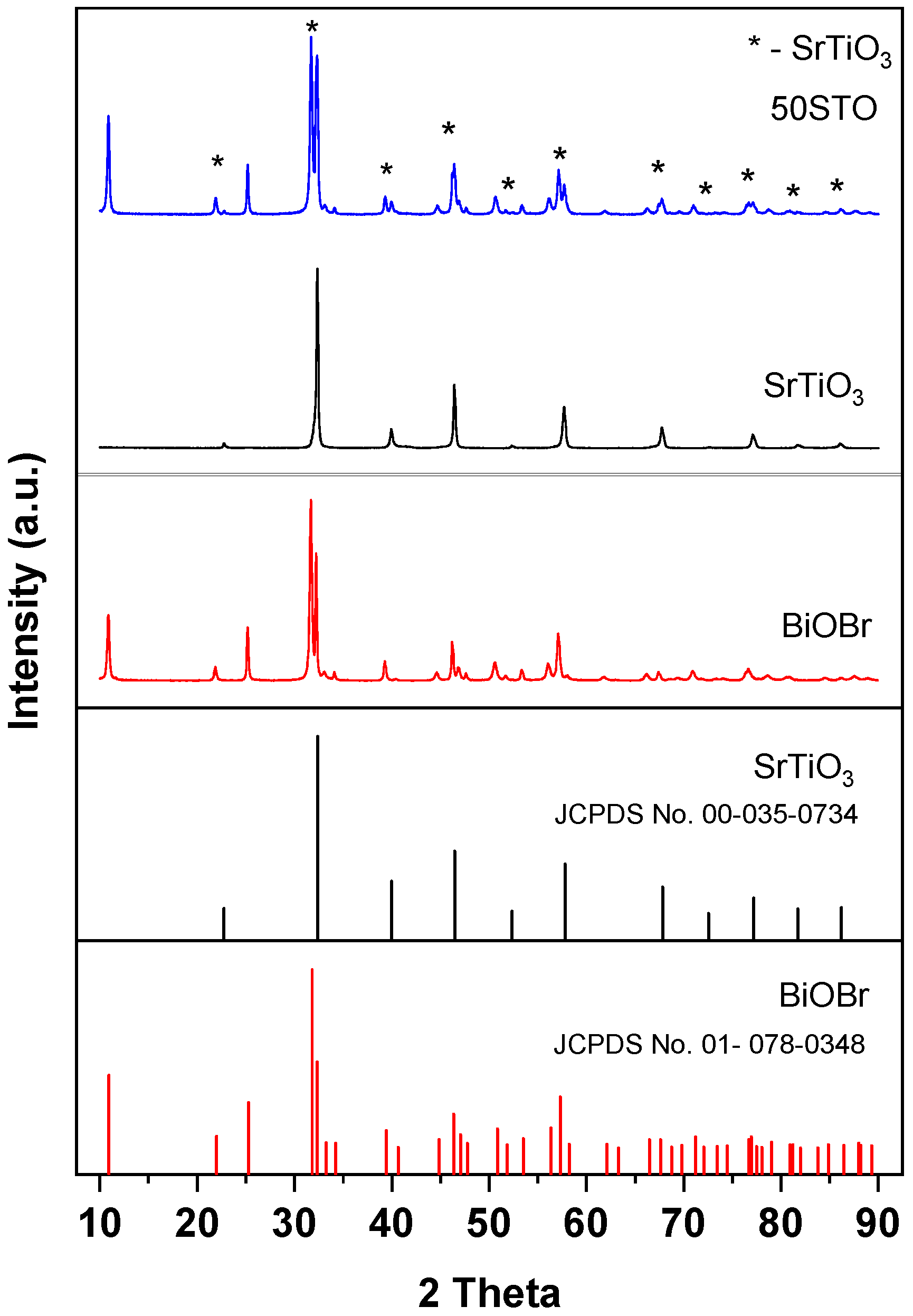
The X-ray diffraction (XRD) patterns of pure SrTiO3, BiOBr, and the SrTiO3/BiOBr composite are shown in Figure 1. The SrTiO3 sample displays characteristic diffraction peaks corresponding to its cubic perovskite structure (Pm-3m, space group no. 221), consistent with JCPDS No. 00-035-0734 [26]. The diffraction peaks of SrTiO3 appear at 2θ values of 22.78°, 32.42°, 39.98°, 46.48°, 52.35°, 57.79°, 67.80°, 72.54°, 77.17°, 81.72°, and 86.20°, which are indexed to the (100), (110), (111), (200), (210), (211), (220), (300), (310), (311), and (222) crystal planes, respectively. The BiOBr sample reveals sharp peaks typical of a tetragonal phase (P4/nmm, space group no. 129), matching JCPDS No. 01-078-0348 [27]. The main diffraction peaks of BiOBr located at 2θ values of 10.90°, 31.79°, and 32.24° correspond to the (001), (102), and (110) planes, respectively. The XRD pattern of the 50STO composite exhibited the characteristic diffraction peaks of SrTiO3 and BiOBr, indicating successful formation of the heterostructure without any detectable changes in their respective crystal phases.
Figure 1.
XRD patterns of BiOBr, SrTiO3, and the 50STO composite.
XPS measurements were employed to investigate the elemental composition, oxidation states, and surface chemistry of STO, BiOBr, and 50STO at room temperature. The binding energy (BE) was calculated using Equation (5):
where BE is the binding energy (eV), hν is the photon energy (eV), KE is the kinetic energy (eV), and Φ is the work function of the electron energy analyzer.
BE = hν − KE − Φ
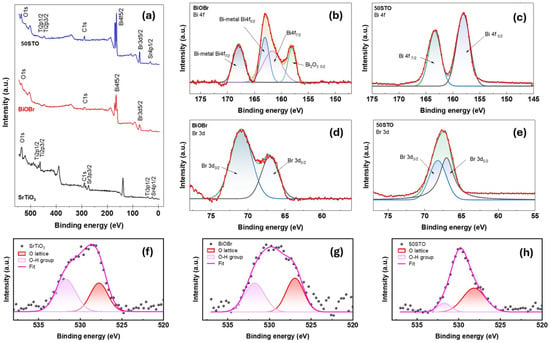
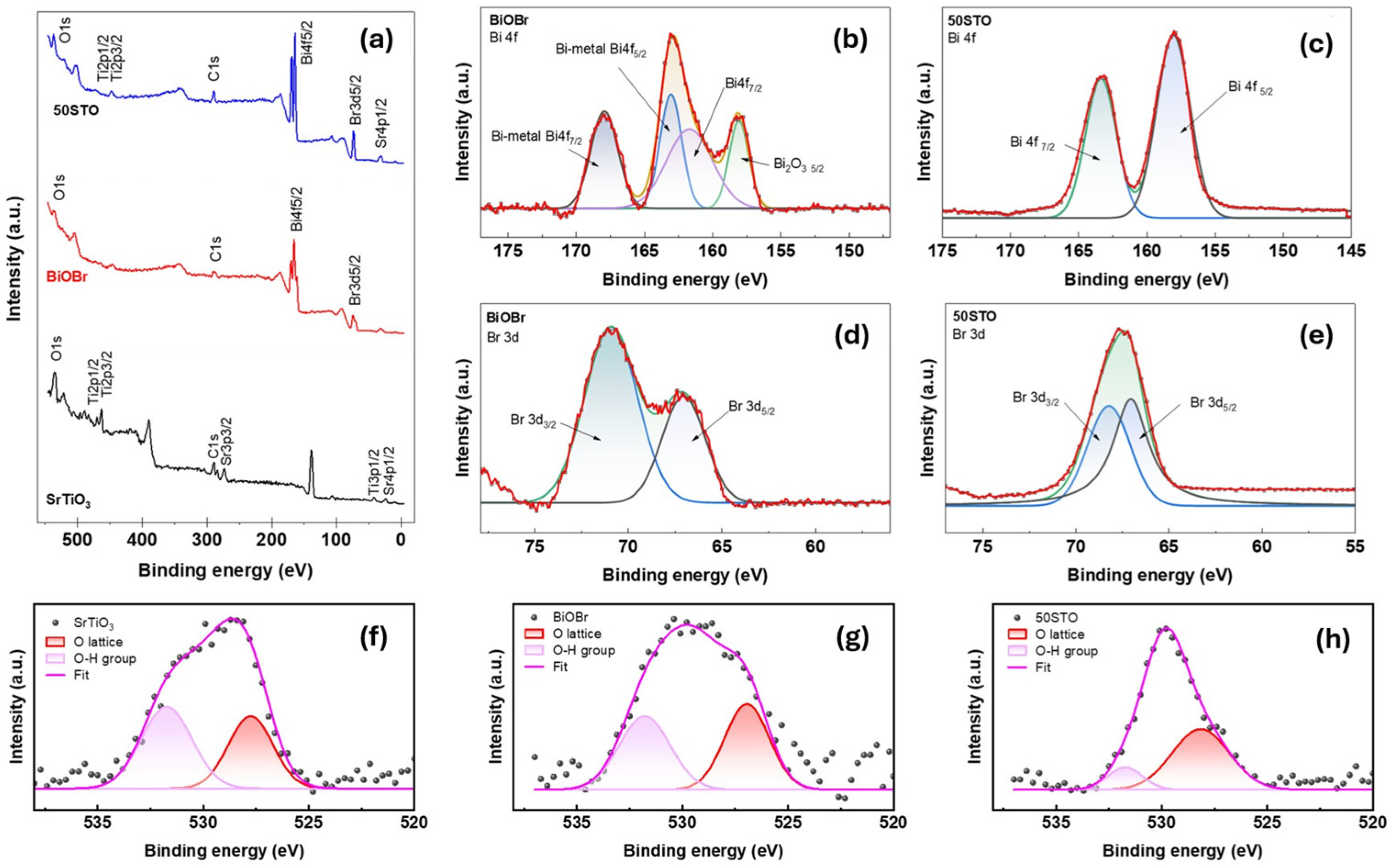
The XPS survey spectrum (Figure 2a) confirms the successful formation of the 50STO heterojunction by revealing the characteristic signals of Sr, Ti, O, Bi, and Br, indicating the coexistence of SrTiO3 and BiOBr. The high-resolution Bi 4f spectrum of pristine BiOBr (Figure 2b) exhibits the characteristic Bi 4f doublet together with a weak low-binding-energy component attributed to reduced bismuth species (Bi0), which has been reported to originate from partial surface reduction [28,29]. In contrast, the 50STO composite (Figure 2c) displays only two well-defined peaks at 158.9 eV and 164.3 eV, corresponding to Bi 4f7/2 and Bi 4f5/2 of Bi3+, respectively. The disappearance of the Bi0 component suggests that heterojunction formation improves the chemical stability of bismuth species in the composite [30]. In addition, the Br 3d spectrum exhibits characteristic peaks at 68–70 eV, corresponding to the Br 3d5/2 and Br 3d3/2 orbitals, confirming the preservation of the BiOBr crystal structure after composite formation (Figure 2c,e).
Figure 2.
XPS spectra of SrTiO3, BiOBr, and the 50STO composite: (a) survey spectra, (b,c) Bi 4f spectra, (d,e) Br 3d spectra, and (f–h) O 1s spectra.
The high-resolution O 1s spectra are presented in Figure 2f–h. The low-binding-energy component was assigned to lattice oxygen (Olatt) in the metal–oxygen frameworks. The component at approximately 531–532 eV was attributed to surface hydroxyl groups, whereas the higher-binding-energy component was assigned to adsorbed water and other oxygen-containing surface species (Oads) [31,32,33]. The deconvoluted XPS spectra confirmed the chemical states of the constituent elements, while the modest binding-energy shifts and changes in the O 1s components indicated modification of the local surface chemical environment following the coupling of SrTiO3 with BiOBr. Together with the XRD results, these findings support the successful formation of the 50STO composite.
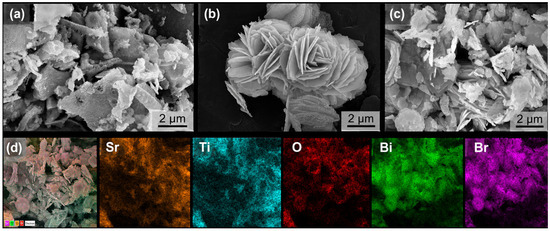
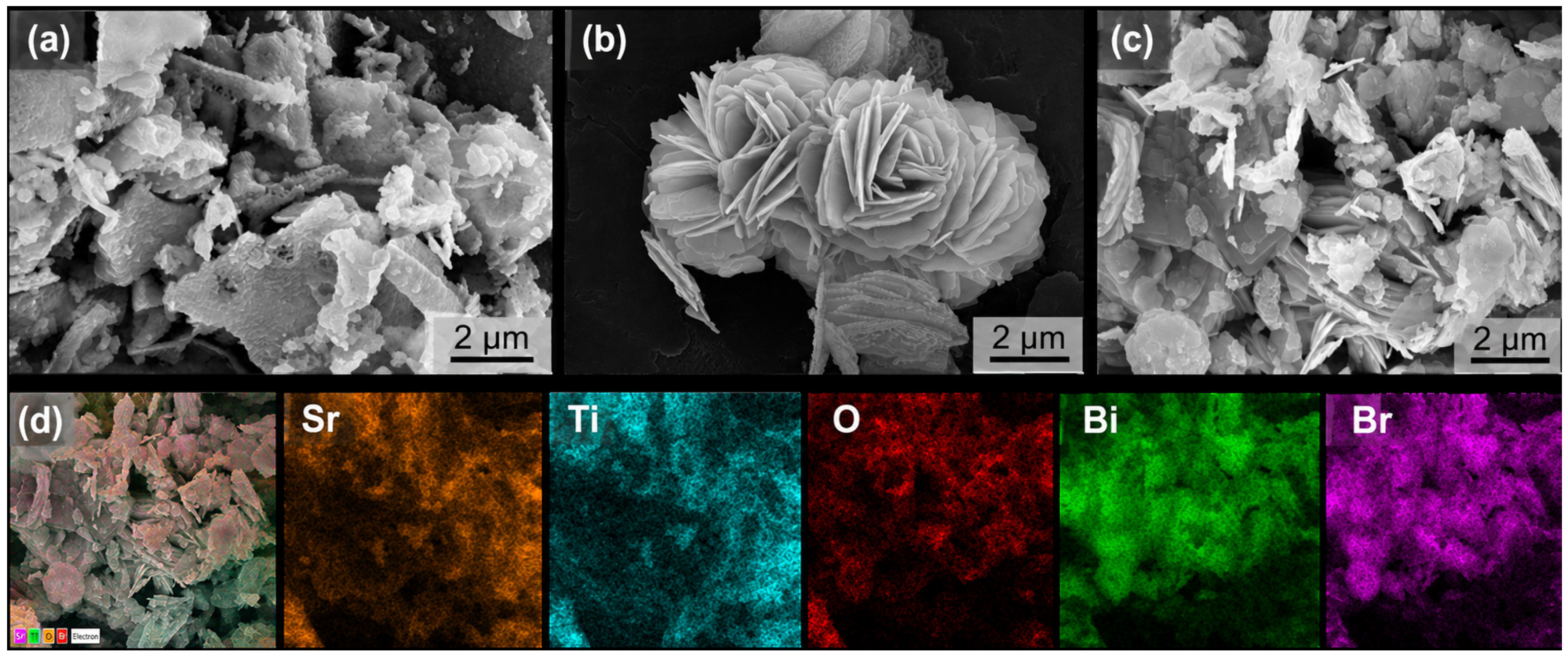
Figure 3a shows that the SrTiO3 particles exhibit an aggregated morphology composed of irregular particles, whereas the BiOBr sample (Figure 3b) consists of overlapping plate-like structures forming a flower-like morphology. The 50STO composite exhibits the characteristic morphologies of SrTiO3 and BiOBr, indicating successful formation of the heterojunction (Figure 3c,d). The elemental mapping of 50STO demonstrates the uniform distribution of Bi, Br, Sr, Ti, and O, confirming the homogeneous mixing of the two components.
Figure 3.
FESEM of (a) SrTiO3, (b) BiOBr, and (c) 50STO, as well as the (d) overall and individual elemental mappings of Sr, Ti, O, Bi, and Br in the 50STO composite.
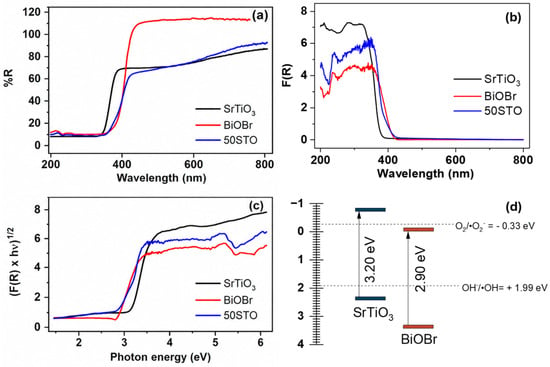
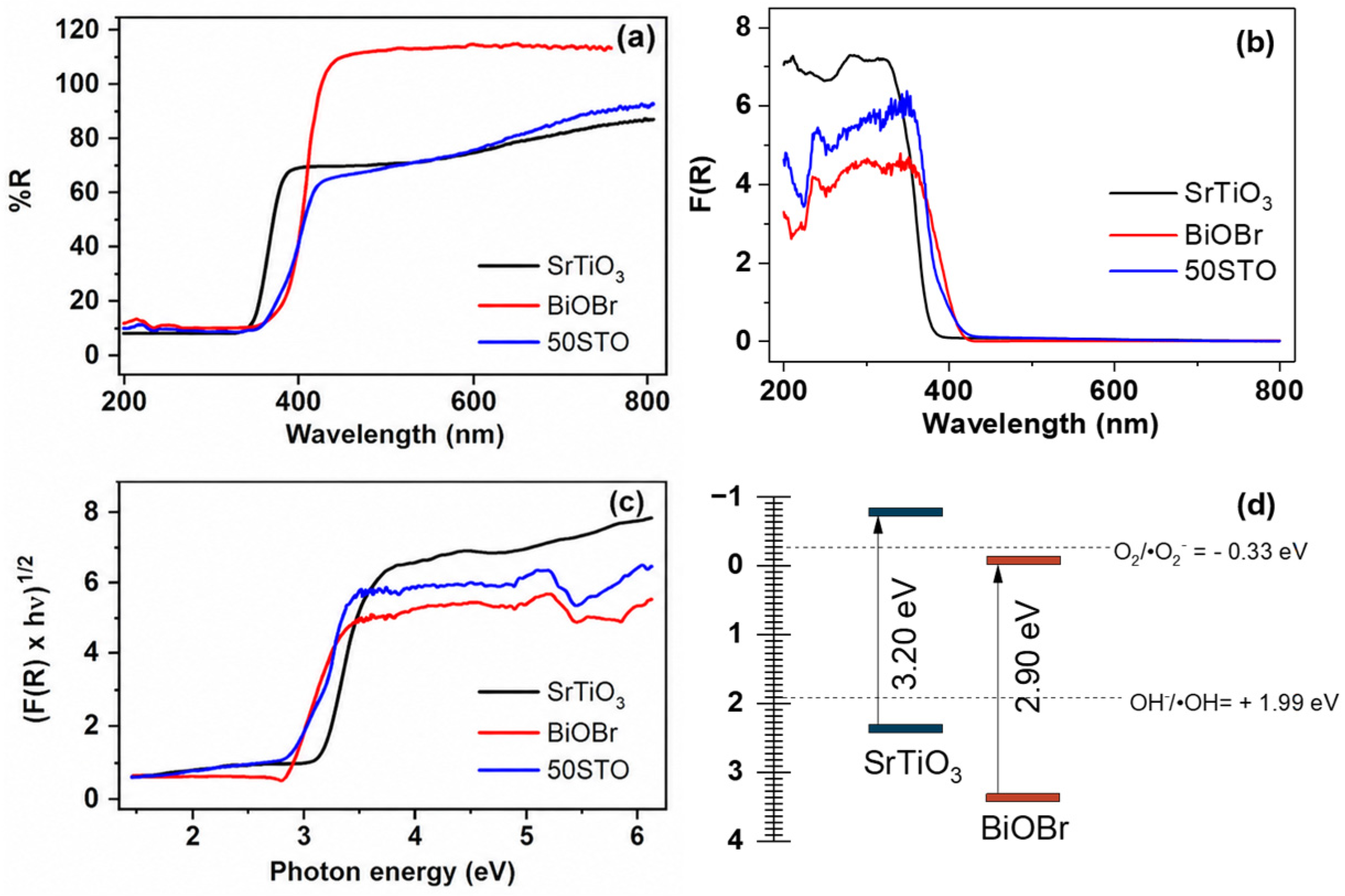
To investigate the optical properties of pristine SrTiO3, pristine BiOBr, and the 50STO composite, UV–Vis diffuse reflectance spectra (DRS) were recorded over the wavelength range of 200–800 nm, as shown in Figure 4a. The reflectance data were converted into the corresponding Kubelka–Munk function, F(R), and then absorption spectra were plotted as a function of wavelength (Figure 4b) [34]. The apparent optical band gaps were subsequently estimated from the corresponding Tauc plots (Figure 4c). By extrapolating the linear region of each plot to the energy axis, the apparent optical band gaps of pristine SrTiO3 and BiOBr were determined to be approximately 3.20 and 2.90 eV, respectively. As summarized in Table 1, the apparent optical band gap of the 50STO composite, estimated from the Tauc plot, decreased to 2.80 eV. This reduction is attributed to the electronic interaction at the SrTiO3/BiOBr interface, which modifies the optical transition behavior of the composite. Furthermore, the incorporation of narrow-band-gap BiOBr extends the absorption edge toward the visible region, resulting in enhanced visible-light harvesting [35,36]. Furthermore, studies of oxygen vacancies/defect states from Figure 2d show that Vo++ can create mid-gap energy levels, causing electron transitions that narrow the band gap [37].
Figure 4.
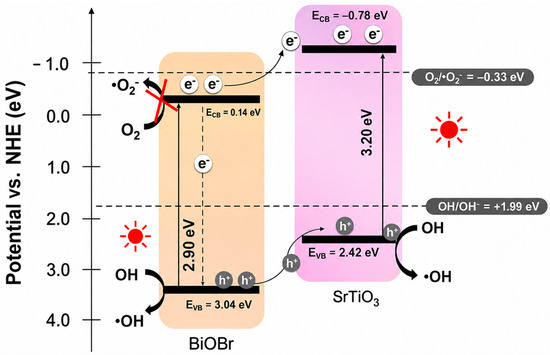
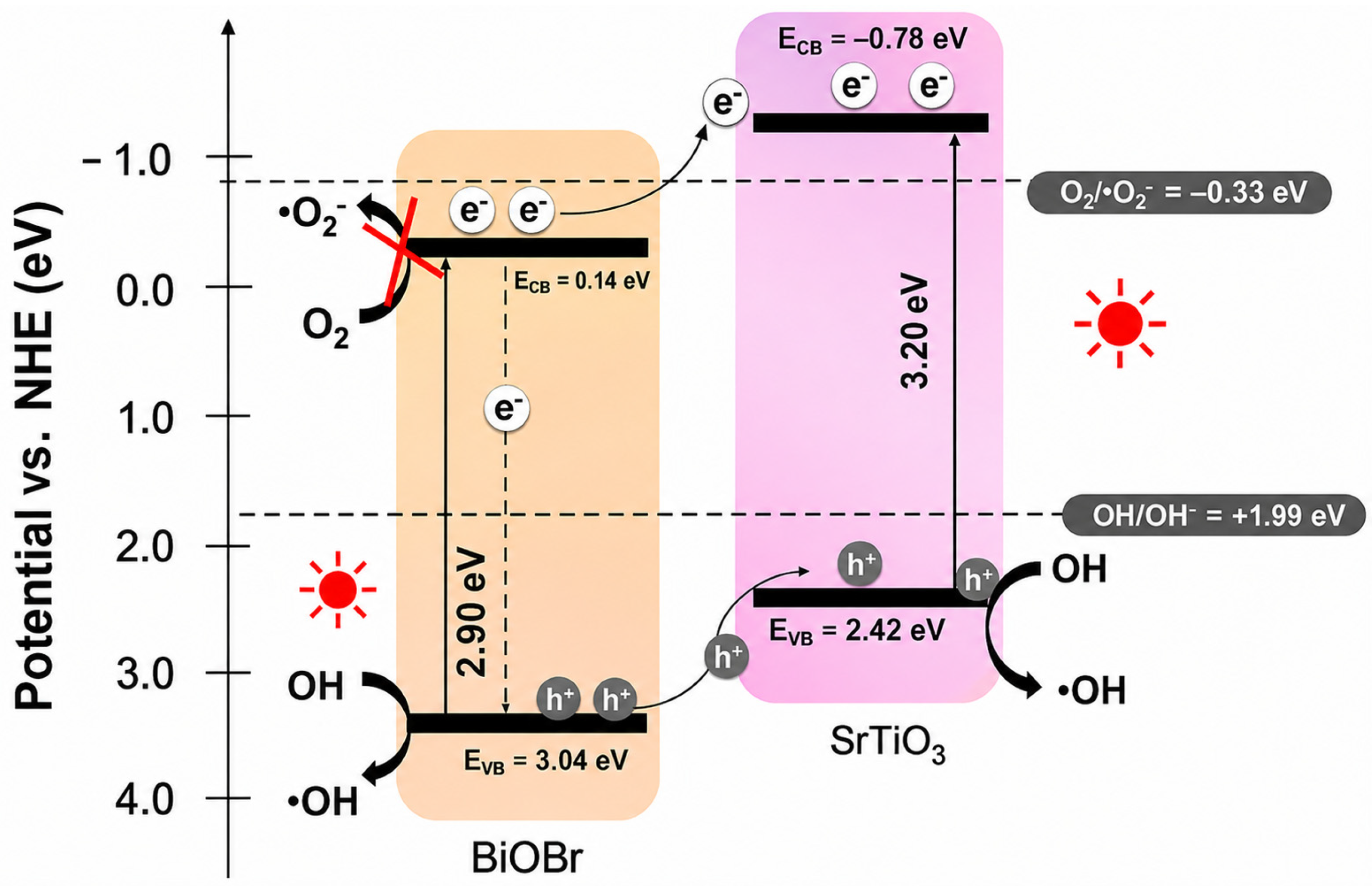
(a) UV–Vis diffuse reflectance spectra, (b) Kubelka–Munk plots, (c) Tauc plots, and (d) band alignment of BiOBr and SrTiO3.
Table 1.
Optical absorption edge wavelength and calculated band gap energies of the SrTiO3, BiOBr, and composite samples.
To evaluate the heterojunction alignment between the two materials, the conduction band (CB) and valence band (VB) edge potentials were calculated using Equations (6) and (7):
where the electronegativity values (χ) of SrTiO3 and BiOBr are 5.32 eV and 6.09 eV, respectively [38,39], and Eg represents the apparent optical band gap estimated from the Tauc plots for pure SrTiO3 (3.20 eV) and BiOBr (2.90 eV).
EVB = χ − 0.5(Eg) − 4.5
ECB = EVB − Eg
Based on the calculated band edge positions, the proposed energy band diagram of the SrTiO3/BiOBr type II heterojunction was constructed with respect to the normal hydrogen electrode (NHE) (Figure 4d). BiOBr possesses a CB potential of approximately 0.14 eV and a VB potential of 3.04 eV versus the normal hydrogen electrode (NHE), whereas SrTiO3 exhibits a more negative CB potential (−0.78 eV) and a VB potential of 2.42 eV. This favorable band alignment suggests the formation of a type II heterojunction, in which photogenerated electrons migrate from the CB of SrTiO3 to the CB of BiOBr, while holes transfer from the VB of BiOBr to the VB of SrTiO3. Consequently, the spatial separation of electrons and holes suppresses their recombination and enhances photocatalytic activity under light irradiation [40].
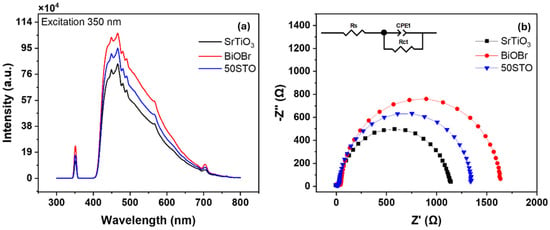
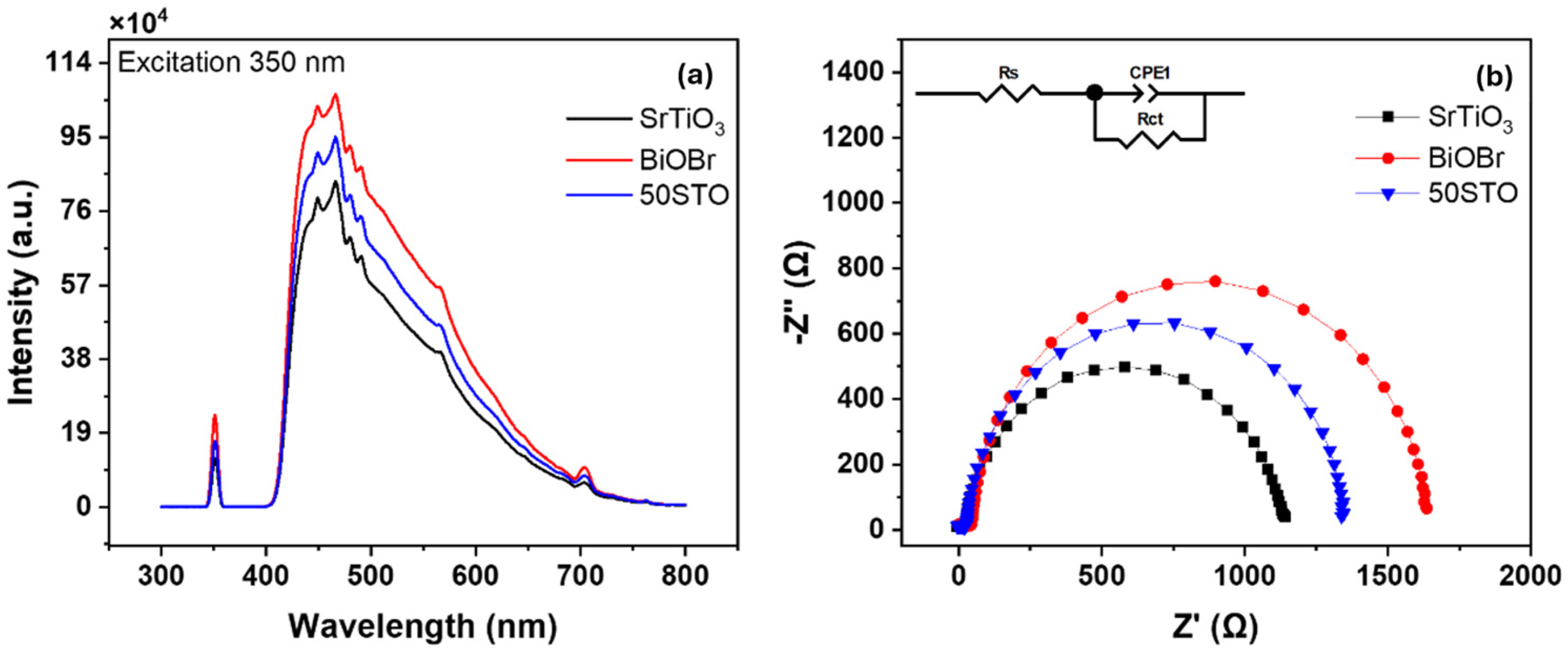
Steady-state photoluminescence (PL) spectroscopy and electrochemical impedance spectroscopy (EIS) were employed to investigate charge-carrier recombination and interfacial charge transfer behavior, respectively [41]; their results are presented in Figure 5. The PL and EIS results revealed changes in these properties after coupling SrTiO3 with BiOBr, indicating electronic interactions between the two components. Together with the structural and chemical characterization results, these findings support the successful formation of the 50STO heterojunction.
Figure 5.
(a) PL spectra (λex = 350 nm) and (b) EIS Nyquist plots of SrTiO3, BiOBr, and 50STO photocatalysts.
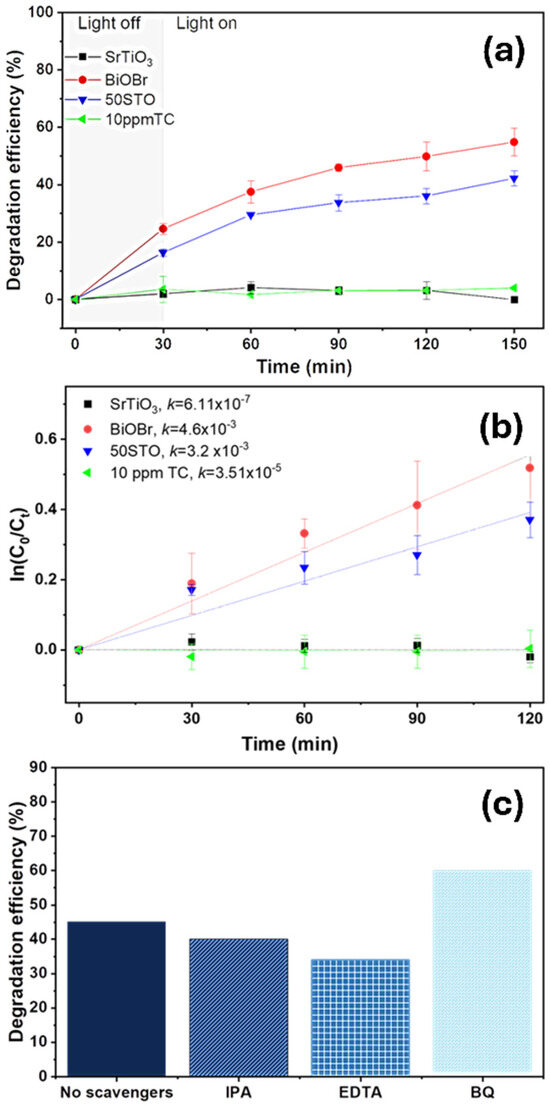
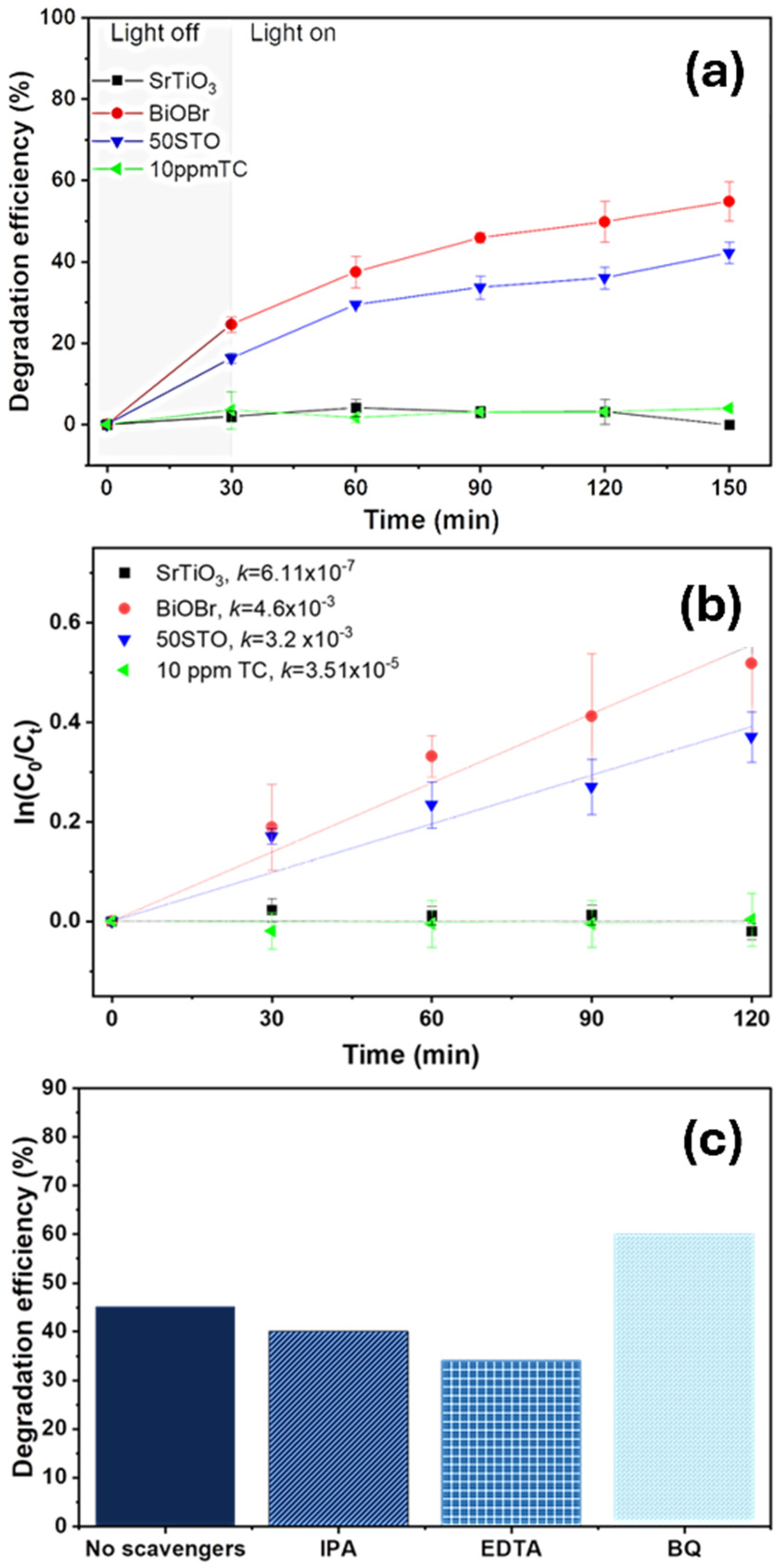
The photocatalytic degradation efficiencies of pristine SrTiO3, pristine BiOBr, and the 50STO composite toward TC under visible-light irradiation are presented in Figure 6. The 50STO composite exhibited markedly enhanced photocatalytic activity, achieving 45% TC degradation after 150 min of visible-light irradiation, whereas pristine SrTiO3 degraded only 2% of TC under the same conditions, which was comparable with the photolysis of the TC blank (Figure 6a). A similar trend was observed from the pseudo-first-order kinetic analysis (Figure 6b). The apparent rate constants (k), obtained from the slopes of the linear plots, followed the order BiOBr (4.6 × 10⁻³ min−1) > 50STO (3.2 × 10⁻³ min−1) > SrTiO3 (6.11 × 10⁻⁷ min−1). The apparent rate constant of the 50STO composite was higher than that of pristine SrTiO3. The enhanced photocatalytic performance of the 50STO composite compared with pristine SrTiO3 is consistent with previous studies on Bi-based heterojunction photocatalysts, in which improved interfacial charge separation and enhanced visible-light utilization have been identified as the primary factors contributing to the increased photocatalytic activity [42,43,44,45]. Although pristine BiOBr showed the highest photocatalytic activity, the primary objective of this study was to enhance the photocatalytic performance of SrTiO3. The results demonstrate that coupling SrTiO3 with BiOBr effectively improved its photocatalytic activity. The slightly lower activity of the 50STO composite than pristine BiOBr may be attributed to the partial coverage of BiOBr active sites by SrTiO3.
Figure 6.
(a) Photocatalytic degradation, (b) pseudo-first order, and (c) scavenger trapping of 50STO.
Table 2 compares the photocatalytic performance of recently reported SrTiO3- and BiOBr-based photocatalysts for TC degradation [46,47,48,49,50,51]. The comparison demonstrates that photocatalytic efficiency is strongly influenced by the initial pollutant concentration, photocatalyst dosage, irradiation time, and characteristics of the light source. Although the 50STO composite exhibited lower TC degradation efficiency than several previously reported photocatalysts, it still achieved 45% degradation under visible-light LED irradiation. Therefore, the SrTiO3/BiOBr heterojunction can be regarded as a promising alternative photocatalyst for TC degradation.
Table 2.
Comparison of the photocatalytic performance of SrTiO3- and BiOBr-based photocatalysts for TC degradation.
To identify the dominant reactive species involved in the photocatalytic degradation of TC, radical scavenging experiments were performed [52,53,54], and the results are presented in Figure 6c. The addition of EDTA, a hole (h+) scavenger, caused the most pronounced decrease in TC degradation efficiency, reducing the degradation efficiency from approximately 45% to 34%. This result indicates that photogenerated holes are the dominant reactive species responsible for TC degradation. The presence of isopropanol (IPA), a hydroxyl radical (•OH) scavenger, caused a moderate decrease in degradation efficiency to approximately 40%, suggesting that •OH radicals also contribute to TC degradation. In contrast, the addition of benzoquinone (BQ), a superoxide radical (•O2−) scavenger, did not suppress TC degradation, indicating that •O2− radicals are not the dominant reactive species in this photocatalytic system. Thus, these findings suggest that the photocatalytic degradation of TC is predominantly governed by photogenerated h+, with •OH acting as a secondary reactive species.
Based on the characterization results and radical scavenging experiments, a possible photocatalytic mechanism for TC degradation over the 50STO heterojunction is proposed and illustrated in Figure 7. After photoexcitation, photogenerated e− migrates from the CB of SrTiO3 to the CB of BiOBr. This spatial separation of e− and h+ reduces charge recombination and increases the availability of charge carriers for photocatalytic reactions.
Figure 7.
Proposed photocatalytic degradation mechanism of the composite system.
The corresponding reactions are described by Equations (8) and (9):
SrTiO3/BiOBr + hν ⟶ e− + h+
e−CB (SrTiO3) → e−CB (BiOBr)
Furthermore, photogenerated h+ migrates from the VB of BiOBr to the VB of SrTiO3 through the type II heterojunction and subsequently oxidizes surface H2O/OH− to generate •OH radicals (Equations (10) and (11)). In addition, the strongly oxidizing h+ retained in the VB of BiOBr contributes to the generation of •OH radicals (Equation (12)). The generated •OH radicals subsequently react with the adsorbed TC molecules, initiating oxidative bond cleavage and progressive degradation into smaller organic intermediates (Equation (13)). This result agrees well with the scavenger test, indicating that h+ and •OH are the primary reactive species involved in the photocatalytic degradation process.
h+VB (BiOBr) → h+VB (SrTiO3)
h+VB (SrTiO3) + OH− → •OH)
h+VB (BiOBr) + OH− → •OH
•OH and h+ + TC ⟶ transformation intermediates ⟶ lower-molecular-weight products
However, the CB potential of BiOBr (+0.14 eV vs. NHE) is more positive than the O2/•O2− reduction potential (−0.33 eV vs. NHE) [55,56]. Therefore, the accumulated electrons do not possess sufficient reducing power to convert adsorbed O2 into •O2−. Those electrons become relatively inactive. Consequently, •O2− is not expected to be the dominant reactive species, which is consistent with the radical scavenging results obtained using benzoquinone.
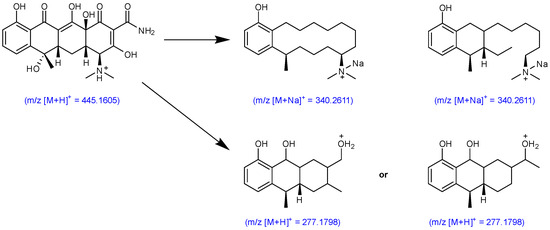
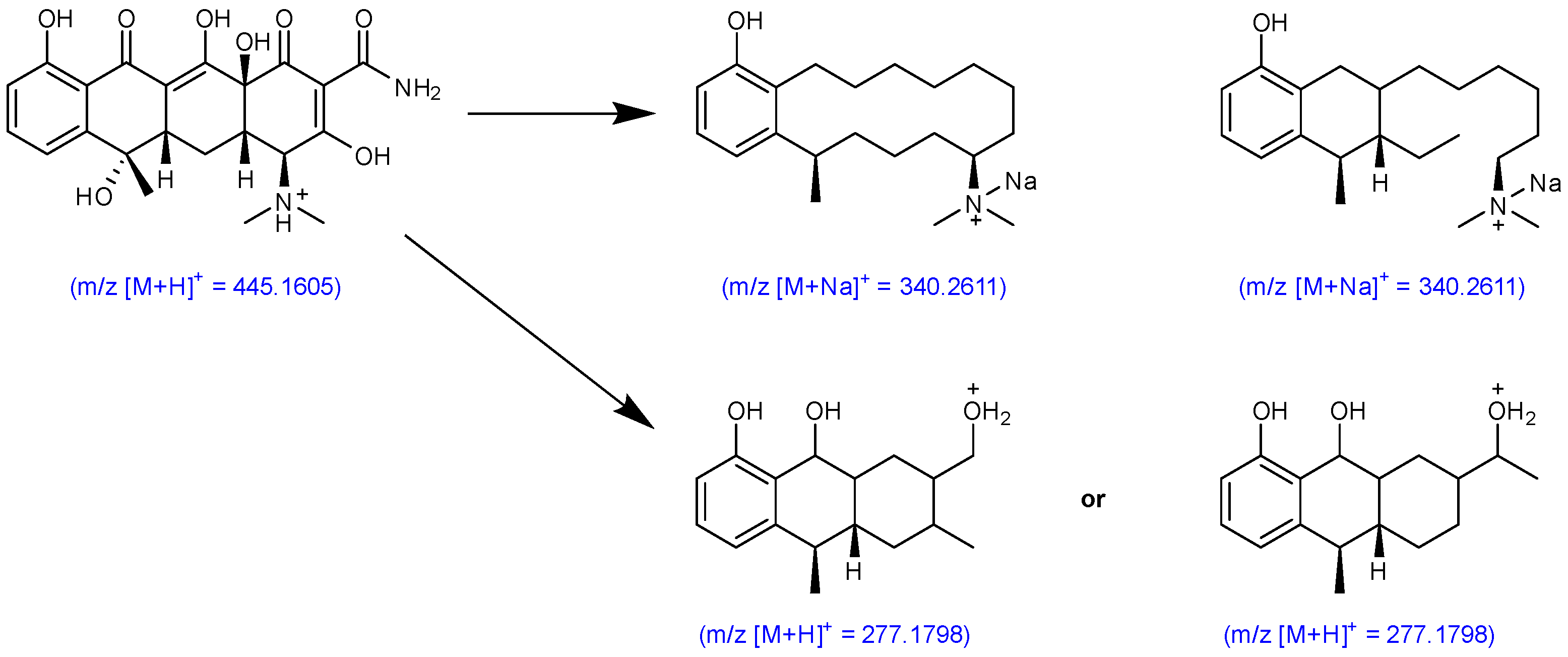
LC–MS analysis was employed to investigate the transformation products formed during TC degradation. In positive-ion mode, untreated TC exhibited a protonated molecular ion at m/z 445.1605, corresponding to [TC + H]+. Following visible-light photocatalytic treatment with the 50STO composite, the intensity of the parent TC ion decreased markedly and new signals appeared at approximately m/z 340.26, assigned as [M + Na]+, and m/z 277.1798, assigned as [M + H]+. These products were tentatively assigned based on their observed m/z values, ion-adduct forms, their appearance after photocatalytic treatment, and comparison with previously reported TC transformation pathways [57,58,59,60].
The LC–MS results provide molecular-level support for the photocatalytic mechanism proposed in Figure 7. The h+ and •OH species generated through the type II charge transfer process attack the adsorbed TC molecules, leading to oxidative cleavage of susceptible functional groups and progressive molecular fragmentation. These reactions produce the lower-molecular-weight transformation products illustrated in Figure 8. Further oxidation may generate additional low-molecular-weight products that were not detected under the present LC–MS conditions.
Figure 8.
Tentative photocatalytic transformation pathway of TC over the 50STO composite based on the ion signals detected by LC–MS.
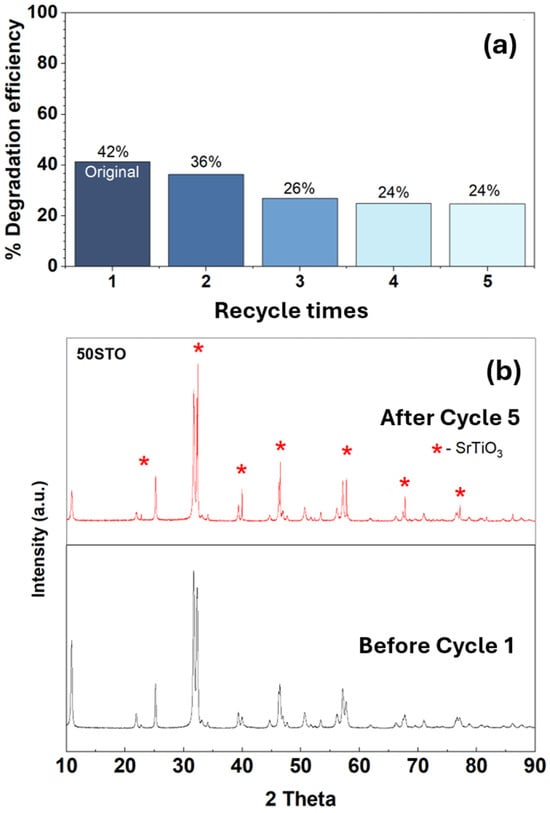
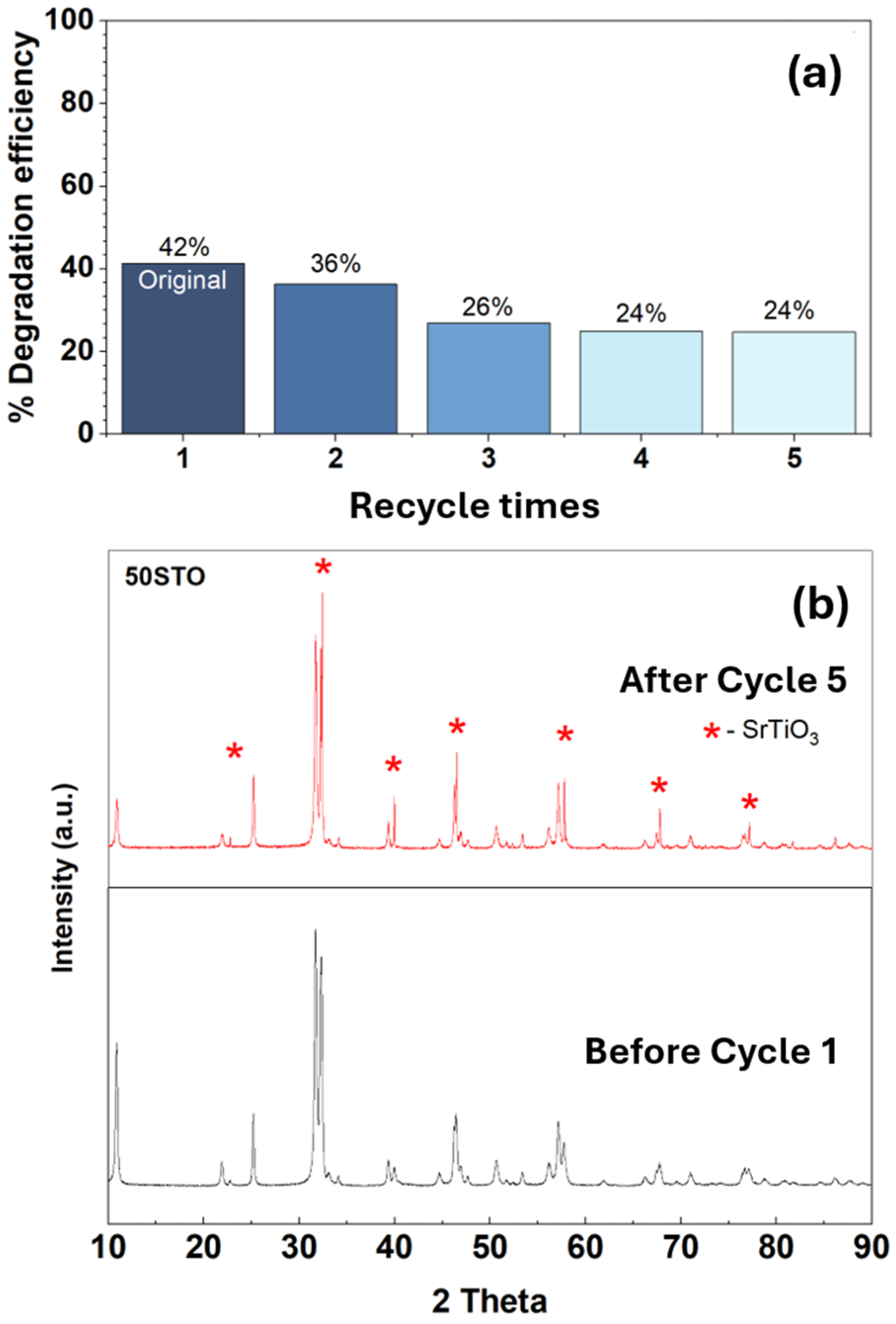
The recyclability of the 50STO photocatalyst was evaluated over five consecutive cycles. As shown in Figure 9a, the degradation efficiency gradually decreased from approximately 42% to 18%. XRD patterns of the fresh and reused catalysts (Figure 9b) showed no significant structural changes, confirming the good structural stability of the composite. The loss of photocatalytic activity is more likely attributed to the loss or blockage of surface-active sites rather than crystal structure degradation.
Figure 9.
(a) Recyclability of the 50STO photocatalyst over five consecutive cycles and (b) XRD patterns of the fresh and reused catalysts.
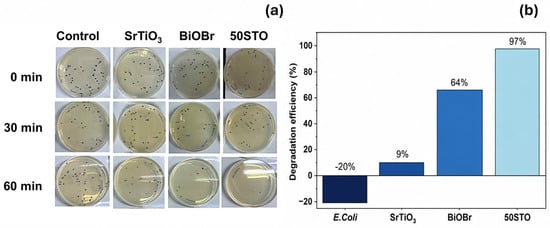
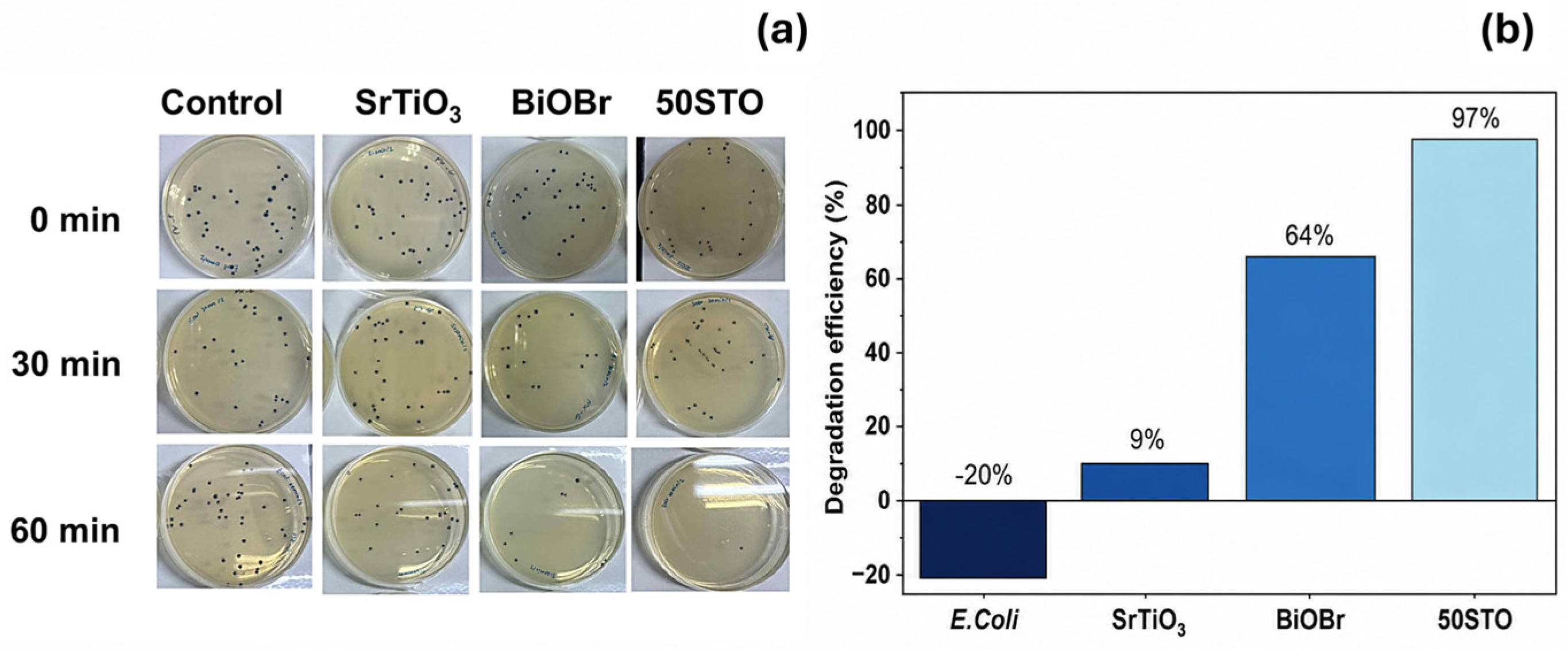
Another application of this study was to evaluate the antibacterial activities of SrTiO3, BiOBr, and the 50STO composite against E. coli under white-light irradiation for 60 min. The variation in bacterial colony counts at 0 min, 30 min in the dark (adsorption control), and 60 min under light irradiation are presented in Figure 10a,b. All samples exhibited similar initial bacterial concentrations, and only a slight reduction was observed after 30 min in the dark, indicating that physical adsorption contributed minimally to bacterial inactivation. Upon illumination, the photocatalytic disinfection efficiency increased significantly, particularly for the 50STO composite, which almost eliminated E. coli colonies after 60 min, corresponding to a %DE exceeding 95%, while pure SrTiO3 and BiOBr demonstrated moderate activities (%DE ≈ 9% and 64%, respectively).
Figure 10.
(a) Representative E. coli colony images before and after treatment and (b) antibacterial activity under white-light irradiation for 60 min.
The superior bactericidal efficiency of 50STO can be attributed to the optimized heterojunction interface between SrTiO3 and BiOBr, which facilitates efficient separation and transfer of photogenerated charge carriers. The well-aligned band structure of SrTiO3 (n-type) [61] and BiOBr (p-type) [62] promotes spatial charge migration, suppressing electron–hole recombination and thereby enhancing the production of reactive oxygen species (ROS)—particularly •OH and •O2− radicals. These ROS are known to play a crucial role in photocatalytic disinfection by attacking bacterial cell membranes, damaging intracellular components, and disrupting DNA, leading to irreversible cell death. The minimal bacterial reduction during the dark phase further verifies that ROS generation, rather than adsorption or thermal effects, governed the antibacterial process. Studies on heterojunction photocatalysts such as CeO2-Agl [63], BiOBr/BiOI [64] show that intimate semiconductor interfaces greatly improve charge carrier mobility and visible-light-driven ROS generation. Moreover, the enhanced antibacterial activity of the 50STO composite aligns with reports on BiO2-x/BiOBr Z-scheme heterostructures [65], which achieved nearly complete E. coli inactivation within 60 min of light irradiation. These studies collectively support that an efficient heterojunction structure with strong internal electric fields enhances interfacial charge transfer and ROS yield, leading to accelerated bacterial destruction. Therefore, the 50STO sample exhibits the most balanced composition, maximizing light absorption and charge separation efficiency, which results in its outstanding photocatalytic antibacterial performance under white-light illumination. Interestingly, 50STO exhibited greater E. coli inactivation than BiOBr despite showing lower overall TC removal. This difference can be attributed to the distinct mechanisms. Bacterial inactivation does not require complete degradation or mineralization of bacterial cells; localized oxidative damage to the cell envelope, membrane lipids, and intracellular components is sufficient to cause a loss of cell viability. The improved charge separation and interfacial charge transfer in 50STO increase the availability of photogenerated holes and promote the formation of •OH radicals, thereby enhancing oxidative damage to bacterial cells. Therefore, the activity rankings for TC removal and E. coli inactivation do not necessarily follow the same trend [66].
4. Conclusions
The photocatalytic activity of SrTiO3 was successfully enhanced through its coupling with BiOBr to construct a SrTiO3/BiOBr heterojunction (50STO). Structural and surface analyses confirmed the successful formation of a homogeneous heterojunction while preserving the crystal structures of both semiconductors. The incorporation of BiOBr into SrTiO3 narrowed the apparent optical band gap and enhanced visible-light absorption, thereby increasing charge-carrier generation under visible-light irradiation, while the resulting interface facilitated interfacial charge transfer. The optimized 50STO composite exhibited significantly enhanced visible-light photocatalytic activity, a markedly higher apparent reaction rate constant than pristine SrTiO3, and good structural stability after five consecutive reuse cycles. Radical scavenging and LC–MS analyses confirmed that h+ and •OH were the predominant reactive species responsible for TC degradation through successive oxidation, ring opening, and molecular fragmentation. The 50STO composite also exhibited excellent antibacterial activity against E. coli under white-light irradiation. These findings highlight the potential of the SrTiO3/BiOBr heterojunction as a stable and multifunctional visible-light photocatalyst for simultaneous antibiotic degradation and microbial disinfection.
Author Contributions
P.T.: methodology, data curation, formal analysis, investigation, and draft writing; M.S.: formal analysis, data curation, and draft writing; T.S.: resources and supervision; T.B.: supervision; S.P.: formal analysis; T.K.: supervision, formal analysis, investigation, data curation, and draft writing; A.R.: formal analysis and data curation; H.N.: formal analysis and data curation; P.J.: formal analysis; D.C.; methodology, review and editing, draft writing, project administration, and funding acquisition. All authors have read and agreed to the published version of the manuscript.
Funding
This work was supported by funding from the Department of Chemistry, Faculty of Science, Naresuan University (grant No. R2569E019).
Institutional Review Board Statement
Not applicable.
Informed Consent Statement
Not applicable.
Data Availability Statement
The original contributions presented in this study are included in the article. Further inquiries can be directed to the corresponding author.
Acknowledgments
The authors gratefully acknowledge the Synchrotron Light Research Institute, Nakhon Ratchasima, Thailand, for providing support with the XRS analysis. The authors also sincerely thank Tatsuru Kamei, Interdisciplinary Centre for River Basin Environment, University of Yamanashi, Japan, for providing access to laboratory facilities and equipment for antibacterial activity testing. During the preparation of this manuscript, the authors used ChatGPT Plus for English language editing. The authors subsequently reviewed and edited the content as necessary and take full responsibility for the content of this manuscript.
Conflicts of Interest
The authors declare no conflicts of interest.
References
- Danner, M.C.; Robertson, A.; Behrends, V.; Reiss, J. Antibiotic pollution in surface fresh waters: Occurrence and effects. Sci. Total Environ. 2019, 664, 793–804. [Google Scholar] [CrossRef] [Scilit] [PubMed]
- Amangelsin, Y.; Semenova, Y.; Dadar, M.; Aljofan, M.; Bjorklund, G. The impact of tetracycline pollution on the aquatic environment and removal strategies. Antibiotics 2023, 12, 440. [Google Scholar] [CrossRef] [Scilit] [PubMed]
- Bartolomeu, M.; Neves, M.; Faustino, M.A.F.; Almeida, A. Wastewater chemical contaminants: Remediation by advanced oxidation processes. Photochem. Photobiol. Sci. 2018, 17, 1573–1598. [Google Scholar] [CrossRef] [Scilit] [PubMed]
- Akbari, M.Z.; Xu, Y.; Lu, Z.; Peng, L. Review of antibiotics treatment by advance oxidation processes. Environ. Adv. 2021, 5, 100111. [Google Scholar] [CrossRef] [Scilit]
- Samrot, A.V.; Wilson, S.; Sanjay Preeth, R.S.; Prakash, P.; Sathiyasree, M.; Saigeetha, S.; Shobana, N.; Pachiyappan, S.; Rajesh, V.V. Sources of antibiotic contamination in wastewater and approaches to their removal—An overview. Sustainability 2023, 15, 12639. [Google Scholar] [CrossRef] [Scilit]
- Zhang, Y.; Zhao, Y.-G.; Maqbool, F.; Hu, Y. Removal of antibiotic pollutants in wastewater by UV-based advanced oxidation processes: Influence of water matrix components, process optimization and applications: A review. J. Water Process Eng. 2022, 45, 102496. [Google Scholar] [CrossRef] [Scilit]
- Tomić, J.; Malinović, N. Titanium dioxide photocatalyst: Present situation and future approaches. AIDASCO Rev. 2023, 1, 26. [Google Scholar] [CrossRef] [Scilit]
- Hasham Firooz, M.; Naderi, A.; Moradi, M.; Kalantary, R.R. Enhanced tetracycline degradation with TiO2/natural pyrite S-scheme photocatalyst. Sci. Rep. 2024, 14, 4954. [Google Scholar] [CrossRef] [Scilit] [PubMed]
- Pandey, S.K.; Romac, S.; Kujavić, M.; Papac Zjačić, J.; Kovačić, M.; Kraljić Roković, M.; Dananić, V.; Kušić, H.; Žener, B.; Genorio, B.; et al. Band-engineered Fe-SrTiO3 for visible-light photocatalytic breakdown of emerging contaminants: Mechanistic and toxicity insights. Sep. Purif. Technol. 2026, 394, 137443. [Google Scholar] [CrossRef] [Scilit]
- Zhu, Y.; Li, Z.; Bian, J.; Zhang, Z.; Chen, C.; Xiong, L.; Tang, J.; Jing, L. Highly selective photo-oxidation of methane to methanol by Fe–Au site-supported SrTiO3 hollow nanotubes with oxygen vacancies. J. Am. Chem. Soc. 2025, 147, 34959–34971. [Google Scholar] [CrossRef] [Scilit] [PubMed]
- Bi, C.; Xu, H.; Zhou, G.; Song, H.; Xu, J.; Li, Q.; Wang, B.; Ding, P.; Li, L.; Chu, P.K.; et al. Lattice energy transfer from homo-crystalline substitution for enhanced piezo-photocatalytic CO2 conversion. Chem. Eng. J. 2024, 501, 157345. [Google Scholar] [CrossRef] [Scilit]
- Avcıoğlu, C.; Avcıoğlu, S.; Bekheet, M.F.; Gurlo, A. Photocatalytic overall water splitting by SrTiO3: Progress report and design strategies. ACS Appl. Energy Mater. 2023, 6, 1134–1154. [Google Scholar] [CrossRef] [Scilit]
- Uma, P.I.; Shenoy, U.S.; Bhat, D.K. Nanocubic copper-doped SrTiO3 for photoreduction of Cr(VI) and photodegradation of methyl violet. ACS Appl. Nano Mater. 2023, 6, 16798–16804. [Google Scholar] [CrossRef] [Scilit]
- Yu, X.; Wang, J.; Fu, X.; Meng, H.; Zhu, Y.; Zhang, Y. Construction of Z-scheme SrTiO3/Ag/Ag3PO4 photocatalyst with oxygen vacancies for highly efficient degradation activity towards tetracycline. Sep. Purif. Technol. 2020, 241, 116718. [Google Scholar] [CrossRef] [Scilit]
- Liu, C.; Wu, G.; Chen, J.; Huang, K.; Shi, W. Fabrication of a visible-light-driven photocatalyst and degradation of tetracycline based on the photoinduced interfacial charge transfer of SrTiO3/Fe2O3 nanowires. New J. Chem. 2016, 40, 5198–5208. [Google Scholar] [CrossRef] [Scilit]
- Wang, L.; Lu, Y.; Wang, S.; Li, M.; Zhang, L.; Ma, H. Efficient photocatalytic degradation of tetracycline over a novel dual Z-scheme Bi2O3/ZnTiO3–SrTiO3 composite photocatalyst. Langmuir 2025, 41, 5848–5859. [Google Scholar] [CrossRef] [Scilit] [PubMed]
- Imam, S.S.; Adnan, R.; Mohd Kaus, N.H. The photocatalytic potential of BiOBr for wastewater treatment: A mini-review. J. Environ. Chem. Eng. 2021, 9, 105700. [Google Scholar] [CrossRef] [Scilit]
- Kanagaraj, T.; Thiripuranthagan, S. Photocatalytic activities of novel SrTiO3–BiOBr heterojunction catalysts towards the degradation of reactive dyes. Appl. Catal. B Environ. 2017, 207, 218–232. [Google Scholar] [CrossRef] [Scilit]
- Chen, R.; Wang, H.; Wu, H.; Sheng, J.; Li, J.; Cui, W.; Dong, F. SrTiO3/BiOI heterostructure: Interfacial charge separation, enhanced photocatalytic activity, and reaction mechanism. Chin. J. Catal. 2020, 41, 710–718. [Google Scholar] [CrossRef] [Scilit]
- Ajin, V.C.A.; Lenus, A.J. Engineering the role of oxygen vacancies in photocatalysts for environmental remediation and energy conversion applications: A comprehensive review. Mater. Sci. Semicond. Process. 2025, 197, 109705. [Google Scholar] [CrossRef] [Scilit]
- Iqbal, M.A.; Akram, S.; Khalid, S.; Lal, B.; Hassan, S.U.; Ashraf, R.; Kezembayeva, G.; Mushtaq, M.; Chinibayeva, N.; Hosseini-Bandegharaei, A. Advanced photocatalysis as a viable and sustainable wastewater treatment process: A comprehensive review. Environ. Res. 2024, 253, 118947. [Google Scholar] [CrossRef] [Scilit] [PubMed]
- Price, R.G.; Wildeboer, D. Escherichia coli as an indicator of contamination and health risk in environmental waters. In Escherichia coli—Recent Advances on Physiology, Pathogenesis and Biotechnological Applications; Samie, A., Ed.; IntechOpen: London, UK, 2017. [Google Scholar]
- Suliman, Z.A.; Mecha, A.C.; Mwasiagi, J.I. Dual application of TiO2–ZnO solar photocatalytic membranes in the degradation of oxytetracycline and inactivation of Staphylococcus aureus and Escherichia coli. Desalin. Water Treat. 2025, 324, 100945. [Google Scholar] [CrossRef] [Scilit]
- Li, Z.; Lu, X.; Reyimu, X.; Gan, Y.; Wang, Z.; Hailili, R. Recent advances and roles of oxygen vacancies for photocatalytic nitrogen oxide removal. Catal. Today 2024, 437, 114747. [Google Scholar] [CrossRef] [Scilit]
- Wang, P.; Han, X.; Zheng, X.; Wang, Z.; Li, C.; Zhao, Z. Removal of tetracycline hydrochloride by photocatalysis using electrospun PAN nanofibrous membranes coated with g-C3N4/Ti3C2/Ag3PO4. Molecules 2023, 28, 2647. [Google Scholar] [CrossRef] [Scilit] [PubMed]
- Mahammad Ali, S.K.; Shankar, J.; Shiva Kumar, A.; Raju, P. Effect of sintering temperature on physical and dielectric properties of SrTiO3 ceramics. Mater. Today Proc. 2023, 92, 976–979. [Google Scholar] [CrossRef] [Scilit]
- Wang, X.J.; Zhao, Y.; Li, F.T.; Dou, L.J.; Li, Y.P.; Zhao, J.; Hao, Y.J. A chelation strategy for in situ constructing surface oxygen vacancies on {001} facet-exposed BiOBr nanosheets. Sci. Rep. 2016, 6, 24918. [Google Scholar] [CrossRef] [Scilit] [PubMed]
- Zatsepin, D.A.; Zatsepin, A.F.; Boukhvalov, D.W.; Gavrilov, N.V. Bi-doped silica glass: A combined XPS–DFT study of electronic structure and pleomorphic imperfections. J. Alloys Compd. 2020, 829, 154509. [Google Scholar] [CrossRef] [Scilit]
- Bi, Y.; Wang, Y.; Dong, X.; Zheng, N.; Ma, H.; Zhang, X. Efficient solar-driven conversion of nitrogen to ammonia in pure water via hydrogenated bismuth oxybromide. RSC Adv. 2018, 8, 21871–21878. [Google Scholar] [CrossRef] [Scilit] [PubMed]
- Wang, X.J.; Yang, W.Y.; Li, F.T.; Zhao, J.; Liu, R.H.; Liu, S.J.; Li, B. Construction of amorphous TiO2/BiOBr heterojunctions via facet coupling for enhanced photocatalytic activity. J. Hazard. Mater. 2015, 292, 126–136. [Google Scholar] [CrossRef] [Scilit] [PubMed]
- Idriss, H. On the wrong assignment of the XPS O1s signal at 531–532 eV attributed to oxygen vacancies in photo- and electro-catalysts for water splitting and other materials applications. Surf. Sci. 2021, 712, 121894. [Google Scholar] [CrossRef] [Scilit]
- Idriss, H. Oxygen vacancies role in thermally driven and photon-driven catalytic reactions. Chem. Catal. 2022, 2, 1549–1560. [Google Scholar] [CrossRef] [Scilit]
- Wang, J.; Mueller, D.N.; Crumlin, E.J. Recommended strategies for quantifying oxygen vacancies with X-ray photoelectron spectroscopy. J. Eur. Ceram. Soc. 2024, 44, 116709. [Google Scholar] [CrossRef] [Scilit]
- Bajpai, P. Optical properties of paper. In Biermann’s Handbook of Pulp and Paper; Elsevier: Amsterdam, The Netherlands, 2018; pp. 237–271. [Google Scholar]
- He, R.; Xu, D.; Cheng, B.; Yu, J.; Ho, W. Review on nanoscale Bi-based photocatalysts. Nanoscale Horiz. 2018, 3, 464–504. [Google Scholar] [CrossRef] [Scilit] [PubMed]
- Shi, X.; Wang, P.; Wang, L.; Bai, Y.; Xie, H.; Zhou, Y.; Wang, J.A.; Li, Z.; Qu, L.; Shi, M.; et al. Few-layered BiOBr with expanded interlayer spacing and oxygen vacancies for efficient decomposition of real oilfield-produced wastewater. ACS Sustain. Chem. Eng. 2018, 6, 13739–13746. [Google Scholar] [CrossRef] [Scilit]
- Yu, Y.; Chen, F.; Jin, X.; Min, J.; Duan, H.; Li, J.; Wu, Z.; Cao, B. Oxygen-vacancy-rich S-scheme BiOBr/CdS heterojunction with synergistic effect for highly efficient light-emitting diode-driven pollutant degradation. Nanomaterials 2023, 13, 830. [Google Scholar] [PubMed]
- Balbás, L.C.; Valderrama, L.A.; Alonso, J.A. Density functional calculation of the electronegativity and other related properties of atoms and ions of the principal groups of the periodic table. Z. Phys. A 1984, 319, 275–282. [Google Scholar] [CrossRef] [Scilit]
- Ouellette, R.J.; Rawn, J.D. Structure of organic compounds. In Principles of Organic Chemistry; Elsevier: Amsterdam, The Netherlands, 2015; pp. 1–32. [Google Scholar]
- Xu, Y.; Schoonen, M.A.A. The absolute energy positions of conduction and valence bands of selected semiconducting minerals. Am. Mineral. 2000, 85, 543–556. [Google Scholar] [CrossRef] [Scilit]
- Li, C.-Q.; Yi, S.-S.; Chen, D.-L.; Liu, Y.; Li, Y.-J.; Lu, S.-Y.; Yue, X.-Z.; Liu, Z.-Y. Oxygen-vacancy-engineered SrTiO3 nanofibers for enhanced photocatalytic H2 production. J. Mater. Chem. A 2019, 7, 17974–17980. [Google Scholar] [CrossRef] [Scilit]
- Xiang, Q.; Yu, J.; Jaroniec, M. Graphene-based semiconductor photocatalysts. Chem. Soc. Rev. 2012, 41, 782–796. [Google Scholar] [CrossRef] [Scilit] [PubMed]
- He, X.; Kai, T.; Ding, P. Heterojunction photocatalysts for degradation of the tetracycline antibiotic: A review. Environ. Chem. Lett. 2021, 19, 4563–4601. [Google Scholar] [CrossRef] [Scilit] [PubMed]
- Wang, K.; Yu, X.; Wei, Y.; Liu, Z.; Yang, F.; Zhang, J.; Chen, L.; Niu, J.; Yao, B. Mechanism of boosted photocatalytic activity of SrTiO3/Bi3O4Br Z-scheme heterojunction mediated by oxygen vacancies in the degradation of chlortetracycline and hydrogen production. Appl. Surf. Sci. 2025, 693, 162793. [Google Scholar] [CrossRef] [Scilit]
- Che, H.; Chen, J.; Huang, K.; Hu, W.; Hu, H.; Liu, X.; Che, G.; Liu, C.; Shi, W. Construction of SrTiO3/Bi2O3 heterojunction toward improved separation efficiency of charge carriers and photocatalytic activity under visible light. J. Alloys Compd. 2016, 688, 882–890. [Google Scholar] [CrossRef] [Scilit]
- Živojinović, J.; Peleš Tadić, A.; Kosanović, D.; Dinić, I.; Vuković, M.; Obradović, N. Photocatalytic degradation of tetracycline by Fe-doped mechanically activated SrTiO3 powders in aqueous solution. Sci. Sinter. 2024, 56, 535–549. [Google Scholar] [CrossRef] [Scilit]
- Hu, M.; Chen, W.; Wang, J. Photocatalytic degradation of tetracycline by La–Fe co-doped SrTiO3/TiO2 composites: Performance and mechanism study. Water 2024, 16, 210. [Google Scholar] [CrossRef] [Scilit]
- Chen, W.; Zhao, N.; Hu, M.; Liu, X.; Deng, B. Strengthened removal of tetracycline by a Bi/Ni co-doped SrTiO3/TiO2 composite under visible light. Catalysts 2024, 14, 539. [Google Scholar] [CrossRef] [Scilit]
- Huang, J.; Li, C.; Hao, H.; Li, L.; Zhu, B.; Chen, X.; Tao, H. Photocatalytic degradation of tetracycline antibiotic over a flower-like S-doped BiOBr: Performance, mechanism insight and toxicity assessment. Front. Nanotechnol. 2022, 4, 1023489. [Google Scholar] [CrossRef] [Scilit]
- Tang, M.; Li, X.; Deng, F.; Han, L.; Xie, Y.; Huang, J.; Chen, Z.; Feng, Z.; Zhou, Y. BiPO4/Ov-BiOBr high-low junctions for efficient visible-light photocatalytic performance for tetracycline degradation and H2O2 production. Catalysts 2023, 13, 634. [Google Scholar] [CrossRef] [Scilit]
- Wang, C.-Y.; Fang, X.; Zeng, Q.; Zhou, H.-D.; Lu, Y. Enhanced photocatalytic degradation of tetracycline hydrochloride over Au-doped BiOBr nanosheets under visible-light irradiation. PLoS ONE 2022, 17, e0273169. [Google Scholar] [CrossRef] [Scilit] [PubMed]
- Wu, G.; Li, P.; Xu, D.; Luo, B.; Hong, Y.; Shi, W.; Liu, C. Hydrothermal synthesis and visible-light-driven photocatalytic degradation of tetracycline by Mn-doped SrTiO3 nanocubes. Appl. Surf. Sci. 2015, 333, 39–47. [Google Scholar] [CrossRef] [Scilit]
- Ma, S.; Qin, Y.; Sun, K.; Ahmed, J.; Tian, W.; Ma, Z. Round-the-clock adsorption–degradation of tetracycline hydrochloride by Ag/Ni-TiO2. Materials 2024, 17, 2930. [Google Scholar] [CrossRef] [Scilit] [PubMed]
- Zheng, X.; Yuan, J.; Shen, J.; Liang, J.; Che, J.; Tang, B.; He, G.; Chen, H. A carnation-like rGO/Bi2O2CO3/BiOCl composite: Efficient photocatalyst for the degradation of ciprofloxacin. J. Mater. Sci. Mater. Electron. 2019, 30, 5986–5994. [Google Scholar] [CrossRef] [Scilit]
- Puga, F.; Navío, J.A.; Hidalgo, M.C. A critical view about the use of scavengers for reactive species in heterogeneous photocatalysis. Appl. Catal. A Gen. 2024, 685, 119879. [Google Scholar] [CrossRef] [Scilit]
- Shkir, M.; Aldirham, S.H.; AlFaify, S.; Ali, A.M. A novel BiOBr/rGO photocatalyst for degradation of organic and antibiotic pollutants under visible-light irradiation: Tetracycline degradation pathways, kinetics, and mechanistic insights. Chemosphere 2024, 357, 141934. [Google Scholar] [CrossRef] [Scilit] [PubMed]
- Xian, T.; Yang, H.; Di, L.; Ma, J.; Zhang, H.; Dai, J. Photocatalytic reduction synthesis of SrTiO3–graphene nanocomposites and their enhanced photocatalytic activity. Nanoscale Res. Lett. 2014, 9, 327. [Google Scholar] [CrossRef] [Scilit] [PubMed]
- Chen, L.; Shi, L.; Wu, J.; Tong, Z.; Huang, C.; Li, C.; Ou, B.; Peng, C.; Tian, L.; Tang, J. N-SrTiO3 nanoparticle/BiOBr nanosheet 0D/2D heterojunctions for enhanced visible-light photocatalytic dye degradation. Mater. Sci. Eng. B 2020, 261, 114702. [Google Scholar] [CrossRef] [Scilit]
- Herrmann, J.-M. Heterogeneous photocatalysis: Fundamentals and applications to the removal of various types of aqueous pollutants. Catal. Today 1999, 53, 115–129. [Google Scholar] [CrossRef] [Scilit]
- Lee, Y.Y.; Cheng, H.C.; Fan, C. Mechanistic explanation and influence of molecular structure on chemical degradation and toxicity reduction by hydroxyl radicals. RSC Adv. 2024, 14, 13926–13933. [Google Scholar] [CrossRef] [Scilit] [PubMed]
- Abdul-Hussein, Y.M.; Hussain, R.K.; Khalaf, M.K. Aerosol-assisted chemical vapor deposition (AACVD) technique of SrTiO3:B thin films and study of the structural, optical, and Hall effect properties. Al-Mustansiriyah J. Sci. 2022, 33, 124–130. [Google Scholar] [CrossRef] [Scilit]
- Song, H.; Zhang, S.; Cheng, S.; Fan, Z.; Gao, H.; Cheng, F. A photocatalytic superhydrophobic coating with p–n type BiOBr/α-Fe2O3 heterojunctions applied to NO degradation. RSC Adv. 2025, 15, 832–843. [Google Scholar] [CrossRef] [Scilit] [PubMed]
- Li, M.; Liu, F.; Ma, Z.; Liu, W.; Liang, J.; Tong, M. Different mechanisms for Escherichia coli disinfection and BPA degradation by CeO2–AgI under visible-light irradiation. Chem. Eng. J. 2019, 371, 750–758. [Google Scholar] [CrossRef] [Scilit]
- Zhang, S.; Guo, J.; Deng, S.; Zhang, R.; Zhu, Q.; Liu, Y.; Lin, X.; Li, Y. Multifunctional BiOBr/BiOI 3D microspheres for improving visible-light-driven photocatalytic degradation and disinfection efficiency. J. Environ. Chem. Eng. 2024, 12, 112707. [Google Scholar] [CrossRef] [Scilit]
- Liu, J.; Huang, L.; Li, Y.; Yang, L.; Wang, C.; Liu, J.; Song, Y.; Yang, M.; Li, H. Construction of oxygen-vacancy-assisted Z-scheme BiO2−x/BiOBr heterojunction for LED-light-driven pollutant degradation and bacterial inactivation. J. Colloid Interface Sci. 2021, 600, 344–357. [Google Scholar] [PubMed]
- Hou, Y.; Li, X.; Zhao, Q.; Chen, G.; Raston, C.L. Role of hydroxyl radicals and mechanism of Escherichia coli inactivation on Ag/AgBr/TiO2 nanotube array electrode under visible-light irradiation. Environ. Sci. Technol. 2012, 46, 4042–4050. [Google Scholar] [CrossRef] [Scilit] [PubMed]

Disclaimer/Publisher’s Note: The statements, opinions and data contained in all publications are solely those of the individual author(s) and contributor(s) and not of MDPI and/or the editor(s). MDPI and/or the editor(s) disclaim responsibility for any injury to people or property resulting from any ideas, methods, instructions or products referred to in the content. |
© 2026 by the authors. Licensee MDPI, Basel, Switzerland. This article is an open access article distributed under the terms and conditions of the Creative Commons Attribution (CC BY) license.